Archive for the ‘Islamic State’ category

The Dangers of Obama’s Cognitive Dissonance

January 26, 2015

The Dangers of Obama’s Cognitive Dissonance, Front Page Magazine, January 26, 2015
ol-450x253

The worst crisis we face is the relentless progress Iran is making toward creating nuclear weapons, a development that would set off an arms race in the Middle East and destabilize an already chaotic region. The Islamic Republic has already extended its malign influence into Syria, Lebanon, and Yemen, creating a Shi’a crescent that threatens our allies in the region, especially Israel, Jordon, Egypt, and Saudi Arabia. If a failed gangster-state like North Korea can demand so much international attention just because it possesses nuclear weapons, think what Iran––with 3 times the population and the world’s 3rd largest oil reserves––could do. Oil won’t stay cheap forever.

Obama, in short, can say that “all options are on the table” all he wants, but the mullahs know he will not take military action against them, nor help Israel to. They know that Obama has withdrawn from the region, and at best will make only token gestures of engagement, like the current bombing campaign against ISIL. They know his ultimatums and “red line” threats are empty. They know he wants a deal more than they do, so he can burnish his legacy. Thus the Iranians are spinning out the negotiations, cadging extensions, pocketing concessions without reciprocating, and giving Obama just enough hope to think he can achieve what he thinks will be a Nixon-goes-to-China foreign policy coup, but will in fact will go down in history as a humiliating and dangerous blunder like Chamberlain’s Munich debacle.

*********************

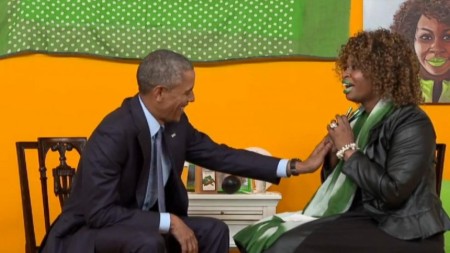
There are many moments from the past 6 years that demonstrate the criminal incompetence of this president and his administration. But for me, Obama’s interview with GloZell––whose claim to YouTube fame comes from eating Cheerios in a bathtub filled with milk––represents best the essential emptiness, triviality, and sheer dumbness of this president. Imagine Franklin D. Roosevelt in 1938 being interviewed by a carnival geek, and you can gauge just how low the most consequential political office in the world has sunk.

This interview, remember, took place the same time as problems requiring urgent presidential attention were escalating. Libya imploding, Iran inching toward a nuclear bomb, ISIS expanding in Syria and holding ground in northern Iraq, Iranian military assets active in Iraq, Yemen falling to an Iranian proxy terrorist group, another Iranian client, Bashar al Assad, strengthening his hold over Syria––and that’s just the Middle East. And don’t forget, the GloZell farce followed hard on Obama’s State of the Union address, a congeries of wishful thinking, narcissistic braggadocio, and outright-lies, a preposterous catalogue in which generous sprinklings of first-person-pronoun fairy dust transmuted every failure into an achievement.

It is the contradiction between fact and fiction, evident in every line of the president’s speech, that typifies progressives in general. This cognitive dissonance may simply be nothing more than the grubby machinations of those who will say and do anything for political power and the wealth and influence it brings. In other words, they know they are hypocrites. But it also could be something more dangerous than a venal character and moral corruption. One gets the feeling that many progressives actually believe what they say, that they are reciting the mantras of their ideological cult, no matter how contrary to reality or their own actions. What’s more important is that whatever the source, this failure to acknowledge reality, to think critically, and to respect intellectual coherence is dangerous to all of us, especially in the many foreign policy crises that have mushroomed on Obama’s watch.

And the worst crisis we face is the relentless progress Iran is making toward creating nuclear weapons, a development that would set off an arms race in the Middle East and destabilize an already chaotic region. The Islamic Republic has already extended its malign influence into Syria, Lebanon, and Yemen, creating a Shi’a crescent that threatens our allies in the region, especially Israel, Jordon, Egypt, and Saudi Arabia. If a failed gangster-state like North Korea can demand so much international attention just because it possesses nuclear weapons, think what Iran––with 3 times the population and the world’s 3rd largest oil reserves––could do. Oil won’t stay cheap forever.

But in the face of this threat, Obama has appeased the mullahs under the guise of diplomatic “engagement” and negotiations, the time-proven way to avoid action while pretending to do something. Indeed, so besotted is he by his faith in diplomacy that he has threatened to veto a Congressional bill that would strengthen his negotiating position by toughening economic sanctions, the best non-lethal shot we have for changing the Iranians’ behavior, given the current decline in their oil revenues. But what we see here is a problem that transcends any one president or Secretary of State, for it reflects the intellectual error and failure of imagination peculiar to modernity.

The heart of this mistake is the belief that whatever their professed beliefs, all peoples everywhere are just like us and want the same things we want. Since our highest goods are peace and prosperity, we think other nations’ privilege the same things. If peoples behave differently, it’s because they are warped by poverty or bad governments or religious superstitions, and just need to be shown that they can achieve those boons in rational, peaceful ways, especially by adopting liberal democracy and free-market economies. Once they achieve freedom and start to enjoy the higher living standards economic development brings, they will see the error of their traditional ways and abandon aggression and violence, and resolve conflicts with the diplomacy and negotiation we prefer.

The problem with this scenario is not that other peoples don’t want freedom and prosperity, or are incapable of achieving them. Rather, it is that they often have other goals more important than the ones we prize. Like religion, for example, or national honor, or revenge. We may think such motives are irrational avatars from an uncivilized past, but they are still drivers of action in individuals and nations alike. They may be, to quote Orwell on the Nazis, “ghosts” out of the premodern world, but they’re still “ghosts which need a strong magic to lay them.”

Of course, if weaker than an enemy or rival, such a people may conceal these motives, and pretend to play by the rules of the more powerful, until they are strong enough to use force to achieve their aims. In such situations, diplomatic engagement becomes a tactic for achieving through words what cannot be gained through deeds. As Robert Conquest said of our Cold War negotiations with the Soviets, “The Soviets did what their interests required when the alternative seemed less acceptable, and negotiation was merely a technical adjunct.”

History shows the truth of this insight, from the Munich Conference in 1938, to the many arms reduction treaties with the Soviet Union, which we know the Soviets and now the Russians have serially violated. More pertinent for Iran is the sorry history of the diplomatic attempts to prevent North Korea from developing nuclear weapons. For decades we indulged in cycles of concessions, agreements, conferences, and violations that all ended up with the North announcing it had gone nuclear. The failure to learn from that recent history is evident in Obama’s current reprise of that sordid dance in his engagement with Iran.

This is not to say that diplomacy can’t ever work. But to be effective, negotiation has to start with a clear understanding of the other side’s motives. One must avoid the “trap,” as Conquest called it, “of thinking that others think, within reason, like ourselves. But this trap is precisely the error that must be avoided in foreign affairs.” The rulers of Iran may lust after wealth and secular power, the default materialist motives recognized by the West. But that greed can coexist with their messianic, apocalyptic strain of Shi’a Islam, and the acceptability of violence in service to their faith that characterizes traditional Islam.

Thus when Muslim warriors tell us, as they have for 14 centuries, that they love death as we love life; when they proclaim, as Mohammed, Iran’s Ayatollah Khomeini, Osama bin Laden, and the Fort Hood jihadist did, “I was instructed to fight all men until they say there is no god but Allah,” we’d better listen and take them seriously, rather than brush aside such profound religious beliefs as mere camouflage for materialist motives. Yet so blind is Obama to this truth, that he and his officials stubbornly refuse even to utter a phrase like “Islamic extremist,” since he has decided that all the Muslim violence roiling the world every day has “nothing to do with Islam.”

Second, diplomacy can work only when backed by a credible threat of force. The other side must believe that mind-concentrating violence will punish them for negotiating in bad faith and violating agreements. In the case of Iran, the mullahs must believe that we will put to the test their love of death and longing for paradise. But our long history with the Islamic Republic has proved the opposite. Iran has never been punished for taking our embassy staff hostage in 1979, for instigating the murder of 241 of our soldiers in Beirut in 1983, or for training and funding the terrorists who have killed our troops in Iraq and Afghanistan, or for being the world’s leading promoter of terrorist violence.

Obama, in short, can say that “all options are on the table” all he wants, but the mullahs know he will not take military action against them, nor help Israel to. They know that Obama has withdrawn from the region, and at best will make only token gestures of engagement, like the current bombing campaign against ISIL. They know his ultimatums and “red line” threats are empty. They know he wants a deal more than they do, so he can burnish his legacy. Thus the Iranians are spinning out the negotiations, cadging extensions, pocketing concessions without reciprocating, and giving Obama just enough hope to think he can achieve what he thinks will be a Nixon-goes-to-China foreign policy coup, but will in fact will go down in history as a humiliating and dangerous blunder like Chamberlain’s Munich debacle.

So much is obvious. Yet in his State of the Union speech Obama astonished even his loyal media retainers when he asserted that his negotiations have “halted the progress of its [Iran’s] nuclear program and reduced its stockpile of nuclear material.” In reality, Iran continues to enrich uranium and is building new nuclear reactors, not to mention constructing missile sites and nuclear facilities in Syria. International inspectors are still barred from numerous sites in Iran, and so the West has no real idea of how many facilities exist there. This means that even if an agreement is signed, it will be worthless if it leaves Iran with the knowledge and technology needed to make nuclear bombs at a time of its choosing. And it means that someday we all will pay the price for our president’s cognitive dissonance.
CBS Panel Blasts Obama’s ‘Extraordinary Disconnect,’ ‘Question if WH Knows What’s Going On’

January 25, 2015

CBS Panel Blasts Obama’s ‘Extraordinary Disconnect,’ ‘Question if WH Knows What’s Going On’, You Tube, January 25, 2015

(Other questions might be: Does he care? About what? and Why? — DM)

President Obama’s ‘successful’ counterterrorism strategy in Yemen in limbo

January 25, 2015

President Obama’s ‘successful’ counterterrorism strategy in Yemen in limbo, Long War Journal, Thomas Joscelyn & Bill Roggio, January 24, 2015

If this is what a successful counterterrorism strategy looks like, we’d hate to see failure.

**********************

When announcing the US strategy to “degrade and ultimately destroy” the Islamic State in both Iraq and Syria, President Barack Obama said he would model it after America’s counterterrorism strategy in Somalia and Yemen, “one that we have successfully pursued…for years.”

Immediately after Obama’s speech, we at The Long War Journal questioned the wisdom of describing Somalia and Yemen as “successfully pursued” counterterrorism operations. Al Qaeda’s official branches, Shabaab in Somalia and al Qaeda in the Arabian Peninsula (AQAP) in Yemen, remain entrenched in their respective countries, despite some setbacks here and there. AQAP’s core leadership cadre is intact. And both al Qaeda branches continue to control territory while working to conduct attacks outside of their countries. [For details, see LWJ report, US strategy against Islamic State to mirror counterterrorism efforts in Yemen, Somalia.]

In the four plus months since Obama described Yemen as a successful engagement, things have gone from bad to worse. The Iranian-backed Shiite Houthis have broken out from the northern provinces and overran the capital. Just this week, President Hadi, who was perhaps America’s greatest ally on the Arabian Peninsula as he actively endorsed and facilitated US counterterrorism operations, including controversial drone strikes against AQAP, was forced to step down. The prime minister has also resigned and the government has dissolved.

During this timeframe, the US drone program against AQAP has stalled. The last US drone strike in Yemen that has been confirmed by The Long War Journal took place on Nov. 12, 2014. This is especially remarkable given that AQAP has claimed credit for the assault on Charlie Hebdo’s offices in Paris, and the terrorists themselves said that AQAP sent them.

Unsurprisingly, US officials are now telling Reuters that counterterrorism operations in Yemen are “paralyzed” with the collapse of the Hadi government (the long gap in strikes in the face of the Charlie Hebdo attack is a clear indication that US CT operations are in limbo). Yemen’s military is also said to be in disarray.

If US officials expect the Houthis to be willing participants against AQAP, they are mistaken. The Houthis, while enemies of AQAP, are no friends of the US. While their movement was not created by Iran, they have adopted the Iranians’ motto: “Death to America.” Additionally, any action against AQAP only serves to strengthen the Houthis, and by extension, Iran.

Meanwhile, without a central government and effective military, Sunnis may be tempted to back AQAP against the Shiite Houthis, thereby increasing AQAP’s recruiting pool. There is already evidence that this is happening.

If this is what a successful counterterrorism strategy looks like, we’d hate to see failure.


John Bolton on WMAL 1-22-15

January 23, 2015

John Bolton on WMAL 1-22-15, via You Tube, January 22, 2015

(Audio only. Amb. Bolton speaks of PM Netanyahu’s address to Congress, no-go zones and Obama’s fantasies about Islamic terrorism, the Islamic State and Iran. — DM)


Islamic State Deepens Grip in Future Palestine

January 23, 2015

Islamic State Deepens Grip in Future Palestine, The Gatestone InstituteKhaled Abu Toameh, January 23, 2015

According to Israeli security forces, dozens of Hamas and Islamic Jihad members in the West Bank have defected to the Islamic State in recent months. Their main goal, according to sources, is to topple the Palestinian Authority and launch terror attacks on Israel.

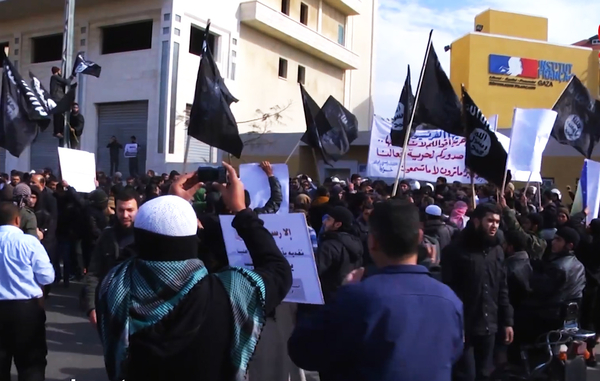
Some 200 supporters of the Islamic State, who held up Islamic State flags, took to the streets of Gaza City to protest the latest cartoons published by the French satirical magazine, Charlie Hebdo. They also chanted slogans that called for slaughtering French nationals, and burned French flags. Attempts by Hamas to impose a news blackout on the protest failed, as photos and videos found their way to social media.

The glorification of terrorists and jihadists by the Palestinian Authority, and the ongoing anti-Israel incitement by both Hamas and the Palestinian Authority, is driving many Palestinians into the open arms of the Islamic State.

Hamas and other Palestinian groups are continuing to deny the obvious, namely that the Islamic State terror group has managed to set up bases of power in the West Bank and Gaza Strip.

The Palestinians do not feel comfortable talking about the fact that Islamic State is working hard to recruit Palestinians to its ranks.

The presence of Islamic State in the West Bank and Gaza Strip is an embarrassing development for both Hamas and the Palestinian Authority.

For Hamas, the fact that Islamic State has long been operating in the Gaza Strip is something that it does not want the world to know about.

Hamas cannot afford a situation where another Islamist terror group poses a challenge to its exclusive control over the Gaza Strip. Since it seized control over the Gaza Strip in 2007, Hamas has successfully suppressed the emergence of rival forces, first and foremost the secular Fatah faction headed by Mahmoud Abbas.

But if until recently it was Fatah that posed a challenge and threat to Hamas’s rule, now it is the Islamic State and its supporters in the Gaza Strip are openly defying the Islamist movement’s regime.

When the first reports about Islamic State’s presence in the Gaza Strip emerged last year, Hamas and other Palestinians were quick to dismiss them as “false.”

Salah Bardaweel, a senior Hamas official, said in February 2014 that the Islamic State “does not exist” in the Gaza Strip.

This week, however, it became evident that Hamas was lying when it denied the presence of Islamic State in the Gaza Strip.

Some 200 supporters of the Islamic State, who held up Islamic State flags, took to the streets of Gaza City to protest the latest cartoons published by the French satirical magazine, Charlie Hebdo.

The protesters tried to storm the offices of the French Cultural Center in Gaza City. They also chanted slogans that called for slaughtering French nationals, and burned the French flag.

899Palestinians waving Islamic State flags attempt to storm the French Cultural Center in Gaza City. Some in the crowd carried posters glorifying the terrorists who carried out this month’s attacks in Paris. (Image source: ehna tv YouTube screenshot)

The protest apparently caught Hamas by surprise. Hamas security forces that were rushed to the scene dispersed the protesters and arrested seven Islamic State supporters.

Attempts by Hamas to impose a news blackout on the Islamic State protest failed, as photos and videos of the demonstration found their way to social media. Needless to say, Hamas-affiliated media outlets ignored the protest. They were hoping that the world would also not see the Islamic State demonstrators on the streets of Gaza City.

Hamas’s biggest fear is that scenes of Islamic State supporters marching in the heart of Gaza City will scare international donors and dissuade them from providing badly needed funds for the reconstruction of the Gaza Strip. Hamas is also afraid that Western officials working with the United Nations and relief agencies will stop visiting the Gaza Strip after watching the footage of Islamic State supporters.

In recent weeks, it has also become evident that Islamic State has some kind of a presence in the West Bank — a fact that poses a serious threat to Abbas’s Palestinian Authority [PA].

Just last week, Israel announced arrests of members of an Islamic State terror cell in the West Bank city of Hebron. The three Palestinian members of the cell confessed during interrogation that had planned to launch a series of terror attacks against Israel. The three suspects were identified as Waddah Shehadeh, 22, Fayyad al-Zaru, 21 and Qusai Maswaddeh, 23.

Until recently, Hamas was considered the number one threat to the Palestinian Authority in the West Bank. Now, however, it has become evident that Islamic State is also trying to set up bases of power in the West Bank. According to Israeli security sources, dozens of Hamas and Islamic Jihad members in the West Bank have defected to Islamic State in recent months. Their main goal, the sources, said, is to topple the PA and launch terror attacks on Israel.

Abbas is lucky that the Israeli security forces are still operating in the West Bank, including inside cities and towns controlled by the Palestinian Authority. Were it not for the IDF and various branches of the Israeli security establishment, Hamas, Islamic Jihad and Islamic State would have toppled the Palestinian Authority and beheaded Abbas and his officials a long time ago.

Still, Abbas does not feel comfortable acknowledging the fact that a growing number of Palestinians in the West Bank are joining Islamic State. Abbas fears is that if he admits that Islamic State is already operating in the West Bank, this could dissuade many Western countries from supporting his effort to persuade the world to support the creation of an independent Palestinian state. Like Hamas, Abbas also fears that Westerners would stop visiting Ramallah and other West Bank Palestinian cities once they learn about Islamic State’s presence in these areas.

Although Hamas and the Palestinian Authority are continuing to bury their heads in the sand and deny what is there, they cannot avoid responsibility for the emergence of Islamic State in the Gaza Strip and West Bank. The glorification of terrorists and jihadists by the PA and the ongoing anti-Israel incitement by both the PA and Hamas, are driving many Palestinians into the open arms of the Islamic State.

This is something that the UN Security Council members will have to consider the next time they are asked to vote in favor of the establishment of a Palestinian state. Otherwise, they will be voting for the creation of an Islamic, and not a Palestinian, state.

Obama’s White Flag On Assad a Gift for Iran

January 21, 2015

Obama’s White Flag On Assad a Gift for Iran, Commentary Magazine, January 21, 2015

[T]he American white flag acknowledging his continued reign of terror is more than merely an admission that he can’t be pushed out of Damascus. It must now be understood as part of a comprehensive policy that is aimed at appeasing Iran. That presents a danger not only to the oppressed people of Syria but to every other nation in the region, including both moderate Arabs and Israel, who are targets of Iran’s predatory ambition.

************************

As anyone who has heard President Obama discuss his opposition to more sanctions being placed on Iran knows, the White House is deeply disturbed at the notion of the United States doing anything to disturb those who run the Islamist regime. Thus, the news that the United States is signaling what may be the formal end of its opposition to Bashar Assad’s rule over Syria must be seen in the context of a general American push for détente with that dictator’s allies in Tehran. This is bad news for the people of Syria who are seeking an alternative to Assad’s murderous rule–other, that is, than the ISIS terrorists. But it is very good news for the Iranians who are pleased about the way the rise of ISIS has led to a de facto alliance on the ground between the U.S. and Iran’s allies Assad and Hezbollah in the effort to fight ISIS. This has led not only to a tacit green light for Assad to go on killing Syrians but also for negotiations that seemed fated to grant a Western seal of approval for Iran’s aspiration to become a threshold nuclear power.

It must be acknowledged that at this point the United States has no good options open to it on Syria. If the U.S. had acted swiftly to aid moderate opponents to the Assad regime after the Arab Spring protests began, it might have been possible to topple Assad, something that would have been a telling blow to Iran’s ambitions for regional hegemony. But President Obama was characteristically unable to make a decision about what to do about it for years despite continually running his mouth about how Assad had to go. By the time he was ready to strike—after Assad crossed a “red line” enunciated by the president about his use of chemical weapons against his own people—the moderate option looked less attractive. The president quickly backed down and punted the task of cleaning up the chemical weapons to Assad’s Russian ally.

Even worse, after Obama’s precipitate withdrawal of U.S. forces from Iraq and inaction on Syria led to the rise of ISIS terrorists, Washington seemed more interested in using this crisis as an excuse to make common cause with Iran than in actually fighting the Islamist group. Thus, while U.S. air attacks on ISIS have barely made a dent in the terrorists’ grip on control of much of Syria and Iraq, the administration is signaling enthusiasm for Russian and United Nations-sponsored diplomatic events that will effectively doom a framework agreed to by the West last year in Geneva by which Assad would be forced to yield power.

The administration will defend this switch as something that will aid the effort to end a war that has killed hundreds of thousands. They also justify the tacit alliance with Iran, Assad, and Hezbollah on the Syrian battlefield as the only possible option available to those who wish to combat ISIS. At this point with non-Islamist Syrian rebels effectively marginalized and the battlefield dominated by the Iran/Hezbollah/Assad alliance and their ISIS foes, forcing Assad out may no longer be an option.

But the chain of events that led to this American move to allow Assad to survive despite his crimes must now be viewed from a different perspective than merely one of Obama’s Hamlet routine on difficult issues.

The decision to gradually back away from the president’s campaign pledge to dismantle the Iranian nuclear program and to engage in negotiations aimed at granting Tehran absolution for its ambitions will, if it results in an agreement, at best make Iran a threshold nuclear power. A weak nuclear deal will further buttress Iran’s hopes for regional hegemony by which it will further threaten moderate regimes and strengthen its Hezbollah and Hamas terrorist allies.

It’s not clear yet whether the Iranians will ever sign a nuclear agreement with the U.S. or if, instead, it will continue to run out the clock on the talks. That’s something that the president’s zeal for a deal may permit because he refuses to admit failure or pressure the Iranians as Congress would like him to do by toughening sanctions in the event the talks collapse.

But what we do know now is that this administration’s Syria policy must now be viewed through the prism of its infatuation with the idea of, as the president put it last month, letting “Iran get right with the world.”

Options for getting rid of the butcher Assad may be few these days. But the American white flag acknowledging his continued reign of terror is more than merely an admission that he can’t be pushed out of Damascus. It must now be understood as part of a comprehensive policy that is aimed at appeasing Iran. That presents a danger not only to the oppressed people of Syria but to every other nation in the region, including both moderate Arabs and Israel, who are targets of Iran’s predatory ambition.

800,000-strong Shiite militia calls for formal recognition by Baghdad

January 18, 2015

800,000-strong Shiite militia calls for formal recognition by Baghdad, RUDAW, January 18, 2015

(RUDAW is a Kurdish media network. Hezbollah was conceived by Muslim clerics and funded by Iran following the Israeli invasion of Lebanon in 1982. From the inception of Hezbollah to the present, the elimination of the State of Israel has been one of Hezbollah’s primary goals. [Footnotes omitted.] — DM)

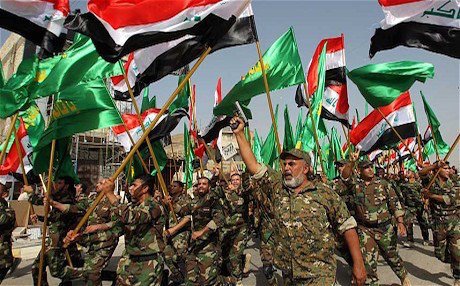
97644Image1Thousands of Shiite men responded to a call for jihad after ISIS stormed across Iraq in June and captured a third of the country. AFP photo.

BAGHDAD, Iraq – The leader of Iraq’s Hezbollah met with Shiite clerical authorities in Najaf Sunday to discuss formal recognition of hundreds of thousands of militiamen by the government and putting them on official payroll, a Hezbollah statement said.

Sheikh Abbas al-Mahmadawi, leader of the Shiite militia group Hezbollah, said that he met with Shiite clerics in Najaf, including Ayatollah Muhammad Saeed al-Hakim, to seek recognition “for the success of the militia groups in the fight against the Islamic State (ISIS).”

Al-Mahmadawi added that the Shiite volunteer militia should be recognized by the authorities and compensated financially “because many of them do not have any salaries and many have been wounded and handicapped.”

According to al-Mahmadawi, there are 800,000 volunteer Shiite fighters in Iraq who joined the fight against ISIS last June.

But he added that “the numbers have been inflated by some political parties” by more than double.

“We do not have any such numbers on the ground which is put down as 2 million volunteers,” he said in a statement following his visit to Najaf.

Al-Mahmadawi hoped that Baghdad would put the Shiite militia on its payroll now that the country is about to pass this year’s budget.

Thousands of Shiite men responded to a call for jihad against ISIS by Iraq’s Grand Ayatollah Ali Sistani last year, when the extremist Sunni group captured Mosul and made a lightening advance towards Baghdad and important Shiite shrines.

A great number of Shiite militiamen are based in the towns of Jalawla and Saadiya, north of Diyala, which they jointly liberated from ISIS in November.

Local residents, mainly the Kurdish population, have remained apprehensive about returning to their homes for fear of the armed militia groups, which operate outside government control and have been accused by Sunnis of acting as vigilantes.

On Saturday, Iraq’s parliament speaker Salim al-Jibouri met with Kurdish leaders in Sulaimani on forming a joint committee to facilitate the return of displaced peoples to Jalawla and Saadiya.

Meanwhile, around 200 tribal and political figures in Diyala met on Saturday to discuss normalizing the situation in the province after some of the fiercest battles between ISIS and a joint force of Peshmerga and Shiite militia groups.

No Room for Parody

January 18, 2015

No Room for Parody, American ThinkerClarice Feldman, January 18, 2015

I was sound asleep when the phone rang and so I cannot be absolutely sure the conversation was not a dream, but it seemed real enough.

“Hello,” the caller began. “My name is Mr. Mensch, I am president of the Parodists of the World, professional comedy writers, and we want to engage you in a suit against the administration for tortious interference with our livelihood.”

“What exactly are you alleging, I mean specifics?” I responded.

He then launched into a litany of grievances against the administration which the Parodists claimed had made it impossible for them to continue making a living.

“First, our country sent no one to the important anti-terrorism demonstration in Paris, and then there’s Valerie Jarrett calling the march against the slaughter of innocents in Paris a ‘Parade’, as if this were some sort of celebration.‘ Certainly We Would Have Loved To Participate In The Parade,” But We “Got The Substance Right”’.” She said and then proceeded to claim that Holder couldn’t attend because he was in a very important terrorism conference at the time, forgetting that we knew everyone else at the conference made it to the march except Holder. So at the time of the march he was meeting with himself, it seems.”

“Well, that was silly, “I agreed.  “And?” I waited for the next item.

“Then our secretary of state, John Kerry, whose entire life has been fashioned around his self-imagined superior diplomatic skills and international affairs expertise, shows up speaking execrable high school level French, accompanied by  an aging ex-druggie who sings to the grieving French ‘You’ve Got a Friend’”

“I have to agree that was preposterous and really embarrassing. One wag suggested the French ought to respond by having Carly Simon sing, ‘You’re so Vain’ to the President and his Secretary of State. ‘Send in the Clowns’ comes to mind.”

“It’s all of a piece you know. It’s cutting substantially into our employment prospects. Let me read this to you,” Mensch said:

“ ‘A scandal has erupted in the American Consulate in Jerusalem, as three Israeli security guards have quit following a plan to hire 35 armed Palestinian guards from East Jerusalem. The Palestinians have been undergoing weapons training in Jericho in recent days. The decision to hire and arm the Palestinian security personnel was made by the consulate’s chief security officer, Dan Cronin. The plan is to employ them mostly as escorts to American diplomats’ convoys in the West Bank. Their operating base will be at the consulate in the city’s west, as well as six other facilities around the city belonging to the consulate, of which five are in western Jerusalem.

The plan is a breach of a 2011 agreement between the consulate and the Israeli government, which determined that only former IDF combat soldiers hired by the consulate would be allowed to carry weapons. That year, Israel gave the consulate approval to keep about 100 guns for its security guards, but only if they’re American diplomats or Israelis who served in the army. While the consulate employs scores of guards from East Jerusalem, they have not been armed up until now.’”

“Sounds like a bad joke to me,” I replied. “With the world’s attention focused on Moslem extremists. New jihadi groups showing up all through Europe, and Palestinians continuing to attack our ally Israel  and we train and arm Palestinian guards to protect us in Jerusalem in violation of  our agreement with Israel?”

“Even the liberal foreign policy pundit Leslie Gelb is concerned that the administration is absolutely clueless,” sputtered Mensch.

“And he keeps releasing men from Gitmo who then return to fight against us. He released Mullah Abdul Rauf and immediately on his return he’s recruiting for the Taliban in Afghanistan.”

By this time Mensch was on a roll.

“The White House spokesman, Josh Earnest is tripping over his own tongue trying not to say the magic words ’Moslem extremist’. Listen to this circumlocution of his: ‘We want to describe exactly what happened. These are individuals who carried out an act of terrorism. And they later tried to justify that act of terrorism by invoking the religion of Islam and their own deviant view of it.’”

“Then there’s the nonsensical negotiations with Iran,” I interjected.

Mensch sputtered, “Thursday Obama announced he would not tighten sanctions on Iran which is violating the sanctions already in place because if we tighten the reins it will only drive them to war. Think about that! If we impose stricter sanctions on them, they’ll go to war, and if we don’t, they’ll go to war with nuclear weapons.”

“That’s nothing to joke about,” I said.

“Precisely! Obama‘s leaving us nothing to parody. We can’t make a living in comedy. He and his administration are themselves the joke. We might as well just send in news clippings to our editors as try to dream up anything wackier than what they’re doing. And, look, it’s not just foreign affairs. Take the Keystone Pipeline — I mean it should be clear to everyone that we are hurting Iran and Russia financially each time we and others increase the supply of gas and oil on the world market and we need jobs badly, so why is he still sitting on this? George Will captured this bit of nuttiness,” he added and I heard the rustle of newspaper as he read this to me.

Actually, there no longer is any reason to think he has ever reasoned about this. He said he would not make up his mind until the Nebraska Supreme Court ruled. It ruled to permit construction, so he promptly vowed to veto authorization of construction.

The more Obama has talked about Keystone, the less economic understanding he has demonstrated. On Nov. 14, he said Keystone is merely about “providing the ability of Canada to pump their oil, send it through our land, down to the gulf, where it will be sold everywhere else. That doesn’t have an impact on U.S. gas prices.” By Dec. 19, someone with remarkable patience had explained to him that there is a world market price for oil, so he said, correctly, that Keystone would have a “nominal” impact on oil prices but then went on to disparage job creation by Keystone. He said it would create “a couple thousand” jobs (the State Department study says approximately 42,100 “direct, indirect, and induced”) and said, unintelligibly, “Those are temporary jobs until the construction actually happens.” Well.

“I understand your distress,” I sympathized, “but to make your case you have to prove that Obama intended to harm your business, and as Will notes it’s just that he isn’t that smart.”

“C’mon,” the parodist, countered, “Almost every professor in America supported and voted for him. Are you calling them all stupid?”


Meet the honor brigade, an organized campaign to silence debate on Islam

January 17, 2015

Meet the honor brigade, an organized campaign to silence debate on Islam, Washington Post, Asra Q. Nomani, January 16, 2015

(It’s encouraging to read that a few actually moderate Muslims are slowly bringing modest changes to a few who practice the Religion of the Perpetually Offended and Violent. However, much more and a long time will be needed before significant numbers of “moderate” and “non-extremist” Muslims begin to accept freedoms for themselves and for others and to reject Sharia law in its present and historic form.  Until then?– DM)

[W]e need a new interpretation of Islamic law in order to change the culture. This would require rejecting the eight schools of religious thought that dominate the Sunni and Shiite Muslim world. I propose naming a new one after ijtihad, the concept of critical thinking, and elevating self-examination over toxic shame-based discourse, laws and rules.

********************

“You have shamed the community,” a fellow Muslim in Morgantown, W.Va., said to me as we sat in a Panera Bread in 2004. “Stop writing.”

Then 38, I had just written an essay for The Washington Post’s Outlook section arguing that women should be allowed to pray in the main halls of mosques, rather than in segregated spaces, as most mosques in America are arranged. An American Muslim born in India, I grew up in a tolerant but conservative family. In my hometown mosque, I had disobeyed the rules and prayed in the men’s area, about 20 feet behind the men gathered for Ramadan prayers.

Later, an all-male tribunal tried to ban me. An elder suggested having men surround me at the mosque so that I would be “scared off.” Now the man across the table was telling me to shut up.

“I won’t stop writing,” I said.

It was the first time a fellow Muslim had pressed me to refrain from criticizing the way our faith was practiced. But in the past decade, such attempts at censorship have become more common. This is largely because of the rising power and influence of the “ghairat brigade,” an honor corps that tries to silence debate on extremist ideology in order to protect the image of Islam. It meets even sound critiques with hideous, disproportionate responses.

The campaign began, at least in its modern form, 10 years ago in Mecca, Saudi Arabia, when the Organization of Islamic Cooperation — a mini-United Nations comprising the world’s 56 countries with large Muslim populations, plus the Palestinian Authority — tasked then-Secretary General Ekmeleddin Ihsanoglu with combating Islamophobia and projecting the “true values of Islam.” During the past decade, a loose honor brigade has sprung up, in part funded and supported by the OIC through annual conferences, reports and communiques. It’s made up of politicians, diplomats, writers, academics, bloggers and activists.

In 2007, as part of this playbook, the OIC launched the Islamophobia Observatory, a watchdog group based in Jiddah, Saudi Arabia, with the goal of documenting slights against the faith. Its first report, released the following year, complained that the artists and publishers of controversial Danish cartoons depicting the prophet Muhammad were defiling “sacred symbols of Islam . . . in an insulting, offensive and contemptuous manner.” The honor brigade began calling out academics, writers and others, including former New York police commissioner Ray Kelly and administrators at a Catholic school in Britain that turned away a mother who wouldn’t remove her face veil.

“The OIC invented the anti-‘Islamophobia’ movement,” says Zuhdi Jasser, president of the American Islamic Forum for Democracy and a frequent target of the honor brigade. “These countries . . . think they own the Muslim community and all interpretations of Islam.”

Alongside the honor brigade’s official channel, a community of self-styled blasphemy police — from anonymous blogs such as LoonWatch.com and Ikhras.com to a large and disparate cast of social-media activists — arose and began trying to control the debate on Islam. This wider corps throws the label of “Islamophobe” on pundits, journalists and others who dare to talk about extremist ideology in the religion. Their targets are as large as Israeli Prime Minister Benjamin Netanyahu and as small as me.

The official and unofficial channels work in tandem, harassing, threatening and battling introspective Muslims and non-Muslims everywhere. They bank on an important truth: Islam, as practiced from Malaysia to Morocco, is a shame-based, patriarchal culture that values honor and face-saving from the family to the public square. Which is why the bullying often works to silence critics of Islamic extremism.

“Honor brigades are wound collectors. They are couch jihadis,” Joe Navarro, a former supervisory special agent in the FBI’s behavioral analysis unit, tells me. “They sit around and collect the wounds and injustices inflicted against them to justify what they are doing. Tragedy unites for the moment, but hatred unites for longer.”

In an e-mail exchange, the OIC’s ambassador to the United Nations denied that the organization tries to silence discussion of problems in Muslim communities.

The attacks are everywhere. Soon after the Islamophobia Observatory took shape, Sheik Sabah Ahmed al-Sabah, the emir of Kuwait, grumbled about “defamatory caricatures of our Master and Prophet Muhammad” and films that smear Islam, according to the OIC’s first Islamophobia report.

The OIC helped give birth to a culture of victimization. In speeches, blogs, articles and interviews widely broadcast in the Muslim press, its honor brigade has targeted pundits, political leaders and writers — from TV host Bill Maher to atheist author Richard Dawkins — for insulting Islam. Writer Glenn Greenwald has supported the campaign to brand writers and thinkers, such as neuroscientist and atheist Sam Harris, as having “anti-Muslim animus” just for criticizing Islam.

“These fellow travelers have made it increasingly unpleasant — and even dangerous — to discuss the link between Muslim violence and specific religious ideas, like jihad, martyrdom and blasphemy,” Harris tells me.

Noticing the beginnings of this trend in December 2007, a U.S. diplomat in Istanbul dispatched a cable to the National Security Council, the CIA, the Defense Intelligence Agency and various State Department offices. The cable said the OIC’s chief called supporters of the Danish cartoons of Muhammad “extremists of freedom of expression” and equated them with al-Qaeda.

Most of the criticism takes place online, with anonymous bloggers targeting supposed Islamophobes. Not long after the cable, a network of bloggers launched LoonWatch, which goes after Christians, Jews, Hindus, atheists and other Muslims. The bloggers have labeled Somali author Ayaan Hirsi Ali, a born Muslim but now an atheist opponent of Islamic extremism, an “anti-Muslim crusader.” Robert Spencer, a critic of extremist Islam, has been called a “vicious hate preacher” and an “Internet sociopath.” The insults may look similar to Internet trolling and vitriolic comments you can find on any blog or news site. But they’re more coordinated, frightening and persistent.

One prominent target of the honor brigade’s attacks was Charlie Hebdo, the French newspaper where several staffers were recently killed by Islamic extremists. According to some accounts, as the killers massacred cartoonists, they shouted: “We have avenged the prophet Muhammad.” The OIC denounced the killings, but in a 2012 report, it also condemned the magazine’s “Islamophobic satires.” Its then-secretary general, Ihsanoglu, said the magazine’s “history of attacking Muslim sentiments” was “an outrageous act of incitement and hatred and abuse of freedom of expression.”

Charlie Hebdo is not the only evidence that, to self-appointed defenders of the faith, a call to kill the message can very easily become a plan to kill the messenger. In January 2011, a security officer for the governor of Pakistan’s Punjab province, Salman Taseer, assassinated him after Taseer defended a Christian woman accused of blasphemy. In court, supporters laid flowers on the shoulders of the assassin in approval.

Murderers like him would be much harder to radicalize in a climate that welcomed debate about Islam rather than seeking revenge on its critics. But in so many Muslim communities now, saving face trumps critical thinking and truth-telling. This is why reform from within Islam is so difficult. In my experience, if you try to hold the community accountable, you’re more likely to be bullied and intimidated than taken seriously.

When Rupert Murdoch recently tweeted, “Maybe most Moslems peaceful, but until they recognize and destroy their growing jihadist cancer they must be held responsible,” he was criticized for indelicately saying all Muslims were responsible for the acts of a few. But I do believe we bear collective responsibility for the problems in our communities.

After my threatening meeting at Panera, I kept advocating for women’s rights in the mosque and in the bedroom. Among other things, I argued that Muslim women have the right to orgasm, an intimacy too often denied in societies with a tradition of female genital mutilation.

Then came the death threats. In the fall of 2004, my parents and my son picked me up after I spoke at a conference. “Somebody wants to kill you,” my father said from behind the wheel of our gold Dodge Caravan, his voice trembling. The death threat was posted on Muslim WakeUp!, a now-defunct progressive Web site. The offender told the FBI that he would stop harassing me, and he did. More prosaic taunts in the past decade have called me a “Zionist media whore,” a “House Muslim” and many other unprintable insults.

Two years ago, Zainab Al-Suwaij, executive director of the American Islamic Congress, was so battered by online attacks aimed at silencing her that she experienced a physical response to the stress and anxiety, and ended up in an emergency room. When I met her in her office near the White House, she pulled up her sleeves to show me the marks left by IV injections that the hospital staff had administered to get her necessary fluids.

“The attacks just killed me,” Al-Suwaij said, wearily.

Bullying this intense really works. Observant members of the flock are culturally conditioned to avoid shaming Islam, so publicly citing them for that sin often has the desired effect. Non-Muslims, meanwhile, are wary of being labeled “Islamophobic” bigots. So attacks against both groups succeed in quashing civil discourse. They cause governments, writers and experts to walk on eggshells, avoiding important discussion.

For my part, I have continued to write, calling on American Muslims to root out extremism in our communities and arguing that certain passages of the Koran are too antiquated for our times. As I see it, the injunction to “stand out firmly for justice even against . . . your kin” is our divine “See something, say something” mandate. But too often, this passage is misused as a justification for attacking our own.

While we still have a long way to go, I have seen progress since I started calling for women’s rights in mosques and challenging the extremism I saw in American Muslim communities. Our mosque in Morgantown, a mostly male congregation, elected its first female president a few years ago, and she was largely accepted as a leader. But most women still shuffle through the back door and pray in a separate balcony.

Four years ago, the Muslim Public Affairs Council, an advocacy group, announced programs to discuss “taboo topics” such as homosexuality, interfaith marriage and extremism. Recently, young Muslim leaders in Northern Virginia started an initiative to create mosques that promote assimilation, interfaith harmony and women’s rights. Later this month, a new group, the Women’s Mosque of America, will hold a female-led prayer service in Los Angeles, a rare event in Muslim communities.

Next month, the Obama administration will hold a conference on challenging violent extremism, and President Obama last year called on Muslim communities to “explicitly, forcefully and consistently reject the ideology of al-Qaeda and ISIL.” But his administration isn’t framing extremism as a problem directly tied to Islam. Last month, by contrast, Egyptian President Abdel Fatah al-Sissi acknowledged that there was an ideology problem in Islam and said, “We need to revolutionize our religion.”

When I heard Sissi’s words, I thought: Finally.

Beyond these statements, though, we need a new interpretation of Islamic law in order to change the culture. This would require rejecting the eight schools of religious thought that dominate the Sunni and Shiite Muslim world. I propose naming a new one after ijtihad, the concept of critical thinking, and elevating self-examination over toxic shame-based discourse, laws and rules. Such a project could take the power out of the hands of the status quo clerics, politicians and experts and replace it with a progressive interpretation of faith motivated not by defending honor but acting honorably.

Don’t ignore the writing on the wall

January 16, 2015

Don’t ignore the writing on the wall, Israel Hayom, Yoram Ettinger, January 16, 2015

(It’s much easier and much less stressful to look forward to hope and change. Briefly. –DM)

Since the 1993 Oslo Accord, Western democracies have refrained from reading the writing on the Palestinian (Mahmoud Abbas and Hamas) wall: hate education in grades K-12; unprecedented terrorism; systematic noncompliance with agreements; naming squares, streets and tournaments after terrorists; monthly allowances for families of terrorists; responding to Israeli withdrawals with intensified terror.

Hitler’s master plan was outlined in 1925-26 in the two volumes of the supremacist, anti-Jewish “Mein Kampf” (“My Struggle”), which is currently a best-seller in the Muslim world, particularly in Iran and the Palestinian Authority.

***************

In 539 B.C.E., Babylonian King Belshazzar ignored the writing on the wall — as interpreted by the Prophet Daniel — and was, therefore, annihilated by the Persians (Daniel 5).

In 2015, Western civilizations must read the writing on the wall, desist from ambiguity, denial and political correctness and embrace clarity, realism and political incorrectness, in order to survive and overcome the clear and present lethal threat of Islamic takeover, which is gathering momentum via demographic, political and terroristic means.

History proves that Western ambiguity and the refusal to identify enemies — due to ignorance, gullibility, oversimplification, appeasement, delusion and wishful thinking — have taken root, yielding major strategic setbacks and painful economic and human losses. When it comes to reading the writing on the wall, Western eyesight has been far from 20:20, dominated by modern day Belshazzars, ignoring modern day Daniels.

For example, during the 1930s, the writing was on the wall in glaring letters: Germany abrogated the Treaty of Versailles, which called for German disarmament, reparations and territorial concessions; German military spending skyrocketed, military conscription was reintroduced and the Rhineland was remilitarized; Germany withdrew from the League of Nations and annexed Austria. Still, on September 30, 1938, British Prime Minister Neville Chamberlain signed the Munich Pact, declaring “peace for our time.” He refused to recognize Hitler’s strategic, global, supremacist goal, assuming that Hitler’s appetite could be satisfied with a tactical, limited gain in Czechoslovakia’s Sudetenland, signing a “peace accord” that triggered the “war of all wars.”

Hitler’s master plan was outlined in 1925-26 in the two volumes of the supremacist, anti-Jewish “Mein Kampf” (“My Struggle”), which is currently a best-seller in the Muslim world, particularly in Iran and the Palestinian Authority.

During 1977-79, U.S. President Jimmy Carter did not read the writing on the wall, supporting the Ayatollah Ruhollah Khomeini’s battle against the Shah of Iran, who was, in fact, the U.S.’s policeman in the Persian Gulf. Overwhelmed by denial and wishful thinking, and heavily influenced by the U.S. foreign policy establishment, Carter ignored the litany of sermons delivered by Khomeini, which exposed the Iranian cleric as an enemy of Western civilization and civil liberties. He despised the U.S. and aligned himself with the enemies of the U.S., while protected by a Palestinian PLO praetorian guard. Thus, the U.S. betrayal of the Shah eliminated a most effective and loyal strategic partner of the U.S., gave rise to the most lethal, conventional and nonconventional threat to vital U.S. interests in the Persian Gulf, the Middle East and beyond and generated a robust tailwind to Islamic terrorism.

In 1990, on the eve of Saddam Hussein’s invasion of Kuwait, the U.S. stated that an Iraq-Kuwait military clash would be an intra-Arab, rather than a U.S., concern. The Bush/Baker administration assumed that “the enemy of my enemy [Iran] is my friend [Iraq],” supplying Saddam with dual-use sensitive systems, providing him with $5 billion loan guarantees and concluding a U.S.-Iraq intelligence sharing agreement. The 1990 policy of denial triggered a conventional conflict, a $1.25 trillion cost to the U.S. taxpayer, 4,500 U.S. military fatalities, a surge of anti-U.S. Islamic terrorism and a dramatic destabilization of the Persian Gulf.

Since the 1993 Oslo Accord, Western democracies have refrained from reading the writing on the Palestinian (Mahmoud Abbas and Hamas) wall: hate education in grades K-12; unprecedented terrorism; systematic noncompliance with agreements; naming squares, streets and tournaments after terrorists; monthly allowances for families of terrorists; responding to Israeli withdrawals with intensified terror.

In 2011, Western democracies denied the eruption of an Arab tsunami, welcoming the violence on the Arab Street as an Arab Spring that would transition the Arabs toward democracy. The Obama administration embraced the Muslim Brotherhood (while giving a cold shoulder to Gen. Abdel-Fattah el-Sissi), refusing to recognize its well-documented intra-Arab terrorism, the offshoot of its motto: “Allah is our objective; the Quran is the constitution; the prophet is our leader; jihad is our way; death for the sake of Allah is our wish.”

The 2015 failure to carefully read the Iranian writing on the wall could produce a nuclear conflict that would cost the U.S. taxpayer trillions of dollars, incur an unprecedented level of fatalities, spark a tidal wave of Islamic terrorism throughout the globe, including in the U.S., decimate the pro-U.S. Arab regimes in the Persian Gulf and Jordan, create an unprecedented disruption of the supply of Persian Gulf oil, further radicalization of the anti-U.S. regime in Venezuela with ripple effects in Latin America, including Mexico, and additional tectonic eruptions of insanity throughout the globe.

At stake is not only freedom of expression and the safety of European Jewry, but the survival of Western democracies.

Solidarity demonstrations and eloquent speeches will not spare Western democracies the wrath of Islamic terrorism and domination, unless accompanied by clarity, realism and the willingness to take military, legislative and political action to thwart the writing on the walls of the mosques: submission of humanity to the Prophet Muhammad; submission of the Christian, Hindu, Buddhist, Sikh and Jewish kuffar (“infidel”) to Muslims and to Shariah laws; jihad — holy war on behalf of Islam — is the duty of Muslims; waqf — Muslim land — is ordained by Allah; Dar al-Islam (the residence of Islam) must take over Dar al-Harb (the residence of war); and Islam-sanctioned taqiyya (dissimulation, deception and concealment of inconvenient data) aimed at shielding Islam and “believers” from “disbelievers.”


