Archive for the ‘Islamic State’ category

The Case for Kurdish Statehood

July 11, 2016

The Case for Kurdish Statehood, Investigative Project on Terrorism, Noah Beck, July 11, 2016

1691

Why has the West been so supportive of Palestinian nationalism, yet so reluctant to support the Kurds, the largest nation in the world without a state?

The Kurds have been instrumental in fighting the Islamic State (ISIS); have generously accepted millions of refugees fleeing ISIS to the Kurdistan Regional Government (KRG); and embrace Western values such as gender equality, religious freedom, and human rights. They are also an ancient people with an ethnic and linguistic identity stretching back millennia and have faced decades of brutal oppression as a minority. Yet they cannot seem to get sufficient support from the West for their political aspirations.

The Palestinians, by contrast, claimed a distinct national identity relatively recently, are less than one-third fewer in number (in 2013, the global Palestinian population was estimated by the Palestinian Authority to reach 11.6 million), control land that is less than 1/15th the size of the KRG territory, and have not developed their civil society or economy with nearly as much success as the Kurds. Yet the United Nations, the European Union, the Arab League, and other international bodies have all but ignored Kurdish statehood dreams while regularly prioritizing Palestinian ambitions over countless other global crises.

Indeed, in 2014 the UK and Sweden joined much of the rest of the world in recognizing a Palestinian state. There has been no similar global support for a Kurdish homeland. Moreover, Kurdish statehood has been hobbled by U.S. reluctance to see the Iraqi state dismantled and by regional powers like Turkey, which worries that a Kurdish state will stir up separatist feelings among Turkish Kurds.

With an estimated worldwide population of about 35 million (including about 28 million in the KRG or adjacent areas), the Kurds are the fourth-largest ethnic group in the Middle East (after the Arabs, Persians, and Turks), and have faced decades of persecution as a minority in Turkey, Iran, and Iraq.

The 1988 “Anfal” attacks, which included the use of chemical weapons, destroyed about 2,000 villages and killed at least 50,000 Kurds, according to human rights groups (Kurds put the number at nearly 200,000). Several international bodies have recognized those atrocities as a genocide.

The Kurds in Turkey have also suffered oppression dating back to Ottoman times, when the Turkish army killed tens of thousands of Kurds in the Dersim and Zilan massacres. By the mid-1990s, more than 3,000 villages had been destroyed and 378,335 Kurdish villagers had been displaced and left homeless, according to Human Rights Watch.

The drive for Kurdish rights and separatism in Iran extends back to 1918, and – during its most violent chapter – cost the lives of over 30,000 Kurds, starting with the 1979 rebellion and the consequent KDPI insurgency.

A 2007 study notes that 300,000 Kurdish lives were lost just in the 1980s and 1990s. The same study states that 51,000 Jews and Arabs were killed in the Arab-Israeli conflict from 1950 until 2007 (and, because that total includes wars with Israel’s Arab neighbors, Palestinians are a small fraction of the Arab death toll).

Perhaps because of the Kurds’ own painful history, the KRG is exceptionally tolerant towards religious minorities and refugees. The KRG has embraced its tiny community of Jews, and in 2014, the Kurds rescued about 5,000 Yazidis trapped on Mount Sinjar after fleeing attempted genocide by ISIS. Last November, the Kurds recaptured the Sinjar area from ISIS, liberating hundreds more Yazidis from vicious oppression.

The KRG absorbed 1.8 million refugees as of December, representing a population increase of about 30 percent. The KRG reportedly needs $1.4 to 2.4 billion to stabilize the internally displaced people in its territory.

“Most of the refugees [in the KRG] are Arab Sunnis and Shia, Iranians, Christians, and others,” Nahro Zagros, Soran University vice president and adviser to the KRG’s Ministry of Higher Education, told the  IPT. “Yet there is no public backlash from the Kurds. And of course, we have been helping the Yazidi, who are fellow Kurds.”

The Kurdish commitment to gender equality is yet another reason that Kurdish statehood merits Western support. There is no gender discrimination in the Kurdish army: their women fight (and get beheaded) alongside the men. Last December, Kurdistan hosted the International Conference on Women and Human Rights.

The Kurds are also the only credible ground force fighting ISIS, as has been clear since the ISIS threat first emerged in 2014. ISIS “would have totally controlled the Baji oil field and all of Kirkuk had the [Kurdish] Peshmerga not defended it,” said Jay Garner, a retired Army three-star general and former Army assistant vice chief of staff who served during “Operation Provide Comfort” in northern Iraq. “Losing Kirkuk would have changed the entire war [against ISIS], because there are billions of dollars [per] week in oil flowing through there. The Iraqi army abandoned their equipment [while the Kurds defended Kirkuk, which has historically been theirs].”

Masrour Barzani, who heads the KRG’s intelligence services, says that Kurdish independence would empower the Kurds to purchase the type of weapons they need without the delays that currently hobble their military effort against ISIS. Under the present arrangement, Kurdish weapons procurement must go through Iraq’s Shia-led central government, which is also under heavy Iranian influence.

Besides bolstering the fight against ISIS, there are other geopolitical reasons for the West to support Kurdish statehood: promoting a stable partition of Syria, containing Iran, balancing extremist forces in the Middle East, and giving the West another reliable ally in a volatile region.

Now that Syria is no longer a viable state, it could partition into more sustainable governing blocs along traditional ethnic/sectarian lines with Sunni Arabs in the heartland, Alawites in the northwest, Druze in the south, and Kurds in the northeast. KRG leader Masrour Barzani recently argued that political divisions within Iraq have become so deep that the country must transform into “either confederation or full separation.”

Southeast Turkey and northwest Iran also have sizeable Kurdish areas that are contiguous with the KRG, but those states are far from disintegrating, and would aggressively resist any attempts to connect their Kurdish areas to the future Kurdish state. However, the Kurdish areas of former Syria should be joined to Iraqi Kurdistan as a way to strengthen the fledgling Kurdish state and thereby weaken ISIS.

In a recent article, Ernie Audino, the only U.S. Army general to have previously served a year as a combat adviser embedded inside a Kurdish Peshmerga brigade in Iraq, notes that Iran currently controls the Iraqi government and Iran-backed fighters will eventually try to control Kurdistan. He also makes the point that Western support for the Kurdish opposition groups active in Iran would force the Iranian regime to concentrate more on domestic concerns, effectively weakening Iran’s ability to pursue terrorism, expansionism, and other destabilizing activities abroad.

Because the Kurds are religiously diverse moderates who prioritize their ethno-linguistic identity over religion, a Kurdish state would help to balance out the radical Mideast forces in both the Shiite and Sunni camps. The Kurds are already very pro-American, thanks to their Western-leaning values, the U.S.-backed-no-fly zone, and the 2003 toppling of Saddam Husssein that made the KRG possible.

A Kurdish state would also have excellent relations with Israel, another moderate, non-Arab, pro-Western democracy in the region. Israeli Prime Minister Benjamin Netanyahu endorsed Kurdish independence in 2014, and Syrian Kurds – after recently declaring their autonomy – expressed an interest in developing relations with Israel.

By contrast, the Palestinian Authority slanders Israel at every opportunity: Abbas recently claimed in front of the EU parliament that Israel’s rabbis are trying to poison Palestinian drinking water. The Authority raises Palestinian children to hate and kill Jews with endless anti-Israel incitement coming from schools, media, and mosques. Palestinians have also shown little economic progress in the territories that they do control, particularly in Gaza, where Palestinians destroyed the greenhouses that donors bought for them in 2006 and instead, have focused their resources on attacking Israel with tunnels and rockets.

By almost any measure, a Kurdish state deserves far more support from the West. After absorbing millions of Syrian refugees while fighting ISIS on shrinking oil revenue, the KRG is battling a deepening financial crisis. Aggravating the situation, Iraq’s central government has refused – since April 2015 – to send the KRG its share of Iraqi oil revenue. The economic crisis has cost the KRG an estimated $10 billion since 2014.

U.S. Rep. Ed Royce, R-Calif., chairman of the House Foreign Affairs Committee, introduced House Resolution 1654 “to authorize the direct provision of defense articles, defense services, and related training to” the KRG. Fifteen months later, the bill is still stuck in Congress.

Helping the Kurds should be an even bigger priority for the European Union, which absorbs countless new refugees every day that ISIS is not defeated. If the EU were to fund the KRG’s refugee relief efforts and support their military operations against ISIS, far fewer refugees would end up on their shores.

 

Iranians and Walid suicide units on Golan border

July 8, 2016

Iranians & Walid suicide units on Golan border, DEBKAfile, July 8, 2016

GolanIsrael_military

A flurry of false Hizballah claims amid rising military tension this week was designed to cover up a direct Israeli hit of the Iranian Revolutionary Guards HQ in South Syria, DEBKAfile military and intelligence sources disclose.

Whereas Hizballah reported on July 5 that Israeli helicopters had attacked Syrian army positions near the Golan town of Quneitra, in fact, one of the two Israeli “Tamuz” IDF rockets fired on July 4, in response to stray cross-border Syrian army mortar shells, struck the Syrian Ministry of Finance building near Quneitra, which housed Iranian Guards and Hizballah regional headquarters. An unknown number of Iranian officers were killed as a result.

On July 6, Hizballah sources reported a high level of tension at its east Lebanese outposts in Hasbaya, al-Qarqoub and Mount Hermon, indicating possible preparations to retaliate for the Iranian casualties.

The mortar shells that occasionally stray into Israel are aimed by the Syrian forces in Quneitra at Syrian rebel engineering units, which are digging an anti-tank trench on the town’s southern edge to prevent Syrian tanks from mounting an all-out assault against them (See attached map).

These skirmishes are put in the shade by the dangerous gains by Islamist terrorists in southern Syria.

Both ISIS and al-Qaeda’s Nusra Front have overrun the entire Syrian strip bordering on Israel and Jordan – a distance of 106km from Daraa up to the Druze villages of Mount Hermon.

The Islamists have seized control of this strategic borderland by taking advantage of the fighting between Syrian army and Syrian rebel forces in southern Syria.

Israel and Jordan were also remiss. The IDF and the Jordanian Army were so busy trying to prevent the Syrian army, the Iranian Revolutionary Guards and Hizballah from encroaching on their northern defense lines in northern Jordan and the Golan that they failed to notice the Islamic terrorists creeping up on their borders.

The terrorist presence which Israel finds most alarming is that of the “Khaled Bin Al-Walid Army” – a militia linked to both ISIS and al-Qaeda, which now controls a 36km band bordering on central and southern Golan from south Quneitra to the Jordan-Israel-Syria tri-border area – opposite Hamat Gader and Shaar HaGolan (See map).

The Khaled Bin Al-Walid Army was spawned by a union between the Islamist Liwa Shouada Yarmouk and Mouthana Islamic Movement militias. Its commander is Abu Abdullah al-Madani,  a Palestinian from Damascus, who is one of al-Qaeda’s veteran fighters. Close to Osama Bin-Laden, he fought with hhimagainst the Americans when they invaded Afghanistan 15 years ago. Ten years ago, he moved to Iraq, still fighting Americans, now alongside the al-Qaeda commander Abu Musab al-Zarqawi.

When al-Qaeda was defeated in Iraq, al-Madani moved to Syria.

DEBKAfile counter terror sources report that this veteran of Islamist terrorism, who is believed to be in touch wit Bin Laden’s successor Ayman al Zawahri, is active in three areas:

1. He is purchasing and stockpiling chemical weapons – a high priced commodity frequently traded among various Syrian rebel organizations.

2. Abu Abdullah al-Madani is recruiting from his militia suicide units for which he is personally training for operations inside Israel. DEBKAfile sources say that his plan is being taken very seriously by Israel security chiefs.

3. He is maintaining operational ties with Al Nusra commanders in the border region, possibly seeking access to the Israeli border through their turf for his chemical weapons and suicide units.

Bangladesh: ISIS pays Italy back for role in Libya

July 3, 2016

Bangladesh: ISIS pays Italy back for role in Libya, DEBKAfile, July 3, 2016

Dhaka_high_powered_Dragunov_sniper_1.7.16

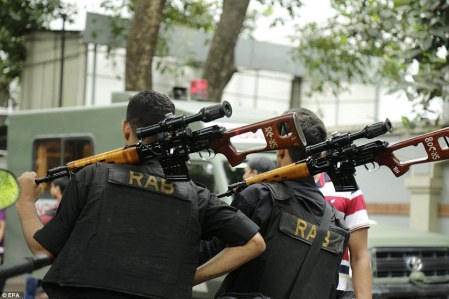
The Islamic State struck the West again on June 1, when it activated a local Bangladeshi cell for a murderous, hostage-taking attack on the Artisan Bakery and O’Kitchen Restaurant, a favorite haunt of foreign visitors near the diplomatic zone of Dakha, the capital. A large contingent of Italian businessmen dining there that night was specifically targeted by ISIS in revenge for the Rome government’s military intervention in the campaign to eject the Islamists from Libya.

DEBKAfile intelligence and counter terror sources note that the long Islamist arm reached into the Indian subcontinent, 7,000km away, to settle its score with Italy, rather than sending its killers by the obvious route from the ISIS capital Sirte in Libya to Italy across 1,200km of Mediterranean Sea. This tactic saved them the risk of running the gauntlet of the Italian Navy boats which are fanned out across the Sidra Gulf to staunch the flow of migrants (an important source of income for ISIS) and intercept terrorists heading for attack in Europe.

Bangladesh is the world’s second largest manufacturing center after China for the major Western fashion houses, netting each year 26.5 Billion USD, 75 pc of its foreign currency earnings. Among the important Italian fashion houses manufacturing in Bangladesh are Prada, Milan, and Benetton.

Italian special operations contingents are the largest Western force operating on several fronts in Libya since early January. They are fighting to capture the key port town of Sirte together with British and US special forces and alongside local Libyan forces.

On April 29, DEBKAfile reported: “ISIS fighters smashed a force of Italian and British Special Ops troops on Wednesday, April 27 in the first battle of its kind in Libya. This battle will result in the delay of the planned Western invasion of Libya, as the encounter proved that European forces are not ready for this kind of guerilla warfare. The sources also said the planners of the invasion were surprised by the high combat skills of the ISIS fighters.”

The Bangladesh attack was therefore not the first contretemps suffered by Italy in its fight on Islamist terror.

Inside Libya, the fighting continues unresolved for lack of air support. The US, Italy, France and the UK cannot agree on which of them will supply air cover for the ground forces battling for Sirte and which will assume command.

In early June, overall command of the campaign was given to NATO. That decision did not break the allied impasse either, because its members remained at loggerheads over respective air force contributions, provision of the logistic intelligence required for aerial operations and, lastly, funding.

Due to insufficient air cover, western and Libyan special forces are stuck in the parts of Sirte they have captured, but cannot advance towards the city’s center or root out the ISIS fighters.

The fact that ISIS was able to operate a terror cell in far-away Bangladesh to strike a counterblow in the battle in Northern Africa, testified to the global scope of the terror organization’s command and communication reach.

Just like the November 2015 Paris attacks, the terrorists were in telephone contact with their masters in the Middle East, once in a while sending pictures of the victims they murdered inside the restaurant.

In the attack, the terrorists killed 9 Italian businessmen, 7 Japanese businessmen, one US citizen, 3 local citizens, and one Indian.

The hostages were executed by beheading with machetes.

The counter terrorism sources report that, just as in the terror attacks in Brussels, Paris and Istanbul, the attackers in Dakha were previously known to local security and intelligence agencies, at least five of the seven terrorists were known to the Bangladesh security agencies, who claimed they were unable to stop them.

ISIS routs new US-backed Syrian force at Abu Kemal

July 1, 2016

ISIS routs new US-backed Syrian force at Abu Kemal, DEBKAfile, July 1, 2016

2

A battle on June 29 between ISIS and a pro-American Syrian rebel force near the Syria-Iraq border will go down as one of the most striking defeats ever suffered by an American-backed Syrian force trained in Jordan in the annals of the war on terror.

It was not the first, say DEBKAfile’s military and intelligence sources. In August 2015, a force from Al Qaeda’s affiliate Nusra Front destroyed a similar rebel force called Division 30. And 12 hours earlier, on June 28, ISIS suicide bombers murdered 44 people in a bloodbath at Ataturk international airport in Istanbul.

The following timeline of events is instructive:

1. In March and April of this year, military instructors from the CIA, together with Jordanian intelligence officers and special operations units, established a new militia to fight ISIS called the New Syria Army. Most of the recruits were from Syrian refugee camps. The US furnished the militia with funds and advanced weapons.

2. They were trained by US and Jordanian military instructors at Jordan’s al-Rukban base in the Berm area on the Syrian border.

3. In May, American commanders in Jordan decided that the militia would launch its first mission in eastern Syria near the border with Iraq.

4. In June, it became clear to the Americans and the Jordanians that the time had come for the new force to go into action.

There were five reasons:

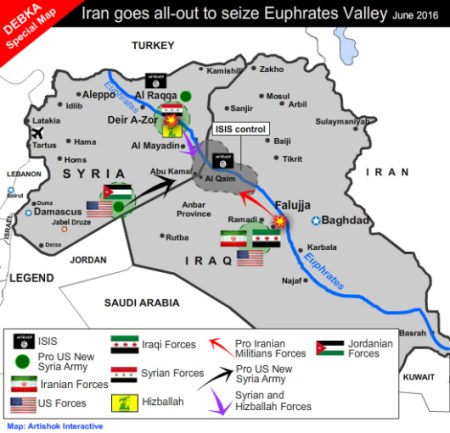
A. After the capture of the Iraqi city of Fallujah from ISIS, the pro-Iranian Shiite militias that participated in the campaign, namely the Popular Mobilization Forces and the Badar Forces, had started moving west toward the Iraq-Syria border (see map).

B. Syrian army and Hizballah forces had embarked on a parallel eastward movement from the vicinity of Deir ez-Zor toward the Iraqi border (see map). Their goal was to link up with the Iraqi Shiite militias on the Syrian-Iraqi border and create a land bridge for the use of all pro-Iranian forces in the two countries.

C. Washington and Amman regarded this development as dangerous and resolved to preempt it.

D. To that end, the New Syria Army was to be sent into action to take the town of Abu Kamal near the border.

E. The commanders assumed that the loss of Abu Kamal would deal a blow to ISIS forces in eastern Syria and plant a pro-American wedge against the linkup of the two pro-Iranian forces and so foil their projected land bridge athwart Iraq and Syria. .

5. On June 21, an ISIS suicide bomber driving a stolen Jordanian military truck blew himself up in the area of Jordan’s al-Rukban base on the Syrian border, in an attempt to avert the coming Abu Kemal attack by inflicting heavy losses on the new militia.  Most of those killed were Jordanian border guards.

6. After the attack, US and Jordanian helicopters airlifted the new militia combatants to a forward base set up at al-Tanf inside Iraq, 230 kilometers from Abu Kamal. They were attacked twice by Russian air strikes in an effort to thwart the pro-US militia’s return to Syria.

7. On June 29, the new Syrian force nonetheless launched its attack, under the direction of Jordanian special operations and military intelligence officers, and the supervision of American elite forces officers at the US-Jordanian war room north of Amman.

8. However, the new Syrian militia was speedily ambushed by ISIS, which apparently was tipped off about the impending attack and its routes of approach. Dozens of Syrian militiamen were killed or wounded, and the force fled from the battlefield. Those unable to flee were shot dead or decapitated.

9. The Jordanian officers who commanded the force were among those who fled.

10. ISIS videos of the battle showed that advanced US military equipment provided the militiamen had fallen into the terrorist organization’s hands, recalling the sights from Iraq of two years ago, when ISIS captured as booty masses of American military hardware from fleeing troops.

The US and Jordan once again failed to establish a Syrian force capable of fighting ISIS. They also lost the chance to gain control of the situation in eastern and southern Syria.

No official in Washington was ready to comment on the battle.

More airports under ISIS threat after Istanbul

June 29, 2016

More airports under ISIS threat after Istanbul, DEBKAfile, June 29, 2016

istanbul-dead

The US, Europe and the Middle East are again refusing to connect the dots of the terrorist threat, recalling the denial that marked the peak period of Al Qaeda’s atrocities in the early 2000’s.

When the US Defense Secretary Ashton Carter trumpeted the Fallujah victory over the Islamic State on June 27, he neglected to disclose that the real victors were Iranians – not Iraqis. The next day, an ISIS suicide attack on Istanbul’s Ataturk airport overshadowed that success, killing at least 41 people including 13 foreign nationald and injuring more than 230.

As the Obama administration labored to conceal from the public in the West its strategy of using Shiite forces to hammer ISIS in Iraq and parts of Syria, the Sunni terrorists retaliated in Istanbul – and not just there.

Seven ISIS suicide bombers, some on motorcycles, exploded on Monday, June 27, in a Christian village in the Lebanon Valley near Baʿalbek. A week earlier, an ISIS suicide bomber blew himself up at the gates of a large Jordanian military base on the Syrian border.

The connection between the ISIS arenas and cause and event is there for anyone who wants to see it.

ISIS has a ready store of suicide bombers who are willing to blow themselves up, not just because they are ‘extreme fanatics’ or “thugs” as President Obama insists on defining them, but because they believe they are fighting a religious war: Sunnis against Shiites, Sunnis against Christians and Sunnis against Jews.

On this point, Obama is in denial.

Turkey’s Sunni President Tayyip Erdogan was swiftly punished for concluding a political-military-intelligence agreement with the Jewish state. That same day, three suicide bombers, probably waiting for months at a safe house near the Istanbul airport, were ordered from ISIS Syrian headquarters in Raqqa, to go into action.

Neither the dense US intelligence net in the region, nor Turkish and Israeli intelligence managed to intercept the order.

DEBKAfile intelligence sources point out that the highly secure Ataturk airport, the third largest in Europe, is not the only one on the continent at which ISIS suicide units are lurking ready to strike.

American-European intelligence input points to their presence near at least two or three other airports in Europe. The problem is that the intel is very general, pointing to intent, with no specifics on countries or airports.

The public in the West and Middle-East are not told either about the ‘small’ victories scored by ISIS on the battle field. For instance, ISIS forces managed to block the Syrian-Hizballah advance towards the highway leading from Palmyra to Raqqa, inflicting heavy losses despite Russian air cover.

In Israel, where security awareness is usually high, no one was told about the successful ISIS engagement at the Syria-Jordan-Israel border junction bordering on the Israeli Golan against US-trained and armed Syrian rebels, who fought under artillery cover from Jordan.

In other words, ISIS has established itself on the Israeli border, a few kilometers away from the Sea of Galilee and Tiberius.

The Islamic State is fully geared to respond to such losses as Fallujah by going for strategic gains on the ground and inflicting horrible retribution on its victims by remotely activating sleeper cells of suicide killers.

Rather than being degraded, as Obama claims, ISIS is fully equipped to target its victims across several continents.

On Tuesday Istanbul airport was its chosen target. Now, we must wait and see who is next.

ISIS is a Footnote: The Real Threat is Sharia and Islamic Supremacism

June 29, 2016

ISIS is a Footnote: The Real Threat is Sharia and Islamic Supremacism, CounterjihadShireen Qudosi, June 29, 2016

Dr. Zuhdi Jasser, a top North American Muslim Reformer, sees Muslim reformers “as the most essential head of spear in the battle against Islamic theocracy.” The largest collective of Muslim Reformers are presently in the United States.

“Ideas of freedom can happen in the laboratory of America,” adds Dr. Jasser. The West offers Muslim voices for humanity a level of freedom that is unmatched in any other part of the world, making Western Muslim reformers critical in this battle against radical Islam — particularly because truthful conversations on faith are painted as persecution, courtesy of the regressive left.

**********************

The battle against radical Islam isn’t an ‘over there’ fight confined to the wastebin landscape of some forgotten town. It’s a ubiquitous problem that takes place on American soil in two forms. The first is through direct jihadi attacks as we most recently saw in Orlando; the second takes the form of political warfare.

Yesterday, the battle of ideas took place on the floor of a Senate hearing spearheaded by Senator Ted Cruz. The “Willful Blindness” hearing, attended by Dr. Zuhdi Jasser,Philip Haney, and Andrew McCarthy among others, offered testimony to better understand barriers to combating radical Islam.

Other witnesses included soft-Islamist Farhana Khera, President and Executive Director of Muslim Advocates, who refused to admit that jihad or radicalization had absolutely anything to do with radical Islam. In fact, Senator Cruz’s attempt to engage Khera in dialogue yielded a minimum of 6 instances of denial within five minutes, with Khera defaulting to a regressive left narrative that the conversation is somehow empowering ISIS.

National security consultant Chris Gaubatz debunks the myth of an all-powerful and seeing ISIS:

“The global Islamic movement is made of terrorist groups and nation states; all seeking to impose sharia.”

ISIS is a footnote at best, not the bogeyman that Islamists try to threaten free speech with. The real threat is sharia and a mindset of Islamic supremacism.

Testimony was also provided by Michael German, a fellow of the Brennan Center for Justice and a former FBI Special Agent. German sees radical Islam as a problem but not in the context we would assume is logical based on the facts and common sense. In the same line of thinking as Khera, German denounces a theological association with violent acts of terror under a political doctrine.

German’s reasoning fails. He is neither expert in nor a student of Islamic theology. Had he an objective mind and trained scholar in both academic and traditional Islam, he would see that Islam has become a highly political system that forms and orchestrates national movement. The version of radical Islam adopted by terror groups is not that different than the version of Islam adopted by Islamic states – and to go further – the version of Islam that Islamists identify with. All versions ultimately hold Islam as supreme, paving the way for what is an undeniable theological supremacy. In other words, Islamic supremacy. And that understanding of Islam is adopted by billions of adherents.

In the same vein of thought as Islamists, German believes “radical Islam” is used to smear a faith group. He further argues “collective national security [is not achieved] by undermining security of others.” For German, “Ideas cannot be killed and ideologies cannot be destroyed.” He points to Nazi ideology that while defeated, was not destroyed.

However, radical Islamic ideology can be challenged and destroyed…from within. A growing movement in partnership with allies is already underway by Muslim reformers. Reformers are the new wave of Muslim scholars appearing nearly a millennia after the original Muslim free thinkers, the Mu’tazilites. The waves of movement in Islamic critical thought from the time of the Prophet, through his passing, and till today, shows that Islam is not the monolith German and Khera try to depict.

Andrew McCarthy, a former Chief Assistant U.S. Attorney, understands Islam has seen a struggle to define itself from its earliest days. As McCarthy points out, Muslims “have not settled the question what is an authentic Islam.”

Dr. Zuhdi Jasser, a top North American Muslim Reformer, sees Muslim reformers “as the most essential head of spear in the battle against Islamic theocracy.” The largest collective of Muslim Reformers are presently in the United States.

“Ideas of freedom can happen in the laboratory of America,” adds Dr. Jasser. The West offers Muslim voices for humanity a level of freedom that is unmatched in any other part of the world, making Western Muslim reformers critical in this battle against radical Islam — particularly because truthful conversations on faith are painted as persecution, courtesy of the regressive left.

For McCarthy, the focus needs to shift to the supremacist interpretation of Islam that is fundamentally at odds with Western values. A clash of civilizations between Islam and the West is not a case of multiculturalism where room can be made for both. Islamic supremacism in its nature allows for only one ideology: its own.

So while German underscores that radical Islam is not a problem – that it is a misnomer – McCarthy points to history which shows us something entirely different. He summarizes that a struggle in Islam has been “ongoing for fourteen centuries supported by centuries of scholarship,” adding that “Islam is less a religion than a political radicalization with a religious veneer.”

McCarthy doesn’t see this as something the U.S. can fix, but it is something that we need to understand and not obscure – particularly because as Chris Gaubatz added, “We can kill every member of Al-Qaeda tomorrow, but it won’t end.”

Zuhdi Jasser added that America has “a sophisticated whack-a-mole system” of combatting terrorism. These are key assessment recognizing that ultimately we need to target the ideology and develop a system that moves beyond a fear of might trigger ISIS – a running theme for both Khera and German.

Khera along with German were both supported by Senator Dick Durbin who brought up a failed ongoing argument that needs to die: Westboro and the KKK are no more Christian than ISIS is Islamic. A cheap, tired trick, it shows a fundamental lack of knowledge about both Islam and Christianity.

Westboro and KKK are not acting in the footsteps of Jesus. However, ISIS is in many ways following the post-Medina violent warring behavior of its prophet, Muhammad. If we’re to see whether something is Islamic or Christian, we need to look at the verses and the leadership. Christianity did not have a violent Jesus and the teachings of Christ himself do not advocate violence. On the other hand, Islam has a violent version of Muhamad, which however justified in whatever context, is still violent and includes violent rhetoric that justified jihadi and supremacist agendas.

Germans builds on the back and forth highlighting Nazi Germany was defeated in part by criminalizing the ideology, something he feels can’t be done with Islam because the ideology can’t be scrubbed. I would argue we’ve already scrubbed so much: over 900 instances of references to jihad and Islam from official documents in what is a systematic purge of intelligence in a critical war.

Let’s go further still and get to the actual problem: the ideology. We need to do the same to political and violent doctrines in Islam, while supporting alternate voices found in reformers who are well on their way by outrightly challenging the theology or through grassroots efforts calling for modernized adaptations.


Brexit – Backlash from mass migration and ISIS

June 25, 2016

Brexit – Backlash from mass migration and ISIS. DEBKAfile, June 24,2016

BREXIT_23.6.16

In a historic referendum, millions of British citizens voted Thursday, June 23, to leave the European Union after 43 years by a margin of 52 to 48 percent. Many were undoubtedly moved into approving this pivotal step by three seismic world events:

1. The mass migration flowing into Europe from the Middle East and Africa under the EU aegis. Forebodings in the UK were fueled by figures released a week before the referendum showing an influx of 330,000 migrants to Britain in 2015.

2. The war on the Islamic State which poses a peril which most Western governments avoid addressing by name as World War III in the making.

3. The inability of those governments, beyond empty words, to grapple with the war on ISIS or cope with the  mass of migrants expected to beat on the gates of Western societies for many more hard years.

Many Americans and Europeans are dissatisfied and resentful of President Barack Obama’s approach to the war on ISIS, which is to dismiss the enemy as a minor band of fanatics and thus, rather than a war against Islam. Neither do they accept German Chancellor Angela Merkel’s magnanimous invitation to take refugees in – 1.5 million in two years – as her country’s moral responsibility.

This popular disgruntlement has thrown up such antiestablishment figures as Donald Trump in the US and Boris Johnson in Britain and contributes to the rise of far right-wing movements and extremist violence on both continents.

Those two leaders, though different in most other ways, owe much of their popularity to the pervasive fear in their countries that surging immigration will forever alter the fabric of their societies.

Such social upheaval is the result of a trap deliberately set for the West by two Muslim leaders: ISIS “caliph” Abu Bakr al-Baghdadi, and Turkish President Tayyip Reccep Erdogan.

Al-Baghdadi conceived the idea of flooding the western world with waves of immigrants from Africa and the Middle East as a way to achieve three targets:

a) To change the composition of the population of Western countries by expanding the Muslim increment.

b) To plant networks of ISIS terrorists in the West.

c) To boost ISIS Middle Eastern arms, people and drugs smuggling networks as the organization’s main source of income. Migrants are willing to pay an average of between 5,000 and 10,000 dollars to reach the West even though they know that many never make it alive.

Al Baghdadi made up for the revenue shortfall caused by the US bombing of ISIS-held oil fields and money reserves by pushing over a new wave of immigrants.

President Erdogan’s motives are quite different.

He allowed the waves of immigrants to pass through Turkey on their way to the US and Europe – just as for years, he allowed Western jihadists joining ISIS to reach Siria via Turkey – because he was consumed with the desire to punish the US, namely, the Obama administration, for refusing to back up his hegemonic aspirations in the Middle East; Europe was punished for denying Turkey EU membership year after year.

The victory of Boris Johnson’s “leave” campaign – in the face of Obama’s personal championship of Prime Minister David Cameron’s bid to keep his country in, supported by the Democratic presumptive nominee Hilary Clinton – was a loud and clear signal for politicians running in future elections in the West, including the US presidential vote in November.

Republican candidate Donald Trump’s call to stop Muslim immigration into the US until proper screening measures are in place may sound like an unformed idea, but no other US politician has dared put it on the table, or directly challenge the hollow words and self-righteous hypocrisy of Obama and Clinton on the issues of terror, wars in the Middle East and mass immigration. This alone gives Trump a popular edge in widening circles in the USA over his rival.

Trump is not likely to lose votes either by his pledge to rebuild NATO for leading the West in the war against Islamic terror.

During the five months up until the US presidential election, the West can expect more large-scale ISIS terror coupled with dramatic events in the wars raging in at least seven countries  – Iraq, Syria, Lebanon, Jordan, Egypt, Libya and Afghanistan. Refugees in vast numbers will continue to batter down the doors of countries that are increasingly unable and unwilling to accept them.

Wars in general and religious wars in particular, have throughout history thrown up massive shifts of population displaced by violence, plague, falling regimes, famine and economic hardship.

The year 2016 will go down as the year in which Middle East crises spilled over into the west, bringing social change and far-reaching political turmoil in their wake.

And this is only the beginning.

Satire | Shi’a death squads liberate Fallujah from Sunni death squads

June 22, 2016

Shi’a death squads liberate Fallujah from Sunni death squads, Duffel Blog, June 22, 2016

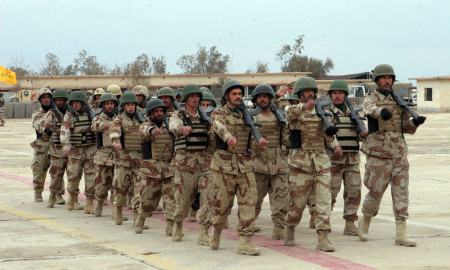
iraq-army-fallujah-1000x600Members of the Iraqi Army pass in review. (USMC photo.)

FALLUJAH, Iraq — Shi’a death squads have resumed patrols on the streets of Fallujah, “restor[ing] a sense of normalcy” to the beleaguered Iraqi city, residents say.

The Shi’a patrols follow the flight of Sunni death squads, religious police, and bootleg pornography vendors who had dominated the largely Sunni city since the Islamic State conquered it in 2014. The rapid departure of ISIS has paved the way for a welcome return to sectarian tension, corruption and graft.

Iraqi government forces announced new rules, heralding an end to the barbaric reign of ISIS.

“We are delighted to announce an end to the Sunni-on-Sunni rape that has so typified Daesh rule,” said Brig. Gen. Haider al-Obeidi of the Iraqi Federal Police/Iranian Revolutionary Guard. “From now on, brutal violence against women and children will be conducted under the rule of law.”

Fallujah’s embattled population expressed their gratitude at their liberation from slavery to second class citizenship.

“We’re just so grateful!” exclaimed repatriated resident Amira Albu Issa. “I thought we’d surely be killed for being Christian, but now, we only have to worry about being killed for going outside on Friday nights.”

Shopkeepers in Fallujah were equally overjoyed. “We will no longer pay ten percent zakat to the religious police, but only two percent for the protection racket instead! Allahu Akbar!”

Prime Minister Haider al-Badi also expressed his gratitude to the Iraqi Army, Popular Mobilization Units and militia that may or may not have been trained by Iran that backed them.

“Fallujah has returned to the embrace of the nation,” al-Badi said. “Now we must begin the rough task of providing security, rooting out heretics, punishing collaborators, and avenging Hassan.”

“We’re sending the very best personnel to aid in this undertaking.”

Prime Minister Al-Badi went to detail a security package featuring members of Asaib Ahl Haq, the Mahdi Army and the Iranian Qods Force, who would be taking point.

“I am excited to have this opportunity.” said Akram Abbas al Kabi, a former senior commander of Asaib Ahl Haq and current militia member. “We won’t let the Prime Minister or our country down.” Al-Kabi then called “dibs” on the first woman to “show some ankle.”


Jordan’s enemy within defies US anti ISIS wall

June 22, 2016

Jordan’s enemy within defies US anti ISIS wall, DEBKAfile, June 22, 2016

5

The terrorist attack that ISIS carried out on the Jordan-Syria border on Tuesday, June 21, in which a suicide bomber blew up the vehicle he was driving against a Jordanian border patrol, seriously alarmed Amman, Washington and Jerusalem on five counts:

1. The terrorist, who killed six Jordanian soldiers, came from inside Jordan, not across the border from Syria, meaning that ISIS had succeeded in setting up a terror network or networks inside the kingdom.

Suspicion was first raised after the June 6 attack on Jordanian intelligence headquarters in Ain el-Basha near Amman, in which five intelligence officers were killed, by the absence of any claim of responsibility. It now transpires that the ISIS commanders in Jordan had decided to leave no traces for the national security and intelligence services to follow in their investigation.

2. The jihadists’ success in pulling off two attacks in two weeks in Jordan – one in the center and the other in the north near the Syrian border, attests to several networks in play across a widely spaced-out region.

3. The attack on Tuesday took place tellingly at Ruqban, where a large exercise by a new brigade of the Jordanian military established to fight ISIS has been taking place for the last few days. The brigade, the first of its kind among Middle Eastern armies, is armed and trained by US counterterrorism advisors, and its structure modeled on that of the ISIS military. The entire brigade travels in new Toyota minivans atop which heavy guns are fixed.

The exercise is therefore preparing for both Jordanian and ISIS forces to fight by means of fast-moving armed convoys when they engage in their next battle in the desert areas between Jordan, Iraq and Syria.

But the Jordanians will have the advantage of air cover by attack helicopters.

That ISIS penetrated the site of a joint Jordanian-US military drill with a truck bomb attests to the upgrading of ISIS operational capabilities in the kingdom.

4. DEBKAfile’s intelligence and counterterrorism sources estimate that about 3,000 Jordanians have now joined ISIS and are fighting in its ranks. These homegrown terrorists have the family connections and local knowledge that enable them to move easily around the country. Most ISIS religious leaders and mentors are likewise locals, another advantage for drawing new recruits.

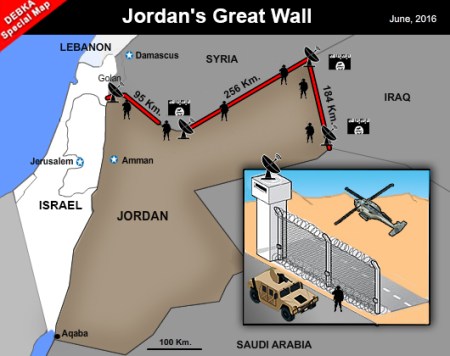
5. The Jordanian military, in cooperation with the Pentagon’s Defense Threat Reduction Agency, is currently completing a $500-million project to build a 442-kilometer defensive fence on the country’s borders with Syria and Iraq as well as around its bases including those hosting American forces (see map). Its purpose is not only to protect the Hashemite throne, but also to transform the 89,000-square-kilometer kingdom into one of the most important US military outposts in the Middle East in the war against ISIS. The fence will also serve as a barrier between Israel and the forces of ISIS, Iran, Iraq and Syria.

Tuesday’s attack, however, raises questions about the entire fence project. Washington and Amman are investing huge sums to keep ISIS out of Jordan when the terrorist peril is creeping up dangerously from within.

Post-Orlando, CAIR Issues New “Islamophobia” Report

June 21, 2016

Post-Orlando, CAIR Issues New “Islamophobia” Report, Front Page MagazineRobert Spencer, June 21, 2016

(Please see also, Meet the ‘Islamophobes’. –DM)

AntiIslamophobia report

Instead of announcing a program to teach young Muslims why they should reject the understanding of Islam held by the Islamic State, al-Qaeda, and other jihad groups, the Hamas-linked Council on American-Islamic Relations (CAIR) held a press conference Monday to unveil its latest cynical and deceptive report on “Islamophobia” in the U.S.

The whole “Islamophobia” enterprise is designed to intimidate people into thinking there is something wrong with opposing jihad terror, and this new report is no different. A few seconds of thought would expose the deceptiveness of it to anyone, but Hamas-linked CAIR is banking on the fact that most people, especially on the Left but not limited to it, will not give the report even that much thought, but will take it at face value, anxious to avoid being stigmatized themselves with the “Islamophobe” label.

For those willing to consider the facts, however, here are some of the problems with the new report:

1. According to an NBC report on CAIR’s latest “Islamophobia” salvo, “thirty-three Islamophobic groups had access to $205 million between 2008 and 2013 to spread fear and hatred of Muslims.” Are these groups part of one umbrella organization? No. Are they collaborators? Some are and some aren’t. Do they share funding? No. So $205 million (if that figure is even accurate, which it probably isn’t) over six years spread out among 33 different and quite disparate organizations actually averages out to a bit over a million a year per organization — a figure that is actually not a large operating budget for a major organization, and doubtless much smaller than that of Hamas-linked CAIR itself. (And for the record, Jihad Watch has never had anything close to a million dollars in any given year.)

2. “…to spread fear and hatred of Muslims.” That is not my objective, and I would venture to say it is not the objective of any of the other people or organizations mentioned in Hamas-linked CAIR’s report. CAIR’s entire premise is false: that to call attention to jihad terror activity, and to call for effective lawful responses to it, is tantamount to spreading “fear and hatred of Muslims.” Hamas-linked CAIR and its allies have spread this Big Lie so insistently for so many years that it has entered the American mainstream, but that doesn’t make it any more true than it was when they first advanced it. If Hamas-linked CAIR had ever provided even one example of a foe of jihad terror who was simultaneously not an “Islamophobe” in their eyes, this charge might have more credibility. But they never have. As far as Hamas-linked CAIR is concerned, any opposition to jihad terror at all is “Islamophobic” and spreading “fear and hatred of Muslims.”

3. “Attacks on mosques have increased, with 78 recorded incidents in 2015.” Have I or any of the others mentioned in this report ever called for attacks on mosques? No. Have any of the people who attacked mosques ever invoked any of us to explain why they attacked the mosques? No. Have Muslims faked “hate” attacks on mosques? Yes. Which is more likely: that any actual attack on a mosque by a non-Muslim vigilante idiot was provoked by our reporting about jihad terror, or by jihad terror itself, against which the mosques in the U.S. have not acted in any strong fashion? Hamas-linked CAIR would have you believe that this alleged cabal of “Islamophobic” individuals and groups is responsible for Americans’ suspicion and distrust of Muslims, when in reality the people who are responsible for any actual such suspicion and distrust are Omar Mateen, Syed Rizwan Farook, Tashfeen Malik, Dzhokhar Tsarnaev, Tamerlan Tsarnaev, Nidal Malik Hasan, etc.

5. In an introduction to the report itself, Hamas-linked CAIR’s Nihad Awad says: “This report makes a case that those who value constitutional ideals like equal protection, freedom of worship, or an absence of religious tests for those seeking public office no longer have the luxury of just opposing the U.S. Islamophobia network’s biased messaging.” But I don’t oppose “equal protection, freedom of worship, or an absence of religious tests for those seeking public office,” and again, I’d venture to say that none of the others mentioned in the report do, either. This is a straw man designed to demonize opponents of jihad terror, and opposition to it in general. In reality, we’re just trying to do all we can via legal means to stop jihad activity in the U.S. But Hamas-linked CAIR cannot acknowledge that, as to do so would reveal its actual agenda. So it has to mischaracterize our aims.

6. The report says: “Islamophobia is a contrived fear or prejudice fomented by the existing Eurocentric and Orientalist global power structure. It is directed at a perceived or real Muslim threat through the maintenance and extension of existing disparities in economic, political, social, and cultural relations, while rationalizing the necessity to deploy violence as a tool to achieve ‘civilizational rehab’ of the target communities (Muslim or otherwise).” Cut through this pseudo-academic gobbledegook and you will see that it is saying that “Islamophobia” as a “contrived fear or prejudice” fomented in response to a “real Muslim threat.” So Hamas-linked CAIR admits that there is a “real Muslim threat,” but claims that the “Islamophobic” individuals and groups in its report have a wrong response to it, and indeed are representatives of the “existing Eurocentric and Orientalist global power structure.”

The idea that the “global power structure” today is anything but fully in line with Hamas-linked CAIR’s point of view today is wildly absurd. But even aside from that, nowhere does Hamas-linked CAIR bother to explain what a proper response would be to this “real Muslim threat.” Apparently it would be nothing more or less than to surrender to it, since its “Islamophobia” report is designed to defame and discredit those who are standing against it, thereby clearing the field so that the jihad can advance unopposed and unimpeded.