Archive for the ‘Islam’ category

The Impact of Islamic Fundamentalism on Free Speech

June 19, 2016

The Impact of Islamic Fundamentalism on Free Speech, Gatestone InstituteDenis MacEoin, June 19, 2016

♦ The 57-member-state Organization of Islamic Cooperation (OIC) have been working hard for years to render Islam the only religion, political system and ideology in the world that may not be questioned with impunity. They have tried — and are in many respects succeeding — to ring-fence Islam as a creed beyond criticism, while reserving for themselves the right to condemn Christians, Jews, Hindus, democrats, liberals, women and gays in often vile, even violent language. Should anyone say anything that seems to them disrespectful of their faith, he or she will at once be declared an “Islamophobe.”

♦ Like almost every world leader, Obama declares, with gross inaccuracy, that “Islam is a religion of peace”. It is politically expedient to deny the very real connection to jihad violence in the Qur’an, the Traditions (ahadith), shari’a law, and the entire course of Islamic history. They do this partly for political reasons, but probably more out of fear of offending Muslims. We know only too well how angry many Muslims can become at even the lightest offence.

♦ “If PEN as a free speech organization can’t defend and celebrate people who have been murdered for drawing pictures, then frankly the organization is not worth the name. … I hope nobody ever comes after them.” – Salman Rushdie, on the PEN members who objected to giving its award to Charlie Hebdo, after 12 of its staff were murdered by jihadists.

♦ The OIC succeeded in winning a UN Human Rights Council resolution that makes “defamation of religion” a crime. But the OIC knows full well that only Muslims are likely to use Western laws to deny free speech about their own faith. Last year, the US Congress introduced House Resolution 569, also purportedly intended to combat hate speech. It contains an oddity: it singles out Muslims for protection three times. It does not mention any other faith community.

One of the greatest achievements of the Enlightenment in Europe and the United States is the principle of free speech and reasoned criticism. Democracy is underpinned by it. Our courts and parliaments are built on it. Without it, scholars, journalists, and advocates would be trapped, as their ancestors had been, in a verbal prison. It is enshrined in the First Amendment to the US Constitution, in the words

“Congress shall make no law respecting an establishment of religion, or prohibiting the free exercise thereof; or abridging the freedom of speech, or of the press; or the right of the people peaceably to assemble, and to petition the government for a redress of grievances.”

Without full freedom to express ourselves in speech or in print, none of us could criticize a religion, an ideology, a political party, a law, an academic theorem, or anything else we might feel to be misguided, flawed, or even dangerous. Through it, we are free to worship as we choose, to preach as we see fit, to stand up in a parliament to oppose the government, to satirize the pompous, to take elites down a peg or two, to raise the oppressed to dignity, or to say that anything is nonsense.

Sir Karl Popper, the philosopher, wrote The Open Society and Its Enemies in defence of democracy, freedom and free speech. In Popper’s open society, all people have to be able to think and express themselves freely, without fear of punishment or censorship.

Closed societies are totalitarian and depend on claims to absolute truth. The citizen is not free to challenge the ideas of the state. Theocracies, including past and present Islamic states, rest for their authority on the rigid application of infallible scripture and divinely revealed laws.

The chief threat to free speech today comes from a combination of radical Islamic censorship and Western political correctness. Over the past century and more, Western societies have built up a consensus on the centrality of freedom of expression. We are allowed to criticize any political system or ideology we care to: capitalism, socialism, liberalism, communism, libertarianism, anarchism, even democracy itself. Not only that, but — provided we do not use personalized hate speech or exhortations to violence — we are free to call to account any religion from Christianity to Scientology, Judaism to any cult we choose. Some writers, such as the late Christopher Hitchens, have been uncensored in their condemnations of religion as such.

It can be hard for religious people to bear the harsher criticisms, and many individuals would like to close them down, but lack that power. Organizations such as Britain’s National Secular Society (established in 1866) flourish and even advise governments.

It used to be possible to do this with Islam as well. In some measure it still is. But many Muslim bodies — notably the 57-member-state Organization of Islamic Cooperation (OIC) — have been working hard for years to render Islam the only religion, political system and ideology in the world that may not be questioned with impunity. They have tried — and are in many respects succeeding — to ring-fence Islam as a creed beyond criticism, while reserving for themselves the right to condemn Christians, Jews, Hindus, democrats, liberals, women, gays, or anyone else in often vile, even violent language. Should anyone say anything that seems to them disrespectful of their faith, he or she will at once be declared an “Islamophobe.”

I am not talking here about hate literature comparable to the ubiquitous anti-Semitic writing so freely available on the internet. Much milder things have fallen and continue to fall afoul of Islamic defensiveness. We know some of the more obvious: a novel, a bunch of cartoons, some films, some political speeches, and a few blogs which have resulted in savage floggings, imprisonment, torture, death threats and murders. There is plenty of vulgar anti-Muslim comment online, just as there is plenty of everything in the public arena. But Muslim sensibilities have become so tender now that even fair, balanced, and informed questions about Muhammad, his early followers, the Qur’an, various doctrines, aspects of Islamic history, the behaviour of some Muslims, even the outrages committed by them, are rejected as Islamophobic.

Politicians and the media rush to disavow any connection between jihadi violence and Islam, and hurry to protect Muslims from the anticipated anger that massacres might provoke. Officials are not wrong to urge against reprisals or hatred targeting ordinary, uninvolved Muslims. But many often seem too quick to avoid pinning blame on actual Islamic laws and doctrines that inspire the jihad attacks.

Just after the horrendous slaughter in a gay nightclub in Orlando on June 12, U.S. President Barack Obama made a speech in which he described the attack as an “act of hate” and an “act of terror”. Not “Islamic terrorism” or even the misleading phrase “Islamist terrorism”. Like almost every world leader, he declares, with gross inaccuracy, that “Islam is a religion of peace”. It is politically expedient to deny the very real connection to jihad violence in the Qur’an, the Traditions (ahadith), shari’a law, and the entire course of Islamic history. Obama and many others simply deny themselves the right to state what is true, partly for political reasons, but probably more out of fear of offending Muslims in general, and Muslim clerics and leaders in particular. We know only too well how angry many Muslims can become at even the lightest perceived offence.

The list of threats, attacks, and murders carried out to avenge perceived irreverence towards Islam, Muhammad, the Qur’an or other symbols of Islam is now long. Even the mildest complaints from Muslim organizations can result in the banning or non-publication of books, distancing from authors, condemnations of alleged “Islamophobes” by declared supporters of free speech, the cancellation of lectures, arrests, and prosecutions of men and women for “crimes” that were not crimes at all. There are trials, fines and sentencings for advocates of an accurate and honest portrayal of Islam, its sources, and its history.

Danish author Lars Hedegaard suffered an attack on his life and lives in a secret location. Kurt Westergaard, a Danish cartoonist, suffered an axe attack that failed, and is under permanent protection by the security services. In 2009, in Austria, the politician Susanne Winter was found guilty of “anti-Muslim incitement,” for saying, “In today’s system, the Prophet Mohammad would be considered a child-molester,” and that Islam “should be thrown back where it came from, behind the Mediterranean.” She was fined 24,000 euros ($31,000) and given a three-month suspended sentence. The phrase “child molester” was based on the fact, recorded by Muslim biographers, that Muhammad had sexual relations with his new wife A’isha when she was nine years old.

In 2011, Elisabeth Sabaditsch-Wolff, a former Austrian diplomat and teacher, was put on trial for “denigration of religious beliefs of a legally recognized religion,” found guilty twice, and ordered to pay a fine or face 60 days in prison. Some of her comments may have seemed extreme and fit for criticism, but the court’s failure to engage with her historically accurate charge that Muhammad had sex with a nine-year-old girl and continued to have sex with her until she turned eighteen, regarding her criticism of it as somehow defamatory, and the judge’s decision to punish her for saying something that can be found in Islamic sources, illustrates the betrayal of Western values of free speech in defence of something we would normally penalize.

The stories of the bounty placed on Salman Rushdie’s head by the Ayatollah Khomeini, the threats and attacks against the artists who drew the Danish cartoons of Muhammad, or the murderous assault on the editorial team at Charlie Hebdo on January 7, 2015 are well known. Accustomed to free speech, open blasphemy, and satire, at home with irreverence for individuals and institutions, and assured of the legality of those freedoms — threats and attacks like those terrify us. Or should.
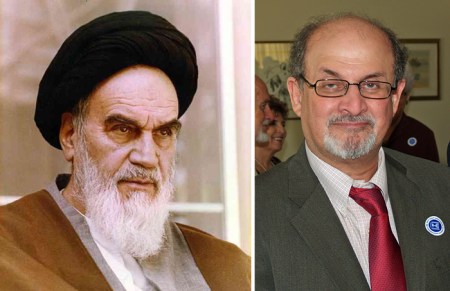
1505 (1)Iran’s then Supreme Leader Ayatollah Khomeini put a cash bounty on the head of British novelist Salman Rushdie 27 years ago, because he deemed Rushdie’s novel, The Satanic Verses, offensive. In February 2016, a group of Iranian media outlets added $600,000 to the cash reward.

But even more terrifying is the way in which so many politically correct Western writers and politicians have turned their backs on our most basic values. There are many instances, but the most disturbing has to be the reaction of Pen International, the internationally acclaimed defender of free speech everywhere, to Charlie Hebdo. PEN International is known worldwide as an association of writers. Together they work tirelessly for the freedom of authors from imprisonment, torture, or other restrictions on their freedom to write honestly and controversially. In 2015, PEN’s American Center planned to present its annual Freedom of Expression Award during its May 5 gala to Charlie Hebdo. The award was to be handed to Gerard Biart, the publication’s editor-in-chief, and to Jean-Baptiste Thorat, a staff member who arrived late on the day when Muslim radicals slaughtered twelve of his colleagues. This is the sort of thing PEN does well: upholding everyone’s right to speak out even when offence is taken.

When, however, this was announced, six PEN members, almost predictably, condemned the decision to give the award to Charlie Hebdo, and refused to attend the gala. Peter Carey, Michael Ondaatje, Francine Prose, Teju Cole, Rachel Kushner and Taiye Selasi exercised their right to double standards by blaming Charlie Hebdo for its offensiveness. Kushner expressed her discomfort with the magazine’s “cultural intolerance.” Does that mean that PEN should never have supported Salman Rushdie for having offended millions of Muslims just to express his feelings about Islam?

Peter Carey expressed his support, not for the satirists, but for the Muslim minority in France, speaking of “PEN’s seeming blindness to the cultural arrogance of the French nation, which does not recognize its moral obligation to a large and disempowered segment of their population.” We never heard Carey speaking out when a young Jewish man, Ilan Halimi, was tortured to death for weeks in France, or when Jews in Toulouse were shot and killed. He seems to be saying that the French government should shut up any writer or artist who offends the extreme sensitivities of a small percent of its population.

Teju Cole remarked, in the wake of the killings, that Charlie Hebdo claimed to offend all parties but had recently “gone specifically for racist and Islamophobic provocations.” But Islam is not a race, and the magazine has never been racist, so why charge that in response to the sort of free speech PEN has always worked hard to advance?

A sensible and nuanced rebuttal of these charges came from Salman Rushdie himself, a former president of PEN:

“If PEN as a free speech organization can’t defend and celebrate people who have been murdered for drawing pictures, then frankly the organization is not worth the name. What I would say to both Peter and Michael and the others is, I hope nobody ever comes after them.”

Those six later morphed into something like one hundred and forty-five. By April 30, Carey and the others were joined by another one hundred and thirty-nine members who signed a protest petition. Writers, some distinguished, some obscure, had taken up their pens to defy the principle of free speech in an organization dedicated to free speech — many of whom live in a land that protects free speech in its First Amendment precisely for their benefit.

The Organization of Islamic Cooperation had succeeded in winning a UN Human Rights Council resolution (16/18, 2010) that makes “defamation of religion” (read: blasphemy in the eyes of its followers) a crime. But the OIC knows full well that only Muslims are likely to use Western laws to deny free speech about their own faith. Five years later, in December 2015, the US Congress introduced House Resolution 569, intended to combat hate speech and other crimes. Insofar as it addresses matters of genuine concern to us all, it seems beyond reproach. But it contains an oddity. It singles out Muslims for protection three times. It does not mention any other faith community.

The greatest defence of our democracy, our freedom, our openness to political and religious debate, and our longing to live in Popper’s open society without hindrance — namely freedom of expression — is now under serious threat. The West survived the totalitarianism of the Third Reich and the Soviet Union without any loss of our freedoms. But today, a new enemy has arisen, global in its reach, more and more often militant in its expression, rooted in 1.6 billion people, seated at the UN and other international bodies, and already partially cowing us into submission to its repressive prejudices. Since the edict against Salman Rushdie, there is no way of calculating how many books have been shelved, how many television documentaries have never been aired, how many film scripts have been tossed in the waste bin, how many conferences have been cancelled or torn down, or how many killers are waiting in the wings for the next book, or poem, or song or sport that will transgress the strictures of Islamic law and doctrine.
Making America unsafe

June 15, 2016

Making America unsafe, Israel Hayom, Judith Bergman, June 15, 2016

When Obama claims, as he did on Tuesday, that “there’s no magic to the phrase ‘radical Islam.’ If someone seriously thinks we don’t know who we’re fighting, if there’s anyone out there who thinks we’re confused about who our enemies are, that would come as a surprise to the thousands of terrorists we’ve taken off the battlefield,” he is simply dissembling. You cannot know an enemy when you prohibit your law enforcement and intelligence personnel from studying or even mentioning them.

***************************

There is a deep and unacknowledged irony to the fact that U.S. President Barack Obama, of all people, has opined in the days since the terror attack in Orlando that how you term things makes no difference.

“What exactly would using this label [‘radical Islam’] accomplish? … Calling a threat by a different name does not make it go away. This is a political distraction,” Obama said on Tuesday in response to the heavy criticism poured on him after he, once more, refused to use the term in connection with the mass shooting. Islamic State quickly claimed responsibility for the attack, perhaps frustrated that no one in the U.S. administration, nor the Democratic presidential candidate, will give it credit for it.

Positing that calling something or someone a particular name makes no difference is the very epitome of hypocritical dissembling, especially coming from the person at the very top of the Democratic echelons.

These are the same people who for decades fought to entrench political correctness into American society, making it impossible to call certain things by their rightful names without facing a barrage of vilification and personal smears. The American Left has fought ceaselessly to shape language according to its ideas and has succeeded so tremendously that Americans are now afraid to report suspicious activity out of fear of coming across as “Islamophobic.” This has already cost lives. Before the attack, the security company that Omar Mateen worked for was afraid of reporting him, despite his suspicious behavior, exactly because it feared being castigated as “Islamophobic.”

The U.S. has much to learn from Israel in this regard. Israel is so efficient at fighting terrorism precisely because it cannot afford the luxury of integrating political correctness into its security doctrines. The very idea is preposterous. Nevertheless, this is exactly what Obama has done.

Five years ago, Obama erased all references to Islam in the educational materials used to train the American law enforcement and national security communities. In 2011, U.S. Deputy Attorney General James Cole confirmed that the Obama administration was recalling all its training materials to eliminate references to Islam that some Muslim groups had claimed were offensive.

In 2013, The Washington Times also reported that countless experts on Islamic terrorism had been banned from speaking to any U.S. government counterterrorism conferences, including those of the FBI and CIA. Government agencies were instead ordered to invite Muslim Brotherhood front groups.

If it is only a matter of labels, then why has Obama endangered American lives by deliberately blindsiding law enforcement and national security communities on the nature of Islamic terrorism? How are they supposed to grapple with the urgent issue of jihad if they are prohibited from learning about the nature of jihad?

When Obama claims, as he did on Tuesday, that “there’s no magic to the phrase ‘radical Islam.’ If someone seriously thinks we don’t know who we’re fighting, if there’s anyone out there who thinks we’re confused about who our enemies are, that would come as a surprise to the thousands of terrorists we’ve taken off the battlefield,” he is simply dissembling. You cannot know an enemy when you prohibit your law enforcement and intelligence personnel from studying or even mentioning them.

These are all relevant questions that the mainstream media has consistently refused to ask the administration — instead, dangerously dismissing them as conspiracy theories. The price is now being paid by innocent Americans, from a Christmas party in San Bernardino to a gay nightclub in Orlando.

Words matter tremendously, and you cannot fight an enemy that you are forbidden to name. Imagine Churchill telling the British that there was “no magic” in calling out the Nazi ideology and prohibiting his intelligence community from studying Nazi Germany’s strategy and tactics.

Hillary Clinton, feeling the backlash after publishing identical statements to those of Obama, has now opportunistically declared that she is ready to say those “magical words.”

But this is meaningless pandering, especially when you know she was part of the administration that purged training materials of all things Islam.

“In my perspective, it matters what we do, not what we say,” Clinton said. “To me, radical jihadism, radical Islamism, I think they mean the same thing. I’m happy to say either, but that’s not the point.”

The administration pretends there is no Islamist threat. This is what it has firmly projected to its law enforcement and intelligence communities, and Clinton is of course fully aware of the intricate details of this fact. Stating that it matters “what we do” then becomes an empty and even dangerous statement, because it deludes Americans into believing that there is a solid and credible intelligence effort underway to prevent future Islamist terror attacks in the United States, when this cannot logically be the case given that the U.S. law enforcement and intelligence communities are not allowed to study jihad or Islamic extremism.

Swedish Politicians: “Islam is Definitely Compatible with Democracy!”

June 8, 2016

Swedish Politicians: “Islam is Definitely Compatible with Democracy!” Gatestone Institute, Ingrid Carlqvist, June 8, 2016 — Part II of a series.

♦ With their goodhearted eagerness to be inclusive, not to discriminate and to defend freedom of religion, Swedish politicians are easy prey for Islamists with an anti-democratic agenda.

♦ “The presumption is that Muslims want nothing more than to adapt to a Western way of life and Western values. … the presumption is also that Islam can be tamed…” — Jimmie Åkesson, Sweden Democrats party leader.

♦ “Democracy is a man-made system, meaning by the people for the people. Thus it is contrary to Islam, because rule is for Allaah… it is not permissible to give legislative rights to any human being…” — Sheik Muhammad Saalih al-Munajjid, in fatwa number 07166.

♦ Everyone knows what happens to anyone who criticizes Islam — first, you get labeled an “Islamophobe racist,” then, like the artist Lars Vilks, you might get afatwa of death on your head.

♦ The question is where the democratic Muslims will be when Islam has gained even more influence in Sweden — will they stand up for Swedish democracy if that means openly going against the tenets of Islam?

It should not be a mystery whether Islam is compatible with democracy or not. All you have to do is look at the Islamic sources or call any imam and pretend to be impressed that Islam does not separate religion and politics.

Yet, when Gatestone Institute called Swedish politicians at all levels to ask if Islam and democracy were compatible, they gave assurances that there were no problems whatsoever with Islam’s capacity for democracy — or they hung up.

The two most common answers given were:

  1. Islam is definitely compatible with democracy!
  2. I cannot discuss this matter right now.

The question cuts through all parties; apparently no one dares to face the facts. So far, throughout history, and now in the world’s 57 Muslim countries in the Organization of Islamic Cooperation (OIC), nowhere has Islam been compatible with democracy, freedom of speech, human rights and legal certainty. These Muslim states have not signed the UN’s Declaration of Human Rights, a document Swedish politicians seem to cherish. Instead, those countries have joined the Cairo Declaration, which stipulates that sharia is the only foundation for human rights. In short, human rights are all well and good so long as they do not conflict with sharia — if they do, sharia wins. In practice, this means that in the Islamic world, there are, in the Western sense, no human rights.

Then why do Swedish politicians believe they will be able to democratize Islam? Do they know something the rest of the world does not? Or, as the alternative is so terrifying, are they just pretending?

In 1985, Sweden was still a homogenous country. There was no doubt that Sweden belonged to the Swedes. We were proud of the country that our forefathers created, and the welfare state given to us by the Social Democrats. Women in veils and men in Middle Eastern clothes did not walk the streets, and Islam was still considered exotic. It was, as the analyst Ronie Berggren recently put it, “Arabian nights, or [the children’s book] Tam Sventon with his manservant, Mr. Omar, and the flying carpet. Olof Palme was still alive and Sweden thought itself a safe and functioning nation.”

But in 1985, the Swedish History Museum published an anthology, “Islam: religion, culture, society,” in which a diplomat, Dag Sebastian Ahlander, expressed concerns:

“Islamic immigration to Sweden can also lead to new conflicts within Swedish society. The Swedish perception is that there is freedom of religion in Sweden, but that perception is built on a private view of religion. To a Muslim, a large part of the rules regarding everyday activities is based on Islam; co-education of boys and girls, sex education, the view on the status of women, the demand that the slaughter of animals should be performed according to certain rituals, the demand that Friday should be a public holiday — all of these things are potential sources of conflict to Muslim immigrants in Swedish society, and they are all ultimately founded on religion.”

Sadly, the anthology fell into oblivion. All at once, while the Swedes were busy tending their gardens or repainting their summer houses, and feeling safe in the knowledge that our politicians surely were not lying to us, Islam was everywhere. The problems sketched out by Dag Sebastian Ahlander are now affecting all of us — but still the politicians refuse to address the most basic question.

In calls to politicians, Gatestone also encountered an incantation: Islam is democratic because it has to be democratic, because what will happen to Sweden otherwise?

Many politicians are, evidently, frightened to death to talk about Islam. They seem to do everything in their power to avoid giving an answer. They claim they are the wrong person to talk to; they hang up the phone — anything to skirt a discussion.

The reason may well be that no matter what they say, everyone knows what happens to anyone who criticizes Islam — first, you get labeled an “Islamophobe racist,” then, like the artist Lars Vilks, you might get a fatwa of death on your head.

Not one of the politicians or officials was able to name a single Muslimmajority country that has a decent democracy with legal certainty and freedom of speech. Not one could see any danger coming from an increasing Islamization of Sweden. Typical answers were:

“Yes, Islam is definitely compatible with democracy. At least, that is my interpretation.” — Beatrice Ask, Conservative (Moderaterna), former Minister of Justice.

“Of course if you read the words in the Quran, and the movements and schools that are leading around the world, then Islam is difficult to merge with the Swedish version of democracy. But I try to avoid talking categorically about Islam as a whole. Many people have Islam as their personal faith.” — Paula Bieler, Sweden Democrats.

“I have nothing against that. People can believe what they want in a democracy.” — Nooshi Dadgostar, Left Party (Vänsterpartiet).

“Islam as a religion is compatible with democracy, why wouldn’t it be? I don’t think there is any religion not compatible with democracy. As long as you don’t use religion to hurt each other, Christianity, Islam and Judaism are all democratic in their basic perspective.” — Jamal Mouneimne, Social Democrats (Socialdemokraterna).

“[Mehmet] Kaplan is a practicing Muslim in a democratically elected government, so of course both he and I believe Islam is compatible with democracy. He is also an anti-racist, a feminist and he stands up for human rights.” — Mikaela Kotschack, Green Party (Miljöpartiet), Press Secretary for the recently resigned Mehmet Kaplan.

“I cannot answer that I’m afraid. This calls for a longer discussion, you cannot just answer yes or no to that question. … No, the question does not make me nervous, but it demands knowledge and a longer discussion.” — Larry Söder, Christian Democrats (Kristdemokraterna).

The civil servants, who are supposed to give the politicians more insight into current political issues, seem no more knowledgeable than the politicians. Deputy Assistant Göran Ternbo, the Government Offices’ expert on democracy and human rights, was also asked if Islam is compatible with democracy:

“Eh, ah … that’s a controversial issue, it is. I don’t know. You cannot be that categorical answering one way or the other. Why are you asking these questions? It feels … where are you going with this?”

Gatestone: We just want to know what the government’s view on Islam is. Are you aware of the Islamic agenda?

Ternbo: “We have freedom of religion in Sweden.”

Gatestone: Can you say that Islam fits into democratic Sweden?

Ternbo: “Yes, if they follow our laws.”

Gatestone: But many say they want sharia?

Ternbo: “I have never heard that.”

Gatestone: Can you mention one democratic Muslim country?

Ternbo: “I do not understand where this is going. If you want to discuss Islam, I advise you to contact the Ministry for Foreign Affairs, they have experts on Islam.”

Gatestone: But the politicians are filling the country with Islam right now, how does that affect Sweden’s future?

Ternbo: “My job is to deal with completely different issues, so I cannot answer that. Right now, I’m working on the Nordic Sami Convention.”

Gatestone: You work with human rights, have the Muslim countries accepted the UN Declaration on Human Rights?

Ternbo: “Yes, they’ve accepted a number of declarations, including the Cairo Declaration.”

Gatestone: Does the Cairo Declaration view human rights the same way we do?

Ternbo: “I don’t want to continue this discussion, it feels like an interrogation. We have freedom of religion in Sweden.”

Gatestone: Is it possible to use Swedish democracy to abolish democracy?

Ternbo: “This is going too far. I have a meeting now. Goodbye.”

The Swedes are highly secularized. They have never asked to be invaded by fierce religious rules. However, the huge immigration of asylum seekers, mainly from Muslim-majority countries, has turned everything the Swedes take for granted upside down — such as the idea that people mind their religious business in private, and that you can trust what other people tell you.

Can you trust what Muslim politicians are saying? In the Nordic culture, telling the truth is a virtue. The Aesir clan of the gods in Norse mythology listed nine noble virtues: courage, love of the truth, honorable living, fidelity, discipline, hospitality, confidence, diligence and endurance. In Islam, however, love of the truth does not seem to be a prominent virtue — in some circumstances, not only is lying allowed, it is compulsory to lie if it benefits Islam.

The question of whether Islam and democracy are compatible is probably the most important one that Sweden has faced in modern times. If Islam is not compatible with democracy, while the number of Muslims in Sweden grows week by week, then Sweden as a democratic country may soon be but a memory.

With their goodhearted eagerness to be inclusive, to defend freedom of religion, and not to discriminate against any group, Swedish politicians are easy prey for Islamists with an anti-democratic agenda.

Islam has its own system of justice, built on divine law (sharia); a ban on any and all criticism of Islam, and laws regulating virtually everything in everyone’s life. Moreover, there seems to be no interest on the part of the newcomers in abandoning these traditions in favor of the traditions of the West.

The fact that all political parties apart from the Sweden Democrats (who are critical of immigration) have Muslim representatives might lead people to think that if there are Muslims working within our democratic system, they must be democrats.

Yet Swedish imams make no secret that in Islam, politics and religion are branches on the same tree. If you phone an imam, and say you are a Swede who has grown tired of the Swedish Church’s compliance on political issues, and that you have thought about converting to Islam, you might hear, as imam Ali at the Islamic Cultural Center in Lund, said, “No, you cannot take politics out of Islam, it is a part of our religion. Islam is a complete system, which people need.”

Of course, if you are critical of Islam mixing politics and religion, you will not get answers like that — the imams evidently know that such answers are not popular in Sweden — anyway, not yet.

Anyone who thinks that these candid imams might be mistaken can study the official pronouncements on the subject. In fatwa number 07166, for instance, entitled, “Ruling on democracy and elections and participating in that system,” Sheik Muhammad Saalih al-Munajjid, one of the most respected scholars in Sunni Islam, writes:

“Praise be to Allaah. Firstly: Democracy is a man-made system, meaning rule by the people for the people. Thus it is contrary to Islam, because rule is for Allaah, the Most High, the Almighty, and it is not permissible to give legislative rights to any human being, no matter who he is.”

His fatwa number 98134, “Concept of democracy in Islam,” states:

“Democracy is a system that is contrary to Islam, because it gives the power of legislation to the people or to those who represent them (such as members of Parliament). Based on that, in democracy legislative authority is given to someone other than Allah, may He be exalted; rather it is given to the people and their deputies, and what matters is not their consensus but the majority. Thus what the majority agree upon becomes laws that are binding on the nation, even if it is contrary to common sense, religious teaching or reason. In these systems legislation has been promulgated allowing abortion, same-sex marriage and usurious interest (riba); the rulings of sharee’ah have been abolished; and fornication/adultery and the drinking of alcohol are permitted. In fact this system is at war with Islam and its followers.”

In fatwa number 111898, he answers a question on whether it is permissible to participate in non-Muslim, democratic elections:

“The Muslim participants should intend thereby to serve the interests of the Muslims and ward off evil and harm from them. The Muslim participants should think it most likely that their participation will have positive effects that will benefit the Muslims in that country, such as supporting their position, conveying their requests to the decision makers and those who are in charge of the country, and protecting their religious and worldly interests. The Muslim’s participation in these elections should not lead to him neglecting his religious duties.”

In fatwa number 178354, the Sheik is asked, “What is the ruling on one who reviles the Muslims and praises the kuffaar [infidels], and even wishes to be one of them?” He replies:

“Allah, may He be exalted, has instructed His believing slaves to love one another and to take one other as friends, and He has instructed them to hate His enemies and regard them with enmity for the sake of Allah. He has stated that friendship can only be among the believers and enmity is to be between them and the kaafirs; disavowing them is one of the basic principles of their faith and is part of perfecting their religious commitment. There are very many verses, hadeeths and comments of the early generation to that effect.”

That Islam combines religion and politics, with a view to using politics to advance the religion, and further these views, which are clearly stated, appears a totally foreign concept to Swedish politicians. Perhaps this is the reason that a Turkish-born Muslim, Mehmet Kaplan, could become Minister for Housing and Urban Development, all the while rubbing shoulders with the Islamists of Turkish groups Milli Görüs and the neo-fascists of the Grey Wolves — he was convinced no one would ever question him or his agenda, as questioning him about such alliances would be considered “Islamophobic.”

When pictures of him consorting with these groups were leaked to the media, a video clip also emerged in which Kaplan compared Israel’s actions with the Palestinians to Nazi Germany’s treatment of the Jews. That remark, in 2016, crossed the line for what an Islamist may say and do in Sweden. In Sweden, it is incredibly important not to question the Holocaust. Disapproval may possibly have come as a surprise to many, who perceive Sweden’s Israel policy under Minister for Foreign Affairs Margot Wallström as extremely critical of Israel. Wallström and the government’s criticism of Israel stems mainly from a view of Israel as the stronger party in the conflict between the Israelis and Palestinians, and from not recognizing that the Muslims and Arabs in the larger conflict perpetually threaten genocide against Israel and the Jews.

Mehmet Kaplan’s remark forced him to resign. Alas, anyone thinking that the Kaplan affair would lead to a discussion of the role of Islam in Swedish politics, is mistaken. Nothing in the public debate so far suggests that Swedish politicians will seriously start looking into a possible underlying agenda among Muslim politicians, such as that they might in fact be working to spread Islam in Sweden, as Sheik Muhammad Saalih al-Munajjid encourages. Such fatwas can be found in his IslamQA.info, one of the world’s most popular websites on Islam.

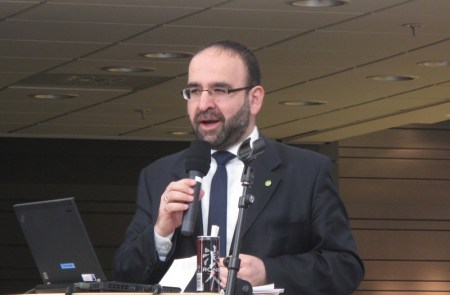
1565Mehmet Kaplan, a Turkish-born Muslim, became Sweden’s Minister for Housing and Urban Development, all the while rubbing shoulders with the Islamists of Turkish groups Milli Görüs and the neo-fascists of the Grey Wolves — he was convinced no one would ever question him or his agenda, for fear that doing so would be considered “Islamophobic.” Kaplan was only forced to resign in April after revelations that he compared Israel’s treatment of Palestinians to Nazi Germany’s treatment of Jews. (Image source: Wikimedia Commons/Jan Ainali)

Mehmet Kaplan had only just resigned, when, within the Green Party, the next scandal broke. Yasri Khan, chairman of Swedish Muslims for Peace and Justice (Svenska muslimer för fred och rättvisa), was also a would-be member of the Green Party executive committee. In a news report on Sweden’s TV4, viewers watched in amazement as Khan refused to shake the female reporter’s hand. Was a man who did this really a good representative for the “feminist” Green Party?

When the Green Party’s spokesman, Gustav Fridolin, tried to explain Khan’s actions and why he had been recommended for the party’s executive, he only made matters worse. On a morning television show, Fridolin said that he “did not understand that women could feel so offended by someone refusing to shake hands.” The same evening, Fridolin apologized for the apology.

The Green Party may be the easiest party in which Islamists can act as entryists. The party appears particularly fond of physical diversity and seems willing to accept just about anybody who appears to be not an ethnic Swede. Possibly the Green Party never counted on the Swedish people, including their own constituents, having a completely different view of religion, politics, gender equality and handshakes.

After these scandals, the scholar Lars Nicander of the Swedish Defense University warned inAftonbladet that the Green Party might have been infiltrated by Islamists:

“I see a resemblance with how the Soviet Union acted during the Cold War, when it tried to infiltrate various democratic parties, and these methods are similar to what we see today, when people close to the Muslim Brotherhood, an Islamist party, apparently have gotten a strong foothold within the Green Party.”

A few days later, the Social Democratic politician Nalin Pekgul, a Kurdish Muslim, told the public-service Sveriges Television that she believes the Green Party is rife with Islamists: “The Green Party has for a long time become an arena for many Islamists to involve themselves in. That is the party where they have been strongest and most successful.”

She also said that while other parties have been exposed to Islamists, the Green Party has been affected the most:

“The Islamists in the Green Party are members of the party executive, they are in City Halls around the country, in the District Councils, and they have friends in the Government Offices who push their issues and make sure their organizations get lots of money.”

The key issue is what, if any, lesson Swedish politicians have learned from the Islamist revelations this spring. If Sweden is to survive as a secular democracy, then all politicians need to understand what Islam actually is. The fact that there are democratic Muslims does not mean that Islam itself is compatible with democracy. Individual Muslims may make a distinction between politics and religion, but this does not mean that Islam accepts this division. The question is where the democratic Muslims will be when Islam has gained even more influence in Sweden: Will they stand up for Swedish democracy if that means openly going against the tenets of Islam?

In 2009, the year before the Sweden Democrats party entered parliament, party leader Jimmie Åkesson published an opinion piece, headlined “The Muslims are our greatest foreign threat,” in the newspaper Aftonbladet:

“This is the reason today’s multicultural Swedish power elite is so totally blind to the dangers of Islam and Islamization. The presumption is that Muslims want nothing more than to adapt to a Western way of life and Western values, and that Islam is essentially the same as Christianity, the only difference being that Muslims have another name for God. Thus, the presumption is also that Islam can be tamed, the same way secular forces have tamed European Christianity and relegated it to the private sphere.”

Åkesson further wrote that Islam has affected the Swedish society to a much higher degree than Swedish society has affected Islam. He listed several areas where Islam has made an impact. People who have made fun of Islam are forced to live under constant police protection; Muslim terrorist organizations are growing stronger; Muslim representatives are demanding sharia laws; taxpayer money is being spent on circumcising baby boys; public swimming pools separate men and women; demands for halal meat at supermarkets while schools should no longer serve pork, and so on.

Not even the Sweden Democrats seem to have focused on Islam’s demands for political influence. Party leader Jimmie Åkesson asked what things will look like in another few decades, when the Muslim population has increased several times over, and cities such as Malmö most likely have a Muslim majority. He concluded the article with a promise:

“The multicultural societal elites may see this future as a colorful, interesting change for a Sweden and a Europe one usually denies has ever been ‘Swedish’ or ‘European’. As a Sweden Democrat, I see this as our greatest foreign threat since World War II, and I promise to do everything in my power to reverse this trend when we go to the polls next year.”

Åkesson’s article ignited a firestorm. Members of the “establishment” swore they had never read anything so vile, and the article was reported to the Chancellor of Justice as suspected “hate speech.” However, the Chancellor at the time, Göran Lambertz, did not open an investigation into the case. He noted that the law allows for “criticism of ethnic groups or circumstances pertaining to those groups.”

“There is no doubt whatsoever that this does not cross the line for criminal behavior. You are allowed to say a lot of things that can be considered offensive and annoying and in many ways unpopular. That goes with freedom of speech.”

Seven years have passed. The Muslim population of Sweden is approaching one million (out of 9.8 million inhabitants), but even the Sweden Democrats do not mention a threat from Islam.

But whether the politicians’ unwillingness to discuss a threat stems from ignorance or fear, to answer a question by hanging up the phone is simply not good enough. It is the politicians who have filled the country with Islam, and the Swedish people have a right to know the result. Above all, they have a right to demand that the politicians know the consequences of their decisions for the Swedes, who are secular and who love their democracy.

Dr. Ben Carson on violence at Trump rallies

June 4, 2016

Dr. Ben Carson on violence at Trump rallies, Fox News via YouTube, June 4, 2016


Sweden: Is Islam Compatible with Democracy?

May 28, 2016

Sweden: Is Islam Compatible with Democracy? Gatestone InstituteIngrid Carlqvist, May 28, 2016

♦ It is not a secret that democracy can be used to abolish democracy.

♦ It may have finally begun to dawn on the people that Swedish Sweden will soon be lost forever, and in many areas replaced by a Middle Eastern state of affairs, where different immigrant groups (mainly Muslims) make war on each other as well as on the Swedes.

♦ According to Dr. Peter Hammond, in his book Slavery, Terrorism and Islam: The Historical Roots and Contemporary Threat, the goal of Islam is not to convert the whole world, but rather, to establish sharia law all over the world.

♦ There is no country where Islam is dominant that can be considered a democracy with freedom of speech and equal justice under law.

In Sweden’s last census in which citizens were asked about their religious beliefs, in 1930, fifteen people said that they were Muslims. Since 1975, when Sweden started its transformation from a homogenous, Swedish country into a multicultural and multi-religious one, the number of Muslims has exploded. Now, approximately one million Muslims live here — Sunni, Shia and Ahmadiyya from all the corners of the world — and Mosques are built and planned all over the country.

No one, however, seems to have asked the crucial question upon which Sweden’s future depends: Is Islam compatible with democracy?

The Swedish establishment has not grasped that Islam is more than a private religion, and therefore it dismisses all questions about Islam with the argument that Sweden has freedom of religion.

Two facts point to Islam not being compatible with democracy. First, there is no country where Islam is dominant that can be considered a democracy with freedom of speech and equal justice under law. Some point to Malaysia and Indonesia — two countries where flogging and other corporal punishments are meted out, for example, to women showing too much hair or skin, as well as to anyone who makes fun of, questions or criticizes Islam. Others point to Turkey as an example of an “Islamic democracy” — a country which routinely imprisons journalists, political dissidents and random people thought to have “offended” President Erdogan, “Islam” or “the nation.”

Second, Muslims in Europe vote collectively. In France, 93% of Muslims voted for the current president, François Hollande, in 2012. In Sweden, the Social Democrats reported that 75% of Swedish Muslims voted for them in the general election of 2006; and studies show that the “red-green” bloc gets 80-90% of the Muslim vote.

It is no secret that democracy can be used to abolish democracy — yet, this crucial issue is completely taboo in Sweden. Politicians, authorities and journalists all see Islam as just another religion. They seem to have no clue that Islam is also a political ideology, a justice system (sharia) and a specific culture that has rules for virtually everything in a person’s life: how to dress; who your friends should be; which foot should go first when you enter the bathroom. Granted, not all Muslims follow all these rules, but that does not change the fact that Islam aspires to control every aspect of human life — the very definition of a totalitarian ideology.

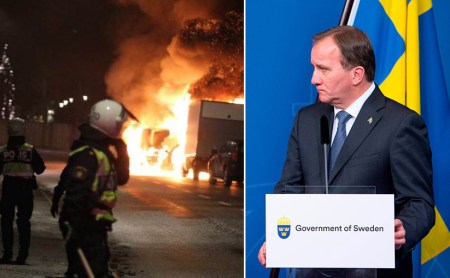
While the establishment closes its eyes to the problems that come with a rapidly growing Muslim population in Sweden, ordinary Swedes seem to be growing increasingly upset. Prime Minister Stefan Löfven, however, appears to be at a complete loss as to why this is. He recently told the British newspaper, Financial Times:

“But the more surreal thing is that all the numbers are going in the right direction, but the picture the public have is that the country is now going in the wrong direction. It’s not only a question about if they are afraid of the refugee crisis; it’s as if everything is going in the wrong direction.”

This comment says a lot about how disconnected Prime Minister Löfven is from the reality that ordinary Swedes are facing. The mainstream media withhold information about most of the violence that goes on in, and around, the asylum houses in the country, and it is not very likely that Stefan Löfven reads the alternative media sites; he and others in power have, in unison, dubbed them “hate sites.” He obviously has no idea about the anger and despair many Swedes are now feeling. It may have finally begun to dawn on them that Swedish Sweden will soon be lost forever, and in many areas replaced by a Middle Eastern state of affairs where different immigrant groups (mainly Muslims) make war on each other as well as on the Swedes.

1625While the establishment closes its eyes to the problems that come with a rapidly growing Muslim population in Sweden, ordinary Swedes seem to be growing increasingly upset. Prime Minister Stefan Löfven (right), however, appears to be at a complete loss as to why this is. Pictured at left: The results of rioting in a Stockholm suburb, December 2014.

The people suffering most cruelly in the “New Sweden” are the elderly. The costs of immigration borne by the welfare state have led to a quarter of a million retirees living below the EU poverty line. Meanwhile, the government recently added another 30 billion kronor (about $3.6 billion) to the migration budget. The 70 billion kronor ($8.4 billion) Sweden will spend on asylum seekers in 2016 is more than what the entire police force and justice system cost, more than national defense costs, and twice the amount of child benefits.

Sweden’s 9.5 million residents are thus forced to spend 70 billion kronor on letting citizens of other countries come in. In comparison, the United States, with its 320 million residents, spent $1.56 billion on refugees in 2015. The editorial columnist PM Nilsson commented in the business paper, Dagens Industri:

“To understand the scope of the increase in spending, a historic look back can be worthwhile. When the right bloc came to power in 2006, the cost was 8 billion [kronor] a year. In 2014, it had gone up to 24 billion. That summer, then Minister of Finance Anders Borg talked about the increase being the most dramatic shift in the state budget he had ever seen. The year after, 2015, the cost rose to 35 billion, and in 2016, it is projected to rise to 70 billion.”

For many years, the politicians managed to fool the Swedish people into thinking that even if immigration presented an initial cost, the immigrants would soon enable the country to turn a profit. Now, more and more research indicates that the asylum seeker immigrants rarely or never find work. The daily newspaper Sydsvenskan reported in February, for example, that 64% of Malmö’s immigrants are still unemployed after living in Sweden for ten years. The government openly calculates in its budget that in four years, 980,000 people will be living on either sickness benefits, disability pensions, unemployment benefits, “introduction benefits” or social welfare.

Swedes, who for many years have paid the highest taxes in the world without whining, are now taking to social media to express their anger that their money is going to citizens of other countries. More and more Swedes are choosing to emigrate from Sweden, mainly to the other Nordic countries, but also to Spain, Portugal and Great Britain, where taxes on pensions are considerably less.

But there are worse problems than the economic aspect. A sense of insecurity and fear has gripped the many Swedes who live close to asylum houses. On some level, the government seems to have grasped that danger: in a recent decision to continue maintaining border controls, Interior Minister Anders Ygeman wrote:

“The Swedish Civil Contingencies Agency (Myndigheten för samhällsskydd och beredskap), MSB, makes the assessment that the flow of migrants still brings challenges to upholding security in society, when it comes to the ability to maintain certain important public functions, among other things. Several of these challenges are expected to persist over time. The Police Authority’s assessment is still that a serious threat to public order and internal security exists. The Immigration Service still advocates border controls.”

Despite these ominous words, politicians still do not seem to understand that many Swedes are already experiencing “a serious threat to public order and internal security.” New asylum houses are opening at an alarming pace, against the will of the people living near them. In the Stockholm suburb of Spånga-Tensta, on April 15, local authorities held a public meeting, the purpose of which was to allow local residents to ask the politicians and officials questions about planned housing for 600 migrants — next to a school. The meeting, which was filmed, showed a riotous mood among those gathered there, many shouting that they were going to fight “until their last breath” to keep the plans from materializing.

Some of the comments and questions were:

  • “We have seen how many problems there have been at other asylum houses – stabbings, rapes and harassment. How can you guarantee the safety for us citizens? This is going to create a sense of us against them, it’s going to create hate! Why these large houses, why not small ones with ten people in each? Why haven’t you asked us, the people who live here, if we want this? How will you make this safe for us?”
  • “We already have problems at the existing asylum houses. It’s irresponsible of you to create a situation where we put our own and our children’s health in jeopardy, with people who are not feeling well and are in the wrong environment. Why is this house right next to a school? What is your analysis?”
  • “Will Swedes be allowed to live in these houses? Our young people have nowhere to live. You politicians should solve the housing issue for the people already living here, not for all the people in the world.”

When the chairman of the meeting, Green Party representative Awad Hersi, of Somali descent, thanked the audience for the questions without giving any answers, the mood approached that of a lynch mob. People shouted: “Answer! Answer our questions! We demand answers!”

Everything points to the so far docile Swedes now having had enough of the irresponsible immigration policy that has been going on for many years, under socialist and conservative governments alike.

People are furious at the wave of rapes that have given Sweden the second-highest rate of rape in the world, after only Lesotho, and that recently forced the Östersund police to issue a warning to women and girls not to go outside alone after dark. People are scared: the number of murders and manslaughters has soared. During the first three months of this year alone, there have been 40 murders and 57 attempted murders, according to statistics compiled by the journalist Elisabeth Höglund.

The authorities have long claimed that lethal violence in Sweden is on the decline, but that is compared to a record-breaking year, 1989, when mass immigration to Sweden was already in full swing. If one instead were to compare the present to the 1950s and 1960s, when Sweden was still a homogenous country, the number of murders and manslaughters has doubled. Recently, the Swedish National Council for Crime Prevention (Brottsförebyggande rådet), BRÅ, had toadmit that lethal violence did, in fact, increase in 2015, when 112 people were killed — 25 more than the year before. It was also revealed that the kind of lethal violence that has gone down was run-of-the-mill drunken homicides committed by Swedes, while the number of gangster-style hits carried out by immigrants has gone up dramatically. Improved trauma care for wounded victims also helps keep the number of murders and manslaughters down.

A recent poll showed that 53% of Swedes now think immigration is the most important issue facing the country. The change from 2015 is dramatic — last year, only 27% said that immigration was most important. Another poll showed that 70% of Swedes feel that the amount of immigration to Sweden is too high. This is the fourth year in a row that skepticism about the magnitude of immigration has increased.

More and more people also seem to worry about the future of Sweden as a democracy with an increasing number of Muslims — through continued immigration as well as Muslim women having significantly more children than Swedish women do.

As statistics on religious beliefs are no longer kept, no one knows exactly how many Muslims are in Sweden. Last year, a poll showed that Swedes believe 17% of the population is Muslim, while the actual number, according to the polling institute Ipsos Mori, may be more like 5%. The company does not account for how it arrived at this number, and it is in all likelihood much too low. Ipsos Mori probably counted how many members Muslim congregations and organizations have, but as Islam is also a culture, and the country is equally affected by the Muslims who do not actively practice their faith, yet live according to Islamic culture.

In 2012, the Swedish alternative newspaper, Dispatch International, calculated how many Muslims were registered residents of Sweden at that time, based on the Swedish name registry. The number the paper arrived at was 574,000, plus or minus 20,000. For obvious reasons, illegals and asylum seekers were not included. The actual number may therefore have been much higher.

Since then, close to 300,000 people have sought asylum in Sweden. Not all of them have had their applications approved, but despite that, very few actually leave Sweden. The Immigration Service told Gatestone Institute that only 9,700 people were deported last year. Most asylum seekers are Muslim, which means that the number of Muslims in Sweden is fast approaching one million, or 10% of the population.

In his book Slavery, Terrorism and Islam: The Historical Roots and Contemporary Threat, published in 2005, Dr. Peter Hammond describes what has always happened throughout history when the number of Muslims in a country increases. Admittedly generalities, Hammond outlines the following:

  • As long as the Muslims make up about 1%, they are generally considered a peace-loving minority who do not bother anyone.
  • At 2-3%, some start proselytizing to other minorities and disgruntled groups, especially in prison and among street gangs.
  • At 5%, Muslims have an unreasonably large influence relative to their share of the population. Many demand halal slaughtered meat, and have been pushing the food industry to produce and sell it. They have also started to work toward the government giving them autonomy under sharia law. Hammond writes that the goal of Islam is not to convert the whole world, but rather, to establish sharia law all over the world.
  • When Muslims reach 10%, historically, lawlessness increases. Some start to complain about their situation, start riots and car fires, and threaten people they feel insult Islam.
  • At 20%, violent riots erupt, jihadi militia groups are formed, people are murdered, and churches and synagogues are set ablaze.
  • When the Muslims reach 40% of the population, there are widespread massacres, constant terror attacks and militia warfare.
  • At 60%, there is the possibility of uninhibited persecution of non-Muslims, sporadic ethnic cleansing, possible genocide, implementation of sharia law and jizya (the tax for “protection” that unbelievers must pay).
  • When there are 80% Muslims in the country, they have taken control of the government apparatus and are, as in, for instance, Syria, Afghanistan, Pakistan and Iraq, committing violence in the name of Islam or political power.
  • When 100% are Muslims, the peace in the house of Islam is supposed to come — hence the claim that Islam is the “religion of peace.”

Hammond also writes that in many countries, such as France, Belgium, Great Britain and Sweden, most of the Muslim population lives in Islamic enclaves — and apparently prefer not to be assimilated into a Western society. This detachment strengthens the group internally, allowing them to exercise greater power than their share of the population might indicate.

Hammond’s description of the 10%-limit accurately describes Sweden. In the so-called exclusion areas, there are car torchings every day, and riots occur in the cities. (To name but a few examples, there were serious riots in Malmö 2008, Gothenburg 2009, Stockholm 2013, and Norrköping and Växjö 2015.) Sometimes, the unrest starts after a local Muslim has been arrested or shot by the police. Muslim leaders then immediately say they sympathize with their people’s reaction. During the Husby riots in 2013, Rami Al-Khamisi of the youth organization “Megafonen”wrote: “We can see why people are reacting this way.”

The artist Lars Vilks, who drew the Muslim prophet Muhammed as a roundabout dog, has been the target of several assassination attempts, and now lives under round-the-clock police protection.

Yet, almost no one in Sweden is willing to speak of these problems and how it all fits together. For months, Gatestone Institute has called politicians, civil servants, organizations and various minority groups, to ask how they feel about Islam in Sweden. Do they think Islam is compatible with democracy, freedom of speech and legal equality — and if so, in what way or what way not?

The questions seemed to provoke anger as well as fear. Some of the people we called said they were angry at the mere questions, but assured the callers that Islam poses no problem whatsoever for Sweden. Others appeared frightened and refused to answer altogether. In the hopes of getting at least some honest answers, we presented ourselves as ordinary, concerned Swedes. Countless people hung up the phone, and in general, many answers pointed to an abysmal ignorance about what Islam is, what consequences the Islamization of a country might have, or how much trouble Sweden really is in. The country appears totally unprepared for what lies ahead.

London’s New Muslim Mayor: Extremist or Opportunist?

May 8, 2016

London’s New Muslim Mayor: Extremist or Opportunist? Clarion Project, Meira Svirsky, May 8, 2016

Sadiq-Khan-HPSadiq Khan makes his acceptance speech. (Photo: Video screenshot)

Majid Nawaz’s assessment of London’s new Muslim mayor, the newly elected Sadiq Khan, is that he is not an Islamist extremist. He is merely a manipulative politician willing to use guile and duplicity to achieve his electoral aims — not so different from the average politician.

Leading up to the mayoral vote, questions arose about Khan’s association with extremists, which constitutes a long list in the new mayor’s political history.

Consider:

  • In 2001, Khan was the lawyer for the American radical Islamist group Nation of Islam, successfully arguing in front of the UK’s High Court to overturn the ban on its leader, Louis Farrakhan.
  • In 2003, Khan appeared at a conference with Sajeel Abu Ibrahim, a member of the banned al-Muhajiroun group that was founded by hate preacher Omar Bakri Muhammad (now prohibited from entering the UK) and led by hate preacher Anjem Choudary (whose many organizations have been said to have contributed “the single biggest gateway to terrorism in recent British history”). Sajeel also ran a terrorist training camp in Pakistan attended by 7/7 bomber Mohammad Sidique Khan.
  • In 2004, Khan testified to the House of Commons as head of the Muslim Council of Britain’s legal affairs committee. As council legal head, Khan argued in parliament that the Muslim Brotherhood’s spiritual leader Yusuf Al-Qaradawi “is not the extremist that he is painted as being.” Qaradawi (also banned in the UK for his extremist views) advocates, among other sharia principles, for wife beating and suicide bombings against Israeli citizens. After the murder of an Ahmadi Muslim in Scotland for wishing his Christian customers a peaceful Easter, the council “condemned” the incident by pointing out that Ahmadis are not Muslims.
  • Khan was the defense lawyer for Zacarias Moussaoui, a 9/11 terrorist and confessed member of Al Qaeda.
  • Khan attended events for the extremist group CAGE and wrote a forward for one of their reports. CAGE is a primary supporter of the Islamic State executioner known as “Jihadi John,” who they described as a “beautiful young man.”
  • Khan appeared on panels with Muslim community leader and cleric Suliman Gani, a supporter of the Islamic State (ISIS/ISIL), no less than nine times.
  • In 2010, Khan shamelessly played the Ahmadi card, flaring up sectarian hatred in his reelection bid to the parliament when faced with stiff competition from Nasser Butt, an Ahmadi who had opposed the war in Iraq unlike Khan who had voted in favor of it.

Defending himself against charges of extremism, Khan points to his record on supporting rights for homosexual and transsexual rights. Since he was first elected to parliament in 2005, that support has been unwavering.

Khan has been an outspoken critic of anti-Semitism. Most recently, he stated he was “embarrassed and sorrowful” about the glaring anti-Semitism that has been spotlighted in his own party.

As the Muslim Public Affairs Committee in the UK (MPAC-UK) derogatorily pointed out in a comment piece on their website posted just two days before the election, “A Vote for Sadiq Khan in the London Mayor Elections is a Vote for Israel.”

Much to MPAC-UK’s chagrin and dismay, Khan is an opponent of the anti-Israel BDS movement. Although he called for sanctions against Israel in 2009, he says he has since changed his mind.

On the last day of his campaign, it was revealed that in an interview Khan gave in 2009 on Iranian television, he referred to Muslims fighting extremism as “Uncle Toms.”  (He has since apologized.)

Still, Majid Nawaz insists that Khan is no extremist. Khan was Nawaz’s lawyer when he was arrested in Egypt for working for the banned Islamist group Hizb ut-Tahrir. Nawaz, now a prominent counter extremism campaigner, says he is forever indebted to Khan for visiting him in Egypt’s Mazra Tora prison, “while the world gave up on me.”

Ironically, it was Nawaz’s counter-extremism foundation Quilliam that were targeted by Khan in his “Uncle Tom” remarks.

Nawaz refrained from commenting on Khan and his electoral bid until after the election. In his first piece penned after the election, Nawaz paints a picture of Khan as a realist (read: opportunistic) and consummate politician.

“When push comes to shove, gaining power becomes more important for politicians from all parties, than defending principles,” writes Nawaz. “And sadly, extremists remain among the most powerful organized forces in Britain’s Muslim grassroots.”

Nawaz explains the unfortunate political climate in today’s Britain: “By 2009, extremism had grown so rife among my own British Muslim community that, in a sign of our times, a Muslim government minister for Social Cohesion [Khan] would find it politically expedient to call a group of Muslims, who were not in government, ‘Uncle Toms’ simply for criticizing extremism.”

Yet, Nawaz doesn’t give Khan a free pass, saying, “It did not need to be like this. As a column in the Wall Street Journal recently noted, ‘Other Muslim leaders took a different approach.’

“The struggles that reforming liberal and ex-Muslims face every day, the dehumanization, the delegitimization, the excommunication, the outcasting, the threats, intimidation and the violence makes this inexcusable … Why is it okay for a mayor to have shared panels with all manner of Muslim extremists, while actively distancing himself from, and smearing, counter-extremist Muslims?”

A good question it would behoove the new mayor to answer.

If some bearded buffoons or some bag-headed bimbos tell us how offended they are …

April 26, 2016

If some bearded buffoons or some bag-headed bimbos tell us how offended they are …, Pat Condell, April 5, 2016

(He seems overly optimistic. — DM)

https://www.youtube.com/watch?v=8H3d6tIgeuQ

Will Egyptian schools strip religion from curriculum?

April 13, 2016

Will Egyptian schools strip religion from curriculum? Al-Monitor

RTXUI2VStudents pray at Nile Garden School before the upcoming Eid Al-Adha festival in Cairo, Nov. 11, 2010. (photo by REUTERS/Mohamed Abd El Ghany)

A call made by Nadia Henry, deputy head of the Free Egyptians Party’s parliamentary bloc, to replace the religion course — which is mandatory for students in public schools — with an alternate course on “values” has raised considerable debate within the parliament, accompanied by an attack launched by the Salafist Nour Party and Al-Azhar.

Egyptian schools teach religion from elementary school through high school, and Christian students are separated from their fellow Muslims during religion courses. However, despite the importance of this course in Egyptian education, the students’ grades in religion are not included in their final grades because religion exams taken by Christians differ from those taken by Muslims, and this way everyone can be graded equally. Meanwhile, the Orthodox Church and Al-Azhar contribute to developing the curricula for the religion courses for both Christian and Muslim students.

In an interview with Al-Monitor, Henry emphasized that she did not call for eliminating the religion course, but rather wanted to replace it with a course on values that would combine verses from both the Quran and the Bible that underline values and ideals. “The values course should be taught by educators who have knowledge in the science of counseling and psychology, in order to plant the idea of citizenship in students’ hearts and teach them how to love one another,” she said.

Henry refused the idea of teaching the values course along with religion, stressing that the religion course and its results over the past years must be evaluated.

Henry pointed out that the religion course did not produce clear results in changing the concepts of ethics and values in society. She also criticized the way religion is taught in schools by separating young Muslim students from Christians, which increases sectarianism. “The values course would teach students the principles of citizenship, without discrimination and without separating between minority and majority. All institutions must work hand-in-hand; the religious institution establishes doctrine, and the educational institution applies it through educational and behavioral rules.”

She called on all those opposing her proposal to join her at the dialogue table to develop the proposal, stressing that she does not aim at eliminating religion from schools but to establish a more advanced way to teach it.

Henry responded to attacks on her proposal by saying that changes to long-standing methods are always accompanied by societal shock, but it is necessary to reconsider the method of teaching religion in schools. According to her, the results of the religion course are negative because students are separated based on their religion and have teachers who are not specialized in teaching religion. She also argued that it would not lead to a decline in religion, claiming, “The values course would hamper any inclinations toward atheism among students, because they would [be taught] to understand and tolerate one another.”

“I will continue to defend the proposal after the Free Egyptians Party’s educational committee finishes preparing it in order to submit it to the parliament,” she asserted.

The veteran member of parliament revealed that she is preparing to hold a workshop for educators, clerics, experts in humanities, as well as media and cultural figures in order to establish regulations and standards for a new educational course under the name of “values.” Henry noted that she will not be affected by the attacks against her. She welcomes all opinions, and she will continue to implement her proposal. Henry expressed her hope that some religious leaders would be welcoming, noting, “The new religious leadership within the Evangelical Church shows how committed it is to teaching religion to the new generation.”

Henry explained that the values course would “emphasize the concepts of moderate Islam for Muslim and Christian students alike. Christian students will learn Quranic verses about tolerance and love, while Muslim students will learn Bible verses about being loving and giving. Thus, citizenship is truly achieved without any [sectarian] slogans.”

Al-Azhar’s committee of senior scholars issued a statement March 10 describing calls to remove religion from state curricula as “harmful to Al-Azhar’s status and the Islamic identity of our country.”

Al-Azhar’s statement was welcomed by Salafist Nour Party’s members of parliament, with parliamentarian Ahmed Sharif applauding Al-Azhar’s stance and stressing that the proposal to remove the religion course was not appropriate.

Meanwhile, Abdel Moneim El-Shahat, a spokesman for the Salafist Call — the Nour Party’s political wing — warned about responding to those calling for eliminating religious education from schools. In press statements published March 15 he said, “All societal classes are in desperate need of an increase in religion in schools, universities and the media.”

For his part, Mohamed El Shahat al-Gundi, a member of the Islamic Research Academy, told Egyptian daily Al-Youm Al-Sabeh in early March that replacing religion for values in school curricula would open the gate to the breakdown of key provisions in the Muslim and Christian religions, and that it was an attempt to resemble the West, which is not the right thing to do.

Henry’s proposal was met with various reactions within parliament. For one, member of parliament Amina Naseer supported the proposal, saying, “Islam and Christianity emphasize the need for ethics and an upright behavior in dealing with others. The values material should include the values contained in Christian and Muslim texts agreed upon by everyone.”

However, independent member of parliament Mohammed Ismail announced that he would make an urgent statement to the Minister of Education to demand including the grades students get in religious course in their final grades, in response to calls to replace the religion course with values. Ismail expressed the need to do away with the current pass/fail grading system for religion, which in his view would eliminate religious illiteracy and prevent the infiltration of extremist ideas into society.


Cartoons of the Day

April 7, 2016

H/t Freedom is Just Another Word

stupid1


H/t Kingjester’s Blog

th-8

Acknowledge, Don’t Apologize

March 30, 2016

Acknowledge, Don’t ApologizePolitical Islam, Bill Warner, March 29, 2016