Archive for the ‘Iranian missiles’ category

U.S. Offers Feckless Response to Iranian Belligerence

April 5, 2016

U.S. Offers Feckless Response to Iranian Belligerence, Clarion Project, Meira Svirsky, April 5, 2016

Iran-Basij-March-IP_4A member of the Iranian Basij voluntary militia (Photo: © Reuters)

Iran has stepped up its belligerency in the Middle East since signing the nuclear agreement, increasing its involvement in conflicts from Syria and Iraq to Yemen and flaunting its forbidden ballistic missile program.

The United States, for its part, has reacted fecklessly, fudging its redlines regarding the Islamic Republic and making empty threats.

Last week, U.S. President Barack Obama commented that Iran was obeying the “letter” of the nuclear agreement with the West, but not the “spirit” of it.

The president’s remark came after the second testing of ballistic missiles (designed to carry nuclear warheads) by the Islamic Republic. While Congress was originally told a moratorium on the Iranian ballistic missile program was part of the agreement, the administration decided it really wasn’t – and that the test constituted “merely” a violation of U.N. resolutions.

No matter that in the latest test, conducted while Joe Biden was visiting Tel Aviv, the missiles had Hebrew writing on them saying “Israel should be wiped out.”

The harshest criticism Obama could muster against the test was that such provocations would be bad for international trade as they would make countries “nervous” to do business with Iran.

Similarly, Congress was told the International Atomic Energy Agency (IAEA) would be conducting inspections of all Iranian nuclear facilities and would have full, independent access. We then heard that two key passages of the Iran deal were kept secret – not only from Congress, but from the president himself.

The secret deal involved the Parchin military installation, which was under suspicion for years for conducting research on nuclear weapons and long-range ballistic missiles. The second centered on negotiations between the IAEA and Iran to resolve the issue of possible military dimensions (PMD) of Iran’s nuclear program.

After allowing Iran to take its own samples from Parchin, the IAEA declared the issue of possible military dimensions of the Iranian nuclear program was now over, freeing billions of dollars in sanctions relief for the Islamists.

Again, there was no reaction from the U.S. administration. Now, that inaction is (finally) prompting outrage in Congress. As Jennifer Rubin writes in  The Washington Post, “Congressional leaders from both parties are firing back over what they see is evidence that Congress was blatantly misled about the terms of the deal and the administration’s willingness to confront Iran’s non-nuclear behavior.”

As Rep. Mike Pompeo (R-Kan.) said, “When multiple officials—including Secretary Kerry, Secretary Lew, and Ambassador Mull—testify in front of Members of Congress, we are inclined to believe them. However, the gap between their promises on the Iran nuclear deal and today’s scary reality continues to widen. We are now trying to determine whether this was intentional deception on the part of the administration or new levels of disturbing acquiescence to the Iranians.”

In the last weeks, it was reported that:

  • Iran warned the United States that it would be crossing a “redline” if it tried to stop Iran’s ballistic missile program. In the words of Iranian Deputy Chief of Staff Brig.-Gen. Maassoud  Jazzayeri, “The White House should know that defense capacities and missile power, especially at the present juncture where plots and threats are galore, is among the Iranian nation’s red lines and a backup for the country’s national security and we don’t allow anyone to violate it.”
  • Iran is beefing up its military presence in Syria by sending an elite unit of commandos as “advisors” to be stationed near Aleppo.  The elite force joins thousands of Iranian troops from its Revolutionary Guards Corps as well as Iranian-backed fighters from the Lebanese terror organization Hezbollah.
  • A U.S. Navy ship seized thousands of rifles and rocket-propelled grenades after stopping an Iranian arms shipment on its way to Yemen. It was the third such seizure in the last few weeks in the Arabian Sea.

Congress must use its power to impose new sanctions on Iran. In addition, lawmakers can extend a number of sanctions that are due to expire this year.

With or without the support of the current administration, Iran represents a threat to the world and must be stopped.
Khamenei Criticizes Top Political Rivals: Favoring Talks over Missiles Constitutes Treason

April 4, 2016

Khamenei Criticizes Top Political Rivals: Favoring Talks over Missiles Constitutes Treason, MEMRITV via You Tube, April 4, 2016

https://www.youtube.com/watch?v=RWBl15Wmw6Q

According to the blurb posted beneath the video,

In two recent public speeches, Iranian Supreme Leader Ali Khamenei, in a pointed reference to a Tweet made by Expediency Council Chairman Rafsanjani, said that those who say that today is an era of talks, not of missiles, are committing treason. Khamenei rejected President Rouhani’s call to instate an economic and cultural model – which he termed JCPOA 2, 3, and 4 – for the benefit of society, and said that this would constitute an abandonment of the principles of Islam and of the Islamic Revolution. He further criticized the U.S., saying: “the Americans have not upheld their commitments” in the JCPOA.

Rouhani threatened unless he keeps Iran’s “provocative”

April 2, 2016

Rouhani threatened unless he keeps Iran’s “provocative” DEBKAfile, April 2, 2016

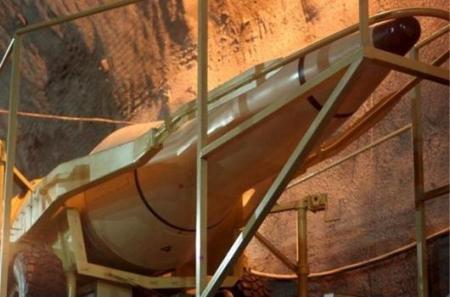
A missile is seen inside an underground missile base for Iran's Islamic Revolutionary Guards Corps (IRGC) Aerospace Force at an undisclosed location in this undated handout photo courtesy of Fars News. REUTERS/farsnews.com/Handout via Reuters

A missile is seen inside an underground missile base for Iran’s Islamic Revolutionary Guards Corps (IRGC) Aerospace Force at an undisclosed location in this undated handout photo courtesy of Fars News. REUTERS/farsnews.com/Handout via Reuters

President Barack Obama said Friday April 1, that “Iran has so far followed the letter of the [nuclear] agreement [with the six powers], but, he added, “the spirit of the agreement involves Iran also sending signals to the world community and business that it is not going to be engaging in a range of provocative actions that may scare business off,” such as fire-testing nuclear-capable ballistic missiles, calling for Israel’s destruction and providing Hizballah with missiles.

At a news conference ending the two-day nuclear summit in Washington, Obama went on to say: “Some of the concerns that Iran has expressed, we are going to work with them to address.” But meanwhile, he said, the US and its allies are taking steps to help Iraq benefit from the agreement by facilitating trade and banking transactions with the Islamic Republic; and the US Treasury Department is seeking to set clearer investment guidelines for Iran.

Two days earlier, on Wednesday, March 30, the Obama administration was reported acting to give Iran limited access to US dollars, since the almost complete lifting of sanctions in January, which netted Tehran an injection of approximately $150 billion “hasn’t provided the country with sufficient economic benefits.”

DEBKAfile’s analysts note the inherent contradiction in the US president’s approach to Tehran: He wants Iran to be compensated with a never-ending shower of dollars for agreeing to limit its nuclear program, but “the US and its allies” cannot question how the money is spent.

So while the West, under orders from Washington, must scramble to boost the Iranian economy, Tehran may continue to test ballistic missiles until they are nuclear capable, and top up the Hizballah terrorists’ arsenal with ever deadlier tools of death.

This glaring inconsistency arises from a fact largely hidden from the world public: last year’s landmark nuclear accord was concluded by Iran’s President Hassan Rouhani and Foreign Minister Mohammed Javad Zarif – not by the real powers in Tehran, supreme leader Ayatollah Ali Khamenei, the Revolutionary Guards chiefs and the ayatollahs at the head of the fundamentalist Shiite movement.

Indeed, even Rouhani was never allowed to formally sign the deal, much less gain Khamenei’s ratification.

But now, Rouhani’s fate depends on keeping those ruling elites happy.  He has found himself in the position of their hostage, a cash machine for keeping the funds for the Islamic Republic’s projects termed by President Obama “provocative” constantly on tap.

Those projects which are currently in full spate clearly leave every little over from the $150bn to even start lifting the Iranian economy out of its mess, while the Rouhani’s government carries the can for that too. Indeed, DEBKAfile’s Iranians sources disclose, the president is forced to earmark 50 percent of the funds released by sanctions relief for items listed under “defense”, namely,  the nuclear and missile development programs, Iran’s overseas military operations, including the Syrian war, subsidizing the Lebanese Hizballah, and establishing new terrorist organizations for attacks on Israel, such as the Al-Sabirin, on the Golan.

These enterprises eat up billions of dollars. Just Iran’s operations in Syria and support for Hizballah cost Tehran $2 billion every month.

Syrian president Bashar Assad didn’t surprise anyone when he revealed that the five-year civil war in his country had cost $200 billion so far. With this kind of spending on “defense,”  the Iranian economy will continue to decay, while Rouhani’s government, which promised the people a better life after the nuclear accord, must bow to the will of the hard-liners or face the consequences.

Our Iranian sources report that Obama’s inconsistent approach to Iran has sharpened the discord between the two major political camps in Tehran and put the “reformists” in extreme peril should they dare to defy the hard-liners who hold the levers of power. Khamenei has publicly threatened to liquidate such opposition leaders as Rouhani and his ally, former president Ayatollah Akbar Hashemi Rafsanjani.

President Rouhani has been put by Obama’s policy in the position of having to keep Tehran’s hungry war- and terror-mongers flush with cash, if he is to save himself and fellow “reformists” from “liquidation.”

The supreme leader was pretty blunt when he said on Friday, March 29, “Those who say the future is in negotiations, not in missiles, are either ignorant or traitors.” This comment underlined Iran’s overriding commitment to developing nuclear missiles and a warning to “traitors” of their fate: execution or a life sentence in a grim Iranian jail.

Op-Ed: Obama’s public face – a political theater of distraction and deception

March 20, 2016

Op-Ed: Obama’s public face – a political theater of distraction and deception, Israel National News, Jeffrey Ludwig, March 20, 2016

In his article “Iran’s Diplomacy for Dummies,” Jonathan Tobin, a totally reasonable individual, again misses the perfidy of Obama’s policies, towards Iran.  We brought to the UN our concerns about Iran testing ballistic missiles being a violation of the Iran deal.  Russia stated flatly that they “would not permit sanctions to be [re-] imposed because Iran’s actions did not violate UN Security Council resolutions.”  Samantha Powers expressed frustration and dismay at the Russian reaction to our concerns.

However, Amb. Powers’ comments against the Russians in the UN were nothing more than a charade. Her comments were a pretense of being offended by Russia.  The Obama administration was just playing politics with the issue, and using Samantha as the actress to give voice to our “concern” in this one-act political theater. We pretend to be standing up for real-time enforcement of the Iran deal, and then blame the Russians when enforcement is prevented. Whereas the truth is there was no real expectation or desire for enforcement by Obama and his lady advisors from day one of the negotiations or our sign-off.  Powers and Obama are merely trying to appear earnest in their implementation of the treaty (which they falsely called an agreement).

The charade (i.e., playacting) can be seen at work over a variety of political scenarios.  These bits of play acting are the modus operandi of the Obama administration.  They seek to reverse the idea found in Shakespeare’s drama “Hamlet.”  There we find the line, “The play’s the thing. Wherein [to] catch the conscience of the king.”   For the Obama inner clique, the principle is “the play’s the thing” to deflect our understanding of the king’s dereliction of duty for God and country.

We see this playacting during a recent interview.  During the course of the interview, Obama tried to appear measured and sincere in his thinking.  For example, he says to the interviewer, “Real power means you can get what you want without having to exert violence.”  He presented himself as a wise Solon who prefers negotiation to force. Here he may not be completely duplicitous but simply be in denial.

Many so-called peaceniks on the left fail to see the cowardly and traitorous underpinnings (motives) of their pseudo-pacifism. Thus, seen in a more honest light, we need to understand that preference for negotiation over force is, in reality, a preference for capitulation and a policy of fear. Capitulation is then interpreted as being wise and detached, whereas it is actually a flight from reality and the unpleasant experiences that accompany any of life’s confrontations.

He also pretended to be detached in the Shiite-Sunni conflict. According to Obama, the two sides “need to find an effective way to share the neighborhood.”  Bret Stephens of the Wall Street Journal tags this remark as sounding more “like Mr. Rogers.” However, this writer finds it to be more duplicitous and sinister than Mr. Stephens thinks.   In reality Obama has taken the side of the Shiites and of the Muslim Brotherhood wing of the Sunnis.  He has decided to reject Sunni leadership that is not rooted in Muslim Brotherhood ideology — in Libya (overthrew Qaddafi), Egypt (overthrew Hosni Mubarak and is not working cooperatively with General Abdel el-Sisi, but did send F-16s to el-Sisi’s predecessor Muslim Brotherhood President Mohamed Morsi), and Yemen (allowed a pro-Iranian Shiite faction to overthrow the pro-Saudi government).

Further, the U.S. has not lifted a finger to prevent Iranian-backed Hezbollah from taking over Lebanon.

Lastly, and most important from a Jewish perspective, he has justified U.S. funding of Hamas via their alliance with the PLO in 2014.   And we know that Hamas is a Shiite (Iranian-backed) organization with Muslim Brotherhood backing as well. Thus by saying to Goldberg that Shiites and Sunnis will just have to learn to get along, Obama was feigning a neutrality that in practice he totally rejects.  His remarks are pure political theater, totally divorced from the policies and practices of his administration.

Although Bret Stephens characterizes Obama’s thinking as shallow, it seems to this writer that Obama’s playacting is not rooted in shallowness, but simply in his being wrong. His underlying principles are ultimately harmful.  He is identified with left-wing pseudo pacifism (“pseudo” because violence is justified, but only for leftist ideals), a Marxist-derived anti-American bias that would portray the U.S. as an exploitative society, a bitter anti-Israel bias derived from his Muslim roots, and a false universalism (“false” because it is not God-centered).

His playacting is thus an attempt to distract from his deep ideological commitments. In Hamlet, the play was intended to reveal the hidden murderous action of the King of Denmark.  With the present U.S. executive branch, the intent of the playacting is to hide the murderous intent.

Iran’s Free Hand in Testing Ballistic Missiles

March 16, 2016

Iran’s Free Hand in Testing Ballistic Missiles, Front Page MagazineJoseph Klein, March 16, 2016

rg

The United Nations Security Council met in an “emergency” closed door session on Monday March 14th to discuss Iran’s recent testing of ballistic missiles reportedly designed to be capable of delivering nuclear weapons. The words “Israel must be wiped out” were written in Hebrew on the side of the missiles. These most recent tests followed in the wake of missile tests conducted last fall, which the Security Council did nothing about at the time.

While North Korea was finally hit with more UN sanctions for its nuclear and missile tests, North Korea’s nuclear weapons collaborators in Iran continue to be let off the hook without even a slap on the wrist.

U.S. Ambassador to the UN Samantha Power told reporters, after the March 14th meeting produced no concrete results, that she will keep trying “no matter the quibbling that we heard today about this and that.” She said that Iran’s missile tests were “in defiance of provisions of UN Security Council Resolution 2231, the resolution that came into effect on January 16, on Implementation Day for the JCPOA [Joint Comprehensive Plan of Action].”

The quibbler in chief is Russia. Its UN ambassador said that Iran has not violated the resolution and that there was no need for any punitive measures against Iran.

The truth is that the Obama administration is now hoisted with its own petard. Ambassador Power complained that “Russia seems to be lawyering its way to look for reasons not to act rather than stepping up and being prepared to shoulder our collective responsibility.” Yet that would not have been as easy for Russia to do if the Obama administration had not allowed a loophole in the nuclear deal wide enough for Iran to fire a whole bunch of missiles through.

President Obama wanted the nuclear deal with Iran so badly that he gave in to Iran’s last minute demands to preserve its missile program. Iran insisted that all prior UN Security Council resolutions which had unambiguously prohibited Iran’s development, testing or procurement of ballistic missiles designed to be capable of delivering nuclear weapons must be terminated. Otherwise, Iran would not go forward with the JCPOA. To make matters worse, even though Iran had held the JCPOA hostage to its missile demands, the Obama administration also bowed to Iran’s insistence that its missile program would not be covered by the JCPOA itself. Thus, Iran would not be subject to the automatic “snap back” of sanctions when Iran is found to have violated the JCPOA, because its missile tests would be outside the scope of the JCPOA. In fact, the Obama administration agreed to language in the JCPOA to clarify that such separation of Iran’s missile program from the JCPOA was the intent. All reliance for dealing with Iran’s missile tests would be placed on the much weaker Security Council Resolution 2231.

The new Security Council Resolution 2231, which endorsed the JCPOA but drafted as separate from the JCPOA, used weaker language than the outright prohibition that had existed under the prior resolutions that were now superseded. Calling upon Iran to refrain from doing something is not the same as an enforceable ban. Moreover, even this insipid “call upon” language is included in an annex to the resolution. This annex is little more than a statement of intent by the parties negotiating with Iran, which Iran does not consider binding on itself.

The Obama administration missed the window of opportunity to clamp down on Iran’s missile testing when those tests were being conducted last fall. The previous Security Council resolutions that prohibited Iran’s missile program outright, and the sanctions regime against Iran, were then still in effect. Those resolutions were referenced in the JCPOA itself as still being binding until the JCPOA was actually implemented. Implementation in turn was dependent on verification of Iran’s compliance with certain commitments set forth in the JCPOA having to do with its enrichment and plutonium programs. Until the JCPOA’s formal implementation date of January 16, 2016, when those resolutions were terminated, the missile program ban had not been technically untethered from the JCPOA.

All the Obama administration had to do last fall was to declare Iran in breach of the JCPOA because the missile ban under those resolutions that Iran breached were effectively incorporated into the JCPOA until terminated. The sanctions were still in place. Iran’s assets were still frozen. Russia’s “lawyering” would have done it little good last fall when the United States still had the upper hand both legally and in practical terms. But President Obama frittered away the last real chance to hold Iran’s feet to the fire before the sanctions were lifted. He wanted the nuclear deal to go forward as a centerpiece of his “legacy” and let the next president worry about its fallout.

In fact, instead of pressing the case against Iran and threatening to walk away from the JCPOA when he had the leverage, Secretary of State John Kerry actually defended Iran’s position on its missile tests. “The issue of ballistic missiles is addressed by the provisions of the new United Nations Security Council Resolution (UNSCR), which do not constitute provisions of the Joint Comprehensive Plan of Action (JCPOA),” Kerry wrote in a letter to Senator Marco Rubio last September.  “Since the Security Council has called upon Iran not to undertake any activity related to ballistic missiles designed to be capable of delivering nuclear weapons, including launches using such ballistic missile technology, any such activity would be inconsistent with the UNSCR and a serious matter for the Security Council to review.”

Rubio raised his concern with Kerry that the language in the new Security Council resolution did not appear to require Iran to refrain from pursuing its ballistic missile tests. Rubio seized upon the weak “call upon” language discussed earlier as the basis for his concern. Kerry’s response was that “if Iran were to undertake them it would be inconsistent with the UNSCR and a serious matter for the Security Council to review.”

Senator Rubio had a right to be concerned. Kerry had deliberately agreed to a circular process to deal with Iran’s missile program violations, which was doomed to fail. To placate Iran, he kicked the can down the road until the JCPOA was actually implemented and the prior, much stronger Security Council missile resolutions that were initially tied into the JCPOA by reference went away. The separation of the JCPOA and the new Security Council resolution was completed as of the formal implementation date. Kerry had to know that once the JCPOA was implemented and in full force, with sanctions lifted and the missile program separated out from the JCPOA with its automatic “snap back” provisions, Russia would likely veto any separate sanctions resolution against its ally and missile purchaser based on Iran’s missile tests. The American people got suckered by President Obama’s reckless concessions.

Iran not only will have a pathway to nuclear enrichment sufficient to produce nuclear weapons when the deal’s restrictions sunset – if not before. Thanks to the Obama administration, Iran presently has a free hand to develop and test ballistic missiles capable of delivering those nuclear weapons along any pathway of attack it chooses.

Russia Reminds Obama: You Caved on Iran’s Missile Program, Bro

March 15, 2016

Russia Reminds Obama: You Caved on Iran’s Missile Program, Bro, Washington Free Beacon, Beacon Staff, March 15, 2016


https://www.youtube.com/watch?v=G-isxwtpw_U


Days after the latest Iranian ballistic missile test, Russia and Iran are telling the Obama administration that Iranian missile tests are not prohibited by the UN Security Council, as the administration argues.

Russia and Iran cited language about ballistic missiles that was changed during last summer’s nuclear negotiations in Vienna. UN Security Council Resolution 1929 had stated plainly: “Iran shall not undertake any activity related to ballistic missiles.” During the negotiations, Iran demanded the removal of this uncompromising language in favor of a new, softer formulation.

The Obama administration complied, resulting in the passage of a new UN Security Council Resolution after the Iran agreement was reached. The new resolution merely “calls upon Iran not to undertake any activity related to ballistic missiles.”

The change in language—from the “shall not” requirement of the original resolution to the “calls upon” suggestion of the new one—was the subject of intense questioning by Congress precisely due to the suspicion that the administration had provided a loophole Iran would use to justify missile development.

In one exchange, Sen. Robert Menendez (D., N.J.) pressed Secretary of State John Kerry to acknowledge that the change in language was substantive.

“The ban on Iranian ballistic missiles,” Menendez told Kerry, “has, in fact, been lifted. The new Security Council resolution is quite clear. Iran is not prohibited from carrying out ballistic missile work.” Kerry rejected Menendez: “That is not accurate … [Iran is] restrained from any sharing of missile technology, purchase of missile technology, exchange of missile technology, work on missiles.”

In response to the Obama administration’s announcement that it would pursue sanctions after Iran’s latest missile test, Russia’s UN Ambassador raised precisely the objection that Menendez and other critics of the deal did: Obama and Kerry removed the prohibition on Iranian ballistic missile work last summer, when they agreed to remove the “shall not” language from the relevant UNSC resolution.

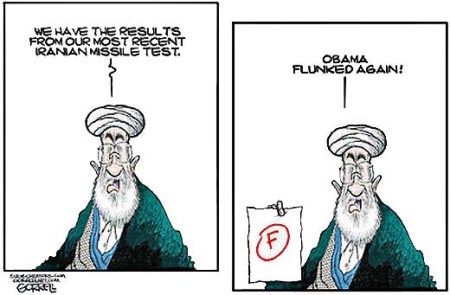
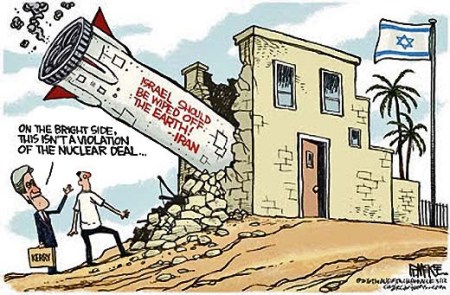
Cartoons of the Day

March 13, 2016

H/t Vermont Loon Watch

a-test
treaty

New Iron Dome version can destroy tunnels

March 11, 2016

New Iron Dome version can destroy tunnels, DEBKAfile, March 11, 2016

Anti_tunnel_missile_NEWIran keeps its ballistic missiles in underground bunkers

Israel has started testing a secret new weapon for defeating the tunnel systems which the Palestinian Hamas and Hizballah are busy digging for surprise attacks against Israel. Western sources reported Friday, March 11, that the new weapon, dubbed the “Underground Iron Dome,” can detect a tunnel, then send in a moving missile to blow it up.

US intelligence sources disclosed only that new weapon is equipped with seismic sensors to detect underground vibrations and map their location before destroying them.

Western experts have been talking for years about a secret Israeli weapon capable of destroying Iran’s Fordo nuclear facility, which is buried deep inside a mountain not far from the Shiite shrine city of Qom. They suggested that this hypothetical weapon could be slipped through the Fordo facility’s vents, thread its way through the underground chambers and take down the illicit enrichment facility.

It was discussed again three years ago, when the Israeli Air Force on Aug. 23 2013 blew up the Popular Palestinian Front-General Command underground facility at Al-Naama on the South Lebanese coast, 15 km south of Beirut.

The PPF-GC leader Ahmed Jibril was then taking his orders from Iran’s Revolutionary Guards Corps.

How this operation turned out was never revealed. But Western military sources saw it as a strong Israeli message to Tehran that its underground nuclear facilities were now vulnerable to attack. The secret JIbril command center was constructed in the 1970s by East German military engineers as one of most heavily fortified military sites in the Middle East.

As for the new weapon, the Pentagon spokesman Christopher Sherwood said that the US had allocated $40 million for completing in 2016 the establishment of “anti-tunnel capabilities to detect, map and neutralize underground tunnels that threaten the US or Israel.”

According to the spokesman, the main part of the development work (on the secret weapon) would be conducted in Israel in 2016. The US would receive prototypes and access to the test sites and hold the rights to any intellectual property.

The Israeli firms working on the anti-tunnel weapon are Elbit Systems and Rafael Advanced Defense Systems, which developed the Iron Dome.

Sherwood denied claims from Israeli defense quarters that the US had earmarked $120 for developing the system, or that another $80 million would be available – half in 2017 and half in 2018.

DEBKAfile’s military sources emphasize that the timeline implicit in those estimates doesn’t necessarily represent the tempo of he Underground Iron Dome’s development.

According to past experience, unfinished Israeli weapons have more than once been rushed to the battlefield to meet an emergency war situation. The Iron Dome is one example. This has the advantage of testing innovative systems in real operational conditions, with the result that improvements and adjustments can be introduced much faster than planned.

Our sources add: Both Palestinian Hamas and the pro-Iranian Hizballah are working overtime on tunnels for sneaking terrorists and commando fighters into Israel to attack IDF posts and civilian locations. During Israel’s last counter-terror operation in the Gaza Strip, Hamas staged a deadly tunnel attack on the Israel side of the border and is planning repeats. Hizballah is training commando units for underground surprise incursions to capture parts of Galilee in northern Israel.

The Israeli government has spent more than $250 million since 2004 on efforts to thwart tunnel construction under the Gaza border.

IDF Chief of Staff Gen. Gadi Eisenkot hinted at these efforts in February. “We are doing a lot, but many of [the things we do] are hidden from the public,” he told a conference at Herzliya’s Interdisciplinary Center. “We have dozens, if not a hundred, engineering vehicles on the Gaza border.”

How Obama made Iran’s Latest “Destroy Israel” Missile Launches Possible

March 10, 2016

How Obama made Iran’s Latest “Destroy Israel” Missile Launches Possible, Front Page Magazine, Daniel Greenfield, March 10, 2016

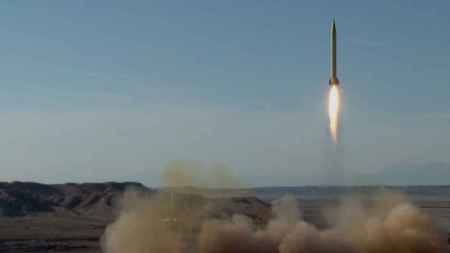
Iran rocket takes off

Back in the Senate, Obama was a fierce opponent of classifying Iran’s IRGC, the core organizing point for Iran’s national and international terror network, as a terror group. He complained that such a move would be provocative. The worthless Iran nuke deal didn’t apply to Iran’s ballistic missile program. And the sanctions relief brought an economic windfall to the IRGC.

So this is the inevitable outcome, not just of Obama’s deal with Iran, but of his entire policy history on Iran even before he took office.

For the second day in a row, Iranian state television has broadcast propaganda videos that show the launch of several ballistic missiles with anti-Israel intent.

A video released Tuesday shows the inside of an underground tunnel used for launching the missiles. It features an Israeli flag painted on the ground which Islamic Revolutionary Guard Corps, or IRGC, members are meant to walk over on their way to launch.

Wednesday’s video shows another two missiles labeled with “Israel must be wiped off the Earth” in Hebrew. Persian-language media headlines included the Hebrew message in order to emphasize the IRGC’s anti-Israel intentions. The missiles were reportedly precision-guided Qadr missiles that put Israel within striking range.

Amir Ali Hajizadeh, commander of the IRGC aerospace division, said that the tests were meant to intimidate Israel.

“The reason we designed our missiles with a range of 2,000 km (1,200 miles) is to be able to hit our enemy the Zionist regime from a safe distance,” Hajizadeh said. “Israel is surrounded by Islamic countries and it will not last long in a war. It will collapse even before being hit by these missiles.”

Before this, the media ran a blitz about “moderates” winning in Iran. As with most terrorist organizations, the term “moderates” is completely meaningless.

Tehran’s show of force—it also tested missiles on Tuesday—are not the work of the usual “hardline” suspects. Iran tested ballistic missiles last fall in violation of a U.N. Security Council resolution, and in January Mr. Rouhani publicly ordered his defense minister to speed up missile testing and production… The tests appear to be timed to coincide with Vice President Joe Biden’s visit to Israel.

So there’s a clear message. It continues Iran’s pattern of slapping Obama across the face and seeing how far back he runs.

Part of the problem is that Secretary of StateJohn Kerry bowed to Iranian demands during the nuclear negotiations not to include ballistic missiles as part of the final deal, though missiles are an essential component of any nuclear program.

Instead, the U.S. pushed a weak resolution through the Security Council, which “called upon” Iran to wait eight years before building or fielding missiles “designed to be capable of delivering nuclear weapons.” Tehran insists that, since it has supposedly abandoned its nuclear program, the current tests cannot violate the resolution.

So either Iran is pursuing a ballistic missile program for no particular reason or it’s continuing its nuclear weapons program while deliberately mocking Obama. Two guesses which one it is.

Jewish voters who believed Obama have been shown up once again. But it isn’t likely that they will learn. The cults of personality that drive people to support candidates, even when their views sharply contradict their supposed deeply held values, are fiercely powerful. And no amount of evidence can dissuade Jewish voters caught up in a cult of personality from voting for anti-Israel candidates.

Obama has effectively allowed Iran’s nuclear weapons program to proceed under the cloak of plausible deniability in which he pretends to believe Iran’s lies so that it can advance toward war.

Dangerous illusions about Iran

March 10, 2016

Dangerous illusions about Iran, Israel Hayom, Elliott Abrams, March 10, 2016

Last year’s Iran nuclear agreement was sold with several powerful arguments, and among the most important were these: that the agreement would strengthen Iranian “moderates” and thus Iran’s external conduct, and that it would allow us unparalleled insight into Iran’s nuclear program.

Both are now proving to be untrue, but the handling of the two differs. The “moderation” argument is being proved wrong but the evidence is simply being denied. The “knowledge” argument is being proved wrong but the fact is being met with silence. Let’s review the bidding.

The idea that the nuclear agreement was a reward for Iran’s “moderates” and would strengthen them is a key tenet of the defense of the agreement. If Iran remains the bellicose and repressive theocracy of today when the agreement ends and Iran is free to build nukes without limits, we have entered a dangerous bargain. It is critical that Iran change, so defenders of the agreement adduce evidence that it has. And the new evidence is Iran’s recent elections. Those elections were a great victory for “moderates” and hard-liners, it is said, and they help to prove that the nuclear deal was wise.

The problem here is that those elections were anything but a victory for Iran’s reformers. As Mehdi Khalaji wrote about the Assembly of Experts election, “If one understands ‘reformist’ as a political figure who emerged during the reform movement of the late 1990s and is associated with the parties and groups created at that time, then neither the candidates on the ‘reformist’ list nor the winners of Tehran’s sixteen assembly seats can credibly be called by that name.” To take one of the examples Khalaji cites, Mahmoud Alavi ran on what has been called a reformist ticket but he “is the current intelligence minister, and Supreme Leader Ali Khamenei appointed him as head of the military’s Ideological-Political Organization from 2000 to 2009.” Khalaji concludes that “no new prominent reformists won seats, and the proportion of hardliners remained the same.”

Ray Takeyh and Reuel Gerecht draw a stark conclusion: This year’s elections “spelled the end of Iran’s once-vivacious reform movement” which has simply been crushed by the regime. “The electoral cycle began with the usual mass disqualification of reformers and independent-minded politicians,” they remind us. I’d cite another fact: that reformers of past election years, presidential candidates Mir-Hossein Mousavi and Mehdi Karoubi, have remained under house arrest for five years now, during the entire Rouhani presidency, demonstrating the true fate of reformers of even a mild variety.

What’s the point of the “reformist” charade? As Takeyh and Gerecht note, “Foreigners don’t have to confess that they are investing in an increasingly conservative and increasingly strong theocracy; rather, they are aiding ‘moderates’ at the expense of hardliners.” But this charade has in fact worked well, producing headline after headline in the Western media about “reformist” victories. You can fool most of the people some of the time, or at least most of the people who have a strong desire to be fooled — because they wish to protect the nuclear deal and its authors.

Iran’s conduct certainly suggests radicalization rather than moderation, and the past weeks have seen repeated ballistic missile tests. Ballistic missiles are not built and perfected in order to carry 500 pound “dumb” bombs; they are used to carry nuclear weapons. So Iran’s continued work on them suggests that it has never given up its nuclear ambitions, not even briefly for the sake of appearances.

The American response has been anemic, even pathetic; we threaten to raise the issue at the United Nations. Two missiles were test-fired today, with the phrase “Israel must be wiped out” written on them. These tests violate U.N. Security Council resolutions, but the American reaction is cautious: a speech, a debate in New York, perhaps some sanctions, but nothing that could possibly lead Iran to undo the nuclear deal. Because Iran knows that this will be the Obama administration’s reaction, expect more and more ballistic missile tests. Expect more conduct like the interception, capture, and humiliation of American sailors in the Gulf. Expect more Iranian military action throughout the region.

Some moderation.

The head of CENTCOM, Gen. Lloyd Austin, put it this way: “We see malign activity, not only throughout the region, but around the globe as well. … We’ve not yet seen any indication that they intend to pursue a different path. The fact remains that Iran today is a significant destabilizing force in the region. … Some of the behavior that we’ve seen from Iran of late is certainly not the behavior that you would expect to see from a nation that wants to be taken seriously as a respected member of the international community.”

Are we now, to turn to the second matter, gaining unparalleled insight into the Iranian nuclear program? Is this one of the achievements of the agreement? On the contrary, it seems. As the Associated Press put it, “The four Western countries that negotiated with Iran — the U.S., Britain, France and Germany — prefer more details than were evident in last month’s first post-deal [International Atomic Energy Agency] report. In contrast, the other two countries — Russia and China — consider the new report balanced, while Iran complains the report is too in-depth. IAEA chief Yukiya Amano feels he has struck the right balance, considering Iran is no longer in violation of U.N. and agency demands to curb its nuclear program. His report was much less detailed than pre-nuclear deal summaries.”

Much less detailed? Sure, because the U.N. Security Council resolutions under which the IAEA provided the detail, are gone, wiped out by the nuclear deal. The IAEA’s February 26 report was its first since the nuclear deal went into effect, and lacked details on matters such as uranium stockpiles, production of certain centrifuge parts, and progress by Iran toward meeting safeguard obligations. The Obama administration has wavered, sometimes saying there was enough detail, but then demanding more. The deal was sold, in part, as a way of providing transparency, but that does not appear to be accurate: it may in fact legitimize opacity. Earlier this week came a remarkable exchange between a reporter and State Department spokesman John Kirby, who defended the degree of knowledge we have.

Kirby said, “So we now know more than we’ve ever known, thanks to this deal, about Iran’s program.” The reporter, Matt Lee of AP, asked “How much near-20% highly enriched uranium does Iran now have?” Kirby replied, “I don’t know.” To which Lee noted, “You don’t know because it’s not in the IAEA report.”

So, the bases on which the nuclear agreement with Iran was sold appear to be crumbling. Moderates are not gaining power, Iran is not moderating its behavior, and we know less rather than more about what it is actually doing in its nuclear program. Some of those conclusions are denied by the administration and by credulous portions of the press, and others are ignored. But all those verbal games will not make us any safer.

From “Pressure Points” by Elliott Abrams. Reprinted with permission from the Council on Foreign Relations.