Archive for the ‘Iranian media’ category

Arab Commentators On American Sailors Incident: This Is Iran’s Message On The Eve Of JCPOA ‘Implementation Day’

January 14, 2016

Arab Commentators On American Sailors Incident: This Is Iran’s Message On The Eve Of JCPOA ‘Implementation Day’ MEMRI, January 14, 2016

On January 12, 2016, Iranian authorities arrested 10 American sailors from two small U.S. naval craft that had strayed into Iranian territorial waters. Iran’s Islamic Revolutionary Guard Corps (IRGC) arrested and handcuffed the crew and held them at a military base, releasing them a short time later. Iranian authorities released photos of the sailors kneeling with their hands on their heads.

Following the incident, articles were published in the Arab press both by supporters of Iran and by its opponents, claiming that, with its actions, Iran had sent a message to the U.S. Tareq Al-Homayed, former editor of the London-based Saudi daily Al-Sharq Al-Awsat, stated that the IRGC had shamed U.S. President Obama and shown him to be weak on the eve of the JCPOA’s “Implementation Day.” The Lebanese daily Al-Akhbar, which is affiliated with Hizbullah and supports the resistance axis, argued that the IRGC was sending a message to the U.S. that Iran will be willing to clash with it if it has to, and at the same time telling other countries – that is, the Gulf states – not to mess with Iran. It should be noted that Al-Akhbar’s January 14, 2016 front page showed the photo of the American sailors kneeling with hands on their heads, under a headline reading “Tehran to Washington: I Control The Gulf.”

26432January 14 Cover of Al-Akhbar: “Tehran to Washington: I Control the Gulf”

Article In Lebanese Daily Close To Hizbullah: Iran Sent U.S. And Others A Message That It Is Ready For A Clash

The Lebanese daily Al-Akhbar, which is close to Hizbullah and the Iranian axis, published an article by columnist Hassan Haidar, who claimed that Iran wanted to use this incident to send a message to the U.S. that it would not hesitate to clash with it if necessary. He added that this was also a message to other countries, hinting at the Gulf states, specifically Saudi Arabia, that the rules of the game have changed and that they must acknowledge their own weakness.

He wrote: “This incident was a quiet yet an important battle, since it took place off the Saudi coast, targeted an American force, and triggered American [responses expressing] hope [that Iran would not hurt the sailors], which were akin to apologizing to Iran. Washington did not threaten war or raise its voice…

“The Revolutionary Guards, which are in charge of defending the Gulf, are known to ‘see but not be seen’ – a term coined by the head of their navy, General Ali Fadavi. This means that they watch [the goings on] in the Gulf without being noticed by anyone, and in an emergency, they suddenly appear.

“The Revolutionary Guards possibly wanted to send a message to all, that if Iran feels that its interests and security are at stake, it will be willing to enter any conflict, even with the U.S…. [Furthermore,] dealing with Washington in this way ensures that smaller [countries] understand that Tehran will never hesitate to respond to any violation of its sovereignty, and that the rules of the game have changed, and therefore certain [elements] should recognize the limits of their power.”[1]

Leading Saudi Writer: Iran Kidnapped Not Only The Sailors But Obama Himself As Well

Tareq Al-Homayed, former editor of the London-based Saudi daily Al-Sharq Al-Awsat, wrote on January 14, 2016 that the arrest of the American sailors just hours before President Obama’s final State of the Union address had cast a shadow over the address, and had in effect kidnapped the president himself. He noted that the kidnapping had proven that Iran has no intention of moderating its positions, and had exposed Obama, who wanted to present the nuclear agreement with it as a great achievement, in all his weakness. Al-Homayed wrote: “When Iran’s Revolutionary Guards seized two American naval craft in the Gulf on Tuesday evening [January 13, 2016], with ten American sailors on board, it was not the sailors who were the important point, but the fact that the Revolutionary Guards effectively kidnapped U.S. President Barak Obama [himself only] a few hours before he was to deliver his final State of the Union address, towards the end of his second term in office. The crisis of the American sailors [detained by] Iran ended [just] a few hours after their arrest, but it was Obama’s speech that was hijacked, since the Iranians deprived Obama of the opportunity to appear as the strong man who had forced Iran to capitulate on the nuclear dossier. The sailors’ arrest deprived Obama of the chance to boast of the legitimacy of the nuclear agreement and to tell America, which is divided on the Iranian issue, as is the entire world, that Iran has changed and will once again become an active member of the international community, [a country] that renounces violence and respects international treaties and agreements. Some may say that the Iranians’ conduct was foolish, and this is true – but so was placing faith in the Iranian regime!

“Hence, the arrest of the Iranian sailors [right] before Obama’s address exposed the weakness of the American president and sparked doubts even in those who defend his foreign policy, especially [his policy] towards Iran’s [behavior] in our region. Embarrassment was apparent even among the White House staff, as manifest in leaks and excuses conveyed by Obama’s staff to the U.S. media during the sailors’ detention. The biggest embarrassment was over Obama’s handling of the incident… and [the question of] whether or not he would refer to it in his pre-prepared speech. So what we witnessed was not so much the abduction of the sailors but the abduction of the American president himself. His ransom was the missed opportunity to present himself as a strong president enjoying the legitimacy of achieving the nuclear agreement with Iran.

“With the premeditated intent to abuse the American president and to present his weakness to all, the Revolutionary Guards arrested the American sailors, and in fact kidnapped Obama himself, [just] days before the expected implementation of the nuclear agreement they will not submit and that Obama is too weak to boast of victory over them. Likewise, the Revolutionary Guards seek to tell anyone, in Iran and outside it, that their hand is still uppermost in Tehran, despite everything that has happened to Iran recently, after the wild attack on the Saudi Embassy in Iran and Tehran’s apology to the [UN] Security Council for this. Additionally, the IRGC’s action [i.e. detaining the sailors] is a response that embarrasses the propaganda of the Iranian president [Rohani] and his men – particularly the wily foreign minister [Zarif] and others – who claim that they want peace and openness, as they market lies and corrupt accusations against Saudi Arabia.

“Obama’s predicament is not manifested only in his kidnapping, but [also] in that he wants to take a neutral stand vis-à-vis the recent Iranian hostility against Saudi Arabia and the entire region. But he himself became a victim of Iran when [Iran] kidnapped him [just] before his final State of the Union address, and wrecked his opportunity to present himself as an accomplished hero when [his accomplishments] are in fact not yet completed.”[2]


Endnotes:

[1] Al-Akhbar (Lebanon), January 14, 2016.

[2] Al-Sharq Al-Awsat (London), January 14, 2016.

Hizbullah Sec.-Gen. Nasrallah: The U.S. Supports ISIS, Runs the Entire War in Our Region

October 30, 2015

Hizbullah Sec.-Gen. Nasrallah: The U.S. Supports ISIS, Runs the Entire War in Our Region,Middle East Media Research Institute TV via You Tube, October 29, 2015

(Oh well. — DM)


https://www.youtube.com/watch?v=awVTuBjzcYc


According to the blurb following the video,

In an October 23 speech at a ceremony marking the ‘Ashura holiday in Beirut, Hizbullah Secretary-General Hassan Nasrallah said that the U.S. “provided ISIS with money, weapons, and aid,” and that “the war raging in our region is actually being led by the US.” The speech aired on the Iranian Al-Alam TV channel.

Humor | Obama supports Iran’s self inspection

August 20, 2015

Obama supports Iran’s self inspection, Dan Miller’s Blog, August 20, 2015

(The views expressed in this article are those of my imaginary guest author, Senator Ima Librul, and do not necessarily reflect mine, those of Warsclerotic or any of its other editors. — DM)

In an exclusive interview with the FARtz News Agency, President Obama today voiced firm support for any deal bewteen Iran and the International Atomic Energy Agency permitting Iran to know for sure what it hasn’t been doing at its alleged military sites.

veto (1)

Editor’s note: This is a guest post by my (imaginary) colleague, the Very Honorable Ima Librul, Senator from the great State of Confusion Utopia. He is a founding member of CCCEB (Climate Change Causes Everything Bad), a charter member of President Obama’s Go For it Team, a senior member of the Senate Foreign Relations Committee and Chairman of the Meretricious Relations Subcommittee. He is also justly proud of his expertise in the care and breeding of green unicorns, for which his Save the Unicorns Foundation has received substantial Federal grants. We are honored to have a post of this caliber by a quintessential Librul such as the Senator.

********************

During His FARtz interview President Obama stated,

Secretary Kerry and I are both delighted with any deal between the International Atomic Energy Agency and Iranian officials which helps Iran to become more introspective. Introspection is good for the soul and I Myself engage in it often to help Me understand the very few instances in which I may have made mistakes and to atone for them. Almost always, I discover that I was right in the first place and wrong in even considering the possibility that I might have been wrong.

If in the past Iran mistakenly declared that it had never attempted research and development of nuclear weapons, its own inspection of Parchin and other alleged military sites should be instrumental in discovering its mistake and advising the World. For example, many years ago Iranianian scientists may have rubbed two pieces of Uranium ore together and, upon discovering that they did not explode, given up all hope of ever trying to develop nuclear weapons. My administration and Iran’s other friends need to know. Then we can put aside any and all lingering doubts about Iran’s exclusively peaceful nuclear program.

World reaction to Obama’s remarks was swift and almost entirely favorable.

iran_self_inspection_cartoon_by_mike

Iran’s Tasnim News Agency praised His enlightened understanding of the possibility of human error and, indeed, even His own. “Talking with President Obama is a humiliating humbling experience!” The often unfairly critical New York Times Editorial Board offered similar praise for Obama’s charming candor and His recognition that even Iran’s allegedly Mad Mullahs are as reasonable as He Himself is. It suggested that Obama follow up on His interview by issuing an Executive Decree pursuant to which

a committee selected by Iran’s Supreme Leader shall have sole authority to determine which, if any, remaining sanctions will be lifted, when, and whether any possibility of their reimposition — or the reimposition of previously removed sanctions —  will be permitted.

Obama’s deputy under secretary for press relations stated that Obama had immediately set to work crafting such a decree.

Only one Israeli newspaper, an infrequently read far right-wing scandal sheet favored by Prime Minister Netanyahu’s wife, had an adverse and therefor obviously racist headline: “IT’S A DARK DAY FOR AMERICA!” Less blatantly right wing Israeli media, such as Haaretz, immediately condemned the story in an article headlined “AS ALWAYS, OBAMA DOES THE RIGHT THING AGAIN.”

Tratorious Republicans, who are trying to kill Obama’s wonderful deal with peace-loving Iran to starve innocent Iranian children, took a position comparable to that of the far right-wing Israeli scandal sheet. For example, Tod Krutz, junior senator from a smelly coal mining village in West Virginia, argued

Whether Iran knows what it’s not been doing is less important than the U.S. Congress knowing what it has been doing. I therefore demand that House Speaker Boehner go immediately to Iran to investigate the Parchin military facility and stay there until he finds out what’s been happening. [Emphasis added.]

Speaker Boehner declined the invitation, lamenting that his miniscule budget does not permit him to acquire any possibly necessary anti-radiation clothing. He did, however, offer tearful thinks to Senator Krutz for the confidence he had placed in his ability and scientific knowledge.

Conclusion

It is indeed a sad day for America when even a right-wing Israeli paper such as Haaretz is less critical of our Dear President than some tratorious, racist Republicans such as Senator Krutz. President Obama, a very sensitive and loving person, needs our unstinting help. In this, His time of need, we must all stand behind Him as He battles the forces of oppression, ignorance and racism sadly still rampant in the U.S. Congress.

International inspections of Iran’s nuke sites are a sick joke

August 20, 2015

International inspections of Iran’s nuke sites are a sick joke, Dan Miller’s Blog, August 19, 2015

(The views expressed in this post — which for the most part consists of links to and quotations from recent articles posted at Warsclerotic — are mine and do not necessarily reflect those of Warsclerotic or its other editors. — DM)


Over the past few days, Iranian officials have confirmed that international inspections of its nuke sites will be severely limited if permitted at all. This post provides excerpts from recent articles quoting them. 

Iran’s nuke sites

The restrictions noted in this post are in addition to previously disclosed prohibitions on access by International Atomic Energy Agency (IAEA) inspectors to military sites, which Iran itself will inspect instead. Even The Daily Beast has mentioned this problem in reliance on an Associated Press article which states,

All IAEA member countries must give the agency some insight into their nuclear programs. Some are required to do no more than give a yearly accounting of the nuclear material they possess. But nations— like Iran — suspected of possible proliferation are under greater scrutiny that can include stringent inspections. [Emphasis added.]

The agreement in question diverges from normal procedures by allowing Tehran to employ its own experts and equipment in the search for evidence of activities it has consistently denied — trying to develop nuclear weapons. [Emphasis added.]

Olli Heinonen, who was in charge of the Iran probe as deputy IAEA director general from 2005 to 2010, said he could think of no similar concession with any other country.

Recent disclosures

According to an article by Adam Kredo at Washington Free BeaconNo international inspectors will be admitted to Iran unless approved by Iranian intelligence officials.

A senior Iranian official declared on Monday that international nuclear inspectors would only be permitted into the country once they receive approval from the Islamic Republic’s Intelligence Ministry, putting another roadblock between the International Atomic Energy Agency (IAEA) and Iran’s contested nuclear sites.

Sayyed Abbas Araqchi, Iran’s deputy foreign minister and one of the top negotiators in talks that led to the recently inked nuclear deal, told the country’s state-controlled press that Iran’s intelligence apparatus must approve of any inspector who is issued a visa to enter Iran. [Emphasis added.]

Acording to an article at DEBKAfileNo international inspectors will be given access to military sites unless they first submit acceptable evidence of prohibited nuke activities there.

International nuclear inspectors will only be permitted into the country after offering proofs of suspicious activity at the sites to be inspected, Iran’s Defense Minister Brig. Gen Hossein Dehqan said Tuesday. DEBKAfile: This condition is not contained either in the nuclear deal Iran signed with the six world powers last month or in its contract with the IAEA. How will the international watchdog obtain proofs if it is denied visits for inspections? [Emphasis added.]

According to another article by Adam Kredo at Washington Free Beaconthe head of the International Atomic Energy Agency (IAEA) was threatened with “harm” should he tell U.S. officials about the Iran – IAEA secret deal(s)

Iranian leaders prevented a top International Atomic Energy Agency (IAEA) official from disclosing to U.S. officials the nature of secret side deals with the Islamic Republic by threatening harm to him, according to regional reports. [Emphasis added.]

Yukiya Amano, IAEA director general, purportedly remained silent about the nature of certain side deals during briefings with top U.S. officials because he feared such disclosures would lead to retaliation by Iran, according to the spokesman for Iran’s Atomic Energy Organization (AEOI).

Amano was in Washington recently to brief members of Congress and others about the recently inked nuclear accord. However, he did not discuss the nature of side deals with Iran that the United States is not permitted to know about.

Iran apparently threatened Amano in a letter meant to ensure he did not reveal specific information about the nature of nuclear inspections going forward, according to Iranian AEOI spokesman Behrouz Kamalvandi.

“In a letter to Yukiya Amano, we underlined that if the secrets of the agreement (roadmap between Iran and the IAEA) are revealed, we will lose our trust in the Agency; and despite the US Congress’s pressures, he didn’t give any information to them,” Kamalvandi was quoted as saying Monday during a meeting with Iranian lawmakers, according to Tehran’s state-controlled Fars News Agency.

“Had he done so, he himself would have been harmed,” the official added. [Emphasis added.]

If these analyses are correct, and they appear to be, there will be no meaningful “anytime anywhere” international inspections of Iranian military sites. Although Obama has repeatedly said that the current nuke “deal” is not based on trust, that appears to its only basis, an absurd one.

Iran’s missiles

Acording to another DEBKAfile article, Iran’s missile research and development are continuing despite (or perhaps because of) the August 2015 “deal.”

Shortly before US Secretary of State John Kerry was due in Qatar Monday, Aug. 3, Iran’s highest authorities led by supreme leader Ayatollah Ali Khamenei Sunday launched a public campaign to support Tehran’s noncompliance with the Vienna nuclear accord and UN Security Council Resolution 2231 of July 20, on its ballistic missile program. The campaign was designed by a team from Khamenei’s office, high-ranking ayatollahs and the top echelons of the Revolutionary Guards, including its chief, Gen. Ali Jafari. [Emphasis added.]

. . . .

The Security Council Resolution, which unanimously endorsed the Joint Comprehensive Plan of Action (Vienna nuclear accord) signed by Iran’s Foreign Minister Mohammed Javad Zarif, called on Iran not to undertake any activity related to ballistic missiles designed to be capable of delivering nuclear weapons, including launches using such ballistic technology until the date eight years after the JCPOA Adoption Day.” [Emphasis added.]

Tehran retorted that none of its ballistic missiles were designed to deliver nuclear weapons, and so this provision was void. Shortly after its passage, the foreign ministry in Tehran issued an assurance that “…the country’s ballistic missile program and capability is untouched and unrestricted by Resolution 2231.”

On July 30, Ali Akbar Velayati, Khamenei’s senior adviser on international affairs and member of the Expediency Council, told reporters, “The recent UNSC Resolution on Iran’s defensive capabilities, specially (sic) its missiles, is unacceptable to Iran.”

According to an August 16th article at the Iranian media site Tasnim, there is no impediment to continuation of Iran’s missile program.

TEHRAN (Tasnim) – Chief of Staff of the Iranian Armed Forces Major General Hassan Firouzabadi underlined that there are not any obstacles to the country’s missile program. [Emphasis added.]

“The Islamic Republic of Iran’s missile activities, as planned inside the country, will not face any obstacles,” the senior officer stressed on Sunday.

The general also reiterated that Iran’s missile tests are going to be carried out in a timely manner according to the plans endorsed by Supreme Leader of the Islamic Revolution Ayatollah Seyed Ali Khamenei.

Iran – North Korea nuke nexis

Nuke cooperation between Iran and North Korea was not considered during the P5+1 “negotiations.” The text of the current “deal” is silent on the subject. Kerry’s State Department has limited media contact with Douglas Frantz, his Assistant Secretary in charge of the Bureau of Public Affairs, to avoid releasing information on the Iran – North Korea nuke nexus. Mr. Frantz, formerly a highly respected journalist, had written extensively on North Korea’s nuclear program.

An honest accounting would quite likely reveal something that many press reports have alleged, but U.S. administration officials have never publicly confirmed: A history of nuclear weapons collaboration between Iran and nuclear-proliferating North Korea.

. . . .

Drawing on “previously secret reports, international officials, independent experts, Iranian exiles and intelligence sources in Europe and the Middle East,” Frantz wrote that “North Korean military scientists recently were monitored entering Iranian nuclear facilities. They are assisting in the design of a nuclear warhead, according to people inside Iran and foreign intelligence officials.”

. . . .

Perhaps Frantz should recycle that article to Secretary of State John Kerry, who while testifying to a congressional panel last month was asked about its allegations by Rep. Christopher Smith, and ducked the question.

. . . .

[I]t appears that as a State Department advocate of a free and well-informed press, Frantz himself is not free to answer questions from the press about his own reporting on North Korea’s help to Iran in designing a nuclear warhead. The State Department has refused my repeated requests to interview Frantz on this subject. Last year, an official at State’s Bureau of Public Affairs responded to my request with an email saying, “Unfortunately Assistant Secretary Frantz is not available to discuss issues related to Iran’s nuclear program.” [Emphasis added.]

. . . .

Of course, the real problem for the Obama administration is that an officially confirmed story of Iran-North Korea collaboration on nuclear warheads could spell further trouble for winning congressional approval of this nuclear deal.

Conclusions

Assuming (a highly dubious assumption) that Kerry and Obama’s other P5+1 “negotiators” wanted to limit Iran’s Uranium enrichment to peaceful purposes, to terminate its nuke weaponization and to restrict its missile development and use they failed. It might have been entertaining to have watched Obama instruct Kerry on how to negotiate for magic carpets in a Persian market. The Persians saw Obama’s P5+1 “negotiators” as suckers and took all of their cash. They then took whatever honor they may once have had.

With international inspections permitted, if at all, only at Iran’s whim, and international sanctions “snap back” a fantasy, Iran has been given a bright green light to do whatever it pleases. What pleases Iran should not please even Obama, who envisions a new era of Middle East stability as a major fruit of His victory in getting the July 2015 “deal.”

Iran plans to “stabilize” Israel first. Israel is the only free and democratic nation in the Middle East; America was once her most reliable ally. No longer, but perhaps one fine day she will be again.

A conference of religious scholars features speaker after speaker calling Israel’s annihilation inevitable and promising that a “new phase” in that effort is about to begin. [Emphasis added]

While some in the United States and among its Western allies may hope that a nuclear weapons deal with Iran might steer the Islamic Republic in a new, more responsible direction, hardliners draw new lines and issue new threats.

On Monday, Iranian Supreme Leader Ali Khamenei took to social media to attack the United States and Israel. “We spare no opportunity to support anyone #FightingTheZionists,” wrote the ayatollah, whose regime supplies Hizballah and Hamas with rockets and other weapons of terror.

Here’s a recent video from Iranian television showing how Iran plans to eliminate Israel.

The July 2015 “deal” remains a mystery shrouded in secrecy and deception. Obama has tried to mislead the the American public and the Congress. He has threatened members who have voiced opposition and characterized them as disloyal. Congress should kill the “deal.” Those members whose ultimate loyalty is to America rather than to Obama will vote to do so and then to override his veto.

Iranian Officials Ratchet Up Genocidal Anti-Israel Rhetoric After Nuclear Deal

August 18, 2015

Iranian Officials Ratchet Up Genocidal Anti-Israel Rhetoric After Nuclear Deal, Investigative Project on Terrorism, Steven Emerson, August 18, 2015

(Three additional videos are available at the linked site. — DM)

A video shows the Revolutionary Guard Corps massing on a hill overlooking Jerusalem.

A conference of religious scholars features speaker after speaker calling Israel’s annihilation inevitable and promising that a “new phase” in that effort is about to begin.

While some in the United States and among its Western allies may hope that a nuclear weapons deal with Iran might steer the Islamic Republic in a new, more responsible direction, hardliners draw new lines and issue new threats.

On Monday, Iranian Supreme Leader Ali Khamenei took to social media to attack the United States and Israel. “We spare no opportunity to support anyone #FightingTheZionists,” wrote the ayatollah, whose regime supplies Hizballah and Hamas with rockets and other weapons of terror.

Perhaps more chilling is an animated video from the Islamic Revolution Design House, a media outfit associated with Iranian hardliners. It shows a soldier preparing for battle. He puts on a Revolutionary Guard patch, and then a Qassam Brigades headband, followed by a ski mask and a Palestinian scarf around his neck, while arming himself with a machine gun and a pistol. As he puts on a helmet, we see him looking over Jerusalem’s Temple Mount, home of the Dome of the Rock and Al Aqsa mosque. The image pulls back, showing the soldier amid a sea of conquering troops.

A concluding message invokes Ayatollah Khomeini’s threat that Israel must be wiped off the map and promises that day is coming soon.


https://www.youtube.com/watch?v=OWfmvUxzW_I


A conference held in Beirut late last month reinforced that message over and over again. The General Assembly of Islamic Resistance Ulema (Scholars) held its first gathering under the banner “Unity for Palestine.” The weekend meeting included fiery rhetoric from an Iranian ayatollah and Hizballah’s leader Hassan Nasrallah.

“Annihilation of the Zionist regime is a sure thing and Quranic pledge,” Ayatollah Mohsen Araki told the assembly. Araki is secretary general of the World Forum for Proximity of Islamic Schools of Thought, emphasizing the importance of unifying “Muslims in countering the regime of Zionism and the arrogant World.”

Many of the speeches were uploaded to YouTube and translated by the Investigative Project on Terrorism.

Nasrallah called Israel a “cancerous tumor” and said “It is only a matter of time” before it is defeated.

“We believe with certainty that Israel, this cancerous tumor, is headed for extinction, and that Palestine and Jerusalem will be returned to their people. It is only a matter of time and [this outcome] is linked to the will, action, jihad, and sacrifices of the Ummah, according to the principle: If you achieve victory for Allah, Allah will lead you to achieve victory.” Nasrallah said it was Allah’s will for Muslims to achieve “final victory over the Zionist scheme” and urged the assembly not to waste the opportunity.

“The day in which we will all pray in Jerusalem, Inshallah (God willing) is inevitably coming Inshallah. All of these calamities, conspiracies, and crises are merely trials to strengthen and make fit all those who believe in this project and in this path to enable them to be worthy of the coming victory. Some people may gain victory but then waste it.

Allah Almighty wants our Ummah (nation) in its final victory over the Zionist project and in restoring Palestine and Jerusalem to be worthy of this huge historic victory and to be worthy of preserving this victory and not to lose it as many victories have been lost.”

Muhammad Hasan Zamani, a former Iranian cultural counselor in Egypt who runs the Department of International Islamic Madrasas for the General Assembly of Islamic Resistance Ulema, maintained the theme, insisting there is no peaceful resolution that would end in Iran’s acceptance of a Jewish state.

“Israel must be erased from the map of the world. These are the golden words Imam Khomeini (may God have mercy on him) uttered. Why do we assert the obligation of erasing Israel from the world, and not speak of erasing America and other unjust countries from the world? We in Iran say slogans in marches, Death to Israel, Death to America, Death to the English, and so forth and so on.”

Iran considers America the “greater Satan,” Zamani went on to say, but the Islamic Republic respects other governments which were chosen by their people. By contrast, he claimed Israel is not legitimate: “I say that the example of the rule of the Zionists is the example of thieves who attack a house and occupy the house and the people of the house defend their house.”

Sheikh Abdel Halim Qadhi, a professor at Zahidan University, explained that the conflict is inherently about religion. “[T]he Holy Quran makes it know that Jews are the enemies of Islam and the Muslims, and their holy places and rites,” he said.

“Jihad is the most powerful and only way to liberate Palestine and defend Jerusalem,” he added, saying “God loves those who fight in his way.”

In a final statement from conference attendees, the group emphasized “the first and most important obligation is to unite the Umma to liberate the holy Al-Aqsa Mosque” in Jerusalem, reported Al-Manar, a Lebanese news outlet considered close to Iran’s proxy Hizballah. The group also said “resistance” was the way “to achieve victory in Lebanon and Palestine, despite the unlimited support received by the Zionist enemy and continuing inaction of the countries in the region.”

Meanwhile, Iran’s supreme leader, Ayatollah Khamenei, published a 416-page book earlier this month outlining the destruction of Israel, referring to the Jewish state as an ally of “The American Great Satan.”

The book features a long-term strategy that entails terrorizing Israel in a war of attrition that would lead to Jews leaving Israel for other countries.

Supporters of the nuclear deal say it’s a fantasy to expect a better outcome should Congress override President Obama’s expected veto of a vote to defeat the agreement. The combined statements of Iran and its supporting clerics makes clear, however, that the true fantasy is any expectation Iran will turn away from terror as a result of its engagement with world powers.

Iran’s and Obama’s co-dependent mushroom clouds

August 15, 2015

Iran’s and Obama’s co-dependent mushroom clouds, Dan Miller’s Blog, August 15, 2015

(The views expressed in this article are mine and do not necessarily reflect those of Warsclerotic or its other editors. — DM)

Courtesy of Obama, Iran’s mushroom clouds will be produced by detonating atomic bombs. Obama’s mushroom clouds, with help from His friends, have already been and continue to be detonated. They thrive in the absence of light and contain copious quantities of bovine fecal matter.

This limerick, if applied to Obama, makes sense:

Last night I saw upon the stair
A little man who wasn’t there.
He wasn’t there again today.
Oh how I wish he’d go away!

I. Obama gave Iran its mushroom cloud

Several conservative media recently focused on Obama’s claim, made in His August 5, 2015 address praising His “deal,” that Iran had agreed to negotiate only after President Rouhani replaced Mahmoud Ahmadinejad on August 3, 2013:

it was diplomacy, hard, painstaking diplomacy, not saber rattling, not tough talk, that ratcheted up the pressure on Iran. With the world now unified beside us, Iran’s economy contracted severely, and remains about 20 percent smaller today than it would have otherwise been. No doubt this hardship played a role in Iran’s 2013 elections, when the Iranian people elected a new government, that promised to improve the economy through engagement to the world. [Emphasis added.]

A window had cracked open. Iran came back to the nuclear talks.

Obama did not mention that Rouhani could neither have run for office nor been elected without the backing of Iran’s Supreme Leader Khamenei. As far as I have been able to determine, neither Obama nor Kerry has said anything denying, acknowledging or explaining Senator Kerry’s “negotiations” with Iran which, as I noted here on August 13th, had begun in 2011, long before Ahmadinejad left office in 2013.

During those early “negotiations,” Kerry had already conceded Iran’s right to enrich Uranium, that the nuclear dossier would be closed and that the Possible Military Dimensions (“PMDs”) of Iran’s nuclear program would be ignored resolved.

Although Obama has claimed otherwise, the timing of P5+1 negotiations vis a vis  Rouhani’s arrival in office makes little sense. Rouhani sought and got — courtesy of Kerry’s earlier concessions — at least as many concessions from the Obama-led P5+1 farce as Ahmadinejad could have got. Perhaps he got more, due to erroneous perceptions that Rouhani was a moderate and that Iran had changed course for the better. Such perceived changes also led to hopes that Iran would become a helpful U.S. Middle East ally.

Here’s an excerpt from a Front Page Magazine about Obama’s claim:

In 2013, Hassan Rouhani was, for lack of a better word, “elected” president of Iran replacing the noxious Mahmoud Ahmadinejad. Rouhani, a grandfatherly-like figure with an affable smile, appeared to be, at least outwardly, more moderate than his predecessor, but in reality expressed the same rancid, xenophobic views. He was quoted as saying that “the beautiful cry of ‘Death to America’ unites our nation,” and referred to Israel as a “wound,” “a festering tumor” and the “great Zionist Satan,” among numerous other reprehensible pejoratives.

Israel’s Prime Minister Benjamin Netanyahu, in an address to the United Nations, dryly noted that while Ahmadinejad was a wolf in wolf’s clothing, Rouhani was a wolf in sheep’s clothing, but both were wolves nonetheless. What’s more, real power in Iran vests not with the nation’s president, but with its Supreme Leader, Ali Hosseini Khamenei, a pernicious man who seems incapable of addressing crowds without inserting at least one “death to America” reference somewhere in the speech. Indeed, just four days after signing the Joint Comprehensive Plan of Action (JCPOA) he addressed a large crowd and repeated the tired banalities of “death to America” and “death to Israel.” Khamenei is also solely responsible for vetting and approving presidential candidates which means that he found Rouhani to be an acceptable contender and that speaks volumes about what kind of character Rouhani is. [Emphasis added.]

. . . .

Despite the given realities about the Islamic Republic and its malevolent nature, Obama attempted to sell the American public on the nonsensical notion that the election of Rouhani ushered in a new period of Iranian enlightenment and moderation and afforded the U.S. an opportunity for meaningful engagement with the mullahs on their nuclear program. On that premise, he led the American public to believe that it was only after the election of the “moderate” Rouhani that the U.S. chose to engage Iran. [Emphasis added.]

What really rankles, as noted in my August 13th article, is that in 2011 Kerry, representing Obama, led the way for Iran to get what it wanted.

Kerry had representatives of The Sultanate of Oman deliver a letter he had written to Iranian officials recognizing Iran’s Uranium enrichment rights and suggesting secret negotiations. Omani officials discussed the letter with Iranian officials and, when the Iranians appeared skeptical, the Omani official suggested,

Go tell them that these are our demands. Deliver [the note] during your next visit to Oman.’ On a piece of paper I wrote down four clearly-stated points, one of which was [the demand for] official recognition of the right to enrich uranium. I thought that, if the Americans were sincere in their proposal, they had to accept these four demands of ours. Mr. Souri delivered this short letter to the mediator, stressing that this was the list of Iran’s demands, [and that], if the Americans wanted to resolve the issue, they were welcome to do so [on our terms], otherwise addressing the White House proposals to Iran would be pointless and unjustified. [Emphasis added.]

“All the demands presented in this letter were related to the nuclear challenge. [They were] issues we had always come up against, like the closing of the nuclear dossier, official recognition of [the right to] enrichment, and resolving the issue of Iran’s past activities under the PMD [possible military dimensions] heading. After receiving the letter, the Americans said, ‘We are definitely and sincerely willing, and we can resolve the issues that Iran mentioned.’” [Emphasis added.]

The Possible Military Dimensions of Iran’s nuke program are no longer of interest to the Obama administration, if they ever were. On June 16, 2015, the New York Times reported that Kerry said

a full accounting of Iran’s possible past atomic weapons research is not necessarily critical to reaching a nuclear deal with Tehran. His comments came amid concerns the Obama administration is backing down on demands that Iran resolve concerns about previous work as part of an agreement that would curb its nuclear program in exchange for sanctions relief. [Emphasis added.]

. . . .

We know what they did,” Kerry said. “We have no doubt. We have absolute knowledge with respect to certain military activities they were engaged in. What we’re concerned about is going forward. It’s critical to us to know that going forward, those activities have been stopped and that we can account for that in a legitimate way.” [Emphasis added.]

Without knowing what Iran had been doing where, there is no viable way to know what it continues to do. Reliable information of that nature will not be available. Under the apparent terms of its secret deals with Iran, Iranians, not members of the IAEA, will inspect and take samples at military sites used by Iran for nuke weaponization. “Details” of the inspections will not be disclosed.

Kerry also claims to know “exactly” what the secret IAEA – Iran deals say, even though he has neither read nor seen them. In the video provided below, Kerry acknowledges just that beginning at about 10:00.

What aspect(s) of Iran’s nuke weaponization does Kerry have “absolute knowledge” about and how did he get it? The IAEA appears to have accumulated far less information than Kerry claimed to have on June 16th concerning Iran’s nuke militarization. Continuing to quote from the New York Times article linked above,

Much of Iran’s alleged work on warheads, delivery systems and detonators predates 2003, when Iran’s nuclear activity first came to light. But Western intelligence agencies say they don’t know the extent of Iran’s activities or if Iran persisted in covert efforts. An International Atomic Energy Agency investigation has been foiled for more than a decade by Iranian refusals to allow monitors to visit suspicious sites or interview individuals allegedly involved in secret weapons development. [Emphasis added.]

The November 14, 2013 Joint Plan of Action recognized Iran’s right to enrich Uranium for “peaceful purposes” — the reason asserted by Iran for enrichment. Iran’s need to enrich Uranium was mainly premised on its need to generate electricity. However earlier this month, Iran’s Deputy Foreign Minister and senior nuclear negotiator called Iran’s nukes for electricity program “a big loss” economically but necessary to defend the country’s honor.

In a leaked off-the-record meeting with journalists Saturday, Abbas Araqchi stressed that “if we want to calculate the expenses of the production materials, we cannot even think about it.” But, he said, “we paid this price so we protect our honor, independence and progress, and do not surrender to others’ bullying.”

Yet, he explained, “If we value our nuclear program based only on the economic calculations, it is a big loss.” [Emphasis added.]

. . . .

Due to the pressure from above, . . .  the original report was removed by the national broadcasting service, which stated that the publication of Araqchi’s statements was a “misunderstanding.”

Please see also, The Iranian Nuke Deal Depends on This One Myth.

The November 13, 2013 Joint Plan of Action left open only where, how and how much Uranium Iran could enrich. It substantially ignored the nuclear dossier (i.e., nuke weaponization), Iran’s principal but denied reason for enrichment. It should, therefore, have come as no surprise that the 2015 “deal,” in conjunction with the secret deals between Iran and the International Atomic Energy Agency (IAEA), did the same, eliminating any chance that the IAEA might learn what Iran had been doing and whether it continues to do it.

II. Related matters

According to March 31, 2015 article at National Public Radio,

Even before he became president, Barack Obama was imagining the possibilities of a diplomatic breakthrough with Iran. His willingness to reverse decades of official U.S. hostility was one of the things that set Obama apart on the campaign trail.

. . . .

Limited though it may be, the administration’s negotiation with Iran has shaken traditional allies such as Israel and Saudi Arabia. Meanwhile, through its action and inaction elsewhere in the Middle East, the U.S. has left both friends and enemies uncertain about what it will do next.

. . . .

The White House insists a nuclear deal with Iran would defuse the biggest threat to the region.

The Wilson Center’s Miller agreed a negotiated deal that stops or even stalls Iran’s nuclear program is preferable to the likely alternative of military action. But he dismisses as wishful thinking any expectation that Iran’s diplomatic rehabilitation will produce a new, more stable Middle East.

On August 15th, Iran’s Tasnim News Agency published an article stating that

Iran’s Secretary-General of World Assembly of Islamic Awakening Ali Akbar Velayati praised the recent conclusion of nuclear talks between Iran and six world powers, saying that with the deal, Tehran has more strength to support its friends in the Middle East region. [Emphasis added.]

. . . .

Velayati, who is also the head of the Strategic Research Center of Iran’s Expediency Council, stressed the need for the consolidation of the anti-Israeli Resistance Front in the region. [Emphasis added.]

This is the Iranian mushroom cloud provided by Obama and Kerry:

Mushroom cloud

III. Obama’s own mushroom cloud

Here is a photo of Obama’s mushroom cloud with one of His supporters standing contentedly in front of it:

cow manure

Obama’s mushroom cloud, made of bovine fecal matter which Obama et al have asked us to swallow, has grown like Topsy. It’s full of many more lies than merely that He waited until Rouhani became Iran’s president to being nuke negotiations. His other lies, and those of His friends, are even less digestible. Here are just a few from Washington Free Beacon Supercuts to serve as aperitifs.


IV. Conclusions

games

The mushroom cloud detonated by Obama and Friends (“OAFs”) likely means that the “deal” with Iran will soon go into full effect. It will enable Iran to present us with its own nuclear mushroom cloud. It will also be of substantial assistance in furthering Iran’s hegemonic efforts to destabilize the Middle East.

Some mushrooms are good to eat. Obama’s cloud is full of toxic mushrooms. Perhaps they have made Obama, Iran and His other friends drunk with power; they are deadly for the rest of us.

A new era of impeachments in Iran?

August 14, 2015

A new era of impeachments in Iran? Al-MonitorArash Karami, August 13, 2015

(What would happen to the Iran “deal” if Rouhani’s “moderates” were impeached? — DM)

Iranian President Hassan Rouhani smiles during a meeting with German Economy and Energy Minister Sigmar Gabriel (unseen) in Tehran on July 20, 2015. Gabriel flew to Iran, becoming the first top Western official to visit the country since world powers and Tehran reached a historic nuclear deal. AFP PHOTO / ATTA KENARE (Photo credit should read ATTA KENARE/AFP/Getty Images)Iranian President Hassan Rouhani smiles during a meeting with German Economy and Energy Minister Sigmar Gabriel (not pictured) in Tehran, July 20, 2015. (photo by Getty Images/Atta Kenare)

The Hassan Rouhani administration took office two years ago and has undoubtedly primarily focused its energy and political clout on the nuclear talks with the five permanent members of the UN Security Council. But domestically, Iran’s conservative-dominated parliament has been more active than ever in pushing back the administration and targeting its ministers through summoning them to parliament, issuing yellow warning cards and using threats of impeachment.

The front pages of two Iranian newspapers, Ebtekar and Aftab-e Yazd, wrote Aug. 13 about this active parliament in targeting Rouhani’s ministers.

Ebtekar published an article titled “A new season of political impeachments,” which read, “The Rouhani administration has reached the halfway point and already the record for most questions by members of parliament put to ministers has been broken. [Parliament] has asked approximately 2,000 questions of the Cabinet.”

The article said that while questioning ministers is part of the parliament’s function, “many believe that in the last two years another goal was used for this function.” The article states that with the exception of a handful of ministers, ministers “have felt the shadow of impeachment above their heads.” The article’s reasons for record number of summons and questions range from personal issues to having an eye on the 2016 parliamentary elections.

Arash Bahmani has written for Al-Monitor about the troubles facing Minister of Culture and Islamic Guidance Ali Jannati, who Supreme Leader Ayatollah Ali Khamenei has reportedly reprimanded. As Alireza Ramezani wrote in Al-Monitor, “As the parliamentary elections approach, conservatives will try to find alternative solutions to drive the administration back and compensate for their loss in the battle over the nuclear deal.”

The newest target has been Alireza Teyebnia, Iran’s minister of economics and finance, who received his third yellow card from parliament Aug. 9, setting into motion the process for his impeachment. The minister, who received the highest number of approval votes during his hearing in August 2013, was summoned to parliament by conservative Iranian member of parliament Mehrdad Bazrpash to answer questions about the increase on taxes of guilds and legislation involving opening lines of credit to Iranian banks.

According to Eghtesad online, the two questions that Teyebnia was summoned for had little to do with his office. Taxes on guilds are set by parliament and Teyebnia’s position only gives him discretion to implement legislation passed by parliament, something Teyebnia explained during the parliament session. Also, the issue of a line of credit to banks has more to do with the Central Bank than the Ministry of Economics and Finance.

Aftab-e Yazd, in an article titled “Teyebnia deserves praise, not the injustice of MPs,” interviewed Ebrahim Nekoo, a member of parliament’s economic committee. While Nekoo defended the right of parliament members to summon ministers, he called Teyebnia’s treatment by parliament members as “unfair.” When asked about the possible impeachment of Teyebnia, Nekoo said, “This type of impeachment is not even logical.” He added, “Given the upcoming parliamentary elections, the possibility of finding a new minister with a better performance than Teyebnia is weak.”

Teyebnia added that given the post-sanctions environment and expectations that the lifting of sanctions will improve Iran’s economic situation, the administration’s economic team is in a sensitive position and must manage this transition. He said, “No one is more proficient in the affairs of the Economics Ministry than Teyebnia.”


Iran’s deputy FM brands nuclear program ‘big loss’ economically

August 5, 2015

Iran’s deputy FM brands nuclear program ‘big loss’ economically, Times of Israel, August 4, 2015

(Please see also, The Iranian Nuke Deal Depends on This One Myth. — DM)

Iran deputy foreign ministerDeputy Foreign Minister Abbas Araqchi speaking in Tehran, Iran, on October 22, 2013. (AFP/Atta Kenare)

Due to the pressure from above, . . .  the original report was removed by the national broadcasting service, which stated that the publication of Araqchi’s statements was a “misunderstanding.”

*********************

Iran’s deputy foreign minister and senior nuclear negotiator has called the Islamic Republic’s nuclear program “a big loss” economically, but necessary to defend the country’s honor.

In a leaked off-the-record meeting with journalists Saturday, Abbas Araqchi stressed that “if we want to calculate the expenses of the production materials, we cannot even think about it.” But, he said, “we paid this price so we protect our honor, independence and progress, and do not surrender to others’ bullying.”

Yet, he explained, “If we value our nuclear program based only on the economic calculations, it is a big loss.”

Meeting with the country’s news chiefs under the direction of the Supreme Leader Ali Khamenei, Araqchi said the Iranian Foreign Ministry’s public diplomacy and media relations have so far been unable to sell the agreement to the Iranian people and “the national broadcasting [service] has to help so the people do not feel frustrated with the agreement.”

During the meeting, which was leaked by the Iranian media soon after, the deputy foreign minister suggested that the Iranian parliament should only review the agreement reached in Vienna, and not present it for ratification.

Araqchi stressed that Iran should declare its final position on the deal as soon as possible, “so that should Congress reject the agreement, the burden of rejection and the failure of the talks would fall on the United States.”

1234The Iranian Parliament (CC-BY Parmida76/Flickr)

“If the [Iranian] National Security Council approves the Vienna nuclear agreement and the leader of the Islamic Republic signs it, then this resolution becomes law,” he added.

With regards to the implications of the agreement on Iranian support for Hezbollah in Lebanon, Araqchi explained that, “we said during the talks that we cannot not provide weapons to Hezbollah, and we are not willing to sacrifice them [Hezbollah] for our nuclear program. Therefore, if you want to keep the weapon sanctions as part of the agreement, we will continue with our efforts. We discussed this matter for a while.”

The Western powers eventually agreed to separate that resolution from the agreement, Araqchi said.

This is in direct contrast to remarks by US officials, who claimed Tuesday that Iran’s support for terror groups was never considered for inclusion in the nuclear deal.

The Iranian minister told journalists that he took seriously previous American threats of a possible military action. “It might be that people do not know the details, however, our IRGC and military friends know that every night in 2007-8 we were concerned that we would wake up in the morning and Iran would be surrounded by all necessary means for an attack against it.”

Iranian military personnel had shown the country’s negotiating team maps of bases where potential foreign attack planes had been identified. “The attack on Iran was a matter of the political will of Mr. Obama,” Araqchi said. “Despite everything, we still continued to object and did not compromise.”

He said that the West tightened the economic sanctions as much as they could and they reached a level where their continuation would lead to a “confrontation.”

“They tried 10 years of economic sanctions and military threats,” he explained, “and it was our strength and capabilities that brought them to the negotiation table.”

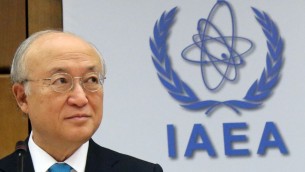
Austria-Iran-Nuclear_Horo-e1401748045152-305x172Yukiya Amano, director general of the International Atomic Energy Agency (IAEA) in Vienna, Austria, June 2, 2014. (AP/Ronald Zak)

Araqchi admitted that the regime had made some mistakes, and that those “mistakes in the past, made-up documentations and excuses were turned into claims against us.” He cited the example of International Atomic Energy Agency chief Yukiya Amano, who Araqchi said submitted a 60-paragraph report that included Iran’s use of detonators with multiple timers.

Iran, Araqchi said, has “to be careful with the information that we provide them… It is not that we are dealing only with the IAEA and these spies, but we are dealing with all countries that have nuclear programs. There are formulas and methods that prevent us from providing excess information to the IAEA inspectors. We did not know this in the past and provided information that we should not have done.”

Against national interest and security

The content of this supposedly off the record briefing was published a day later on the website of the Islamic Republic of Iran Broadcasting and picked up almost immediately by various other news sites inside Iran.

Due to the pressure from above, however, the original report was removed by the national broadcasting service, which stated that the publication of Araqchi’s statements was a “misunderstanding.”

Some believe that radical elements within the national broadcasting authority, who oppose the nuclear deal, leaked the briefing in order to undermine the reformist government’s achievements.

Araqchi called the leak “immoral” and “unprofessional,” saying it went “against national interest and security.”

The leak apparently occurred just days after the Iranian Ministry of Culture and Islamic Guidance issued confidential instructions to the media, warning them to avoid publications that could question “the achievements of the nuclear talks,” or would “indicate contradictions among the views of the high-ranking officials.”

On the day of leak, Iranian President Hassan Rouhani said during an interview on live Iranian television that the achievements of the nuclear talks exceeded his initial expectations.

More bad news for Obama from Iran about the secret deals

August 4, 2015

More bad news for Obama from Iran about the secret deals, Dan Miller’s Blog, August 4, 2015

(The views expressed in this article are mine and do not necessarily reflect those of Warsclerotic or its other editors. — DM)

An Iranian official recently stated that no International Atomic Energy Agency (IAEA) personnel will be permitted to enter military or missile sites. Another stated that “no country is permitted to know the details of future inspections conducted by the IAEA.” Their statements are probably consistent. There may well be other secret deals we don’t know about and perhaps never will. Meanwhile, Iran is preparing to test long range ballistic missiles “to prove that the missile ban was invalid.”

It's not MY fault.

It’s not MY fault.

I. No IAEA inspections of the sites that matter most

Entry-into-Iran-military-sites-forbidden (1)

In an interview on Al Jazeera TV last week Ali Akbar Velayati, Security Adviser to Iran’s Supreme Leader, stated that

United Nations nuclear inspectors from the International Atomic Energy Agency would not be given access to Tehran’s sensitive military nuclear sites.

. . . .

“First, allow me to emphasize that the issue of the missiles and of Iran’s defensive capabilities were not part of the negotiations to begin with,” Velayati said. [Emphasis added.]

“No matter what pressure is exerted, Iran never has negotiated and never will negotiate with others – America, Europe, or any other country – about the nature and quality of missiles it should manufacture or possess, or about the defensive military equipment that it needs. This is out of the question.” [Emphasis added.]

A video of Mr. Velayati remarks, with translations by the Middle East Media Research Institute (MEMRI), is available here. Since I have been unable to find it on You Tube I have no way to embed it.

Unfortunately, Mr. Velayati is essentially correct. The November 2013 Joint Plan of Action focused almost exclusively on Uranium enrichment, to the exclusion of the “possible military dimensions” of Iran’s military nuclear activities including missile research, development and testing.

II. Details of IAEA inspections will not be disclosed

Reza Najafi, Iran’s ambassador and permanent envoy to the IAEA, stated over the weekend that “no country is permitted to know the details of future inspections conducted by the IAEA.”

Najafi’s statement could mean (a) that no details about inspection methodology will be disclosed, (b) that no details about inspection results will be disclosed or (c) both. If inspection methodologies — who did the inspections as well as when, where and how, are not disclosed, what useful purpose will they serve, other than for Iran? If details of the results of inspections are not disclosed, that will also be the case. How, in either or both cases, will the members of the P5+1 negotiating teams have sufficient information to decide whether to “snap back” sanctions — if doing so is now even possible — or anything else?

III. Even details about inspections of non-military sites will be hidden

Considering Parts I and II together, and assuming that the statements of Iranian officials are reasonably consistent and not mere gaffes, IAEA personnel will be permitted to inspect non-military sites only and hence only to keep tabs on Uranium enrichment; even the details of those inspections will not be disclosed. Is that what Kerry and the other P5+1 negotiators had (pardon the expression) in mind?

IV. Iran says, Ballistic missile testing and development are OK

games

As reported by DEBKAfile,

Shortly before US Secretary of State John Kerry was due in Qatar Monday, Aug. 3, Iran’s highest authorities led by supreme leader Ayatollah Ali Khamenei Sunday launched a public campaign to support Tehran’s noncompliance with the Vienna nuclear accord and UN Security Council Resolution 2231 of July 20, on its ballistic missile program. The campaign was designed by a team from Khamenei’s office, high-ranking ayatollahs and the top echelons of the Revolutionary Guards, including its chief, Gen. Ali Jafari. [Emphasis added.]

It was kicked off with a batch of petitions fired off by the students of nine Tehran universities and Qom religious seminaries to Iran’s chief of staff Maj Gen. Hassan Firouzabadi, demanding immediate tests of long-range ballistic missiles to prove that the missile ban was invalid. [Emphasis added.]

. . . .

The Security Council Resolution, which unanimously endorsed the Joint Comprehensive Plan of Action (Vienna nuclear accord) signed by Iran’s Foreign Minister Mohammed Javad Zarif, called on Iran “not to undertake any activity related to ballistic missiles designed to be capable of delivering nuclear weapons, including launches using such ballistic technology until the date eight years after the JCPOA Adoption Day.” [Emphasis added.]

Tehran retorted that none of its ballistic missiles were designed to deliver nuclear weapons, and so this provision was void. Shortly after its passage, the foreign ministry in Tehran issued an assurance that “…the country’s ballistic missile program and capability is untouched and unrestricted by Resolution 2231.” [Emphasis added.]

This appears to confirm that all of Iran’s ballistic missile sites are off-limits to inspectors.

V. What does Kerry know?

When questioned by members of Congress on the secret deals, Secretary Kerry testified that he had neither seen nor read them but that he had been fully briefed and knew “exactly” what they say. Put charitably, it seems unlikely that he knew that much.

Less charitably, Kerry knew far more than he said and declined to be forthcoming. Now that two Iranian officials have provided highly important information, thus far probably unknown to Congress, will Kerry have additional comments? Not if he can help it.

VI. Conclusions

I wrote early and often about the miserable “deal” about to be entered into by P5+1 under Obama’s dubious leadership. As Iranian officials provide additional information it should be clear — even to the most enthusiastic “deal” supporters — that the “deal” is far worse than earlier thought possible and that the U.S. Congress is obligated to disapprove it and to override any Obama veto, partisan politics notwithstanding.

Iran: Obama Admin Lying About Nuclear Deal for ‘Domestic Consumption’

July 30, 2015

Iran: Obama Admin Lying About Nuclear Deal for ‘Domestic Consumption’ Washington Free Beacon, July 30, 2015

( It’s clear that the Obama administration is lying, but what lies do the Iranian officials claim are being told? Do they involve the secret deals? — DM)

AP

Senior Iranian officials are accusing the Obama administration of lying about the details of the recent nuclear accord in order to soothe fears among U.S. lawmakers and Americans about the implications of the deal, which will release billions of dollars to the Islamic Republic while temporarily freezing its nuclear program, according to reports from Iran’s state-controlled media.

As Secretary of State John Kerry and other senior Obama administration figures launch a full-court press to convince Congress to approve the  deal, Iranian leaders are dismissing the rhetoric as “aimed at domestic consumption.”

Kerry and other top administration officials have been defending the deal on Capitol Hill in recent days, claiming that it will rein in the Islamic Republic’s contested nuclear program and fix its nuclear “breakout” period, the time required for it to obtain the amount of highly enriched uranium necessary for a nuclear weapon, at one year.

Critics have noted that the deal provides Iran with billions of dollars in sanctions relief that could be spent on terrorism and lifts bans on Iran’s export of weapons and construction of ballistic missiles.

When addressing claims this week by the administration that the deal shuts down Tehran’s nuclear infrastructure, Iranian officials scoffed and said that the Obama administration is misleading the public in order to sell the deal.

Hamid Baeidinejad, an official in the Iranian foreign ministry and one of the country’s nuclear negotiators, scoffed on Wednesday at the Obama administration’s comments, saying that they were meant to placate an American domestic audience.

“The remarks by the western officials are ambiguous comments which are merely uttered for domestic use and therefore we should say that there is no ambiguity in this (nuclear) agreement,” the Fars news agency quoted Baeidinejad saying in an interview with state-controlled radio.

Baeidinejad said that the Obama administration is misleading Americans about the deal in order to “calm opponents in the Congress and Zionist lobbies to soothe the internal conditions prevailing over debates on the nuclear agreement in that country,” Fars, which is also run by the Iranian state, reported.

As Congress spends 60 days reviewing the deal, which it may reject, the Iranian parliament is undertaking the same task.

During a meeting on Wednesday with Laurent Fabius, the French foreign minister, President Hassan Rouhani of Iran urged world powers to keep its commitments under the deal.

These includes lifting sanctions on the nearly $100 billion dollar financial empire of the Iranian Supreme Leader Ali Khamenei and agreeing to bar American inspectors from all Iranian nuclear sites.

“The Iranian government is standing strong on the path of (implementing) the agreement and we will remain committed to our undertakings as long as the other side remains loyal to its obligations,” Rouhani was quoted as saying during a meeting in Tehran with Fabius, who served as a key negotiator for the French.

Rouhani said the agreement could help Iran become a key player on the international stage.

“This agreement is not against any country and our cooperation and consultations to settle the regional problems, including fight against terrorism, humanitarian aids, and materialization of nations’ demands can prove it,” Rouhani was quoted as saying.

Meanwhile, Fabius was met at the airport by Iranian protestors who accused him of serving as an Israeli spy.

“The protesters chanted slogans such as ‘Aids, A French Gift to Iran’, ‘We Neither Forgive nor Forget’, ‘Fabius, Servant of the US, Spy of Israel’ and ‘No Welcome to Aids Lord,’” according to Fars.