Archive for the ‘Iranian anti-semitism’ category

Iranian Officials Ratchet Up Genocidal Anti-Israel Rhetoric After Nuclear Deal

August 18, 2015

Iranian Officials Ratchet Up Genocidal Anti-Israel Rhetoric After Nuclear Deal, Investigative Project on Terrorism, Steven Emerson, August 18, 2015

(Three additional videos are available at the linked site. — DM)

A video shows the Revolutionary Guard Corps massing on a hill overlooking Jerusalem.

A conference of religious scholars features speaker after speaker calling Israel’s annihilation inevitable and promising that a “new phase” in that effort is about to begin.

While some in the United States and among its Western allies may hope that a nuclear weapons deal with Iran might steer the Islamic Republic in a new, more responsible direction, hardliners draw new lines and issue new threats.

On Monday, Iranian Supreme Leader Ali Khamenei took to social media to attack the United States and Israel. “We spare no opportunity to support anyone #FightingTheZionists,” wrote the ayatollah, whose regime supplies Hizballah and Hamas with rockets and other weapons of terror.

Perhaps more chilling is an animated video from the Islamic Revolution Design House, a media outfit associated with Iranian hardliners. It shows a soldier preparing for battle. He puts on a Revolutionary Guard patch, and then a Qassam Brigades headband, followed by a ski mask and a Palestinian scarf around his neck, while arming himself with a machine gun and a pistol. As he puts on a helmet, we see him looking over Jerusalem’s Temple Mount, home of the Dome of the Rock and Al Aqsa mosque. The image pulls back, showing the soldier amid a sea of conquering troops.

A concluding message invokes Ayatollah Khomeini’s threat that Israel must be wiped off the map and promises that day is coming soon.


https://www.youtube.com/watch?v=OWfmvUxzW_I


A conference held in Beirut late last month reinforced that message over and over again. The General Assembly of Islamic Resistance Ulema (Scholars) held its first gathering under the banner “Unity for Palestine.” The weekend meeting included fiery rhetoric from an Iranian ayatollah and Hizballah’s leader Hassan Nasrallah.

“Annihilation of the Zionist regime is a sure thing and Quranic pledge,” Ayatollah Mohsen Araki told the assembly. Araki is secretary general of the World Forum for Proximity of Islamic Schools of Thought, emphasizing the importance of unifying “Muslims in countering the regime of Zionism and the arrogant World.”

Many of the speeches were uploaded to YouTube and translated by the Investigative Project on Terrorism.

Nasrallah called Israel a “cancerous tumor” and said “It is only a matter of time” before it is defeated.

“We believe with certainty that Israel, this cancerous tumor, is headed for extinction, and that Palestine and Jerusalem will be returned to their people. It is only a matter of time and [this outcome] is linked to the will, action, jihad, and sacrifices of the Ummah, according to the principle: If you achieve victory for Allah, Allah will lead you to achieve victory.” Nasrallah said it was Allah’s will for Muslims to achieve “final victory over the Zionist scheme” and urged the assembly not to waste the opportunity.

“The day in which we will all pray in Jerusalem, Inshallah (God willing) is inevitably coming Inshallah. All of these calamities, conspiracies, and crises are merely trials to strengthen and make fit all those who believe in this project and in this path to enable them to be worthy of the coming victory. Some people may gain victory but then waste it.

Allah Almighty wants our Ummah (nation) in its final victory over the Zionist project and in restoring Palestine and Jerusalem to be worthy of this huge historic victory and to be worthy of preserving this victory and not to lose it as many victories have been lost.”

Muhammad Hasan Zamani, a former Iranian cultural counselor in Egypt who runs the Department of International Islamic Madrasas for the General Assembly of Islamic Resistance Ulema, maintained the theme, insisting there is no peaceful resolution that would end in Iran’s acceptance of a Jewish state.

“Israel must be erased from the map of the world. These are the golden words Imam Khomeini (may God have mercy on him) uttered. Why do we assert the obligation of erasing Israel from the world, and not speak of erasing America and other unjust countries from the world? We in Iran say slogans in marches, Death to Israel, Death to America, Death to the English, and so forth and so on.”

Iran considers America the “greater Satan,” Zamani went on to say, but the Islamic Republic respects other governments which were chosen by their people. By contrast, he claimed Israel is not legitimate: “I say that the example of the rule of the Zionists is the example of thieves who attack a house and occupy the house and the people of the house defend their house.”

Sheikh Abdel Halim Qadhi, a professor at Zahidan University, explained that the conflict is inherently about religion. “[T]he Holy Quran makes it know that Jews are the enemies of Islam and the Muslims, and their holy places and rites,” he said.

“Jihad is the most powerful and only way to liberate Palestine and defend Jerusalem,” he added, saying “God loves those who fight in his way.”

In a final statement from conference attendees, the group emphasized “the first and most important obligation is to unite the Umma to liberate the holy Al-Aqsa Mosque” in Jerusalem, reported Al-Manar, a Lebanese news outlet considered close to Iran’s proxy Hizballah. The group also said “resistance” was the way “to achieve victory in Lebanon and Palestine, despite the unlimited support received by the Zionist enemy and continuing inaction of the countries in the region.”

Meanwhile, Iran’s supreme leader, Ayatollah Khamenei, published a 416-page book earlier this month outlining the destruction of Israel, referring to the Jewish state as an ally of “The American Great Satan.”

The book features a long-term strategy that entails terrorizing Israel in a war of attrition that would lead to Jews leaving Israel for other countries.

Supporters of the nuclear deal say it’s a fantasy to expect a better outcome should Congress override President Obama’s expected veto of a vote to defeat the agreement. The combined statements of Iran and its supporting clerics makes clear, however, that the true fantasy is any expectation Iran will turn away from terror as a result of its engagement with world powers.

Obama’s shameful betrayal of America

August 18, 2015

Obama’s shameful betrayal of America, Front Page MagazineDr. Majid Rafizadeh, August 18, 2015

secretary_kerry_meets_with_iranian_foreign_minister_zarif_in_paris_to_continue_nuclear_program_negotiations_16107653417

Thanks to President Obama, radical Islam is the winner of the nuclear deal and the US emerges as the biggest loser when it comes to its national, economic, geopolitical and strategic interests. In addition, except for Israel and the United States, almost every country in the world (as well as Shiite militia groups) appear to be benefiting from the nuclear deal – economically, strategically, and geopolitically — as a result of rekindling relationships with the Islamic Republic. Not only does this deal damage the US and Israel’s national and economic interests, but it also strengthens the same forces and axis which have repeatedly sworn war and violence against Americans. 

A strong argument can be made that one of the major birthplaces of fundamentalist Islamism, which at its core aims at opposing and fighting the United States, is the Islamic Republic of Iran.

The mission of anti-Americanism and anti-Semitism began heavily when the ruling mullahs of Iran, with the leadership of Ayatollah Rooh Allah Khamenei, came to power.  This mission remains and will continue to remain the major pillar of the Islamic Republic as well as the keystone of the mullah’s political and ideological establishments.

Since then, the Islamic Republic, with IRGC and its proxies, has been attacking and slaughtering Americans. They also attempt to scuttle US foreign policy. The United States is not their sole target. They also interfere with the national and economic interest of several countries in the Middle East and beyond including Iraq, Lebanon, Syria, Yemen, etc.

Without a doubt, this is a regime that breeds anti-Americanism and hatred towards Jewish and Christian people. So, what is President Obama’s solution to offset such a threat? Surrender — while continuing to give bonuses and gifts to the Iranian regime.

After Russia and China, Switzerland was the first European country to officially lift economic and political sanctions against the Islamic Republic citing the nuclear deal which was reached between the Islamic Republic and six world powers. The sanctions included restrictions on trade in precious metals, petrochemical products, petroleum products as well as the transport of Iranian crude oil. Switzerland issued a statement pointing out that the “Federal Council (government) wishes today’s steps to be seen as a sign of its support for the implementation of the nuclear agreement and its interest in deepening bilateral relations with Iran.” It also added that it will seek to “promote a broad political and economic exchange with Iran.”

Other European countries are going to follow as well. What is going to happen next? Billions off dollars are going to flow into a government whose primary objective is to fight with the United States.

Russia, China, and other rivals will benefit economically, politically, strategically, and ideologically from the nuclear deal. It is the United States which not only is not gaining anything (economically, geopolitically, security-wise, or strategically) from this deal, but also is significantly empowering its rivals.

In the next phase, the nuclear deal will significantly tip the balance of power in favor of US rivals and the anti-American axis. China, Russia and the Iran-Assad-Hezbollah-Haman’s alliance will be considerably strengthened.

What does President Obama think that a political regime — that has been fighting the United States tooth and nail and that is responsible for the killing of many Americans in the Middle East — is going to use the billions of dollars it earns to promote? It certainly will not be pro-American or pro-Israel ideology, democratization, social justice, rule of law, human rights, or freedom of speech, press, and assembly.

Mr. Obama recently delivered a speech at American University pointing out that “just because Iranian hardliners chant ‘Death to America’ does not mean that that’s what all Iranians believe.” He added, “In fact, it’s those hardliners … chanting ‘Death to America’ who’ve been most opposed to the deal. They’re finding common cause with the Republican Caucus.”

There are several fallacies in his statements. First of all, he is implying the Republicans are similar to those Iranian politicians who are anti-American. Republicans are attempting to preserve the national and economic interest of their country when it comes to the Islamic Republic, but Iranian politicians are sworn to fight American interests and wipe out Israel.

Secondly, President Obama argues that Iranian hardliners are against the nuclear deal. This is absolutely inaccurate. It was because of the approval of  Iran’s Supreme autocrat, Ayatollah Ali Khamenei, that the deal was signed. The hardliners are the ones who will gain the most from this deal.

Third, it is true that not all Iranian people believe in “Death to America,” but Mr. Obama is dodging the major point. When it comes to international politics and the mission of fighting America, it honestly does not matter what Iranian people believe or do not believe. What matters is the political establishment of the Islamic Republic and the government which has the hard power (weapons, military, financial means, oil, etc) to fight with the US.

Finally, it is not only the hardliners that chant “Death to America,” but the entire group of ruling clerics and leaders of the Islamic Republic that believe this with a passion. We should not forget that a major slogan of President Rouhani (the so-called “moderate”) is: “Saying ‘Death to America’ is easy. We need to express ‘Death to America’ with action.” Or, as the other supposed “moderate” and “pragmatist,” Rafsanjani pointed out, “If a day comes when the world of Islam is duly equipped with the arms Israel has in possession, the strategy of colonialism would face a stalemate because application of an atomic bomb would not leave anything in Israel[.]”

United Nations and European Union sanctions on some of Iranian war criminals will also be lifted as part of the nuclear pact. One of these figures is General Qassem Suleimani, the head of Iran’s Islamic Revolutionary Guard Corps—Qods Force, who is the mastermind behind creating Shiite militia groups and terrorists across the region. He oversaw the training, financing, and arming of these militia groups. These groups are directly or indirectly fighting the United States and American soldiers as well.

As Lt. Gen. (ret.) Michael Barbero stated Sunday in The Weekly Standard, the lifting of international sanctions against Gen. Soleimani is a “shameful betrayal” of the “the American families of Suleimani’s casualties, and …those of us who lost friends and comrades.”

What if the Iranian leaders circumvent the guidelines put into place by the deal down the road? Then, too bad. If the Iranian leaders, as predicted, are caught deceiving their way towards obtaining a nuclear bomb, it will be too late to do anything. The economic and political sanctions will have been lifted, leaving the Iranian government with a surplus of funds. The US, which was in a stronger position when sanctions were imposed on the Islamic Republic, will become the weaker player. Russia and China will block any re-imposition of sanctions on the Islamic Republic. At that point, unfortunately, it will be the US in the desperate position, not the Islamic Republic. Radical Islam will exponentially spread against the US, as well as democratic and Western values around the globe.

The profs who love Obama’s Iran deal

August 10, 2015

The profs who love Obama’s Iran deal, Front Page MagazineCinnamon Stillwell, August 10, 2015

1.29.13-ayatollah-ali-khamenei

Meet the Mullahs’ academic cheerleaders.

Who supports the Obama administration’s increasingly unpopular Joint Comprehensive Plan of Action (JCPOA) aimed ostensibly at curbing Iran’s nuclear program? Many of its strongest proponents come from the field of Middle East studies, which boasts widespread animus towards the U.S. and Israel along with a cadre of apologists for the Iranian regime determined to promote ineffectual diplomacy at all costs.

University of California, Riverside creative writing professor Reza Aslan concedes that his generation of Iranian-Americans “feel[s] far removed from the political and religious turmoil of the Iranian revolution” before falling in line with the Iranian regime’s propaganda: the deal will “empower moderates in Iran, strengthen Iranian civil society and spur economic development,” and create “an Iran that is a responsible actor on the global stage, that respects the rights of its citizens and that has warm relations with the rest of the world.” “Warm relations” are the least likely outcome of the increase in funding for Iran’s terrorist proxies Hamas and Hezbollah that even President Obama admits will follow the easing of sanctions.

Flynt Leverett, an international relations professor at Pennsylvania State University, whitewashes these terrorist groups as “constituencies” and “communities” which the Iranian regime “help[s] organize in various ways to press their grievances more effectively,” effective terrorism being, for Leverett, a laudable goal.  Characterizing the regime as “a rising regional power” and “legitimate political order for most Iranians,” he urges the U.S., through the JCPOA, to “come to terms with this reality.”

Diablo Valley College Middle East studies instructor Amer Araim’s seemingly wishful thinking is equally supportive of Tehran’s line: “it is sincerely hoped that these funds will be used to help the Iranian people develop their economy and to ensure prosperity in that country.” Meanwhile, Hooshang Amirahmadi, an Iranian-American international relations professor at Rutgers University, attempts to legitimize the regime by delegitimizing the sanctions: “The money that will flow to Iran under this deal is not a gift: this is Iran’s money that has been frozen and otherwise blocked.”

Others deny the Iranian regime intends to build a nuclear bomb. University of Michigan history professor Juan Cole has “long argued that [Iran’s leader Ali] Khamenei is sincere about not wanting a nuclear weapon” because of his “oral fatwas or legal rulings” indicating that “using such weapons is contrary to Islamic law.” His unwarranted confidence in the regime leads him to conclude:

[T]hey have developed all the infrastructure and technical knowledge and equipment that would be necessary to make a nuclear weapon, but stop there, much the way Japan has.

Evidently, Cole has no problem with a tyrannical, terrorist-supporting regime that seeks regional hegemony on the threshold of becoming a nuclear power.

Likewise, William Beeman, an anthropology professor at the University of Minnesota, maintains that, “It was . . .  easy for Iran to give up a nuclear weapons program that never existed, and that it never intended to implement.” Like Cole, he uncritically accepts and recites the regime’s disinformation: “Iran’s leaders have regularly denounced nuclear weapons as un-Islamic.”

Beeman—who, in previous negotiations with the Iranian regime, urged the U.S. to be “unfailingly polite and humble” and not to set “pre-conditions” regarding its nuclear program—coldly disregards criticism of the JCPOA for excluding conditions such as the “release of [American] political prisoners” and “recognition of Israel,” calling them “utterly irrelevant.” No doubt the relatives of those prisoners and the Israeli citizens who live in the crosshairs of the regime’s continued threats of annihilation would disagree.

A number of academics have resorted to classic anti-Semitic conspiracy mongering to attack the deal’s Israeli and American opponents, calling them the “Israel Lobby.” Muqtedar Khan, director of the Islamic Studies Program at the University of Delaware, accuses “the Israeli government and all those in the U.S. who are under the influence of its American lobbies” of obstructing the deal, claiming that, “The GOP congress is now being described as the [Israeli Prime Minister Benyamin] Netanyahu congress.”

Hatem Bazian, director of the Islamophobia Research & Documentation Project at the University of California, Berkeley, takes aim at “pro-Israel neo-conservatives,” “neo-conservative warmongers,” “AIPAC,” and (in a mangled version of “Israel-firster”) “Israel’s first D.C. crowd” for “attempting to scuttle the agreement.” Asserting a moral equivalence between the dictatorial Iranian regime and the democratically-elected Israeli government, Bazian demands to know when Israel’s “pile of un-inspected or regulated nuclear weapons stockpile” will be examined before answering, “It is not going to happen anytime soon!” That Israel has never threatened any country with destruction, even after being attacked repeatedly since its rebirth, is a fact ignored by its critics.

The unhinged Facebook posts of Columbia University Iranian studies professor and Iranian native Hamid Dabashi reveal in lurid language his hatred of Israel:

It is now time the exact and identical widely intrusive scrutiny and control compromising the sovereignty of the nation-state of Iran and its nuclear program be applied to the European settler colony of Jewish apartheid state of Israel and its infinitely more dangerous nuclear program! There must be a global uproar against the thuggish vulgarity of Netanyahu and his Zionist gangsters in Israel and the U.S. Congress to force them to dismantle their nuclear program–systematically used to terrorize and murder Palestinian people and steal the rest of Palestine!

Elsewhere, Dabashi attacks adversaries of the JCPOA, including “Israel, Saudi Arabia, the U.S. Neocons, and their treacherous expat Iranian stooges masquerading as ‘Opposition,’” calling them a “terrorizing alliance,” a “gang of murderous war criminals,” and “shameless warmongers.”

Willful blindness to Iran’s brutal, terrorist-supporting regime, moral equivocation, and an irrational hatred for Israel and the West characterize the fawning support enjoyed by the mullahs from these and other professors of Middle East studies. In place of objective, rigorously researched plans for countering Iran’s aggression and advancing the safety of America and its allies, they regurgitate the crudest propaganda from Teheran. Until their field of study is thoroughly reformed, their advice—such as it is—should and must be utterly ignored.

“Death to America” Falling on Obama’s Deaf Ears

August 10, 2015

“Death to America” Falling on Obama’s Deaf Ears, American ThinkerEileen F. Toplansky, August 10, 2015

(Please see also, It’s Not Just Iran’s Hardliners Saying ‘Death to America.’  — DM)

The Iranian curriculum is based on an Iranian-style Islam called the New Islamic Civilization (NIC).  The battle between good and evil, which is to be waged on a global scale, “is the responsibility of each Iranian citizen,” and “it begins with defense.”  America is seen as “arrogant,” and “any kind of freedom of speech, political debate or appreciation of Iranian culture or values other than those espoused by the regime are intolerable[.]”

[T]reating Iran as a normal country instead of one that inculcates acts of aggression is extraordinarily dangerous.

**********************

We are well past the point where we can ever believe Obama the man because, as those prescient about Obama’s background instinctively understood, whatever was taught  Obama the child is what is now being reflected in his dangerous anti-American actions.

Thus, the 17th-century Jesuit-inspired quotation of “give me the child, and I will mold the man” remains true.

This is why the idea that one can trust the Iranians is not only naive, but extraordinarily dangerous, given the education of their children.  In the May 2015 Special Interim Report entitled “Imperial Dreams: The Paradox of Iranian Education” by Eldad J. Pardo, the incessant propagandizing and intimidation of Iranian students is proof positive that they are being primed to attack those whom their leaders deem the enemy.  The first page of the report shows the map of a “New Dreams of World Power” with Iran at the center.  Underneath this map is a picture of “Iranian children preparing for martyrdom.”

Lest one think this is unthinkable, recall the fact that Iran and its proxies regularly send their children as suicidal bombers.  Thus, as Pardo recounts, the Iranian education curriculum includes “the ambition to impose Iranian hegemony on the world; a culture of militarism and jihad; blind obedience and martyrdom; and hostility and paranoia toward foreigners.”

In fact, “jihad war is unending,” and “the frenzied rush toward the end-of-time’s ‘horrifying battle'” is the lifeblood of continuous jihad.

The backdrop to all this education is the idea that Iran is committed to “total struggle for the creation of a just world order” and that such a “condition will remain until the coming of the Mahdi, the Shiite Messiah[.]”  The messianic ideal here is quite different from what most Westerners believe; that it is ignored will be a fatal mistake.  And Obama knows this, which is why Americans must stomach, yet again, his “compendium of demagoguery, historical revisionism and outright lying.”

Iranian students understand that “possible martyrdom on a massive scale and for which they practice from the first grade – could be launched as part of an Iranian ‘attack on countries ruled by oppressive governments.'”  Moreover, Iranian students study about “dissimulation” (taqiyya) and “misleading the enemy.”  They learn that “in time of need, dissimulation and  temporary pacts – even with ‘un-Godly, idolatrous governments’ – are proper (but only until such time as the balance of power should change).”  The idea of sacrifice is “constantly instilled in them,” as evidenced by the Teacher’s Guide for Persian, Grade 3 text.  Never is there any concern with the “human wave assault,” which includes many sacrificed schoolchildren.  Instead, enthusiasm for military participation is promoted in the first grade, for six-year-olds.

Surely Obama’s many Muslim Brotherhood advisers would have informed him of taqiyya, and since Obama early on learned the tenets of Islam, this is part of his worldview.  Whether one believes he is a pathological liar or not, the fact remains that Obama defends the Iranian deal with falsehoods and slurs.  Moreover, he recently exploited American college students at American University, much as his Iranian counterparts abuse their own children with incessant misinformation and propaganda.

The Iranian educational curriculum makes much of the Aryan-Shiite basis of Iranian identity wherein the Allies, and not Nazi Germany, are vilified, and, of course, the Holocaust is completely avoided.  Hence, the unremitting cries of “Death to Israel” fall on ears already primed to hate the Jew.  Furthermore, in echoes of Nazism, “children are instructed not to obey their parents in matters regarding martyrdom,” and pictures of soldiers are amply sprinkled in the textbooks.

This is of little concern to Obama, who has been surrounded by anti-Semites for many years.  The anti-Jewish hatred does not disturb him, nor does it deter him.  While Caroline Glick asserts that Obama maintains that “an anti-Semite is someone who refuses to recognize the 3,000-year connection between the Jews and the Land of Israel,” and “an anti-Semite is also someone who refuses to recognize the long history of persecution that the Jewish people suffered in the Diaspora,” this is hardly a ringing endorsement of ensuring that no harm will come to the Jewish people.  Acknowledging a connection to a piece of land is not the same as making certain that that land is not blown to smithereens.

The Iranian curriculum is based on an Iranian-style Islam called the New Islamic Civilization (NIC).  The battle between good and evil, which is to be waged on a global scale, “is the responsibility of each Iranian citizen,” and “it begins with defense.”  America is seen as “arrogant,” and “any kind of freedom of speech, political debate or appreciation of Iranian culture or values other than those espoused by the regime are intolerable[.]”

In essence, the “school textbooks prepare the entire Iranian population for a constant state of emergency, requiring Iranians to foment revolutions throughout the world, particularly across the Middle East, while evil arrogant enemies – who hate Iran and Islam – scheme against them.”  In fact, texts emphasize the martyrdom of women as well as cyber warfare tactics.  Most importantly, “students learn that no checks are needed on the Supreme Leader’s authority, including his right to sanctify new weapons” (italics mine).  Blind obedience to the Supreme Leader is mandatory.

In a Grade 11 Iranian text, students are enjoined to understand that jihad “covers a range of meanings including killing, massacring, murdering and fighting,” and jihad “permits its use against anyone, anywhere.”  There is “defensive jihad,” which refers to an “enemy transgressing the border or city of the Muslims, or defense of one’s own or other’s life, honor and property.”  Thus, as Muslims gain in number in American cities, it is clear that defensive jihad can be used, especially since defensive jihad is seen as a warfare that is “gradual” and that can be “military and sometimes cultural,” since it “sometimes aims at conquering a land or part of it and sometimes aims at political-economic control.”

Then there is “internal jihad,” which “represents a war with outlawed people who implement rebellion and disobedience as well as armed uprisings.”  Western ideas of freedom will be relegated to the dustbin of history, and those who desire it will be annihilated.

Finally there is “elementary jihad,” which at first glance sounds familiar to Western ears.  It is “defined as an attack on countries ruled by oppressive governments that do not allow free religious activities or freedom to listen to the call of religion.”  But there is no freedom of religion in Iran.  It can be only Islam.  There is no room for any other ideas.  And, in fact, “non-Islamic moral constraints” have no impact as Hezb’allah, Iran’s Lebanese proxy, or any other Islamic-inspired group engages in jihad.

Thus, as Jeffrey Herf writes, treating Iran as a normal country instead of one that inculcates acts of aggression is extraordinarily dangerous.  This is a war of ideas – whose will remain supreme?  In essence, Obama is painting a bull’s-eye on America, and not on Iran, who continues the “Death to America” chant on a regular basis.  And while Mona Charen claims that “Obama doesn’t take the Iranian chant seriously,” I, for one, beg to disagree.


Contentions | Has Obama Read the Khamenei Palestine Book?

August 4, 2015

Contentions | Has Obama Read the Khamenei Palestine Book? Commentary Magazine, August 4, 2015

(Another interesting question would be, does Obama agree with any of Khamenei’s statements and, if so, which? — DM)

The Khamenei Palestine book is important not in and of itself but because the regime’s obsession with Israel is a key to its foreign policy. . . . But as much as Iran is focused on regional hegemony in which Sunni states would be brought to heel, as Khamenei’s Palestine illustrates, it is the fixation on Israel and Zionism that really animates their expansionism and aid for terror groups.

******************

It turns out President Obama isn’t the only world leader who writes books. His counterpart in Iran – Supreme Leader Grand Ayatollah Ali Khamenei — has also just published a new book. But while it may not be as introspective as Obama’s Dreams From My Father, it does tell us at least as much about the vision of the person in charge in Tehran (as opposed to Hassan Rouhani, the faux moderate who serves as its president) as the president’s best-selling memoir. As Amir Taheri reports in the New York Post, Palestine is a 416-page diatribe against the existence of the state of Israel and a call to arms for it to be destroyed. Supporters of the nuclear deal the president has struck with Khamenei’s regime may dismiss this book as merely one more example of the Supreme Leader’s unfortunate ideology that must be overlooked. But as the New York Times noted last week, the administration’s real goal here isn’t so much in delaying Iran’s march to a nuclear weapon (which is the most that can be claimed for the agreement) as it is fostering détente with it. Seen in that light, the latest evidence of the malevolence of the Islamist regime should be regarded as yet another inarguable reason for Congress to vote the deal down.

In his interview with The Atlantic’s Jeffrey Goldberg on May 21, President Obama was asked directly about the significance of Iran’s anti-Semitism and its commitment to destroying Israel. The president said the anti-Semitism of the Iranian leadership did not mean they weren’t also “interested in survival” or being “rational.” As far as he was concerned, the ideology of the regime was not something that would influence its decisions.

But everything Khamenei says and, even more importantly, everything the regime does, by funding terrorist groups at war with Israel such as Hamas and Hezbollah or by embarking on a ruinously expensive nuclear project that placed it in conflict with the West, speaks to its commitment to policies that Obama may think are irrational but which are completely in synch with what he called its “organizing principle.” Why would a nation so rich in oil need to risk international isolation or war seek nuclear power if not to help Khamenei fulfill his pledge to “liberate” what is now Israel for Muslims?

The president told Goldberg that the American military option would be a sufficient deterrent to ensure that Iran didn’t violate the nuclear pact or behave in an irrational manner. But since the president has ruled out the use of force in a categorical manner, it’s hard to see why the Iranians would fear it once the U.S. and Europe are doing business with them. Even if it was a matter of snapping back sanctions, assuming that such a concept is even possible? Once the restrictions are unraveled, it’s fair to ask why would they work then when the president repeatedly tells us additional sanctions won’t work now and require us to accept the current deal that doesn’t achieve the objectives that the administration set for the negotiations when they began.

The Khamenei Palestine book is important not in and of itself but because the regime’s obsession with Israel is a key to its foreign policy. Iran constitutes a grave threat to Neighboring Arab countries that are at least as angry about the president’s embrace of Tehran as the Israelis since their nuclear status would undermine their security. But as much as Iran is focused on regional hegemony in which Sunni states would be brought to heel, as Khamenei’s Palestine illustrates, it is the fixation on Israel and Zionism that really animates their expansionism and aid for terror groups.

As Taheri notes in his article on the book, Khamenei distinguishes his idée fixe about destroying Israel from European anti-Semitism. Rather, he insists, that his policy derives from “well established Islamic principles.” Chief among them is the idea that any land that was once ruled by Muslims cannot be conceded to non-believers no matter who lives there now. While the Muslim world seems to understand that they’re not getting Spain back, the territory that constitutes the state of Israel is something else. Its central location in the middle of the Muslim and Arab worlds and the fact that Jews, a despised minority people, now rule it makes its existence particularly objectionable to Islamists like Khamenei.

Khamenei’s book shows that not only is he serious about wanting to destroy Israel and uproot its Jewish population, he regards this project as a practical rather than a theoretical idea. The administration ignores this because it wants to believe that Iran is a nation that wants to, as the president put it, “get right with the world.” But what it wants is to do business with the world while pursuing its ideological goals. The nuclear deal is a means to an end for the regime and that end does not involve good relations with the West or cooperation with other states in the region, let alone coexisting peacefully with Israel.

What is curious is that this is the same administration that regarded the announcement of a housing project in Jerusalem by low-level Israeli officials as an “insult” to Vice President Biden. But it chooses to regard the “death to America” chants led by regime functionaries in Iran as well as a book by the country’s leader indicating that Obama’s ideas about its character are fallacious as non-events. The only explanation for this remarkable lack of interest in Iranian behavior is an ideological fixation on détente with Tehran that is every bit as hardcore as any utterances that emanate from the mouth or the pen of the Supreme Leader.

Taken out of the context of a vision of friendship with the Iranian regime, the nuclear deal makes no sense. Yet squaring that vision with Khamenei’s literary effort is impossible. Members of the House and Senate must take note of this conundrum and vote accordingly.

Iran Deal: The Great Bamboozle Festival

July 18, 2015

Iran Deal: The Great Bamboozle Festival, Gatestone InstituteDouglas Murray, July 18, 2015

(Would Chamberlain, in the context of British military weakness but in otherwise comparable circumstances, have made a similar “deal” with Hitler and declared “peace in our time?”  — DM)

  • A generous person might say that this is unimportant — that in Iran, chanting “Death to America” is like throat-clearing.
  • Surely only an uncharitable person would wonder why Iran’s rulers are buying the technology they would need to repel any attack on their nuclear project at the same time as they are promising the Americans that they are not developing nuclear weaponry.

What exactly is it that the Obama administration thinks has changed about the leadership of Iran? Of all the questions which remain unanswered in the wake of the P5+1 deal with Iran, this one is perhaps the most unanswered of all.

There must, after all, be something that a Western leader sees when an attempt is made to “normalize” relations with a rogue regime — what Richard Nixon saw in the Chinese Communist Party that persuaded him that an unfreezing of relations was possible, or what Margaret Thatcher saw in the eyes of Mikhail Gorbachev, which persuaded her that here was a counterpart who could finally be trusted.

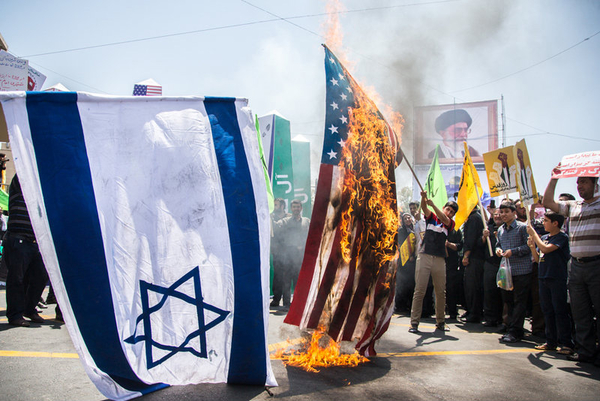
After all, the outward signs with Iran would seem to remain unpromising. Last Friday in Tehran, just as the P5+1 were wrapping up their deal with the Iranians, the streets of Iran were playing host to “Al-Quds Day.” This, in the Iranian calendar, is the day, inaugurated by the late Ayatollah Khomeini, when anti-Israel and anti-American activity come to the fore even more than usual. Encouraged by the regime, tens of thousands of Iranians march in the streets calling for the end of Israel and “Death to America”. Not only Israeli and American flags were burned — British flags were also torched, in a touching reminder that Iran is the only country that still believes Britain runs the world.

The latest in a long line of “moderate” Iranian leaders, President Hassan Rouhani, turned up at one of these parades himself to see the Israeli and American flags being burned. Did he intervene? Did he explain to the crowd that they had got the wrong memo — that America is now our friend and that they ought at least to concentrate their energies on the mass-burning of Stars of David? No, he took part as usual, and the crowds reacted as usual.

1153Participants in Tehran’s Quds Day rally burn U.S. and Israeli flags, on July 10, 2015. (Image source: ISNA)

It was the same just a few weeks ago, when the Iranian Parliament met to discuss the Vienna deal. On that occasion, after some authorized disputation, the Iranian Parliament broke up, with the representatives chanting “Death to America.”

A generous person might say that this is unimportant — that in Iran, chanting “Death to America” is like throat-clearing. This is just what we are being told — that these messages are “just for domestic consumption,” and don’t mean anything.

Putting aside what they say for a moment, what is it about Iran’s actions that have changed enough to persuade the U.S. government that the Iranian regime might be a regime in transition?

Internally there has been no let-up in the regime’s campaign of oppression against their own Iranian people: hanging people for a range of “crimes,” from being gay to being a poet found guilty of “blasphemy,” continue.

Iran has hanged more than a thousand of these internal “enemies” in the last eighteen months alone, as negotiators sat in Vienna thrashing out a deal. In the wider region, Iran remains the most voraciously ambitious, and perhaps the only successfully outgoing, regional power. In the years since the “Arab Spring” began, only Iran has been able significantly to extend its reach and grip in the region. It now has a vastly increased presence and influence in Yemen, Iraq, Syria and Lebanon. It continues to arm its terrorist proxies, including Hezbollah, which in turn continues to increase its build-up of rockets and other munitions on the northern border of Israel.

Iran has not released the four American hostages it continues to hold — Pastor Saeed Abedini, for the crime of converting to Christianity; Washington Post journalist Jason Rezian, on the patently nonsensical charges of espionage; former U.S. Marine Amir Mirza Hekmati, who went to Iran to visit his grandmother; and retired DEA and FBI agent Robert Levinson, who was abducted eight years ago and has not been heard from since early 2013. This, in spite of last-minute requests from Iran to lift a ban on conventional weapons, acceded to by the members of the P5+1, wasting yet another abandoned opportunity actually to get something in return for their total surrender.

From the outside, it would seem that very little has changed in the rhetoric of Iran and very little has changed in the regime’s behavior. That is why the mystery of what change the U.S. administration and its partners see in the eyes of the Ayatollahs is so doubly curious.

Because the nature of the deal makes it exceptionally important that there is some change. In the next decade, in exchange for the supposed “managed inspections” of limited Iranian sites, the Ayatollas are going to enjoy a trade explosion with a cash bonanza of $140 billion unfrozen assets, just to start them off. Throughout that same decade, there will be a lifting of restrictions on — among other things — the sale and purchase by Iran of conventional arms and munitions. Iran will finally be able to purchase the long-awaited anti-aircraft system that the Russians (also of course present at the table in Vienna) want to sell them. This system — among the most advanced surface-to-air missile systems — will be able to shoot down any American, Israeli or other jets that might ever come to destroy Iran’s nuclear project. And surely only an uncharitable person would wonder why Iran’s rulers are buying the technology they would need to repel any attack on their nuclear project at the same time as they are promising the Americans that they are not developing nuclear weaponry.

And it is even more important that the signs of hope located by the U.S. administration are correct, because after all, barring an internal uprising — which the Vienna deal makes more unlikely than ever (having strengthened the diplomatic and financial hand of the regime) — it is safe to say that over the next decade and beyond the Mullahs will remain in charge in Iran.

In the U.S., Germany, France and Britain, by contrast, who knows who will be in charge? In Britain, the Labour party may have romped to victory with, at its head, Jeremy Corbyn MP (currently Labour leadership contender) — a man who has openly and repeatedly praised Hamas and Hezbollah as his “friends.” That would certainly change the dynamics.

But put aside such a potentially unlikely situation and assume that Britain and America simply do politics as usual. In ten years, there will have been four U.S. governments overseeing the implementation of this deal and scrutinizing the inspections-compliance of the Iranian regime.

In the UK, there will have been at least two new governments. Who is to say that all these different governments — of whatever party or political stripe — will pay the same attention, know what to look out for, and feel as robust about totally unenforceable “snapback sanctions” and other details of the implementation of this deal as the signatories to the deal appear to expect? Is it possible that the Iranians actually know this?

Perhaps, after all, there is something in the eyes of the Ayatollahs. Maybe US Secretary of State John Kerry and President Barack Obama really have looked into the Iranian leaders’ eyes and seen a smile. But whether it is for the reason they appear to believe is, of course, quite another matter.

Exclusive Interview – Former Israeli Ambassador Michael Oren

July 17, 2015

Exclusive Interview – Former Israeli Ambassador Michael Oren, Blackfive, July 16, 2015

Why do some in the press want to discredit Oren’s roots?  Possibly because the Ambassador is publicly warning that the Obama Administration is setting a dangerous precedent concerning the Iranian nuclear deal.  As Daniel Silva profoundly wrote in his latest book, The English Spy, “Now the president’s confronted with a world gone mad, and he doesn’t have a clue as to what to do about it.”

***************************

The following interview and book review is a special for BlackFive readers provided by Elise Cooper.  You can read all of our book reviews and author interviews by clicking on the Books category on the right side bar.

Former Israeli Ambassador Michael Oren’s latest book Ally is a riveting description of the relationship between Israel and the United States.  Readers get a behind the scenes look at how the Obama Administration has a one sided point of view. Through his numerous notes and direct insight he tells of the struggles Israel has had with the Obama Administration, especially regarding the Iranian nuclear deal.  He warns that Israel is in existential danger, that his only agenda is a reality check regarding this administration’s policies toward Israel. Blackfive.net interviewed him about his book and the Iranian nuclear deal.

He gave an exclusive to Blackfive.net, stating that he only tells those people “who come to work with me about this clip.  I ask them to watch it so that they will understand me.”  The clip (https://www.youtube.com/watch?v=ImtrifoxW4c) is about the Battle of the Bulge with interviews from participants including Oren’s father, Lester Bornstein, a US Army Corps Engineer whose duty was to clear roads and build bridges during World War II.  Yet, in the Ardennes Forest in France on December 16, 1944, Lester along with his friend Jimmy Hill became infantrymen to help fend off the German advance, which had taken the American military off guard.  He and his friend bravely disabled the first German tank in line, forcing a halt in the advance.

Oren, born in America, feels a kinship with America’s culture, principles, and spirit.  He remembers his father telling the family war stories and during his first combat mission in the war, Operation Peace for the Galilee, thought of his father’s experience, wondering “how I would conduct myself under fire.”

Throughout the book Oren emphasizes the closeness he feels with both America and Israel.  Yet, some in the media like Newsweek’s Jonathan Broder attempt to discredit him by writing, “The American-born Oren, who renounced his U.S. citizenship and now serves as a lawmaker in Netanyahu’s right-wing coalition, transforms from a measured historian into a breathless polemicist.” This is anything but the truth. Oren noted, “By Federal law any American who officially served a foreign county had to renounce their US Citizenship. My loyalties to the United States and the Jewish State are mutually validating.”

He wrote in the book how his love for America is filled with gratitude. “From the time that all four of my grandparents arrived on Ellis Island, through the Great Depression, in which they raised my parents, and the farm-bound community in which I grew up, America held out the chance to excel. True, prejudice was prevalent, but so, too, was our ability to fight it. Unreservedly, I referred to Americans as ‘we.’ The United States and Israel, are both democracies, both freedom-loving, and similarly determined to defend their independence. One could be — in fact, should be — a Zionist as well as a patriotic American, because the two countries stood for identical ideals.” Except now Israel is being thrown under the bus with the Iranian nuclear deal.

Why do some in the press want to discredit Oren’s roots?  Possibly because the Ambassador is publicly warning that the Obama Administration is setting a dangerous precedent concerning the Iranian nuclear deal.  As Daniel Silva profoundly wrote in his latest book, The English Spy, “Now the president’s confronted with a world gone mad, and he doesn’t have a clue as to what to do about it.”

Oren noted to blackfive.net about another irrational period in history and compared it to the current situation; “Lets remember one infamous example, when the Nazis pursued their insane ends.  Even during the last days of World War II, as the Allied armies liberated Europe, they diverted precious military resources to exterminating Jews.  The Israeli position is that this Iranian regime is irrational. Unlike Israel, which is in Iran’s backyard, the US is not threatened by the proximity of national annihilation. This is about our survival as a people. It’s about our children and grandchildren. What may look like an academic debate here in America is for us in Israel a matter of life and death.”

Asked if he agrees with the quote from former CIA Director Michael Hayden, who said of Iran, “the enemy of our enemy is still our enemy,” Oren told blackfive.net, that Americans should not forget that Iran “wants to wipe Israel off the face of the earth, something they have been calling for the last thirty years.  Let’s not forget they also attempted to blow up the Israeli Embassy in Washington DC and assassinate the Saudi Ambassador. Iran and its terrorist groups have killed more Americans than any other terrorist group outside of Al Qaeda.  This does not even include those in the American military who were killed by Iran during the Iraq War.  They are not friends.”

But a true friend, an ally, is defined by Oren as assisting “in saving American lives on and off the battlefield. On an ideological level, an ally is a country that shares America’s values, reflects its founding spirit, and resonates with its people’s beliefs. And an ally stimulates the U.S. economy through trade, technological innovation, and job creation. The two countries I love need to unite on issues vital to both and yet they remain separated ideologically and even strategically. However, on issues of security, anybody in the Israeli military, in the intelligence community, will tell you that security relations between Israel and the United States are better now than probably any other time in the past.”

In the Middle East Israel is America’s staunchest ally. Even though the Obama Administration appears not to recognize this, Americans do. A recent Gallup Poll shows that two out of three Americans sympathize with Israel, with support for Israel in the United States rising, not declining.

Ambassador Oren wrote this book, Ally, to send a clear message, “A friend who stands by his friends on some issues but not others is, in Middle Eastern eyes, not really a friend. In a region famous for its unforgiving sun, any daylight is searing.” Ally is a must read, because it alerts people that Israel faces the greatest challenge they have faced since World War II.

Hajj Amin Husseini’s Anti-Semitic Legacy

June 24, 2015

Hajj Amin Husseini’s Anti-Semitic Legacy, The Middle East Quarterly, Boris Havel, Summer 2015

(Islamic hatred of Jews goes back at least to the sixth century A.D. The pamphlet reproduced below, Islam and Judaism, was written by The Jerusalem Mufti, Muhammad Hajj Amin Husseini, apparently in the 1940s.  A fascinating book by Anthony Pagden titled Worlds at War, The 2,500-year struggle between East and West, provides a scholarly account of rivalries and wars and includes highlights of the rise of Islam. 

Jew hatred is now most visible in the Islamic Republic of Iran, soon to be welcomed into the “community of nations” by P5+1 “negotiators” under Obama’s guidance. — DM)

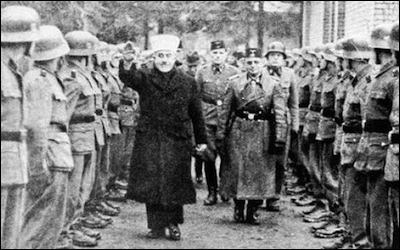
1379The Jerusalem mufti, Muhammad Hajj Amin Husseini (left), meets with SS-Reichsführer Heinrich Himmler, April 1943.

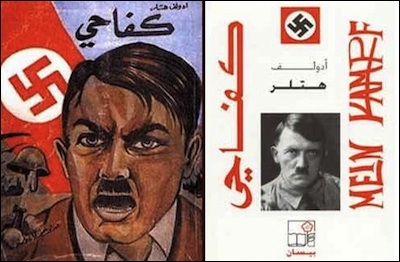
Hitler’s Mein Kampf has been a bestseller for years in predominantly Muslim countries, including the Palestinian Authority and Turkey.

***********************

The Jerusalem mufti, Muhammad Hajj Amin Husseini, leader of the Palestinian Arabs from the early 1920s to the late 1940s, is widely known for his close collaboration with the Nazis during World War II. Aspects of the collaboration remain to be more thoroughly scrutinized.[1]However, and without discounting his culpability for the collapse and dispersal of Palestinian Arab society (or al-Nakba, the catastophe, as it is called by Palestinians and Arabs), Hajj Amin’s role in shaping Muslim perceptions of Jews might be a far more important and lasting legacy than his political activism in Palestine, Germany, or elsewhere.[2] An important source supporting this fact is a booklet he authored for Muslim soldiers enlisted in the Nazi SS division in Bosnia.

During the mufti’s stay in Berlin in 1941-45, he befriended Hitler’s right-hand man, Reichsführer-SS Heinrich Himmler. Himmler’s fascination with Islam and the mufti’s zealous support for the Nazi cause resulted in several common enterprises, notably the establishment of a volunteer Waffen-SS division in Bosnia, made up mostly of Bosnian Muslims, later named the Handzar division. Most books about the division display photographs of its soldiers—distinguishable by its insignia on uniform lapels and fez headgear—reading a booklet titled Islam und Judentum—most certainly the German version of the mufti’s Croatian or Bosnian pamphlet Islam i židovstvo (Islam and Judaism).

In whatever language the pamphlet was originally written, the intended readers were Muslims (Bosnian or otherwise) and not Germans. This author has been unable to locate a German copy of the pamphlet, but it is reasonable to regard the text written in the language of the Bosnian Muslims (at the time called Croatian) as the most relevant. A translation of the booklet is presented below, followed by an analysis of its significance and far reaching implications.[3]

_________________

Islam and Judaism (Islam i židovstvo)

For us Muslims, it is unworthy to utter the word Islam in the same breath with Judaism since Islam stands high over its perfidious adversary. Therefore, it would be wrong to carry out comparison of those two generally different counterpoints.

Unfortunately, it is insufficiently known that animosity between Islam and Judaism is not of a recent date. It reaches long back in history, all the way to the time of the Prophet Muhammad. This short historical overview will demonstrate the importance and perfidiousness of Jewry and its animosity toward the founder of Islam, the Prophet Muhammad.

Jews are known in history only as a subjugated people. Their vulgar[4] nature
and insufferable stance toward the nations that offered them hospitality, and toward their neighboring nations, are the reason that those same nations had to resort to [certain] measures in order to suppress a Jew’s efforts to obtain his[5] desire by force.

The history of antiquity shows us that the pharaohs were already forced to use all means against Jewish usury and Jewish immorality. Ancient Egyptians finally expelled the Jews from their land. Led by Moses, the Jews then arrived in the Sinai desert.

Arab theologian Muhammad ibn Jarir al-Tabari [839-923 C.E.] narrates that the Jews even wanted to kill their leader and savior Moses when he came back from Mount Sinai. Because of that, God punished them, and they had to meander in the wilderness for forty years. It should have brought them to their senses, and the new generation should have been cleansed from the low esteem of their fathers.

Following that, the Jews spread like locust all over the Arab peninsula. They came to Mecca, to Medina, to Iraq, and to Palestine, which is the land of milk and honey. The group of the Jews that came to Syria and Palestine was now under Roman rule. The Romans, however, soon discerned the peril that threatened the land from the Jews, and so they introduced harsh measures against them. Besides that, a serious, contagious illness of plague erupted, which was by common opinion brought into the land by Jews. When even medical doctors stated that the Jews were indeed the source of the infection—and their opinion was obviously correct—there arose among the people such upheaval against the Jews that many Jews were killed. In addition, that event is the reason why the Jews have been called “microbes” in Arabia to this very day.

1380The mufti of Jerusalem, Muhammad Hajj Amin Husseini, visits the volunteer Nazi Waffen-SS division in Bosnia, made up mostly of Bosnian Muslims. The mufti was instrumental in the division’s formation.

The Arabs have a particular understanding for introducing forceful measures against Jews in Germany and for their expulsion from the country. After the [First] World War, England and America enabled the Jews to settle in Palestine and to establish a Jewish state there. Jewish excrement from all countries assembled there, rascally striving to seize the land from Arabs. And indeed, they succeeded in buying land from the poorest of the poor and from unscrupulous landlords. By doing so, they took poor widows’ bread and stole food from children to fatten themselves.[6] When the Arabs opposed the Jewish settlement, the Jews did not shun bloody murders. So they robbed many families of their livelihood and threw the families into misery and troubles. (God will punish them for those disgraceful deeds).

The Jewish struggle against Arabs is nothing new for us, except that as time passed, the location of the battlefield changed. Jews hate Muhammad and Islam, and they hate any man who wishes to advance the prosperity of his people and to fight against Jewish lust for possessions and Jewish corruption.

Struggle between Jews and Islam began when Muhammad fled Mecca to Medina where he created the base for the development of Islam. At that time, Jews were merchants, already permeated with guile, and they understood that Muhammad’s influence, in both the spiritual and business spheres, could turn into a danger for them. Thus they were possessed by a deep hatred toward Islam; hatred that intensified as Islam was growing more solid and powerful. The Jews breached the agreement they had concluded with Muhammad in Khaibar, of which we shall speak later. Moreover, their rage grew immensely when the Qur’an revealed the deepest inclinations of their soul, their heartlessness, and unscrupulousness by which their ancestors had been commonly known. At that time, the Jewish methods were already the same as they are today. Their weapon has been, as always, slander and quarrel, and so they attempted to humiliate Muhammad in the eyes of his followers. They claimed that he was a deceiver, an enchanter, and a liar. When they did not succeed in this, they attempted to undermine Muhammad’s honor by spreading a rumor that his wife Aisha committed adultery. The purpose of spreading such a rumor was to sow doubt in the hearts of Muhammad’s followers.

When that failed, they tried to show Muhammad’s teaching in a bad light. With that purpose, several Jews converted to Islam; only a few days later, they returned to the Jewish faith. When asked why they changed their mind so suddenly, they replied that they were very willing to settle in Islam but found that all of it is nothing but a lie. The following Qur’anic verse alludes to that:

Many of those knowledgeable in the Scriptures attempt to somehow render you infidels again by converting to our religion. It was, though, nothing but their souls’ envy, when they comprehended truth.[7]

When the Jews understood that they would not reach their goal by the means used until then, they started to ask Muhammad various meaningless and unsolvable questions. Thus, they wanted to convince others that Muhammad was poor in knowledge and wisdom. However, that method achieved no success. As they were thus persuaded that Islam was deeply rooted in the hearts of the Muslims, they commenced with the attempts to destroy the Muslims. Pursuant to that goal, they paid some non-Muslim tribes to fight against Muhammad. The almighty God, however, wanted it differently. With iron fist, Muhammad defeated the rebellious tribes and conquered their city. The Jews could not bear such a defeat, and so they decided to destroy Muhammad in every way. They hired men to murder him.

The Medina Jews lived in the city district of Banu Nadir. When Muhammad came to Medina, he concluded a contract with them. One day he set out to that city district, accompanied by only ten companions, to talk to the Jews and to try to convert them to Islam. Muhammad explained the principles of Islam to the Jews, and they seemed very interested and open-minded. Yet as Muhammad was talking in a friendly way with some of the Jews, another group prepared an attempt on his life. They persuaded a man to throw a piece of rock on Muhammad’s head. Surely Muhammad would have been killed were it not for God, who warned him. An inner voice advised him to leave that place, and so the treacherous Jews could not carry out their design. Consequently Muhammad sent a companion to deliver his message to the Jews to leave the city within ten days. They had breached the contract they concluded with him by trying to take his life. Any Jew found in the city after those ten days would be punished by death.

However, some of the Jews, who outwardly accepted Islam but in their innermost remained Jewish, persuaded other Jews not to leave the city. When the ten days passed, Muhammad was forced to expel the Jews from the city by armed force. Part of the Jews fled to Khaibar and part to Syria.

The Jews who fled to Khaibar, however, would not concede defeat and decided to avenge themselves on Muhammad. For that purpose, they turned to other Khaibar Jews and to the Jews of Taima and of Wadi Qura. Together they plotted a conspiracy: With large sums of money, they agitated non-Muslim Arab tribes to attack Medina. When Muhammad discovered their plan he quickly armed his men and set out toward the plotters’ base in Khaibar. Muhammad’s companions captured Khaibar and expelled most Jews from the site. With the remaining Jews, Muhammad concluded a contract by which peace was guaranteed.

Only after that devastating defeat [of the Jews] could an Islamic Empire peacefully develop. But when one takes into account the Jewish significance, it was not to be wondered that Jews, in spite of the agreements made, did not abandon their plans and continued to try to destroy Muhammad by all available means. They invited him to a feast, and he accepted the invitation suspecting no evil. In front of him was placed a roasted lamb prepared by the Jewess Zainab, wife of Sallam ibn Mishkam.[8] The [topic of] conversation around the table was the contract and a peaceful life in mutual agreement in which they now lived. Muhammad had not the slightest suspicion about treason. The Prophet and his faithful companion Bashr ibn Bara each took a piece of lamb meat. Muhammad, however, did not swallow his bite because its taste made him suspicious.

“The bone tells me that the lamb was poisoned,” he said and called the Jewess Zainab to ask whether the meat had been poisoned. She answered, “You know I am highly esteemed by the Jews, and I acknowledge that I have poisoned the lamb. In so doing, I thought that if you were a king, I would only kill a king, but if you were indeed a prophet, you would know that the meat had been poisoned.”

Muhammad’s companion soon succumbed to the poison’s effect, whereas Muhammad, despite spitting the poisonous bite, later suffered various health disorders, and the impact of the poison had always been evident. Some historians even believe that Muhammad’s death was a consequence of that poisoning. In this matter, they refer to a hadith by Abu Huraira, whereby the Prophet said shortly before his death, “The effect of Khaibar’s feast will manifest in me until I die!”[9]
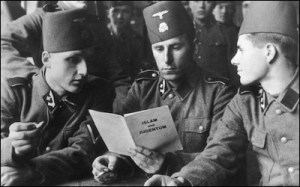
1381Many books about the Waffen-SS division in Bosnia display photographs of its soldiers reading a booklet titled Islam und Judentum—most certainly the German version of the mufti’s Croatian or Bosnian pamphlet Islam i židovstvo (Islam and Judaism). The booklet offers a stark illustration of the lengths taken by the mufti to demonize Jews and Judaism and clearly was produced for propaganda and incitement purposes.

Now, the Jews were persuaded that Muhammad was immune to their attacks. Therefore, they made a decision to spread discord among the Arab tribes, so as to break the power of Islam. When Muhammad went back to Medina, he succeeded in reconciling the Arab tribes of Kawsha and Karasha,[10] which had been fighting each other ceaselessly for 120 years. In doing so, he significantly strengthened Islam’s position. Members of those two [formerly] hostile tribes became brethren in Islam, and peace entered the city. In this regard, the Jews tried to undermine the Islamic empire.

A revengeful old man by the name of Shas ibn Qais one day walked with his friends and came across an assembly of the reconciled tribes held in city square. He could not bear to see how [the members of] those two tribes, formerly at war with each other, now communicated nicely, and so devised a hellish plan. He sent to their assembly a friend of his, knowledgeable in war poems, and persuaded him to recite some of his old poems that were full of hatred. That Jew, an outstanding orator, came indeed to the assembly and started to recite old war poems of both tribes. By doing so, he managed to find in each tribe a man in whom old hatred flared up. Those two men started to fight each other and then urged their fellow-tribesmen to take up arms. An immense tragedy would have ensued were it not for Muhammad, who learned about the fight amongst brethren and hurried up to the battlefield.

“Oh my God, are the old times returning even while I am still amongst you!” he shouted. “When I gave you Islam as religion, the old fratricidal discord was buried, and you became brothers in your hearts. Do you wish to slip into infidelity again?”

Both tribes understood that disturbances among them were sown by the Jews alone. They threw away their weapons and asked God for forgiveness, and then they hugged each other and concluded a new brotherly alliance. Regarding Shas ibn Qais the Jew, it is said in the Qur’an,

Oh, you scribes,[11] why do you prevent the believer from walking on God’s path when you are witnesses yourselves? But God is not blind for what you do.[12]

Regarding the tribes of Kawsha and Karasha, the Qur’an said,

Oh, you who believe, would you listen to those who received the Scripture, so that they would turn you into unbelievers again, after you have received faith! How can you be infidels when God’s words were read to you, and his apostle is among you? He who holds unto God has already been introduced to a straight path.[13]

Notwithstanding their attempts, the Jews never succeeded in spreading division among Muhammad’s followers and in dragging them back into infidelity. However, even after all these events should have taught them the futility of their efforts, they persistently continued to carry out their devilish plans. Once, they tried by deceit to even bring down Muhammad himself.

There was a quarrel between two Jewish tribes, and the side that was wrong held an assembly and sent its leaders to Muhammad. Those Jewish leaders said to Muhammad, “You know that we are influential people. If you support us in our dispute with our opponents, we will apply all our influence to make all Jews convert to Islam.” Muhammad, of course, dismissed them. There is a verse in the Qur’an about this event:

Be careful to make decisions according to what God has revealed and not to consider their desires. Keep your guard toward them so that they would not even partially shift you from what God has revealed to you. If they rebel, know that God will surely punish them for a part of their sins. There are, indeed, many men who are evildoers.[14]

Another example of Jewish subversive action was recorded by Ibn Abbas. At the time when Muhammad went from Mecca to Medina, prayers were directed toward Jerusalem. However, it lasted only for seventeen months. Then Muhammad received God’s revelation that the direction of prayers should be Mecca, and ever since, prayers are uttered with faces turned to Mecca. The Qur’an says about this:

We see how you turn your face toward heaven, and we would like to give it a direction which you will like: Turn your face toward the holy place of prayer; wherever you find yourselves, turn your face in that direction. Don’t you see that even those who had received the Scripture know that it is the truth before their Lord? And God is never heedless of what they do.[15]

When the Jews found out about this Qur’anic verse, they were angered and asked Muhammad to return to the previous direction of prayer, which was Jerusalem. Were he to do so, they promised, all Jews would accept Islam. Muhammad, however, did not allow himself to be led astray by such a proposal and to transgress against God’s command. We find the following in the Qur’an about that:

The direction to which you used to turn in prayer until now we have changed only for the purpose of distinguishing those who follow apostles from those who turn on their heel. That was surely difficult but not for those led by God. And God does not want to destroy your faith because God is full of goodness and compassionate to men.[16]

Here is another example how the Jews did not hesitate to stab Muhammad in the back at the time of his utmost distress. When Muhammad won the Battle of Badr, he sent a messenger on his own camel, because that camel was the fastest, to carry the news about his victory to Medina. The Jews, however, tried to bring confusion into the Muslims’ ranks by spreading false rumors that Muhammad had been killed in the battle. As evidence, they pointed out that Muhammad’s camel returned to the city with another rider.

When even that design failed, the Jews turned to Mecca to incite Muhammad’s enemies against him. Moreover, they declared their readiness to support the Meccans in their fight against Muhammad with an army of theirs. When the pagans of Mecca asked the Jews—since the Jews had received the Holy Scripture even before Muhammad—whether or not Muhammad’s religion was good, the Jews answered, “You know that we are men of letters. Believe us, therefore, when we tell you that your religion is much better.” The following verse is in the Qur’an about this:

Don’t you see those who received the Scriptures? They believe in Jibt and Taghut [superstition and idolatry], but they nevertheless say about pagans that their way is better than believers’ way. Those are the ones whom God has cursed, and he who was cursed by God cannot be helped.[17]

As we see, that curse came true. Without a homeland, the Jews are scattered throughout the whole world, and nowhere do they find true help and support. Another Qur’anic verse reads:

You will certainly find out that the greatest animosity toward the believers foster the Jews and the pagans.[18]

That idea has been even better expressed by words of Muhammad: “It will never be possible for you to see a Muslim and a Jew together without secret intention in the [heart of the] Jew to destroy the Muslim.”[19] Abu Huraira passed to us the following hadith:

Judgment Day will not come before the Muslims completely destroy the Jews, and when every tree with a Jew hidden behind will say to the Muslim, “There is a Jew behind me, kill him!” Only the gharqad tree, which is a small bush with many thorns growing around Jerusalem, will not participate in it because it is a Jewish tree! [Bukhari-Muslim VIII, p. 188].

_____________________

Assessing the Pamphlet

The booklet Islam and Judaism offers a stark illustration of the lengths taken by the mufti to demonize Jews and Judaism. Qur’anic passages are freely paraphrased without reference to sura and verse while apparent quotations (like those about Jews converting insincerely to Islam in order to drag Muslims away from their faith) are nowhere to be found in the Qur’an, certainly not in the translation by Muhammed Pandža and Džemaluddin Čaušević[20] used by Yugoslav Muslims since 1937. Indicating the pamphlet’s clear propaganda and incitement purpose, this sloppiness reflected both Hajj Amin’s poor religious credentials and his apparent conviction that the pamphlet would not be subjected to critical scrutiny or even read by believers well-versed in the Qur’an. For, though bestowed with the title of Grand Mufti of Jerusalem, Mandatory Palestine’s highest religious authority, it was common knowledge at the time that Hajj Amin did not possess the necessary religious credentials for such a lofty post. Indeed, he even failed to make the final short-list for the mufti’s post having received only nine of the electors’ sixty-four votes; but the Husseinis and their British champions forced one of the final three candidates to step down in his favor, paving the road to his appointment.[21]

Some of the pamphlet’s assertions indicate the mufti’s deficient familiarity with Islamic history and theology. Nor was Hajj Amin averse to introducing novelties and fabrications for the purpose of defaming Jews. His text contains details with an unconventional interpretation of Qur’anic accounts, some of them erroneous. He accuses the Jews of having “attempted to undermine Muhammad’s honor by spreading a rumor that Muhammad’s wife Aisha committed adultery.” But renowned Islamic scholars, including Tabari, to whom the mufti refers in the booklet, do not mention the Jews at all in the context of this event: Aisha’s accusers were all Arabs. Some came from the tribe of Kharzaj; at least one was from the Quraish, Muhammad’s tribe, and another was the sister of Muhammad’s wife. Their names are listed in both Ibn Ishak’s and Tabari’s accounts of the event. After God revealed Aisha’s innocence to Muhammad, some of the accusers were punished by flogging.[22]

Furthermore, the mufti claimed that Muhammad attacked Khaibar because its Jews bribed Arab tribes to attack Medina. The sources, however, do not mention any such activity by the Khaibar Jews. Khaibar was in alliance with the Arab tribe of Ghatafan—which at this point seemed to be rather defensive—with the Quraish, and with the Persians. Muhammad’s attack occurred shortly after he concluded the peace of Hudaibiya (March 628) with the Meccans. It is hard to envisage that Muhammad’s enemies would plot an attack from the north without Meccan support. On the contrary, it seems that he concluded the peace of Hudaibiya to secure his southern front so as to be able to attack the Khaibar Jews, whose Persian allies had just been defeated by the Byzantine army.[23]
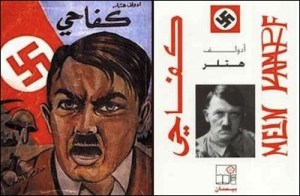
1382There remains a deep connection between Islamism and Nazism based on the common characteristics of racism, nationalism, religious bigotry, and intolerance. Hitler’s Mein Kampf has been a bestseller for years in predominantly Muslim countries, including the Palestinian Authority and Turkey.

There was, however, an event reminiscent of the mufti’s story that occurred a year earlier. The Jews of Medina had invited the Quraish and Ghatafan tribes to attack Muhammad. It was at this point, after the Battle of Badr, that the Quraish asked the Jews whose religion was better, theirs or Muhammad’s. Encouraged by the Jews, the two tribes marched on Medina, and their subsequent abortive attack came to be known as the Battle of the Ditch. After their retreat, Muhammad attacked Medina’s Jewish tribe of Banu Quraiza.[24] It seems likely that the mufti—unless he intentionally invented stories, a possibility that cannot be ruled out—confused the episode of the Banu Quraiza with that of Muhammad’s war on Khaibar.

Far more important than these technical details and idiosyncratic interpretations are the novelties the pamphlet introduces in Islamic political discourse regarding the Jews. By combining the Islamic canon with pre-Christian and Christian anti-Judaism, it attributes strengths and powers to Jews that cannot be found in Islamic tradition by portraying them as far more cunning and successful in their vicious designs than previous mainstream Islamic thought had recognized or permitted.

A simpler example of this anti-Jewish eclecticism can be found in the mufti’s accusation that Jews brought plague to Arabia. This statement evokes medieval European myths with similar themes. More significant is the notion that Muhammad’s death might have been a result of poison given to him by a Khaibar Jewess.

To be sure, Ibn Ishak and Tabari do mention how during the illness that led to his death Muhammad spoke to Umm Bashr, mother of his poisoned companion, and complained about his pain, caused by poisonous meat he had tasted three years earlier.[25] However, in classic Islamic thought, this tradition was not interpreted as proof that the Jewess had succeeded in her attempt on the Prophet’s life but as a desire to attribute to the Prophet the highest of virtues: martyrdom. In Ibn Ishak’s words, “The Muslims considered that the apostle died as a martyr in addition to the prophetic office with which God had honored him.”[26] Tabari repeats this explanation, as does Ibn Kathir (1300-73), who referred to eight different hadiths asserting that Muhammad had been warned by God about the poison: proof of his being a genuine prophet. Conversely, Ibn Kathir states that “the Messenger of God died a martyr.”[27]

The core theme of all these traditions is the Prophet’s martyrdom and not the Jews’ lethal craft; the reader is left with the clear impression that the two phenomena were unrelated. In contrast, the mufti’s pamphlet establishes the link and changes the emphasis from the Prophet’s virtue to the Jews’ mendacity. Apparently, his intention was to draw parallels with Christian traditions regarding Christ’s killing by the Jews. This accusation was intended to provoke more anger among Muslims, but it also violated Islamic tradition and theology.

The implications of the mufti’s claim that the Jews were successful in killing Muhammad despite God’s warning imply that Jews possess the power to defy God’s will. Such a blasphemous thought would be worse than Christian accusation of deicide. Jesus overcame death, and by his suffering, death and resurrection brought salvation to his community of believers; however, Muhammad not only remained dead but also failed to appoint his successor due to the rapid progression of his illness and his sudden, untimely demise. Consequently, the umma was split by different claimants to authority, and the dispute eventually led to the fiercest internecine strife in the history of early Islam, known as the fitna.

While the mufti’s Palestinian successors would not tire of reiterating this story (as late as November 2013, Palestinian Authority minister of religious affairs Mahmoud Habbash claimed that Yasser Arafat was poisoned by the Jews just as they had poisoned the Prophet Muhammad to death),[28]most contemporary Islamic scholars have a different understanding of this hazardous theology; inasmuch, the accusation that the Jews killed the Prophet has largely faded as a theological theme with mainstream Islamic commentary viewing the Jews, along the Qur’anic derision, as “adh-dhilla wa-l-maskan,” translated by Yehoshafat Harkabi as “humiliation and wretchedness.”[29] Bernard Lewis further explained:

The outstanding characteristic, therefore, of the Jews as seen and as treated in the classical Islamic world is their unimportance. … For Muslims, he might be hostile, cunning, and vindictive, but he was weak and ineffectual—an object of ridicule, not fear. This image of weakness and insignificance could only be confirmed by the subsequent history of Jewish life in Muslim lands.[30]

Departing from this conventional view, the mufti did not interpret contemporary events as a new historical phenomenon to which Muslims should respond in a new, ad hoc manner. Instead, he traced Jewish accomplishments of the 1920s, 1930s, and 1940s, and the alleged Jewish power and ambitions, to supposed Jewish activities at the time of Muhammad. In doing so, he created a precedent, later followed by prominent Islamic actors in the Middle East and elsewhere, particularly after Israel’s stunning military victories over its Arab adversaries. Thus Hamas accuses the Jews of “wiping out the Islamic caliphate” by starting World War I and of starting the French and the communist revolutions, establishing “clandestine organizations” and financial power so as to colonize, exploit, and corrupt countries.[31] Likewise, former Malaysian prime minister Mahathir Muhammad accused Jews of ruling the world by proxy.[32] Attributing such gargantuan accomplishments to the Jews, many of them at the expense of Muslims, presents a theological innovation with an immediate political consequence. Linking early Islamic with medieval Christian depictions of Jews results in their portrayal as “a demonic entity,” thus making their “extermination legitimate.”[33]

______________________

[1] Klaus-Michael Mallmann and Martin Cüppers, Nazi Palestine: The Plans for the Extermination of the Jews in Palestine, trans. Krista Smith (New York: Enigma Books in Association with the United States Holocaust Memorial Museum, 2010), p. viii.

[2] Boris Havel, “Haj Amin al-Husseini: Herald of Religious Anti-Judaism in the Contemporary Islamic World,”The Journal of the Middle East and Africa, 3 (2014): 221-43.

[3] The following text has been translated from the original pamphlet: Veliki Muftija Jeruzalemski Hadži Emin el-Huseini, Islam I Židovstvo (Zagreb: Hrvatski tiskarski zavod, 1943). I wish to thank the staff of the National and University Library in Zagreb for tracing the booklet. The Qur’anic verses and hadith are translated as they appear in the original text.

[4] The word “prostačkoj” can also be translated as: obscene, dirty, or indecent.

[5] This word was written in singular in the original text and introduces the notion that the average Jew was such; by referring to “a Jew,” the author refers to the whole people.

[6] The mufti fails to note that prominent members of his own family, including his father, were among the “unscrupulous landlords” selling plots of land to the Jews. See Efraim Karsh, Palestine Betrayed (New Haven: Yale University Press, 2010), pp. 15-19.

[7] Sura 2:109.-Ed.

[8] Ibn-Ishak, The Life of Muhammad: A Translation of Ibn Ishaq’s “Sirat Rasul Allah” by A. Guillaume(Karachi: Oxford University Press, 2004; repr., 1967), p. 516; Tabari, The History of al-Tabari [Ta’rikh al-Rusul Wal-Muluk] (New York: State University of New York Press, 1987-97), vol. VIII, pp. 123-4.- Ed.

[9] Bukhari’s Hadith, 4.394.-Ed.

[10] The author probably refers to the Arab tribes of Aws and Kharzaj though the transliteration (Kauša i Karaša) barely resembles those names.

[11] The word “pismenjaci” refers to the “People of the Book” (sljedbenici knjige in Čaušević-Pandža).

[12] Sura 3:99.-Ed.

[13] Sura 3:99-101.-Ed.

[14] Sura 5:41-5.-Ed.

[15] Sura 2:144-9.-Ed.

[16] Sura 2:142-3.-Ed.

[17] Sura 4:51-5.-Ed.

[18] Sura 5:82.-Ed.

[19] There is no Qur’anic verse with this message. The mufti perhaps refers to a non-canonical hadith or obscure tradition.

[20] Muhammed Pandža and Džemaluddin Čaušević (eds.), Kuran, Sedmo Izdanje (South Birmingham: Islamic Relief, 1937-89). Though the Qur’an condemns those who falsely feigned Islamic belief (e.g., sura 2:8-9, or sura 63), this condemnation does not specifically apply to the Jews but rather to the wider category of “hypocrites.”

[21] Karsh, Palestine Betrayed, p. 17; David Dalin and John Rothmann, Icon of Evil: Hitler’s Mufti and the Rise of Radical Islam (New York: Random House, 2008), p. 252.

[22] Ibn-Ishak, The Life of Muhammad, pp. 492-9; Tabari, The History of al-Tabari, vol. VIII, pp. 57-67; Qur’an: sura 24:11-26.

[23] Michael Lecker, “The Hudaybiyya-Treaty and the Expedition against Khaybar,” Jerusalem Studies in Arabic and Islam, 5 (1984), pp. 1-12.

[24] Ibn-Ishak, The Life of Muhammad, pp. 450-69.

[25] Tabari, The History of al-Tabari, vol VIII, p. 124.

[26] Ibn-Ishak, The Life of Muhammad, p. 516.

[27] Ibn-Kathir, The Life of the Prophet Muhammad (al-Sira al-Nabawiyya), trans. Trevor Le Gassick (Reading: Garnet Publishing, 2000-06), vol. 3, pp. 283-7.

[28] Palestinian Authority TV, Nov. 8, 2013; “PA: Arafat was poisoned by Jews like Islam’s Prophet Muhammad,” trans. Palestinian Media Watch, Nov. 12, 2013.

[29] Yehoshafat Harkabi, Arab Attitudes to Israel (Jerusalem: Israel Universities Press, 1972), p. 220.

[30] Bernard Lewis, Semites and Anti-Semites (London: Phoenix, 1997), pp. 117-39.

[31] See, for example, “Hamas Covenant 1988,” Yale Law School Avalon Project, accessed Mar. 14, 2015.

[32] CNN, Oct. 16, 2003.

[33] Moshe Sharon, Jihad: Islam against Israel and the West (Jerusalem: Moshe Sharon, 2007), pp. 77-8.

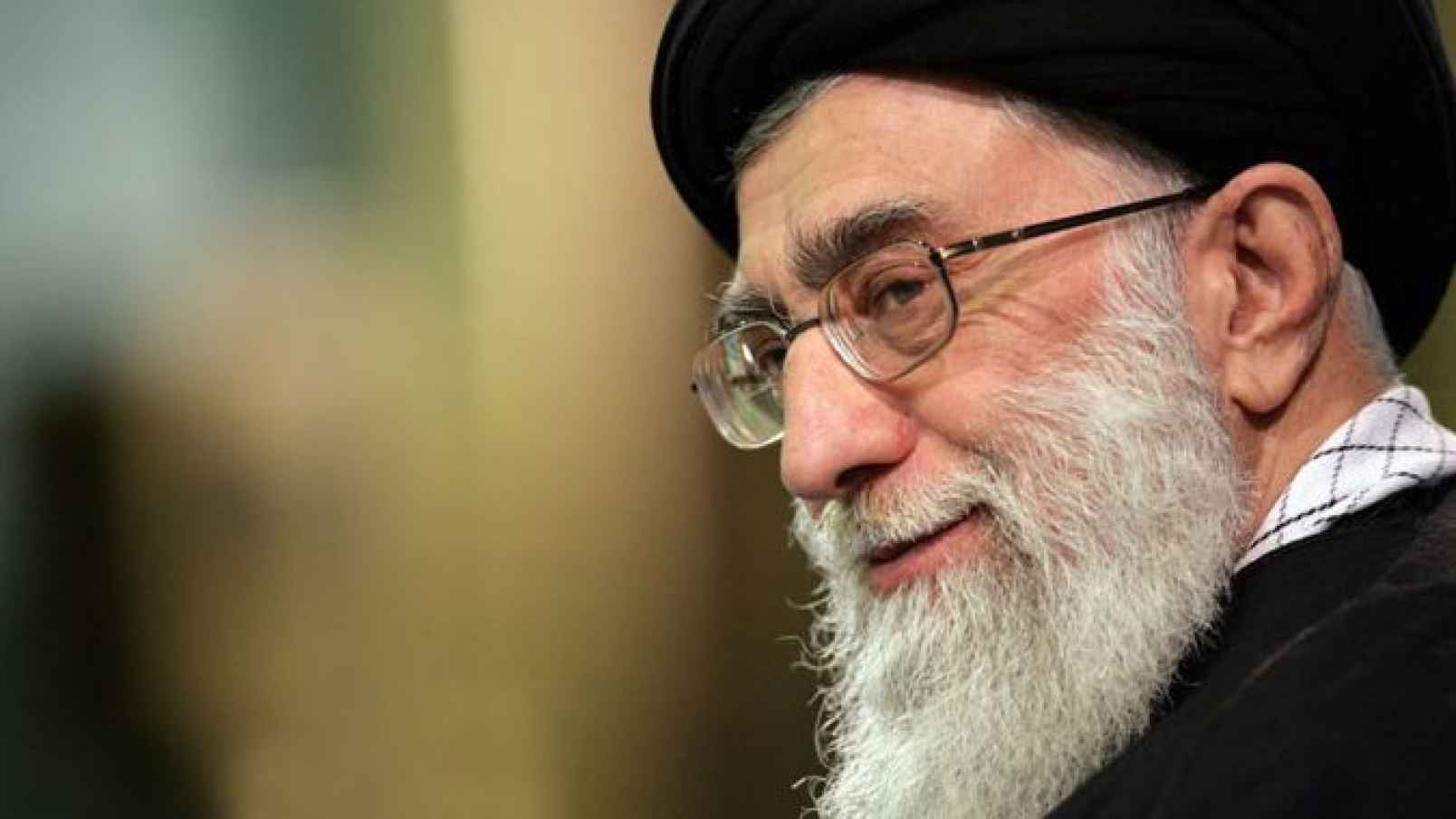
Iran Implicated in Foiled Hezbollah Attacks on Europe

June 2, 2015

Iran Implicated in Foiled Hezbollah Attacks on Europe, The Clarion ProjectRYAN MAURO, June 2, 2015

Iran-Basij-IP_3Iranian Basij volunteer militia members (Photo: © Reuters)

If this is the behavior of the Iranian regime when it has every incentive to temporarily play nice, then what will it do when it breaks free of sanctions and uses trade deals to disarm the U.S. of its economic leverage?

********************

The arrest of a Hezbollah terrorist in Cyprus is believed to have foiled attacks in Europe, probably against Israeli or Jewish targets. The plots show that Iran is as committed to international terrorism as ever and is not the least bit dissuaded by the prospect of a lucrative nuclear deal.

The terrorist came to Cyprus last month and had nearly two tons of ammonium nitrate—a substance commonly used for making bombs—in his basement. That’s about the amount that was used to carry out the Oklahoma City bombing in 1995 that took down a federal building and killed 168 people.

It is suspected that he was planning on attacking Israelis, and there is evidence linking the operative to Hezbollah leader Hassan Nasrallah. It is also believed that the operative belonged to a network planning on using Cyprus as a “port of export” for additional terrorist plots in Europe.

The National Council of Resistance in Iran, an opposition group, says that a Cyprus newspaper reported that he was trained in Iran by the Revolutionary Guards Corps.

In 2012, a Hezbollah terrorist was arrested and later found guilty of planning attacks on Israeli tourists in Cyprus. His possession of a Swedish passport enabled him to conduct surveillance on targets in Europe. It was discovered that he was tracking flights from Israel to Cyprus, researching bus routes used by Israeli tourists and assessing a hospital parking lot. He also traveled to France and the Netherlands for Hezbollah.

The foiled plot helps make an important point about the nature of the Iranian regime. If there was any time for the regime to resist its impulses to engage in international terrorism, it is now.

An Iranian-sponsored plot could unravel the nuclear deal that could strengthen its “Islamic Revolution,” bolster the regime and allow it to dramatically increase its sponsorship of terrorism. And yet, even under these conditions, the Iranian regime can’t help but orchestrate terror plots in Europe with the objective of killing hundreds of innocents.

If this is the behavior of the Iranian regime when it has every incentive to temporarily play nice, then what will it do when it breaks free of sanctions and uses trade deals to disarm the U.S. of its economic leverage?

The rational Ayatollah hypothesis

May 29, 2015

The rational Ayatollah hypothesis, Power LineScott Johnson, May 28, 2015

In his Wall Street Journal column this past Tuesday, Bret Stephens took up “The rational ayatollah hypothesis” (accessible via Google here). That hypothesis — asserted, I would say, as a thesis if not a fact by our Supreme Leader about Iran’s Supreme Leader — holds that economics and other such considerations constrain the anti-Semitic behavior of the Islamic Republic of Iran. So about those nuclear weapons that Iran is developing on — Israel is not to worry. Neither are we. It’s the Alfred E. Newman approach writ large.

Obama articulated his thesis in response to a question posed by Jeffrey Goldberg in his recent interview of Obama. I wrote about it in “Obama expounds the limits of Iran’s anti-Semitism.” I struggled because Obama’s observations are both ignorant and obtuse. Stephens takes up Obama’s thesis somewhat more elegantly than I did:

Iran has no border, and no territorial dispute, with Israel. The two countries have a common enemy in Islamic State and other radical Sunni groups. Historically and religiously, Jews have always felt a special debt to Persia. Tehran and Jerusalem were de facto allies until 1979, when Ayatollah Khomeini came to power and 100,000 Jews still lived in Iran. Today, no more than 10,000 Jews are left.

So on the basis of what self-interest does Iran arm and subsidize Hamas, probably devoting more than $1 billion of (scarce) dollars to the effort? What’s the economic rationale for hosting conferences of Holocaust deniers in Tehran, thereby gratuitously damaging ties to otherwise eager economic partners such as Germany and France? What was the political logic to Mahmoud Ahmadinejad’s calls to wipe Israel off the map, which made it so much easier for the U.S. and Europe to impose sanctions? How does the regime shore up its domestic legitimacy by preaching a state ideology that makes the country a global pariah?

Maybe all this behavior serves Tehran’s instrumental purposes by putting the regime at the vanguard of a united Shiite-Sunni “resistance” to Western imperialism and Zionism. If so, it hasn’t worked out too well, as the rise of Islamic State shows. The likelier explanation is that the regime believes what it says, practices what it preaches, and is willing to pay a steep price for doing so.

So it goes with hating Jews. There are casual bigots who may think of Jews as greedy or uncouth, but otherwise aren’t obsessed by their prejudices. But the Jew-hatred of the Iranian regime is of the cosmic variety: Jews, or Zionists, as the agents of everything that is wrong in this world, from poverty and drug addiction to conflict and genocide. If Zionism is the root of evil, then anti-Zionism is the greatest good—a cause to which one might be prepared to sacrifice a great deal, up to and including one’s own life.

This was one of the lessons of the Holocaust, which the Nazis carried out even at the expense of the overall war effort. In 1944, with Russia advancing on a broad front and the Allies landing in Normandy, Adolf Eichmann pulled out all stops to deport more than 400,000 Hungarian Jews to Auschwitz in just two months. The Nazis didn’t even bother to make slaves of most of their prisoners to feed their war machine. Annihilation of the Jews was the higher goal.

Modern Iran is not Nazi Germany, or so Iran’s apologists like to remind us. Then again, how different is the thinking of an Eichmann from that of a Khamenei, who in 2012 told a Friday prayer meeting that Israel was a “cancerous tumor that should be cut and will be cut”?”

Walter Russell Mead has more here, all of it worth reading. I thought readers who have been tracking the deep thoughts of our Supreme Leader, as we all should, might find Mead’s thoughts and Stephens’s column of interest.