Archive for the ‘Iran’ category

What the Arab League Meeting Reveals

August 1, 2016

What the Arab League Meeting Reveals, Gatestone InstituteLawrence A. Franklin, August 1, 2016

♦ The most significant aspect of this year’s Arab League conference was the downgrading in significance of Palestinian issues on the agenda.

♦ The community of Arab states is bereft of the confidence to act collectively in its own interests, and has a fearful inability to meet the challenge of either Iran or radical Islamic terrorism, which threaten the very existence of their regimes.

The Arab League concluded its 27th annual summit on July 28 in Nouakchott, Mauritania. The sessions exposed the deep divisions in the Arab world, the bloc’s decreased influence in regional affairs, and the declining importance of Palestinian issues in the Middle East.

The annual affair apparently failed to make progress on last year’s Saudi proposal to establish an all-Arab, multinational force in response to Iran’s aggressive policies in Yemen, Iraq, and Syria. The Nouakchott-hosted sessions also seem to have made no progress toward developing a unified anti-terrorist agenda. The growth of the Islamic State presence in Libya and elsewhere in North Africa was evidently a prime motivator for the perceived need for an anti-terrorism policy.

1739The Arab League concluded its annual summit on July 28, which was held this year in a tent in Nouakchott, Mauritania. (Image source: CCTV News video screenshot)

The Arab League’s precipitous decline in political clout was symbolically exposed by the failure of many key national leaders to attend the conference. The leaders of Egypt, Saudi Arabia, Jordan and Tunisia did not attend. Only eight national leaders from the 22-member organization attended the conference.

However, the most significant aspect of this year’s conference was the downgrading in significance of Palestinian issues on the agenda. Perhaps aware of this development, Palestinian Authority (PA) President Mahmoud Abbas also decided not to attend. However, PA Minister of Foreign Affairs Riyad al-Maliki explained that Abbas could not attend due to the recent death of his brother. Later, Maliki, somewhat quixotically, called upon the Arab League to help sponsor a UN Resolution to initiate a lawsuit against the United Kingdom for having embraced the 1917 Balfour Declaration, which made it official London policy to support the creation of a national home for the Jewish People.

Nevertheless, when the representative of the Popular Front for the Liberation of Palestine (PFLP) hectored delegates that they no longer seem to treat the depressed state of the Palestinian people as the overriding issue that should unite all Arabs, his pleas seemed to fall on deaf ears. The PFLP gave public evidence of the Palestinian issue’s fall from priority, stating on their website that “this year’s resolutions are no more than a carbon copy of the resolutions of the Arab Summits made in previous years. It reflects the situation too of the Arab League which long ago lost the Arab peoples’ confidence.”

Hamas also ruefully expressed similar frustration with the Arab League delegates, saying the summit “reflects the status of decline which the Arabs are suffering, even at the official level.”

Ironically, the only commentator who assessed that the Palestinian issue remains paramount in Arab minds was the French Consul General in Jerusalem, Herv Magro, who commented that “the Israeli-Palestinian Conflict is the central issue in the Middle East.”

Arab and Islamic states traditionally give lip service to the Palestine issue and Israel’s “occupation” of Arab lands. However, from the substance discussed at the Arab Summit, it seems apparent that Palestinian affairs and the so-called Arab-Israeli peace process are not currently the primary concerns of Arab states. Certainly, there was little evidence at this year’s annual meeting that Palestine was any representative’s principal concern, except that of the PFLP delegate.

The tenor of this year’s conference demonstrates the politically reality of a divided Arab world, a community of Arab states that is bereft of the confidence to act collectively in its own interests, and its fearful inability to meet the challenge of either Iran or radical Islamic terrorism, which threaten the very existence of their regimes.
Humor? | Let’s give all immigrants and Muslim “terror” groups what they want and need.

June 28, 2016

Let’s give all immigrants and Muslim “terror” groups what they want and need. Dan Miller’s Blog, June 28, 2016

(I marked the post as “Humor?” but it comes very close to reflecting Obama’s world view. The opinions implicit in this article are mine and do not necessarily reflect those of Warsclerotic or its other editors. — DM)

This is a guest post by Loretta Lynchmob, Supreme Attorney of Imam Obama’s Loving America. Her younger sister is among the singers in the following inspirational video, as is Hillary Clinton. Here are her, er, inspiring words.

I also participated in this dazzling performance on my way to support an abortion clinic:

Unfortunately, I did not have enough time to sing What the World Needs Now is Love before or after making my remarks following the White supremacist hate-group’s attack in Orlando, Florida during which almost two hundred innocent  homosexuals and lesbians were killed or wounded. That sad incident, of course, had nothing — absolutely nothing — to do with the wonderful Religion of Peace and Tolerance. Rather than listen to the haters who claim that it was on account of our their beautiful Islam, we must give all Muslims at home and abroad love, not hate.

This brings me to the major point of this article: Since everyone — including Muslim “terror” groups — wants the same loving sort of life that all good Americans want, we must give them what they want and need to end their totally justified “depredations.” To do so is Imam Obama’s Loving American way and we cannot do otherwise; that would not be who we are and would put us on the wrong side of hisherstory.

What do immigrants and the so-called terror groups want and what can we give them?

“Terror” groups, like the immigrants fleeing the poverty and repression they suffer in much of Latin America, want to have the same prosperity and freedom that we have in Imam Obama’s already-great America; America was never greater than under the heel of Obama. The Latin American immigrants want it here, the “terror groups” want it in the countries we wrongfully took from them to give to radical firebrands such as President al-Sisi in Egypt and Prime Minister Netanyahu in Occupied Palestine. They will have the prosperity and freedom they want and deserve only when we give them love, not hate. Trump offers hate, we offer love. Surely, ours is not only the better way, it is the only way.

Aside from our abiding, non-judgmental love, what can we give them? They are poor so we need to give them money and the stuff that money can buy. Based on our outpourings of love, they will not use the money to purchase automatic weapons and other types of assault rifles to use against innocents or even against us. Obama’s wonderful peace deal with Iran is a case in point: due to His wisdom in returning to Iran economic power and money of which she had been unjustly deprived, Iran has joined the world community as a peaceful power, opposed to “terrorism,” and will never have nuclear bombs. Only those in America who cling hatefully to their guns and their religion of hate see the world differently and use weapons of war on innocents.

We can, and must, also help them to learn more about democracy. We encouraged democracy when the Egyptian masses overthrew “their” dictator Mubarak and replaced him with their own peace-loving, tolerant President Morsi. That’s the way true democracy works. Then, sadly, a few thousand Egyptian enemies of the brave and peace-loving Muslim Brotherhood conducted a coup, led by an Egyptian general, and replaced President Morsi with a fascist dictator named al-Sisi. The people of Egypt have not forgotten about how democracy should work, and given a chance will again rebel against fascist al-Sisi and depose him in favor of another brave, peace-loving Muslim Brotherhood advocate. We must do everything we can to help them in their loving quest for true freedom and true democracy.

Much of Occupied Palestine is rich; that’s where the Jews live and parade with their filthy feet in what they call “Temple Mount.”

What do the Jews give their Palestinian brothers — who want only their love and sustenance? When they provide water, they poison it. They often cut off electricity to Gaza, with no better excuse than that their poverty-stricken supplicants there can’t pay for it! Is money all that matters? Is gross human suffering of no consequence?

We can, and must, do everything possible to send the Jews festering in Occupied Palestine back to wherever they came from. It’s only just and fair! The blessed United Nations is one hundred percent with us on this; too long have we vetoed Security Council resolutions even modestly adverse to “Israel.” Were we to sponsor a decree by the UN Security Council to rid Occupied Palestine of its Jews, it would pass without veto. If we believe in love — not the hate spewed by “Israel” — that’s precisely what we must do.

Hillary Clinton is indisputably the best-qualified person to take up Obama’s great work when He, sadly, must leave office next January. There is much left to be done, and only She can and will do it. Even the proprietor of this vile right-wing hate blog has said so. Trump, on the other hand, would destroy everything that Obama has done and thereby destroy America as we know and love her. A vote for Hillary is a vote for honesty, candor and, most important, love. A vote for he-of-the-orange hair is a vote for dishonesty, lies and hate.

****************

Editor’s comments

Ms. Lynchmob does a good job of articulating the differences between Trump and the Obama-Clinton cabal and their visions for America as seen by the left. How many in Obama’s America see things as she does?


Israeli-Turkish accord: core of new lineup vs Iran

June 28, 2016

Israeli-Turkish accord: core of new lineup vs Iran, DEBKAfile, June 27, 2016

(Please see also, Israel and Turkey restore relations – peace in our time? — DM)

Turkey_Israel480

The reconciliation agreement announced Monday, June 27 for restoring full normalization between Israel and Turkey after six years of animosity will restart intelligence and security cooperation between the two countries and entail joint military exercises, and investments in energy and defense.

DEBKAfile’s security experts evaluate the deal as offering a valuable and timely increment for Israeli’s national interests on eight scores:

1. It fits neatly into the current joint Saudi-Egyptian bid for Israel to bolster their emerging alliance with Turkey that is designed for drawing a Sunni line against Iran’s expansionist moves in the Horn of Africa, the Red Sea, the Straits of Aqaba and in uncomfortable proximity to the Mediterranean shores of Israel and Egypt.

2. It is designed as the forerunner of a series of interlocking deals. DEBKAfile can disclose that the next bilateral accord expected to be concluded is a reconciliation agreement between Turkey and Egypt for Presidents Recep Tayyip Erdogan and Abdel-Fatteh El-Sisi to bury the hatchet. In at least one respect, this ont will be modeled on the Turkish deal with Israel: Turkey is committed not to let Hamas act against Israel from its soil and, by the same token, not to permit Hamas’s parent and El-Sisi’s archenemy, the Muslim Brotherhood, operate from Turkey.

3. In this regard, Egypt and Turkey will maintain intelligence cooperation.

4. The bilateral intelligence mechanisms to be set up between Turkey and Israel and Turkey and Egypt will pool their input on Iran.

5.  This key aspect of the renewed cooperation between Ankara and Jerusalem lends it a military-intelligence dimension rather than that of a diplomatic protocol. This dimension finds expression in the decision to devolve its implementation not on the holders of political office but the heads of the military-intelligence services of the two countries.

IDF Chief of Staff Lt. Gen. Gady Eisenkot, to whom the head of military intelligence defers, will in fact be in charge of these exchanges, as well as the joint military exercises which are in the active planning stage.

Realizing he had been passed over for this important facet of cooperation with Turkey, Israel’s new defense minister Avigdor Lieberman announced he was opposed to the deal. This was treated as no more than a token protest that will not impede it.

6.  Jordan has been slated as another member of the new alliance. King Abdullah is currently in the process of quietly dismantling the Muslim Brotherhood networks in his kingdom. Many of is members belong to the Palestinian Hamas.

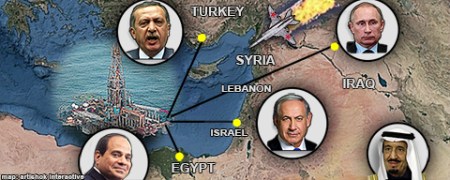
7.  Under the agreement, Israel and Turkey will begin formal talks to build a gas pipeline between the two countries, through which Israel might sell its natural gas, with Turkish assistance, to Europe.

DEBKAfile rates this provision as fundamental to the entire process and of cardinal importance to both their interests. Israel is in need of a major client to boost the development of its offshore gas fields, whereas Turkey wants to be that client and, at the same time, Russia is after a piece of the energy bonanza and most of all a contract to build the pipeline to Europe.

Up until recently, Israel put up a keep out sign for Moscow, mainly under pressure from Washington. But in recent months the conversations between Binyamin Netanyahu and Vladimir Putin have progressed into an inclusive strategic dialogue on Middle East issues, especially on Syria. This opened the door to a Russian role being broached in the export of Israeli gas.

8. This role took another step forward Monday. On the table now is Israeli-Turkish-Russian military and intelligence collaboration for securing the Israeli offshore gas in the Mediterranean – a prospect that brought the Turkish president to finally apologize for his air force downing a Russian Su-24M bomber over the Syrian-Turkish border on Nov. 24, 2015.

For the sake of these promising relations, Turkey was ready to offer compensation in the case of the dead pilot, just as Israel agreed to pay compensation for the nine Turks killed in a clash with Israeli troops during an illicit attempt too breach Israel’s blockade of the Gaza Strip.

Israeli-Turkish-Russian cooperation and goodwill for their mutual benefit on the gas issue may also generate joint efforts in other spheres too.

Is Obama’s Iran Deal a ‘Dhimmi’ Contract?

June 1, 2016

Is Obama’s Iran Deal a ‘Dhimmi’ Contract?, PJ Media, A.J. Caschetta, May 31, 2016

iran-nuclear-deal.sized-770x415xc

IRGC Commander Ali Fadavi’s recent threat to “drown American vessels” in the Persian Gulf is only the latest indication that America’s relationship with Iran resembles a dhimma contract more than a traditional foreign policy.

Since the seventh century, anyone defeated by Islamic conquest was given three choices: conversion, death, or a dhimma contract, which Bat Ye’or calls the “treaty of submission for people conquered by jihad.” By accepting the third choice, they became dhimmis: members of a “protected” class whose failure to submit to Allah was replaced by a compulsory submission to Muslims.

Isolated, disarmed, insulted at every turn, and coerced into acknowledging their inferiority with regular self-abasement, dhimmis are expected to show humility and gratitude to their conquerors.

President Obama’s approach to the Muslim world in general has been replete with gratitude, flattery, and apologies – even, and especially, for violence perpetrated by Christians one thousand years ago. Obama refuses to utter the words “Islamist terrorism.” He wildly exaggerates Islam’s role in “saving” Western culture. At the United Nations, Obama demanded that “the future must not belong to those who slander the prophet of Islam.” He even put one filmmaker in jail for doing so.

Above all, throughout his presidency Obama has reached out to Iran both publicly and via private letters.

Obama’s overtures may not be consciously designed to follow a dhimmi’s accommodation of his master. However, Ali Khamenei certainly treats Obama as if a dhimmi contract is in effect, offering only contempt in return for the president’s obsequious deference.

Khamenei leads cheers of “Death to America”? Obama makes excuses for it.

Obama insists that Iran’s path forward lies at the UN with the P5+1 partners. Khamenei answers:

[T]hose who say the future is in negotiations, not in missiles, are … ignorant.

Within Iran and elsewhere, each Iranian provocation that goes unanswered by Obama reinforces the appearance of his dhimmi status: Obama pays his tribute and endures his proscribed submission with gestures of obeisance.

Under Obama’s administration, Iran has attempted an assassination in Washington, D.C., shipped arms to Palestinian terrorists in Gaza and Houthi rebels in Yemen, and attempted to hack a dam in New York and the electrical grid in California.

Obama’s administration has responded with self-effacing conciliation.

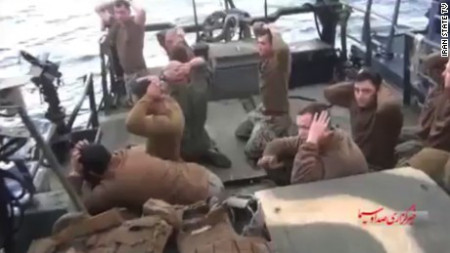
Even video of captured American sailors being humiliated by the IRGC didn’t rouse the president from his supine repose. John Kerry actually thanked “the Iranian authorities for their cooperation.”

Iran’s violations of sanction have grown more flagrant with each passing year — with zero consequences. As the supposed weaker side, Iran should be expected to deny it had conducted missile tests, or to claim its ICBM program is just a space program. Instead, Iran has boasted of the tests. An emboldened, confident Iran has acted as though it possesses the upper hand.

Among the humiliations dhimmis are forced to endure at the hands of Muslims is a tax called the jizya. This originates in the Koran:

Fight those who believe not in Allah … until they pay the Jizya with willing submission, and feel themselves subdued (9:29).

As they present their payment, dhimmis are often required to prostrate themselves and accept slaps to the head and neck, symbolic of the fate they avoided with the treaty. In 1799, British historian William Eton referred to the jizya as a “capitation tax” — permitting dhimmis to “wear their heads” for another year.

The $100 to $150 billion Iran receives under the U.S.-brokered Joint Comprehensive Plan of Action (JCPOA) is, surely, the largest jizya payment in history.

Last July as the White House celebrated the JCPOA, Khamenei tweeted an image of Obama holding a gun to his own head.

Six months later, the IRGC fired missiles dangerously close to the USS Harry S. Truman.

Despite Iran’s defiant and aggressive behavior, the president continues to grant concessions. Obama has pushed for Iran to gain access to the U.S. monetary system. Obama has even purchased Iranian nuclear waste.

Meanwhile, Iran threatened to close the Strait of Hormuz and to kill Americans found there.

Shortly after the American Revolution, the Barbary Pirates of Morocco, Tunis, Algiers, and Tripoli began seizing U.S. merchant vessels and demanding ransom. These Islamic pirates — from whence the English term “barbarians” arose — explained that the Koran simply gave them the “right and duty to make war” on non-Muslims.

George Washington did not pay tribute to the sheikhs. Instead, George Washington ordered the creation of the U.S. Navy.

They were send to fight what Washington termed the “nests of banditti.” In 1815, James Madison used that Navy to defeat the Barbary sheikhs at sea, and on “the shores of Tripoli.”

Two hundred years later, the Obama administration is accommodating the “banditti” in Tehran — and lying to the American people about it.

President Obama has assumed the role of a meek and humbled dhimmi paying tribute to his Muslim protector while enduring his insults. Washington and Madison would be disgusted.

Iran supplying weapons, cash and training to Taliban

May 27, 2016

Iran supplying weapons, cash and training to Taliban, Jihad Watch

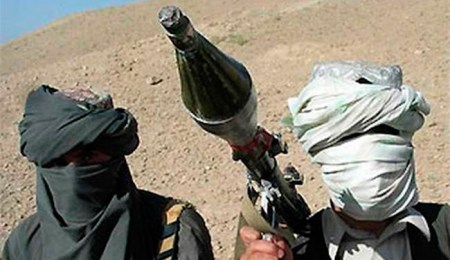
Sunnis and Shi’ites hate each other, but not as much as they hate the Infidel. Hence Iran’s support for the Taliban, as well as Hamas and Islamic Jihad: Sunnis who are waging jihad against Infidels are allies of Iran, as far as the mullahs are concerned. Such support also strengthens Iran’s ongoing maneuvering to be the leader of the Islamic world.

Taliban89
“Death of Mullah Mansoor highlights Taliban’s links with Iran,” by Jon Boone and Saeed Kamali Dehghan, Guardian, May 23, 2016:The killing of the Taliban chief on the main highway leading from the Iranian border shines new light on the movement’s complicated relationship with Tehran.Although it is Pakistan that has traditionally been condemned for secretly supporting Afghan insurgents, analysts say Iran also provides weapons, cash and sanctuary to the Taliban. Despite the deep ideological antipathy between a hardline Sunni group and cleric-run Shia state the two sides have proved themselves quite willing to cooperate where necessary against mutual enemies and in the pursuit of shared interests.

Mullah Mansoor first entered Iran almost two months ago, according to immigration stamps in a Pakistani passport found in a bag near the wreckage of the taxi he was travelling in when he was killed by a US drone strike.

The passport, in the name of Wali Muhammad, also showed he had only just returned to Pakistan from the border crossing of Taftan, some 280 miles (450km) away from the site where he was killed, an area called Ahmed Wal, where he had stopped for lunch.

On Monday, the Iranian foreign ministry denied that “such a person had entered Pakistan from the Iranian border”.

“Iran welcomes any efforts made in bringing stability and peace to Afghanistan,” said spokesman Hossein Jaberi-Ansari.

It is not known where Mansoor went inside Iran, whether his trip was secretly facilitated by the Iranian Revolutionary Guard or whether he stayed among the large populations of Afghans living in eastern Iran, especially in the cities of Mashhad and Zahedan.

The Taliban also have ties to Sunni extremist groups operating in the Iranian province of Sistan and Balochistan.

A Pakistani official from Dalbandin, a district bordering Iran, said he did not think Iran would back foreign insurgents with links to such groups.

“All Afghan militants hold Pakistani nationality, it is not written on their forehead whether he is a militant or not,” said the official, who did not wish to be identified.

Nonetheless police and intelligence officials in western Afghanistan often complain the local insurgency is being managed and supplied with weapons and training from Iran….

Canada Home to Islamic Radicals

May 25, 2016

Canada Home to Islamic RadicalsThe Toronto Sun via Middle East Forum, Tarek Fatah, May 24, 2016

2683

In November 2014, while testifying before the Senate Committee on National Security and Defence, I raised the issue of Islamic clerics using mosque sermons to attack the foundational principles of Western civilization and liberal secular democracy.

Liberal Senator Grant Mitchell was outraged by my testimony that at most Canadian mosques, the Friday congregation includes a ritual prayer asking, “Allah to give victory to Muslims over the ‘Kufaar’ (non-Muslims).” In a heated exchange with me, the senator suggested I wasn’t telling the truth, implying I was motivated by Islamophobia. Sadly, Sen. Mitchell is not alone in such views.

But neither is there any let-up in the attacks on Canadian values emanating from many mosque pulpits and Islamic conferences hosted by radical Islamist groups.

For example, in a sermon on Friday, May 6, delivered at a mosque in Edmonton, an imam invoked the memory of Prophet Muhammad to whip up hatred against Israel. He declared peace accords with Israel are “useless garbage” and vowed that Jerusalem will be conquered “through blood.”

In February, the same cleric predicted Islam would soon conquer Rome, “the heart of the Christian state.”

The Edmonton mosque diatribe was not isolated.

On May 13, just north of Toronto, an Islamic society hosted a celebration of Iranian mass murderer, Ayatollah Khomeini. The poster promoting the event described Khomeini as a, “Liberator and Reformer of the Masses.”

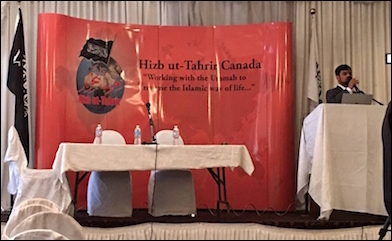
On Saturday, the Islamist group Hizb-ut-Tahrir, banned in some countries, hosted a conference to discuss the re-establishment of a global Islamic caliphate.

Pakistan-Canadian writer Tahir Gora went to cover the event, but was barred from entering the hall. “They said this was a closed door, in-camera meeting for our supporters,” Gora told me after he was asked to leave.

2684A speaker addresses the Hizb-ut-Tahrir conference in Mississauga, Ontario, on May 21.

Fortunately, one Palestinian-Canadian woman was able to enter the event.

She shared with me some of the proceedings from inside the gathering. “I walked into the banquet hall with approximately 100 attendees who were gender segregated. I sat next to a woman who said she had been in Canada for 40 years.” When I asked her if she felt any disconnect between enjoying 40 years of democracy, yet supporting the Hizb-ut-Tahrir who wanted to end it, she explained that democracy has done nothing good to people, so she and other believers follow Allah’s rule.

“The first speaker reminded Muslims that they are obligated to implement Allah’s orders that fulfil the Islamic State. It is “not permissible for us to choose’ he said, citing the Quran. However, he said it was necessary to win the public’s hearts and minds; and to partner with people of power, citing examples from the life of the Prophet.”

“At the end, a three-minute video was presented to demonstrate the collective oil and natural gas production capabilities of the Muslim world, the human capital needed to mine and process these resources … the military power required to protect them and the types of weapons needed to make such a military effective.”

While this was unfolding we received news that the Trudeau government, as part of its infrastructure development program, had authorised a $200,000 grant to a southern Ontario mosque with links to the Muslim Brotherhood.

Which begs the question: Who’s minding the store?

Why Is The Iran Report On The Treatment Of U.S. Sailor’s Still Classified?

May 17, 2016

Why Is The Iran Report On The Treatment Of U.S. Sailor’s Still Classified? Jonathan Turley’s Blog, Jonathan Turley, May 17, 2016

US Sailors

[T]he full details of the treatment of the sailors after they were taken into custody is obviously known to Iran . . . it is simply not known to the American people.

******************

We previously discussed how the government has kept 28 pages classified in the 9-11 Report to protect Saudi Arabia from a public backlash of its alleged involvement (or at least the involvement of Saudi officials) in the attacks. Now, a report on the treatment of U.S. sailors by Iran in seizure of Navy boats earlier this year will reportedly remain classified for some time. That is rather curious since Iran already knows how it treated the sailors. Again, there is a suspicion that the Administration simply does not want the public to know the full details of the mistreatment, which Rep. Randy Forbes (R., Va.), a member of the House Armed Services Committee, says are far worse than has been made public. Recently, the Navy fired the commander in the incident.


The 10 sailors were captured and their high-speed special boats were seized when they drifted into Iranian waters around Farsi Island. They were held for 16 hours and the Iranians used videotapes of sailors apologizing and crying for propaganda purposes.

Now, Forbes (who was given a classified briefing) alleges that the Administration is keeping details of the incident classified for a year or longer. He stated “I think that when the details actually come out, most Americans are going to be kind of taken aback by the entire incident, both how Iran handled it and how we handled it.”

I fail to see why the description of the treatment cannot be released immediately. I can understand the need to review and potentially classify the conditions leading to the seizure. There are issues of communications and diplomatic exchanges are likely sensitive. However, the full details of the treatment of the sailors after they were taken into custody is obviously known to Iran . . . it is simply not known to the American people.

Source: Fox

Report: German Refugee Program Money Given to Hizballah Operatives

April 20, 2016

Report: German Refugee Program Money Given to Hizballah Operatives, Investigative Project on Terrorism, April 20, 2016

Hizballah activists continue to operate freely in Germany and serve as senior employees of a German government-funded theater project intended to aid refugees in the country, according to the Berliner Zeitung daily and reported by the Jerusalem Post.

Two directors of the Refugee Club Impulse (RCI), sisters Nadia and Maryam Grassman, were central organizers of the annual pro-Iran/pro-Hizballah al-Quds Day rally in 2015 featuring “anti-Semitic slogans” and calls for “the abolition of Israel.”

Video and photographic evidence showed Nadia chanting on a loudspeaker while Maryam disseminated fliers and posters and collected donations during the anti-Semitic rally. It is uncertain whether the donations were intended to fund Hizballah’s terrorist operations in Syria and against Israel.

The RCI is expected to receive €100,000 ($113,260 USD) from the German government for the refugee project. Public taxpayer money has been transferred to the organization for several years.

There are roughly 250 active Hizballah operatives in Berlin and a total of 950 Hizballah members throughout Germany, according to a 2014 Berlin intelligence report summarized by the Jerusalem Post. Though the number of Hizballah supporters is believed to be far higher in Germany than listed in the report.

Radical Islamists are “the greatest danger to Germany…Germany is on the spectrum of goals for Islamic terrorists,” said Hans-Georg Maassen, president of Germany’s domestic intelligence agency – the Federal Office for the Protection of the Constitution (BfV).

In 2014, Germany closed down the Lebanon Orphan Children Project for providing money to the al-Shahid (“The Martyr”) Association in Lebanon. Al-Shahid was “disguised as a humanitarian organization” and “promotes violence and terrorism in the Middle East using donations collected in Germany and elsewhere,” German security expert Alexander Ritzmann said in a 2009 European Foundation for Democracy report.

While the European Union, including Germany, designated Hizballah’s military wing as a terrorist entity, Germany allows Hizballah’s political wing to operate freely in the country. The U.S., Canada, and the Netherlands designate Hizballah as a terrorist organization entirely. Even senior Hizballah officials have noted the futility in distinguishing between its political and military wings, acknowledging that Hizballah is a hierarchical and bureaucratic organization with a clear chain of command. Therefore the organization’s terrorist and military wings answer to its senior leadership and political echelons, including its main benefactor – Iran.

Israeli hysteria magnifies Hamas rocket threat

April 15, 2016

Israeli hysteria magnifies Hamas rocket threat, DEBKAfile, April 15, 2016

epa01962019 A Palestinian Hamas masked militant stands near a Hamas flag as he takes part in protest and a military parade in central Gaza Strip, 11 December 2009. Israeli settlers vandalized a mosque in a northern West Bank village early 11 December, spray-painting hate slogans in Hebrew and setting ablaze bookshelves and a carpet, Palestinian police and the Israeli military said. Palestinian police spokesman Munir Jagoub told the German Press Agency dpa that the fire in the grand mosque in the village of Yasouf, south-west of the city of Nablus, in the northern West Bank, caused heavy damage to the library, where copies of the Holy Quran are kept, as well as to prayer rugs and the wall. EPA/MOHAMMED SABER I

A Palestinian Hamas masked militant stands near a Hamas flag as he takes part in protest and a military parade in central Gaza Strip, 11 December 2009.

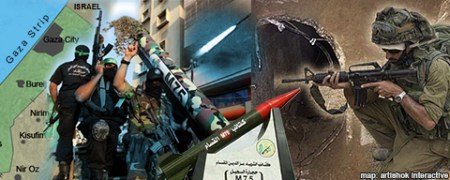
Hamas Political Bureau Chairman Musa Abu Marzuk led an SOS delegation to Tehran last month in a desperate effort to persuade Iran to end its boycott and renew the flow of funds and weapons to the Gaza Strip. But on April 4, the delegation returned home empty-handed.

This was a last-ditch effort since the Palestinian fundamentalist Hamas which rules the Gaza Strip is flat broke.

Since March 1, it has been forced to slash by two-thirds the wages paid to members of its military wing, the Ezz-a-din Qassem Brigades: each fighter now takes home $200 instead of $600 per month, and officers used to earning $1,000 must be satisfied with $350.

Since March 1, it has been forced to slash by two-thirds the wages paid to members of its military wing, the Ezz-a-din Qassem Brigades: each fighter now takes home $200 instead of $600 per month, and officers used to earning $1,000 must be satisfied with $350.

DEBKA’s military and intelligence sources add: The terrorist group has moreover halted recruitment for lack of funds to pay, accommodate or train new fighters.

The cash crunch has also hit the Hamas government. Most of Gaza’s municipal services are suspended because city officials have not been paid.

Iran’s boycott on military and financial assistance to the Gaza Strip was clamped down in mid-2015 over Hamas’ refusal to line up behind Iran’s unqualified endorsement of its allies, Syrian President Bashar Assad and Yemen’s Houthi rebels.

Since then, Hamas has spared no effort to end the shutdown. Its leaders even tried asking their friend and ally, Hizballah’s Hassan Nasrallah, to intercede on their behalf with his masters in Tehran. Nasrallah pulled some strings, suggesting that his group would be allowed to renew military and intelligence operations in Gaza to make it worthwhile for Iran to restore its support.

But that proposition like all previous applications was thrown out.

This time, the Hamas visitors were initially received by high Iranian officials, including Ali Shamkhani, secretary of the Iranian Supreme National Security Council, and Ali Larijiani, chairman of the Shura Council. Abu Marzuk asked them to put the case for ending the boycott before Iran’s supreme leader Ayatollah Ali Khamenei.

After the Palestinian officials cooled their heels for two weeks, Gen. Qassem Soleimani, commander of the Revolutionary Guards’ Al Qods Brigades, finally gave them a hearing.

But, according to DEBKA’s Iranian sources report, he told them bluntly that no more largesse would be forthcoming from the Islamic Republic until Hamas publicly declared its support for Syrian President Assad and ordered its fighting assets in Lebanon to join Hizballah’s military campaign in support of the Syrian ruler.

This confrontation has broad ramifications over and above Iran’s relations with the Palestinian terrorists.

Hamas_480_Kotert

1. Tehran demonstrated that its support for Assad is absolute and brooks no opposition. This should dash any hopes underlying the US-Russian understanding for a political resolution of the Syrian conflict that Assad would at some point agree to hand over power to a broad coalition.

Iran is ruthless in bending all its allies and dependents into toeing its line in defense of the Syrian ruler

2. Gen. Soleimani has resurfaced after a five-month disappearance from public view. Rumors abounded that he had been seriously wounded in a Syrian battle, or else fallen into disfavor with Khamenei and cast aside. His reappearance in Tehran with the Hamas delegation means he has been reinstated to the command of Iran’s forces in Syria and the role of operations coordinator with the Russian military.

3. After Iran’s door was slammed in their faces, Hamas leaders reluctantly tried patching up their tattered ties with Egyptian President Abdel-Fatteh El-Sisi.

But a delegation to Cairo found Egyptian military and intelligence officials as tough-minded as the Iranians. Hamas terrorists were put on notice that, to mend relations, they would have to prove their good faith by cooperating with Cairo in the war against the Islamic State in Sinai. Specifically, the Palestinian terrorists must hand over to the Egyptian army all the intelligence data they had accumulated on the ISIS networks in Sinai with whom they were playing ball.

Though insolvent, Hamas decided it could not afford to comply with Egypt’s terms for assistance. As DEBKA’s sources explain, breaking up with the Islamic State affiliates in Sinai, would also snap Hamas’ last remaining conduit for the receipt of smuggled funds and weapons from Islamist sources in Libya.

Having burned their boats to Tehran and Cairo, the Palestinian terrorists have run themselves into a dead end.

Hysteria regarding the threat posed by Hamas resurfaced in Israel this week, even though the terrorist organization’s military strength is gradually disintegrating mainly amid a cash crunch that nobody in the Hamas  political or military leadership has been able to resolve.

It all started from a briefing given by the head of the IDF Southern Command, Maj. Gen. Eyal Zamir, to military correspondents following a defensive exercise in the Gaza border area.

Afterwards, the heads of the Israeli defense establishment commented on the threat posed by Hamas using clichés that have been familiar to the Israeli public for years. Perhaps the most common one is “Hamas is not interested in an escalation now… but.” Another one is “Israel and the IDF are not interested in an escalation now…but.”

One of the heads of the Israeli local councils in the Gaza border area added that he was not surprised by recent comments by senior IDF officers on the strengthening of the Hamas. “The statements that Hamas operatives are continuing terror operations can only surprise those who are detached from reality,” he said.

Amid the terrorist organization’s weakness, Israeli hysteria is helping Hamas conceal its true situation from the Palestinian public.

Cuba and Obama’s ‘Axis of Evil’

March 21, 2016

Cuba and Obama’s ‘Axis of Evil’ Gatestone InstituteA.J. Caschetta, March 21, 2016

♦ Just as the Soviet Union did not subsidize Castro’s tyranny for the good cigars, so too Iran and North Korea are less interested in old weapons and luxury goods than in the one thing Cuba has always offered to America’s enemies — physical proximity. The USSR used Cuba as a forward operating base in the Cold War. Why would Iran and North Korea not do the same?

♦ Iranian and North Korean scientists have been openly cooperating on so many projects that Iran, if it is not already doing so, will likely evade IAEA inspections by testing its weapons in North Korea.

♦ A medium range missile fired from Cuba could reach most of the US. Cuba would also be a good launch point for an EMP attack on the US.

♦ Obama’s diplomatic engagement with Cuba’s octogenarian dictators will ensure that the island prison stays in business. Like Iran, Cuba has been flaunting its tyranny since Obama’s outreach, with 8,616 political arrests in 2015.

When George W. Bush used the term “axis of evil” to describe Iran, Iraq and North Korea in his 2002 State of the Union speech he was derided from all sides. Post-modernists and others among whom ideas of good and evil are quaint but obsolete, sneered that Bush was a simplistic thinker. Others, who agreed that threats to their existence might be evil, seemed less troubled by the ethics than by the accuracy of the term “axis.”

Bush, by linking these three nations, was accused of misunderstanding that members of an axis work together. As Iraq and Iran were mortal enemies, so went the argument, there was no evidence of cooperation.

In 2002 it may have been impossible to prove Iranian-North Korean cooperation, but that has changed. Since at least 2012 when the two countries signed a technological cooperation pact, Iranian and North Korean scientists have been openly cooperating on so many projects that Iran, if it is not already doing so, will likely evade IAEA inspections by testing its weapons in North Korea.

Whether through prescience or luck, Bush was correct about the Iran-North Korea connection. With Saddam out of the picture the “Axis of Evil” has become the “Duo of Evil” — not nearly the same ring. There also is evidence that the Duo is seeking to recruit a new third member to complete the axis.

Putin’s Russia, for instance, could easily be taken for a new member of the axis. Its fingerprints have been showing up in many places: the murder of Russian dissidents, the downing of passenger jets, the invasion of its neighbors. Putin’s decisions to cancel the transfer of S-300 surface-to-air missiles to Iran and withdrawal of troops from Syria suggest a Russia making a strategic retreat for its own best interests at the moment, whatever they may be.

China might also part of the axis. Constructing military bases on artificial islands indicates a budding expansionism. China’s reportedly growing dismay over North Korea’s antics, however, suggest a nation too concerned with its own interests to join any axis seeking to destroy the chief marketplace for its goods.

The less obvious, but more probable, recruit to the axis is Cuba, which shares with Iran and North Korea an institutional hatred for the USA and a history of autocratic rule. Robin Wright has called Cuba and Iran “melancholy twins.”

Most bitterly of all, all three countries might today be far less threatening had U.S. aid not saved them at crucial moments when their tottering regimes might have been toppled.

1519President Barack Obama shakes hands with Cuban dictator Raúl Castro during the Summit of the Americas in Panama City, on April 11, 2015. (Image source: White House/Pete Souza)

Had Jimmy Carter not pulled the regime out from under the Shah, the Iranian Revolution might never have caught on. Carter’s shameful treatment of an imperfect ally is a blight on his presidency. But when the so-called Green Revolution broke out in 2009, a newly-inaugurated President Obama did nothing to help the revolutionaries. Worse, he reached out his open hand, eventually placing billions of dollars at the mullah’s disposal just when sanctions were crippling Iran’s economy.

In 1994, North Korea was not yet a nuclear power. Its economy was almost non-existent, and an ailing Kim Il-Sung was losing the battle of world opinion after the IAEA declared it in violation of non-proliferation safeguards. Just when international opprobrium might have been leveraged against the regime, a semi-retired Jimmy Carter saved the Kims with the worst diplomatic deal the U.S. had ever made. The subsequent Clinton-Carter Agreed Framework provided Kim Jong Il (whose father died during negotiations) regular shipments of heavy fuel oil and, of all things, two light water nuclear plants. In return, Kim promised not to do what he immediately set about doing.

The now-infamous photograph of Kim Jong-Il and Madeleine Albright toasting the deal is an iconic tableau to diplomatic folly on par with Neville Chamberlain triumphantly waving a piece of paper with Hitler’s promise to behave himself, or more recently, John Kerry and Zarif shaking hands over the JCPOA.

Now Cuba is being saved just when its repressive dictatorship was finally vulnerable and fading on the vine, bereft of the welfare it enjoyed first from its Soviet patrons and then from Venezuela’s Hugo Chavez. Obama’s diplomatic engagement with Cuba’s octogenarian dictators will ensure that the island prison stays in business. Like Iran, Cuba has been flaunting its tyranny since Obama’s outreach, with 8,616 political arrests in 2015.

Historical similarities aside, Cuba has cooperated with both Iran and North Korea. Under the Shah, Iran had no diplomatic ties with Cuba; but after 1979, Castro was one of the first nations to recognize Khomeini’s regime as the legitimate government of Iran. Since then, ties between the two have been increasing steadily. In May of 2001, Fidel Castro visited Iran, where he said “Iran and Cuba, in cooperation with each other, can bring American to its knees.” Visiting Cuba at a meeting of the Non-Aligned Movement (NAM) in 2006, then Iranian President Mahmoud Ahmadinejad thanked the Castros for their support of his country’s nuclear program; he visitedCuba again in 2012; by 2014 the relationship had grown even closer.

Cuban relations with North Korea are not as old nor as easily documented as those with Iran. Aside from Castro’s visit to Pyongyang in 1986 and some weapons transfers in the 1980s, there had been little to report, until recently. The Economist offers 2008 as the year that cooperation between Cuba and North Korea began increasing. In 2013, the North Korean ship Chong Chon Gang was interdicted in Panama after leaving Cuba laden with Soviet weaponry hidden under mountains of sugar. There were MiG jets, spare MiG engines, missile parts, radar components, and other weaponry. There were reports that the ship had visited Cuba several times before being caught with the weapons. What else might have been smuggled out of Cuba is far less worrisome than what might have been smuggled into Cuba.

A Cuban role in the axis would be more than ideological. Just as the USSR did not subsidize Castro’s tyranny for the good cigars, so too Iran and North Korea are less interested in old weapons and luxury goods than in the one thing Cuba has always offered to America’s enemies — physical proximity. The USSR used Cuba as a forward operating base in the Cold War. Why would Iran and North Korea not do the same?

Most analysts are focused on North Korea’s intercontinental ballistic missiles (ICBMs), but a medium-range missile fired from Cuba could reach most of the US. Cuba would also be a good launch point for an electromagnetic pulse (EMP) attack on the US.

Just days before North Korea’s purported hydrogen bomb test, the State Department reached out to Kim Jong Un with another lifeline offer. And on March 17, the US removed Cuba from the list of countries deemed to have insufficient port security.

In spite of repeated Iranian violations of the JCPOA, there is no sign that the so-called “snapback sanctions” are even a topic of discussion at the White House. Last week, Russia used its veto at the UN Security Council to prevent any sanctions on Iran.

The biggest difference between the Bush and Obama approach to the “axis of evil” is that Bush was opposed to it; Obama appears infatuated.