Archive for the ‘Iran scam’ category
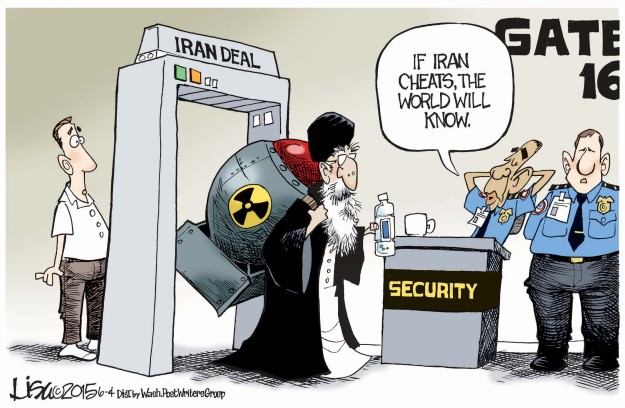
Cartoon of the day
June 6, 2015Welcome to The New World Disorder
June 5, 2015Nuke Deal Could Result in Iran Joining Eurasian Security Bloc Led by Russia and China
By Patrick Goodenough June 5, 2015 Via CNS News

Straight out of a James Bond movie, Russian and China plot to take over the world.
(Iran under the protective arms of the Bloc? Could be the best place to be when announcing to the world that you now have nukes. – LS)
(CNSNews.com) – Apart from other benefits Iran may accrue as a result of an international agreement on its nuclear program, Russia on Thursday held out another, long sought-after reward – membership in a growing Eurasian security bloc, which some observers view as a means to counterbalance the West and NATO.
After hosting a meeting in Moscow of foreign ministers from Shanghai Cooperation Organization (SCO) member-states, Foreign Minister Sergei Lavrov gave the clearest indication yet that Iran’s decade-old bid to join the group will succeed.
“Iran has been actively engaging in SCO issues as an observer since 2005,” Lavrov said. “Bloc members have discussed Iran’s application for SCO membership and reached consensus to raise Iran’s status in the organization after its nuclear issue is solved.”
June 30 is the deadline for Iran and the P5+1 group – the U.S., Britain, France, Russia, China and Germany – to reach a final agreement resolving the lengthy nuclear stand-off.
Ten days later Russia will host a summit of SCO leaders in the southern city of Ufa.
Last September, as Russia looked forward to holding the rotating presidency of the six-country bloc, Lavrov said that the SCO hoped to begin a long-deferred expansion “during the Russian presidency.”
Whether he was including Iran in that prediction remains to be seen. Meanwhile two other countries knocking on the door, India and Pakistan, look set to join: “We adopted recommendations paving the way for India and Pakistan’s accession to the SCO,” Lavrov said on Thursday.
Current members of the SCO are Russia, China, and the former Soviet Central Asian republics of Kazakhstan, Kyrgyzstan, Tajikistan and Uzbekistan.
Official observer states are Iran, India, Pakistan, Afghanistan and Mongolia, while Turkey, Belarus and Sri Lanka are “dialogue partners.”
Together the current members account for one-quarter of the world’s population, and control resource-rich territory stretching from the Caucasus to the Pacific Ocean.
Should India, the world’s second-largest country by population, and Pakistan become members, the SCO’s combined population will be more than two-fifth of the global total.
From its beginnings as the Shanghai Five in the late 1990s the bloc’s stated mission has centered on regional security, including combating “terrorism, extremism and separatism.”
Beyond regular joint military exercises and security coordination, SCO members also cooperate in other fields, including economic development, law enforcement including drug trafficking, transportation, disaster relief and culture.
SCO officials and governments, especially core members Russia and China, have long dismissed Western concerns about the bloc being a counterweight to NATO or the West in general, insisting that the organization poses no threat to “any third party.”
Nonetheless, Russian media outlets and analysts in particular characterize the SCO as a “counter balance” to NATO, and Russian leaders at times use phrases alluding to Moscow’s rejection of a U.S.-dominated world system, for instance calling the SCO “an important factor in the emergence of a new polycentric world order.”
U.S. officials were troubled when in 2005 the bloc called for the U.S. to set a deadline for withdrawing from Central Asia troops who were supporting operations in Afghanistan. Months later, SCO member Uzbekistan year expelled the U.S. from the strategically-located Karshi-Khanabad airbase, amid strained relations over human rights abuses.
Also in 2005, the SCO turned down a request from the United States to become an observer – at the same time as it gave Iran, India and Pakistan observer status.
Addressing the foreign ministers gathered in Moscow, Putin said Wednesday that “the SCO is gaining greater weight and importance all the time, as it addresses the issues of greatest priority for our countries and for the region as a whole.”
On Thursday, a member of the Iranian delegation led by Foreign Minister Mohammad Javad Zarif predicted that the SCO could “become the main competitor of the G7” – the Group of 7 major industrialized countries: the U.S., Canada, Japan, Britain, Germany, France and Italy.
(Russia formally joined the G7 – which thus became the G8 – in 2002, but its membership was suspended in March 2014 in response to the Ukraine crisis.)
Iranian deputy foreign minister Ebrahim Rahimpour told Russia’s official Sputnik news agency that the SCO “will become stronger as an international institution if the organization accepts new members,” adding that Iran wants “want the SCO region to be strong and independent.”
Iran Will Walk
June 5, 2015Iran Will Walk, The Gatestone Institute, Lawrence A. Franklin, June 5, 2015
(What if the article is otherwise correct but Obama agrees to a “deal” anyway? — DM)
- The Islamic Revolutionary Guard Corps (IRGC), the Praetorian Guard of Iran’s regime, controls most of the economy, as well as the black-market, alternative economy. The IRGC therefore actually benefits from sanctions; it is private firms, such as those involved in international commerce, that suffer. Why would IRGC operatives want to see the playing field made more level by private investment, transparency and a competitive economy?
- Sanctions never hurt the regime’s ruling class; lifting them only helped the regime solidify its power over its people.
- The objective of these two demands [an immediate lifting of all sanctions and no, or severely limited, inspections] is either to have them accepted, or to render it untenable for the Obama administration to offer Congress any deal that could be accepted – thereby shifting blame for the collapse of the talks to the U.S.
- The U.S should also be on guard against the mullahs’ belief that the Obama administration is weak both politically and its aversion to using force. The mullahs might find great pleasure in humiliating Obama, as they did President Jimmy Carter, by dragging out hostage crisis negotiations by running out the clock until his term was over. They clearly believe that the Obama administration, simply to say it got “a deal,” is ready to sign anything.
From Washington to Riyadh, not to mention Jerusalem, statesmen are gritting their teeth at the possibility of a U.S.-Iran nuclear deal that seems overly generous to the theocratic-terror state of the Islamic Republic.
 Representatives of the P5+1 countries pose with Iranian Foreign Minister Javad Zarif after nuclear negotiations in Lausanne, Switzerland on April 2, 2015. (Image source: U.S. State Department)
Most intelligence analysts and journalists assume that because Iran’s leadership endorsed the negotiations and has been the beneficiary of several key concessions by the P5+1 (the five permanent members of the UN Security Council, plus Germany), that an agreement is imminent. Forecasters have been predicting what the likely consequences of such a deal would be: negative.
But what if the Iranians walk?
Sanctions never hurt the regime’s ruling class; lifting them only helped the regime to solidify its power over its people.
A nuclear deal combined with an improvement in the commercial and business relations with the West would be inimical to IRGC interests.
The Islamic Revolutionary Guard Corps (IRGC), the Praetorian Guard of the regime, controls most of the economy as well as the black-market, alternative economy. IRGC-controlled conglomerates operate outside the law and reap huge profits through their control of the black market. The IRGC therefore actually benefits by sanctions; it is the private firms, such as those involved in international commerce, that suffer.
Furthermore, IRCG naval vessels, and private ships under their control, have been engaging in sanctions-breaking deliveries of imports across Persian Gulf waters to Dubai. The IRGC then sells the products at a profit by filtering them through the many foundations they control in Iran.
The most recent example of IRGC’s skirting of sanctions involved the illegal acquisition of aircraft through front-organizations with offices in both Europe and the Arabian Peninsula. Mahan Air, an IRGC front, was able to purchase 15 used commercial aircraft for $300 million. Another front, al-Naser Air, was about to purchase two more aircraft, this time from a U.S. owner. Israeli intelligence, however, passed details of the planned sale to the U.S. government, and on May 21, the deal was scuttled by the Office of Export Enforcement of the Department of Commerce.
Why would IRGC operatives want to see the playing field made more level by private investment, transparency and a competitive economy?
Moreover, if a nuclear deal indicated improved relations with the United States, Iranian hardliners, whether clerical revolutionaries or intelligence operatives, might fear seeing their ideological legitimacy erode. The Iranian regime’s only remaining fig leaf of legitimacy is its anti-American animus, with its accompanying pledge to “protect” Iran’s interests against the U.S.-Israel-Sunni “alliance.”
Improved relations with Washington might raise false hopes among Iran’s citizens that the regime may ultimately improve its woeful record on human rights. There remains only a thin patina of clerical control over Iranian society; if the hoped-for social and political reforms were not implemented, the result could produce a destabilizing political environment, harmful to the interests of the regime.
Another fallacy embraced by many “inside-the-beltway” analysts is that, as the Supreme Leader Ayatollah Khamenei endorsed the negotiations, a legitimate deal is now probable.
The once all-powerful Office of the Supreme Leader no longer calls all the shots. The current Iranian regime resembles a military junta or a security state as much as a theocracy. While the reach of Ayatollah Khamenei, through his network of representatives, still penetrates all dimensions of Iranian society, he does not have the final decision on key security matters. The regime’s strategic assets, for instance, such as its ballistic missile programs, are firmly under the control of the IRGC. Decisions related to Iran’s expansionist presence in the region are made by IRGC Quds Force Commander Qasem Soleimani. The role of Khamenei’s representative to the IRGC resembles more that of a handler than of an action officer.
The principal task for the regime is to find a way to back out of the negotiations while avoiding the blame. Iran’s efforts at disengagement may already have been underway for the past few weeks; the pace of decoupling from the talks seems to be accelerating. Iran has been increasing its demands apparently in the hope that they will either be accepted, or else rejected like the “poison pills” they are — such as inspectors no longer being allowed on its military sites.[1]
Another way to make the talks no longer palatable for the Obama administration was to create a hostile incident with the United States in the Persian Gulf, as it has tried to do by aggressively tailing American warships. Iranian ships affiliated with the IRGC Navy also seized a commercial ship, the Maersk Tigris, in the Strait of Hormuz, and temporarily detained both vessel and crew. Then, on May 14, IRGC boats fired several shots across the bow of a Singapore flagged vessel, but it escaped unharmed.
By this type of reckless comportment, the IRGC Navy appears intent on producing a clash with American naval vessels in the Gulf waters. Western negotiators have only to recall the presidency of Mohammad Khatami, when the IRGC and Iran’s Ministry of Intelligence and Security operated independently after they felt that the reformers had gone too far, thus threatening hard-liner control of the regime. The IRGC may have decided that Rouhani along with his American-educated Foreign Minister Zarif have reached a similar tipping point. This independent IRGC initiative is being executed even though a deal would release Iranian monetary assets that would in turn boost the sagging economy.[2]
Iran’s combative posture in Gulf waters against international shipping is also a direct challenge to international maritime law, which guarantees freedom of navigation through the world’s shipping lanes such as the Strait of Hormuz. A key principle of U.S. foreign policy is to enforce this freedom of navigation, if it is challenged by any foreign power, as one also hopes the U.S. will do in the South China Sea.
Iranian military and political spokesmen have also raised the temperature of their anti-American and anti-Israeli rhetoric of late. Leading members of the regime, including its Supreme Leader, Ali Khamenei, keep repeating, “Death to America” as well as its theological “obligation” to destroy Israel. While the Obama administration has alleged that these threats are just for “internal consumption,” an old Persian saying goes: “They spit in his eye and he calls it rain.”
Mojtaba Zolnour, Ayatollah Khamenei’s Deputy Representative to the IRGC, stated that the Islamic Republic of Iran, “has the divine permission to destroy Israel.” This media assault on Israel was designed to widen the divergence between the Obama administration and the Israeli government regarding the efficacy of the framework of a nuclear agreement negotiated so far.
Additionally, various Iranian principals have drawn “lines in the sand” designed to cause the Americans to disengage from the talks, such as the assertion that Iran will never accept inspection of its declared military sites. Another is Tehran’s repeated statement that it will not accept a gradual lifting of sanctions. Iranian leaders have insisted on immediate and irreversible lifting of all sanctions immediately after a nuclear deal is signed. The objective of these two demands is either to have them accepted, or to render it untenable for the Obama administration to offer Congress any deal that could be accepted — thereby shifting the blame for the collapse of the talks to the U.S.
Regime hard-line representatives to the majlis [Iranian Parliament] have already been mobilizing members to denounce the talks as detrimental to Iran’s national sovereignty. Eighty majlismembers signed a petition on May 12, calling upon the regime to suspend the nuclear talks until Washington halts its rhetorical threats against Iran. Hardliners in the majlis and elsewhere within the regime’s bureaucracy will likely continue to lobby against any deal.
Western analysts should be looking for the Iranian regime’s hard-line media outlets to increase domestic commentary condemning alleged U.S. deception in the negotiations as a reason to abandon the talks.
The death knell for the nuclear negotiations could come from newspapers such as Kayhan, a pro-regime newspaper run by Hossein Shariatmadari, and often characterized as a Khamenei mouthpiece.
The regime’s Friday-prayer Imams in key Iranian cities might also start opposing the talks. The themes of their noonday khutbahs [sermons] are likely to appeal to Iranian people’s patriotism, and suggest that it is more important for Iran to endure continued sanctions rather than submit to intrusive monitoring that offends Iran’s sovereignty.
Finally, hardliners who oppose any possibility of Iran’s improved relations with the U.S. may launch personal attacks on Iran’s negotiators to the nuclear talks, and, in an effort to discredit them, challenge their loyalty to the Iranian revolution. Their point of attack on Foreign Minister Mohammad Javad Zarif’s loyalty might be his alleged obsequious behavior to Secretary of State John Kerry. Zarif, on account of his many years of residency and education in the United States, can be depicted as an Americanized Iranian.
The United States should also be on guard against the mullahs’ belief that the Obama administration is weak — both politically and in its reluctance to use force. The mullahs might find great pleasure in humiliating Obama as they did President Jimmy Carter, when they dragged out hostage crisis negotiations by running out the clock until his term was over. They clearly believe that the Obama administration, simply to say it got “a deal,” is ready to sign anything.
[1] “Iran’s powerful Guard rejects inspection of military sites” by Ali Akhbar Dareini, Associated Press, 19 April 2015. Deputy Chief of the IRGC General Hossein Salami is quoted and several more statements by IRGC officials since have repeated the same prohibitive statements regarding Iran’s military sites.
[2] “U.S. to Award Iran $11.9 Billion Through End of Nuke Talks,” Washington Free Beacon, 21 January 2015. In the first of many subsequent denunciations, Senator Mark Clark of Illinois attacked the Obama administration’s plan to free Iran’s frozen assets if nuclear deal is reached.
Iran Outsources Peaceful Nuclear Development to Country With Virtually No Electricity
June 4, 2015Iran Outsourcing Nuclear Program to Korea
BY RYAN MAURO Thu, June 4, 2015 Via The Clarion Project

Iranian observers participate in a nuclear power plant test (Photo: © Reuters)
(Thanks for nothing, China. – LS)
The information about Iran’s ties to North Korea further highlights the “one step back, two steps forward” nuclear strategy of the Iranian regime.
The National Council of Resistance in Iran (NCRI), an opposition group famous for exposing Iran’s secret nuclear sites as early as 2002, claims that seven North Korean nuclear and missile experts were in Iran for one week in late April. The report substantiates concerns that Iran is outsourcing its nuclear weapons program to North Korea so it can cash in on a deal with the U.S.
The seven visitors allegedly had expertise in nuclear warheads and guidance systems for ballistic missiles. The International Atomic Energy Agency (IAEA) says it has “credible” evidence that Iran has worked on nuclear warheads for its Shahab-3 ballistic missiles as late as 2003, despite the regime’s denials.
The Iranian opposition group says the North Koreans stayed in an eight-story building named the Imam Khomeini Complex that is controlled by the Defense Ministry. It is located near the Shahid Hemmat Industrial Complex, which has a history of hosting North Korean scientists and is linked to the regime’s nuclear and ballistic missile program. It is sanctioned by the U.S. Treasury Department.
The NCRI says that this was the third North Korean nuclear team to come to Iran this year and that a fourth trip consisting of nine experts is planned for June.
It also claims to have specific information about a visit to North Korea in 2013 by Iranian Revolutionary Guards Corps nuclear scientist Mohsen Fakhrizadeh. Fakhrizadeh is suspected of being present for a nuclear weapons test in North Korea. The NCRI revealed that he traveled via China using the pseudonym of Dr. Hassan Mohseni.
Fakhrizadeh is believed to be overseeing Iran’s work on nuclear warheads, triggers for nuclear explosions and other bomb technologies. Iran refuses to let international inspectors interview him or to have access to the Parchin site where much of his research happened.
Fakhrizadeh runs the Organization of Defensive Innovation and Research, a Revolutionary Guards organization that was birthed in 2011. It is the successor to a previous nuclear weapons front that was disbanded in 2003. The IAEA says that he is using some of the same personnel from his previous outfit.
“[During the North Korea visit, Fakhrizadeh, accompanied by two other SPND nuclear experts, stayed in Hotel Koryo in Pyongyang. To keep his visit secret, Mansour Chavoshi, Tehran’s Ambassador to Pyongyang, personally welcomed Fakhrizadeh and facilitated his communications and exchanges with North Korean officials. Fakhrizadeh spent only two hours in the Iranian regime’s embassy in Pyongyang and made no other visits to the embassy during this trip,”writes NCRI official Alireza Jafarzadeh.
NCRI says that members of the Iranian Revolutionary Guards Corps and the Defense Ministry are also known to visit North Korea often. It is consistently reported that Iranian scientists are present when North Korean nuclear and missile tests are carried out.
It may not be a coincidence that the North Koreans have expandedtheir uranium enrichment program just as Iran agreed to limit its own. And just as Iran halted its plutonium reactor at Arak, North Korea restarted its plutonium reactor at Yongbyon that had been shut down since 2007. It is estimated that North Korea’s nuclear weapons stockpile could increase from 10-16 bombs to 100 by 2020.
The Iranian and Syrian regimes have a history of outsourcing their nuclear work to North Korea. In 2007, Israel blew up a nuclear site in Syria that was believed to have been built by the North Koreans. A senior defector from the Iranian regime revealed that Iran had financed the $1-2 billion project.
“While [Iranian] President Hassan Rouhani talks with diplomats in Geneva about the shape of a comprehensive agreement, his weapons specialists are likely beavering away in the hills of northeast North Korea, laying the groundwork for Iran’s first detonation—or maybe its fourth,” writes Gordon Chang, an expert on North Korea.
The information about Iran’s ties to North Korea further highlights the “one step back, two steps forward” nuclear strategy of the Iranian regime. As North Korea advances, so does Iran—especially if a lucrative deal allows the regime to invest its new wealth in North Korea’s weapons of mass destruction programs.
If the regime curtails its nuclear activities inside Iran but continues them outside Iran, then Iran won’t have disarmed its nuclear program; it will have merely dispersed it.
Iran’s cooperation with North Korea includes nuclear warhead technology
June 3, 2015Iran’s cooperation with North Korea includes nuclear warhead technology, The Hill, Alireza Jafarzadeh, June 5, 2015
(The author of the article,
Jafarzadeh, the deputy director of the Washington office of the National Council of Resistance of Iran, is credited with exposing Iranian nuclear sites in Natanz and Arak in 2002, triggering International Atomic Energy Agency inspections. He is the author of “The Iran Threat” (Palgrave MacMillan: 2008).
— DM)
For years, the conventional wisdom has been that Iran and North Korea have long cooperated in missile technology, giving the perception of not so dangerous of an alliance. That was until last week. In yet another groundbreaking revelation, Iran’s main opposition movement, the Mujahedin-e Khalq (MEK) provided information that Iran and North Korea have been engaged in extensive exchange of information and visits by experts on nuclear weapons and nuclear warhead design, as recently as April 2015.
The MEK, based on information obtained by its network inside Iran, provided a detailed account of a visit to North Korea in 2013 by Tehran’s top nuclear weapons experts headed by elusive Mohsen Fakhrizadeh, who was present during the last nuclear test conducted by North Korea.
A seven-member North Korean delegation, comprised of experts in nuclear warhead design and various parts of ballistic missiles including guidance systems, spent the last week of April in Iran. This was the third such nuclear and missile team to visit Iran in 2015. The next delegation is scheduled to secretly arrive in Iran in June and will be comprised of nine experts, according to the same MEK sources.
That Tehran continues to closely engage with North Korea, a country that cheated its way into making a nuclear weapon, all the while pledging that it would not do so, should be an additional cause for alarm. It should be a red flag for the P5+1 countries as they continue their negotiations with Iran in Vienna and Geneva with only days left before the June 30 deadline to sign an agreement.
The Iran-North Korea nuclear cooperation is in sharp contrast to what the Iranian regime leaders are telling the world. It also explains why the Supreme Leader Ali Khamenei rejects IAEA inspections of military sites, snap inspection of all sites, and interviews with nuclear scientists.
Tehran has so far managed to largely push its missile program out of the nuclear agreement requirements, and with it its extensive nuclear cooperation with North Korea—something that was kept under the radar for years.
The North Korean nuclear experts who traveled to Iran in April stayed in a secret guesthouse, a cordoned-off eight-story building, near a Hemmat Industrial Group site in the Khojir area, northeast of Tehran. Named “Imam Khomeini Complex,” and also known as 2000 units, the site is controlled by the Ministry of Defense (MoD).
The Korean delegation’s needs were met by Center for Research and Design of New Aerospace Technology, one of seven sections of the Organization of Defensive Innovation and Research (SPND). Dr. Aref Bali Lashak, who personally dealt with the Korean delegation, heads this section.
The North Korean delegation dealt with this section of SPND whose responsibility is electronics area of research and manufacturing interior parts of nuclear warhead. The visit’s arrangements were made by the Directorate of Coordination of the Iranian Ministry of Defense (MoD), headed by Brigadier General Nassorllah Ezati and the Directorate of Inspections of the MoD headed by IRGC Brigadier General Alireza Tamizi.
While there were earlier reports about Fakhrizadeh’s presence during the North Korean’s 2013 nuclear test, a two-year investigation by the Iranian opposition shows that Fakhrizadeh had gone to North Korea for the nuclear test through China under the alias “Dr. Hassan Mohseni.”
Fakhrizadeh, the head of SPND and the key figure in activities concerning the military dimensions of the regime’s nuclear program, is a Brigadier General of the IRGC, with whom the IAEA has repeatedly requested interviews, but to no avail.
The MEK first exposed the formation of SPND in July 2011 and the State Department placed it on its sanctions list in August 2014.
According to the Iranian opposition reports, during the North Korean visit, Fakhrizadeh, accompanied by two other SPND nuclear experts, stayed in Hotel Koryo in Pyongyang and spent only two hours at the Iranian regime’s embassy. To keep his visit a secret, Mansour Chavoshi, Tehran’s Ambassador to Pyongyang, personally welcomed Fakhrizadeh and facilitated his communications and exchanges with North Korean officials.
The stunning detailed information provided by the MEK is further indication that the drive to acquire nuclear weapons remains at the core of the Iranian regime’s program as nuclear negotiations continue.
North Korea’s nefarious connection once again proves that after three decades of concealment and deception, adding six or nine months to the nuclear breakout time as a result of the P5+1 negotiations will not lead to a lasting solution. Washington needs to rethink its strategy in dealing with the Iranian regime; a strategy that would eliminate, not delay, the regime’s ability to build the bomb, because Tehran consistently shows that it must not be trusted. Any nuclear agreement with Tehran, which would leave open a pathway to the nuclear bomb, must be rejected. To that end, Congress might have its biggest role to play.
Iran Implicated in Foiled Hezbollah Attacks on Europe
June 2, 2015Iran Implicated in Foiled Hezbollah Attacks on Europe, The Clarion Project, RYAN MAURO, June 2, 2015
 Iranian Basij volunteer militia members (Photo: © Reuters)
If this is the behavior of the Iranian regime when it has every incentive to temporarily play nice, then what will it do when it breaks free of sanctions and uses trade deals to disarm the U.S. of its economic leverage?
********************
The arrest of a Hezbollah terrorist in Cyprus is believed to have foiled attacks in Europe, probably against Israeli or Jewish targets. The plots show that Iran is as committed to international terrorism as ever and is not the least bit dissuaded by the prospect of a lucrative nuclear deal.
The terrorist came to Cyprus last month and had nearly two tons of ammonium nitrate—a substance commonly used for making bombs—in his basement. That’s about the amount that was used to carry out the Oklahoma City bombing in 1995 that took down a federal building and killed 168 people.
It is suspected that he was planning on attacking Israelis, and there is evidence linking the operative to Hezbollah leader Hassan Nasrallah. It is also believed that the operative belonged to a network planning on using Cyprus as a “port of export” for additional terrorist plots in Europe.
The National Council of Resistance in Iran, an opposition group, says that a Cyprus newspaper reported that he was trained in Iran by the Revolutionary Guards Corps.
In 2012, a Hezbollah terrorist was arrested and later found guilty of planning attacks on Israeli tourists in Cyprus. His possession of a Swedish passport enabled him to conduct surveillance on targets in Europe. It was discovered that he was tracking flights from Israel to Cyprus, researching bus routes used by Israeli tourists and assessing a hospital parking lot. He also traveled to France and the Netherlands for Hezbollah.
The foiled plot helps make an important point about the nature of the Iranian regime. If there was any time for the regime to resist its impulses to engage in international terrorism, it is now.
An Iranian-sponsored plot could unravel the nuclear deal that could strengthen its “Islamic Revolution,” bolster the regime and allow it to dramatically increase its sponsorship of terrorism. And yet, even under these conditions, the Iranian regime can’t help but orchestrate terror plots in Europe with the objective of killing hundreds of innocents.
If this is the behavior of the Iranian regime when it has every incentive to temporarily play nice, then what will it do when it breaks free of sanctions and uses trade deals to disarm the U.S. of its economic leverage?
Iran Short Film Series – 3. Believe Them!
June 2, 2015Iran Short Film Series – 3. Believe Them! Clarion Project, via You Tube, June 1, 2015
(But to believe what Iranian leaders say, repeatedly, would be Islamophobic. Or something. — DM)
Obama Assures Iran It Has Nothing to Fear
June 2, 2015Obama Assures Iran It Has Nothing to Fear, Commentary Magazine, Jonathan S. Tobin, June 1, 2015
(Obama seems to have been talking about Iranian efforts to militarize nukes, not peaceful uses such as medical or generation of electricity. If, as claimed, Iran has no intention of getting, keeping or using nukes why try to halt it? Why bother even to negotiate?– DM)
“A military solution will not fix it. Even if the United States participates, it would temporarily slow down an Iranian nuclear program but it will not eliminate it.”
****************
At this point, there is virtually no one in Israel or the United States who thinks it is remotely possible that the Obama administration would ever, under virtually any circumstances, use force against Iran. Though President Obama and his foreign policy team have always claimed that “all options,” including force, are always on the table in the event that Iran refuses to back down and seeks to produce a nuclear weapon, that is a threat that few took seriously. But President Obama has never been quite as explicit about this before as he was in an interview with Israel’s Channel 2 in which he reportedly said there is no military option to stop Iran. If Obama wanted to telegraph Iran that it could be as tough as it likes in the talks over the final text of the nuclear deal being negotiated this month this statement certainly did the job. Though they had little worry about Obama’s toughness or resolve, the ayatollahs will be pleased to note that the president no longer even bothers to pretend he is prepared to do whatever is necessary to stop Iran’s nuclear ambition.
According to the Times of Israel, Obama said:
“A military solution will not fix it. Even if the United States participates, it would temporarily slow down an Iranian nuclear program but it will not eliminate it.”
Though he continued to use rhetoric that left force as an option, the implicit threat of American action if a nuclear weapon were a possibility has lacked credibility since the president began his second term. Once he embarked upon secret back-channel talks in which, one by one, he abandoned his previous pledges about forcing Iran to shut down its program in concessions and virtually every other U.S. position on the issue, force was never a real possibility. The signing of a weak interim deal in November, 2013, and then the framework agreed upon this spring signaled the end of any idea that the U.S. was prepared to act. That is especially so because the current deal leaves Tehran in possession of its nuclear infrastructure and with no guarantees about inspections or the re-imposition of sanctions in the event the agreement collapsed. The current deal, even with so many crucial details left unspecified makes Iran a U.S. partner and, in effect, the centerpiece of a new U.S. Middle East policy that essentially sidelines traditional allies like Saudi Arabia and Israel that are directly threatened by Iran.
Moreover, it must be conceded that the use of force against Iran would be problematic even for the United States and its vast military resources. As for Israel, despite a lot of bold talk by some in the Jewish state, there has always been skepticism that its outstanding air force had the ability to sustain an air campaign for the length of time that would be required to make a difference. Nevertheless, the notion that force would not be effective in forestalling an Iranian bomb is mistaken. Serious damage could put off the threat for a long time and, if sanctions were kept in place or made stricter as they should have been to strengthen the West’s bargaining position, the possibility of an Iranian nuke could have been put off for the foreseeable future.
Yet, while talk about using force has been largely obsolete once the interim deal was signed in 2013, for the president to send such a clear signal that he will not under any circumstances walk away from the current talks, no matter what Iran does, is significant.
After all, some of the most important elements of the deal have yet to be nailed down. Iran’s Supreme Leader, Grand Ayatollah Ali Khamenei has publicly stated that he will never allow the sort of inspections that would make a deal verifiable. He has also demanded that sanctions be lifted permanently on the day the agreement is signed, and that there should be no provision for them to be snapped back. Nor are the Iranians conceding that their stockpile of nuclear fuel be taken out of their hands.
So if Obama is to get the “verifiable tough agreement” he told Channel 2 he seeks, the U.S. must somehow convince the Iranians to back down on all these points. That’s going to be difficult since the past two years of negotiations with Obama have taught them to wait for him to give up since he always does so sooner or later. The president’s statement makes it clear that, no matter how obdurate the Iranians remain, he will never walk away from the talks. And since this deal is the lynchpin of his foreign policy legacy, they know very well that all they have to do is to be patient.
Iran already knows that the deal in its current form allows them two clear paths to a bomb. One is by cheating on its easily evaded terms. The other is by waiting patiently for it to expire, the sunset provision being another astonishing concession by Obama.
If a tough deal were even a possibility, this would have been the moment for the president to sound tough. But throughout this process, the only toughness the president has shown has been toward Israel as he sought to disparage and dismiss its justifiable worries about his course of action. Merely saying now, as he does in the Channel 2 interview, that he understands Israel’s fears is mere lip service, especially since it comes along with a virtual guarantee to Iran that it needn’t worry about a U.S. strike under any circumstance.
With only weeks to go until the June 30 deadline for an Iran deal, there is no question that Obama’s statement makes an unsatisfactory final text even more certain than it was before. That’s good news for Tehran and very bad news for an Israeli people who have no reason to trust the president’s promises or believe in his good intentions.
In a Gesture of Peace, Russia Agrees to Build Second Nuke Plant in Iran
June 1, 2015Russia to Start Construction On New Iranian Nuke Plant
BY: Adam Kredo June 1, 2015 1:48 pm Via The Washington Free Beacon

(Putin needs a little cash to cover all those S-300 shipments. Besides, he’s got a lot of uranium coming in from his investments in the United States ….thanks to Hillary and Bubba. – LS)
Russia announced on Monday that it would start construction this year on a second nuclear plant in Iran, according to regional reports.
Russia’s Rosatom State Atomic Energy Corporation made the announcement early on Monday, stating that it will begin building a second nuclear power plant in Iran’s southern region later this year, according to Iran’s state-controlled Fars News Agency.
Meanwhile, an earthquake struck Monday morning near the site of Iran’s current nuclear power plant in Bushehr, near where the second plant will be built.
Iranian media outlets reported the quake as hitting a 4.4 magnitude with no injuries occurring as a result. Iran’s southern region is prone to such incidents.
Iranian officials announced in late 2014 that it had already begun the initial stages of construction on at least two nuclear plants in the region. In November, Tehran finalized a deal with Russia to aid in the construction of these plants.
“We have entered the executive phase of the construction of these two nuclear power plants based on the contract signed between Tehran and Moscow in March to construct the plants,” Behrouz Kamalvandi, deputy chief of Iran’s Atomic Energy Agency, was quoted as saying at the time.
The construction of these new plants is not barred under the terms of a current agreement between Iran and Western powers to curb the Islamic Republic’s nuclear program.
“In general, the construction of light water nuclear reactors is not prohibited by U.N. Security Council resolutions, nor does it violate the [interim agreement struck in 2013],” a State Department official told the Washington Free Beacon in January.
Iranian officials said on Monday that its negotiators would not give up further ground as talks reach the final stage in June.
“These are the final days of the negotiations and both sides naturally try to see more of their demands met, and they may even make use of provocative remarks through their officials and unofficial people,” Mohammad Baqer Nobakht, a spokesman for the Iranian government, was quoted as saying on Monday.
“But what matters is the issues that are written and not speeches, and we are striving to materialize the Iranian nation’s rights in full in what is written,” he said.




 WarSclerotic
Recent Comments