Archive for the ‘Iran scam’ category

Contentions — Cementing the Bad Deal

July 6, 2015

Contentions — Cementing the Bad Deal, Commentary Magazine, July 6, 2015

The following is a dispatch from The Israel Project’s Omri Ceren regarding the state of nuclear negotiations with Iran:

Happy Monday from Vienna. The EU’s foreign affairs chief Federica Mogherini arrived yesterday and told reporters: “As you know I have decided to reconvene the ministers. They will be arriving tonight and tomorrow. It is the third time in exactly one week. That’s the end, the last part of this long marathon.” Secretary of State John Kerry and Iranian Foreign Minister Javad Zarif already held an impromptu meeting this morning. The overarching consensus – which is almost certainly correct – is that whatever gets announced will be announced no later than tomorrow afternoon. It might very well happen tonight.

As to what that announcement might be, there are a few options. In order of increasing probability:

0% chance: Kerry might make good on the comments that he made yesterday to reporters, and walks away from a bad deal.

Very low probability: the parties might come to a full-blown agreement ready to be implemented immediately. This scenario was never likely by June 30, and became functionally impossible after Supreme Leader Ayatollah Ali Khamenei set out a range of new red lines a few weeks ago. Also, the Iranians gave a background briefing earlier today in Vienna where they provided their interpretation of an emerging final deal. Among other things they have some interesting views on what military-related restrictions will be lifted, which are in tension with how the Americans have been describing the deal. Those differences will have to be overcome, and they won’t be in the next few days.

Low-probability: the gaps might still be too significant to even colorfully announce a deal, and the parties would extend the interim agreement all the way through the summer. The option would be more attractive to the Obama administration than taking another 2 or 3 weeks. If the administration sends Congress a deal after July 9 then the Corker clock – how long a deal sits in front of Congress – goes from 30 days to 60 days. But if they get all the way through the summer, it goes back down to 30 days. The administration has obvious reasons to prefer that.

Most likely: there will be a non-agreement agreement. The parties will announce they’ve resolved all outstanding issues but they still have to fill in some details. Then the P5+1 and Iran would move in parallel to implement various commitments, and the Iranians would in particular have to work with the IAEA on its unresolved concerns regarding Iran’s weapons program (PMDs). In the winter the IAEA would provide a face-saving way for the parties to declare Iran is cooperating – IAEA head Amano said earlier this week that the agency could wrap up by the end of the year if Iran cooperates – and then a deal would officially begin. The option is attractive to the administration because it puts off granting Iran all of its anticipated sanctions relief until the IAEA makes some noises about the Iranians cooperating. The alternative would be poison on the Hill. This way the administration can tell Congress that of course PMDs will be resolved before any sanctions relief is granted; and after Congress votes, if the Iranians jam up the IAEA but demand relief anyway, lawmakers will have no leverage to stop the administration from caving.

The focus will then shift to Congress, where the debate on approving or disapproving of the deal will take place over the next month. Some of the questions will get technical and tangled – the breakout time debate is going to be mind-numbing – but lawmakers will also use a very simple metric: Is the deal the same one the President promised he’d bring home twenty months ago? Back then the administration was very clear about what constituted a good deal and emphatic that U.S. negotiators had sufficient leverage to secure those terms. The U.S. subsequently collapsed on almost all of those conditions, and lawmakers will want to know how the deal can still count as a good one.

In line with those questions, here is a roundup from the Foreign Policy Initiative on where the administration started and how dramatically it has moved backwards. From the overview of the analysis:

Over the past three years, the Obama administration has delineated the criteria that any final nuclear agreement between the P5+1 and Iran must meet. In speeches, congressional testimony, press conferences, and media interviews, administration officials have also articulated their expectations from Tehran with repeated declarations: “No deal is better than a bad deal.” This FPI Analysis… compiles many of the administration’s own statements on nuclear negotiations with Iran over the past three years, and compares them with current U.S. positions. It also examines U.S. statements on a range of other issues related to U.S. policy toward Tehran, and assesses whether subsequent events have validated them.

The web version has embedded links for each of the statements, so if you need them just click through on the url at the top. You might just want to do that anyway, because the web version is more readable.
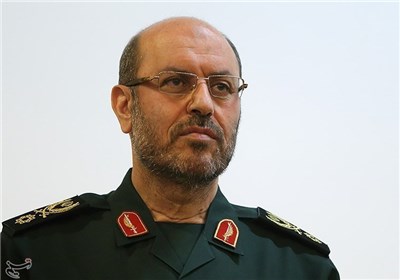
Israel Plotting to Occupy Nile to Euphrates with Support of ISIL: Iran’s DM

July 6, 2015

Israel Plotting to Occupy Nile to Euphrates with Support of ISIL: Iran’s DM, Tasnim News Agency (Iranian), July 6, 2015

(But, he inadvertently failed to mention, “we don’t want the bomb.” — DM)

139403121032243845415453

TEHRAN (Tasnim) – Iranian Defense Minister Brigadier General Hossein Dehqan warned against Israel’s plot to expand the occupied territories from “the Nile to the Euphrates” with the support of the Islamic State in Iraq and the Levant (ISIL) terrorist group.

“This year’s rallies to mark the International Quds Day due to be held this Friday are more important than the previous years’ because the Zionist regime (of Israel) with the full support of ISIL terrorists… is seeking to realize the occupation of (areas from) the Nile to the Euphrates,” General Dehqan said in a speech on Monday.

Undoubtedly, massive participation of people in the international event can thwart “the dangerous plot”, the minister stressed.

He further emphasized that the only way to liberate the holy Quds is unity and solidarity among Muslims.

Back in January, Supreme Leader of the Islamic Revolution Ayatollah Seyed Ali Khamenei underlined Iran’s determination to continue support for the Palestinian cause.

“The Islamic Republic of Iran will remain resolved (in its support) until the day that the cause of Palestine is materialized,” Ayatollah Khamenei said in a meeting with Head of Popular Front for the Liberation of Palestine–General Command (PFLP-GC) Ahmed Jibril in Tehran.

The Leader also noted that the issue of Palestine is among the top issues of the entire Muslim world.

Each year, the International Quds Day is celebrated on the last Friday of the holy Muslim month of Ramadan.

The event’s overarching theme is support for the Palestinians and fierce denunciation of Israel.

The day is also seen as the legacy of the late founder of the Islamic Republic of Iran, Imam Khomeini, who officially declared the last Friday of Ramadan as International Quds Day back in 1979.

Kerry Threatens to Leave Nuke Talks With No Deal

July 5, 2015

Kerry Threatens to Leave Nuke Talks With No Deal, Washington Free Beacon, July 5, 2015

U.S. Secretary of State John Kerry tries to adjust a podium as he delivers a statement on the Iran talks in Vienna, Austria, Sunday, July 5, 2015. Secretary of State John Kerry says negotiations with Iran could go either way ó cutting off any potential path for an Iranian nuclear bomb or ending without agreement. Speaking in Vienna on the ninth day of the nuclear talks, Kerry says disagreements remain on several significant issues. He says hard choices must be made for a deal to be made by Tuesday, the latest deadline. (Leonhard Foeger/Pool photo via AP)John Kerry AP

VIENNA—Secretary of State John Kerry said on Sunday that the United States and Iran may fail to reach a final nuclear agreement despite the talks being extended past their June 30 deadline so that the sides could hash out remaining differences over the scope and scale of the Islamic Republic’s contested nuclear program.

Western observers suggested the statement from Kerry was designed to provide cover for the administration if a deal with wide-ranging concessions to Iran is struck.

Kerry told reporters in a brief press conference Sunday afternoon that he is prepared to leave town without a deal that has been viewed as the Obama administration’s biggest foreign policy priority.

“I want to be absolutely clear with everybody: We are not yet where we need to be on several of the most difficult issues,” Kerry said. “And the truth is that while I completely agree with Foreign Minister [Javad] Zarif that we have never been closer, at this point, this negotiation could go either way.”

“If hard choices get made in the next couple of days and made quickly, we could get an agreement this week. But if they are not made, we will not,” Kerry said.

Critics of the administration were not impressed by Kerry’s tough stance.

Asked by the Washington Free Beacon about Kerry’s remarks, one Western observer present in Vienna visibly rolled his eyes and said, “If the State Department thinks they’re fooling anybody, they are literally the only ones who think that.”

U.S. officials and diplomats have been quiet in public, declining to brief reporters on record about the status of the talks and what a final deal could look like.

If a deal is not reached by July 7, it is expected that the world powers and Iran will not make one.

“If we don’t get a deal, if we don’t have a deal, if there’s absolute intransigence, if there’s an unwillingness to move on the things that are important, President Obama has always said we’ll be prepared to walk away,” Kerry said.

The secretary also defended a virtual news blackout that has left reporters with very little insight into the status of the critical talks.

“In the coming hours and days we’re going to go as hard as we can. We are not going to be negotiating in the press,” Kerry said. “We’ll be negotiating privately and quietly. And when the time is right, we will all have more to say.”

Asked if he thinks a deal in attainable in the announced time period, Kerry demurred.

“Right now we’re aiming to try to finish this in the timeframe that we’ve set out,” he said. “That’s our goal and we’re going to put every bit of pressure possible on it to try to do so.”

Shortly after Kerry’s remarks, he walked back into another meeting with Iranian Foreign Minister Zarif.

Iranian officials also remained quiet over the weekend, but have hinted that disagreements remain over the future scope of Iran’s nuclear program and the timetable in which international sanctions will be removed.

Wire reports have claimed in recent days that the United States and Iran are close to sorting out the sanctions issue, which has remained one of the most contested issues in the talks.

U.S. lawmakers and other critics have expressed repeated concerns that Iran will pocket billions of dollars in sanctions relief while doing little to stop its most controversial nuclear work.

Meanwhile, Iran announced on Sunday that Russia had agreed to supply it with a range of naval equipment.

“Talks between the Iranian delegation and the Russian side were held at the International Maritime Defense Show (IMDS) in St. Petersburg on Saturday. They spoke about boosting bilateral military-technical cooperation, including on deliveries of a wide range of naval equipment and armaments,” an Iranian military official was quoted as saying in the country’s state-run press.

Fireworks for Iran

July 5, 2015

U.S. stockpiles powerful bunker-buster bombs in case Iran nuclear talks fail

By W.J. HENNIGAN For The L.A. Times July 3, 2015


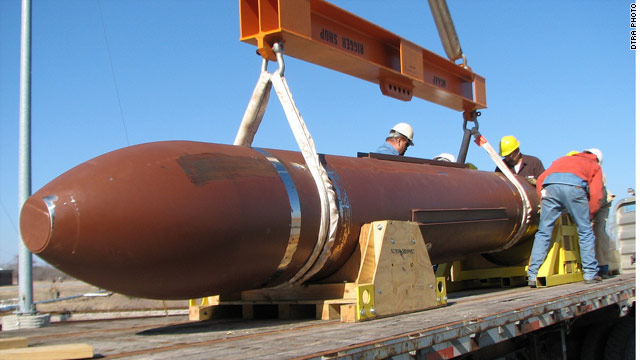
Loading the MOP during a 2007 test in New Mexico [Source: Unknown]

(Happy 4th of July everyone! – LS)

As diplomats rush to reach an agreement to curb Iran’s nuclear program, the U.S. military is stockpiling conventional bombs so powerful that strategists say they could cripple Tehran’s most heavily fortified nuclear complexes, including one deep underground.

The bunker-busting bombs are America’s most destructive munitions short of atomic weapons. At 15 tons, each is 5 tons heavier than any other bomb in the U.S. arsenal.

In development for more than a decade, the latest iteration of the MOP — massive ordnance penetrator — was successfully tested on a deeply buried target this year at the White Sands Missile Range in New Mexico. The test followed upgrades to the bomb’s guidance system and electronics to stop jammers from sending it off course.

U.S. officials say the huge bombs, which have never been used in combat, are a crucial element in the White House deterrent strategy and contingency planning should diplomacy go awry and Iran seek to develop a nuclear bomb.

Obama has made it clear that he has no desire to order an attack, warning that U.S. airstrikes on Iran’s air defense network and nuclear facilities would spark a destabilizing new war in the Middle East, and would only delay Iran by several years should it choose to build a bomb.

“A military solution will not fix it,” Obama told Israeli TV on June 1. An attack “would temporarily slow down an Iranian nuclear program, but it will not eliminate it.”

Secretary of Defense Ashton Carter, speaking to reporters Thursday at the Pentagon, sought to downplay the likelihood or the utility of an attack. He said no plan under consideration, including use of the bunker-busters, could deliver a permanent knockout blow to Iran’s nuclear infrastructure and enrichment plants.

“A military strike of that kind is a setback, but it doesn’t prevent the reconstitution over time,” he said. “And that basically has been the case as long as we’ve had those instruments and those plans, and I don’t think there’s anything substantially changed since then.”

U.S. officials have publicized the new bomb partly to rattle the Iranians. Some Pentagon officials warned not to underestimate U.S. military capabilities even if the bunker-busters can’t eliminate Iran’s nuclear program.

Gen. Martin Dempsey, chairman of the Joint Chiefs of Staff, suggested at the same Pentagon news conference Thursday that airstrikes might be ordered multiple times if Iran tries to build a bomb.

The military option “isn’t used once and set aside,” he said. “It remains in place. … We will always have military options, and a massive ordnance penetrator is one of them.”

A dynamic of escalation, action, and counteraction could produce serious unintended consequences that would … lead, potentially, to all-out regional war.

With negotiators in Vienna facing a self-imposed deadline of Tuesday, the White House views a layered military response as a potential fallback if the emerging deal — which would block Iran’s nuclear weapons capability for at least a decade in exchange for easing of economic sanctions — collapses and evidence shows that Iran is building a bomb.

Contingency plans include airstrikes by cruise missiles and stealth bombers on Iran’s major nuclear facilities, including the uranium enrichment plant at Natanz, a heavy-water reactor at Arak and a nuclear enrichment site at Fordow, which is inside a mountain and fortified with steel and concrete.

B-2 stealth bombers would be required to drop the MOP, which is designed to burrow 200 feet underground before it detonates. Multiple MOPs probably would be aimed at the same target to bore deeper and achieve maximum destruction.

The U.S. began secretly developing the MOP in 2004 after U.S. forces scoured caves in eastern Afghanistan in the hunt for Osama bin Laden. They discovered some sites so deeply buried they appeared impervious to existing bombs.

The Air Force and bomb builder Boeing Co. flight-tested the GPS-guided MOP in 2008 at the White Sands range, where the first atomic bomb was tested during World War II. The 20-foot-long bombs were dropped on multistory buildings with hardened bunkers and tunnels.

But development ramped up in 2010 after Fordow was uncovered and concern about Iran’s nuclear capabilities rose. Since then, the military has spent at least $400 million — including $40 million this year — to build and upgrade 20 bombs, according to budget documents.

Analysts offered mostly pessimistic predictions of how Iran would respond to a U.S. attack on its nuclear facilities.

“A military strike would result in the worst of all worlds,” said Dalia Dassa Kaye, director of the Center for Middle East Public Policy at the nonpartisan Rand Corp. “It may eliminate some facilities. But it would not eliminate Iranian scientists’ technical know-how and would likely further incentivize Iran to pursue a weapon at all costs.”

Iran could increase support for regional militant groups, such as Hezbollah, and perhaps back a terrorist attack on the United States, she said. U.S. forces battling Islamic State fighters in Iraq could find themselves targeted by Iranian-backed militias who are in tacit alignment in the war against the Sunni extremists.

A U.S. attack also could spark a broader war in the world’s most volatile region. Iran has hundreds of medium-range missiles capable of hitting Israel, Jordan and other American allies, according to defense intelligence estimates.

“A dynamic of escalation, action, and counteraction could produce serious unintended consequences that would … lead, potentially, to all-out regional war,” according to a recent study by the Woodrow Wilson International Center for Scholars that was endorsed by 32 high-ranking former military and government officials.

Iran’s nuclear program has already been attacked through covert digital action. In 2010, the U.S. and Israel reportedly slipped a destructive computer worm called Stuxnet into Iranian computer systems controlling the fast-spinning centrifuges that enrich uranium.

The cyberattack destroyed centrifuges and delayed enrichment, but Tehran soon recovered, according to the International Atomic Energy Agency, the United Nations nuclear watchdog agency.

Stuxnet did not lead to overt Iranian retaliation. U.S. airstrikes, and the casualties they would cause, almost certainly would spark a different response.

“It would create huge problems,” said Michael E. O’Hanlon, a military analyst at the Brookings Institution. “That said, it’s hard to rule out if talks fail.”

Zarif on getting to yes

July 4, 2015

Zarif on getting to yes, Power LineScott Johnson, July 3, 2015

(Javad Zarif — “Mr. Moderation.” — DM)

In the annals of murderous deceit and provocative audacity, the video of Iranian foreign minister Javad Zarif takes the cake. The video aims at zarif’s American counterparts and a wider American audience. The video is posted here with full text of Zarif’s message on YouTube. [Here’s the video, with text in a box beneath it. — DM)

Mr. Zarif advises: “Getting to yes requires the courage to compromise, the self-confidence to be flexible, the maturity to be reasonable, the wisdom to set aside illusions, and the audacity to break old habits.” Do check out the whole sickening production. It virtually defies belief. Mr. Zarif, where can I get the soundtrack?

Mr. Zarif, of course, speaks with a forked tongue about the qualities conducive to this particular agreement. He must be in some doubt on this point, but I’m confident that our own Supreme Leader has all the qualities necessary to enter into the deal in process with Iran.

Deadlines, red lines

July 3, 2015

Deadlines, red lines, Israel Hayom, Ruthie Blum, July 3, 2015

(Please see also, Iran’s Nuclear Negotiators Emboldened by Islamic Ideology: Cleric at (Iranian) Tashim News Agency. — DM)

The regime in Tehran has made its position clear. So has the White House. It will take a miracle — or a military strike — to prevent Iran from building nuclear bombs.

**********************

The deadline for a nuclear deal between the P5+1 powers and Iran was extended on Tuesday, when too many bones of contention remained unresolved on June 30. The new date set by the parties to finalize the “framework for an agreement” reached in Lausanne three months ago is July 7.

This means that there are four days to go before the current talks in Vienna bear fruit in the form of an official document. If such a piece of paper is signed, two leaders will feel particularly vindicated: U.S. President Barack Obama and Iranian President Hassan Rouhani — the former for playing out his fantasy of peace through diplomacy and the latter for delivering the goods to his boss, Ayatollah Ali Khamenei.

The rest of the world, however, will be in mortal peril. And Israel will be forced to act fast.

The only sliver of a silver lining in this otherwise black cloud is that Islamists sometimes play their cards wrong. Buoyed by the weakness of the West in the face of their fanaticism, they often take their visions of grandeur to heights that even American and European appeasers cannot accept. So by next week, it is possible that the Iranian negotiators will overstep their counterparts’ bounds, and everyone will return to the country from whence they came with nothing but another date and venue to show for their efforts.

But because the stakes are nuclear weapons in the hands of a mullah-led regime bent on global hegemony — and working toward it through proxy terrorist organizations — one cannot count on the above scenario.

A number of recent statements are cause for concern.

On Thursday, Iranian Foreign Minister Mohammad Javad Zarif told reporters: “The negotiations are moving forward and we should be hopeful. Today is a good day.”

This was an abbreviated version of what his deputy, Abbas Araqchi, said the day before in a TV interview: “A positive atmosphere is ruling the negotiations, and the spirit for going forward exists in all delegations, but this doesn’t mean that all delegations, including us, are ready to reach an agreement at any price.”

Araqchi also defined a “good deal” as one that would honor Khamenei’s “red lines.”

These were spelled out in a June 23 speech by Khamenei (and included in a June 30 Middle East Media Research Institute report): “In contrast to what the Americans are insisting on, we do not accept long-term restrictions for 10 to 12 years.

“Research, development and construction will continue. … They say, ‘Don’t do anything for 12 years,’ but these are particularly violent words, and a gross mistake.

“The economic, financial and banking sanctions — whether related to the Security Council or the American Congress and administration — must be lifted immediately with the signing of the agreement. The remainder of the sanctions will also be lifted within a reasonable time frame. The Americans are presenting a complex, convoluted, bizarre, and stupefying formula for [removing the] sanctions, and it is unclear what will emerge from it, but we are clearly stating our demands.

“The lifting of the sanctions must not depend on Iran carrying out its obligations. Don’t say, ‘You carry out your obligations and then the IAEA will approve the lifting of the sanctions.’ We vehemently reject this. The lifting of the sanctions must take place simultaneously with Iran’s meeting of its obligations. We oppose the delay of the implementation of the opposite side’s obligations until the [release of] the IAEA report [verifying that Iran has met its obligations], because the IAEA has proven repeatedly that it is neither independent nor fair, and therefore we are pessimistic regarding it.

“They say, ‘The IAEA should receive guarantees.’ What an unreasonable statement. They will be secure only if they inspect every inch of Iran. We vehemently reject special inspections [that are not customary for any country except Iran], questioning of Iranian personnel, and inspection of military facilities.

“Everyone in Iran — including myself, the government, the Majlis [parliament], the judiciary, the security apparatuses, and the military, and all institutions — want a good nuclear agreement … that is in accordance with Iran’s interests.

“Although we wish the sanctions lifted, we see them as [having brought us] a particular kind of opportunity, because they made us pay more attention to domestic forces and domestic potential.”

A few days later, on June 29, Obama’s deputy national security adviser, Ben Rhodes, gave an interview to The Atlantic’s Jeffrey Goldberg at the Aspen Ideas Festival.

When asked whether Obama believes a deal will exact change in Iran’s behavior, Rhodes replied: “We believe that an agreement is necessary … even if Iran doesn’t change. … That said, we believe that a world in which there is a deal with Iran is much more likely to produce an evolution in Iranian behavior than a world in which there is no deal. In fact … if the notion is that Iran has been engaged in these destabilizing activities under the last several years when they’ve been under the pressure of sanctions, clearly sanctions are not acting as some deterrent against them doing destabilizing activities in the region. … [T]he point is … in a world of a deal, there is a greater possibility that you will see Iran evolve in a direction in which they are more engaged with the international community and less dependent upon the types of activities that they’ve been engaged in.”

The regime in Tehran has made its position clear. So has the White House. It will take a miracle — or a military strike — to prevent Iran from building nuclear bombs.

Iran Violates Past Nuclear Promises on Eve of Deal

July 2, 2015

Iran Violates Past Nuclear Promises on Eve of Deal, Washington Free Beacon, July 2, 2015

(As the scorpion said to the frog, “that’s just what scorpions do.” Like the frog, Obama and Kerry are anxious to give the scorpion a ride, but on our backs.– DM)

Kerry on crutchesJohn Kerry outside the hotel where the Iranian nuclear talks are being held / AP

Wednesday’s disclosure by the IAEA sent the State Department rushing to downplay the Iranian violation.

Obama administration officials insisted that despite Iran’s failure to meet its obligations, negotiations were still on track and that Tehran would face no repercussions.

********************

VIENNA—Senior Obama administration officials are defending Iranian nuclear violations in the aftermath of a bombshell report published Wednesday by the United Nations indicating that Iran has failed to live up to its nuclear-related obligations, according to sources apprised of the situation.

The International Atomic Energy Agency (IAEA) disclosed yesterday that Iran has failed to meet its commitments under the interim Joint Plan of Action to convert recently enriched uranium gas to powder.

While Iran has reduced the amount of enriched uranium gas in its stockpiles, it has failed to dispose of these materials in a way that satisfies the requirements of the nuclear accord struck with the United States and other powers in 2013.

Secretary of State John Kerry declared last summer that Iran would be forced to comply with such restrictions, and State Department officials were assuring reporters as recently as last month that the Iranians would meet their obligations.

Wednesday’s disclosure by the IAEA sent the State Department rushing to downplay the Iranian violation.

Obama administration officials insisted that despite Iran’s failure to meet its obligations, negotiations were still on track and that Tehran would face no repercussions.

One U.S. official who spoke with the Associated Press on Wednesday said that instead of converting its uranium gas into uranium dioxide powder as required, Iran had transformed it into another substance. The IAEA found that Iran had converted just 9 percent of the relevant stockpile into uranium dioxide.

The official went on to downplay concerns about Iran’s violation, claiming that Tehran was only having some “technical problems.”

The “technical problems by Iran had slowed the process but the United States was satisfied that Iran had met its commitments,” the AP reported the official as saying.

“Violations by Iran would complicate the Obama administration’s battle to persuade congressional opponents and other skeptics,” the AP continued.

David Albright, a nuclear expert and founder of the Institute for Science and International Security (ISIS), warned that the United States is weakening its requirements on Tehran as a final deal gets closer.

“The choosing of a weaker condition that must be met is not a good precedent for interpreting more important provisions in a final deal,” Albright wrote in an analysis published late Wednesday.

While Iran was not in compliance with the oxidation requirement, the IAEA found that it did get rid of uranium gas that surpassed a self-imposed benchmark of 7,650 kg.

The IAEA’s disclosures are in contrast to comments made by Kerry last summer when he assured observers that Iran would live up to the interim agreement.

“Iran has committed to take further nuclear-related steps in the next four months” and “these include a continued cap on the amount of 5 percent enriched uranium hexafluoride and a commitment to convert any material over that amount into oxide,” Kerry said.

The Israel Project (TIP), which has sent officials to Vienna to track the deal, wrote in an email to reporters that the administration looked like it was “playing Tehran’s lawyer” in a bid to defuse potential fallout from the IAEA’s report.

This is not the first time that Iran has been caught by the IAEA cheating on past nuclear arrangements.

As negotiations between the sides slip past their June 30 deadline and stretch into July, Iranian officials have become more insistent that the United States consent to demands on a range of sticking points.

President Hassan Rouhani also threatened to fully restart Iran’s nuclear program if negotiators fail to live up to any final agreement.

One Western source present in Vienna said the administration is scrambling to ensure that nothing interferes with a final deal.

“Once again, the White House will go to any length needed to preserve the Obama-Iran deal, even if it means covering up Iran’s failure to convert all of the nuclear material as promised,” said the source.

“If they had admitted Iran failed to live up to the letter of the JPOA—as is the case—this one-week extension period of the JPOA would be totally invalidated and the talks would be over,” the source added. “Like they have for months, the administration continues to hide violations and is acting more like Iran’s advocate than the honest broker the American people deserve. “

How not to write about Iran

July 2, 2015

How not to write about Iran, The New York Times, Ishaan Tharoor, July 2, 2015

(The NY Times article is a good example of how not to write about Iran. History is important, but Iran’s more recent activities are even more important. That ancient Persia and its Islamic successors engaged in and supported terrorism is important, but that the Islamic Republic of Iran still does is more important. Please see also, Rouhani Threatens Nuclear Breakout. — DM)

In the Western imagination, Iran has long been a kind of bogeyman. It’s the land of hostage crises and headscarves. It was part of the Axis of Evil (whatever that was). Its leaders grouse about defeating Israel, an American ally. Its mullahs, say Iran’s critics, plot terror and continental hegemony.

Supporters of the ongoing talks in Vienna, where Iranian diplomats and their international counterparts are wrangling over a final agreement on Tehran’s nuclear program, are in part hoping to change this overwhelming narrative.

Rapprochement between Iran and the U.S., they argue, would signal a new era for U.S. relations in the Middle East — and, at the very least, put to rest fears of yet another American military escalation in the region.

But whether that changes the actual Western discourse around Iran is another matter. Every society or culture gets stereotyped in some way by others — but Iran, even before the rise of the Islamic Republic in 1979, has been a very conspicuous victim.

That’s in part a consequence of its history. As the inheritor of Persia’s ancient empires, Iran has been the Other — the enemy of the nominal “West” — since classical times and the famous wars with Greek city-states. In the 18th century, some European writers and thinkers popularized the image of a “decadent” and “despotic” Persia as an allegorical device to critique their own societies. A century later, as Europe’s empires gained in power, the Orientalist cliches hardened and served to bolster the West’s own sense of racial and moral superiority.

Even in the present day, many of the old tropes have been trotted out during the nuclear talks. While giving testimony to Congress in 2013, Wendy Sherman, a senior State Department official and lead negotiator with Iran, counseled caution when dealing with the Iranian regime because “deception is in their DNA.” The remarks, which infuriated Tehran, gestured at much older Western perceptions of Iranians as “wily” swindlers who cannot be trusted.

Sherman was hardly alone in conjuring up this stereotype: Those opposed to her efforts have also done the same. An editorial in the Wall Street Journal last year warned against “haggling in a Mideast bazaar” and embarking on a “Persian nuclear carpet ride.” This April, Michael Oren, Israel’s former U.S. ambassador, went on a cringe-worthy ramble about the crafty tricks of Persian rug salesmen.

“The Iranians are not just expert carpet merchants,” Oren wrote, stretching the ungainly metaphor to its frayed, tasseled edges. “They also deal in terror and endangering American allies.”

Other more nuanced assessments fall into similar traps, too. Earlier this week, James Stavridis, a retired U.S. admiral, top NATO official and the dean of the Fletcher School of Law and Diplomacy, painted a picture of the Iranian regime with the broadest brush he could possibly find.

“Tehran’s geopolitical strategy,” he wrote, “is taken directly from the playbooks of the first three Persian empires, which stretched over a thousand years.”

To no great surprise, this view of Iran as a mysterious realm, beholden to its past (and its vast store of carpets), irks some observers.

“Iran is an ancient civilization with a rich culture that definitely has roots in its old history,” Iranian-American journalist Negar Mortazavi tells WorldViews. “But to stereotype modern Iran and Iranians based on what happened thousands of years ago is wrong.”

Mortazavi argues that you would never see such simplistic, overreaching appraisals of American allies: “Do we view today’s Europe through the affairs of the Vikings? No. Do we look at Saudi Arabia through the lens of its old Islamic Empire when it was taking over the world? No.”

Arash Karami, the Iran editor of the Middle East news site Al-Monitor, dismisses the idea “that Iran has imperial ambitions in the Middle East simply because of its history.” He adds that “most Iranians only have a vague understanding” of the long-gone Achaemenid dynasty or the medieval Safavids.

The stereotypes in play seem to support the contention of some hawks that Iran is not a normal, rational state actor. Critics of the Islamic Republic may see nothing wrong with that, but these sorts of characterizations were being made well before the 1979 Islamic Revolution and the collapse of U.S.-Iran ties.

In a write-up published in January 1952, Time magazine named Iran’s democratically-elected Prime Minister Mohammed Mossadegh  as “Man of the Year.” The recognition was not particularly flattering. It sneeringly described Iran as “a mountainous land between Baghdad and the Sea of Caviar.” And it went on to attack both Mossadegh’s plan to nationalize Iran’s oil — at the expense of British and American energy interests — and the leader’s character.

Time actually called the Iranian politician “a strange old wizard.”

A year later, the Ivy League buddies of Time’s editors in the C.I.A. helped engineer a coup that ousted Mossadegh, scrapped Iran’s fledgling democracy, and re-installed the country’s monarchy as an American client. Memory of that event still informs the political conversation within Iran, but is rarely recognized in the West.

“In American media, it seems that either those wily Persians are calculating ‘chess masters’ outwitting the well-meaning Westerner,” says Karami, “or they’re bumbling idiots” who resent how “the West rules the Middle East.”

To be sure, there are many negative things that should be said about Iran’s political status quo — where a repressive theocratic government curbs dissent, jails journalists and actively supports armed proxies elsewhere in the Middle East. But you don’t need to start quoting Xenophon or Morier to get there.

“If you’re writing about a country of more than 77 million people,” says Kia Marakechi, news editor at Vanity Fair, “and the metaphors or signifiers you draw on come more from ‘Aladdin’ than a serious understanding of that nation’s politics and culture, you should probably hand the assignment to someone else.”

Rouhani Threatens Nuclear Breakout

July 2, 2015

Rouhani Threatens Nuclear Breakout, Commentary Magazine, July 2, 2015

Obama, Kerry, and negotiator Wendy Sherman have effectively become Iran’s lawyers. In doing so, they have applied the logic of “it depends on what the meaning of ‘is’ is” to U.S. national security. All one has to do, however, is look at the thinly veiled threats and logical somersaults of Iran’s top leaders . . . to understand just what a capability Tehran is after.

***********************

Where brinkmanship is in the blood of Iranian negotiators, careerism and obsession about legacy appears to be in the blood of their American counterparts. By playing good cop, bad cop with Ayatollah Ali Khamenei, by quibbling over every understanding previously reached, and by increasingly threatening to walk away, the Iranians appear to be wringing the Americans dry. Obama and Kerry have voided their own red lines, and prepare to normalize an Iranian path to a bomb whenever the Iranian government makes a decision to pursue that option.

Iranian President Hassan Rouhani is part and parcel of Iran’s brinkmanship. According to the Islamic Republic News Agency in Persian, he declared: “…If they do not fulfill their commitments, the government will be ready to immediately reverse the path in a more severe way than they can ever dream of.”

If Iran’s program has always been peaceful—as repeated Iranian officials have maintained—then reverting to Iran’s previous behavior would mean what exactly?  Threats from Rouhani, the supposed moderate, should get the attention of Congress.

Increasingly, Iran is tripping upon its own internal inconsistencies. First, there was Supreme Leader Ali Khamenei’s (as yet unseen) sacrosanct nuclear fatwa that forbids nuclear weaponry and yet the Iranian leadership refuses to come clean on past nuclear work for fear it would show nuclear weaponry work. There has also been Iran’s insistence that it seeks a completely indigenous program, yet it doesn’t possess enough natural uranium to fuel an expanded civilian energy program. Now, Rouhani has more or less threatened to build a nuclear bomb, the same threat made previously by Ali Akbar Hashemi Rafsanjani and a number of clerical associates of Khamenei himself. On May 29, 2005, for example, Hojjat ol-Islam Gholam Reza Hasani, the Supreme Leader’s representative in the Iranian province of West Azerbaijan, declared possession of nuclear weapons to be one of Iran’s top goals. “An atom bomb …must be produced as well,” he said.

Obama, Kerry, and negotiator Wendy Sherman have effectively become Iran’s lawyers. In doing so, they have applied the logic of “it depends on what the meaning of ‘is’ is” to U.S. national security. All one has to do, however, is look at the thinly veiled threats and logical somersaults of Iran’s top leaders, however, to understand just what a capability Tehran is after.

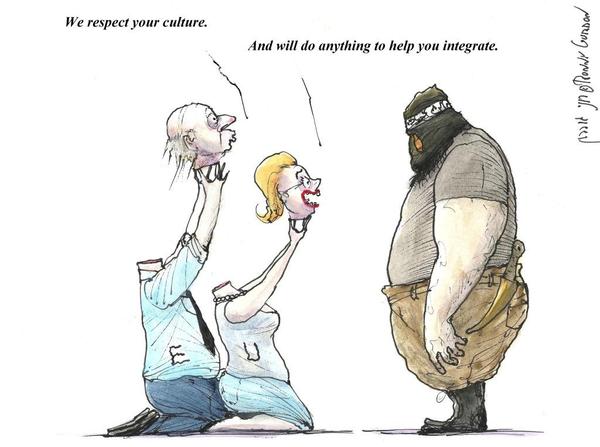
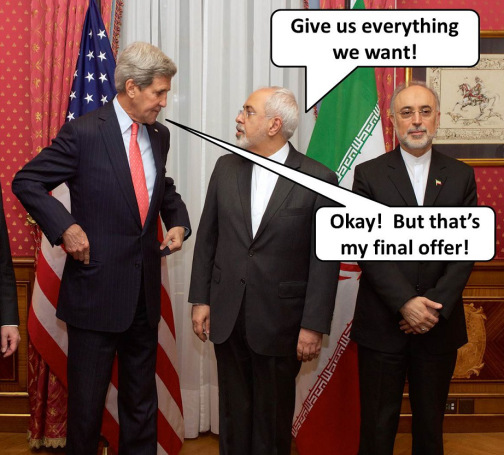
Cartoons of the day

July 2, 2015

H/t Joopklepzeiker

EU and Islamists

H/t Bring the heat, bring the stupid

kerry-iran