Archive for the ‘Iran scam’ category

No new dawn in Iran

March 1, 2016

No new dawn in Iran, Israel Hayom, Ruthie Blum, March 1, 2016

For the past three years, the West has been tricking itself into seeing the Islamic Republic of Iran as a country undergoing a gradual process of reform. The outcome of Friday’s two elections — one for the Majlis (parliament) and the other for the Assembly of Experts — is serving as the latest mirage in the delusion.

In 2013, when Hassan Rouhani replaced Mahmoud Ahmadinejad as president of Iran, the United States and Europe took it as a sign of a new dawn. Even Supreme Leader Ali Khamenei, the chief mullah controlling Iran’s “elected” leader, came to understand that Rouhani was preferable to the volatile and fanatic Ahmadinejad, whose repeated pronouncements about wiping Israel off the map before attending to America were not serving Tehran in good stead.

Rouhani’s appearance on the international stage provided particular fantasy-fodder for supporters of a diplomatic solution to the problem of Iran’s race to obtain nuclear weapons and to guarantee its regional, and eventually global, hegemony.

Those people today feel vindicated for two reasons. The first is that world powers finally did reach a nuclear deal with Iran. The second is that Rouhani’s “pro-deal” camp emerged victorious in the latest parliamentary election, and two of the most hard-line ayatollahs were voted out of the Assembly of Experts, the body charged with appointing the supreme leader. And considering Khamenei’s advancing age and questionable health, this clerical assembly, which sits for eight years, is likely to end up selecting his successor.

To understand why the above is no cause for celebration, two crucial things need to be kept in mind: the only thing the nuclear deal accomplished was to enable Iran to step up its nuclear program, but with lots more money at its disposal; and Rouhani is no moderate.

Indeed, Iran continues to assert its right to nuclear power, while flexing its military muscles nearly daily by testing missiles and threatening the West not to intervene. In addition, celebrations less than three weeks ago marking the anniversary of the 1979 revolution that turned Iran into an Islamic state included chants of “death to America,” “death to Israel” and a reenactment of the Iranian Revolutionary Guard Corps Navy’s humiliation of U.S. sailors who had strayed into Tehran’s territorial waters.

A review of Rouhani’s record also leaves little room for optimism. Though the Shiite cleric was not Khamenei’s preferred choice, he would never have been approved as a candidate in the first place if his revolutionary credentials had not been impeccable. And they certainly were.

Rouhani was a long-time Ayatollah Ruhollah Khomeini loyalist, who has always backed and spearheaded the quelling of any popular protests, employing any bloody means to nip them in the bud. The only real difference between him and his predecessor is in his strategic understanding of how to accomplish Iran’s goals by presenting himself as more palatable to the West.

In 1992, his eldest son committed suicide, leaving a note to this very effect, saying, “I hate your government, your lies, your corruption, your religion, your double-dealing and your hypocrisy. I am ashamed to live in an environment in which I am forced to lie to my friends every day and tell them that my father is not part of all this — to tell them that my father loves the nation and to know that the reality is far from this. I get nauseated when I see you, father, kissing Khamenei’s hand.”

But it was his resume that made Rouhani such an appropriate nuclear negotiator, a role he fulfilled for years. Addressing Iran’s Supreme Cultural Revolution Council in September 2005, he explained the purpose of being a wolf in sheep’s clothing: “While we were talking with the Europeans in Tehran, we were installing equipment in parts of the Isfahan facility,” he said. “By creating a calm environment, we were able to complete the work.”

It is this tactic that puts Rouhani in the “pragmatist” camp.

In July, after the completion of the nuclear deal was first announced — and then disputed as to its contents, perceived differently in Washington and Tehran — Rouhani made a speech to the Iranian public.

“Peace and blessings upon the pure souls of the prophets and the holy men, the great Prophet of Islam [Muhammad], the imams, the imam of the martyrs [Khomeini], and the exalted martyrs, especially the nuclear [scientists], and peace and blessings upon the Hidden Imam,” he began.

“We aspired to achieve four goals: The first was to continue the nuclear capabilities, the nuclear technology, and even the nuclear activity. The second was to remove the mistaken, oppressive, and inhuman sanctions. The third was to remove the Security Council resolutions that we see as illegitimate. The fourth was to remove the nuclear dossier from Chapter VII of the U.N. Charter and the Security Council in general. All four goals have been achieved today.”

He later referred to Israel’s warnings about the deal. “The people in Gaza, the West Bank, Jerusalem and Lebanon are happy, too, because the hollow efforts of the oppressive Zionist regime to thwart the negotiations during the past 23 months have failed,” he said, ending with a message to the Arab countries of the region.

“Do not be misled by the propaganda of the Zionist regime and the evil-mongers of this [Iranian] nation,” he cautioned. “Iran and its might are always your might. We see the security of the region as our security, and the stability of the region as our stability.”

Let us not kid ourselves. Rouhani’s showing in the elections does not signify a new era of freedom for the Iranian people. Nor does it indicate a shift away from the regime’s sponsorship of global terrorism. On the contrary, if anything, it could provide American voters with a false sense of national — and international — security that is utterly unwarranted.

The Moral Cost of Appeasing Iran

February 24, 2016

The Moral Cost of Appeasing Iran, Gatestone InstituteMohshin Habib, February 24, 2016

♦ The leaders of both France and Italy set aside their values to appease the president of Iran.

♦ In France, protesters demanded that President François Hollande challenge the Iranian president about his country’s human rights abuses. France’s leadership, however, raised no questions of that sort. Instead, Mr. Rouhani was welcomed as a superstar.

♦ According to a 659-page report by Human Rights Watch, Iran’s human rights violations under Mr. Rouhani’s governance have been increasing. Social media users, artists and journalists face harsh sentences on dubious security charges.

♦ In November, the Iranian Supreme Court upheld a criminal court ruling sentencing Soheil Arabi to death for Facebook posts “insulting the Prophet” and “corruption on earth.”

Right after signing the Iran nuclear deal with itself — Iran still has not signed it, and even if it did, the deal would not be legally binding — members of the P5+1 (the five permanent members of the UN Security Council plus Germany) have been showing their eagerness to establish improved relations with their imaginary partner.

Last month, after the lifting of international sanctions, Iran’s president, Hassan Rouhani, went on a five-day trip to Italy and France.

Officials from the host countries were so enthusiastic to welcome the Iranian president, it was as if they were unaware of Iran’s multiple violations of The Treaty on the Non-Proliferation of Nuclear Weapons (NPT) — which Iran did sign in 1968. They also seemed unaware of Iran’s expansion into Syria, Lebanon and Yemen, as well as Iran’s continuing role in sponsoring global terrorism.

Although both the leaders of France and Italy seemed eager to appease the president of Iran, in Paris, thousands of demonstrators gathered on the streets to protest Mr. Rouhani’s visit, and staged mock executions to highlight Iran’s dire human rights violations. In 2014, for instance, at least nine people were executed on the charge of moharebeh (“enmity against God”).

Even today, dozens of child offenders remain on death row in Iran. According to Iranian law, girls who reach the age of 9 and boys who reach the age of 15 can be sentenced to capital punishment. A recent report by Amnesty International called Iran one of the world’s leading offenders in executing juveniles. Despite the country’s ratification of the Convention on the Rights of the Child — which abolishes the use of the death penalty against offenders under the age of 18 — the UN estimates that 160 minors remain on death row.

The Iranian delegation, according to The New York Times, had asked Italian officials to hide all statues leading to the grand hall of the Capitoline Museums — where a news conference between Prime Minister Matteo Renzi and the Iranian president took place — to avoid any “embarrassment” for Rouhani, who casts himself as a moderate and reform-seeker. So on the first stop of Mr. Rouhani’s European visit, statues were encased in tall white boxes. In addition, “The lectern, was placed to the side — not the front — of an equestrian statue of the emperor Marcus Aurelius, apparently to avoid having images of the horse’s genitals appear in news photographs.”

As any kind of image is haram (forbidden) in Islam, any form of statue is considered idolatry.

Many Italians expressed their outrage over the decision to censor the statues. They accused the government of betraying Italian history and culture for the sake of economic interests.

An Iranian women’s rights organization, My Stealthy Freedom, condemned the Italian government’s decision. In a post on their Facebook page, the group wrote:

“Italian female politicians, you are not statues, speak out. Rome covers nude statues out of respect for Iran’s president in Italy and Islamic Republic of Iran covers Italian female politicians in Iran. Dear Italy. Apparently, you respect the values of the Islamic Republic, but the problem is the Islamic Republic of Iran does not respect our values or our freedom of choice. They even force non-Muslim women to cover up in Iran…”

In France, protesters demanded that President François Hollande challenge the Iranian president about his country’s human rights abuses. France’s leadership, however, raised no questions of that sort. Instead, Mr. Rouhani was welcomed as a superstar.

Big business deals were signed. France’s car-maker Peugeot and Iran’s leading vehicle manufacturer, Khodro, are engaged in a €400 million partnership. France’s energy giant, Total, signed a Memorandum of Understanding to buy crude oil from Iran. Total will reportedly begin importing 160,000 barrels of oil per day starting on February 16. Twelve days after the West lifted economic sanctions, Airbus announced that Iran Air had agreed to purchase 118 new planes. The deal is estimated at $25 billion.

Prime Minister of France Manual Valls hailed his country’s trade agreements with Iran. “France is available for Iran,” he said.

During a recent visit to Tehran, Germany’s Foreign Minister, Frank Walter Steinmeier, asked the Iranian president to keep Germany in mind as a future stop on his next trip to Europe.

Meanwhile, according to a US State Department report, Iran has pledged to continue its assistance to Shiite militias in Iraq. Many of these militias have poured into Syria and are now fighting alongside the Assad regime. Rouhani’s government also continues to support its Lebanese proxy Hezbollah, and Palestinian militants in Gaza.

For many years, the Iranian president has kept up close ties with leaders of Hezbollah, including Abbas Moussavi (the former leader of Hezbollah who was killed in 1992) and Hassan Nasrallah. In March 2014, Mr. Rouhani publicly pledged support for Hezbollah.

Rouhani’s Defense Minister is a former Islamic Revolutionary Guards Corps (IRGC) officer, Brig. Gen. Hossein Dehghan. He commanded IRGC forces in Lebanon is Syria during Hezbollah’s founding years from 1982-1984.

Last September, Dehghan said that Tehran will continue arming Hezbollah, Hamas and any group that is part of the “resistance” against the U.S. and Israel. Iran, he explained, considers America to be the Great Satan.

“Hizbullah,” Dehghan stated, “does not need us to supply them with rockets and arms. Israel and the U.S. need to know this. Today, Hamas, the Islamic Jihad, and Hizbullah have the capability of producing their own resources and weapons themselves. Nevertheless, we shall not refrain from supporting them.”

As well as Dehghan, almost all of Rouhani’s appointments are either former members of the IRGC or other revolutionary institutions, such as Iran’s Judiciary and Intelligence Ministries.

Iran’s human rights violations under Rouhani’s governance have been increasing. A 659-page report published by Human Rights Watch concludes that Iranian authorities have repeatedly clamped down on free speech and dissent. “In a sharp increase from previous years, Iran also executed more than 830 prisoners.”

806Since Hassan Rouhani (right) became the president of Iran, the surge in executions has given Iran the world’s highest death penalty rate per capita.

Social media users, artists and journalists face harsh sentences on dubious “security” charges. In May 2014, four young men and three unveiled women were arrested after a video showing them dancing to the popular song “Happy” went viral on YouTube. They were sentenced to up to a year in prison and 91 lashes on several charges, including “illicit relations.”

In November, the Iranian Supreme Court upheld a criminal court ruling sentencing Soheil Arabi to death for Facebook posts “insulting the Prophet” and “corruption on earth.”

What to Expect in Iran

February 22, 2016

What to Expect in Iran, Gatestone InstituteJagdish N. Singh, February 22, 2016

♦ “The destruction of Israel is non-negotiable.” — Mohammad Neza Naghdi, Commander of Iran’s Basij paramilitary force.

♦ Sanctions relief will mainly benefit Ayatollah Khamenei and members of the Revolutionary Guards: they control up to one-third of Iran’s economy.

♦ Part of the Iranian regime’s grand strategy is to inflict “death to America” and replace it with its own radical version of Islamic governance. Ayatollah Khamenei himself called for America’s destruction amid nuclear negotiations.

♦ Officials also believe Iran is indirectly funding the Islamic State (IS) in the Sinai. “Suitcases of cash” are sent directly to Hamas officials in the Gaza Strip; part of the money is then transferred to IS.

♦ Iran now poses an even greater threat. If democracies today continue their present policies towards Iran, it will only embolden Iran’s regime to continue its quest to obtain nuclear weapons as well as its terrorism and human rights violations.

Humanity seldom seems to learn its lessons. The governments of the world’s leading democracies appear to be suffering from this predicament in their nuclear dealings with the Islamic Republic of Iran. To avoid catastrophe, democracies need quickly to correct their course.

One of the fatal blunders of Western democracies is their repeated commitment to appeasing and delaying action against aggressive regimes. Between the two World Wars, despite plenty of evidence of the widely-declared global racist agenda of Germany’s Adolf Hitler, democratic powers waited to take action until it was too late. Hitler was able to carry out a genocide that continues to haunt many nations.

Today, Western democratic governments, with their Eastern counterparts such as India, seem on a similar course in dealing with the Islamic Republic of Iran.

The domestic and international agenda of the Khomeinist government is publicly documented. Since the Iranian Revolution of 1979, part of the regime’s open grand strategy is to inflict “death to America,” the leader of the free world, and replace it with its own radical version of Islamic governance. Under the current Supreme Leader Ayatollah Ali Khamenei and his Islamic Revolutionary Guards Corps (IRGC), Iran has been gaining influence across the Middle East, Latin America, the Caribbean and South Asia. Despite nuclear talks with the West, Iran’s goal of “death to America” remains. The Ayatollah himself even called for America’s destruction amid nuclear negotiations.

Currently, Iran is a major player in aiding the autocratic regime of Basher al-Assad in Syria, the Houthis in Yemen, Hezbollah in Lebanon, Palestinian Islamic Jihad and Hamas in the West Bank and Gaza and the Islamic State (IS) in Egypt’s Sinai Peninsula.

To advance its imperial agenda, Iran has proceeded to develop its conventional and nuclear ballistic missile program. According to Director of National Intelligence James Clapper, Iran has “one of the largest inventories of ballistic missiles in the Middle East.”

In line with Iran’s missile development program, Iran’s Revolutionary Guard Navy Rear Commander, Ali Fadavi, announced: “Based on the fifth five-year plan, we should materialize our objective of mass-producing military speedboats with the speed of 80 knots per hour… and are equipped with missiles with a range of 100km; the vessels no one can catch.”

Aside from its military aspirations, since the fall of the Shah in 1979, successive Iranian governments have voiced their plans to annihilate the State of Israel, the only pluralist democracy in the Middle East, and an effective military deterrent to Iran’s designs in the region.

Hostile messages have been pouring forth from Iran. Mohammad Neza Naghdi, Commander of the Basij paramilitary force, stated in clear terms in April 2015, that, “The destruction of Israel is non-negotiable.”

Major General Yahya Rahim Safavi, a former IRGC commander and a top military aide to Khamenei, warned in May 2015, that “More than 80,000 missiles are ready to rain down on Tel Aviv and Haifa.”

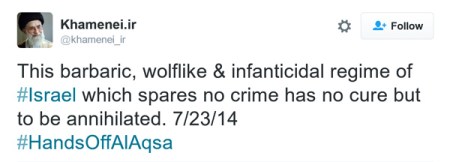
As late as November, Iran’s Supreme Leader Khamenei himself tweeted, “This barbaric, wolflike & infanticidal regime of #Israel which spares no crime has no cure but to be annihilated.”
1477

Bewilderingly, Western democracies have chosen to overlook Iran’s speeches and actions. They chose instead to appease the regime. Last July, despite genuinely serious reservations expressed by international strategic and military experts (including retired American military officers), the United States, United Kingdom, France and Germany – the four democracies in the P5+1 — concluded a nuclear deal with themselves that they proposed to Iran. Iran so far has not signed the deal, and apparently even if it did, according to the U.S. Department of State, the deal would not be legally binding.

Tehran will greatly benefit financially from the terms of the nuclear agreement in the months to come. Under the administration of President Barack Obama, nuclear sanctions against Iran have been lifted. To advance the deal and make it more appealing to Iran, the president has also agreed to pay Iran a $1.7 billion settlement for $400 million in “frozen” assets held in the United States since 1981.

The Society for Worldwide Interbank Financial Telecommunication (SWIFT), “the electronic bloodstream of the global financial system,” had disconnected 15 Iranian banks from its system in 2012. after coming under pressure from both the United States and the European Union at the height of efforts to curb Iran’s nuclear ambitions. Today, SWIFT is ready to let those banned banks, including the Central Bank of Iran, use its system once again. Iran now has an even greater ability to fund its terrorist proxies around the world.

European political and business leaders have been rushing to Tehran to sign new agreements. On January 28, in Paris, Iran’s President Hassan Rouhani and France’s President Francois Hollande signed major business deals, including a joint venture between car-makers PSA Peugeot Citroen and Iran’s Khodro. Iran is in the process of buying 118 Airbus passenger planes to update its aging fleet. The construction group Bouygues and the French airport operator ADP are now set to build an extension for Tehran’s airport, while Vinci, another construction firm, has been commissioned to design, build and operate new terminals for the Mashhad and Isfahan airports. The French oil company Total has agreed to buy Iranian crude oil, and agreements in shipping, health, agriculture and water provision have also been signed.

Democratic India is also cultivating relations with Iran. In a meeting in May, India’s Minister of Road Transport and Highways, Nitin Gadkari, and Iranian Transport and Urban Development Minister, Abbas Ahmad Akhoundi signed a Memorandum of Understanding on India’s participation in the development of the Chabahar Port in Iran.

The Chabahar project will impart strategic leverage to India and its access to Afghanistan and energy-rich Central Asia by bypassing Pakistan. The distance between the Chabahar Port and Gujarat – India’s westernmost state, located near the Persian Gulf, is less than the distance between Delhi and Mumbai. Transit times are estimated to be reduced by a third. Indian firms have already agreed to lease two existing berths at the port and operate them as container and multi-purpose cargo terminals.

The Chabahar project, New Delhi calculates, will be highly beneficial. As India has invested over $2 billion in Afghanistan, the Indian government plans to link the Chabahar port with the Zaranj-Delaram road it built in Afghanistan, thereby opening alternative routes to Afghanistan and enhancing access to regional and global markets.

Russia and China, permanent members of the UN Security Council, are also strengthening their cooperation with Iran. Both Russia and China adopted a policy of ambivalence towards Iran and saw to it that sanctions imposed by the West were not too tough. They also repeatedly blocked attempts at sanctioning Iran’s ally, the current Syrian regime, out of concern over financial ties in the region.

China is also capitalizing on the lifting of sanctions against Iran. Chinese President Xi Jinping rushed to Iran after the so-called nuclear agreement to discuss a 25-year strategic cooperation plan. In a landmark deal worth up to $600 billion, Xi committed to increase trade between the two nations during the next decade. Beijing and Tehran also agreed to enhance security cooperation through intelligence-sharing, counter-terror measures, military exchanges and coordination. Incidentally, despite international sanctions, China-Iran trade increased from $3 billion in 2001 to more than $50 billion in 2014.

Given its fanatical and sectarian ideological agenda, Iran is likely to use the new funds to boost its armament program and ongoing clandestine terror acts. Sanctions relief will mainly benefit Khamenei and members of the IRGC: they control up to one-third of Iran’s economy.

Iran now poses an even greater threat to the entire civilized world. The pattern of Tehran’s behavior shows the government can never be trusted on any promises it makes not to advance its nuclear weapons program. Khamenei has made an open declaration that Tehran will not allow effective inspections of its military sites or interviews with its nuclear scientists.

The links of the IRGC’s Qods Force with Hezbollah, Hamas, Palestinian Islamic Jihad, the Houthis and other terror militias pose a major threat to peace and stability in the Middle East.

Hezbollah’s networks have expanded over the years, infiltrating Latin America and the Caribbean through Shiite cultural centers in the region. According to an official Argentine report, Tehran has established its terrorist, intelligence and operational networks throughout Latin America as far back as the 1980s. Iran’s intelligence activities in the region are being conducted directly by Iranian officials or through its proxy, Hezbollah. Criminal activity may already be underway in Brazil, Colombia, Chile, Paraguay, Uruguay, Suriname and Trinidad and Tobago. Iran’s involvement in the cocaine trade has bolstered the regimes regional access and strengthened ties with its allies in Venezuela, Ecuador, Bolivia and elsewhere.

According to senior Western intelligence officials, the IRGC has transferred tens of millions of dollars to Hamas to be used for weapons, military equipment and training, and that Iran also delivers arms and funds to Hamas through the Red Sea and the Sinai. Officials also believe Iran is indirectly funding the Islamic State (IS) in the Sinai. “Suitcases of cash” are sent directly to Hamas officials in the Gaza Strip; part of the money is then transferred to IS.

Tehran’s links with Hamas and IS are part of a grander strategy of using proxy forces to gain hegemony over the Middle East and undermining American allies such as Egypt and Israel. In Lebanon, Iraq and Syria, Iran seeks to preserve its influence. By fighting IS, Iran strengthens existing pro-Iran regimes and maintains its relevance in the region.

While Iran does support IS indirectly in the Sinai, the government’s goal is to weaken the current Egyptian regime and the Sunni Arab alliance between Egypt, Saudi Arabia and Jordan. It has no problem with IS gaining strength in the Sinai right now. If IS does gain more power in the Sinai, Iran can use it to impose its own agenda in the future. Tehran evidently wants to use IS victories against Sunni states as an opportunity to take over.

Iran also supports the Gaza-based terror group al-Sabireen [“The Patient Ones”], established in the wake of previous tensions between Iran, Hamas and Islamic Jihad. The group has about 400 followers and its emblem is identical to that of Hezbollah. Each member receives a monthly salary of $250-$300, while senior members receive at least $700. Annually, the terror group receives a budget of $10 million from Iran, smuggled in suitcases through tunnels along the border with Egypt. Potential members are wooed by al-Sabireen through familiar channels of philanthropy and education. The group’s publications refer to the United States as “the source of superpower terrorism,” and its slogan is, “The road to the liberation of Palestinian goes through Karbala” — a Shiite holy city in Iraq.

Al-Sabireen has extended its operations from the Gaza Strip to the West Bank and Jerusalem with Iran’s backing. Hisham Salim, the founder of al-Sabireen, admitted that his group is directly financed by Iran. “We have an armed branch whose goal is to wage war on the Israeli occupation everywhere,” Salim said. “Within this framework we have members in the West Bank and Jerusalem.”

The Obama administration has forged ahead with its Iran policies despite knowing the regime’s support of global terrorism. U.S. President Barack Obama himself spoke about Iran’s terror activities in a press conference last year. “Now, we’ll still have problems with Iran’s sponsorship of terrorism; its funding of proxies like Hezbollah that threaten Israel and threaten the region; the destabilizing activities that they’re engaging in, including place like Yemen,” he said, adding that the nuclear “deal is not contingent on Iran changing its behavior. Its not contingent on Iran suddenly operating like a liberal democracy.”

History urges those living in democracies today to rein in their governments and correct their fatal Iran policies. The world cannot afford to overlook the damage of these governments. If democracies today continue their present policies towards Iran, it will only embolden Iran’s regime to continue its quest to obtain nuclear weapons as well as its terrorism and human rights violations.

Sean Hannity Full One-on-One Interview with Donald Trump (2/18/2016)

February 19, 2016

Sean Hannity Full One-on-One Interview with Donald Trump (2/18/2016), Fox News via You Tube, February 18, 2016

(Trump discusses the Israel – “Palestine” situation and the mess Obama has made beginning at 11:05 during the interview. The rest is very good too. — DM)

Iran Mocks Capture Of U.S. Sailors In Tehran Revolution Day Parade – Outnumbered

February 12, 2016

Iran Mocks Capture Of U.S. Sailors In Tehran Revolution Day Parade – Outnumbered, Fox News via You Tube, February 11, 2016

Clapper: Iran Views Deal as ‘Means to Remove Sanctions While Preserving Nuclear Capabilities’

February 9, 2016

Clapper: Iran Views Deal as ‘Means to Remove Sanctions While Preserving Nuclear Capabilities’ Washington Free Beacon, February 9, 2016

Director of National Intelligence James Clapper testified to lawmakers Tuesday that Iran sees the nuclear deal it struck with the United States and five other world powers as a way to remove burdensome sanctions while simultaneously maintaining a strong nuclear infrastructure.

Clapper made his statement to the Senate Armed Services Committee at a hearing in which the intelligence chief discussed the intelligence community’s annual assessment of worldwide threats to U.S. interests and national security.

Part of Clapper’s testimony focused on the threats posed by the Islamic Republic and how the Iran nuclear deal, known formally as the Joint Comprehensive Plan of Action (JCPOA), affects the country’s relationship with America going forward.

“Iran probably views the JCPOA as a means to remove sanctions while preserving nuclear capabilities,” Clapper told lawmakers.

He added that “Iran’s perception of how the JCPOA helps it achieve its overall strategic goals will dictate the level of its adherence to the agreement over time.”

The nuclear deal was signed in July and implemented on Jan. 16, at which time Iran received an estimated $50 billion to $150 billion in sanctions relief after it took steps to curb its nuclear program.

Some experts have said Iran’s objective throughout negotiations was to ensure the removal of sanctions that were crippling its economy while retaining a nuclear weapons capability to possibly exercise at a future time.

One argument critics of the JCPOA make is that the agreement grants Tehran large-scale sanctions relief whileallowing it to have a vast nuclear infrastructure whose most important restrictions have clear expiration dates, after which time Iran could breakout to a nuclear weapon in little time.

The Obama administration maintains that the deal ensures Iran cannot obtain a nuclear weapon and is at least a year away from producing one.

Clapper’s testimony comes upon his release of the annual “Worldwide Threat Assessment of the U.S. Intelligence Community,” which outlines the current array of challenges threatening U.S. national security.

The report says the intelligence community “continue[s] to assess that Iran does not face any insurmountable technical barriers to producing a nuclear weapon, making Iran’s political will the central issue.”

Directly addressing Iran’s political will, the document adds that “Supreme Leader [Ayatollah Ali] Khamenei continues to view the United States as a major threat to Iran, and we assess that his views will not change, despite implementation of the JCPOA deal … Iran’s military and security services are keen to demonstrate that their regional power ambitions have not been altered by the JCPOA deal.”

The assessment also describes how Tehran’s pursuit of nuclear weapons is part of its “overarching strategic goals of enhancing its security, prestige, and regional influence.”

Beyond the nuclear deal, the intelligence assessment calls the Islamic Republic the world’s foremost state sponsor of terrorism. Clapper explained to lawmakers how Iran’s aggression in the Middle East and elsewhere is dangerous to American interests and national security, as well as its growing missile arsenal and cyber capabilities.

The intelligence community, according to its assessment, views Iran as “an enduring threat to US national interests” and a country that sees itself as leading an “axis of resistance” against American influence and the influence of U.S. allies.

“Tehran might even use American citizens detained when entering Iranian territories as bargaining pieces to achieve financial or political concessions in line with their strategic intentions,” the report added.

“Extensive Information” Obtained from US Sailors Captured by IRGC

February 1, 2016

“Extensive Information” Obtained from US Sailors Captured by IRGC, Tasnim News Agency, February 1, 2016

Iranian admiral

TEHRAN (Tasnim) – Commander of the Islamic Revolution Guards Corps Navy Rear Admiral Ali Fadavi said the forces extracted a lot of information from the confiscated cell phones and laptops of the US sailors recently captured by Iran after intrusion into the country’s territorial waters.

“We have extracted extensive information from their (American sailors’) laptops and cell phones,” Admiral Fadavi said in a parliamentary session in Tehran on Monday.

The IRGC commander went on to say that the information can be made public if a decision is made to that effect.

Admiral Fadavi also noted that the IRGC has filmed the capture of the US sailors for several hours, the release of which would bring humiliation to the United States.

If US officials say they are angry with and frustrated by the footage released, they would be 100 times more embarrassed if the IRGC releases other films of the capture, the Iranian commander said.

Iran does not seek to humiliate any nation, he said, but stressed that if they want to humiliate Iran, the IRGC would publish the footage and make them even more embarrassed and humiliated.

US Defense Secretary Ashton Carter had earlier said he was “very, very angry” when he saw footage of 10 US Navy sailors detained by Iranian authorities broadcast by Iranian television news.

The Islamic Revolution Guards Corps (IRGC) Navy on January 12 captured the US Navy sailors inside Iran’s territorial waters in the Persian Gulf, but released them the next day following an apology and after technical and operational investigations indicated that the intrusion into Iranian territorial waters was “unintentional”.

Yesterday, Leader of the Islamic Revolution Ayatollah Seyed Ali Khamenei awarded the ‘Medal of Fath (Conquest)’ to Admiral Fadavi and four other IRGC commanders who made the “courageous and timely” move in the recent capture of American boats and sailors near Iran’s Farsi Island.

Humor | Hillary is Transparent and Open

January 31, 2016

Hillary is Transparent and Open, Dan Miller’s Blog, January 31, 2016

(The views expressed in this post are mine and do not necessarily reflect those of Warsclerotic or any of its other editors. — DM)

President Obama claimed to be the most open and transparent president ever but did not follow through. During her term as Secretary of State, Hillary Clinton showed her persistent openness and transparency to friend and foe alike.

Right.

Clinton emails

Hillary demonstrated her openness and transparency to the entire world  — friend and foe alike — through her use of an unsecured home-brew server for e-mails containing classified national security information. As of late December, more than 1,200 e-mails found on Hillary’s server had been deemed classified. More continued to be found.

According to a report by Intelligence Community Inspector General I. Charles McCullough III dated January 14th, “‘several dozen’ additional classified emails — including specific intelligence known as ‘special access programs’ (SAP)” had been discovered.

That indicates a level of classification beyond even “top secret,” the label previously given to two emails found on her server, and brings even more scrutiny to the presidential candidate’s handling of the government’s closely held secrets.

As of January 29th, at least twenty-two of the most recently discovered e-mails were top secret and contained such damaging information that not even redacted copies can be released to members of the Congress.

With such undiscriminating openness to our enemies, Hillary demonstrated unprecedented impartiality. By doing so, she helped to dispel vicious rumors that America helps only its few remaining friends. The State Department, now under the direction of John Kerry, was unwilling to extend the same courtesy to the Congress, doubtless a greater enemy than any foreign nation. This may have been hard for him to do. But then, sometimes it’s hard to be John Kerry.

Hillary’s principal opponent in the race for the Democrat presidential nomination, Bernie Sanders, merely says that to be true socialists we must share everything. Hillary does more than talk; she shares.

A vote for Hillary is a vote for openness. Due to her exceptional devotion to non-discriminatory transparency, our enemies will love us even more, perhaps even until death do us part.

A European-Iranian honeymoon

January 31, 2016

A European-Iranian honeymoon, Israel Hayom, Prof. Eyal Zisser, January 31, 2016

Last week, the European dam burst. While the continent was turning a cold shoulder to Israel and European entities continued with their threats of boycott, its gates were thrown open to Iran. European leaders put their obsession with Israel aside for an hour or two, and after paying the necessary lip service to International Holocaust Memorial Day, gave Iranian President Hassan Rouhani a royal welcome.

The Iranian president, the smiling face of the Islamic republic, arrived for visits to Italy and France. It was the first visit of its kind since the nuclear deal was signed, a visit that signaled the start of a European-Iranian honeymoon, a visit that will be followed by others like it all over the continent. Rouhani’s visit came days after the economic sanctions on Iran were lifted. It’s no wonder that during the visit, announcements were made about contact between the Iranians and a number of Italian and French companies on deals including a return to European cars being manufactured in Iranian plants and, of course, contracts to purchase Iranian oil. The Iranians are hungry for Europe’s products and technology, while European companies are hungry for Iranian money.

As Rouhani was being received in Europe as an honored guest, Iran’s spiritual leader Ayatollah Ali Khamenei was busy with his longtime hobby of denying the Holocaust. He posted a clip on his website in which he called to investigate whether or not the Holocaust had actually happened, as the Zionists claim it did. But no one in Europe bothered Rouhani with any minor matter like that. After all, it was U.S. Secretary of State John Kerry who urged people not to take Tehran’s calls to annihilate Israel and the U.S. seriously, saying it was only talk. The Europeans also didn’t bother to raise the question of Iranian involvement in regional destabilization, such as in Yemen and Syria, or about Tehran’s support of terrorism. Even questions about respecting human rights and freedom of expression and promoting democracy in Iran itself were removed out of respect for the agenda of the day. Europe, as we know, only asks those questions of Israel.

Indeed, despite Rouhani’s smiles, no change has taken place yet in Iran itself. The conservative camp continues to rule with a fist of iron and supreme leader Khamenei remains firmly at the wheel, or in the hands of the Revolutionary Guard and not Rouhani and his people. So while Rouhani was trying to spread the slogan of a “new Iran” throughout Europe and asking his hosts to turn over a new leaf in the relations between Iran and Europe, the conservatives at home were preparing an unpleasant surprise. Most of the reform camp’s candidates for the parliamentary election scheduled to take place on February 26 were rejected. Even the grandson of late Ayatollah Ruhollah Khomeini, Ahmed Khomeini, who wanted to be elected to the Council of Experts — the Iranian body that oversees the supreme spiritual leader and is responsible for choosing his successor — was rejected on the grounds of “not proving appropriate religious capabilities.”

Iran should be judged not by its words, but by its actions, but the Iranian record speaks for itself. A mere two months after it signed the nuclear agreement with the major world powers in July 2015, Tehran sent thousands of soldiers to Syria to fight on the side of Syrian President Bashar Assad. Painful pictures are coming out of Syria of children dying of hunger in cities under siege by Assad’s forces, Hezbollah fighters, and members of the Iranian Revolutionary Guard. But Iran has been rewarded for its doings in Syria and invited by the U.N. and western countries to take part in a discussion on Syria’s future. The Iranian record also includes ballistic missile tests, to show us what Iranian’s military ambitions are; the arrest of U.S. sailors in the Persian Gulf; and — just like in the good old days — an angry mob setting fire to the Saudi Arabian embassy in Tehran.

The Europeans are choosing to ignore all that as they announce a new chapter in Iranian-European relations. The bill for the honeymoon will be footed by others — in Syria, the Persian Gulf, and Israel.

Cartoons of the Day

January 23, 2016

H/t Vermont Loon watch

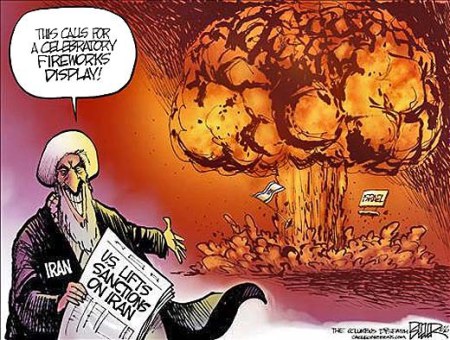
boom


deals


position


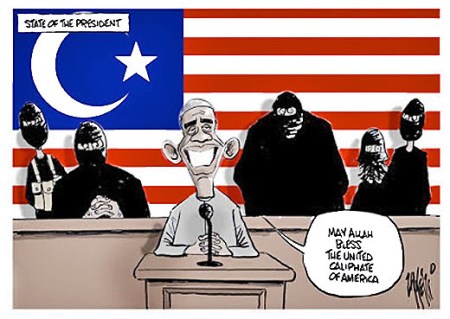
caliphate