Archive for the ‘Hamas’ category

It’s Not ‘Islamophobic’ to Protest a Pro-Hamas Speaker

April 7, 2016

It’s Not ‘Islamophobic’ to Protest a Pro-Hamas Speaker, National Review, M. Zuhdi Jasser, April 6, 2016

taleb

This past Good Friday, the Islamic Society of Wichita, Kan., invited a self-declared Hamas supporter, Sheikh Monzer Taleb, as a special guest for its fundraising event. Sheikh Taleb is a notorious figure in the Muslim community, bringing controversy — and hate — wherever he goes. That is, until Representative Mike Pompeo caught wind of the plans and took a stand, calling on the Islamic Society to cancel the event, to the ire of the group and some in the community.

Sheikh Taleb has proudly sung as part of a pro-Hamas group that calls for the destruction of Israel and the Jewish people, even declaring on video: “I am from Hamas.” His other extremist ties are also significant and damning: In the 2008 terrorism-financing case against the Holy Land Foundation, Taleb was named an “unindicted co-conspirator” for his deep association with Hamas. The case resulted in guilty verdicts on all 108 counts against leaders of the Foundation.

All Americans have a duty to speak out, like Pompeo did, for if we stay silent, we give Islamists a pass to suffocate critical thinking inside Muslim communities. There is nothing more American, more pro-Islam, and more pro-Muslim than taking a stand against the extremist and anti-Semitic hate spewed by Islamist individuals like Sheikh Taleb. In fact, this tough love is what every Muslim community needs to pursue on its own, long before their elected representative have to intervene.

Marginalizing and exposing the ideas of Sheikh Taleb and others like him is crucial if we are to effectively counter Islamist ideology and radicalization. This is the sort of reform work the American Islamic Forum for Democracy (AIFD) encourages. Before Islamic terrorists become hell-bent on using violence, extremist Islamist ideologues radicalize them. Islamist movements such as Hamas and the Muslim Brotherhood reject the liberal secular democratic order and seek an Islamic state with sharia law, filled with ugly anti-Americanism and anti-Semitism.

This debate is not about silencing speech, but rather about exposing and defeating extremist Islamist ideas. From San Bernardino to Brussels, radical Islamism will never be defeated unless Muslims and non-Muslims alike expose it, confront it, and marginalize it, much as Mike Pompeo did in Wichita last month.

It seems obvious that Sheikh Taleb’s Hamas sympathies and connections would make any American Muslim organization hesitant to have anything to do with him, much less invite him as a special guest to an event. Particularly in today’s climate, one would think that the Islamic Society of Wichita would want to stay as far away as possible from Taleb. Better yet, one would hope they would protest his appearances at mosques around the country in order to truly convey their dedication to reforming the hateful ideas that radicalize Muslims in our communities.

Instead, the Islamic Society of Wichita was stubborn in its invitation, cancelling the event only when Pompeo expressed serious concern and community pressure mounted. Now, rather than admitting its mistake, the Islamic Society of Wichita has the temerity to play the victim, blaming Kansans for their “Islamophobia.” The Islamic Society is attempting to dodge responsibility and avoid the repercussions of its terrible and even dangerous decision. But the facts remain the same: The Islamic Society invited and was planning to fête a man who has supported Hamas not only in word but also in deed, by raising funds for the terrorist group. In this case, the Islamic Society of Wichita can blame only itself for increased tensions in the community.

The event featuring Sheikh Taleb was canceled, yet it is critical for Kansans and all Americans, both Muslims and non-Muslims, to take a long, hard look at some of the key instigators and ideologies of extremist sentiment: the Council on American-Islamic Relations (CAIR) and the other Hamas-sympathizing, Muslim Brotherhood–tied individuals and groups passing themselves off as mainstream.

M. Zuhdi Jasser is the president of the American Islamic Forum for Democracy and the co-founder of the Muslim Reform Movement. He is a former U.S. Navy lieutenant commander and the author of A Battle for the Soul of Islam.

 

Palestinians: Presidents for Life, No Elections

April 1, 2016

Palestinians: Presidents for Life, No Elections, Gatestone InstituteKhaled Abu Toameh, April 1, 2016

♦ We hear often that Mahmoud Abbas is keen on having Palestinians vote in a democratic election. Yet Abbas turned 81 last week and appears ready to remain at the helm until his last day — free elections for Palestinians be damned. That makes sense: Hamas could easily best Abbas in such an election.

♦ Hamas and Abbas’s Fatah are still far from achieving any form of reconciliation. This, despite all the talk about “progress” that has been reportedly achieved in talks between the two parties taking place in Doha, Qatar.

♦ Hamas is also cracking down on journalists, academics, unionists and even lawyers in the Gaza Strip.

♦ Yet Abbas’s West Bank rivals Hamas in Gaza, in terms of a lack of human rights and freedom of speech. The idea of free and democratic elections there is a joke. Abbas will leave a legacy of chaos.

Best birthday wishes to Palestinian Authority (PA) President Mahmoud Abbas, who turned 81 last week. The octogenarian appears ready to remain at the helm until his last day — free elections for Palestinians be damned.

Abbas has inherited a tradition of tyranny. His predecessor, Yasser Arafat, was also president for life. Both have plenty of company, joining a long list of African presidents who earned the notorious title of “President for Life” – in Uganda, Equatorial Guinea, Angola, Zimbabwe, Sudan, Chad, Eritrea and Gambia. And let us not forget the Arab dictators in these ranks.

One might hope for at least a deputy — someone to fill the impending and inevitable power vacuum in the PA. Not likely.

Abbas has fiercely resisted demands from leaders of his ruling Fatah faction to name a deputy president or a successor. His reasoning: the time is not “appropriate” for such a move. Palestinians should instead concentrate their energies on rallying international support for a Palestinian state.

The PA president acquired his “private fiefdom,” as it is called by his detractors, in a January 2005 election, when Abbas was given a four-year mandate.

Such mandate seems to have been rewritten by the standing president. January 2016 marked the beginning of the eleventh year of Abbas’s four-year term in office. But it is business as usual in Ramallah.

We hear on a monthly basis that Abbas is keen on having Palestinians cast their ballots in a free and democratic vote. Yet we have seen no evidence to this effect. That make sense: Hamas could easily best Abbas in such an election. Despite his advancing age, Abbas still has clear memories of January 2006, when Hamas was permitted to run in the parliamentary election and won.

Abbas is also acutely aware that Hamas, which holds hostage nearly two million Palestinians in the Gaza Strip, would never allow a free vote there — especially for Abbas loyalists who have been seeking to undermine its rule.

Just a few days ago, a Hamas “military” court in the Gaza Strip sentenced two senior Palestinian Authority security officers, Sami Nisman and Naim Abu Ful, to 15 and 12 years in prison respectively, on charges of spying for the Palestinian Authority and plotting terror attacks against Hamas targets.

The verdicts are yet another sign that Hamas and Abbas’s Fatah are still far from achieving any form of reconciliation. This, despite all the talk about “progress” that has been reportedly achieved in talks between the two parties. Unconfirmed reports earlier this week leaked details of sticking points between Hamas and Fatah negotiators, have been meeting in Doha, Qatar, under the auspices of the Gulf state, towards forming a new unity government and holding new presidential and parliamentary elections. Qatar is the largest source of funds for the Muslim Brotherhood and its offshoot, Hamas.

Abbas’s fear of holding elections in the Gaza Strip is not without justification. In addition to the crackdown on his loyalists and security officers there, Hamas is also cracking down on journalists, academics, unionists and even lawyers.

Last week, Hamas security forces raided the offices of the Palestinian Bar Association in Gaza City and confiscated computers. The raid came as a result of the controversy surrounding the Bar Association not submitting lawyers’ financial and administrative records, in addition to complaints filed by some lawyers against the Bar Association, according to a statement released by the Palestinian Center for Human Rights (PCHR). The raid, some Palestinians claim, is in the context of Hamas’s effort to crack down on lawyers who are affiliated with the rival Fatah faction.

Yet Abbas’s West Bank rivals Hamas in Gaza, in terms of a lack of human rights and freedom of speech. The president’s security forces are in the midst of a massive and ongoing crackdown on political opponents of all stripes, making the idea of free and democratic elections there a joke. Abbas cannot tolerate the idea of having a deputy: how would he consider the establishment of a new party or the emergence of a potential candidate for the presidency.

Senior figures who have dared to challenge Abbas’s autocratic rule have already found themselves targeted by the president and his men. Ask former Prime Minister Salam Fayyad, who had his organization’s bank accounts seized by Abbas, or Mohamed Dahlan, the former Fatah commander and minister who was forced to flee the Palestinian territories after falling out with Abbas and his sons. Perhaps deposed PLO Secretary-General Yasser Abed Rabbo, who overnight was stripped of his powers and thrown to the dogs for speaking out against the president, would have a word to say. In Ramallah, they call them the “Abbas victims.”

909Palestinian Authority President Mahmoud Abbas (left), who turned 81 last week, has fiercely resisted demands from leaders of his ruling Fatah faction to name a deputy president or a successor. Senior figures who have dared to challenge Abbas’s autocratic rule have been targeted by the president — such as Mohamed Dahlan (right), the former Fatah commander and minister who was forced to flee the Palestinian territories after falling out with Abbas and his sons. (Image sources: U.S. State Dept., M. Dahlan Office)

We would need a crystal ball to know what will happen the day after Abbas disappears from the scene. Perhaps, say some, we shall witness a scene reminiscent of the old days of the Soviet Union “Politburo,” with the next president chosen by a group of Fatah and PLO leaders who will meet in Ramallah. This seems the most likely scenario, in the absence of any chance of free and democratic elections, and in light of the continued split between the two Palestinian entities in the West Bank and Gaza Strip.

We do not need a crystal ball, however, to know that Abbas will leave a legacy of chaos. His adamant refusal to name a deputy or even discuss the issue of succession in public has already created tensions among the top brass of the PLO and Fatah. The Palestinian public, for its part, has precious little confidence in its leaders.

The behind-the-scenes power struggle that has been quietly raging in Ramallah for the past few months is likely to lead to a state of paralysis in the Palestinian arena and leave the Palestinians without an acceptable leader. Or, as senior Fatah official Tawfik Tirawi put it, Abbas will be the last president for the Palestinians.

Palestinians are plagued with leaders who desire one thing: personal power. The Palestinians are marching away from achieving a state, partly because they seem incapable of the fundamental political principle of free and democratic elections. The day after does not look promising.

The Gaza Time Bomb

March 30, 2016

The Gaza Time Bomb, Investigative Project on Terrorism, Yaakov Lappin, March 30, 2016

1161

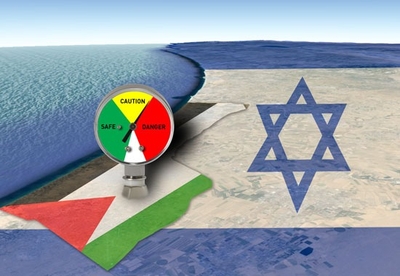
On the surface, the Gaza Strip looks relatively calm, with few security incidents occurring since the end of the protracted 2014 summer conflict between Hamas and Israel.

Behind the scenes, pressure within the Islamist-run enclave is gradually building again, just as it did prior to the 2014 war.

Gaza’s civilian population is hostage to Hamas’s dramatically failed economic policies, and its insistence on confrontation with Israel, rather than recognition of Israel and investment in Gaza’s economic future.

Ultimately, the civilian-economic pressure cooker in Gaza looks likely to explode, leading Hamas to seek new hostilities with Israel, for which it is preparing in earnest.

Right now, Hamas remains deterred by Israel’s firepower, and is enforcing its part of the truce. Hamas security forces patrol the Strip’s borders to prevent Gazans from rioting, to stop them from trying to escape Gaza into Israel, and to stop ISIS-affiliated radicals who fire rockets at Israel.

Hamas is using the current quiet to replenish its rocket arsenal, dig its combat tunnel network, and build up sea-based attack capabilities. It is investing many resources in cooking up new ways to surprise Israel in any future clash. These efforts have not gone unnoticed by the Israel Defense Forces (IDF).

Hamas has not fired a single rocket into Israel since August 2014, but it encourages violence in the West Bank as part of a strategy to destabilize its Palestinian rival, the Fatah-led Palestinian Authority. Hamas in Gaza also works remotely to set up and orchestrate terrorism cells in the West Bank, while plotting way to overthrow Fatah from power. The Shin Bet, Israel’s domestic intelligence agency, has successfully foiled nearly all of these efforts thus far, saving many Israeli lives, and the PA’s rule, too.

A deeper look at processes under way in Gaza reveals why the status quo seems untenable in the long run. Thirty percent (910,000) of Gaza’s population of 1.85 million are aged 15 to 29, and out of these, 65 percent are unemployed. This represents one of the highest unemployment rates for young people in the world. Many are university educated and deeply frustrated. The overall unemployment rate in Gaza is 38.4 percent, and rising steadily. Eighteen thousand Gazan university students graduate every year. Most of them have nothing to do with their degrees, and return home to a life of idle unemployment. Many Gazans dream of leaving. The suicide rate is growing. Under Hamas’s rule, these young people see no change on the horizon.

Out of the total population of Gaza, 1.3 million receive assistance from United Nations aid workers, without which, a humanitarian crisis would likely ensue.

Those who dare complain, such as Gazan bloggers, find themselves whisked away into Hamas police custody, where they receive firm warnings to remain silent, or else.

Meanwhile, the Gazan population is growing at an unsustainable rate. Since Israel pulled out all of its soldiers and civilians in 2005, 600,000 Gazans have been born. This is a generation that has never been to Israel (unlike the older Gazans), and its only experience of Israel is through air force missiles fired at Hamas targets following clashes sparked by the jihadist regime’s military wing.

Many of these young people are exposed to the propaganda of Hamas’s media outlets, like the Al-Aksa television station, which is a major source of incitement. Some are also exposed to the wider world through the Internet, and are aware that life can be different for them.

By 2020, Gaza’s population will hit 2.3 million people. It could run out of drinking water. This might prompt a civilian revolt, which could push Hamas into starting a new war with Israel to distract attention.

To try to relieve the pressure, Hamas leaders make promises that they cannot keep, such as the setting up of a sea port, and the opening of the Rafah crossing with Egypt, which the anti-Hamas Egyptian government opened just 18 times in 2015 for fear of allowing jihadists in Gaza to pour into the restive Sinai Strip.

A Hamas delegation traveled to Egypt earlier this month to try to mend relations with the Cairo government. The effort resulted in failure, after Egyptian officials accused Hamas of failing to acknowledge its collaboration with the ISIS-affiliated Sinai Province insurgents.

Changes are underway within Hamas itself, which are causing the Izzadin Al-Qassam Brigades military wing to gain power at the expense of the political wing, which is led by Ismael Haniyeh.

Yiyhe Sinwar is a senior Hamas member with growing power, operating in the gray zone between both wings. He is close to military wing chief Muhammed Def, and to Haniyeh. Sinwar’s power represents the rise of military wing’s influence, where many members are finding their way into political elite positions in Gaza.

Marwan Isa is another senior Hamas member, influential to both wings. While the political wing has, behind closed doors, been hesitant to support the military wing’s disastrous adventures against Israel, its ability to veto future attacks may vanish.

Additionally, Hamas is running out allies as it did before the 2014 war.

Iran continues to fund its military wing, as well as Palestinian Islamic Jihad. Yet Tehran’s ability to traffic weapons into Gaza has been ruined by Egypt’s tunnel demolition drive.

Iran’s overall influence on Gaza, therefore, is limited.

The Muslim Brotherhood-friendly Qatar has also stepped back from Hamas, limiting its funding projects in Gaza to civilian reconstruction only, building a modern highway in Gaza and a fancy new neighborhood in Khan Younis. However, no Qatari funds go to Hamas’s military build-up. Turkey’s assistance to Hamas is limited, too. It paid for a new Gaza hospital and 11 mosques, but beyond that, its support is mostly rhetorical.

The Arab world is indifferent to Gaza, meaning that Hamas is in strategic distress.

ISIS-inspired ideology is penetrating Gaza, and a few thousand former Hamas, Fatah, and Islamic Jihad members have defected to small Salafist-jihadist groups there. These groups have been responsible for all rocket fire into Israel since the summer of 2014.

In fact, the only state that makes major efforts to care for Gaza’s civilians is Israel. Israel provides 60 percent of Gaza’s electricity (30 percent is locally produced and Egypt provides the remaining 10 percent).

In 2015, Israel allowed 104,000 Gazans through the Erez border crossings to assist traders and humanitarian journeys. At the Kerem Shalom vehicle crossing, 900 trucks pass each day from Israel into Gaza, carrying all manner of goods, from fuel, to construction materials and commercial goods.

For Gaza civilians, the only ray of light seems to shine from the reconstruction mechanism, which Israel quietly set in motion after Hamas cynically used Gazan civilian areas as rocket launching zones and urban combat bases.

Israel set up a computerized reconstruction system that closely monitors and enables the rebuilding, while preventing the use of concrete and dual use items from falling into Hamas’s hands. Gaza contractors who cannot account for their materials on the computerized systems are immediately removed from their positions, a heavy price to pay in the unemployment-rife Gaza Strip.

Funded by international donors and the Palestinian private sector, the mechanism, which Israel pushed to set up, has repaired 80,000 of the 130,000 housing units damaged during the conflict. Another 20,000 are currently being repaired.

Of the 18,000 homes completely destroyed in 2014, nearly 11,000 have already been rebuilt, and material for nearly 2,000 more homes has been bought and paid for.

The reconstruction program is providing jobs and a little hope for Gazans. But it is unlikely to be sufficient to stave off an economic collapse. Again, the rebuilding effort is funded almost entirely by outside sources while Hamas invests tremendous resources into terrorism-guerilla capabilities and denies the Gazan people the opportunity of economic development by refusing to recognize Israel.

Until Gaza is run by people with different priorities, its residents have little hope their lives will improve.

More Palestinian Empty Threats

March 21, 2016

More Palestinian Empty Threats, Gatestone InstituteKhaled Abu Toameh, March 21, 2016

♦ For Abbas, security coordination with Israel is indeed “sacred”: it keeps him in power and stops Hamas from taking over the West Bank.

♦ Abbas cannot tell his people that security coordination with Israel is keeping him on the throne. That is a topic for Israeli ears only.

♦ So what are the threats to end security cooperation about? Money. Here is Abbas’s take-home to the world: “Send more money or we will cut off security cooperation with Israel.”

♦ Halting security coordination with Israel would spell both his end and that of the PA in the West Bank. The international community is simply hearing a new version of the old bid for yet more political concessions and yet more cash.

The Palestinian Authority’s endless threats to suspend security coordination with Israel are a carefully crafted bluff designed to extort more funds from Western donors, scare the Israeli public and provide a cover for its refusal to talk peace with Israel.

Many Palestinians say these threats are also intended for “internal consumption” — namely to appease Hamas and other radical factions and to refute charges that the Palestinian Authority (PA) is betraying its people by “collaborating” with Israel.

Hamas has conditioned “reconciliation” with President Mahmoud Abbas’s ruling Fatah faction in the West Bank on Fatah ending all forms of security coordination with Israel. Hamas claims that the security coordination is directed mostly against its members and supporters in the West Bank.

Over the past several years, PA security forces have rounded up hundreds of Hamas men in an attempt to prevent the Islamist movement from establishing bases of power in the West Bank.

Hardly a week has passed during the past few months in which a senior Palestinian Authority official does not threaten to cut off security ties with Israel. Some officials in Ramallah have even claimed that the PA has already taken a decision to suspend not only security coordination with Israel, but also political and economic relations as well.

PA officials are saying that their threats, which until now have been so much dust in the wind, will be realized next month.

“April is going to be the turning point,” declared Jamal Muheissen, member of the Fatah Central Committee. “This is a month that will witness changes with regards to several issues that can no longer be delayed or marginalized. April will witness the complete and public suspension of security coordination [with Israel]. This will be the first step taken by the Palestinian leadership.”

This sounds curiously familiar: nearly a year has passed since leaders from the Palestinian Authority and Fatah first announced their decision to halt all forms of security coordination between the PA and Israel.

Meeting in Ramallah last month, the leaders once again reaffirmed their decision. This time, it is allegedly Israel’s “failure to honor all signed agreements with the Palestinians” that prompts them to suspend security coordination.

U.S. Vice President Joe Biden was reportedly informed of this intention earlier this month while visiting Ramallah.

But Biden is not the only Western leader to be privy to this threat. Palestinian sources say that foreign dignitaries and leaders who visit Ramallah have become accustomed to hearing Abbas and other Palestinian leaders announce their “intention” to suspend all relations with Israel, including security coordination.

Moreover, the PA recently leaked to the Palestinian media that it has officially notified Israel of its decision to “limit” all relations with it. According to the unconfirmed report, President Mahmoud Abbas dispatched three senior officials — General Intelligence Chief Majed Faraj, Preventive Security Chief Ziad Hab Al-Reeh and PA Minister for Civilian Affairs, Hussein Al-Sheikh — to a meeting with Israeli officials to brief them about the reported decision.

The Palestinian street, however, takes a different view of these threats. The reports, they say, call to mind President Abbas’s incessant threats to resign.

These Palestinians consider the threats a smokescreen to conceal the continued security coordination with Israel which, they say, seems even to have increased in recent months. They say that President Abbas can probably fool Western leaders with these threats, but not his people, who have become used to hearing empty threats from their leaders.

A senior Fatah official in Ramallah summed up the Palestinian Authority’s dilemma: “We are facing a complicated crisis. If we carry out the threat [to suspend security coordination with Israel], we will suffer; similarly, if we don’t we will suffer.”

The situation, however, is not all about money: it is also about power. President Abbas and his security chiefs know perfectly well that the security coordination benefits them first and foremost. They are well aware that without Israel’s help, Hamas would spread in the West Bank like a cancer, ultimately overthrowing the PA and replacing it with another Islamist regime like the one in the Gaza Strip.

It is helpful to remember Abbas’s moment of lucidity, when in 2014, in front of a visiting Israeli group, he declared that security coordination with Israel was “sacred.” He added: “We will continue with it even if we differ on political matters.”

For a change, Abbas was being honest. And he is right. For Abbas, security coordination is indeed “sacred”: it is keeping him in power and stopping Hamas from taking over the West Bank. Hence the security coordination — in Abbas’s words — is very important for the Palestinian Authority – perhaps more than thwarting Hamas terror attacks against Israel.

Abbas has a problem. He cannot tell his people that security coordination with Israel is what is keeping him on the throne. The sacredness of security coordination is a topic for Israeli ears only.

So what are the threats about? Money.

Here is Abbas’s take-home to the world: “Send more money or we will cut off security cooperation with Israel.” And now there is a little added value, messaged mostly to the U.S. and EU: Convene an international conference for “solving” the Israeli-Palestinian conflict, or we will cut off security cooperation with Israel.

1410 (1)Abbas to the world: “Send more money or we will cut off security cooperation with Israel.”
Left: Palestinian Authority President Mahmoud Abbas with French President François Hollande. Right: Abbas with top European Union officials Federica Mogherini and Jean-Claude Juncker.

Whatever else he is, Abbas is not suicidal. Halting security coordination with Israel would spell both his end and the end of the Palestinian Authority in the West Bank. What the international community is hearing, then, is nothing more than a new version of the old bid for yet more political concessions and yet more cash.

Sweden’s Palestinian Lobbyists

March 19, 2016

Sweden’s Palestinian Lobbyists, Gatestone InstituteNima Gholam Ali Pour, March 19, 2016

(News from the “rape capital of the world.” — DM)

♦ The Swedish municipality of Malmö, with only 318,000 inhabitants, is providing tens of thousands of dollars in tax revenues each year to organizations that spread extreme anti-Israeli messages.

♦ Apelgårdsskolan elementary school in Malmö lends its premises on Sundays to an association called Framtidsföreningen [“The Future Society”]. The organization holds a Sunday school, where, among other things, maps are handed out to children where Israel has been removed, and schoolbooks are distributed in which “resistance” against Israel is celebrated. Framtidsföreningen has also received $4500 from Malmö’s recreational board since 2014.

♦ That pro-Palestinian organizations will use tax-funded operations as a tool to spread hatred against Israel is a given. This means that organizations that spread hatred against Israel in Sweden in many cases have tax revenues at their disposal at several levels.

♦ There are no effective lobbying organizations in Sweden that fight for the cause of Israel.

In recent years, aid that finances hatred against Israel has received much attention. Organizations such as NGO Monitor have shown time and again how European countries and international organizations provide financial support to projects in which the sole purpose is to spread lies about Israel and erode its legitimacy as a nation.

But the European war going on against Israel has deeper presence and is more widespread than just some European governments or international organizations providing assistance to organizations that are spreading hatred against Israel.

The Swedish municipality of Malmö, for instance, with only 318,000 inhabitants, is providing tens of thousands of dollars in tax revenues each year to organizations that spread extreme anti-Israeli messages.

The association Kontrakultur has, since 2012, received $167,000 in tax revenues from the municipality of Malmö. If you visit the website of Kontrakultur, you can see that two of their partners are the International Solidarity Movement Sweden and Isolera Israel [“Isolate Israel”]. Both the International Solidarity Movement and Isolera Israel are organizations that have extreme views on the Israel-Palestine conflict. Both organizations say they believe that Israel is an apartheid state conducting ethnic cleansing and is to be boycotted; they support Palestinian terrorism against Israelis, which they call “resistance.”

When Isolera Israel in March 2015 carried out a campaign during “Israel Apartheid Week,” when they sent out “apartheid inspectors” to Malmö’s stores to encourage shop owners to remove Israeli products, they had their headquarters located on premises owned by the municipality of Malmö.

Apelgårdsskolan elementary school in Malmö lends its premises on Sundays to an association called Framtidsföreningen [“The Future Society”]. The organization holds a Sunday school, where, among other things, maps are handed out to children where Israel has been removed, and schoolbooks are distributed in which “resistance” against Israel is celebrated.

Framtidsföreningen has no business being in a Swedish school: it is a pro-Palestinian association that cooperates with organizations such as International Committee for Breaking the Siege of Gaza, one of the founding organizations behind the Freedom Flotilla Coalition.

Apelgårdsskolan is located in the area of Rosengård, which is, according to Swedish police, a “particularly vulnerable” area. According to the Swedish police’s definition, there are, among other things in “particularly vulnerable” areas, parallel society structures, extremism, people traveling to take part in combat in conflict areas and a high concentration of crime. That the municipality of Malmö makes it possible to spread hatred against Israel among children in such an area is enabling a future war against Israel.

In addition to having used municipal premises to indoctrinate young children that Israel does not exist and teaching children that they should carry out militant actions against Israel, Framtidsföreningen has also received $4500 from Malmö’s recreational board since 2014.

Although these might seem shocking details to any sensible person, this kind of activity is normal in Sweden. Tobias Pettersson, Chairman of the pro-Israeli think tank Perspektiv På Israel [“Perspective on Israel”], sent information about Framtidsföreningen to Malmö’s largest newspaper, Sydsvenskan. However, Sydsvenskans journalists responded that the subject was not something for them to cover.

No newspaper in Sweden has written anything about these events. The anti-racist organization Motargument [“Counterpoint”] wrote a blog about the events in Apelgårdsskolan but tried to downplay the incident by saying that it was just a matter of “Arabic-speaking pupils” who were having “Palestinian studies.”

On March 3, the organization “Malmö’s Young Muslims” held a lecture on municipal premises about “Palestinian lobbying in Sweden.” This lecture was directed at young people and held by Adnan Abou-Chakra, a person who among other things, acts as interpreter when Hamas writes articles for Swedish newspapers. This lecture also took place in Rosengård. It is a mystery for anyone why a Swedish municipality should make it possible for young people to learn about “Palestinian lobbying in Sweden.”

These are just some examples of how pro-Palestinian organizations that spread hatred against Israel or have extreme views on the Israel-Palestine conflict have created a local infrastructure in Malmö financed by taxes.

They have managed to do this through effective lobbying. Beside the Sweden Democrats, there is no political party in Malmö that sees any of this as a problem. That pro-Palestinian organizations will use tax-funded operations as a tool to spread hatred against Israel is a given. This means that organizations that spread hatred against Israel in Sweden in many cases have tax revenues at their disposal at several levels.

While there are pro-Palestinian organizations on the municipal school premises that indoctrinate children that Israel is not on the map and teach young people in municipal premises how they should conduct lobbying on behalf of Palestinian causes, there are no effective lobbying organizations in Sweden that fight for the cause of Israel.

While municipal tax revenues go to organizations that spread hatred against Israel, the local synagogue is financing its own security without any financial support from Malmö. Such an inequitable situation in itself shows how effective the pro-Palestinian groups have been in their lobbying.

Even when someone is fighting against anti-Semitism in Sweden, it is important that the person condemns Israel. Siavosh Derakhti, who has received several awards for his fight against anti-Semitism in Sweden and has met President Obama in 2013, wrote the following about Israel in an article from 2011; he tells young Muslims in Sweden why they should distance themselves from anti-Semitism:

“But we must also be critical of Israeli policies and military. Where there is oppression and discrimination against civilians in Palestine. We must show courage and hope for the future. We need to influence our politicians so that they can take up the fight in parliament and hopefully strengthen demands against Israeli policy and listen to the young people. The children and the civilian population in Palestine should live in peace and live in freedom. Israel must cease its military attacks and discrimination and the oppression against the Palestinian civilian population in the West Bank and Gaza. I think our politicians show little support for the Palestinians and the European Union must have the courage to strengthen the tone against Israel, possibly threatening a boycott if things continue. The attacks against the civilian population of Palestine must end. The world should boycott cooperation with Israel, as long as the country carries out attacks against civilians in Palestine.”

Even the one person in Sweden who has been praised for his struggle against anti-Semitism evidently feels compelled to remind people how evil Israel is, and in contradiction to the facts on the ground there. Derakhti’s approach towards Israel may also explain why he has received awards from the Swedish establishment.

The Palestinians may not be able to run a country, as the chaos in the Palestinian territories demonstrates, but they can apparently run Swedish politics better than anyone. As long as this imbalance, composed of Palestinian lobbying activities at all levels of Swedish policy-making, from local to national, exists, and is unopposed by any real lobbying for Israel’s cause, then Sweden will be a pro-Palestinian country with a pro-Palestinian establishment.

This disinformation and imbalance also ensure that Swedish taxpayers, at all levels, support operations that spread hatred against Israel.

It is not that Swedish politicians have misunderstood anything, except facts about Israel; it is that a pro-Palestinian lobby has been very successful and has achieved all its goals, while whoever supports Israel has been either silent or passive and not taken to heart how effective grassroots organizations can be. You can be very charming, and if you are pro-Palestinian building grassroots organizations, it is easy to convince Swedish politicians.

There are many people who now analyze Sweden and ask how this country in northern Europe could recognize Palestine so fast and criticize Israel so much. It is the pro-Palestinian lobbying organizations that have caused this to happen. The only way to reverse the trend is to build or support effective pro-Israeli lobby organizations that are as ambitious as the pro-Palestinian lobby organizations.

If the people who support Israel do not confront these pro-Palestinian lobbyists, more countries like Sweden will become platforms from which to delegitimize Israel. This European confrontation is essential and of the most urgent, strategic importance.

Islamist Activist Asks Obama to Support Libyan AQ Group

March 18, 2016

Islamist Activist Asks Obama to Support Libyan AQ Group, Investigative Project on Terrorism, John Rossomando, March 18, 2016

1414

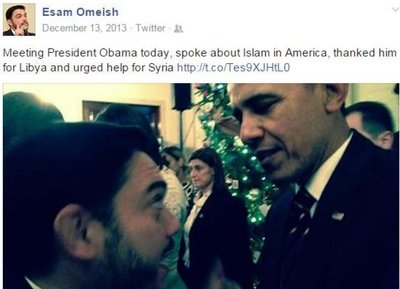
The revelation of his praise for Palestinians who chose “the jihad way” to liberation forced northern Virginia surgeon Esam Omeish to resign from a statewide immigration commission in 2007. But it hasn’t stopped him from enjoying red carpet treatment from Obama administration officials.

Omeish briefly drew national attention in 2007 when he was forced to resign from the Virginia immigration panel. The move resulted from Investigative Project on Terrorism (IPT) video showing him praising for Palestinians who chose the “jihad way” during a rally in 2000.

This was no slip of the tongue. At a different event two months earlier, Omeishcongratulated Palestinians who gave “up their lives for the sake of Allah and for the sake of Al-Aqsa. They have spearheaded the effort to bring victory upon the believers in Filastin, insha’allah [God willing]. They are spearing the effort to free the land of Filastin, all of Palestine, for the Muslims and for all the believing people in Allah.”

Nonetheless, high-ranking Obama administration officials engaged with him despite this and his praise for Hamas founder Sheikh Ahmed Yassin. They consulted with him on Libya and included him in other events aimed at engagement with the Muslim community and countering violent extremism.

Now, Omeish is hoping those contacts will help him persuade U.S. officials to change gears in Libya, shifting support from a secular political figure to one with links to al-Qaida. He spelled out those ambitions in a Feb. 29 letter addressed to President Obama posted on Omeish’s Facebook page.

It is co-signed by Emadeddin Z. Muntasser, secretary general of the Libyan American Public Affairs Council (LAPAC). Omeish is identified as the LAPAC president.

Before he was affiliated with the LAPAC, Muntasser was convicted in 2008 of failing to disclose connections between a charity he worked with and jihadist fundraising when he sought tax-exempt status for the charity.

Muntasser ran the Boston branch of the Al-Kifah Refugee Center, which is considered a precursor to al-Qaida, federal prosecutors have said. It was founded by Osama bin Laden’s mentor Abdullah Azzam. Under Muntasser’s leadership, Al-Kifah’s Boston office published a pro-jihad newsletter called Al-Hussam and distributed flyers indicating its support for jihadists fighting on the front lines in places such as Chechnya, Bosnia, Afghanistan and Algeria.

Muntasser’s charity, Care International, was “an outgrowth of and successor” to Al-Kifah, prosecutors say.

Omeish and Muntasser note in their letter that the U.S. has backed the “Libyan National Army,” led by Khalifa Hifter, a former general under dictator Muammar Gaddafi. That’s a bad idea, Omeish and Muntasser wrote, because “many in Libya believe [Hifter] has dictatorial aspirations …”

“He sounds like the Ahmed Chalabi of Libya,” said former Pentagon spokesman J.D. Gordon, a fellow at the Center for a Secure Free Society. “He wants America to fight his battles for him in order to gain the upper hand over his countrymen.”

However, the letter makes no mention of ties between the group Omeish endorses, the Revolutionary Council of Derna, and al-Qaida. Instead, he and Muntasser casts the group as an effective counter to ISIS because the council has “stripped [ISIS] from its social support. [ISIS]’s foreign presence and violent ways made them an evil that local Libyans themselves rejected and defeated” in Derna.

The council’s leaders included two men – Nasir Atiyah al-Akar and Salim Derbi –known to have had ties to al-Qaida.

After ISIS killed al-Akar, the Derna council eulogized him last June for his close ties to Abu Qatada, al-Qaida operative currently in Jordan. Defense Intelligence Agency (DIA) reports from 2012 connect Akar to Abdulbasit Azzouz, who was al-Qaida leader Ayman al-Zawahiri’s man in Libya at the time. Azzouz allegedly was involved with the attack on the U.S. consulate and CIA annex in Benghazi that left U.S. Ambassador Stevens and three other Americans dead.

Derbi, also killed fighting ISIS, previously belonged to the al-Qaida linked Libyan Islamic Fighting Group (LIFG) and commanded the Abu Salim Martyrs Brigade, which also has al-Qaida ties.

Egypt’s Al-Alam Al-Youm refers to the Revolutionary Shura Council as “a branch of al-Qaida.”

Despite his ongoing connections to key White House decision-makers, Omeish appears headed for disappointment this time.

His letter is not likely to be read by the president’s national security team, a White House source told the Investigative Project on Terrorism (IPT). The U.S. is prepared to support a “Government of National Accord” that is being developed, the White House said in a statement.

However, the Obama administration repeatedly has involved Omeish in policy deliberations about Libya.

White House logs show that Omeish visited nine times since 2011, including a Dec. 13, 2013 visit in which he was photographed with President Obama.

Omeish’s encounter with the president came during the White House’s annual Christmas party, a White House spokesperson said. President Obama never conducts policy discussions at such public meetings, the source said.

1415 (1)

Two photos appear on Omeish’s Facebook page showing him with U.N. Ambassador Samantha Power, widely considered an architect of the president’s Libya policy, where she advocated for military intervention. She notably helped draft PSD-11, a secret presidential directive that led to the U.S. supporting the Muslim Brotherhood in Libya among other places.

One photo shows Omeish meeting with Power in February 2012, when she worked as special assistant to the president and senior director for Multilateral Affairs and Human Rights at the National Security Council. The other photo posted the day Obama announced Power’s nomination as U.S. ambassador to the U.N. shows her standing next to Omeish.

White House officials thought enough of Omeish that they invited him to attend an April 2011 speech on Libya by President Obama at the White House. Omeish also attended the installation of Christopher Stevens, the late U.S. ambassador to Libya killed in the Sept. 11, 2012 Benghazi attack, and that of his successor, Deborah Jones, in 2013.

Omeish told The Washington Times following the Benghazi attack that he briefed Stevens before the ambassador began his duties in Tripoli.

Omeish and the Muslim Brotherhood

In addition to his comments about Palestinians and jihad, Omeish admits to prior personal involvement in the Muslim Brotherhood in the U.S. and served as president of the Muslim American Society, which has been described as the “overt arm” of the Brotherhood in America. His association with the Brotherhood likely dates back to his involvement in the Muslim Students Association (MSA) in the 1990s when he became the national organization’s president, which was founded by Brotherhood members in 1963.

Omeish endorsed Libya’s Muslim Brotherhood in a 2012 IRIN News article, stating that although it came in a distant second in Libya’s 2012 elections, it “may be able to provide a better platform and a more coherent agenda of national action.”

Libya’s Muslim Brotherhood subsequently failed to implement a coherent agenda and became deadlocked with its liberal rival, the National Forces Alliance, over establishing a working constitution.

Brotherhood members opposed building a strong Libyan military that could have helped rein in the militias that have since created havoc. Numerous militias tied to the Brotherhood have contributed to Libya’s instability. U.S. State Department officials contracted with the Brotherhood-linked February 17 Martyrs Brigade – a group that also had Al-Qaida ties – to provide security for the ill-fated U.S. consulate in Benghazi. A BBC report described the brigade as the best armed militia in eastern Libya. It additionally held al-Qaida sympathies, according to posts on its Facebook page. A State Department report called reliance on the February 17 militia in the case of an attack such as happened on Sept. 11, 2012 “misplaced.”

LAPAC is but one of an alphabet soup of groups that Omeish helped found as a result of the Arab Spring, aimed at affecting U.S. policy toward Libya.

This includes Libyan Emergency Task Force,(LETF), Libyan Americans for Human Rights, Libyan Council of North America (LCNA), Libyan American OrganizationAmerican Libyan Council, American Libyan Chamber of Commerce and Industry (ALCCI), Center for Libyan American Strategic Studies. Former Libyan Ambassador to the U.S. Ali Aujali appointed Omeish the official representative of the Libyan-American community, according to ALCCI’s old website.

LETF lobbied for the U.S. and the international community to establish a no-fly zone to keep Gaddafi from bombing rebellious cities in early 2011. Omeish’s LCNA worked to facilitate meetings between U.S. officials and Libyan rebels, including a meeting with John Kerry while he still was a U.S. senator. ALCCI  works with the Libyan embassy in Washington to “certify and support trade relations between Libya and the United States.”

It remains to be seen whether the advice from Omeish and Muntasser will be ignored. But their gambit, publicly posting their letter urging the president to support Islamists, indicates a confidence generated by years of access and consultation. That raises a host of troubling questions.


New Iron Dome version can destroy tunnels

March 11, 2016

New Iron Dome version can destroy tunnels, DEBKAfile, March 11, 2016

Anti_tunnel_missile_NEWIran keeps its ballistic missiles in underground bunkers

Israel has started testing a secret new weapon for defeating the tunnel systems which the Palestinian Hamas and Hizballah are busy digging for surprise attacks against Israel. Western sources reported Friday, March 11, that the new weapon, dubbed the “Underground Iron Dome,” can detect a tunnel, then send in a moving missile to blow it up.

US intelligence sources disclosed only that new weapon is equipped with seismic sensors to detect underground vibrations and map their location before destroying them.

Western experts have been talking for years about a secret Israeli weapon capable of destroying Iran’s Fordo nuclear facility, which is buried deep inside a mountain not far from the Shiite shrine city of Qom. They suggested that this hypothetical weapon could be slipped through the Fordo facility’s vents, thread its way through the underground chambers and take down the illicit enrichment facility.

It was discussed again three years ago, when the Israeli Air Force on Aug. 23 2013 blew up the Popular Palestinian Front-General Command underground facility at Al-Naama on the South Lebanese coast, 15 km south of Beirut.

The PPF-GC leader Ahmed Jibril was then taking his orders from Iran’s Revolutionary Guards Corps.

How this operation turned out was never revealed. But Western military sources saw it as a strong Israeli message to Tehran that its underground nuclear facilities were now vulnerable to attack. The secret JIbril command center was constructed in the 1970s by East German military engineers as one of most heavily fortified military sites in the Middle East.

As for the new weapon, the Pentagon spokesman Christopher Sherwood said that the US had allocated $40 million for completing in 2016 the establishment of “anti-tunnel capabilities to detect, map and neutralize underground tunnels that threaten the US or Israel.”

According to the spokesman, the main part of the development work (on the secret weapon) would be conducted in Israel in 2016. The US would receive prototypes and access to the test sites and hold the rights to any intellectual property.

The Israeli firms working on the anti-tunnel weapon are Elbit Systems and Rafael Advanced Defense Systems, which developed the Iron Dome.

Sherwood denied claims from Israeli defense quarters that the US had earmarked $120 for developing the system, or that another $80 million would be available – half in 2017 and half in 2018.

DEBKAfile’s military sources emphasize that the timeline implicit in those estimates doesn’t necessarily represent the tempo of he Underground Iron Dome’s development.

According to past experience, unfinished Israeli weapons have more than once been rushed to the battlefield to meet an emergency war situation. The Iron Dome is one example. This has the advantage of testing innovative systems in real operational conditions, with the result that improvements and adjustments can be introduced much faster than planned.

Our sources add: Both Palestinian Hamas and the pro-Iranian Hizballah are working overtime on tunnels for sneaking terrorists and commando fighters into Israel to attack IDF posts and civilian locations. During Israel’s last counter-terror operation in the Gaza Strip, Hamas staged a deadly tunnel attack on the Israel side of the border and is planning repeats. Hizballah is training commando units for underground surprise incursions to capture parts of Galilee in northern Israel.

The Israeli government has spent more than $250 million since 2004 on efforts to thwart tunnel construction under the Gaza border.

IDF Chief of Staff Gen. Gadi Eisenkot hinted at these efforts in February. “We are doing a lot, but many of [the things we do] are hidden from the public,” he told a conference at Herzliya’s Interdisciplinary Center. “We have dozens, if not a hundred, engineering vehicles on the Gaza border.”

Hamas Supplying ISIS w/Bombs, Guns and Communications

March 3, 2016

Hamas Supplying ISIS w/Bombs, Guns and Communications, Front Page Magazine, Daniel Greenfield, March 3, 2016

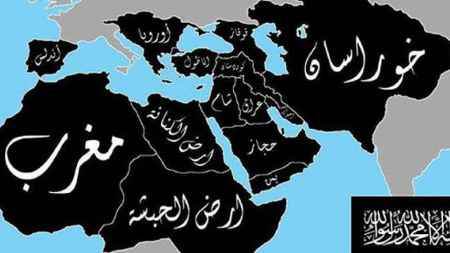
isis_revised_map_of-world_caliphate

There have been plenty of protests that Israel is “strangling” Gaza with its blockade. That Gaza is an “open air prison” or even a “concentration camp”. The truth is that Hamas is facing restrictions because it’s a terrorist organization that keeps trying to kill people.

The following letter published by Memri also reveals that it’s allied with ISIS in the Sinai is supplying guns and bombs to ISIS.

Anyone who calls for ending restrictions on Gaza is calling for more weapons to be transferred to ISIS. They are a traitor and a terrorist supporter in every possible sense of the word.

On February 24, 2016, a letter from an Islamic State (ISIS) fighter to ISIS leader Abu Bakr Al-Baghdadi was posted on social media. In it, the fighter strongly protests the close ties and cooperation between ISIS’s Sinai province and Hamas, particularly Hamas’s military wing.

The letter lays out a variety of Islamic objections to the problem that Hamas has not sworn allegiance to the Caliph of the Islamic State, making them apostates, but Hamas and ISIS in the Sinai nevertheless maintain a close working cooperation. It also lists some of the details of the cooperation between ISIS in the Sinai and Hamas.

“1. Sinai province is smuggling weapons for Hamas in Gaza, because of the province’s fighters’ expert knowledge of the [smuggling] routes from Libya, Sudan, and Egypt.

“2. Sinai province depends very much on Hamas and Al-Qassam for weapons and for explosives and ammunition. There are direct and continuous supply routes from Hamas to Sinai province. The Al-Qassam factories operate assembly lines for manufacturing explosive devices and bombs for the Sinai province, but do not stamp the Al-Qassam logo on them, as they usually do.

The Al-Qassam factories produce most particularly the rather famous Kassam rockets, but other weapons as well. So Hamas is supplying bombs for ISIS attacks on Egyptian forces (so you can see why Egypt has been cracking down so hard on Hamas), but it’s possible that some Hamas weapons filter beyond ISIS in Egypt to core ISIS as well. Certainly to ISIS in Libya.

This is a serious problem that merits investigation, much like the IEDs that Iran supplied to Jihadis in Iraq which killed so many American soldiers.

It also makes it clear that Gaza effectively functions as ISIS’ base in Israel.

“3. Sinai province leaders are regularly visiting the Gaza Strip, and holding cordial meetings with Hamas and Al-Qassam leaders, even [Hamas] government [representatives]. Animals are slaughtered for them, feasts are held, and they are embraced in Gaza.

“4. Hamas and Al-Qassam are accepting all wounded Sinai province [fighters], and they are treated in Gaza Strip hospitals under Al-Qassam’s direct protection.

“5. Hamas is providing wireless communication hubs for Sinai province, because of the difficulty of operating them in Sinai and because they are vulnerable to swift destruction by the Egyptian army.

So Hamas is providing medical care, weapons, communications, supplies and other military support functions to ISIS. It even supplies uniforms to ISIS

“Hamas manufactures the military uniforms for Sinai province – the uniforms we see, and over which we rejoice, in videos are from Hamas, oh our Sheikh Abu Bakr.”

This means that ISIS in Egypt becomes hard to beat without defeating Hamas.

And it means Obama engaged in back channel negotiations with an ISIS ally and that the man responsible for those negotiations, Robert Malley, is now Obama’s anti-ISIS czar.


Cartoon of the Day

March 3, 2016

Via The Jewish Press

Expulsion-Incentive

Analysis: Iran, ISIS Likely to Unite for WWIII

February 28, 2016

Analysis: Iran, ISIS Likely to Unite for WWIII, The Jewish PressHana Levi Julian, February 28, 2016

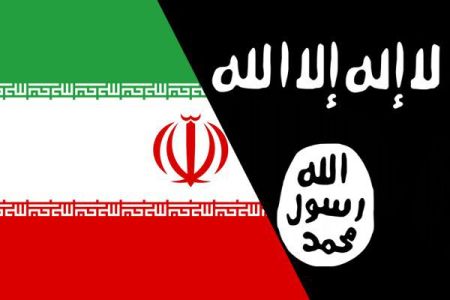
Iran-ISIS-flagPhoto Credit: JP.com graphic

Israeli military analysts are now beginning to prepare top officials, who are in turn beginning to prepare the nation, for what eventually may become the start of World War III.

Most analysts still believe the Syrian crisis is a sectarian conflict between the Sunni, Shi’a and Alawite Muslims. But that time is long gone.

A cataclysmic clash of civilizations is taking place in Syria, one that a number of nations have patiently awaited for decades.

Turkey, so deeply invested in the glorious history of its Ottoman Empire period, would find great satisfaction in stretching its influence with a modern-day “Turkish Islamic Union” that might embrace like-minded nations in the region and perhaps also beyond.

Da’esh, as it is known in the Middle East and which in English calls itself the “Islamic State” (known by others as ISIS or ISIL) is rapidly stretching its influence to build a worldwide Sunni caliphate. It began as a splinter group from the Al Qaeda terrorist organization, and then morphed into the Islamic State in Iraq and Syria (hence “ISIS”) — but at last count had successfully recruited more than 41 other regional Muslim terrorist organizations to its cause from around the world on nearly every continent.

And then there is the Islamic Republic of Iran, a Shi’ite Muslim nation, which is extending its tentacles as rapidly throughout the world as Da’esh, but far more insidiously and certainly more dangerously. If in this world one might define any nation today as Amalek, that ice-cold, black-hearted evil that first picks off the weakest of the Jewish nation, it is Iran, which has quietly extended its influence and control farther and more deeply than any other enemy Israel has ever had. Wealthy, patient, smiling and calculating, Iran acquires new allies each year, even among those Israel once counted as friends. Meanwhile, Iranian officials never forget to keep the home fires burning, to stir the pot and keep it simmering, and always to nurture the various conflicts at home in the Middle East.

This past week, Iran announced the money it donates to families of Arab “martyrs” who murder Israelis will be paid via its own special charity organization, and not through the Palestinian Authority government.

But Tehran has yet to reveal the details of exactly how it intends to pay.

Instead, a high-ranked government official simply made an announcement this weekend saying Iran did not trust the Ramallah government, driving a deeper wedge already dividing the PA’s ruling Fatah faction from Gaza’s ruling Hamas terror organization — Iran’s proxy group.

Hamas has been planting sleeper cells and budding regional headquarters, however, throughout the PA-controlled areas of Judea and Samaria, and it is clear the group’s next goal is an attempt to wrest control of those two regions from the PA, thus completing Iran’s takeover of the PLO — the PA’s umbrella organization and liaison to the United Nations.

Money is always helpful in such an enterprise, and Iran has recently enjoyed a massive infusion of cash that came courtesy of the United States and five other world powers after sanctions were lifted last month as part of last July’s nuclear deal.

Iranian Ambassador to Lebanon Mohammed Fath’ali announced last Wednesday that Iran would pay Arab families for each “martyr” who died attacking Israelis in Jerusalem and each Arab family whose home was demolished by Israel after one of its occupants murdered Israelis in a terror attack.

Iranian Parliament Speaker Ali Larijani last week underlined Tehran’s continued strong support for the wave of terror against Israel.

“The Islamic Republic supports the Palestinian Intifada and all Palestinian groups in their fight against the Zionist regime. We should turn this into the main issue in the Muslim world,” Larijani said in a meeting with a number of “resistance” groups in Tehran,FARS reported Sunday (Feb 28).

But it is clear that Iran is not content solely with a takeover of the PLO.

Tehran has its eye on a much wider goal, now more clearly than ever the resurrection of an updated Persian Empire — in modern parlance military analysts refer to it as an “Axis of Evil” — in much the same manner that Sunni Da’esh (ISIS) is single-mindedly pursuing its goal of rebuilding a worldwide caliphate.

Iranian forces via proxies have already managed to involve themselves in what once were domestic affairs in Yemen, Syria, Lebanon, Egypt, Jordan, Bahrain, Saudi Arabia, Iraq, Israel, Cuba, Mexico, the United States, Afghanistan, Venezuela, Brazil, Argentina, Qatar, Turkey and numerous other nations.

Larijani has at last proclaimed officially that Iran doesn’t differentiate between Shiites and Sunnis since they share many commonalities, adding that Tehran “has supported the Palestinian nation (although they are Sunnis) for the past 37 years.”

The remark is significant in that Iran’s Revolutionary Guard Corps and Lebanese Shi’ite Hezbollah guerrillas – another Iranian proxy – are fighting Sunni opposition forces in Syria on behalf of President Bashar al-Assad. Iranian forces are fighting the Sunni Muslim Da’esh (ISIS) terror organization that seized a significant percentage of territory in Syria.

But south of Israel, Iran’s proxy Hamas, a Sunni Muslim group, has been providing material and technical support to the same Da’esh — but its “Sinai Province” terror group in the Sinai Peninsula.

Here we finally see that Iran is willing to adapt and support terror wherever it can be found, as long as it meets two of three criteria: (1) it furthers its goal to destabilize the region, (2) in the process it works towards the annihilation of Israel, and/or (3) will contribute towards conquest and influence to reach the goal of an ultimate renewed, updated Persian Empire.

How long then until Iran connects the two dots and simply arranges a meeting between its own Supreme Leader Ayatollah Ali Khamenei and the leader of Da’esh, Abu Bakr al-Baghdadi? Hezbollah’s Hassan Nasrallah and Hamas leader Khaled Meshaal will likely be invited for dessert …

The other question is how long until someone strikes the spark that ignites the conflagration — the region is already in chaos.