Archive for the ‘Germany’ category

Another Day, Another Jihad Massacre

July 23, 2016

Another Day, Another Jihad Massacre, Front Page MagazineRobert Spencer, July 22, 2016

munich massacre

The events unfolded in predictable fashion: a young Iranian Muslim opened fire at a shopping mall in Munich while screaming “Allahu akbar,” and initial mainstream media reports were that the gunman was a “right-wing extremist,” lashing out on the fifth anniversary of the Norwegian madman Anders Breivik’s massacre, while screaming out his hatred for foreigners. 

As it happened, it was someone else screaming his hatred for foreigners at the jihad murderer, not the other way around, but once again, the lie had gotten halfway around the world before the truth had a chance to put on its shoes.

And the same old comedy, the familiar one that plays out every week now in modern, multicultural Europe and North America, duly played out again, to an increasingly bored and indifferent crowd. Munich police chief Hubertus Andrae informed the world that the young jihadi had no known links to jihad terror groups, and added: “The motive or explanation for this crime is completely unclear.”

Unclear? Really? What is it about “Allahu akbar” and the gunning-down of innocent civilians that you don’t understand, Herr Andrae? And the answer, of course, is: everything. Hubertus Andrae, and Angela Merkel, and Theresa May, and Manuel Valls, and John Kerry, and Barack Obama, and every last one of the other Western leaders are resolutely and determinedly ignorant about what it means when a young Iranian Muslim screaming “Allahu akbar” opens fire in a shopping mall.

What, after all, could it possibly mean? This young man must have come from a troubled home, no? He must have grown up in poverty and been denied access to all sorts of economic opportunities that were open to native Germans of his age, right? He must have been “radicalized on the Internet” by shadowy forces that somehow possess the magic power to turn benign, peaceful Muslims who are a benefit and asset to every Western nation into misunderstanders of their own religion who suddenly and inexplicably discard the peaceful Islamic teachings they have imbibed from youth in their Western mosques, in favor of a twisted and hijacked version of their religion that leads them to think that treason and mass murder are not only commendable, but blessed by the Almighty – isn’t that the case?

The Munich shooter’s motive is completely unclear, because we don’t yet know if he was teased in school or on the job, or if he had trouble getting a job in the first place, or if he had psychological problems, or if he was a brooding loner who always left his moderate Muslim friends disquieted – the only thing we do know is that he couldn’t possibly have been motivated by a religion that exhorts its adherents to “slay them wherever you find them” (cf. Qur’an 2:191, 4:89, 9:5).

No, none of that is true, and one wonders if even the European and North American political and media elites believe in their own nonsense anymore. The Munich mass murderer was motivated by Islam, pure and simple – by its teachings of warfare against unbelievers and the necessity to subjugate them. His war cry of “Allahu akbar,” revered by jihadis for its power to “strike terror in the hearts of the enemies of Allah” (Qur’an 8:60), demonstrates that.

The Islamic State’s repeated calls for the mass murder of civilians in Western countries also demonstrate that. Hubertus Andrae, and Angela Merkel, and Theresa May, and Manuel Valls, and John Kerry, and Barack Obama, and every last one of the other Western leaders persist in pretending that incidents such as the mass murder in Munich on Friday, and the mass murders in Nice, Orlando, Brussels, Paris, San Bernardino, Chattanooga, and elsewhere recently are all separate, discrete criminal acts, unrelated to one another and all requiring extensive investigation to determine the motives of the perpetrators.

That proposition is not only false; it’s a Goebbelsian Big Lie. These are not criminal acts. These are not the acts of the psychopathic or the disenfranchised. These are acts of war, battles in a larger war that has been going on for 1,400 years and is picking up speed in our own age, courtesy of our willfully myopic and feckless leaders. Unless and until Western authorities begin to treat each of these incidents as part of a larger war, they will continue to misdiagnose the problem and apply the wrong solutions.

And that is the one thing they are certain to do. And so there will be many, many more Munichs. Watch this space next week for my comments on the next jihad massacre and the next flurry of predictable denials and obfuscations. My comments next week will be much like my comments here, because the actions of the elites after the next jihad attack will be much like what they have been today. What is it going to take to get leaders who are in touch with reality? Seriously, is that really too much to ask?

Germany: The Terrifying Power of Muslim Interpreters

July 22, 2016

Germany: The Terrifying Power of Muslim Interpreters, Gatestone InstituteStefan Frank, July 22, 2016

♦ “Everything I told you then is true. … But the interpreter there told me that a faithful woman must not use words like sex and rape. Words like that would dishonor my husband and our family. She also said that I was a blasphemer, because I went to the police. No woman should report her own husband. The husband must be honored.” — “Sali,” in an apparent suicide note to her lawyer, Alexander Stevens.

♦ “I am aware of statements in which interpreters have pressed and supposedly said to Christians on the way to the police or beforehand: If you complain, you can forget your application for asylum. I often noticed that statements were retracted because Christians were threatened.” — Paulus Kurt, Central Committee of Eastern Christians in Germany (ZOCD).

♦ “The interpreters are neither employed by the Federal Agency, nor are they in any way sworn in to the legal system of the Federal Republic of Germany. Ultimately, examination of the asylum application is left solely to these interpreters… In our view, a decision-making process such as this, which is practiced on a massive scale, is not in keeping with due process.” — Open letter from employees of Germany’s Federal Agency for Migration and Refugees.


Alexander Stevens is a lawyer at a Munich law firm specializing in sexual offenses. In his recent book, Sex in Court, he describes some of his strangest and most shocking cases. One such case raises the question: What do you do when interpreters working for the police and courts lie and manipulate? As no one monitors translators, it is likely that in many instances, the dishonesty of interpreters goes undetected — Stevens’ book chronicles the devastating effects one dishonest interpreter had on a case.

The parents of a Syrian girl, “Sali,” had promised their daughter to a man named Hassan, who, at the time, was still living in Syria. The arrangement was seen as mutually beneficial: Sali’s parents would receive money and Hassan would be allowed to enter Germany. Sali would never willingly have married a man 34 years her senior, but the family’s honor required it. However, Sali did not receive any benefits from this arrangement. Hassan’s interest in Sali was apparently confined to her body. He forced Sali to perform all kinds of sexual practices several times a day, and brutally abused the girl in the process.

Sali was unable to hide the fact that she took no pleasure in these rapes and she became ill, so Hassan reproached her and “openly threatened to demand a large compensation payment from her family, for the cost of the wedding reception and lost pleasures of love.” Sali sought help from a women’s shelter, where an employee took her to a lawyer: Stevens. At the shelter, Sali described her misfortune, but was careful repeatedly to come to her husband’s defense. She was more worried about her family’s honor, should Hassan decided to divorce her, than about herself.

“After two hours of painstaking depictions of sexual abuse, corporal punishment, and mental humiliation,” Stevens writes, “I had no doubt that everything had actually happened as she said.”

The next day, Stevens tried to get an appointment for questioning with the police and an interpreter. But he was surprised when he got to the shelter. Sali was like a different person. Suddenly, she wanted nothing to do with him or the women’s shelter employee.

Sometime later, an employee of the women’s shelter sent him a letter that Sali had left behind for him. It read:

Dear Mr. Stevens,

I am very sorry to have caused you so much inconvenience. Please believe me when I say I did not want to. Everything I told you then is true. I also wanted to make a statement to the police regarding what I told you. But the interpreter there told me that a faithful woman must not use words like sex and rape. Words like that would dishonor my husband and our family. She also said that I was a blasphemer, because I went to the police. No woman should report her own husband. The husband must be honored. I did not know what to do, Mr. Stevens. Because I think she is right. I should never have disgraced my husband and my family. Therefore, I would ask you not to tell anyone. I do not want to create any more trouble for my family and my husband’s family. Please forgive me. You were very good to me.

Sali

By this time, Sali was already dead. According to the employee from the women’s shelter, the police suspected suicide.

Interpreters Decide on Asylum

Non-Muslim refugees, in particular, complain of the pressure exerted on them by Muslim interpreters. As Gatestone Institute has already reported, Christians and other non-Muslims are beaten, threatened, and harassed in German refugee homes. One of the reasons that German authorities do not intervene has to do with the Muslim interpreters, says Paulus Kurt, head of the work groups for the Central Committee of Eastern Christians in Germany (ZOCD):

“Interpreters belonging to the Islamic religion often stick with the defendants. I am aware of statements in which interpreters have pressured and supposedly said to Christians, on the way to the police or beforehand: ‘If you complain, you can forget your application for asylum.’ I often noticed that statements were retracted because Christians were threatened.”

The effects of these abuses of power are devastating: interpreters in Germany have great influence on who is granted asylum. In a November 2015 open letter to Frank-Jürgen Weise, the head of their agency, employees of the Federal Agency for Migration and Refugees (BAMF), pointed out the potential problems of this system within their agency:

“A Syrian is someone who identifies himself as a Syrian in writing (checks the proper box on the questionnaire), and the interpreter (usually not sworn in, or from Syria) confirms it. The interpreters are neither employed by the Federal Agency, nor are they in any way sworn in to the legal system of the Federal Republic of Germany. Ultimately, examination of the asylum application is left solely to these interpreters — insofar as it involves the verification of nationality and, therefore, the country of persecution. In our view, a decision-making process such as this, which is practiced on a massive scale, is not in keeping with due process.”

Television Reports

In May 2016, the German public television station Bayerischer Rundfunk broadcast a report on Muslim interpreters who lie. The report, entitled “Treason in the Refugee Home: When Translators Mistranslate,” exposed several instances of the same issue:

Moderator: With the growing number of refugees, the demand for interpreters has also rapidly increased. Ultimately, translators play a central role in the asylum procedures, for example. Since there is an overall shortage of qualified and sworn interpreters, the Federal Agency for Migration and Refugees has recently been advertising for translators with this flyer [title: “We are Looking for Interpreters”]. Inside, it says: “You take on great responsibility in your work, and we expect you to be neutral and reliable.” But there is often a gaping hole between expectations and reality.

Reporter: Bullied and threatened by other refugees. A nightmare, what this Iraqi refugee is telling us. He asks one of the translators for help, but he [the translator] takes the side of the attacker.

Hassan: “They wanted to beat us; they insulted us. And the interpreter thought about everything while translating, and alleged that none of it had happened.”

Reporter: Hassan, as we call the young man, belongs to a small religious community of Yezidis. Radical Sunni Muslims despise Yezidis, even in Germany. Instead of conveying the message, the translator cheated him.

Hassan: “The interpreter translated that we merely had a dispute on the street.”

Reporter: That was a conscious mistranslation. Not an isolated incident, says Gian Aldonani. She fled to Germany as a young Yezidi girl. As a student in Cologne, she got involved in working with refugees. In the process, it became apparent to her again and again:

Gian Aldonani: “It is purposefully mistranslated. At first, we thought these were isolated cases out of Cologne and the surrounding area. But in documenting all of the cases, we recognized that translators all over Germany were very purposefully mistranslating. […] The social workers are reliant on the translators. The translators take advantage of this situation. These people are doing the same thing here that they do with minorities in their countries of origin.”
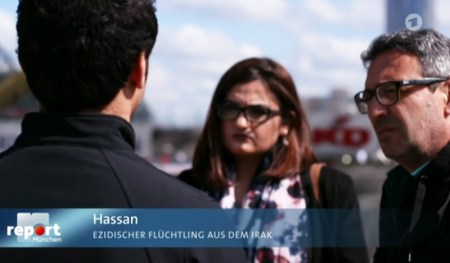
1706Hasan (left), a Yezidi refugee in Germany who was threatened by Muslims, speaks to a reporter from German public television about how a government-employed translator deliberately mistranslated his complaint and took the side of his attackers. (Image source: Bayerischer Rundfunk video screenshot)

More “Isolated Cases”

Similar cases — always labelled “isolated cases” — are found in German and Austrian newspapers again and again.

In Austria, in June 2016, the Salzburg regional court sentenced a jihadist to two years in prison. He had fought for the Al-Nusra Front in Syria. Incidentally, it became known that: “The 29-year-old came to Salzburg as a refugee in October 2015 and helped at the Freilassing border crossing as an interpreter.”

Regarding “interpreter and cultural mediator Besnik S.,” the Hamburger Morgenpost newspaper wrote:

“Besnik S. also interpreted for the young refugees — until one of his colleagues became suspicious of him. Besnik S. was consistently translating incorrectly. Instead of facilitating communication for the young men, he allegedly tried to bring them closer to his ideology. “

Particularly grotesque is the March 2016 case of a Chechen interpreter, who worked as a court translator in Graz, Austria:

“The interpreter had already interpreted several people’s statements. As another witness was supposed be questioned at that point, the woman [interpreter] explained that the witness in question was her husband. But she claimed that he could not come that day, and sent his apologies, because he was in Russia at the moment and had already informed the court of that. The man was accused in another proceeding of a similar type. … Observers had already noticed that, during recesses in the proceedings, the interpreter had talked with about 20 Chechens among the courtroom spectators.”

Alexander Stevens, the Munich lawyer, often gets the impression that there is a “fraternal solidarity” between interpreters and criminal defendants, he tells Gatestone. From his own experience and from conversations with judges, prosecutors, and fellow attorneys, he knows that Muslim interpreters in particular often violate their duty of neutrality:

“My personal feeling is that not only the defendants [but also the interpreters] of Islamic society are cunning, sly, and sometimes crafty. In this room, organized crime, gang violence, theft, and fraud are frequently dealt with. They are often very smart, and there is an incredible cohesion within the respective cultural and religious community, particularly among Albanians, Turks, Syrians and Moroccans. The common denominator is possibly Islamist conditioning. They are very close, almost like family, but without being related by blood.”

Negligence on the Part of the Authorities

This problem is well known among judges and defense lawyers, says Stevens: “It starts as soon as the judge asks: ‘What is your name?'” Instead of simply translating those three words, the interpreter often talks “forever.”

“Conversely, the interpreter then only says one sentence where you expect a lengthy testimony. Often, you are not really sure what the interpreter and the defendant are discussing.”

Stevens cites negligence on the part of German authorities as exacerbating this problem. While there are strict admission requirements for court interpreters in languages such as English or Spanish, this is not the case in Germany for many other languages. He points out that the German state of Bavaria’s Court Interpreters Act clearly states: “The recognition of foreign degrees falls under the responsibility of the Bavarian Ministry of Education” — meaning that even applicants with flimsy degrees can be hired if the Ministry feels that there is a shortage of interpreters in a particular language.

Stevens criticizes the naïveté of the Germans:

“The swearing-in process goes like this: The judge reads aloud to him from the Judiciary Act, proclaiming that he [the interpreter] will translate faithfully and diligently. That’s it! With that, he is sworn in, and according to German law, he is absolutely credible.”

Stevens points out that although this problem has existed for a long time, it has become even more harmful since the start of “the refugee problem, which involves a whole potpourri of crime, including sexual assault.”

Human Rights Activists: “No Trust for Muslim Translators”

Karl Hafen, the former longtime Executive Chairman of the German section of the International Society for Human Rights (ISHR), is concerned about the situation faced by non-Muslims in German refugee housing, where interpreters seem complicit. He told Gatestone that

“Most of what is reported to us about translators involves threats that they will not translate if the affected victims blame Muslims for their misfortune, or that interpreters try to point out that what happened is mandated by the Koran.”

Many refugees are already intimidated by the mere presence of a Muslim interpreter.

“Some victims complain that they can no longer speak openly when an interpreter reveals she is Muslim by wearing a headscarf. Others tell us that they are afraid to go to the doctor with a Muslim interpreter, because based on what was done to them, they cannot trust her.”

Hafen does not want to label those interpreters as Islamists — they are normal, conservative Muslims:

“Again, there is a strong return to Islamic rules, a kind of de-integration. It also depends on how the interpreters themselves live, whether alone or in a family that practices Islam. The Muslim interpreters refuse to believe that what happened actually took place as described. And among other things, this practice is encouraged, because part of our media — but especially politicians and bishops — downplay the brutalities and simply refuse to recognize that the people who have become victims, or who have had to witness crimes with their own eyes, no longer trust Muslims.”

We cannot allow translators to continue misrepresenting and manipulating an already vulnerable refugee population. The German authorities need to reform the system for employing translators for courts, police and government agencies, so that all refugees receive the due process they deserve.

Refugee Activists Worry Anti-Rape Laws Will Hurt Muslim Migrants

July 11, 2016

Refugee Activists Worry Anti-Rape Laws Will Hurt Muslim Migrants, Front Page Magazine, Daniel Greenfield, July 11, 2016

(Please see also, Germany’s New “No Means No” Rape Law. — DM)

four_lions_menus_3 (1)

This is one of those clarifying moments that show what the left really stands for. The left claims to fight for women. It claims to want gay rights. And yet Muslims come first. They always come first.

After mass sexual assaults in Cologne on New Year’s Eve, the German Parliament voted Thursday in favor of a stricter sexual-assault law that also could ease deportation rules for refugees convicted of sex-related offenses.

The changes appear aimed at two overlapping targets: closing legal loopholes over sexual assaults amid complaints that German codes are too lax and addressing mounting public backlash after the country absorbed the bulk of the wave of migrants and refugees from the Middle East and beyond last year.

But some lawmakers and activists oppose linking the two issues, claiming it could further stigmatize refugees and others as German public opinion increasingly turns against them.

Further stigmatize them… after the mass rapes that they carried out in which 2,000 men assaulted 1,200 women. This was the sexual assault equivalent of 9/11.

The parliamentary vote came on the same day that a court in Cologne sentenced two men in the New Year’s Eve assaults. Iraqi national Hussein A., 21, and Algerian Hassan T., 26, were handed suspended one-year sentences. They were the first suspects to be convicted over the assaults. Both had arrived in Germany in the past two years, a court spokesman said.

They got off with a slap on the wrist. But let’s not stigmatize them.

Bernward Ostrop, an expert on asylum law at the Berlin office of the Catholic charity Caritas, said Germany’s new sex assault law would most probably not make the country safer and was instead meant to send a message to voters. “We already have very good possibilities to deport persons who have committed crimes,” Ostrop said.

Yes, that would be why Hassan and Hussein got suspended one-year sentences.

Opposition politicians and activists have argued that amending the law to make it easier to deport foreign nationals guilty of sexual offenses could create the impression that foreigners are more likely to commit such crimes, stoking tensions further.

I wonder what could possibly create that impression?

A. The fact that it’s true

B. The fact that it’s true

or

C. The time that 2,000 Muslims sexually assault 1,200 women in one day

Halina Wawzyniak, a lawmaker from the Left Party, said that she was generally in favor of stronger sexual-assault laws but that sex assaults and immigration should not be linked.

Wawzyniak said she feared that the new law could lead to “disproportionate” sanctions for relatively minor offenses by asylum seekers and that they could face a “double punishment” by being deported.

This is the left. Remember that. They pretend to be feminists, but they put Muslim rapists over female victims.

Obama Admin Brushes Off Intel Iran Is Buying Nuke, Missile Materials

July 11, 2016

Obama Admin Brushes Off Intel Iran Is Buying Nuke, Missile Materials. Washington Free Beacon, July 11, 2016 

(Please see also, German intel report charges Iran seeking illegal nuke, missile tech. — DM)

iran_missileA missile is displayed during a military parade in Tehran / AP

The administration’s response stands in sharp contrast to comments made by many lawmakers who view the German intelligence as proof that Iran is in violation of international accords.

******************

The Obama administration is brushing aside new German intelligence reports indicating that Iran has accelerated its efforts to procure key nuclear materials, despite promises to end this behavior as part of last summer’s nuclear accord, according to comments by a U.S. official provided to the Free Beacon.

Germany’s internal intelligence agency concluded in a recent report that sources have witnessed “extensive Iranian attempts” to procure illicit materials, “especially goods that can be used in the field of nuclear technology,” according to the report. The report appears to show that Iran is not upholding its most critical commitments under the nuclear deal.

German Chancellor Angela Merkel made it clear this week that the intelligence shows “Iran continued unabated to develop its rocket program in conflict with the relevant provisions of the UN Security Council,” particularly one Security Council resolution that bars Iran from pursuing ballistic missile technology.

The intelligence report and subsequent warnings were met with a tepid response from the Obama administration, which declined to comment on the intelligence and told the Free Beacon that it continues to view Iran as complying with the nuclear accord.

The administration’s response stands in sharp contrast to that of leading GOP lawmakers, who told the Free Beacon that the White House is intentionally ignoring Iran’s bad behavior.

“We believe that Iran is continuing to meet its [Joint Comprehensive Plan of Action] commitments,” a State Department official authorized only to speak on background told the Free Beacon.

When pressed to explain how this comported with Germany’s warnings, the official said the administration “would refer you to German authorities for any comment about reports attributed to them.”

The administration official would not take a stance on indications that Iran’s procurement activity—which has increased nearly twofold since the nuclear deal—could violate U.N. Security Council Resolution 2231, which bans such activity.

“As for UNSCR 2231, we have spoken previously about ‎how Iran’s reported missile launches are clearly inconsistent with the resolution,” the source said when asked if the new intelligence shows that Iran’s behavior constitutes a violation of the resolution.

A CIA official declined to comment on Germany’s findings and whether they comport with U.S. intelligence assessments.

The administration’s response stands in sharp contrast to comments made by many lawmakers who view the German intelligence as proof that Iran is in violation of international accords.

Rep. Kevin McCarthy (R., Calif.), the House majority leader, told the Free Beacon that the administration is ignoring mounting evidence of Iran’s illicit actions.

“The Obama Administration can’t ignore the sheer weight of evidence showing Iran isn’t upholding its side of the bargain,” McCarthy said. “From illicit procurement for its nuclear program to testing ballistic missiles, Iran is showing that it had no intention of ever following international agreements, even ones that granted them enormous concessions.”

“The administration’s decision to continue implementing the deal and ignore Iran’s actions isn’t just delusional, it’s dangerous,” he added. “Iran must be stopped, which is why we need the sanctions legislation we are voting on this week.”

Rep. Mike Pompeo (R., Kan.), a member of the House intelligence committee, also said Iran’s behavior indicates that it is not faithfully abiding by the nuclear deal.

“The latest German intelligence report on Iran’s efforts to secure nuclear and missile technology and material is extremely troubling,” Pompeo said. “While the Obama administration deletes public videos and alters transcripts related to the nuclear deal, at least our allies are speaking out on the threat from Iran’s nuclear program.”

The German intelligence report’s “naming of more than 1,000 associates of Iranian-backed terrorist groups that are living in Germany should serve as a wake-up call to the U.S. and other European countries who are prefer to ignore Tehran’s active support for entities like Hezbollah and Hamas,” Pompeo said.

One source intimately familiar with the administration’s thinking on Iran told the Free Beacon that Iran’s illicit activity has forced U.S. officials to walk back certain claims made about how the deal would reform Tehran.

“The administration isn’t even sure what to say any more. Sometimes they say that the nuclear deal is so weak Iran can’t violate it even if it illegally imports nuclear technology,” said one senior congressional adviser who works closely on the Iran portfolio. “Other times they say the nuclear deal is really strong, and they just ignore what even they admit are violations, like when Iran accumulated more heavy water than allowed a few months ago.”

Germany’s disclosure is the latest in a series of revelations that appear to show Iran stretching the limits of last summer’s nuclear deal.

The issue of ballistic missile technology has emerged as an issue of concern on Capitol Hill in light of the administration’s refusal to describe Iran’s ballistic missile tests as violations of UNSCR 2231.

Germany’s New “No Means No” Rape Law

July 8, 2016

Germany’s New “No Means No” Rape Law, Gatestone InstituteSoeren Kern, July 8, 2016

♦ The reforms are unlikely to end Germany’s migrant rape epidemic.

♦ When it comes to immigration, political correctness often overrides the rule of law in Germany, where many migrants who commit sexual crimes are never brought to justice, and those who do stand trial receive lenient sentences from sympathetic judges.

♦”Every police officer knows he has to meet a particular political expectation. It is better to keep quiet [about migrant crime] to avoid problems.” — Rainer Wendt, head of the German police union.

♦ “It is unacceptable that asylum seekers are trampling on our society at the same time that they are here seeking our protection.” — Prosecutor Bastian Blaut.

The German parliament has approved changes to the criminal code that expand the definition of rape and make it easier to deport migrants who commit sex crimes.

Under the bill, also known as the “No Means No” (“Nein heißt Nein”) law, any form of non-consensual sex will now be punishable as a crime. Previously, only cases in which victims could show that they physically resisted their attackers were punishable under German law.

The changes, which were prompted by the sex attacks in Cologne, where hundreds of women were assaulted by mobs of mostly Muslim migrants on New Year’s Eve, is being hailed as a “paradigm shift” in German jurisprudence.

But the reforms, which are designed to make it easier for victims of sexual assault to file criminal complaints, are unlikely to end Germany’s migrant rape epidemic. This is because Germany’s politically correct justice system is notoriously lenient when it comes to prosecuting, sentencing and deporting foreign offenders.

1685

The bill was unanimously approved on July 7 by the Bundestag, the lower house of parliament. The measure must still be approved by the Bundesrat, the upper house, which will vote on the reforms after the summer recess.

According to the original law, as stipulated in Paragraph 177 of the Criminal Code, victims were required to prove that they had physically defended themselves for an act to constitute rape. Verbal communication — simply saying “No” — was insufficient to bring charges against an assailant. The original law was written that way to deter false accusations of rape and avoid frivolous lawsuits, according to German legal experts.

The reforms will allow prosecutors and courts to take into account physical, verbal and non-verbal signals from the victim when determining whether or not a rape occurred. Anyone convicted of sexual activity that goes against the “discernable will” (erkennbaren Willen) of the victim faces up to five years in prison. The law also broadens the definition of sexual assault to include groping, which is punishable by up to two years in prison.

Moreover, the new law introduces Paragraph 184j, which will make it crime just to be in a group that carries out sexual assaults. The measure is aimed to deter attacks such as those which occurred in Cologne, although some lawmakers say this provision is unconstitutional because a person could be convicted of a crime that he or she did not personally commit. Finally, the reforms make it easier to deport migrants who are convicted of sex crimes in Germany.

The German Minister for Women, Manuela Schwesig, hailed the measure as a milestone:

“In the past there were cases where women were raped but the perpetrators could not be punished. The change in the law will help increase the number of victims who choose to press charges, reduce the number of criminal prosecutions that are shelved and ensure sexual assaults are properly punished.”

According to Minister of Justice Heiko Maas, only one in 10 rapes in Germany is reported and just 8% of rape trials result in convictions.

Even if the new law results in an increase in the number of rape convictions, it is unlikely to be a meaningful deterrent for the migrants who are sexually assaulting German women and children.

When it comes to immigration, political correctness often overrides the rule of law in Germany, where many migrants who commit sexual crimes are never brought to justice, and those who do stand trial receive lenient sentences from sympathetic judges.

On June 30, for example, a court in the northern German town of Ahrensburg found a 17-year-old migrant from Eritrea guilty of attempting to rape an 18-year-old woman in the stairwell of a parking garage at the train station in Bad Oldesloe. The woman was seriously injured in the attack, in which the migrant tried to subdue her by repeatedly biting her in the face and neck. After police arrived, the migrant resisted arrest and head-butted a police officer, who was also sent to the hospital.

Despite finding the Eritrean guilty of sexually assaulting the woman and physically assaulting the police officer, the court gave him a seven-month suspended sentence and ordered him to do 30 hours of community service. He has been released from custody and will not be deported.

In addition to judicial leniency, migrant criminals have benefited from German authorities, who have repeatedly been accused of underreporting the true scale of the migrant crime problem in the country, apparently to avoid fueling anti-immigration sentiments.

In January, the newspaper Die Welt reported that the suppression of data about migrant criminality is a “Germany-wide phenomenon.” According to Rainer Wendt, the head of the German police union (Deutschen Polizeigewerkschaft, DPolG), “Every police officer knows he has to meet a particular political expectation. It is better to keep quiet [about migrant crime] to avoid problems.”

Also in January, a document leaked to the newspaper Bild revealed that politicians in the northern city of Kiel had ordered local police to overlook many of the crimes perpetrated by migrants. According to Bild, police in North Rhine-Westphalia and Lower Saxony have also been instructed to be lenient to criminal migrants.

In February, Die Welt reported that authorities in the German state of Hesse were suppressing information about migrant-related crimes, ostensibly due to a “lack of public interest.”

In May, a chief superintendent from the Cologne police department revealed that an official at the interior ministry in North-Rhine Westphalia ordered him to remove the term “rape” from an internal police report about the assaults in Cologne.

Police in Cologne now say they have received more than 1,000 complaints from women, including 454 reports of sexual assaults, related to New Year’s Eve. Police in Hamburg say they have received complaints from 351 women, including 218 reports of sexual assault that took place on the same evening.

On July 7, more than six months after the Cologne attacks (and the same day that the Bundestag approved the new “No Means No” rape law), a German court issued the first two convictions: The District Court of Cologne gave a 20-year-old Iraqi and a 26-year-old Algerian a one-year suspended sentence and then released the two men.

The court found the Iraqi, identified only as Hussain A., guilty of kissing one of the victims and licking her face. The Algerian, named as Hassan T., prevented the boyfriend of the other victim from intervening to stop the attack and offered him money to have sex with her: “Give the girls or you die,” he said. He was found guilty of being an accessory to sexual assault.

The Iraqi man, who was 20 at the time, was sentenced under juvenile law and was ordered to attend an integration course and do 80 hours of community service. The newspaper Bild published photographs of a jubilant Hassan T. smiling as he left the courtroom.

One observer said the light sentence was a mockery of justice and would serve as an invitation for criminal migrants to do as they please with German women.

Prosecutor Bastian Blaut said:

“It is unacceptable when basic values such as the equality of woman and man are violated. It is unacceptable that migrants are bargaining over women as in a bazaar. It is unacceptable that asylum seekers are trampling on our society at the same time that they are here seeking our protection.”


German intel report charges Iran seeking illegal nuke, missile tech

July 8, 2016

German intel report charges Iran seeking illegal nuke, missile tech, Fox News, , July 7, 2016

While the German intelligence report did not say what specifically Iran had obtained or attempted to obtain, the more recent report said dual use goods such as carbon fiber must be reported. Iran did not seek permission from the UN-affiliated panel for its proliferation attempts and purchases in Germany, officials said.

************************

With the ink barely dry on the deal between the U.S. and Iran to prevent the Islamic Republic from securing nuclear weapons, a new German intelligence document charges that Iran continues to flout the agreement.

Germany’s domestic intelligence agency said in its annual report that Iran has a “clandestine” effort to seek illicit nuclear technology and equipment from German companies “at what is, even by international standards, a quantitatively high level.” The findings by the Federal Office for the Protection of the Constitution, Germany’s equivalent of the FBI, were issued in a 317-page report last week.

German Chancellor Angela Merkel underscored the findings in a statement to parliament, saying Iran violated the United Nations Security Council’s anti-missile development regulations.

“Iran continued unabated to develop its rocket program in conflict with the relevant provisions of the UN Security Council,” Merkel told the Bundestag.

Merkel told lawmakers NATO’s anti-missile system, including a shield in Romania and a planned shield in Poland, were deployed in response to Iran’s rocket program and was “developed purely for defense” in a sign of how seriously the alliance takes Iran’s illegal ambitions.

One year ago, world powers led by the U.S. negotiated a nuclear deal designed to curb Iran’s drive to obtain an atomic weapon of mass destruction. The lifting of sanctions and the release of more than $100 billion of assets frozen since Iran’s 1979 revolution came in exchange for Iran’s pledge to forgo its nuclear weapons program and be transparent to international inspections.

The German report also stated “it is safe to expect that Iran will continue its intensive procurement activities in Germany using clandestine methods to achieve its objectives.”

According to an Institute for Science and International Security July 7 report by  David Albright and Andrea Stricker, Iran is required to get permission from a UN Security Council panel for “purchases of nuclear direct-use goods.”

While the German intelligence report did not say what specifically Iran had obtained or attempted to obtain, the more recent report said dual use goods such as carbon fiber must be reported. Iran did not seek permission from the UN-affiliated panel for its proliferation attempts and purchases in Germany, officials said.

In addition, the report identified more than 1,000 associates of Iranian-backed terror groups living in Germany, including some 950 Hezbollah members and supporters, as well as 300 Hamas members. The report implied that some of these individuals could be inside Germany working on behalf of Iran and other terror-sponsoring states.

“The followers of Islamist-terrorist groups like Hamas and Hezbollah striving for the abolition of the Jewish State of Israel are focused on their regions of origin, which is where they commit most of their terrorist acts of violence,” the report said.

Does Islam Belong to Germany?

July 5, 2016

Does Islam Belong to Germany? Gatestone InstituteSoeren Kern, July 5, 2016

♦ “Former German President Christian Wulff said: ‘Islam belongs to Germany.’ That is true. This is also my opinion.” — Chancellor Angela Merkel, January 12, 2015.

♦ “Angela Merkel’s statement obscures the real problem: A growing proportion of Muslim citizens in Europe does not share the Western system of values, does not want to culturally integrate and seals itself off in parallel societies.” — Thilo Sarrazin, renowned former central banker and a member of the Social Democrats, January 20, 2015.

♦ “Islam is not a religion like Catholicism or Protestantism. Intellectually, Islam is always linked to the overthrow of the state. Therefore, the Islamization of Germany poses a threat.” — Alexander Gauland, AfD party leader for Brandenburg, April 17, 2016.

♦ “An Islam that does not respect our legal system and even fights against it and claims to be the only valid religion is incompatible with our legal system and culture. Many Muslims live according to our laws and are integrated and are accepted as valued members of our society. However, the AfD wants to prevent the emergence of Islamic parallel societies with Sharia judges.” — AfD Manifesto.

♦ “Anyone who believes Islam belongs to Germany should not hesitate to go one step further and declare: Sharia law belongs to Germany. Without Sharia law, there is no authentic Islam.” — Henryk Broder, German journalist, May 16, 2016.

Nearly two-thirds of Germans believe that Islam does not belong to Germany, according to a recent opinion poll, which also found that only 22% of Germans consider Islam to be an integral part of German society.

In a similar poll conducted in January 2015, 37% of Germans said that Islam belongs to Germany, 15% more than now. The results indicate that German attitudes toward Islam are hardening after Chancellor Angela Merkel’s decision to allow more than 1.1 million mostly Muslim migrants to enter Germany in 2015.

The poll has opened yet another chapter in the decade-long debate over the phrase, “Islam belongs to Germany.” The words were first uttered in September 2006 — at the time there were 3.5 million Muslims in Germany, compared to nearly six million today — by then Interior Minister Wolfgang Schäuble.

Speaking ahead of the first-ever German-Islam Conference, the first institutionalized dialogue between representatives of the German government and of Muslims in Germany, Schäuble said: “Islam is a part of Germany and a part of Europe. Islam is a part of our present and a part of our future. Muslims are welcome in Germany.”

The phrase was repeated in October 2010 by Germany’s then president, Christian Wulff, during a keynote speech to mark the 20th anniversary of German reunification. Wulff proclaimed that “Islam belongs to Germany” because millions of Muslims now live there:

“Christianity doubtless belongs Germany. Judaism belongs unequivocally to Germany. This is our Judeo-Christian history. But now Islam also belongs to Germany (Der Islam gehört inzwischen auch zu Deutschland).”

Wulff then quoted the German poet Johann Wolfgang von Goethe, who in his West-Eastern Diwan (West–östlicher Divan, 1819) wrote: “He who knows himself and others will understand: East and West are no longer separable.”

Since then, a debate has raged over the increasingly contentious question of Muslim immigration, integration and the role of Islam in German society. The University of Bonn launched a research project entitled, “How much Islam belongs to Germany?” The Konrad Adenauer Foundation published a paper: “Which Islam belongs to Germany?” According to the head of the Lutheran Church in Germany, Heinrich Bedford-Strohm, only “Democratic Islam” belongs to Germany.

What follows is an abridged historical review of the phrase “Islam belongs to Germany.”

March 3, 2011. In his first press conference as German Interior Minister, Hans-Peter Friedrich said that Islam does not belong to Germany: “To say that Islam belongs in Germany is not a fact supported by history at any point.” He added that Muslim immigrants should respect the “Western Christian origin of our culture.” His comments set off a firestorm of criticism from the guardians of German multiculturalism.

March 4, 2011. Wolfgang Bosbach, of the ruling Christian Democrats (CDU), defended Friedrich: “I like politicians who say what they think. Islam is part of the reality of Germany, but it is not part of German identity.”

March 5, 2011. Alexander Dobrindt, the General Secretary of the Christian Social Union (CSU), the Bavarian sister party to Angela Merkel’s CDU, said: “Of course there are Muslims in Germany. But Islam is not part of the German mainstream culture (Leitkultur).” CDU parliamentary leader Volker Kauder said: “Islam has not shaped our society in the past and it does not do so today. Therefore, Islam does not belong to Germany.”

May 31, 2012. The new German President, Joachim Gauck, distanced himself from Wulff’s comments: “The reality is that many Muslims live in our country. I would have simply said that the Muslims who live here belong to Germany.” He added: “Where has Islam shaped Europe? Did Islam experience the Enlightenment, or even a Reformation?”

January 12, 2015. Chancellor Angela Merkel, during a meeting in Berlin with Turkish Prime Minister Ahmet Davutoglu, declared: “Former German President Christian Wulff said: ‘Islam belongs to Germany.’ That is true. This is also my opinion.” She stressed the need to “strengthen the dialogue between religions because there is still too much ignorance.”

January 13, 2015. Hans-Peter Friedrich, the former interior minister, challenged Merkel’s claim that Islam belongs to Germany:

“The Muslims who live in this country, who are committed to this country, belong to Germany, no question. There is nothing to deny and nothing to relativize. But I can see nowhere that Islam belongs to Germany. Islam is not a formative, constitutive element of the identity of our country.

“The issue revolves around the question of what is constitutive, of what makes the identity of this country. And the identity of this country, developed over centuries, is not Islam but a Christian culture, based on Christian and Jewish roots.

“Islam is not a defining element of the identity of this country. Anyone who travels through Germany can see this. They can see churches and paintings, they can listen to music that comes from many centuries of ecclesial roots; they can see art and architecture which are marked by Christianity.

“Whether Islam will be a defining element of Europe or Germany in centuries from now, only time will tell.”

January 20, 2015. Thilo Sarrazin, a renowned former German central banker and a member of the Social Democrats (SPD) who has been warning Germans for years about the consequences of mass migration, criticized Merkel:

“When the Chancellor says she is of the opinion that Islam is part of Europe’s tradition and culture, she is mistaken. When Angela Merkel says that Muslims should enjoy full citizenship in Germany and will be welcome if they integrate, her statement is true, although banal.”

He said that Islam “with all its radical, violent manifestations” arrived in Germany only in the last 40 years due to “unplanned and uncontrolled mass immigration into German society.” He added: “In addition, Angela Merkel’s statement obscures the real problem: A growing proportion of Muslim citizens in Europe does not share the Western system of values, does not want to culturally integrate and seals itself off in parallel societies.”

June 30, 2015. Merkel, speaking in Berlin after an Iftar, an evening meal that breaks the daily fast during Ramadan, declared: “It is indisputably obvious that Islam now belongs to Germany.”

September 21, 2015. Edmund Stoiber, the Honorary Chairman of Christian Social Union (CSU), the Bavarian sister party to Angela Merkel’s Christian Democrats (CDU) said: “I cannot accept the phrase, ‘Islam belongs to Germany.’ Muslims belong to Germany, but Islam does not. Islam is not a core element of German culture and has not shaped our intellectual history and tradition.”

April 17, 2016. Beatrix von Storch, the Deputy Chairperson of the anti-immigration Alternative for Germany (AfD), now the third-most popular political party in Germany, said: “Many Muslims belong to Germany, but Islam does not belong to Germany. Islam is at base a political ideology that is not compatible with the German Constitution.”

Alexander Gauland, the leader of the AfD in Brandenburg, elaborated: “Islam is not a religion like Catholicism or Protestantism. Intellectually, Islam is always linked to the overthrow of the state. Therefore, the Islamization of Germany poses a threat.”

May 1, 2016. The AfD adopted a manifesto calling for curbs to migration and restrictions on Islam. The document calls for a ban on minarets, Muslim calls to prayer and full-face veils:

“Islam does not belong to Germany. The AfD views the spread of Islam and the growing number of Muslims in Germany as a great danger for our country, our society and our system of values. An Islam that does not respect our legal system and even fights against it and claims to be the only valid religion is incompatible with our legal system and culture. Many Muslims live according to our laws and are integrated and are accepted as valued members of our society. However, the AfD wants to prevent the emergence of Islamic parallel societies with sharia judges. The AfD wants to prevent Muslims from radicalizing and turning to violent Salafism and religious terrorism.”

May 5, 2016. CDU parliamentary leader Volker Kauder said that Christian Wulff’s choice of words in 2010 were “well-intentioned but imprecise.” He said that while Muslims belong to Germany, Islam certainly does not: “Germany has not been historically or culturally shaped by Islam.” According to Kauder, Islam has many manifestations, “some of which we can never accept in Germany.” He added: “For us, religion is never above the state.” He said that religious freedom is not unlimited, but is restrained by the German Constitution.

May 16, 2016. The German journalist Henryk Broder wrote:

“Anyone who believes Islam belongs to Germany should not hesitate to go one step further and declare: Sharia law belongs to Germany. Without Sharia law, there is no authentic Islam. The ‘Euro-Islam’ desired by many is a chimera, as was ‘Euro-communism’ during the Cold War.

“This would significantly facilitate peaceful coexistence on a firm foundation. It would also be the end of all debates — about the equality of men and women, marriage for all, headscarves in the civil service, the separation of power in politics, separation of church and state, caricatures and satires. We would save a lot of time and could turn to the really relevant questions. For example: Was Jesus the first Muslim?”

1680In a speech on October 22, 2014, German Chancellor Angela Merkel stated that she agreed with the statement of former German President Christian Wulff, that “Islam belongs to Germany.”


Leaked document: Germany and France to replace Brussels in charge of EU?

June 28, 2016

Leaked document: Germany and France to replace Brussels in charge of EU? RT via YouTube, June 26, 2016

According to the blurb beneath the video,

Document leaked by Polish media indicates Germanу and France could be taking matters in their own hands without bothering to consult Brussels or any other EU countries. Document claimed to be presented to Poland, Czech Republic, Hungary and Slovakia at the meeting in Prague. It reportedly discloses intention to create ‘superstate’ within EU with center of power split between Paris and Berlin.

Germany’s Turkish-Muslim Integration Problem

June 24, 2016

Germany’s Turkish-Muslim Integration Problem, Gatestone Institute, Soeren Kern, June 24, 2016

♦ Seven percent of respondents agreed that “violence is justified to spread Islam.” Although these numbers may seem innocuous, 7% of the three million Turks living in Germany amounts to 210,000 people who believe that jihad is an acceptable method to propagate Islam.

♦ The survey also found that labor migration is no longer the main reason why Turks immigrate to Germany: the most important reason is to marry a partner who lives there.

♦ A new statistical survey of Germany — Datenreport 2016: Social Report for the Federal Republic of Germany — shows that ethnic Turks are economically and educationally less successful than other immigrant groups, and that more than one-third (36%) of ethnic Turks live below the poverty line, compared to 25% of migrants from the Balkans and southwestern Europe.

♦ “In our large study we asked Muslims how strongly they feel discriminated against, and we searched for correlations to the development of a fundamentalist worldview. But there are none. Muslim hatred of non-Muslims is not a special phenomenon of Muslim immigration, but is actually worse in the countries of origin. Radicalization is not first produced here in Europe, rather it comes from the Muslim world.” — Ruud Koopmans, sociologist.

Nearly half of the three million ethnic Turks living in Germany believe it is more important to follow Islamic Sharia law than German law if the two are in conflict, according to a new study.

One-third of those surveyed also yearn for German society to “return” to the way it was during the time of Mohammed, the founder of Islam, in the Arabia of the early seventh century.

The survey — which involves Turks who have been living in Germany for many years, often decades — refutes claims by German authorities that Muslims are well integrated into German society.

The 22-page study, “Integration and Religion from the Viewpoint of Ethnic Turks in Germany” (Integration und Religion aus der Sicht von Türkeistämmigen in Deutschland), was produced by the Religion and Politics department of the University of Münster. Key findings include:

  • 47% of respondents agreed with the statement that “following the tenets of my religion is more important to me than the laws of the land in which I live.” This view is held by 57% of first generation Turkish immigrants and 36% of second and third generation Turks. (The study defines first generation Turks as those who arrived in Germany as adults; second and third generation Turks are those who were born in Germany or who arrived in the country as children.)
  • 32% of respondents agreed that “Muslims should strive to return to a societal order like that in the time of Mohammed.” This view is held by 36% of the first generation and 27% of the second and third generation.
  • 50% of respondents agreed that “there is only one true religion.” This view is held by 54% of the first generation and 46% of the second and third generation.
  • 36% of respondents agreed that “only Islam is able to solve the problems of our times.” This view is held by 40% of the first generation and 33% of the second and third generation.
  • 20% of respondents agreed that “the threat which the West poses to Islam justifies violence.” This view is held by 25% of the first generation and 15% of the second and third generation.
  • 7% of respondents agreed that “violence is justified to spread Islam.” This view is held by 7% of the first generation and 6% of the second and third generation. Although these numbers may seem innocuous, 7% of the three million Turks living in Germany amounts to 210,000 people who believe that jihad is an acceptable method to propagate Islam.
  • 23% of respondents agreed that “Muslims should not shake the hand of a member of the opposite sex.” This view is held by 27% of the first generation and 18% of the second and third generation.
  • 33% of respondents agreed that “Muslim women should wear a veil.” This view is held by 39% of the first generation and 27% of the second and third generation.
  • 31% of female respondents said that they wear a veil in public. This includes 41% of the first generation and 21% of the second and third generation.
  • 73% of respondents agreed that “books and movies that attack religion and offend the feelings of deeply religious people should be banned by law.”
  • 83% of respondents agreed that “I get angry when Muslims are the first to be blamed whenever there is a terrorist attack.”
  • 61% of respondents agreed that “Islam fits perfectly in the Western world.”
  • 51% of respondents agreed that “as an ethnic Turk, I feel like a second class citizen.”
  • 54% of respondents agreed that “regardless of how hard I try, I am not accepted as a member of German society.”

The study also found that Turks and native Germans hold radically different perceptions about Islam:

  • While 57% of Turkish Germans associate Islam with human rights, only 6% of Germans do.
  • While 56% of Turkish Germans associate Islam with tolerance, only 5% of Germans do.
  • While 65% of Turkish Germans associate Islam with peace, only 7% of Germans do.

Based on the answers provided, the authors of the survey concluded that 13% of respondents are “religious fundamentalists” (18% of the first generation and 9% of the second and third generation). Although these numbers may appear insignificant, 13% of the three million Turks in Germany amounts to nearly 400,000 Islamic fundamentalists, many of whom believe that violence is an acceptable means to spread Islam.

The survey’s findings mirror those of other studies, which show that Turkish migrants are poorly integrated into German society.

In 2012, the 103-page study, “German-Turkish Life and Values” (Deutsch-Türkische Lebens- und Wertewelten), found that only 15% of ethnic Turks living in Germany consider the country to be their home. Other key findings include:

  • Nearly half (46%) of Turks agreed with the statement, “I hope that in the future there will be more Muslims than Christians living in Germany”; more than half (55%) said that Germany should build more mosques.
  • 72% of respondents said that Islam is the only true religion; 18% said that Jews are inferior to Muslims and 10% said that Christians are inferior.
  • 63% of Turks between the ages of 15 and 29 said they approve of a Salafist campaign to distribute a Koran to every household in Germany; 36% said they would be willing to support the campaign financially.
  • 95% of respondents said it is absolutely necessary for them to preserve their Turkish identity; 87% said they believe that Germans should make a greater effort to be considerate of Turkish customs and traditions.
  • 62% of respondents said they would rather be around Turks than Germans; only 39% of Turks said that Germans were trustworthy.

The survey also found that labor migration is no longer the main reason why Turks immigrate to Germany: the most important reason is to marry a partner who lives there.

Meanwhile, a new statistical survey of Germany — Datenreport 2016: Social Report for the Federal Republic of Germany (Datenreport 2016: Sozial-bericht für die Bundesrepublik Deutschland) — shows that ethnic Turks are economically and educationally less successful than other immigrant groups.

The report, produced by Germany’s official statistics agency, Destatis, in cooperation with several German think tanks, shows that more than one-third (36%) of ethnic Turks are living below the poverty line, compared to 25% of migrants from the Balkans and southwestern Europe (Spain and Portugal). The average income of ethnic Turkish households is €1,242 ($1,400) per month, compared to €1,486 ($1,700) for non-Turkish migrants and €1,730 ($1,950) for German households.

Only 5% of ethnic Turks earn more than 150% of the average German income, compared to 21% of migrants from Eastern Europe, 18% of those from southwestern Europe and 11% of those from the Balkans.

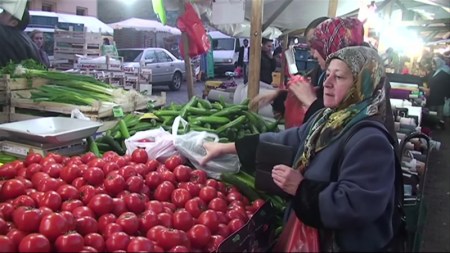
1662An open-air market in the heavily-Turkish Kreuzberg district of Berlin. (Image source: The Berlin Project video screenshot)

The report also shows that Turks have a lower educational attainment than other migrant groups in Germany. Only 60% of ethnic Turks complete secondary school (Hauptschulabschluss), compared to 85% of migrants from Eastern Europe. Moreover, only 8% of ethnic Turks between the ages of 17 and 45 earn a Bachelor’s degree, compared to 30% of migrants in the same demographic from Eastern Europe. Education is a determinative factor for successful integration, according to the report.

German multiculturalists often blame the lack of Turkish integration on the Germans themselves. Writing for Die Welt, economist Thomas Straubhaar argues that most Germans view Turks as guests, not as fellow citizens, an attitude which discourages Turks from integrating:

“Ethnic Turks are essentially treated as guests — hence the controversy over whether their faith belongs to Germany or not. Their immigration is seen as temporary. Their contribution to German culture is seen in a negative light.

“Those who treat migrants as guests should not be surprised when they behave as such. Guests are not expected to have any emotional devotion to the host, nor does the host feel any obligation to show irrevocable loyalty to the guest.

“Guests will not be willing to put all their cards on the table of the host country and take full responsibility for successful integration. Guests assume that sooner or later they must return home again. In everything they do, they will always consider their guest status and be only halfheartedly engaged. This applies to investments in language, culture, friendships, social contacts and professional career.”

Others counter that those who act like strangers should not be surprised if they are treated as strangers. Sociologist Ruud Koopmans argues that one of the most determinative factors in successful integration involves the cultural gap between host and guest. The greater the distance, the greater the integration challenge.

In a recent interview with WirtschaftsWoche, Koopmans criticized multiculturalists who for normative reasons insist that culture and religion should not be factored into the debate on integration:

“In all European countries, Muslim immigrants lag behind all other immigrant groups in almost every aspect of integration. This applies to the labor market, but also to educational achievement, inter-ethnic contacts, i.e., contacts with the local population, and identification with the country of residence.

“Three decisive factors determine cultural distance: language skills, inter-ethnic contacts — especially those involving marriage — and values about the role of women. They all have something to do with religion. This of course applies especially for ideas about the role of women, which are derived directly from the Islamic religion. The greater the cultural distance between groups — especially when there are cultural taboos — the more complicated inter-ethnic marriages become. Such taboos make it virtually impossible for a Muslim, and especially Muslim women, to marry a non-Muslim. Statistics from various European countries show that less than ten percent of Muslim marriages are inter-ethnic.”

Detlef Pollack, the author of the University of Münster study cited above, blames the lack of Turkish integration on discrimination: “The message to the majority German population is that we should be more sensitive to the problems encountered by those of Turkish origin,” he told Deutsche Welle. “It is our view that the feeling of not being accepted is expressed in the vehement defense of Islam.”

Koopmans rejects the link between discrimination and radicalization:

“This is a common assertion. But it is wrong. In our large study we asked Muslims how strongly they feel discriminated against, and we searched for correlations to the development of a fundamentalist worldview. But there are none. Muslim hatred of non-Muslims is not a special phenomenon of Muslim immigration, but is actually worse in the countries of origin. Radicalization is not first produced here in Europe, rather it comes from the Muslim world.”

German Architect: Demolish Churches, Build Mosques

June 23, 2016

German Architect: Demolish Churches, Build Mosques, Clarion Project, June 23, 2016

Germany-Mosque-Hamburg-HPThe call to prayer at a mosque in Hamburg (Photo: Video screenshot)

Breitbart notes that Reinig remarks come “after a report this month revealed that half of Turks in Germany regard Islamic law supreme over German laws and that young people are the most devout.”

************************

A prominent German architect has argued that the key to integration of Muslim immigrants in Germany is to build mosques, while at the same time demolishing churches.

Joaquim Reinig’s remarks were published in an interview with Die Tageszeitung and reported in English by Breitbart.

Reinig said that essential to integration is that immigrants should “have no fear” that their new country is asking them “to lose their identity in this society.”

The building of mosques, particularly the “visible minaret,” he says, sends this “message to the migrants.”

Reinig believes that the mosques are a positive influence on migrants, taking on the vital role of community workers.

Speaking about the previous influx of Turkish immigrants, who came to Germany as temporary workers, Reinig said that when they came, they were “relatively secular,” but when they decided to stay, they “remembered “their religion.

“The desire to become a German citizen and the activation of their faith ran parallel,” he said.

Breitbart notes that Reinig remarks come “after a report this month revealed that half of Turks in Germany regard Islamic law supreme over German laws and that young people are the most devout.”

Although Reinig says there is plenty of room for mosques in Hamburg – “theoretically 50 locations – he recommends demolishing churches rather than converting them.

Breitbart reports that Reinig “noted that around three per cent of Christians in Germany, 23,000 people, attend church in the region compared to the 17,000 Muslims who currently attend mosques in Hamburg.”

Reinig said he does not anticipate that other faiths will have a problem with his proposals.

“Jews, Christians and Muslims, as members of Abrahamic religions, are theologically brothers and sisters,” he said. “They have many similarities so should have no fear.”