Archive for the ‘European Union’ category

Brexit: “An Off Ramp From the Road to Serfdom”

May 30, 2016

Brexit: “An Off Ramp From the Road to Serfdom” Power LinePaul Mirengoff, May 29, 2016

Next month, Great Britain will vote on whether to exit the European Union. One of the main arguments against a “Brexit” seems to be that Germany and company will punish Britain economically if it exits in order to deter other states from following or perhaps just out of spite.

For some, though, this reality may be an argument in favor of leaving. Why remain attached, and cede more and more authority, to an entity this powerful and vindictive?

The core argument for leaving is forcefully set forth by George Will. He points to the EU’s “democracy deficit” and contends that it flows inexorably from the very point of the EU — to create a continent-wide administrative state.

In Europe, as in the United States, the administrative state exists to marginalize politics — to achieve [the] goal of “replacing the government of persons by the administration of things.” The idea of a continent-wide European democracy presupposes the existence of a single European demos, the nonexistence of which can be confirmed by a drive from, say, Stettin in the Baltic to Trieste in the Adriatic.

Quoting Michael Gove, secretary of justice and leader of the Brexit campaign, Will maintains that the ongoing concentration of power in Brussels guarantees “regulation in the interest of incumbents” who “do not want a dynamic, innovative Europe.” Under Europe’s administrative state, interest groups are stronger than ever and they prefer social stasis to the uncertainties of societies that welcome the creative destruction of those interests that thrive by rent-seeking.

Then there is the matter of mass migration. Will states:

If, as some serious people here fear, Europe’s current crisis of migration is just the beginning of one of the largest population movements in history, the E.U.’s enfeebled national governments must prepare to cope with inundations. But each E.U. member’s latitude for action exists at the sufferance of E.U. institutions.

I would move the analysis back one step and argue that the EU’s national governments should be able to decide the extent, if any, to which their country shall be inundated.

Consider the issue of Syrian refugees. The German chancellor wants a large influx of them because her country doesn’t have enough people. Trying to make the mass influx of Syrians acceptable to the German public, she insists that other EU countries take “their fair share” of refugees, and claims they have a moral duty to do so.

But some EU nations don’t lack for people. Thus, their interests diverge sharply from those of Germany and certain other EU countries. And because they don’t share Germany’s guilt over World War II or its level of prosperity, their sense of moral responsibility may diverge, as well.

Separate entities with separate demographic interests and separate views of what is morally required should be able to make separate decisions about immigration. As I argued here, it’s one thing for the EU to dictate banking rules or antitrust policy. It’s quite another to tell a nation whom it must allow to settle inside its borders.

That the EU apparently perceives no material distinction illustrates how dangerous it is.

Will concludes:

If Britain rejects continuing complicity in the E.U. project — constructing a bland leviathan from surrendered national sovereignties — it will have rejected the idea that its future greatness depends on submersion in something larger than itself. It will have taken an off-ramp from the road to serfdom.

Exactly.

Pamela Geller: EU Now Vows to Block Populist Parties, Another Sop To Europe’s Invaders

May 25, 2016

Pamela Geller: EU Now Vows to Block Populist Parties, Another Sop To Europe’s Invaders, Breitbart, Pamela Gekker, May 24, 2016

GettyImages-493750110-640x480Getty

It was reported Tuesday that the European Commission is moving to make sure that their hegemonic hold on European politics isn’t broken by populist parties that want to save Europe from the Muslim migrant invasion.

“Norbert Hofer failed in his bid for Austria’s presidency, but he would have been cut out of EU decision-making,” reported the Times of London.

“The EU will isolate and use sanctions against any far-right or populist governments that are swept to power or presidential office on the wave of popular anger against migration.”

The Times quoted Jean-Claude Juncker, president of the European Commission, saying flatly: “There is no debate or dialogue with the far-right.”

This is the modern face of fascism: the “anti-fascists.”

In the twentieth century, the idea of totalitarianism was a German initiative and most European countries fell into line. Forty-five thousand concentration camps located throughout Europe speaks to the enthusiastic support the Germans received.

In the 21st century, the European Union is the Reich, and they mean for their power to be absolute. Juncker made it clear that the parties they call “far-right” will never have a voice in the EU no matter how big their vote totals get.

“Far right” – what is that, anyway? Nazis? The Nazi Party was far-left: the National Socialist German Workers Party. What is far-right? Anti-Islamization? Anti-immigration? Pro-freedom?

When you import an influx of Muslims, you get jihad. It’s hardly rocket science. The West faces jihad terror because a certain percentage of the Muslim population will kill in the cause of Islam. Yet Juncker and the other European Commission authorities are not moving to stop the migrant influx, but to crush dissent from parties that want to save Europe’s free and pluralistic societies.

It seems the Nazis are back, in a different uniform and with a cheekier narrative, but the objective is very much the same.

Let’s be honest, they slaughtered six million Jews and imported 25 million Jew-haters. The problem for them is the fact that their new immigrants hate Europeans, too. But instead of facing that fact and doing something about it, the European Union is paving the way for the suicide of Europe and the West by guilt-tripping Europeans into thinking it’s morally wrong to oppose the migrant invasion.

Eight hundred thousand more Muslim migrants are lining up to invade Europe. Greece has its hands full. Muslim migrants are storming the border. They are violently rioting in refugee camps. Terror, terror, and more terror — and even aside from terror, there is the fact that Muslims are the only immigrant group that comes to Western countries with a ready-made model of society and government (sharia) which they believe to be superior to what we have here, and they work to institute it.

And that is exactly what they are doing now in Europe — by force, or lawsuit, or intimidation. But as far as the European Union is concerned, “Islamophobia” is the real problem that they need to confront.

The Europeans learned all the wrong lessons from the horrors of World War II. The lesson that Europe had decided to avail itself of in the aftermath of Auschwitz was not that they were evil and behaved like monsters, but rather that everything was caused by nationalism and therefore what they really needed to do was create a European Union that would obviate their need for nationalism, so that they could become this transnational gobbledygook, and they’ll all get together and therefore they won’t have another Auschwitz.

Wrong.

The lesson they should have learned was that they were evil and they have to be good. That is the lesson they never learned. They have to be able and willing to make moral distinctions and stand up for the good and fight evil, and that is something the Europeans refuse to do.

They did not learn that lesson.

The UK could send a powerful message – a clear rebuke – to the EU’s authoritarian tendencies by voting for Brexit on June 23rd. Whether the British people can surmount the media’s propaganda campaign and all the political fear-mongering remains to be seen.

FULL: Donald Trump at Morning Joe, May 20, 2016- ‘Would you consider Sanders as your running mate?’

May 20, 2016

FULL: Donald Trump at Morning Joe, May 20, 2016- ‘Would you consider Sanders as your running mate?’ May 20, 2016

(Spoiler alert: The question about Sanders as Trump’s VP choice comes at the tail end of the interview, and Trump’s answer was that Sanders should run as an independent. The interview is wide-ranging and deals with foreign policy, China, Mexico, the Islamist threat, the terrorist attack on EgyptAir and a bunch of other stuff. — DM)

https://www.youtube.com/watch?v=B36FldQmVq4

EU-Turkey Migrant Deal Unravels

May 18, 2016

EU-Turkey Migrant Deal Unravels, Gatestone InstituteSoeren Kern, May 18, 2016

♦ “It can be expected that, as soon as Turkish citizens will obtain visa-free entry to the EU, foreign nationals will start trying to obtain Turkish passports … or use the identities of Turkish citizens, or to obtain by fraud the Turkish citizenship. This possibility may attract not only irregular migrants, but also criminals or terrorists.” — Leaked European Commission report, quoted in theTelegraph, May 17, 2016.

♦ According to the Telegraph, the EU report adds that as a result of the deal, the Turkish mafia, which traffics vast volumes of drugs, sex slaves, illegal firearms and refugees into Europe, may undergo “direct territorial expansion towards the EU.”

♦ “If they make the wrong decision, we will send the refugees.” — Burhan Kuzu, senior adviser to Turkish President Recep Tayyip Erdogan.

♦ Erdogan is now demanding that the EU immediately hand over three billion euros ($3.4 billion) so that Turkish authorities can spend it as they see fit. The EU insists that the funds be transferred through international aid agencies in accordance with strict rules on how the aid can be spent. This prompted Erdogan to accuse the EU of “mocking the dignity” of the Turkish nation.

The EU-Turkey migrant deal, designed to halt the flow of migrants from Turkey to Greece, is falling apart just two months after it was reached. European officials are now looking for a back-up plan.

The March 18 deal was negotiated in great haste by European leaders desperate to gain control over a migration crisis in which more than one million migrants from Africa, Asia and the Middle East poured into Europe in 2015.

European officials, who appear to have promised Turkey more than they can deliver, are increasingly divided over a crucial part of their end of the bargain: granting visa-free travel to Europe for Turkey’s 78 million citizens by the end of June.

At the same time, Turkey is digging in its heels, refusing to implement a key part of its end of the deal: bringing its anti-terrorism laws into line with EU standards so that they cannot be used to detain journalists and academics critical of the government.

A central turning point in the EU-Turkey deal was the May 5 resignation of Turkish Prime Minister Ahmet Davutoglu, who lost a long-running power struggle with Turkish President Recep Tayyip Erdogan. Davutoglu was a key architect of the EU-Turkey deal and was also considered its guarantor.

On May 6, just one day after Davutoglu’s resignation, Erdogan warned European leaders that Turkey would not be narrowing its definition of terrorism: “When Turkey is under attack from terrorist organizations and the powers that support them directly, or indirectly, the EU is telling us to change the law on terrorism,” Erdogan said in Istanbul. “They say ‘I am going to abolish visas and this is the condition.’ I am sorry, we are going our way and you go yours.”

Erdogan insists that Turkey’s anti-terrorism laws are needed to fight Kurdish militants at home and Islamic State jihadists in neighboring Syria and Iraq. Human rights groups counter that Erdogan is becoming increasingly authoritarian and is using the legislation indiscriminately to silence dissent of him and his government.

European officials say that, according to the original deal, visa liberalization for Turkish citizens is conditioned on Turkey amending its anti-terror laws. Erdogan warns that if there is no visa-free travel by the end of June, he will reopen the migration floodgates on July 1. Such a move would allow potentially millions more migrants to pour into Greece.

European officials are now discussing a Plan B. On May 8, the German newspaper Bild reported on a confidential plan to house all migrants arriving from Turkey on Greek islands in the Aegean Sea. Public transportation to and from those islands to the Greek mainland would be cut off in order to prevent migrants from moving into other parts of the European Union.

Migrants would remain on the islands permanently while their asylum applications are being processed. Those whose asylum requests are denied would be deported back to their countries of origin or third countries deemed as “safe.”

The plan, which Bild reports is being discussed at the highest echelons of European power, would effectively turn parts of Greece into massive refugee camps for many years to come. It remains unclear whether Greek leaders will have any say in the matter. It is also unclear how Plan B would reduce the number of migrants flowing into Europe.
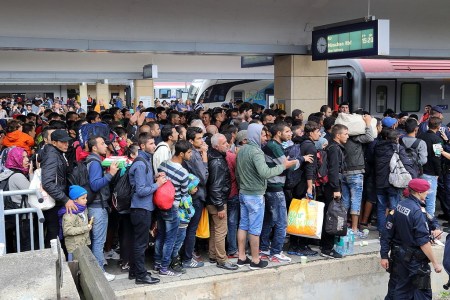
1607Thousands of newly arrived migrants, the vast majority of whom are men, crowd the platforms at Vienna West Railway Station on August 15, 2015 — a common scene in the summer and fall of 2015. (Image source: Bwag/Wikimedia Commons)

Speaking to the BBC News program, “World on the Move,” on May 16, Sir Richard Dearlove, the former head of the British intelligence service MI6, warned that the number of migrants coming to Europe during the next five years could run into millions. This, he said, would reshape the continent’s geopolitical landscape: “If Europe cannot act together to persuade a significant majority of its citizens that it can gain control of its migratory crisis then the EU will find itself at the mercy of a populist uprising, which is already stirring.”

Dearlove also warned against allowing millions of Turks visa-free access to the EU, describing the EU plan as “perverse, like storing gasoline next to the fire we’re trying to extinguish.”

On May 17, the Telegraph published the details of a leaked report from the European Commission, the powerful administrative arm of the European Union. The report warns that opening Europe’s borders to 78 million Turks would increase the risk of terrorist attacks in the European Union. The report states:

“It can be expected that, as soon as Turkish citizens will obtain visa-free entry to the EU, foreign nationals will start trying to obtain Turkish passports in order to pretend to be Turkish citizens and enter the EU visa free, or use the identities of Turkish citizens, or to obtain by fraud the Turkish citizenship. This possibility may attract not only irregular migrants, but also criminals or terrorists.”

According to the Telegraph, the report adds that as a result of the deal, the Turkish mafia, which traffics vast volumes of drugs, sex slaves, illegal firearms and refugees into Europe, may undergo “direct territorial expansion towards the EU.” The report warns: “Suspect individuals being allowed to travel to the Schengen territory without the need to go through a visa request procedure would have a greater ability to enter the EU without being noticed.”

While the EU privately admits that the visa waiver would increase the risk to European security, in public the EU has recommended that the deal be approved.

On May 4, the European Commission announced that Turkey has met most of the 72 “benchmarks of the roadmap” needed to qualify for the visa waiver. The remaining five conditions concern the fight against corruption, judicial cooperation with EU member states, deeper ties with the European law-enforcement agency Europol, data protection and anti-terrorism legislation.

European Commission Vice President Frans Timmermans said:

“Turkey has made impressive progress, particularly in recent weeks, on meeting the benchmarks of its visa liberalization roadmap…. This is why we are putting a proposal on the table which opens the way for the European Parliament and the Member States to decide to lift visa requirements, once the benchmarks have been met.”

In order for the visa waiver to take effect, it must be approved by the national parliaments of the EU member states, as well as the European Parliament.

Ahead of a May 18 debate at the European Parliament in Strasbourg over Turkey’s progress in fulfilling requirements for visa liberalization, Burhan Kuzu, a senior adviser to Erdogan, warned the European Parliament that it had an “important choice” to make.

In a Twitter message, Kuzu wrote: “If they make the wrong decision, we will send the refugees.” In a subsequent telephone interview with Bloomberg, he added: “If Turkey’s doors are opened, Europe would be miserable.”

Meanwhile, Erdogan has placed yet another obstacle in the way of EU-Turkey deal. He is now demanding that the EU immediately hand over three billion euros ($3.4 billion) promised under the deal so that Turkish authorities can spend it as they see fit.

The EU insists that the funds be transferred through the United Nations and other international aid agencies in accordance with strict rules on how the aid can be spent. That stance has prompted Erdogan to accuse the EU of “mocking the dignity” of the Turkish nation.

On May 10, Erdogan expressed anger at the glacial pace of the EU bureaucracy:

“This country [Turkey] is looking after three million refugees. What did they [the EU] say? We’ll give you €3 billion. Well, have they given us any of that money until now? No. They’re still stroking the ball around midfield. If you’re going to give it, just give it.

“These [EU] administrators come here, tour our [refugee] camps, then ask at the same time for more projects. Are you kidding us? What projects? We have 25 camps running. You’ve seen them. There is no such thing as a project. We’ve implemented them.”

In an interview with the Financial Times, Fuat Oktay, head of Turkey’s Disaster and Emergency Management Authority (AFAD), the agency responsible for coordinating the country’s refugee response, accused European officials of being fixated on “bureaucracies, rules and procedures” and urged the European Commission to find a way around them.

The European Commission insists that it was made clear from the outset that most of the money must go to aid organizations: “Funding under the Facility for Refugees in Turkey supports refugees in the country. It is funding for refugees and not funding for Turkey.”

The migration crisis appears to be having political repercussions for German Chancellor Angela Merkel, a leading proponent of the EU-Turkey deal. According to a new poll published by the German newsmagazine Cicero on May 10, two-thirds (64%) of Germans oppose a fourth term for Merkel, whose term ends in the fall of 2017.

In an interview with Welt am Sonntag, Horst Seehofer, the leader of the Christian Social Union (CSU), the Bavarian sister-party to Merkel’s Christian Democrats (CDU), blamed Merkel for enabling Erdogan’s blackmail: “I am not against talks with Turkey. But I think it is dangerous to be dependent upon Ankara.”

Sahra Wagenknecht of the Left Party accused Merkel of negotiating the EU-Turkey deal without involving her European partners: “The chancellor is responsible for Europe having become vulnerable to blackmail by the authoritarian Turkish regime.”

Cem Özdemir, leader of the Greens Party and the son of Turkish immigrants said: “The EU-Turkey deal has made Europe subject to Turkish blackmail. The chancellor bears significant responsibility for this state of affairs.”

Brexit Can Only Be Good for the United Kingdom

May 17, 2016

Brexit Can Only Be Good for the United Kingdom, American ThinkerJustin O. Smith, May 17, 2016

Nigel Farage, UKIP leader, warns that the U.K. will not be able to handle the upcoming surge of migrants if it stays in the EU.  He observed during the April 1 Munk Debate that “Jeane-Claude Juncker, the unelected president of the European Commission, has changed the definition of what a refugee is, to include people … from war torn areas … [and] from extreme poverty … [and] perhaps 3 billion people could possibly come to Europe [as a result].”

************************

The British people seem ready to leave the European Union through a historic June 23 referendum, because they are tired of the high-handed tyrannical regulations, clauses and counter-clauses, emanating from the EU Council on even the simplest aspects of their everyday lives.  They have determined that leaving the EU will be the best step toward reclaiming their nation’s sovereignty and democratic rule in all matters of immigration and border control, their economy, free trade, and national security, and they are proudly waving the Union Jack, as they tell their would-be masters in Brussels to go to hell, declaring their independence.

In November 2015, U.K. prime Minister David Cameron attempted to renegotiate a treaty change with European Union Council president Donald Tusk concerning U.K. sovereignty, trade, immigration, and economic governance.  Tusk rejected it all, with a minor exception regarding the handling of a few million pounds for children’s benefits.  This dismal failure of P.M. Cameron only offered proof that the EU was closed to any substantial moves toward reform, which created a renewed and angry momentum for the Out of Europe, Vote Leave, and Brexit movements.

Corporatists, trans-nationalists, advocates of the U.N. 2030 Agenda, the BBC, and the Guardinista establishment are presenting dishonest and fear-based monologues regarding the uncertainty a U.K. exit from the EU might bring.  They enjoy being able to circumvent individual nation’s policies by going through Brussels, and most of them have been made rich through their deals with the tyrannical, unelected, and entrenched bosses of the European Union.

Despite disingenuous conclusions from the trans-nationalist President Obama, does anyone really believe that a hundred years of shared security concerns and initiatives and trade agreements between the U.S. and the U.K. will be detrimentally affected by a “yes” vote to leave the EU?

What cogent thought process could people, like Lena Komileva (London economist), possibly be using when they ascribe the term “illiberal” to the British people’s desire for nationalist policies and reclaiming Britain’s sovereignty?

It will not take years for the U.K. to renegotiate trade deals with the U.S., as Obama suggests, but rather only months.  And if small nations like South Korea and Chile can succeed in global markets, certainly Britain also will continue to succeed, especially since the EU already imports 45% of British exports.

Membership in the EU currently costs Britain approximately $30 billion annually.  Although $55 billion in austerity cuts were made by the chancellor of the exchequer during the last Parliament, Britain’s contribution to the EU was roughly $132 billion.  Every cut in public spending could be reversed, and Britain could still pay down its deficit faster if Britain were to leave the European Union.

In February, George Mason, senior vice president of Britain’s high-profile Tate and Lyle Sugars, made a mockery of claims by Britain Strong in Europe that Brexit would spell economic disaster for the U.K.: “we are absolutely certain that our business and people who work in it would have a more secure future outside the EU.”

Priti Patel, the U.K.’s employment minister, told the Daily Telegraph in March: “The Prime Minister has tried hard but the EU refused to give the British people what they want[.] … The only way to take back control over our economy[.] … [T]o create more jobs and growth is to Vote Leave.”

However, national security is the issue currently foremost in most Britons’ minds, but Eurocentrics, who believe that the U.K. will be safer in the EU through cooperation on crime and terrorism, have failed to see that the EU has never been capable of agreeing on effective foreign policy.  Also not taken into account, the EU recently embraced the expanded definition of “refugee” put forth by the United Nations in its 2030 Agenda.

Nigel Farage, UKIP leader, warns that the U.K. will not be able to handle the upcoming surge of migrants if it stays in the EU.  He observed during the April 1 Munk Debate that “Jeane-Claude Juncker, the unelected president of the European Commission, has changed the definition of what a refugee is, to include people … from war torn areas … [and] from extreme poverty … [and] perhaps 3 billion people could possibly come to Europe [as a result].”

There are also reports of Bosnia, with a population of 3.8 million, being infiltrated by Islamic State terrorists.  They are buying property there, and they would be free to travel to the U.K. if Bosnia is granted EU membership.

Andrew Rosindell, a Conservative member of Parliament, stated in March: “Being in the EU means we don’t have control of our own systems, we don’t have control of our own borders. We are effectively tied to countries which I think are not as good at protecting their people as we have been.”

One can only imagine the palpable red-hot anger of the British people upon hearing Martin Shulz, European Parliament president, say that he was “sad and angry [over] the undertone of national resentment” and it was “not possible” to make the changes PM Cameron wanted. Shulz added that Britain “belongs” to the EU.  Really?  Just watch, wait, and see.

Downing Street has declared that “a vote to leave is a vote to leave.”  A leave vote will facilitate the U.K.’s departure through Article 50 of the Lisbon Treaty, and terms for Britain’s withdrawal will then be negotiated over the next two years.

Over forty years ago, Britain last debated her relationship with Europe, and even then, elected officials on both the right and left, such as two of the most iconic political figures of that era, Enoch Powell and Tony Benn, campaigned against the U.K.’s membership in what was then the European Economic Community.  They objected to Britain’s elected government meekly surrendering Britain’s national sovereignty to unelected foreign entities and the fundamental lack of democracy in the EU.

Lady Margaret Thatcher knew that it would be near impossible to effectively and efficiently impose one currency, one economy, and one national identity on many different countries (now 28) with such different languages, histories, customs, and cultures in general.  Early on, the Iron Lady called the attempt to create a European super-state “the greatest folly of the modern era.”

Britons, excited and optimistic, are moving forward to reclaim a more free, prosperous, ally-connected, and nationally secure Britain, through their own elected officials and their own choices and wisdom, breaking free of the heavy bureaucratic chains of the European Union.  As they shout “Hail Britannia,” they will vote to leave in June.


Will America Follow Britain further Into, or away from, the Abyss?

May 14, 2016

Will America Follow Britain further Into, or away from, the Abyss? Dan Miller’s Blog, May 14, 2016

(The views expressed in this post are mine and do not necessarily reflect those of Warsclerotic or its other editors. — DM)

The Muslim invasion is changing European and British demographics to the degree that some countries will soon have Muslim majorities. Will America follow Europe? What about our Publican and Demorat elites? Will we reject them and the unelected bureaucrats they have spawned and empowered? 

America needs to vote for her own version of Brexit this November.

British and European Demographics

https://www.youtube.com/watch?v=a-hPCnel0qc

Paul Weston is the vile “Islamophobe” who dared to read — aloud and in public — a passage from a book written by another vile “Islamophobe,” Winston Churchill, a couple of years ago. For that, he (Weston, not Winston) was arrested.

https://www.youtube.com/watch?v=WB7en-eu0X8

So what if Weston spoke accurately? He offended Muslims and that can’t be tolerated. Besides, Britain is terribly “racist” even though Islam is not a race.

Meanwhile, London’s East End is losing its native population and the place looks “less like a British city, more like Baghdad.”

The European Union and Britain

Currently, Mr. Weston of the Liberty GB Party is campaigning for Britain to leave the Europen Union, a force for unrequited love, charity and destruction. So is Nigel Farge of UKIP.

Here’s a long video about the EU and why Britain should leave it. It’s over an hour long but well worth watching. It’s principally about economics, the destructive power the EU has given unaccountable bureaucrats and the stifling of democracy.

As you watch and listen, please consider the similarities and differences between the EU and governance of, by and for the Publican and Demorat Establishment in America. Both have empowered and continue to expand unelected bureaucracies.

I was disappointed that the video does not deal with the immigration problem which will continue to plague Britain if she remains in the EU. Perhaps the topic was seen as likely to displease Britain’s already substantial Muslim population and prompt them to vote to remain in the EU. Remember, London just elected its first Muslim mayor.

https://www.youtube.com/watch?v=eYqzcqDtL3k

Here’s another “Islamophobic” EUophobe:

Democracy and self-governance are seen by far too many as absurdly old fashioned. In Obama’s America, where would we be if governance were taken away from our betters in the Publican and Demorat Establishment and returned to the vulgarian little people? Do we need great Establishment intellects to think for us so that we don’t have to do it ourselves? The vulgarian dummies living in EU member states haven’t had to think for years. Now, with the upcoming referendum, those in Britain l have a chance to do so. We will have a chance this November.

Obama has told the citizens of once-great Britain that membership in the EU is economically and otherwise good for them — perhaps even as good as His presidency has been for citizens of His America. Many disagree with “the smartest person in any room;” those in Obama’s America who do may even elect Vulgarian-in-Chief Donald Trump as President shortly after citizens of Britain who cherish self-governance may vote to exit the EU.

Conclusions

America does not yet have the same Muslim demographic problems as Europe or Britain. Unless we halt or at least reduce Islamic immigration and cease to subsidize it we will eventually. One way to minimize the problem is to get rid of the politically correct “Islamophobia” nonsense and speak of Islam as it is rather than as though it were a benign unicorn.

Islamophobia-copy (1)

The elites of the Publican and Demorat establishment are a big part if the problem. Just as Britain seems to be moving toward leaving the EU, we need to diminish the power of our own elected elites by electing “vulgarians” to replace them. We also need to reduce the very substantial power of the masses of unelected and unaccountable bureaucrats they have empowered. There is no need to replace them.

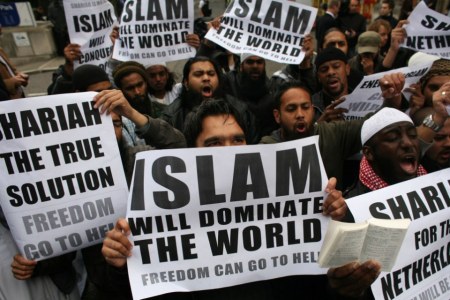
16/10/09 TODAY Picture by Tal Cohen - Muslims protest outside Geert Wilders press conference in central London 16 October 2009, Wilders who faces prosecution in the Netherlands for anti-Islam remarks pays visit to the capital. The Freedom Party leader said 'Lord Malcolm Pearson has invited me to come to the House of Lords to discuss our future plans to show Fitna the movie.' Wilders won an appeal on October 13 against a ban, enforced in February, from entering Britain. Ministers felt his presence would threaten public safety and lead to interfaith violence. (Photo by Tal Cohen) All Rights Reserved – Tal Cohen - T: +44 (0) 7852 485 415 www.talcohen.net Email: tal.c.photo@gmail.com Local copyright law applies to all print & online usage. Fees charged will comply with standard space rates and usage for that country, region or state.

The EU’s Kiss of Death

May 10, 2016

The EU’s Kiss of Death, Gatestone InstituteJudith Bergman, May 10, 2016

♦ The European Union may yet come to realize that this latest ill-concealed jab at the Central- and Eastern European members of the European Union may signal the beginning of the unraveling of the European Union, an event which, considering the authoritarian structure of the organization, might be a good thing. The EU’s authority comes, undemocratically, from the top down, rather than from the bottom up; it is non-transparent, unaccountable and there is no mechanism for removing European Commission representatives.

♦ “We especially do not like it when people who have never lived in Hungary try to give us lectures on how we should cope with our own problems. Calling us racists or xenophobes is the cheapest argument. It’s used just to dodge the issues.” — Zoltán Kovács, spokesman for Hungary’s Prime Minister Viktor Orban.

♦ By persisting in pushing their agendas on European Union member states that still consider themselves sovereign and not merely provinces of the EU, Timmermans and his European Commission bureaucrats may just have given the European Union its kiss of death.

The European Union is hell-bent on forcing member states to take “their share” of migrants. To this end, the European Commission has proposed reforms to EU asylum rules that would see enormous financial penalties imposed on members refusing to take in what it deems a sufficient number of asylum seekers, apparently even if this means placing those states at a severe financial disadvantage.

The European Commission is planning sanctions of an incredible $290,000 for every migrant that recalcitrant EU member states refuse to receive. Given that EU countries such as Hungary, Poland, the Czech Republic, Slovakia and Austria have closed their borders to migrants or are in the process of doing so, it is not difficult to discern at whom the EU is aiming its planned penalties.

The EU may yet come to realize, however, that this latest ill-concealed jab at the Central- and Eastern European members of the European Union — if it passes muster by most member states and members of the European parliament — may just signal the beginning of the unraveling of the European Union, an event which, considering the authoritarian structure of the organization, might be a good thing. The EU’s authority comes, undemocratically, from the top down, rather than from the bottom up; it is non-transparent, unaccountable and there is no mechanism for removing European Commission representatives.

The migrant crisis has revealed a deep and seemingly irreconcilable rift between those countries that roughly two decades ago still found themselves on the wrong side of the Iron Curtain and have not forgotten it, and Western European countries spared from a merciless Soviet totalitarianism. The soft Western Europeans, instead, developed politically correct credos of “diversity” and “multiculturalism,” which they intractably push down the throats of those recently released from captivity, refusing to show the tolerance of which they themselves purport to be high priests.

In September, European Commission Vice President Frans Timmermans said,

“We should know more about Central European history. Knowing that they were isolated for generations, that they were under oppression by Moscow for so long, that they have no experience with diversity in their society, and it creates fear in the society.

“Any society, anywhere in the world, will be diverse in the future — that’s the future of the world. So [Central European countries] will have to get used to that. They need political leaders who have the courage to explain that to their population instead of playing into the fears as I’ve seen Mr Orbán doing in the last couple of months.”

Exactly because central Europeans were subjected to a totalitarian ideology for half a century, they are rather unenthusiastic about submitting to a new, increasingly totalitarian ideology, especially one which seeks to impose itself as the “only truth,” and in its intolerance is averse to any nonconformity — as Timmermans’ comments make condescendingly clear.

The European Union’s vision of an ideal “multicultural” and “diverse” society seems to be viewed by the central Europeans as humbug, perhaps because they have correctly observed that the “multiculturalism” on display in Western Europe is largely a monoculture of the Islamic variety.

If there is anything at which the Central Europeans became experts during their Soviet internment, it was deciphering the doublespeak of communist apparatchiks, which may account for their adeptness at deciphering the doublespeak coming from Eurocrats such as Timmermans. As the Hungarian Prime Minister’s spokesman, Zoltán Kovács, said in September, “… multi-culturalism in Western Europe has not been a success in our view. We want to avoid making the same mistakes ourselves.”

The magic that the European Union once held for Central European countries, which rushed to join the organization after the demise of communism — believing it to be the very antithesis of what they had just experienced under communist rule — is fast evaporating.

In February, Czech Prime Minister Bohuslav Sobotka said that, “If Britain leaves the EU, we can expect debates about leaving the EU in a few years too.” Three-fifths of Czechs say that they are unhappy with EU membership, and according to an October 2015 poll by the STEM agency, 62% said they would vote against it in a referendum.

In March, after the Brussels terrorist attacks, Polish Prime Minister Beata Szydło said, “I see no possibility at this time of immigrants coming to Poland.”

“Until procedures to verify the refugees are put in action, we cannot accept them,” Rafał Bochenek, a government spokesman, told reporters.

“The priority of the government is the safety of Poles … We understand the previous government … signed commitments which bind our country. We cannot allow a situation in which events taking place in the countries of Western Europe are carried over to the territory of Poland.”

In Poland, 64 percent of Poles want the country’s borders closed to migrants.

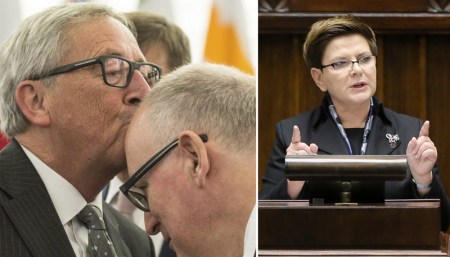
1593The European Commission, led by Jean-Claude Juncker and Frans Timmermans (left), is hell-bent on forcing member states to take “their share” of migrants. In March, Polish Prime Minister Beata Szydło (right) bluntly stated: “I see no possibility at this time of immigrants coming to Poland.”

In Hungary, Prime Minister Viktor Orban’s spokesman, Zoltán Kovács, stated:

“Mr. Timmermans is right that we have not had the same experience as Western Europe, where countries such as Holland, Britain and France have had mass immigration as a result of their colonial legacies. But we would like to deal with our problems in a way that suits us. And we especially do not like it when people who have never lived in Hungary try to give us lectures on how we should cope with our own problems. Calling us racists or xenophobes is the cheapest argument. It’s used just to dodge the issues.”

Even among those Eastern European countries still waiting to be admitted to the EU, the enthusiasm for the EU seems to have dwindled. “The EU that all of us are aspiring to, it has lost its magic power,” Serbian Prime Minister, Aleksander Vucic said in February, “Yes we all want to join, but it is no longer the big dream it was in the past.”

The reactions of countries such as Poland and Hungary are the normal, healthy reactions of nations who wish to remain prosperous, sovereign and safe for the sake of their own citizens. In addition, entertaining no illusions about “multiculturalism,” they appear to have a justifiable apprehension about the detrimental effects of the current migration crisis on national security and finances.

It is not only the newest members of the EU that have begun to realize that is a bad idea to defer decisions about borders and national security to an unelected supranational entity, which appears completely oblivious to the concerns of its member states.

In Norway, the government announced that it will not accommodate any more migrants beyond the 1500 that the country has already agreed to take during the next two years, as part of the EU’s refugee relocation scheme. “We have set a quota for refugees from the EU. Increasing it is not of current interest,” Immigration Minister Sylvi Listhaug said in April. Norway, in fact, has begun paying asylum seekers to return to their own countries.

In Austria, the government is imposing border controls at the Brenner Pass, the main Alpine crossing into Italy, and erecting a barrier between the two countries.

In the face of such resistance from member states, the European Commission’s plan to penalize them for not accepting “their share” of migrants could not possibly be more ill-timed and out of touch. It comes across as a desperate attempt by the EU’s executive body to force its way of handling the migrant crisis onto disobedient EU member states, like an authoritarian parent disciplining its unruly children. There is, however, such a thing as bending something until it snaps. By persisting in pushing their agendas on EU member states that still consider themselves sovereign and not merely provinces of the European Union, Timmermans and his European Commission bureaucrats may just have given the European Union its kiss of death.

New UK campaign – it’s ‘payback time’ for the EU

May 9, 2016

New UK campaign – it’s ‘payback time’ for the EU, Israel National News, Ari Yashar, May 9, 2016

As the UK is poised ahead of a fateful vote on whether or not to remain in the EU, a group of concerned British ex-pats and Israelis have launched a new “Support Israel-Leave Europe” campaign to get Britain out of the EU and stop helping its efforts against the Jewish state.

The campaign, which is funded by Jewish land rights watchdog Regavim and whose website can be viewed here, has launched a humorous video of Hamas terrorists calling on the UK to stay in the EU to continue helping fund the terrorists in their fight against Israel.

https://www.youtube.com/watch?time_continue=2&v=vO654XRQ7FI

Regavim’s work on the project comes amid their legal battle against the EU over its funding of illegal Arab settlements in Area C, the region in Judea and Samaria designated as being under full Israeli control by the 1994 Oslo Accords and which contains all the Jewish residents.  Area A is under complete Arab control and only security in Area B is controlled by Israel.

The new “Support Israel-Leave Europe” campaign presents several major reasons why those who support the Jewish state should want to see Britain leave and consequently weaken the EU.

Firstly, the EU has paid millions in aid money to the Palestinians, a large portion of which is going directly to pay the salaries of terrorist murderers.

Another strike against the EU is its funding of illegal Arab buildings in Area C, as it has built over 1,000 structures in the region to create a de-facto state of “Palestine” there.

The campaign also argues the EU’s recent campaign to label all Jewish products made in Judea, Samaria, eastern Jerusalem and the Golan Heights is a form of state-sponsored anti-Semitism, and finally it notes that the EU provides huge budgets for hundreds of virulently anti-Israeli NGOs to support their work delegitimizing Israel and conducting lawfare against it.

“For decades the European Union has meddled in Israeli affairs to the detriment of the Jewish State, for thousands of Israel supporters in the United Kingdom and ex-pats around the globe, it’s pay back time,” said Ari Briggs, Regavim’s international director.

“We call on everyone who supports Israel to ‘vote leave’ and deal a major blow to this mammoth bureaucracy that has an unhealthy obsession with Israel.”

Briggs warned that “the double standard in which the EU holds Israel, is nothing short of state-sponsored anti-Semitism. We encourage all eligible ex-pats in Israel and elsewhere to make sure they are on the electoral registry before the June 7th deadline to ensure they can vote, all the information needed is provided on our website.”

Pope Francis Blasts Europe Over Migrants

May 7, 2016

Pope Francis Blasts Europe Over Migrants, Front Page Magazine, Daniel Greenfield, May 7, 2016

02

Sigh.

Europe is struggling to live up to the vision of its founders, Pope Francis has said in a powerful speech that asked: “What has happened to you, the Europe of humanism, the champion of human rights, democracy and freedom?”

Speaking as he became the first pope to accept the prestigious Charlemagne prize for his work on behalf of European solidarity, the pontiff called for Europe to reclaim the principles that had been established after the second world war, above all by embracing integration and revamping its economic model to “benefit ordinary people and society as a whole”.

…Founded in 1950 by Dr. Kurt Pfeiffer, the Charlemagne Prize is “the oldest and best-known prize awarded for work done in the service of European unification,” according to the organization’s website.

Kurt Pfeiffer was a Nazi. There are debates about whether he was a reluctant Nazi or not, but he was certainly a member. Rodney Atkinson has spoken about this in the past, I don’t know that I accept the whole thing, but certainly there are valid questions to be raised here.

The Charlemagne Prize. The prize was originally founded by the Nazis, but was then re-founded in 1949 by the efforts of the Aachen textile merchant Kurt Pfeiffer. Pfeiffer, who had previously been a member of the Nazi Party and of five other Nazi organizations, maintained that he had always tended to be a fundamental believer in Europe. And the Charlemagne Prize Society was to be associated with the imperial idea Reichsidee of the Emperor Charlemagne. The post-war image of Charlemagne as unifier of the Christian west was preceded by his Nazi portrayal as a unifier of the German tribes. Charlemagne had been compared with Hitler, his Reich and Greater Germany. This is clearly exemplified by the career of the Aachen professor of philosophy Peter Mennicken, who took over the professorship previously occupied by an expelled Jew, and who after the war had authorized influence over the symbolism of the Charlemagne Prize and the liturgy of its award ceremonies.

But we’ll skip over to the speech about the ideals of the EU’s founders. Some of whom just happened to Nazi-ish.

He expressed his desire for a Europe “where being a migrant is not a crime but a summons to greater commitment on behalf of the dignity of every human being,” and where youth can “breathe the pure air of honesty” in a culture that is “undefiled by the insatiable needs of consumerism.”

“I dream of fa Europe that promotes and protects the rights of everyone, without neglecting its duties towards all,” he said, and voiced his hope for a Europe “of which it will not be said that its commitment to human rights was its last utopia.”

Except you can’t protect the rights of all. Sometimes you have to choose.

You couldn’t protect German sovereignty and Polish sovereignty at the same time. You couldn’t protect German and French civilians at the same time. You had to make choices. You can’t protect Muslim rights to migrate and the right of the Jewish population of Europe not to be terrorized or murdered.

You have to choose. You have to decide between good and evil rather than providing a fuzzy humanistic picture in which evil does not appear to exist except as selfishness in the face of social justice demands. In which evil is not going along with the latest horrible and disastrous scheme executed at your own expense.

Pointing to French statesman Robert Schuman, the Pope echoed his insistence at the birth of the first European Community that the continent couldn’t be built all at once, but “through concrete achievements which first create a ‘de facto solidarity.’”

Schuman was one of Petain’s ministers. Again, like Pfeiffer, his legacy is complex and mixed, but it’s interesting that so many key EU people are so tainted.

The Pope also stressed the importance of cultural integration, rather than merely resettling foreigners geographically, allowing European peoples to overcome “the temptation of falling back on unilateral paradigms and opting for forms of ideological colonization.”

Francis advocated for a culture of dialogue involving “a discipline that enables us to view others as valid dialogue partners, to respect the foreigner, the immigrant and people from different cultures as worthy of being listened to.”

“Today we urgently need to build coalitions that are not only military and economic, but cultural, educational, philosophical and religious,” he said, and encouraged the leaders to arm their people “with the culture of dialogue and encounter.”

How does the culture of dialogue work within Islam? It’s the old “nice doggie” until you find a big enough rock school of dialogue.

And what does cultural integration mean? It seems to involve listening to Muslim migrants, rather than them listening.

To create dignified, well-paying jobs “requires coming up with new, more inclusive and equitable economic models, aimed not at serving the few, but at benefiting ordinary people and society as a whole,” he said.

“It would involve passing from an economy directed at revenue, profiting from speculation and lending at interest, to a social economy that invests in persons by creating jobs and providing training,” he said, adding that “we need to move from a liquid economy prepared to use corruption as a means of obtaining profits to a social economy that guarantees access to land and lodging through labor.”

An economy is based on profit. A social economy is just a welfare state funded by profitability somewhere. Even Communist countries ended up needing to find a profitable venue. China did really well at it. The USSR was terrible at it and collapsed.

In an actual economy, social mobility and dignity may not be perfect, but they are available. A social economy is just feudalism with more buzzwords and depends entirely on the goodwill of insiders. No one has dignity in a social economy. They have no sense of worth. They depend entirely on charity dispensed by political barons which is stolen from the people who have been enslaved and denied the profits of their work.

Pope Francis closed his speech by voicing his dream for “a new European humanism” based on the welcome for foreigners, care for the poor, and respect for human life and dignity.

You can have two out of three. But if you turn Europe into Pakistan and Saudi Arabia, you’ll eventually have none of the above.

EU: Europeans Must Pay $280K For Each Muslim Migrant they Refuse

May 4, 2016

EU: Europeans Must Pay $280K For Each Muslim Migrant they Refuse, Front Page Magazine, Daniel Greenfield, May 4, 2016

2015-09-09_0134_2

Despite growing opposition, the EU is really doubling down on its aggressive push to distribute Muslim migrants across Europe. This is being described as “fair”, but that’s as fair as your neighbor setting his house on fire and then demanding that you either let him move in with you or he’ll set your house on fire.

Merkel decided to open the doors to any Muslim who wanted to come. Greece chose to pass them along without caring in the least what other countries would suffer. But other countries are supposed to be penalized for Merkel’s bleeding heart.

The European Commission made a proposal on Wednesday to automatically distribute asylum-seekers across the EU from member states overwhelmed by arrivals.

Depending on the number of asylum seekers in the European Union, each country would be assigned a “fair share”, based on the size of its population and economy. Should it face arrivals exceeding 1.5 times the fair share, automatic relocation would start to other EU states until it drops again.

There’s nothing fair about any of this. Nor is it much of a plan because the Muslim migrants have repeatedly said that they want to go to Germany or Sweden. And they want specific cities with large Muslim populations. Trying to send them to Poland won’t work for very long.

Countries could exempt themselves from relocation for one year at a time if they pay 250,000 euros per refugee they would otherwise need to take in to the country that accommodates the person.

The figure is meant to be “dissuasive” and is very high compared to 6,000 euros for every relocated person as offered by the European Commission last year under an emergency relocation plan that was due to cover 160,000 people.

That’s around $280K US. And rather few European countries can afford that. And since Muslim migrants keep coming, the question becomes moot anyway. As countries continue being overwhelmed, the figures will go on being recalculated.

While any reform would only apply mid- to longer-term, a calculation for Poland, the biggest eastern EU state, shows it would have to pay some 1.6 billion euros for fewer than 7,000 people it was assigned – but never took in – under the 160,000 plan.

Of course this isn’t going to shut down anything. It’s just meant to make Germans and some others feel better that other countries will do their “fair share”. It’s a political divide and conquer strategy.

Meanwhile smuggling migrants into Europe is a $7 billion business. And that’s not counting the payoffs that Turkey’s Islamist government will be getting.