H/t Joopklepzeiker


H/t Joopklepzeiker
Why This American Supports ‘Brexit, PJ Media, Roger L Simon, June 17, 2016

But what this is really about, what Britain and we really need from this vote, is a firewall against Islamization. Economic niceties aside, that is finally how “Brexit” will be judged—here and in Europe. The Brits have to suck it up, brave the inevitable accusations of Islamophobia and put poor old Hannan out of a job.
****************************
For those of us of a “certain age,” Europe was the height of old world cool and sophistication—Anouk Aimée and Jean-Louis Trintignant, the glorious Julie Christie. We wanted to be like them. That was a long time ago. No more Nouvelle Vague. No more Beatles. Now it’s a continent on the verge of imploding with moribund or worse economies, intermittent (and, in the case of France, persistent) violence, and a growing Islamization that is turning countries once among the most free on Earth into Sharia-laced nightmares.
The European Union—consciously or unconsciously—has been complicit in all that, an ever-growing bureaucratic miasma that seems more distant from the needs of its constituents than even our own government.
Americans—concerned ones anyway—watch from afar as right-wing separatist parties have sprung up across the continent, gaining popularity from Austria to the UK. Are they avatars of the World War II-era fascist parties the liberal-left (our guardians at The Guardian) would have us believe or are they natural responses to this monolithic EU and its fruits and therefore the true protectors of the Enlightenment?
It’s hard to say at this point. A welter of conflicting forces are at play. The only thing that is clear is that things are bad.
Those of us who travel often to Europe have seen it, ever-expanding Islamic enclaves in and around many of the major cities that are now larger, quite literally, than any since the days of Muslim-ruled Spain. The “Reconquista” is in progress via what Robert Spencer calls “the stealth jihad.” (Sometimes, as we know, it’s not so stealthy.) Putting up barely a fight, Europe appears to be relinquishing the values they have fought for since the Magna Carta. Who cares about misogyny, homophobia or that outdated separation of church and state when you don’t have any religion of your own to separate? We’re multicultural! We’re diverse! We’re…. dead? Well, not quite but wait.
Meanwhile, here in the US of A, the same process has been revving up. Under the Obama administration we’re on track to admit a million new Muslim immigrants—and that doesn’t include those overstaying their visas, etc. Our politically correct, morally narcissistic president has decreed that these people are culturally our equal and deserving of citizenship even though roughly half (probably more if we really knew) of those already here, and therefore supposedly assimilated, believe in that oppressive religious legal system straight out of the Dark Ages—Sharia law.
Is that what we want? Call me a bigot, but I don’t think so. There are lots of places believers in Sharia can live, thank you, and I have long passed my tolerance for wife beatings, adultery stonings, and repellent women-hating rape laws—even, maybe especially, if they’re only practiced in secret—not to mention mass shootings in Florida gay bars and at California Christmas parties in the name of somebody’s twisted vision of God, events that are from from secret.
Which leads me to “Brexit” (Britain-exit) and the coming June 23 vote on whether the United Kingdom will remain in the European Union. Enough ink has been spilled to fill every issue of theTimes Literary Supplement back to its 1902 founding with a few Virginia Woolf novels thrown in about the economic ins and outs of the UK leaving the EU. I am not knowledgeable enough to have an opinion about that, but suspect the witty Daniel Hannan, a 17-year Member of the European Parliament who asked to be “sacked” by his readers in his recent book on Brexit, is a more than reliable source. Hannan makes the case that Brussels has become ground zero for crony capitalism—hardly a surprise, alas.
But what this is really about, what Britain and we really need from this vote, is a firewall against Islamization. Economic niceties aside, that is finally how “Brexit” will be judged—here and in Europe. The Brits have to suck it up, brave the inevitable accusations of Islamophobia and put poor old Hannan out of a job.
There may not “always be an England,” but let’s give her a chance, even if her neighbors have given up (some of them, anyway). The arrogant moral narcissism of Angela Merkel and her ilk has caused enough problems. It was truly tragic and horrible that that Labor MP was murdered by a psychotic the other day —this time a right-wing one—but I sincerely hope it won’t overly affect the vote. I can’t cast one myself, but were I a Brit, I’d be voting “LEAVE” wholeheartedly.
H/t Joopklepzeiker
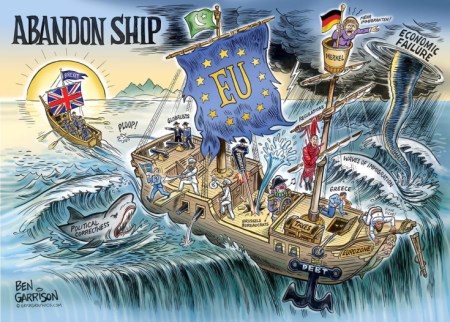
All Your Social Media Belong to the EU, Front Page Magazine, Daniel Greenfield, June 10, 2016

For a decade, the top search result for “EU referendum” on Google was the political blog EU Referendum. Then it was abruptly displaced by solidly pro-EU media outlets. It appeared that someone at Google had decided that search traffic should be driven to pro-EU sites. Ingrid Carlqvist, a Swedish columnist who covers, among other things, migrant violence, at Gatestone, had her Facebook account deleted after posting a video detailing migrant rapes in Sweden.
These seemingly isolated incidents fit into a larger pattern as Facebook, Google, Microsoft and Twitter helped create and signed a “code of conduct” banning hate speech. Facebook had already become notorious for its political agenda while Twitter had created a Trust and Safety Council filled with extremist left-wing groups like Feminist Frequency to censor the politically incorrect.
Google has historically been a pro-free speech outlier. Its politics have never been ambiguous, but it has eschewed the overt censorship of some of its new partners working to keep the EU free of political dissent. But the code of conduct goes well beyond censorship. The companies will be working to strengthen their “ongoing partnerships with civil society organisations who will help flag content that promotes incitement to violence and hateful conduct”. That amounts to empowering left-wing advocacy groups to dictate content removal to major companies. It means that not only Twitter, but Facebook, Google and Microsoft will get their own Trust and Safety Council. It may be called something else. It may not even have a name. But it will have power. That’s what this really means.
And it’s only a starting point in a larger propaganda initiative.
“The IT Companies and the European Commission, recognising the value of independent counter speech against hateful rhetoric and prejudice, aim to continue their work in identifying and promoting independent counter-narratives,” the press release reads.
Even more than the censorship, the counter-narratives push represents a troubling development.
Left-wing groups won’t just be embedded as censors, but major tech firms will be expected to promote their agendas. And the biggest resource that companies with massive social media platforms have at their disposal isn’t mere money. It’s the ability to decide what is trending and what isn’t.
If a story about Islamic terrorism trends, will Facebook or Twitter be expected to promote a counter-narrative from an Islamic group? How exactly is this any different than traditional propaganda?
“The IT Companies to intensify their work with CSOs to deliver best practice training on countering hateful rhetoric and prejudice and increase the scale of their proactive outreach to CSOs to help them deliver effective counter speech campaigns. The European Commission, in cooperation with Member States, to contribute to this endeavour by taking steps to map CSOs’ specific needs and demands in this respect,” the release tells us.
CSO stands for Civil Society Organization. It’s used more often now that NGO carries with it an air of contempt. That last sentence informs us that the CSOs will have “demands.” The European Commission will help leverage and assemble these demands. Meanwhile major tech firms will be working to aid these CSOs in pushing their agenda.
What will this look like? We got a preview of it with Facebook’s “Initiative for Civil Courage Online”. Facebook had been facing pressure from Germany’s Merkel who was worried over public outrage at crimes committed by her Muslim migrant arrivals. Censorship was obviously the order of the day.
The Initiative promoted Klick It Out which, in properly Orwellian fashion, urged people to “See It. Report It.” The “It” being “Social Media Discrimination.” And then users were expected to “Klick It Out”. It was a failure. But Facebook and friends are doubling down.
Tech companies love the idea of creating “counter-narratives” because it’s cheaper to throw some money at an NGO or CSO, or to boost their profile, than to invest still more money in censorship. It’s not because they have a bias for free speech, but because active censorship, even when outsourced to poorer countries, which it often is, demands more resources. Pushing an agenda is cheap.
And the goal of companies like Facebook is to increase usage, rather than reduce it, which is why COO Sheryl Sandberg championed “like attacks” in which users flood the pages of bigots with their own speech. But the code of conduct is a thorough rejection of any of that self-interested libertarianism. Censorship is packaged together with agenda pushing. There might be like attacks, but what the EU really wanted was deletion and promotion for the groups that its leaders support. And they got it.
Some fraction of these efforts may be directed at ISIS supporters, but there is no particular reason to be optimistic about that. By putting CSOs first, the message is that this isn’t about counter-terrorism, but about promoting one set of political agendas at the expense of another. Much like Twitter’s Trust and Safety Council, this is about selecting who should speak and who should be silenced.
Programs like these operate under the umbrella of fighting extremism. And extremism, unlike blowing up buses or beheading hostages, is in the eye of the beholder. And the beholder is a tech company standing on the left while looking to the right. The obsession with radicalization treats lawful speech as the precursor to violence. It also assumes that Muslim terrorism emerges from a cycle of extremism between Muslims and critics of Islam. Silence the critics and you stop the terrorism.
European governments, like those of Angela Merkel, are far less worried about Salafists than they are about domestic political dissent. When Merkel berated Facebook CEO Mark Zuckerberg over insufficient censorship, it wasn’t because she objected to the pipeline that feeds Muslims from Germany into ISIS. Muslim terrorism is inconvenient, but political dissent is politically explosive. Social media comprise an alternative organizing force that counters the dominance of media narratives. That makes it a threat.
Attempts to silence more prominent voices like Richard North and Ingrid Carlqvist have run into a backlash, but it’s impossible to rally in support of each ordinary person who has their account shut down or their blog pushed down in the rankings for having politically incorrect views. Social media at their best bring people together. This initiative is about disrupting social organizations that are disapproved of.
It is about preserving the dominance of a government-media narrative while promoting astroturf organizations that try to appear independent, but really echo that very same narrative.
Private companies have the right to determine what content appears on their platforms. But Facebook, Google, Microsoft and Twitter have become part of an alliance with governments and advocacy groups to maintain a particular narrative. They will not simply be removing hateful content. Instead they have undertaken to play a role in putting forward a particular set of ideas by particular governments.
That’s propaganda and it is the opposite of how the internet was meant to be used.
The deal puts a series of private organizations, backed by EU government power, in charge of determining the content of social media, both positive and negative. Social media were meant to be centered around the user. Instead this deal displaces the user and replaces him or her with the EU.
Public Support for the European Union Plunges, Gatestone Institute, Soeren Kern, June 9, 2016
♦ Public anger is also being fueled by the growing number of diktats issued by the unelected officials running the Brussels-based European Commission, the powerful administrative arm of the bloc, which has been relentless in its usurpation of sovereignty from the 28 nation states that comprise the European Union.
♦ Although the survey does not explicitly say so, the findings almost certainly reflect growing anger at the anti-democratic nature of the EU and its never-ending power grabs.
♦ On May 31, the EU, in partnership with Facebook, Twitter, YouTube and Microsoft, unveiled a “code of conduct” to combat the spread of “illegal hate speech” online. Critics say the EU’s definition of “hate speech” is so vague that it could include virtually anything deemed politically incorrect by European authorities, including criticism of mass migration, Islam or even the EU itself.
♦ On April 20, the European Political Strategy Centre, an in-house EU think tank that reports directly to Juncker, proposed that the European Union establish its own central intelligence agency, which would answer only to unelected bureaucrats.
Public opposition to the European Union is growing in all key member states, according to a new survey of voters in ten EU countries.
Public disaffection with the EU is being fueled by the bloc’s mishandling of the refugee and debt crises, according to the survey, which interviewed voters in Britain, France, Germany, Greece, Hungary, Italy, the Netherlands, Poland, Spain and Sweden.
Public anger is also being fueled by the growing number of diktats issued by the unelected officials running the Brussels-based European Commission, the powerful administrative arm of the bloc, which has been relentless in its usurpation of sovereignty from the 28 nation states that comprise the European Union.
The 17-page report, “Euroskepticism Beyond Brexit,” was published by the Pew Research Center on June 7, just two weeks before the June 23 referendum on whether Britain will become the first country to leave the European Union (Brexit blends the words Britain and exit).
The following are excerpts:
Although the survey does not explicitly say so, the findings almost certainly reflect growing anger at the anti-democratic nature of the EU and its never-ending power grabs.
On May 31, the European Union, in partnership with Facebook, Twitter, YouTube and Microsoft,unveiled a “code of conduct” to combat the spread of “illegal hate speech” online in Europe. Critics say the initiative amounts to an assault on free speech in Europe because the EU’s definition of “hate speech” and “incitement to violence” is so vague that it could include virtually anything deemed politically incorrect by European authorities, including criticism of mass migration, Islam or even the European Union itself.
On May 24, the unelected president of the European Commission, Jean-Claude Juncker, vowed to use sanctions to isolate far-right or populist governments that are swept into office on the wave of popular anger against migration. Under powers granted to the European Commission in 2014, Juncker can trigger a “rule of law alert” for countries that depart from “the common constitutional traditions of all member states.” Rather than accepting the will of the people at the voting booth, Juncker can impose sanctions to address “systemic deficiencies” in EU member states.
On May 4, Juncker warned that EU countries that failed to “show solidarity” by refusing take in migrants would face a fine of €250,000 ($285,000) per migrant.
On April 20, the European Political Strategy Centre, an in-house EU think tank that reports directly to Juncker, proposed that the European Union establish its own central intelligence agency, which would answer only to unelected bureaucrats. According to the plan, the 28 EU member states would have a “legally binding duty to share information.”
The British Minister of State for the Armed Forces, Penny Mordaunt, responded:
“These matters are supposed to be, and must be the competence of member states. Intelligence sharing can only be done on a bilateral basis. This latest EU integration project not only shows how little the EU cares for the sovereignty of nation states, but also how little it understands the business of counter-terrorism.”
On December 15, 2015, the European Commission unveiled plans for a new European Border and Coast Guard force that can intervene anywhere in the EU, even without the host country’s consent.
On March 8, 2015, Juncker said that the EU needed its own military in order to restore the bloc’s standing around the world: “Europe’s image has suffered dramatically and also in terms of foreign policy, we don’t seem to be taken entirely seriously.”
 Jean-Claude Juncker, the unelected president of the European Commission, recently vowed to use sanctions to isolate far-right or populist governments that are swept into office on the wave of popular anger against migration. In December 2015, the Commission unveiled plans for a new European Border and Coast Guard force that can intervene anywhere in the EU, even without the host country’s consent. (Image source: © European Union 2015 – European Parliament)
In a recent interview with Le Monde, Juncker said that if Britons voted to leave the EU, they would be treated as “deserters”:
“I am sure the deserters will not be welcomed with open arms. If the British should say ‘No’ — which I hope they do not — then life in the EU will not go on as before. The United Kingdom will be regarded as a third country and will have its fur stroked the wrong way (caresser dans le sens du poil). If the British leave Europe, people will have to face the consequences. It is not a threat but our relations will no longer be what they are today.”
In an interview with the Telegraph, Giles Merritt, director of the Friends of Europe think tank in Brussels, summed it up this way:
“The EU policy elites are in panic. If the British vote to leave the shock will be so ghastly that they will finally wake up and realize that they can no longer ignore demands for democratic reform. They may have to dissolve the EU as it is and try to reinvent it, both in order to bring the Brits back and because they fear that the whole political order will be swept away unless they do.”
Brexit is the Only Way to Secure Great Britain, Breitbart, Christopher Carter, June 4, 2016
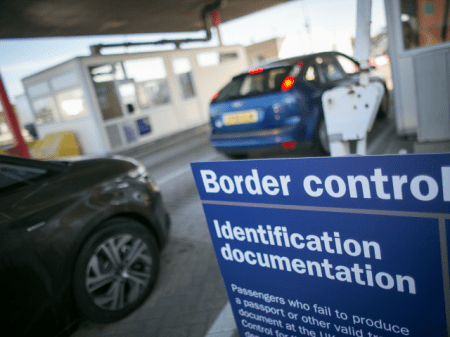
A few weeks ago David Cameron made contemptible warnings over Brexit and its implications for UK security. He even went so far as to suggest the Islamic State leader Abu Bakr al-Baghdadi “might be happy” if the country votes to Leave the EU.
It is rather telling that since this intervention the PM has chosen to focus on prophesizing economic collapse and hardship rather than discussing this vital issue of Britain’s national security. It is not surprising – considering the recent interventions and revelations concerning how the UK’s membership of the EU impacts on our security.
A report by the EU itself has revealed how there will be a greater risk of terrorist attacks as a result of the Turkey visa-waiver scheme. This has been supported by the ex-head of MI6, Sir Richard Dearlove, who strongly criticised the EU’s attempt to solve the migrant crisis by offering visa-free access to millions of Turks, saying it was “like storing gasoline next to the fire one is trying to extinguish”.
Added to the short-term security threat posed by 77 million Turks having access to all the countries within the EU, there are the long-term political ramifications of the deal, which has the potential to accelerate the resurgence of the far-Right across Europe.
The fact President Erdogan is willing to simply pocket the €3 billion he has demanded the EU send Turkey in aid is hardly going to improve the mood of governments currently forcing through major austerity measures.
He is even threatening to renege on the deal he made over the Greek borders if he doesn’t get his way. His recent warning to the German Parliament not to pass a resolution declaring the mass killings of Armenians in 1915 as genocide are typical of his despotic interventions.
It is clear the EU’s deal with Turkey will have lasting consequences for the whole of the EU, and only by Leaving can we protect the UK.
Of huge concern are the rulings of the European Court of Justice (ECJ), the official court of the EU. Not content with simply supporting the European Commission in its drive to create a federal superstate, its interventions are now putting UK citizens at risk.
Particularly worrying is the recent ruling by the ECJ on freedom of movement. The ECJ is now insisting if a Member State wants to restrict a citizen’s right to ‘free movement’ if they suspect the person has been involved in terrorist activities for example, it must explain exactly why – even though this would endanger national security.
This raises the prospect of British Intelligence officials being forced to hand over highly sensitive documents to people they suspect of terrorism. The UK’s own Court of Appeal has since ruled the rights enshrined in the Charter of Fundamental Rights of the European Union “cannot yield to the demands of national security”.
Yesterday the Justice Secretary, Michael Gove spoke of his frustration at the inability of the UK Government to refuse entry to EU citizens who are suspected of terrorist links. It is clear the European elite are perfectly happy to put the lives of the people of Europe at risk in order to protect the deeply flawed principle of ‘free movement’.
These revelations completely undermine the claims of the Remain campaign that we are safer inside the EU. It is not at all surprising the Prime Minister has now backtracked, choosing to orchestrate a smear campaign against his Leave opponents, rather than addressing the important issue of our national security.
Whilst David Cameron is happy making ludicrous claims about Brexit causing a World War 3, he is clearly uncomfortable addressing the very real threats we will face if we vote to Remain inside the EU.
There is only one way to regain control of our borders and our security and this is to Vote to Leave, to Get Britain Out of the EU.
European Union Declares War on Internet Free Speech, Gatestone Institute, Soeren Kern, June 3, 2016
♦ Opponents counter that the initiative amounts to an assault on free speech in Europe. They say that the European Union’s definition of “hate speech” and “incitement to violence” is so vague that it could include virtually anything deemed politically incorrect by European authorities, including criticism of mass migration, Islam or even the EU itself.
♦ Some Members of the European Parliament have characterized the EU’s code of online conduct — which requires “offensive” material to be removed from the Internet within 24 hours — as “Orwellian.”
♦ “By deciding that ‘xenophobic’ comment in reaction to the crisis is also ‘racist,’ Facebook has made the view of the majority of the European people… into ‘racist’ views, and so is condemning the majority of Europeans as ‘racist.'” — Douglas Murray.
♦ In January 2013, Facebook suspended the account of Khaled Abu Toameh after he wrote about corruption in the Palestinian Authority. The account was reopened 24 hours later, but with the two posts deleted and no explanation.
The European Union (EU), in partnership with Facebook, Twitter, YouTube and Microsoft, has unveiled a “code of conduct” to combat the spread of “illegal hate speech” online in Europe.
Proponents of the initiative argue that in the aftermath of the recent terrorist attacks in Paris and Brussels, a crackdown on “hate speech” is necessary to counter jihadist propaganda online.
Opponents counter that the initiative amounts to an assault on free speech in Europe. They say that the EU’s definition of “hate speech” and “incitement to violence” is so vague that it could include virtually anything deemed politically incorrect by European authorities, including criticism of mass migration, Islam or even the European Union itself.
Some Members of the European Parliament have characterized the EU’s code of online conduct — which requires “offensive” material to be removed from the Internet within 24 hours, and replaced with “counter-narratives” — as “Orwellian.”
The “code of conduct” was announced on May 31 in a statement by the European Commission, the unelected administrative arm of the European Union. A summary of the initiative follows:
“By signing this code of conduct, the IT companies commit to continuing their efforts to tackle illegal hate speech online. This will include the continued development of internal procedures and staff training to guarantee that they review the majority of valid notifications for removal of illegal hate speech in less than 24 hours and remove or disable access to such content, if necessary.
“The IT companies will also endeavor to strengthen their ongoing partnerships with civil society organisations who will help flag content that promotes incitement to violence and hateful conduct. The IT companies and the European Commission also aim to continue their work in identifying and promoting independent counter-narratives [emphasis added], new ideas and initiatives, and supporting educational programs that encourage critical thinking.”
Excerpts of the “code of conduct” include:
“The IT Companies share the European Commission’s and EU Member States’ commitment to tackle illegal hate speech online. Illegal hate speech, as defined by the Framework Decision 2008/913/JHA of 28 November 2008 on combating certain forms and expressions of racism and xenophobia by means of criminal law and national laws transposing it, means all conduct publicly inciting to violence or hatred directed against a group of persons or a member of such a group defined by reference to race, color, religion, descent or national or ethnic origin….
“The IT Companies support the European Commission and EU Member States in the effort to respond to the challenge of ensuring that online platforms do not offer opportunities for illegal online hate speech to spread virally. The spread of illegal hate speech online not only negatively affects the groups or individuals that it targets, it also negatively impacts those who speak out for freedom, tolerance and non-discrimination in our open societies and has a chilling effect on the democratic discourse on online platforms.
“While the effective application of provisions criminalizing hate speech is dependent on a robust system of enforcement of criminal law sanctions against the individual perpetrators of hate speech, this work must be complemented with actions geared at ensuring that illegal hate speech online is expeditiously acted upon by online intermediaries and social media platforms, upon receipt of a valid notification, in an appropriate time-frame. To be considered valid in this respect, a notification should not be insufficiently precise or inadequately substantiated.
“The IT Companies, taking the lead on countering the spread of illegal hate speech online, have agreed with the European Commission on a code of conduct setting the following public commitments:
- “The IT Companies to have in place clear and effective processes to review notifications regarding illegal hate speech on their services so they can remove or disable access to such content. The IT companies to have in place Rules or Community Guidelines clarifying that they prohibit the promotion of incitement to violence and hateful conduct.
- “The IT Companies to review the majority of valid notifications for removal of illegal hate speech in less than 24 hours and remove or disable access to such content, if necessary.
- “The IT Companies and the European Commission, recognising the value of independent counter speech against hateful rhetoric and prejudice, aim to continue their work in identifying and promoting independent counter-narratives, new ideas and initiatives and supporting educational programs that encourage critical thinking.”
The agreement also requires Internet companies to establish a network of “trusted reporters” in all 28 EU member states to flag online content that “promotes incitement to violence and hateful conduct.”
The EU Commissioner for Justice, Consumers and Gender Equality, Vĕra Jourová, has defended the initiative:
“The recent terror attacks have reminded us of the urgent need to address illegal online hate speech. Social media is unfortunately one of the tools that terrorist groups use to radicalize young people and racists use to spread violence and hatred. This agreement is an important step forward to ensure that the internet remains a place of free and democratic expression, where European values and laws are respected. I welcome the commitment of worldwide IT companies to review the majority of valid notifications for removal of illegal hate speech in less than 24 hours and remove or disable access to such content, if necessary.”
Others disagree. The National Secular Society (NSS) of the UK warned that the EU’s plans “rest on a vague definition of ‘hate speech’ and risk threatening online discussions which criticize religion.” It added:
“The agreement comes amid repeated accusations from ex-Muslims that social media organizations are censoring them online. The Council of Ex-Muslims of Britain has now begun collecting examples from its followers of Facebook censoring ‘atheist, secular and ex-Muslim content’ after false ‘mass reporting’ by ‘cyber Jihadists.’ They have asked their supporters to report details and evidence of any instances of pages and groups being ‘banned [or] suspended from Facebook for criticizing Islam and Islamism.'”
NSS communications officer Benjamin Jones said:
“Far from tackling online ‘cyber jihad,’ the agreement risks having the exact opposite effect and entrapping any critical discussion of religion under vague ‘hate speech’ rules. Poorly-trained Facebook or Twitter staff, perhaps with their own ideological bias, could easily see heated criticism of Islam and think it is ‘hate speech,’ particularly if pages or users are targeted and mass reported by Islamists.”
In an interview with Breitbart London, the CEO of Index on Censorship, Jodie Ginsburg, said:
“Hate speech laws are already too broad and ambiguous in much of Europe. This agreement fails to properly define what ‘illegal hate speech’ is and does not provide sufficient safeguards for freedom of expression.
“It devolves power once again to unelected corporations to determine what amounts to hate speech and police it — a move that is guaranteed to stifle free speech in the mistaken belief this will make us all safer. It won’t. It will simply drive unpalatable ideas and opinions underground where they are harder to police — or to challenge.
“There have been precedents of content removal for unpopular or offensive viewpoints and this agreement risks amplifying the phenomenon of deleting controversial — yet legal — content via misuse or abuse of the notification processes.”
A coalition of free speech organizations, European Digital Rights and Access Now, announced their decision not to take part in future discussions with the European Commission, saying that “we do not have confidence in the ill-considered ‘code of conduct’ that was agreed.” A statement warned:
“In short, the ‘code of conduct’ downgrades the law to a second-class status, behind the ‘leading role’ of private companies that are being asked to arbitrarily implement their terms of service. This process, established outside an accountable democratic framework, exploits unclear liability rules for online companies. It also creates serious risks for freedom of expression, as legal — but controversial — content may well be deleted as a result of this voluntary and unaccountable take-down mechanism.
“This means that this ‘agreement’ between only a handful of companies and the European Commission is likely in breach of the EU Charter of Fundamental Rights (under which restrictions on fundamental rights should be provided for by law), and will, in practical terms, overturn case law of the European Court of Human Rights on the defense of legal speech.”
Janice Atkinson, an independent MEP for the South East England region, summed it up this way: “It’s Orwellian. Anyone who has read 1984 sees its very re-enactment live.”
Even before signing on to the EU’s code of conduct, social media sites have been cracking down on free speech, often at the behest of foreign governments.
In September 2015, German Chancellor Angela Merkel was overheard on a live microphone confronting Facebook CEO Mark Zuckerberg on what he was doing to prevent criticism of her open-door immigration policies.
In January 2016, Facebook launched an “Online Civil Courage Initiative” aimed at Facebook users in Germany and geared toward “fighting hate speech and extremism on the Internet.”
Writing for Gatestone Institute, British commentator Douglas Murray noted that Facebook’s assault on “racist” speech “appears to include anything critical of the EU’s current catastrophic immigration policy.” He wrote:
“By deciding that ‘xenophobic’ comment in reaction to the crisis is also ‘racist,’ Facebook has made the view of the majority of the European people (who, it must be stressed, are opposed to Chancellor Merkel’s policies) into ‘racist’ views, and so is condemning the majority of Europeans as ‘racist.’ This is a policy that will do its part in pushing Europe into a disastrous future.
Facebook has also set its sights on Gatestone Institute affiliated writers. In January 2013, Facebook suspended the account of Khaled Abu Toameh after he wrote about corruption in the Palestinian Authority. The account was reopened 24 hours later, but with the two posts deleted and no explanation. Abu Toameh wrote:
“It’s still a matter of censorship. They decide what’s acceptable. Now we have to be careful about what we post and what we share. Does this mean we can’t criticize Arab governments anymore?”
In June 2016, Facebook suspended the account of Ingrid Carlqvist, Gatestone’s Swedish expert, after she posted a Gatestone video to her Facebook feed — called “Sweden’s Migrant Rape Epidemic.” In an editorial, Gatestone wrote:
“After enormous grassroots pressure from Gatestone’s readers, the Swedish media started reporting on Facebook’s heavy-handed censorship. It backfired, and Facebook went into damage-control mode. They put Ingrid’s account back up — without any explanation or apology. Ironically, their censorship only gave Ingrid’s video more attention.
“Facebook and the EU have backed down — for now. But they’re deadly serious about stopping ideas they don’t like. They’ll be back.”
 This week, the EU, in partnership with Facebook, Twitter, YouTube and Microsoft, unveiled a “code of conduct” to combat the spread of “illegal hate speech” online in Europe. The next day, Facebook suspended the account of Ingrid Carlqvist, Gatestone’s Swedish expert, after she posted a Gatestone video to her Facebook feed — called “Sweden’s Migrant Rape Epidemic.”
The Moment of Truth, Pat Condell via YouTube, May 31, 2016
(Brexit the Movie is available at Warsclerotic, here. — DM)
The blurb beneath the video states,
Do we want to live in a sovereign democracy or a federal dictatorship?
Please watch ‘Brexit The Movie’ before the referendum, not after. This is the most important political decision we will ever make.
https://www.brexitthemovie.com
H/t Joopklepzeiker

Anti-Brexit Shocker: Economists and Faith Leaders Plot Britain’s Downfall, The Daily Bell, Staff, May 30, 2016
Economists overwhelmingly reject Brexit in boost for Cameron … Poll shows 88% of 600 experts fear long-term fall in GDP if UK leaves single market, and 82% are alarmed over impact on household income. -Guardian
Once again, economists remind us that that their profession is at least a questionable one.
Presumably healthy economies are based in private competition not public regulation. Economic progress is made via individual human action.
One person has a product or service and competes against another. And one company against another.
There is room for more than one product or service as consumers have different priorities.
And thus an “economy” is built.
But for some reason, British economists seem to believe that the authoritarian mess that is the European Union is necessary for prosperity.
More:
Relatively few economists have publicly come out saying that leaving the EU would be good for British growth, and only a handful have signed up in support of the pro-Brexit group Economists for Britain.
Most studies of the impact on Britain’s economy of a decision to quit the EU show the uncertainty will hit growth in the short term and the loss of access to the EU’s single market will damage growth for decades to come.
The poll was administered by Ipsos MORI, and received responses from more than 600 economists.
These economists believed in great numbers that leaving the EU would damage the British economy for years to come. Some 61% believe unemployment would expand.
Economists from top institutions such as the Royal Economic Society and the Society of Business Economists replied voluntarily.
The article also tells that 37 “faith leaders” have just written a letter to the Observer newspaper claiming Brexit damages both peace and prosperity.
It’s not clear from the article why leaving the EU would damage peace and prosperity.
The article makes a clearer case for what economists are worried about: “Loss of access to the single market” (67%) and “increased uncertainty leading to reduced investment” (66%).
Presumably economists (and faith leaders?) see their professions somehow enhanced by the EU and diminished by Brexit.
But these views still don’t make much sense.
There are currently reports that the EU is pushing hard for the federalization of Europe via a new tax ID number and also via plans for a pan-European army.
A national insurance number will allow Brussels to identify European (and British) taxpayers and would be a further step toward the institution of an aggressive European tax.
Additionally, new legislation will ban sovereign states from reducing corporate taxation to below 15 percent.
Neither plans for a European army nor the new tax ID number are apparently getting much coverage in Britain.
It really doesn’t matter though. Brussels have proven several times over that the EU’s goal is a United States of Europe.
Surely the economists involved in the survey understand the level of corruption currently infecting the EU.
Those affiliated with the EU receive enormous compensation for useless activities. Regulatory advantages are routinely sold to the highest bidder.
And surely they understand that the decision-making bodies have been purposefully divorced from Parliament. The entire setup of the EU is aimed at producing a mega-state responsible only to a handful of bureaucrats.
How on earth British economists, let alone “faith leaders” can endorse the EU is difficult to imagine.
If Britain stays in the EU, within a decade the country – as it has existed for perhaps a thousand years – will be disassembled.
These economists and faith leaders are content to support the end of Britain.
Faith will not be diminished and industry will not leave if Brexit occurs. But the country will not survive as a historical entity if it remains within Europe.
Conclusion: These two groups are willfully presiding over the end of Britain.




 anneinpt
 artaxes
 danmillerinpanama
 davidking1530
 Peter Hofman
 Joseph Wouk
 Peter
Peter Louisiana Steve
 WarSclerotic
Recent Comments