Archive for the ‘European Union’ category

European Temper Trumptums

November 15, 2016

European Temper Trumptums, Gatestone InstituteJudith Bergman, November 15, 2016

The arrogant claim to the moral high ground by European elites has no basis in reality.

There is no respect for freedom and democracy on a continent where citizens, such as the politician Geert Wilders, are arrested and prosecuted by in a court of law for speaking their minds freely about topics that the authorities find it expedient not to debate in public.

Freedom, respect for the rule of law, and people’s race, religion and gender have never been less respected and protected in Germany during the post-WWII era than under Merkel. German authorities have completely failed to protect women, Christians and others from the chaos unleashed by the mass, unvetted, immigration of mainly Muslim migrants from Africa and the Middle East. The rule of law is anything but “respected” in Germany.

Not everyone is “panicking”. UK Foreign Secretary Boris Johnson, rejected the invitation and told his colleagues to end their “collective whinge-o-rama” about the U.S. election result.

Critics of the U.S. election omitted, however, the runaway lawlessness, divisiveness and corruption that American voters declined to reinstate.


“A world is collapsing before our eyes”, tweeted the French ambassador to the United States, Gerard Araud, as it became clear that Donald Trump had won the US presidential election. Although he later apparently deleted the tweet, the sentiment expressed in his tweet encapsulates the attitude of the majority of the European political establishment.

Deutsche Welle (DW), Germany’s international broadcaster, described the reaction to Trump’s victory across Germany’s political spectrum as “shock and uncertainty.” Defense Minister Ursula von der Leyen described Trump’s win as a “heavy shock.” German Justice Minister Heiko Maas tweeted: “The world won’t end, but things will get more crazy”.

Green party leader Cem Özdemir called Trump’s election a “break with the tradition that the West stands for liberal values.”

Chancellor Angela Merkel’s deputy chancellor, Sigmar Gabriel, said:

“Trump is the trailblazer of a new authoritarian and chauvinist international movement. … They want a rollback to the bad old times in which women belonged by the stove or in bed, gays in jail and unions at best at the side table. And he who doesn’t keep his mouth shut gets publicly bashed.”

In a fine touch of irony, EU Commissioner Guenther Oettinger, who recently referred to the Chinese as “slanty eyed,” told Deutschlandfunk radio that the U.S. election was a “warning” for Germany: “Things are getting simplified, black or white, good or bad, right or wrong. You can ask simple questions, but one should not give simple answers.”

In France, the media reaction was summed up by the left-leaning newspaper, Libération:

“Trumpocalypse… Shock… The world’s leading power is from now on in the hands of the far-right. Fifty percent of Americans voted in all conscience for a racist, lying, sexist, vulgar, hateful candidate.”

Critics omitted, however, the runaway lawlessness, divisiveness and corruption that American voters declined to reinstate.

President François Hollande described Trump’s victory as marking the start of “a period of uncertainty.” Previously, Hollande had said that Trump made him “want to retch.”

European Commission President Jean-Claude Juncker, one of the most powerful men in Europe, told students at a conference in Luxembourg, “We will need to teach the president-elect what Europe is and how it works”. He also claimed that, “The election of Trump poses the risk of upsetting intercontinental relations in their foundation and in their structure.” He added that Americans usually have no interest in Europe.

Chancellor Angela Merkel herself offered to work closely with Trump only “on the basis that shared values, such as democracy, freedom, respect for the rule of law and people’s race, religion and gender are respected” — the overbearing implication being that Trump cannot be expected to respect these concepts.

Just how hysterical European political leaders’ reaction has been to Trump was manifested in the fact that they felt compelled to hold an informal “crisis meeting” — some diplomats called it a “panic dinner” — on Sunday evening, to deal with the “shock” of the presidential election. “We would never have had a similar dinner if Hillary Clinton had been elected. It shows just how much we’re panicking,” said a diplomat from one of the smaller EU states.

Not everyone is “panicking.” UK Foreign Secretary Boris Johnson rejected the invitation and told his colleagues to end their “collective whinge-o-rama” about the U.S. election result.

There is indeed an unmistakable infantility about the reactions of European political elites to the election of the new US president, which are reminiscent of a young child lashing out after being denied candy. More significantly, the reactions reveal an overbearing disrespect for the American people’s free and democratic choice of a leader. Most important, however, is that the arrogant claim to the moral high ground by European elites has no basis in reality. It simply is not true that, as Merkel claimed, freedom and democracy, rule of law and respect for people’s race, religion and gender are at the foreground of European policies.

In fact, there is something deeply ironic about Angela Merkel mentioning freedom, the rule of law and so on. In fact, freedom, respect for the rule of law, and people’s race, religion and gender have never been less respected and protected in Germany during the post-WWII era than under Merkel. German authorities have completely failed to protect women, Christians and others from the chaos unleashed by the mass, unvetted, immigration of mainly Muslim migrants from Africa and the Middle East. The rule of law is anything but “respected” in Germany, where large pockets of Muslims live in parallel societies, or no-go zones, where police are too afraid to enter, where the residents impose their own rules, such as polygamy, and where committing social benefits fraud is rampant while German authorities turn a knowing blind eye.

2046

This pattern repeats itself endlessly in other European countries. In Britain, the police and social workers have turned a blind eye for years to Muslim gangs grooming, prostituting, and raping young white British teenagers in cities such as Oxford, Birmingham, Rochdale and Rotherham. How is that for “respect for the rule of law” and human rights?

There is no freedom, or respect for gender in Swedish women being told not to go out after dark, or German women being told to follow a “code of conduct” because local police authorities can no longer protect them from sexual assault.

There is no respect for religion on a continent where authorities have been unable to stem a tidal wave of anti-Semitism or to protect Christians who flee from the Middle East to Europe, only to experience similar prosecution from local or migrant Muslims.

There is no respect for freedom and democracy on a continent where citizens, such as the politician Geert Wilders, are arrested and prosecuted by national authorities in a court of law for speaking their minds freely about topics that the authorities do not find it expedient to debate in public.

Perhaps Europe can start preaching to president-elect Donald Trump once it gets its own house in order?

The Real Weak Link in Europe

August 17, 2016

The Real Weak Link in Europe, American ThinkerAlex Alexiev, August 17, 2016

With some weeks now past since the event, the Brexit doom and gloom-mongers have taken a well deserved break from conjuring up the imminent demise of the U.K., the EU, and perhaps the world itself.  This may be an appropriate opportunity to consider whether or not there might be an even better candidate for such end-of-times prognostications: Germany.

On the face of it, this is surely preposterous.  Europe’s largest economy, its most stable government, and the main if not only pillar of the EU and the euro is hardly a destabilizing factor, most would agree.  Germany may indeed be all of that, but only in comparison to the rest of the EU, which has been stagnating economically for a decade and is beset by major political instability and terrorism.  Since 2007, German labor productivity growth has been close to zero, while GDP growth has averaged a miserable 0.8% per annum, even as Germany’s largest company, Volkswagen, is being prosecuted around the world for cheating, while its very symbol of stability, Deutsche Bank, has been called by the IMF “the biggest contributor to risk in global finance.”

Serious as these are, much more disturbing are unmistakable trends that Germany may be going in directions hardly congenial to European and Western policies vis-à-vis Russia.  A case in point is the new Nord Stream 2 pipeline project, designed to bring up to 80% of the Russian gas supply to Europe while bypassing Ukraine and Eastern Europe.  A blatantly political ploy by Mr. Putin and Gazprom, it will guarantee that Moscow can blackmail Eastern Europe at will.  Despite that, the project enjoys support not only among companies likely to profit from Nord Stream 2, but also by significant parts of the German establishment, including Chancellor Angela Merkel, who quite disingenuously claims that it is just a commercial project.

To understand why this is now possible in Germany, one must note the rapid growth of pro-Russian, anti-Western, and anti-American sentiments in all segments of German society of late.  These attitudes often run counter to the official policies of the Merkel government, which may actually make them even more significant.  Mrs. Merkel, for instance, is known as a key supporter and architect of the sanctions regime against Russia following its aggression against Ukraine, yet her government coalition partner, the social-democratic party (SPD), argues ever more forcefully that the sanctions should be lifted or, at the very least, made less onerous.  This not only undermines the authority of the Berlin government, but also makes the continuation of the sanctions when they expire at the end of the year unlikely.  This will please Germany’s export community, but only at the cost of outraging its partners in Eastern Europe.

Even more striking is the emerging anti-Western consensus among radical parties at both extremes of the political spectrum.  The former communist party of East Germany now repackaged as “Die Linke” and the right-wing, anti-immigrant Alternative for Germany (AfD) share essentially identical anti-Western and anti-American platforms that call for disbanding NATO and a new security alliance with Russia.  These parties may be extreme, but they are not without influence.  Die Linke is currently in power in one German state (Thuringia), while the AfD is supported by 12% of German voters according to the latest polls.

NATO is being undermined from yet another side, and that is the renewed EU discussions of the ostensible need for a European army independent of NATO.  Both European Commission president Jean-Claude Juncker and French president François Hollande have publicly supported the idea, and so have German officials, who cite the limited German-Dutch armed forces integration as a model.  The idea is, of course, complete nonsense if for no other reason than because no EU country is even contemplating, let alone seriously considering the massive amounts of money that would have to be spent to bring this about.  It is nonetheless a dangerous bit of nonsense, since nothing will deny NATO’s very raison d’être, and with it American commitment to the defense of Europe, faster than a standing European army outside the alliance command structures.

Finally, the most destabilizing German policy by far continues to be immigration policy.  Despite signs that it is an abject failure, Mrs. Merkel insists on continuing on the same course, leading to even greater conflict with Eastern Europe and others (Brexit) that reject it wholesale.  Poland has already announced that it will refuse to take any migrants, while Czech president Milos Zeman, a socialist, has called for a referendum on EU membership and even urged the Czechs to arm themselves for self-defense.

Merkel government officials have already proclaimed their migrant policies to be a success, but such claims should be taken with a large chunk of salt.  Here are the available statistics.  In 2015, 1.1 million migrants came to Germany after Merkel essentially invited them in on  Sept. 4, 2015.  Of those, 476,649 applied for political asylum.  The rest neither applied nor left the country, and their whereabouts are not known.  According to Eurostat, in the first quarter of 2016, 287,100 migrants, or nearly 100,000 more than in 2015 applied for asylum in the EU, which would mean that even if migrants to Germany have fallen off from the 2015 pace, the EU as a whole will get more than 1 million by the end of the year, and a similar number is expected in 2017.

More important than the sheer numbers is what this massive influx means for society.  Even though German authorities try to suppress such information, there is overwhelming evidence that rape and sexual assault by migrants has reached epidemic proportions in all 16 federal states, as documented in this report by the Gatestone Institute.  More troubling still is evidence that large numbers of terrorists and jihadists have used the migrant wave to organize “hit squads” in Germany.  According to Bavarian intelligence official Manfred Hauser, “irrefutable evidence exists that there is an IS [Islamic State] command structure in place.”

What all of this means for German and European security should not be difficult to foresee.  German officials openly acknowledge that the police cannot handle this massive threat and are now openly discussing setting in place a 400,000-strong “national guard” type of organization.  Before they do that, it might be useful to first consider changing Mrs. Merkel’s failed policies.


Turkey, Europe’s Little Problem

August 11, 2016

Turkey, Europe’s Little Problem, Gatestone InstituteBurak Bekdil, August 11, 2016

♦ Europe is giving signals, albeit slowly, that it may be waking up from the “Turkey-the-bridge” dream. Germany’s Foreign Minister Frank-Walter Steinmaier said that his country’s relations with Turkey have grown so bad the two countries have virtually “no basis” for talks.

♦ “Italy should be attending to the mafia, not my son,” said Turkish President Recep Tayyip Erdogan. Typically, he does not understand the existence of independent judiciary in a European country. He thinks, as in an Arab sheikdom, prosecutors are liable to drop charges on orders from the prime minister.

♦ “We know that the democratic standards are clearly not sufficient to justify [Turkey’s] accession [to the European Union].” — Austrian Chancellor Christian Kern.

Nations do not have the luxury, as people often do, of choosing their neighbors. Turkey, under the 14-year rule of Recep Tayyip Erdogan’s Islamist governments, and neighboring both Europe and the Middle East, was once praised as a “bridge” between Western and Islamic civilizations. Its accession into the European Union (EU) was encouraged by most EU and American leaders. Nearly three decades after its official bid to join the European club, Turkey is not yet European but has become one of Europe’s problems.

Europe’s “Turkish problem” is not only about the fact that in a fortnight a bomb attack wrecked a terminal of the country’s biggest airport and a coup attempt killed nearly 250 people; nor is it about who rules the country. It is about the undeniable democratic deficit both in governance and popular culture.

In only the past couple of weeks, Turkey was in the headlines with jaw-dropping news. In Istanbul, a secretary at a daily newspaper was attacked by a group of people who accused her of “wearing revealing clothes and supporting the July 15 failed coup.” She was six months pregnant.

Also in Istanbul, a Syrian gay refugee was murdered: he had been beheaded and mutilated. One social worker helping LGBT groups said: “Police are doing nothing because he is Syrian and because he is gay.”

Turkey is dangerous not only for gays and refugees. A French tourist was left bloodied and beaten by Turkish nationalists after he refused to hold a Turkish flag. Grisly footage shows the gang, encouraged by Erdogan to patrol the streets on “democracy watch,” telling the man “You will be punched if you don’t hold the flag.” The tourist is alone and does not appear to speak Turkish.

Meanwhile Europe is giving signals, albeit slowly, that it may be waking up from the “Turkey-the-bridge” dream. Germany’s Foreign Minister Frank-Walter Steinmaier said that his country’s relations with Turkey have grown so bad the two countries have virtually “no basis” for talks. He said that Germany has serious concerns about mass arrests carried out by Turkish officials. According to Steinmaier, Turkey and Germany are like “emissaries from two different planets.” Steinmaier is right. He is also not the only European statesman who sees Turkey as alien.

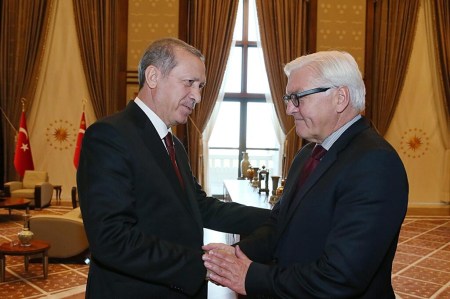
1777Germany’s Foreign Minister Frank-Walter Steinmaier (right) said that his country’s relations with Turkey under Recep Tayyip Erdogan have grown so bad the two countries have virtually “no basis” for talks.

Erdogan recently threatened Italy that its bilateral relations with Turkey could deteriorate if Italian prosecutors investigating Erdogan’s son, Bilal, for money laundering, proceeded with their probe. “Italy should be attending to the mafia, not my son,” Erdogan said. Typically, he does not understand the existence of independent judiciary in a European country. He thinks, as in an Arab sheikdom, prosecutors are liable to drop charges on orders from the prime minister.

Italy’s prime minister, Matteo Renzi, answered Erdogan in language Erdogan will probably will not understand: “Italy has an independent legal system and judges answer to the Italian constitution and not the Turkish president.”

In unusual European realism, Austrian Chancellor Christian Kern said that he would start a discussion among European heads of government to end EU membership talks with Turkey. He rightly called the accession talks “diplomatic fiction.” Kern said: “We know that the democratic standards are clearly not sufficient to justify [Turkey’s] accession.”

Even Turkish Cypriots on the divided island fear that Erdogan’s Islamization campaign may target their tiny statelet. On August 3, about 1,500 people from 80 groups spanning the political spectrum took to the streets in Nicosia to protest against “Turkey’s attempt to mold their secular culture into one that’s more in tune with Islamic norms.”

All of that inevitably makes Turkey an alien candidate waiting at Europe’s gates to join the club. According to a European survey, Turkey is the least-wanted potential EU member — even less wanted than Russia. Opposition to Turkish membership ranges from 54% (Norway) to 81% (Germany).

Celal Yaliniz, a little-known Turkish philosopher, likened Turks in the 1950s to “members of a ship’s crew who are running toward the west as their ship travelled east.” The Turks were not alone. Erdogan’s “liberal” Western supporters have been no different.

Coup-Weary Turkey: Directionless and Insecure

August 8, 2016

Coup-Weary Turkey: Directionless and Insecure, Gatestone InstituteBurak Bekdil, August 8, 2016

♦ The more Ankara feels distant to Washington, the more it will want to feel closer to Moscow.

♦ As Western leaders call on President Erdogan to respect civil liberties and democracy, Erdogan insists he will consider reinstating the death penalty: “The people have the opinion that these terrorists [coup-plotters] should be killed. Why should I keep them and feed them in prisons for years to come?”

Turkey once boasted of having NATO’s second biggest army, equipped with state-of-the-art weapons systems. That powerful army now lacks command: After the failed coup of July 15, more than 8,500 officers and soldiers, including 157 of the 358 generals and admirals in the Turkish military’s ranks, were discharged. The top commanders who were purged had made up 44% of the entire command structure. Prime Minister Binali Yildirim said that the military’s shipyards and weapons factories will be transferred to civilian authority; military high schools and war academies have been shut; military hospitals will be transferred to health ministry; and the gendarmerie, a key force in anti-terror operations, and the coast guard will be tied to the interior ministry.

Those changes leave behind an army in deep morale shock, with political divisions and polarization. Its ranks are suffering not just trauma but also humiliation. The Turks are lucky their country was not attacked by an enemy (and they are plentiful) at a time like this. Conventional war, however, is not the only threat to Turkey’s security. The Turkish army’s worst decline in modern history came at a time when it was fighting an asymmetrical war against Kurdish insurgents inside and outside of Turkey and, as part of a U.S.-led international campaign, the Islamic State (ISIS) in neighboring Syria.

The attempted coup not only quickly discredited the Turkish military but also left the country once again directionless in foreign policy. President Recep Tayyip Erdogan has been slamming his NATO ally, the United States, almost daily. His government big guns have been implying an American hand behind the failed coup by a faction of officers they claim are linked to a U.S.-based Muslim cleric, Fethullah Gulen, once Erdogan’s best political ally. “The putschist [Gulen] is already in your country, you are looking after him. This is a known fact,” Erdogan said, addressing Washington. “You can never deceive my people. My people know who is involved in this plot, and who is the mastermind.”

The White House immediately denied Erdogan’s claim. Deputy Press Secretary Eric Schultz said the U.S. was one of the first countries to condemn the failed coup, and noted that a successful one would have put American troops serving in Turkey at risk. “It is entirely false. There is no evidence of that at all,” Schultz said. “We feel that talk and speculation along those lines is not particularly constructive.” The failed coup has become a Turkish-American dispute — with a military dimension, too.

Erdogan also criticized U.S. General Joseph Votel, who voiced concerns over “the long-term impact” of the coup on the Pentagon’s relations with the Turkish military. According to Erdogan, Votel’s remarks were evidence that the U.S. military was siding with the coup plotters. The Pentagon’s press secretary, Peter Cook, flatly denied that claim: “Any suggestion anyone in the department supported the coup in any way would be absurd.”

Erdogan probably wants to play the tough guy and is slamming Washington day after day not just to look pretty to millions of anti-American Turks but also to pressure Washington in Turkey’s quest to extradite Gulen, presently the biggest snag between the two allies.

But there is another dimension to Erdogan’s ire: He wants to mend fences with Moscow.

Turkey’s relations with Russia were frozen after Nov. 24, when Turkey, citing a brief violation of its airspace along Turkey’s border with Syria, shot down a Russian military aircraft. Russia’s President Vladimir Putting ordered punishing economic sanctions, imposed a travel ban on Russian tourists visiting Turkey and suspended all government-to-government relations. Unable to ignore the damage, a repentant Erdogan conveyed regrets to Putin; the regrets were accepted and the two leaders are scheduled to meet on August 9, when the Turks hope that relations with Russia will be entirely normalized.

Normalization, unfortunately, will not come at the price of Turkish “regrets” alone. For full normalization, Turkey will have to digest the Russian-Iranian-Syrian line in Syria’s civil war — a pact which Turkey has loudly detested ever since civil war erupted in Syria in 2011. This will be another foreign policy failure for Erdogan and an embarrassing U-turn. But the more Ankara feels distant to Washington, the more it will want to feel closer to Moscow.

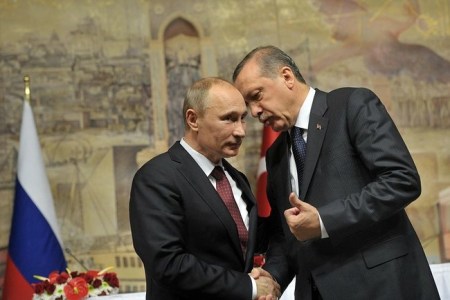
1375Turkish President Recep Tayyip Erdogan is attempting to repair badly damaged relations with Russia, even as he slams his NATO ally, the United States, almost daily, and accuses the U.S. military of supporting the coup attempt against him. Pictured: Russian President Vladimir Putin (left) with Erdogan (then Prime Minister), meeting in Istanbul on December 3, 2012. (Image source: kremlin.ru)

Meanwhile, after the coup attempt, Turkey’s troubled relations with the European Union turned even more troubled. European Commission head Jean-Claude Juncker said that the EU’s deal with Turkey on halting the flow of migrants toward the bloc may collapse. “The risk is big. The success so far of the pact is fragile. President Erdogan has already hinted several times that he wants to scrap it,” Juncker said. It is not just the migrant deal that may entirely suspend Turkey as a candidate country for the EU.

As Western leaders call on Erdogan to respect civil liberties and democracy, Erdogan insists he will consider reinstating the death penalty. “The people have the opinion that these terrorists [coup-plotters] should be killed,” Erdogan said in interview with CNN. “Why should I keep them and feed them in prisons for years to come? That’s what the people say … as the president, I will approve any decision to come out of the parliament.”

Such a move would kill Turkey’s accession process entirely. Federica Mogherini, EU’s foreign policy chief, warned that if Turkey reintroduces the death penalty, it will not be joining the European Union. “Let me be very clear on one thing,” she said; “… No country can become an EU member state if it introduces [the] death penalty.”

The attempted coup not only destabilized NATO’s second largest army and exposed it to the risk of serious operational vulnerabilities; it also left Turkey at risk of engaging in potentially dangerous liaisons with playmates of different kind — Russia and Iran & Co. — at least for now.

Turkey Sets Ultimatum for EU Migrant Deal

August 2, 2016

Turkey Sets Ultimatum for EU Migrant Deal, Gatestone InstituteSoeren Kern, August 2, 2016

(Europe’s assisted suicide. — DM)

♦ Turkey has threatened to back out of an agreement to stem the flow of migrants to the European Union if Turkish nationals are not granted visa-free travel to the bloc by October.

♦ Europe is trapped in a no-win situation. European officials say that although Turkey has fulfilled most of their conditions, it has failed to relax its stringent anti-terrorism laws, which are being used to silence critics of President Erdoğan, especially since Turkey’s failed coup on July 15.

♦ The German newspaper Bild recently reported a confidential plan to house all migrants arriving from Turkey on Greek islands. Public transportation between those islands and the Greek mainland would be cut off to prevent migrants from moving into other parts of the EU.

♦ “No matter how uncouth, how merciless, how unscrupulous Western countries act, they have no chance of keeping the migration flows under control.” — Turkish President Recep Tayyip Erdoğan, quoted by German journalist Wolfram Weimer.

Turkey has threatened to back out of an agreement to stem the flow of migrants to the European Union if Turkish nationals are not granted visa-free travel to the bloc by October.

Although Turkish officials have repeatedly threatened to renege on the March 18 EU-Turkey deal, this is the first time they have set a deadline.

If the EU approves the visa waiver, tens of millions of Turks will gain immediate and unimpeded access to 26 European countries. If the EU rejects the visa waiver, and Turkey retaliates by reopening the migration floodgates, potentially millions of migrants from Africa, Asia and the Middle East could begin flowing into Greece this fall. Europe is trapped in a no-win situation.

The migration deal, which entered into force on June 1, was hastily negotiated by European leaders desperate to gain control over a crisis in which more than one million migrants poured into Europe in 2015.

Under the agreement, the EU pledged to pay Turkey €3 billion ($3.4 billion), grant visa-free travel to Europe for Turkey’s 78 million citizens, and restart accession talks for Turkey to join the bloc. In exchange, Turkey agreed to take back all migrants and refugees who reach Greece via Turkey.

Turkish officials have repeatedly accused the EU of failing to keep its end of the bargain.

In a July 25 interview with the German television broadcaster ARD, Turkish President Recep Tayyip Erdoğan said that Turkey had so far received only €2 million of the promised €3 billion: “European leaders are dishonest,” he said. “We have stood by our promise. But have the Europeans kept theirs?”

The EU insists that the €3 billion must be transferred through the United Nations and other international aid agencies in accordance with strict rules on how the money can be spent: “Funding under the Facility for Refugees in Turkey supports refugees in the country,” the EU said in a statement. “It is funding for refugees and not funding for Turkey.”

In a July 31 interview with the Frankfurter Allgemeine Zeitung, Turkish Foreign Minister Mevlüt Cavusoglu stressed that the Turkish government wants the EU to set a “specific deadline” for lifting the visa requirements: “It can be early or mid-October but we are waiting for an exact date,” he said.

Cavusoglu said that his words are “not a threat,” but added that “if there is no lifting of the visa restrictions, we will be forced to abandon the agreement struck on March 18.”

Under the agreement, European officials promised to fast-track visa-free access for Turkish nationals to the Schengen (open-bordered) passport-free zone by June 30, and to restart Turkey’s stalled EU membership talks by the end of July 2016.

To qualify for the visa waiver, Turkey had until April 30 to meet 72 conditions. These include: bringing the security features of Turkish passports up to EU standards; sharing information on forged and fraudulent documents used to travel to the EU and granting work permits to non-Syrian migrants in Turkey.

European officials say that although Turkey has fulfilled most of their conditions, it has failed to comply with the most important one: relaxing its stringent anti-terrorism laws, which are being used to silence critics of Erdoğan, especially since Turkey’s failed coup on July 15.

European Commissioner Günther Oettinger recently said he did not believe the European Union would grant visa-free travel for Turkish citizens this year due to Erdoğan’s post-coup crackdown.

Turkish authorities have arrested more than 15,000 people in connection with the coup attempt, and at least 60,000 civil servants, teachers, journalists, police officers and soldiers have been fired or suspended from various state-run institutions.

Turkey’s EU accession talks also have run aground after Erdoğan threatened to reinstate the death penalty in Turkey. Oettinger said: “The death penalty is irreconcilable with our order of values and our treaties. No country can become a member state of the EU if it introduces the death penalty.”

Erdoğan has indicated he is no longer interested in EU membership: “We’ll go our way, you go yours,” he said.

Meanwhile, Greek officials report a significant increase in the number of migrants arriving in Greece from Turkey since the coup attempt. Observers say Erdoğan is using the migrant flows to pressure Greece to extradite eight Turkish officers who participated in the coup and fled across the border to Greece. Athens has refused to hand them back.

As the migrant deal unravels, European officials are discussing a “Plan B.” The German newspaper Bild recently reported a confidential plan to house all migrants arriving from Turkey on Greek islands in the Aegean Sea. Public transportation between those islands and the Greek mainland would be cut off to prevent migrants from moving into other parts of the European Union.

The plan, which Bild says is being discussed at the highest echelons of European power, would effectively turn parts of Greece into massive refugee camps for many years to come. It remains unclear whether Greek leaders will have any say in the matter.

The European Union now finds itself in a Catch-22 situation. Large numbers of Muslim migrants will flow to Europe regardless of whether or not the EU approves the visa waiver.

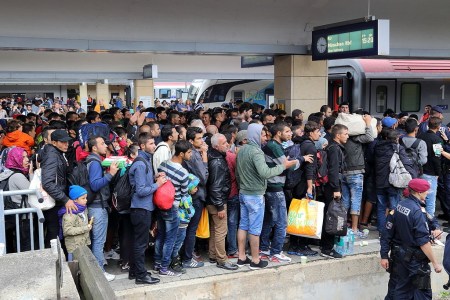
1607 (1)Thousands of newly arrived migrants, the vast majority of whom are men, crowd the platforms at Vienna West Railway Station on August 15, 2015 — a common scene in the summer and fall of 2015. (Image source: Bwag/Wikimedia Commons)

Critics of visa liberalization fear that millions of Turkish nationals may end up migrating to Europe. The Austrian newsmagazine, Wochenblick, recently reported that 11 million Turks are living in poverty and “many of them are dreaming of moving to central Europe.”

Other analysts believe Erdoğan views the visa waiver as an opportunity to “export” Turkey’s “Kurdish Problem” to Germany. According to Bavarian Finance Minister Markus Söder, millions of Kurds are poised to take advantage of the visa waiver to flee to Germany to escape persecution at the hands of Erdoğan: “We are importing an internal Turkish conflict,” he warned. “In the end, fewer migrants may arrive by boat, but more will arrive by airplane.”

In a refreshingly perceptive essay, Wolfram Weimer, a well-known German journalist, wrote that Erdoğan is exploiting Europe’s strategic weaknesses to advance Turkish imperialism and his goal of Islamizing the continent:

“A few days ago Erdoğan said: ‘No matter how uncouth, how merciless, how unscrupulous Western countries act, they have no chance of keeping the migration flows under control.’ In short, he sees mass migration as a political weapon to put Europe under pressure. In diplomatic and military circles, the word that has been circulating for months is ‘migration weapon’ because the Turkish secret service has been deliberately and massively promoting the migration of Muslims to Europe.

“Turkey now earns tremendous amounts of money on all sorts of migration services and has allowed the refugee industry to blossom. At the same time Erdoğan is openly pursuing the Islamization of Europe. With its religious authority Diyanet [a branch of the Turkish government’s Directorate for Religious Affairs that runs hundreds of mosques in Europe], Europe (and especially Germany) are being Islamized in a planned manner; the refugees play a key role, as do mosques, to give a ‘home’ to the faithful in a foreign land.

“Erdoğan’s favorite quote comes from a poem by Ziya Gökalp [1876-1924, a father of Turkish nationalism]: ‘The mosques are our barracks, the minarets are our bayonets.’ Erdoğan sees himself both domestically and internationally as a religious cultural warrior — as the patron saint of Islamist expansion.”

Turkey’s Tradition of Murdering Christians

July 31, 2016

Turkey’s Tradition of Murdering Christians, Gatestone InstituteRobert Jones, July 31, 2016

(Please see also, Turkey’s Erdogan to US General: ‘Know Your Place’, which deals in large part with the U.S. relationship with Turkey. Turkey is “our” NATO ally and its membership in the European Union is still under consideration. — DM)

♦ Turkey’s countless agreements with Western organizations do not seem to have reduced the hatred for Christians there.

♦ In Turkey, it is “ordinary people” who murder or attack Christians, then the judiciary or political system somehow find a way of enabling the perpetrators to get away with the crimes. Most of these crimes are not covered by the international media and Turkey is never held responsible.

♦ While Muslims are pretty much free to practice their religion and express their views on other religions anywhere in the world, Christians and other non-Muslims can be killed in Turkey and other Muslim-majority countries just for attempting peacefully to practice their religion or openly express their views.

♦ “Multiculturalism,” which is passionately defended by many liberals in the West, could have worked wonders in multi-ethnic and multi-religious places such as Anatolia. But unfortunately, Islamic ideology allows only one culture, one religion, and one way of thinking under their rule: Islam. Ironically, this is the central fact these liberals do not want to see.

On 26 July, the northern French town of Saint-Étienne-du-Rouvray witnessed a horrific Islamist attack: Two Islamic State (ISIS) terrorists killed an 85-year-old priest, Jacques Hamel, in his church during Mass. Two nuns and two churchgoers were taken hostage.

The terrorists, who had pledged allegiance to ISIS and, shouting “Allahu Akbar”, slit the throat of the priest and captured the bloody episode on video, according to a nun who escaped the assault.

Such Islamist attacks might be new to EU member countries but not to Turkey. For decades, so many innocent, defenseless Christians in Turkey have been slaughtered by Muslim assailants.

Christians in Turkey are still attacked, murdered or threatened daily; the assailants usually get away with their crimes.

In Malatya, in 2007, during the Zirve Bible Publishing House massacre, three Christian employees were attacked, severely tortured, then had their hands and feet tied and their throats cut by five Muslims on April 18, 2007.

Nine years have passed, but there still has been no justice for the families of the three men who were murdered so savagely.

First, the five suspects who were still in detention were released from their high-security prison by a Turkish court, which ruled that their detention exceeded newly-adopted legal limits.

The trial is still ongoing. The prosecutor claims that the act “was not a terrorist act because the perpetrators did not have a hierarchic bond, their act was not continuous and the knives they used in the massacre did not technically suffice to make the act be regarded as a terrorist act.”

If the court accepts this legal opinion of the prosecutor, it could pave the way for an acquittal. However, given the many “mysterious” rulings of the Turkish judiciary system to acquit criminals, these killers could also be acquitted by a “surprise” ruling any time.

Ironically, Turkey’s President Recep Tayyip Erdogan said in March that it is necessary to redefine terrorism to include those who support such acts, adding that they could be journalists, lawmakers or activists. There was no difference, he said, between “a terrorist holding a gun or a bomb and those who use their position and pen to serve the aims” of terrorists.

In a country where state authorities are outspokenly so “sensitive” about “terrorism” and “people holding guns,” why are the murderers of Christians not in jail, and why is the prosecutor trying to portray the murders of Christians as “non-terroristic acts”?

Sadly, the three Christians in Malatya were neither the first nor the last Christians to be murdered in Turkey.

On February 5, 2006, Father Andrea Santoro, a 61-year-old Roman Catholic priest, was murdered in the Santa Maria Church in the province of Trabzon. He was shot while kneeling in prayer at his church. Witnesses heard the 16-year-old murderer shout “Allahu Akbar” (“Allah is the Greatest”) during the murder.

After the murder, a 74-year-old priest, Father Pierre François René Brunissen, from Samsun, led the next church service in Santoro’s church, which boasted barely a dozen members. Because no one volunteered to replace Santoro, Father Pierre was instructed to travel from Samsun to Trabzon each month to care for the city’s small congregation.

“This is a terrible incident,” Father Pierre said. “It is a sin to kill a person. After all of these incidents, I am worried about my life here.”

In July, 2006, he was stabbed and wounded by a Muslim in Samsun. The perpetrator, 53, said that he stabbed the priest to oppose “his missionary activities.”[1]

The attacks against the Christian culture in Anatolia continue in modern times — even after Turkey joined the Council of Europe in 1949 and NATO in 1952.

Turkey’s countless agreements with Western organizations do not seem to have reduced the hatred for Christians there. In March, 2007, as the Christian community of Mersin was preparing for the Easter, a young Muslim man with a kebab knife entered the church and attacked the priests, Roberto Ferrari and Henry Leylek.

Mersin, in southern Turkey, is home to Tarsus, the birthplace of Saint Paul, and to several churches dating from the earliest Christian era.

As the Christian roots of Anatolia weakened, so did its bonds with Western civilization. “The attack against the priest is an indicator that Ankara is not ready for Europe,” a Roman Catholic Cardinal and theologian, Walter Kasper, told the Italian newspaper, Corriere della Sera. “There is some amount of tolerance but there is not real freedom. Turkey has to change many things. This change is not about laws. A change of mentality is needed. But you cannot change mentality in one day.”

Bishop Luigi Padovese, Apostolic Vicar of Anatolia, said: “We do not feel safe. I am very worried. Fanaticism is developing in some groups. Some people want to poison the atmosphere and catholic priests are targeted. Anti-missionary films are broadcast on TV channels.”

At a commemorative ceremony for Father Santoro in February, Bishop Padovese said:

“Today, we are asking the question we asked four years ago: Why? We are also asking the same question for all other victims so unjustly murdered even though they were innocent. Why? What was it that they tried to destroy by murdering Father Andrea? Just a person or what that person represented? The aim of shooting Father Andrea was definitely to shoot a Catholic cleric. His being a Father became the reason of his martyrdom.

“The message of Christ on the cross is clear. ‘Father, forgive them, for they do not know what they do.’ Had they known, they would not have done that. It is wrong to extinguish a life to uphold an idea. It is wrong to think that a person who disagrees with us is at fault and should be destroyed. This is the fundamentalism that crumbles a society. For it wrecks coexistence. This fundamentalism — regardless of what religion or political view it belongs to — might win a few battles but it is doomed to lose the war. This is what history teaches us. I hope that this city and this country will turn into a place where people can live as brothers and sisters and unite for the common good for all. Is the Allah of all of us not the same?”

No, unfortunately, the Allah of all of us is not the same.

Just four months later, in June, 2010, it was Padovese’s turn to be murdered. This time the murderer was the Bishop’s own driver for the previous four years. The driver first stabbed the bishop, then cut his throat, while shouting “Allahu Akbar” during the attack.

At the trial, the driver said that the bishop was “Masih ad-Dajjal” (“the false messiah”), then twice in the courtroom he loudly recited the adhan (Islamic call to worship).

1737 (1)Father Andrea Santoro (left), a 61-year-old Roman Catholic priest, and 63-year-old Bishop Luigi Padovese (right), Apostolic Vicar of Anatolia, were two Christian priests murdered in Turkey in recent years.

In the territory where Christians once thrived, even converting to Christianity now creates serious problems.

“New Christians coming from Muslim families are often isolated and ostracized,” writes Carnes. “Turgay Ucal, a pastor of an independent church in Istanbul, who converted from Islam to Christianity said: “Buddhism is okay, but not Christianity. There was a history.”

And this history includes how indigenous Christians in Anatolia have been slaughtered by Muslims. [2]

The total population of Turkey is about 80 million; believers of non-Muslim faiths — mostly Christians and Jews — comprise 0.2%. Nevertheless, anti-Christian sentiment is still prevalent in much of the Turkish society. [3]

There seems to be a pattern: Murders of Christians are committed stealthily in Turkey: It is “ordinary people” who murder or attack Christians, then the judiciary or political system somehow finds a way of enabling the murderers or attackers to get away with what they have done. Sadly, most of these crimes are not covered by the international media, and Turkey is never held responsible.

Turkey, however, signed a Customs Union agreement with the European Union in 1995 and was officially recognized as a candidate for full membership in 1999. Negotiations for the accession of Turkey to the EU are still ongoing.

How come a nation that has murdered or attacked so many Christians throughout history, and which has not even apologized for these crimes, is considered even a suitable candidate for EU membership? Because of the threat of blackmail to flood Europe with Muslims? Turkey will flood Europe with them anyway. There is even a name for it: Hijrah, spreading Islam (jihad) by emigration. Exactly as Muslims have done inside Turkey.

And what kind of a culture and civilization have many Muslims built for the most part in the lands that they have conquered? When one observes the historical and current situation in Muslim-majority countries, what one mostly sees are murders, attacks and hatred: Hatred of non-Muslims, hatred of women, hatred of free thought and an extremely deep hatred of everything that is not Islamic. Many Muslims that have moved to the West have been trying to import political Islam to the free world, as well.

Muslim regimes including Turkey have not achieved civilized democratization that would enable all of their citizens — Muslims and non-Muslims — to live free and safe lives.

While Muslims are pretty much free to practice their religion and express their views on other religions or on atheism anywhere in the world, Christians and other non-Muslims can be killed in Turkey and other Muslim-majority countries just for attempting peacefully to practice their religion or openly express their views.

“Multiculturalism,” which is passionately defended by many liberals in the West, could have worked wonders in multi-ethnic and multi-religious places such as Anatolia. But unfortunately, Islamic ideology allows only one culture, one religion, and one way of thinking under their rule: Islam. Ironically, this is the central fact these liberals do not want to see.

Much of the history of Islam shows that the nature of Islamic ideology is to invade or infiltrate, and then to dominate non-Muslims.

In general, Muslims have never shown the slightest interest in peaceful coexistence with non-Muslims. Even if most Muslims are not jihadis, most do not speak out against jihadist attacks. Many thus appear quietly to support jihadis. That there are also peaceful Muslim individuals who respect other faiths does not change this tragic fact.

That is why non-Muslims in the West have every right to fear one day being exposed to the same treatment at the hands of Muslims. The fear non-Muslims have of Islamic attacks is, based on recent evidence, both rational and justified.

Given how unspeakably non-Muslims are treated in majority Muslim countries, including Turkey, who can blame them for being concerned about the possible Islamization of their own free societies?

Why does Turkey, which seems to hate its own Christians, want to have visa-free access to Christian Europe, anyway?

____________________________


[1] Christianity has a long history in Samsun – as in all other Anatolian towns. As Amisos, in Greek, it was one of the centers of the ancient Greek Pontos region, and helped spread the Christian influence in the region.

“After 1914 the Greek and Armenian populations were to dwindle considerably due to the organized death marches and other methods used by the Turks during the Greek and Armenian Genocides,” according to “Pontos World.”

Decades later, attacks against Christians are still commonplace. In December 2007, another Catholic priest, Adriano Franchini, 65, of Izmir was also stabbed and wounded during the Sunday church service by a 19-year-old Muslim.

Izmir, or Smyrna, was an ecclesiastical territory of the Ecumenical Patriarchate of Constantinople, and one of the Seven Churches of Asia mentioned by Apostle John in the Book of Revelation.

During the Ottoman era, Smyrna hosted one of the largest populations of Greeks and Armenians. Today, there is only a tiny Christian minority in the city. The devastation of the Greek culture in the city peaked during what is commonly known as the “Catastrophe of Smyrna.” The Turkish army destroyed the city in 1922, after the Great Fire of Smyrna. Turkish soldiers murdered many non-Muslim civilians, including dozens of priests and bishops, and forced countless Greek men to join labor battalions. Most Greeks fled their homes in the city to seek shelter in Greece and other states.

“The Great Fire of Smyrna,” wrote the author Ioanna Zikakou, “was the peak of the Asia Minor Catastrophe, bringing an end to the 3,000-year Greek presence on Anatolia’s Aegean shore and shifting the population ratio between Muslims and non-Muslims.”

According to the journalist Tony Carnes:

“Few nations have as rich a Christian history as Turkey. This is where Paul founded some of the earliest churches, including the church at Ephesus. Seven churches in this region were addressed in the Book of Revelation. Those in the early monastic movement found the caves of Cappadocia a near-perfect place to live out lives of prayer.

“But Christianity came under Islamic rule in Turkey in 1453 and steadily declined for centuries; the last 100 years have been the worst. In 1900, the Christian population was 22 percent. Now most experts estimate that there are fewer than 200,000 Christians nationwide, comprising less than 0.3 percent of the population.”

Today, in Islamized Anatolia, the members of the diminutive Christian minority are daily exposed to verbal or physical attacks. Kamil Kiroglu was born and raised in Turkey as a Muslim. At the age of 24, he became a Christian and served in the Turkish Church until 2009. After he became Christian, he was rejected by his family.

On January 8, 2006, Kiroglu was beaten unconscious by five young Muslim men.

“The attack followed church services,” writes the scholar John L. Allen Jr. in his book, The Global War on Christians. “Kiroglu later reported that one of the young men, wielding a knife, had shouted, ‘Deny Jesus or I will kill you now!’ Another reportedly shouted, ‘We do not want Christians in this country!’ As the attackers left, they told a friend of Kiroglu’s that they had left a gift for him. It turned out to be a three-foot-long curved knife, left behind as a further warning against Christian activity.”

“Turkey may be an officially secular state, but sociologically it’s an Islamic society. In general, the greatest threat facing Christians comes not from religiously zealous forms of Islam but from ultranationalists who see Christians as agents of the West, often accusing them of being in league with Kurdish separatists.”

In 2009, Bartholomew I of Constantinople, the Orthodox Christian Church’s Patriarch, said in aninterview with CBS that Turkey’s Christians were second-class citizens and that he felt “crucified” at the hands of Turkish state authorities.

[2] “The annihilation of the non-Turk/non-Muslim peoples from Anatolia started on April 24, 1915, with the arrest of 250 Armenian intellectuals in Istanbul,” wrote the columnist Raffi Bedrosyan.

“Within a few months, 1.5 million Armenians had been wiped out from their historic homeland of 4,000 years in what is now eastern Turkey, as well as from the northern, southern, central, and western parts of Turkey. About 250,000 Assyrians were also massacred in southeastern Turkey during the same period. Then, it was the Pontic Greeks’ turn to be eliminated from northern Turkey on the Black Sea coast, sporadically from 1916 onward.”

Orhan Picaklar, the pastor of the Samsun Agape Church, was kidnapped and threatened by Muslim locals in 2007. He said that people also tried to kidnap his 11-year-old son from his school. His church has been stoned countless times. Ahmet Guvener, the pastor of the Diyarbakir Protestant Church, said he received so many threats that he was awaiting death: “I will give a letter of attorney to a friend of mine. If I die, I want him to take care of my children.”

[3] See the yearly reports of the Association of Protestant Churches about rights abuses against Christians in Turkey.

Obama administration mum as Turkey’s post-coup crackdown expands

July 23, 2016

Obama administration mum as Turkey’s post-coup crackdown expands, Fox News, Christiana Licata, July 23, 2016

Turkey festersVan Hipp: Turkey had been festering, but Obama admin asleep

The Obama administration’s relative silence on Turkey’s alarming crackdown following last week’s failed coup attempt is tantamount to a green light for President Recep Tayyip Erdogan to continue his assault on democracy in the NATO nation, experts said.

Questioned about Erdogan’s ongoing roundup of some 50,000 academics, judges, teachers, soldiers and civil servants, and the declaration Wednesday of a state of emergency, a State Department official earlier this week meekly warned against “overreach.”

“I cannot overstate the sense of the Turkish government and the Turkish people right now that they truly felt and truly feel under threat,” State Department spokesman Mark Toner told an Associated Press reporter at a department briefing. “We support completely the efforts to bring the perpetrators of the coup to justice. We just also caution against any kind of overreach that goes beyond that.”

But when pressed, Toner declined to characterize the arrest, firing or suspension of the tens of thousands of Turkish government workers as “overreach.”

Erdogan’s government, which blames U.S.-based cleric Fethullah Gulen for inciting the coup attempt, in which more than 200 people were killed and members of the military briefly commandeered tanks, aircraft and communications channels, has reacted with a vengeance.

The state of emergency gives Erdogan and his cabinet new powers to implement laws without parliamentary approval. It also allows Ankara to censor media broadcasts, search citizens, impose curfews and restrict gatherings both public and private.

Erdogan has simultaneously demanded the U.S. hand over Gulen, a onetime Erdogan ally who lives in a Pennsylvania mountain compound and runs a profitable chain of Islamic charter schools. Secretary of State John Kerry has said the department is considering the request, but it remains unclear what evidence Erdogan’s administration has provided.

Former U.S. Ambassador to the United Nations John Bolton said the crackdown shows Erdogan is taking advantage of the failed coup to further strengthen his grip on power. The strongman, who has ruled Turkey as either president or prime minister since 2001, has been steadily stripping the long proudly secular nation of its constitutional freedoms and increasingly adopted Islamist rhetoric.

“When he was mayor of Istanbul 20 years ago, he said democracy is like a street car — you ride it to the stop you want and then you get off,” Bolton said of Erdogan. “This will enable him to pursue his objective of Islamisizing the Turkish government and overturning the secular constitution. That’s what’s underway. I don’t think there’s much question about it.”

Bolton said that the Obama administration appears to have done “very little” to pressure Turkey to ease up on its people, either publicly or behind the scenes. That gives Erdogan all the encouragement he needs, Bolton said.

“The situation will continue to deteriorate as Erdogan arrests more people and puts them in jail,” he said.

The European Union has more aggressively sought to rein in the crackdown, with two EU officials warning Thursday that Turkey’s declaration of a state of emergency had led to “unacceptable decisions on the education system, judiciary and the media.”

“We call on Turkish authorities to respect under any circumstances the rule of law, human rights and fundamental freedoms, including the right of all individuals concerned to a fair trial,” EU high representative Federica Mogherini and commissioner Johannes Hahn said in a statement.

Ahmet Yayla, who was chairman of the sociology department at Harran University and a former police chief in Turkey, said many of those being rounded up in Turkey include the Muslim nation’s bulwark against terrorism.  Police, soldiers and judges deemed disloyal to Erdogan have been detained, leaving a diminished human infrastructure to deal with security threats, he said.

“Those are the people who were fighting against terrorism in Turkey,” said Yayla, who fled to the U.S.  eight months ago when ISIS threatened his life for interrogating terrorist defectors.

Yayla said Erdogan’s dangerous dance with ISIS – tacitly supporting the terror group and allowing foreign fighters to pass through Turkey on their way to the terrorist army’s caliphate – could combine with the post-coup unrest to threaten the nation’s stability.

“In the near future, Turkey will face a lot of danger coming from terrorism because the newly appointed officers in the military and police are not going to be able to fight or deal with terrorism threats that exist in the country, especially by Erdogan’s allowing the terrorists inside the country,” he said.


France: The Coming Civil War

July 16, 2016

France: The Coming Civil War, Gatestone InstituteYves Mamou, July 16, 2016

♦ For French President François Hollande, the enemy is an abstraction: “terrorism” or “fanatics”.

♦ Instead, the French president reaffirms his determination to military actionsabroad: “We are going to reinforce our actions in Syria and Iraq,” the president said after the Nice attack.So confronted with this failure of our elite who were elected to guide the country across nationals and internationals dangers, how astonishing is it if paramilitary groups are organizing themselves to retaliate?

♦ “Western elites, with a suicidal obstinacy, oppose naming the enemy. Confronted with attacks in Brussels or Paris, they prefer to imagine a philosophical fight between democracy and terrorism, between an open society and fanaticism, between civilization and barbarism”. — Mathieu Bock-Côté, sociologist, in Le Figaro

♦ In France, the global elites made a choice. They decided that the “bad” voters in France were unreasonable people too stupid to see the beauties of a society open to people who often who do not want to assimilate, who want you to assimilate to them, and who threaten to kill you if you do not.

♦ Similarly, the British took the first tool that was given to them to express their disappointment at living in a society they did not like anymore. They did not vote to say: “Kill all these Muslims who are transforming my country or stealing my job or soaking up my taxes”. They were just protesting a society that a global elite had begun to transform without their consent.

♦ The global elite made a choice: they took the side against their own old and poor because those people did not want to vote for them any longer. They also made a choice not to fight Islamism because Muslims vote collectively for this global elite.


1697French police shoot dead a Tunisian-born Islamist terrorist who murdered 84 people in Nice, France, July 14, 2016. (Image source: Sky News video screenshot)

“We are on the verge of a civil war.” That quote did not come from a fanatic or a lunatic. No, it came from head of France’s homeland security, the DGSI (Direction générale de la sécurité intérieure), Patrick Calvar. He has, in fact, spoken of the risk of a civil war many times. On July 12th, he warned a commission of members of parliament, in charge of a survey about the terrorist attacks of 2015, about it.

In May 2016, he delivered almost the same message to another commission of members of parliament, this tme in charge of national defense. “Europe,” he said, “is in danger. Extremism is on the rise everywhere, and we are now turning our attention to some far-right movements who are preparing a confrontation”.

What kind of confrontation? “Intercommunity confrontations,” he said — polite for “a war against Muslims.” “One or two more terrorist attacks,” he added, “and we may well see a civil war.”

In February 2016, in front of a senate commission in charge of intelligence information, he said again: ” We are looking now at far-right extremists who are just waiting for more terrorist attacks to engage in violent confrontation”.

No one knows if the truck terrorist, who plowed into the July 14th Bastille Day crowd in Nice and killed more than 80 people, will be the trigger for a French civil war, but it might help to look at what creates the risk of one in France and other countries, such as Germany or Sweden.

The main reason is the failure of the state.

1. France is at War but the Enemy is Never Named.

France is the main target of repeated Islamist attacks; the more important Islamist terrorist bloodbaths took place at the magazine Charlie Hebdo and the Hypercacher supermarket of Vincennes (2015); the Bataclan, its nearby restaurants and the Stade de France stadium, (2015); the failed attack on theThalys train; the beheading of Hervé Cornara (2015); the murders at a school in Toulouse (2012); the three week torture and murder of young Ilan Halimi (2006); the assassination of two policemen in Magnanville in June (2016), and now the truck-ramming in Nice, on the day commemorating the French Revolution of 1789.

Most of those attacks were committed by French Muslims: citizens on their way back from Syria (the Kouachi brothers at Charlie Hebdo), or by French Islamists (Larossi Abballa who killed a police family in Magnanville last June) who later claimed their allegiance to Islamic State (ISIS). The truck killer in Nice was also French, of Tunisian descent, living quietly in Nice until he decided to murder more than 80 people and wound dozens more.

At each of these tragic episodes, the head of state, President François Hollande, refused to name the enemy, refused to name Islamism — and especially refused to name French Islamists — as the enemy of French citizens.

For Hollande, the enemy is an abstraction: “terrorism” or “fanatics”. Even when the president does dare to name “Islamism” the enemy, he refuses to say he will close all Salafist mosques, prohibit the Muslim Brotherhood and Salafist organizations in France, or ban veils for women. No, instead, the French president reaffirms his determination for military actions … abroad: “We are going to reinforce our actions in Syria and Iraq,” the president said after the Nice attack.

For France’s head of state, the deployment of soldiers on the national ground is for defensive actions only: a dissuasive policy, not an offensive rearmament of the Republic against an internal enemy.

So confronted with this failure by our elite — who were elected to guide the country across national and international dangers — how astonishing is it if paramilitary groups are organizing themselves to retaliate?

As Mathieu Bock-Côté, a sociologist in France and Canada says in Le Figaro: “Western elites, with a suicidal obstinacy, oppose naming the enemy. Confronted by attacks in Brussels or Paris, they prefer to imagine a philosophical fight between democracy and terrorism, between an open society and fanaticism, between civilization and barbarism”.

2. The Civil War Has Already Begun and Nobody Wants to Name It.

The civil war began sixteen years ago, with the second Intifada. When Palestinians invented suicide attacks in Tel Aviv and Jerusalem, French Muslims began to terrorize Jews living peacefully in France. For sixteen years, Jews — in France —were slaughtered, attacked, tortured and stabbed by French Muslim citizens supposedly to avenge Palestinian people in the West Bank.

When a group of French citizens who are Muslims declares war on another group of French citizens who are Jews, what do you call it?

For the French establishment, it is not a civil war, just a regrettable misunderstanding between two “ethnic” communities.

Until now, no one has wanted to establish a connection between these attacks and the murderous attack in Nice against people who were not necessarily Jews — and name it as it should be named: a civil war.

For the very politically correct French establishment, the danger of a civil war will begin only if anyone retaliates against French Muslims; if everyone just submits to their demands, everything is all right. Until now, no one thinks that the terrorist attacks against Jews by French Muslims; against Charlie Hebdo’s journalists by French Muslims; against an entrepreneur who was beheaded a year ago by a French Muslim; against young Ilan Halimi by a group of Muslims; against schoolchildren in Toulouse by a French Muslim; against the passengers on the Thalys train by a French Muslim, against the innocent people in Nice by a French Muslim were the symptoms of a civil war. These bloodbaths remain, still today something like a climatic catastrophe, a kind of tragic mistake.

3- The French Establishment Considers the Enemy the Poor the Old and the Disappointed

In France, who most complains about Muslim immigration? Who most suffers from local Islamism? Who most likes to drink a glass of wine or eat a ham-and-butter sandwich? The poor and the old who live close to Muslim communities, because they do not have the money to move someplace else.

Today, as a result, millions of the poor and the old in France are ready to elect Marine Le Pen, president of the rightist Front National, as the next president of the Republic for the simple reason that the only party that wants to fight illegal immigration is the Front National.

Because, however, these French old and poor want to vote for the Front National, they have become the enemy of the French establishment, right and left. What is the Front National saying to these people? “We are going to restore France as a nation of French people”. And the poor and the old believe it – because they have no choice.

Similarly, the poor and the old in Britain had no choice but to vote for Brexit. They took the first tool given them to express their disappointment at living in a society they did not like anymore. They did not vote to say, “Kill these Muslims who are transforming my country, stealing my job and soaking up my taxes”. They were just protesting a society that a global elite had begun to transform without their consent.

In France, the global elites made a choice. They decided that the “bad” voters in France were unreasonable people too stupid to see the beauties of a society open to people who often who do not want to assimilate, who want you to assimilate to them, and who threaten to kill you if you do not.

The global elites made another choice: they took the side against their own old and poor because those people did not want to vote for them any longer. The global elites also chose not to fight Islamism, because Muslims vote globally for the global elite. Muslims in Europe also offer a big “carrot” to the global elite: they vote collectively.

In France, 93% of Muslims voted for the current president, François Hollande, in 2012. In Sweden, the Social Democrats reported that 75% of Swedish Muslims voted for them in the general election of 2006; and studies show that the “red-green” bloc gets 80-90% of the Muslim vote.

4. Is the Civil War Inevitable? Yes!

If the establishment does not want to see that civil war was already declared by extremist Muslims first — if they do not want to see that the enemy is not the Front National in France, the AfD in Germany, or the Sweden Democrats — but Islamism in France, in Belgium, in Great Britain, in Sweden — then a civil war will happen.

France, like Germany and Sweden, has a military and police strong enough to fight against an internal Islamist enemy. But first, they have to name it and take measures against it. If they do not — if they leave their native citizens in despair, with no other means than to arm themselves and retaliate – yes, civil war is inevitable.


Brexit Disrupts Nonchalant European Union Meddling

July 13, 2016

Brexit Disrupts Nonchalant European Union Meddling, Gatestone InstituteMalcolm Lowe, July 13, 2016

♦ In respect of the Palestinian problem, the European political elites have only the means to destabilize the status quo without installing an alternative. But Israel’s leaders can take heart. Any declarations made at French President François Hollande’s conference will be unenforceable, because the EU on its own lacks the means and because its energies must now focus on stopping its own disintegration.

♦ The underlying reasons for Brexit and for EU disintegration in general have still not been widely understood. Brexit was not merely a vote of no confidence in the EU but also in the UK establishment. Similar gaps between establishment and electorate now exist in several other major European states. In some cases, however, governments are united with their electorates in detesting the EU dictatorship in Brussels.

The June 23 vote by the United Kingdom electorate to leave the European Union should be seen in the context of two other recent European events. Three days earlier, on June 20, the EU’s Foreign Ministers Council decided to solve the Palestinian problem by Christmas with its endorsement of French President François Hollande’s “peace initiative.” Three days after the vote, on June 26, the second election in Spain within a few months failed once again to produce a viable majority for any government. Worse still, the steadily rising popularity of nationalist parties in France, Germany, Austria and the Netherlands suggests that political paralysis in other EU countries is on the way.

In short, the ambitions of the ruling political cliques of Europe to solve the problems of the world are being undermined by their own neglected electorates, which are increasingly furious at the failure of those cliques to solve the problems of Europe itself. Four years ago, we wrote about Europe’s Imminent Revolution. Two years ago, about the attempt and failure of those cliques to turn the EU into a make-believe copy of the United States. Today, that revolution is creeping ahead month by month.

Before threatening Israel’s security and local supremacy, the EU foreign ministers could have recalled the results of their previous nonchalant meddling in the area. We were all rightly horrified by the threat of Muammar Gaddafi to hunt down his enemies “street by street, house by house,” as he began by shooting hundreds in his capital, in February 2011. Hollande’s predecessor, Nicolas Sarkozy, rallied European leaders — first and foremost the UK’s David Cameron — to do something about it. President Obama turned up to give a speech, something that he is good at. More importantly, Obama supplied warplanes from the NATO base in Naples. The idea was to enable victory for the Libyan rebel forces by paralyzing Gaddafi’s own air force and bombing his land forces.

Victory was achieved. But the rebels were united only in their hatred of Gaddafi. So Libya has descended into a chaos that could have been prevented only by a massive long-term presence of European land forces, which Europe — after repeated cuts in army strength — does not have. Now it is the local franchise of the Islamic State, among others, that is hunting down enemies house by house.

Europe was incapable of achieving anything in Libya without the United States, and incapable of replacing a detestable regime with a superior alternative. The lesson could have been learned from Iraq. Here, a massive American military presence accompanied a constitutional revolution and the beginnings of parliamentary rule. But the whole costly achievement collapsed when Obama decided to remove even the residual military presence needed to perpetuate it.

In respect of the Palestinian problem, too, the European political elites have only the means to destabilize the status quo without installing an alternative. But Israel’s leaders can take heart. At Hollande’s conference in December, the UK will be half in and half out, if present at all. Neither Obama nor his by then elected successor will turn up to make a speech. Any declarations made at Hollande’s conference will be unenforceable because the EU on its own lacks the means and because its energies must now focus on stopping its own disintegration.

Of the authors of the Libyan adventure, David Cameron resigned after the vote for Brexit. Obama will shortly leave after what may charitably be called a mixed record in foreign affairs. Sarkozy’s aspiration to be reelected and succeed the unpopular Hollande, whose approval rate is now just 12%, has been challenge by a recent French court decision.

Sarkozy was trying to sue Mediapart, a French investigative agency, for publishing a letter of 2007 from Gaddafi’s intelligence chief about an “agreement in principle to support the campaign for the candidate for the presidential elections, Nicolas Sarkozy, for a sum equivalent to Euro 50 million.” (The maximum individual contribution permitted in French law is 1500 euros.) The judges investigating the corruption case against Sarkozy have ruled that the letter is genuine. The suspicion, then, is that Sarkozy’s campaign to eliminate Gaddafi was at least partly motivated by the need to eliminate the supplier of a bribe.

The underlying reasons for Brexit and for EU disintegration in general have still not been widely understood. Brexit was not merely a vote of no confidence in the EU but also in the UK establishment. Out of 650 members in the House of Commons, only around 150 — nearly all Conservatives — are estimated to have voted for Brexit. Against Brexit was also a clear majority of leading figures in commerce, academia and the churches. Similar gaps between establishment and electorate now exist in several other major European states. In some cases, however, governments are united with their electorates in detesting the EU dictatorship in Brussels.

That glaring discrepancy between the UK establishment and the electorate explains the establishment’s quick acceptance of Brexit, for fear of becoming totally discredited. A contributory reason was the broad consensus on both sides of the debate that the operative style of EU institutions is deeply flawed and often detrimental to UK interests. The concessions obtained by Cameron from the EU before the vote were widely regarded as derisory. Moreover, the President of the European Parliament, Martin Schulz, had loudly proclaimed that he could obtain a vote to cancel those concessions. The real issue, therefore, was whether a Remain vote could help to reform the EU, in cooperation with other member states, or whether the EU was fundamentally unreformable. The UK electorate decided for the latter view and the establishment is committed to implementing it.

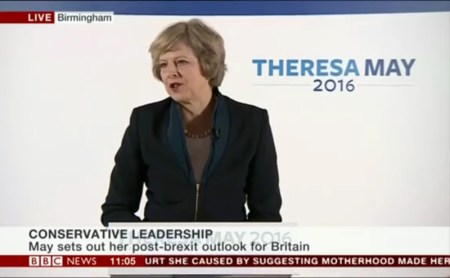
1693The glaring discrepancy between the UK establishment and the electorate explains the establishment’s quick acceptance of Brexit, for fear of becoming totally discredited. Pictured above: Theresa May launches her campaign for leader of the UK Conservative party on July 11, 2016, saying “Brexit means Brexit.”

The two earlier articles mentioned above first spotted the phenomenon of European disintegration and then explained it. Today, the intervening events have made the explanation all the simpler. Basically, the European political elites were correctly convinced, long ago, that considerable European integration was desirable, but their very successes in this area made them grossly overestimate what could and should be done further.

Up to a decade ago, it seemed that a similar pattern was becoming established in one EU country after another: the parliament was dominated by a large center-right party and a large center-left party that alternated in power from one election to another. The parallel to the United States seemed obvious, but the parallel was illusory, as we shall show.

Emboldened, the political parties concerned made the fatal mistake of trying to combine for the purpose of elections to the EU Parliament. Thus emerged a pan-European center-right pseudo-party, the “European People’s Party” (EPP), whose origins go back to a get-together of Christian Democrat parties in 1976. And a pan-European center-left pseudo-party, the “Party of European Socialists” (PES), founded in 1992 as an alliance between old-style Social Democrat parties and the former so-called Eurocommunist parties. The latter first emerged during the decline and discreditation of the Soviet Union in the 1970s and 1980s, then changed their names after its disappearance in December 1991. Thus, the core of Italy’s current Democratic Party derives from the Italian Communist Party (PCI), the major opposition party of post-war Italy.

Curiously but inevitably, the more those parties tried to unite, the more they lost support in their own countries of origin. Thus the Dutch Christian Democrats (CDA) are today a minor party of the right and the Panhellenic Socialist Movement (PASOK) barely crosses the threshold of 5% needed for entry into the Greek Parliament. (Incongruously, the last PASOK Prime Minister of Greece, George Papandreou, continues to be President of the Socialist International.) The reason for this development, however, is not far to seek.

Nationalism, it was forgotten, is an essential component of center-right sentiment. So a center-right party that prefers an international interest at the expense of the national interest of its own country loses credibility among its own core supporters; it becomes vulnerable to the rise of far-right upstart parties. Examples of this process in the EU are now so evident as not to need enumeration.

The attraction of socialism, it was forgotten, is that its core supporters expect increases in government social spending at the expense of financial stability. This becomes more difficult, the more a country is constrained by participation in a shared international framework. It becomes impossible to maintain once a country joins a common currency, since the usual remedy for socialist overspending is devaluation of the national currency. This is why PASOK has been eclipsed in Greece by the far-left SYRIZA, why the Spanish franchise of the PES (the PSOE) has lost severely to the upstart Podemos, and why support for its Dutch franchise (the PvdA) is now down to about the same as for each of two other left-wing parties.

It is also why in Britain, where the electoral system obstructs the rise of new parties, Jeremy Corbyn was voted leader by the Labour Party membership to the horror of the party establishment. Corbyn himself was a pronounced Euroskeptic until recently and only half-heartedly spoke in public for Remain, creating suspicions that he secretly voted for Leave.

A far-right party, like the Freedom Party (OFP) of Austria, has an easy sales pitch. Not so the far-left ones: after they come to power, it quickly and painfully becomes evident that they have no more ability than their derided Social Democrat predecessors to defy the constraints imposed by membership in the Eurozone.

Thus SYRIZA came to power in Greece and won a referendum to end austerity. The result was that all Greeks found that their bank accounts were virtually frozen: they were allowed to withdraw only sixty Euros a day. SYRIZA then split. The larger faction won the resulting general election and accepted the harsh conditions that the referendum had rejected. The paradoxical result in Greece is that the current government is a coalition of an upstart far-left party, SYRIZA, and an upstart nationalist party (the Independent Hellenes) that lies to the right of New Democracy (the Greek franchise of the EPP).

In other EU countries, however, the typical development has been the opposite: the erstwhile competing franchises of the EPP and the PES are in coalition against the motley upstart breakaway parties, since neither of the two gets an absolute majority in parliament any more. That is, their former raison d’être as competing alternatives has been abandoned in the need to survive in power at all. The paralysis in Spain comes from the fact that the two local franchises there are descended from the two sides in the murderous Civil War of 1936-1939. Joint government is still hardly imaginable especially for the losing socialists, who continued to suffer persecution long after the war.

Likewise, in the elections to the EU Parliament in May 2014, the EPP and the PES won only 221 and 191 seats respectively out of 751, each far short of a majority. So they clubbed together to make the top candidate of the EPP, Jean-Claude Juncker, President of the EU Commission and to retain the top candidate of the PES, Martin Schulz, as President of the Parliament. The incredible response of Juncker to Brexit has been to demand even tighter integration: he wants to force into the Eurozone the eight EU member states (other than the UK) that still have independent currencies. He also reiterated his proposal, originally made last March, to unite the armed forces of all states (with the UK gone) into a European army. For this he has the support of Schulz’s home party, the German SPD. That is, they want more and more of what the European electorates want less and less.

Especially in Eastern Europe, there are now also governments that resent the relentless centralizing urges of the EU establishment. In Hungary, for example, the government has rejected the demand of the EU Commission to absorb a quota of the immigrants currently streaming into Europe; it has scheduled a referendum on the matter for October 2. On the same day, Austria will hold a revote for the presidency, which the Freedom Party may narrowly win after narrowly losing the first time around.

These governments are among the new friends of Israel described in a recent Reuters article, titled “Diplomatic ties help Israel defang international criticism.” As it notes:

“Whereas a few years ago Israel mostly had to rely on Germany, Britain and the Czech Republic to defend its interests in the EU, now it can count Italy, Greece, Cyprus, Austria, Hungary and a handful of others among potential allies.”

These allies have no desire to penalize Israel on behalf of increasingly tedious Palestinians. On the contrary:

“Like Turkey, which last week agreed to restore diplomatic ties with Israel after a six-year hiatus, they see a future of expanding business, trade and energy ties.”

By “energy ties” is meant Israel’s recently discovered vast fields of natural gas, the phenomenon that we earlier dubbed “Israel as a Gulf State.” That is: just as governments care little for the human rights record of, say, Qatar in their eagerness to acquire its natural gas, so also the self-righteous moaning of the Palestinian Authority does not deter those governments from going for what Israel has to offer. As the Reuters article quotes a European ambassador: “There’s just no appetite to go toe-to-toe with Israel and deliver a really harsh indictment. No one sees the upside to it.”

Israel’s government is not, of course, gloating over the discontent spreading in the EU. But it surely appreciates some of the side effects.

We Saved Our Democracy

July 7, 2016

We Saved Our Democracy, Pat Condell via YouTube, July 7, 2016

(Perhaps American will vote for her own Brexit on November 8th. — DM)