Archive for the ‘Europe’ category

Trump Fires Up Europe’s Anti-Establishment Movement

January 22, 2017

Trump Fires Up Europe’s Anti-Establishment Movement, Gatestone Institute, Soeren Kern, January 22, 2017

The genie will not go back into the bottle again, whether you like it or not.” — Geert Wilders, MP and head of the Party for Freedom, the Netherlands.

A growing number of Europeans are rebelling against decades of government-imposed multiculturalism, politically correct speech codes and mass migration from the Muslim world.

Europe’s establishment parties, far from addressing the concerns of ordinary voters, have tried to silence dissent by branding naysayers as xenophobes, Islamophobes and neo-Nazis.

“In many respects, France and Germany are proving they do not understand the meaning of Brexit. They are reflexively, almost religiously, following exactly the path that has provoked the EU’s current existential crisis.” — Ambassador John R. Bolton, former U.S. ambassador to the United Nations.

“There is a genuine feeling that Trump taking over the White House is part of a bigger, global movement. Our critics, looking at Trump’s candidacy and his speech yesterday, would call it the rise of populism. I would say it’s simply a return to nation state democracy and proper values…. This is a genuine political revolution.” — Nigel Farage, former head of Britain’s UKIP party, who led the effort for the United Kingdom to leave the EU.

“This disruption is fruitful. The taboos of the last few years are now fully on the agenda: illegal immigration, Islam, the nonsense of open borders, the dysfunctional EU, the free movement of people, jobs, law and order. Trump’s predecessors did not want to talk about it, but the majority of voters did. This is democracy.” — Roger Köppel, editor-in-chief of Die Weltwoche, Switzerland.

Inspired by the inauguration of U.S. President Donald J. Trump, the leaders of Europe’s main anti-establishment parties have held a pan-European rally aimed at coordinating a political strategy to mobilize potentially millions of disillusioned voters in upcoming elections in Germany, the Netherlands and France.

Appearing together in public for the first time, Marine Le Pen, leader of the French National Front, Frauke Petry, leader of the Alternative for Germany (AfD), Geert Wilders, leader of the Dutch Party for Freedom (PVV), Matteo Salvini, leader of Italy’s Northern League and Harald Vilimsky of Austria’s Freedom Party gathered on January 21 at a rally in Koblenz, Germany, where they called on European voters to participate in a “patriotic spring” to topple the European Union, reassert national sovereignty and secure national borders.
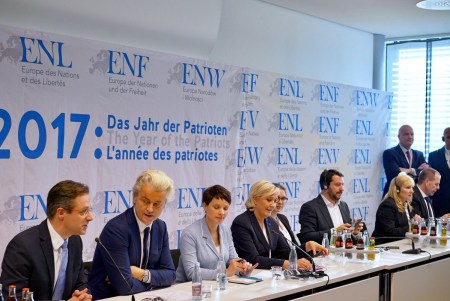
2226The leaders of Europe’s main anti-establishment parties appearing together in public for the first time, on January 21 in Koblenz, Germany. (Image source: Marine Le Pen/Twitter)

The two-hour rally was held under the banner of the Europe of Nations and Freedom (ENF), a group established in June 2015 by Members of the European Parliament from nine counties to oppose European federalism and the transfer of political power from voters to unelected bureaucrats in Brussels, the de facto capital of the European Union.

Referring to the June 2016 decision by British voters to leave the European Union, and the rise of President Donald Trump in the United States, Le Pen said:

“We are living through the end of one world, and the birth of another. We are experiencing the return of nation-states. 2016 was the year the Anglo-Saxon world woke up. 2017, I am sure, will be the year in which the peoples of the European continent rise up.”

Wilders added:

“The world is changing. America is changing. Europe is changing. It started last year with Brexit, yesterday there was Trump and today the freedom-loving parties gathered in Koblenz are making a stand. The genie will not go back into the bottle again, whether you like it or not. The people of the West are awakening. They are throwing off the yoke of political correctness.”

Polls indicate that the political sea change engulfing the United States is fueling support for anti-establishment parties in Europe. In addition to anger over eroding sovereignty, a growing number of Europeans are rebelling against decades of government-imposed multiculturalism, politically correct speech codes and mass migration from the Muslim world.

In France, a new Ipsos poll for Le Monde shows that Marine Le Pen is now poised to win the first round of the French presidential election set for April 23, 2017. Le Pen has between 25% and 26% support among likely voters, compared to 23% and 25% for François Fillon of the center-right Republicans party. In December 2016, Fillon held a three-point lead over Le Pen.

In the Netherlands, Geert Wilders is now leading polls ahead of the general election scheduled for March 15, 2017. The PVV has the support of between 29% and 33% of the electorate. By contrast, support for the ruling People’s Party for Freedom and Democracy (VVD) has fallen to between 23% and 27%.

In Germany, the anti-immigration Alternative for Germany party (AfD) has become the third-largest party the country, with support at around 15% percent. The AfD had gained representation in ten of Germany’s 16 state parliaments, and the party hopes to win seats in the Federal Parliament (Bundestag) for the first time in national elections set for September 24, 2017.

Europe’s establishment parties, far from addressing the concerns of ordinary voters, have tried to silence dissent by branding naysayers as xenophobes, Islamophobes and neo-Nazis.

In Germany, for example, Vice Chancellor Sigmar Gabriel, in an underhanded effort to silence criticism of the government’s open door migration policy, called for German intelligence to begin monitoring the AfD.

The German Interior Ministry is now proposing to establish a “Defense Center against Disinformation” (Abwehrzentrum gegen Desinformation) to combat “fake news.” Critics have described the proposed center as a “censorship monster” aimed at silencing dissenting opinions.

Enter Trump. If sufficient numbers of European voters are inspired by the political transformation taking place in the United States, the balance of European political power may begin to shift in favor of the anti-establishment parties. European political and media elites will therefore surely view Trump as a threat to the Europe’s established political order.

In a January 16 interview with the Times of London and Germany’s Bild, Trump said he believed that Brexit is “going to end up being a great thing.” He added that German Chancellor Angela Merkel made an “utterly catastrophic mistake by letting all these illegals into the country.”

In the same interview, Trump said that the NATO alliance “is very important to me” but he called it “obsolete” for failing to contain the threat posed to the West by Islamic terrorism. He also complained that some countries “don’t pay what they should pay.” Of the 28 countries in the alliance, only five — Britain, Estonia, Greece, Poland and the United States — meet the target of spending at least 2% of their GDP on defense.

European commentators roundly criticized Trump for his comments and some accused the United States of being an “unreliable partner.” European leaders repeated calls for a pan-European Army, a long-held goal of European federalists, which would entail an unprecedented transfer of sovereignty from European nation states to the European Union.

Gatestone Institute Chairman Ambassador John R. Bolton, has provided much-needed context to the debate over NATO. In a recent article for the Boston Globe, he wrote:

“NATO has taken intense criticism this year from Donald Trump, evoking howls of outrage from foreign-policy establishment worthies. The worthies know, however, that Trump is simply using his bullhorn to say what they themselves say more quietly: NATO’s decision-making is often sclerotic; its mission has not been adequately redefined after the Cold War; and too many members haven’t carried their weight financially or militarily for long years…. Trump has emphasized that his complaints are intended to encourage debate about improving and strengthening NATO, not sundering it. The debate is well worth having.”

Bolton added:

“In many respects, France and Germany are proving they do not understand the meaning of Brexit. They are reflexively, almost religiously, following exactly the path that has provoked the EU’s current existential crisis: every failure of closer integration by the ‘European project’ leads only to calls for more integration. Whether it is establishing a currency without a government; pledging military capabilities that collectively the EU never achieves; or pretending to an EU role in world affairs that no one outside of Brussels takes seriously, ‘more Europe’ is always the answer.”

European Reactions to President Trump’s Inauguration

Trump’s presidential inauguration speech was greeted with formal politeness by European leaders — most of whom will have to work with the new leader of the free world — and with unbridled derision by European commentators and media elites — many of whom appear to be in denial about the anti-establishment fervor sweeping the United States and Europe.

Much of the European commentary about Trump has consisted of name-calling and anti-Americanism. A handful of European analysts, however, have called for introspection and self-criticism.

What follows is a brief selection of European commentary on Trump’s inauguration:

In Britain, reactions to Trump were evenly divided between those who do and do not support British membership in the European Union. Prime Minister Theresa May said:

“From our conversations to date, I know we are both committed to advancing the special relationship between our two countries and working together for the prosperity and security of people on both sides of the Atlantic.”

Foreign Secretary Boris Johnson wrote:

“I think that the new president has made it very clear that he wants to put Britain at the front of the line for a new trade deal and obviously that’s extremely exciting and important.”

Nigel Farage, the politician who led the effort for the United Kingdom to leave the EU, was one of the few Europeans to understand the magnitude of Trump’s rise. He wrote:

“There is a genuine feeling that Trump taking over the White House is part of a bigger, global movement. Our critics, looking at Trump’s candidacy and his speech yesterday, would call it the rise of populism. I would say it’s simply a return to nation state democracy and proper values. For this inauguration is not just a change from the 44th President to the 45th President of the United States. This is a genuine political revolution.”

In France, President François Hollande advised Trump to stay out of European affairs — this a few days after the French government tried to impose a “two-state solution” on Israel. He said: “Europe will be ready to pursue transatlantic cooperation, but it will be based on its interests and values. It does not need outside advice to tell it what to do.”

Marine Le Pen said: “Clearly, the victory of Donald Trump is another step toward the emergence of a new world, whose vocation is to replace an old order.”

Jean-Marie Colombani, the former editor-in-chief of Le Monde, articulated Europe’s geopolitical predicament, which is the direct consequence of a failure to prioritize French defense spending:

“From an American point of view, Vladimir Putin is a secondary problem: Russia is a medium power, which can certainly create problems for the United States, but only marginally, as in Syria, for example. China is the only power to rival the United States. It will be, already is, the only obsession of Trump’s America.

“Vladimir Putin represents a problem, if not a threat, for Europe. In fact, the Russian President has set the goal of weakening the European Union, in order to restore the role of guardian that the USSR exercised in the East of Europe, in countries that are now members of the EU and NATO. Everything suggests that Trump shares the same objective: to weaken Europe.

“Indeed, Trump’s European policy is inspired by Nigel Farage, who spearheaded the campaign for Brexit, and whose political aim is now to achieve the dismantling of the European Union. This explains the prediction formulated by Trump on the soon-coming demise of Europe, and his anti-German undertones. In the new American president we find the language and elements of all the populist and extremist parties whose common doctrine is hostility towards the European project. Here, then, in the East and the West, Europe is squeezed as in a vise!”

In Germany, which is wholly dependent upon the United States for defense, and which has steadfastly refused to meet its commitment to pay 2% of GDP on defense, reaction to Trump’s speech was overwhelmingly negative.

Chancellor Angela Merkel pledged to work with Trump to preserve the transatlantic relationship. “The trans-Atlantic relationship will not be less important in the coming years than it was in past years,” she said. “And I will work on that. Even when there are different opinions, compromises and solutions can be best found when we exchange ideas with respect.”

Vice Chancellor Sigmar Gabriel was far less diplomatic. He said: “We have to take this man seriously. What we heard today were highly nationalistic tones. I think we have to prepare for a rough ride.” He called on Europeans to unite to “defend our interests.”

Writing for Deutsche Welle, commentator Max Hofmann admonished Europeans to stop complaining about Trump and instead put their own house in order:

“What do you do when your closest partner just disappears on you? You do what the EU should have done long ago: you fix up your home, regardless of what ‘The Donald’ is doing in the USA. There is enough work that needs to be done in Europe with regard to ‘putting your own house in order’ — Brexit, migration and refugee policies, the euro. If Europeans were honest to themselves and viewed what is happening on the old continent from the American perspective — and not just that one — then the situation would not be comprehensible to them. If US parliamentarians were to call European dissent ‘madness’ or ‘nonsense,’ no one could blame them.”

Commentator Hubert Wetzel said that Trump posed a threat to European security and called for European unity to weather the next four years. In an essay laced with hyperbole, he wrote:

“Europeans will have to adapt to a new tone in dealing with America. Trump has made it clear in his speech that he will pursue a nationalist foreign policy, and his speech contained no reference to America’s allies. [Trump actually said: ‘We will reinforce old alliances and form new ones,’ and ‘We will seek friendship and goodwill with the nations of the world’]. His willingness to spend money on the defense of other countries is limited. He does not see the USA as a protective power of democratic values in the world; and he is the first U.S. president since the end of the Second World War who has openly expressed doubts about the value of European unity and the existence of NATO. At a time when Russia is trying to weaken the West by means of diplomatic, intelligence, and military means, it is an attitude that is a serious threat to united Europe.”

In Spain, geopolitical analyst Rafael Bardají wrote:

“President Trump promised that a new era is beginning today. In his inaugural speech he made it very clear that he despises Washington and hates the way the establishment has ruled the country up until now, defending its privileges at the expense of citizens. Yes, a speech that can be called populist, but one that nevertheless is true. Democracy, after all, emerged as the government of the people for the people, something that, at present, is far from being a reality in America as well as in Europe. The great social contract of liberal democracy, namely, growing prosperity and peace and security for the citizens, is no longer being fulfilled. This is due to the inability of our elites to deal with the [economic] crisis, due to their obsession with pacifism and due to the subordination of the interests of nationals in favor of immigrants.”

In Switzerland, Roger Köppel, editor-in-chief of Die Weltwoche, warned against efforts by European elites to belittle Trump. He wrote:

“Trump’s election was a healthy shock. The shock was necessary. Not only power cartels, but also worldviews are breaking down. This disruption is fruitful. The taboos of the last few years are now fully on the agenda: illegal immigration, Islam, the nonsense of open borders, the dysfunctional EU, the free movement of people, jobs, law and order. Trump’s predecessors did not want to talk about it, but the majority of voters did. This is democracy.”
Happy New Year Liberals & Refugees: (Pat Condel)

January 12, 2017

Happy New Year Liberals & Refugees: (Pat >Condell) via YouTube</a, January 1, 2017

Czech government pushing constitutional change to let citizens use guns against Islamic jihadis

January 8, 2017

Czech government pushing constitutional change to let citizens use guns against Islamic jihadis, Jihad Watch

The Washington Post, as one would expect from a key outpost of the establishment propaganda media, is appalled: “Never mind that there are fewer than 4,000 Muslims in this country of 10 million people — gun purchases spiked. One shop owner in East Bohemia, a region in the northern center of the Czech Republic, told a local paper that people were scared of a ‘wave of Islamists.’”

Only 4,000 Muslims! Such a small number couldn’t possibly mount a jihad terror attack, now, could they?

This is a common sense measure against a rising threat. The threat is rising because of Europe’s suicidal immigration policies. If Europeans don’t start defending themselves soon, it’s only going to get worse.

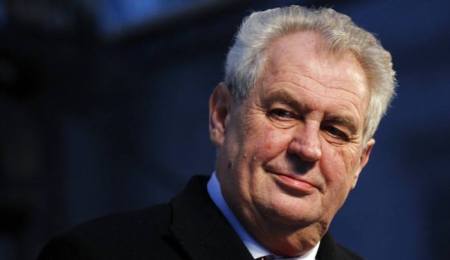
milos-zeman

“Czech government tells its citizens how to fight terrorists: Shoot them yourselves,” by Amanda Erickson, Washington Post, January 6, 2017:

A couple of months ago, Czech President Milos Zeman made an unusual request: He urged citizens to arm themselves against a possible “super-Holocaust” carried out by Muslim terrorists.

Never mind that there are fewer than 4,000 Muslims in this country of 10 million people — gun purchases spiked. One shop owner in East Bohemia, a region in the northern center of the Czech Republic, told a local paper that people were scared of a “wave of Islamists.”

Now the country’s interior ministry is pushing a constitutional change that would let citizens use guns against terrorists. Proponents say this could save lives if an attack occurs and police are delayed or unable to make their way to the scene. To become law, Parliament must approve the proposal; they’ll vote in the coming months.

The Czech Republic already has some of the most lenient gun policies in Europe. It’s home to about 800,000 registered firearms and 300,000 people with gun licenses. Obtaining a weapon is relatively easy: Residents must be 21, pass a gun knowledge check and have no criminal record. By law, Czechs can use their weapons to protect their property or when in danger, although they need to prove they faced a real threat.

This puts the country at odds with much of Europe, which has long supported much more stringent gun-control measures. In the wake of the 2015 terror attacks in Paris, France pushed the European Union to enact even tougher policies. The European Commission’s initial proposal called for a complete ban on the sale of weapons like Kalashnikovs or AR-15s that are intended primarily for military use. Ammunition magazines would be limited to 20 rounds or less.

The Czech Republic came out hard against the directive. Officials warned — somewhat ominously — that the measure would limit the country’s ability to build “an internal security system” and make it nearly impossible to train army reservists. And a total ban on military-style rifles that can fire large numbers of rounds would make illegal thousands of weapons already owned by Czech citizens, potentially creating a black market for terrorists to exploit. Finland and Germany offered their own reservations; Europe’s pro-gun groups also mobilized against the bill with the support of politicians on the extreme right….

Turkish army like Iraqis stalled by ISIS pushback

December 28, 2016

Turkish army like Iraqis stalled by ISIS pushback, DEBKAfile, December 28, 2016

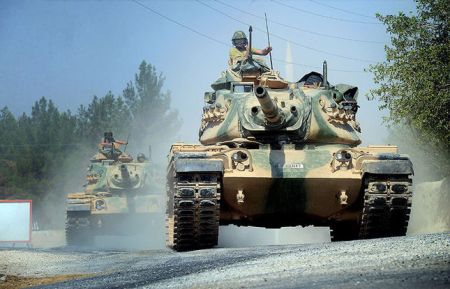
turkeytrot

Wednesday, Dec. 28, hours before US Secretary of State John Kerry was due to deliver a major speech on his vision for the Middle East, Turkey and Russia announced a ceasefire plan going into effect the same night for the whole of Syria, and in all regions, where fighting between pro-government forces and opposition groups were taking place – excepting for terrorist organizations.

Moscow and Ankara assumed the role of guarantors of the process. This accord will be brought for approval before the Syrian peace conference to be convened in the Kazakhstan capital, Astana, this week, attended by Russia, Turkey, Iran, the Syrian government and Syrian opposition groups. The US and Europe were not invited.

Not content with kicking Washington out of any role in resolving the Syrian crisis, the Turkish president Tayyip Erdogan accused the US, leader of the Western war on the Islamic State, of supporting “terrorist groups.”

He claimed Tuesday to have evidence of the US “giving support to terrorist groups including Daesh, YPG, PYD,” adding, ” We have…  pictures, photos and videos.”

While Erdogan is scoring in the diplomatic arena, he faces nothing but frustration militarily over the failure of the large, professional Turkish army to gain ground in the battle for Al Bab in northern Syria. This is Turkey’s first face-to-face with the Islamic State in its  four-month old Euphrates Shield operation in northern Syria – and it is not gong well. The fighting is deadly with no end in sight.

This may partly account for Erdogan’s oddly inconsistent behavior.

Tuesday, Dec. 26, he quietly asked the Obama administration to step up its air support for the Turkish campaign to capture Al Bab, 55 km north of Aleppo and the only major town in ISIS hands in northern Syria. He accused the US of not doing enough.

It was doubly odd in that Turkey has a large air force of its own, and if that force was not enough to support the campaign against ISIS, Erdogan’s obvious address for assistance would be his ally in the Syrian arena, Russian President Vladimir Putin. After all, Ankara, Moscow and Tehran are in the middle of a shared effort to set the rules of the game in Syria, which has pointedly excluded the US under the Obama administration.

As to the state of the fighting, on Dec. 21, Erdogan claimed: “Right now, Al-Bab is completely besieged by the Free Syrian Army and our soldiers.” In fact, this siege has been in place for weeks and, worse still, the casualties are mounting.

Wednesday, Dec. 28, the Turkish military said  it had “neutralised” 44 Islamic State fighters in Al Bab and wounded 117 in Al Bab,  while 154 Islamic State targets had been struck by artillery and other weaponry.

No casualty figures have been released for the Turkish army fighting for Al Baba. They are conservatively estimated at 90 dead and hundreds injured. The losses of Free Syrian Army (FSA), the local rebel force fighting alongside the Turkish army, are undoubtedly heavier still.

Our military and counterterrorism experts explain how the Islamic State’s beleaguered fighters are not just holding out in Al Bab against a superior army, but running circles around it.

The jihadists took the precaution of clearing back passages from Al Bab to their headquarters in Raqqa, 140km to the southeast, and Palmyra, 330km away.

This heritage town, which the Russians took from ISIS several months ago, was recaptured by the jihadists earlier this month, when Russian forces were fully engaged with capturing Aleppo. The US air force has in the last few days redoubled its strikes on Palmyra – both to cut off the flow of reinforcements and supplies to the besieged ISIS fighters in Al Bab and to clear the way for Russian forces to recover the lost town.

This US-Russian cooperative effort is at odds with the Obama administration’s presentation of Washington’s prickly relations with Moscow.

Notwithstanding the forces ranged against it, ISIS has so far managed to repel almost every Turkish bid to break into Al Bab – thanks to the new tactics it has introduced to the battles for Syrian Al Bab and Iraqi Mosul, which mark a turning point in the war on Islamist terror in those countries.

Those tactics hinge heavily on maximizing enemy casualties in order to knock the opposing army off the battlefield.

This is achieved by a deadly mix of guerilla and terrorist methods, and includes car bombs, bomb belt-clad suicides, improvised explosive devices (IED), sniper squads, gliders carrying explosives with small parachutes, as well as the increasing use of anti-air missiles and poison chemicals.

Tuesday, Iraqi Prime Minister Haydar Al-Abadi estimated that the Iraqi army needed another three months to beat ISIS in Mosul. He was trying to buck up the Iraqi people by concealing the true situation.
The fact is that the Iraqi military offensive against ISIS in its Mosul stronghold has ground to a halt – and no wonder, when some units have suffered a 50 percent manpower loss.

Gen. Stephen Townsend, commander of American troops in Syria and Iraq, was of the opinion last week that at least two years of fighting were needed to drive ISIS out of its two capitals, Mosul and Raqqa. He did not spell this out, but his meaning was clear: to achieve this objective, a far larger army was needed than the military manpower available at present.

Hungarian PM Orbán: “2017 will be a year of rebellion…America, what is your message? Let’s make Hungary great again!”

December 22, 2016

Hungarian PM Orbán: “2017 will be a year of rebellion…America, what is your message? Let’s make Hungary great again!” Jihad Watch,

(Please see also, Political Revolution Is Brewing in Europe. — DM)

Hungarian Prime Minister Viktor Orbán has praised the victories of the populist Five Star Movement in the Italian referendum and the election of Donald Trump in the United States, claiming these developments are just the beginning of the “rebellion”.

Orbán is referring to the taking back of Western countries from Leftist globalists who have flooded Europe with Muslim migrants who are responsible for an unprecedented wave of crime throughout Europe, including widespread sex assaults. In July, Orban stated that migrants were “poison” and “not needed”:

Orban said the migration and foreign policy plans of the US Republican presidential candidate Donald Trump were “vital” for Hungary…. the US Democrats supported migration as well as what he described as “democracy export”, while Hungary – like Trump – opposed both, “making it clear where Hungary’s interests lie”….The Democrats’ foreign policy is bad for Europe, and deadly for Hungary,” he said. “The migration and foreign policy advocated by the Republican candidate, Mr Trump, is good for Europe and vital for Hungary.”

orban-1

“Orbán Declares 2017 the ‘Year of Rebellion’”, by Chris Tomlinson, Breitbart, December 21, 2016:

Hungarian Prime Minister Viktor Orbán has praised the victories of the populist Five Star Movement in the Italian referendum and the election of Donald Trump in the United States, claiming these developments are just the beginning of the “rebellion”.

The Hungarian leader, who is known to be outspoken in expressing his opinions on mass migration and the migrant crisis claims a kinship with rising populist leaders and movements across Europe and the United States.

Mr. Orbán said his party Fidesz was a “self-made story … about ten to twenty, or thirty guys coming from somewhere, rising up, fed up with the world that surrounds them” who wanted to change it.

He claimed to see the same attitude in President-Elect Donald J. Trump, saying in an interview with Hungarian news site 888.hu that Trump had what he called a “self-made man mentality.” He went on to add, “Self-made figures are people who themselves are successful, who do not begin a sentence with ‘I know people,’ but say, ‘I’ve done that.’ ”

For the Hungarian prime minister, 2016 isn’t the end of the populist rebellion against globalism and the elites. Asked if he thought the anti-globalist sentiment would spread he said, “I am convinced that 2017 will be a year of rebellion. Whether they [the globalists] put down the rebellion or not, that’s another story.”

Orbán cited the victory of the Italian opposition in the recent referendum and said that despite the defeat for anti-mass migration candidate Norbert Hofer in the Austrian presidential elections, the rebellion was growing.

“Next year will be elections in Germany, the Netherlands, France. A lot of things can happen,” he said. Mr. Orbán said there were two rebellions going on, one was a revolt of the working and middle class which led to Brexit and the victory of Donald Trump and the other “…is a kind of national rebellion.

“The ‘United States of Europe’ advocates, by being stealthy, encroachments on the sovereignty of individual nations using the issue of asylum.

“All of this is surrounded by political correctness, containment, intellectual rebellion against stigma. The rebellion started in 2016, will be even more enhanced in the future. Therefore, I say that 2017 will be a year of rebellion,” he said.

When asked if he thought it was contradictory for a ruling government to declare themselves rebels, he said, “The real freedom fighters are the people.”

He went on to add, “If we believe in Hungary, the Hungarian people, one inside the other, then we are facing a bright future,” adding that children should be taught “not to seek the easy way, but go their own way even when it seems difficult, then the country can be great again.

“America, what is your message? Let’s make Hungary great again!”

Political Revolution Is Brewing in Europe

December 22, 2016

Political Revolution Is Brewing in Europe, Gatestone InstituteGeert Wilders, December 21, 2016

The German authorities are dangerously underestimating the threat of Islam… They have betrayed their own citizens.

Let no-one tell you that only the perpetrators of these crimes are to blame. The politicians, who welcomed Islam into their country, are guilty as well. And it is not just Frau Merkel in Germany, it is the entire political elite in Western Europe.

Out of political-correctness, they have deliberately turned a blind eye to Islam. They have refused to inform themselves about its true nature. They refuse to acknowledge that is all in the Koran: the permission to kill Jews and Christians (Surah 9:29), to terrorize non-Muslims (8:12), to rape young girls (65:4), to enslave people for sex (4:3), to lie about one’s true goals (3:54), and the command to make war on the infidels (9:123) and subjugate the entire world to Allah (9:33).

We will have to de-islamize our societies…. But it all begins with politicians with the courage to face and speak the truth.

More and more citizens are aware of that. This is why a political revolution is brewing in Europe. Patriotic parties are rapidly growing everywhere. They are Europe’s only hope for a better future.

Yesterday, the Islamic State claimed the Berlin terror attack of Monday evening, in which twelve people were killed with a truck at a Christmas market.

The killer managed to escape. However, in the truck the police found identity papers belonging to Anis A., a Tunisian who came to Germany as an asylum seeker in 2015.

2032(Image source: RTL Nieuws video screenshot)

When last year German Chancellor Angela Merkel opened Germany’s borders to almost one million refugees and asylum seekers, she invited the Trojan horse of Islam into her country. Among the so-called refugees were many young men of Islamic background, filled with hatred for the West and its civilization. One of them was Anis A.

It took almost a year for the German authorities to reject his asylum request, but meanwhile the man had disappeared. The police are now looking for him as a prime suspect of Monday’s attack in Berlin.

The German authorities are dangerously underestimating the threat of Islam. They signs are there for all to see. In October, an Afghan asylum seeker raped and murdered a 19-year old German girl in Freiburg. And a 12-year old Iraqi boy was caught before he could explode a nail bomb at a Christmas market in Ludwigshafen.

Last Summer, an Afghan with an axe attacked train passengers in Heidingsfeld, a Syrian murdered a pregnant woman with a machete in Reutlingen, another Syrian detonated a suicide bomb at a music festival in Ansbach, a Palestinian attempted to decapitate a surgeon in Troisdorf. And who has forgotten last New Year’s eve, when migrant sex mobs assaulted hundreds of women in Cologne?

This year, 1,500 police officers will be patrolling the streets in Cologne on New Year’s eve. Ten times more than last year. But how many police officers will be needed next year? And the year after that? And what will happen when they are outnumbered? What is needed are not just more police officers; what is needed is a democratic political revolution.

The Politicians Are Guilty

Let no-one tell you that only the perpetrators of these crimes are to blame. The politicians, who welcomed Islam into their country, are guilty as well. And it is not just Frau Merkel in Germany, it is the entire political elite in Western Europe.

Out of political-correctness, they have deliberately turned a blind eye to Islam. They have refused to inform themselves about its true nature. They refuse to acknowledge that is all in the Koran: the permission to kill Jews and Christians (Surah 9:29), to terrorize non-Muslims (8:12), to rape young girls (65:4), to enslave people for sex (4:3), to lie about one’s true goals (3:54), and the command to make war on the infidels (9:123) and subjugate the entire world to Allah (9:33).

Instead of informing themselves, they have opened their country’s borders to mass immigration and invited asylum seekers in, despite the fact that IS had announced that it would send terrorists to the West as asylum seekers.

They even allowed Syria fighters to return to Europe, instead of denaturalizing them and blocking their re-entry. They have not even imprisoned them. In short, they are guilty of serious negligence. They have betrayed their own citizens.

The asylum tsunami of 2015 has only exacerbated an already terrible situation. Almost a decade ago, in 2008, a study by the (very leftist) University of Amsterdam revealed that 11% of all Muslims in the Netherlands agree that there are situations in which they find it acceptable for themselves to use violence for the sake of their religion.

This means that, in my country, the Netherlands, alone, there are 100,000 Muslims who are personally prepared to use violence. The Dutch army, however, is less than 50,000 soldiers strong. Hence, even if we deploy the entire army to protect Christmas markets, theaters, night clubs, festivals, shopping malls, churches and synagogues, we cannot guarantee the safety of all our citizens.

That is why there is little doubt that 2017 will bring Germany and the entire West more violence, more attacks on our women and daughters, more bloodshed, more tears, more sorrow. The terrible truth is that, in all likelihood, we ain’t seen nothing yet.

But this does not mean that there is no hope.

Just as the present dangerous situation has been created by politicians refusing to see the horrible reality of Islam and refusing to do their duty, the solution to the gigantic self-inflicted problem the West is currently suffering from, needs to be a political one.

Fixing a broken Europe

We will have to de-islamize our societies. Indeed, every single measure we take to achieve this goal, from ending all immigration from Islamic countries, to preventive detention of radical Muslims, to the promotion of voluntary remigration, to the denaturalization and expelling of criminals with dual nationality, will be a step towards a safer society for ourselves and our children. But it all begins with politicians with the courage to face and speak the truth.

More and more citizens are aware of that. This is why a political revolution is brewing in Europe. Patriotic parties are rapidly growing everywhere. They are Europe’s only hope for a better future.

We have to drive politicians, such as Angela Merkel, my own weak Dutch Prime Minister Mark Rutte, and their like minded colleagues in other countries, from power. We must liberate our countries.

And believe me, my friends, that is exactly what we are going to do. Terrorists, who hope to break our resolve with bloody atrocities will not succeed. We will choose new and brave leaders, we will de-islamize, we will win!

Are Europe’s ‘Extreme Right’ Parties Really So Extreme?

December 21, 2016

Are Europe’s ‘Extreme Right’ Parties Really So Extreme? PJ Media, Roger L Simon, December 20, 2016

(Please see also, CNN Uses Germany Attack To Bash The Right. –DM)

Not more than an hour — or was it ten minutes — after news broke of Monday night’s truck terror attack in Berlin, reports began to appear from the usual suspects (CNN, Reuters, AP, BBC, etc.) with the requisite sentences and paragraphs expressing concern that the horrific event would play into the hands of the “extreme right-wing” parties of Europe.

Buried not so deep was the implication that, bad as these attacks were, something even worse loomed, the return of Nazism or Nazi-like fascism.

I have always wondered how accurate this characterization of parties like Germany’s relatively new Alternative für Deutschland (AfD) as “far right”  (as the BBC did Monday) really was.  I have been to Germany several times, though not recently, so my knowledge is not first hand, but I am skeptical.

I was in England around the Brexit vote and got to speak with people who were members of or sympathetic to the UK Independence Party (UKIP) and didn’t find any of them particularly fascistic. On the contrary, they wanted independence from the EU so they could have local democratic rule and determine the fate of their own country apart from the undemocratic Brussels bureaucracy. But perhaps I missed something.

Perhaps I missed something too when I traveled the country covering the Trump campaign and didn’t find any fascistic leanings to speak of among his supporters — no racism, sexism, homophobia, etc. — just an over-weening disgust with Washington and a feeling they had been substantially overlooked by a morally narcissistic liberal elite busy enriching themselves. (They had.)

Of course there are Nazis in the world. How could there not be in populations, American and European, that together approach a billion? Just about anything could be found. In the USA we have this white-supremacist character Richard Spencer, whose group consists of fewer people than are normally in line for pizza at Ray’s, yet the press persists on making a big deal out of him for reasons that are laughably obvious.  (If Spencer would agree to wear a “Make America Great Again” hat, they’d put him on the cover of TIME.)

But these tiny groups, domestic and foreign, do not constitute the remotest proof that parties seeking to limit Islamic immigration in European countries are extreme or far right. This is what one might call  “guilt by the most minute association.”

What is really going on is an ideological fracturing with extreme — in the real sense — violent implications.  The European left — lost for so many years in a blind, virtue-signaling multiculturalism — now has to come to grips with the fact that maybe all cultures are NOT equal, that some cultures truly are racist, sexist, and homophobic and are governed by a religious ideology that seeks to rule the world with no separation of mosque and state and human rights virtually non-existent, the very things the left claims it abhors. And those same leftists don’t know how to handle this contradiction.  So they blame those who do and call them neo-Nazis.

Ironically, those called neo-Nazis and the like are often the most open-minded people, seeking to preserve Europe’s gift to humanity, the Enlightenment.

Such a person is the extraordinary Geert Wilders, recently found guilty of “discrimination” by a Dutch court and now the odds-on favorite to be the next prime minister of that country. The Dutch are in many ways the most honest people in Europe.  Wilders — no shrinking violet — has already tweeted out in no uncertain terms that Angela Merkel has blood on her hands for what transpired in Berlin.  She does.

The irony of ironies may be that the true heirs to the Nazis are the Merkels of the world, not the AfD, etc. While not Hitler-like in mass murder and megalomania, not to mention all the master-race insanity, they do share a background with the genocidal dictator — socialism.  The Nazis were the National Socialist Party.  That Merkel is East German is not accidental.  Leading (and controlling) from the top is what she is used to. (The AfP, paradoxically, originated in the same area of Germany as Merkel, still an economically disadvantaged region.)

Now these guilty, pseudo-pacifist heirs of their crazy Fuhrer have to confront Hitler’s old ally in irredentist Islam, invading their country under cover of “political asylum” from a situation created, at least in part, by Barack Obama’s Middle Eastern fecklessness.  Aleppo belongs to Barack, but Berlin is Angela’s (and “progressive” Germany’s).

As the madman who drove through the Christmas market disappears into the European night, we wonder where Islam will strike next. France again? Belgium? Sweden? Things look pretty bad there.  Or perhaps Spain — the original home of La Reconquista? Land once claimed by Islam is theirs forever, according to their holy book that even the more peaceful and supposedly moderate of their faith believe. Why then do we expect them to intervene when their more bloodthirsty brethren act out? And indeed they don’t.

The complex knot that Europe needs to cut through is Gordian indeed and the continent is barely in shape to do it.  It may be too late.  Should America help?  Despite Trump’s “America Firstism,” I think we have to, to the extent we can, and I suspect he knows it. Without Old Europe, we’re basically friendless in the world.

Well…. there’s  always Australia. And now Taiwan. And maybe, once in a while, India. (And of course that place the French like to call the “petit pays merdique.”)

Nigel Farage says the EU is a threat to NATO nations

December 15, 2016

Nigel Farage says the EU is a threat to NATO nationsRobinHoodUKIP via YouTube, December 14, 2016

https://www.youtube.com/watch?v=t812Fc1mStQ

The Dutch Death Spiral

December 11, 2016

The Dutch Death Spiral, Gatestone Institute, Giulio Meotti, December 11, 2016

“It would have been better if the Dutch state had sent a clear signal [to terrorists] via a Dutch court that we foster a broad notion of the freedom of expression in the Netherlands.” — Paul Cliteur, Professor of Jurisprudence, Leiden University.

The historic dimension of Wilders’s conviction is related not only to the terrible injustice done to this MP, but that it was the Netherlands that, for the first time in Europe, criminalized dissenting opinions about Islam.

“I will never be silent. You will not be able to stop me… And that is what we stand for. For freedom and for our beautiful Netherlands.” — Geert Wilders, Dutch MP and leader of the Party for Freedom (PVV).

“We have a lot of guests who are trying to take over the house.” — Pym Fortuyn, later shot to death to “defend Dutch Muslims from persecution.”

Before being slaughtered, clinging to a basket, Theo van Gogh begged his assassin: “Can we talk about this?” But can we talk?

A country whose most outspoken filmmaker was slaughtered by an Islamist; whose bravest refugee, hunted by a fatwa, fled to the U.S.; whose cartoonists must live under protection, had better should think twice before condemning a Member of Parliament, whose comments about Islam have forced him to live under 24-hour protection for more than a decade, for “hate speech.” Poor Erasmus! The Netherlands is no longer a safe haven for free thinkers. It is the Nightmare for Free Speech.

The most prominent politician in the Netherlands, MP Geert Wilders, has just been convicted of “hate speech,” for asking at a really if there should be fewer Moroccans in the Netherlands. Many newly-arrived Moroccans in the Netherlands seem to have been responsible for a disproportionate amount of crime there.

Paul Cliteur, Professor of Jurisprudence at Leiden University, who was called as an expert witness, summed up the message coming from the court: “It would have been better if the Dutch state had sent a clear signal [to terrorists] via a Dutch court that we foster a broad notion of the freedom of expression in the Netherlands.”

Here are just a few details to help understand what Wilders experiences every day because of his ideas: No visitors are allowed into his office except after a long wait to be checked. The Dutch airline KLM refused to board him on a flight to Moscow for reasons of “security.” His entourage is largely anonymous. When a warning level rises, he does not know where he will spend the night. For months, he was able to see his wife only twice a week, in a secure apartment, and then only when the police allowed it. The Parliament had to place him in the less visible part of the building, in order better to protect him. He often wears a bulletproof vest to speak in public. When he goes to a restaurant, his security detail must first check the place out.

Wilders’s life is a nightmare. “I am in jail,” he has said; “they are walking around free.”

The historic dimension of Wilders’s conviction is related not only to the terrible injustice done to this MP, but that it was the Netherlands that, for the first time in Europe, criminalized dissenting opinions about Islam.

The Netherlands is a very small country; whatever happens to this enclave is seen in the rest of Europe. The Netherlands refused to surrender to the Spanish invasion. It was from Rotterdam, the second-largest Dutch city, that the Founding Fathers left to create the United States of America. It was to the Netherlands that some of the most brave, original European philosophers and writers — Descartes, Rousseau, Locke, Sade, Molière, Hugo, Swift and Spinoza — had to flee to publish their books. It is also the only corner of Europe where there were no pogroms against Jews, and where Rembrandt painted Jesus with the physical traits of Jews.

Take Leiden: “Praesidium Libertatis” (“Bastion of Freedom”) is the motto of the Netherlands’ most ancient university. Leiden was the university of Johan Huizinga, the great historian who opposed the Nazis and died in a concentration camp. Leiden was also the university of Anton Pannekoek, the mentor of Martinus Van der Lubbe, the Dutch hero who torched the Nazi Parliament in 1933.

In Leiden today, you meet brave intellectuals such as Afshin Ellian, an Iranian jurist who fled Khomeini’s Revolution in Iran and who also now lives under police protection for his observations on Islam. Ellian’s office is close to the former office of Rudolph Cleveringa. When the Nazis invaded the Netherlands and called on Dutch public officials to fill out a form in which they had to declare whether they were “Aryans” or “Jews”, everyone but Cleveringa capitulated. He understood the consequences of such commands.

Twelve years ago, the Netherlands was again plunged into fear for the first time since World War II. In Linnaeusstraat, a district of Amsterdam, Mohammed Bouyeri, a Muslim extremist, ambushed the filmmaker Theo van Gogh and slaughtered him, then pinned on his chest a letter threatening the lives of Geert Wilders and Ayaan Hirsi Ali. Before that murder, Pim Fortuyn, a professor who had formed his own party to save the country from Islamization, was shot to death to “defend Dutch Muslims from persecution.”

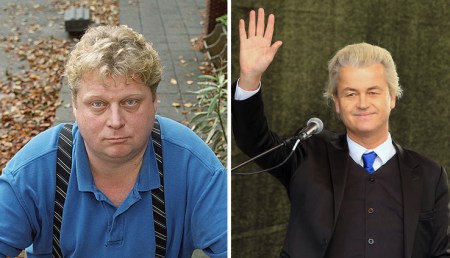
2117Twelve years ago, Dutch filmmaker Theo van Gogh (left) was assassinated by an Islamist who pinned on van Gogh’s chest a letter threatening the life of Geert Wilders (right). Today Wilders, the most prominent politician in the Netherlands, lives in hiding under round-the-clock protection.

Fortuyn had said, “We have a lot of guests who are trying to take over the house.”

Since then, many Dutch artists have capitulated to fear.

Sooreh Hera, from Iran, submitted her photos to the Gemeentemuseum Museum in The Hague. One of these works depicted Mohammed and Ali. After many threats, the museum proposed that it would acquire the photos without publishing them and that one day, perhaps, when the situation was calmer, they might show them then. Hera refused: it would have been self-censorship, a sad day for the West. Rants Tjan, director of Museum Gouda, bravely offered to exhibit her censored images, but that event was later cancelled, too. Hera was forced to go into hiding.

Paul Cliteur, a critic of multiculturalism, announced that he would no longer write for Dutch newspapers about Islam, for fear of reprisals: “With the murder of van Gogh, everyone who writes takes a certain risk. That is a scary development. What I am doing do is self-censorship, absolutely….”

Then a columnist, Hasna el Maroudi, from the newspaper NRC Handelsblad, stopped writing, after receiving threats.

The Dutch artist Rachid Ben Ali, irreverent about Islam, no longer satirizes Muslims.

Amsterdam, a city famous for its exuberant cultural life, had already lived through threats to artists: the occupation by the Nazis during World War II.

Several artists still refuse to mention Theo Van Gogh, so as not to “contribute to… divisions”, according to the New York Times. Translation: They are afraid. Who would not be?

In the Oosterpark, a steel sculpture by the artist Jeroen Henneman, dedicated to Van Gogh, is entitled “De Schreeuw” (“The Scream”). But it is a scream you hardly hear in the Dutch society.

What you do hear is the defiant protest after the conviction of a brave MP, Geert Wilders: “I will never be silent. You will not be able to stop me… And that is what we stand for. For freedom and for our beautiful Netherlands.”

Before being slaughtered, clinging to a basket, Theo van Gogh begged his assassin: “Can we talk about this?

But can we talk?

Ask Geert Wilders, just the latest brave victim of Europe’s Bolshevik thought police.

Biden says the world needs genuine leaders such as Trudeau

December 10, 2016

Biden says the world needs genuine leaders such as Trudeau, CIJ News, Ilana Shneider, December 10, 2016

justin-trudeau-meets-with-joe-biden-photo-twitter-joe-bidenPM Justin Trudeau meets with VP Joe Biden. Photo: Twitter Joe Biden

Outgoing United States Vice-President Joe Biden paid a visit to Ottawa on Thursday, apparently for no reason other than to show the “depth of the relationship” between the US and Canada, Justin Trudeau’s director of communication said.

“I’ve never seen Europe engaged in as much self-doubt,” Biden told Trudeau during the visit. “The world’s going to spend a lot of time looking to you, prime minister, as we see more and more challenges to the liberal international order since the end of World War II — you and Angela Merkel.”

“The world is going to spend a lot of time looking to you Mr Prime Minister,” Biden told a crowd of Canadian dignitaries. “Viva la Canada because we need you very, very badly.”

Biden’s remarks were made two days before a new poll conducted by Forum Research showed that support for the federal Liberals dropped by 9 per cent in one month. According to Forum, if federal elections were held today, 42 per cent of Canadians would vote Liberal, compared to 51 per cent in November.

The same poll also found that Trudeau’s “favourability” rating dropped from 58 per cent last month to 51 per cent in December, while approval rating for Conservative Party’s interim leader Rona Ambrose increased from 30 per cent to 36 per cent.

German Chancellor Merkel, who is running for her fourth term in office, sank to her lowest voter support in five years, primarily due to her handling of the refugee crisis and last summer’s terrorist attacks on German soil perpetrated by Islamic jihadists which included a shooting spree, an axe attack, a suicide bombing and a machete assault that left 13 people dead. Last year, Merkel opened Germany’s doors to more than one million migrants from the Middle East and Africa.

With Trump winning the elections in the US, Britain’s David Cameron’s resigning, France’s Hollande is not seeking re-election and Italy’s Renzi’s leaving after having gambled and lost on a flawed constitutional referendum, Trudeau and Merkel remain the “last two liberal leaders standing”.