Archive for the ‘Europe’ category

Palestinians: The Right Time to Take Big Steps?

March 4, 2016

Palestinians: The Right Time to Take Big Steps? Gatestone InstituteBassam Tawil, March 4, 2016

♦ Despite the “official” surveys taken among Palestinians, which show support for Hamas, the residents of the West Bank are terrified that Hamas will gain control and destroy our lives and property, the way they did in the Gaza Strip.

♦ The BDS organizations are trying to boycott products made in the West Bank, which only throws masses of Palestinians out of good jobs in an effort to force Israel into a hasty withdrawal that has no chance of taking place. The Israelis and everyone else remember all too well that the last Israeli withdrawals — from southern Lebanon and the Gaza Strip — led to the terrorist takeover of the vacuums created.

♦ Ikrima Sabri, the former Mufti of Jerusalem, often said that Palestinians were better off with the Jews in charge of Al-Aqsa mosque and Jerusalem, because in the future they could be removed and killed off, but if the Crusaders returned to Jerusalem — such as an international commission headed by the French — it would be harder to get rid of them.

During a visit to Berlin, German Chancellor Angela Merkel told Israel’s Prime Minister Benyamin Netanyahu that now is not time to move forward with the “two-state solution” and the establishment of a Palestinian state.

Merkel, evidently seeing Israel as a dam protecting Europe from Islamist extremists, told Netanyahu that while the Germans recognized the terrorist threat faced by Israel, and that a peace process had to be advanced based on two states for two peoples, now was not the right time to take big steps.

1494Agreed: It’s not a good time to establish a Palestinian state. Pictured: Israeli Prime Minister Benjamin Netanyahu and German Chancellor Angela Merkel address a press conference in Berlin, Germany, on February 16, 2016. (Image source: Israel Government Press Office)

The Palestinians living in the Gaza Strip are well aware that they are hostages of the terrorist organizations, in particular Hamas. Jibril Rajoub, a senior official in the Palestinian Authority (PA), told Al-Jazeera TV the same thing just last week.

The Palestinians in the West Bank, regardless of public declarations, also secretly support security collaboration with Israel, which protects us from radical Islamist terrorism. Therefore, despite the “official” surveys taken among Palestinians, which show support for Hamas, the residents of the West Bank are terrified that Hamas will gain control and destroy our lives and property the way they did in the Gaza Strip. We do want a Palestinian state, but one that will preserve the lifestyle and accomplishments we have built over the years — not a state that will have them fall to the horrors of Hamas and ISIS.

In light of the quiet, passive public support for the regime of Mahmoud Abbas, Hamas is inciting Palestinians against it. Hamas, in an attempt to overthrow the Palestinian Authority, is portraying Abbas’s security forces as traitors who transmit information to Israel.

Like Germany — and unlike Sweden and France — Britain has recently instituted a more balanced policy. The UK has begun to fight the anti-Israel BDS (Boycott, Divestment and Sanctions) organizations. Matthew Hancock, Britain’s Minister for the Cabinet Office, who coordinates activities between various government ministries, is advancing protocols to prevent the ongoing boycotts by the British establishment.

These BDS organizations are trying to boycott products made in the West Bank, but the boycott only throws masses of Palestinians out of good jobs and great benefits in an effort to force Israel into a hasty withdrawal that has no chance of taking place. The Israelis and everyone else remember all too well that the last Israeli withdrawals — from southern Lebanon and the Gaza Strip — were nothing more than case-studies for the terrorist takeover of the vacuums created, exactly the same way as the U.S. withdrawal from Iraq made room for the Islamic State (ISIS).

As Palestinians we know that the BDS may or may not harm Israel, but it does untold damage to the Palestinians who support their families by working in the settlement factories and would otherwise be unemployed and then, as a scarcity of jobs will have been created, hired by various terrorists. When the SodaStream factory moved out of the West Bank, 500 Palestinians lost their well-paid jobs.

In view of the current U.S. helplessness in dealing with the Russians, Iranians and Syrians, the Obama administration has now chosen to bare its fangs at Israel. Despite what are apparently his predictable personal objections, U.S. President Barack Obama is expected to sign into law the Trade Facilitation and Trade Enforcement Act, which includes anti-BDS provisions. It introduces new policy language by including all “Israeli-controlled territories” as part of Israel. Meanwhile, the American customs authority is still continuing to enforce a 20-year-old law, marking products made in the West Bank and hurting Palestinians. Labeling products hurts the Palestinians, who then are driven look for work in the eager arms of the terrorist organizations radicalizing the region.

The French, as usual, slither and shift. A number of months ago, they tried to build up steam for an international commission of inquiry into the Al-Aqsa mosque. Both the Israelis and the Palestinians objected.

Ikrima Sabri, the former Mufti of Jerusalem, often said that Palestinians were better off with the Jews in charge of Al-Aqsa mosque and Jerusalem, because in the future they could be removed and killed off, but if the Crusaders returned to Jerusalem through the back door — such as an international commission headed by the French — it would be harder to get rid of them.

The French, fearing for their lives at the hands of their own local Islamist enclaves, are in dire straits and doggedly try one maneuver after another to appease them. In desperation, they have proposed peace negotiations for the Palestinians and Israel “with international mediation.” They even brazenly suggested that if the negotiations failed, they would recognize the Palestinian state. The outcome is written on the wall: the Palestinians, who will have no reason to negotiate, will fall over themselves rushing to the conference, then automatically veto every proposal or possible compromise, and then receive the promised recognition of Palestine.

The French are masters of diplomatic flimflam: on the one hand, they will do anything to appease their own Islamists at the expense of Israel, and on the other, they know full well neither Israel nor any other Western country will accept their self-serving suggestion. The French keep revealing their duplicity again and again. They refuse to designate Iranian-backed Hezbollah as a terrorist organization; they instead call it a “political party,” despite its full participation in slaughtering Sunni Muslims in Syria. Hezbollah is also one of the main actors pushing the countless asylum-seekers (and occasional ISIS operative) flooding Europe, Turkey and Jordan.

The atrocities committed today in the Middle East are the direct result of the refusal of Europe (including France) and the United States to intervene, and the stunning silence of the Arab states. Unwilling to fight ISIS, they are more than willing to condemn, slander and criticize Israel, while the Middle East slips into anarchy.

The result for us Palestinians will be bloodletting, either in the Hamas-Fatah rivalry, or as collateral damage in the Israelis’ war against Islamist terrorism, or, when the Palestinian Authority falls, at the hands of ISIS and Al-Qaeda and the Al-Nusra Front as they sweep through the Jordan Valley on their way to attack Israel.

Al-Jazeera TV is also trying to serve its master, Qatar, radicalize the Palestinians by saying that the Palestinian Authority’s security coordination with Israel, which benefits everyone here by keeping out Islamic terrorists, is betraying the Palestinian cause. In addition, Israeli intelligence, by saying that a seaport for Hamas should be built is, for some mysterious reason, trying to kill off the Palestinian Authority by strengthening Hamas. Both the Egyptians and we Palestinians — and even the Israelis — do not need Hamas strengthened at our expense. Hamas and the many other extremist organizations that have infiltrated the Gaza Strip, including ISIS, are what enable Israelis to justify their security concerns as well as those regarding peace negotiations with the Palestinians, and that prevent a withdrawal from the West Bank. Given the current situation in the Middle East, Angela Merkel was correct. It is not the right time now to take big steps.

The Next Syrian Refugee Crisis: Child Brides

February 27, 2016

The Next Syrian Refugee Crisis: Child Brides, Investigative Project on Terrorism, Abigail R. Esman, February 26, 2016

1371UNICEF graphic

The Moral Cost of Appeasing Iran

February 24, 2016

The Moral Cost of Appeasing Iran, Gatestone InstituteMohshin Habib, February 24, 2016

♦ The leaders of both France and Italy set aside their values to appease the president of Iran.

♦ In France, protesters demanded that President François Hollande challenge the Iranian president about his country’s human rights abuses. France’s leadership, however, raised no questions of that sort. Instead, Mr. Rouhani was welcomed as a superstar.

♦ According to a 659-page report by Human Rights Watch, Iran’s human rights violations under Mr. Rouhani’s governance have been increasing. Social media users, artists and journalists face harsh sentences on dubious security charges.

♦ In November, the Iranian Supreme Court upheld a criminal court ruling sentencing Soheil Arabi to death for Facebook posts “insulting the Prophet” and “corruption on earth.”

Right after signing the Iran nuclear deal with itself — Iran still has not signed it, and even if it did, the deal would not be legally binding — members of the P5+1 (the five permanent members of the UN Security Council plus Germany) have been showing their eagerness to establish improved relations with their imaginary partner.

Last month, after the lifting of international sanctions, Iran’s president, Hassan Rouhani, went on a five-day trip to Italy and France.

Officials from the host countries were so enthusiastic to welcome the Iranian president, it was as if they were unaware of Iran’s multiple violations of The Treaty on the Non-Proliferation of Nuclear Weapons (NPT) — which Iran did sign in 1968. They also seemed unaware of Iran’s expansion into Syria, Lebanon and Yemen, as well as Iran’s continuing role in sponsoring global terrorism.

Although both the leaders of France and Italy seemed eager to appease the president of Iran, in Paris, thousands of demonstrators gathered on the streets to protest Mr. Rouhani’s visit, and staged mock executions to highlight Iran’s dire human rights violations. In 2014, for instance, at least nine people were executed on the charge of moharebeh (“enmity against God”).

Even today, dozens of child offenders remain on death row in Iran. According to Iranian law, girls who reach the age of 9 and boys who reach the age of 15 can be sentenced to capital punishment. A recent report by Amnesty International called Iran one of the world’s leading offenders in executing juveniles. Despite the country’s ratification of the Convention on the Rights of the Child — which abolishes the use of the death penalty against offenders under the age of 18 — the UN estimates that 160 minors remain on death row.

The Iranian delegation, according to The New York Times, had asked Italian officials to hide all statues leading to the grand hall of the Capitoline Museums — where a news conference between Prime Minister Matteo Renzi and the Iranian president took place — to avoid any “embarrassment” for Rouhani, who casts himself as a moderate and reform-seeker. So on the first stop of Mr. Rouhani’s European visit, statues were encased in tall white boxes. In addition, “The lectern, was placed to the side — not the front — of an equestrian statue of the emperor Marcus Aurelius, apparently to avoid having images of the horse’s genitals appear in news photographs.”

As any kind of image is haram (forbidden) in Islam, any form of statue is considered idolatry.

Many Italians expressed their outrage over the decision to censor the statues. They accused the government of betraying Italian history and culture for the sake of economic interests.

An Iranian women’s rights organization, My Stealthy Freedom, condemned the Italian government’s decision. In a post on their Facebook page, the group wrote:

“Italian female politicians, you are not statues, speak out. Rome covers nude statues out of respect for Iran’s president in Italy and Islamic Republic of Iran covers Italian female politicians in Iran. Dear Italy. Apparently, you respect the values of the Islamic Republic, but the problem is the Islamic Republic of Iran does not respect our values or our freedom of choice. They even force non-Muslim women to cover up in Iran…”

In France, protesters demanded that President François Hollande challenge the Iranian president about his country’s human rights abuses. France’s leadership, however, raised no questions of that sort. Instead, Mr. Rouhani was welcomed as a superstar.

Big business deals were signed. France’s car-maker Peugeot and Iran’s leading vehicle manufacturer, Khodro, are engaged in a €400 million partnership. France’s energy giant, Total, signed a Memorandum of Understanding to buy crude oil from Iran. Total will reportedly begin importing 160,000 barrels of oil per day starting on February 16. Twelve days after the West lifted economic sanctions, Airbus announced that Iran Air had agreed to purchase 118 new planes. The deal is estimated at $25 billion.

Prime Minister of France Manual Valls hailed his country’s trade agreements with Iran. “France is available for Iran,” he said.

During a recent visit to Tehran, Germany’s Foreign Minister, Frank Walter Steinmeier, asked the Iranian president to keep Germany in mind as a future stop on his next trip to Europe.

Meanwhile, according to a US State Department report, Iran has pledged to continue its assistance to Shiite militias in Iraq. Many of these militias have poured into Syria and are now fighting alongside the Assad regime. Rouhani’s government also continues to support its Lebanese proxy Hezbollah, and Palestinian militants in Gaza.

For many years, the Iranian president has kept up close ties with leaders of Hezbollah, including Abbas Moussavi (the former leader of Hezbollah who was killed in 1992) and Hassan Nasrallah. In March 2014, Mr. Rouhani publicly pledged support for Hezbollah.

Rouhani’s Defense Minister is a former Islamic Revolutionary Guards Corps (IRGC) officer, Brig. Gen. Hossein Dehghan. He commanded IRGC forces in Lebanon is Syria during Hezbollah’s founding years from 1982-1984.

Last September, Dehghan said that Tehran will continue arming Hezbollah, Hamas and any group that is part of the “resistance” against the U.S. and Israel. Iran, he explained, considers America to be the Great Satan.

“Hizbullah,” Dehghan stated, “does not need us to supply them with rockets and arms. Israel and the U.S. need to know this. Today, Hamas, the Islamic Jihad, and Hizbullah have the capability of producing their own resources and weapons themselves. Nevertheless, we shall not refrain from supporting them.”

As well as Dehghan, almost all of Rouhani’s appointments are either former members of the IRGC or other revolutionary institutions, such as Iran’s Judiciary and Intelligence Ministries.

Iran’s human rights violations under Rouhani’s governance have been increasing. A 659-page report published by Human Rights Watch concludes that Iranian authorities have repeatedly clamped down on free speech and dissent. “In a sharp increase from previous years, Iran also executed more than 830 prisoners.”

806Since Hassan Rouhani (right) became the president of Iran, the surge in executions has given Iran the world’s highest death penalty rate per capita.

Social media users, artists and journalists face harsh sentences on dubious “security” charges. In May 2014, four young men and three unveiled women were arrested after a video showing them dancing to the popular song “Happy” went viral on YouTube. They were sentenced to up to a year in prison and 91 lashes on several charges, including “illicit relations.”

In November, the Iranian Supreme Court upheld a criminal court ruling sentencing Soheil Arabi to death for Facebook posts “insulting the Prophet” and “corruption on earth.”

Newsmax Prime | Raymond Ibrahim and Nonie Darwish discuss the latest US airstrike in Libya

February 22, 2016

Newsmax Prime | Raymond Ibrahim and Nonie Darwish discuss the latest US airstrike in Libya, Newsmax TV via You Tube, February 19, 2016

Denmark Criminalizes Free Speech – Selectively

February 19, 2016

Denmark Criminalizes Free Speech – Selectively, Gatestone InstituteJudith Bergman, February 19, 2016

♦ According to the court decision, pointing out the totalitarian and cruel aspects of Islam itself is now a criminal offense, considered “insulting and demeaning” to Muslims in Denmark and therefore constituting “racism.” In effect, this means that the court is conflating what might possibly constitute blasphemy with racism.

♦ Conversely, when a Danish imam called Jews “the offspring of apes and pigs,” he was officially reported to the police for breaching § 266b, but no legal charges were ever filed against him.

♦ In Denmark, apparently, it is a crime to criticize Islam and “Islamists,” but calling Jews the “offspring of apes and pigs” and inciting their murder in a mosque (and calling non-Muslims in general “animals”) can be done with impunity.

Last week, a Danish district court ruled that what a Danish citizen had written on Facebook in November 2013 violated the Danish criminal code.

In response to a debate about the local activities of a radical Islamic organization, Hizb-ut-Tahrir, which works for the re-establishment of the Islamic caliphate, he wrote: “The ideology of Islam is as loathsome, disgusting, oppressive and as misanthropic as Nazism. The massive immigration of Islamists into Denmark is the most devastating thing to happen to Danish society in recent history.”

According to § 266b of Denmark’s criminal code, it is prohibited and punishable by fine or prison publicly to threaten, insult or demean a group of persons because of their race, skin color, national or ethnic origin, faith or sexual orientation.

The man was fined 1600 Danish kroner (approximately $240), which makes it unlikely that he will be allowed to appeal the sentence: the fine is so small that an appeal to the Higher Court requires special permission.

The Danish district court found that the man’s statements about Islam were “generalizing statements” that were “insulting and demeaning towards adherents of Islam.”

The district court reached this conclusion despite the defendant’s testimony, according to which he specifically wrote “the ideology of Islam” in order to make a distinction between the religion of Islam and the ideology of Islam. The defendant explained that, “‘Islamist’ is a normal term for extremist groups, who commit crimes against humanity and do the most terrible things, whereas Islam is a peaceful religion.”

The district court decided to disregard “the defendant’s explanation that a distinction should be made between the ideology of Islam and the religion of Islam”.

The court reasoned that

“the statements that the defendant has made should be seen in the societal and historical context of the fall of 2013, and in this context the court sees the statements about ‘the ideology of Islam’ as pertaining to Islam generally and not only the extreme part of Islam. In this regard, the court has furthermore emphasized that the quoted statements were written on 29 November 2013 at 17.13 and that at 17.27 on the same day — as pointed out by the defense — the defendant wrote in the same [Facebook] thread that “Islam wishes to abuse democracy in order to get rid of democracy.”

For the incredulous reader, it should be pointed out that the court presumably meant that in 2013, Islamism as an ideology had not manifested itself through terrorism in Denmark and Europe in the same way as it has today, a few years later. This is, of course, nonsense, as pointed out by the defendant’s lawyer, Karoly Nemeth: “I believe the court is expressing a lack of historical understanding. The ideology of Islam has existed for over 1,000 years,” he said.

According to this court decision, then, pointing out the totalitarian and cruel aspects of Islam itself is now a criminal offense, considered “insulting and demeaning” to Muslims in Denmark and therefore constituting “racism.” In effect, this means that the court is conflating what might possibly constitute blasphemy with racism. Despite this decision being wrong in every single aspect, the court did, however, get one thing right: It refused to distinguish between Islam as an ideology and Islam as religion. The prosecutor, Bente Schnack, said it did not make a difference whether the defendant spoke of the ideology or the religion of Islam. “It is pretty difficult to tell the difference,” she said.

While the court’s decision was widely criticized in Denmark, two leading professors of Danish criminal law agreed with it. One professor, Gorm Toftegaard Nielsen, said that, “§ 266b is about subjecting a group of people to hatred by threatening, insulting or demeaning them. When you group Islamists with Nazis, then it is not a compliment.”

The following question, of course, inevitably arises: Since when is public debate supposed to be restricted to complimenting each other?

The professor continued: “When he [the defendant] says ‘the massive immigration of Islamists,’ it can easily be interpreted as meaning that those people are as immoral as Nazis… It is not nice to compare those two groups. But that is what he does indirectly and that amounts to subjecting a group to hatred.”

What the Danish district court did was what the 57-member Organization of Islamic Cooperation has long sought: the establishment of Islamic “blasphemy laws,” making criticism of a religion a criminal offence. The UN Human Rights Commission’s Resolution 16/18 does exactly that, although it is non-binding — except presumably for the countries that want it to be. Infractions, as in Denmark now, are punishable by law. The UNHRC Resolution, originally known as “Defamation of Islam,” was changed in later versions — it would seem for broader marketability — to “Defamation of Religions.”

Conversely, in October 2014, when Mohamed Al Khaled Samha, a Danish imam from the Odense mosque, called Jews “the offspring of apes and pigs,” he was officially reported to the police, and local Danish police began an investigation of the imam with a view to charging him for breaching § 266b, but as far as Gatestone Institute has been able to ascertain, no legal charges were ever filed against him. (Incidentally, this imam was among the group of imams who traveled to the Middle East presumably to stir up anti-Danish sentiment in the aftermath of Jyllands-Posten newspaper’s printing of the Mohammed cartoons). In his sermon, Samha also said, “”Palestine has been and will remain the land of Islam. It is the land of the great battle, in which the Muslims will fight the Jews, and the trees and the stones will say: ‘Oh Muslim, oh servant of Allah! There is a Jew behind me. Come and kill him.'”

In July 2014 another Danish imam, Abu Bilal Ismail, from the Grimshøj mosque, prayed for the death of Jews at a sermon in a Berlin mosque. “Oh Allah, destroy the Zionist Jews. They are no challenge for you. Count them and kill them to the very last one. Don’t spare a single one of them,” Ismail said. This, too, was officially reported to the Danish police, who never acted against that imam, either.

Instead, it was German authorities who criminally charged him. In December 2015, he was sentenced to a €10,000 fine for inciting hatred against Jews as well as non-Jewish groups in Germany. The Berlin court found that Ismail targeted “Jews with hatred, as well as all other non-Muslim groups living in Germany.”

The German court also said that the Lebanese-born cleric had shown deep contempt for the United States and Europe in his sermon, and that his assault on European civilization and Zionists had met the definition of incitement. The verdict said that Ismail considered Jews as “criminals who kill prophets and children, and Jews are worse than wild beasts in the world of the jungle,” and that “Allah should kill Jews.” Since Ismail had already been convicted in Germany, and a person cannot be punished twice for the same criminal act, the Danish police decided not to press charges.

In another, ironic, development regarding the use of § 266b of the Danish penal code, the state Prosecutor decided that Hajj Saeed, who incited against Jews in the Masjid Al-Faru mosque in Copenhagen, on February 13, 2015 — the very same sermon, in fact, that the terrorist Omar Abdel Hamid El-Husseini attended the day before he murdered Dan Uzan at the Copenhagen synagogue — will not be prosecuted for his statements. In his sermon, Saeed said that the Western “infidel” civilization has led non-Muslims “to an abyss of deprivation and corruption and has reduced them from being human to being at the level of animals”. He incited Muslims to wage war against Jews:

“Our prophet Muhammad had Jewish neighbors in Medina. Did he talk about closer ties, harmony and dialogue with them — in the same way as the UN and those who call for reconciliation between what is true and what is false? Or did he tell them to worship Allah? When they broke their promise and did not accept his calling, well, you know what he did to them… He declared war against the Jews.”

Danish police investigated the imam and recommended that the state prosecutor indict him under the same provision of the penal code, § 266b, for inciting hatred and threatening a particular group of people because of their ethnicity — in this instance because they were Jews. The state Prosecutor, for reasons that are unknown at this point, evidently thought otherwise.

Ironically, the mosque in question, Masjid Al-Faru, is connected with Hizb-ut-Tahrir; and the imam, Hajj Saeed, is considered to be one of the organization’s “rising stars” in Denmark.

In 2002, in fairness, the spokesman at the time for Hizb ut-Tahrir, Fadi Abdullatif, was sentenced for violating § 266b, when his organization handed out flyers against Jews with the words, “And kill them, wherever you may find them and banish them from where they banished you.”

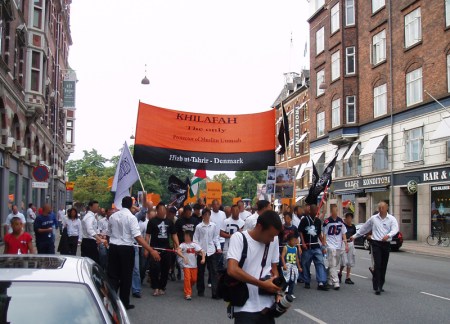
1476Members of the Islamist organization Hizb ut-Tahrir demand a worldwide Islamic Caliphate during a demonstration in Copenhagen, Denmark, in 2006. (Image source: Wikimedia Commons/Epo)

After the February 2015 terrorist attacks in Copenhagen against the synagogue, where Dan Uzan was murdered, and the Krudttønden café, where film director Finn Nørgaard was murdered, Hizb ut-Tahrir told Muslims not to condemn the terrorist attacks, but instead “put things in their right context.”

In Denmark, apparently, it is a crime to criticize Islam and “Islamists,” but calling Jews the “offspring of apes and pigs” and inciting their murder in a packed mosque (and calling non-Muslims in general “animals”) can be done with impunity.

Spring could bring a fresh surge of refugees. But Europe isn’t ready for them.

February 16, 2016

Spring could bring a fresh surge of refugees. But Europe isn’t ready for them. Washington PostGriff Witte and Anthony Faiola, February 16, 2016

LONDON — After an unparalleled tide of asylum seekers washed onto European shores last summer and fall, the continent’s leaders vowed to use the relative calm of winter to bring order to a process marked by chaos.

But with only weeks to go before more favorable spring currents are expected to trigger a fresh surge of arrivals, the continent is no better prepared. And in critical respects, the situation is even worse.

Ideas that were touted as answers to the crisis last year have failed or remain stuck in limbo. Continental unity lies in tatters, with countries striking out to forge their own solutions — often involving a razor-wire fence. And even the nations that have been the most welcoming toward refugees say they are desperately close to their breaking point or already well past it.

The result, analysts say, is a continent fundamentally unequipped to handle the predictable resurgence of a crisis that is greater than any Europe has faced in its post-Cold War history.

“It’s a very dangerous situation,” said Kris Pollet, senior policy officer at the European Council on Refugees and Exiles. “Anything can happen.”

On Thursday, European leaders will have one last opportunity to reckon with the crisis before the pace of new arrivals inevitably begins to climb again in the spring. But few have any expectations that this week’s summit will succeed where countless others before it have failed.

“Europe can deal with this if it wants to. But there needs to be a political breakthrough. And I’m not optimistic,” Pollet said.

Without one, he said, “it’s going to be chaos. That’s clear.”

The scale of disorder and political disruption could be even greater than what Europe faced in 2015.

The numbers themselves are already of an entirely new magnitude: Although arrivals are down from the height of the crisis last fall, the number of people who crossed the sea to reach Europe in the first six weeks of the year — around 75,000 — is 25 times what it was during the same period last year. More than 400 have drowned along the way.

On the Greek islands, the most common European landing spot for people fleeing war and oppression in the Middle East, South Asia and North Africa, thousands have arrived even on days when the rough winter seas have been churned by gale-force winds.

But once the asylum seekers have landed in Europe, the continent still has no coherent system for managing the flows. Just three out of an intended 11 “hot spots” — locations in Italy and Greece where those deemed likely to receive asylum will be separated from those expected to be denied — were up and running at the start of the week. A quota system that was intended to evenly distribute 160,000 refugees across the continent has similarly foundered: Fewer than 500 people have taken part. Countries in eastern and central Europe, meanwhile, have boycotted the program.

With countries improvising their own responses to the mass migration, the most basic tenet of Europe’s post-Cold War identity — that national leaders should act collaboratively to reach continent-wide solutions to common problems — is being called into question as never before.

At most immediate risk is Europe’s decades-old system for borderless travel, the Schengen zone. European leaders have warned that it could come crashing down within months, and it has already been riddled by an array of new fences, military patrols and identification checks where once there was free movement.

Greece could be the first casualty of Schengen’s decline, with the rest of the European Union threatening to kick the cash-starved nation out of the free-movement club unless authorities in Athens can get better control of the nation’s sea border with Turkey. Last week, the E.U. gave Greece a three-month deadline to do so.

But some do not want to wait that long. Eastern European countries including Poland and Hungary are attempting to form an anti-refugee front ahead of this week’s Brussels summit, seeking to combine forces on a plan that would effectively trap refugees in Greece and allow them to travel no farther into Europe.

Hungarian Prime Minister Viktor Orban, who on Monday called Europe “defenseless and weak” in stopping what he regards as an Islamic invasion, has called for the construction of razor-wire fences along Greece’s northern borders with Bulgaria and Macedonia.

Such a barrier is already going up on the Greek-Macedonian border, a major transit point for those heading farther north. Even governments regarded as reasonably pro-refugee say that border will soon need to be sealed.

On a visit to the Macedonian capital Friday, Austrian Foreign Minister Sebastian Kurz said that his country is rapidly nearing the limit it has set for asylum seekers this year — less than half the total of last year — and that Macedonia should be ready to “completely stop” the flow of migrants in the coming months.

On Tuesday, Austria announced a plan to limit new arrivals, part of what is now being called a “domino effect” of measures from Greece through the Balkans and into Western Europe meant to deter migrant flows. In a news conference, Interior Minister Johanna Mikl-Leitner said Austria was preparing to set up 12 new checkpoints along its southern border and impose a daily, perhaps even hourly, quota on migrant flows. Austria will also follow Sweden in denying entry to anyone without a valid travel document.

“If fences are necessary, additional fences will be built as well,” Mikl-Leitner said.

Those comments only add to the pressure on German Chancellor Angela Merkel, whose nation has taken more asylum seekers than any other in Europe but who faces growing demands to live up to her pledge to dramatically reduce the flows.

She heads to Brussels this week with an urgent need to break the political gridlock. One possibility would be to form what some are calling a new “coalition of the willing” — or a list of nations, probably in northern Europe, willing to take in asylum seekers who qualify for resettlement directly from Greece and Turkey.

She is also putting stock in a new NATO effort to combat people-smugglers in the Aegean Sea, while pushing Greece to more rapidly ramp up its hot spots for registering and processing asylum seekers. Meanwhile, she is continuing to press Turkish leaders to live up to their end of a bargain in which the E.U. agreed to pay Ankara 3 billion euros ($3.34 billion) in exchange for Turkish cooperation in cracking down on smuggler networks.

But with arrivals already far outpacing those in the same period last year, Germans are running out of patience with Merkel. At home, she faces a falling approval rating and a conservative backlash against her steadfast refusal to close Germany’s borders, even after it took in more than 1 million people last year.

The refugee crisis “is a Gordian knot Merkel has to cut. But she tied her political future to it, and there’s no way back for her,” said David Kipp, an associate at the German Institute for International and Security Affairs.

If Merkel fails in her attempts to cajole European leaders into cooperating, refugee advocates say there could be grave consequences — not only for the continent but also for the millions of people seeking an escape from the wars that have consumed Syria, Iraq, Afghanistan and other conflict zones.

“Our fear is that there will be a domino effect where countries say, ‘We’ve had enough,’ ” said William Spindler, a spokesman for the Office of the U.N. High Commissioner for Refugees. “Refugee flows are a reality. As long as you have conflict, you will have people fleeing for their lives.”

And at the moment, more people are doing so globally than at any time since World War II — some 60 million. The number trying to enter Europe is a relatively small fraction.

Heaven Crawley, who chairs the study of international migration at Britain’s Coventry University, said Europe should be able to handle the number of people reaching its shores. Syria’s neighbors, she noted, have coped with much higher proportional totals.

But, she said, the continent has been plagued by internal division, as well as a focus on keeping people out — rather than honestly reckoning with what should happen once refugees arrive.

“It’s a crisis of Europe’s own making,” she said. “If Lebanon and Jordan can manage it, why can’t the richest region in the world? It’s politics.”

Between Putin and Obama

February 7, 2016

Between Putin and Obama, Israel Hayom, Boaz Bismuth, February 7, 2016

The tide has turned in Syria: Aleppo, the rebel stronghold, is on the verge of falling to President Bashar Assad’s army. Hezbollah’s Shiite militias, the Iranian army and the massive Russian air strikes have been the difference.

In contrast to the rebels, Assad can count on his partners. On the Syrian dictator’s side, backed by Russia, action is being taken. On the rebel side, backed by the Americans, there has been a lot of talking. This perhaps explains why in January 2017 U.S. President Barack Obama will exit the White House, and Assad will still be in power. We can add this legacy to the American president’s splendid list of achievements.

And we haven’t even mentioned the millions of Syrian refuges, the terrible migrant crisis in Europe (leading to the rise of far-right parties across the continent), and the escalation of hostilities between Shiites and Sunnis. It’s not a short list.

Since last Monday, Aleppo has been under heavy attack from Assad’s forces. The gains on the ground have been considerable. Russia’s intervention has tipped the balance of power. No one can say this was unexpected. Washington, meanwhile, continues to grumble. U.S. Secretary of State John Kerry lambasted Moscow on Friday for the large number of dead Syrian women and children. Moscow isn’t exactly heeding his criticism. Washington still fails to understand that instead of talking, maybe it would be better to take action already. In August of 2013, however, after Assad had attacked his own people with chemical weapons for the 14th time, the Americans did nothing (red lines, remember?). Why should things be any different today?

Washington, you will say, has worked hard to find a diplomatic solution. This is a good time to remind everyone that the peace talks in Vienna have again hit a dead end. The talks aren’t likely to succeed for a number of reasons, namely that the two main players — Saudi Arabia and Iran — have reached a point of open hostilities, thanks to American foreign policy. Instead of cooperating to resolve the Syrian crisis, these two regional powers are closer than ever to a full-fledged military conflict. Riyadh is threatening to send ground forces into Syria to support the rebels. The commander of Iran’s Revolutionary Guard has already vowed that any such intervention would result in immense casualties for the Saudis. This is where things stand.

Over the weekend Turkey’s foreign minister discussed opening his country’s borders to the steady stream of refugees, but the crossings remain as shut as they were in September, 2014, when thousands of Kurds tried to flee the border town of Kobani. The European Union is trying to remind the Turks that they were given $3 billion for the expressed purpose of absorbing these 2 million refugees. But who expects agreements to be kept in today’s Middle East?

Who does have faith in agreements?

The refugee issue is becoming the hot button topic of the Syrian civil war. “The markets solved the economic crisis, the voters will solve the refugee crisis,” a French lawmaker said a few days ago. In the meantime, as Assad solidifies his power the far-right parties in Germany, Sweden, Denmark and Holland, and of course in France, are all growing in strength. It appears that everyone outside the Obama camp is thriving. And here is yet one more legacy to tell the grandchildren about.

The End Of The Multiculturalist Consensus In Europe

February 5, 2016

The End Of The Multiculturalist Consensus In Europe, Daily Caller, Michel Gurfinkiel, February 3, 2016

(Please see also, Latest Poll: Merkel in Free Fall, Germans Sensible; 76% of AfD Supporters OK with Genuine Refugees.  — DM)

One wonders why America, a nation of immigrants, can be suddenly so receptive to Donald Trump’s anti-immigration rhetoric. The best answer, so far, is that immigration does not seem to work any more the way it did, at least for certain groups of immigrants.

A similar situation has arisen in Europe. In 2009, the American journalist Christopher Caldwell famously characterized the changes that a massive non-European, non-Judeo-Christian, immigration was forcing over Europe as a “revolution.” We may now be on the brink of a counter-revolution, and that can be as violent and far-reaching as revolution itself.

Last year’s massacres in Paris (the attacks on satirical cartoonists and a kosher supermarket’s customers in January 2015, then the November 13 killing spree) were a tipping point : the French – and by extension, most Europeans — realized that unchecked immigration could lead to civil war.

Then there was the Christmas crisis in Corsica, a French island in the Mediterranean. On December 24, a fire was activated at an immigrant-populated neighborhood in Ajaccio, the capital of Southern Corsica. As soon as the firemen arrived, they were attacked by local youths, Muslims of North African descent. Such ambushes have been part of French life for years. This time, however, the ethnic Corsicans retaliated; for four days, they rampaged through the Muslim neighborhoods, shouting Arabi Fora! (Get the Arabs out, in Corsican). One of Ajaccio’s five mosques was vandalized.

Then, there was the New Year’s crisis in Germany and other Northern European countries. On December 31, one to two thousand male Muslim immigrants and refugees swarmed the Banhofvorplatz in Cologne, a piazza located between the railway Central Station and the city’s iconic medieval cathedral. As it turned out during later in the evening and the night, they intended to “have fun”: to hunt, harass, or molest the “immodest” and presumably “easy” German women and girls who celebrated New Year’s Eve at the restaurants and bars nearby, or to steal their money. 766 complaints were lodged. Similar incidents took place in other German cities, like Hamburg, Frankfurt and Stuttgart, as well as in Stockholm and Kalmar in Sweden, and Helsinki in Finland.

Here again, the local population reacted forcefully. Support for asylum seekers from the Middle East plummeted – 37 percent of Germans said that their view of them has “worsened,” and 62 percent said that there are “too many of them.” The Far Right demonstrated against immigration in many cities, but liberal-minded citizens were no less categorical. Le Monde, the French liberal newspaper, on January 20 quoted Cologne victims as saying, “Since 1945, we Germans have been scared to be charged with racism. Well, the blackmail is over by now.”

Indeed, postwar Europe, and Germany in particular, had been built upon the rejection of Hitler’s mad regime and everything it stood for. Nationalism, militarism, authoritarianism, and racism were out. Multinationalism, pacifism, hyperdemocracy, and multiculturalism were in. This simple, almost Manichean, logic is collapsing now – under the pressure of hard facts. Or rather the Europeans now understand that it was flawed in many ways from the very beginning, especially when it came to multiculturalism, the alleged antidote to racism.

What Europeans had in mind when they rejected racism in 1945 was essentially antisemitism. Today, the “correct” antiracist attitude would be to welcome non-European immigrants en masse and to allow them to keep their culture and their way of life, even it that would contradict basic European values. Hence last summer’s “migrants frenzy,” when the EU leadership in Brussels and major EU countries, including Angela Merkel’s Germany, decided to take in several millions of Middle East refugees overnight.
European public opinion is now awaking to a very different view. And the political class realizes that it must adjust – or be swept away.

European public opinion is now awaking to a very different view. And the political class realizes that it must adjust – or be swept away.

The Schengen regime – which allows free travel from one country to the other in most of the EU area – is being quietly suspended; every government in Europe is bringing back borders controls. The French socialist president François Hollande is now intent to strip disloyal immigrants and dual citizens of their French citizenship (a move that precipitated the resignation, on January 27, of his super-left-wing justice minister, Christiane Taubira). He is also hiring new personnel for the police and the army and even considering raising a citizens’ militia. Merkel now says that immigrants or refugees who do not abide by the law will be deported. Even Sweden, currently ruled by one of Europe’s most left-wing cabinets, has been tightening its very liberal laws on immigration and asylum.

Most Europeans agree with such steps. And wait for even more drastic measures.


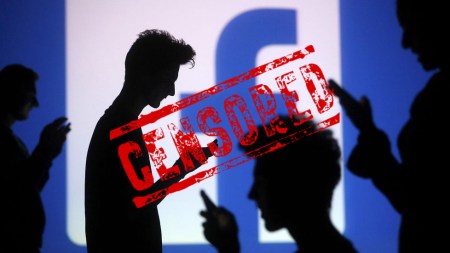
Facebook’s War on Freedom of Speech

February 5, 2016

Facebook’s War on Freedom of Speech, Gatestone InstituteDouglas Murray, February 5, 2016

♦ Facebook is now removing speech that presumably almost everybody might decide is racist — along with speech that only someone at Facebook decides is “racist.”

♦ The sinister reality of a society in which the expression of majority opinion is being turned into a crime has already been seen across Europe. Just last week came reports of Dutch citizens being visited by the police and warned about posting anti-mass-immigration sentiments on social media.

♦ In lieu of violence, speech is one of the best ways for people to vent their feelings and frustrations. Remove the right to speak about your frustrations and only violence is left.

♦ The lid is being put on the pressure cooker at precisely the moment that the heat is being turned up. A true “initiative for civil courage” would explain to both Merkel and Zuckerberg that their policy can have only one possible result.

It was only a few weeks ago that Facebook was forced to back down when caught permitting anti-Israel postings, but censoring equivalent anti-Palestinian postings.

Now one of the most sinister stories of the past year was hardly even reported. In September, German Chancellor Angela Merkel met Mark Zuckerberg of Facebook at a UN development summit in New York. As they sat down, Chancellor Merkel’s microphone, still on, recorded Merkel asking Zuckerberg what could be done to stop anti-immigration postings being written on Facebook. She asked if it was something he was working on, and he assured her it was.

At the time, perhaps the most revealing aspect of this exchange was that the German Chancellor — at the very moment that her country was going through one of the most significant events in its post-war history — should have been spending any time worrying about how to stop public dislike of her policies being vented on social media. But now it appears that the discussion yielded consequential results.

Last month, Facebook launched what it called an “Initiative for civil courage online,” the aim of which, it claims, is to remove “hate speech” from Facebook — specifically by removing comments that “promote xenophobia.” Facebook is working with a unit of the publisher Bertelsmann, which aims to identify and then erase “racist” posts from the site. The work is intended particularly to focus on Facebook users in Germany. At the launch of the new initiative, Facebook’s chief operating officer, Sheryl Sandberg, explained that, “Hate speech has no place in our society — not even on the internet.” She went to say that, “Facebook is not a place for the dissemination of hate speech or incitement to violence.” Of course, Facebook can do what it likes on its own website. What is troubling is what this organization of effort and muddled thinking reveals about what is going on in Europe.

1455

The mass movement of millions of people — from across Africa, the Middle East and further afield — into Europe has happened in record time and is a huge event in its history. As events in ParisCologne and Sweden have shown, it is also by no means a series of events only with positive connotations.

As well as being fearful of the security implications of allowing in millions of people whose identities, beliefs and intentions are unknown and — in such large numbers — unknowable, many Europeans are deeply concerned that this movement heralds an irreversible alteration in the fabric of their society. Many Europeans do not want to become a melting pot for the Middle East and Africa, but want to retain something of their own identities and traditions. Apparently, it is not just a minority who feel concern about this. Poll after poll shows a significant majority of the public in each and every European country opposed to immigration at anything like the current rate.

The sinister thing about what Facebook is doing is that it is now removing speech that presumably almost everybody might consider racist — along with speech that only someone at Facebook decides is “racist.”

And it just so happens to turn out that, lo and behold, this idea of “racist” speech appears to include anything critical of the EU’s current catastrophic immigration policy.

By deciding that “xenophobic” comment in reaction to the crisis is also “racist,” Facebook has made the view of the majority of the European people (who, it must be stressed, are opposed to Chancellor Merkel’s policies) into “racist” views, and so is condemning the majority of Europeans as “racist.” This is a policy that will do its part in pushing Europe into a disastrous future.

Because even if some of the speech Facebook is so scared of is in some way “xenophobic,” there are deep questions as to why such speech should be banned. In lieu of violence, speech is one of the best ways for people to vent their feelings and frustrations. Remove the right to speak about your frustrations, and only violence is left. Weimar Germany — to give just one example — was replete with hate-speech laws intended to limit speech the state did not like. These laws did nothing whatsoever to limit the rise of extremism; it only made martyrs out of those it pursued, and persuaded an even larger number of people that the time for talking was over.

The sinister reality of a society in which the expression of majority opinion is being turned into a crime has already been seen across Europe. Just last week, reports from the Netherlands told of Dutch citizens being visited by the police and warned about posting anti-mass-immigration sentiments on Twitter and other social media.

In this toxic mix, Facebook has now — knowingly or unknowingly — played its part. The lid is being put on the pressure cooker at precisely the moment that the heat is being turned up. A true “initiative for civil courage” would explain to both Merkel and Zuckerberg that their policy can have only one possible result.

The Russian Federation’ Strategic Equation in Syria

February 4, 2016

The Russian Federation’ Strategic Equation in Syria, Israel DefenseGiancarlo Elia Valori, February 4, 2016

Bombs away

According to Western sources, ISIS has recently reduced its size by 40% overall and by 20% in Syria, while it had lost only 14% of its territory throughout 2015 when the Caliphate’s ISIS expanded – without recovering the same amount of territory – in Eastern Syria.

Another area where the Caliph Al Baghdadi has lost much of his territorial control is the area along the border with Turkey – while the Caliphate has arrived up to the areas along the border with Jordan, the traditional area of smuggling and transit of its militants. Areas towards the Lebanese border and in the Palmira region are reported to be under ISIS control.

Hence, so far, both the US Coalition’s and the Russian-Syrian pressures do not seem to be sufficient to definitively destabilize Al-Baghdadi’s Caliphate, despite its current territorial losses.

Therefore ISIS is likely to restructure itself in the form of a first-phase Al Qaeda, as indeed it already appears to do.

This means that ISIS could create – or has already done so – a small and centralized organizational structure, with informal peripheral networks in Europe, North Africa and Central Asia, with a view to organizing mass terrorist actions and blocking the Western resistance against the jihad, as well as finally disrupting the European security forces.

Nevertheless, why the Russian-Syrian actions and the other US-led action do not work fully?

Firstly, we must analyze the Caliphate’s weapons: it has acquired most of the stocks abandoned by the Iraqi and Syrian armies, including sufficiently advanced weapons to counter the Russian and the Coalition’s weapon systems.

Absolute technological superiority is not needed. The will to fight and the higher mobility of the Caliphate’s armies are more than enough.

In essence, ISIS can avoid attacking the best equipped areas of both coalitions, while it can predict and avoid the West’s points of attack thanks to a joint and unified command/control center located far from the lines. Said center employs the same technologies as the anti-jihadist forces, as well as similar logics of action. Mimicking the enemy is an effective way of fighting it.

Furthermore, mobility replaces technological superiority and currently nobody – except for the Russian Federation – wants to fight “for Gdansk”, which today means fighting for Damascus.

A Caliphate’s conventional strategy “from the weak to the strong” – just to use the same terminology as the philosophers of war, Beaufre and Ailleret – where the Western weakness is twofold: both on the ground, where ISIS is much more mobile and causes politically unacceptable damage to the West (with the exception of Russia and the Kurdish and Yazidi militias) and within the Western public, slackened off by the fairy tale of “good” immigration which blocks the European governments’ reactions on the necessary presence of Western troops on the ground.

Not to mention the fact that ISIS has taken possession, on its own territory, of the Hamas line in Gaza: a very thick and dense network of underground tunnels, which protects from air attacks and allows the economic activities needed to support the organization.

Another primary goal of the Caliph Al Baghdadi is to saturate Western police forces and making them actually unusable since they are already scarce in number and weapons, while Europe dies in “multiculturalism”.

This is a primary goal of ISIS which, in the future, will certainly attack – probably also territorially – some areas in European countries “from the weak to the strong”.

The bell tolls for us, too – just to make reference to John Donne’s verse, which became famous as the title of Ernest Hemingway’s novel on the Spanish Civil War, which in fact paved the way for World War II.

Hence, we will soon have a core of militant jihadists not necessarily trained in Syria, but connected via the Internet, and a vast network of “fellow travelers” who can serve as cover, logistical support, recruitment area, political and media manipulation for the more gullible or fearful Westerners.

This will be – and, indeed, it already is – the structure of Al Baghdadi’s Caliphate in Europe.

The “branches” of Al-Baghdadi’s Caliphate are equally efficient: in the Barka province in Libya – and now in the Sirte district with the agreement between the ISIS and Gaddafi’s tribes – as well as Jund-al-Kilafah in Algeria, Al Shaabab in Somalia, Boko Haram in Northern Nigeria, Jundallah in Pakistan and Abu Sayyaf in Malaysia.

The void of Western inanity is immediately filled by ISIS, which does not know international law, but only a miserably manipulated Koran.

Hence, a mechanism similar to communicating vessels is in place: the more the ISIS crisis deepens on its territory of origin, the more threatening and powerful the peripheral groups become.

While, at the same time, in Europe we are witnessing some mass radicalization maneuvers which rely on Al Qaeda’s old techniques: at first, the more or less crazy “Manchurian candidates”, who played havoc in small areas.

Later – as today – mass actions, like that in front of the Cathedral and train station in Cologne, which will certainly bring good results to the Caliph in the future; then again real, visible and very effective terrorist attacks. Not to mention similar mass actions in Hamburg and Zurich.

Finally, when and how it will be logistically possible, we will witness the creation of small “Caliphates” in Europe, in the areas which the enormous long-term stupidity of EU leaders has left fully in the hands of Islamic mass immigration that has seized neighborhoods and cities.

The war against the Caliphate is and will be a very long war and the West – probably with the only exception of the Russian Federation – has in no way the political and psychological ability, nor the power to fight it with a view to winning it.

The West will die of soft power, as well as of a lot of talk with Islamists who do not want to hear it – all convinced of their alleged cultural, religious and military superiority.

Years of peacekeeping, “stabilization” and peace-enforcing have turned the European Armed Forces – already largely undersized at that time – into traffic guards and organizers  of elections – always rigged – just to be as quick as possible and go away without disturbing the sleep of European peoples.

The very size of the European Armed Forces, considered individually or in a ramshackle coalition “against terror”, is not even comparable with those of the United States or Russia, after decades of equally unreasonable reduction of investment in the military and in the public safety sectors, even after the first Al Qaeda attacks.

On the contrary, Russia has implemented a thorough reform of its Armed Forces in 2008, after the war with Georgia, and it has worked much more on the “human factor” than on technology which, however, has not been neglected.

So far the Russian forces in Syria have deployed artillery groups and other ground forces while, according to reports coming from Russian sources, Russia is deploying batteries of S-400 anti-aircraft missiles again on Syrian territory, over and above providing “Buk” anti-aircraft missile systems to the Arab Syrian Army.

The S-400 missile – also known as “Growler”, according to the NATO designation – is an anti-aircraft missile which intercepts aircrafts flying up to 17,000 kilometers per hour, while “Buk” (also known as SAM 17) is a surface-to air missile system (also known as “Gainful” according to the NATO designation) with radars for the acquisition of targets, which are the enemy cruise missiles and strike aircrafts.

Nevertheless, why does Russia deploy such an advanced anti-aircraft structure if ISIS has no planes?

The simple answer to this question is because Russia wants to reduce and eventually eliminate Western raids, often objectively inconclusive or scarcely effective, also due to the lack of a network for target acquisition.

Conversely, Russia wishes to take Syria as a whole, after destroying or minimizing Al Baghdadi’s Caliphate.

President Putin needs a victory in Syria – firstly because the defeat of Al Baghdadi’s Caliphate avoids the jihadist radicalization of the over twenty million Muslim residents and citizens of Russia.

If the Russian and Central Asian Islam takes fire, Russia can no longer control – militarily or economically – the energy networks towards Europe and the Mediterranean region, which is the central axis of its geoeconomy.

Moreover, Vladimir Putin wants to become the only player of the Syrian crisis because, for Russia, ousting the West from a NATO neighboring country, which is pivotal for control over the Mediterranean region, means to become – in the future – one of the two players or even the first player  in the Mare Nostrum, with strategic consequences which are unimaginable today.

Finally, the Russian anti-aircraft missile systems are needed to wipe out the aircrafts of the powers not coordinating with Russia and to strengthen military cooperation with the countries which have accepted the Russian air superiority.

For example Israel which, for the time being, offsets by Russia the de facto breaking of military and strategic relations with the United States and the political anti-Semitism mounting in Europe.

Furthermore, Putin also holds together – in a hegemonic way – Iran, Bashar al-Assad’s Syria and the Lebanese Hezbollah, thus setting himself up as a mediator and power broker between the Shi’ite bloc and the West when, in all likelihood, the clash between the Sunnis and the “Party of Ali” will become disastrous and fatal for European security.

Furthermore, the Russian President wants to push the United States away from the Middle East definitively, regardless of the United States maintaining or not their preferential relations with Saudi Arabia.

Finally, within the UN Security Council, Russia will do its utmost to capitalize on its hopefully future victory against ISIS, by exchanging it with the achievement of other Russian primary interests: the management of the Arctic; the forthcoming militarization of the Shanghai Cooperation Organization; the regionalization of NATO eastward and possibly a new military agreement with China, which would make the composition of the UN Security Council completely asymmetrical.

Not to mention the great attraction which Russia would hold for a Eurasian peninsula left alone by the United States and devoid of acceptable defenses in the Southeast.

In this case, the Eurasia myth of the Russian philosopher and strategist, Alexander Dugin, would come true very quickly.