Archive for the ‘Erdogan’ category

State Sponsor of Islamic Terrorism: “Terrorism will Never have a Religion”

April 6, 2016

State Sponsor of Islamic Terrorism: “Terrorism will Never have a Religion” Front Page Magazine, Daniel Greenfield, April 6, 2016

(But he’s a cool guy. Please see Germany Moves To Remove Anti-Erdogan Poem And Merkel Calls Turkey To Apologize

— DM)


Islamic terrorism

Islamic Terrorism has no religion. We all know that. And it’s good to hear a state sponsor of Islamic terrorism reaffirm that right here.

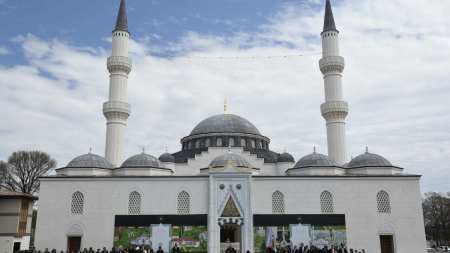
Hailing the beauty of its location near the capital Washington, Turkish President Recep Tayyip Erdogan officially inaugurated the Diyanet Center of America.

“Unfortunately, we are going through a rough time all around the world. Intolerance towards Muslims is on the rise not only here in the United States but also around the globe,” said Erdogan, who is accused of increasingly autocratic rule.

Also Erdogan threatened to ethnically cleanse Armenians, massacred Kurds and has prisons filled with political prisoners. But all his victims are probably guilty of Islamophobia.

The complex, the only one in the United States to feature two minarets, echoes the golden age of 16th century Ottoman architecture, with its central dome, half domes and cupolas in the style of Istanbul’s Suleymaniye Mosque.

Also it echoes the Islamist poem that sent Erdogan to jail originally, before he took over the country. “The mosques are our barracks, the domes our helmets, the minarets our bayonets and the faithful our soldiers.”

Good thing we let him set up his barracks and bayonets here. When even Cuba denied him permission.

“Terrorism will never have a religion, will never have a nation, will never have a nationality, nor will it ever have a root or ethnicity,” Erdogan said.

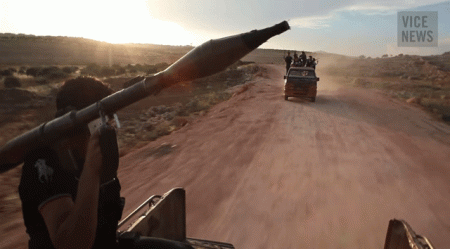
Obviously. Just ask Hamas, which Erdogan backs. Not to mention the various Syrian Jihadists whom he also backs. These Islamic terrorists have no religion.

P.S. This all makes sense if you define terrorism as non-Muslims defending themselves against Jihadists.

Germany Moves To Remove Anti-Erdogan Poem And Merkel Calls Turkey To Apologize

April 5, 2016

Germany Moves To Remove Anti-Erdogan Poem And Merkel Calls Turkey To Apologize, Jonathan Turley’s Blog, Jonathan Turley, April 5, 2016

220px-recep_tayyip_erdogan
220px-angela_merkel_2008

The enabling of an authoritarian like Erdogan is a new low for the Western nations. Not only is Erdogan destroying free speech and the free media in Turkey, but he has now found a way to enlist Western governments like Germany to embrace the same anti-free speech principles.

********************

We recently discussed how Turkish President Recep Tayyip Erdogan has turned his suppression of critics to other countries and was demanding action from governments against his critics. At the time, I was relieved to report that Germany had held the line on free speech. My relief of premature. German ZDF public television said Monday it had deleted a poem recited by presenter Jan Böhmermann from last Thursday’s edition of “Neo Magazin Royal” after pressure from the German government. Böhmermann’s poem, containing numerous sexual innuendos, accuses Erdogan of repressing minorities, including Kurds and Christians. German government spokesman Steffen Seibert said Chancellor Angela Merkel in a telephone call on Sunday evening with Turkish Prime Minister Ahmet Davutoglu had agreed that Böhmermann had recited a “deliberately abusive text.” Merkel has done precisely what civil libertarians feared: feeding Erdogan’s desire to suppress speech and affirming that he can indeed silence critics abroad.

What is truly maddening is that the spokesman insisted that none of this takes away from the “high value” the German government placed on freedoms of the press and public opinion. Unbelievable. Merkel silences Germans to appease a rising dictator while insisting that she remains committed otherwise to free speech.

Böhmermann mocked Merkel and said “Limits, at last. I think we have spectacularly shown, jointly with ZDF, where the limits of satire lie by us in Germany. At last!”

Merkel is not the only one who should be condemned in this matter. ZDF Program director Norbert Himmler insisted that there were limits to irony and satire.

“In this case, they were clearly exceeded . . . As a result, in consultation with Jan Böhmermann, we have decided to take the passage out of the broadcast. That relates to the video in the Mediathek, clips on YouTube, and re-runs.”

As we discussed, Erdogan flew into a rage over a satirical song entitled “Erdowie, Erdowo, Erdogan,” that ridiculed Erdogan’s alleged extravagance and a crackdown on civil liberties. Here is the video:

The video is a parody of a 1980s song by the German pop star Nena, “Irgendwie, Irgendwo, Irgendwann,” (“Anyway, Anywhere, Anytime”) which is changed to “Erdowie, Erdowo, Erdogan.” The facts that it reports however are not satirical but actual. The video details Erdogan crackdown on democracy and basic freedoms as well as his infamous intolerance for any criticism. Merkel has now added fuel to the meglomania of Erdogan in saying that certain criticism will not be tolerated in Germany. That is likely far more than the Turks ever dreamed of . . . to have a major Western nation embrace censorship.

We have previously discussed the alarming rollback on free speech rights in the West, particularly in France (here and here and here and here and here and here) and England (here and here and here and here and here and here and here and here and here and here). Much of this trend is tied to the expansion of hate speech and non-discrimination laws. We have seen comedians targeted with such court orders under this expanding and worrisome trend. (here and here). In Germany, Merkel government has crackdown on anti-immigration speech as the government expands its list of permitted and prohibited speech.

The enabling of an authoritarian like Erdogan is a new low for the Western nations. Not only is Erdogan destroying free speech and the free media in Turkey, but he has now found a way to enlist Western governments like Germany to embrace the same anti-free speech principles.

Horowitz: Turkish Islamic Leader Inaugurates Largest Mosque Complex in U.S.

April 4, 2016

Horowitz: Turkish Islamic Leader Inaugurates Largest Mosque Complex in U.S., Conservative Review, Daniel Horowitz, April 4, 2016

(At least Obama was displeased with Erdogan and did not attend. — DM)

Diyanet Center of America

Imagine FDR inviting Benito Mussolini to come to the United States in Middle of World War II to dedicate a massive Italian cultural center?  Or how about inviting the Japanese emperor to the groundbreaking of a new Shinto shrine that was bankrolled by his country?  Well, the reality of Turkey’s Islamist leader, Recep Tayyip Erdogan, speaking at the opening of a massive Islamic center that he funded in a small Maryland town – while we are at war with Islamic fascism – dwarfs these historical hypotheticals in terms of absurdity and outrage.

In May 2013, Erdogan visited the site of the future Mosque in Lanham, Maryland along with Obama administration officials.  After $110 million from the Turkish government, this massive Islamic center is now open and is the largest Islamic facility in the United States.  The Turkish Islamic-fascist leader spoke there on Saturday to inaugurate the behemoth complex.  During the feisty speech, Erdogan lectured Americans about tolerance towards Muslims, yet failed to acknowledge how he shuts down churches in his home country and fuels anti-Semitism.

While I haven’t seen any information on those who attended this ceremony, the head of the Islamic Circle of North America (ICNA) was present at the 2013 groundbreaking.  ICNA is an Islamic supremacist group that follows the teachings of Maulana Mawdudi and the Jamaat Al-Islami of Pakistan.  Maulana has said that Jews will be exterminated in the end of days.  The mother of Syed Farook, who lived with her son for months while he was making bombs in San Bernardino, was a member of ICNA.  Syed’s wife, Tafsheen Malik, was radicalized in Pakistan by the network of Sharia-schools that followed those teachings as well.

Also in attendance in 2013 was Imam Mohamed Magid, the former head of the Islamic Society of North America (ISNA).  ISNA is a Muslim Brotherhood offshoot that was designated as an unindicted co-conspirator in the Holy Land Foundation terror trial by the 5th Circuit Court of Appeals.  Even though Magid’s father is the Grand Mufti of Sudan responsible for the Christian genocide, he was appointed by Obama in 2011 to serve on the Department of Homeland Security’s (DHS) Countering Violent Extremism Working Group.  No, you aren’t missing anything.  There are Islamists who have been designated as Hamas agents that are given advisory positions in DHS, FBI, and the National Security Council.

Indeed, the Turkey/Muslim Brotherhood axis has come full circle right outside of our nation’s capital in a residential neighborhood.

Ever since the 9/11 attacks, and particularly over the past year, our political leaders have been pulling their hair out and wringing their hands in pursuit of a solution to combating Islamic terror.  We’ve spent 15 years refereeing Islamic civil wars overseas at a great fiscal and human cost to our nation.  Yet, at the same time we have brought the enemy to our shores through suicidal immigration policies and have allowed the Muslim Brotherhood and Islamic foreign governments to represent the entire Muslim community in America.  We are at war with Islamic extremism, yet our political leaders have openly invited the Islamic extremists to come here and radicalize American Muslims.

Erdogan has been playing a double game of supporting ISIS for the past few years.  And of course, he is one of the biggest supporters of Hamas in the Middle East.  Then again, the Muslim Brotherhood is Hamas, yet they are in our government and control most of the mosques in this country.

Harking back to our original historical hypothetical analogy of allowing Mussolini or the Japanese emperor to inaugurate a cultural center during World War II, the reality we face today is much worse.  For the most part, Japanese-Americans and Italian Americans were completely assimilated and patriotic at the time.  What was going on in Japan and Italy had nothing to do with an entrenched religious ideology that spanned the globe and united all Japanese and Italians across the world to commit genocide or at least subvert their host countries.  That is not the case today with Sharia-adherent Muslims living in the West and radicalized by terror groups and foreign entities with which we are at war.

That we would allow the Erdogan regime—which has become the Islamist leader of the Sunni jihad world the same way Iran leads the Shia Jihad—to fund and control a $110 million Islamic center right near our capitol while we are at war with this very ideology and these very individual Islamic extremists not only defies logic, it defies the innate desire for self-preservation.


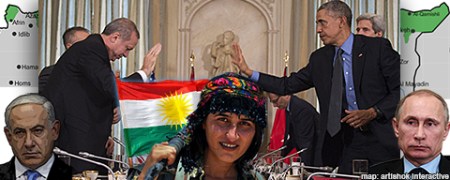
Netanyahu’s dilemma: Détente with Turkey or recognition of Syrian Kurds

April 4, 2016

Netanyahu’s dilemma: Détente with Turkey or recognition of Syrian Kurds, DEBKAfile, April 4, 2016

obama_erdogan_best_friends_2012They were once good friends

Last Friday, April 1, President Reccep Tayyip Erdogan had his first encounter with a group of American Jewish leaders, at his request. The full details of its contents were hard to sort out because the Turkish translator censored his master’s words with a heavy hand to make them more acceptable to his audience. But Erdogan’s bottom line, DEBKAfile’s New York sources report, was a request for help in explaining to the Obama administration in Washington and the Netanyahu government in Jerusalem why they must on no account extend support to the Syrian Kurdish PYD and its YPG militia or recognize their bid for a separate state in northern Syria.

The Turkish president did not spell out his response to this step, but indicated that a Turkish invasion to confront the Kurdish separatists was under serious consideration in Ankara. His meaning was clear: He would go to war against the Kurds, even if this meant flying in the face of President Barack Obama’s expectation that Turkey would fight the Islamic State.

Relations between the Turkish and US presidents have slipped back another notch in the last two weeks. When he visited Washington for the nuclear summit, Erdogan was pointedly not invited to the White House and his request for a tete a tete with Obama was ruled out. The US president even refused to join Erdogan in ceremonially honoring a new mosque built outside Washington with Turkish government funding.

At odds between them is not just the Kurdish question, but Erdogan’s furious opposition to Obama’s collaboration with Russian President Vladimir Putin on the Syrian conflict, and the two presidents’ tacit accord to leave Bashar Assad in power indefinitely until a handover becomes manageable.

On Feb. 7, on his return for a Latin American tour, the Turkish president warned Obama that he must choose between Ankara and the Kurds, whom he called “terrorists.” By last week, the US president’s choice was clear. It was the Kurds.

ObamaErdogan480_Koteret

When Erdogan arrived home from Washington last week, he discovered that the roughly four million Syrian Kurds dwelling in three enclaves touching on the Turkish border had taken important steps to advance their goal for self-rule: They were drafting a plan for establishing a “Federal Democratic System” in their three enclaves – Hassakeh-Jazeera, Kobani and Afrin – and had announced the amalgamation of their respective militias under the heading the “Syrian Democratic Forces”.

Cold-shouldered in Washington as well as Moscow (since Turkish jets shot down a Russian fighter last November), Erdogan found himself let down by the Jewish leaders whom he tried to woo. They refused to support him or his policy on the Kurdish question for three reasons:

1. Ankara had for years consistently promoted the radical Palestinian Hamas organization. To this, Erdogan replied by denying he had backed Hamas  only acted to improve the lives of the Gaza population. And, anyway, he said he had reacyed understandings with Israel on this issue..

2. His hostility towards Egyptian President Abdel-Fatteh El-Sisi. Erdogan’s response to this was a diatribe slamming the Egyptian ruler.

3. No clear reply had been forthcoming from Jerusalem by that time on Israel’s relations with Turkey or its policy towards the Kurds, despite the Turkish leader’s positive presentation of  mended fences.

The current state of the relationship is laid out by DEBKAfile’s sources:

Prime Minister Binyamin Netanyahu is caught on the horns of multiple dilemmas: While reluctant to respond to Ankara’s suit for warm relations with a leader who is shunned by Obama and Putin alike, Turkey is nonetheless offering to be Israel’s best client for its offshore gas.

Israel’s friendship with the Kurdish people goes back many years. The rise of an independent or autonomous state in Syria and its potential link-up with the semiautonomous Kurdish region of Iraq would create an important new state of 40 million people in the heart of the Middle East.

Israel has no wish to make enemies of its longstanding friends by disowning them in favor of Turkey.

Already, Israel’s evolving ties with the Syrian Kurds have given Israel’s strategic position in Syria a new positive spin, upgrading it versus the Assad regime in Damascus and its Hizballah and Iranian allies, who are avowed enemies of the Jewish state. Those ties offer Israel its first foothold in northern Syria.

And finally, Erdogan is not the only opponent of Kurdish separatism; so too are important Sunni Muslim nations like Saudi Arabia and Egypt. By promoting the Kurds, Israel risks jeopardizing its rapidly developing ties with those governments.

Journalism in Turkey: Newsroom vs. Courtroom

March 31, 2016

Journalism in Turkey: Newsroom vs. Courtroom, Gatestone InstituteBurak Bekdil, March 31, 2016

(Please see also, Turkey to Host UN’S First Global Humanitarian Summit. — DM)

♦ According to a report by the Turkish Journalists Association, 500 journalists were fired in Turkey in 2015; 70 others were subjected to physical violence. Thirty journalists remain in prison, mostly on charges of “terrorism.” There are also many journalists among the 1,845 Turks who have been investigated or prosecuted for insulting President Recep Tayyip Erdogan since he was elected in August 2014.

♦ After the secular daily newspaper Cumhuriyet published evidence of arms deliveries by the Turkish intelligence services to Islamist groups in Syria, President Erdogan himself filed a criminal complaint against Cumhuriyet’seditor-in-chief, Can Dundar, and the Ankara bureau chief, Erdem Gul.

♦ At a March 25 hearing, the Istanbul court ruled for the whole trial to be held in secret.

♦ “We came here today to defend journalism…We said we would defend the people’s right to access information. We defended that and we were arrested.” — Can Dundar, editor-in-chief of Cumhuriyet.

♦ The trial clearly exhibits how Erdogan’s authoritarian rule diverges from Western democratic culture.

“Turkey is where many journalists may have to spend more time at their attorneys’ offices or in courtrooms than in the newsrooms, where they should be,” a Western diplomat joked bitterly. “Don’t quote me on that. I don’t want to be declared persona non grata,” he added with a smile.

He was right. According to a report by the Turkish Journalists Association, 500 journalists were fired in Turkey in 2015; 70 others were subjected to physical violence. Thirty journalists remain in prison, mostly on charges of “terrorism.”

Needless to say, the unfortunate journalists are invariably known to be critical of Erdogan. There are also many journalists among the 1,845 Turks who have been investigated or prosecuted for insulting President Recep Tayyip Erdogan since he was elected in August 2014.

One of them is Sedat Ergin, editor-in-chief of Turkey’s most influential newspaper, Hurriyet. On March 25 Ergin had to appear before a penal court on charges of insulting Erdogan, with the prosecution demanding up to four years in jail for him. The veteran journalist says he is devastated to have been taken to court for the first time in his 41 years as a journalist on such an accusation. After his trial Ergin told reporters: “… in the year 2016 courthouse corridors and the hearing rooms have become the habitats of journalists in Turkey. Freedom of the press in Turkey in 2016 is now confined to court corridors.”

On that same day, two more journalists were in a courtroom, but they are not as lucky as Ergin in terms of the prison sentences demanded by the prosecution.

In May 2015, the secular daily newspaper Cumhuriyet published on its front page video and photographic evidence of arms deliveries by the Turkish intelligence services to Islamist groups in Syria. A month later, President Erdogan himself filed a criminal complaint against Cumhuriyet’seditor-in-chief, the prominent journalist, Can Dundar, and the newspaper’s Ankara bureau chief, Erdem Gul. In a public speech, Erdogan said: “He who ran this story will pay heavily for it.”

Dundar and Gul were arrested and remained behind bars for over 90 days, until Turkey’s Constitutional Court ruled that their detention violated their rights. They were released, but must now stand trial on charges of espionage, as well as aiding a terrorist organization that aims to topple Erdogan’s government. The case is a serious threat to the two journalists’ liberty, especially when Erdogan’s “weight” in the courtroom remains easily felt, if not seen.

1535Can Dundar (right), editor-in-chief of Turkey’s Cumhuriyet newspaper, and Erdem Gul (left), Cumhuriyet’s Ankara bureau chief, were arrested after the paper published evidence of arms deliveries by the Turkish intelligence services to Islamist groups in Syria. They remained behind bars for over 90 days, until Turkey’s Constitutional Court ruled that their detention violated their rights.

At the March 25 hearing, the Istanbul court ruled for the whole trial to be held in secret. A group of opposition MPs protested the decision and refused to leave the courtroom. The court decided to file a criminal complaint against them for “obstructing justice.”

“We came here today to defend journalism. We gathered here before and said the same thing. We said we would defend the people’s right to access information. We defended that and we were arrested,” Dundar said.

It seems that Erdogan has no intention of leaving the journalists alone. The trial also clearly exhibits how his authoritarian rule diverges from Western democratic culture. On March 25, a group of Western consuls-general in Istanbul attended the journalists’ trial in a show of solidarity. The diplomats included Leigh Turner, the British Consul-General, who shared images from outside the court and messages of support for the journalists on Twitter. Now Erdogan thinks he has new enemies.

The day after the court hearing, Erdogan spoke:

“The situation of those who attended this hearing is very important. The consuls-general in Istanbul come to the courthouse. Who are you, what are you doing there? This is not your country, this is Turkey … Diplomats can operate within the boundaries of missions. Elsewhere is subject to permission.”

Now is that a new jurisprudence in diplomacy — that foreign diplomats in Turkey should be confined to their mission buildings and not observe most important political trials without permission from the Turkish government? In addition to the court’s blackout on the Dundar-Gul case, Erdogan now wants political confinement for the journalists.

By pursuing life sentences so aggressively for the journalists, Erdogan is in fact trying to achieve another political goal: He is giving messages at many wavelengths to any other investigative journalist who may in the future publish another embarrassing report on his administration.

Not really peaceful and free times for Turkish journalism.

Secrets and Lies: Turkey’s Covert Relationship With ISIS

March 29, 2016

Secrets and Lies: Turkey’s Covert Relationship With ISIS, Clarion Project, Meira Svirsky, March 29, 2016

Islamic-State-5-IPWith the aid of Turkish officials, Islamic State fighters’ have been able to travel through Turkey to reach Syria (Photo: Video screenshot)

A hot warning received by intelligence officials revealed that the Islamic State (ISIS/ISIL) is planning an “imminent attack” on Jewish children in Turkey. Officials believe the most likely target is in the Beyoglu district of Istanbul, where a Jewish school is attached to a synagogue and community center.

The information was obtained after Turkey arrested six ISIS operatives in the southern city of Gaziantep last week.

“This is a more than credible threat. This is an active plot,” a Turkey source said.

Less than 10 days ago, a suicide bomber stalked Israeli tourists in Istanbul before blowing himself up near them, killing five people (four of them Israelis) and wounding many more.

“The so-called Islamic State is believed to be behind both sets of attacks and the organization continues in determined efforts to perpetrate further attacks in Turkey and elsewhere,” reported Sky News, quoting from an intelligence report seen by the news outlet.

In addition to the six arrested, another three ISIS operatives were arrested last week. Turkey, it seems is scrambling to protect itself from attacks the terror group has threatened to execute all across Europe.

After the Brussels attacks, Turkish President RecepTayyip Erdogan shocked the world by saying that Turkey had captured one of the perpetrators of the massacre last June and send him back to his country.  Erdogan specifically said that Ibrahim El Bakraoui, one of the suicide bombers in the Brussels airport, was detained in Turkey and sent back to Belgium with a warning (that was ignored) that he was a militant.

Yet, new documents obtained by Kurdish YPG fighters (People’s Protection Units) and the Syrian Democratic Forces (SDF) who are fighting together, refute the claim made by Erdogan that Turkey is preventing ISIS and Al-Nusra (Al Qaeda’s official affiliate in Syria) from travelling through Turkey to reach Syria.

The documents seized from Islamic State headquarters in seven locations, including Kobane, show that ISIS fighters from all over the world – and particularly from Kazakhstan, Indonesia, and Tajikistan  — were given passage through Turkey to Syria.

The Firat News Agency (ANF), a Kurdish outlet whose websites have been repeatedly blocked in Turkey by Turkish courts, reports that the hundreds of documents show that since 2013, ISIS fighters have used the Istanbul and Adana airports and have received permits from the Turkish government to reside in Turkey until they cross over to Syria.

The documents also include bus tickets, electronic Turkish visas, residency permits, and documents with stamps from Turkish immigration officials.

Chillingly, the documents show that chemical and explosive materials was transferred from Turkey to Syria. One such document was signed by the manager of Istanbul’s Police Foreigners’ Department Erkan Aydoga. Manuals in Turkish as to how to use these materials were also given to the jihadis.

A sample of the documents can be viewed here.

Turkey, as has been previously reported, is playing a dangerous and duplicitous game with the West. As Clarion Project has wrote, Turkey’s arms transfers to al-Qaeda-linked Islamist jihadis in Syria have been long-documented, yet largely ignored by the Western media. A major raid by the U.S. on an Islamic State safe house in Syria in the summer of 2015 gleaned large amounts of intelligence undeniably linking Turkey to the Islamic State.

Similarly, the fact the Turkey has been the top financial sponsor of Hamas since 2012, with Erdogan arranging for the transfer of $250-300 million to this U.S.-designated terrorist group annually, is another oft-ignored inconvenience. Similarly, the West has brilliantly avoided confronting Turkey on its abysmal human rights record.

Using air-tight documentation, Nafeez Ahmed, editor of InsurgeIntelligence, writes about the many reasons the West has chosen to look the other way while Turkey facilitates oil sales for the Islamic State, which guarantees its strength and viability.

“There are many explanations,” writes Ahmed, “but one perhaps stands out: the West’s abject dependence on terror-toting Muslim regimes, largely to maintain access to Middle East, Mediterranean and Central Asian oil and gas resources.”

Since 2013, the Turkish government has been building a $100 million mega-mosque in Lanham, Maryland, taking Turkey’s“outreach” in America out of the realm of the subtle. This week in America, U.S. President Barack Obama will join Erdogan at the opening of the mosque, the largest in the U.S.

The show, it seems, must go on.

Pakistan on the Mediterranean

March 28, 2016

Pakistan on the Mediterranean, Washington Free Beacon, March 28, 2016

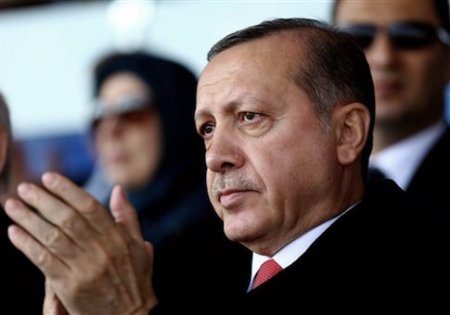
Turkish President Recep Tayyip Erdogan listens during a ceremony to commemorate the 101st anniversary of the Battle of Gallipoli in Canakkale, Turkey, Friday, March 18, 2016. Turkish President Recep Tayyip Erdogan on Friday warned Europe that it, too, could fall victim to attacks by Kurdish militants following a terror attack in Ankara that killed 37 people. (Kayhan Ozer, Presidential Press Service, Pool via AP)

Turkish President Recep Tayyip Erdogan listens during a ceremony to commemorate the 101st anniversary of the Battle of Gallipoli in Canakkale, Turkey, Friday, March 18, 2016. Turkish President Recep Tayyip Erdogan on Friday warned Europe that it, too, could fall victim to attacks by Kurdish militants following a terror attack in Ankara that killed 37 people. (Kayhan Ozer, Presidential Press Service, Pool via AP)

President Obama will welcome Erdoğan to Washington this week for a strategy meeting about countering the ISIS.

**********************

On March 18, European and Turkish diplomats signed off on a comprehensive deal on migrants pouring from Syria, Iraq, and elsewhere in the Middle East through Turkey and into the European Union. Under the terms of the deal, for every illegal migrant the E.U. returns to Turkey, Turkey would send one refugee for resettlement in Europe. Additionally, Turkey and Europe agreed to re-open discussions concerning the Muslim country’s efforts to join the E.U., and Europe agreed to allow Turks visa-free travel throughout the Schengen zone.

Two days after the deal was announced, a Turk who had joined the Islamic State blew himself up among tourists on Istanbul’s Istiklal Street, one of the city’s major shopping and tourism districts. Two days after that, ISIS suicide bombers killed dozens in two separate attacks in Brussels. ISIS called what occurred in Belgium “a drop in the sea” compared with what the terrorists have in store for “nations of disbelief.”

Turkey and its president, Recep Tayyip Erdoğan, have used the growing threat to argue that the West must better conform its policies to Turkey’s desires. In the wake of the Brussels attacks, Prime Minister Ahmet Davutoğlu chided Europe. “Europe has no partner other than Turkey to provide its regional security,” he declared, adding a subtle threat: “They should see this reality and act accordingly.” Meanwhile President Obama will welcome Erdoğan to Washington this week for a strategy meeting about countering the ISIS.

The reality Davutoğlu deliberately ignores, however, is his own country’s role in allowing ISIS to develop and metastasize. The Turkish government is adept at pulling the wool over Western officials’ eyes. Erdoğan pays lip service in meetings with European and American officials to the importance of both democracy and the Turkish partnership with the West, for example, declaring, “Secularism is the protector of all beliefs and religions.” He speaks differently to his Turkish audience. As mayor of Istanbul, he described himself as “the imam of Istanbul” and declared, “Thank God almighty, I am a servant of Shari‘a.” He is famous for his quip, “Democracy is like a streetcar. When you come to your stop, you get off.” In recent years, he has declared his goal to be to “raise a religious generation.”

This “religious generation” is flowing into the cauldron of Syria and Iraq. More than 30,000 foreign fighters from as many as 100 countries now fight with the Islamic State. The bulk of these soldiers—perhaps 90 percent—crossed into the Islamic State from Turkey. Turkish visa policy contributes to the problem. A direct correlation can be drawn between foreign fighters serving ISIS and those nationalities from which Turkish authorities require no visa or provide waivers: Several thousand more Moroccans and Tunisians, who need no visas to transit Turkey, fight with ISIS in Syria and Iraq than Algerians and Libyans, who do. If Erdoğan simply required visas in advance for those under the age of 40 coming from countries like Morocco, Tunisia, Lebanon, and Jordan—or, for that matter, from Russia, the United Kingdom, and Australia—the flood of recruits into the Islamic State would slow to a trickle.

ISIS terrorists regularly traverse the Turkish border, not only for medical care but also for rest and relaxation. Some merchants in Istanbul openly sell ISIS propaganda and promise that proceeds from their sale will benefit the group’s fight in Syria and Iraq. Smugglers peddling contraband oil to fund ISIS rely on Turkey to bring the oil to market, paying off local and perhaps even national officials of the AKP, Turkey’s governing party, along the way.

Turkey has done more than lend passive support to Islamist radicals. In his 13 years in power, Erdoğan has transformed Turkey from a Western-leaning democracy into Pakistan-on-the-Mediterranean. There was, for example,the leak of documents from the Millî İstihbarat Teşkilatı (MİT), Turkey’s intelligence service, showing Turkish support of the Nusra Front, an al Qaeda affiliate operating in Syria. And, rather than give medals to the Turkish soldiers who intercepted truckloads of weaponry destined for Syrian radicals, Erdoğan ordered their arrest.

Likewise, when Turkish journalists exposed—with photographic evidence—the transfer of munitions and other supplies from the Turkish border to ISIS, Erdoğan’s response was not to applaud the media but to seize the newspaper and arrest its editors and many of its reporters.

There is also evidence that, as Kurds fighting ISIS in Kobani in 2014 began to turn the tide against the radical group, Erdoğan and Turkish intelligence officials allowed ISIS fighters to pass through Turkey and attack Kobani from across the border, a flank the town’s largely Kurdish residents assumed was secure.

From the beginning, Erdoğan has looked at the Syrian refugee crisis not as a humanitarian tragedy but an arrow in his quiver. Inside Turkey, he has offered Sunni refugees Turkish citizenship if they settle in Turkish provinces currently dominated by the Shi‘ite offshoot Alevi sect. And, whereas the world condemns ISIS “genocide” against the Yezidi, the Yezidi who sheltered in Turkey were then victimized, again, by local AKP-run municipalities who refused to provide services offered to Sunni refugees.

Allowing Turkey to choose which refugees to send to Europe and promising to eliminate visa restrictions for Turks only rewards Erdoğan for his behavior and gives him additional leverage in his dealings with the West. Nor is this the type of policy Erdoğan’s neighbors would support. Earlier this year, King Abdullah II of Jordan told Congress, “The fact that terrorists are going to Europe is part of Turkish policy and Turkey keeps on getting a slap on the hand, but they are let off the hook.” He added that, “radicalization was being manufactured in Turkey.”

Abdullah’s message fell on deaf in ears in Washington, Brussels, Paris, and Berlin. It is Erdoğan who has the initiative as he pursues the Islamicization of Turkey and neo-Ottoman imperialism. He has built a Pakistan on the Mediterranean: an incubator of terror that markets itself as the only available partner of the West, with tragic results.

Turkey: Normalizing Hate

March 13, 2016

Turkey: Normalizing Hate, Gatestone InstituteUzay Bulut, March 13, 2016

(Breaking news: Obama, Cruz and Rubio have issued a joint statement blaming Trump. What? OK. Not yet. — DM)

♦ [T]hey have launched an investigation against me in accordance with article 301 because I mentioned ‘peace, brotherhood, and human rights’ in my statement to the press. Hundreds of lawsuits have been brought against lawyers and members of opposition in Turkey because they talked about peace and brotherhood.” — Ilhan Ongor, Co-President of the Adana branch of the Human Rights Association.

♦ Starving or murdering civilians does not, apparently, constitute a crime in Turkey, but speaking out about them does.

♦ Insulting non-Turkish and non-Muslim people has almost become a social tradition in Turkey. Prejudice and hate speech have become normalized.

♦ What makes this hate speech even more disturbing is that these people — Armenians, Greeks, Assyrians, and Jews, among others — are the indigenous peoples of Anatolia, Mesopotamia and Thrace, where they have lived for millennia. Today, as a result of Turkey’s massacres, pogroms and deportations, they have been turned into tiny communities.

According to the 2015 statistics of the European Court of Human Rights (ECHR), 28 lawsuits were opened by applicants against member states regarding their violations of freedom of expression. Ten of those applications (complaints) were made against Turkey’s violations of freedom of expression. Turkey ranked first in that category.

Turkish law professor Ayse Isil Karakas, both a judge and elected Deputy Head of the ECHR, said that among all member states, Turkey has ranked number one in the field of violations of free speech.

“619 lawsuits of freedom of expression were brought at the ECHR between 1959 and 2015,” she said. ” 258 of them — almost half of them — came from Turkey and most were convicted as violations of freedom of expression.”

For a country that fancies itself a candidate for EU membership, that is quite a record. Actually, when it comes to deciding what thoughts are warmly tolerated and what thoughts are severely punished, Turkey is extraordinary. If the statement involves Jew-hating for instance, it is welcomed by many.

Seyfi Sahin, a columnist in the Islamist pro-government newspaper Vahdet, wrote on January 31:

“I believe that the gorillas and chimpanzees living in the forests in northern Africa today are cursed Jews. Those are mutated, perverted people.

“Believe me, this view is stronger and more scientific than the Darwin theory. We Muslims, and those who believe that, do not have the banks, the money, the organizational power in the world of science, or the propaganda power to scream those truths.

“But we have our wisdom, our faith and our Allah. Alhamdulillah (Praise be to Allah).”

In an attempt to back up his “views,” Sahin mentioned that he is also a medical doctor, and quoted Koranic verses 2/65, 5/60 and 7/166. “Those verses are signs that monkeys descended from human beings,” he said. “Allah always tells the truth.”

Throughout his entire piece — which has been widely “liked” and shared on social media — he tried to “prove” his claim that monkeys come from Jews, and his newspaper saw no harm in publishing it. Yet, no one has yet brought him to account for his libelous insults. Who knows? He might even be given an award for this piece.

However, much of the Turkish public and the Turkish state are not so tolerant and welcoming when human rights issues — especially Kurdish issues — are discussed.

According to reports, two lawsuits were filed on January 3 against Sibel Ozbudun, an author and retired associate professor of anthropology known for her writings about minority rights. The indictment claims that through her social media posts, Ozbudun has committed the crime of “openly inciting people to commit an offense” and “making propaganda of the PKK.” The lawsuits were filed after the police received an e-mail from someone denouncing Ozbudun for her posts.

One of the pieces of “evidence” of the prosecutors is a verse, popular in Turkey, shared by Ozbudun on her Facebook page: “I want the country be divided — henchmen, sycophants and slimy ones to one side; honorable, dignified, laborious, patriotic people to the other.”

On another occasion, on December 30, a Turkish instructor and a member of the Social Rights Association, Cise Atalay, during a lecture at Amasya University mentioned human rights abuses. A student called the police; Atalay was arrested for “terrorist propaganda” on the spot. Next, her home and office were searched.

The student who called the police is not alone. Turkish state authorities also regard requests for human rights as “terrorist propaganda” or “insulting the Turkish state.” On January 7, an investigation was launched against the co-president of the Adana branch of the Human Rights Association (IHD), Ilhan Ongor, for violating Article 301 of the Turkish penal code, which makes it illegal “to insult Turkey, the Turkish nation, or Turkish government institutions.”

On November 11, apparently, Ongor had issued a press release in which he said, “Today, in Silvan, a crime against humanity is being committed by the state. They are trying to make the massacres ordinary.” He had been criticizing the recent military attacks against Kurds during a curfew imposed on the Kurdish district of Silvan.

The military attacks had caused starvation, civilian deaths and massive destruction. After his criminal investigation, Ongor said that “People’s right to life is violated while the judiciary is trying to suppress human rights and defenders of freedom.”

“Interestingly, they have launched an investigation against me in accordance with article 301 because I mentioned ‘peace, brotherhood, and human rights’ in my statement to the press. Hundreds of lawsuits have been brought against lawyers and members of opposition in Turkey because they talked about peace and brotherhood.”

Starving or murdering civilians does not constitute a crime in Turkey, apparently, but speaking out about them does.

In Turkey, if someone utters the most vicious or threatening remarks about Armenians, Greeks, Jews, Christians, Kurds, Alevis or other members of a minority, he is never condemned by the state or held to account. But those who speak of human rights abuses, or criticize the state for its violent, repressive actions, will most probably be accused of violations.

After a group of Turkish soldiers and Kurdish PKK guerillas were killed in battle on September 8, the principal consultant of President Tayyip Erdogan and former Chairman of the Constitutional Commission of Turkey’s Parliament, Burhan Kuzu, wrote in his Twitter account:

“So far, thousands of terrorists have been bumped off. This will continue. The corpses of the dead terrorists should definitely have autopsies. Many of them will be found to be uncircumcised. Wake up, my Kurdish brother, wake up now!”

Kuzu seems to be trying to legitimize the killings of PKK members because being uncircumcised implies being Christian or non-Muslim. He also seems to think that the PKK members are not Muslims, and that any non-Muslim deserves to be “bumped off.”

Evidently jumping to conclusions about the possible political leanings of dead people based on their genitalia, and saying that because of their religious background they deserve to be killed, is perfectly acceptable in Turkey. What is more alarming is that Kuzu, who made these statements, is a constitutional law professor.

In 1996, at Turkey’s parliament, the interior minister at the time, Meral Aksener, and a current MP from the Nationalist Movement Party (MHP), said that the leader of the PKK (Kurdistan Workers’ Party), Abdullah Ocalan, was “Armenian semen.” She then clarified the remark by saying, “I did not refer to the Armenians living in Turkey. I referred to the Armenian race in general.”[1]

Humiliating statements about non-Turkish or non-Muslim people are common and popular, even among political circles, but if one makes critical statements about the state policies, one might be prosecuted, or end up in prison — due to the vagueness of Turkey’s “terrorism” laws.

Because of several articles in the Turkish penal code, many individuals face prosecution as if they were actually fighting the government as “members” of the armed Kurdish PKK, and are often sentenced accordingly.[2]

Many peaceful demonstrators have also faced prosecution for exercising their right of freedom of expression, if they shout slogans, hold up banners, or make statements to the press.

The latest victims are the peace activists who demanded an end to the recent military siege in Turkey’s Kurdistan. On December 27, activists from western Turkey started a journey towards Diyarbakir in an attempt to oppose the military siege and civilian deaths in the region. Calling their action “We are walking towards peace,” they arrived in Diyarbakir on December 31 — to be attacked by the police. Four were injured and twenty-four were taken into custody, accused of “carrying out acts on behalf of a terrorist organization.”

1508In December, peace activists walked to the city of Diyarbakir in Turkish Kurdistan in an action they called “We are walking towards peace.” When they arrived, they were attacked by the police. Four were injured and twenty-four were arrested, accused of “carrying out acts on behalf of a terrorist organization.” (Image source: JINHA)

The state tradition of violating the freedom of expression goes back to the foundation of the Turkish republic in 1923. The new regime established by the Republican People’s Party (CHP) — with its laws and “independence tribunals” — totally crushed any kind of political opposition and freedom of opinion.

The 1925 Law on the Maintenance of Order gave the government that founded the Turkish republic extraordinary authority through which it could suppress all kinds of opposition and ban any group or publication it viewed as threatening its authority.

In 1926, all major national newspapers except Cumhuriyet and the official Ankara daily, Hakimiyet-i Milliye were closed.[3]

In another autocratic policy, the “independence tribunals” were founded in 1920 — and functioned periodically until 1929 — to prosecute the dissidents of the government and hand down swift capital punishment for them.

“The members of the independence tribunals were chosen from the parliament,” wrote the historian Ayse Hur.

“But those members — except for the prosecutors — were not jurists. On the doors of the tribunals were written ‘Independence tribunals are afraid of Allah only’ and they were not responsible for their rulings but all of the civilian and military bureaucrats were responsible for the executions of punishments without delay.

“No evidence was needed to give rulings. It was very rare that the defendants had lawyers. There was neither time for that nor lawyers courageous enough. The rulings were given in accordance with the personal convictions of judges and those who were tried did not have a right of appeal. The punishments (and hangings) were carried out right away. The rulings were given and executed so swiftly that sometimes the wrong people were hanged instead of real defendants.”

“By the time the independence tribunals were disbanded two years later,” wrote professor Michael M. Gunter, “more than 7400 Kurds had been arrested, 660 had been executed, hundreds of villages had been destroyed, and thousands of other Kurds had been killed or exiled.”[4]

The tribunals were legally closed down in 1929, but the laws concerning independence tribunals remained in force until 1949. They continued functioning as the nightmare of the opponents of the regime until the end of the one-party regime of the Republican People’s Party (CHP) in 1950.

Sadly, the new Turkish regime founded in 1923 did not aim to foster a culture of free opinions and free debate. And the rest of Turkey’s history has mostly been about repeated violations of freedom of expression. Almost all opinions that are different from the state’s official ideology are targeted, criminalized and repressed.

Turkey has pursued discriminatory and violent policies towards minority groups, but discussing those policies often constitutes a crime.

Omer Asan, a Turkish author and publisher, was accused by Turkish courts of “spreading separatist propaganda” through “Pontus, Pontic Culture,” a book he wrote. The title means “sea” in Greek, and is a historical Greek designation for the territory located in the eastern Black Sea region of Turkey. The inhabitants of Pontus were some of the very first converts to Christianity. From 1914 to 1923, out of approximate 700,000 Pontic Greek Christians, as many as 350,000 were killed by Muslim Turks in a genocidal campaign. Almost all the rest were driven out of their homes during the forced population exchange between Greece and Turkey.

That act marked the end of one of the ancient Greek civilizations in Asia Minor. The ancient region known as Pontus has been almost totally Turkified and Islamized up until today.

The book was, among other things, the subject of a television program in which a theology professor accused Asan of “being a traitor friendly to Greece” and of “wanting to reintroduce Orthodox Christianity to a Muslim region.”

In January 2002, the National Security Court ordered the seizure of the book.[5]

In March, 2002 the State Security Court brought criminal proceedings against Asan. He was charged with disseminating separatist propaganda by asserting that there were still some communities influenced by Pontic Greek culture in the province of Asan’s hometown, Trabzon, and the surrounding area.

In 2007, the European Court of Human Rights convicted Turkey of violating Asan’s right to free speech.

Why is Turkey disturbed by critical thoughts, questions and books, but not by those who call Armenians “sperm,” Jews “monkeys” or who talk about the private parts of dead Kurds? Insulting non-Turkish and non-Muslim people has almost become a social tradition in Turkey. Prejudice and hate speech have become normalized.

What makes this hate speech even more disturbing is that these people — Armenians, Greeks, Assyrians, and Jews, among others — are the indigenous peoples of Anatolia, Mesopotamia and Thrace, where they have lived for millennia. Today, as a result of Turkey’s massacres, pogroms and deportations, they have been turned into tiny communities.

After committing crimes against these native people, Turkey not only denies the realities of this history, but insults and threatens the remaining members of those groups. It also represses whoever would like to discuss these issues. The only people who seem to enjoy “freedom” completely are those engaging in hate speech.

Citizens of other countries who live in Turkey are also exposed to prohibitions on free speech.

Norma Cox, an American academic who worked as a lecturer at Turkish universities during the 1980s, was deported and banned from re-entering Turkey by order of the Turkish Ministry of the Interior in 1986, 1989 and 1996. She has been unable to return to Turkey ever since.

The Ministry of the Interior claimed that Cox had been expelled and banned because of her separatist activities against national security, “namely statements she had made about Turks assimilating Kurds and Armenians, and Turks forcing Armenians out of the country and committing genocide.”

Cox’s application to the European Court of Human Rights (ECHR) said: “Expressing opinions on Kurdish and Armenian issues at a university, where freedom of expression should be unlimited, could not be used as a justification for any sanctions, such as the ban on her re-entry into Turkey.”

In 2010, the ECHR convicted Turkey of violating Cox’s freedom of expression.[6]

While hate speech and racism are warmly tolerated and even promoted by state authorities, free debate on Turkey’s social and political issues such as the Kurdish question and the PKK, Armenian genocide, history of Anatolian and Pontic Greeks, and the Christian roots of Anatolia, among others, are criminalized.

Turkey thereby systematically violates Turkish citizens’ freedom of information or right to know, a right recognized by the United Nations.

The researcher Lisa Reppell, who analyzed Turkey’s cases in the ECHR, wrote:

“The category in which Turkey stands out most significantly is freedom of expression. … Though by number of incidences, freedom of expression judgments are a smaller percentage of Turkey’s judgments, violations of this category are much more common in Turkey than in any other member state. Out of a total of 544 judgments handed down by the Court between 1959 and 2013, 41 percent of all freedom of expression violations have come from cases against Turkey.”

Turkey is a mental prison. In Turkey, knowledge of history and respect for human rights are neither valued nor popular; hatred, bans and discrimination are.

Despite Turkey’s unchanging pattern of violating freedom of expression, the country was officially recognized as a candidate for full membership of the European Union in 1999, and is a part of the “Western Europe” branch of the Western European and Others Group (WEOG) at the United Nations.[7]

For decades, Europe has treated Turkey almost as if Turkey were a part of Europe. Turkey, however, has never behaved like a modern European state or even a state that truly aspires to be one.

Perhaps Turkish authorities in charge of the country’s tourism affairs should prepare more truthful videos or posters. They might say: “Come to Turkey, where Asking for Peace is a Crime., but Asking for Uncircumcised People To Be Killed Is Normal.”

Or: “Watch your books and remarks! We Are So Sensitive That Even the Mention of Greeks and Christians Offends Us.”

Another poster could say, “In This Country, Recognizing the Armenian Genocide Is a Crime but Calling Someone “Armenian Sperm” is Just Fine. Welcome to Turkey!”

_________________

[1] “Armenian semen” is one of the most popular swear words in Turkey, often used for Kurds, as well. Kurds, or Kurds who request national rights, are “accused” of being Armenian. Many people in Turkey, including military personnel openly refer to Kurds or Kurdish activists as “Armenians,” “dirty Armenians,” “Armenian bastards,” “Armenian sperm” or “Armenian semen.”

[2] For more details, see: “Protesting as a Terrorist Offense: The Arbitrary Use of Terrorism Laws to Prosecute and Incarcerate Demonstrators in Turkey,” by Human Rights Watch, November 1, 2010.

[3] “The History of Turkey”, by Douglas Arthur Howard, Greenwood Publishing Group, 2001.

[4] “The A to Z of the Kurds”, by Michael M. Gunter, Scarecrow Press, 2009.

[5] For details about Asan’s case at ECHR, please see: European Court of Human Rights, 840; 27.11.2007 Asan V. Turkey.

[6] Cox’s application to the ECHR also said:

“[T]he Ministry’s allegations against her had not been proved. Even assuming that she had said those things at the university, she had remained within the permissible limits of criticism. Furthermore, she had never been prosecuted for having expressed those opinions. The action taken against her by the Ministry had therefore been devoid of any legal basis.”

For details about Cox’s case at ECHR, see “Case of Cox v. Turkey“, Application no. 2933/03, 20 May 2010

[7] In 1987, Turkey’s application to accede to the European Economic Community, the predecessor of the European Union (EU), was made. Since 1963, Turkey has been an associate member. Turkey became a member of the Council of Europe in 1949; the Organization for Economic Co-operation and Development (OECD) in 1961; and the Organization for Security and Co-operation in Europe (OSCE) in 1973. It was an associate member of the Western European Union from 1992 to its end in 2011. It also signed a Customs Union agreement with the EU in 1995.
Turkish Gov’t Bans Int’l Women’s Day March Due to ‘Security’

March 7, 2016

Turkish Gov’t Bans Int’l Women’s Day March Due to ‘Security,’ Clarion Project, Meora Svorsly, March 7, 2016

TUrkey-Womens-Day-Protesters-HPTurkish women defying a ban on marching for International Women’s Day are met by police. (Photo: Video screenshot)

Turkish women, defying a ban issued by Istanbul’s governor prohibiting demonstrations marking International Women’s Day demonstrations, took to the streets en masse to call attention to the challenges faced by women in Turkey.

The demonstrations, three days ahead of the official March 8 commemoration, were met by a brutal police force, which fired rubber bullets into the crowd and shoved and arrested demonstrators.

“We have always said that we would never leave the streets for the March 8 demonstration, and we never will. Neither the police nor the government can stop us,” protester Guris Ozen said, speaking to told Reuters. “You see the power of women. We are here despite every obstacle and we will continue to fight for our cause.”

Women also defied the ban in Ankara, where protestors were similarly manhandled by police officers.

The official reason cited for the demonstration ban was security concerns, but with increasing frequency and brutality, Turkey’s Islamist ruling party – under the direction of President (and former prime minister) Recep Tayyip Erdogan – has cracked down on any and all institutions not in line with his Islamist agenda.

In the past, Erdogan has drawn ire for commenting that Islam defines the role of women as motherhood, adding “You cannot explain this to feminists because they don’t accept the concept of motherhood.” In an earlier comment, he told a delegation of women’s rights activists “I don’t believe in equality between men and women.”

His deputy prime minister, Bulent Arinc, was met with derision after saying that women should refrain from laughing in public because it’s immodest.

The current demonstrations sought to call attention to the dire position of women in Turkey, which was ranked 130 out of 145 states in the 2015 Global Gender Gap Index and last in Europe and Central Asia.

In addition, it has been reported that 40% of women in Turkey suffer from violent abuse from a spouse or family member. The report, compiled by Turkey’s Ministry of Family and Social Policy, had been long suppressed.

Violence against women in Turkey has skyrocketed since Erdogan came to power. According to the Turkish Ministry of Justice, from 2003, when Erdogan took power, until 2010, there was a 1,400 percent increase in the number of murders of women.

In 2014, there were at least 287 cases of women being murdered because they asked for a divorce.

According to the U.N., Turkish women are 10 times more likely to be victims of domestic violence than women in any other European country.

Professor Aysel Çelikel, head of the Support for Contemporary Living Association, or ÇYDD, cited the root cause behind the alarming rise in violence against women saying, “Women’s rights are going backward as much as [Islamist] conservatism is increasing in society.”

The sickening footage of women being abused by plain-clothed and uniformed police (see video below) is an indication of how far Turkish women will need to push back to obtain their rights.

In the words of one protester, “You see the power of women. We are here despite every obstacle and we will continue to fight for our cause.”

Turkish women will need to dig in for a long and hard fight.

Watch women defy the ban on demonstrations in honor of International Women’s Day. Note: The plain clothed men in the video footage are almost entirely police. 

Turkey and Saudi Arabia hit back for the Obama-Putin Syrian pact

March 5, 2016

Turkey and Saudi Arabia hit back for the Obama-Putin Syrian pact, DEBKAfile, March 5, 2016

Zaman_4.3.16Headline of last issue of Turkey’s Zaman before government takeover

Turkey and Saudi Arabia have taken separate steps to break free from Washington’s dictates on the Syrian issue and show their resistance to Russia’s highhanded intervention in Syria. They are moving on separate tracks to signal their defiance and frustration with the exclusive pact between Presidents Barack Obama and Vladimir Putin which ostracizes Riyadh and Ankara on the Syrian question.

Turkey in particular, saddled with three million Syrian refugees (Jordan hosts another 1.4 million), resents Washington’s deaf ear to its demand for no-fly zones in northern and southern Syria as shelters against Russian and Syrian air raids.

Last year, President Reccep Erdogan tried in desperation to partially open the door for a mass exit of Syrian refugees to Europe. He was aghast when he found that most of the million asylum-seekers reaching Europe were not Syrians, but Muslims from Africa, Afghanistan and Pakistan, in search of a better life in the West. Most of the Syrians stayed put in the camps housing them in southern Turkey.

Even the Turkish intelligence agency MIT was hard put to explain this setback.  According to one partial explanation, organized crime gangs of Middle East dope and arms smugglers, in which ISIS is heavily represented, seized control of the refugee traffic heading to Europe from Libya, Iraq and Syria.
This human traffic netted the gangs an estimated $1 billion.

Turkey was left high and dry with millions of Syrian refugees on its hands and insufficient international aid to supply their needs. No less painful, Bashar Assad was still sitting pretty in Damascus.

Finding Assad firmly entrenched in Damascus is no less an affront for Saudi Arabia. Added to this, the Syrian rebel groups supported by Riyadh are melting away under continuing Russian-backed government assaults enabled by the Obama-Putin “ceasefire” deal’

The oil kingdom’s rulers find it particularly hard to stomach the sight of Iran and Hizballah going from strength to strength both in Syria and Lebanon.

The Turks threatened to strike back, but confined themselves to artillery shelling of Syrian areas close to the border. While appearing to be targeting the Kurdish YPD-YPG militia moving into these areas, the Turkish guns were in fact pounding open spaces with no Kurdish presence. Their purpose was to draw a line around the territory which they have marked out for a northern no-fly or security zone.

Saturday, March 5, President Erdogan proposed building a “new city” of 4,500 square kilometers on northern Syrian soil, to shelter the millions of war refugees. He again tried putting the idea to President Obama.

The Saudi Defense Minister, Deputy Crown Prince Mohammed bin Salman put together a more high-risk and comprehensive scheme. Its dual purpose is to hit pro-Iranian Hizballah from the rear and forcied [Sic] the two big powers to treat Riyadh seriously as a player for resolving the Syrian imbroglio.

The scheme hinged in the cancellation of a $4 billion Saudi pledge of military aid to the Lebanese army, thereby denying Hizballah, which is a state within the state and also dominates the government, access to Saudi funding. But it also pulled the rug from under Lebanon’s hopes for combating ISIS and Al Qaeda’s Nusra Front, which have grabbed a strip of Lebanese territory in the northern Beqaa Valley.

The Saudi action, by weakening the Lebanese military and its ability to shore up central government in Beirut, risks tipping Lebanon over into another civil war.

The London Economist commented that this Saudi step against Lebanon seems “amateurish.” Under the young prince (30), “Saudi Arabia sometimes acts with bombast and violence that makes it look like the Donald Trump of the Arab World,” in the view of the magazine.

But the Saudi step had a third less obvious motive, a poke in the eye for President Obama for espousing Iran’s claim to Middle East hegemony. Resentment on this score is common to the Saudi royal house and the Erdogan government.

As a crude provocation for Washington, the Turkish president ordered police Friday, March 4, to raid Turkey’s largest newspaper Zaman, after an Istanbul court ruling placed it under government control.

The newspaper released its final edition ahead of the raid declaring the takeover a “shameful day for free press” in the country. A group of protesters outside the building was dispersed with tear gas, rubber bullets and water cannons.

Zaman is owned by the exiled Muslim cleric Felhullah Gulen, who heads the powerful Hizmet movement, which strongly contests Erdogan government policies. A former ally of the president, the two fell out years ago. In 1999, after he was accused of conspiring to overthrow the government in Ankara, Gulen fled to the United States.

Today, the exiled cleric runs the Hizmet campaign against the Turkish president from his home in Pennsylvania, for which he has been declared a terrorist and many of his supporters arrested.

The takeover of Zaman was intended both as a blow by Ankara against Muslim circles opposed to the Erdogan regime and as an act of retaliation against the United States, for harboring its opponents and sidelining Turkey from Obama administration plans for Syria.

Oddly enough, the Turkish president finds himself in a position analogous to Egyptian President Abdel-Fatteh El-Sisi, who is at war with the Muslim Brotherhood, a movement which enjoys Obama’s support.

Israeli Prime Minister Binyamin Netanyahu has his own dilemmas. Struggling to keep his balance while walking a tight rope on the Syrian situation between Israel’s longstanding ties with Washington and handling the Russian tiger lurking next door, he is in no hurry to welcome Erdogan’s determined overtures for the resumption of normal relations.

Turkey is in trouble with both major world powers and, after living for five years under hostile abuse from Ankara, Israel does not owe Erdogan a helping had for pulling  him out of the mess.