Archive for the ‘Erdogan’ category

Turkey: Wrong Partner to Fight Terror

November 29, 2015

Turkey: Wrong Partner to Fight Terror, Gatestone InstituteBurak Bekdil, November 28, 2015

  • In Erdogan’s usual Sunni supremacist language, he accused the victims of jihad rather than the jihadists.
  • “New tragedies will be inevitable,” Erdogan said, “if the rising racism in Europe and other countries is not stopped.” Yet Erdogan willingly ignores the rising racism, xenophobia, and anti-western, jihadist sentiments that increasingly command the hearts and minds of his fellow Turks.
  • How should Erdogan fight Islamic terror — something he does not believe exists? One of Erdogan’s famous remarks is, “there is no Islamic terror.” But he thinks that “just like fascism,” Zionism is a crime against humanity.
  • It is so funny that the free world cannot see that its ally in fighting the jihadists is another jihadist.

Racism is bad, no doubt. But it cannot be the reason why jihadists kill “infidels,” including fellow Muslims in Muslim lands. Sadly, the free world feels compelled to partner with the wrong country in its fight against Islamic terror.

The host of this year’s G-20 summit, which came right after the Nov. 13 Paris attacks, was Turkey’s President Recep Tayyip Erdogan. In his usual Sunni supremacist language, he accused the victims of jihad rather than the jihadists. “New tragedies will be inevitable,” he said, “if the rising racism in Europe and other countries is not stopped. Racism, coupled with enmity against Islam, is the greatest disaster, the greatest threat.”

Yet Erdogan willingly ignores the rising racism, xenophobia, and anti-western, jihadist sentiments that increasingly command the hearts and minds of his fellow Turks. A quick look at a few sports games and fan behavior in recent weeks would reveal much about the Turkish mind and heart.

On October 13, three days after a twin suicide bomb attack in Turkey’s capital, Ankara, killed more than 100 Kurds and pro-Kurdish, leftist and secular Turks, the central Anatolian province of Konya, a hotbed of political Islam in Turkey, hosted a Euro 2016 football qualifier between Turkey and Iceland. Before the kick-off, both teams stood for a moment of silence to protest the bomb attack — a typical gesture to respect the victims. Sadly, the moment of silence was marred by whistles and jeers: apparently the football fans of Konya were protesting the victims, not their jihadist killers.

Anyone under the impression that the whole world stands in solidarity with Paris should think again. Hundreds of Turkish fans booed and chanted “Allahu Akbar” (“Allah is greater” in Arabic) during a moment of silence for the Paris attack victims before a Turkey-Greece soccer friendly. Once again, the Turks were exhibiting solidarity with the terrorists, not their “infidel” victims.

More recently, on Nov. 21, Turkish police had to deploy 1,500 policemen so that Turkish fans could not harm the visiting Israeli women’s national basketball team. One thousand five hundred police officers at a women’s basketball game! Despite that, Turkish fans threw objects at Israeli players as they were singing Israel’s national anthem. Fans also booed the Israeli players while others applauded the fans who threw the objects.

Unsurprisingly, Turkish fans waved Palestinian flags. Israeli women basketball players were barred from leaving their hotel other than for training and the game.

None of that is surprising although, at least in theory, Turkey is a candidate state for membership in the European Union. A new study by Pew Research Center revealed that 8% of Turks have a favorable opinion of the Islamic State (IS), higher than in the Palestinian territories, where support for IS stands at 6%, and only one point lower than in Pakistan. Nineteen percent of Turks “do not know” if they have a favorable or unfavorable opinion of IS — which means 27% of Turks do not have an unfavorable opinion of the jihadist killing machine. That makes more than 21 million people! Of the countries polled, Lebanon boasted a 100% unfavourable opinion of IS and Jordan, 94%. In Indonesia, the world’s most populous Muslim country, 4% reported a favourable opinion of IS, half of Turkey’s.

This is Erdogan’s “neo-Ottoman” and increasingly Islamist Turkey. After the Paris attacks, this author saw tweets that called the victims “animal carcass;” that said “now the infidels will lose their sleep out of fear;” and others that congratulated the terrorists “who shouted Allah-u aqbar.”

Meanwhile, and so funny, the free world cannot see that its ally to fight the jihadists is another jihadist. How should Erdogan fight Islamic terror – something he does not believe exists? One of Erdogan’s famous remarks is, “there is no Islamic terror.” But he thinks that “just like fascism,” Zionism is a crime against humanity.

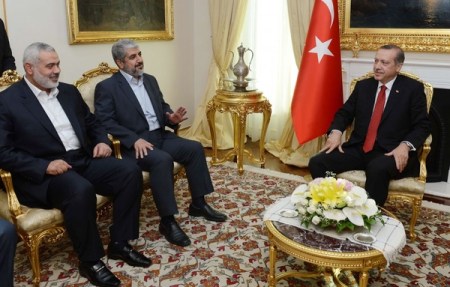
826 (2)Turkish President (then Prime Minister) Recep Tayyip Erdogan, right, meeting with Hamas leaders Khaled Mashaal (center) and Ismail Haniyeh on June 18, 2013, in Ankara, Turkey. One of Erdogan’s famous remarks is, “there is no Islamic terror.” (Image source: Turkey Prime Minister’s Press Office)

There is a Turkish saying that could perhaps describe the free world’s alliance with Erdogan’s Turkey against jihadist terror: “Kuzuyu kurda emanet etmek” (“to trust the wolf with the sheep”).

A handy guide for progressives trying to choose between Russia and Turkey

November 24, 2015

A handy guide for progressives trying to choose between Russia and Turkey, Front Page Magazine, Daniel Greenfield, November 24, 2015

putin-erdogan-car-sultan-670

Hello progressives,

This morning you’re probably wondering why there’s something about Turkey shooting down a Russian plane in the news. Why is this story taking up valuable space in your news feed and taking away time from reading about how stupid Donald Trump and Ben Carson are, or how yoga is cultural genocide or how oppressed Yale students are? And didn’t Obama already fix the Syrian Civil War with a hashtag?

You’re probably worrying over which side is the progressive one in the Turkey-Russia spat. So I’ve written this helpful guide just for you.

1. Progressive rating

Russia – Ex-Communist dictatorship run by KGB operatives like Putin and has jails full of political prisoners.

Turkey – Islamist dictatorship run by “moderate” Islamists like Erdogan with jails full of political prisoners.

So both Russia and Turkey are both pretty progressive. But since Islam is now officially at the top of the victim list, Turkey is more progressive.

2. Gay rights

Putin – Anti-Gay

Erdogan – “Their biggest ally is Doğan Media. The Armenian lobby, homosexuals” – Anti-Gay and Anti-Armenian

Split decision?

3. Socialist

Erdogan – “Let’s earn a little less than you currently do. Share your wealth with the low-income group.”

Putin – “Income inequality is unacceptable, outrageous.”

Can’t we get Bernie Sanders to replace them both?

4. Abortion

Erdogan – Abortion is murder and a plot against Turkey

Putin – Abortion is murder and a plot against Russia

5. Islam

Putin – “Some scholars of (Eastern) Christianity say it is much closer to Islam”

Erdogan – “The mosques are our barracks, the domes our helmets, the minarets our bayonets and the faithful our soldiers”

6. Racism

Erdogan – “Kilicdaroglu is striving every bit he can to raise himself from the level of a black person to the level of a white man.”

Putin – “What?”

7. The Kardashians

Putin – In favor

Erdogan – “In my country there are 170,000 Armenians. Seventy thousand of them are citizens. We tolerate 100,000 more. So, what am I going to do tomorrow? If necessary I will tell the 100,000: OK, time to go back to your country.”

There you have it. Now you can decide which side to cheer for and which side to hate based on all the compelling issues that progressives care about.

Turkey’s Stockholm Syndrome

November 8, 2015

Turkey’s Stockholm Syndrome, The Gatestone InstituteBurak Bekdil, November 8, 2015

(Please see also, Obama’s favorite Muslim dictatorships. — DM)

  • AKP supporters celebrated their victory on November 1 with chants of “Allahu Akbar” [“Allah is the greatest”], an Islamist slogan, indicating that for them the political race in Turkey is in fact a “religious war.”
  • The Turkish “Sultan wannabe” runs an empire of fear. The November 1 vote will only help make him even more despotic.
  • A recent study found that only a quarter of Turks were NOT afraid of Erdogan. According to the research, even some of his own supporters are afraid of him.
  • “The rapidly diminishing choice of media outlets and restrictions on freedom of expression in general impacted the process and remain serious concerns.” — Ignacio Sanchez Amor, Organization for Security and Co-operation in Europe
  • The AKP’s setback in last June’s elections was because some nationalists disapproved of the AKP’s peace process with the Kurdish minority. In July, the government scrapped the peace process and ordered the military relentlessly to bomb the strongholds of militant Kurds in northern Iraq.

Once again, after a brief pause, political Islam has won in Turkey. President Recep Tayyip Erdogan’s Islamist party, the Justice and Development Party (AKP), earned nearly one out of every two votes in the renewed parliamentary elections on November 1. The AKP won more than 4.8 million new votes since the June 7 elections, in which it had lost its parliamentary majority for the first time since it came to power in 2002. The November 1 election gave the AKP a mandate to rule until 2019; by then Turkey’s Islamists will have been in power uninterruptedly for 17 years. There are happy smiles on the faces of half the Turks.

The AKP’s unexpected landslide victory can be explained in numbers. The party won by 9 percentage points more on Nov. 1 than on June 7, just five months before. How did this happen?

  1. The nationalist party, MHP, shares more or less the same voter base with the AKP. Votes often go from one to the other. In the June election, some AKP votes shifted to the MHP, which won 16.3% of the national vote. This was because some nationalists disapproved of the AKP’s peace process with the country’s restive Kurdish minority. After a new spiral of violence started in July, the government scrapped the peace process and ordered the military relentlessly to bomb the strongholds of militant Kurds in northern Iraq. With the AKP boasting its newfound nationalist spirit, the MHP lost 4.1 percentage points on Nov. 1, all of which apparently went to the AKP.
  2. The summer-long violence between the autonomy-seeking Kurdish fighters and the Turkish military, which has killed hundreds, apparently wore down Kurds with more loyalist sentiments to Turkey, and caused a shift of votes at the magnitude of 1.4 percentage points from a pro-Kurdish party to the AKP.
  3. Two splinter Islamist and nationalist parties that won 2% of the vote on June 1 disappeared from the political scene, winning just a combined 0.5% on November 1. From them the AKP earned another 1.5 percentage points.
  4. In the face of President Recep Tayyip Erdogan’s lavish, expensive palace, new private jets, extravagant spending of public funds; his assertive intervention in party politics (he must remain non-partisan, according to the Turkish constitution), and growing allegations of corruption and nepotism, some traditionally AKP voters abstained from voting on June 7. Typically, half of those who abstained in June were AKP voters. Apparently, they returned to the ballot box in November, earning the AKP another good 2 percentage points (the turnout rate was nearly 4 percentage points higher in November than in June).

All of this makes exactly 9 percentage points: the difference between what the Islamists got in June and November. That is worrying for everyone in the civilized (and shrinking) parts of Turkey — and the world. AKP fans celebrated their victory on November 1 with chants of “Allahu Akbar” [“Allah is the greatest”], an Islamist slogan, indicating that for them the political race in Turkey is in fact a “religious war.” The only non-Turkish flags at the celebrations were the Palestinian and Ottoman. It is worrying that the party that won half of the national vote celebrates with religious slogans and Palestinian and Ottoman flags.

True, even if there is not yet credible evidence of vote-rigging, the election campaign was totally unfair to the opposition. Erdogan and the AKP massively used a powerful pro-government media machine, including the state broadcaster and a semi-official news agency.

“While Turkish citizens could choose between genuine and strong political alternatives in this highly polarized election, the rapidly diminishing choice of media outlets and restrictions on freedom of expression in general impacted the process and remain serious concerns,” said Ignacio Sanchez Amor, the special coordinator and leader of the short-term observer mission of the Organization for Security and Co-operation in Europe.

The head of the delegation from the Parliamentary Assembly of the Council of Europe, Andreas Gross, said: “Unfortunately, the campaign for these elections was characterized by unfairness and, to a serious degree, fear.”

In fact, one could easily understand how democratic and fair the Turkish election campaign was from the words of Khaled Mashaal, head of Hamas’s political bureau. He called both Erdogan and his prime minister, Ahmet Davutoglu, to convey the Palestinian group’s congratulations on Turkey’s “democratic electoral environment.”

826 (1)Turkish President (then Prime Minister) Recep Tayyip Erdogan, right, meeting with Hamas leaders Khaled Mashaal (center) and Ismail Haniyeh on June 18, 2013, in Ankara, Turkey. Mashaal, last week called Erdogan to convey Hamas’s congratulations on Turkey’s “democratic electoral environment.” (Image source: Turkey Prime Minister’s Press Office)

In a way, this is Turkey’s Stockholm Syndrome. A recent study found that only a quarter of Turks were NOT afraid of President Erdogan. As many as 68.5% said they were afraid of the president. It is interesting to note that according to the findings of this research, even some of his own supporters are afraid of him: If Erdogan’s supporters make up 50% of Turkey and those who say they are afraid of him stand at 68.5%, this means a good 18.5% of his own supporters are also afraid of him.

The Turkish “Sultan wannabe” runs an empire of fear. The November 1 vote will only help make him even more despotic.

Obama’s favorite Muslim dictatorships

November 5, 2015

Obama’s favorite Muslim dictatorships, Front Page Magazine, Daniel Greenfield, November 5, 2015

(Please see also, US senior commander says US will not provide arms ‘as of now’ to YPG units. And why isn’t Iran on the list?  — DM)

oy

Obama’s favorite Muslim dictatorships are the opposite of everything that America stands for. They are places where human rights are a myth and terrorism a virtue. They are everything that we should reject. But instead their tyrants and terrorists are the good friends of their man in the White House.

**************************

Michelle Obama is heading to Qatar, a state sponsor of just about every Islamic terrorist group you can name, on a mission of “gender parity” accompanied by late night comedian Conan O’Brien.

That makes sense since the idea of equal rights for women in Qatar is a joke.

Qatar charges rape victims with adultery, has no law against domestic violence and women need permission from their male guardian to get an education, a driver’s license, a job or to leave the country.

Women aren’t equal in Qatar. They’re property.

But Qatar is one of Obama’s favorite Muslim dictatorships. Secretary of State John Kerry recently launched an economic dialogue with Qatar. Qatar got a free pass to smuggle weapons past the NATO blockade of Libya even though the administration knew the weapons were going to terrorists.

While Qatar was buying weapons from Sudan, a country whose leader is wanted for crimes against humanity, to pass along to Islamic terrorists in Syria, the State Department was clearing Qatar to buy American weapons. Qatar was, of course, a Clinton Foundation donor.

The Reagan administration had cracked down on Qatar for illegally getting its hands on Stinger missiles. The first Bush administration had forced Qatar to destroy them. But these days we are the arms dealer for a nasty tyranny that has ties to terrorists. Or as the State Department report politely stated, “U.S officials are aware of the presence of Hamas leaders, Taliban members, and designated Al Qaeda and Islamic State financiers in Qatar.” These nice folks share a country with U.S. Central Command.

Khalid Shaikh Mohammed, the Al Qaeda bigwig who planned 9/11, was tipped off by a member of the Qatari royal family and the former Minister of the Interior which allowed him to escape.

That made it the perfect place to host the “moderate” Taliban for negotiations that went nowhere. It was also where Obama sent the 5 Taliban commanders after their release.

When meeting with the Emir, Obama claimed that “Qatar is a strong partner in our coalition to degrade and ultimately defeat ISIL.” But Qatar has allegedly funded and armed ISIS and other Al Qaeda groups. Islamic State financiers and supporters comfortably move around Qatar flying their ISIS freak flag.

Vice President Biden and Germany’s Development Aid Minister Gerd Mueller were forced to apologize for accusing Qatar of financing terrorists because some truths about our “ally” simply could not be spoken. Meanwhile an Egyptian intelligence document reportedly claimed that Qatar had provided anti-aircraft missiles to ISIS.

But Qatar is only Obama’s second favorite Muslim dictatorship and state sponsor of terror. Topping the list is Turkey, which just underwent another ugly Islamist election defined by accusations of fraud.

Obama had spoken of building a “model partnership” with Turkey between “a predominantly Christian nation and a predominantly Muslim nation”.  The United States, Obama said, is not “a Christian nation or a Jewish nation or a Muslim nation”. He suggested that “modern Turkey was founded with a similar set of principles.” But the Turkish Republic has long since been ground under the wheels of Erdogan’s Islamist Turkey whose model is the Ottoman Empire and whose ruler lives in a billion dollar palace.

A little insight into Erdogan’s view of Islam can be gained from the fact that Turkey’s tyrant was once sent to prison for reciting an Islamic poem with the infamous lines, “The mosques are our barracks, the minarets our bayonets, the domes our helmets and the believers our soldiers.” It’s not surprising that Erdogan’s Turkey supports most of the same Islamic terrorist groups as Qatar including Hamas.

While Turkey still has elections, it is increasingly an Islamist one-party state where the political opposition, journalists, prosecutors and even police can be locked up by the forces of the regime.

And much of that controversy stems from a criminal investigation into arms smuggling to terrorists.

Having helped create the mess in Syria, Turkey has become a waypoint for Syrian Muslims invading Europe. Once shunned by Germany, whose Turkish Muslim settlers are his strongest base of support, the refugee crisis sent Merkel and the Europeans with hat in hand to beg Erdogan to stop the invasion.

But Obama has always been Erdogan’s faithful friend. When the Islamist wanted to build mosques in this part of the world, Communist Cuba turned him down, but he got his $100 million mega mosque in Maryland.  Millions calls Erdogan another Hitler, but Obama calls him “my friend.”

Another friend of Obama is the Sultan of Brunei. Obama called the Sultan, “My good friend” and rolled out a $6 billion green energy financing scheme for Brunei and Indonesia; two Muslim countries that violate human rights like it’s a spectator sport.

While Obama was palling around with the Sultan of Brunei, his “good friend” was bringing back Sharia law complete with stoning gays. The Sultan also banned Christmas and the Chinese New Year while urging “all races” to unite under Islamic law.

African Christian countries that outlawed homosexuality had faced pressure and criticism from the White House, but Obama had no lectures on human rights to offer his good Islamist friend.

Neither did Hillary Clinton whose Clinton Foundation had received millions of dollars from the regime.

But the most explosive allegations about Brunei, like those about Qatar and Turkey, involve Al Qaeda. In one of the more controversial uses of the “super-injunction” in UK law, the ex-wife of the Sultan had filed a gag order against a British businessman involving allegations that the Sultan of Brunei had met with a senior member of Al Qaeda, funded the terror group and even that “the claimant knew or suspected from conversations with her ex–husband that there would be major terrorist attacks on the UK (7/7) and Israel.” There is of course no way to verify the truth of these allegations. But the Islamization of Brunei parallels the goals of groups such as Al Qaeda and ISIS.

Obama has many “good friends” among the tyrants and terrorists of the Muslim world. But one of them is both a tyrant and a terrorist whose illegal regime is heavily subsidized by American taxpayers.

Muslim terrorists in Israel stabbed an 80-year-old woman and a 71-year-old man just this week. They did it because the PLO’s media operation, under President Abbas, told them it was their way to paradise.

Or as Abbas, the dictator whom Obama described as “someone who has consistently renounced violence”, said, “We bless every drop of blood, that has been spilled for Jerusalem…blood spilled for Allah…Every Martyr will reach Paradise.”

The blood includes the blood of elderly women and children, and the blood of families murdered together. Every murder is funded by US foreign aid because every terrorist knows that he can count on a lifetime salary from the PLO. The PLO paid out $144 million to terrorists last year alone.

Some terrorists have even confessed that they tried to kill Israelis to be able to pay off their debts.

Hillary Clinton and the State Department were sued by terror victims for funding terrorism in Israel. But nothing has changed. And when American terror victims won a lawsuit against the PLO in America, Obama’s people stepped in to protect the interests of the PLO against its victims.

The PLO is funded by hundreds of millions in American foreign aid. Over the years, $4.5 billion was spent on promoting “Palestinian democracy”. There is now less democracy than ever because Obama’s PLO pal doesn’t bother with elections. He just takes the money and runs a totalitarian terror state.

Obama’s favorite Muslim dictatorships are the opposite of everything that America stands for. They are places where human rights are a myth and terrorism a virtue. They are everything that we should reject. But instead their tyrants and terrorists are the good friends of their man in the White House.

Obama gives ISIS ally veto power over US air strikes on ISIS

August 3, 2015

Obama gives ISIS ally veto power over US air strikes on ISIS, Front Page Magazine, Daniel Greenfield, August 3, 2015

turkey-2erdoganwhitehouse

The war against the JayVee team that has captured large chunks of Syria, Iraq and Libya is going really well. Secretary of State John Kerry and White House Minister of Information Mohammed Saeed al-Sahaf assure us that the un-Islamic terrorist group whose name must not be mentioned will shortly be crushed.

Meanwhile Obama keeps trying to negotiate with the Taliban, the other group of misogynistic mass-murdering Islamists he had vowed to defeat back in his first term.

The administration is celebrating a coup in finally getting Turkey to get on board and allow the US to use an air force base for air strikes on ISIS. But as Commander Dyer points out, there’s a slight problem.

1.  The Obama administration refuses to define a territorial or operational objective.

2.  U.S. forces aren’t sure whom they’ll be allowed to shoot at.

Well it’s not like we need to know what we’re fighting for or how we’re going to fight. The important thing is that Obama got a crazy Islamist dictator who built himself a billion dollar palace while terrorizing his people to agree to let the US use an air force base.

As long as he gets to decide who we bomb.

The US Air Force could use the Incirlik air force base in Turkey but had to allow Turkish oversight of the targets it would strike in Syria and Iraq from Incirlik.

That is a slight tiny problem because the Turkish regime loves terrorists almost as much as Iran and has a history of secret ties to ISIS.

According to the Guardian on 25 July, a U.S.-led raid on an ISIS compound in May 2015 unearthed a treasure trove of documentation on this connection.  Turkish middlemen have been funding ISIS for months, to the tune of millions of dollars, by buying oil from the guerrillas – implicitly with the knowledge and support of the Turkish government.

The Jerusalem Post reported one Islamic State member said Turkey, a member of NATO, provided funds for the terrorist group.

“Turkey paved the way for us. Had Turkey not shown such understanding for us, the Islamic State would not be in its current place. It [Turkey] showed us affection. Large [numbers] of our mujahedeen received medical treatment in Turkey,” said the man, who was not identified.

The topic of Turkey’s involvement with ISIS remains controversial and has led to a conflict between Turkish law enforcement, which tried to expose government weapons shipments, and the Erdogan regime.

Even Joe Biden said it not long ago, before being forced to apologize.

So Obama has given an ally of ISIS oversight of US air strikes against ISIS. And it gets even more schizophrenic because the US is now involved with the PKK, a Kurdish Marxist liberation group, which Turkey is bombing.

So yes, the war will be won any day. Meanwhile Pakistan will be hosting peace talks with the Taliban. You know, the country which was pretending to be our ally while harboring Osama bin Laden.

Don’t worry. I’m sure the Caliph of ISIS probably isn’t living in a mansion in downtown Istanbul. Yet.

Column One: Obama strikes again

July 31, 2015

Column One: Obama strikes again, Jerusalem Post, Caroline Glick, July 30, 2015
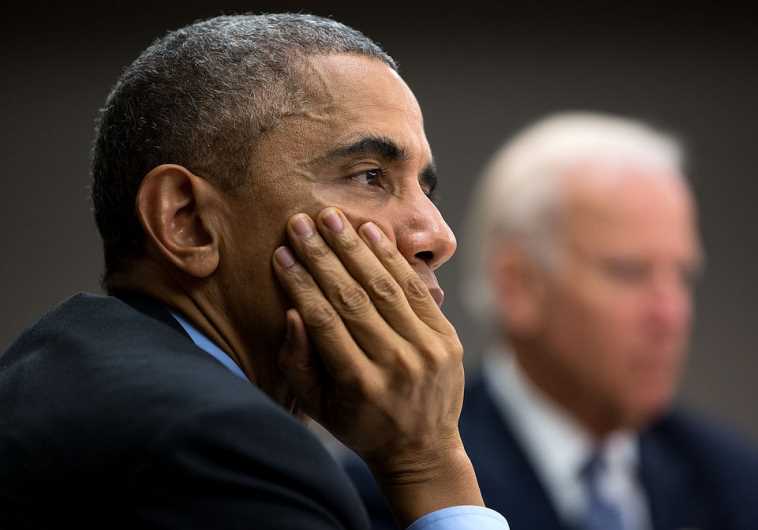
ShowImage (5)US President Barack Obama (L) and Vice President Joe Biden. (photo credit:OFFICIAL WHITE HOUSE PHOTO BY PETE SOUZA)

Most of the antiquities that ISIS plunders in Iraq and Syria make their way to the world market through Turkey. So, too, most of the oil that ISIS produces in Syria and Iraq is smuggled out through Turkey. According to the US Treasury, ISIS has made $1 million-$4m. a day from oil revenue.

Instead of maintaining its current practice of balancing its support for Turkey with its support for the Kurds, under the agreement, the West ditches its support for the Kurds and transfers its support to Turkey exclusively.

************************

While Israel and much of oficial Washington remain focused on the deal President Barack Obama just cut with the ayatollahs that gives them $150 billion and a guaranteed nuclear arsenal within a decade, Obama has already moved on – to Syria.

Obama’s first hope was to reach a deal with his Iranian friends that would leave the Assad regime in place. But the Iranians blew him off.

They know they don’t need a deal with Obama to secure their interests. Obama will continue to help them to maintain their power base in Syria though Hezbollah and the remains of the Assad regime without a deal.

Iran’s cold shoulder didn’t stop Obama. He moved on to his Sunni friend Turkish President Recep Erdogan.

Like the Iranians, since the war broke out, Erdogan has played a central role in transforming what started out as a local uprising into a regional conflict between Sunni and Shiite jihadists.

With Obama’s full support, by late 2012 Erdogan had built an opposition dominated by his totalitarian allies in the Muslim Brotherhood.

By mid-2013, Erdogan’s Muslim Brotherhood- led coalition was eclipsed by al-Qaida spinoffs. They also enjoyed Turkish support.

And when last summer ISIS supplanted al-Qaida as the dominant Sunni jihadist force in Syria, it did so with Erdogan’s full backing. For the past 18 months, Turkey has been ISIS’s logistical, political and economic base.

According to Brett McGurk, the State Department’s point man on ISIS, about 25,000 foreign fighters have joined ISIS in Syria and Iraq. All of them transited through Turkey.

Most of the antiquities that ISIS plunders in Iraq and Syria make their way to the world market through Turkey. So, too, most of the oil that ISIS produces in Syria and Iraq is smuggled out through Turkey. According to the US Treasury, ISIS has made $1 million-$4m. a day from oil revenue.

In May, US commandos in Syria assassinated Abu Sayyaf, ISIS’s chief money manager, and arrested his wife and seized numerous computers and flash drives from his home. According to a report in The Guardian published last week, the drives provided hard evidence of official Turkish economic collusion with ISIS.

Due to Turkish support, ISIS has become a self-financing terrorist group. With its revenue stream it is able to maintain a welfare state regime, attracting recruits from abroad and securing the loyalty of local Sunni militias and former Ba’athist forces.

Some Western officials believed that after finding hard evidence of Turkish regime support for ISIS, NATO would finally change its relationship with Turkey. To a degree they were correct.

Last week, Obama cut a deal with Erdogan that changes the West’s relationship with Erdogan.

Instead of maintaining its current practice of balancing its support for Turkey with its support for the Kurds, under the agreement, the West ditches its support for the Kurds and transfers its support to Turkey exclusively.

The Kurdish peshmerga militias operating today in Iraq and Syria are the only military outfits making sustained progress in the war against ISIS. Since last October, the Kurds in Syria have liberated ISIS-controlled and -threatened areas along the Turkish border.

The YPG, the peshmerga militia in Syria, won its first major victory in January, when after a protracted, bloody battle, with US air support, it freed the Kurdish border town of Kobani from ISIS’s assault.

In June, the YPG scored a strategic victory against ISIS by taking control of Tal Abyad. Tal Abyad controls the road connecting ISIS’s capital of Raqqa with Turkey. By capturing Tal Abyad, the Kurds cut Raqqa’s supply lines.

Last month, Time magazine reported that the Turks reacted with hysteria to Tal Abyad’s capture.

Not only did the operation endanger Raqqa, it gave the Kurds territorial contiguity in Syria.

The YPG’s victories enhanced the Kurds’ standing among Western nations. Indeed, some British and American officials were quoted openly discussing the possibility of removing the PKK, the YPG’s Iraqi counterpart, from their official lists of terrorist organizations.

The YPG’s victories similarly enhanced the Kurds’ standing inside Turkey itself. In the June elections to the Turkish parliament, the Kurdish HDP party won 12 percent of the vote nationally, and so blocked Erdogan’s AKP party from winning a parliamentary majority.

Without that majority Erdogan’s plan of reforming the constitution to transform Turkey into a presidential republic and secure his dictatorship for the long run has been jeopardized.

As far as Erdogan was concerned, by the middle of July the Kurdish threat to his power had reached unacceptable levels.

Then two weeks ago the deck was miraculously reshuffled.

On July 20, young Kurdish activists convened in Suduc, a Kurdish town on the Turkish side of the border, 6 kilometers from Kobani. A suicide bomber walked up to them, and detonated, massacring 32 people.

Turkish officials claim that the bomber was a Turkish Kurd, and a member of ISIS. But the Kurds didn’t buy that line. Last week, HDP lawmakers accused the regime of complicity with the bomber. And two days after the attack, militants from the PKK killed two Turkish policemen in a neighboring village, claiming that they collaborated with ISIS.

At that point, Erdogan sprang into action.

After refusing for months to work with NATO forces in their anti-ISIS operations, Erdogan announced he was entering the fray. He would begin targeting “terrorists” and allow the US air force to use two Turkish air bases for its anti-ISIS operations. In exchange, the US agreed to set up a “safe zone” in Syria along the Turkish border.

Turkish officials were quick to explain that in targeting “terrorists,” the Turks would not distinguish between Kurdish terrorists and ISIS terrorists just because the former are fighting ISIS. Both, they insisted, are legitimate targets.

Erdogan closed his deal in a telephone call with Obama. And he immediately went into action.

Turkish forces began bombing terrorist targets and rounding up terrorist suspects. Although a few of the Turkish bombing runs have been directly against ISIS, the vast majority have targeted Kurdish forces in Iraq and Syria.

Moreover, for every suspected ISIS terrorist arrested by Turkish security forces, at least eight Kurds have been taken into custody.

Then, too, Erdogan has called on AKP lawmakers to begin criminalizing their counterparts from the HDP. Kurdish lawmakers, he urged them, must be stripped of their parliamentary immunity to enable their arrests.

As Erdogan apparently sees things, by going to war against the Kurds, he will be able to reestablish the AKP’s parliamentary majority. Within a few weeks, if the AKP fails to form a governing coalition – and it will – then new elections will be held. The nationalists, who abandoned the AKP in June, will return to the party to reward Erdogan for fighting the Kurds.

As for that “safe area” in northern Syria, as the Kurds see it, Erdogan will use it to destroy Kurdish autonomy. He will flood the zone with Syrian Arab refugees who fled to Turkey, to dilute the Kurdish majority. And he will secure coalition support for the Sunni Arab militias – including those still affiliated with al-Qaida – which will be permitted by NATO to operate openly in the safe area.

Already the Kurds are reporting that the US has stopped providing air support for their forces fighting ISIS in the border town of Jarablus. Those forces were bombed this week by Turkish F-16s.

For their part, despite Erdogan’s pledge to fight ISIS, his forces seem remarkable uninterested in rolling back ISIS achievements. The Turks have no plan for removing ISIS from its strongholds in Raqqa or Haskiyah.

The Obama administration is presenting the deal with Turkey as yet another great achievement.

In an interview with Charlie Rose on Tuesday, McGurk explained that the deal was a long time in the making. It began with a phone conversation between Obama and Erdogan last October and it ended with their phone call last week.

In October, Obama convinced Erdogan not to oppose US air support for the Kurds in Kobani and to enable the US to resupply YPG fighters in Kobani through Turkey. In the second, Obama agreed not to oppose Erdogan’s offensive against the Kurds.

Two years ago, in August 2013, the world held its breath awaiting US action in Syria. That month, after prolonged equivocation amidst mountains of evidence, the Obama administration was forced to acknowledge that Iran’s Syrian puppet Bashar Assad had crossed Obama’s self-declared redline and used chemical weapons against regime opponents, including civilians.

US forces assembled for battle. Everything looked ready to go, until just hours before US jets were scheduled to begin bombing regime targets, Obama canceled the operation. In so doing, he lost all deterrent power against Iran. He also lost all strategic credibility among America’s regional allies.

To save face, Obama agreed to a Russian proposal to have international monitors remove Syria’s chemical weapons from the country.

Last summer, the administration proudly announced that the mission had been completed.

UN chemical weapons monitors had removed Syria’s chemical weapons arsenal from the country, they proclaimed. It didn’t matter to either Obama or Secretary of State John Kerry that by that point Assad had resumed chemical assaults with chlorine-based bombs. Chlorine bombs weren’t chemical weapons, the Americans idiotically proclaimed.

Then last week, the lie fell apart. The Wall Street Journal reported that according to US intelligence agencies, Assad not surrendered his chemical arsenal.

Rather, he hid much of his chemical weaponry from the UN inspectors. He had even managed to retain the capacity to make chemical weapons – like chlorine-based bombs – after agreeing to part with his chemical arsenal.

Assad was able to cheat, because just as the administration’s nuclear deal with the Iranians gives Iran control over which nuclear sites will be open to UN inspectors, and which will be off limits, so the chemical deal gave Assad control over what the inspectors would and would not be allowed to see. So, they saw only what he showed them.

Obama has gone full circle in concluding his deal with Erdogan. Since entering office, Obama has sought to cut deals with both the Sunni jihadists of the Muslim Brotherhood ilk and the Shi’ite jihadists of the Iranian ilk.

His chemical deal with Assad and his nuclear deal with the ayatollahs accomplished the latter goal, and did so at the expense of America’s Sunni Arab allies and Israel.

His deal last week with Erdogan accomplishes the former goal, to the benefit of ISIS, and on the backs of America’s Kurdish allies.

So that takes care of the Middle East. With 17 months left to go till Obama leave office, the time has apparently come for the British to begin to worry.

Will Anyone Help the Kurds?

July 19, 2015

Will Anyone Help the Kurds?, Gatestone InstituteUzay Bulut, July 19, 2015

  • What does the Turkish army — this flamboyant member of the NATO — want from the small Kurdish village of Roboski?
  • The West should apply pressure on Turkey to act humanely, morally and responsibly towards Kurds and other minorities. We all know that the Obama administration will never do that. But there are thousands of activists, academics, and universities who just turn a blind to the plight of Kurds as if their maltreatment is perfectly normal.
  • There are many “activists” like that. Their universities are filled with events bashing Israel. But if you ask them, they do not even know what is done to Kurds by their Turkish rulers. These activists are either ignorant or hypocritical. Their activism has nothing to do with caring about human beings; it is just about hating the Jews. When Turkey condemns Israel for “committing massacres,” Israelis should start lecturing Turkey about tens of thousands of dead Kurds and about how Turkey still treats them.

During Turkey’s elections on June 7, the pro-Kurdish Peoples’ Democratic Party (HDP) won a great victory by securing 13% of the vote, which allowed its candidates to occupy 80 seats in the 550-seat parliament of Turkey — not all of them are Kurdish, some are Turkish or of other ethnic groups. In any normal country, this would be welcomed by state authorities as a potential way to resolve a huge national issue in a non-violent manner for the benefit of both peoples, Kurds and Turks.

Sadly, Turkey does not seem to be about to do so. The recent incidents in which Ferhat Encu, a Kurdish deputy from the HDP, was threatened, insulted and beaten by Turkish soldiers in the Kurdish village of Roboski (Uludere) in the Kurdish-majority province of Sirnak are another manifestation of that. (Video of the incident: here and here, and here.)

For four months, the Turkish army has blockaded the plateaus in Roboski and banned the villagers from going to those places, Ferhat Encu told Gatestone Institute.

Heavy military reinforcements have also been sent to the village, which borders Iraq’s Kurdistan Regional Government, and this has created tension in the village, said Encu.

In 2011, Turkey’s air force killed 34 innocent civilians, including 17 children, in an airstrike on Roboski. Ferhat Encu lost 11 relatives in the massacre, including his brother Serhat Encu.

Between the 2011 massacre and his election to parliament in June 2015, Ferhat Encu had been detained by the police six times under to various pretexts, and then released.

On June 7, Encu travelled to Roboski, his hometown, to observe what was going on and try to ease tensions.

“Roboski is like an open prison,” he said later. “On 6 July, local people started a 2-day protest to end the ban on travel to the plateaus and stop the military reinforcements to the region. But soldiers shot their long barreled weapons [rifles] at the villagers.

“On July 7, about 20 soldiers intercepted us and threw [tear] gas bombs at our car. Then, a reporter from the newspaper Cumhuriyet, Mahmut Oral, got out of his car, introduced himself and asked them not to throw gas bombs, but they threatened him.

“Then, I got out of the car and I told them I am a [parliamentary] deputy. There were about 5 meters between the soldiers and me. At that moment, a few soldiers started shooting their guns randomly.”

Perhaps, they fired their guns up in the air. They may have done this just to scare him and the journalists, not to kill them. Even if they had killed them, they would have never been held accountable for that. There are lots of gunshots in the video.

Encu said that he told the soldiers they were not being resisted, and asked them to stop shooting.

“But they responded: ‘You are not our deputy. You are the deputy of terrorists, traitors, and marauders. And we represent the honor of the state.’

“Then the commander told me to buzz off and walked up to me — I tried to stop him from hitting me. Then soldiers started shooting their guns again while others battered me.”

Mahmut Oral, a reporter from the newspaper Cumhuriyet, who was present during the confrontation, wrote:

“When we got out of the car, saying that we are journalists, we were manhandled by soldiers and threatened with guns. When the situation got more serious, Encu got out the car but soldiers seized him by the collar and surrounded him. The soldiers told Encu that ‘we are the state here. What deputy? You are a terrorist and marauder.’… They kept insulting the journalists who tried to intervene between Encu and the soldiers… They threatened us with breaking our cameras and shooting us if we do not get back on the car.”

The 2011 Roboski Massacre

On December 28, 2011, Turkish F-16 fighter-bombers launched a five-hour long airstrike on Roboski, killing 34 civilians, including 17 children, some of whom were as young as 12.

The victims had been transporting cheap cigarettes, diesel oil and the similar items into Turkey when the bombing started. The bodies of some of the victims were burned beyond recognition or dismembered.

The AKP government has not provided any written or verbal apology for the massacre. Instead, on December 30, 2011, Erdogan, then prime minister, thanked the Turkish general staff for “their sensitivity towards the issue despite the media.”

Some of the victims froze to death, according to a report by human rights activists, doctors and lawyers; after the massacre, aid was not provided for hours and even ambulances were not allowed to enter the area.

878The funeral procession for the victims of the 2011 Roboski massacre in Turkey.

In May 2012, Prime Minister Erdogan said that whoever was trying to keep the Roboski massacre on the agenda was “the terrorist organization and its extensions.”

In June 2012, when families of the victims and representatives of NGOs came out to commemorate the dead, the police turned water cannons on them.

At first, public prosecutors from Diyarbakir were responsible for the investigation on the Roboski killings. But then, in June 2013, they announced that they were not going to deal with the case due to “lack of jurisdiction,” and forwarded the file to military prosecutors.

In January 2014, the Turkish military prosecutor’s office dismissed the investigation into the Roboski airstrike. The 16-page ruling said that “the staff of the Turkish armed forces acted in accordance with the decisions of the Turkish parliament and council of ministers and with the approval of the general staff.” The ruling also stated that Necdet Ozel, chief of the Turkish military’s general staff, gave the order for the airstrike from his home.

Veli Encu, Ferhat Encu’s brother, said that receiving the ruling by the military prosecutors was like having the 34 victims killed all over again:

“We struggled for two years to bring the perpetrators of the massacre to court, but the state officials did not even send the ruling to our lawyers. We learnt it from TV,” he said. “None of those responsible for the massacre have been removed from their posts. The perpetrators of the massacre are rewarded instead of being punished.”

He added that the government is trying to ban villagers from entering the location of the massacre.

“I and my four friends took a writer to the border as she was going to write a book on the massacre. On our way back, the military officers stopped us. They had about 30 dogs with them. They detained us even though we had not crossed the border. And they gave us a fine of 2,000 Turkish liras for border violation.”

Relatives, including children aged 12 and 13, who tried to go to the site to lay flowers to mark 500 days after the attack, were stopped, given fines or asked to report to the police station for “violating the passport law”.

Zeki Tosun, who lost his son in the massacre, said, “We went there to lay 34 cloves. But they gave us a fine of 3000 Turkish liras for each clove. … Here is like a cage. Every step we take is followed [by the Turkish army]. We are already in custody.”

The victims’ relatives were then brought to trial in court, but acquitted in August 2014.

Meanwhile, no perpetrator of the killings has yet been brought to trial, even as a criminal investigation was carried out against the survivors of the massacre, Davut Encu, Servet Encu and Haci Encu. They were interrogated in January 2012.

* * *

Attacks against this small village continue.

In June 2015, Ferhat Encu told the Bianet News Agency that soldiers had attacked people in Roboski for two days and that people were afraid to go outside.

“Soldiers broke into houses and battered women, detained four people and insulted people. A citizen was injured and the vehicle carrying him had an accident. When soldiers departed, everything calmed down.

“In this morning at 5 o’clock, without a warning, soldiers opened fire and killed villagers’ five mules. If people had been outside at that moment, they would have been killed.”

“I cannot comprehend this savageness. What do they want from Roboski?”

That is the question: What does the Turkish army — this flamboyant NATO member — want from this small Kurdish village?

The answer is that the dehumanization of Kurds in Turkey is so intense and widespread that state authorities cannot stand anything related to the Kurdish existence. Not only a Kurdish election victory — even if this election was for the parliament of Turkey, not of Kurdistan — but also Kurds’ demanding punishment for the perpetrators of a massacre is intolerable to them.

Kurds are not to be members of parliament, not to mention patriotic MPs that struggle for national rights. They are to be assimilated into “Turkishness” or be invisible, and if possible, dead. As the infamous saying of Turkish racists goes, “The best Kurd is a dead Kurd.”

Experience has taught us that in the 21st century, there are two ways of dealing with a national problem.

First, there is the right way — the moral, civilized and democratic way — in which you treat peoples under your rule with respect. When an indigenous people say that they are suffering or that they have complaints about or demands from you, you listen to them, try to understand and come terms with them because you regard them as your equals and you know that this indigenous people have been living in their ancient lands for centuries. Actually, you do not treat them as if they are less than fully human in the first place. And you do not put them through huge grievances.

But even then, a disagreement might emerge. On such on occasion, you also clarify your expectations and want that group to recognize your right to life and liberty, as well. And as civilized parties, you might decide to go separate ways and become good neighbors. But if you want to keep that people inside your borders, you at least recognize the national existence of that people. Whatever political and cultural rights you have, you grant those things to them. This is how political leaders with moral considerations would behave.

But then, there is the traditional Turkish-Islamic or Middle Eastern way: In such a political culture, when indigenous peoples or minority groups have complaints or demands, you instantly crush them with your army. You murder them en masse, deny their existence, torture them as you wish, insult them daily and then call them “terrorists”, “traitors” and “marauders”. And you commit all those atrocities based on one thing: your military power. For that is the only “value” you have.

Kurds entering the Turkish parliament by getting so many votes was a huge victory, and should be cherished as an opportunity for achieving democratic peace in the region.

And Kurds have made it clear many times that they wish to live in peace. Before the elections, Selahattin Demirtas, the co-president of the pro-Kurdish Peoples’ Democratic Party (HDP), said that “whether the HDP enters the parliament or not, we will defend peace.”

But if even becoming MPs and demanding a legal way to resolve the Kurdish issue through dialogue and negotiations cannot provide Kurds with political recognition and national rights, what else are they supposed to do?

Is it not high time that the international community heard of the plight of Kurds and supported them? The US helped to liberate Kosovo. The West should now apply pressure on Turkey to act humanely, morally and responsibly towards Kurds and other minorities.

We all know that the Obama administration would never do that. But there are individuals and organizations outside of Turkey. There are thousands of activists, academics, universities who just turn a blind to the plight of Kurds as if their maltreatment is perfectly normal.

If they are ignorant and unaware of the Kurds and other minorities in the region, we need to educate them, and hope that after they learn the truth, they will “act.” If they still do not care, then they are hypocrites. There are many “activists” like that. Their universities are filled with events bashing Israel. But if you ask them, they do not even know what is going on in Kurdistan and what is done to Kurds by their Turkish rulers. These activists are either ignorant or hypocritical. Their activism has nothing to do with caring about human beings; it is just about hating the Jews. When Turkey condemns Israel for “committing massacres,” Israelis should start lecturing Turkey about tens of thousands of dead Kurds and about how Turkey still treats them.

Turkey: “An End to an Era of Oppression”

June 8, 2015

Turkey: “An End to an Era of Oppression,” The Gatestone InstituteBurak Bekdil, June 8, 2015

  • “We, through democratic means, have brought an end to an era of oppression.” — Kemal Kilicdaroglu, leader of the main opposition, Republican People’s Party (CHP).
  • Erdogan is now the lonely sultan in his $615 million, 1150-room presidential palace. For the first time since 2002, the opposition has more seats in the parliament than the AKP.

For the first time since his Islamist party won its first election victory in 2002, Turkish President Recep Tayyip Erdogan was nowhere to be seen on the night of June 7. He did not make a victory speech. He did not, in fact, make any speech.

Not only failing to win the two-thirds majority they desired to change the constitution, the AKP lost its parliamentary majority and the ability to form a single-party government. It won 40.8% of the national vote and 258 seats, 19 short of the simple majority requirement of 276. Erdogan is now the lonely sultan at his $615 million, 1150-room presidential palace. For the first time since 2002, the opposition has more seats in parliament than the AKP: 292 seats to 258.

“The debate over presidency, over dictatorship in Turkey is now over,” said a cheerful Selahattin Demirtas after the preliminary poll results. Demirtas, a Kurdish politician whose Peoples’ Democracy Party [HDP] entered parliament as a party for the first time, apparently with support from secular, leftist and marginal Turks, is the charismatic man who destroyed Erdogan’s dreams of an elected sultanate. Echoing a similar view, the social democrat, Kemal Kilicdaroglu, leader of the main opposition Republican People’s Party [CHP], commented on the early results in plain language: “We, through democratic means, have brought an end to an era of oppression.”

What lies ahead is less clear. Theoretically, the AKP can sign a coalition deal with the third biggest party, the right-wing Nationalist Movement Party [MHP], although during the campaign, MHP leader Devlet Bahceli slammed Erdogan harshly for the embarrassing corruption allegations against the president. At the same time, a CHP-MHP-HDP coalition is unlikely, as it must bring together the otherwise arch-enemies MHP and HDP.

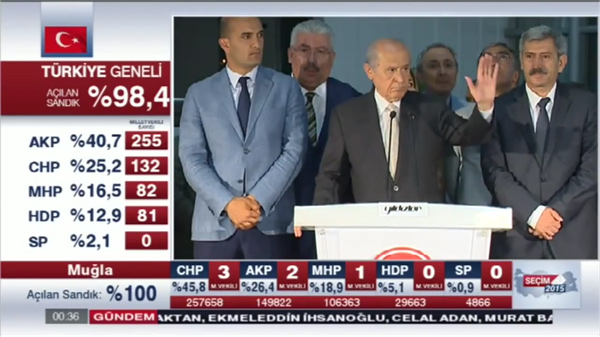
1098Turkey’s Nationalist Movement Party leader Devlet Bahceli addresses supporters after the release of preliminary election results, June 7, 2015. (Image source: MHP video screenshot)

The AKP management may be planning for snap, or early, polls but there are hardly any rational reasons for it except to risk another ballot box defeat. Parliament may try a minority government, supported by one of the parties from outside government benches, but this can only create a temporary government.

Two outcomes, however, look almost certain: 1) The AKP is in an undeniable decline; the voters have forced it into compromise politics rather than permitting it to run a one-man show, with in-house bickering even more likely than peace, and new conservative Muslims challenging the incumbent leadership. 2) Erdogan’s ambitions for a too-powerful, too-authoritarian, Islamist executive presidency, “a la sultan,” will have to go into the political wasteland at least in the years ahead.

The AKP appeared polled in first place on June 7. But that day may mark the beginning of the end for it. How ironic; the AKP came to power with 34.4% of the national vote in 2002, winning 66% of the seats in parliament. Nearly 13 years later, thanks to the undemocratic features of an electoral law it has fiercely defended, it won 40.8% of the vote and only 47% of the seats in parliament, blocking it from even forming a simple majority.