Archive for the ‘Dishonor’ category

At the U.N., Obama refuses to see the chaotic world he has made,

September 29, 2015

At the U.N., Obama refuses to see the chaotic world he has made, BreitbartJohn Hayward, September 28, 2015

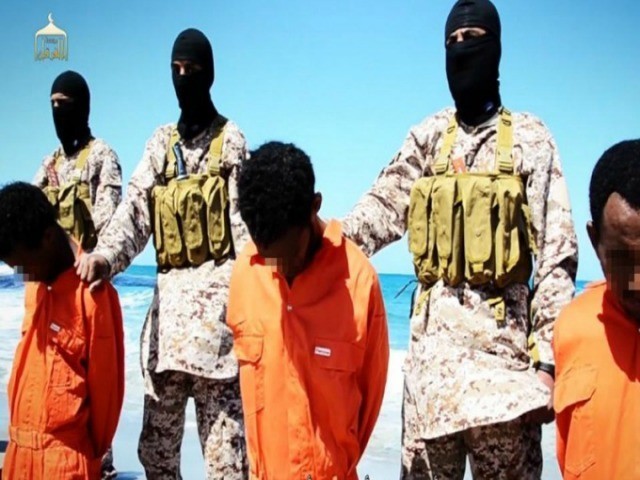
ISIS-beheading-Christians-Libya-ap-640x480

President Obama’s address to the U.N. General Assembly on Monday morning was a rambling journey through a fantasy world where his foreign policy hasn’t been an unmitigated disaster.

Perhaps the most bizarre moment came when he tried to tout his Libyan adventure as a success.

There was plenty of tough-guy posturing that intimidated absolutely no one.  The Russian and Iranian delegations were especially good at looking bored and unimpressed when he called upon them to do this-or-that because The World supposedly demanded it. Obama hasn’t figured out he’s the only leader at the U.N. eager to sacrifice his nation’s interests to please The World.

Obama made the weird decision to vaguely threaten Russia over its invasion of Ukraine by claiming that The World would not stand idly by and allow it… when that’s exactly what The World, and especially First Citizen of the World Barack Obama, has been doing.  He essentially pleaded with Iran to stop supporting terrorist proxies and pursuing its aggressive regional ambitions, and focus on their economy instead.  (Of course, in Obama’s vigorous imagination, the U.S. has been enjoying an economic boom under his stewardship, instead of an endless grinding non-recovery and limp, sporadic growth, after Obama’s spending doubled the national debt in a single presidency.)

It was bad enough that the President talked about American troops coming home from Iraq and Afghanistan as the triumphant conclusion of an effective policy, rather than the hideous blunder that allowed ISIS to create a terror state, al-Qaeda to rise from the ashes, and the Taliban to begin planning its return to power.  At the same moment Obama was speaking, the Taliban was conducting a major offensive in Afghanistan, on par with the importance of ISIS taking Mosul in Iraq.  Obama’s pitifully small “New Syrian Force” of U.S.-backed rebels just handed a good deal of its American equipment over to al-Qaeda, and no one really knows what became of the unit itself.  Their predecessors were destroyed by al-Qaeda’s Nusra Front in Syria, with less than half a dozen survivors still on the field.

When Obama boasted of the Libyan operation as the successful removal of a tyrant, jaws must have hit the floor around the room.  Libya is an unholy disaster, a wasteland of warlords fighting to keep ISIS off their turf.  It’s a key gateway for the incredible migratory tide blasting out of Africa and the Middle East and now surging across Europe.  And yet, Obama portrays it as [a] laudable example of tyrant removal… while modestly admitting that “our coalition could have, and should have, done more to fill a vacuum left behind.”

Of course he blamed everyone else in the “coalition” for the disaster in Libya. He’s Barack Obama.  The day may come when he takes responsibility for something, but today is not that day, and tomorrow isn’t looking good either.

The scary thing about Obama is that he believes so completely in the power of his own rhetoric.

He thinks he can reshape reality with his words.  When he scolds the Iranians for their “Death to America!” rhetoric by saying bloodthirsty chants don’t create jobs, he’s asking Iran to live up to the silly talking points he foisted off on the American people to cover the Iranian nuclear deal.  He’s commanding Iran to act like the enlightened, responsible nation-state he gambled the future of Israel, America, and much of the Western world on.

The Iranians, on the other hand, see no reason to knock off the “Death to America!” chants, disband their theocracy, and begin spending their days arguing about stimulus bills.  Belligerence has gotten them everything so far.  They’ve been rewarded for it… by Barack Obama.  They’ve got $150 billion in sanctions relief coming their way.  They can afford to send a few guys to sit in the U.N. General Assembly with pissy expressions on their faces while Obama rambles on about how geo-political crime does not pay.  They know for a fact it pays, quite handsomely.  The Iranians are already using their Obama loot to reinforce terror proxies like Hamas and Hezbollah, and secure Bashar Assad in power.

Ah, yes, Bashar Assad… the dictator Obama still blathers on about removing from power, even as his own diplomatic apparatus gets used to the idea Assad is not going anywhere.  The only really good part of Obama’s speech was when he spent five seconds glaring at the Syrian ambassador before launching into his denunciation of barrel bombs and chemical weapons.  But you know what?  That Syrian ambassador gets paid enough to take a few seconds of hairy eyeball from the ineffectual American president.  The Russians are smoothly replacing American influence across the Middle East, in partnership with Iran.  The new order is taking shape.  Obama isn’t going to reverse that process by telling aggressive, bare-knuckle conquerors they should be ashamed of themselves.

The other dangerous thing about this delusional President is his belief in the “judgment of history.”

He’s constantly hitting on the idea that all of the world’s villains are on the wrong side of history, and will find themselves buried in the sands of time any day now.  It’s a dodge, a way of Obama evading responsibility.  Bashar Assad is going to remerge from the Wrong Side of History in pretty good shape.  ISIS is very comfortable there, as is Iran.  Qaddafi didn’t assume room temperature because History caught up with him. Vladimir Putin has a lovely view of Crimea from the wrong side of history.  The history of Europe is being reshaped by the tramping of a million “refugee” feet.

In every example, Obama clings to the idea that he can change the world by talking and scoring debate points, while his adversaries seize territory and control the course of events.  It’s not as though Obama has some deep-seated reluctance to use deadly force – there have been a lot of deaths by drone strike since he won that Nobel Peace Prize.  What Obama lacks is commitment.  His foreign policy is all about gestures and distractions.  He cooks up half-baked plans that will blow up a terrorist here and there, so he can’t be accused of doing “nothing,” but he won’t do anything that could cost him political capital at home.  Even Libya was half-hearted and calculated for minimum risk, which is why the place went to an even deeper Hell after Qaddafi was overthrown.

Obama talks as if he’s taken action against numerous crises, but all he ever did was talk about them.  The men of action are stacking up bodies, and raising flags over conquered cities, while this President is writing speeches and trying to win applause from editorial boards.  The men of action know that Obama’s promises all have expiration dates, his vows of action always have escape clauses, and no matter how he loves to boast that he heads up the most powerful military the world has ever seen, he’s done everything he can to make it weaker.

President Obama is still clinging to a romantic vision of the “Arab Spring” as a flourishing of democracy, despite all evidence to the contrary.  He’s giving the same foreign policy speeches he gave in 2009 because he can’t bear to live in the world he made.  He talks about filling vacuums and voids… but those voids are already filled, by hard characters with plans to make the most of the extraordinary opportunity Barack Obama afforded them.

(Video of Obama’s UN address — DM):


Clearing my spindle, Syria edition

September 26, 2015

Clearing my spindle, Syria edition, Power LineScott Johnson, September 26, 2015

The withdrawal of the United States from Iraq and points elsewhere around the Middle East has created a vacuum that has been filled by forces hostile to the United States. Syria is representative. ISIS has moved into Syria from Iraq. Iran and Hezbollah have both moved into Syria to defend the Assad regime from ISIS.

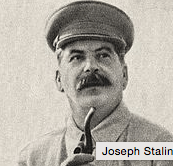
Stalin

The Obama administration has taken a sort of Stalinist tack. Obama has concentrated on building socialism in one country (i.e,, the United States) rather than protecting the national interests of the United States abroad in a difficult foreign theater, especially insofar as doing so might complicate Obama’s dreams of an entente with Iran.

Last week brought a new round of Syria related stories. At the Weekly Standard, Lee Smith noted “Obama’s Syria doctrine.” Obama disclaims responsibility even for his own pathetically failed approach:

In the wake of last week’s embarrassing revelation that only four or five U.S.-trained rebels are currently engaged in fighting the Islamic State, the White House was scrambling to deflect blame. It wasn’t Obama’s fault, said White House press secretary Josh Earnest. The president never wanted to back the rebels in the first place. His hand was forced by administration figures and Republican lawmakers who wanted to aid the rebels. It’s time, said Earnest for “our critics to fess up in this regard as well. They were wrong.”

Enter Russia. Barbara Starr & Ross Levitt report for CNN: Russian fighter jets enter Syria with transponders off”

Lucas Tomlinson & Jennifer Griffin report for FOX News “Russians, Syrians and Iranians setting up military cooperation cell in Baghdad”. Tomlinson and Griffin note:

Russian, Syrian and Iranian military commanders have set up a coordination cell in Baghdad in recent days to try to begin working with Iranian-backed Shia militias fighting the Islamic State, Fox News has learned.

Western intelligence sources say the coordination cell includes low-level Russian generals. U.S. officials say it is not clear whether the Iraqi government is involved at the moment.

Describing the arrival of Russian military personnel in Baghdad, one senior U.S. official said, “They are popping up everywhere.”

The Wall Street Journal published two important stories last week. Dion Nissenbaum & Carol Lee report: “Russians expand military presence in Syria, satellite photos show.” Jay Solomon & Sam Dagher report: “Russia, Iran seen coordinating seen coordinating of Assad regime in Syria.”

And Prime Minister Netanyahu flew to Moscow with two members of the IDF General Staff to meet with Putin about Russia’s moves in Syria. “In Moscow,” the Times of Israel reported, “presence of generals sends a message of military urgency.” President Obama, however, is taking the long view. A couple of weeks ago Obama declared Russia’s Syrian adventure to be “doomed to failure.” Obama’s judgment represents a striking case of projection.

Like it or not, Putin’s is the ‘only game in town’

September 26, 2015

Like it or not, Putin’s is the ‘only game in town’ Gulf News, Mustapha Karkouti, September 26, 2015

(Nature abhors a vacuum and Obama created one in the Middle East. Please see also, A Chinese aircraft carrier docks at Tartus to support Russian-Iranian military buildup. — DM)

With a nearly total absence of any significant US-led coalition presence in Syria, apart from slow-effective air strikes, Moscow seems to be the only dominant player in that region. As the Kremlin clearly stated, Putin’s intention is to prevent a repetition of Libya’s 2011 scenario and avoid the total collapse of Bashar Al Assad’s authority, similar to what happened following Muammar Gaddafi’s overthrow after the badly-planned intervention by Nato. Putin is simply, but clearly, saying to the West: Where you failed in Libya, I’ll do better in Syria.

[W]hatever Putin’s plans are in the long run, his mission in the country is largely seen by the majority of Syrians as a sinister effort to save Al Assad and help him consolidate his authority in Syria.

**********************

It is very rare that a Russian head of state holds top strategic talks with an Israeli prime minister in the Russian capital. This happened just recently when Vladimir Putin met Benjamin Netanyahu to discuss Syria’s latest developments. The two chiefs are not known to have had close and friendly personal relations, but they displayed those sitting side by side in the Kremlin last week. The arrival in Moscow last Monday of Netanyahu accompanied by his chief of staff and head of military intelligence, is by all means unprecedented.

The visit is significant as it is a part of tripartite diplomatic activities that involve discussions with the US as well. The American Defence Secretary Ashton Carter has recently had a long and “useful” discussion with his Russian counterpart over Syria. With the current congestion of military activities in the sky above the region by the Israelis and Americans and the rapidly increasing presence of Russian forces and hardware, there is obviously a need to liaise to avoid any unpredicted conflict, i.e. shooting down one another’s planes by mistake. But both the US and Israel’s main concern goes far beyond the technicalities. They aim mostly at finding out what exactly the Kremlin’s long term purpose in Syria is and how far Moscow is capable of effectively controlling the direction of the tragic game currently being played in this sad country.

Sitting next to Netanyahu, Putin reassuringly explained what he was trying to achieve by stating that Moscow’s main goal was “to protect the Syrian state”, or more accurately, what’s left of it. The Russian president seemed fully aware of Netanyahu’s main concern of the Iran-supported potential attacks by Hezbollah and the Syrian army across the occupied Golan Heights, when he told his visitor that neither Damascus nor the Iranian-financed Lebanese militia was “in any state to open a second front”. In others words, Putin reassured Netanyahu that Moscow was fully engaged with Tehran and Damascus on that front.

Saving Al Assad

With a nearly total absence of any significant US-led coalition presence in Syria, apart from slow-effective air strikes, Moscow seems to be the only dominant player in that region. As the Kremlin clearly stated, Putin’s intention is to prevent a repetition of Libya’s 2011 scenario and avoid the total collapse of Bashar Al Assad’s authority, similar to what happened following Muammar Gaddafi’s overthrow after the badly-planned intervention by Nato. Putin is simply, but clearly, saying to the West: Where you failed in Libya, I’ll do better in Syria.

The timing of Moscow’s build-up along the Syrian coastal area couldn’t be more perfect, particularly with western policy on the country in a state of limbo. Surely, moving dozens of combat aircraft and hundreds of troops to the aid of the encircled Syrian president must have been given the green light a while ago. This is precisely how Putin sees the situation. Under the nose of the Americans and the world community, Russian personnel and Special Forces have re-emerged in large numbers at an old air base of theirs near Al Assad’s stronghold of Latakia. Russia has always had, through the former Soviet Union, significant military presence in Syria during the long years of the Cold War and beyond.

However, whatever Putin’s plans are in the long run, his mission in the country is largely seen by the majority of Syrians as a sinister effort to save Al Assad and help him consolidate his authority in Syria.

After all, Al Assad is the man largely accused of killing thousands of Syrians during the almost five-year war in the country. It has become absolutely clear that all players in the region, including US, Israel, Turkey and Iran are adjusting to the new reality as a result of the speed and scale of Russian’s deployment. It is commonly known now that Israel was made aware of Moscow’s deployment before it began, while Iran had been informed of the move as early as the first week of August. In fact, shipments from Black Sea ports to the Syrian port of Tartous began to pass through the Bosphorus as from August 20.

The Russians had moved by last Tuesday into the coastal stretch between Latakia and Tartous 28 combat jets (12 Su24 bombers, 12 Su25 ground attack aircraft and 4 Su-30 multi-role fighters), two types of drones and 20 multi-purpose helicopters. Almost the equivalent of Al Assad’s entire air power. Pentagon officials have confirmed these deployments and said Russian drones are now fully operating where offensive air attacks could be expected very soon.

Turkey on its part, is willing to dip its hands in ‘Syria’s Cake’ as a highly Turkish informed source told me few days ago, and send troops into the country, provided it gets the green light to set up its ‘no-fly zone’ along Syria’s northern borders. In fact, discussion between Ankara and several European capitals, including Berlin, over the issue has been going on for sometimes as many European leaders consider the no-fly zone option is urgently needed method to help controlling the flow of refugees into European Union countries.

However, with Iran well entrenched behind Al Assad at an annual cost of $6-$10 billion (Dh22-36.7 billion), it is also a decisive regional power of huge influence in shaping events in shrinking Syria and beyond. Additionally, there is newcomer into the killing fields of Syria as China has just officially revealed that it is sending personnel and advisers to assess the situation. And with almost total US absence in the Levant, Russia would militarily and politically remain the most significant power to shore up Al Assad’s regime as long as it is possible.


Progressivism: Easing the Way to Mass Murder

September 26, 2015

Progressivism: Easing the Way to Mass Murder, American ThinkerKenneth Levin, September 26, 2015

The progressive creed as it relates to foreign policy, and as represented most notably by our Progressive-in-Chief, President Obama, holds that the impact of United States behavior in the world has largely been negative. It casts American foreign policy as a variation on European colonialism: exploitative, indifferent to the peoples subjected to American attention and intervention, and inexorably engendering anti-American sentiment among those peoples.

The translation of this comprehension of the world into a progressivism-informed foreign policy has had the effect of making the world safer for mass murder.

President Obama has offered apologies for past American policy to Europeans, to Arabs and the Muslim world more broadly, to the peoples of Central and South America. Various media outlets have noted that, according to a 2011 Wikileaks publication, only a negative response by the Japanese government prevented Mr. Obama from going to Hiroshima in September, 2009, and offering apologies for America’s atomic bomb attack on the city.

But whatever the President’s erstwhile intentions vis-a-vis Hiroshima, the broader focus of his apologetics has been on those nations and peoples that are hostile to America. His key foreign policy syllogism, and that of America’s progressive camp, is that anti-American sentiment is essentially a product of American abuses and that American self-reform and accommodation, a kinder, gentler United States, will bring an end to current hostility and engender a new comity between this nation and its long-time victims.

Most of the world’s nations offer their citizens at best very limited rights. Some authoritarian regimes have close relations with the United States; others are hostile to the United States. One might think that progressives would object to despots of whatever sort and aspire to the liberation of populations from such governments.

But that is not case. The progressivist pattern, rather, is to oppose despotic regimes with which this nation has had positive relations but to be sympathetic and accommodating towards those that have viewed us as the enemy — that view being congruent with progressive orthodoxy.

Moreover, the advocates of genuine democratic reform in closed societies of either sort, pro- or anti-American, are essentially given short shrift. Such advocates typically look to the United States as a model for their aspirations, and that is sufficient to alienate, and preclude any hoped for support from, the progressive camp. Within pro-American authoritarian regimes, American progressives reserve their sympathy primarily for anti-regime forces that likewise look to America as the source of their respective nations’ ills and seek to replace those in power with a despotism of their own, a despotism with an anti-American stamp.

In Latin America, a number of democracies have in recent decades been subverted by left-wing populists who gained power at the ballot box and then proceeded to dismantle their nations’ democratic institutions with, for example, measures against competing parties, a free media and an independent judiciary. The pattern was established by Hugo Chavez, who became president of Venezuela in 1998, and was followed by, among others, Evo Morales in Bolivia and Rafael Correa in Ecuador. The new despots commonly justified their anti-democratic measures as necessary to counter the supposed nefarious aims of parties domestic and foreign, among which the United States is commonly trotted out as key bogeyman.

Obama and his administration displayed a notable sympathy for Chavez and have likewise done so for his emulators. The victims — among media figures or political opponents — that suffered at the hands of the post-democratic strongmen have enjoyed no such sympathy. Amazingly, when President Manuel Zelaya of Honduras likewise sought to undo his nation’s democracy and consolidate his personal control of the country but had his subversion of Honduras’s constitution blocked by the nation’s parliament and courts, the Obama administration backed Zelaya, attacked the “coup” that pushed him from power, and sought his reinstatement.

All of these populist despots were supported, of course, by Castro’s Cuba, which remains the chief example of anti-democratic leftism in Latin America both in terms of its longevity and in terms of its record of thousands murdered and myriad more imprisoned among those who have dared to take issue with the island’s dictatorship. But here, too, the progressive camp, and the Obama administration, have chosen to look upon the regime’s anti-American cant sympathetically, to see the proper way forward as American reform and cultivation of the Castros, and to close their ears and eyes to the regime’s victims.

But this progressivist cultivating of despotic forces which have only their anti-Americanism to recommend them takes on an even more sinister hue — indeed, much more sinister, in terms of the slaughters perpetrated by such forces and essentially ignored by American progressives — in the arena of the Muslim Middle East.

Virtually from its inception, the Obama administration has demonstrated support for the Muslim Brotherhood. The Brotherhood, founded in 1928 and closely linked to the Nazis during World War II, has consistently promoted an anti-American, anti-Western and anti-Semitic agenda. Its offshoot, Hamas, openly declares its dedication not only to the murder of all Israel’s Jews but of all Jews worldwide. Yet the Obama administration has appointed American Muslims associated with the Muslim Brotherhood to government posts and even as liaisons with federal law enforcement and security agencies and the military, and Brotherhood associates have been frequent guests at the White House.

Obama intervened to provide Brotherhood leaders prominent audience placement for his 2009 Cairo speech in which he apologized for America’s past role in the Middle East and sought more generally to propitiate the Arab and broader Muslim world. The President subsequently undercut pro-American Egyptian strongman Hosni Mubarak when the so-called “Arab spring” exploded in Egypt. He helped force Mubarak from office, and, as in Latin America, rather than support moderate, democratically oriented, groups in Egyptian society in the shaping of an alternative to Mubarak (including groups that consisted of Muslims and Coptic Christians working together for a democratic Egypt), threw his support behind the Brotherhood. One expression of this was the administration’s pushing for quick elections, which provided less time for challengers to the Brotherhood — the best organized political group in Egypt — to mount effective campaigns.

The election in June 2012, did bring the Brotherhood to power, with Mohamed Morsi as president and with the White House’s blessing. In the ensuing months, which saw increased murderous Brotherhood assaults on Egypt’s Coptic Christians — more than ten percent of the population and the Middle East’s largest Christian community — as well as Brotherhood cultivation of its Hamas protégés, the Obama administration continued to offer its support. (The only high profile criticism of Morsi came in the wake of the rarest of events, a New York Times front page, above-the-fold piece on Muslim anti-Semitism, in this instance a newly revealed Morsi anti-Semitic diatribe recorded some years earlier. On this occasion, the White House finally felt obliged to break from its typical indulgence of the Brotherhood and its leaders by releasing some comment condemning Morsi’s remarks.)

The Brotherhood ultimately lost popular favor, in large part because of its failure to address Egypt’s economic ills. But Egyptians were also put off by Morsi’s pursuit of the Brotherhood’s Islamist agenda. As, for example, The Economist noted

“… [I]n power the Brotherhood began to abandon its previous caution regarding its foes. Mr Morsi appeared to dismiss secular opponents and minorities as politically negligible. Instead of enacting the deeper reforms that had been a focus of popular revolutionary demands, such as choosing provincial governors by election rather than presidential appointment, or punishing corrupt Mubarak-era officials, the Brothers simply inserted themselves in key positions…

“When nearly all the non-Islamist members of a body charged with drafting a new constitution resigned in November 2012, the Brothers brushed the problem aside. Mr Morsi issued a snap decree rendering him and his constitution-writers immune from court oversight. This was when his popularity started to slide…

“The Brothers pushed through a hastily drafted constitution to a national referendum despite angry criticism from all other parties, and the referendum went Mr Morsi’s way. But his high-handedness lost him a crucial part of the electorate…”

But, again, none of this seemed to dampen Obama’s enthusiasm for Morsi and the Brotherhood, and when the Egyptian army under Abdel Fattah al-Sisi deposed Morsi in July, 2013, with wide popular support, the White House condemned the coup and dismissed its popular backing and the transgressions of the Morsi regime that generated that support. For much of the subsequent two years, the administration has given the pro-American al-Sisi the cold shoulder. Its withholding of military grants and sales to Egypt — only recently softened to some degree — has pushed al-Sisi to renew Egypt’s long dormant military links with Russia.

Before its victory in Egypt, the country where the Muslim Brotherhood had been most successful in gaining power had been Sudan, where its members made up a large part of the government following the 1989 coup d’état by General Omar Hassan al-Bashir. Bashir, who still rules Sudan, led a genocidal campaign against the black and non-Muslim — Christian and animist — population of southern Sudan over many years, until that region successfully seceded and established its independence. He currently continues a campaign of mass murder and displacement of the Muslim — but, again, black rather than Arab — population of Darfur. Bashir is under indictment by the International Criminal Court for genocide in Darfur.

President Obama, during his 2008 campaign as well as in earlier speeches, promised to act against the Darfur genocide. But he has done nothing, even as the slaughter, displacement and suffering continue. On the contrary, the Obama administration has reached out to Bashir. In addition, consistent with the Sudan government’s wishes and despite the horrible consequences for the people of Darfur, the administration appears to be supporting the downsizing of the UN peacekeeping mission in Darfur. Once again, for President Obama, appeasing anti-American entities such as the Muslim Brotherhood, an appeasement consistent with progressive orthodoxy, trumps supporting the victims of those entities.

Obama’s favorite Middle East leader has long been, according to various sources, Turkey’s Recep Tayyip Erdogan. Turkey is, of course, a NATO member and remains so even under Erdogan’s Islamist regime. It is not openly anti-American. But Erdogan has clearly turned away from the West, has developed close ties with the Muslim Brotherhood and has sought to establish himself as the leading figure in a Middle East and broader Muslim world dominated by Islamist policies that emulate those of the Brotherhood.

Having notably described democracy as like a streetcar from which one exits upon reaching one’s destination, Erdogan has done much to undermine Turkish democracy. He has essentially dismantled the nation’s independent judiciary, closed down opposition media and arrested journalists — with Turkey having more journalists incarcerated than either China or Iran — and engineered his Islamist camp’s infiltrating and seizing control over other Turkish institutions, both public and private.

Erdogan was an enthusiastic supporter of the Muslim Brotherhood’s rise to power in Egypt, is reported to have cried over the downfall of Morsi and the Brotherhood, and some months ago declared that he still regards Morsi rather than al-Sisi as Egypt’s president. He remained silent over and apparently indifferent to the Brotherhood’s slaughter of Egyptian Christians both before and during its period in power.

Erdogan likewise supports the Brotherhood offshoot Hamas in its genocidal war against Israel and has, through statements by him and leaders of his party and through his party-controlled media, whipped up domestic anti-Israel and anti-Jewish sentiment. He has opened Turkey as a refuge for members of both Hamas and the Egyptian Brotherhood, and attacks on Israelis, such as the kidnapping and murder of three Israeli teenagers last year, have been orchestrated by senior Hamas agents in Turkey.

Yet none of this seems to have shaken President Obama’s enthusiasm for the Turkish leader. On the contrary, Erdogan’s turning from the West and embracing an agenda close to that of the Brotherhood has, once more consistent with the president’s progressive world view, rendered him worthy of the administration’s propitiation.

Obama’s reaching out to the Iranian mullahs virtually from the moment of his taking office in 2009 is likewise in line with his progressivist comprehension of foreign hostility to the United States as a response to past American transgressions. Following from this, his path to ending the hostility lay in breaking from that past, offering mea culpas for it, and cultivating new policies of understanding and comity.

More particularly, the CIA’s involvement in the overthrow of Iranian Prime Minister Mossadegh in 1953 (which in fact at the time had the support of Iran’s religious establishment) and America’s subsequent ongoing support for Shah Reza Pahlavi are construed as the source of Iranian enmity and the history for which the President seeks to apologize and atone.

The popular uprising that followed the disputed reelection of President Mahmoud Ahmadinejad in June, 2009, led to the regime’s killing of dozens of protesters and the arrest and reported torture and rape of thousands more. Protesters urged the outside world, particularly the United States and President Obama, to support them, but Obama refrained even from offering significant verbal support, apparently not wanting to do anything that might undermine his outreach to the mullahs.

In the ensuing years, torture, including rape, and murder of political prisoners, among them suspected student critics of the regime culled in raids on Iranian universities, have been an ongoing fact of life in Iran. So, too, have been the imprisonment and execution of homosexuals and individuals accused of religious crimes, and abuses targeting members of the embattled Baha’i community and elements of Iran’s ethnic minorities, who represent more than fifty percent of the nation’s population.

But on all of this the Obama administration has been essentially silent as it has pursued its policy of winning over the apocalyptic Iranian theocracy through accommodation and concessions. That policy culminated this summer in the agreement on the Iranian nuclear program, which provides Iran with a path to nuclear weapons and even offers American aid to Iran in defending its nuclear program against sabotage and attack.

Nor has the administration let Iran’s role in killing Americans in Lebanon, Saudi Arabia, Afghanistan and Iraq, and Iran’s assertions of never compromising in its enmity towards America, interfere with Obama’s agenda of pursuing its progressivist fantasies of peace with Iran through accommodation. Nor has the mullahs’ genocidal anti-Semitism, including their openly and repeatedly declared determination to destroy Israel, or their arming and training of Hezb’allah and Hamas to pursue Israel’s annihilation, led to the administration’s wavering from its course. On the contrary, the nuclear agreement appears to offer Iran protection against any Israeli attempt to derail the Islamo-fascist theocracy’s development of nuclear weapons. It also promises to soon provide the regime with tens of billions of dollars in previously embargoed funds, which has already translated into Iran’s embarking on a massive acquisition of advanced warplanes and other major weapons systems from China and Russia and its promising enhanced military aid to Hezb’allah and its other terrorist allies for use in pursuit of Israel’s destruction.

But the off-handedness regarding existential threats to Israel, and regarding as well myriad instances of wholesale human rights abuses, including mass slaughter by those the Obama administration has sought to propitiate, is apparently due to such matters being regarded as of no great consequence when measured against the central international dynamic as construed by progressivism. Administration indifference to the fact of some of those hostile regimes and non-state entities — the objects of American cultivation — having dismantled working democracies or having strangled incipient democratic movements derives from the same worldview. All their various crimes are mere epiphenomena, at most secondary, and potentially an unwelcome distraction, when measured against what is comprehended as the essential world-shaping dynamic: hostility towards America whose roots lie in past American abuses, and an end to hostility and creation of a more peaceful world through American contrition and accommodation.

In this way, Obama’s, and the progressive camp’s, comprehension of reality and playing out of that delusional “reality” on the world stage inexorably makes the world safer for the crimes, including mass murder, of the anti-American forces that are the object of progressivist propitiation.


A Chinese aircraft carrier docks at Tartus to support Russian-Iranian military buildup

September 26, 2015

A Chinese aircraft carrier docks at Tartus to support Russian-Iranian military buildup, DEBKAfile, September 26, 2015

liaoning_Tartus_25.9.15

This turn of events has a highly detrimental effect on Israel’s strategic and military position. It also strengthens Iran’s supreme leader Ayatollah Ali Khamenei in his determination to turn the nuclear deal concluded in July into a tool for isolating the US politically, militarily and economically in the Middle East, rather than a milestone on the road to a breakthrough in ties with Iran, as the Obama administration had hoped. 

***********************

As US President Barack Obama welcomed Chinese President Xi Jinping to the White House on Friday, Sept. 25, and spoke of the friendship between the two countries, the Chinese aircraft carrier Liaoning-CV-16 docked at the Syrian port of Tartus, accompanied by a guided missile cruiser. This is revealed exclusively byDEBKAfile.

Beijing is not finding it hard to dance at two weddings, wooing the US for better relations, while at the same time backing Russia in its military intervention in Syria. Coupled with the warm smiles and handshakes exchanged at the lavish reception on the White House lawn, Beijing was clearly bent on showing muscle – not just in the South China Sea, but by allying itself with the Russian-Iranian political and military buildup in support of Syrian President Bashar Assad and his regime.

DEBKAfile’s military sources report that the Chinese aircraft carrier passed through the Suez Canal on Sept. 22, one day after the summit in Moscow between Russian President Vladimir Putin and Israeli Prime Minister Binyamin Netanyahu.

When they talked, Putin made no mention of the Chinese warship entering the eastern Mediterranean or its destination. Its arrival has upended the entire strategic situation surrounding the Syrian conflict, adding a new global dimension to Moscow and Tehran’s military support for Assad.

This was grasped at length by US Secretary of State John Kerry. On Sept. 25, he sent Under Secretary of State Wendy Sherman, who also led the US negotiating team for the nuclear talks with Iran, to announce that the Obama administration is ready for dialogue with Iran about the situation in Syria, and this topic would be raised when Kerry’s met Iranian Foreign Minister Muhammad Jawad Zarif in New York on Sept. 26.

But if the top US diplomat hoped to bypass the Russian initiative in Syria by going straight to Tehran, he was too late. Iran is already moving forward fast to augment its military presence in the war-torn country, buttressed by the ground, air and sea support of two world powers, Russia and China.

This turn of events has a highly detrimental effect on Israel’s strategic and military position. It also strengthens Iran’s supreme leader Ayatollah Ali Khamenei in his determination to turn the nuclear deal concluded in July into a tool for isolating the US politically, militarily and economically in the Middle East, rather than a milestone on the road to a breakthrough in ties with Iran, as the Obama administration had hoped.

Our military sources find evidence that the Chinese forces are digging in for a prolonged stay in Syria. The carrier put into Tartus minus its aircraft contingent. The warplanes and helicopters should be in place on its decks by mid-November – flying in directly from China via Iran or transported by giant Russian transports from China through Iranian and Iraqi airspace.

This explains the urgency of establishing a RussianSyria-Iranian “military coordination cell” in Baghdad in the last couple of days. This mechanism, plus the Russian officers sighted in Baghdad, indicates that the Russian military presence is not limited to Syria but is beginning to spill over into Iraq as well.

The coordination cell – or war room – was presented as necessary to begin working with Iranian-backed Shiite militias fighting the Islamic State in both places. But more immediately, it is urgently needed to control the heavy traffic of Russian, Iranian and Chinese military flights transiting Iraqi air space.

Our sources report that the Chinese will be sending out to Syria a squadron of J-15 Flying Shark fighters, some for takeoff positions on the carrier’s decks, the rest to be stationed at the Russian airbase near Latakia. The Chinese will also deploy Z-18F anti-submarine helicopters and Z-18J airborne early warning helicopters. In addition, Beijing will consign at least 1,000 marines to fight alongside their counterparts from Russia and Iran against terrorist groups, including ISIS.

DEBKAfile’s counterterrorism sources point out that just as Russian marines will be instructed to single out rebel militias with recruits from Chechnya and the Caucasus, the Chinese marines will seek out and destroy Uighur fighters from the northern predominantly Muslim Chinese province of Xinjiang.

In the same way that Putin has no wish to see the Chechen fighters back in Russia, so too Chinese President Xi wants to prevent the Uighurs from returning home from the Syrian battlefields.

Obama Throws Christian Refugees to Lions

September 24, 2015

Obama Throws Christian Refugees to Lions, Gatestone InstituteRaymond Ibrahim, September 24, 2015

  • Why are Christian minorities, who are the most to suffer from the chaos engulfing the Middle East, the least wanted in the United States?
  • To the Obama administration, the only “real” refugees are those made so due to the actions of Bashar Assad. As for those who are being raped, slaughtered, and enslaved based on their religious identity by so-called “rebel” forces fighting Assad — including the Islamic State — their status as refugees is evidently considered dubious at best.
  • The Obama administration never seems to miss an opportunity to display its bias for Muslims against Christians. The State Dept. is in the habit of inviting scores of Muslim representatives but denying visas to solitary Christian representatives. While habitually ignoring the slaughter of Christians at hands of Boko Haram, the administration called for the “human rights” of the jihadi murderers.
  • In Islamic usage, the “cause of Allah” is synonymous with jihad to empower and enforce Allah’s laws on earth, or Sharia. In this context, immigrating into Western lands is a win-win for Muslims: if they die in the process somehow, paradise is theirs; if they do not, the “locations and abundance” of the West are theirs.
  • Muslims all around the U.S. are supporting the Islamic State and Muslim clerics are relying on the refugee influx to conquer Western nations, in the Islamic tradition of Hijrah, or jihad by emigration.

The fate of those Iraqi Christians who had fled from the Islamic State only to be incarcerated in the United States has finally been decided by the Obama administration: they are to be thrown back to the lions, where they will likely be persecuted, if not slaughtered, like so many Iraqi Christians before them.

Fifteen of the 27 Iraqi Christians that have been held at a detention center in Otay Mesa, California, for approximately six months, are set to be deported in the coming weeks. Some have already been deported and others are being charged with immigration fraud.

Many of the Iraqi Christian community in San Diego — including U.S. citizen family members vouching for the refugees — had hopes that they would eventually be released. Mark Arabo, a spokesman for the Chaldean community, had argued that “They’ve escaped hell. Let’s allow them to reunite with their families.” One of the detained women had begged to see her ailing mother before she died. The mother died before they could reunite, and now the daughter is to be deported, possibly back to the hell of the Islamic State.

1261Members of California’s Iraqi Christian community and their supporters protest the months-long detention of Iraqi Christian asylum-seekers at the Otay Mesa detention center. (Image source Al Jazeera video screenshot)

Why are Christian minorities, who are the most to suffer from the chaos engulfing the Middle East, the least wanted in the United States?

The answer is that the Obama administration defines refugees as people “persecuted by their government.” In other words, the only “real” refugees are those made so due to the actions of Syrian President Bashar Assad. As for those who are being raped, slaughtered, and enslaved based on their religious identity by so-called “rebel” forces fighting Assad — including the Islamic State — their status as refugees is evidently considered dubious at best.

As Abraham H. Miller argues in “No room in America for Christian refugees“:

“What difference does it make which army imperils the lives of innocent Christians? Christians are still be[ing] slaughtered for being Christian, and their government is incapable of protecting them. Does some group have to come along — as Jewish groups did during the Holocaust — and sardonically guarantee that these are real human beings?”

In fact, from the start of Western meddling in the Middle East in the context of the “Arab Spring, “Christians were demonized for being supportive of secular strongmen like Assad. In a June 4, 2012 article discussing the turmoil in Egypt and Syria, the Independent’s Robert Fisk scoffed at how Egyptian presidential candidate “Ahmed Shafiq, the Mubarak loyalist, has the support of the Christian Copts, and Assad has the support of the Syrian Christians. The Christians support the dictators. Not much of a line, is it?”

More than three years later, the Western-supported “Arab Spring” proved an abysmal failure and the same Christian minorities that Fisk took to task were, as expected, persecuted in ways unprecedented in the modern era.

The Obama administration never seems to miss an opportunity to display its bias for Muslims against Christians. The U.S. State Dept. is in the habit of inviting scores of Muslim representatives but denying visas to solitary Christian representatives. While habitually ignoring the slaughter of Christians at hands of Boko Haram, the administration called for the “human rights” of the jihadi murderers. And when persecuted Egyptian Copts planned on joining the anti-Muslim Brotherhood revolution, Obama said no. Then there is the situation that every Arab nation the Obama administration has meddled in — for example, Libya and Syria — has seen a dramatic nosedive in the human rights of Christian minorities.

The Obama administration’s bias is evident even regarding the Iraqi Christians’ illegal crossing of the U.S.-Mexico border, the occasion on which they were arrested. WND correctly observes: “At the same time the Obama administration [is] deporting Christians, it has over the years allowed in hundreds of Muslim migrants from Africa and the Middle East who crossed the Southern border the same way the Chaldeans did.”

Meanwhile, as the Obama administration nitpicks at the definition of refugee and uses it against severely persecuted Christian minorities, it turns out that four out of five migrants — or 80 percent — are not even from Syria.

And while Christian minorities pose little threat to the United States — indeed, they actually bring benefits to U.S. security — Muslims all around the U.S. are supporting the Islamic State and Muslim clerics are relying on the refugee influx to conquer Western nations, in the Islamic tradition of Hijrah, or jihad by emigration. As Koran 4:100 puts it:

And whoever emigrates for the cause of Allah will find on the earth many locations and abundance. And whoever leaves his home as an emigrant to Allah and His Messenger and then death overtakes him — his reward has already become incumbent upon Allah.

In Islamic usage, the “cause of Allah” is synonymous with jihad to empower and enforce Allah’s laws on earth, or Sharia. In this context, immigrating into Western lands is a win-win for Muslims: if they die in the process somehow, paradise is theirs; if they do not, the “locations and abundance” of the West are theirs.

All the while, the Obama administration is turning away Christian refugees fleeing the same hostile Muslim forces as Muslims — who are being welcomed into America and Europe.

Saudi Arabia: World’s Human Rights Sewer

September 21, 2015

Saudi Arabia: World’s Human Rights Sewer, Gatestone InstituteDouglas Murray, September 21, 2015

(This must be a premature April Fools Day joke. There have been several others recently, including criticisms of Donald Trump for not rebuking, correcting and silencing someone who claimed that Obama is a Muslim and of Dr. Ben Carson for saying he would not support a Muslim for President. Yeah, they must all be just sick jokes. I wish. — DM)

Saudi Arabia has been appointed as the head of a key UNHRC panel. This panel selects the top officials who shape international standards in human rights; it is intended to report on human rights violations around the world. The five-member group of ambassadors, which Saudi Arabia will now head, is known as the Consultative Group and has the power to select applicants to fill more than 77 positions worldwide that deal with human rights issues.

**********************

  • Ali Mohammed al-Nimr, sentenced to be crucified, was accused of participating in banned protests and firearms offenses — despite a complete lack of evidence on the latter charge, and he was denied access to lawyers. Al-Nimr is also alleged by human rights groups to have been tortured and then forced into signing a confession while in custody.
  • Not only are the Saudi authorities preparing to crucify someone — in 2015 — whom they tortured into making a confession; they are preparing to crucify someone who was a minor at the time of arrest.
  • Alas not a week goes by without Saudi Arabia demonstrating to the world why they retain their reputation as one of the world’s foremost human rights sewers.
  • Crucifixion is a punishment which, it would appear, is not only Sharia-compliant but also — we must assume — Geneva-compliant.

The United Nations Human Rights Council (UNHRC) in Geneva is an organization that may be easy to critique, but it is very hard to satirize. Ordinarily, if you told anyone that there was a place in Switzerland where Sudan, Iran and others of the world’s worst dictatorships and human rights abusers have their views on human rights treated with respect and deference, you would assume the script was written by Monty Python. Idi Amin would make an appearance at some point to share his views on how to improve equal conditions for women in the workplace. Pol Pot would crop up in order to castigate those countries where living standards had not been sufficiently raised in accordance with global averages.

Everything that happens in Geneva is beyond satire. But last week provides a demonstration, outrageous even by the standards of the UN. For this week, it came out – thanks to the excellent organization UN Watch — that Saudi Arabia has been appointed as the head of a key UNHRC panel. This panel selects the top officials who shape international standards in human rights; it is intended to report on human rights violations around the world. The five-member group of ambassadors, which Saudi Arabia will now head, is known as the Consultative Group and has the power to select applicants to fill more than 77 positions worldwide that deal with human rights issues. It appears that the appointment of Saudi Arabia’s envoy to the UNHRC, Faisal Trad, was made before the summer, but that diplomats in Geneva have kept silent on the matter since then.

That this appointment had to leak out months after the event raises the possibility that the UNHRC, contrary to popular perception, actually does have some sense of shame. Otherwise, why not shout from the rooftops that Saudi Arabia has won this prestigious position? Why not distribute a press release? After all, Saudi Arabia — and by extension the UNHRC — have nothing to be ashamed of, do they?

Alas not a week goes by without Saudi Arabia demonstrating to the world why they retain their reputation as one of the world’s foremost human rights sewers. Saudi Arabia may have beheaded more people in the last year than ISIS, but only rarely do any of these cases get more than a flicker of international attention. Occasionally a case breaks above the waves of public opinion. One such case is that of the jailed blogger Raif Badawi, sentenced last year to 10 years in jail and 1000 lashes for “insulting Islam.” The plight of Raif Badawi, who has already been served the first 50 lashes, and is being held in prison while awaiting the rest, has garnered international attention and condemnations of Saudi Arabia. The kingdom’s response has been strongly to denounce “the media campaign around the case.”

But the glare of international opinion clearly disturbs the Saudi authorities — a fact well worth keeping in mind. And it is not as though they have nothing to hide. This week brings a case that should get at least as much attention as that of Raif Badawi.

Ali Mohammed al-Nimr was just 17 when he was arrested by the Saudi authorities in 2012, during a crackdown on anti-government protests in the Shia province of Qatif. He was accused of participating in banned protests and firearms offenses — despite a complete lack of evidence on the latter charge. Denied access to lawyers, al-Nimr is alleged by human rights groups to have been tortured and then forced into signing a confession while in custody. Campaigners say that it seems he has been targeted by authorities because of his family association with Sheikh Nimr al-Nimr, the 53-year-old critic of the Saudi regime who is his uncle. The Sheikh has also been convicted and sentenced to death. After the confession and “trial,” his nephew was convicted at Saudi’s Specialized Criminal Court and sentenced to death. The trial itself failed to meet any international standards. Al-Nimr appealed against his sentence, but this week that appeal was dismissed. It now seems likely that he and his uncle will now be executed. Because charges include crimes involving the Saudi King and the state itself, it seems likely that the method of death will be crucifixion.

1255Imprisoned Saudi dissidents Raif Badawi (left) and Ali Mohammed al-Nimr (right).

If this were in any way to cause a flicker of concern among other participants in the UNHRC farce going on Geneva, they have at least some consolation. For in Saudi Arabia crucifixion is not what it used to be. Indeed, in Saudi Arabia crucifixion begins with the beheading of the victim and only then the mounting of the beheaded body onto a crucifix, to make it available for public viewing. This is a punishment which it would appear is not only Sharia-compliant but also — we must assume — Geneva-compliant.

Of course, Ali Mohammed al-Nimr counts as having been a juvenile at the time of his arrest, so not only are the Saudi authorities preparing to crucify someone — in 2015 — whom they tortured into making a confession – they are preparing to crucify someone who was a minor at the time of arrest. Perhaps the authorities at the UNHRC in Geneva do indeed blush when they appoint Saudi officials to head their human rights panels. But it does not seem to affect their behaviour. Just as Saudi authorities think it is “international attention” rather than flogging people to death or crucifying them after beheading that is the problem, so the UNHRC in Geneva seems to think it is public awareness of their grotesque appointments rather than the appointments themselves that are the problem.

The international attention paid to the case of Raif Badawi has not yet seen him released, but it seems to have delayed the next rounds of lashes. Which suggests the Saudi authorities have the capacity to feel some shame. This should in turn be a cause for some hope among everyone who cares about human rights. It should also provide a reminder to everyone to increase global attention on the case of Ali Mohammed al-Nimr and the many others like him who suffer under a government and judicial system that should utterly shame the world outside Geneva, even if it cannot shame the UN.

U.S. soldiers ordered to ignore Afghan allies’ abuse of boys

September 21, 2015

U.S. soldiers ordered to ignore Afghan allies’ abuse of boys, Jihad Watch, Robert Spencer, September 20, 2015

(“It’s their culture, so it’s cool. Don’t get involved.” The (non-Islamic) Islamic State is also a manifestation of Islamic culture. Should our we be required to ignore it as well? — DM)


What are we in Afghanistan for, if not to stand for our own values and the principles of human rights? Instead, U.S. officials are aiding and abetting the destruction of these boys’ lives — and in the case of Lance Corporal Buckley, sacrificing our own troops. This is beyond shameful.

“Those are the ones brought near in the Gardens of Pleasure, a company of the former peoples and a few of the later peoples, on thrones woven, reclining on them, facing each other. There will circulate among them young boys made eternal with vessels, pitchers and a cup from a flowing spring.” — Qur’an 56:11-18

“And they will be given to drink a cup whose mixture is of ginger, a fountain within Paradise named Salsabeel. There will circulate among them young boys made eternal. When you see them, you would think them scattered pearls. And when you look there, you will see pleasure and great dominion.” — Qur’an 76:17-20

Gregory-Buckley

“U.S. Soldiers Told to Ignore Afghan Allies’ Abuse of Boys,” by Joseph Goldstein, New York Times, September 20, 2015:

KABUL, Afghanistan — In his last phone call home, Lance Cpl. Gregory Buckley Jr. told his father what was troubling him: From his bunk in southern Afghanistan, he could hear Afghan police officers sexually abusing boys they had brought to the base.

“At night we can hear them screaming, but we’re not allowed to do anything about it,” the Marine’s father, Gregory Buckley Sr., recalled his son telling him before he was shot to death at the base in 2012. He urged his son to tell his superiors. “My son said that his officers told him to look the other way because it’s their culture.”

Rampant sexual abuse of children has long been a problem in Afghanistan, particularly among armed commanders who dominate much of the rural landscape and can bully the population. The practice is called bacha bazi, literally “boy play,” and American soldiers and Marines have been instructed not to intervene — in some cases, not even when their Afghan allies have abused boys on military bases, according to interviews and court records.

The policy has endured as American forces have recruited and organized Afghan militia to help hold territory against the Taliban. But soldiers and Marines have been increasingly troubled that instead of weeding out pedophiles, the American military was arming them in some cases and placing them as the commanders of villages — and doing little when they began abusing children.
Gregory Buckley Sr. believes the policy of looking away from sexual abuse was a factor in his son’s death.

“The reason we were here is because we heard the terrible things the Taliban were doing to people, how they were taking away human rights,” said Dan Quinn, a former Special Forces captain who beat up an American-backed militia commander for keeping a boy chained to his bed as a sex slave. “But we were putting people into power who would do things that were worse than the Taliban did — that was something village elders voiced to me.”

The policy of instructing soldiers to ignore pedophilia by their Afghan allies is coming under new scrutiny, particularly as it emerges that service members like Captain Quinn have faced discipline, even career ruin, for disobeying it.

After the beating, the Army relieved Captain Quinn of his command and pulled him from Afghanistan. He has since left the military.

Four years later, the Army is also trying to forcibly retire Sgt. First Class Charles Martland, a Special Forces member who joined Captain Quinn in beating up the commander….

The American policy of nonintervention was intended to maintain good relations with the Afghan police and militia units the United States has trained to fight the Taliban. It also reflected a reluctance to impose cultural values in a country where pederasty is rife, particularly among powerful men, for whom being surrounded by young teenagers can be a mark of social status.

Some soldiers believed that the policy made sense, even if they were personally distressed at the sexual predation they witnessed or heard about.

“The bigger picture was fighting the Taliban,” a former Marine lance corporal reflected. “It wasn’t to stop molestation.”

Still, the former lance corporal, who spoke on condition of anonymity to avoid offending fellow Marines, recalled feeling sickened the day he entered a room on a base and saw three or four men lying on the floor with children between them. “I’m not a hundred percent sure what was happening under the sheet, but I have a pretty good idea of what was going on,” he said.

But the American policy of treating pedophilia as a cultural issue has often alienated the villages whose children were being preyed upon. The pitfalls of the policy emerged clearly as American Special Forces soldiers began to form Afghan Local Police militias to hold villages that American forces had retaken from the Taliban in 2010 and 2011.

By the summer of 2011, Captain Quinn and Sergeant Martland, both Green Berets on their second tour in northern Kunduz Province, began to receive dire complaints about the Afghan Local Police units they were training and supporting.

First, one of the militia commanders raped a 14- or 15-year-old girl whom he had spotted working in the fields. Captain Quinn informed the provincial police chief, who soon levied punishment. “He got one day in jail, and then she was forced to marry him,” Mr. Quinn said.

When he asked a superior officer what more he could do, he was told that he had done well to bring it up with local officials but that there was nothing else to be done. “We’re being praised for doing the right thing, and a guy just got away with raping a 14-year-old girl,” Mr. Quinn said.

Village elders grew more upset at the predatory behavior of American-backed commanders. After each incident, Captain Quinn would gather the Afghan commanders and lecture them on human rights.

Soon another commander absconded with his men’s wages. Mr. Quinn said he later heard the commander had spent the money on dancing boys. Another commander murdered his 12-year-old daughter in a so-called “honor killing” for having kissed a boy.“There were no repercussions,” Mr. Quinn recalled.

In September 2011, an Afghan woman, visibly bruised, showed up at an American base with her son, who was limping. One of the Afghan police commanders in the area, Abdul Rahman, had abducted the boy and forced him to become a sex slave, chained to his bed, the woman explained. When she sought her son’s return, she herself was beaten. Her son had eventually been released, but she was afraid it would happen again she told the Americans on the base.

She explained that because “her son was such a good-looking kid, he was a status symbol” local commanders coveted, recalled Mr. Quinn, who did not speak to the woman directly but was told about her visit when he returned to the base from a mission later that day.

So Captain Quinn summoned Abdul Rahman and confronted him about what he had done. The police commander acknowledged that it was true, but brushed it off. When the American officer began to lecture about “how you are held to a higher standard if you are working with U.S. forces, and people expect more of you,” the commander began to laugh.

“I picked him up and threw him onto the ground,” Mr. Quinn said. Sergeant Martland joined in, he said. “I did this to make sure the message was understood that if he went back to the boy, that it was not going to be tolerated,” Mr. Quinn recalled….

Sergeant Martland, who received a Bronze Star for valor for his actions during a Taliban ambush, wrote in a letter to the Army this year that he and Mr. Quinn “felt that morally we could no longer stand by and allow our A.L.P. to commit atrocities,” referring to the Afghan Local Police.

The father of Lance Corporal Buckley believes the policy of looking away from sexual abuse was a factor in his son’s death, and he has filed a lawsuit to press the Marine Corps for more information about it.

Lance Corporal Buckley and two other Marines were killed in 2012 by one of a large entourage of boys living at their base with an Afghan police commander named Sarwar Jan.

Mr. Jan had long had a bad reputation; in 2010, two Marine officers managed to persuade the Afghan authorities to arrest him following a litany of abuses, including corruption, support for the Taliban and child abduction. But just two years later, the police commander was back with a different unit, working at Lance Corporal Buckley’s post, Forward Operating Base Delhi, in Helmand Province.

Lance Corporal Buckley had noticed that a large entourage of “tea boys” — domestic servants who are sometimes pressed into sexual slavery — had arrived with Mr. Jan and moved into the same barracks, one floor below the Marines. He told his father about it during his final call home.

Word of Mr. Jan’s new position also reached the Marine officers who had gotten him arrested in 2010. One of them, Maj. Jason Brezler, dashed out an email to Marine officers at F.O.B. Delhi, warning them about Mr. Jan and attaching a dossier about him.

The warning was never heeded. About two weeks later, one of the older boys with Mr. Jan — around 17 years old — grabbed a rifle and killed Lance Corporal Buckley and the other Marines.

Lance Corporal Buckley’s father still agonizes about whether the killing occurred because of the sexual abuse by an American ally. “As far as the young boys are concerned, the Marines are allowing it to happen and so they’re guilty by association,” Mr. Buckley said. “They don’t know our Marines are sick to their stomachs.”

The one American service member who was punished in the investigation that followed was Major Brezler, who had sent the email warning about Mr. Jan, his lawyers said. In one of Major Brezler’s hearings, Marine Corps lawyers warned that information about the police commander’s penchant for abusing boys might be classified. The Marine Corps has initiated proceedings to discharge Major Brezler.

What Iran Is Permitted To Do Under The JCPOA

September 18, 2015

What Iran Is Permitted To Do Under The JCPOA, Middle East Media Research Institute, Yigal Carmon, September 17, 2015

Support or opposition to the nuclear deal should be predicated on the text of the JCPOA.

Here are a few examples of what Iran can do under the JCPOA. These actions – permitted under the JCPOA – clearly contradict statements and arguments raised recently by administration officials.

Iran Can Pursue The Development Of A Nuclear Device And Key Nuclear Technologies

Under the JCPOA, Iran can conduct activities “which could  contribute  to  the  design  and  development of a nuclear explosive device” if these activities are “approved by the Joint Commission for non-nuclear purposes and subject to monitoring.”[1]  If anything should have been totally and absolutely banned by this agreement it is activity suitable for the development of a nuclear device. President Obama’s declared rationale for the agreement is to distance Iran from a nuclear device. The JCPOA, under certain conditions allows even that.

Also nowhere in the JCPOA does Iran promise to refrain from development of key technologies that would be necessary to develop a nuclear device. To the contrary, Ali Akbar Salehi head of the Atomic Energy Organization of Iran stated that: “We are building nuclear fusion now, which is the technology for the next 50 years.”[2]

Iran Can Prevent The Inspection Of Military Sites

Under the JCPOA the IAEA cannot go wherever the evidence leads. The JCPOA allows Iran to reject a priori any request to visit a military facility. This exclusion was included in the JCPOA by introducing a limitation under which a request that “aims at interfering with military or other national security activities” is not admissible. [3]

The ban on visits to military sites has been enunciated by all regime figures from Supreme Leader Khamenei downwards. Supreme Leader Khamenei specified: “(The foreigners) shouldn’t be allowed at all to penetrate into the country’s security and defensive boundaries under the pretext of inspection, and the country’s military officials are not permitted at all to allow the foreigners to cross these boundaries or stop the country’s defensive development under the pretext of supervision and inspection.” [4]

Iranian Foreign Minister Javad Zarif said that such visits crossed a red line and were successfully rejected by Iran during the negotiations.[5] Supreme Leader Khamenei’s top adviser for international affairs Ali Akbar Velayati stated: “The access of inspectors from the IAEA or from any other body to Iran’s military centers is forbidden.”[6]

Administration spokespersons persist in claiming that military facilities will also come under inspection in total contradiction to the language of the JCPOA and the Iranian position.

There Will Be No Snap Back Of Sanctions

Under the JCPOA snap back is not automatic but will be dependent on UN Security Council approval.

Additionally, a declaration has been introduced into the JCPOA and thus became an integral part of the agreement, namely that “Iran has stated that it will treat such a re-introduction or re-imposition of the sanctions specified in Annex II, or such an imposition of new nuclear-related sanctions, as grounds to cease performing its commitments under this JCPOA in whole or in part.”[7] The inclusion of this clause in the agreement makes the reimposition of sanctions in the optimal case, the subject of litigation, when Iran can contend that the other side is in violation of the agreement.

Sanctions Duration On The Issue Of Missile Development Can Be Shortened To Less Than Eight Years

Under the JCPOA the sanctions on missile development need not remain in place for eight years but can be lifted earlier, namely whenever “the IAEA has reached the Broader Conclusion that all nuclear material in Iran remains in peaceful activities.”[8]

Arak Will Remain A Heavy Water And Hence A Plutonium Capable Facility; Iran’s Plutonium Pathway Was Not Totally Blocked

Arak houses Iran’s heavy water facility. Despite the vague wording in the JCPOA, (i.e. Iran will “redesign” and “modernize” the reactor),[9] it will also continue to operate partially as a heavy water facility a key element needed in plutonium production.

_______________________

[1] http://apps.washingtonpost.com/g/documents/world/full-text-of-the-iran-nuclear-deal/1651/

[2] Farsnews.com, August 9, 2015.

[3] JCPOA, Annex I, Q.74.

[4]  Ibid.

[5] Latimes.com, July 22, 2015

[7] JCPOA, Section I, Article C, Paragraph 26. See footnote 1 for link to text.

[8] JCPOA, Annex V, D.19. See footnote 1 for link to text.

[9] JCPOA, I.B.8. See footnote 1 for link to text.

The Shady Family Behind America’s Iran Lobby

September 15, 2015

The Shady Family Behind America’s Iran Lobby, Daily Beast, Alex Shirazi, September 15, 2015

(The National Iranian American Council is the voice of the Iranian regime. It found great favor with the Obama administration while becoming a significant part of it. — DM)

How one enterprising Iranian expat family and its allies successfully pushed for U.S.-Iran rapprochement—and now stands to make a fortune from sanctions relief.

When the world’s major powers struck a deal over Iran’s nuclear program in Vienna in July, it represented a victory not just for the Islamic Republic, which has now been granted international legitimacy as a nuclear threshold state, but also for a small but increasingly influential lobby in America, one which has long sought rapprochement between Washington and Tehran and now seeks to leverage a successfully concluded nuclear deal as a means to that end.

This Iran lobby, publicly represented by the National Iranian American Council (NIAC), has become a staunch institutional ally of the White House selling the Joint Comprehensive Plan of Action, as the nuclear deal is known. But while NIAC has done the heavy-lifting—the ad-buying, the leafleting, and Congressional meet-and-greets, all designed to sell lawmakers on the Iran deal—its political efforts also underwrite the economic interests of one very well connected but low-profile Iranian family, the Namazis, who played a key role as intellectual architects of NIAC.

Little known to the American press, the Namazis have rarely acted as spokespersons for their own cause. In fact, attempts to reach various members of the family for comment on this story were met with increasing levels of hostility and threats of legal action. Yet in many ways, the Namazi clan is the perfect embodiment of Iranian power politics, at least as it has played out among the Iranian diaspora. Those close to the Namazis say that they are savvy financial operators rather than ideologues, eager to do business with the West and enjoy all of its political freedoms and perquisites, and yet ever mindful that they’re straddling the delicate fault-line between cashing in with a theocratic dictatorship and being frozen out entirely. They have stayed on the right side of international law if not always on the right side of prevailing political interests in the Islamic Republic.

Nor did they begin their rise to prominence as supporters of the Islamic Revolution. Mohammad Bagher Namazi, also known as Baquer Namazi, is the patriarch of the family and formerly the governor under the Shah of the oil-rich Iranian province of Khuzestan. Despite his relationship with the ancien régime, Baquer Namazi was not persecuted by the Khomeinists after they seized power in 1979, and he and his family were allowed to emigrate in 1983 to the United States. There he raised two well-educated and Americanized sons, Babak and Siamak, while his niece, Pari Namazi, married Bijan Khajehpour, another Iranian expatriate.

The 1980s were the years of the fiery-eyed Ayatollah Khomeini and Iran’s ferocious war with Saddam Hussein’s Iraq. Iranian-backed terrorism in Lebanon included the bombing of the U.S. embassy and the Marine barracks there, while Iranian “hit teams” hunted down and murdered opponents of the regime in exile. Iran’s Hezbollah clients kidnapped Europeans and Americans, and in the Irangate scandal the Reagan administration was exposed trading weapons systems for hostages. Afterward it effectively went to war against Iran on the waters of the Gulf, and in the process blew an Iranian civilian airliner out of the sky. There seemed no possibility of improved relations between Washington and the theocracy in Tehran. But after the Iran-Iraq war ended in 1988 and Khomeini died in 1989, new possibilities for rapprochement—and huge deals for international companies—started to emerge.

***

Doing serious business in Iran has always required some measure of political protection. The Islamic Republic is a web of rival economic interests. Broadly speaking, the three largest are those tied through various semi-clandestine fronts to  Khomeini’s successor as “supreme leader,” Ayatollah Ali Khamenei; those linked to the regime’s praetorian Islamic Revolutionary Guards Corps (IRGC); and those associated with Iran’s president, who may hold the most conspicuous position in the country’s political life, but whose official powers are limited. Typically, to get things moving in the mire of Iran’s notorious bureaucracy, businesses have to have connections in one or more of these groups.

From 1989 to 1997, the president of Iran was Akbar Hashemi Rafsanjani, known as “the Shark,” an Iranian reference to a beardless man. He was also famous for getting rid of his rivals and political competitors one by one, like a great white shark. In addition, Rafsanjani had a reputation for corruption and taking advantage of power.

In this environment of increased willingness to do business with the West, the stage was set for a return of the Namazis. In 1993, Pari Namazi and her husband Bijan Khajehpour founded a company in Tehran called Atieh Bahar Consulting (AB). It offered a range of legal and industrial services to foreign enterprises, most importantly the access it provided to the regime, and the advice it dispensed on how best to navigate the vagaries of the regime’s entrenched factions and competitive interests.

At the time, it looked like Iran might even be opening up to big American-based oil companies, then unencumbered by any sanctions regime on the Islamic Republic. But after an announcement in 1995 that Iran had given Conoco a contract to develop an offshore gas field, and an uproar in the U.S.  Congress, the Clinton administration imposed unilateral sanctions and barred U.S. companies from doing business there.

Eventually Siamak Namazi, who had worked from 1994 to 1996 at Iran’s Ministry of Housing and Urban Planning, also joined AB. So did his brother Babak, a lawyer. And the AB client list just kept growing. Plenty of companies based outside the U.S. were more than happy to do business in Iran once they had the right connections. As Siamak eventually told Lebanon’s Daily Star newspaper, “If oil companies want to operate in the Iranian market they need to link up with a local partner, and this is where we step in and help them to find the right partner.”

With the surprise election of the “reformist” presidential candidate Mohammad Khatami in 1997, political and economic enthusiasm for better Iranian relations with the West grew dramatically. Meanwhile the “pragmatist” Rafsanjani took other powerful positions in the regime. In those optimistic times, AB’s non-American clients—free from any sanctions regime—included the German engineering giant Siemens; major oil companies BP, Statoil, and Shell; car companies Toyota, BMW, Daimler, Chrysler, and Honda; telecom giants MTN, Nokia, Alcatel; and international banks such as HSBC.

But the political winds were shifting. A nuclear cloud darkened the horizon, and the United States, slowly but surely, found ways to broaden the sanctions against Iran, forcing many international companies to dial back on their investments there or pull out altogether.

The Namazis, of course, had every reason to want to bring them back.

***

Atieh Bahar Consultancy had aligned itself with Rafsanjani’s faction early on by forging an especially close relationship with Rafsanjani’s influential son, Mehdi.

From 1993 to 2005, Mehdi Hashemi was employed at the National Iranian Oil Company (NIOC), the state-owned entity that controls almost all oil and gas production in a country that has the world’s largest gas reserves and third-largest oil reserves.

But Mehdi Hashemi brought some serious problems to the relationship. In 2004, Norway’s Statoil was caught paying bribes to a prominent Iranian official using the company Horton Investment, an entity run by a close Mehdi Hashemi confidant as intermediary. Hashemi would later be imprisoned for his complicity in the bribery, along with two other charges, and ordered to pay a total of $10.4 million; $5.2 million of the bribe money, plus an additional $5.2 million in fines. Abbas Yazdanpanah Yazdi, meanwhile, was allegedly kidnapped in the UAE in 2013 and has since “disappeared.”

The scandal came just as the elder Rafsanjani was plotting a presidential comeback in the 2005 elections, and it gave substance to the rumors of corruption that always swirled around him and his son. (Mehdi Hashemi denied the Statoil bribery allegation and said it was designed to hurt his father’s reputation.) He managed to make it into the second and final round, but finally lost to Mahmoud Ahmadinejad, who staked out a position as a “clean” populist who would give money to the poor and who didn’t give a damn about foreign business interests.

After Ahmadinejad came into office, the nuclear cloud grew much darker.

In 2003, the United States had led the invasion and occupation of neighboring Iraq, eliminating Iran’s old enemy Saddam Hussein in order to be sure that he had no weapons of mass destruction. And, as it turned out, by then he did not. A few months earlier in 2002, however, Israeli intelligence turned up evidence that Iran, a signatory of the Nuclear Non-Proliferation Treaty, had developed a secret uranium enrichment operation at a site called Natanz. (The first public airing of this intelligence came from a militant Iranian dissident group that had been nurtured by Saddam Hussein.)

This did not distract from the march to war with Iraq, but a few months later Iran was declared in material breach of the Treaty on the Non-Proliferation of Nuclear Weapons (NPT), and, under threat of heightened sanctions, a process of negotiations began between Iran and the European Union to limit the nascent enrichment program. At the time Iran had only 160 of the centrifuges needed to enrich uranium, and thousands would be required to get it to the point where it could produce fissile material for a bomb. U.S. intelligence estimates eventually concluded “with high confidence” that the Iranians also had a secret nuclear weapons program, in addition to enrichment, but shut it down in the fall of 2003.

When Ahmadinejad took over in 2005, he ditched all pretense of willingness to compromise over Iran’s “peaceful” nuclear program, an intransigence that led Western countries to tighten sanctions, making foreign investment ever more difficult. And what was worse for AB and the Namazis, Ahmadinejad went after his political rivals, particularly the Rafsanjani faction, with a vengeance. Mehdi Hashemi, naturally, was a prominent target. Ahmadinejad barred him from conducting any business in relation to Iran’s oil and gas sector. Ten years later, the courts actually sentenced him to a collective 25 years—and 50 lashes—in Tehran’s notorious Evin prison for all three charges against him including the Statoil corruption case. In reality, he will only serve 10 years.

AB needed to shore up some new alliances, and bide its time. Co-founder Bijan Khajehpour, worked for a leading Iranian politician named Hassan Rouhani who had served under the Khatami government as Iran’s nuclear negotiator. Rouhani also was the president of a think tank called the Center for Strategic Research (CSR). But relations with Iran in the middle of the last decade were almost as bleak as they had been after the 1979 hostage crisis and the grim terror and counter-terror campaigns of the 1980s.

By 2006, Iran, was in effect at war with the U.S. in Iraq. The Revolutionary Guards’ expeditionary Quds Force led by Qasem Soleimani had been training, financing, and arming Shia militias killing U.S. soldiers.

Moreover, the West was growing more alarmed about Iran’s nuclear program, which it seemed powerless to stop. Ahmadinejad had declared the resumption of uranium enrichment “irreversible” just as the country’s nuclear scientists had mastered the fuel cycle. He’d appointed conservative Ali Larijani as chief negotiator with the European Union (before Iran withdrew from talks altogether), and he said he’d “wipe [his] nose” on international sanctions.

A war with Iran, most likely started by Israel with the United States drawn in, began to seem possible, then probable, and almost inevitable. The International Atomic Energy Agency referred Iran to the UN Security Council for action forcing it to curtail its nuclear activities.

Out of this dark morass, the Namazis struggled to keep alive hopes of rapprochement and trade, while avoiding a war at all costs. And by then they had in place the architecture for convincing a war-weary U.S. policy establishment that not only was avoiding a military confrontation with Iran possible, but the Islamic Republic was really just a friend America had yet to make.

***

In November 1999, when Khatami was still president and, Siamak Namazi got together with a Swedish-Iranian expat named Trita Parsi at a conference in Cyprus. The conference, titled, “Dialogue and Action Between the People of Iran and America,” was convened jointly by the Centre for World Dialogue, a Cypriot non-governmental organization, and by Hamyaran, an Iranian non-governmental resource center for other NGOs, which was chaired by Mohammad Bagher Namazi, the family patriarch. Namazi fils and Parsi there presented an influential white paper (PDF), “Iran-Americans: The bridge between two nations,” which called for three steps to ameliorate U.S.-Iranian relations in advance of reconciliation:

1. Hold “seminars in lobbying for Iranian-American youth and intern opportunities in Washington DC.”

2. Increase “awareness amongst Iranian-Americans and Americans about the effects of sanctions, both at home and in Iran.”

3. End “the taboo of working for a new approach on Iran”—i.e., end the then two-decade-old U.S. policy of containment.

Namazi and Parsi wrote that “the fear of coming across as a lackey of the Iranian regime is still prohibiting many Iranian Americans from fully engaging in the debate on the future of Iran-U.S. relations.” The way around this, they submitted, was to mobilize the Iranian-American community and enlist “Americans of non-Iranian background” to lessen the adversarial posture of both nations.

The white paper led to the creation two years later, in 2001, of NIAC, a Washington, D.C.-based organization which Parsi founded and currently heads. During the formative period preceding NIAC’s launch, Parsi had sought advice and guidance from numerous sources, including and especially Mohammad Bagher, as was disclosed in documents (PDF) obtained during a defamation law suit brought by NIAC and Parsi against one of their most outspoken critics.

Parsi was extremely well-placed to front the Iran lobby. He had obtained a doctorate at Johns Hopkins on a subject intimately tied to the lobby’s central thesis—the relationship between Israel and Iran and how the former hindered the latter’s acceptance in the U.S. He even studied under Francis Fukuyama, a onetime neoconservative policy intellectual who abandoned his ideological comrades when the Iraq war went south. Finally, Parsi had gained valuable political experience on the Hill by working for Republican Congressman Bob Ney, a connection he has not included in his curriculum vitae and official website. (Ney went to jail in 2007 for accepting bribes from mega-lobbyist Jack Abramoff’s Native American casino clients.)

While serving as president of NIAC, Parsi also wrote intelligence briefings as an “affiliate analyst in Washington, D.C.” for AB, focusing on such topics as whether or not the American Israel Public Affairs Committee (AIPAC) would revive its anti-Iran campaigning on the eve of the Iraq war, or on efforts by the Mujahideen-e Khalq (MeK), the militant Iranian opposition group that exposed Natanz in 2002 would get itself de-listed as a terrorist entity by the U.S. State Department. Parsi was paid for his work for the consultancy, as disclosed by an email sent from Bijan Khajehpour to him, dated Sept. 22, 2002, an employment that Parsi did not mention when fulsomely praising Khajehpour in the Huffington Post as an ideal Iranian businessman.

Although it has only 5,000 dues-paying members, a mere one percent of the estimated 470,000 Iranian-Americans, NIAC’s network of activists and event attendees is said to extend into the tens of thousands. In June of this year, as the Iran deal looked likely, NIAC inaugurated an official “lobbying” arm called NIAC Action registered with the Internal Revenue Service as a 501(c)(4) organization, but for years, internally, the group has described its activities (PDF) as lobbying. NIAC Action is explicitly meant to counter the influence of AIPAC, which has spent millions to block the Iran deal’s passage in Congress by securing a veto-proof bipartisan majority of senators opposed to it—an effort that now appears close to failure.

Since its founding, NIAC has also proved a useful finishing school for rapprochement-minded Iranian-Americans, many of whom have either come from positions in U.S. government or graduated into them. Its current research director, for instance, is Reza Marashi, an Iranian-American dual national, who worked for Atieh Bahar until 2006 when he landed a  job at the U.S. government’s Institute for National Strategic Studies at the National Defense University, which acts as a research center for the Pentagon. Marashi then went to work for the Office of Iranian Affairs at the U.S. State Department as a desk officer overseeing Iran democracy and human rights programs.

Marashi is very outspoken on social media against any critics of NIAC’s agenda. Along with the rest of his organization’s staff, he has accused Jewish opponents of the Iran deal of being dual loyalists. “Shame on Chuck Schumer for putting #Israel’s interests ahead of America’s interests,” he tweeted after the New York senator’s decision to come out as the senior-most Democrat against the deal.

Given the obvious connection between NIAC and the Namazi family, Marashi makes no mention of his job at AB in his biography on NIAC’s official website. Nor did he respond to The Daily Beast’s repeated requests for comment on this story.

Perhaps NIAC’s most accomplished alum is Sahar Nowrouzzadeh, who is now National Security Council Director for Iran in the Obama administration and therefore the top U.S. official for Iran policy, bringing together the various departments of government working on U.S. strategy toward the country. She is also, after the White House principals, one of the leading advisors to President Obama on Iran. No doubt owing to the sensitivity (and influence) of her government role, Nowrouzzadeh has maintained a low profile, but her work at NIAC is publicly available. She drafted one of the organization’s annual reports for 2002-2003 (PDF) and was referred to by Dokhi Fassihian, then executive director, as a “staff member” (DOC). The Obama administration insists that Nowrouzzadeh was only ever an intern with NIAC, and Nowrouzzadeh does not seem eager to play-up her affiliation with the group. According to her LinkedIn profile, she has worked at the State Department and the Department of Defense. The profile doesn’t mention NIAC at all.

Such inconspicuousness stands in notable contrast to how other Obama administration officials who emerged NIAC’s nemesis—the pro-Israel lobbying establishment—tend to invoke their past credentials as a means of establishing their diplomatic bona fides.

But then, Israel is a longtime and “sacrosanct” American ally, as Obama has stated. Iran, on the other hand, has been a pariah state where crowds are encouraged to chant “Death to America.”

On NIAC’s website, in its mailings and in media interviews, NIAC rarely criticizes the IRGC or the Quds Force, a U.S.-designated terrorist entity. Parsi characterizes the Iranian regime, of which the Quds Force is the main military enforcer, as a U.S. ally in the war against the so-called Islamic State, or ISIS.  But neither he nor NIAC has discussed the Quds Force’s military role in Syria where it plays a key role in targeting U.S.-backed rebels deemed the best bulwark against both Assad and the so-called Islamic State widely known as ISIS and, more broadly, organizing the savage defense of the Assad dynasty, for which several of the Quds Force’s personnel have been sanctioned by the U.S. government.

NIAC publicly opposes designating the IRGC as a whole as a terrorist entity because doing so would only conform to part of a pattern of failed sanctions, “further entrenching U.S.-Iran relations in a paradigm of enmity.”

Instead, campaigning against any U.S. sanctions on Iran has been the mainstay of NIAC’s endeavors, and this held even when the Obama administration thought sanctions the most effective way to bring the Iranians back to the negotiating table. NIAC has maintained (PDF) that sanctions have cost the U.S. economy billions of dollars and hundreds of thousands of job opportunities.

Parsi’s activism won him praise from the Iranian regime during the very dark days a decade ago. Former ambassador to the United Nations Javad Zarif, who is now the heavily spotlighted foreign minister, wrote to Parsi in 2006, “Your help is always welcome,” and, after catching part of a Parsi interview on the BBC the same year, Zarif called his performance “Great.”

In March 2006 (at the height of the covert Iranian war with the U.S. in Iraq), Parsi told a colleague not to worry about a trip to Tehran, “NIAC has a good name in Iran and your association with it will not harm you.” When the colleague was briefly questioned by the regime, then released, he reported back (PDF) to Parsi that he’d been told the reason he was let go was “that they knew NIAC had never done anything seriously bad against the Islamic Republic.”

***

In 2009, Sen. Mark Kirk called NIAC Iranian “Regime Sympathizers” (PDF), stating “they came to Capitol Hill urging members of Congress to cut off U.S. funding for democracy programs in Iran.” NIAC had sought to eliminate the Bush administration’s “Democracy Fund” for programs in Iran, which it saw as nothing more than a vehicle for attempted regime change. NIAC responded to Kirk by calling the $75 million fund a “brainchild” of the Bush administration’s “disastrous Middle East policy,” which aimed to finance Iranian NGOs seeking overthrow the government of Iran.

And NIAC does some name-calling of its own, calling organizations it doesn’t like (i.e., those too critical of the Islamic Republic) “neocon puppets,” and warmongers. Indeed, it has also tried to define the parameters of acceptable Iranian civil society groups (i.e., ones that never really undermined the regime) by partnership with Hamyaran, described by NIAC as an “NGO umbrella organization” (PDF). In reality, however, it was conceived as more of a governmental non-governmental organization and launched by those close to Iranian President Mohammad Khatami—its board member was Hossein Malek Afzali, a deputy minister in Khatami’s government). By NIAC’s own admission, the organizatiom (PDF) “operates independently, but with the implicit permission of the Iranian government.” (Emphasis added.) Hamyaran’s board of directors was also once chaired by Namazi paterfamilias Mohammed Bagher.

Hamyaran obtained support from the congressionally funded National Endowment for Democracy—as did NIAC, which received Endowment funding in 2002, 2005, and 2006 in the collective amount of close to $200,000. NIACdescribed Hamyaran to the Endowment in 2004 as its “main partner in Iran.” Perhaps unsurprisingly, among those civil society groups selected for NIAC and Hamyaran’s “Digital Film Production Workshop Report,” a training program for Iranian activists to learn how to use digital media, were those described as having been “contracted by the Iranian government” or “worked closely with the Iranian government.”

As for NIAC, Carl Gershman, the president of the National Endowment for Democracy, told The Daily Beast, “We’re not supporting NIAC now and we have nothing to do with them.”

“Back then there were people arguing, ‘Try to get into Iran’ and we thought this was a way forward,” Gershman said. “We weren’t aware when these grants were made that NIAC were presenting themselves as a lobby. We didn’t know that. Our effort was to work with emerging space in Iran. We were trying something that might be a way to help people on the inside. But that quickly became unworkable; the grant didn’t work. Then NIAC showed itself as a lobby organization, so we have nothing to do with them anymore. Not every grant works out the way you want it to.” Asked if that meant that NED regretted working with NIAC , Gershman answered: “Yes, I think that’s true.”

At the same time it was taking U.S. taxpayer money, NIAC wanted to end U.S. government support for NGOs which categorically opposed the Islamic Republic. In April 2007, NIAC held a strategy meeting with international human rights groups including Amnesty International and Human Rights Watch (HRW). The HRW representative was himself a former NIAC board member, Hadi Ghaemi, who had (PDF) worked for NIAC in Iran, and then served HRW from 2004 to 2008. During the meeting, according to an email sent by Parsi afterward, Ghaemi “noted that certain groups being funded by the state dept [sic] are covers for regime change and that we need to be careful. Many groups misrepresent themselves as wanting to improve human rights and democracy in Iran.” Ghaemi did not specify which groups. When The Daily Beast contacted Ghaemi via email, he replied that he could not confirm the meeting in question. He was unavailable for further comment after The Daily Beast showed him Parsi’s email asking if that refreshed his memory.

***

In 2008, NIAC made a strategic mistake, waging a not-so-quiet campaign against the Voice of America’s Persian service, a U.S. government-funded broadcast medium. Both NIAC and the Namazis were aggravated by the frequent appearances of Hassan Dai, an Arizona-based Iranian exile, who lambasted NIAC as a regime mouthpiece.

Siamak Namazi (PDF) called for Dai to be banned from VOA in February 2007. NIAC chief lobbyist Emily Blout petitioned (PDF) Congress in September 2007 for an “independent review” of VOA Persian. After Dai appeared again on VOA in 2009, Parsi (PDF) remarked that its hosting of a NIAC critic “won’t change until the VOA leadership changes.” He was right. Today the editor-in-chief of VOA Persian is Mohammad Manzarpour, a former employee of Atieh Bahar Consultancy.

But serious damage to NIAC’s reputation was done, and much of it was self-inflicted. In 2008, Parsi and NIAC had brought a defamation suit against Hassan Dai, alleging that he had made “numerous false and defamatory statements that characterize plaintiffs as agents of the Iranian government.” Parsi and NIAC lost the case in 2012, with the judge rejecting their self-portrayal as critics of Tehran. “That Parsi occasionally made statements reflecting a balanced, shared blame approach is not inconsistent with the idea that he was first and foremost an advocate for the regime,” U.S. District Court Judge John D. Bates (PDF) wrote in his judgment. “After all, any moderately intelligent agent for the Iranian regime would not want to be seen as unremittingly pro-regime, given the regime’s reputation in the United States.”

Nor did NIAC do itself any favors in during the trial and on appeal. Three circuit judges of the U.S. Court of Appeals found its behavior (PDF) “dilatory, dishonest, and intransigent” and accused it of engaging in a “disturbing pattern of delay and intransigence. Seemingly at every turn, NIAC and Parsi deferred producing relevant documents, withheld them, or denied their existence altogether. Even worse, the Appellants also misrepresented to the District Court that they did not possess key documents [Dai] sought. Most troublingly, they flouted multiple court orders… A court without the authority to sanction conduct that so plainly abuses the judicial process cannot function.”

Unsurprisingly, then, NIAC and Parsi lost their appeal and were ordered to pay $183,480.09 in monetary sanctions in February 2015.

“NIAC and Parsi filed the lawsuit to break me under the financial burdens and silence other critics but they totally failed,” Dai told The Daily Beast. “The lawsuit, which lasted nearly seven years, showed the deceptive character of an organization that lobbies in favor of the mullahs’ theocratic regime but represents itself as a defender of peace.”

***

The fortunes of the entire Namazi clan waned after 2009, when a popular uprising against Ahmadinejad’s fraudulent re-election was met with murder, mass arrests, and torture.

Bijan Khajehpour was imprisoned because of the struggle raging in the regime between the Supreme Leader and the IRGC on one side, and the Rafsanjani camp on the other. And while praising the Obama administration for not speaking up on behalf of those who resisted the stealing of the 2009 election, the so-called Green Movement, on the grounds that doing so would have only given the regime an excuse to murder and torture more people, Parsi rushed to the defense of his friend and former employer Khajehpour, “who neither participated in the protests nor had any involvement with the opposition” but was instead a “self-made man” and “top-notch consultant drawing the attention of multinational and local firms to investment opportunities in the country.”

In The Huffington Post Parsi wrote as an acquaintance or friend of Khajehpour, nowhere disclosing his past business relationship writing reports for Atieh Bahar Consulting.

Khajehpour subsequently was released from prison and he and his wife, Pari Namazi, moved to Vienna.

Siamak Namazi also faced harassment after the 2009 election and the subsequent unrest. He left Iran for the United Arab Emirates and is currently the head of Strategic Planning at the UAE-based Crescent Petroleum, an oil and gas company based in Abu Dhabi.

Business in Iran was drying up. Ahmadinejad may have held onto power after he broke the Green Movement, but his drive toward nuclear “self-sufficiency” raised so many alarms that the Obama administration was able to persuade the four other members of the UN Security Council to impose draconian sanctions on the regime. Hundreds of billions of dollars worth of assets were frozen, and international commerce ground toward a halt.

Then, in 2013, Khajehpour’s former employer Hassan Rouhani, the former nuclear negotiator, the Rafsanjani-style “pragmatist,” was elected Iran’s new president. The ever affable-seeming former UN ambassador, Javad Zarif, was appointed foreign minister. Suddenly the door looked like it was open wide to a new relationship with the West of just the sort the Iran Lobby had worked for so hard and for so long. Rouhani was avuncular, good-humored, and had made it his goal to open Iran for business, if only the nuclear issue could be dealt with.

By the time serious talks with Washington were opened, Ahmadinejad’s nuclear program had built almost 14,000 centrifuges, and Iran was within a year, by some estimates within months, of producing enough fissile material to build a bomb, at least in theory.

Although there was talk in Washington about compelling Iran to dismantle the whole program, there was never really any question of that, and the deal as finally signed merely buys time—pushing Iran’s possibility of producing a potential nuclear weapon back from months to as many as 15 years.

As these pieces fell into place in the age of Obama, Parsi and NIAC found themselves in the unlikely position of power brokers. One prominent faction of the Iranian regime—Rafsanjani’s—sees them as convenient conduits for disseminating a pro-Iranian line in U.S. politics, while the “hardline” Iranian security services have classified their activities as benign to the interests of the Islamic Republic.

The U.S. government, meanwhile, has adopted many of NIAC’s talking points. Both Parsi and Atieh International, one of the companies in the Atieh Group, were fixtures on the sidelines of the Geneva and Vienna negotiations between the P5+1 and Iran. In fact, Atieh International held a joint briefing with NIAC at the Marriott in Vienna on June 29 to discuss a most pressing topic—renewed economic possibilities for the West once a deal was inked. The speakers were Bijan Khajehpour and Trita Parsi.

The Namazis’ alignment with Rafsanjani and Rouhani can now pay off. Because they were attacked so often and sometimes so viciously by “hard liners”—the very Iranian officials the Obama White House claims constitutes the only Iranian opposition to the nuclear deal—the Namazis and NIAC, the think tank and lobby they helped create, have gained great renewed credibility in the West, even promoting the idea that they can liberalize what remains by and large a fanatical theocracy and a fiercely competitive kleptocracy. At the same time, they can present themselves in today’s Iran as the best go-betweens with, well, with the not-so-Great Satan, who loves to listen to their advice.

— Alex Shirazi is a pseudonym for a well-known Iranian dissident who requested that The Daily Beast keep his identity concealed for fear of what might happen to his family in Iran in retaliation for this article.