Archive for the ‘Diplomacy’ category

The U.S. Is Providing Air Cover for Ethnic Cleansing in Iraq

March 29, 2015

The U.S. Is Providing Air Cover for Ethnic Cleansing in Iraq, Foreign Policy MagazineMichael Weiss, Michael Pregent, March 28, 2015

(Don’t worry! Be Happy! Obama is in charge so everything will come up roses for sure.

Just ask Obama, the all-wise, all-knowing. He will set it right, as soon as Iran uses the nukes she deserves. — DM)

464763530_iraq2michaelweiss

American warplanes have begun bombing the Islamic State-held Iraqi city of Tikrit in order to bail out the embattled, stalled ground campaign launched by Baghdad and Tehran two weeks ago. This operation, billed as “revenge” for the Islamic State (IS) massacre of 1,700 Shiite soldiers at Camp Speicher last June, was launched without any consultation with Washington and was meant to be over by now, three weeks after much triumphalism by the Iraqi government about how swiftly the terrorist redoubt in Saddam Hussein’s hometown was going to be retaken.

U.S. officials have variously estimated that either 23,000 or 30,000 “pro-government” forces were marshaled for the job, of which only slender minority were actual Iraqi soldiers. The rest consisted of a consortium of Shiite militia groups operating under the banner of Hashd al-Shaabi, or the Population Mobilization Units (PMU), which was assembled in answer to afatwah issued by Iraq’s revered Shiite cleric Ayatollah Ali Sistani in June 2014 following ISIS’s blitzkrieg through northern Iraq. To give you a sense of the force disparity, the PMUs are said to command 120,000 fighters, whereas the Iraqi Army has only got 48,000 troops.

Against this impressive array of paramilitaries, a mere 400 to 1,000 IS fighters have managed to hold their ground in Tikrit, driving major combat operations to a halt. This is because the Islamic State is resorting to exactly the kinds of lethal insurgency tactics which al Qaeda in Iraq (its earlier incarnation) used against the more professional and better-equipped U.S. forces. BuzzFeed’s Mike Giglio has ably documented the extent to which IS has relied upon improvised explosive devices, and just how sophisticated these have been. Even skilled explosive ordnance disposal teams — many guided by Iranian specialists — are being ripped apart by what one termed the “hidden enemy” in Tikrit.

Because IS controls hundreds of square miles of terrain in Iraq, it has an unknown number of bomb manufacturing plants, and because it knows the terrain so well, it’s been able to booby-trap houses and roads. Even Shiite prayer beads left lying on the ground are thought to be rigged to explosives. One Kurdish official told Giglio that the Kurdish Peshmerga fighters alone have “defused or detonated more than 6,000 IEDs along their 650-mile front with ISIS since the war began in August.”

The toll this has taken on the militias is extraordinary. Cemetery workers in Najaf told the Washington Post that as many as 60 corpses are arriving per day. Former Defense Intelligence Agency officer Derek Harvey tweeted last week that an Iraqi Shiite source told him the number of militia war dead from the Tikrit offensive so far may be as high as 6,000. So the militias’ triumphalism, much of it no doubt manufactured by Iran’s propaganda machine, proved to be misplaced. Jeffrey White, another former DIA analyst now at the Washington Institute for Near East Policy, notes “there’s a failure of will on the part of the militias and government forces. They just didn’t have the sufficient desire and determination to take the fight forward given the casualties they’ve been sustaining.”

So now, the same Iraqi government which earlier dismissed the need for U.S. airpower had to put in an eleventh-hour request for it, lest an easy victory descend into embarrassing folly. But the past few months ought to have shown that even indirectly relying on Iranian agents to conduct a credible ground war against Sunni extremists was always a lousy idea for three reasons: those agents hate the United States and have threatened to attack its interest in Iraq; they’re guilty of IS-style atrocities themselves; and they’re lousy at fighting an entrenched jihadist insurgency.

Chairman of the Joint Chiefs Martin Dempsey told Congress on March 3: “What we are watching carefully is whether the militias — they call themselves the popular mobilization forces — whether when they recapture lost territory, whether they engage in acts of retribution and ethnic cleansing.” He needn’t watch any longer. They are engaging in exactly that.

The crimes of war

On March 10, the United Nations Office of the High Commissioner for Human Rights (OHCHR) released a comprehensive study of human rights violations committed by both IS and pro-Iraqi forces. The Islamic State, OHCHR concluded, has likely committed genocide against the Yazidis, a ethno-religious minority in Iraq, in a catalogue of war crimes and crimes against humanity that include gang-rape and sexual slavery. But OHCHR’s language is equally unambiguous in condemning the other side on the battlefield: “Throughout the summer of 2014,” the report noted, “[PMUs], other volunteers and [Shiite] militia moved from their southern heartlands towards [Islamic State]-controlled areas in central and northern Iraq. While their military campaign against the group gained ground, the militias seem to operate with total impunity, leaving a trail of death and destruction in their wake.” [Italics added.]

Sunni villages in Amerli and Suleiman Bek, in the Salah ad-Din province, have been looted or destroyed by militiamen operating on the specious assumption that all inhabitants once ruled by IS must be IS sympathizers or collaborators. Human Rights Watch has also lately discovered that the “liberation” of Amerli last October — another PMU/Iranian-led endeavor, only this one abetted by U.S. airstrikes in the early stages — was characterized by wide-scale abuses including the looting and burning of homes and business of Sunni residents of villages surrounding Amerli. The apparent aim was ethnic cleansing. Human Rights Watch concluded, from witness accounts, that “building destruction in at least 47 predominantly Sunni villages was methodical and driven by revenge and intended to alter the demographic composition of Iraq’s traditionally diverse provinces of Salah al-Din and Kirkuk.”

Sunnis weren’t the only demographic subjected to collective punishment. A 21-year-old Shiite Turkmen from the Yengija village was “burned with cigarettes and tied to a ceiling fan” by militants of Saraya Tala’a al-Khorasani, another Iran-backed militia. He told Human Rights Watch: “They kept saying, ‘You are ISIS,’ and I kept denying it. They were beating me randomly on my face, head, shoulders using water pipes and the butts of their weapons…. They went to have lunch and then came back and beat us for an hour and half. Later that night they asked me if I was Shia or Sunni. I told them I was Shia Turkoman and they ordered me to prove it by praying the Shia way…. They kept me for nine days.”

This account tracks with a mountain of social media-propagated video and photographic evidence showing that Iraq’s Shiite militias are behaving rather like the Islamic State — beheading and torturing people they assail as quislings, and then exhibiting these atrocities as a means of recruitment. More worrying, a six-month investigation by ABC News has found that U.S.-trained Iraqi Security Force personnel are also guilty of anti-Sunni pogroms, with officers from Iraq’s Special Forces shown in one video accusing an unarmed teenaged boy of being a shooter (a charge the boy denies) before opening fire on him.

Looking the other way

The Obama administration’s counterterrorism-driven policy for the Middle East, and a quietly pursued diplomatic reconciliation with Iran, has resulted in America’s diminishment of grave war crimes committed by Iran’s clients and proxies, and the problem is hardly just confined to Iraq. In Syria, for instance, the National Defense Force, a conglomerate of militias trained and equipped by Iran’s Revolutionary Guards Corps-Quds Force (IRGC) — a U.S.-designated terrorist entity — has been accused by the Syrian Network for Human Rights and the Euro-Mid Observer for Human Rights, of “[burning] at least 81 people to death, including 46 civilians; 18 children, 7 women, and 35 of the armed opposition fighters,” along with other pro-Assad forces. The State Department has offered condolences to Iran’s President Hasan Rouhani on the death of his mother; to date, it has not said a word about the immolation of these Syrians at the hands of a Quds Force-built guerrilla army.

All of which raises the question: Does the United States have a “common interest,” as Secretary of State John Kerry phrased it, with a regime in Tehran whose proxies are currently burning people alive in their houses, playing soccer with severed human heads, and ethnically cleansing and razing whole villages to the ground?

It really ought to surprise no one in the U.S. government that what amounts to an Iranian occupation of the Levant and Mesopotamia would lead to an increase in jihadist bloodletting. Dempsey has less of an excuse than most. A four-star general, he formerly commanded the First Armored Division in Baghdad, which in 2004 was the unit redirected, as it was about to go home, to fight the Shiite militias who had taken over Karbala and other southern cities, so he would have seen the precursor to the PMUs in action. Yet somehow managed to brief legislators that the Islamic Republic’s role in Iraq might yet prove “positive” — provided, that is, it didn’t lead to an uptick in sectarianism. This is like arguing that death wouldn’t be so bad if it didn’t result in being dead. It did not take much, however, for the scales to fall from Dempsey’s eyes. He took a helicopter tour of Baghdad last week and noticedthe “plethora of flags, only one of which happens to be the Iraqi flag,” The rest, he told reporters to evident dismay, belonged to Shiite militias. (He might have also added that posters of Ayatollah Ruhollah Khomeini and Ayatollah Ali Khamenei are now omnipresent in the Iraqi capital where ones of Saddam Hussein used to be.)

Everyone from Gen. David Petraeus to Kurdish intelligence chief Masrour Barzani is acknowledging the obvious: that Shiite militias pose more of a long-term threat to the stability of Iraq than does the Islamic State. Even Ayatollah Sistani has made noises lately about the rampant abuses committed by the “volunteers” he assembled through a religious edict.

While it is true that most Iraqis do not wish to live in a state of vassalage to Iran, it also true that most of the “units” in the PMUs are well-known subsidiaries of the Quds Force. “The indoctrination they’ve been getting is anti-American, Khomeinist ideology,” said Phillip Smyth, an expert on Shiite militias and author of a comprehensive survey of them put out by the Washington Institute for Near East Policy. “Sectarianism has been promoted whether we like it or not.”

According to Chris Harmer, a former U.S. Naval officer and now an analyst at the Institute for the Study of War, there really is no dressing up who the supposed “good guys” in Iraq now are. “They killed hundreds of Americans during the war,” Harmer said. “These are not ‘affiliated’ organizations — they are same guys, the same organizations. And can you find me anybody stupid enough to say that what Iran wants is a stable, unified, secular, non-sectarian Iraq?”

The enemies of our enemy are our enemy

Indeed, quite apart from having American blood on their hands and American interests furthest from their mind, Shiite militias — following Tehran’s favorite playbook — have also taken to conspiratorially blaming the United States for inventing and militarily supporting the Islamic State, while decrying any American anti-IS involvement in Iraq. Take, for instance, the Badr Corps, headed by Hadi al-Amiri, the commander of Hashd al-Shaabi, and a man infamous for “using a power drill to pierce the skulls of his adversaries,” or so the State Department found in a 2009 cable to Washington, which also alleged that al-Amiri “may have personally ordered attacks on up to 2,000 Sunnis.” (Despite this grim record, al-Amiri was invited to the Obama White House in 2011 when he was Iraq’s transportation minister.)

Lately al-Amiri taken to both boasting that Stuart Jones, the current U.S. ambassador to Iraq, personally offered him close air support, whilereprehending those Iraqis who “kiss the hands of the Americans and get nothing in return.” But when it comes to Tehran, he’s full of praise for the “unconditional” support his country has received. Now al-Amiri has found a more modest tongue. He told the Guardian’s Martin Chulov on March 26: “We did not ask for [U.S. airstrikes on Tikrit] and we have no direct contact with the Americans. From what I understand, Prime Minister Haidar al-Abadi made the request. However, we respect his decision.”

Kataeb Hezbollah may be the only Iraqi Shiite militia in Iraq to be designated a terrorist entity by the United States, but that hasn’t stopped it from driving around in Abrams tanks, Humvees, armored personnel carriers, MRAPs, and toting M4 and M16 rifles — all the accidental largesse of Uncle Sam, which has sent $1 billion in military equipment to Baghdad, but has no oversight as to which actors, foreign or domestic, ultimately receive what. An abundance of U.S. weapons hasn’t dissuaded Kataeb Hezbollah from openly inciting violence against the American-led coalition to destroy the Islamic State.

“Recently we had them accusing the United States of supplying [IS] via helicopters,” said Smyth. “Kataeb Hezbollah then came out with a bullshit article claiming that they shot down a British cargo plane carrying arms to [IS]. They also said they were going to move antiaircraft missile batteries in Anbar and north of Baghdad to counter U.S. airdrops to [IS]. Whenever they sense too much of a U.S. influence in Iraq, they start to threaten American soldiers.” Kataeb Hezbollah, it bears mentioning, is headed by Abu Mahdi al-Muhandis, an Iranian spy who is widely believed to have planned the bombings of both the U.S. and French embassies in Kuwait in the 1980s. There’s even a photograph of him holding up a Kuwaiti newspaper fingering him for this act of international terrorism. Kataeb Hezbollah has also been caught on video playing bongos with severed human heads.

Another prominent Shiite militia is Asaib Ahl al-Haq, or the League of the Righteous, which in 2007 set an ambush which killed 5 U.S. servicemen in Karbala. It, too, now also happily motors around Iraq in U.S. armored vehicles, some of them thought to have been stolen from the U.S. consulate in Basra. One unnamed U.S. official told Al Jazeera that Asaib was most recently responsible for burning down homes in Albu Ajil, a village near Tikrit in retaliation for massacres carried out by the Islamic State. It has also been implicated in the abduction and murder of Sheik Qassem Sweidan al-Janabi, one of the Sunni tribal leaders who worked cheek-by-jowl with U.S. forces in fighting al Qaeda in Iraq during the so-called Awakening period.

Remarkably, the demagogic Shiite cleric Muqtada al-Sadr, once the bane of U.S. forces in Baghdad, condemned al-Janabi’s murder — in language more severe than anything contrived by the U.S. State Department’s Marie Harf or Jennifer Psaki. “Did not I tell you that Iraq will suffer from the brazen militias?” al-Sadr was quoted as saying. “Did I tell you that the army must handle the reins?” Al-Sadr demanded that Shiite head-loppers be punished and actually backed up his rhetoric with action, suspending the participation of his own al-Salam Brigades and al-Yaom ak-Mawood military in ongoing operations. (He unsuspended these militias a week ago to help with the battle in Tikrit, but so far, because of the frozen nature of the ground campaign, none of the Sadrists have seen any real action.)

Assad’s friends in Iraq want to kill Americans

The Basij-ization of Iraq of was both inevitable, given the defunct and corrupted state of the U.S.-trained military, and Iran’s outsize influence in Baghdad even before ISIS conquered a third of the country. “When the Iraqi Army was destroyed last July, this was a gift to Iran to build up these militias,” Gen. Najim Jibouri, the former mayor and police chief of Tal Afar, a crucial Iraqi border town now held by the Islamic State, said in a recent interview. “A few days ago, Khaled al-Obaidi, Iraq’s minister of defense, went to Tikrit, but the militias wouldn’t allow him to enter. He had to stay in Samarra.”

All of which makes risible U.S. officials’ continued emphasis that there is no direct American coordination with Iran or its proxies. Gen. James Terry, the U.S. commander of the coalition, claims that the “ongoing Iraqi and coalition air strikes are setting the conditions for offensive action to be conducted by Iraqi forces currently surrounding Tikrit. Iraqi security forces supported by the coalition will continue to gain territory.”

One of the authors personally witnessed in Baghdad how the IRGC targets make their way into the U.S. targeting queue. Shiite militia commanders pass Quds Force-selected targets to Badr-affiliated Iraqi Security Force commanders on the ground (many of whom are, in fact, agents of the militias), who then pass them on as legitimate targets to Iraq’s Defense Ministry representatives in the Joint Operations Centers where U.S. advisors then put those targets into a queue for aerial sorties. This is the pattern of target development that U.S. forces tried to stop during the American occupation of Iraq — when there was actually a military strategy for countering Iranian influence in the country.

But this nefarious chain of putting intelligence into action — and making the United States do the dirty work — has been resurrected. Soleimani knows it, al-Muhandis knows it, al-Amiri and his Badr agents in the Iraq Security Forces know it — so, too, should the Pentagon, whatever claims to the contrary it puts out. Iranian intelligence operatives are now America’s eyes on the ground.

What does this mean for Tikrit? The Islamic State will no doubt be flushed from the city or bombed to death eventually, but it will be a tactical loss for IS, not a strategic one. They’ll still have Mosul and most of Anbar province. The Institute for the Study of War’s Chris Harmer notes that this will have a direct bearing on bigger fights ahead. “These militiamen will say, ‘This is how badly we got beat up in Tikrit, who wants to volunteer to storm that castle in Mosul?’”

Even if Iran’s proxies do end up massing on Mosul, they’ll remain the ultimate occupying force in post-Islamic State Tikrit. The Washington Post’s Loveday Morris tweeted on March 26 that Kataeb Hezbollah and Asaib Ahl al-Haq have now “suspended” their operations in the city, no doubt out of a desire to not appear to be coordinating with the hated United States. But once the Pentagon declares victory, the militias will no doubt try to hijack it and move right in to serve as the occupying force in Tikrit.

Despite reports on Thursday that three Shiite militias were “withdrawing” from operations in objection to U.S. airstrikes, now the news has come that they’ve called off their boycott, largely owing to another edict by Ayatollah Sistani. Even an alleged accidental hit by U.S. warplanes on Asaib Ahl al-Haq barely raised that militia’s pique, according to the New York Times. A Badr Corps representative also told the newspaper, “We haven’t retreated from our positions near Tikrit.” Still, others have indicated that they’re not going to let a good turn go unpunished and intend to strike at American soldiers in Iraq.

Akram al-Kabi, the leader of the Al Nujabaa Brigade, which has also fought with the Assad regime in Syria, has said: “We are staying in Tikrit, we are not leaving and we are going to target the American led coalition in Tikrit and their creation, ISIS.” Today, one of al-Kabi’s spokesmen reiterated thatthreat. Al-Kabi was once a deputy in Asaib Ahl al-Haq and was associatedwith that militia’s attacks against U.S. and British troops in 2008-2011, including an incident in which British contractors were abducted from the Iraqi Finance Ministry and later murdered. CENTCOM commander Gen. Lloyd Austin’s nevertheless briefed the Senate on Thursday with a straight face that “[c]urrently, there are no [Shiite] militia and as reported by the Iraqis today, no [PMU] in that area as well.” This is either propaganda or sheer ignorance about what is transpiring in Austin’s theatre of operations. The Guardian’s Chulov, who just returned from Tikrit, confirmed to one of the authors, in fact, that both al-Amiri and al-Muhandis were indeed in the center of the city on March 26.

Recrimination and resentment by these militias is no light matter. According to Politico, U.S. military planners are now worried that any decision to engage or isolate the Assad regime in Syria will encourage Iran or its cut-outs to attack the some 3,000 U.S. military trainers currently stationed in Iraq. It’s hard to tell where genuine concern bleeds into further excuse-making on the part of an Obama administration that has shown no intention of engaging or isolating the Assad regime, which is responsible for the vast majority of war dead and war crimes in Syria. Regardless, the result is the same: Washington is now behaving as if it needs Tehran’s permission to pursue its own anti-IS strategy, if it can even be called that.

You call this a plan?

“What strategy?” asks Chris Harmer. “We have only consequentially intervened in one part in Syria — Kobani. What’s the plan for countering [the Islamic State] there? Training 5,000 Syrian rebels per year. That is laughable when you consider the 200,000 dead from four years of attritional warfare, the four million refugees, and slow-motion destruction of the country. Five thousand doesn’t even get you into the ballgame. You have to have a significant portion of the population on your side. Moderate Syrians should be on our side. They’re saying the Americans are unreliable, they’re not on our side. This is why the moderate opposition has collapsed and the beneficiaries of that collapse have been al Qaeda, the Islamic State and Assad.”

The loss of confidence in the United States by moderate Sunnis in Syria is mirrored in Iraq. New polling data has confirmed that most Mosulawis, for instance, welcomed IS back into Iraq’s second city not out of ideological sympathy for the terror group, but out of deep-seated political grievances with the Iraqi government. Yet the Obama administration is doing next to nothing to redress these grievances. The Anbar tribal leader Sheikh Ahmed Abu Risha, whose charismatic brother was notoriously gunned down by al Qaeda just days after meeting with President George W. Bush in Baghdad in 2007, simply could not get a meeting with any significant official in White House during a 10-day tour of Washington last February. Vice President Joe Biden was good enough to drop in on a lesser confab, mainly to smile and pat them on the head and tell them to work constructively with the new government of Prime Minister Haider al-Abadi.

“Many of the people in Mosul will stand with [the Islamic State] if Shiite militias invade,” said Gen. Najim Jibouri. “Eighty percent of the population is does not like [IS], but if the militias are involved — 80 percent will stand very strong with [IS]. I told the Americans before, the image now is not like it was in 2003. Now the Sunni people want American forces. They will throw the flowers on them now, because the battle now is not between them and the United States and [IS], it’s between the Sunnis and Iran.” Yet far too many Sunnis still see the United States as aligned with Iran against them, Jibouri said.

Whether or not a nuclear agreement with Iran gets signed in Lausanne this weekend, whether or not Obama inaugurates a perestroika with Tehran as a result, the unshakable truth is that most of Iraq looks in the long term to remain a satrapy of the mullahs. This will only lead to further sectarian violence and civil war. “I met with almost two dozen national leaders in Iraq last week,” Ali Khedery, the longest consecutively serving U.S. diplomat in the Green Zone, told us. “I heard from Sunni, Shiite, Kurdish officials and virtually all of them told me that the real prime minster of the country is Qasem Soleimani and his deputy is Abu Mahdi al-Muhandis.”

US surrender on breakout time to a bomb leads to breakthrough on a nuclear deal

March 29, 2015

US surrender on breakout time to a bomb leads to breakthrough on a nuclear deal, DEBKAfile, March 29, 2015

Kerry-0bama_IranObama and Kerry hash over nuclear deal with Iran

President Barack Obama and John Kerry promised that the nuclear deal to be signed with Iran in Switzerland this week will give the world powers a year’s warning after the Islamic Republic’s breakout up to an operational weapon. DEBKAfile’s intelligence sources disclose that, to clinch the framework deal in Lausanne, even this concession, which imperils Israel, the Gulf and the Middle East at large, was not enough. In a further surrender, the president authorized the US delegation to fall back again on the space granted the world powers for reacting to breakthrough, dropping it from a year to six or seven months:

Our nuclear experts explain why even that grim arithmetic does not do full justice to the advantages Iran has gained for its push to a nuke:

1.  Because Iran is permitted to continue running up to 6,500 elderly IR-1 centrifuges for enriching uranium to a low 3.5 percent grade, even if it is permitted to keep only 500 kilos of its stock of 7.5-8 –tons, Tehran would still be able to build a bomb in 7-8 months, i.e. a lot faster than Obama and Kerry have promised.
2.  But if Tehran activates secret facilities undetected by US intelligence, it can produce a larger quantity of enriched uranium and so shrink the time between breakout and bomb to three, at most, four months, totally insufficient for the world powers to detect, step in and abort the bomb’s manufacture, in view of the following considerations:

— To obtain proof that Iran is cheating on its accord with the world powers, “environmental” samples would have to be obtained and tested in laboratories outside Iran. Results would be available only after two months, further slashing the time line for stopping Iran building a weapon. But that is not all.
— If Iran is shown by the first round of tests to be in violation of the accord and enriching uranium to a higher grade than 3.5, a second batch of “environmental” samples must be collected to analyze the exact quantities of uranium illicitly enriched and grade of purity.

There goes another month of valuable time for action, cutting it down to 10-12 weeks.

3. And, finally, the US President, Secretary of State and International Atomic Energy leaders have affirmed Iran’s faithful compliance with the first interim nuclear accord – known as the Joint Plan of Action – JPOA – that was signed in Geneva November 2013.

That information is equally false.

It is a fact which is known to intelligence agencies that Iran never complied with its commitment to reduce its UF6 stocks below 7.5 tons and convert added amounts to harmless oxides. Indeed, they estimate that Iran has enlarged its approved amount of stock to 8.5 tons or more, by means of the “creep-out” strategyit has repeatedly pursued in the past to conceal its nefarious nuclear activities.

3.  A final concession which Iran has managed to wring out of the six world powers led by Washington allows Tehran to keep an extra 9,000 IR-1 centrifuges Tehran idle – though not dismantled – and permission to continue research and development on high-speed IR-8 or IR-5 centrifuges.

This mans thatn the Islamic Republic will not only keep its nuclear infrastructure under the accord the six powers plan to sign, but add improvements along with the freedom to shorten at will the critical time lapse between breakout and bomb.

The tons of spoken and printed verbiage poured out on the Iranian nuclear issue and ongoing diplomacy year after year have exposed, rather than disguised, President Obama’s willingness to sign a nuclear deal with Iran – however bad and whatever the price.

The inescapable conclusion is that the US president has come around to accepting the reality of a nuclear-armed Iran. As seen from Washington, America never stopped India, Pakistan and North Korea from becoming nuclear powers, and has therefore decided it can live with a fourth – Iran.

Iranian Defector: ‘U.S. Negotiating Team Mainly There to Speak on Iran’s Behalf’

March 29, 2015

Iranian Defector: ‘U.S. Negotiating Team Mainly There to Speak on Iran’s Behalf’, Weekly StandardDaniel Halper, March 28, 2015

(If the report is accurate, it explains quite a lot about the direction in which the “negotiations” have been going. — DM)

An Iranian journalist writing about the nuclear negotiations between the United States and Iran has defected. In an interview Amir Hossein Motaghi, has some harsh words for his native Iran. He also has a damning indictment of America’s role in the nuclear negotiations.

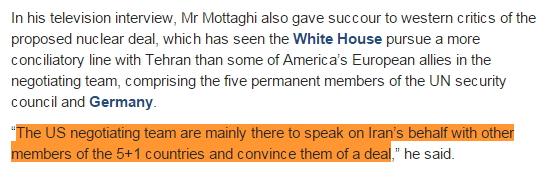
“The U.S. negotiating team are mainly there to speak on Iran’s behalf with other members of the 5+1 countries and convince them of a deal,” Motaghi told a TV station after just defecting from the Iranian delegation while abroad for the nuclear talks. The P 5 + 1 is made up of United States, United Kingdom, Russia, China, France, plus Germany.

CBNkmdFVIAADMpl
CBNk6T0WsAAEI1T

NBC’s Engel: Officials Say Allies: Simply Don’t Trust” U.S. Under Obama Admin – The Five

March 28, 2015

NBC’s Engel: Officials Say Allies: Simply Don’t Trust” U.S. Under Obama Admin – The Five, Fox News via You Tube, March 27, 2015

(In other breaking news, today is Saturday, unexpectedly. Please see also, Iranian general in Sanaa to organize Yemen rebel counter-offensive for Saudi-led attacks.  — DM)


Column One: Managing Obama’s war against Israel

March 27, 2015

Column One: Managing Obama’s war against Israel, Jerusalem Post, Caroline Glick, March 26, 2015

ShowImageUS President Barack Obama meets with Prime Minister Benjamin Netanyahu at the White House, October 1, 2014. (photo credit:REUTERS)

As Max Boot explained Wednesday in The Wall Street Journal, the administration’s animosity toward Israel is a function of Obama’s twin strategic aims, both evident since he entered office: realigning US policy in the Middle East toward Iran and away from its traditional allies Israel and the Sunni Arab states, and ending the US’s strategic alliance with Israel.

Obama has reached a point in his presidency where he is prepared to give full expression to his plan to end the US’s strategic alliance with Israel.

He thinks that doing so is both an end to itself and a means of succeeding in his bid to achieve a rapprochement with Iran.

*********************

On Wednesday the Jerusalem Municipality announced it is shelving plans to build 1,500 apartments in the Har Homa neighborhood. Officials gave no explanation for its sudden move. But none was needed.

Obviously the construction of apartments for Jews in Jerusalem was blocked in the hopes of appeasing US President Barack Obama.

But is there any reason to believe he can be appeased? Today the White House is issuing condemnations of Israel faster than the UN.

To determine how to handle what is happening, we need to understand the nature of what is happening.

First we need to understand that the administration’s hostility has little to do with Israel’s actions.

As Max Boot explained Wednesday in The Wall Street Journal, the administration’s animosity toward Israel is a function of Obama’s twin strategic aims, both evident since he entered office: realigning US policy in the Middle East toward Iran and away from its traditional allies Israel and the Sunni Arab states, and ending the US’s strategic alliance with Israel.

Over the past six years we have seen how Obama has consistently, but gradually, taken steps to advance these two goals. Toward Iran, he has demonstrated an unflappable determination to accommodate the terrorism supporting, nuclear proliferating, human rights repressing and empire building mullahs.

Beginning last November, as the deadline for nuclear talks between the US and its partners and Tehran approached, Obama’s attempts to accommodate Tehran escalated steeply.

Obama has thrown caution to the winds in a last-ditch effort to convince Iranian dictator Ali Khamenei to sign a deal with him. Last month the administration published a top secret report on Israel’s nuclear installations. Last week, Obama’s director of national intelligence James Clapper published an annual terrorism threat assessment that failed to mention either Iran or Hezbollah as threats.

And this week, the administration accused Israel of spying on its talks with Iran in order to tell members of Congress the details of the nuclear deal that Obama and his advisers have been trying to hide from them.

In the regional context, the administration has had nothing to say in the face of Iran’s takeover of the Bab el-Mandeb Strait and the Gulf of Aden this week. With its Houthi-proxy now in charge of the strategic waterway, and with its own control over the Straits of Hormuz, Iran is poised to exercise naval control over the two choke points of access to Arab oil.

The administration is assisting Iranian Shi’ite proxies in their battle to defeat Islamic State forces in the Iraqi city of Tikrit. It has said nothing about the Shi’ite massacres of Sunnis that come under their control.

Parallel to its endless patience for Tehran, the Obama administration has been treating Israel with bristling and ever-escalating hostility. This hostility has been manifested among other things through strategic leaks of highly classified information, implementing an arms embargo on weapons exports to Israel in time of war, ending a 40-year agreement to provide Israel with fuel in times of emergency, blaming Israel for the absence of peace, expressing tolerance and understanding for Palestinian terrorism, providing indirect support for Europe’s economic war against Israel, and providing indirect support for the BDS movement by constantly accusing Israel of ill intentions and dishonesty.

Then there is the UN. Since he first entered office, Obama has been threatening to withhold support for Israel at the UN. To date, the administration has vetoed one anti-Israel resolution at the UN Security Council and convinced the Palestinians not to submit another one for a vote.

In the months that preceded these actions, the administration exploited Israel’s vulnerability to extort massive concessions to the Palestinians.

Obama forced Benjamin Netanyahu to announce his support for Palestinian statehood in September 2009. He used the UN threat to coerce Netanyahu to agree to negotiations based on the 1949 armistice lines, to deny Jews their property rights in Jerusalem, Judea and Samaria, and to release scores of terrorist murderers from prison.

Following the nationalist camp’s victory in last week’s election, Obama brought to a head the crisis in relations he instigated. He has done so for two reasons.

First, next week is the deadline for signing a nuclear agreement with Iran. Obama views Netanyahu as the prospective deal’s most articulate and effective opponent.

As Obama sees it, Netanyahu threatens his nuclear diplomacy with Iran because he has a unique ability to communicate his concerns about the deal to US lawmakers and the American people, and mobilize them to join him in opposing Obama’s actions. The letters sent by 47 senators to the Iranian regime explaining the constitutional limitations on presidential power to conclude treaties without Senate approval, like the letter to Obama from 367 House members expressing grave and urgent concerns about the substance of the deal he seeks to conclude, are evidence of Netanyahu’s success.

The second reason Obama has gone to war against Israel is because he views the results of last week’s election as an opportunity to market his anti-Israel and pro-Iranian positions to the American public.

If Netanyahu can convince Americans to oppose Obama on Iran, Obama believes that by accusing Netanyahu of destroying chances for peace and calling him a racist, Obama will be able to win sufficient public support for his anti-Israel policies to intimidate pro-Israel Democratic lawmakers into accepting his pro-Iranian policies.

To this end, Obama has announced that the threat that he will abandon Israel at the UN has now become a certainty. There is no peace process, Obama says, because Netanyahu had the temerity to point out that there is no way for Israel to risk the transformation of Judea and Samaria into a new terror base. As a consequence, he has all but made it official that he is abandoning the peace process and joining the anti-Israel bandwagon at the UN.

Given Obama’s decision to abandon support for a negotiated peace between Israel and the Palestinians, modes of appeasement aimed at showing Israel’s good faith, such as Jewish building freezes, are no longer relevant. Scrapping plans to build apartments in Jewish neighborhoods like Har Homa will make no difference.

Obama has reached a point in his presidency where he is prepared to give full expression to his plan to end the US’s strategic alliance with Israel.

He thinks that doing so is both an end to itself and a means of succeeding in his bid to achieve a rapprochement with Iran.

Given this dismal reality, Israel needs to develop ways to minimize the damage Obama can cause.

Israel needs to oppose Obama’s policies while preserving its relations with its US supporters, including its Democratic supporters. Doing so will ensure that it is in a position to renew its alliance with the US immediately after Obama leaves office.

With regards to Iran, such a policy requires Israel to act with the US’s spurned Arab allies to check Iran’s expansionism and nuclear progress. It also requires Israel to galvanize strong opposition to Obama’s goal of replacing Israel with Iran as America’s chief ally in the Middle East and enabling it to develop nuclear weapons.

As for the Palestinians, Israel needs to view Obama’s abandonment of the peace process as an opportunity to improve our diplomatic position by resetting our relations with the Palestinians. Since 1993, Israel has been entrapped by the chimerical promise of a “two-state solution.”

By late 2000, the majority of Israelis had recognized that there is no way to achieve the two-state solution. There is no way to make peace with the PLO. But due to successive governments’ aversion to risking a crisis in relations with Washington, no one dared abandon the failed two-state strategy.

Now, with Obama himself declaring the peace process dead and replacing it with a policy of pure hostility toward Israel, Israel has nothing to gain from upholding a policy that blames it for the absence of peace.

No matter how loudly Netanyahu declares his allegiance to the establishment of a Palestinian state in Israel’s heartland, Obama will keep castigating him and Israel as the destroyer of peace.

The prevailing, 23-year-old view among our leadership posits that if we abandon the two-state model, we will lose American support, particularly liberal American support. But the truth is more complicated.

Inspired by the White House and the Israeli Left, pro-Israel Democrats now have difficulty believing Netanyahu’s statements of support for the establishment of a Palestinians state. But those who truly uphold liberal values of human rights can be convinced of the rightness of Israel’s conviction that peace is currently impossible and as a consequence, the two-state model must be put on the back burner.

We can maintain support among Republicans and Democrats alike if we present an alternative policy that makes sense in the absence of an option for the two-state model.

Such a policy is the Israeli sovereignty model. If the government adopts a policy of applying Israeli sovereignty over Judea and Samaria in whole – as I recommend in my book The Israeli Solution: A One- State Plan for Peace in the Middle East, or in part, in Area C, as Economy Minister Naftali Bennett recommends, our leaders will be able to defend their actions before the American people, including pro-Israel Democrats.

Israel must base its policy of sovereignty on two principles. First, this is a liberal policy that will ensure the civil rights of Palestinians and Israelis alike, and improve the Palestinians’ standard of living.

Second, such a policy is not necessarily a longterm or permanent “solution,” but it is a stable equilibrium for now.

Just as Israel’s decision to apply its laws to united Jerusalem and the Golan Heights in the past didn’t prevent it from conducting negotiations regarding the possible transfer of control over the areas to the Palestinians and Syrians, respectively, so an administrative decision to apply Israeli law to all or parts of Judea and Samaria will not block the path for negotiations with the Palestinians when regional and internal Palestinian conditions render them practicable.

The sovereignty policy is both liberal and strategically viable. If the government adopts it, the move will rebuild Israel’s credibility and preserve Israel’s standing on both sides of the aisle in Washington.

Never before has Israel had to deal with such an openly hostile US administration. Indeed, until 2009, the very notion that a day would come when an American president would prefer an alliance with Khamenei’s Iran to its traditional alliances with Israel and the Sunni Arab states was never even considered. But here we are.

Our current situation is unpleasant. But it isn’t the end of the world. We aren’t helpless. If we act wisely, we can stem Iran’s nuclear and regional advance. If we act boldly, we can preserve our alliance with the US while adopting a policy toward the Palestinians that for the first time in decades will advance our interests and our liberal values on the world stage.

Obama Admin Threatens U.S. Allies for Disagreeing with Iran Nuke Deal

March 27, 2015

Obama Admin Threatens U.S. Allies for Disagreeing with Iran Nuke Deal, Washington Free Beacon, March 27, 2015

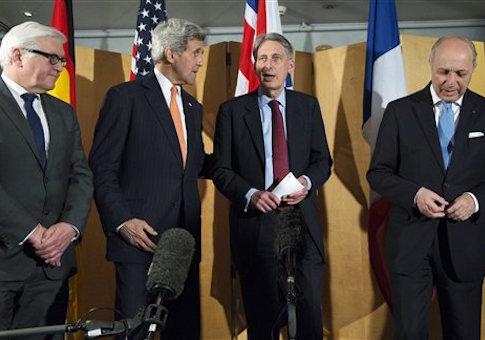
Iran Nuclear TalksFrom left, German Foreign Minister Frank Walter Steinmeier, U.S. Secretary of State John Kerry, British Foreign Secretary Philip Hammond and French Foreign Minister Laurent Fabius talk after Hammond made a statement about their meeting regarding recent negotiations with Iran over Iran’s nuclear program in London, England, Saturday, March 21 / AP

LAUSANNE, Switzerland—Efforts by the Obama administration to stem criticism of its diplomacy with Iran have included threats to nations involved in the talks, including U.S. allies, according to Western sources familiar with White House efforts to quell fears it will permit Iran to retain aspects of its nuclear weapons program.

A series of conversations between top American and French officials, including between President Obama and French President Francois Hollande, have seen Americans engage in behavior described as bullying by sources who spoke to the Washington Free Beacon.

The disagreement over France’s cautious position in regard to Iran threatens to erode U.S. relations with Paris, sources said.

Tension between Washington and Paris comes amid frustration by other U.S. allies, such as Saudi Arabia and Israel. The White House responded to this criticism by engaging in public campaigns analysts worry will endanger American interests.

Western policy analysts who spoke to the Free Beacon, including some with close ties to the French political establishment, were dismayed over what they saw as the White House’s willingness to sacrifice its relationship with Paris as talks with Iran reach their final stages.

A recent phone call between Obama and Hollande was reported as tense as the leaders disagreed over the White House’s accommodation of Iranian red lines.

Amid these tensions, U.S. Ambassador to France Jane Hartley met with her French counterpart, Gerard Araud, Monday to discuss a range of issues.

Benjamin Haddad, who has advised senior French political figures on foreign policy issues, said leaders in Paris have not been shy about highlighting disagreements they have with the White House.

“Fance, like other European countries, has negotiated for more than 10 years and endured most of the sanctions’ burden,” said Haddad, a research fellow at the Hudson Institute.

“The French want a deal, but they see no rush and repeat that Iranians need a deal more than we do, and that we shouldn’t fix artificial deadlines that put more pressure on us than Iran.”

One source in Europe close to the ongoing diplomacy said the United States has begun to adopt a “harsh” stance toward its allies in Paris.

“There have been very harsh expressions of displeasure by the Americans toward French officials for raising substantive concerns about key elements of what the White House and State Department negotiators are willing to concede to Iran,” said the source, who spoke on condition of anonymity. “That is because the clarifications expose just how weak the Americans’ deal is shaping up to be.”

“The meeting between the French ambassador in Washington and the president’s envoy to Paris—not a diplomat but a big fundraiser for his campaigns—comes amid these very harsh words that were spoken privately about the ambassador’s recent comments on the seeming American desperation for a deal, and the tough words that President Obama had for President Hollande in their phone call.”

Strategic differences remain between the United States and its allies over how a final deal should look, the source said. The French remain opposed to a recent range of concessions made by the Obama administration.

“We may agree that denying Iran a nuclear weapon ability is the goal, but apparently the view of what one can leave Iran and assure that is very different,” the source said.

“Clearly these are the differences that must be discussed. I don’t see France suddenly deciding that America is right and French objections to weakness are wrong, nor that silence is preferable to transparency.”

Haddad said the French are hesitant to rush into an agreement.

“The French want a robust deal with clear guarantees on issues like [research and development] and inspections to ensure that Iranians won’t be able to reduce breakout time during the duration of the agreement (also an issue of discussion), or just after thanks to research conducted during the period,” he said. “That is also why they disagreed on lifting sanctions.”

He also said the French “don’t trust Iran and believe an ambiguous deal would lead to regional proliferation.”

Another Western source familiar with the talks said the White House is sacrificing longstanding alliances to cement a contentious deal with Iran before Obama’s term in office ends.

“The President could be hammering out the best deal in the history of diplomacy, and it still wouldn’t be worth sacrificing our alliances with France, Israel, and Saudi Arabia—key partners in Europe, the eastern Mediterranean, and the Gulf,” the source said. “But he’s blowing up our alliances to secure a deal that paves Iran’s way to a bomb.”

A State Department spokesperson declined to comment on the issue.

Meanwhile, talks between the United States and Iran reached a critical juncture Thursday, as Secretary of State John Kerry met with his Iranian counterpoint to hash out differences over key points concerning Iran’s nuclear program.

The sides are hoping to reach a framework agreement by March 31 amid reports that Iran is demanding Saudi Arabia immediately halt airstrikes in Yemen, where Iran-aligned forces are working to bring down the Western-backed government.

The issue could complicate the talks as the United States attempts to balance its regional alliance with Iran in Iraq against competing interests with traditional allies in Saudi Arabia.

U.S. negotiators have reportedly softened their stance in recent days on a range of issues relating to Iran’s continued production of nuclear materials. One of Iran’s nuclear sites in Fordow could continue to operate, according to the Associated Press.

Gulf states, abandoned against Iran

March 26, 2015

Gulf states, abandoned against Iran, Israel Hayom, Dr. Reuven Berko, March 26, 2015

(At least the Gulf States are awakening. That’s a good start. — DM)

The West’s weakness and apathy toward Iran and the perilous predicament it has created in Yemen again prove the flimsy nature of those security and defense treaties. This lesson justifies Israel’s approach, which is based on the ability to defend itself on its own. In the meantime, following the Houthi takeover, Saudi Arabia has decided to deploy a massive military force along the border with Yemen. The first shot is in the chamber and the finger is already on the trigger.

**********************

Shiite Iran’s increasing involvement in Iraq, Syria and Lebanon, while exploiting the Shiite elements of the population in those target countries, is causing a great deal of concern among leaders of Arab Gulf states. The trauma of Iran’s attempt to topple the regime in Bahrain, where most of the population is Shiite, under the claim that Bahrain is Iran’s 14th province, is still fresh in their minds. The Iranian goal of using Bahrain as a bridgehead from which to spread across the Arabian Peninsula is still in play, despite Iran’s first effort being blocked in March 2011, when some 1,000 Saudi troops and 500 policemen from the United Arab Emirates entered Bahrain to save its regime.

Ever since Saddam Hussein’s sudden invasion of Kuwait, the Gulf states — Saudi Arabia, Oman, Kuwait, Qatar, Bahrain and the UAE — realized the need for a type of “Al Jazeera defense force” to pose a strategic deterrent against Iranian machinations on the peninsula. Their effort has not been a success. Through its latest intervention, via the mobilization of Shiite Houthi tribesmen to capture key targets in Yemen, including the primary port cities and airports in the south of the country leading to control of the Gulf of Aden, Iran is clearly reiterating its ambition of acquiring the straits of Hormuz and Bab el-Mandeb, which will allow Iran to paralyze the Red Sea and Persian Gulf waterways.

Arab stagnation combined with the West turning a blind eye to this Iranian aggression, alongside the willingness of Western powers to sign a deal allowing Iran to acquire a nuclear bomb, is causing sleepless nights among those Arab leaders who are again pushing the need to upgrade the capabilities of the “Al Jazeera defense force.”

Considering the lack of trust in the West and Yemen’s expected fall to the Houthis, the leaders of the Arab Gulf states are again working, feverishly, to build the military capability to curb Iran. As early as December 2009, with the goal of protecting the integrity of Arab territories situated in the Arabian Peninsula, the Arab League decided to establish a massive, unified, heavily funded, rapid-reaction military force comprising hundreds of thousands of troops and naval capabilities, capable of posing a deterrent and striking a decisive blow on the battlefield. Morocco and Jordan were also added to this coalition, as strategic depth, but the initiative ultimately failed to gain traction.

The recent gathering of these partner states in Riyadh gave birth to a multitude of agreements, including support and aid to Egypt, which is considered the strongest true military force in the Sunni Arab Middle East. Additionally, Saudi Arabia has lobbied for Pakistani support in the aftermath of Yemen’s inevitable fall, or worse, when Iran completes its nuclearization with American consent.

As the West falls victim to the fraud peddled by Mohammad Javad Zarif, Iran’s foreign minister, the Arabs (and Israel) have no illusions about Iran’s true intentions. Even as the Bahrain crisis was unfolding, the threats issued by many of Iran’s highest-ranking defense establishment officials — whether in the regime, the military or the Shura (parliament) — reflected the hostile nature of Iran’s foreign policy, and removed any doubt in the minds of neighboring Arab leaders.

Many of the Gulf states with signed security and defense pacts with the West, namely the United States, are currently feeling abandoned. Ever since the events in Bahrain, and to a greater degree following the recent developments in Yemen, the realization is growing in the Gulf that Iran’s aggressive goals and ambitions regarding the Arabian Peninsula have not changed and that they must take care of themselves.

The Arabs have recently come to the realization that not only will they not receive aid from the West in their hour of need, but that the West is forging a deal with Iran at their expense — a deal that will pose the greatest threat to their security. The situation that has been created provides an opportunity for Israel, even if clandestinely, to play a part in the geostrategic plans being formulated by states in the region, and which could help lead to an agreeable deal on the Palestinian issue — which is rather secondary in the current pan-Arab context.

The West’s weakness and apathy toward Iran and the perilous predicament it has created in Yemen again prove the flimsy nature of those security and defense treaties. This lesson justifies Israel’s approach, which is based on the ability to defend itself on its own. In the meantime, following the Houthi takeover, Saudi Arabia has decided to deploy a massive military force along the border with Yemen. The first shot is in the chamber and the finger is already on the trigger.

Cartoon of the day

March 23, 2015

Hope n’ Change, March 23, 2015

Trick or Treaty sm

For Obama, Bibi’s words matter while Iran’s don’t

March 22, 2015

For Obama, Bibi’s words matter while Iran’s don’t, Times of IsraelShmuley Boteach, March 22, 2015

(Please see also, Iranians Chant “Death to America” While Negotiations Continue. — DM)

President Obama says that Bibi’s words matter when it comes to a Palestinian state. “We take him at his word when he said that it wouldn’t happen during his prime ministership,” he told The Huffington Post. The President used Netanyahu’s statement as cause for a “reassessment” of American ties with Israel.

White House spokesman Josh Earnest echoed the sentiment in last Thursday’s White House briefing that the Prime Minister’s words could bring punishment. “Words matter,” he said. There could be “consequences” for Netanyahu’s statements. “Everybody who’s in a position to speak on behalf of their government understands that that’s the case, and particularly when we’re talking about a matter as serious as this one.”

So let’s get this straight. When foreign leaders speak, it matters. What they say is consequential. Bibi’s going to have to pay for his remarks.

But I have one question. Why doesn’t any of this apply to Iran? Why, on Saturday Ayatollah Ali Khameini uttered the words “Death to America” even as John Kerry was expressing optimism the very same day that the United States would come to a nuclear accord with Iran!

Suddenly, Iran’s words don’t matter?

Taking this further, the most hair-raising aspect about the growing American rapprochement with Iran is that it has all happened while Iran has continued to repeatedly threaten the annihilation of the Jewish people. Ayatollah Khameini has called Jews dogs and tweeted as recently as this past November that “there is no cure for Israel other than annihilation.”

Now, if words matter, how can the United States continue to speak to his government while they are openly threatening a second holocaust? Why did President Obama and John Kerry not establish a repudiation of these genocidal words and threats as a precondition for any talks?

The hypocrisy is startling. And it leads to a more important point.

By now it’s clear to all that President Obama positively loathes Prime Minister Netanyahu more any other world leader. His hostility to the Prime Minister has become so pronounced that the President can no longer disguise or control it.

Am I the only one that finds it just a touch unseemly for the leader of the free world to hate the leader of the only free country in the Middle East?

The President has a good relationship with Erdogan, the tyrant of Turkey, who has destroyed his nation’s democracy and allows fighters to pass through his nation to join ISIS. President Obama traveled to Saudi Arabia to pay his personal condolences upon the passing of arch-misogynist King Abdullah of Saudi Arabia, a man who wouldn’t even allow women to drive a car. And he utters not an unkind word about Ayatollah Khameini, the world’s foremost terrorist.

But he hates Netanyahu. Go figure.

For years we Americans have heard that our President is cerebral and unflappable. That he famously remains cool under the most challenging circumstances. It turns out that this is true for every world leader except one, Benjamin Netanyahu, who makes the President’s blood boil.

Don’t we deserve to know why?

If the two leaders merely had bad personal chemistry, I could understand. They’re not the best of friends. Fine. But for Obama the hatred of Netanyahu has become positively visceral, personal, and irrepressible.

My own belief is this. President Obama is desperate for some foreign policy victories. There’s a year-and-a-half left to his Presidency and the world is on fire. From Iran to Boko Haram to ISIS to Putin to Hezbollah to Al Qaida and Hamas, bad guys are running amok under this president. American Foreign policy is a shambles.

The only ally President Obama can truly expert pressure on for a deal that would give him the lasting foreign policy legacy he needs and craves is Israel. And in the past Israeli Prime Ministers have proven so utterly malleable. American Presidents have squeezed them like lemons.

But Bibi refuses to be squeezed. He won’t play ball. He won’t withdraw from Judea and Samaria and allow “Hamastan” on his eastern border the way it is in Gaza. He won’t shut up about America’s capitulation to the Iranian mullahs that would leave them with a military-grade nuclear program. He won’t go quietly into the nuclear night while America appeases one of the most violent and vile regimes on earth.

This darned Bibi guy just won’t bend.

And our President finds the intransigence so utterly frustrating.

He prayed and hoped that someone else might win the Israeli election. And some of the President’s top political operatives went and worked for Herzog. But, huff and puff as he might, the President could not blow Bibi’s house down.

So now he’s stuck with him. A stick-necked Prime Minister, getting in the way of the President’s peace deals with Iran and the Palestinians.

And with no way of getting rid of the Israeli nuisance, all the President can do is continue to give interviews that express his dislike and frustration, not realizing that we’re reaching a point where the President is beginning to look positively un-Presidential and where is enmity is becoming unbecoming.

It’s called democracy, Mr. President. Bibi won. And it’s time for the world’s foremost democracy, the United States of America, to live with it and work with the man who has the mandate of the Israeli people, just as you have the mandate of the American people.


Unstated Factor in Iran Talks: Threat of Nuclear Tampering

March 22, 2015

Unstated Factor in Iran Talks: Threat of Nuclear Tampering, New York Times, 

JP-SABOTAGE-master675Foreign Minister Mohammad Javad Zarif, center, said someone had tried to sabotage an Iranian reactor’s cooling system. Credit Laurent Gillieron/European Pressphoto Agency

[R]eaching an accord is quite different than reaching a state of trust. Inside Iran, there will be pressure to keep making slow progress on a nuclear program that is central to the ambitions of the Iranian Revolutionary Guard Corps and thousands of scientists who have labored for years. And in the uneasy alliance among Israel, the United States and Europe there will be continued debate about whether to supplement diplomatic pressure with covert action to keep Iran from getting to the threshold of being able to build a weapon.

*********************

WASHINGTON — In late 2012, just as President Obama and his aides began secretly sketching out a diplomatic opening to Iran, American intelligence agencies were busy with a parallel initiative: The latest spy-vs.-spy move in the decade-long effort to sabotage Tehran’s nuclear infrastructure.

Investigators uncovered an Iranian businessman’s scheme to buy specialty aluminum tubing, a type the United States bans for export to Iran because it can be used in centrifuges that enrich uranium, the exact machines at the center of negotiations entering a crucial phase in Switzerland this week.

Rather than halt the shipment, court documents reveal, American agents switched the aluminum tubes for ones of an inferior grade. If installed in Iran’s giant underground production centers, they would have shredded apart, destroying the centrifuges as they revved up to supersonic speed.