Archive for the ‘Chamberlain’ category

Why the Iran nuclear deal will mean war

September 8, 2015

Why the Iran nuclear deal will mean war, Front Page Magazine, Daniel Greenfield, September 8, 2015

mars-mushroom-562873

Iran . . . is not looking for a deterrent weapon against its neighbors. With the fall of Saddam, it faces no serious threat of invasion by Sunni forces. Today its nuclear program can have no other purpose except to expand its power and territory while forcing the United States out of the region. Nuking Israel would help seal its right to rule over the Muslim world while intimidating its enemies.

********************

Like a snake oil salesman trying to move a gallon of lies by promising that it’s either buy the bottle or die, Obama sold the Iran deal as the only alternative to war. In fact the deal is a certain road to war.

Or as Churchill said, “You were given the choice between war and dishonor. You chose dishonor, and you will have war.” Before long, the British and French were facing Czech tanks redesignated as Panzers that had been seized as part of the Nazi spoils of appeasement.

When Obama claimed that the Iran nuclear deal was the only alternative to war, he was lying in more ways than one. The United States has already been dragged into Iran’s war for control of Iraq. That war was one of the levers that Iran exploited to get its way on its nuclear program. Iran also came close to dragging us into its war in Syria and we are hovering on the edge of being dragged into Yemen.

Iran and ISIS have done a thorough job of carving up entire countries into Shiite and Sunni blocs. And there’s no sign that this Islamic realignment of the Sykes Picot borders is going to stop. If the process continues, the scale and scope of the war will expand and transform the region away from nation states.

Everyone will have a choice between backing a Sunni ISIS or a Shiite ISIS. Obama chose the Shiite ISIS.

This would be happening even without the deal, but Iran’s victory and Obama’s appeasement will speed up the process. Russia is blatantly joining the Shiite military coalition as part of Tehran’s victory celebration. And the Russians aren’t there just to protect Assad, but to push America out of the region. As areas of operations overlap, there will be incidents. And Obama will back off once again.

But it’s not just about Syria. Iran promised its Russian and Chinese backers that they will benefit from a major regional realignment. Nations allied with the US will be overthrown or suppressed. And once that process really gets underway and will begin to threaten oil supplies, even a Democrat won’t be able to stay out. But by then America will have little credibility, few allies and major strategic disadvantages.

The real test won’t be in Syria. It has already come and gone in Yemen. It will probably come in Bahrain. Bahrain has a majority Shiite population and is the home of the Fifth Fleet. During the Arab Spring the Saudis put down Iran’s “civilian” uprising in Bahrain using tanks. The next time, it won’t be that easy for the House of Khalifa or the House of Saud. If there’s one thing that Iran knows it’s how to arm and train insurgencies and this time around its bid for a takeover of Bahrain will have Russian backing.

Iran’s Islamic Front for the Liberation of Bahrain played a significant role in the Arab Spring protests under the umbrella of political Islam and human rights organizations. Iran’s ideal game plan would be for its front groups to win Western political backing for a takeover the way that the Muslim Brotherhood did in Egypt. Turning over Bahrain to admirers of the Iranian Revolution would seem insane, but so was turning over Iran to Khomeini or Egypt to Al Qaeda’s parent Muslim Brotherhood organization.

The Saudis have had to consider the possibility that Obama, Hillary or Biden would back Iran over the Saudis in Bahrain as they did in Iraq and Yemen. And they have been making their own plans.

Some months after Iran’s Ahmadinejad visited Cairo and met with the Muslim Brotherhood’s Morsi, the Saudis reversed the Qatari-Obama coup that had put the Muslim Brotherhood in power. As the deadline for last year’s negotiations with Iran approached, the Saudis began dumping oil to hurt Russia and Iran. A similar Saudi move against Iran had helped bring on the Islamic Revolution. The Saudis probably don’t expect to undo that disaster, but they were hoping to offset any Obama-backed Iranian recovery.

Instead of fighting to keep sanctions in place, the Saudis were instead poisoning the well.

Whether he understood it or not, by signing off on Iran’s Shiite bomb, Obama was also signing off on an Egyptian-Saudi Sunni bomb. Israel’s nuclear capability was tacitly understood as a defensive weapon of last resort that would not trigger a regional arms race. Genocidal military invasions of Israel came to an end and any weapons remained under wraps.

Iran however is not looking for a deterrent weapon against its neighbors. With the fall of Saddam, it faces no serious threat of invasion by Sunni forces. Today its nuclear program can have no other purpose except to expand its power and territory while forcing the United States out of the region. Nuking Israel would help seal its right to rule over the Muslim world while intimidating its enemies.

A Middle Eastern MAD with Iranians and Saudis in a nuclear standoff would be bad enough, but both powers have a long history of using terrorists to do their dirty work. And the transfer of nuclear materials to terrorists is a lot harder to track than ICBM launches.

Iran and Saudi Arabia getting the bomb won’t be the end. It will only be the beginning. A decade ago, Iran had already funneled a billion dollars into helping Syria get its own nuclear reactor. A nuclear Iran will expand its points of proliferation to the Shiite regime in Baghdad, to Hezbollah in Lebanon and any other Shiite allied states it can set up. The Saudis will expand their own nuclear capabilities to their GCC allies and Egypt so that instead of two nuclear powers, there may be as many as ten nuclear nations.

Imagine the Cold War in miniature with a lot more proliferation and Jihadists with nukes on both sides.

That is what the Iran nuclear deal really means. Every Sunni kingdom will be glaring out from under its own nuclear shield as petty tyrants keep one finger on the populace and the other on the button. A single popular uprising could see nuclear weapons in the hands of Al Qaeda or ISIS.

On the other side, Iran will be aggressively expanding its influence while engaging in escalating naval confrontations with America and its allies. It’s possible that Obama, Biden or Hillary will be able to run away fast enough to avoid a war, but they won’t be able to avoid the resulting economic chaos. And the war will follow them home as Muslim countries have a history of settling their scores by aiming at more “legitimate” non-Muslim targets. That is how 9/11 happened as part of a Saudi power struggle.

And if the United States stays, our people will be trying to keep the peace in a region gone nuclear where American bases will be prime targets for Iran and its terrorist allies. The United States will retaliate against a nuclear strike directly from Iran, but what if it comes from one of the Hezbollahs?

The question isn’t whether there will be a war. It’s how bad the war will be.

That is what Churchill understood and Chamberlain didn’t. While Churchill had fought in Afghanistan against the forerunners of the Taliban, Chamberlain had run family businesses. He saw the military as an unnecessary expense and war as something that could be negotiated away. Churchill knew better.

We are up against something similar today.

The Middle East has exploded before. It will explode again. All we’ve been doing is keeping the lid on. Obama’s surrender means that we won’t control how that explosion happens, but it won’t stop us from getting dragged in anyway once the bombs start going off.

Obama’s advisers have told him to outsource American foreign policy to Tehran. And that’s what he did. Turning over your power to your enemy won’t make him your friend. It won’t stop a war.

It will make the war much worse.
Cartoons of the day

August 15, 2015

H/t Freedom is just another word

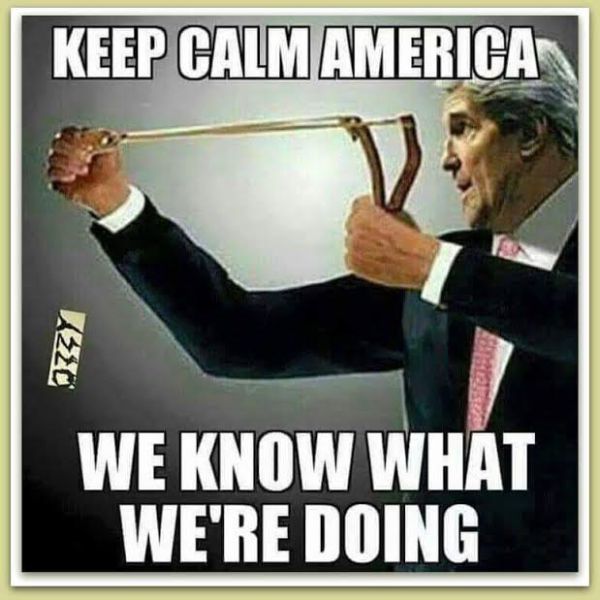
Kerry with slingshot

H/t Vermont Loon Watch

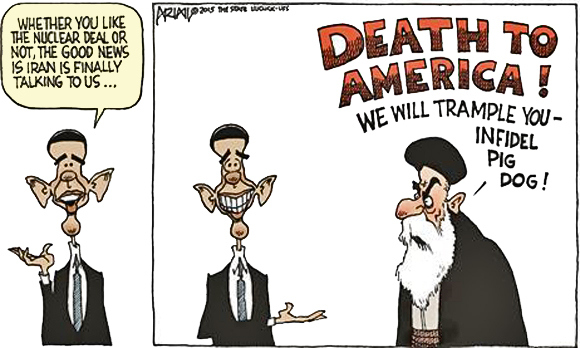
Death to America

H/t Kingjester’s Blog

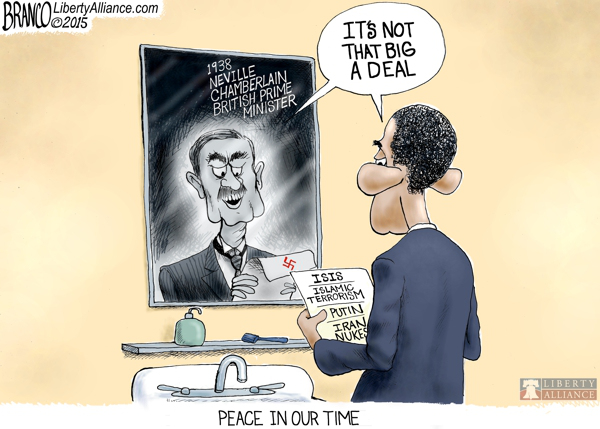
No big deal

Moral clarity of the past

August 2, 2015

Moral clarity of the past, Power Line, Steven Hayward, August 2, 2015

(Please see also, Iran’s Supreme Leader Khameni publishes book on how to eliminate Israel. — DM)

Scott reminded us this morning of Winston Churchill’s notice of Hitler’s Mein Kampf, suggesting that we ought to take seriously the statements of murderous purpose whether they come from a seemingly implausible Austrian-born corporal, or a soon-to-be nuclear-armed Iranian ayatollah. Of course, Mein Kampf was mostly ignored in the 1930s or dismissed as the unimportant or irrelevant thoughts that Hitler would discard once he assumed the “responsibilities” of high office.

As background research for one of my longer writing projects currently under way I have been reading old issues of the American Political Science Review from the late 1930s to see how the rise of European fascism and specifically German Nazism was treated. The majority of the articles and book reviews are either stupid, trivial, or superficial, i.e., they examine institutional changes and administrative structures in the value-free way typical of social science that can’t bring itself to consider making moral judgments. Hitler’s regime is treated as more or less normal (ditto the Soviet Union, of course). From these treatments a serious student would learn almost noting important about politics. These blinkered assessments remain the case even after the Reichstag fire, Kristallnacht, the Anschluss, the investment of all of Czechoslovakia following the Munich agreement, and even the outbreak of open war in 1939. While there were some clear voices about the deeper significance of what was taking place—one thinks of Hermann Rauschning’s 1939 best-seller The Revolution of Nihilism: Warning to the West—you typically didn’t find such clarity and depth among academic political scientists.

There are a few notable exceptions. One of them was Robert C. Brooks of Swarthmore College, who was president of the American Political Science Association in 1940. His presidential address at the December 1940 annual meeting of the APSA was entitled “Reflections on the ‘World Revolution’ of 1940,” and you could hardly ask for a more direct and sensible statement of what political science ought to be and to say. He opens by chiding his fellow academics for avoiding “contemporary, controversial political affairs.”

Some representative samples:

[S]ince Nazi Germany is the sole really effective totalitarian state, its overthrow should be the one great desideratum of democratic world politics. Nothing should be allowed to obscure that end. It was the tragic, nay criminal, blunder of Neville Chamberlain that he did not perceive this fact, that he believed in the possibility of gaining concessions from the insatiable Hitler by a policy of appeasement. For Britain, the consequences of this blunder have been tragic beyond all reckoning. Fortunately, in Winston Churchill a prime minister has been found who knows how to keep his eye on the ball. Let us hope that the President of the United States will follow his example.

Incredible as it may seem under such conditions, there are still said to be some appeasers on this side of the Atlantic, gentlemen willing to make a neat little loan—five billion dollars is the figure most frequently mentioned—to Germany as soon as her victory over Europe is complete. This, it is assumed, will soften any ill-feeling Hitler might cherish against us because of our earlier mistaken sympathies for the Allies. Also, poor fellow, he would need the money to buy our goods where with to repair the ravages of war and to feed the starving German people. Of course, once the loan were made, we would be too polite to inquire how much of it was spent, not for butter but for guns, the latter to be used against the United States. If political scientists cannot scotch so obviously ruinous a policy, one may well despair of the future of our profession. What is far worse, one would have to despair of the future of free government. . . [Emphasis added.]

Political scientists must be realists. As such, we know that if Britain is crushed, the only kind of peace we can hope for will be an armed peace—and that probably of short duration. . .

Combined attack by dictator powers upon America may result in our defeat or in our victory. In the former event, democracy will be dead upon this planet for a period of unpredictable length. Even so, let us hope that we might inflict wounds upon despotic aggressors from which they would not soon recover. This is not set down in malice; rather it would appear to be the only hope of future resurrection for our political principles. If democracy fighting for its life proves to be spineless and cowardly, why should any future generation wish to revive it? On the other hand, if it goes down fighting gloriously to the last ditch, it will not lose the power to fire the hearts of some future generation. Once more, as at the end of the eighteenth century, a race of rebels may be born of the sons of men.

Finally, the conclusion, which evokes the spirit of both Churchill and the famous words of Lincoln:

In the end, it is certain that Americans will not submit tamely to such a fate. They will not enter the door marked “Appeasement”: they will go out through the opposite door marked “Defiance.” I do not pretend to like the sort of future that confronts us. It may bring with it the heaviest burdens, the most cruel sacrifices. In all probability, things will get worse before they get better. It may fall to the lot of an American President to say, as did Prime Minister Winston Churchill, that he has “nothing to offer but blood, toil, tears, and sweat.” Not liking a future, however, is no reason for not facing up to it. There is a deep satisfaction in resoluteness, through all perils, regardless of the outcome. Let us give thanks also that we are done with roseate illusions; that we are ready to deal with grim realities. Peace and justice may not be for our time, but we have the privilege of risking everything that they “shall not perish from the earth.”

For this Prof. Brooks gets posthumous induction into the Power Line 100 roster of Best Professors in America. Can anyone imagine a president of the APSA speaking in these tones today? Not likely. (And now that James Kurth is retired, is there anyone remotely like Brooks at Swarthmore today?)

(There is no public Internet access to the complete article unfortunately: You can only get it if you have a JSTOR account. It appears in the February 1941 issue of the APSR.)

The Iran scam worsens — Part III, Human rights and support for terrorism

June 22, 2015

The Iran scam worsens — Part  III, Human rights and support for terrorism, Dan Miller’s Blog, June 22, 2015

(The views expressed in this post are mine and do not necessarily reflect those of Warsclerotic or its other editors. — DM)

It is likely that the P5+1 nuke “deal” with Iran will be approved soon. Military and other nuke sites which Iran has not “disclosed” will not be inspected. Nor will Iran’s nuke ties with North Korea — which P5+1 member China seems to be helping, Iran’s massive support for terrorism and abysmal human rights record be considered because they are also deemed unnecessary for “deal” approval. Sanctions against Iran are moribund and will not be revived regardless of whether there is a “deal.” However, a bronze bust of Obama may soon be displayed prominently in Supreme Leader Khamenei’s office and one of Khamenei may soon be displayed proudly in Dear Leader Obama’s office.

Iran fenced in

Iranian support for terrorism

According to the U.S. State Department, The Islamic Republic of Iran continued its sponsorship of terrorism during 2014. The linked article observes,

Iran has increased its efforts to finance and carry out terrorist activities across the world and remains a top nuclear proliferation threat, according to a new State Department assessment. [Emphasis added.]

Iran is funding and arming leading terrorist groups in the Middle East and elsewhere, according to the State Department’s 2014 Country Reports on Terrorism, which thoroughly documents how Tehran continues to act as a leading sponsor terror groups that pose a direct threat to the United States.

The report comes as Western powers work to finalize a nuclear deal with Iran ahead of a self-imposed June 30 deadline, though it is unclear whether the new findings will come up in negotiations.

It seems clear that the new findings will not be considered.

Among many other terrorist organizations, Iran supports the Taliban.

Afghan and Western officials say Tehran has quietly increased its supply of weapons, ammunition and funding to the Taliban, and is now recruiting and training their fighters, posing a new threat to Afghanistan’s fragile security.

Iran’s strategy in backing the Taliban is twofold, these officials say: countering U.S. influence in the region and providing a counterweight to Islamic State’s move into the Taliban’s territory in Afghanistan. [Emphasis added.]

According to James Clapper, the U.S. Director of National Intelligence, the intelligence community considers Iran to be the “foremost state sponsor of terrorism.”

The assessment came after criticism from the Senate that the information was omitted in a global threat assessment submitted to Congress [in February of this year.] Initially, Iran and Hezbollah were not included as terror threats in the intelligence community’s report to the Senate in February. [Emphasis added.]

Might the Obama administration have been trying to ignore Iran’s continuing support for terrorist activities because of its fixation on getting a “deal” with Iran in the ongoing P5+1 “negotiations?” Probably, but that was then. Now, it is apparently not a problem to report on Iran’s terrorist activities because they are deemed unworthy of consideration by the P5+1 negotiators. It’s terrible, but so what?

Iran is the world’s biggest sponsor of terrorism. Its tentacles have a hold on Syria, Lebanon, Iraq, Afghanistan, Yemen and the Gaza Strip. Its terrorist operations know no border and its proxies partake in mass killings and war crimes. But as it has been demonstrated time and time again, the West appears unperturbed by all that. It views Iran as a potentially constructive state actor, which, as long as it gets its way, could serve to stabilize the region. [Emphasis added.]

Iran could, of course, “stabilize” the region with its own military and its terror proxies in much the same way that Hitler tried to “stabilize” Europe — by gaining military control and forcing his ideology on subjugated residents. At first, there was some resistance but that was shown to be useless as Britain under Chamberlain gave Hitler Czechoslovakia. Eventually, Britain and later her ally, the United States, became sufficiently upset to intervene militarily.

As noted in an article at Asia Times on Line, the “free world” is unwilling to confront Iranian hegemony:

For differing reasons, the powers of the world have elected to legitimize Iran’s dominant position, hoping to delay but not deter its eventual acquisition of nuclear weapons. Except for Israel and the Sunni Arab states, the world has no desire to confront Iran. Short of an American military strike, which is unthinkable for this administration, there may be little that Washington can do to influence the course of events. Its influence has fallen catastrophically in consequence of a chain of policy.

. . . .

President Obama is not British prime minister Neville Chamberlain selling out to Hitler at Munich in 1938: rather, he is Lord Halifax, that is, Halifax if he had been prime minister in 1938. Unlike the unfortunate Chamberlain, who hoped to buy time for Britain to build warplanes, Halifax liked Hitler, as Obama and his camarilla admire Iran. [Emphasis added.]

The bountiful windfall soon to be given to Iran if the P5+1 “deal” is approved, via a “signing bonus” and other Sanctions relief, will help Iran’s terror sponsorship.

[S]hould the “treaty” with Iran be consummated, this sponsor of global terrorism will receive at least $100 billion in sanctions relief. Not only will this money be used for Assad, but it will bankroll Hezbollah and Hamas with a new generation of rockets and weapons.

For Tehran, money buys weapons, and weapons buy power and influence. President Obama is counting on an accommodative Iran that receives foreign assistance. But is there any reason to embrace this hypothesis? And even if someone does, at what point can the International Atomic Energy Agency (IAEA), or any other relevant body, determine the turnabout in Iran’s nuclear program? How do we know when a genuine peace has arrived? [Emphasis added.]

Iranian leaders have made it clear that dreams of a Persian kingdom dance like sugar plums in their imagination. For that to happen, the money pump cannot run dry. There is a need to support their Houthi surrogates in Yemen; resupply Hamas rockets that were destroyed in the last war with Israel; continue to add to the Hezbollah war machine that is poised to attack Israel; and keep Assad afloat, the mechanism by which control of Lebanon is retained. [Emphasis added.]

Iran’s abysmal human rights record is getting worse

Executions in Iran

According to Iranian Human Rights,

[T]he Iranian regime has executed a prisoner every two hours this month.

“So far in 2015, more than 560 have been executed, and we are just in the first half of the year… What we are witnessing today is not so much different from what ISIS is doing. The difference is that the Iranian authorities do it in a more controlled manner, and represent a country which is a full member of the international community with good diplomatic relations with the West.” — Mahmood Amiry-Moghaddam, spokesman for Iran Human Rights. [Emphasis added.]

Now the West, with the possibility of a nuclear deal, stands to increase Iran’s diplomatic standing.

According to officials of the Islamic Republic of Iran,

Iran has “the best human rights record” in the Muslim world;[11] that it is not obliged to follow “the West’s interpretation” of human rights;[12] and that the Islamic Republic is a victim of “biased propaganda of enemies” which is “part of a greater plan against the world of Islam“.[13] According to Iranian officials, those who human rights activists say are peaceful political activists being denied due process rights are actually guilty of offenses against the national security of the country,[14] and those protesters claiming Ahmadinejad stole the 2009 election are actually part of a foreign-backed plot to topple Iran’s leaders.[15] [Emphasis added.]

Conclusions

Iran’s abysmal and already worsening records of human rights violations and support for terrorism will likely get even worse as it gets (or gets to keep) the bomb, along with a reward of massive further sanctions relief. None of that is deemed worthy of consideration by the P5+1 “negotiators,” lest Iran decline to sign a deal or lest its feelings be hurt — as they would be were IAEA inspections of “undisclosed” sites be demanded or if any Iranian demands were not met.

Iran and North Korea share not only nuclear weaponization technology; they also share a common contempt for human rights. Yet the North Korea – Iran nuclear nexus (denied by Iran) appears to be of no concern to the P5+1 “negotiators.”

Obama long ago “opened his heart” to the Muslim world.

“To the Muslim world, we seek a new way forward based on mutual interest and mutual respect,” Obama declared in his first inaugural address. The underlying assumption was that America’s previous relations with Muslims were characterized by dissention and contempt. More significant, though, was the president’s use of the term “Muslim world,” a rough translation of the Arabic ummah. A concept developed by classical Islam, ummah refers to a community of believers that transcends borders, cultures, and nationalities. Obama not only believed that such a community existed but that he could address and accommodate it.

The novelty of this approach was surpassed only by Obama’s claim that he, personally, represented the bridge between this Muslim world and the West.

ALL of My policies are the best ever

ALL of My policies are the best ever

Obama does deserve some credit: His foreign policies are the most foreign in U.S. history to the security of the United States and of what’s left of the free world. Much the same is true of His domestic policies.

Take Them At Their Word: Iran Might Destroy Us | Bill Whittle

April 9, 2015

Take Them At Their Word: Iran Might Destroy Us | Bill Whittle via You Tube, April 9, 2015


Afterburner w/ Bill Whittle: Umbrella Men: Neville Chamberlain and Barack Obama

April 2, 2015

Afterburner w/ Bill Whittle: Umbrella Men: Neville Chamberlain and Barack Obama via You Tube, September 12, 2013.

(Posted in 2013 but still pertinent. Please see also, The Shadow of Munich Haunts the Iran Negotiations. — DM)


The Shadow of Munich Haunts the Iran Negotiations

April 2, 2015

The Shadow of Munich Haunts the Iran Negotiations, National Review Online, Victor Davis Hanson, April 2, 2015

(Hitler did tell the truth occasionally, in Mein Kampf for example. It was generally ignored until too late. “Death to America and Israel” are spouted by the Iranian Supreme Leader at every opportunity. Obama, et al, ignore it. Will Israel be Obama’s Czechoslovakia? And then what?– DM)

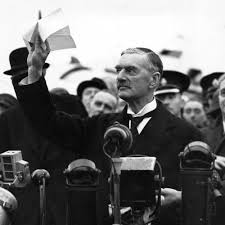
Neville Chamberlain

Our dishonor in Lausanne, as with Munich, may avoid a confrontation in the present, but our shame will guarantee a war in the near future.

*********************

Once again our leaders are needlessly appeasing a hostile state that shows them nothing but contempt.

The Western capitulation to Adolf Hitler in the 1938 Munich Agreement is cited as classic appeasement that destroyed Czechoslovakia, backfired on France and Britain, and led to World War II. All of that is true.

But there was much more that caused the Munich debacle than simple Western naiveté. The full tragedy of that ill-fated agreement should warn us on the eve of the Obama’s administration’s gullible agreement with Iran on nuclear proliferation. Fable one is the idea that most people saw right through the Munich folly. True, Europeans knew that Hitler had never once told the truth and was already murdering German citizens who were Jews, Communists, or homosexuals. But Europeans did not care all that much.

Instead, the Western world was ecstatic over the agreement. After the carnage of World War I, Europeans would do anything to avoid even a small confrontation — even if such appeasement all but ensured a far greater bloodbath than the one that began in 1914.

Another myth was that Hitler’s Wehrmacht was strong and the democracies were weak. In fact, the combined French and British militaries were far larger than Hitler’s. French Char tanks and British Spitfire fighters were as good as, or superior to, their German counterparts.

Czechoslovakia had formidable defenses and an impressive arms industry. Poland and perhaps even the Soviet Union were ready to join a coalition to stop Hitler from dissolving the Czech state.

It is also untrue that the Third Reich was united. Many of Hitler’s top generals did not want war. Yet each time Hitler successfully called the Allies’ bluff — in the Rhineland or with the annexation of Austria — the credibility of his doubters sank while his own reckless risk-taking became even more popular.

Munich was hardly a compassionate agreement. In callous fashion it immediately doomed millions of Czechs and put Poland on the target list of the Third Reich.

Munich was directly tied to the vanity of Neville Chamberlain. In the first few weeks after Munich, Chamberlain basked in adulation, posing as the humane savior of Western civilization. In contrast, loud skeptic Winston Churchill was dismissed by the media and public as an old warmonger.

Hitler failed to appreciate the magnanimity and concessions of the French and British. He later called his Munich diplomatic partners “worms.” Hitler said of the obsequious Chamberlain, “I’ll kick him downstairs and jump on his stomach in front of the photographers.”

The current negotiations with the Iranians in Lausanne, Switzerland, have all the hallmarks of the Munich negotiations.

Most Westerners accept that the Iranian government funds terrorist groups such as Hezbollah and Hamas. It has all but taken over Iraq, Lebanon, Syria, and Yemen. Yet the idea of stronger sanctions, blockades, or even force to stop Iranian efforts to get a bomb are considered scarier than Iran getting a bomb that it just possibly might not threaten to use.

The U.S. and its NATO partners are far stronger than Iran in every imaginable measure of military and economic strength. The Iranian economy is struggling, its government is corrupt, and its conventional military is obsolete. Iran’s only chance of gaining strength is to show both its own population and the world at large that stronger Western powers backed down in fear of its threats and recklessness.

Iran is not united. It is a mishmash nation in which over a third of the population is not Persian. Millions of protestors hit the streets in 2009. An Iranian journalist covering the talks defected in Switzerland — and said that U.S. officials at the talks are there mainly to speak on behalf of Iran.

By reaching an agreement with Iran, John Kerry and Barack Obama hope to salvage some sort of legacy — in the vain fashion of Chamberlain — out of a heretofore failed foreign policy.

There are more Munich parallels. The Iranian agreement will force rich Sunni nations to get their own bombs to ensure a nuclear Middle East standoff. A deal with Iran shows callous disagreed for our close ally Israel, which is serially threatened by Iran’s mullahs. The United States is distant from Iran. But our allies in the Middle East and Europe are within its missile range.

Supporters of the Obama administration deride skeptics such as Democratic senator Robert Menendez and Israeli prime minister Benjamin Netanyahu as if they were doubting old Churchills.

Finally, the Iranians, like Hitler, have only contempt for the administration that has treated them so fawningly. During the negotiations in Switzerland, the Iranians blew up a mock U.S. aircraft carrier. Their supreme leader, Ayatollah Khamenei, did his usual “death to America” shtick before adoring crowds. Our dishonor in Lausanne, as with Munich, may avoid a confrontation in the present, but our shame will guarantee a war in the near future.