Archive for the ‘Al Qaeda’ category

The Russian Federation’ Strategic Equation in Syria

February 4, 2016

The Russian Federation’ Strategic Equation in Syria, Israel DefenseGiancarlo Elia Valori, February 4, 2016
Bombs away

According to Western sources, ISIS has recently reduced its size by 40% overall and by 20% in Syria, while it had lost only 14% of its territory throughout 2015 when the Caliphate’s ISIS expanded – without recovering the same amount of territory – in Eastern Syria.

Another area where the Caliph Al Baghdadi has lost much of his territorial control is the area along the border with Turkey – while the Caliphate has arrived up to the areas along the border with Jordan, the traditional area of smuggling and transit of its militants. Areas towards the Lebanese border and in the Palmira region are reported to be under ISIS control.

Hence, so far, both the US Coalition’s and the Russian-Syrian pressures do not seem to be sufficient to definitively destabilize Al-Baghdadi’s Caliphate, despite its current territorial losses.

Therefore ISIS is likely to restructure itself in the form of a first-phase Al Qaeda, as indeed it already appears to do.

This means that ISIS could create – or has already done so – a small and centralized organizational structure, with informal peripheral networks in Europe, North Africa and Central Asia, with a view to organizing mass terrorist actions and blocking the Western resistance against the jihad, as well as finally disrupting the European security forces.

Nevertheless, why the Russian-Syrian actions and the other US-led action do not work fully?

Firstly, we must analyze the Caliphate’s weapons: it has acquired most of the stocks abandoned by the Iraqi and Syrian armies, including sufficiently advanced weapons to counter the Russian and the Coalition’s weapon systems.

Absolute technological superiority is not needed. The will to fight and the higher mobility of the Caliphate’s armies are more than enough.

In essence, ISIS can avoid attacking the best equipped areas of both coalitions, while it can predict and avoid the West’s points of attack thanks to a joint and unified command/control center located far from the lines. Said center employs the same technologies as the anti-jihadist forces, as well as similar logics of action. Mimicking the enemy is an effective way of fighting it.

Furthermore, mobility replaces technological superiority and currently nobody – except for the Russian Federation – wants to fight “for Gdansk”, which today means fighting for Damascus.

A Caliphate’s conventional strategy “from the weak to the strong” – just to use the same terminology as the philosophers of war, Beaufre and Ailleret – where the Western weakness is twofold: both on the ground, where ISIS is much more mobile and causes politically unacceptable damage to the West (with the exception of Russia and the Kurdish and Yazidi militias) and within the Western public, slackened off by the fairy tale of “good” immigration which blocks the European governments’ reactions on the necessary presence of Western troops on the ground.

Not to mention the fact that ISIS has taken possession, on its own territory, of the Hamas line in Gaza: a very thick and dense network of underground tunnels, which protects from air attacks and allows the economic activities needed to support the organization.

Another primary goal of the Caliph Al Baghdadi is to saturate Western police forces and making them actually unusable since they are already scarce in number and weapons, while Europe dies in “multiculturalism”.

This is a primary goal of ISIS which, in the future, will certainly attack – probably also territorially – some areas in European countries “from the weak to the strong”.

The bell tolls for us, too – just to make reference to John Donne’s verse, which became famous as the title of Ernest Hemingway’s novel on the Spanish Civil War, which in fact paved the way for World War II.

Hence, we will soon have a core of militant jihadists not necessarily trained in Syria, but connected via the Internet, and a vast network of “fellow travelers” who can serve as cover, logistical support, recruitment area, political and media manipulation for the more gullible or fearful Westerners.

This will be – and, indeed, it already is – the structure of Al Baghdadi’s Caliphate in Europe.

The “branches” of Al-Baghdadi’s Caliphate are equally efficient: in the Barka province in Libya – and now in the Sirte district with the agreement between the ISIS and Gaddafi’s tribes – as well as Jund-al-Kilafah in Algeria, Al Shaabab in Somalia, Boko Haram in Northern Nigeria, Jundallah in Pakistan and Abu Sayyaf in Malaysia.

The void of Western inanity is immediately filled by ISIS, which does not know international law, but only a miserably manipulated Koran.

Hence, a mechanism similar to communicating vessels is in place: the more the ISIS crisis deepens on its territory of origin, the more threatening and powerful the peripheral groups become.

While, at the same time, in Europe we are witnessing some mass radicalization maneuvers which rely on Al Qaeda’s old techniques: at first, the more or less crazy “Manchurian candidates”, who played havoc in small areas.

Later – as today – mass actions, like that in front of the Cathedral and train station in Cologne, which will certainly bring good results to the Caliph in the future; then again real, visible and very effective terrorist attacks. Not to mention similar mass actions in Hamburg and Zurich.

Finally, when and how it will be logistically possible, we will witness the creation of small “Caliphates” in Europe, in the areas which the enormous long-term stupidity of EU leaders has left fully in the hands of Islamic mass immigration that has seized neighborhoods and cities.

The war against the Caliphate is and will be a very long war and the West – probably with the only exception of the Russian Federation – has in no way the political and psychological ability, nor the power to fight it with a view to winning it.

The West will die of soft power, as well as of a lot of talk with Islamists who do not want to hear it – all convinced of their alleged cultural, religious and military superiority.

Years of peacekeeping, “stabilization” and peace-enforcing have turned the European Armed Forces – already largely undersized at that time – into traffic guards and organizers  of elections – always rigged – just to be as quick as possible and go away without disturbing the sleep of European peoples.

The very size of the European Armed Forces, considered individually or in a ramshackle coalition “against terror”, is not even comparable with those of the United States or Russia, after decades of equally unreasonable reduction of investment in the military and in the public safety sectors, even after the first Al Qaeda attacks.

On the contrary, Russia has implemented a thorough reform of its Armed Forces in 2008, after the war with Georgia, and it has worked much more on the “human factor” than on technology which, however, has not been neglected.

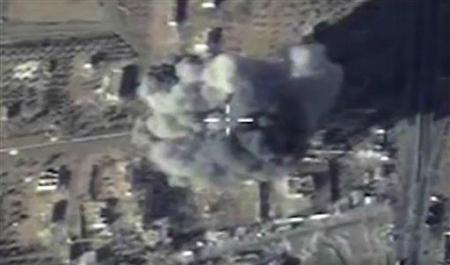
So far the Russian forces in Syria have deployed artillery groups and other ground forces while, according to reports coming from Russian sources, Russia is deploying batteries of S-400 anti-aircraft missiles again on Syrian territory, over and above providing “Buk” anti-aircraft missile systems to the Arab Syrian Army.

The S-400 missile – also known as “Growler”, according to the NATO designation – is an anti-aircraft missile which intercepts aircrafts flying up to 17,000 kilometers per hour, while “Buk” (also known as SAM 17) is a surface-to air missile system (also known as “Gainful” according to the NATO designation) with radars for the acquisition of targets, which are the enemy cruise missiles and strike aircrafts.

Nevertheless, why does Russia deploy such an advanced anti-aircraft structure if ISIS has no planes?

The simple answer to this question is because Russia wants to reduce and eventually eliminate Western raids, often objectively inconclusive or scarcely effective, also due to the lack of a network for target acquisition.

Conversely, Russia wishes to take Syria as a whole, after destroying or minimizing Al Baghdadi’s Caliphate.

President Putin needs a victory in Syria – firstly because the defeat of Al Baghdadi’s Caliphate avoids the jihadist radicalization of the over twenty million Muslim residents and citizens of Russia.

If the Russian and Central Asian Islam takes fire, Russia can no longer control – militarily or economically – the energy networks towards Europe and the Mediterranean region, which is the central axis of its geoeconomy.

Moreover, Vladimir Putin wants to become the only player of the Syrian crisis because, for Russia, ousting the West from a NATO neighboring country, which is pivotal for control over the Mediterranean region, means to become – in the future – one of the two players or even the first player  in the Mare Nostrum, with strategic consequences which are unimaginable today.

Finally, the Russian anti-aircraft missile systems are needed to wipe out the aircrafts of the powers not coordinating with Russia and to strengthen military cooperation with the countries which have accepted the Russian air superiority.

For example Israel which, for the time being, offsets by Russia the de facto breaking of military and strategic relations with the United States and the political anti-Semitism mounting in Europe.

Furthermore, Putin also holds together – in a hegemonic way – Iran, Bashar al-Assad’s Syria and the Lebanese Hezbollah, thus setting himself up as a mediator and power broker between the Shi’ite bloc and the West when, in all likelihood, the clash between the Sunnis and the “Party of Ali” will become disastrous and fatal for European security.

Furthermore, the Russian President wants to push the United States away from the Middle East definitively, regardless of the United States maintaining or not their preferential relations with Saudi Arabia.

Finally, within the UN Security Council, Russia will do its utmost to capitalize on its hopefully future victory against ISIS, by exchanging it with the achievement of other Russian primary interests: the management of the Arctic; the forthcoming militarization of the Shanghai Cooperation Organization; the regionalization of NATO eastward and possibly a new military agreement with China, which would make the composition of the UN Security Council completely asymmetrical.

Not to mention the great attraction which Russia would hold for a Eurasian peninsula left alone by the United States and devoid of acceptable defenses in the Southeast.

In this case, the Eurasia myth of the Russian philosopher and strategist, Alexander Dugin, would come true very quickly.

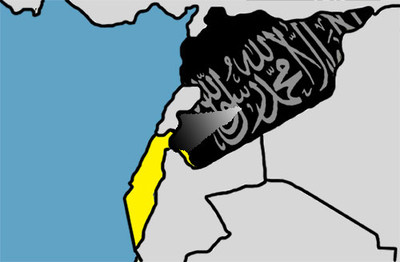
Iraqi Journalist Comes Out Against Claim That ISIS Has Nothing To Do With Islam

February 1, 2016

Iraqi Journalist Comes Out Against Claim That ISIS Has Nothing To Do With Islam, MEMRI, February 1, 2016

(Mr. Boula’s comments relate to Sunni Salafist Islam as practiced in Saudi Arabia and elsewhere. He does mention Shiite Islam as practiced in Iran. Perhaps that has something to do with the pro-Iranian bent of the newspaper for which he writes. — DM)

In an article titled “Does Terror Truly Have No Religion?” in the pro-Iranian Iraqi newspaper Al-Akhbar, Iraqi journalist Fadel Boula came out against the claim, which is frequently heard in the Arab world and outside it, that the terror of the Islamic State (ISIS) and its ilk is completely unrelated to Islam. He pointed out that these terror organizations are motivated by an extremist Salafi ideology and claim that their atrocities represent Allah’s will and directives.

The following are excerpts from his article:[1]  

26614Fadel Boula (image: Al-Akhbar, Iraq)

“[Does terror truly have no religion?] This slogan is uttered regarding terror, as though [terror] reflects a picture that is completely unrelated to its perpetrators’ religious affiliation, and as though there are no religious goals or values behind it, but only a state of insanity that causes those afflicted with it to run amok, unaware of what they are doing or what [they seek] to achieve by their actions – [actions] that disgust not only human beings but [even] the beasts of the jungle.

“The terror that is shaking the world today is not a natural disaster like a tornado, a thunderstorm or an earthquake, and it is not perpetrated by savage tribes. It is perpetrated by people who enlist [because they are] inspired by a religious ideology. [These people] advocate enforcing and spreading [this ideology as a set of] dogmatic principles that must be imposed by the force of the sword, and which [mandate] killing, expulsion and destruction wherever they go.

“Since its inception, this movement of terror has espoused a Salafi ideology that champions religious extremism, and brainwashed people of all ages have rallied around its flag, [people who were] trained to kill themselves and kill others in order to attain martyrdom.

“The terror organizations that act in the name of religion were born when [the mujahideen] declared Islamic jihad against the Soviet forces in Afghanistan. It was the Saudi sheikh Osama bin Laden who laid the cornerstone for the first [terror] cell, which he named Al-Qaeda. Later he called to launch a war in the name of religion, and young believers, influenced by fatwas of extremist [clerics], especially Saudi ones, flocked from the Muslim lands [to Afghanistan].

“[Then, Abu Mus’ab] Al-Zarqawi formed a branch of Al-Qaeda in Iraq, which, calling itself ‘the Islamic State in Iraq,’ recently settled in the city of Mosul and united with its counterpart in Syria. Thus, a scary organization [namely ISIS] suddenly appeared, which advertises itself as the bearer of Islam’s message and banner. [Emulating the early] Islamic conquests, [this organization] invaded Iraq and Syria and appointed a Caliph for the Muslims: Abu Bakr Al-Baghdadi, who settled in Mosul and showed its people what [it is like] to be ruled by a government [that is a throwback to] 1,400 years ago, in terms of the treatment [they received] and the plunder of their lands. The invaders attacked the populace of Mosul and eastern Syria, arrested them by the hundreds, and took a sword to their necks, and later singled out the Christians among them and offered them two options: either convert to Islam or pay the poll tax, as happened to their forefathers when the Arabs attacked their lands in the days of the Caliph ‘Umar Al-Khattab [583-644 AD]. When [the Christians] rejected this humiliation, [ISIS] seized their property, expelled them from their historic home, the province of Ninveh, and sent them to wander destitute under the skies, seeking rescue and safety.

“As for the Yazidis, their plight was and remains an historic disaster that was inflicted upon them by the God-fearing Caliph [Al-Baghdadi] when he applied to them the verse pertaining to infidels, namely offering them two options: to [either] embrace Islam, or die and have their money, women and children seized. We keep seeing images of innocent people being killed and beheaded by these terrorists, who butcher their victims while crying out “in the name of Allah the merciful” and “Allah akbar.” All these crimes are [ostensibly] carried out with Allah’s approval, and they are perpetrated by those who praise Allah day and night and who pray fervently and do everything according to His will.

“When the terrorists blew up the World Trade Center and several airplanes, killing thousands of victims, Osama bin Laden, surrounded by his people, said on television: ‘This is a victory from Allah.’ And now ISIS is bragging about killing innocent people in Paris, saying that it was ‘done with Allah’s approval,’ and threatening that the next attack will be in the U.S., Allah willing. And [Sheikh Yusouf] Al-Qaradhawi and others like him pray and hope that, in the wake of this terrorist momentum, a day will arrive when Muslims inundate Europe and subdue it to Islam. Is this not enough to convince [us] that terror [does] have a religion?”


Endnotes:


[1] Al-Akhbar (Iraq), November 18, 2015.

IDF Preparing for Arrival of ISIS on Syrian Border

January 30, 2016

IDF Preparing for Arrival of ISIS on Syrian Border, Investigative Project on Terrorism, Yaakov Lappin, January 29, 2016

934

As conflict and mayhem continue to rage across Syria, the Israel Defense Forces (IDF) is preparing to encounter the threat of ISIS and al-Qaida forces right on its borders, and could encounter such threats in the coming months.

The preparations come as the Syrian civil war shows no sign of letting up. This is a conflict that has led to the violent deaths of 300,000 Syrians, and the displacement of more than 10 million others, 4.5 million of whom have fled the country.

Today, the IDF’s Military Intelligence Directorate views Syria as a former state that has broken apart into multiple ‘Syrias.’ The Assad regime controls barely 30 percent of Syria and is fully reliant on the foreign assistance of Russia, Hizballah, and Iran. Sunnis and Shi’ites wage daily war on one another.

It is worth examining the wider recent events in the multifaceted Syrian conflict, and place the IDF’s preparations in their broader regional perspective.

In Syria’s murderous kill-or-be-killed environment, Salafi-jihadist doctrines flourish, in the form of ISIS, which views Shi’ites (including the Assad regime and Hizballah) as infidels who must be destroyed.

ISIS cells have operated recently in Lebanon too, targeting Shi’ite Hizballah’s home turf of Dahiya in southern Beirut with two large bombings in November that claimed over 40 lives, while ISIS in Iraq continues to target Shi’ites.

Today, ISIS has between 30,000-50,000 members who are dedicated to expanding their caliphate and killing all those who disagree with their doctrine, including even fellow Sunni jihadi members of al-Qaida’s branch in Syria, the Al-Nusra Front, which has 8,000-12,000 members.

ISIS continues to use its territory in Syria and Iraq to plot major, mass-casualty terrorist attacks in Western cities. At the same time, its budgetary future looks uncertain, as oil funds have decreased significantly following allied air strikes on oil facilities. In the past year, 45 percent of ISIS’s $1.3 billion budget came from oil, far less than the oil revenue in 2014.

Unlike ISIS, al-Qaida believes in following a phased, slower plan in setting up a caliphate, and the two jihadist organizations have been at war with each other for more than two years in Syria.

Shi’ites led by Iran are fighting to stop the Salafi-jihadis’ spread. Under the command of Iranian Revolutionary Guard Corps (IRGC)-Quds Force unit commander, Qassem Suleimani, Iranian fighting forces and advisers moved into Syria. Iran has sustained more than 300 casualties there thus far.

Hizballah, too, is heavily involved in Syria’s battles, losing an estimated 1,300 fighters and sustaining 10,000 injuries – meaning more than half of its conscripted fighting force has been killed or wounded. Iran and its proxies are using the mayhem to try to spread their own influence in Syria.

Near Israel’s border with Syria, the Al-Yarmouk Martyrs Battalions, which is affiliated with ISIS, has set up many posts.

An estimated 600 members of the group control a population of around 40,000 Syrians. Al-Yarmouk is at war with al-Qaida’s Jabhat Al-Nusra, which maintains a few thousand members in the Syrian Golan near Israel.

Jabhat Al-Nusra’s membership is mostly derived of local Syrians, who tend to be more hesitant to start a war with Israel that would result in their areas, and relatives, being badly affected. Yet 10 to 15 percent of its membership comes from abroad, and have no commitment to the area. These foreign fighters have no qualms about precipitating attacks on Israel. At the moment, however, Jabhat Al-Nusra is bogged down by its fight with Al-Yarmouk.

ISIS has officially put Israel in its sights, and its leader, Abu Bakr Al-Baghdadi, declared his intention at the end of December to attack Israel.

The IDF is taking the threat seriously and is preparing for a range of possible attacks, including strategic terror attacks, cross-border raids, the sending of bomb-laden armored vehicles into Israel, and rocket, missile, small-arms, and mortar fire on the Israeli Golan Heights.

One possibility is that the heavily armed Al-Yarmouk group, which is facing the southern Golan Heights, might follow an Islamic State directive to attack Israel.

In 2014, Al-Yarmouk became an ISIS representative, swearing allegiance to it, though it is not fully subordinate to it.

Al-Yarmouk’s late leader, known as Al Khal (“the uncle”), was killed in November in an attack by Jabhat Al-Nusra. Before his violent end, Al Khal only partially committed himself to ISIS, and turned down ISIS requests to send fighters to Iraq.

Al-Yarmouk’s response to Jabhat Al-Nusra’s attacks came in December, when it assassinated a Jabhat Al-Nusra commander in his armored vehicle, just 400 meters from the Israeli border.

Al-Yarmouk subscribes to the Salafi jihadist ideology and has shoulder-held missiles, tanks, and other weapons looted during raids on the Assad regime military bases.

But Israel is also preparing for the possibility of encountering ISIS itself, not just an affiliate group.

ISIS proper is currently situated 40 kilometers from the Israeli border in southern Syria. One possibility is that Russian airstrikes will cause ISIS forces to ricochet southwards, towards Israel.

The IDF is gathering intelligence on all armed groups near its border, exhausting many resources to assess their capabilities, and intentions.

Israel watched as Shi’ite Hizballah came from Lebanon to block Sunni jihadist advances towards Lebanon in recent months, and as Russian airstrikes blocked the advance of the rebels northwards, to Damascus.

The IDF remains in a heightened state of alert along the Syrian border, though it is also working to avoid the creation of easy targets for the array of predatory forces on the other side.

As part of its preparations, the IDF’s Northern Command has given more autonomy to regional field commanders to enable faster responses to surprise attacks by reducing the initial chain of command during emergencies.

Inter-branch cooperation between intelligence, ground forces, and the air force has also been tightened.

Additionally, the IDF has fortified its border fence with Syria, adding electronic sensors to better be able to detect and respond to a potential attack in time.

The underlying assumption within military circles is that, sooner or later, ISIS will turn its guns on Israel, and the IDF does not intend to be caught off guard when that happens.

Clare Lopez Exposes Benghazi – Obama Disaster 1 of 3

January 14, 2016

Clare Lopez Exposes Benghazi – Obama Disaster, United West via You Tube, January 12, 2016

US continues to push for negotiations with Taliban despite direct ties to al Qaeda

December 17, 2015

US continues to push for negotiations with Taliban despite direct ties to al Qaeda, Long War Journal, December 17, 2015

siraj-haqqani-wanted-poster1-e1438370266398-1024x432Images of Siraj Haqqani, one of the Taliban’s two deputy emirs, from a US government wanted poster.

The US government and military continue to seek a negotiated settlement with the Afghan Taliban despite the group’s continuing support for al Qaeda and the increased leadership role the Haqqani Network plays in the Afghan insurgency.

The Department of Defense asserts in its biannual Enhancing Security and Stability in Afghanistan report, released earlier this week, that “reconciliation and a political settlement with the Taliban” is a key part of its strategy to end the conflict in Afghanistan.

“The U.S. and Afghan governments agree that the best way to ensure lasting peace and security in Afghanistan is reconciliation and a political settlement with the Taliban,” the report says in its very first section, titled US Strategy in Afghanistan.

The report then states that to achieve a political settlement, the Taliban must take the very steps the group has refused for 15 years: denounce al Qaeda and submit to Afghanistan’s constitution.

“Success of an Afghan-led peace process will require the Taliban and other armed opposition groups to end violence, break ties with international terrorist groups, and accept Afghanistan’s constitution, including its protections for the rights of women and under-represented groups.”

The Pentagon report continues to advocate for reconciliation with the Taliban despite the fact that al Qaeda’s emir, Ayman al Zawahiri, swore and oath of allegiance to the new leader of the Taliban, Mullah Akhtar Mohammad Mansour, after he was publicly named successor to Mullah Omar over the summer. Mansour accepted Zawahiri’s oath just days after it was given.

Shockingly, the Pentagon report made no mention of Zawahiri’s oath and Mansour’s acceptance in its 90-page report. The report did note that the emir of the Islamic Movement of Uzbekistan swore allegiance to the Islamic State’s leader, Abu Bakr al Baghdadi.

The Pentagon also continues to press for negotiations despite the fact that Sirajuddin Haqqani, the operational commander of the Haqqani Network – a powerful Taliban subgroup that is closely tied to al Qaeda and backed by Pakistan’s military and intelligence establishment – was appointed as one of Mansour’s two deputies. Siraj is effectively the Taliban’s military commander. The US military does recognize that Siraj’s “elevation” in the Taliban leadership is problematic.

“The elevation of Haqqani Network leader Siraj Haqqani as Taliban leader Mullah Mansour’s deputy signals that the Haqqani Network will remain a critical and lethal component of the overall Taliban-led insurgency,” the report states.

“Of the groups involved in the Taliban-led insurgency, the Haqqani Network remains the greatest threat to U.S., coalition, and Afghan forces and continues to be the most critical enabler of al Qaeda,” the report continues. “Haqqani Network leader Siraj Haqqani’s elevation as Taliban leader Mullah Mansour’s deputy has further strengthened the Haqqani Network’s role in the Taliban-led insurgency. The Haqqani Network and affiliated groups share the goals of expelling U.S. and coalition forces, overthrowing the Afghan government, and re-establishing an Islamic Emirate of Afghanistan.”

Siraj’s tight working relationship with al Qaeda has been confirmed by multiple sources. Files recovered in Osama bin Laden’s Abbottabad compound revealed the depth of the collusion. [See LWJ report, The Taliban’s new leadership is allied with al Qaeda.]

Since accepting Zawahiri’s oath of loyalty and appointing Siraj as a top deputy, the Taliban have not backed off from either party. In early September the Taliban released a video that highlighted Siraj’s importance to the group as well as Mansour’s accepting Zawahiri’s pledge. In early September, the Taliban also devoted significant space to al Qaeda leaders and pro-al Qaeda clerics eulogizing its former emir in that month’s edition of Al Sumud, the group’s official magazine.

The anatomy of denial

November 23, 2015

The anatomy of denial, Front Page MagazineBruce Thornton, November 23, 2015

boko_haram_main

Western secularism has rendered us incapable of understanding passionate religious beliefs. The banishment of faith from public life is nearly complete in Europe, and we Americans are on the same trajectory.

In contrast, most Muslims are intensely religious to a degree most Westerners can hardly imagine. Religion suffuses their lives, most noticeably in the muezzin’s daily five calls to prayer, and the commands of Allah and the words and deeds of Mohammed are a living presence in every aspect of a devout Muslim’s life. Nor is this religiosity a private affair kept away from the public square, and compartmentalized in people’s lives apart from politics, economics, or foreign policy.

************************

The murder of 27 hotel guests in Mali’s capital city by Boko Haram, now an al Qaeda franchisee, highlights yet again the delusional futility of asserting that, as Hillary Clinton put it in a tweet, “Islam is not our adversary. Muslims are peaceful and tolerant people and have nothing whatsoever to do with terrorism.” Like Obama, Hillary also vigorously condemns the use of a phrase like “Islamist radicalism.”

These evasions are contrary to the history and doctrines of Islam consistent over 14 centuries, and contradict the professed motives for the continuing violence perpetrated across the globe––27,295 deadly attacks just since 9/11–– by Islamic terrorist groups who emulate the Prophet and take seriously his injunction to “slay the idolaters wherever you find them, and take them captive and besiege them, and lie in wait for them in every ambush” (9.5), one of 109 verses––the direct commands of Allah–– that order war against infidels.

Moreover, that most Muslims do not engage directly in such violence, or may even condemn it, does not change the fundamental doctrines that justify it, no more than the millions of Catholic women who use birth control invalidate the church’s doctrine against contraception. The doctrine of jihad has been part of Islam from its beginning, enjoined by the Koran and Hadith, and confirmed and celebrated by the most eminent Islamic historians, jurisprudents, and theologians. One of the most famous, the late-14th century writer Ibn Khaldun, wrote in the Muqaddimah, “In the Muslim community, the holy war is a religious duty, because of the universalism of the Muslim mission and the obligation to convert everybody to Islam either by persuasion or by force.” When we see Muslims in the 21st century killing and dying in service to this traditional religious imperative created in the 7th century, it is perverse blindness to claim that there is no connection between Islam and Islamic terrorism.

The more important question is why anyone would assert something that would have struck our Western ancestors––for a thousand years the victims of Muslim invasion, occupation, enslavement, and slaughter–– as a dangerous fantasy. One rationale appeared in the months after 9/11, when George W. Bush distinguished al Qaeda from the larger Muslim community and engaged in outreach to the latter, inviting imams to the White House and proclaiming Islam the “religion of peace.” The idea was that alienating millions of Muslims would make it harder to fight the jihadists, and even aid in their recruitment. This tactic, of course, has been an obvious failure for over a decade, as there is no evidence that being nice to Muslims––for example, rescuing Afghan and Iraqi Muslims from murderous autocrats––changed traditional Muslim attitudes toward infidels, and predisposed them to turn on their fellow Muslims.

The better answer lies in several bad ideas spawned by modernity. Western secularism has rendered us incapable of understanding passionate religious beliefs. The banishment of faith from public life is nearly complete in Europe, and we Americans are on the same trajectory. What remains of religion is reduced to a private life-style choice, commercialized holiday traditions, and a vague comforting “spiritualism” that makes few demands on its adherents. Secularists relentlessly patrol the public square to attack any sign that religious belief is stepping outside its private ghetto. And any recognition that the Judeo-Christian tradition contributed to the foundational beliefs of the West––equality, unalienable rights, and freedom––is attacked as spiritual colonization and “fundamentalist” bigotry. Hence Obama calls “shameful” the suggestions that Christian Syrians, currently suffering a genocidal persecution, be prioritized over the mostly economic Syrian refugees.

In contrast, most Muslims are intensely religious to a degree most Westerners can hardly imagine. Religion suffuses their lives, most noticeably in the muezzin’s daily five calls to prayer, and the commands of Allah and the words and deeds of Mohammed are a living presence in every aspect of a devout Muslim’s life. Nor is this religiosity a private affair kept away from the public square, and compartmentalized in people’s lives apart from politics, economics, or foreign policy. As Bernard Lewis writes,

In most Islamic countries, religion remains a major political factor, for most Muslim countries are still profoundly Muslim in a way and in a sense that most Christian countries are no longer Christian . . . in no Christian country at the present time can religious leaders count on the degree of belief and participation that remains normal in the Muslim lands . . . Christian clergy do not exercise or even claim the kind of public authority that is still normal and acceptable in mot Muslim countries.

Lacking the constant public presence of spiritual reality in our own lives, we find it hard to accept that religious doctrines advocating violence against the unbeliever, or basing all social, economic, judicial, and political order on a code of law formulated over a thousand years ago, can be real enough to compel violence against innocents. This failure of imagination has been a powerful enabler of our feckless strategies.

So too has been our ignorance of history. Worse yet, what history we do rely on is false or ideologically warped. Few politicians in charge of our foreign policy seem to be aware of the long, violent assault of Islam against the West, the chronicle of massacre, slaving, kidnapping, occupation, and exploitation, all in service to the commands of Allah and the practices of Mohammed. At the same time, our president invents the mythic “golden age” of enlightenment and tolerance in Muslim Cordoba, harps on the Crusades and the Inquisition, excoriates Israel for defending itself against the progeny of invaders, colonizers, and immigrants to the ancient Jewish homeland of Judea and Samaria, and apologizes for imperialism and colonialism. Meanwhile Muslim Turkey is in its fifth decade of the occupation of northern Cyprus that followed an invasion accompanied by ethnic cleansing, population transfers from Turkey, and the destruction or vandalizing of 300 churches.

A good example of this bizarre historical ignorance is the demonic role assigned to the 1916 Sykes-Picot agreement. An ISIS billboard in Iraq reads, “We are the ones who determine our borders, not Sykes-Picot.” In this false history borrowed from self-loathing Westerners, the imperialist French and English divided up the Ottoman Empire in an act of stealth colonialism. This history is false, and strangely diminishes the region’s Muslims, making them the mere passive pawns of external manipulators. But as Efraim Karsh points out in his indispensable new book The Tail Wags the Dog, the region’s leaders “have been active and enterprising free agents doggedly pursuing their national interests and swaying the region pretty much in their desired direction, often in disregard of great-power wishes.” The true history of the region shows that the disorder today has two main sources: the doctrines of Islam that keep the region mired in a premodern, tribal mentality; and the disastrous decision of the Ottoman sultan to join the Central powers in World War I, against the advice of the British, who wanted not colonies, but an Arab empire to replace the Ottomans’.

Such distorted history, in which the West is to blame for dysfunctions created by Muslims themselves, justifies an apologetic tone like that of Obama’s Cairo speech, and rationalizes Muslim violence as an understandable reaction to historical injustice––just as John Kerry did in his despicable comments that the Charlie Hebdo murders had a “rationale that you could attach yourself to.”

Finally, multiculturalism, which is an expression of this false history that makes the West the global villains deserving of payback from the oppressed dark-skinned “other,” compromises a robust and muscular response to Islamic violence. The lexicon of political correctness, predicated on the commandment never to blame the victim “of color,” leads to the sort of duplicitous evasions mentioned earlier, in which traditional Islamic doctrine disappears as motivating force, and effort is wasted on pursuing remedies––economic development, flattering outreach, or democracy promotion––that will not solve the problem of metastasizing jihadism. Moreover, like the British sympathizers with Germany in the 20s and 30s, the charges of racism and neo-imperialist oppression thrown around by the multiculturalists foster a spirit of appeasement and accommodation, sapping our morale and inhibiting our response.

The denial of Islam’s sanctified violence, confessional intolerance, and global ambitions is the biggest impediment to our destroying the enemy. The solution is simple, and memorably expressed in the New Testament: “And ye shall know the truth, and the truth shall make you free.”

Al Qaeda has not been neutralized

November 21, 2015

Al Qaeda has not been neutralized, The Long War Journal, November 20, 2015

This article was originally published at The Weekly Standard.

Secretary of State John Kerry believes that al Qaeda’s “top leadership” has been “neutralize[d]” as “an effective force.” He made the claim while discussing the administration’s strategy, or lack thereof, for combating the Islamic State, which is al Qaeda’s jihadist rival. Kerry believes that the US. and its allies can finish off the Islamic State quicker than al Qaeda. There’s just one problem: It is not true that al Qaeda or its top leaders have been “neutralize[d].”

Dozens of senior al Qaeda terrorists, including of course Osama bin Laden, have been eliminated. But al Qaeda is not a simple top-down terrorist group that can be entirely vanquished by killing or detaining select key leaders. It is a paramilitary insurgency organization that is principally built for waging guerilla warfare. Terrorism is a part of what al Qaeda does, but not nearly all. And a key reason why al Qaeda has been able to regenerate its threat against us repeatedly over the past 14 years is that it uses its guerilla armies to groom new leaders and identify recruits for terrorist plots against the West.

The summary below shows what al Qaeda looks like today – it is far from being “neutralize[d].” Instead, al Qaeda and its regional branches are fighting in more countries today than ever. They are trying to build radical Islamic states, just like ISIS, which garners more attention but hasn’t, contrary to conventional wisdom, surpassed al Qaeda in many areas.

In Afghanistan, al Qaeda remains closely allied with the Taliban and is participating in the Taliban-led insurgency’s advances throughout the country. Al Qaeda leader Ayman al Zawahiri has sworn allegiance to the Taliban’s new emir, Mullah Mansour, who publicly accepted Zawahiri’s oath of loyalty in August. Al Qaeda-affiliated fighters are playing a key role in the Taliban’s offensive, with the Taliban-al Qaeda axis overrunning approximately 40 of Afghanistan’s 398 districts this year alone. This is part of the reason that President Obama decided to leave a small contingent of American forces in Afghanistan past his term in office.

To give you a sense of what al Qaeda is really doing in Afghanistan, consider that U.S. forces led raids against two large training facilities in the country’s south in October. One of the camps was approximately 30 square miles in size. Gen. John F. Campbell, who oversees the war effort in Afghanistan, explained that the camp was run by al Qaeda in the Indian Subcontinent (AQIS) and is “probably the largest training camp-type facility that we have seen in 14 years of war.”

Think about that: U.S. officials just discovered what is probably the largest al Qaeda camp since 2001. Al Qaeda hasn’t been neutralized in Afghanistan. In fact, numerous al Qaeda leaders have relocated into the country.

AQIS, which answers to Zawahiri, was established in September 2014 and is exporting terrorism throughout the region. The group has claimed attacks in Pakistan and Bangladesh. And al Qaeda is still allied with Pakistan’s many jihadist groups, which frequently carry out operations, especially in the northern part of the country.

In Syria, Al Nusrah Front, which is openly loyal to Zawahiri, is deeply enmeshed in the anti-Assad insurgency. It is such an effective fighting force that it disrupted the Pentagon’s $500 million train and equip program multiple times this year, leading the Obama administration to cancel it. Multiple senior al Qaeda leaders have relocated to Syria since 2011 and they are guiding Al Nusrah’s efforts. In addition, some of these leaders work for what is known as the “Khorasan Group,” which has been planning attacks against the West. In September 2014, the administration began targeting the Khorasan Group with airstrikes. Some top figures in this al Qaeda subunit have been taken out, but others have survived thus far. Even so, al Qaeda has thousands of fighters in Syria today. And Al Nusrah Front jointly leads a coalition known as Jaysh al Fath (“Army of Conquest”), which took substantial territory from Bashar al Assad’s regime earlier this year.

In Yemen, al Qaeda in the Arabian Peninsula (AQAP) operates a prolific insurgency and has gobbled up territory, particularly in the country’s south. The U.S. has killed several senior AQAP officials this year, but that hasn’t stopped the organization from taking advantage of the Houthis’ surge and the Gulf states’ intervention. The AQAP leaders who replaced those killed in U.S. drone strikes since January are al Qaeda veterans and answer to Zawahiri. AQAP has also threatened the U.S. on multiple occasions, including the attempted Christmas Day 2009 bombing and other plots.

Across the Gulf of Aden from Yemen, in Somalia, Shabaab remains one of the most prolific jihadist organizations on the planet. It, too, does not hide its fealty to Zawahiri. Thousands of Shabaab fighters battle African forces regularly and still control significant territory. Shabaab is most infamous these days for its high-profile massacres in Kenya, such as at the Westgate mall in 2013 and Garissa University College earlier this year. Shabaab has a long history of exporting terrorism throughout East Africa, where it is attempting to build a radical Islamic nation on behalf of al Qaeda.

Al Qaeda in the Islamic Maghreb (AQIM) and affiliated groups remain a potent force in North and West Africa. Groups such Ansar al Sharia, Ansar Dine and others all operate within AQIM’s orbit and are regularly engaged in heavy fighting against their opponents.

Al Murabitoon, led by Mohkthar Belmokhtar, is another al Qaeda group that operates in North and West Africa. Belmokhtar, a former AQIM commander, is a Zawahiri loyalist. His group has reportedly claimed responsibility for a hotel siege in Mali earlier today.

To this brief sketch we can add a number of al Qaeda-affiliated organizations around the globe. But the point is that al Qaeda has a guerilla army totaling tens of thousands of fighters across a large geographic expanse.

AQIS, AQAP, AQIM, Al Nusrah Front, Shabaab – these are al Qaeda’s regional branches. Each of them is fighting to implement al Qaeda-style sharia law in its designated region. All of them are part of Zawahiri’s organization. They have not been “neutralize[d].”

Al Qaeda realized long ago that this is a generational war, and the next generation of leaders are fighting in several countries today. The US government still doesn’t get it.

French President Hollande was top target in multiple terror atrocity in Paris

November 14, 2015

French President Hollande was top target in multiple terror atrocity in Paris, DEBKAfile, November 14, 2015

Paris_Bataclan_concert_hall13.11.15

Our sources suspect that the survivors of the group are lying low and may be planning to emerge for a second round of atrocities in the coming hours or days, like after the Charlie Hebdo episode ten months ago, which was quickly succeeded by a massacre at the Jewish kosher store.

2.  A second group of back-up confederates was made up of drivers, who drove the terrorists to the scenes of attack and were ready to extricate any survivors. They handed the attackers their bomb belts, automatic weapons and explosives and acting also as spotters who watched and recording the movements of French security forces. They also photographed the incident.

******************************

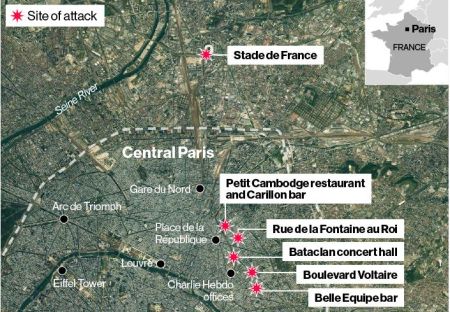
The geography of the six Paris locations targeted by terrorists Friday night points to precise advance planning in support of a primary target, namely, French President Francois Hollande, while at the same time sowing bloody havoc in the French capital, frightening tourists away and shaking the French governing system to the core. The cost in lives has not been finally tallied. Estimates range from 127 to 153 with dozens of people injured.

Paris_map_attacks_13-14.11.15_1

DEBKAfile’s counterterrorism sources note that the parties who orchestrated the deadliest terrorism attack on any European capital took into account that President Hollande would be attending a friendly French-German football match at the Stade de France, presenting them with a high-quality target for assassination or capture as their hostage. Saturday, the president was the first French official to explicitly accuse ISIS of “an act of war” against France.

Hollande_13.11.15

One of the terrorists shouted before he died, “Francois Hollande’s foreign policy is to blame!” Another was reported by a witness as shouting “This is for Syria!” while spraying gunfire in one of the targeted restaurants: The other attacks on at least six locations were a kind of vicious subplot with the dual purpose of bloody terror per se as well as a diversionary tactic to confuse French security forces and keep them running around in several directions. The president’s bodyguards were meant to be distracted by two earsplitting explosions staged by two suicide bombers outside the stadium.

The guards however quickly whisked the president out of the stadium in time to escape harm.

Whatever their primary objective, coordinating so many simultaneous terror attacks by a large team called for months of preparation, precise intelligence, a variety of weapons and a large team of dedicated killers backed by exceptional staff work and organization.

Our analysts attribute the multiple assaults to a collaborative effort between Al Qaeda and the Islamic State. Together they were capable of putting up the necessary resources which included: –

1. A group of at least 20 terrorists for executing the six attacks. The French Prosecutor’s office reported Saturday that seven died in suicide bombings and the eighth was killed by security forces when they raided the concert hall, where dozens of hostages were being killed. Others may still be at large.

Our sources suspect that the survivors of the group are lying low and may be planning to emerge for a second round of atrocities in the coming hours or days, like after the Charlie Hebdo episode ten months ago, which was quickly succeeded by a massacre at the Jewish kosher store.

2.  A second group of back-up confederates was made up of drivers, who drove the terrorists to the scenes of attack and were ready to extricate any survivors. They handed the attackers their bomb belts, automatic weapons and explosives and acting also as spotters who watched and recording the movements of French security forces. They also photographed the incident.

3. A command group planned the attacks, enlisted operatives, directed and coordinated them, and maintained communications among the different teams.

At least 200 operatives at various levels were completely in the picture and directly involved in at least two months of advance planning.

The night of November 14 will be remembered for the failure of France’s Director-General for Internal Security (DGSI) and Director-General for External Security (DGSE) – or their refusal – to pick up the slightest clue to the massive preparations afoot for a horrendous, wide-scale terrorist outrage against their capital city.

Reclusive Muslim communities populate whole Paris suburbs and often practice an extremist Islamic life style which does not recognize the authority of the French Republic. When French police are forced to enter those areas they take care to have an armored military escort with automatic rifles. Rife with crime, poverty and deprivation, these communities are perfect breeding grounds for terrorist networks.

The alienation of the Paris Muslim community and the experiences of young radicals in former Islamic terrorist operations in the past two years have raised a high wall against penetration by French intelligence and police services and any attempts by them to enlist informers, undercover agents or collaborators able to whisper a warning when trouble lies ahead.

The French agencies therefore work in the almost total absence of human intelligence from Arabic speakers conversant with the local dialect, and rely almost exclusively on “signal Intelligence” (SIGINT) for warnings of a deadly threat of the kind that swept Paris Friday and is unlikely to end any time soon.

Since it could not have been the work of 200 lone wolves, but only a large organization with headquarters in Syria and Iraq and impressive multinational capabilities, it is hard to understand how the far-reaching preparations for a multiple Paris terror assault were not detected by any Western signals intelligence branches, including ECHELON, the all-seeing American digital surveillance system and its small brother, Frenchelon. This is bad news for other Western capitals, which ISIS has placed under threat.

Al Qaeda operates in southern Helmand province

October 24, 2015

Al Qaeda operates in southern Helmand province, Long War Journal, October 24, 2015

Foreign jihadists, including members of al Qaeda in the Indian Subcontinent (AQIS), are training at facilities in southern Helmand province in Afghanistan. The camps are used to prepare fighters to conduct attacks throughout Southeast Asia, according to reports reviewed by The Long War Journal. The discovery of the training centers in Baramcha, a town in southern Helmand province, indicates that al Qaeda and affiliated groups are training in multiple regions of Afghanistan.

Earlier this month, the US military raided two significant al Qaeda camps in the neighboring province of Kandahar. One of the facilities was approximately 30 square miles in size, according to a US military spokesman. [See LWJ report, US military strikes large al Qaeda training camps in southern Afghanistan.]

But reporting in the Indian and Pakistani press indicates that the camps in Kandahar are not the only ones where al Qaeda is training inside Afghanistan. These same reports indicate that al Qaeda-linked groups, such as the Indian Muhajideen and Laskhar-e-Jhangvi, are also training in the district of Dishu in Baramcha.

The training facilities in Baramcha are likely tied to al Qaeda’s relocation from northern Pakistan into Afghanistan.

AQIS, which was established in September 2014, is the newest regional branch of al Qaeda. It is led by Asim Umar, who was groomed by al Qaeda to assume a leadership position, and includes jihadists from several established groups in the region. The earliest plots conceived by AQIS focused on the Pakistani military and other security forces, as well as American and Indian interests.

Since the beginning of the year, Pakistani authorities have carried out multiple raids against the group. However, according to Pakistani officials, AQIS has relocated a significant portion of its operations into Helmand. The move by AQIS was made in anticipation of the Pakistani military’s Operation Zarb-e-Azb, an offensive that began in June 2014. The offensive has targeted al Qaeda and affiliated jihadist groups, including several from Central Asia. Some of these same organizations have helped fuel the Taliban’s advances in Afghanistan this year.

In April, Pakistani officials announced that they had broken up an AQIS cell in Karachi. However, a senior Pakistani counterterrorism official, Mohammed Arif Hanif, said that the jihadist group was using Helmand as a hub for its operations. “AQIS terrorists are provided assistance in Helmand from where they travel to Chaman, Quetta, Shikarpur and Karachi,” Hanif said, according to Dawn. A young Bengali suicide bomber who had targeted Pakistani Rangers had been traced back to Helmand, according to Pakistani officials. They added that AQIS had “relocated from Waziristan to Helmand province.”

In August, Dawn again reported that the Taliban was “sheltering” al Qaeda in Helmand. “The bond between us and our Taliban brothers is a solid ideological bond. They opted to lose their government and family members just to protect us,” Qari Abu Bakr, who works for As Sahab, al Qaeda’s propaganda arm, was quoted as saying. “There is no question of us moving apart now after going through this war together. Our common enemy does not know what is coming its way,” he added.

Al Qaeda has announced its relocation out of northern Pakistan. Earlier this month, an audio message featuring Hossam Abdul Raouf, a veteran al Qaeda leader who is close to Ayman al Zawahiri, was released online. Al Qaeda has “almost completely vacated Waziristan and Pakistan,” Raouf said in the recording. He explained that the “weight” of al Qaeda has been shifted to Syria and Yemen, because that is where al Qaeda’s efforts are most needed. But it is clear that al Qaeda has relocated senior leaders, including perhaps Raouf himself, to Afghanistan as well.

In July, the US killed Abu Khalil al Sudani, one of Osama bin Laden’s and Ayman al Zawahiri’s closest compatriots, in an airstrike in Paktika province. In October 2014, another veteran al Qaeda commander, Abu Bara al Kuwaiti, perished in a US airstrike in Nangarhar province.

The training facilities in Baramcha are, therefore, almost certainly part of al Qaeda’s broader effort over the past few years to entrench its operations inside Afghanistan once again.

Taliban control Dishu, training camps established

The conditions are ripe for al Qaeda and affiliated groups to train at camps in Baramcha. The Afghan government admitted that the wider Dishu district is under the control of the Taliban, The New York Times reported in June.

In 2014, Pajhwok Afghan News reported, citing Afghan police officials, that Taliban “training camps and hideouts of drug smugglers were operational in [the] Dishu and Khanishin districts” in Helmand.

“[T]he rebels had established training centers in the Baramcha area of Dishu district,” the Afghan news agency said in February of that year.

The Taliban and al Qaeda have used Baramcha to host training facilities because the town is located in the remote southern district and borders Pakistan’s Baluchistan province. The Afghan military and police find it difficult to project power in the area, and jihadists can quickly cross the border into Pakistan if threatened. The town is across the border from the Gerdi Jangal refugee camp, where one of the Taliban’s four regional military shuras is based.

The US military noted in October 2010 that Baramcha was a key node for the Taliban and “foreign fighters,” a term the US military often uses to mean al Qaeda.

“The area is a Taliban command and control area that consists of narcotics trafficking, weapons and ammunition storage, improvised explosive device factories, and foreign fighter training areas,” the now-defunct International Security Assistance Force noted in a press release announcing an operation to clear the Taliban and allied jihadists from the town.

US Marines and Afghan troops ultimately cleared Baramcha, but after US forces withdrew from the area in 2012, it quickly slipped back under the Taliban’s control, and the jihadists’ camps were back in operation.

Jihadists train in Baramcha

The Pakistani and Indian press have identified several jihadists who have passed through Baramcha for training over the past several years.

On Oct. 7, the Islamabad-based Daily Express reported that police captured Saeedullah, “an important member of Al Qaeda in the Indian Subcontinent.” According to police, Saeedullah (AKA Rizwan Mullah, Choti Dunya), who was arrested in Karachi, “confessed that he had received training from Amir Jawad in Baramcha city of Afghanistan.”

In April 2014, The Indian Express reported that two Pakistanis from Karachi, Abdul Waleed Rind and Fahim, were recruited by Riyaz Bhatkal, who was identified as the founder of the Indian Muhajideen. The two Pakistani jihadists, who were captured inside India in March 2014 before they could attack Indian soldiers, attended separate training camps in Baramcha.

“The training routine for Fahim and Waleed, even though they went separately to different camps, was quite similar – a 15-21 day capsule with three days dedicated to assembling and disassembling the AK-47, three days to do the same with 9 mm pistols, two days on grenades and ways to throw them,” The Indian Express reported. “The remaining days were used for physical training and endurance.”

And in August 2015, The Friday Times, a Lahore-based publication, reported that Abdul Kabeer Shakir, a leader in Ahle Sunnat Wal Jamaat (ASWJ), is “providing financial and other assistance” to “assassins” that are targeting Pakistani Shiites. ASWJ is the new name for the radical anti-Shiite Sipah-e-Sahaba Pakistan (SSP), which is closely allied with Lashkar-e-Jhangvi and other Pakistani terrorist groups.

“A source in law enforcement said the people involved in sectarian killings usually received training at a bordering village named Baramcha,” The Friday Times reported.

US-backed rebels handed over equipment to al Qaeda in Syria

September 26, 2015

US-backed rebels handed over equipment to al Qaeda in Syria, Long War Journal, September 26, 2015

Al-Nusrah-in-Aleppo-300x169

[T]he Jaysh al Fateh alliance, which is led by Al Nusrah and its closest jihadist allies, has captured more territory from Assad’s regime this year than the Islamic State has.

Not only has al Qaeda thwarted America’s first efforts under the overt $500 million train and equip program, which is managed by the US military, it has also taken out rebels who received unofficial support from the US intelligence community.

*****************************

US-backed rebels in the so-called “New Syrian Forces” (NSF) have turned over at least some of their equipment and ammunition to a “suspected” intermediary for Al Nusrah Front, US Central Command (CENTCOM) conceded in a statement released late yesterday. The coalition-provided supplies were given by the rebels to Al Nusrah, an official branch of al Qaeda, in exchange for “safe passage within their operating area.

The “NSF unit contacted Coalition representatives and informed us that on Sept. 21-22 they gave six pick-up trucks and a portion of their ammunition to a suspected Al Nusrah Front intermediary, which equates to roughly 25 percent of their issued equipment,” CENTCOM spokesperson Col. Patrick Ryder said. “If accurate, the report of NSF members providing equipment to Al Nusrah Front is very concerning and a violation of Syria train and equip program guidelines.”

While Ryder left open the possibility that the report is not accurate, he did not offer any explanation for why the NSF unit would lie about giving the equipment to Al Nusrah. The admission further jeopardizes the unit’s ability to receive American arms in the future.

Rebels belonging to Division 30, a group supported by the US, suffered losses immediately upon entering the Syrian fray earlier this year.

More than 50 members of Division 30 were sent into Syria in July. But Al Nusrah quickly thwarted their plans, even though the US-backed rebels intended to fight the Islamic State, Al Nusrah’s bitter rival. A number of Division 30 fighters were captured or killed within days of embarking on their mission.

Al Nusrah released a statement at the time saying that Division 30 is part of an American scheme that is opposed to the interests of the Syrian people. Al Qaeda’s branch accused the group of trying to form “the nucleus” of a “national army” and blasted the attempt to bolster the “moderate opposition.”

Al Nusrah also attacked Division 30’s headquarters in Azaz, a city north of Aleppo. The US responded with airstrikes, killing a number of jihadists, but the damage to the limited US effort was done. US officials said earlier this month that only four or five rebels were left in the fight. Dozens of additional US-supported rebels have entered the war in recent weeks, according to US military officials.

Not only has al Qaeda thwarted America’s first efforts under the overt $500 million train and equip program, which is managed by the US military, it has also taken out rebels who received unofficial support from the US intelligence community.

Al Nusrah Front has consistently resisted the West’s meager attempts to build a reliable opposition force. Late last year, al Qaeda’s branch pushed the Syrian Revolutionaries Front (SRF), which had reportedly received some support from the West, out of its strongholds in the Idlib province. The SRF’s demise helped pave the way for Al Nusrah and its allies in the Jaysh al Fateh (“Army of Conquest”) coalition to capture much of Idlib beginning in late March.

After being vanquished, SRF head Jamaal Maarouf accused Al Nusrah’s emir, Abu Muhammad al Julani, of being a “Kharijite” (or extremist). This was an about-face in the relationship, as the SRF and Al Nusrah had previously fought side-by-side. Maarouf also publicly lamented the limited support he had received from the West.

Earlier this year, Al Nusrah also took the fight to Harakat Hazm (the Hazm Movement) outside of Aleppo. Despite receiving Western support, including US weaponry, Hazm had fought alongside the jihadists in the past and its leaders had praised Al Nusrah. Regardless, it was eventually forced to disband under Al Nusrah’s relentless pressure. Hazm’s remaining members were folded into other rebel groups.

It is suspected that American-made anti-tank TOW missiles fell into al Qaeda’s hands as a result of the battle against Hazm. The weapons were used during the jihadists’ successful assault on Idlib in March, as well as during other key confrontations with the Assad regime.

Recent events demonstrate that the US is consistently underestimating al Qaeda’s presence and capabilities in Syria, and does not have a true strategy for the multi-sided conflict. The rebels who have gone through the train and equip program are supposed to fight the Islamic State and not, according to public accounts, Al Nusrah. But it is Al Nusrah, which has been seeded with al Qaeda veterans in its upper ranks and is openly loyal to al Qaeda emir Ayman al Zawahiri, that has interfered with the US effort.

The US apparently did not anticipate Al Nusrah blocking Division 30’s first foray into northern Syria in July. The al Qaeda branch did so not to support Abu Bakr al Baghdadi’s men, but because it is opposed to any US presence in the country. The US has targeted individual al Qaeda commanders in Syria, especially those believed to pose an immediate threat to the West, but has not sought to degrade the Al Nusrah-led wing of the anti-Assad insurgency. However, the Jaysh al Fateh alliance, which is led by Al Nusrah and its closest jihadist allies, has captured more territory from Assad’s regime this year than the Islamic State has.