Archive for the ‘Abbas’ category

The Iran-Hamas Plan to Destroy Israel

October 23, 2017

The Iran-Hamas Plan to Destroy Israel, Gatestone InstituteKhaled Abu Toameh, October 23, 2017

Abbas and the Egyptians were probably naïve to think that Hamas would disarm and allow Abbas loyalists to deploy in the Gaza Strip after the signing of the “reconciliation” agreement. It is possible that some of the Hamas leaders had lied to Abbas and the Egyptians by hinting that Hamas would give up security control of the Gaza Strip.

The Egyptians, who played a major role in brokering the Hamas-Fatah deal, are also believed to be worried about Iran’s renewed meddling in the internal affairs of the Palestinians. Both the Palestinian Authority and Egypt see the visit of the Hamas delegation to Iran as a serious setback to the “reconciliation” agreement and as a sign that Hamas is not sincere about implementing the accord.

********************************

Iran’s goal in this move? For Hamas to maintain and enhance its preparation for war against Israel.

Iran’s message to Hamas: If you want us to continue providing you with financial and military aid, you must continue to hold on to your weapons and reject demands to disarm.

Iran wants Hamas to retain its security control over the Gaza Strip so that the Iranians can hold onto another power base in the Middle East, as it does with Hezbollah in Lebanon.

In a historic reawakening, Iran is once again meddling in the internal affairs of the Palestinians. This does not bode well for the future of “reconciliation” between Hamas and Palestinian Authority’s Fatah faction run by President Mahmoud Abbas.The re-emergence of Iran, as it pursues its efforts to increase its political and military presence in the region, does not bode well for the future of stability in the Middle East.

The Iranians are urging Hamas to hold on to its weapons in spite of the recent “reconciliation” agreement signed between Hamas and Fatah under the auspices of Egypt. Iran’s goal in this move? For Hamas to maintain and enhance its preparation for war against Israel.

A high-level Hamas delegation headed by Saleh Arouri, deputy chairman of Hamas’s “political bureau,” traveled to Tehran last week to brief Iranian leaders on the “reconciliation” deal with Fatah. During the visit, Iranian leaders praised Hamas for resisting demands (by Fatah) to disarm and relinquish security control over the Gaza Strip.

“We congratulate you on your refusal to abandon your weapons, an issue that you consider as a red line,” Ali Velayati, a senior Iranian politician and advisor to Leader of the Islamic Revolution Ayatollah Khamenei, told the visiting Hamas officials. “The Palestinian cause is the most important cause of the Islamic world, and after all this time you remain committed to the principle of resistance against the Zionists despite all the pressure you are facing.”
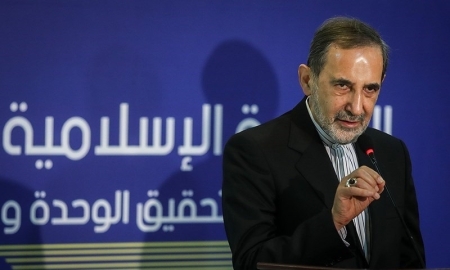
During the visit of a high-level Hamas delegation to Iran last week, Ali Velayati (pictured above in 2016), a senior Iranian politician and advisor to Supreme Leader Ayatollah Ali Khamenei, told the visiting Hamas officials: “We congratulate you on your refusal to abandon your weapons…” (Image source: Hamed Malekpour/Wikimdia Commons)

Arouri and his colleagues rushed to Tehran to seek the support of the Iranian regime in the wake of demands by Abbas that Hamas allow the Palestinian Authority to assume security control over the Gaza Strip. The “reconciliation” agreement stipulates nothing about the need for Hamas to disarm, and Hamas officials have stressed during the past two weeks that they have no intention of laying down their weapons or dismantling their security apparatus in the Gaza Strip.

Hamas views the demand to disarm as part of an Israeli-American “conspiracy” designed to eliminate the Palestinian “resistance” and thwart the “reconciliation” accord with Abbas’s Fatah. Hamas’s refusal to disarm is already threatening to spoil the “reconciliation.”

Arouri was quoted during his visit to Tehran as saying that Hamas “will not backtrack on the option of defending the Palestinian people.” He specified that the “reconciliation” agreement with Fatah would not affect the weapons of the Palestinian “resistance,” including Hamas. Hamas, he added, will “confront the Israeli-American conspiracy through national unity and reconciliation and by continuing the resistance. The Palestinian resistance forces will always stick to their weapons and will not lay them down.”

Hamas also sees the visit of its top officials to Tehran as a rejection of Israel’s demand that it cut off its ties with Iran. Hamas officials say they continue to see their relations with Iran as “strategic and significant,” especially in wake of Tehran’s financial and military aid to their movement in the Gaza Strip.

By aligning itself with Iran, Hamas is also seeking to resist any demand that it abandon its ideology and charter, which call for the destruction of Israel and oppose any peace process between Israelis and Palestinians.

Iranian officials apparently do not like Mahmoud Abbas and the Palestinian Authority and are not keen on seeing them return to the Gaza Strip. Iran considers Abbas a “traitor” because his Palestinian Authority conducts security coordination with Israel in the West Bank and claims that it is committed to a “peace process” with Israel. This position goes against Iran’s wish to destroy the “Zionist entity.”

Abbas, for his part, has always considered Iran a threat to his regime as well as to stability in the region. In the past, he has criticized Iran for “meddling” in the internal affairs of the Palestinians by supporting Hamas and Palestinian Islamic Jihad in the Gaza Strip.

Earlier this year, the Palestinian Authority strongly condemned Iran after a senior Iranian official accused Abbas of waging war in the Gaza Strip on behalf of Israel. The official’s statement came in response to a series of punitive measures imposed by Abbas on the Gaza Strip.

Abbas’s spokesman, Nabil Abu Rudaineh, accused Iran of meddling in the internal affairs of the Palestinians and some Arab countries. He said that Iran’s actions “encouraged divisions” among the Palestinians. “Iran must stop feeding civil wars in the Arab world,” he said. “Iran must stop using rhetoric that only serves Israel and the enemies of the Arabs.”

Abbas and the Palestinian Authority are now convinced that Iran is working towards foiling the “reconciliation” agreement with Hamas. They believe that Iran invited the Hamas leaders to Tehran to pressure them not to lay down its weapons.

Abbas and the Egyptians were probably naïve to think that Hamas would disarm and allow Abbas loyalists to deploy in the Gaza Strip after the signing of the “reconciliation” agreement. It is possible that some of the Hamas leaders had lied to Abbas and the Egyptians by hinting that Hamas would give up security control of the Gaza Strip.

The Egyptians, who played a major role in brokering the Hamas-Fatah deal, are also believed to be worried about Iran’s renewed meddling in the internal affairs of the Palestinians. Both the Palestinian Authority and Egypt see the visit of the Hamas delegation to Iran as a serious setback to the “reconciliation” agreement and as a sign that Hamas is not sincere about implementing the accord.

Some Palestinian Authority and Hamas officials have recently claimed that Israel was not happy with their “reconciliation” agreement and was doing its utmost to foil it. The truth, however, is that it is Iran and Hamas that are working to thwart the agreement by insisting on maintaining the status quo in the Gaza Strip. Iran’s message to Hamas: If you want us to continue providing you with financial and military aid, you must continue to hold on to your weapons and reject demands to disarm.

What is in it for Iran? Iran wants Hamas to retain its security control over the Gaza Strip so that the Iranians can hold onto another power base in the Middle East.

Iran wants Hamas to continue playing the role of a proxy, precisely as Hezbollah functions in Lebanon.

The last thing Iran wants is for the Palestinian Authority security forces to return to the Gaza Strip: that would spoil Tehran’s plans to advance its goal of destroying Israel.

Iran’s continued support for Hamas stems not out of love for either Hamas or the Palestinians, but from its own interest in consolidating its presence in the Middle East.

Many Palestinians see the “successful” visit of the Hamas officials to Tehran as a major setback for efforts to end the 10-year-long Hamas-Fatah dispute. Similarly, the Egyptians are now wary of the sudden rapprochement between Iran and Hamas and are beginning to ask themselves whether they have been duped by Hamas. An Israeli delegation that visited Cairo on the eve of the signing of the Hamas-Fatah deal is said to have warned the Egyptians that the “reconciliation” would not work unless Hamas disarms and severs its ties with Iran. However, the Egyptians reportedly failed to listen to the Israeli warning.

As for Israel, the US and other Western parties, the lesson to be drawn from the renewal of ties between Hamas and Iran is that Hamas has not changed one iota.

Contrary to delusional hopes, discussed on the heels of the “reconciliation” agreement in Cairo and based on lies and thin air, Hamas is not headed toward moderation and pragmatism. By openly supporting Hamas, Iran is once again demonstrating that it aims to fan the fire in the Middle East and continue to sabotage any prospects for peace.

Khaled Abu Toameh, an award-winning journalist, is based in Jerusalem.

In This Round of Reconciliation Talks, Hamas is the Great Victor

October 5, 2017

In This Round of Reconciliation Talks, Hamas is the Great Victor, FrontPage MagazineCaroline Glick, October 5, 2017

Tuesday’s surrender ceremonies tell us two things.

First, the notion that Fatah is even remotely interested in defeating Hamas is complete nonsense. For 10 years since its forces were humiliated and routed in Gaza, Fatah has faithfully funded and defended Hamas. Abbas’s only concern is staying in charge of his Israeli-protected fiefdom in Ramallah. To this end, he will finance – with US and EU taxpayer monies – and defend another 10 Hamas wars with Israel.

The second lesson we learn from Hamas’s victory is that we need to curb our enthusiasm for Sisi and his regime in Egypt, and for his backers in the UAE. Sisi’s decision to facilitate and mediate Hamas’s newest victory over Fatah shows that his alliance with Israel is tactical and limited in scope. His decision to side with Israel against Hamas during Operation Protective Edge three years ago may not repeat itself in the next war.

*****************************************

Originally published by the Jerusalem Post

On Tuesday, a delegation of 400 Fatah officials from Ramallah, led by Palestinian Authority Prime Minister Rami Hamdallah, arrived in Gaza to officially surrender to Hamas.

No, the ceremony isn’t being portrayed as a Fatah surrender to Hamas. But it is. It’s also an Egyptian surrender to Hamas.

How is this the case? Ten years ago this past June, after a very brief and deadly assault by Hamas terrorists against US-trained Fatah forces in Gaza, the Fatah forces cut and ran to Israel for protection. Fatah politicians also headed for the border and then scurried into Fatah-controlled (and Israeli protected) Ramallah. Ever since, Hamas has served as the official authority on the ground in Gaza. Its personnel have been responsible for internal security and for Gaza’s borders with Egypt and Israel.

Despite their humiliating defeat and removal from Gaza, Fatah and its PA government in Ramallah continued to fund Hamas-controlled Gaza. They paid Gaza’s bills, including the salaries of all the PA security forces that were either no longer working or working double shifts as stay at home Fatah gunmen and up and coming Hamas terrorist forces.

The PA paid Hamas’s electricity bills to Israel and it paid Israeli hospitals which continued to serve Gaza.

Internationally, the PA defended Hamas and its constant wars against Israel. The PA and Fatah, led by President-for-life Mahmoud Abbas, continued to use Israel’s defensive operations against Hamas as a means to ratchet up their political war against Israel. The latest victory in that war came last week with Interpol’s decision to permit the PA to join the organization despite its open support for and finance of terrorism.

For most of the past decade, the PA-Fatah has allocated more than half of its EU- and US-underwritten budget to Hamas-controlled Gaza. It has defended its actions to successive delegations of US lawmakers and three US administrations. It has defended its actions to EU watchdog groups. No amount of congressional pressure or statements from presidential envoys ever made a dent on Abbas’s strident devotion to paying the salaries of Hamas terrorists and functionaries.

But then, in April, Abbas cut them off.

Ostensibly he cut them off because he was under pressure from the US Congress, which is now in the end stages of passing the Taylor Force Act. Once passed, the law will make it a bit more difficult for the State Department to continue funding the terror- financing PA.

While the Taylor Force Act is the ostensible reason for Abbas’s move, Palestinian sources openly acknowledge that congressional pressure had nothing to do with his decision.

Abbas abruptly ended PA financing of Hamas in retaliation for Hamas’s decision to open relations with Abbas’s archrival in Fatah, Muhammad Dahlan.

From 1994, when the PA was established, until 2007, when Hamas ousted his US-trained forces from Gaza, Dahlan was the Gaza strongman.

Once one of Abbas’s closest cronies, since 2011 Dahlan has been his archenemy. Abbas, now in the twelfth year of his four-year term in office, views Dahlan as the primary threat to his continued reign.

As a consequence, he ousted Dahlan from Fatah and forced him to decamp with his sizable retinue to the UAE. There Dahlan enjoys exceedingly close ties with the Nahyan regime.

The UAE is allied with Egyptian President Abdel Fattah Sisi. Both view Hamas’s mother organization the Muslim Brotherhood as their mortal foe. As a result, Sisi and the UAE as well as Saudi Arabia sided with Israel in its 2014 war with Hamas.

Since May, the UAE, Saudi Arabia and Egypt have been in open conflict with Qatar. Qatar, which sponsors the Muslim Brotherhood, has long sponsored Hamas as well.

Since the start of the year, the UAE has been interested in prying Hamas away from Qatar. And so with the blessing of his UAE hosts, Dahlan began building ties with Hamas.

Recognizing Dahlan’s close ties to the UAE and through it, with Sisi, Hamas, which has been stricken by Sisi’s war against it, and particularly Sisi’s enforcement of the closure of Gaza’s border with Egypt’s Sinai, was quick to seize on Dahlan’s initiative.

The talks between Dahlan and Sisi on the one hand and Hamas on the other were ratcheted up in April after Abbas cut his funding to Gaza.

In May, Hamas formally cut its ties with the Muslim Brotherhood.

In exchange, Sisi permitted the Rafah border crossing with Gaza to open for longer hours and permitted Gazans to transit Egypt en route to their religious pilgrimage to Saudi Arabia, among other things.

To build its leverage against Abbas, beginning in the spring, Hamas began describing Dahlan as a viable alternative to Abbas. The UAE agreed to begin financing Hamas’s budget and to help pay for electricity.

Against this backdrop, it is self-evident that Abbas didn’t send his own representatives to Cairo to negotiate a surrender deal with Hamas because his aid cut-off brought Hamas to its knees. Abbas sent his people to Cairo because Hamas’s double dealing with Dahlan brought Abbas to his knees.

As for Sisi, Hamas has also played him – and the UAE.

Over the past few months, Hamas has been rebuilding its client relationship with Iran. A senior Hamas delegation visited Tehran last month for Iranian President Hassan Rouhani’s swearing-in ceremony.

They met there with Iranian Foreign Minister Javad Zarif and with senior Revolutionary Guards commanders.

A month earlier, senior Hamas terrorist Salah Arouri, who lives under Hezbollah protection in Beirut, paved the way for the reconciliation in a meeting under Hezbollah sponsorship with senior Revolutionary Guards commander Amir Abdollahian.

Following the meeting in Tehran, Hamas leader in Gaza Yahya Sinwar extolled Hamas’s relations with Iran as “fantastic.” Sinwar also said that Iran is “the largest backer financially and militarily” of Hamas’s terrorism apparatus.

Concerned about Tehran’s growing influence in Gaza, and through it, the Sinai, where Sisi continues to fight against an Islamic State-backed insurgency, Sisi has an interest in tempering Hamas’s client-ties to Tehran.

So just as Abbas has decided to restore financing to Hamas to keep Dahlan at bay, so Sisi has decided to embrace Hamas to keep Iran at bay.

In all cases, of course, Hamas wins.

The fact that Hamas has just won is obvious when we consider the unity deal it just concluded with Fatah.

Hamas made one concession. It agreed to break up its civil governing authority – a body it formed in response to Abbas’s decision to cut off funding in April. In exchange for agreeing to disband a body it only formed because Abbas cut off its funding, Hamas receives a full restoration of PA funding. The PA will fund all civil service operations in Gaza. It will pay the salaries of all civil servants and security personnel in Gaza. It will pay salaries to all Hamas terrorists Israel freed from its jails.

In other words, the PA will now be responsible for keeping the lights on and picking up the garbage.

And Hamas will be free to concentrate on preparing for and initiating its next terror war against Israel. It can dig tunnels. It can build missiles. It can expand its operational ties with Hezbollah, Islamic State, Iran’s Revolutionary Guard Corps and Fatah.

In the wake of Hamas’s leadership’s meetings in Tehran, Sinwar told reporters that Hamas is now moving full speed ahead toward doing all of these things. Sinwar said that Hamas is “developing our military strength in order to liberate Palestine.” He added, “Every day we build missiles and continue military training.”

Thousands of people, he said, are working “day and night” to prepare Hamas’s next terror war against Israel. And indeed, two weeks ago, two Hamas terrorists were killed when the tunnels they were digging collapsed on them.

Tuesday’s surrender ceremonies tell us two things.

First, the notion that Fatah is even remotely interested in defeating Hamas is complete nonsense. For 10 years since its forces were humiliated and routed in Gaza, Fatah has faithfully funded and defended Hamas. Abbas’s only concern is staying in charge of his Israeli-protected fiefdom in Ramallah. To this end, he will finance – with US and EU taxpayer monies – and defend another 10 Hamas wars with Israel.

The second lesson we learn from Hamas’s victory is that we need to curb our enthusiasm for Sisi and his regime in Egypt, and for his backers in the UAE. Sisi’s decision to facilitate and mediate Hamas’s newest victory over Fatah shows that his alliance with Israel is tactical and limited in scope. His decision to side with Israel against Hamas during Operation Protective Edge three years ago may not repeat itself in the next war.

Palestinian ‘Reconciliation’: Jihad is Calling!

September 25, 2017

Palestinian ‘Reconciliation’: Jihad is Calling! Gatestone InstituteBassam Tawil, September 25, 2017

(To what extent does the “international community” agree with Hamas and the Palestinian Authority that Israel must be destroyed? — DM)

Hamas insists on maintaining its terror and military capabilities in preparation for war against Israel.

At the risk of overwhelming the international community with troubling facts, here is a final one: Hamas aims to use the agreement with the Palestinian Authority as a smokescreen for concealing its true goal: the destruction of Israel.

Here is how it works: Hamas is telling Abbas, “You continue to pretend as if you want to talk peace with the Jews, while we prepare for war.”

*************************************

Leaders of Hamas maintain that under no circumstances will they agree to lay down their weapons. Hamas is, in fact, continuing full-speed-ahead digging tunnels under the border between the Gaza Strip and Israel. Hamas is planning to use the tunnels to smuggle armed terrorists into Israel.

The accord with Hamas requires Mahmoud Abbas to lift the sanctions he recently imposed on the Gaza Strip, such as refusing to pay Israel for the electricity it supplies to Gaza. It also requires Abbas to resume payment of salaries to thousands of Palestinians who served time in Israeli prison for terror-related offenses.

Above all, Hamas wants to use the agreement to be removed from the U.S. State Department List of Foreign Terror Organizations.

The Russians are closing their ears to what Hamas itself declares day after day: that its true goal is to eliminate Israel and that it has no intention of abandoning its murderous, genocidal agenda.

The Palestinian terror group Hamas has once again made clear that its true intention is to pursue the fight against Israel until the “liberation of Palestine, from the (Jordan) river to the (Mediterranean) sea.” Hamas, which controls the Gaza Strip, says that despite the latest “reconciliation” agreement reached with the Palestinian Authority (PA) under the auspices of the Egyptian government, it will continue to prepare for war with Israel.

While some Western analysts have misinterpreted the agreement as a sign that Hamas is moving towards moderation and pragmatism, leaders of the Islamist movement maintain that under no circumstances will they agree to lay down their weapons. Hamas is, in fact, continuing full-speed-ahead digging tunnels under the border between the Gaza Strip and Israel. Hamas is planning to use the tunnels to smuggle armed terrorists into Israel.

Just last week, two Hamas terrorists were killed when the tunnels in which they were working collapsed, in separate incidents in the Gaza Strip. The terrorists were identified as Khalil Al-Dumyati and Yusef Abu Abed.

The news about the collapse of the tunnels coincided with the reports of the new “reconciliation” agreement reached in Cairo between Hamas and the Palestinian Authority (PA). This means that while the Egyptians and Abbas’s representatives were discussing with Hamas leaders ways of ending their 10-year-long dispute and achieving “national unity,” Hamas terrorists were busy tunneling under the Gaza Strip to prepare for attacks on Israel.

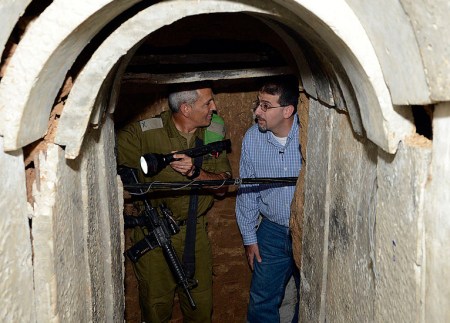
Pictured: On October 17, 2013, then U.S. Ambassador to Israel Dan Shapiro visited a tunnel penetrating Israel from Gaza, which had been discovered by the Israeli army. Shapiro said: “I was shocked from what I saw in the tunnel. It is clear that this tunnel has only one purpose: to carry out terrorist attacks against Israeli civilians and IDF soldiers.” (Image source: Matty Stern/U.S. Embassy Tel Aviv)

The “reconciliation” accord does not require Hamas to stop terror attacks on Israel. Nor does it require Hamas to abandon its charter, which explicitly calls for the elimination of Israel. Instead, the agreement, which has yet to be implemented, requires Abbas’s PA government to resume funding for various government institutions and civil servants in the Gaza Strip.

In other words, this agreement benefits Hamas by absolving it of its responsibilities toward the two million Palestinians living under its control in the Gaza Strip. Moreover, the agreement emboldens Hamas by allowing it to redirect its resources and energies towards amassing weapons and digging tunnels to be used for launching terror attacks against Israel. The accord requires Abbas to lift the sanctions he recently imposed on the Gaza Strip, such as refusing to pay Israel for the electricity it supplies to Gaza, reducing medical supplies and forcing thousands of civil servants in the Gaza Strip into early retirement. It also requires Abbas to resume payment of salaries to thousands of Palestinians who served time in Israeli prison for terror-related offenses. All this in return for one “concession” on the part of Hamas: dismantling the shadow government it established in the Gaza Strip a few months ago — something to which Hamas happily agreed in return for Abbas lifting the sanctions.

Make no mistake: Hamas has no intention of relinquishing security control over the Gaza Strip. Thousands of Hamas “security officers” and members of its military wing, Ezaddin Al-Kassam, will remain the law-enforcement force in the Gaza Strip. This means that even if Abbas’s government will be allowed to operate in the Gaza Strip, it would have limited civilian powers only, such as paying salaries and funding various projects.

One week after the Cairo “reconciliation” agreement, Hamas is still urging Abbas to lift the sanctions he imposed on the Gaza Strip. Why the rush? Jihad against Israel is calling. Hamas’s message to Abbas: Hurry up and give us the funds because we need to invest our energies and money in building more tunnels and smuggling weapons (through Egypt) into the Gaza Strip.

Hamas has been seeking international recognition and legitimacy and is hoping that the agreement with Abbas’s Palestinian Authority will facilitate this mission. Above all, Hamas wants to use the agreement to be removed from the U.S. State Department List of Foreign Terror Organizations.

This position was relayed last week to the Russian government by a senior Hamas delegation that visited Moscow. Hamas is hoping that in wake of the Egyptian-sponsored agreement with the PA, the Russians will exert pressure on the U.S. to remove Hamas from the terror list.

Musa Abu Marzouk, a senior Hamas official who participated in the Moscow discussions, confirmed that he and his friends had asked the Russians for their help. “We asked the Russians to help stop the US from keeping Hamas on the (terror) list,” Abu Marzouk said. “We also asked that the Russians help remove the (Israeli and Egyptian) blockade on the Gaza Strip.” Abu Marzouk and the Hamas delegation appear to have found a sympathetic ear in Moscow. They now claim that the Russians told them that Moscow does not consider Hamas a terror organization “because Hamas won a free and fair (parliamentary) election in 2006.”

If true, the Russians seem to have bought the lie that Hamas is headed towards moderation and pragmatism, supposedly thanks to the latest “reconciliation” agreement. More disturbing still, concerning the reported Russian position, is that Moscow, it seems, does not view Hamas as a terror group; the reason for this omission is apparently that Hamas “won” an election. The Russians are ignoring the fact that since Hamas won in 2006, the terror movement has launched thousands of rocket and other terror attacks against Israel. The Russians are also ignoring Hamas’s continued buildup and preparation for war by digging tunnels and amassing weapons in the Gaza Strip. More significantly, the Russians are closing their ears to what Hamas itself declares day after day: that its true goal is to eliminate Israel and that it has no intention of abandoning its murderous, genocidal agenda.

How do the Russians and the rest of the world define “non-negotiable”? The same way as Abu Marzouk after the Moscow visit, with regards to the Hamas weapons: “The weapons of the resistance belong to all the Palestinians and are non-negotiable,” Abu Marzouk emphasized. “No one can tamper with this issue.”

The statement means that Hamas insists on maintaining its terror and military capabilities in preparation for war against Israel.

At the risk of overwhelming the international community with troubling facts, here is a final one: Hamas aims to use the agreement with the Palestinian Authority as a smokescreen for concealing its true goal: the destruction of Israel.

Here is how it works: Hamas is telling Abbas, “You continue to pretend as if you want to talk peace with the Jews, while we prepare for war.”

In the eyes of Hamas, the “reconciliation” agreement should serve as functional sharing between the PA and Hamas, with each side playing the role it wants. Abbas will go on pretending he wants peace, while Hamas builds more tunnels and acquires additional weapons. That is their real agenda: Hamas wants to collaborate with Abbas in fooling the world. Abbas’s job will be to “pursue peace” and rake in the money, while Hamas plans for the next round of terrorism against the Jews.

It remains to be seen whether the Western-funded Palestinian Authority will be complicit in this scheme to scam the world. Also interesting should be seeing whether the international community will once again fall into the web of lies woven by the master manipulators, Abbas and Hamas.

Bassam Tawil is a Muslim based in the Middle East.

Crossing the Rubicon

August 27, 2017

Crossing the Rubicon, Israel Hayom, Sarah N. Stern, August 27, 2017

On Wednesday, at a U.S. State Department press briefing, the Rubicon was finally crossed. Responding to a question regarding Israeli-Palestinian ‎peace, spokeswoman Heather Nauert said, “We want to work toward a peace that both sides can agree to and both sides find ‎sustainable. … We believe that both parties should be able to find a workable solution that works for ‎both of them. We are not going to state what the outcome has to be. … It’s been many, many decades, ‎as you well know, that the parties have not been able to come to any kind of good agreement and ‎sustainable solution to this. So we leave it up to them to be able to work through that.”‎

This is the most constructive statement I have heard about the Israeli-Palestinian conflict in decades. ‎For the last several years, the “experts” have been saying, “We all know what a solution to the ‎Palestinian-Israeli conflict looks like.”

If anyone ever took the time to listen to the parties themselves, and examine the cultural context in ‎which these words are spoken, they would immediately understand that the single most critical litmus ‎test for determining a negotiating partner’s real intentions is not what they say to visiting diplomats ‎and journalists in English, but what they say among themselves in their own language, and in particular, what they ‎teach their children. ‎

According to John Calvin (formerly “Jonaid Salameh,” before his conversion to Christianity), an EMET fellow who was born in Nablus, from the very earliest age, he ‎was taught there would not be two states, but one state called Palestine. An important slogan on everyone’s tongue in the disputed territories is “Lama neharherah,” meaning “When we free ‎it” — and “it” is all of Israel.

Calvin told me ‎that this belief is a certainty, that the average Palestinian feels it is destiny that eventually all of the ‎land will be free of Jews.‎

Surah 8, verse 38 of the Quran says, “Tell the unbelievers that if they desist from evil, their past shall be forgiven and if they revert to their past ways, then it is well known what happened with the people of the past.” According to Calvin, the interpretation is clear: There should ‎be conflict until all worship is only to Allah.

Part of this cultural context implies a different meaning of the word “peace.” Accepting the existence ‎of the other on their own terms is incompatible with true Islamic thought. Islam is a religion of ‎conquest.‎

Says Calvin, “The conception of peace, as we know it in the West, simply does not exist within Islam. ‎There can be a “hudna,” a temporary cessation of war, but only to regroup. Islam means total ‎submission, or surrender, and a permanent peace can only happen when the entire world surrenders ‎to Islamic rule. There is that sort of messianic concept of peace, but only after the entire world submits ‎to Islamic rule.”‎

Many individual Muslims, particularly in places like Indonesia, Pakistan and India, where Arabic is not the ‎native tongue, may not understand the Quran in a literal sense, and thus, may not hold these sort of ‎hegemonic beliefs.‎

Most Americans, including many so-called “experts” in the field, have no idea of the cultural context with which ‎they are dealing when they set out to solve the Israeli-Palestinian dispute.‎

In former U.S. President Bill Clinton’s autobiography, “My Life,” he describes how profoundly disappointed he had been with then-PLO Chairman ‎Yasser Arafat after generous offers were made to the Palestinian leader by Prime ‎Minister Ehud Barak in the Camp David negotiations. Arafat did not respond in the affirmative or the ‎negative, but simply walked away from the table. His response came several months later, in the ‎form of the Second Intifada.

In a moving chapter, Clinton describes how, just as he was about to leave office, ‎Arafat called him up and told him he was a great man.‎

“Mr. Chairman,” Clinton replied, “I am not a great man. I am a failure, and you have made me one.”

It obviously has been more important for Arafat, as well as his successor, Mahmoud Abbas, who turned down an ‎even more generous offer from Prime Minister Ehud Olmert, to continue the struggle then to arrive at a permanent ‎peace.‎

For decades, too many Western leaders and diplomats have tried to impose a solution that ‎looks ideal when viewed through Western lenses. ‎

These statesmen, however, do not have to be there on the ground when the maximalist offers are ‎walked away from, and the inevitable violence ensues. ‎

Thank you, Heather Nauert, for taking us a bit closer to reality.‎

Sarah N. Stern is founder and president of EMET, the Endowment for Middle East Truth, a pro-Israel think tank and policy shop in Washington, D.C.‎

Abdullah’s friendly reminder to Abbas

August 13, 2017

Abdullah’s friendly reminder to Abbas, Israel Hayom, Dr. Ronen Yitzhak, August 13, 2017

Abdullah’s visit was in fact aimed at reining in Abbas following his handling of the crisis in Jerusalem. Abbas has been outspoken as of late in his criticism of the understandings between Israel and Jordan, and has effectively been edging Jordan out of the Temple Mount by allowing radical Islamist elements to gain a foothold there.

****************************

According to senior Palestinian official Dr. Mohammad Shtayyeh, the Jordanian king’s visit to Ramallah last week is proof that “the Palestinians and the Jordanians speak with one voice.”

Indeed, King Abdullah’s visit appears to have been aimed at bolstering the position of Palestinian Authority President Mahmoud Abbas in light of recent tensions with Israel over the Temple Mount. Arab media outlets reported that the two leaders discussed increasing cooperation between Jordan and the PA, as well as the need to advance peace talks between the PA and Israel.

Despite this public show of solidarity, it seems Abdullah’s visit was in fact aimed at reining in Abbas following his handling of the crisis in Jerusalem. Abbas has been outspoken as of late in his criticism of the understandings between Israel and Jordan, and has effectively been edging Jordan out of the Temple Mount by allowing radical Islamist elements to gain a foothold there.

Abdullah also demanded stability in the West Bank. He knows violence in the Palestinian territories could spill over into the Hashemite Kingdom, and is therefore constantly working to ensure the PA’s continued rule over the West Bank.

The timing of the visit is no coincidence. Jordanians are currently furious at Israel and at Abdullah, who is seen as working in cahoots with the Israeli government in the recent shooting incident at the Israeli Embassy compound. (He allowed Israeli Embassy guard Ziv Moyal, who shot and killed two Jordanians after being attacked with a screwdriver, and the embassy staff to leave Jordan without being investigated for the shooting, which sparked a diplomatic crisis [LINK: http://www.israelhayom.com/site/newsletter_article.php?id=44183%5D.) Abdullah’s visit to Ramallah, therefore, was also aimed at demonstrating to his people that he is not a collaborator.

According to Jordan’s official news agency, Petra, Abdullah made it abundantly clear to Abbas that Jordan would continue to fulfill its historic role as guardian of Jerusalem’s holy sites. Although this message was outwardly directed at Israel, it was also a reminder to the PA that it is the Jordanians, and not the Palestinians or the Arabs or any other group, who determine the policy in Jerusalem.

And so the king made the politically wise decision to come to Ramallah. Abdullah’s visit allowed him to demonstrate his solidarity with Palestinians, while simultaneously reminding Abbas that when it comes to Jerusalem, he is in charge.

Palestinians Escalate War on Journalists

August 12, 2017

Palestinians Escalate War on Journalists, Gatestone Institute, Bassam Tawil, August 12, 2017

They said they did not know what “sensitive information” Mahmoud Abbas and the Palestinian Authority (PA) were trying to hide.

Today, it is safe to say that the situation of the freedom of the media under the PA and Hamas is not much different than that under Bashar Assad’s Syria or even North Korea.

Palestinian journalists’ hateful obsession with Israel brings them no dividends. Rather, such venomous bias diverts attention from the true challenges and threats they face from the PA and Hamas. By expending their efforts in this twisted fashion, the journalists aid and abet their leaders in building dictatorial regimes that suppress public freedoms.

As part of its overarching effort to silence critics, President Mahmoud Abbas’s Palestinian Authority (PA) has resumed its war against Palestinian journalists who refuse toe the line or are suspected of being insufficiently loyal to their leaders in Ramallah.

But this is nothing new: Abbas and his team have long been notoriously intolerant of news stories that reflect negatively on them in particular and on Palestinians in general.

In the past few days, PA security forces arrested six Palestinian journalists from Bethlehem, Nablus and Hebron. The journalists — Mamdouh Hamamreh, Qutaiba Kassem, Tarek Abu Zeid, Amer Abu Arafeh, Thaer Al-Fakhouri and Ahmed Al-Halaykeh — are suspected of “leaking sensitive information to hostile parties.”

This is the first time that Abbas’s PA has made such a ridiculous charge against Palestinian journalists. In an attempt to justify the latest crackdown on freedom of the media, Abbas’s news agency, Wafa, published a statement by an unnamed “senior security source” who said that the detained journalists were being interrogated about their role in “leaking sensitive information to hostile parties.” The detained journalists, meanwhile, have gone on hunger strike to protest their incarceration.

Upon hearing about the baseless charge, many Palestinian journalists said they did not know whether to laugh or cry. They said they did not know what “sensitive information” Abbas and the PA were trying to hide.

“We don’t have nuclear facilities,” remarked a Palestinian journalist from east Jerusalem sarcastically. “It’s clear that the Palestinian Authority leadership is using the security issue as an excuse to justify its punitive measures against journalists.”

Another Palestinian journalist from Ramallah scoffed at the charge against his colleagues. “This is the most ridiculous claim I’ve heard in years,” he commented. “It reminds us of Arab dictators who accuse their opponents and critics of revealing state secrets and consuming narcotics.”

That the PA leadership has refused to provide further details about the nature of the offense committed by the suspected journalists has only reinforced the belief that they were targeted as part of an ongoing campaign by Abbas and his lieutenants to silence critics and deter other journalists from doing their job or reporting any story that could reflect negatively on the Palestinian leaders.

Some Palestinian journalists take a different view of the matter. These reporters trace the arrest of the six journalists to a desire to pressure Hamas to release two journalists it is holding in the Gaza Strip: Amer Abu Shabab and Fuad Jaradeh.

In other words, the PA security forces are holding the six journalists hostage until Hamas frees the two newsmen it is holding. The journalists detained by the PA work for Hamas-affiliated media outlets in the West Bank.

Notably, the two Palestinian regimes – the Palestinian Authority in the West Bank and Hamas in the Gaza Strip — have hardly championed freedom of speech and freedom of the media. In fact, the two parties share the same values when it comes to silencing all forms of criticism. Dozens of Palestinian journalists have been targeted over the past two decades by both the PA and Hamas.

These regimes have their own special way of defining freedom of the press. That is, the press is utterly free to blacken the name of Israel. The name of Hamas or the PA, however, is sacrosanct: criticism of either would land a Palestinian reporter behind bars or in an interrogation room.

Hamas and the PA prefer that the press pound Israel. Short of that, they tolerate journalistic critique of municipal services or the shortage of medicine in hospitals.

Today, it is safe to say that the situation of the freedom of the media under the PA and Hamas is not much different than that under Bashar Assad’s Syria or even North Korea. The failure to achieve a free media for the Palestinians is yet another sign of the Palestinian failure to build proper and transparent state institutions.

The Palestinians have no functioning parliament, no open debate and no free media. In the West Bank, the media is controlled, directly and indirectly, by Abbas and his loyalists. In the Gaza Strip, the only “media” is that which is controlled by Hamas — again, directly and indirectly.

But there is an interesting twist to the latest story of Palestinian Authority and Hamas assaults on freedom of the media. Sadly, many Palestinian journalists do not seem to care much about the harassment and suppression of their colleagues at the hands of their leaders in Ramallah and the Gaza Strip.

Instead of organizing widespread protests to demand the release of their colleagues who are being tortured by PA and Hamas interrogators, Palestinian journalists are still scapegoating Israel. Incredibly, they continue to incite against Israel despite the fact that they are being detained and tortured by the PA and Hamas.

Instead of demanding the release of their six colleagues from PA prison, some Palestinian journalists are protesting because some Israeli (Jewish) journalists came to Ramallah last week to cover the visit of Jordan’s King Abdullah II.

The presence of the Israeli reporters in Ramallah enraged several Palestinian journalists, who took to social media to condemn the Palestinian Authority leadership that gave them permission to come and cover the monarch’s visit.

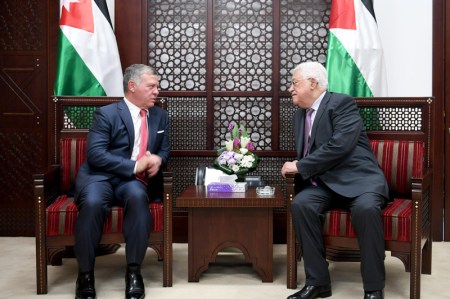
The presence of Israeli reporters in Ramallah last week, to cover the visit of Jordan’s King Abdullah II, enraged several Palestinian journalists, who took to social media to condemn the Palestinian Authority leadership that gave them permission to cover the visit. (Image source: Palestinian President’s Office)

In this cartoon by Palestinian cartoonist Mohammad Sabaaneh, an Israeli journalist, carrying a microphone dripping with blood, is interviewing a dog.

Such incitement was easy to find on Palestinian social media websites this week. The presence of several Israeli Arab journalists seemed to roll right over the racist, raging Palestinian journalists — it is the presence of Jewish journalists that they cannot stand.

This attack on Israeli journalists has been backed by the Palestinian Journalists Syndicate (PJS), a Fatah-affiliated group headed by Nasser Abu Baker, a correspondent of the evidently unprofessional Agence France-Press: Baker has also run for election in the Fatah Revolutionary Council.

In a statement published in Ramallah, the PJS strongly condemned the presence of Israeli (Jewish) journalists in Ramallah and urged Abbas to hold accountable whoever gave the Israeli journalists permission to come to the city to cover the Jordanian king’s visit.

It seems that for the PJS, the presence of Israeli (Jewish) reporters in Ramallah is more disturbing than the arrest of Palestinian journalists by the PA and Hamas.

For the record, in recent years the PJS has served as a mouthpiece for Abbas’s office; instead of defending the rights of Palestinian journalists, it devotes more than 95% of its words and actions to denouncing Israel and whipping up rage against Israeli journalists.

Palestinian journalists’ hateful obsession with Israel brings them no dividends. Rather, such venomous bias diverts attention from the true challenges and threats they face from the PA and Hamas. By expending their efforts in this twisted fashion, the reporters aid and abet their leaders in building dictatorial regimes that suppress public freedoms.

Bassam Tawil, an Arab Muslim, is based in the Middle East.

Abdullah in Ramallah will strike anti-Israel stance

August 5, 2017

Abdullah in Ramallah will strike anti-Israel stance, DEBKAfile, August 5, 2017

Jordanian King Abdullah’s forthcoming visit to Ramallah Monday, Aug. 7, for talks with Palestinian Authority Chairman Mahmoud Abbas, bodes ill for Jordanian-Israeli relations at an especially jarring moment.

The Israeli embassy security officer Ziv Moyal, who on July 24 shot dead two Jordanians in the embassy compound when he was attacked with a screwdriver, left a trail of Jordanian ill will in his wake, especially since the incident occurred in the middle of the Temple House crisis in Jerusalem.

King Abdullah proposes to turn this unfortunate incident into a springboard for persuading the Palestinian leader to work with Jordan in the framework of the peace initiative US President Donald Trump is trying to resuscitate between Israel and the Palestinians.

Abdullah also plans to take advantage of Israeli Prime Minister Binyamin Netanyahu at a moment of political and personal weakness. He is under a barrage of reported police investigations into allegations of corruption. Netanyahu has brushed the reports aside as “background noise.”

Jordan and Israeli signed a peace treaty in 2004. But since the shooting at the embassy, the Israeli ambassador and staff have not returned to Amman. And with tensions still running high, there is no sign that normal diplomatic business will be resumed any time soon.

In Ramallah, security cooperation between the Palestinian Authority and Israel is still suspended, since Abbas ordered a freeze in the heat of the Palestinian disturbances over the security measures Israel put in place after the murder of two of its police guards.

The Jordanian king believes that there is plenty of common fodder for him and the Palestinian leader to build a united front that will boost him politically and personally at home. The Hashemite throne is in urgent need of shoring up after the shaking it took from an event that had nothing to do with Temple Mount, Jerusalem or Israel.

Abdullah had to sign a life sentence handed down by a Jordanian court against Marik al-Tuwayha, a Jordanian soldier who fired 70 bullets into vehicle of carrying US military instructors, killing three of them.

The court also booted the shooter out of the royal armed forces.

This judgment was a direct hit at the Tuwayha, a Bedouin tribe that by tradition sends its sons to the royal army and is historically loyal to the Hashemite throne. The fact that one of those sons attacked American soldiers carried the dread message that extremist ISIS ideology has penetrated deep into the king’s most solid power base.

The monarch is therefore in an extremely tight spot: He can’t afford to lose the Tuwayha tribe’s allegiance, on the one hand, but neither can be afford to alienate the Americans, when the US along with Israel, are his regime’s economic and security mainstay.

Netanyahu’s warm hug for the security officer on his safe return from Amman put up too many backs in Jordan and its streets for its king to weather the storm without striking a strong anti-Israeli posture. The Palestinian leader will no doubt take advantage of this situation to stir up the crisis between Amman and Jerusalem and so and lift his own plummeting fortunes in the Palestinian street. The royal visit to Ramallah, the first Abdullah has made in five years, will most likely produce a stream of invective against Israel and tough statements assailing Israel’s right to sovereignty over Jerusalem and Temple Mount.


“The Battle over Jerusalem Has Just Begun”

August 1, 2017

“The Battle over Jerusalem Has Just Begun” Gatestone Institute, Bassam Tawil, August 1, 2017

(Please see also, Israel’s public diplomacy challenge. — DM)

The Palestinians, feeling triumphant now that Israel has complied with their demand to remove the metal detectors and security cameras, have been clarifying that it is only the first step in their fight to eradicate any Israeli presence in the Old City of Jerusalem and the Temple Mount.

They admit that this is a battle over sovereignty on the Temple Mount and Jerusalem. For the Palestinians, the real battle is over who controls Jerusalem and its holy sites. The real battle, in their eyes, is over the Jews’ right to live in their own state in the Middle East. Many Palestinians have still not come to terms with Israel’s right to exist, and that is what this battle is really about.

The Palestinians have added it up just right. In their own words, they aim at an escalation of violence because they believe that what Israel did is the first step toward even more concessions and even further retreat.

The Palestinian “victory” celebrations that took place after Israel removed metal detectors and surveillance cameras from the entrances to the Temple Mount in Jerusalem bode badly for the future of stability and peace in the Middle East.

To the Palestinians and many Arabs and Muslims, the Israeli move is viewed as a sign of weakness. In their eyes, the removal of the security cameras and metal detectors is capitulation, pure and simple.

How do we know this? Easy: look at the Palestinian response. Rather than acknowledging the conciliatory nature of the Israeli government’s decision, aimed at easing tensions and preventing bloodshed and violence, the Palestinians are demanding more.

As far as the Palestinians are concerned, the controversy over the Israeli security measures at the Temple Mount, which came after three terrorists murdered two Israeli police officers at the holy site on July 14, is part of a larger battle with Israel.

We have reached a new level in this discourse: Palestinian Authority (PA) officials are now openly admitting that it is not the metal detectors or security cameras that are at issue.

Instead, they admit, this is a battle over sovereignty on the Temple Mount and Jerusalem. For the Palestinians, the real battle is over who controls Jerusalem and its holy sites. The real battle, in their eyes, is over the Jews’ right to live in their own state in the Middle East. Many Palestinians have still not come to terms with Israel’s right to exist, and that is what this battle is really about.

The Palestinians, feeling triumphant now that Israel has complied with their demand to remove the metal detectors and security cameras, have been clarifying that it is only the first step in their fight to eradicate any Israeli presence in the Old City of Jerusalem and the Temple Mount.

No one explained this Palestinian position better than the PA foreign minister, Riad Malki, who announced on July 27 that the Palestinians consider the Israeli decision to dismantle the metal detectors and security cameras as surrender. He also confirmed what many Israeli and Palestinian political analysts have been saying for the past few weeks — that the conflict over Israel’s security measures was merely an excuse used by the Palestinians to force Israel to make political and territorial concessions.

In a speech before the Arab League foreign ministers in Cairo, Malki explained: “The issue is not metal detectors or cameras, but who is in charge and who has sovereignty over the Al-Aqsa Mosque.” Malki went on to explain that the Palestinians do not see the recent conflict as a security issue, but rather as a purely political matter. “The battle over Jerusalem has just begun,” he said, adding that the wave of Palestinian protests over the Israeli security measures had succeeded in “thwarting” Israel’s “conspiracy” to change the historical and legal status quo at the Temple Mount.

Palestinian Authority Foreign Minister Riad Malki (pictured above in 2009) said last week in a speech: “The issue is not metal detectors or cameras, but who is in charge and who has sovereignty over the Al-Aqsa Mosque… The battle over Jerusalem has just begun.” (Image source: Mario Tama/Getty Images)

We are witnessing a rare moment of truth from the PA foreign minister, in which, ironically, he refutes claims by many in the international community and media to the effect that the recent conflict was sparked by metal detectors and surveillance cameras.

The Palestinian protests that came in response to the security measures indicated that it was more about hating Israel and trying to force it to its knees than about the removal of metal detectors and cameras. During these protests, especially at the entrances to the Temple Mount, Palestinians chanted slogans that included threats to destroy Israel and kill Jews.

“We are marching toward Al-Aqsa (Mosque), and we will sacrifice millions of martyrs,” was one of the chants at the protests, which were led by top Palestinian religious and political leaders. Another chant: “Khaybar Khaybar ya yahud, jaish Mohammed sa yaoud” (“Khaybar Khaybar O’ Jews, the army of Mohammed will return”) — a reference to the Battle of Khaybar in the year 628 between Prophet Mohammed and his followers against the Jews living in the oasis of Khaybar. The Jews were forced to surrender after being slaughtered and were thereafter permitted to live in Khaybar on condition that they give half of their produce to Muslims. The protesters also chanted slogans calling on Hamas’s military wing, Ezaddin Al-Qassam, to launch terror attacks against Israel.

For the most part, the foreign journalists covering the protests did not perceive these chants as intimidating or anti-Semitic. The protests were largely reported in a positive sense as peaceful “civil disobedience.” This is precisely the rhetoric, however, that fuels the Palestinian fire to take to the streets and hurl stones and petrol bombs at Israeli police officers and civilians.

Eighteen-year-old Omar Al-Abed, however, is one Palestinian who paid careful attention to such rhetoric. On July 22, he stormed the home of a Jewish family in Halamish, in the West Bank, and stabbed to death a grandfather and his son and daughter during a dinner to celebrate the birth of a grandchild. Shortly before setting out on his murderous mission, Al-Abed posted a note on his Facebook page in which he echoed many of the slogans from the protests, and went further by describing Jews as “sons of pigs and monkeys.”

The carnage in Halamish was perpetrated by a single Palestinian. Perhaps he acted alone, without having been indoctrinated to murder Jews and without communal support for doing so? Well, let us check: how did the Palestinian street react to his murderous rampage? How did Al-Abed’s own mother respond? The terrorist’s mother was filmed handing out sweets to visitors in celebration of her son’s decision to take the lives of the three Jews. “I’m proud of my son because he has raised our heads high,” she declared.

Perhaps the pride in the terrorist was simply a local affair? No, even that hope is smashed: as many Palestinians, especially in the Gaza Strip, took to the streets to celebrate the brutal murder, Hamas leader Ismail Haniyeh phoned the terrorist’s father to tell him, “Your son brought pride to the nation.”

The Halamish bloodshed brought intense pride to the terrorist’s mother, to those around her, and to the Palestinian world at large.

Palestinian Authority President Mahmoud Abbas, who never misses an opportunity to paint himself as a peacemaker par excellence, chose to remain quiet about the murder. Make no mistake: his loud silence over the Halamish terror attack is being interpreted by many Palestinians as an act of condoning the murder of three Jews. Whether condoning the atrocity or terrified of his own people, one thing is certain: Abbas and most Palestinian leaders have trained the Palestinians well. When they smell Jewish blood, they attack.

This is precisely what is going on in the Temple Mount mayhem.

Now that Israel has complied with their demands regarding the security measures, Palestinians feel more emboldened than ever. Murder and incitement, in their case, does indeed pay. They got away with the murder of the two police officers at the Temple Mount; they got away with the murder of the three family members in Halamish, and, in their view, they also got away with the recent violent protests and incitement against Israel.

Buoyed by the Israeli “capitulation,” the Palestinians are now talking about a “historic victory” over Israel. They are boasting that they have twisted Israel’s arm and forced it to “retreat.” Palestinian cartoonists and commentators have expressed similar sentiments, arguing that the removal of the metal detectors and security cameras is largely the result of their violence, terrorism and threats.

Once again, an Israeli gesture is being misinterpreted by the Palestinians and other Arabs and Muslims as weakness. This sort of deliberate misreading is far from new. Yet every time it occurs, it sets the stage for another cycle of violence. The result of Israeli conciliation is invariably Palestinian violence.

The Palestinians have added it up just right. In their own words, they aim at an escalation of violence because they believe that what Israel did is the first step toward even more concessions and even further retreat.

Bassam Tawil is an Arab Muslim based in the Middle East.

Countering contemptuous Palestinians

July 28, 2017

Countering contemptuous Palestinians, Israel Hayom, David M. Weinberg, July 28, 2017

(In the present environment, “two state solution” would a precursor to the death of Israel. — DM)

Israel should unsheathe its sovereign power and put the extremists down; decisive action that one day might allow for Palestinian moderates to emerge.

****************************

The Palestinian Authority and its fiendish intra-Palestinian Islamic rivals seem hellbent on brinkmanship; on being belligerent adversaries with escalating, maximalist demands of Israel.

They really think they can roll Israel back by recourse to street brawls and international courts; by browbeating Israel through aggression, isolation and criminalization; by demonizing Israel with outrageous lies like “Al-Aqsa is in danger.” They think they can conduct guerilla and diplomatic warfare against Israel with impunity.

It’s time to disabuse Palestinian Authority President Mahmoud Abbas and these gangs of such delusion, through resolute Israeli action.

The holy war over the Temple Mount that Abbas is promoting tells Israelis that Palestinian society has gone crazy-radical-rogue Islamic — just like much of the Arab Middle East. This spells the end of the two-state solution as Israelis (and most Western policymakers) understood it. Because the one thing that Israel absolutely cannot countenance is the emergence of a madcap Islamic caliphate in Jerusalem and Judea and Samaria.

Sinai-stan, Hamas-stan, Hezbollah-stan, and Syria-stan already have emerged on Israel’s southern and northern borders. This is more than enough for Israel to handle. A Pales-stan on Israel’s eastern border would be unbearable. Israel can’t and won’t let it rise.

The only Palestinian state in the West Bank that Israelis ever contemplated was a mature entity willing to reconcile ideologically with Israel, leading to the reasonable sharing of land, airspace, natural resources, and historical and religious sites.

The sharing includes the Temple Mount. Indeed, for there to be peace, Jewish prayer would have to be facilitated on the Temple Mount, alongside the prayers of other faith-traditions.

Alas, Abbas has made it clear that the Palestinian national movement is far from understanding this.

The only Palestinian state that Israelis ever envisioned would not threaten Israel’s security, obviously. This means that it would be truly demilitarized with Israeli supervision on all borders and at all holy places. It would not form hostile foreign alliances or allow radical Islamic groups to dictate the internal agenda. It would not rev up violent insurrection when it has a difference of opinion about management of a city or holy site.

Alas, Abbas has made it clear that the Palestinian national movement is far from accepting this.

The only Palestinian state that Israelis ever thought of tolerating in Judea, Samaria and Gaza would declare a permanent end to the conflict and all claims against Israel. This means recognizing Israel as the nation-state of the Jewish people and recognizing ancient Jerusalem as its capital. It means renouncing the so-called right of refugee return, and inculcating respect, not anti-Semitism, on Palestinians airwaves and in Palestinian schools.

Alas, Abbas has made it clear that the Palestinian national movement is far from internalizing this.

On the contrary, Abbas has made it clear that the Palestinian liberation movement will never recognize Israel as a Jewish state nor forgo refugee return. In other words, he wants his state, but without an end to the conflict. He seems to want a Palestinian state to continue the conflict.

Professor Ahmad Khalidi, a Palestinian ideologue close to Abbas, scorns the two-state solution as a “sovereign cage.” “The concept of Palestinian statehood is nothing but a punitive construct devised by our worst enemies — the United States and Israel — to constrain Palestinian aspirations and territorial ambitions,” he has written.

Until now, Israeli governments have sought to co-opt Palestinian leaders into peace and to mollify Palestinian masses through compromise and concession, including the provision of Israeli money, guns, water, electricity and many aspects of national sovereignty.

This could have been a path to enhanced Palestinian national power in cooperation with Israel. But the kleptocratic Palestinian Authority has pocketed these goodies without showing any true willingness to meet Israeli needs and expectations.

As a result, tactical Israeli restraint, like the decision to retreat from justified security measures at the Temple Mount, comes off as capitulation to Palestinian terrorism. It reinforces the rejectionist and triumphalist Palestinian narrative. It looks and smells like appeasement.

Winston Churchill warned that “an appeaser is one who feeds a crocodile, hoping it will eat him last.” So it’s time for a different strategy. Palestinian overreach and superciliousness should be countered by strong Israeli and international countermeasures.

Palestinian leadership must be disabused of the notion that it can drive Israel off the Temple Mount and out of east Jerusalem by violence, or coerce Israel into withdrawals by appealing to international tribunals.

This will require perseverance and the flexing of muscle.

To begin with, Israel can stop doing favors for the Palestinian Authority like absorbing its mushrooming debt for electricity and fuel, or selling it water at discount prices. Then Israel should stop facilitating the business interests of Abbas’ cronies, whose cartels control the Palestinian economy. The international donor community, too, might usefully rethink the huge sums of cash it pours into Abbas’ coffers every year.

Then Israel can and should revoke the VIP permits that allow Abbas and his ministers to fly in and out of Ben-Gurion International Airport on their luxury private jets. Let them beg King Abdullah in Amman for travel privileges.

Simultaneously, Israel should arrest the activities in east Jerusalem of rabble rousers like Sheikh Ekrima Sa’id Sabri, the former the grand mufti of Jerusalem and the lead agent in the city for Erdogan’s Turkey and the Moslem Brotherhood; Sheikh Issam Amira, the lead agent in the city for the Islamic Liberation Party (Hizb ut-Tahrir); and Abbas’ handpicked henchmen, the intemperate Grand Mufti Muhammad Ahmad Hussein and the fanatic former chief justice of the PA’s religious court, Sheikh Tayseer Al-Tamimi.

Their sermons, “charitable” enterprises and educational programs glorify terrorists and explicitly call for violent resistance to Israel. Their networks (along with Fatah social media) also are the source for the libel that Al-Aqsa mosque is at risk.

It’s also not too hard to arrest 2,000 of their key street activists — those leading the riots in the city.

Israel should unsheathe its sovereign power and put the extremists down; decisive action that one day might allow for Palestinian moderates to emerge.

David M. Weinberg (www.davidmweinberg.com) is director of public affairs at the Begin-Sadat Center for Strategic Studies.

Abbas is playing a dangerous game

July 27, 2017

Abbas is playing a dangerous game, Israel Hayom, Yaron Blum, July 27, 2017

(Please see also, Israel’s public diplomacy challenge. “Of course, the world rightly assumes that no nation would willingly give up what is rightly theirs, and so millions watching from the sidelines throw their support behind the violent side that refuses to compromise.” — DM)

The threat of stopping the security coordination with Israel is likely to turn on Abbas, as Hamas is lurking around the corner, waiting for the opportunity to stage a coup against the Palestinian Authority as it did in 2007 in the Gaza Strip. The need to calm these players down is of the utmost importance if the wave of incitement is to stop becoming a wave of more lone terrorist attacks.

***********************************

The Temple Mount crisis is far from over. The latest excuse for the Palestinians’ riots is Israel’s decision to conduct manual security checks on the Temple Mount complex.

How transparent and pathetic. Everyone with something at stake on the Temple Mount or Al-Aqsa mosque understands that the site has become a fantastic vantage point from which to promote personal interests. For the average Muslims, the Temple Mount and any change in its status quo is a red line. Indeed, this motif prompts millions in the Muslim world to take to the streets and is strong enough to glue the various streams in Muslim and Palestinian communities worldwide together.

Tensions apparently came to an end after an agreement between Jordan and Israel to take down the metal detectors and security cameras installed on the Temple Mount after the July 14 terrorist attack carried out by three gunmen from Umm al-Fahm. Despite this, the Muslim players found an excuse to reignite the playing field. And who are these players’ captains? The Palestinian Authority, Hamas, organizations active around Al-Aqsa, Waqf workers, the Northern Branch of the Islamic Movement, and Turkey.

Even though Turkish President Recep Tayyip Erdogan is once again disparaging Israel and its policies, despite agreements between him and Israel, the star of the week is Palestinian Authority President Mahmoud Abbas. From a point of great weakness against rivals in the Fatah movement, such as exiled party official Mohammed Dahlan — not to mention Hamas — Abbas realized that the “Al-Aqsa is in danger” narrative had the potential to add to his failing power. At the moment he is doing everything to ignite the streets, whether through his own voice or through the heads of the Tanzim, one of Fatah’s militant factions, and Fatah itself.

Palestinian Authority and Palestinian security apparatus officials, who had received orders to suspend the security coordination with Israel before its decision to remove security measures on the site, are now calling to further escalate the popular struggle by taking to the streets in protests planned for Friday in the Temple Mount area against the “occupation.”

Abbas’ recent declarations and direct involvement in the escalation stand out in their irregularity and are worrying. Most of all, however, these are new because they do not hide behind excuses. He is not meandering, maybe because he feels that the bullets in his gun are running out and this step can improve his current low position. Abbas is playing a double game: With the U.S. and the international community, he conveys a message of willingness to negotiate with Israel; while on the other hand, when speaking of the Temple Mount crisis, he comes out with contradictory, obtrusive statements on cutting ties, as well as calls likely to be construed as condoning terrorist activity by young Fatah and Tanzim members.

The threat of stopping the security coordination with Israel is likely to turn on Abbas, as Hamas is lurking around the corner, waiting for the opportunity to stage a coup against the Palestinian Authority as it did in 2007 in the Gaza Strip. The need to calm these players down is of the utmost importance if the wave of incitement is to stop becoming a wave of more lone terrorist attacks.

Meanwhile, a handful of residents in the Jewish community in Hebron are taking advantage of the situation by invading the Machpelah House, adjacent to the Cave of the Patriarchs, over which they claim ownership. This creates a new and dangerous point of contention, as well as a post the Israeli army and police are forced to protect. Some would understand this development as a provocation for escalation — and it is difficult to argue with that.

Yaron Blum is a former senior Shin Bet security service officer.