Author Archive

Bannon: ‘It’s Now Time to Take Over’ to Build the Trump Populist Movement

November 11, 2017

Bannon: ‘It’s Now Time to Take Over’ to Build the Trump Populist Movement, BreitbartSean Moran, November 10, 2017

“Trump is the leader of this movement,” Bannon said. “He has been talking about this for the last 25, 30 years. He has been talking about this day in and day out. He embodies it.”

Bannon charged, “I was the only figure in the White House that really believed that he’s a truly globally revolutionary figure. I believe there is greatness within him.”

Bannon told the New York Times, “You have to build institutions, we’re trying to build think tanks and the first thing is the institutionalization of the movement, to mobilizing all of these grassroots groups, to actually get engaged in vetting candidates for the Senate, to look at how to put together a grassroots army.”

Bannon concluded, “The institutions of this movement have to be built, and you’re right, Donald Trump will sometime will have to leave the battlefield at the end of his second term. You have to continue to win elections and implement your policies.”

***********************************

Former White House chief strategist and Breitbart News executive chairman Steve Bannon told the New York Times that “it’s now time to take over” to build the Donald Trump nationalist-populist movement.

Bannon told the Times that the Donald Trump movement serves as a “revolt against a globalist that ran the Republican party and part of an elite that runs the country.”

“This will be seen as a revolt of working class people of both parties at a time that rejected the permanent political class, that is inextricably linked both Republican and Democrat in Washington, D.C. and take back their government,” Bannon added.

Bannon told the New York Times that the populist movement needs to take control of Congress. He also said that Senate Majority Leader Mitch McConnell (R-KY) should resign. Bannon suggested that McConnell resign after Republicans pass a tax reform package.

Bannon reportedly will challenge every Senate Republican in the 2018 midterms outside of Sen. Ted Cruz (R-TX). The Breitbart News executive chairman also started gatheringdonors who are frustrated with Republican incumbents’ inability pass any significant legislation.

Several Senate Republican candidates are reluctant to support Mitch McConnell for Majority Leader. Even Mitch McConnell’s number one recruit, Missouri Attorney General Josh Hawley, refuses to endorse McConnell for Majority Leader.

Bannon suggested, “It’s now time to take over these institutions.”

The Breitbart News executive chairman explained that President Donald Trump served as the vanguard of the populist movement.

“Trump is the leader of this movement,” Bannon said. “He has been talking about this for the last 25, 30 years. He has been talking about this day in and day out. He embodies it.”

Bannon charged, “I was the only figure in the White House that really believed that he’s a truly globally revolutionary figure. I believe there is greatness within him.”

“He’s going to win re-election with 400 electoral votes and he’ll be considered in the pantheon of Reagan and Lincoln and others as great presidents, but you have to stick with the program,” Bannon told the New York Times.

Bannon argued that the permanent political class will not easily relinquish their power.

“They’re not going to give up their power easily,” Bannon said. “You have to fight every day.”

The former White House strategist then explained that Trump’s populist-nationalist movement will have to build institutions to continue to fortify the movement.

Bannon told the New York Times, “You have to build institutions, we’re trying to build think tanks and the first thing is the institutionalization of the movement, to mobilizing all of these grassroots groups, to actually get engaged in vetting candidates for the Senate, to look at how to put together a grassroots army.”

Bannon concluded, “The institutions of this movement have to be built, and you’re right, Donald Trump will sometime will have to leave the battlefield at the end of his second term. You have to continue to win elections and implement your policies.”

Name: “Sword of Islam”? Let Him In!

November 11, 2017

Name: “Sword of Islam”? Let Him In! Gatestone InstituteDouglas Murray, November 11, 2017

In Britain, as in the rest of Western Europe and North America, there is only thought to be a political price to pay for being tough on immigration. For the time being, only people who believe in enforcing the law look heartless. Only those who insist on following — or even tightening — due process look like the ones who have done a wicked thing.

But as the events on the Underground in London in September presage, all of this can change in a few instants. A few more bombs left by a few more illegal immigrants, or a few more trucks driven along a few more bicycle lanes — let alone by illegal immigrants who have overstayed and not been deported — and the whole thing can change. At that point, instead of looking warm and big-hearted, you begin to look as if you were just unforgivably lax with the security of your own citizens. So an entire political class has been. But it may take a lot of bloodshed yet for them to learn that there are not just political benefits to be accrued from such laxness, but one day a political price to pay.

***********************************

Even the craziest immigration systems dreamed up by European officials have not yet come up with something like America’s “diversity visa” lottery, by which someone named “Sword of Islam” is promptly let into the country — only then to mow people down in a New York bicycle lane.

Nearly 56,000 foreign nationals have disappeared from the radar of the British authorities after being told that they were required to leave the country.

Instead of looking warm and big-hearted, you begin to look as if you were just unforgivably lax with the security of your own citizens. So an entire political class has been.

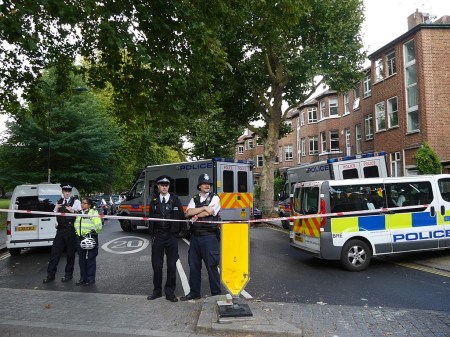
It is only eight weeks since an 18-year old Iraqi-born man walked onto the London Underground and left a bomb on the District line. Fortunately for the rush-hour commuters and school children on that train, the detonating device went off without managing to set off the bomb itself. Had the device worked, the many passengers who suffered life-changing burns would instead have been among many other people taken away in body bags. Ahmed Hassan came to the UK illegally in 2015 and was subsequently provided with foster care by the British government. He has now been charged, and is awaiting trial, for causing an explosion and attempted murder.

As stories like that of Mr. Hassan emerge, there are varying reactions. Some people say that this act is not indicative of anything, and that we must accept that such things happen — like the weather. Others suggest that anyone might leave a bomb on the District line in the morning, and that there is no more reason to alter your border policy because of it than there is to alter your meteorological policy because of it.

As poll after poll shows, however, the majority of the public in Britain — as in every other European country — think something else. They think that a country that has lost a grip on its immigration policy is very likely to lose control of its security policy, and that one may indeed follow the other.

So the British public were not at all reassured by the news this month that the country’s Home Office has lost track of tens of thousands of foreign nationals who were due to be removed from the country. Nor that there is no evidence of any effort to find the people in question.

Figures revealed in two new reviews by the Chief Inspector of Borders and Immigration showed that nearly 56,000 foreign nationals have disappeared from the radar of the British authorities after being told that they were required to leave the country. This figure includes over 700 foreign national offenders (FNOs) who went missing after being released into the community from prison. It also revealed that around 80,000 foreign nationals are required to check in on a regular basis at police stations and immigration centres while authorities prepare for them to leave the country. By the end of 2016, just under 56,000 of them had failed to keep appointments and had become persons “whose whereabouts are unknown and all mandatory procedures to re-establish contact with the migrant have failed.”

Nevertheless, with a straight face, Brandon Lewis, the immigration minister for the present Conservative government, declared that “People who have no right to live in this country should be in no doubt of our determination to remove them.” Yet he still admitted that “Elements of these reports make for difficult reading.”

For the British public, they will also make difficult living. We all have to live with the consequences of an immigration system which has been more than usually unfit for purpose since the Labour government of 1997. It is just the British version of a story that is playing all across Western Europe. Across the Western half of the continent, all governments have allowed immigration policy to slide for more than a generation. Having become lax about policing the borders, they have become lax about returning people who have no right to be inside those borders. And having become lax about returning people who should not be in the country, they end up putting at peril the citizens of the country.

When the post-1997 Labour government first decided that the return of people in the UK illegally was not an important priority, they did so in part because the then-immigration minister decided that it was too traumatic for everyone involved: traumatic for the illegal migrant and for the UK border officials who had to remove them. In just such a way, by thousands of small cuts, does a nation’s territorial integrity and future security become shattered.

Although a person’s name may be nothing more than an inauspicious start — its owner, after all, did not choose it — even the craziest immigration systems dreamed up by European officials have not yet come up with something like America’s “diversity visa” lottery, by which someone pronounces themselves to be called “Sword of Islam” [terrorist Sayfullo Saipov] and is promptly let into the country — only then to mow people down in a New York bicycle lane. But we are all suffering from variants of the same mania.

Nevertheless, even the most seriously ingrained manias can be snapped out of. In Britain, as in the rest of Western Europe and North America, there is only thought to be a political price to pay for being tough on immigration. For the time being, only people who believe in enforcing the law look heartless. Only those who insist on following — or even tightening — due process look like the ones who have done a wicked thing.

But as the events on the Underground in London in September presage, all of this can change in a few instants. A few more bombs left by a few more illegal immigrants, or a few more trucks driven along a few more bicycle lanes — let alone by illegal immigrants who have overstayed and not been deported — and the whole thing can change. At that point, instead of looking warm and big-hearted, you begin to look as if you were just unforgivably lax with the security of your own citizens. So an entire political class has been. But it may take a lot of bloodshed yet for them to learn that there are not just political benefits to be accrued from such laxness, but one day a political price to pay.

Douglas Murray, British author, commentator and public affairs analyst, is based in London, England. His latest book, an international best-seller, is “The Strange Death of Europe: Immigration, Identity, Islam.”

A Venezuelan drug dealer secures another bailout from Russia

November 11, 2017

A Venezuelan drug dealer secures another bailout from Russia, American ThinkerMonica Showalter, November 11, 2017

(Please see also, Socialism: Venezuela’s Minimum Wage Crashes to Under Four Dollars a Month. — DM)

For the umpteenth time, Venezuela has clawed back from the brink of near sovereign default, making a $1.2-billion payment on a PDVSA state oil company bond Friday, which was its absolute last chance before the ISDA’s repo men, who rule on whether a type of bond insurance known as credit default swaps should be invoked, moved in.

Riding to its rescue was Russia, which has an enormous stake in Venezuela’s oil production, including even its Citgo refineries.  Russia agreed to renegotiate $3 billion of the straight sovereign debt Venezuela owes it, in what is believed to have been from arms sales to then-living Hugo Chávez’s government.

That $3 billion gave Venezuela enough wiggle-room liquidity to shell out for the PDVSA bonds this one last time…until the next.  This is Russia’s third bailout of the socialist hellhole, for what it’s worth.  There will be more.

The Wall Street Journal and the New York Times both report that Venezuela will now seek to restructure $150 billion in debt – and those negotiations will be led by Venezuela’s Vice President Tareck el-Aissami, who is on the U.S. sanctions list as a drug dealer.  That’s some fine company the other creditors of Venezuela, such as Goldman Sachs, will find themselves in.  The Times notes that due to the sanctions, the creditors can’t legally do business with him, or even be in the same room with him.

This won’t bother the Russians.  Russia, after all, has at least $17 billion in investment in Venezuela’s oil industry, a greater amount than the $11 billion in arms sales.  The arms sales just made some factory in Russia richer.  The oil, on the other hand, not only represents commodity wealth, but means petro-power and Russia’s capacity to control natural resources and project global influence.  That’s a bigger deal to Russia’s leaders, who played the same game with Hillary Clinton’s Uranium One deal, than a few rifle and aircraft sales.  Venezuela has probably allowed the equipment to go to seed anyway.

All the same, it shows the extent to which Russia will defend its crummy little cat’s-paw in the Western Hemisphere.  China has an even greater stake in Venezuela’s bond market health, given that it has $63 billion in loans outstanding in Venezuela.  It refuses renegotiation of the debt even as it encourages default to Western creditors, and after a period of providing bailouts, it just quit giving them.

Russia hasn’t.  And it’s costing and costing, not the least in terms of goodwill, as this piece by Foreign Policy notes.  Yet it doesn’t want to let go of this costly strategy.  It will probably bail Venezuela out ’til kingdom come.  And why is it?  Not just to be the big dog on the global block, but to tweak Uncle Sam as payback for U.S. involvement in what it sees as its backyard in the Baltics, the former Soviet republics, and Eastern Europe.  The U.S. has no such burden of having to bail out socialist hellholes for the purpose of manipulating them or getting back at a superpower rival.  That Russia would assume this burden for an increasingly untenable regime shows the extent to which it values leverage against the U.S.


Syrian drone over Golan followed Trump-Putin disagreement on Syrian buffer zones

November 11, 2017

Syrian drone over Golan followed Trump-Putin disagreement on Syrian buffer zones, DEBKAfile, November 11, 2017

Nonetheless, the negotiating teams did achieve progress on two points, our sources report: It was decided to expand the de-escalation zones already operating in Syria and also to boost the joint US-Russian Monitoring Center based in Amman – not only to prevent accidental clashes between Russian and US forces, but also between their local allies.

********************

The Syrian UAV was sent over the Golan, likely with Russian approval, to probe Israel’s flexibility on the buffer zones for keeping Syrian/Iranian/Hizballah forces far from its borders.

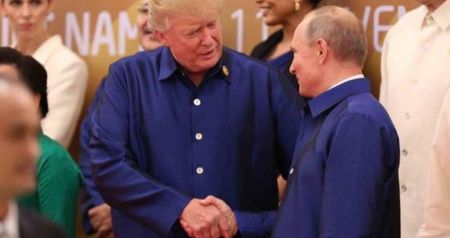
The Syrian UAV which flew over the Golan demilitarized zone Saturday, Nov. 11, was a direct result of the failure of US President Donald Trump and Russian President Vladimir Putin to reach an agreement in time for the Danang summit in Vietnam on the political and military future of Syria. They were at odds in particular on the depth of the buffer zone to be carved out between Syria and Israel. This is reported exclusively by DEBKAfile’s sources.

The Syrian UAV was sent over the Golan, presumably with Russian approval, to probe Israel’s reactions and find out how far into Israeli air space the drone would be permitted to enter. This probe was to be taken as a measure of Israeli flexibility and willingness to accept a buffer zone between IDF positions and Syrian/Iranian/Hizballah forces of less than 30-40km deep.

Israel struck back and launched a Patriot missile defense system which intercepted the Syrian drone before it crossed the border and reached Israeli air space over the Golan. No breach of Israel’s sovereignty was allowed to occur.

Neither did a “high-ranking IDF source” need to offer reassurance that the Russian liaison apparatus was kept in the picture, since the Russian officers in Syria must have tracked the UAV and taken note of the message Israel relayed by shooting it down.

Our sources add that the Trump administration, as well as Moscow, is pushing Israel hard for flexibility as to the depth of the Syrian buffer zone. But the Netanyahu government has not so far given way, in the knowledge that Tehran fully intends to maintain military strength together with its proxies, including Hizballah, in post-war Syria.

The BBC revelation of Friday, Nov. 11, supported by large satellite images, that Iran is building a permanent base in Syria just 50km from the Israeli-Syrian Golan border, was intended to show that Israeli leaders don’t mean what they say. The site cited by “Western intelligence sources” is El-Kiswah, 14km from Damascus, where Syrian military facilities already exist

The British report contains several quotes of Prime Minister Binyamin Netanyahu’s declarations that Israel will not permit Iran to establish a military presence in Syria that threatens its borders.

The May government has a bone to pick with Netanyahu on other issues. The Brits, whom both Washington and Moscow have cut out of decision-making on Syria’s future, were also taking a dig at them both by showing that Tehran is out of their control.

The buffer zone is not the only topic on which Trump and Putin are in discord on the shape of post-war Syria.

The plan for a US-Russian deal on a final accommodation was meant to ride on the momentum of the recent military successes in pushing ISIS back from eastern Syria and into western Iraq. Both presidents felt that these victories were too good not to use for working together on Syria’s future. Therefore, when ISIS strongholds in Al Qaim, Iraq and Abu Kamal, Syria fell to joint Iraqi-Syrian-Hizballah-pro-Iranian Shiite militia forces in the last two weeks, both the US and Russia were eager to seize star roles as victors by forging a final accord for ending the Syrian war.

However, the US and Russian teams working on a draft accord found the gaps between them too great to bridge at this time. They are at loggerheads on major issues —  such as the political future of Bashar Assad — how long he would remain president and how much power must he hand over to Syrian opposition groups in a government coalition. Neither do they see eye to eye on the disposition of foreign armies to remain in the country, specifically Iran’s role in the new Syria.

Last Friday, Nov. 10, DEBKAfile reported that the differences between Trump and Putin on the Syrian issue had prevented the release of a statement of accord. The US president insisted that without an accord there would be no formal sit-down at the Vietnam Asian summit.

Nonetheless, the negotiating teams did achieve progress on two points, our sources report: It was decided to expand the de-escalation zones already operating in Syria and also to boost the joint US-Russian Monitoring Center based in Amman – not only to prevent accidental clashes between Russian and US forces, but also between their local allies.

Socialism: Venezuela’s Minimum Wage Crashes to Under Four Dollars a Month

November 11, 2017

Socialism: Venezuela’s Minimum Wage Crashes to Under Four Dollars a Month, BreitbartBen Kew, November 10, 2017

FEDERICO PARRA/AFP/Getty Images

As part of his socialist economic program, the late Venezuelan leader Hugo Chávez would boast that Venezuela had the highest minimum wage in Latin America, equivalent to $372 a month. However, inflation began to soar as early as 2007 and has now reached levels comparable to Germany’s Weimar Republic or Zimbabwe’s hyperinflation crisis, which saw people using wheelbarrows to buy products and the introduction of a 100 trillion dollar banknote.

******************************

The monthly minimum wage in the socialist country of Venezuela has crashed to under four dollars a month as hyperinflation continues to crush the country’s shattered economy.

Despite dictator Nicolás Maduro’s five minimum wage hikes over the course of 2017, the monthly minimum wage of 177,507 bolivares is equivalent to $3.41, working out at just over two cents an hour, according to latest real value exchange rates.

Venezuelans also receive a monthly food ticket of 279,000 bolivares a month, bringing people’s total monthly income to around approximately nine dollars a month.

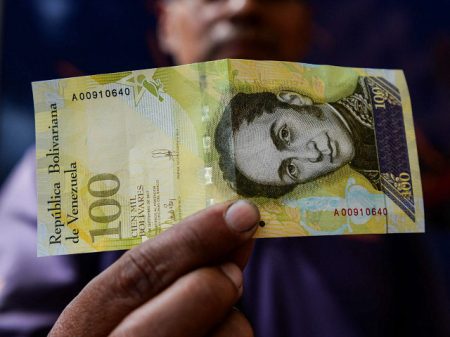
Maduro confirmed last week that the government would debut a new 100,000 Bolivar bill, making it the highest denomination note released in modern Venezuelan history. The move comes less than a year after he tried to relieve pressure on consumers by releasing 500, 1000, 2000, 10,000, and 20,000 bolivar notes, although all of these notes now all have a value of well under half a dollar.

While, ten years ago, a 100 Bolivar note could buy a television, it is now worth just over one cent, with the currency having lost over 99.99 percent of its value since 2010. Yet rates of inflation continue to accelerate amid fears of a default on the country’s colossal debt.

On Wednesday, Russian Finance Minister Anton Siluanov confirmed that Russia would offer Maduro a restructuring package on Venezuela’s $3 billion debt, although analystsbelieve this will do little to ease the overall debt burden, which currently stands at around $120 billion.

The unprecedented levels of inflation have now led the country into the worst humanitarian crisis in its history, leaving millions living in abject poverty amid chronic shortages of basic resources such as food, electricity, medicine, and sanitary products.

The country’s government also faces further pressure from the United States, with the Trump administration signing off on a range of sanctions primarily targeting the country’s state-run oil company following the socialist government’s installation of a “national constituency assembly,” a fraudulent lawmaking body which has effectively rendered the country a dictatorship.

As part of his socialist economic program, the late Venezuelan leader Hugo Chávez would boast that Venezuela had the highest minimum wage in Latin America, equivalent to $372 a month. However, inflation began to soar as early as 2007 and has now reached levels comparable to Germany’s Weimar Republic or Zimbabwe’s hyperinflation crisis, which saw people using wheelbarrows to buy products and the introduction of a 100 trillion dollar banknote.

Roy Moore: Allegations about 14-year-old girl ‘completely false and misleading’

November 11, 2017

Roy Moore: Allegations about 14-year-old girl ‘completely false and misleading’, Washington ExaminerAl Weaver, November 10, 2017

He also said he suspected that the story was written to take down his campaign.

“Why would women say these things if they are not true?” he said. “I can’t fully answer that because as much as I have disagreed vehemently on political issues with many people over the years, I cannot understand the mentality of using such a dangerous lie to try to personally destroy someone.”

“This woman has waited over 40 years to bring the complaint four weeks out of an election. It’s obvious to the casual observer that something’s up,” he told Hannity.

*****************************

Judge Roy Moore defended himself Friday by saying accusations that he sexually assaulted a teenager more than 30 years ago are “politically motivated,” and that he never had any interaction with the woman who accused him of sexual misconduct when she was 14.

“These are allegations are completely false and misleading,” Moore told Sean Hannity on his radio show.

He went further by saying he agrees that anyone who abuses a 14-year-old girl should not run for the Senate, and said he is not guilty of any such activities.

“Nobody that abuses a 14-year-old at age 32 or age 17, it doesn’t matter,” he said. “If you abuse a 14-year-old, you shouldn’t be a Senate candidate, I agree with that. But I did not do that.”

Leigh Corfman is the 14-year-old who accused Moore of wrongdoing, but Moore said he didn’t know her at all.

“I don’t know Ms. Corfman from anybody,” he said. “I’ve never talked to her. Never had any contact with her. Allegations of sexual misconduct are completely false. I believe they are politically motivated. I believe they are brought only to stop a very successful campaign and that’s what they’re doing. I have never known this woman or anything.”

Moore did say he recognized two of the other women who have come forward: Debbie Wesson and Gloria Thacker. He said he dated “a lot of young ladies” after ending his stint in the military, and couldn’t rule out that he may have dated some women in their teens, even though he said he didn’t “generally” date women that young.

He also said he would not have given wine or alcohol to underage women because he lived in a “dry county,” and said he doesn’t remember dating any girl without the permission of her mother.

Moore repeated his denials in a written statement released Friday.

“I have never provided alcohol to minors, and I have never engaged in sexual misconduct,” he said. “As a father of a daughter and a grandfather of five granddaughters, I condemn the actions of any man who engages in sexual misconduct not just against minors but against any woman.”

He also said he suspected that the story was written to take down his campaign.

“Why would women say these things if they are not true?” he said. “I can’t fully answer that because as much as I have disagreed vehemently on political issues with many people over the years, I cannot understand the mentality of using such a dangerous lie to try to personally destroy someone.”

“This woman has waited over 40 years to bring the complaint four weeks out of an election. It’s obvious to the casual observer that something’s up,” he told Hannity.

Moore also asserted that his campaign has gathered some “evidence of some collusion,” but is not ready to releases it to the public yet. He didn’t say what that evidence might show. “This is a completely manufactured story meant to distract this campaign,” he continued.

The Washington Post reported Thursday that he initiated a sexual encounter with a 14-year-old when he was 32. Since then, several Republican senators have said Moore should drop out from the race if the report is true, such as Sen. Ted Cruz, R-Texas, and Rep. Mark Meadows, R-N.C., and some have said he should drop out regardless of what happened.

Sen. Mike Lee, R-Utah, one of the five GOP senators to endorse him, asked for Moore to remove his image from a fundraising ad he was running. Along with him, other key supporters have also called for him to exit the race if the report is true, including Sen. Ted Cruz, R- Texas, and Rep. Mark Meadows, R-N.C.

Moore is running against Democrat Doug Jones to fill the remainder of Attorney General Jeff Sessions’ seat. Moore defeated Sen. Luther Strange, R-Ala., in the primary runoff to take on Jones back in September.

Kristallnacht, and Our Modern-Day Approach to Antisemitism

November 11, 2017

Kristallnacht, and Our Modern-Day Approach to Antisemitism, AlgemeinerVladimir Sloutsker, November 10, 2017

(Please see also, Family History by our own Anne in PT. She focuses on the Kristallnacht and later experiences of members of her family who were living in Germany. Here is a short video documentary on Kristallnacht:

— DM)

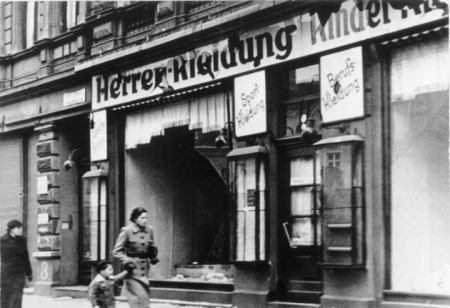
A store damaged during Kristallnacht. Photo: German Federal Archives via Wikimedia Commons.

Kristallnacht is another important reminder that the Holocaust did not begin with the death camps; that’s where it ended. Rather, it began with words, the singling out of one group of people and far too many in society looking the other way in the face of such hatred. Nobody is born to hate; they learn to hate.

Third, we must recognise that oppression is not a uniquely Jewish problem, and that what starts with the Jews, seldom ever ends with the Jews. When we consider the predicament of other minorities, racial or religious, hatred and bigotry is rarely far behind. The Jewish community should consider itself a partner in a wider struggle, and cooperate with other faith groups in the battle for their right to exist peacefully.

***************************

Seventy-nine years ago, Nazis across Germany and Austria razed synagogues, smashed windows and murdered almost 100 innocent Jews in a violent pogrom. Kristallnacht — or the “Night of Broken Glass” — is so named to describe the shattered glass that littered the streets the next morning. In the weeks that followed, approximately 30,000 Jews were transported to concentration camps — a sorrow foreshadowing of what would soon ensue.

On Kristallnacht’s 79th anniversary, I am compelled to address the rising tide of antisemitism sweeping Europe, reaching levels not seen since the end of the darkest chapter in Europe’s history.

In the first half of 2017, some 767 antisemitic attacks were recorded in the UK alone. This represents the highest figure since monitoring began in 1984 — and, staggeringly, was a 30 percent increase from 2016. In the meantime, violent assaults on Jews this year have risen 78 percent compared with the same period in 2016.

The above figures are broadly replicated in other major Jewish communities throughout Europe, including France and Germany. Even in the U.S., according to a recent survey by the ADL, there has been a significant spike in antisemitism across the country.

Kristallnacht is considered by many to represent the transition from the harassment of Jewish communities to outright violence against them.

Seventy-nine years later, many Jews across Europe are once again singled out because of their race — with Jewish property, institutions and even cemeteries, coming under assault.

Clearly, a new way to combat this tide of hatred is required.

Until now, the international community has focused attentions on ‘minimizing’ the problem. This is inherently problematic; it enables us to label a reduction in antisemitism as a ‘success.’ What is needed is the eradication of antisemitism completely. To achieve this, we must be more proactive, smarter and more creative.

As I have said before, I believe that there are five key areas of focus for which all global citizens, not just the Jewish community, should pursue.

First, we must adopt a universal definition of antisemitism in Europe. The Israeli Jewish Congress (IJC) — an organization I co-founded to support Jewish communities —  has advocated for this for some time. Defining the problem is the first step to eradicating it.

In this regard, I commend European countries, including the UK, Germany, Austria, Romania and Bulgaria, for adopting the all-encompassing International Holocaust Remembrance Alliance (IHRA) definition of antisemitism. This definition accepts that the delegitimization of Israel and attacks on Zionism can also manifest as antisemitism. If we cannot define what we are trying to defeat, how can we defeat it? Therefore, I would call on all IHRA Member States to adopt this definition of antisemitism.

The second necessity is that we promote the value of education in understanding the scale of the problem. This program should not solely focus on the history of antisemitism, bigotry and the Holocaust; we should also touch on the vital contribution of Jewish people and texts to the wider cultural and economic prosperity of Europe.

Kristallnacht is another important reminder that the Holocaust did not begin with the death camps; that’s where it ended. Rather, it began with words, the singling out of one group of people and far too many in society looking the other way in the face of such hatred. Nobody is born to hate; they learn to hate.

Third, we must recognise that oppression is not a uniquely Jewish problem, and that what starts with the Jews, seldom ever ends with the Jews. When we consider the predicament of other minorities, racial or religious, hatred and bigotry is rarely far behind. The Jewish community should consider itself a partner in a wider struggle, and cooperate with other faith groups in the battle for their right to exist peacefully.

Fourth, recognizing that antisemitism and online hatred represents a major challenge today, we need to develop communications strategies that are fit for the digital age. Whilst social media channels are used as platforms for inciting racial hatred against the Jewish community, these platforms can also be used to reach new audiences — and encourage them to be advocates. We must develop engaging and comprehensive strategies to use these tools effectively.

Fifth, we need to energize the global debate on the roles and responsibilities of large technology firms to prevent the sharing of hateful commentary. We can utilize the pre-existing legal frameworks across Europe, as well as supporting modernization efforts to ensure that legislation is fit for the digital age. But the internet knows no state borders, and so our work with technology firms must be conducted at the international level.

In a landmark address before the European Parliament last year, former UK chief rabbi, Lord Jonathan Sacks, described antisemitism as a “mutating virus.” Containment is not enough. It is high time we find an antidote.

Kristallnacht was a murderous example of the capacity of humans to escalate from harassment to violence. Yet the EU was built on a foundation of tolerance and openness. For this reason, it is the responsibility of European governments — and European people — to reconcile this foundation of tolerance with an unequivocal commitment to eradicating harassment and violent antisemitic racism at its source.

Vladimir Sloutsker is the president and co-founder of the Israeli Jewish Congress (IJC).

U.S. General: Missile Targeting Saudi Capital Was Iranian

November 10, 2017

U.S. General: Missile Targeting Saudi Capital Was Iranian, Washington Free Beacon, November 10, 2017

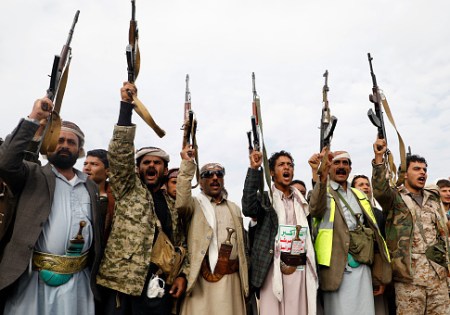
Supporters of the Shiite Huthi movement raise their weapons during a gathering in the capital Sanaa, Yemen / Getty Images

The top U.S. Air Force official in the Middle East said Friday that the ballistic missile fired by Yemeni rebels and intercepted by Saudi Arabian forces late last week originated from Iran and bore “Iranian markings.”

Lt. Gen. Jeffrey L. Harrigian, who oversees the Air Force’s Central Command in Qatar, said an investigation of the Saudi capital-bound missile’s remains uncovered evidence proving “the role of [the] Iranian regime in manufacturing” the missile, according to CBS News.

Saudi Arabia’s foreign ministry said it also found similar evidence regarding Iranian manufactured missiles after a July 22 launch from Yemen.

CBS News noted French President Emmanuel Macron similarly said the missile was “obviously” Iranian earlier this week.

Harrigian made his comments during a news conference in Dubai on Friday following the most recent strike near Riyadh, Saudi Arabia, but declined to mention any specifics on what type of missile they believe it was.

Saudi Arabia reported it shot down the missile on Nov. 4 near Riyadh’s international airport, the deepest location to date for a rebel missile to reach.

The country has long has accused Iran of providing weapons to the Shiite rebels, known as Houthis, and their allies.  In turn, Tehran has long denied supplying the missiles.

Michael Knights, a fellow at the Washington Institute For Near East Policy who previously worked in Yemen, said in an analysis Thursday that “it is not a stretch” to believe Iran is supporting Houthi rebels.

It is “not a stretch to believe that Tehran is supporting the Houthi missile program with technical advice and specialized components,” Knights wrote. “After all, the Houthis have rapidly fielded three major new missile systems in less than two years while under wartime conditions and international blockade.”

Endless Accusations Cloud the Truth

November 10, 2017

Endless Accusations Cloud the Truth, PJ MediaAndrew Klavan, November 10, 2017

(Righteously demanding that Judge Moore step down, based on three decade old claims never previously ventilated, pursued or even now substantiated, seems to be an acceptable species of virtue signaling. I dissent. — DM)

Roy Moore

I can only see one rational moral response to this: If it’s true, he should step down; if it’s a political frame-up, he should fight it.

What bothers me about the story is I have absolutely no idea which is the case. No clue. Even before the allegations were made, I had been thinking about how easy it would be to set someone up in the current climate. Get a few women together. Say something happened too long ago to check. No one reads past the headline, and everyone’s done something at some point they shouldn’t have, so it’s a slam dunk smear.

In this particular case, too, everyone in establishment politics hates Moore. (I mean, he is kind of a loony-tune, but if that disqualified you to work in the capitol, the place would be empty.) So no one will come running to his defense.

Or… maybe he’s just guilty. I really don’t know.

**********************************

I have to write this quickly because any minute now, Senate candidate Roy Moore might quit or be cleared or might simply be blown out of the headlines by some fresh violent atrocity that the media will either attempt to exploit in an effort to destroy our second amendment or attempt to distort so we don’t notice that every killer involved happened to be named Mohammed. At my back, I always hear the news cycle’s winged chariot drawing near.

I’m in a hotel in New York, and this morning over my covfefe in the lounge, I looked up at a television and saw a Chyron announcing that someone I’d never heard of was finally going to “break her silence.” And I thought, “Oh, please don’t.” Silence has become a precious commodity and we need as much of it as we can get. Otherwise, it’s all noise and outrage and outrage at the noise and noise about the outrage. As far as I’m concerned, you should only break your silence in case of emergency.

But so far, my words have gone unheeded. And now controversial and kind-of-hilarious Senate candidate Roy Moore has been accused of sexual contact with a 14-year-old girl back in 1979 when he was 32. He’s said to have carried on with a couple of other young-but-legal girls as well. The contact with the child wasn’t forced but, of course, she was too young to consent to it and he was old enough to be responsible, so it’s bad.

I can only see one rational moral response to this: If it’s true, he should step down; if it’s a political frame-up, he should fight it.

What bothers me about the story is I have absolutely no idea which is the case. No clue. Even before the allegations were made, I had been thinking about how easy it would be to set someone up in the current climate. Get a few women together. Say something happened too long ago to check. No one reads past the headline, and everyone’s done something at some point they shouldn’t have, so it’s a slam dunk smear.

In this particular case, too, everyone in establishment politics hates Moore. (I mean, he is kind of a loony-tune, but if that disqualified you to work in the capitol, the place would be empty.) So no one will come running to his defense.

Or… maybe he’s just guilty. I really don’t know.

I blame feminists and the media for this cloud of confusion, mostly because I hate feminists and the media, but also because they do bear some of the blame. For instance, the New York Times, a former newspaper, now has a tip line where you can complain about something sexual someone famous did to you back in the day. How is that not going to lead to abuse? Liars will flock to it. And if someone calls up and complains about Barack Obama, and someone else calls up and complains about Rush Limbaugh — which one do you think the Times will follow up on? Me too.

And then hideous feminists (a redundancy, I know) with their snarling hatred of men and masculinity start shrieking about how it’s an outrage that any male should be considered innocent until proven guilty or that any one event should be judged less egregious than any other. With that kind of attitude, things can get very Salem-y very fast.

USA Today has a running list of Hollywood sexual offenders and I was reading through it and came upon the charges against Dustin Hoffman. The now 80-year-old Hoffman is accused of talking dirty to one woman and inviting another woman on a date some 30-odd years ago. And you know what? I don’t care. Not even a little. I think Harvey Weinstein, assuming he’s guilty, should go to prison for what he did and I think what Hoffman allegedly did shouldn’t even be mentioned in the papers. When they’re both on the same list, the whole list becomes a moral blur.

Human life is complicated. Sexuality is one of the most complicated parts of human life. Some people make errors, other people corner you in the basement and bang off in front of you, and still other people tell lies. If any voice can be raised against any man and illicit the same level of outrage, all voices will eventually blend into a silence of obscurity and indifference — and that’s a kind of silence that’s very difficult to break.


A Month of Islam and Multiculturalism in France: October 2017

November 10, 2017

A Month of Islam and Multiculturalism in France: October 2017, Gatestone InstituteSoeren Kern, November 10, 2017

Article 57 of the French Civil Code states that the name chosen by parents must be in “the best interests of the child.” If the public prosecutor thinks the name “Jihad” is contrary to the law, he can ask a judge to order the name to be changed. If the parents are unable or unwilling to choose a new name, the judge has the right to choose a name.

Of the 1,900 French jihadists fighting with the Islamic State, as many as one-fifth have received as much as €500,000 ($580,000) in social welfare payments from the French state, according to Le Figaro.

Henda Ayari, in an interview with Le Parisien, gave detailed public testimony accusing Tariq Ramadan of sexually assaulting her in Paris. She said that Ramadan believes that “either you wear a veil or you get raped.”

October 1. A 29-year-old illegal immigrant from Tunisia stabbed two women to death at the central train station in Marseille. Witnesses heard the assailant shout “Allahu Akbar” as he lunged at the women with a 20-centimetre (eight-inch) knife before threatening soldiers, who shot him dead. The man, identified as Ahmed Hanachi, was using seven different identities and had a long criminal history. He had been arrested in Lyon for shoplifting just days before the attack, but those charges were dropped due to a lack evidence. He was released, despite not having the documents needed to live in France. Why he was never deported remains unclear.

October 2. Five people were arrested in Paris after police found four makeshift bombs at a building in the 16th arrondissement, one of the city’s most exclusive neighborhoods. Police said there was no one living in the apartment block who might be considered a target for jihadists. Interior Minister Gérard Collomb surmised that the bomb was simply meant to create fear: “Blowing up a building in a posh neighborhood shows that no one is safe…that it could happen anywhere in France.” He added: “This shows that the level of the threat in France is extremely high…yes, even if the Islamic State has suffered military setbacks, we are still in a state of war.”

October 2. The trial began of Abdelkader Merah, the 35-year-old brother of Mohamed Merah. In March 2012, Mohamed in March 2012 had gone on a nine-day shooting spree in southern France, killing three soldiers and gunning down a teacher and three children at a Jewish school before being shot dead by police. Abdelkader stands accused of “knowingly” helping to facilitate the “preparation” of the attack, in particular by stealing the scooter used for the three separate shootings. He appeared alongside 34-year-old Fettah Malki, accused of giving Mohamed Merah a bulletproof jacket, an Uzi submachine gun and the ammunition he unloaded on his victims. Abdelkader Merah faces a possible life sentence while Malki could get 20 years in prison.

October 5. Six gas canisters attached to a “crude detonator device” were found under several trucks at a cement company in Paris. The trucks, parked in the French capital’s northeastern 19th arrondissement, belonged to Franco-Swiss cement company Lafarge-Holcim. Lafarge is being investigated over claims that it paid taxes to the Islamic State and other armed groups in Syria to keep a plant running in a war zone. The company admitted that it resorted to “unacceptable measures” to continue operations at a now-closed cement factory in northern Syria in 2013 and 2014, after most French groups had quit the war-torn country.

October 6. A French woman who travelled three times to Syria in support of her jihadist son was sentenced to 10 years in prison for being part of a terrorist conspiracy. Christine Rivière, 51, was sentenced for her “unfailing commitment” to jihad and for helping a number of young women travel to Syria to marry jihadists, including her son, Tyler Vilus. Rivière, a Muslim convert who was nicknamed “Mama Jihad,” said of her son: “I didn’t want to push him to die a martyr, but that could happen. Then he would be in heaven, near Allah.”

October 6. French prosecutors charged three men in connection with a makeshift explosive device made of gas canisters, placed inside an apartment block in western Paris. Amine A, his cousin Sami B, and Aymen B., were charged with “attempted murder in an organized group in connection with a terrorist enterprise” and placed in pre-trial detention. All three were arrested on October 2, two days after the device was found in the exclusive 16th arrondissement. Amine A., 30, and Aymen B., 29, are both on the terror watch list.

October 9. French police and intelligence services are surveilling around 15,000 jihadists living on French soil, according to Le Journal du Dimanche. Of these, some 4,000 are at “the top of the spectrum” and most likely to carry out an attack.

October 10. President Emmanuelle Macron announced a plan to open immigration offices in Niger and Chad to identify persons eligible for asylum on lists provided by the United Nations High Commissioner for Refugees (UNHCR) and bring them directly to France. The stated aim is to “better prevent an influx of economic migrants” who are not eligible for asylum. In all, France will take in 10,000 people, not only from Niger and Chad, but also from Jordan, Lebanon and Turkey, by October 2019.

October 11. Interior Minister Gérard Collomb announced the dismissal of the central government’s top representative in the southern Rhône region, after a report criticized “errors of judgement” and “serious faults” in handling foreigners whose papers are not in order. The report was commissioned after 29-year-old Tunisian Ahmed Hanachi stabbed two women to death at the central train station in Marseille on October 1.

October 11. A 20-year-old woman was arrested in Rouen on suspicion that she may have played a role in a jihadist attack on a church in Saint-Étienne-du-Rouvray. On July 26, 2016, two jihadists had broken into the church and murdered Father Jacques Hamel while he was celebrating mass. While leaving the church, they were shot dead by the police. A few hours later, the Islamic State claimed responsibility for the attack. Police say that shortly before the attack, the woman had been in contact with one of the jihadists.

October 12. A French intelligence agent accidentally sent a text message to the mobile phone of a jihadist, inadvertently warning him that he was under surveillance and being monitored, according to M6 television. The target, a “proselytizing Islamist” living in Paris, responded by directly calling the agent and informing him of his mistake.

October 12. The interior ministry announced that France will maintain border checks with its European neighbors until April 30, 2018, because of “persistent” terror threats. The 1985 Schengen Agreement ended passport checks and other protective measures on borders, but after the jihadist attacks in Paris in November 2015, France resumed them.

France recently announced that it will maintain border checks with its European neighbors until April 30, 2018, because of “persistent” terror threats. France resumed passport checks and other protective measures on borders after the November 2015 jihadist attacks in Paris. Pictured: French border and customs police control vehicles at the France-Italy border. (Photo by Murielle Gander Cransac/Getty Images)

October 15. A groundbreaking ceremony was held in Strasbourg to expand the Eyüp Sultan Mosque. The 32 million euro ($37 million) project will make the mosque one of the biggest in Europe. The 15-acre site will include a school, a library, conference rooms, restaurants and boutiques, as well as a prayer room for up to 3,000 worshippers. The mosque, which will be redesigned according to Ottoman architecture, will have 28 domes and 44-meter-high (145-foot) minarets. Local officials say the mosque will contribute to the religious, architectural and cultural diversity of Strasbourg.

October 16. President Emmanuel Macron pledged to deport illegal immigrants who commit crimes in France. He said that even without new legislation, “we can take tougher measures” and expel illegal immigrants if they commit a crime, “whatever it may be.” He added: “We are not taking all the steps that should be taken. Well, that’s going to change.” He was speaking after it emerged that a Tunisian who stabbed two women to death in Marseille had been arrested in Lyon two days earlier for shoplifting.

October 18. President Emmanuel Macron unveiled a plan to bolster France’s domestic security. A key promise was to hire 10,000 extra police and gendarmes during the next five years. He also proposed to create a new “daily security police” (police de la sécurité du quotidian, PSQ) which would be deployed in “priority neighborhoods from the point of view of insecurity.” The PSQ, community police charged with fighting crime at the local level, will be tested in about fifteen localities in early 2018. In addition, Macron announced a plan to combat radicalization and to reform of asylum procedures to bring them in line with those of Germany. Finally, he promised to speed up the deportations of illegal immigrants who commit crimes in France. “We don’t welcome people well; our procedures are too long; we don’t integrate people properly and neither do we send enough people back,” Macron said. “We should take our fair share, but we can’t just welcome in all the world’s poor people.”

October 20. Prosecutors in Toulouse launched an investigation after receiving a report that a couple in nearby Léguevin named their newborn son “Jihad.” Article 57 of the French Civil Code states that the name chosen by parents must be in “the best interests of the child.” A justice ministry memo on the topic states that local registrars must inform the public prosecutor if a name appears to be contrary to the law. If the public prosecutor thinks the name “Jihad” is contrary to the law, he can ask a judge to order the name to be changed. If the parents are unable or unwilling to choose a new name, the judge has the right to choose a name.

October 20. Henda Ayari, a former Salafist who is now a Muslim feminist activist, accused prominent Islamic scholar Tariq Ramadan of sexually assaulting her in Paris. Ramadan, a grandson of the founder of Egypt’s Muslim Brotherhood, denied her accusations. Some of his supporters criticized Ayari on social media, insinuating that if the assault did take place, it was her own fault because Islam forbids an unmarried woman to be alone with a man. Others claimed that Ramadan is a victim of “international Zionism” and that the charges were “fabricated by Jews.”

October 22. Eight people, including three minors, were charged with “criminal terrorist conspiracy” for plotting to attack left-wing politicians, migrants and mosques. An investigation found that the group, led by Logan Alexandre Nisin, a 21-year-old far-right activist based in Provence, planned to buy weapons, organize paramilitary training exercises and conduct shooting practice.

October 23. An official inquiry cast doubt on allegations that the French police had abused migrants in the northern port city of Calais. Human Rights Watch had accused police of a disproportionate use of force against migrants as well as aid workers when the notorious Calais migrant camp, known as the “jungle,” was dismantled in October 2016. The inquiry said that some abuse was “plausible” but that there was no proof it had occurred. It added that accusations that police had used pepper spray against migrants while they were sleeping were “without foundation.” The report found that many of the injuries sustained by migrants were due to brawls among migrants. “There is no evidence to prove the most serious allegations made,” Interior Minister Gérard Collomb said.

October 24. France issued an arrest warrant for Redouane Sebbar, a 25-year-old Moroccan man being held in Germany and suspected of helping plan an August 2015 attack on high-speed train traveling from Amsterdam to Paris.

October 26. Of the 1,900 French jihadists fighting with the Islamic State, as many as one-fifth have received as much as €500,000 ($580,000) in social welfare payments from the French state, according to Le Figaro.

October 30. Henda Ayari, in an interview with Le Parisien, gave detailed public testimony accusing Tariq Ramadan of sexually assaulting her in Paris. She said that Ramadan believes that “either you wear a veil or you get raped.” Ramadan denied the accusations as a “campaign of slander.” Since Ayari’s original allegation, two more women have filed sexual assault complaints against Ramadan.

October 30. President Emmanuel Macron formally signed a new counter-terrorism law that gives prefects, police and security forces wide-ranging powers — without the need to seek prior approval from a judge — to search homes, place people under house arrest and close places of worship. The measure also authorizes police to perform identity checks at French borders. The new law, adopted by the French Senate on October 18, makes permanent many of the previously exceptional measures imposed under a two-year-old state of emergency, which was introduced after the jihadist attacks in Paris in November 2015. That state of emergency was slated to expire on November 1. Macron said the new law strikes the right balance between security and respect for civil liberties. Hardliners countered that it does not go far enough, while human rights groups complained that it will leave France in a permanent state of emergency.

Soeren Kern is a Senior Fellow at the New York-based Gatestone Institute.