Author Archive

Normalizing anti-Semitism on campus

November 14, 2017

Normalizing anti-Semitism on campus, Israel National News, Dr. Richard L. Cravatts, November 13, 2017

Progressive students have decided, from within their own moral self-righteousness, that the Palestinian campaign for self-determination is such a sacred cause that anyone who questions it or expresses the Israeli point of view is a moral retrograde. To support Israel is to risk being deemed a racist, an imperialist, a tacit supporter of apartheid. And more than that: if you are Jewish, or even a non-Jewish student with no connection to Palestinian Arabs or Israelis who has not publicly proclaimed his or her allegiance to the Palestinian cause and denounced the Israeli one, he or she can be deemed morally unworthy of serving as a student leader or even, in the South African instance, of attending a particular university.

The student leaders who, in the context of the Israeli/Palestinian conflict, now try to suppress all thought of which they disapprove have sacrificed one of the core values for which the university exists. In their zeal to be inclusive, and to recognize the needs and aspirations of victim groups, they pretend to foster inquiry but have actually stifled it. The first victim in the dilution of academic free speech and debate has been the truth.

***************************

At McGill University recently, three board members of the University’s Students’ Society were removed from their appointments after a vote at the Fall General Assembly due to their alleged “Jewish conflict of interest.” The ouster was led by a pro-BDS student group, Democratize McGill, which was campaigning against pro-Israel students in the wake of a September ruling by the Judicial Board that had rejected the BDS movement on the McGill campus once and for all. This was done on the grounds that the movement failed to uphold the university’s constitution by “violat[ing] the rights of [Israeli] students to represent themselves” and discriminating on the basis of national origin.

In retaliation, and to eliminate pro-Israel views on the board, Democratize McGill launched an effort to purge the board of BDS opponents. This effort was based on the cynical notion that such opponents harbored a clear conflict of interest that arose from their purported biases. Because the students in question were Jewish or pro-Israel (or both), they were labeled by Democratize McGill as incapable of making informed or fair decisions as student leaders.

In stating this premise, the pro-BDS students ignored their own obvious biases as well as the lack of any balance in their own views on the Israeli/Palestinian conflict. They nonetheless felt entirely comfortable suppressing pro-Israel voices and Jewish students on the board, asserting that they sought to remove these students because they “are all either fellows at the Canadian Jewish Political Affairs Committee (CJPAC), an organization whose explicit mandate is to promote pro-Israel discourse in Canadian politics, or primary organizers for the anti-BDS initiative at McGill.”

Those students were to be disqualified, in other words, for having views that differed from those of the student leaders who sought to purge them. The Jewish board member and two other non-Jewish, pro-Israel board members were subsequently voted off the board.

McGill has a history of seeking to suppress pro-Israel expression, not only in the student government but also in its press. An example is a 2016 controversy involving The McGill Daily, which made the astonishing editorial admission that it was the paper’s policy not to publish “pieces which promote a Zionist worldview, or any other ideology which we consider oppressive.”

“While we recognize that, for some, Zionism represents an important freedom project,” the editors wrote, “we also recognize that it functions as a settler-colonial ideology that perpetuates the displacement and the oppression of the Palestinian people.”

Leading up to this revealing editorial, a McGill student, Molly Harris, had filed a complaint with the Students’ Society of McGill University’s (SSMU) equity committee. In that complaint, Harris contended that, based on the paper’s obvious anti-Israel bias, and “a set of virulently anti-Semitic tweets from a McGill Daily writer,” a “culture of anti-Semitism” defined the Daily – a contention apparently confirmed by the fact that several of the paper’s editors were BDS supporters and none of the staffers was Jewish.

An attempted purging of a pro-Israel student from student government, similar to the inquisition that occurred at McGill, took place in February 2015 at UCLA, when several council members on the USAC Judicial Board, UCLA student government’s highest judicial body, grilled Rachel Beyda, then a second-year economics student, when she sought a seat on the board.

The focus on her candidacy was not her qualifications for the position (which no one seemed to doubt), but the fact that she was Jewish. At issue was the way her “affiliation with Jewish organizations at UCLA . . . might affect her ability to rule fairly on cases in which the Jewish community has a vested interest in the outcome, such as cases related to the Israeli-Palestinian conflict,” as the student newspaper described it.

“Ruling fairly,” of course, meant ruling in support of the increasingly virulent anti-Israel campaign on the UCLA campus. Solely on the grounds of her religion, she failed the political litmus test that so-called progressive students, enthralled with their pursuit of social justice, see as their default position – being pro-Palestinian and anti-Israel.

The same thinking inspired a similarly discriminatory proposal the previous May by two members of UCLA’s chapter of Students for Justice in Palestine (SJP), which attempted to bar Jewish candidates from filling council positions if they had taken trips to Israel subsidized by the Anti-Defamation League, American Jewish Committee, or other organizations. According to the activists, those organizations “have openly campaigned against divestment from corporations that profit from Israeli violations of Palestinian human rights.”

Of course, there was no mention in this debate of sponsored trips to send pro-Palestinian students to Israel or the territories on propaganda excursions designed to malign Israel and teach visitors an alternate, anti-Israel narrative. Once again, in addition to trying to stack the deck against the pro-Israel argument, this proposal took it as a given that anyone not committed to the Palestinian cause was by default not to be trusted, incapable of making unbiased decisions, and morally compromised.

A particularly odious attempt to rid a campus of Jewish and pro-Israel voices took place in 2015 when student council leaders at Durban University of Technology (DUT) in South Africa floated a proposal suggesting that Jewish students be purged entirely from the institution. As the student body’s secretary, Mqondisi Duma, put it, “We took the decision that Jewish students, especially those who do not support the Palestinian struggle, should deregister.” This is, one would think, a rather shocking sentiment from students who themselves benefited from a worldwide campaign in the 1970s and 1980s to end South Africa’s racist apartheid system.

The moral arrogance of the South African students’ proposal was breathtaking, and not only because of its grotesque version of the anti-Semitic practice of making all Jews responsible for the political actions of Israel. It revealed that the pro-Palestinian movement is so enthralled with the righteousness of its cause that anyone who harbors or expresses other views is considered a pariah, unworthy to have his or her ideas heard in the marketplace of ideas on campus.

Progressive students have decided, from within their own moral self-righteousness, that the Palestinian campaign for self-determination is such a sacred cause that anyone who questions it or expresses the Israeli point of view is a moral retrograde. To support Israel is to risk being deemed a racist, an imperialist, a tacit supporter of apartheid. And more than that: if you are Jewish, or even a non-Jewish student with no connection to Palestinian Arabs or Israelis who has not publicly proclaimed his or her allegiance to the Palestinian cause and denounced the Israeli one, he or she can be deemed morally unworthy of serving as a student leader or even, in the South African instance, of attending a particular university.

The student leaders who, in the context of the Israeli/Palestinian conflict, now try to suppress all thought of which they disapprove have sacrificed one of the core values for which the university exists. In their zeal to be inclusive, and to recognize the needs and aspirations of victim groups, they pretend to foster inquiry but have actually stifled it. The first victim in the dilution of academic free speech and debate has been the truth.

Dr. Richard L. Cravatts, President Emeritus of Scholars for Peace in the Middle East, is the author of Dispatches from the Campus War Against Israel and Jews.
 

The U.S. Middle East Peace Plan?

November 13, 2017

The U.S. Middle East Peace Plan? Gatestone Institute, Bassam Tawil, November 13, 2017

Abbas is now caught between two choices, both disastrous: On the one hand, he needs the political backing of his Arab brothers. This is the most he can expect from the Arab countries, most of whom do not give the Palestinians a penny. It is worth noting that, by and large, the Arab countries discarded the Palestinians after the PLO and Yasser Arafat openly supported Saddam Hussein’s invasion of Kuwait in 1990. Kuwait was one of several Gulf countries that used to provide the Palestinians with billions of dollars a year. No more.

Since then, the Palestinians have been almost entirely dependent on American and European financial aid. It is safe to assume, then, that the US and EU have more leverage with the Palestinians than most Arab countries.

*********************************

No American or European on the face of this earth could force a Palestinian leader to sign a peace treaty with Israel that would be rejected by an overwhelming majority of his people.

Trump’s “ultimate solution” may result in some Arab countries signing peace treaties with Israel. These countries anyway have no real conflict with Israel. Why should there not be peace between Israel and Kuwait? Why should there not be peace between Israel and Oman? Do any of the Arab countries have a territorial dispute with Israel? The only “problem” the Arab countries have with Israel is the one concerning the Palestinians.

The question remains: how will the Saudis and the rest of the international community respond to ongoing Palestinian rejectionism and intransigence?

Who said that Palestinians have no respect for Saudi Arabia and the rest of the Arab countries? They do.

Palestinians have respect for the money of their Arab brethren. The respect they lack is for the heads of the Arab states, and the regimes and royal families there.

It is important to take this into consideration in light of the growing talk about Saudi Arabia’s effort to help the Trump Administration market a comprehensive peace plan for the Middle East, the details of which remain intriguingly mysterious.

Last week, the Saudis unexpectedly summoned Palestinian Authority (PA) President Mahmoud Abbas to Riyadh for talks on Trump’s “ultimate solution” for the Israeli-Arab conflict, reportedly being promoted by Jared Kushner.

According to unconfirmed reports, the Saudis pressured Abbas to endorse the Trump Administration’s “peace plan.” Abbas was reportedly told that he had no choice but to accept the plan or resign. At this stage, it remains unclear how Abbas responded to the Saudi “ultimatum.”

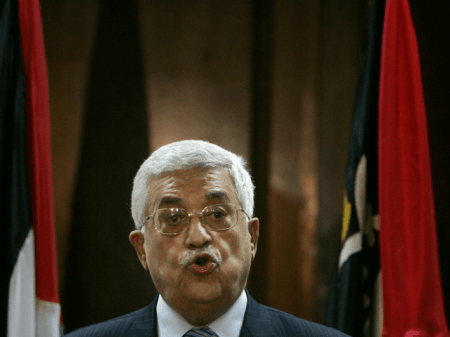
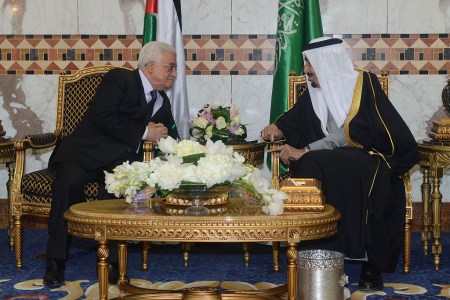
Last week, the Saudis unexpectedly summoned Palestinian Authority President Mahmoud Abbas to Riyadh for talks on Trump’s “ultimate solution” for the Israeli-Arab conflict. Abbas was reportedly told that he had no choice but to accept the plan or resign. Pictured: Abbas on a previous visit to Saudi Arabia, on February 23, 2015, meeting with Saudi King Salman. (Photo by Thaer Ghanaim/PPO via Getty Images)

If true, the Saudi “ultimatum” to Abbas is tantamount to asking him to sign his death warrant. Abbas cannot afford to be seen by his people as being in collusion with an American “peace plan” that does not comply completely with their demands. Abbas has repeatedly made it clear that he will not accept anything less than a sovereign Palestinian state on all the pre-1967 lands, including east Jerusalem. He has also emphasized that the Palestinians will never give up the “right of return” for millions of “refugees” to their former homes inside Israel. Moreover, Abbas has clarified that the Palestinians will not accept the presence of any Israeli in their future Palestinian state.

Abbas has done his dirty work well. He knows that he cannot come back to his people with anything less than what he promised them. He knows that his people have been radicalized to the point that they will not agree to any concessions or compromise with Israel.

And who is responsible for this radicalization? Abbas and other Palestinian leaders, who continue unendingly to tell their people through the media, discourse and mosques that any concession to Israel constitutes treason, pure and simple.

So it would be naïve to think that Saudi Arabia or any other Arab country would be able to strong-arm any Palestinian leader to accept a “peace plan” that requires the Palestinians to make concessions to Israel. Abbas may have much respect for the ambitious and savvy young crown prince of Saudi Arabia, Mohammed bin Salman. This respect, however, certainly stops at the border of the political suicide – and extreme personal risk — from Abbas’s point of view.

Abbas is now caught between two choices, both disastrous: On the one hand, he needs the political backing of his Arab brothers. This is the most he can expect from the Arab countries, most of whom do not give the Palestinians a penny. It is worth noting that, by and large, the Arab countries discarded the Palestinians after the PLO and Yasser Arafat openly supported Saddam Hussein’s invasion of Kuwait in 1990. Kuwait was one of several Gulf countries that used to provide the Palestinians with billions of dollars a year. No more.

Since then, the Palestinians have been almost entirely dependent on American and European financial aid. It is safe to assume, then, that the US and EU have more leverage with the Palestinians than most Arab countries.

Nevertheless, no American or European on the face of this Earth could force a Palestinian leader to sign a peace treaty with Israel that would be rejected by an overwhelming majority of his people.

Trump’s “ultimate solution” may result in some Arab countries signing peace treaties with Israel. These countries anyway have no real conflict with Israel. Why should there not be peace between Israel and Kuwait? Why should there not be peace between Israel and Oman? Do any of the Arab countries have a territorial dispute with Israel? The only “problem” the Arab countries have with Israel is the one concerning the Palestinians.

For now, it appears that the vast majority of Arab regimes no longer care about the Palestinians and their leaders. The Palestinians despise the Arab leaders as much as they despise each other. It is a mutual feeling. The Palestinians particularly despise any Arab leader who is aligned with the US. They do not consider the US an honest broker in the Israeli-Arab conflict. The Palestinians, in fact, view the US as being “biased” in favor of Israel, regardless of whether the man sitting in the Oval Office is a Democrat or Republican.

The Saudi crown prince is viewed by Palestinians as a US ally. His close relations with Jared Kushner are seen with suspicion not only by Palestinians, but by many other Arabs as well. Palestinian political analysts such as Faisal Abu Khadra believe that the Palestinian leadership should prepare itself to face the “mysterious” Trump “peace plan.” They are skeptical that the plan would meet the demands of the Palestinians.

The Palestinians appear to be united in rejecting the Trump Administration’s effort to “impose” a solution on them. They are convinced that the Americans, with the help of Saudi Arabia and some Arab countries, are working towards “liquidating” the Palestinian cause. Abbas and his rivals in Hamas now find themselves dreading the US administration’s “peace plan.”

Like lemmings drawn to the sea, the Palestinians seem to be marching towards yet another scenario where they “never miss an opportunity to miss an opportunity.” The question remains: how will the Saudis and the rest of the international community respond to ongoing Palestinian rejectionism and intransigence?

Bassam Tawil, a Muslim, is based in the Middle East.

Not Satire | Penn State Greens: Israeli Tree Planting is Environmental Racism

November 13, 2017

Penn State Greens: Israeli Tree Planting is Environmental Racism, Watts up with That, November 13, 2017

h/t Nick – If there was one Israeli initiative you would think radical greens would support, that would be Israeli efforts to restore ancient forests and improve national CO2 sequestration with a massive tree planting programme.

But no – according to Penn State Student organization “Fossil Free Penn”, the tree planting initiative is environmental racism.

Penn Students Hold Presentation on Environmental Racism

By Daniel Tancredi

The student group Fossil Free Penn held a discussion on environmental racism as part of its weeklong engagement project called “Divestfest” Wednesday afternoon.

In discussing environmental racism, the speakers highlighted the Israel-Palestine conflict. The Jewish National Fund, an organization that plants trees in Israel, was a major subject of discussion. After asserting that the organization acted unjustly by purchasing land from Palestinians in the early 1900s in deals from which the Palestinians did not profit, the presenters looked into the symbolism of “making the desert bloom,” a phrase the students argued connected the forest environment to whiteness, evoked the notion of “a vacuum that the European savior can come nourish,” and ultimately incentivized “artificially making these areas look more like Europe.”

The students found a particular problem in the planting of pine trees in Israel and the West Bank, drawing a “connection between pine trees, forestation, and the way they further the colonialist agenda through capitalistic (sic) means of timber production.

While pine trees are an invasive species and can be bad for certain environments, the solution is not merely to plant native trees like the olive tree.

“If we are talking about environmental justice, we have to consider intersectionality,” one of the presenters said. “We have to consider the way that different environmental agendas are being used in order to romanticize and support things that may be in violation of human rights and ancestry rights.” Additionally, the students urged the audience to “look for the complexity in the way that issues are whitewashed.”

Read more: https://statesmanonline.org/2017/11/03/students-hold-presentation-on-environmental-racism/

Penn State, the place where your kids can learn from greens that planting trees is wrong, unless they are planted by people with a politically acceptable pedigree.

‘Don’t you dare’

November 13, 2017

‘Don’t you dare’ Israel Hayom, Yoav Limor, November 13, 2017

Now the message to Gaza is “no more.” Israel will not be a passive player, rather an active one that if attacked – will attack back. If Islamic Jihad considered a limited retaliation, one that would not lead to an escalation of hostilities, Israel is saying that its reaction will be severe regardless. It will not only target Islamic Jihad but the ruling faction in Gaza: Hamas.

***********************************

The unusual announcement from Maj. Gen. Yoav Mordechai, head of the Coordinator for Government Activities in the Territories unit, Saturday night was not out of the blue. In Israel, defense officials believe Palestinian Islamic Jihad is preparing a revenge attack for the demolition of its underground tunnel and deaths of its people.

This assessment was enough for Mordechai to leave his home Saturday evening, put on his uniform, and drive to IDF headquarters in Tel Aviv to record an announcement in Arabic, the gist of which can be summarized in three simple words: Don’t you dare.

During the 69 seconds in which he spoke, Mordechai sought to transfer the dilemma to the other side. Ever since the tunnel was destroyed, some two weeks ago, Israel has been on high alert; its military activity along the security fence has been minimal, agricultural work in the vicinity has been greatly restricted, and the message received by the Gaza was that Israel was waiting for a retaliation.

Now the message to Gaza is “no more.” Israel will not be a passive player, rather an active one that if attacked – will attack back. If Islamic Jihad considered a limited retaliation, one that would not lead to an escalation of hostilities, Israel is saying that its reaction will be severe regardless. It will not only target Islamic Jihad but the ruling faction in Gaza: Hamas.

This purpose of this message was to pass the dilemma back to Gaza. It was meant for Hamas, which is taking great pains to restrain Islamic Jihad and has thus far managed to stop it from retaliating; and for Islamic Jihad itself – which was warned that a terrorist attack would bring disaster to the Gaza Strip and sabotage Palestinian reconciliation efforts (which Israel opposes but is presently seeking to utilize). As expected, Islamic Jihad responded with an aggressive message of its own, reiterating its intention to retaliate.

With that, it appears the group’s leadership in Gaza has yet to make that decision and is waiting for the green light from its military headquarters in Damascus, namely from Ramadan Salah and his second-in-command Ziad Nahala. This is also why Mordechai included in his statement a particularly undiplomatic message for the two, warning “there will be those who will be held responsible” for the consequences of a future attack.

In the meantime, there are no signs that Islamic Jihad is folding. If the prevailing assumption of a revenge attack materializes – which will lead to an assured Israeli response – we could find ourselves in a downward spiral that neither side wants.

Senior Abbas Advisor: We Won’t Stop Fighting for Palestine Until It is ‘Purified of the Impious Existence of Jews’

November 12, 2017

Senior Abbas Advisor: We Won’t Stop Fighting for Palestine Until It is ‘Purified of the Impious Existence of Jews’, BreitbartDeborah Danan, November 12, 2017

AP/Muhammed Muheisen

Deputy Chief Minister Mohammad Mahmood Ali of India’s Telangana said that witnessing the “Jews’ atrocities against Palestinians” makes one “understand why Hitler carried out the massacre of Jews.”

“In Hitler’s words, wherever Jews lived, they created conflict,” he said.

*********************************

TEL AVIV – Palestinian martyrs will not stop fighting for Palestine until it is completely purged of the Jews, a senior religious adviser to Palestinian Authority President Mahmoud Abbas declared at a recent conference held in India.

Other Arab diplomats – including Syria’s Ambassador to India – accused Israel of “genocide” against the Palestinians and said Hitler’s motive for killing Jews was thus understandable.

The aim of the October 29 conference, which took place in the southern Indian city of Hyderabad, was to express solidarity between Indians and Palestinians, MEMRI reported. In addition to Palestinian officials, the day-long conference was attended by delegates and ambassadors from Iraq, Syria, Saudi Arabia, Jordan, Egypt and Yemen, among others.

Chief Sharia Justice and religious affairs adviser to Abbas, Mahmoud Al-Habbash, made a speech in which he declared, “Every Palestinian will continue the struggle till the complete freedom of Palestine.”

“Those who started the movement for the freedom of Palestine took a pledge, while leaving this world, from the next generation that it will continue this struggle until the land … is purified of the impious existence of Jews,” he said.

“Yasser Arafat, Amin Al-Hussein, and many martyrs like them fought for the freedom of Palestine till the last breath of their lives,” he added.

Habbash continued by slamming Britain for its role in the establishment of the State of Israel.

“Britain is responsible for Israel’s occupation supremacy on Palestinian land,” he said. “This year, on November 2, 2017, the British government is celebrating 100 years of the Balfour Declaration. The world of humanity should condemn this.”

Habbash extolled the United Nations for giving “Palestine” full status.

He also said Israel was “stunned by the Intifada movement of Palestinian youths.”

“It cannot bear the stones of Palestinian youths. Allah will help Palestinians, will deliver them justice,” he added.

Syrian Ambassador Riad Kamil Abbas also addressed the conference, saying that the fight against Bashar Assad’s regime was also a fight “against Palestine.”

“Syria considers the Palestinian problem its own problem, and that of the Arab world. Those who have conspired against Palestinians are the same people who are active against Syria,” he said.

He added that Israel’s “atrocities” towards the Palestinians were “a crime against humanity, genocide.”

Abbas added that the Islamic State terror group was created by the West.

Iraqi Ambassador Fakhri Hassan Al-Issa told the conference: “Iraq has always been a supporter of the Palestinian cause and has been supporting international efforts against Israel’s cruel occupation to succeed.”

Deputy Chief Minister Mohammad Mahmood Ali of India’s Telangana said that witnessing the “Jews’ atrocities against Palestinians” makes one “understand why Hitler carried out the massacre of Jews.”

“In Hitler’s words, wherever Jews lived, they created conflict,” he said.

The conference organizers – part of an NGO called the Indo-Arab League – offered free land for a Palestinian consulate in the city. According to Indo-Arab League Chairman Syed Vicaruddin, the consulate will help strengthen “relations between India and Palestine and facilitate Muslims wanting to visit Al-Aqsa mosque in Jerusalem.” Vicaruddin also announced a cultural hall to be established “in memory of Palestinian martyrs.”

Central Europe and the U.S.: The New Alliance

November 12, 2017

Central Europe and the U.S.: The New Alliance, Gatestone Institute, Drieu Godefridi, November 12, 2017

The US president may be an arch-villain in Western Europe, but in Central Europe, he is a superhero. For years, Central European countries have respectfully disagreed with the Green millenarianism of the EU. Still catching up after 50 years of communism, they do not have the financial means for the “energy transition”. They see no rational reason to exchange their cheap electricity for the most expensive electricity on Earth, with no measurable impact whatsoever on “climate”. Before Trump, they felt alone, and weak in front of the economic (and moral) supremacy of Germany. Now, they know they are not alone.

************************************

Even German Chancellor Angela Merkel recognized that multiculturalism has failed. All scientific studies show that a significant number of Muslims in Europe are fundamentalist; and that thousands of young European Muslims went to Syria to join ISIS. And yet, it is insufferable to Brussels and Berlin, to hear that the people of Central Europe have no intention of following the same path.

The European Court of Human Rights and the Court of Justice of the EU have made sure, through ruling after ruling, that it is virtually impossible to expel a “refugee” after his asylum request has been rejected.

The UN Intergovernmental Panel on Climate Change (IPCC) defines itself as a scientific body, although in reality, unsurprisingly, it is a purely political body. In composition, competence or functioning, there is not a shred of science in the IPCC. Yet, in the name of this “science”, European politicians are extracting from their people trillions in additional taxes, building pyramids of new regulations and inflicting prohibitions in every sphere of human activity.

On immigration, on sustainable development and on many other subjects, the convergence between the United States and Central Europe is now as evident as the new divide between Western Europe and Central Europe.

The European mindset is shifting. Twenty-three of the 28 governments of the European Union now have parliamentarian majorities on the center-right of the political spectrum. Everywhere in Europe, the “left” is on the run.

This is particularly true in Central Europe. The soon-to-be Austrian Prime Minister Sebastian Kurz won the election on an anti-immigration platform and is on the verge of forming a government with the right-wing Austrian Freedom Party (FPÖ) which owes its own success to the same topic.

In the Czech Republic, political parties on the right now hold 157 of the 200 seats in the Parliament and tycoon Andrej Babis­ ­— “the Czech Trump” — is set to be the next prime minister.

All in all, the “Visegrad Group” peoples — Czechs, Hungarians, Poles and Slovaks — plus the Austrians, have voted in the most conservative governments we have seen in Europe for almost 30 years, since the fall of Margaret Thatcher in the United Kingdom.

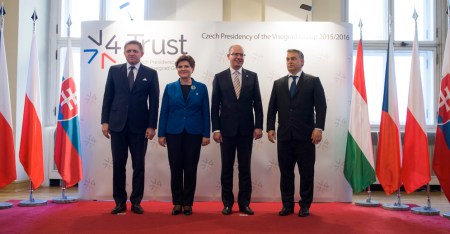
Pictured: The Prime Ministers of the Visegrad Group countries meet in Prague on December 3, 2015. From left to right: Slovakia’s Robert Fico, Poland’s Beata Szydło, Czech Republic’s Bohuslav Sobotka and Hungary’s Viktor Orbán. (Image source: Chancellery of the Prime Minister of Poland)

These people and parties have much more in common — in terms of values, priorities,Weltanschauung — with the American Right than with the milder Western-European right. To state, as Hungarian Prime Minister Viktor Orbán, has repeatedly, that people in Central Europe do not want Muslim refugees because they do not want their cities to look like Brussels, Paris or London, is Trumpian, and in no way EU-compatible.

If we go to the bones of the contention, we see that these differing perspectives between Western Europe and Central Europe are no mere trifles, temporary divergences in wait of the next synthesis. They are existential. The world view of Central Europe looks increasingly irreconcilable with that of Western Europe and the EU. Let us focus on just two matters: immigration and environmentalism.

The political elites of Western Europe have not only fully embraced the concept of “no borders”; they would also dub any form of dissent as ignorance, discrimination or racism. Merkel herself has recognized that multiculturalism has failed . All scientific studies show that a significant number of Muslims in Europe are fundamentalist; and that thousands of young Muslim Europeans have departed for Syria to join ISIS. And yet, to hear that the people of Central Europe have no intention of following the same path is insufferable to Brussels and Berlin.

Bearing in mind that under EU law — the Dublin Regulation — these countries have a legal obligation to welcome their “quota” of refugees, who are overwhelmingly Muslims coming via Greece and Italy, you can understand that Europe, that is the EU, has a real problem. It is also worthwhile to note that the European Parliament’s Civil Liberties Committee has just adopted a draft EU regulation to augment this obligation, providing that the refugees should be distributed throughout the whole of the EU immediately following their arrival on EU soil.

The more “moderate” European Commission has proposed to streamline and supplement the current rules with a corrective allocation mechanism:

“This mechanism would be triggered automatically were a Member State to be faced with disproportionate numbers of asylum-seekers. If a Member State decided not to accept the allocation of asylum-seekers from a Member State under pressure, a ‘solidarity contribution’ of €250 000 per applicant would have to be made instead.”

€250 000 per applicant! Let us say should Poland refuse a mere 1000 refugees, the penalty would be a staggering 250 million euros (which may come as a surprise since the official ideology prevalent in the EU is that refugees are of benefit to the economy).

Of course, everybody agrees that “asylum applications should be processed much quicker so those in need of protection get it sooner, while those with no right to asylum can be returned to their home country swifter,” in the words of MEP Cecilia Wikström. The plan is unfortunately of little consequence as the EU is living under the law of the infernal twins: the European Court of Human Rights and the Court of Justice of the EU. They have made sure, through ruling after ruling, that it is virtually impossible to expel a “refugee” after his asylum request has been rejected: no collective deportation, no deportation if the country of origin does not want its national back, no deportation if the country of origin is not a nice democracy, no deportation pending the appeal, no deportation if there is a medical condition, etc. All of these exceptions are reliant upon the “refugee” not seeing fit to destroy his or her own documents, as in that case he cannot be expelled at all.

If the US system of justice regarding immigration is, in Trump’s words, “a joke,” then the EU system is a monumental joke. “Deportation of quarter of a million failed asylum seekers is almost impossible,” said Horst Seehofer, Minister President of Bavaria of Bavaria and reluctant ally of Merkel in her last coalition.

“The question of deportation is a great illusion in Germany. It is almost impossible to send back the migrants once they are in the country. There are mass complaints against courts for deportation. In most cases, papers are missing and without papers, the country of origin does not take people back. In other cases, there are health certificates missing.”

Central Europe, on the other hand has declared that it has no intention whatsoever of taking its part in the extreme policies and grotesque failure of “open borders” and forced multiculturalism of Western Europe.

And that was before there was “sustainable development”. Self-anointed moral leader, Europe, has decided to become the global poster boy for green policy. The past belongs to Fossil fuels; the future belongs to renewable energy — from the wind and sun (“our sisters”, as Pope Francis wrote in his encyclic Laudato si’). Energy transformation — essentially electric energy — has taken on gigantic proportions in Europe. Thanks to the Energiewende, in Germany the average family is now paying more than twice as much for its electricity (per kW/h) as in the US. France, the happy owner of an extraordinary nuclear production capacity, which for decades was its only substantial competitive advantage has decided to reduce the role of nuclear energy in its production of electricity from 75% to 50%, under the guidance of Minister Nicolas Hulot (by education photographer and beach guardian).

There is also the exemplary instance of Belgium. Belgium’s federal government has just decided to close all its seven nuclear reactors by 2025. Eight years! The beauty of it is that nobody knows, at this stage, how Belgium is going to replace its nuclear reactors. There seem to be two options: building gas plants or blotting Belgium’s land and sea with wind turbines. The first option is anathema to the Greens and the Left in general, as Belgium would then be emitting more CO2than now. Or, second, the wind option, which would mean that in ten years Belgian electricity will be at least twice as expensive as now. Millions would be condemned to energy poverty, meaning they would have to live partly in cold and darkness, as is already the situation in Germany.

The whole concept of “energy transition” is based on the science of the UN Intergovernmental Panel on Climate Change (IPCC), which states in report after report that the Earth is warming because of the human emission of CO2. European politicians regard the IPCC as a scientific body, and the IPCC defines itself as a scientific body, although in reality, unsurprisingly, it is a purely political body. In composition, competence or functioning, there is not a shred of science in the IPCC.

Yet, when the IPCC publishes a report, it is in Europe as if Science had spoken. In the name of this “science”, European politicians are extracting from their people trillions in additional taxes, building pyramids of new regulations and inflicting prohibitions in each and every sphere of human activity. Moreover, they stipulated in the 2015 the Paris Accord, that from then on, the West would also finance the “energy transition” of the rest of the world, via the “Green Fund”: intending to donate $100 billion per year, from the Western taxpayer to whole world (including China).

US President Donald Trump said on June 1st that enough was enough. Europeans want to build International Socialism in the name of Science? Very well, but no thank you, we are not interested. In Europe, this decision caused the vilification of Trump as archvillian (until then he had been regarded by the glitterati of the EU as nothing more than a buffoon). It is now common in the highest spheres of European politics publicly to insult the US president: “He is a climate terrorist. Millions of people will die because of such behavior”, wrote the Belgian expert Damien Ernst on October 31, after President Trump welcomed the increase in US coal production.

The US president may be an arch-villain in Western Europe, but in Central Europe, he is a superhero. For years, Central European countries have respectfully disagreed with the Green millenarianism of the EU. Still catching up after 50 years of communism, they do not have the financial means for the “energy transition”. They see no rational reason to exchange their cheap electricity for the most expensive electricity on Earth, with no measurable impact whatsoever on “climate”. Before Trump, they felt alone, and weak in front of the economic (and moral) supremacy of Germany. Now, they know they are not alone.

Of course, the European press still considers Trump to be a cosmic anomaly. They hope that a post-Trump America will come back to the greatest embezzlement in the history of mankind — the Paris Accord, in which Western countries transfer vast amounts of their taxpayers’ wealth to poorer countries in exchange for promises that they will supposedly address their carbon-emission problems in 25 years. This is wishful thinking. Climate and energy are probably the only subjects on which Trump and the Republicans agreed from the beginning. The exit of the Paris Accord is not the isolated act of an unbalanced person, it is only one of the many closely aligned rulings, nominations and deregulation making a moderate energy policy which does not demonize fossil fuels and is open to “renewable” (intermittent) energies as long as they are economical. If the trend persists, in 10 years’ time the electricity in countries such as Germany and Belgium will be at least four times as expensive as in the US. And all, ironically, in the name of “sustainable development”. No ideologically-based “science” could survive such realities; it is only a question of time.

On mass-migration, environmentalism as on many other subjects — such as gender or family values — the divide between Western and Central Europe has deepened into an abyss, aggravated by the arrogance of EU bureaucrats convinced of their own moral superiority. The European Union is a “Union” no more, and the convergence between Central Europe and the US is a new and massive geopolitical fact.

Drieu Godefridi, a classical-liberal Belgian author, is the founder of the l’Institut Hayek in Brussels. He has a PhD in Philosophy from the Sorbonne in Paris and also heads investments in European companies.

Palestinian Migrant Who Attacked Hamburg Shoppers Wanted to Kill Christians

November 12, 2017

Palestinian Migrant Who Attacked Hamburg Shoppers Wanted to Kill Christians, BreitbartChris Tomlinson, November 12, 2017

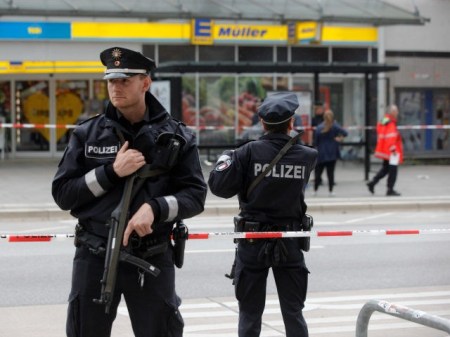
MARKUS SCHOLZ/AFP/Getty Images

German federal prosecutors now believe that Hamburg supermarket attacker Ahmad A. was motivated by religious hatred to kill German Christians, but have refused to charge him with terrorism.

The 26-year-old failed Palestinian asylum seeker will be charged with the murder of a 50-year-old man and six more counts of attempted murder. Prosecutors say that he was upset about the treatment of Muslims, claimed they were being oppressed around the world, and decided to take action against any Christians he could, find Die Welt reports.

The Hamburg supermarket attack occurred in late July and initially many believed it to be an act of terror after witnesses reported hearing a man shouting “Allahu Akbar!”

Prosecutors say that the Palestinian was particularly aggrieved by the growing tensions between Israelis and Palestinians on the Temple Mount in Jerusalem.

“He found the access restrictions to the Al-Aqsa mosque unfair and unbearable,” the prosecutor’s office said, adding: “Therefore, German citizens of the Christian faith should die as an atonement.”

While they believe the attack was religiously motived, prosecutors say they have found no evidence that Ahmad A. had any links to terror organisations like the Islamic State terror group.

Germany Could Have Deported Hamburg Supermarket Attacker in 2015
http://www.breitbart.com/london/2017/08/03/germany-deported-hamburg-supermarket-attacker-2015/ 

New reports show the German government attempted to deport Islamist and failed asylum seeker Ahmad A., who stabbed a person to death last week, but were unable because authorities missed a key deadline by one day.

Intelligence officials say that the Palestinian did, however, show signs of radicalisation, and was known to the domestic security services as an Islamist. He was also known to be “mentally unstable.”

The trial for Ahmad A. is set to begin in January according to the court press office in Hamburg.

The attack is not the first which has not been classified as terrorism by German authorities despite being carried out by a known Islamist.

Last year three Muslim teenagers attempted to bomb a Sikh temple in Essen, but despite their revealed links to Islamic State they were not charged with terrorism.

Prosecutors have seen a four-fold increase in terrorism cases over the last year and a report by the Heritage Foundation think tank found that over half of the plots were being planned by asylum seekers.

How Iran Tried to Turn Arab States into Fading Ghosts

November 12, 2017

How Iran Tried to Turn Arab States into Fading Ghosts, Gatestone InstituteAmir Taheri, November 12, 2017

Tehran also exerts political influence through at least part of the Ad-Daawa (“The Call”) party. However, Iran’s hope of creating a second Lebanon in Iraq has not succeeded because many Iraqis resent Iranian domination while the grand ayatollahs of Najaf regard the Khomeinist regime in Tehran as an abomination.

The mullah’s scheme in Syria has also run into trouble because of Russian intervention and President Vladimir Putin’s determination that Syria’s future is decided in Moscow and not in Tehran.

Hariri’s resignation may be a sign that the Arabs are no longer prepared to grin and bear it as Tehran dismantles their state structures by creating doubles to their armies and transforming their governments into puppets with their strings pulled from the Iranian Embassy.

Tehran’s scheme for dominating the Arab states may have reached its limits; the rapid advance of the mullahs may now be followed with a roll-back. And that could mean the return of political frontiers and loyalties based on citizenship not religious sect.

*************************************

If history is a stage on which the fate of nations is played out, knowing when to step in and when to bow out is of crucial importance. Being in the wrong place at the wrong time and, even worse, in the wrong context, could lead to loss and grief.

These may have been some of the thoughts that Lebanon’s outgoing Prime Minister Saad Hariri may have had in mind when he decided to throw in the towel rather than pretend to exercise an office without being able to do so in any effective manner. Hariri realized that he was in office but not in power.

Whatever the reason for Hariri’s departure, I think he was right to withdraw from a scenario aimed at turning Lebanon into a ghost of a state with a ghost of a president and ghost prime minister and parliament.

Lebanon’s outgoing Prime Minister, Saad Hariri. (Image source: kremlin.ru)

That scenario was written in Tehran in the early 1980s with the creation of the Lebanese branch of Hezbollah by then Iranian Ambassador to Damascus Ayatollah Ali-Akbar Mohtashami-pour. The original idea had taken shape in 1975, when Ayatollah Hadi Ghaffari created the first branch of Hezbollah in Tehran to fight the Shah. By 1977, clandestine branches had been created in Turkey and Kuwait.

The hope was to fade out political frontiers, often created by accidents of history or designs of empires, and replace them with religious frontiers. The aim was to create an archipelago of Shi’ite communities across the Middle East, linked together through a network of religious-political organizations controlled by Iran.

The rationale for this was that throughout Islamic history, the element binding people together was allegiance to a version of the religion (Arabic: Mazhab) rather than political concepts such as citizenship of a state.

The fall of the Shah and the seizure of power in Tehran by mullahs gave the scheme a new impetus by putting Iran’s resources at its disposal.

However, very soon it became apparent that the grand design could not be realized without destroying or at least weakening Western-style state structures already in place. The states targeted had more or less strong armed forces that would resist an Iranian takeover.

This was precisely what happened in Turkey, where attempts by the Hezbollah branch to make a splash were crushed by the army.

In Iraq, a premature takeover bid by Khomeini gave Saddam Hussein an excuse to invade Iran and start an eight-year war.

In Syria, according to the memoirs of General Hussein Hamadani, who led the Iranian military contingent there, the national army did all it could to prevent Tehran from creating power bases of its own. The situation in Syria changed only when the nation was plunged into civil war by President Bashar al-Assad’s ruthless repression of peaceful protests.

The mullahs learned from their experience in Iran.

Soon after they seized power by a combination of freakish circumstances, Khomeini realized that he would never win the loyalty of existing state structures, while being unable to destroy them altogether.

Thus, he developed the strategy known as “parallelism” (movazi-sazi in Persian).

He created the Islamic Revolutionary Guard Corps (IRGC) as a parallel to the national army. Islamic courts were set up as parallels to state courts based on laws inspired by the Napoleonic Code. The Majlis (parliament) found its parallel in the Assembly of Experts.

Applied to other Middle Eastern countries, this strategy was known as tohi-sazi or “emptying of content”.

The first place this was put into practice was Lebanon.

Iran created a Shi’ite militia to “parallel” the regular Lebanese army. Then, through Hezbollah, Tehran also recruited allies among other Lebanese communities and transformed the Lebanese parliament into a toothless bulldog. Finally, Tehran succeeded in propelling its candidate into the presidency, and secured effective power of veto in the Council of Ministers.

All that costs a lot of money.

According to the current Iranian national budget, Iran is spending an average of $60 million a month in Lebanon, most of it through Hezbollah. Consequently, as President Hassan Rouhani said in a speech last month, nothing can be done in Lebanon without Iran’s say-so.

The Lebanese branch of Hezbollah has given Iran value for money to the point of sustaining thousands of casualties in combat in the 2006 mini-war with Israel and, more importantly, the campaign to crush Assad’s opponents in Syria.

In Iraq, the Iranian scheme has had partial results.

Tehran created the Popular Mobilization Forces, a coalition of 17 Shi’ite militias, plus the Islamic Peshmergas (Kurdish fighters hired by Tehran) to parallel the Iraqi national army and the military force of the Kurdistan Autonomous Region government.

Tehran also exerts political influence through at least part of the Ad-Daawa (“The Call”) party. However, Iran’s hope of creating a second Lebanon in Iraq has not succeeded because many Iraqis resent Iranian domination while the grand ayatollahs of Najaf regard the Khomeinist regime in Tehran as an abomination.

The mullah’s scheme in Syria has also run into trouble because of Russian intervention and President Vladimir Putin’s determination that Syria’s future is decided in Moscow and not in Tehran.

Tehran’s scheme has had partial success in Yemen.

Iran’s surrogates, the Houthis, succeeded in creating a parallel army in the shape of Ansar Allah, but failed to fully clip the wings of the regular army. The Houthis also reduced President Ali Abdullah Saleh to a shadow of his past but could not fully get rid of him. On top of that, the Saudi-led coalition’s intervention has dealt a decisive blow to Tehran’s hope of doing another Lebanon in Yemen.

In the case of Qatar and Oman, Tehran used Finlandization, allowing them to enjoy tranquility in exchange for splitting the Arab ranks and toeing the mullahs’ line on key issues.

When Muhammad Morsi took over as Egypt’s elected president, Tehran tried to sell its scenario in Cairo as well.

Former Foreign Minister Ali-Akbar Velayati was sent to Egypt with a letter from Supreme Leader Ali Khamenei. In it, Khamenei called on Morsi to disband the Egyptian army and create a parallel military force to “guard the revolution”. The proposed scheme was never applied either because, as Velayati and Khamenei claim, Morsi rejected it or the Egyptian army pre-empted it by deposing Morsi.

Hariri’s resignation may be a sign that the Arabs are no longer prepared to grin and bear it as Tehran dismantles their state structures by creating doubles to their armies and transforming their governments into puppets with their strings pulled from the Iranian Embassy.

Tehran’s scheme for dominating the Arab states may have reached its limits; the rapid advance of the mullahs may now be followed with a roll-back. And that could mean the return of political frontiers and loyalties based on citizenship not religious sect.

Amir Taheri, formerly editor of Iran’s premier newspaper, Kayhan, before the Iranian revolution of 1979, is a prominent author based on Europe. He is the Chairman of Gatestone Europe.

This article first appeared in Asharq Al Awsat and is reprinted here with the kind permission of the author.

UK Muslim Labour Candidate: We’re Brainwashed into Thinking Hitler Was the Bad Guy

November 12, 2017

UK Muslim Labour Candidate: We’re Brainwashed into Thinking Hitler Was the Bad Guy, The Point (FrontPage Magazine), Daniel Greenfield, November 12, 2017

(Please see also, The horrifying scale of antisemitism in the British Labour Party and Kristallnacht, and Our Modern-Day Approach to Antisemitism. — DM)

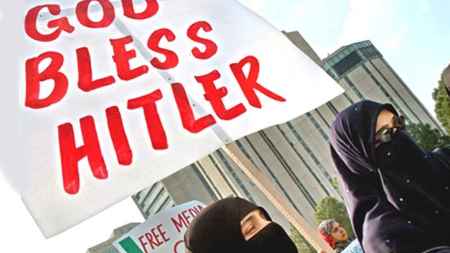
The left embraced Islamists to be tolerant. And ended up embracing Islamofascists. Even while bellowing that everyone who didn’t embrace them was a Nazi. While their new friends defended Hitler.

Nasreen Khan, a former member of George Galloway’s Respect Party, made offensive remarks about Jews on Facebook five years ago.

Miss Khan, a Muslim who has since joined the Labour Party, said they were ‘inappropriate and unacceptable’.

But despite the remarks, she is on a two-person shortlist for the Labour nomination in a safe seat in Bradford at next year’s local elections.

In 2012, writing under a video titled ‘The Palestine you need to know’, she said: ‘It’s such a shame that the history teachers in our school never taught us this but they are the first to start brainwashing us and our children into thinking the bad guy was Hitler.

‘What have the Jews done good in this world?’ When questioned about the comment, she had added: ‘No, I’m not a Nazi, I’m an ordinary British Muslim that had an opinion and put it across. We have worse people than Hitler in this world now.’

The Labour Party’s position is, no comment.

A Labour Party spokesperson said: “We do not comment on internal selection matters.”

But don’t worry. This isn’t anti-Semitism. It’s anti-Zionism. The two just happen to be really hard to distinguish.

Dems Fuming as Trump Remakes Federal Judiciary

November 11, 2017

Dems Fuming as Trump Remakes Federal Judiciary, PJ MediaMichael Walsh, November 11, 2017

(AP Photo/Ted S. Warren, file)

Mr. Trump has already appointed eight appellate judges, the most this early in a presidency since Richard M. Nixon, and on Thursday, the Senate Judiciary Committee voted along party lines to send a ninth appellate nominee — Mr. Trump’s deputy White House counsel, Gregory Katsas — to the floor.

Republicans are systematically filling appellate seats they held open during President Barack Obama’s final two years in office with a particularly conservative group of judges with life tenure. Democrats — who in late 2013 abolished the ability of 41 lawmakers to block such nominees with a filibuster, then quickly lost control of the Senate — have scant power to stop them.

 ********************************

Meanwhile, back at the Swamp:

In the weeks before Donald J. Trump took office, lawyers joining his administration gathered at a law firm near the Capitol, where Donald F. McGahn II, the soon-to-be White House counsel, filled a white board with a secret battle plan to fill the federal appeals courts with young and deeply conservative judges.

Mr. McGahn, instructed by Mr. Trump to maximize the opportunity to reshape the judiciary, mapped out potential nominees and a strategy, according to two people familiar with the effort: Start by filling vacancies on appeals courts with multiple openings and where Democratic senators up for re-election next year in states won by Mr. Trump — like Indiana, Michigan and Pennsylvania — could be pressured not to block his nominees. And to speed them through confirmation, avoid clogging the Senate with too many nominees for the district courts, where legal philosophy is less crucial.

Nearly a year later, that plan is coming to fruition. Mr. Trump has already appointed eight appellate judges, the most this early in a presidency since Richard M. Nixon, and on Thursday, the Senate Judiciary Committee voted along party lines to send a ninth appellate nominee — Mr. Trump’s deputy White House counsel, Gregory Katsas — to the floor.

Republicans are systematically filling appellate seats they held open during President Barack Obama’s final two years in office with a particularly conservative group of judges with life tenure. Democrats — who in late 2013 abolished the ability of 41 lawmakers to block such nominees with a filibuster, then quickly lost control of the Senate — have scant power to stop them.

Gee, that’s too damn bad. As I wrote at the time, the Harry Reid Democrats were acting like a party that thought the fix was in, and that they would never lose another election for a long, long time. Oops.

Most have strong academic credentials and clerked for well-known conservative judges, like Justice Antonin Scalia. Confirmation votes for five of the eight new judges fell short of the former 60-vote threshold to clear filibusters, including John K. Bush, a chapter president of the Federalist Society, the conservative legal network, who wrote politically charged blog posts, such as comparing abortion to slavery; and Stephanos Bibas, a University of Pennsylvania law professor who once proposed using electric shocks to punish people convicted of certain crimes, although he later disavowed the idea. Of Mr. Trump’s 18 appellate nominees so far, 14 are men and 16 are white.

“It’s such a depressing idea, that we don’t get appointments unless we have unified government, and that the appointments we ultimately get are as polarized as the rest of the country,” said Lee Epstein, a law professor and political scientist at Washington University in St. Louis. “What does that mean for the legitimacy of the courts in the United States? It’s not a pretty world.”

Wouldn’t be a New York Times story without the cultural-Marxist sex-and-race bean counting. Meanwhile, the Left has nobody to blame but itself. Serves them right.