H/t Power Line


Justice Dept. Re-Opens Clinton “Crime Cartel” Investigation | John Cardillo, Rebel Media via YouTube, January 6, 2018
(Please see also, Byron York: What the Trump dossier criminal referral means. — DM)
Byron York: What the Trump dossier criminal referral means, Washington Examiner, Byron York, January 6, 2018
[T]here has been much speculation that the FBI used information from the uncorroborated dossier to seek court permission to spy on Americans in the Trump-Russia investigation. That would be a big deal, and it is an issue House and Senate Republicans are determined to sort out.
“I don’t take lightly making a referral for criminal investigation,” Grassley said in a statement Friday. “But, as I would with any credible evidence of a crime unearthed in the course of our investigations, I feel obliged to pass that information along to the Justice Department for appropriate review. Everyone needs to follow the law and be truthful in their interactions with the FBI.”
“Maybe there is some innocent explanation for the inconsistencies we have seen,” Grassley continued, “but it seems unlikely.”
*****************************
There’s been a lot of confusion about the decision by Senate Judiciary Committee chairman Chuck Grassley and crime subcommittee chairman Lindsey Graham to refer Christopher Steele, author of the Trump dossier, to the Justice Department for a possible criminal investigation.
The two senators sent a brief letter Thursday to deputy attorney general Rod Rosenstein and FBI director Christopher Wray. The letter, which was unclassified and released to the public Friday, was a cover letter for what Grassley and Graham called a “classified memorandum related to certain communications between Christopher Steele and multiple U.S. news outlets regarding the so-called ‘Trump dossier’ that Mr. Steele compiled on behalf of Fusion GPS for the Clinton campaign and the Democratic National Committee and also provided to the FBI.”
Grassley and Graham said that, on the basis of the classified information laid out in the memo, “we are respectfully referring Mr. Steele to you for investigation of 18 U.S.C. 1001, for statements the committee has reason to believe Mr. Steele made regarding his distribution of information contained in the dossier.” (18 U.S.C. 1001 is the same federal false statements law that special counsel Robert Mueller has used to charge Michael Flynn and George Papadopoulos in the Trump-Russia investigation.)
That’s all Grassley and Graham said, or at least all they said that was released to the public. The classified memo, of course, was not released at all.
It was all very confusing. What did the letter mean? Were Grassley and Graham alleging that Steele lied to the Senate Judiciary Committee? To some other congressional committee? To other investigators? If so, to whom?
The move met with skepticism in a number of circles. Sen. Dianne Feinstein, ranking Democrat on the Judiciary Committee, called it an “effort to deflect attention” from the Trump-Russia probe. A former prosecutor called it “nonsense” in an interview with the Washington Post. A law professor speculated that it was “baseless.”
At the same time, few outside the committee seemed to understand what the letter meant. So, here is what appears to be going on:
Steele has not talked to any of the three congressional committees investigating the Trump-Russia affair – the Senate Judiciary Committee, the Senate Intelligence Committee, or the House Intelligence Committee. Steele did not make false statements to them because he has not made any statements to them.
Steele has, reportedly, talked to Mueller’s prosecutors, but it seems highly unlikely Grassley and Graham are suggesting Steele lied to Mueller because it is highly unlikely – actually, beyond highly unlikely – that the Mueller office would have shared any of Steele’s answers with the Senate Judiciary Committee. So, what were Grassley and Graham referring to in their letter? What are the “statements the committee has reason to believe Mr. Steele made” that Grassley and Graham believe might be false?
The answer is that Steele talked – and talked a lot – to the FBI. Remember that when he began to compile the dossier in the summer of 2016, Steele reportedly concluded the sensational information he had picked up – allegations of election collusion and Trump sexual escapades in Russia – was so important that he had to take it to the FBI. Steele told the left-leaning magazine Mother Jones that he first took the material to the FBI “near the start of July.”
That began a series of communications between Steele and the bureau in which Steele made certain representations to the FBI about his work. It is a crime to make false statements to the FBI – doesn’t have to be under oath, doesn’t have to be in a formal interview or interrogation setting, it’s simply a criminal act to knowingly make a false statement to the FBI.
As a result of their talks, Steele and the FBI reached a tentative agreement whereby the FBI would pay Steele to continue the anti-Trump work.
All the while, Steele was also working for the opposition research firm Fusion GPS – his dossier was the result of a Fusion anti-Trump project funded by the Clinton campaign. As part of that, Steele briefed reporters on what he had found. In a London court case, Steele’s lawyers said that in September 2016, Fusion GPS directed Steele to brief reporters from the New York Times, the Washington Post, CNN, the New Yorker, Yahoo News, and, later, Mother Jones. Steele did each briefing individually.
One serious question is whether Steele told the FBI that he was telling reporters the same information – those explosive allegations about Trump and Trump associates – that he was bringing to bureau investigators. If the FBI knew that, would they have agreed to an arrangement to make Steele a paid FBI operative investigating the Trump-Russia affair? That would have been a most unorthodox arrangement, with Steele disseminating his allegations to the FBI and the press simultaneously.
That is not exactly how the FBI operates. So now the question is: When Steele was discussing working for the FBI, did he fully inform the FBI of what his work for the Clinton campaign involved, in particular his briefing the press on the findings he would be reporting to the FBI? To use Grassley’s and Graham’s words, were the “statements the committee has reason to believe Mr. Steele made regarding his distribution of information contained in the dossier” accurate?
One way to find that out is to compare what Steele told the London court with what Steele told the FBI. Some of the London court testimony is public. As for what Steele told the FBI, the Senate Judiciary Committee has examined a lot of dossier-related material from the FBI under an agreement that allows the committee to view materials the bureau has originally produced to the House Intelligence Committee.
It appears that Grassley and Graham are pursuing inconsistencies between what Steele told the FBI and what Steele told the London court. If they conflict, which is true? If what Steele told the FBI was untrue, that’s a problem.
Ultimately, the Steele-FBI deal fell through, for reasons that have never been publicly disclosed.
But there has been much speculation that the FBI used information from the uncorroborated dossier to seek court permission to spy on Americans in the Trump-Russia investigation. That would be a big deal, and it is an issue House and Senate Republicans are determined to sort out.
“I don’t take lightly making a referral for criminal investigation,” Grassley said in a statement Friday. “But, as I would with any credible evidence of a crime unearthed in the course of our investigations, I feel obliged to pass that information along to the Justice Department for appropriate review. Everyone needs to follow the law and be truthful in their interactions with the FBI.”
“Maybe there is some innocent explanation for the inconsistencies we have seen,” Grassley continued, “but it seems unlikely.”
If You Hate America, Why Not Go Back to Your Country?, Gatestone Institute, Majid Rafizadeh, January 6, 2018
No matter what the Islamists’ current status or situation, they would lash out at the US, the West and Americans. Meanwhile, American taxpayers were providing hundreds of thousands of dollars to them in scholarships, free accommodation, and often even a monthly stipend. By comparison, many American students struggle to pay their own tuition and housing; many graduate with debt.
Some believed that the US was simply supposed to do these favors for them for free of charge. Others argued that this was an opportunity to take advantage of America, and should be done for the sake of furthering Islamic political and religious views.
The US has been funding the lives of these extremists as they endanger our country and the lives of all Americans, and spread hatred towards America, Christianity, Judaism and the West. Is this how American taxpayers want their hard-earned contributions to be used?
When I first arrived in America, I would ask every extremist and fundamentalist Muslim I met: “How has your life been since you came to the United States?”
It was clear that their living standards were much better than back home. I knew well the lands they had come from, their economic standards and restrictions, their lifestyle, the social, and the religious, economic and political landscapes of the region.
They were surely about to say how much their lives had improved, and how grateful they were to be in a new, less restricted environment. Instead, they expressed anger and even hatred of their new country and its culture. What they could not put into words, was clearly written across their faces: revulsion and disgust.
It seemed they were comfortable disclosing their true feelings in Farsi or Arabic about the US, Americans, the West, Christians, and Jews. As we had all come from, grown up in, and worked in the same region, many of them mistakenly assumed that we both shared the same hate-filled views. Once they discovered that was not the situation, some even tried to reshape my views: as I was new to the country, I probably did not yet understand.
Everything in this country, they patiently explained, was kufr: blasphemy, filthy, infidel. They went on harshly to criticize American culture and the Western lifestyle. Their list of complaints was unending: how men and women dress, how people interact, how people work and celebrate life, go to parties, date, marry, dance, drink — there did not seem one aspect of American life that did not enrage them.
A wealthy Islamist imam, who explained that he was poor in his prior country and had accumulated all of his wealth after coming to the US by expanding existing mosques and attracting people and donations, ironically bashed the US for not allowing Islamist imams to grow financially. He could not explain why. It was just another hypocritical tool, used as an excuse to hate America and brainwash followers to hate America. Despite the fact that he had gone from poverty to riches beyond anything he could have dreamed, he was quite angry at his new country.
More intriguingly, this attitude was apparent among both academics and non-academics. No matter what the Islamists’ current status or situation, they would lash out at the US, the West and Americans. Meanwhile, American taxpayers were providing hundreds of thousands of dollars to them in scholarships, free accommodation, and often even a monthly stipend. By comparison, many American students struggle to pay their own tuition and housing; many graduate with debt.
When asked what they thought of the free education that they were receiving at the best universities in the world, which ensured their success in life, a sense of entitlement would appear. Some believed that the US was simply supposed to do these favors for them for free of charge. Others argued that this was an opportunity to take advantage of America, and should be done for the sake of furthering Islamic political and religious views.
When asked for details about their home country from where they immigrated or fled, surprisingly, they had nothing bad to say. Everything in their home country was heaven-like. They beautified and worshiped their authoritarian and Islamist regimes.
Finally, I asked the question that burned in my mind: Why, if they hated the US so much, did they not they go back to their beloved home country? What if all their expenses were covered, such as plane tickets to their native land?
Instead of the earlier lengthy explanations, the general response was evasive. Some even remained perfectly silent or refused to answer.
The question itself had unmasked me. In their eyes, just by asking this question, I had revealed myself as an outsider. In that moment, I joined the crowd of multitudes of human beings that they hate and refuse to tolerate.
Even if one puts their Islamist agenda aside, their extreme ungratefulness seemed jolting. The United States had given them a home, a green card, citizenship, free scholarships, salaries, unlimited opportunities, and freedoms they had never known: freedom of speech, of the press, and of assembly.
Here they were enjoying equality under the law, security, and so many other benefits that would be considered extreme luxuries or unheard of in their previous homelands — everything they had been deprived of in their earlier home. No other country would have provided them with half of this. So why did they demonstrate and ratchet up anti-American, anti-Western, anti-Christian, anti-Semitic sentiments, while at the same time rejecting the idea of returning to their original country? How could they enjoy all of these benefits America offered them, and yet, at the same time, yearn for its destruction? There do not seem to be such anti-American sentiments expressed by other immigrants from non-Islamist countries, or from Christians or Jews who fled from Islamist states in the same region.
 (Image sources: Welcome to USA sign – Craig Nagy/Wikimedia Commons; Islamist protester – Peter Macdiarmid/Getty Images)
It is now time to reconsider whom we are freely providing money and resources to — including those Islamists who have already been in the United States for generations. It is the time to reconsider whom we are allowing to enter this country, and providing with free shelter, scholarships, cash, freedom of speech, and all the rights that come with the constitution. The US has been funding the lives of these extremists as they endanger our country and the lives of all Americans, and spread hatred towards America, Christianity, Judaism and the West.
Is this how American taxpayers want their hard-earned contributions to be used?
Dr. Majid Rafizadeh, is a business strategist and advisor, Harvard-educated scholar, political scientist, board member of Harvard International Review, and president of the International American Council on the Middle East. He is the author of “Peaceful Reformation in Iran’s Islam“.
Act 2 of Trump clampdown on Iran: Re-imposing sanctions lifted under nuclear accord, DEBKAfile, January 6, 2018
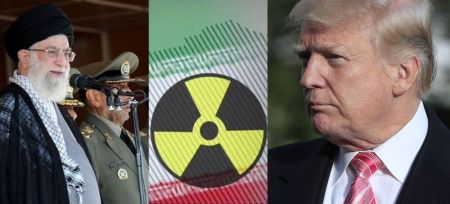
On the heels of the first protests to hit the Iranian regime, Washington will turn the screw by negating financial benefits afforded by the nuclear deal. To this end, President Donald Trump will use the deadlines he faces as of next week for certifying the Iranian nuclear deal and approving sanctions waivers. This intent was indicated by Secretary of State Rex Tillerson in an AP interview Friday, Jan. 5.
Since the president had demanded that the 2015 nuclear accord with Iran be either “fixed or cancelled,” Tillerson said the administration was working with lawmakers on legislation for making it more acceptable to the president. Last October, Trump reluctantly waived sanctions for another three months. However, since sanctions relief was not incorporated in the nuclear deal, which Iran signed with six world nations three years ago, the US may set them aside without being accused of non-compliance. The US may therefore certify the framework while emptying it of the economic benefits the Obama administration granted, which funneled hundreds of billions of dollars to the Iranian treasury.
This is what Tillerson meant by “fixing” rather than “cancelling” the nuclear accord. He is charged with reformulating the deal, while upholding the Trump policy for countering Iran’s regional aggression and continuing support for anti-regime protests. These steps are components of the drawn-out, staged war of attrition the Trump administration has begun orchestrating against the revolutionary Shiite regime in Tehran for the year of 2018.
The following steps are already in the pipeline, DEBKAfile reports:
Source: Our World: Trump kicks America’s Palestinian habit – Opinion – Jerusalem Post
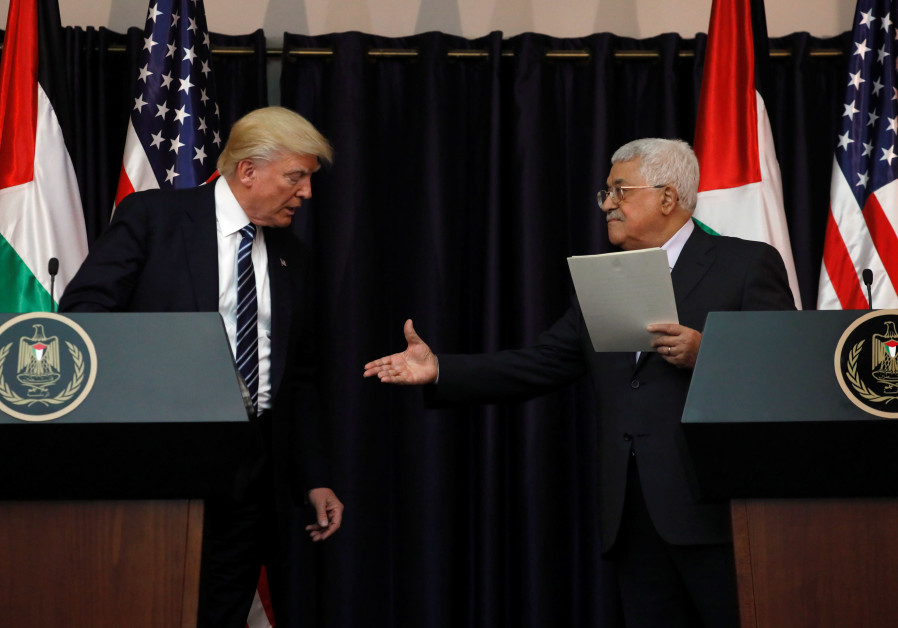
Palestinian President Mahmoud Abbas extends his hand to US President Donald Trump at the Presidential Palace in the West Bank city of Bethlehem May 23, 2017.. (photo credit: REUTERS)
It is no coincidence that Hamas is escalating its rocket attacks on Israel as the Iranian regime confronts the most significant domestic challenge it has ever faced.
As IDF Chief of Staff Lt.-Gen. Gadi Eisenkot said this week, Iranian assistance to Hamas is steadily rising. Last August, Hamas acknowledged that Iran is its greatest military and financial backer. In 2017, Iran transferred $70 million to the terrorist group.
Eisenkot said that in 2018, Iran intends to transfer $100m. to Hamas.
If Iran is Hamas’s greatest state sponsor, UNRWA is its partner. UNRWA is headquartered in Gaza. It is the UN’s single largest agency. It has more than 11,500 employees in Gaza alone. UNRWA’s annual budget is in excess of $1.2 billion. Several hundred million each year is spent in Gaza.
The US is UNRWA’s largest funder. In 2016, it transferred more than $368m. to UNRWA.
For the past decade, the Center for Near East Policy Research has copiously documented how UNRWA in Gaza is not an independent actor. Rather it is an integral part of Hamas’s regime in Gaza.
UNRWA underwrites the jihadist regime by paying for its school system and its healthcare system, among other things. Since 1999, UNRWA employees have repeatedly and overwhelmingly elected Hamas members to lead their unions.
In every major missile campaign Hamas has carried out against Israel since the group seized control of the Gaza Strip in 2007, UNRWA facilities have played key roles in its terrorist offensives. Missiles, rockets and mortars have been stored in and fired from UNRWA schools and clinics.
UNRWA teachers and students have served as human shields for Hamas missile launches against Israel.
UNRWA ambulances have been used to ferry weapons, including mortars, and terrorists.
UNRWA officials have served as Hamas mouthpieces in their propaganda war against Israel.
In the UNRWA school curriculum, the overwhelming message in nearly every class, and nearly every textbook, is that students should seek martyrdom in jihad against Israel. They should strive to destroy the Jewish state.
Hamas’s youth group, which provides children’s military training and jihadist indoctrination, gathers at UNRWA schools.
Despite repeated demands by the US Congress, and the passage of US laws requiring UNRWA to bar Hamas members from working for the agency, UNRWA administrators have insisted for more than a decade that they have no way to conduct such screening. Yet rather than cut off US funding for the agency, successive US administrations have increased funding for UNRWA every year.
Given all of this, Hamas is comfortable using Iran’s $100m. to build attack tunnels and missile launchers, because it trusts that the US and other UNRWA donor countries will continue to underwrite its regime through UNRWA.
If the US cuts off its assistance, then at least some of Iran’s money will have to be diverted to teachers’ salaries.
Hamas’s recently escalating rocket attacks on Israel may be happening because Iran wishes to deflect international attention away from its plan to brutally suppress the anti-regime protesters at home.
So the more Hamas is financially squeezed by the US and other UNRWA funders, the more likely any Hamas-Iran war plans being advanced now will be placed on the back burner.
So whether or not Haley realized it, her statement on cutting off US funding to Hamas strengthened the anti-regime protesters against the regime.
Those protesters, of course are demanding that Ayatollah Ali Khamenei and his henchmen stop raiding Iran’s treasury to finance Hezbollah, Hamas and Bashar Assad’s regime in Syria.
Haley’s comments, as well as President Donald Trump’s follow-on threat to end US funding of the PA, were more than a blow to Hamas. They marked end of the past 25 years of US-Palestinian relations.
For the past generation, the bipartisan position of all US administrations has been that the US must support the Palestinians unconditionally. The Obama administration did not differ from George W. Bush’s administration on that score. The main difference between the Obama and Bush administrations was Obama’s hostility toward Israel, not his knee-jerk support for the Palestinians.
The Clinton, Bush and Obama administrations provided the Palestinians unstinting and unconditional support, despite the fact that the Palestinians never abided by any of their expectations. They never embraced the cause of peace. Indeed, the supposedly moderate ruling Fatah faction that controls the PLO and the Palestinian Authority, and has accepted billions of dollars in US aid since 1994, doesn’t even recognize Israel’s right to exist. Fatah remains deeply involved in committing terrorism.
And the Fatah-controlled PA has sponsored, incited, financed and rewarded terrorists and terrorism since it was established under US sponsorship in 1994.
When the Palestinians last voted for their governmental representatives in 2006, they flummoxed Bush and his secretary of state Condoleezza Rice by electing Hamas to run their affairs. Rather than accept that the Palestinians were uninterested in peace and cut them off, Rice and Bush chose to pretend their vote just meant they didn’t like Fatah corruption.
A year later, after US-trained and -armed Fatah security forces cut and ran when Hamas gunmen opened fire on them in Gaza, the US didn’t cut off its support for Fatah’s security forces. The US massively expanded that support.
As for Hamas-controlled Gaza, Rice responded to Gaza’s transformation into the Palestinian equivalent of Taliban-controlled Afghanistan by immediately raising US financial support for UNRWA by $40m. and pretending that the money would not benefit Hamas.
After that, both the Bush and Obama administrations touted UNRWA as an independent counterforce to Hamas, despite the fact that their protestations were demonstrably false and indeed, entirely absurd.
In this context, Abbas and his deputies had every reason to believe they could initiate anti-American resolutions at the UN in response to Trump’s recognition of Jerusalem as Israel’s capital and face no consequences. It made sense as well for them to boycott administration officials in retaliation for Trump’s Jerusalem policy and assume that the US would continue to finance them.
The Trump administration’s threat to cut off funding to UNRWA and the PA does not point to a new US policy toward the Palestinians. It simply makes clear that unlike all of its predecessors, Trump’s support for the Palestinians is not unconditional.
As Trump, Haley and other senior officials have made clear, they are still trying to put together their policy for the Palestinians. And this is where Israel needs to come into the picture.
IT IS important to recall that the US’s unconditional support for the Palestinians across three administrations was the result not of a US decision, but an Israeli one. It was Israel under the Rabin-Peres government, not the US under then-president Bill Clinton, that decided to recognize the PA in 1993 and give Yasser Arafat and his deputies control of Gaza and the Palestinian towns and cities in Judea and Samaria. If Yitzhak Rabin and Shimon Peres hadn’t decided to abandon the then-ongoing US peace talks that excluded the PLO in favor of Norwegian talks with the PLO, the US would probably not have embraced the PLO.
Now that the Trump administration is abandoning its predecessors’ policy, the time has come for Israel to offer it an alternative. This week, the government and the governing Likud party took two steps toward doing just that.
On Sunday, the Likud central committee passed a resolution unanimously that called for Israel to apply its law to the Israeli communities in Judea and Samaria. Although the resolution was declarative, and does not obligate Prime Minister Benjamin Netanyahu, it points toward the policy that either this government or its successor will likely adopt.
In both the 2013 and 2015 elections, facing the hostile Obama administration, Netanyahu refused to run on any platform other than his personal credibility. With the Likud resolution, and with a Trump administration interested in considering alternatives to the failed policies of its predecessors, Netanyahu can be expected (and should be urged) to pledge to implement his party’s policy if reelected.
On Monday, the Knesset passed an amendment to the Basic Law: Jerusalem. The amended law protects Israel’s sovereignty over the territory now within Jerusalem’s municipal boundaries while permitting the government to take some of that territory out of the municipal boundaries. The idea is that some Arab villages now within the city limits will be given their own local councils.
Today, for political reasons, Arab residents of Jerusalem refuse to vote in municipal elections. Consequently, they have effectively disenfranchised themselves. By providing them with separate local councils while ensuring that they will remain governed by Israel’s liberal legal code, the Knesset provided a model for future governance of the Palestinian population centers in Judea and Samaria.
In response to Haley’s and Trump’s threats to cut off funding to the PA and UNRWA, Rice’s Israeli counterpart, former foreign minister Tzipi Livni, wrote on Twitter that the government should lobby Trump to maintain funding. In her words, “A responsible and serious government would sit quietly and discretely with the US president and explain the Israeli interest.”
Livni maintained that interest remains what it was when she backed Rice’s decision to expand US funding to Hamas-controlled UNRWA and the feckless US-trained Fatah security forces.
Luckily, like the Trump administration, Israel’s government today recognizes that repeating the failures of its predecessors makes no sense.
The Likud’s resolution on Judea and Samaria and the Knesset’s amendment to the Basic Law: Jerusalem represent the beginning of a new Israeli policy toward the Palestinians.
If the Trump administration follows Israel’s lead, as the Clinton administration followed its lead in 1993, then the new era in US policy toward the Palestinians won’t be limited to ending US unconditional support for the PLO and through UNRWA, Hamas.
A new US policy will involve providing the Palestinians the means to govern themselves while enjoying the protections of Israeli law. It will involve ending US support for Palestinian sponsorship and finance of terrorism. It will involve securing Israel’s borders, security and national rights. And of course it will involve kicking Iran out of Gaza and out of the Levant more generally.
Turkish President Erdogan Rails Against US ‘Chain of Plots,’ Israeli ‘Interference’ in Iran Protests, Algemeiner, Ben Cohen and Agencies, January 5, 2017
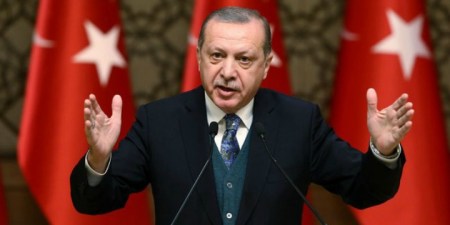 Turkish President Erdogan speaks at the presidential palace in Ankara. Photo: Reuters / Kayhan Ozer.
Turkey and Iran are presently enjoying a warm phase in their relations, with Erdogan giving full support to the Tehran regime as it faced a week of anti-government protests in more than thirty cities.
******************************
Turkish President Recep Tayyip Erdogan launched fresh verbal onslaught against the US and Israel on Friday, as he responded to the sentencing of Turkish banker by an American court for breaking sanctions on Iran, as well as the previous week of protests against the Tehran regime.
Erdogan, currently in Paris for an official visit with French President Emmanuel Macron, accused the US of carrying out “a chain of plots,” following the sentencing on Wednesday of Mehmet Hakan Atilla, an executive with Halkbank, a Turkish bank.
“These are not just legal but also economic plots,” Erdogan asserted.
Atilla was convicted on five of six counts, including bank fraud and conspiracy to violate US sanctions law. The case against him was based on the testimony of a wealthy Turkish-Iranian gold trader, Reza Zarrab, who cooperated with prosecutors and pleaded guilty to charges of leading a scheme to evade American sanctions against Iran.
In his testimony, Zarrab implicated top Turkish politicians, including Erdogan. Zarrab said Erdogan, who was Turkey’s prime minister at the time, had personally authorized two Turkish banks to join the scheme.
Turkey says the case was based on fabricated evidence and has accused US court officials of ties to Fethullah Gulen — the US-based Muslim cleric blamed by Erdogan for the murky coup attempt against his regime in July 2016.
He continued: “It is turning the people against each other in these countries. It’s a shame that we have seen this done in many nations. We saw this in Iraq.”
Erdogan did not expand on the nature of the alleged meddling in Pakistan. On Thursday, the US announced a freeze in deliveries of military equipment and security funding until Pakistan cracks down on jihadi terrorist organizations in the country.
The Turkish president then referred to problems in “Syria, Palestine, Egypt, Libya and Tunisia” and in African countries including Sudan and Chad.
He claimed a “game was being played” against Muslim-majority nations.
“They are taking steps towards making the plentiful underground riches in all these countries their own resources,” he said.
“Sorry, these realities should be known by our people and all people,” he said.
Turkey and Iran are presently enjoying a warm phase in their relations, with Erdogan giving full support to the Tehran regime as it faced a week of anti-government protests in more than thirty cities.
Iranian Resistance Sends a Message to the UN Security Council, Iran News Update, January 5, 2018
(Please see also, Russia: US demand for UN meeting on Iran is ‘destructive’. The Iranian Resistance movement does not have a chance at the UN. — DM)
.
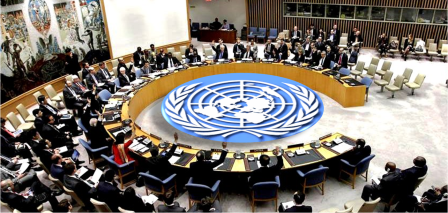
INU – On January 5, 2018, the Secretariat of the National Council of Resistance of Iran issued an important statement regarding the today’s UN Security Council session on the current uprising against the Iranian regime, the following is the full text of the statement:
Security Council upbraids Iran regime for mass murder and arrest of protesters
The Iranian Resistance asks today’s UN Security Council to defend the legitimate and natural right of the Iranian people to overthrow the religious fascism ruling Iran and to achieve the freedom they have been uprising for, and to strongly condemn and hold accountable the mullahs’ regime for killing defenseless and unarmed demonstrators; measures that are a clear indication of a crime against humanity, and confronting them is the responsibility of the United Nations Security Council.
According to reliable reports obtained by the Iranian Resistance, at least 50 demonstrators have been martyred by the direct fire of the Revolutionary Guards since the beginning of the uprising (during eight days) and more than 3,000 have been arrested. Children and teenagers as young as 12 or 13 years old are among the martyrs. The actual number of martyrs and arrestees is much more; a reality that the Iranian regime is trying hard to hide.
The clerical regime has blocked social networks in Iran since the first days of the uprising and cut off the Internet or has boosted severe restrictions on it. The IRGC commander, major general Jaafary, and the Minister of Communications, Azari Jahromi, and many other officials in the clerical regime officially acknowledged cutting off internet communications and announced that they would continue it until the unrest ends.
Welcoming the convening of today’s UN Security Council on Iran’s uprising, the Iranian Resistance emphasizes the need for the following actions to be taken by the UN Security Council:
Secretariat of the National Council of Resistance of Iran
January 5, 2018
Sexual Harassment East and West, Gatestone Institute, Denis MacEoin, January 5, 2018
“I say that when a girl walks about like that, it is a patriotic duty to sexually harass her and a national duty to rape her.” — Nabih Wahsh, Islamist lawyer, on Egypt’s al-Assema TV, October 19, 2017.
The Iranian Revolution of 1979 sparked off increasingly revolutionary movements across the Islamic world, and in the process saw women in many countries denied the freedoms they had started to acquire under earlier regimes. The veil returned widely, notably in Turkey, following the growing power of authoritarian and fundamentalist President Recep Tayyip Erdogan, with women’s rights being increasingly denied.
We urgently need to drop our unwillingness to contrast Western and Islamic values — whether regarding violence, treatment of religious minorities, anti-Semitism, or treatment of women. There are also growing numbers of Muslims, as we are seeing today in Iran, who find wider Islamic attitudes abhorrent and work hard, mostly against the odds, to bring their faith closer to modern values.
For a time, one could not open a newspaper or visit an online news site without finding yet another scandal about sexual harassment. Lawyers are presumably going to have a field day for years to come. In the UK, a further wave of accusations has shaken an already shaky parliament and the Government, whose Cabinet is increasingly in disarray. In the US Congress, Hollywood and elsewhere, similar claims are still being made, with #MeToo stories being shared by women, while there is an unknown number of accusations in US statehouses.
Sex scandals in the West are far from new.[1] The irony is that this brings us face to face with attitudes to the same problem in the Islamic world.
For many years in the West, it was common practice for sexual harassment and rape among celebrities and public figures to be hushed up. To secure silence, abusers often used bribes or threats. Young women feared the loss of their careers or reputations; in many instances, the police would reject claims of abuse. This happened more than once in the UK, when young victims of “Asian” grooming gangs were not believed by social workers and police; in Europe authorities tried — and still try (see here, here and here) — to cover up harassment and rape committed by Muslim migrants. There will be a lot of work to do to protect women and children from the excesses of so many men.
Just watch and marvel at this short clip from a debate on Egypt’s al-Assema TV, aired on October 19, 2017, or read an English transcript. The Director-General of al-Assema is Brigadier-General Muhammad Samir, a former spokesman for the Egyptian armed forces. His appointment has been criticized on the grounds that it is “a miserable attempt by the military regime authorities to nationalize the media, unify its message, and block any opposing voices against the government”. In that sense, al-Assema represents a semi-official voice.
The debate on Egypt’s al-Assema TV included a lawyer, Nabih [el] Wahsh, an Islamist who has filed countless hesba [2] cases against intellectuals, artists, religious leaders and government ministers for acts he deems immoral or blasphemous. With Wahsh on air were three women: Shadia Thabet, a member of the Egyptian parliament, Abeer Soleiman, a women’s rights activist, and Ashgaan Nabil, a life coach.
Wahsh began by stressing that, regardless of Egypt being a civil state, it had to conform to Islamic religious rules and norms. On that basis, he engages in an argument which leads him to the following confrontation with Soleiman, whom he effectively silences by bullying her:
Nabih Wahsh: “Are you happy when you see a girl walking down the street with half of her behind showing?”
Abeer Suleiman: “Do you think that we don’t care about our girls?”
Nabih Wahsh: “I say that when a girl walks about like that, it is a patriotic duty to sexually harass her and a national duty to rape her.”
Abeer Suleiman: “No, no, no, no! I totally oppose this kind of talk. This is sexual harassment live on air…”
Nabih Wahsh: “It is a national duty to rape such a girl! What she allows herself to do constitutes depravity.”
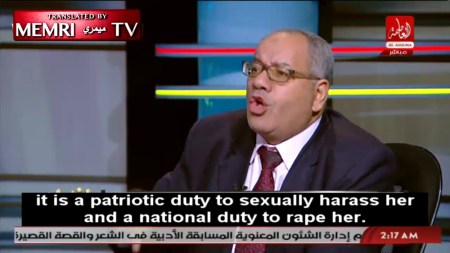 Egyptian lawyer Nabih Wahsh recently advocated on television for sexual harassment and rape in retaliation for the temptation caused by uncovered women. (Image source: MEMRI)
This open espousal by a lawyer of sexual harassment and rape in retaliation for the temptation caused by uncovered women was backed by a heavily-covered member of parliament and followed by a “life coach” urging ten-year prison terms for homosexuals — all during a television broadcast — would, of course, finish their careers anywhere in the Western world within minutes. Men behave badly in Europe and the United States, and some very badly indeed; but to boast publicly about wishing to do so would be unthinkable.[3]
In the West, however, women have been fighting back for generations. The rise of sane feminism (as distinct from its shrill and politically-correct cousin)[4] has elevated the status of women in all the democracies and given courage to the many women who now find themselves empowered to call out powerful men who have sexually abused, groped and raped them.
There are feminists in the Islamic world. Countless books have been written about them and the growth of feminism in countries from Egypt and Iran to Indonesia. During the twentieth century, progress in establishing women’s rights was made in several places: the veil was abandoned, more women moved into professional life and even into politics — notably, the assassinated Benazir Bhutto, the first Muslim woman democratically elected (twice) as Prime Minister of Pakistan.
Real advances, nevertheless, have been slow. Even as things were starting to improve for women, religious minorities, and others in some countries, such as Turkey, the Salafi style of fundamentalist Islam, based on a demand to return to the practices of the Islamic prophet Muhammad and the first three generations of his followers (salaf means “predecessors”), was already underway from the early years of the twentieth century, notably through the work of the Egyptian writer Rashid Rida. For Rida, and later for Salafis down to the Islamic State enterprise, reform meant turning away from the Western models that had inspired new legislation, and back to the earliest days of Islam as embodied in the Qur’an, the ahadith (sayings and acts of the prophet), and the biographies of Muhammad. In 1928, another Egyptian, the schoolteacher Hasan al-Banna, established the Muslim Brotherhood, the leading revivalist movement in Islam since the 1920s, which remains to this day a major international force for reviving fundamentalist Islam.
Ironically, one prominent individual to have been caught up in the current wave of harassment revelations is Tariq Ramadan, Professor of Contemporary Islamic Studies at Oxford University. Ramadan’s grandfather was none other than Hasan al-Banna, founder of the Muslim Brotherhood. Masquerading as the respectable voice of modern Islamic thought and practice, Ramadan has been exposed by several writers as a front for the Brotherhood and its anti-Western values. French journalist Caroline Fourest published an exposé, Brother Tariq: The Doublespeak of Tariq Ramadan, in which she shows how he says one thing to his Western audience and quite another to Muslims in France and abroad.
The American author Paul Berman wrote clearly of this in a long article about Tariq Ramadan in New Republic:
Ramadan’s harsher critics would argue that in speaking… the way he did on these abstract and historical questions, not to mention on his grandfather’s ideals, he was cagily deploying a “double discourse” — a language intended to deceive Western liberals about the grain of his own thought. An accusation of “double discourse” has dogged Ramadan for many years in France. It is a chief complaint against him, and a big source of anxiety among his critics. Fourest, in Brother Tariq, documents what appears to be rather a lot of “double discourse,” instances in which Ramadan appears to have said one thing to the general public and something else to his Muslim audiences.
In his many books and lectures, Ramadan has promoted the worldview of the hardline Brotherhood while posing as a Western-style philosopher in tune with modern liberal values. That is the basis for his duplicity: the Islam he promulgates in carefully phrased and disingenuous terms has nothing in common with Western values at all. It is this ability to pull the wool over the eyes of thinkers and politicians, a deception that has given him a professorship at Oxford University, that makes him a truly dangerous individual.
In addition to Caroline Fourest’s series of articles in the French journal Marianne, detailing Ramadan’s use of sexual harassment, rape, and general misogynist practices, he has also been accused by the American academic Phyllis Chesler “of having violently raped, battered, humiliated, confined, and death threatened them [his victims] if they talked”.
In response to these claims, Oxford University acted promptly, placing him on leave while his predations are investigated and, as seems likely, subjected to criminal charges. Not surprisingly, as the journalist Abigail Esman has pointed out:
Tariq Ramadan’s many fans – more than 600,000 people follow him on Twitter and he has more than 2 million Facebook followers – have had plenty to say. He is innocent, they are certain. In their comments on both social media sites, they assure him that Allah will protect him. The women are liars, or part of a conspiracy: against Muslims, against the Muslim leader himself, against Islam – all the insidious, but entirely predictable, work of the world’s Jews.
The Iranian Revolution of 1979 sparked off increasingly more revolutionary movements across the Islamic world, and in the process saw women in many countries, across the Islamic world, denied the freedoms they had started to acquire under earlier regimes. The veil returned widely, notably in Turkey, following the growing power of authoritarian and fundamentalist President Recep Tayyip Erdogan, with women’s rights being increasingly denied. Erdogan recently condemned Saudi Crown Prince Muhammad ibn Salman’s vow to engender a “moderate Islam,” calling it a fake Islam supposedly imposed by the West.
Men in Western democracies certainly have much to be ashamed of; the women who call out predators are right to do so. If identifying powerful figures who manipulate vulnerable women will help create a more level playing field for both sexes in countries that have worked hard to put all citizens on a basis of equality, it cannot but be a boon for democracy. Whatever we have done wrong, we have also done much to rectify distortions in our societies. The very fact that in the West, such men are considered shameful and contrary to our better values is itself a sign of how far things have changed.
The Islamic world in general remains enmeshed in ancient attitudes, going backwards rather than forwards, despite sterling efforts by various reformers to confront patriarchy in several Muslim countries, efforts backed by many Muslim women.[5] Those attitudes are rooted in a wide range of assaults on women and their lives: female genital mutilation (FGM) sanctioned by religious tradition; honor killings even for girls who have been raped; legally-enforced marriage to a woman’s rapist; floggings and stonings for women suspected of marital or pre-marital adultery, or even who have been raped; veiling; marital rape; and denial of independence (a woman must always be subject to a male guardian – father, brother, uncle, male cousin — whose permission is needed for most things). Beyond this, it has always been permissible for Muslim men to capture or buy non-Muslim women as sex slaves, as we have seen recently with Boko Haram and Islamic State, and in Saudi Arabia, Mauritania, Singapore, Sudan, Mauritius, Libya, the United States and Europe.
Muslim men, however, have enormous freedoms. They may marry four women; they can divorce a wife by merely pronouncing “I divorce you”; if they are Shi’is, they can take temporary wives through nikah mut’a,[6] (“pleasure marriage”), that can be contracted for hours or months or years, and as easily terminated. If they are Sunnis, they can take temporary wives through nikah misyar, (“traveller’s marriage”), used in Saudi Arabia and the Gulf to allow men to keep wives in towns they visit from time to time or, more widely, by married men who seek legal mistresses.
Polygamy continues to be popular, even for Muslim men living in the West. A website set up by British businessman Azad Chaiwala, “Secondwife.com“, which enables men to find further wives in the way non-Muslims use dating sites, has over 100,000 members, including 25,000 in the UK. Although polygamy in Britain carries a seven-year prison term for men, the Muslim version is seemingly exempt as it is considered a religious arrangement. Muslim men in Britain and on the Continent are never prosecuted as polygamists, even though Islamic marriage laws place women in jeopardy in respect of divorce and child custody. The government has even encouraged polygamous marriages to be contracted abroad, and at one point offered £10,000 in benefits for families with four wives.
We urgently need to drop our unwillingness to contrast Western and Islamic values — whether regarding violence, treatment of religious minorities, anti-Semitism, or treatment of women. It is not only non-Muslim Westerners who are entitled to make such comparisons — there are also growing numbers of Muslims, as we are seeing today in Iran, who find wider Islamic attitudes abhorrent and work hard, mostly against the odds, to bring their faith closer to modern values.
Many Western politicians, churchmen and sundry do-gooders choose to find no fault in Islam and describe any form of criticism as “Islamophobia” — even punishing honest critics of the religion or the actions of some of its followers for daring to breach the code of silence and multicultural acquiescence. These would-be moralists do no favours to us, to Muslim women and children, or to Muslim reformers. Ours is not a perfect civilization. But crying mea culpa, while passing over the problems of a civilization that also has faults, does not seem the way to assuage a communal guilt.
Dr. Denis MacEoin taught Islamic Studies at a UK university, has published books and articles on Islamic themes, and contributed to academic encyclopedias dealing with the subject, such as the second edition of the massive Encyclopedia of Islam. He is a Distinguished Senior Fellow at the Gatestone Institute.
[1] The harm they do has been dissected by Northwestern University professor Laura Kipniss, in her study How to Become a Scandal: Adventures in Bad Behavior, New York, 2010, and in her recent exposure of witch hunts in US colleges, Unwanted Advances: Sexual Paranoia Comes to Campus, New York, 2017.
[2] Hesba or hisba is the duty to identify and prevent or punish contraventions of Islamic law in Muslim states.
[3] To give credit to the Egyptian government, Wahsh was arrested for these remarks and is currently serving a three-year prison term. See here.
[4] For an intelligent discussion of the differences, see Christina Hoff Sommers, Who Stole Feminism?: How Women Have Betrayed Women, New York, 1995.
[5] Note, in particular, Ida Lichter, Muslim Women Reformers: Inspiring Voices against Oppression, Amherst, NY, 2009. See here.
[6] For a full academic account, see Shahla Haeri, Law of Desire: Temporary Marriage in Shi’i Iran, rev. ed., Syracuse University Press, 2014; and see Sachiko Murata, Temporary Marriage in Islamic Law, privately published, 2017.
FBI tries to claw back credibility – and maybe get on Trump’s good side, American Thinker, Monica Showalter, January 5, 2017
(The Department of Justice Inspector General probably has more to do with getting the Clinton Foundation investigation on track than any staff desires to make nice with President Trump. — DM)
Suddenly, suddenly, the FBI isn’t so blase about the doings of the Clinton Foundation, launching a new investigation into its apparently corrupt activities. Might it really be a quest for its lost credibility?
According to a report from John Solomon of The Hill:
The Justice Department has launched a new inquiry into whether the Clinton Foundation engaged in any pay-to-play politics or other illegal activities while Hillary Clinton served as Secretary of State, law enforcement officials and a witness tells The Hill.
FBI agents from Little Rock, Ark., where the Foundation was started, have taken the lead in the investigation and have interviewed at least one witness in the last month, and law enforcement officials said additional activities are expected in coming weeks.
The officials, who spoke only on condition of anonymity, said the probe is examining whether the Clintons promised or performed any policy favors in return for largesse to their charitable efforts or whether donors made commitments of donations in hopes of securing government outcomes.
The probe may also examine whether any tax-exempt assets were converted for personal or political use and whether the Foundation complied with applicable tax laws, the officials said.
More than a year ago, author Peter Schweizer and the New York Times did a sort of joint investigation showing just how bad things were with money flowing into the Clinton Foundation and favors flowing out of Hillary Clinton’s State Department, notably in the case of the Uranium One giveaway to the Russians. The Times and Schweizer are hardly ideological coevals, so the fact that the two could work together and come to the same conclusion says something. The Times utilized a preview of Schweizer’s upcoming blockbuster, Clinton Cash, and then augmented the research with its own reporting. The Times’ editorial page didn’t like it, but seemed to accept that facts are facts and no corrections were issued on the story.
Pay for play was hardly confined to Russians and uranium. A Swiss company called Firmenich reportedly was experiencing a lime shortage for its fragrance industry and somehow got Bill Clinton to get some lime trees (as opposed to other things) planted in Haiti via the Clinton Foundation. After that, a $260,000 check was waiting for him for a brief speech in Switzerland, so the reports say.
There were countless instances of funds rolling in to the Clinton Foundation as favors rolled out, either from State or the foundation leaning on foreign governments.
The Hill reported that the FBI’s Little Rock office found all sorts of problems in its local investigation but were rebuffed in their findings by headquarters and the highly politicized Obama Department of Justice. The investigation apparently died.
Until, well, now. Which raises questions about just how the FBI does business. Far from fear or favor, it let itself be rolled by positively Chavista-level politicizers from Team Obama. It was so bad the private sector with its far feebler investigative resources was able to show them up. Now they are scrambling to recover some lost credibility, as a law enforcement agency, not an Obama enforcer.
They may also be trying to restore credibility with President Trump, who has berated them for their politicization on Twitter. After all, they are going to have to work with him for the next three or seven years, and there will be resources and prerogatives they will want.
Well, glad they got on it. Better late than never.




 anneinpt
 artaxes
 danmillerinpanama
 davidking1530
 Peter Hofman
 Joseph Wouk
 Peter
Peter Louisiana Steve
 WarSclerotic
Recent Comments