Archive for June 2017

Kamala Harris Goes Silent When Confronted with True Sex-Based Oppression

June 24, 2017

Kamala Harris Goes Silent When Confronted with True Sex-Based Oppression, Power LinePaul Mirengoff, June 23, 2017

Last week, Sen. Kamala Harris became the left’s designated victim of the month because she was interrupted by Republican Senators during a hearing of the Senate Intelligence Committee. Harris kept interrupting the witness, Attorney General Jeff Session, so it’s debatable whether she had a genuine grievance. Nonetheless, the Democrats and their media allies were quick to level hackneyed allegations that, once again, sexist patriarchs have tried to silence a woman “speaking truth to power.”

The next day, two women with genuine grievances of sexism testified before the Senate Committee on Homeland Security and Governmental Affairs, of which Harris, regrettably, is a member. The women were our friend Ayaan Hirsi Ali and Asra Q. Noman.

Both were born into deeply conservative Muslim families. Ayaan is a survivor of female genital mutilation and forced marriage. Asra defied Shariah by having a baby while unmarried.

Both have been threatened with death by jihadists for things they have said and done. Ayaan cannot appear in public without armed guards.

You might have thought that Sen. Harris would show considerable interest in what these victims of sexism had to say. If so, you don’t grasp that Harris’ slavish adherence to the left’s taboo against calling out Islamists trumps any real commitment she may have to women’s rights.

Here, as told by Ayaan and Asra in the New York Times, is what happened:

The Democrats on the panel, including Senator Harris and three other Democratic female senators — North Dakota’s Heidi Heitkamp, New Hampshire’s Maggie Hassan and Missouri’s Claire McCaskill — did not ask either of us a single question.

This wasn’t a case of benign neglect. At one point, Senator McCaskill said that she took issue with the theme of the hearing itself. “Anyone who twists or distorts religion to a place of evil is an exception to the rule,” she said. “We should not focus on religion,” she said, adding that she was “worried” that the hearing, organized by Senator Ron Johnson, a Republican from Wisconsin, would “underline that.” In the end, the only questions asked of us about Islamist ideologies came from Senator Johnson and his Republican colleague, Senator Steve Daines from Montana.

Ayaan and Asra nail the meaning of what went down:

[W]hat happened that day was emblematic of a deeply troubling trend among progressives when it comes to confronting the brutal reality of Islamist extremism and what it means for women in many Muslim communities here at home and around the world.

When it comes to the pay gap, abortion access and workplace discrimination, progressives have much to say. But we’re still waiting for a march against honor killings, child marriages, polygamy, sex slavery or female genital mutilation.

They will be waiting for a long time.

Ayaan and Asra continue:

[W]hen we speak about Islamist oppression, we bring personal experience to the table in addition to our scholarly expertise. Yet the feminist mantra so popular when it comes to victims of sexual assault — believe women first — isn’t extended to us. Neither is the notion that the personal is political. Our political conclusions are dismissed as personal; our personal experiences dismissed as political.

That’s because in the rubric of identity politics, our status as women of color is canceled out by our ideas, which are labeled “conservative” — as if opposition to violent jihad, sex slavery, genital mutilation or child marriage were a matter of left or right. This not only silences us, it also puts beyond the pale of liberalism a basic concern for human rights and the individual rights of women abused in the name of Islam.

Why aren’t leftists willing to call out Islamic extremism? Ayaan and Asra offer this explanation:

Partly they fear offending members of a “minority” religion and being labeled racist, bigoted or Islamophobic. There is also the idea, which has tremendous strength on the left, that non-Western women don’t need “saving” — and that the suggestion that they do is patronizing at best. After all, the thinking goes, if women in America still earn less than men for equivalent work, who are we to criticize other cultures?

This is extreme moral relativism disguised as cultural sensitivity. And it leads good people to make excuses for the inexcusable.

The silence of the Democratic senators is a reflection of contemporary cultural pressures. Call it identity politics, moral relativism or political correctness — it is shortsighted, dangerous and, ultimately, a betrayal of liberal values.

Ayaan and Asra have said it all. Almost. Another point needs to be made.

Sen. Harris and her fellow female committee members are cowards. If they believe Ayaan and Asra are presenting a misleading picture of Islam, based on their “exceptional” experiences, then take them on. Make the point by asking probing questions, the way Harris’ cheerleaders think she did with Jeff Sessions.

Harris wouldn’t do it. She probably recognized that Ayaan would have carved her up to the point that even her cheerleaders couldn’t have declared her the victor. So the supposedly fearless ace ex-prosecutor took the coward’s way out and tried to minimize the extent to which Ayaan and Asra were heard.

Ayaan and Asra conclude:

We believe feminism is for everyone. Our goals — not least the equality of the sexes — are deeply liberal. We know these are values that the Democratic senators at our hearing share. Will they find their voices and join us in opposing Islamist extremism and its war on women?

This is the only off-key note in their article. The goals and values of Ayaan and Asra are not the goals and values of Harris and most of her fellow Democrats.

As for the voices of Harris and her colleagues, what you hear, or in this case didn’t hear, is what you get.

Israel attacks Syrian tanks in response to wayward projectiles

June 24, 2017

Ten mortar shells land in Israeli territory, causing no damage or injuries; the fire is presumed to be spillover from Syrian infighting; the IDF recommends residents keep their distance from the Syrian border; the military states it holds the Assad regime responsible for what takes place in their territory.

Yoav Zitun|Published:  24.06.17 , 17:44

Source: Ynetnews News – Israel attacks Syrian tanks in response to wayward projectiles

The Golan Heights

Israeli Air Force aircraft attacked a number of targets belonging to the Syrian regime loyal to President Bashar Assad on Saturday afternoon in response to mortar shell fire earlier in the day that landed in Israeli territory.

The IDF reported that ten projectiles were identified as having landed in the northern Israeli Golan Heights, apparently as a spillover from the civil war that is raging in Syria. The Israeli military added that the IAF retaliatory strike was aimed at two tanks and a position whence the projectiles were fired into Israel.

The Golan Heights

The Golan Heights

The IDF said that the fire from Syria landed in open areas Saturday and no injuries or damage was caused. But with Israelis flocking to the Golan Heights in the summer for hikes and fruit picking, the military asked them to keep their distance from the border area.

No siren was activated by the Syrian fire, which landed close to the border fence between Quneitra and the Valley of Tears.

A statement released by the military reads in part, “The IDF sees with severity and will not tolerate any attempt to harm the sovereignty of the State of Israel or the security of its residents, and sees the Syrian regime as responsible for what is happening in its territory.”

The government-controlled Syrian Central Military Media said Syrian troops and their allies repelled an attack by insurgents on the outskirts of the southern city of Baath on the edge of the Golan Heights. The SCMM accused an Israeli helicopter of assisting insurgents in their attack on military outposts.

The Britain-based Syrian Observatory for Human Rights also said that Israeli warplanes attacked a Syrian army position in Quneitra while Syria’s state-run news agency SANA said “an army position was targeted in Quneitra.”

Israel has steadfastly stayed on the sidelines of Syria’s civil war, now in its seventh year, refraining from taking sides or getting drawn into hostilities. It has responded in the past with limited strikes when fire has spilled into Israel.

The Associated Press contributed to this report.

DHS Denies Grant to Islamic Radicalization Enabler MPAC

June 24, 2017

DHS Denies Grant to Islamic Radicalization Enabler MPAC. Investigative Project on Terrorism, John Rossomando, June 23, 2017

(One down and a bunch more to go. Does anybody CAIR care? — DM)


The Department of Homeland Security has ruled that the Muslim Public Affairs Council (MPAC) will not receive the $393,800 Countering Violent Extremism (CVE) grant approved by Secretary of Homeland Security Jeh Johnson on Jan. 13, days before Johnson left office.

The DHS released its list of grant recipients on Friday. MPAC is not on it. The change came after “DHS utilized its discretion to consider other factors and information when reviewing applicants,” a spokeswoman said in an email to the Investigative Project on Terrorism. “The Department considered whether applicants for CVE awards would partner with law enforcement, had a strong basis of prior experience in countering violent extremism, had a history of prior efforts to implement prevention programs targeting violent extremism, and were viable to continue after the end of the award period. These additional priorities were applied to the existing pool of applicants. Top scoring applications that were consistent with these priorities remained as awardees, while others did not.”

In a statement, MPAC acknowledged that working with law enforcement isn’t a priority: “Our position on this issue has consistently centered on community-led initiatives that improve mental health resources, access to counseling, and a host of other social services without the involvement or spectre of law enforcement.”

Still, it disputed the loss of the grant, saying it would consider “all legal options…”

“The exclusion of groups like MPAC point to a DHS that is ineffective in coordinating with communities and unconstitutional in its treatment of a religious minority,” the statement said. “MPAC will continue challenging the trajectory of the Trump administration’s efforts in this space by advocating for a holistic approach that empowers rather than sidelines communities, focuses on all forms of violent threats, and fosters a climate of trust over fear.”

MPAC pledged to use the money for targeted interventions under its Safe Spaces program for people at risk for radicalization. Created in 2014, Safe Spaces aims to improve relations between Muslim institutions and law enforcement.

MPAC Executive Director Salam Al-Marayati introduced the program as an alternative to law enforcement agencies using informants to infiltrate mosques. The roll out meeting included Johnson, U.S. Sen. Dick Durbin, D-Ill., Rep. Bill Foster, D-Ill., and other Muslim community groups including the Council on American Islamic Relations (CAIR).

Al-Marayati vehemently objects to anything that involves mosques or informants in terror investigations.

“Counter-terrorism and counter-violence should be defined by us,” he said at 2005 Islamic Society of North America (ISNA) conference in Dallas. “We should define how an effective counter-terrorism policy should be pursued in this country. So, No. 1, we reject any effort, notion, and suggestion that Muslims should start spying on one another. Everywhere I go either somebody tells me that officials have met with them publicly or they tell me that they know who those folks are that are representing law enforcement. So we know they have communicated one way or the other with the Muslim community.

“The question is how do you deal with it in a healthy, open, transparent manner? That is why we are saying have them come in community forums, in open-dialogues, so they come through the front door and you prevent them having to come from the back door,” Al-Marayati said.

Government agencies preferred CVE programs, especially during the Obama administration. But there’s no way to measure whether they work, a Government Accountability Office report issued in April said. The GAO “was not able to determine if the United States is better off today than it was in 2011 as a result” of CVE programs.”

The House Homeland Security Committee’s Subcommittee on Oversight and Management offered similar criticism during a hearing last September. The committee has “no way of gauging whether CVE efforts have been successful – or harmful – or if money is being spent wisely,” said U.S. Rep. Scott Perry, R-Pa.

MPAC may have won the grant simply because it is “the most organized group,” said Heritage Foundation counterterrorism scholar Robin Simcox. But that “is going down the wrong path. Often this means giving it to some very, very divisive voices who will play into the Islamist narrative; they will play off grievances. They will encourage a feeling of segregation and otherness, and we are promoting other problems for the future.”

MPAC promotes a narrative that Muslims are victimized by a hostile non-Muslim society, Simcox said. That message helps breed terrorists.

“I think it creates an environment where these radical ideas are in the ether, and it’s no surprise to me that somebody then [would] take that final step into violence,” Simcox said.

Research backs up Simcox’s assertion.

Grievances “framed around victimhood against Western foreign policy and military intervention” are among “a kaleidoscope of factors” in fueling extremism, Swedish jihad researcher Magnus Ranstorp has found.

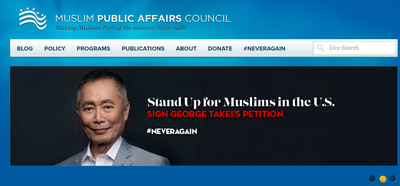
MPAC’s recent messaging has emphasized threats to Muslim Americans’ freedom and security, including promoting a conspiracy theory that internment camps could be revived for them. In February, MPAC posted an image of Star Trek actor George Takei, on its homepage, with the heading “Stand Up for Muslims in the U.S.” The image linked to a petition in which Takei described his experience during World War II: “When I was just 5, my family was rounded up at gunpoint from our home in Los Angeles into an internment camp. We were prisoners in our own country, held within barbed wire compounds, armed guards pointing guns down on us.”

“A Trump spokesperson recently stated the internment of Japanese Americans during World War II “sets a precedent” for Trump to do the same today,” Takei wrote. [Emphasis original]

But that spokesman, former Navy SEAL Carl Higbie, had no role in the Trump transition and only spoke for himself. No one in the administration has endorsed such a scheme.

But Takei’s statement, which MPAC embraced, claimed that “Trump continues to stand by his plans to establish a Muslim registry and ban immigrants from ‘certain’ Muslim countries from the U.S. It starts with a registry, with restrictions, with irrationally ascribed guilt, and with fear. But we never know where it might lead.”

Takei didn’t start the internment analogy. “Challenging patriotis (sic) of AmMuslims is un-American – what happened to Japanese Americans-loyalty test, confiscating their wealth #CruzHearing,” Al-Marayati wrote a year ago, in a Twitter post he later deleted.

Promoting the internment conspiracy theory destroys the credibility of “soft Islamist” organizations like MPAC that don’t engage in terrorist acts themselves, yet validate the jihadist narratives, Simcox said.

Al-Marayati has long promoted the narrative that the U.S. is waging “war on Islam,” one of the most potent terrorist recruitment tropes.

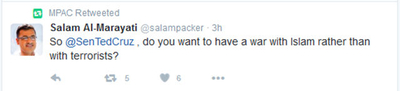
He called U.S. counterterrorism policies a “war on Islam” in a 2009 interview with Al-Watan Al-Arabi. Al-Marayati also engaged in “war on Islam” rhetoric when he chided U.S. Sen. Ted Cruz a year ago for using the term “radical Islam” during a hearing about the Obama administration’s avoidance of using the phrase “So @SenCruz, do you want to have a war with Islam rather than a war on terrorists?” he wrote in a tweet he later deleted.

MPAC Whitewashes Jihad

Al-Marayati appeared on C-Span in 2014, and balked when asked why Muslims weren’t speaking up against jihadism: “Well I think we’ll call this violent extremism. And one thing we have to be clear about, we should not be countering jihad,” Al-Marayati said. “Jihad to the violent extremists means holy war. But jihad in classical Islam means ‘struggle.’ So let us at least not use religious terminology in fighting groups like ISIS. It just plays into their hands. They want this to be a war on Islam, a war on religion.

“We should be at war on criminal behavior, war against terrorism.”

Al-Marayati again rejected the connection between jihad and violence during a Jan. 25 debate with American Islamic Forum for Democracy founder and President Zuhdi Jasser. Jihad is not holy war, he said, but a struggle against oneself.

“We must allow the Muslims to reclaim their faith and not let Islam be defined by the extremist distortions of Islam,” Al-Marayati said.

Muslim Brotherhood founder Hassan al-Banna disagreed, writing that jihad only had to do with fighting and argued that purely spiritual jihad was spurious. MPAC co-founder Maher Hathout described himself as an al-Banna disciple.

“Many Muslims today mistakenly believe that fighting the enemy is jihad asghar (a lesser jihad) and that fighting one’s ego is jihad akbar (a greater jihad),” al-Banna wrote in his tract On Jihad. “This narration is used by some to lessen the importance of fighting, to discourage any preparation for combat, and to deter any offering of jihad in Allah’s way. This narration is not a saheeh (sound) tradition.”

Jasser sees a dichotomy between Al-Marayati’s public rejection of violent jihad and his group’s embrace of Tunisian Muslim Brotherhood-linked cleric Sheikh Rached Ghannouchi. MPAC hosted Ghannouchi at a 2011 dinner, and Al-Marayati flew to Paris in 2013 to attend a conference with Ghannouchi. The sheikh is a member of the International Muslim Brotherhood’s Guidance Bureau.

Back in 1990, Ghannouchi spoke at a conference in Tehran, Iran where he called for the “destruction of the Jews” and invoked Ayatollah Khamenei’s “call to jihad” against America, “the Great Satan.” Ghannouchi aspired to wage “worldwide jihad,” a 1991 State Department cable said. Ghannouchi still favors violent jihad, 5 endorsing the Palestinian knife jihad against Israelis in 2015.

“The central problem with MPAC … is the schizophrenia with which they deal with American issues versus how they deal with global issues,” Jasser said. “The Islamists assume Americans are not very smart, so they are going to listen to their apologetics about jihad and then not connect it to what happens when the Ghannouchis of the world get into power.”

MPAC leaders have made their own pro-terrorist and anti-Israeli statements.

Al-Marayati didn’t seem to have a problem with Hizballah calling its terror campaign against Israel “jihad” in a November 1999 interview with PBS’s Jim Lehrer.

“If the Lebanese people are resisting Israeli intransigence on Lebanese soil, then that is the right of resistance and they have the right to target Israeli soldiers in this conflict. That is not terrorism. That is a legitimate resistance. That could be called liberation movement, that could be called anything, but it’s not terrorism,” Al-Marayati said.

Similarly, MPAC Public Affairs Consultant Edina Lekovic served as managing editor of Al-Talib, the defunct newspaper of UCLA’s Muslim Student Association, when it published an editorial saying Osama bin Laden was not a terrorist in its July 1999 issue.

“When we hear someone refer to the great Mujahid (someone who struggles in Allah’s cause) Osama bin Laden a ‘terrorist,’ we should defend our brother and refer to him as a freedom fighter; someone who has forsaken wealth and power to fight in Allah’s cause and speak out against oppressors,” the unsigned editorial said.

MPAC Defends Al-Qaida and Hamas Financiers

Another hit against MPAC’s credibility is its history of apologism for terrorist financiers.

Just after 9/11, Al-Marayati painted Muslims as victims after the federal government shut down the Benevolence International Foundation (BIF) on suspicion it provided material support to al-Qaida. Its leader, Enaam Arnaout, had close ties with Osama Bin Laden, court documents show.

He had similar reactions after Treasury Department asset freezes in December 2001 targeted the Holy Land Foundation (HLF), which illegally routed charity money to Hamas, and the Global Relief Foundation, which provided assistance to Osama Bin Laden and al-Qaida.

“Selective justice is injustice – it does not help us in the war on terror and continues to project the image that the U.S. is anti-Islam,” Al-Marayati wrote in July 2002 press release posted on MPAC’s website defending all three charities.

Closing these terror-linked charities could send the message to Muslims abroad that America is intolerant of religious minorities, Al-Marayati said that October in a New York Times op-ed.

When the Treasury Department shut down the Islamic African Relief Agency (IARA) in 2004, saying it “provided direct financial support for” Osama bin Laden, Al-Marayati described it as “a bit disturbing that the announcement of shutting down another charity… [took] place just before the month of Ramadan in the peak of the election season.”

Arnaout pleaded guilty to violating the Racketeer Influenced Corrupt Organizations Act (RICO) and acknowledged that his group hid the fact it used a portion of its donations to fund terrorists overseas.

HLF’s leaders were convicted of providing material support to Hamas in 2008.

MPAC’s magazine, The Minaret, cast these charity closures in an anti-Semitic light in a political cartoon it published in its March 2002 issue. It shows President George W. Bush doing the bidding of Israel and the Anti-Defamation League knocking down a building with a foundation labeled “Islamic Foundations (Holy Land, Global Relief, etc.” The top of the building being knocked down says, “Relief for Muslim Orphans” and “Support for U.S. Muslim Free Speech.”

This was not an isolated incident. A January 2000 Minaret cartoon showed “The West” apologizing for the Holocaust and handing over money to an old woman holding a cane with the label “Jewish holocaust.” At the same time, an Arab wearing a keffiyeh labeled “Palestine” says, “Ahem ‘scuse me” followed by a person with a crutch and bandaged foot labeled “Indian genocide” and a black person emblazoned with “African slavery.”

During the 2006 Israeli war with Hizballah in Lebanon Al-Marayati similarly diminished the Holocaust.

“And as far as the Holocaust is concerned, we’ve come out very clearly saying that the Holocaust is the worst genocide, war crime, in the 20th century. We’re against Holocaust denial, but we’re also against people who exploit that as a way of shoving this kind of war propaganda and dehumanization of the Arab peoples and the Muslim peoples as if they have to pay the price for what Nazi Germany did to the Jews back in the 20th century,” Al-Marayati said in an interview.

“MPAC’s default position is that the government is on a witch hunt against Muslims, and that any identification of organizations or non-profits doing quote end quote humanitarian work must be anti-Muslim if they are identified as a terror group,” Jasser said. “And if they are found to support terror, they say they are not the rule; they are the exception.”

MPAC’s statements and actions suggest that DHS’s decision to rescind Johnson’s decision to award the CVE grant was the right thing to do.

An Epidemic of Lawlessness

June 24, 2017

An Epidemic of Lawlessness, Power LineScott Johnson, June 24, 2017

Taking the story at face value, we can conclude that the Post and its sources have done great damage to the national security of the United States. The Post attributes the leaks on which the story is based to “three dozen current and former U.S. officials in senior positions in government, including at the White House, the State, Defense and Homeland Security departments, and U.S. intelligence services. Most agreed to speak only on the condition of anonymity…”

Again, taken at face value, the story buries this bombshell. Three dozen current and former U.S. officials in senior government positions have undertaken a campaign of gross lawlessness for their own purposes undermining the national security of the United States beyond anything Vladimir Putin can do.

**********************

Yesterday’s Washington Post carried the Russia story of the day. Post reporters Greg Miller, Ellen Nakashima and Adam Entous purport to deliver the goods on “Obama’s secret struggle to punish Russia for Putin’s election assault.” It’s a long, long story that is of interest from a variety of perspectives.

The Post purports to give us the inside story on the collection of intelligence on Russian interference in the presidential election and serve up the apologetics explaining the Obama administration’s passive response. Based on highly classified intelligence related to the Post, the CIA discovered Russian interference in the election while it was in process within months of the election in the last year of the Obama administration. According to the CIA intelligence, the interference came on the order of Vladimir Putin and furthered Putin’s desire to aid the election of Donald Trump as president.

The Post dates the critical intelligence “bombshell” obtained by the CIA to August 2016. The Post reports that CIA Director John Brennan deemed it so confidential that he withheld it from the President’s Daily Brief and conveyed it directly in writing to Obama by hand delivery.

The intelligence provided Obama administration officials plenty of time to do foil Putin’s plans. Indeed, administration officials concocted plans to punish and deter Russia from interference. The Post reports that “Obama administration secretly debated dozens of options for deterring or punishing Russia, including cyberattacks on Russian infrastructure, the release of CIA-gathered material that might embarrass Putin and sanctions that officials said could ‘crater’ the Russian economy. But in the end, in late December, Obama approved a modest package” (emphasis added). In other words, President Obama declined to take any action while it might still have done some good.

One might infer from story that President Obama “colluded” with Putin to defeat Hillary Clinton and elect Donald Trump. One might support the inference with Obama’s own comment open mic comment to Dmitri Medvedev that during Obama’s second term he would have more “flexibility” to cooperate with Putin.

To be fair, we might consider the explanation that Obama was just a pusillanimous pussy disinclined to protect the interests of the United States from our enemies. Perhaps Obama’s passivity was overdetermined and several of the possible explanations apply. Certainly some explanation beyond any offered by the Post’s sources is called for. The possibilities are endless.

By contrast, however, the Post’s reportage offers no evidence of Trump’s “collusion” with the Russian interference intended to assist Trump’s election. Zero. Nada. Not even by inference.

Perhaps evidence of Trump “collusion” is beyond the scope of the Post’s story. If the Post had obtained such evidence from its numerous sources, however, it would be in the story.

So far as I can tell, sophisticated commenters on the story take it at face value and consider it on the terms presented by the Post. See, for example, David French’s NRO column and Tom Rogan’s Examiner column.

The story comes complete with this revelation: “Obama also approved a previously undisclosed covert measure that authorized planting cyber weapons in Russia’s infrastructure, the digital equivalent of bombs that could be detonated if the United States found itself in an escalating exchange with Moscow. The project, which Obama approved in a covert-action finding, was still in its planning stages when Obama left office. It would be up to President Trump to decide whether to use the capability.”

I’m sure Putin is grateful for the heads-up from the Post. You don’t have to be a CIA officer of analyst to figure that out.

Now like much of the Post story, this is a piece of highly classified intelligence whose disclosure violates the oaths of those who gave it to the Post. The violation of a solemn oath by a witness is commonly taken to detract from the credibility of the witness’s testimony. Consider, moreover, that the Post did not place its sources were not under oath when they confided in Greg Miller, Ellen Nakashima and Adam Entous. The intelligent reader would be well within his rights not to believe a word they say.

If we believe it, however, this pertinent fact should be added. The disclosure of highly classified intelligence by government officials seriously violates the espionage laws of the United States. It is in all likelihood felonious several times over in the case of each of the Post’s numerous anonymous sources.

The Post and its reporters are accomplices to the crimes committed by their sources. They have disseminated highly classified intelligence to the enemies of the United States — as the left has lately discovered Putin and Russia to be.

Taking the story at face value, we can conclude that the Post and its sources have done great damage to the national security of the United States. The Post attributes the leaks on which the story is based to “three dozen current and former U.S. officials in senior positions in government, including at the White House, the State, Defense and Homeland Security departments, and U.S. intelligence services. Most agreed to speak only on the condition of anonymity…” As for the requirement of anonymity imposed by the Post’s sources, see the paragraph above.

Again, taken at face value, the story buries this bombshell. Three dozen current and former U.S. officials in senior government positions have undertaken a campaign of gross lawlessness for their own purposes undermining the national security of the United States beyond anything Vladimir Putin can do.

Trump Derangement Syndrome Has Become the New Plague

June 24, 2017

Trump Derangement Syndrome Has Become the New Plague, PJ MediaRoger L Simon, June 23, 2017

Younger generations, of course, get this. They hear it in the schools and they watch it on television and it’s shoveled at them on BuzzFeed and the like. They are given little chance to think for themselves. And if they do, they know the risks.

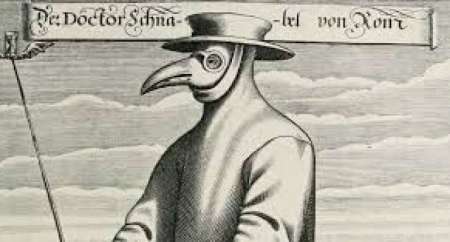
Meanwhile, The Plague keeps spreading.  In the 1330s the “Black Death” took about a third of Europe. It’s unlikely things would get that bad in this country on a personal level, but our democracy is already being littered with symbolic corpses, logical thought among the earliest and most consistent of victims.

Does anyone have an antidote to Trump Derangement Syndrome? I think I hear something scampering around my basement. Either it’s one of the plague rats of my generation spreading its… okay… I won’t say it.

*************************************

To what can we ascribe the continuing metastasis of Trump Derangement Syndrome, which has come to infect America, and indeed the world, almost to the level of a true plague?

The most recent of the seemingly endless incidents/outbreaks range from the ridiculous (hapless movie star Johnny Depp making a joke about assassinating the president and then recanting it…his agent must have called) to the genuinely creepy (a Democratic Party official declaring he was glad Steve Scalise was shot).

Yes, this last one was about a congressman, not the president. But we know the atmosphere that condoned it — the same atmosphere that enabled thirty GOP congressmen either to have been violently attacked or to have had their lives threatened since the beginning of May. (Such things did not happen BT/Before Trump.)

In the case of Depp, it was not so much his pathetic remarks that horrified — the actor is in the midst of a public nervous breakdown — but the raucous approval of his comments by the Glastonbury Festival audience, as if he had just given a shout-out to the local football team.

This automatic reaction by the rabble is just another example of the reach of Trump Derangement Syndrome, where assassination talk is de rigueur and Trump is regarded as a combination of Daddy Warbucks and Caligula with a little of The Joker thrown in. (Just the other day, author Michael Chabon told an Israel Radio interviewer that he wakes up every morning with the hope that Trump “is going to have a massive stroke, and, you know, be carted out of the White House on a gurney.” The surprised Israeli interviewer told Breitbart he naturally thought Chabon was just joking, but then realized he wasn’t. )

Of course the Congress, with its astoundingly tedious and extraordinarily phony Russia investigations, has congressmen and senators competing on an infinite loop to see who… mirror, mirror, on the wall… can be the most hypocritical of all. (Winner so far: Senator Mark Warner. Runner-up: Rep. Adam Schiff). They help spread the infection, scratching scabs that were, at best, of the most tangential interest months ago, until they gush blood all over again, keeping the Russia controversy alive and kicking, at least until  Jon Ossoff makes his presidential run of 2032. (Not sure I’m joking.)

And speaking of competitions, the New York Times, Washington Post and CNN are no longer actual news organizations but contestants locked in a non-stop gladiatorial to dethrone Donald Trump via ceaseless leaks, most of which are either disinformation or absurdly trivial, and virtually all of which are illegal in the first place. But they don’t care. It doesn’t even seem to bother them that their journalistic reputations may be affected. They are infected. By this New Plague.

So they carry the infection on, spewing the bacterium, spreading the TDS Plague as assiduously as did the rats of the Middle Ages, the hated Yersinia pestis, no antidotes allowed, not on their pages anyway. At Blue State cocktail parties from Manhattan to Brentwood, people dare not open their mouths to say a tiny thing in favor of Trump, even to old friends, for fear of eternal ostracism. In our schools, conservatives are not allowed to speak. Patriotic films are only made if Clint Eastwood agrees, or maybe now Mark Wahlberg, on a nice day.

And then, of course, there are the #NeverTrumpers who still can’t stand Trump because he’s… well, I’m not sure I ever understood them in the first place, but I guess it’s because he’s vulgar. He may have gone to Wharton but talks as if he’s gone to Queens College.

All this is occurring although Trump, since taking office, has been, in his actions, a basically middle-of-the-road president, rather like, of all people, Bill Clinton after he made his accommodation with Gingrich. Of course, unlike Billy boy, he hasn’t misbehaved, to my knowledge, in the Oval Office. More precisely, Trump governs slightly from the right as Clinton governed slightly from the left. The differences are not greater than we have seen many times before.

Yet the Plague grows, edging almost inexorably toward violence. Why?

The “Deep State” bureaucrats feel their jobs are in jeopardy. I get that. But the rest?

May I suggest that what we are witnessing in our culture (and outwardly across the globe, because willy-nilly the U.S. is still the leading factor) is a form of mass hysterical conformism. I emphasize the conformism because by nature most human beings are conformists — we want to get along.

My generation —  I regret to say since I was part of this — was nurtured in a kind of counter-cultural conformity, everyone in tie-dye and smoking joints, thinking the same inchoate ideas. Peace and Love. Hey, hey LBJ… You’re part of the solution or you’re part of the problem…. Power to the People. Right on! Tune in, turn on, drop out!

As we grew up — taking over media, entertainment, and the schools — we formed a new cohort that was as truly conformist (probably more) as the generations before us. That New Conformism (actually pretty old at this point) generated this New Plague — how could it not, even though Donald was (technically) one of them — with everyone against Trump no matter what, pass it on. Otherwise, you will be read out of the new version of the hipster Volvo-becoming-Tesla country club. Trump was too Rat Pack for us (too like our parents or what our parents thought was cool). We wanted a smooth, black dude or, failing that, a righteous Latina, whatever that was. These days not even the Dalai Lama is acceptable.

It was all image. Almost none of it was substance, although we wanted to pretend it was. We were Eliot’s hollow, stuffed men, the ghosts of our parents’ Greatest Generation. But the image prevailed anyway — bland and unexamined as it was. Clichéd. Our image. John Lennon lite. It’s everywhere now. (“Imagine there’s no Donald. It isn’t hard to do.” Right, Michael Chabon?)

Younger generations, of course, get this. They hear it in the schools and they watch it on television and it’s shoveled at them on BuzzFeed and the like. They are given little chance to think for themselves. And if they do, they know the risks.

Meanwhile, The Plague keeps spreading.  In the 1330s the “Black Death” took about a third of Europe. It’s unlikely things would get that bad in this country on a personal level, but our democracy is already being littered with symbolic corpses, logical thought among the earliest and most consistent of victims.

Does anyone have an antidote to Trump Derangement Syndrome? I think I hear something scampering around my basement. Either it’s one of the plague rats of my generation spreading its… okay… I won’t say it.

Cartoons and Video of the Day

June 24, 2017

LatmaTV via YouTube


H/t Freedom is Just Another Word


H/t Power Line


DHS John Kelly: Islamic Terrorists Are Sincere, So Regulate the Internet

June 24, 2017

by Neil Munro22 Jun 2017

Source: DHS John Kelly: Islamic Terrorists Are Sincere, So Regulate the Internet – Breitbart

Pete Marovich/Bloomberg via Getty Images

Homeland Security Secretary John Kelly acknowledged Thursday that sincere Islamic beliefs are fuelling deadly jihad attacks during Ramadan — but he quickly hid that key recognition behind vague calls for Internet regulation and suggestions that Christian and Jewish beliefs are also causing terrorism.

“As far as Ramadan goes, you know, first of all, the uptick in violence and activities [during Ramadan is] done by a very, very small percentage of people who have just corrupted the whole concept of Islam as a religion, but it is what it is,” Kelly told the chairman of the House homeland defense committee on June 22. He continued:

We are in the middle of it, so they are out there doing what they think is their religion and think [it is] what they are supposed to be doing. In Flint, Michigan, as an example, a completely off-the-screen individual who attacked this police officer — who will be okay, as I understand it… We’ve seen these terrible things happen in Europe.

Instead of focusing on the jihad doctrine that is part-and-parcel of orthodox Islam, Kelly quickly tried to spread the blame for terror attacks, saying “Whether they are church, synagogues or mosques [we need] an open line of communication so they know if they see this [belligerence] happening in the home or they see it happening — that is to say, the move towards radicalism — or they see it happening in the churches or mosques, they know to call someone before that person typically crosses the line,” he told the chairman, Texas Rep. Michael McCaul.

Kelly added racist and even anti-Semitic groups to the blame gallery, even though Islamic radicals are anti-Semitic, saying: “Whether they are white supremacists, anti-Jewish or neo-Nazi or Islamic radicalism, until they do something [criminal], generally speaking, the best law enforcement can do is watch,” adding “I don’t know how to predict it.”

Kelly also blamed the Internet and urged businesses to block access to “some” websites. “The one constant that I have seen, Mr. Chairman, since I have been in this job, the one constant in all of this has been the Internet … The one constant is the Internet. I’m not blaming the Internet but I’m just saying that we probably need to step back, and say, maybe [have] stricter rules on what is hung on the Internet,” he said.

The secreary also cited existing laws against child pornography, which require companies to disconnect websites offering images of sexualized children, saying “just like in terms of child pornography sites that are taken down like that, we need to have probably a stricter set of rules to look at some of these [jihad] sites and bring them down maybe faster.”

He suggested the United States should follow the example set by Europe’s new policies against free speech, which this week prompted teams of black-clad German secretive police to raid 60 homes of people accused of illegal speech. Kelly said about the Europeans:

I think kind of the [Internet] rules and thinking they are operating under — that frankly that our country has been operating under — is probably five or ten years old … I know the Europeans are, particularly in the last five months, what they have dealt with — whether it is Paris, Manchester, I mean all of it, running people down on London bridge or Westminster bridge, they have really stepped back from their thinking [on free speech], as I think we should.

Kelly’s refusal to focus on jihad as the problem can lead his agency down a blind alley, said Robert Spencer, the best-selling author of books on Islam, and the director of the Jihadwatch website. “Instead of dealing with the threat, he’s threatening the freedom of speech of all Americans to maintain his politically correct veneer,” Spencer said.

“He needs to look at [Koran verses] 47.4 or 9:5, where there is an abundant incitement to violence in a place where he dares not acknowledge where it comes from,” said Spencer. According to those Islamic scriptures:

So when you meet those who disbelieve {Islam} [in battle], strike [their] necks until, when you have inflicted slaughter upon them, then secure their bonds, and either [confer] favor afterwards or ransom [them] until the war lays down its burdens. That [is the command]. And if Allah had willed, He could have taken vengeance upon them [Himself], but [He ordered armed struggle] to test some of you by means of others. And those who are killed in the cause of Allah – never will He waste their deeds …

And when the sacred months have passed, then kill the {non-Muslim} polytheists wherever you find them and capture them and besiege them and sit in wait for them at every place of ambush. But if they should repent, establish prayer, and give zakah, let them [go] on their way. Indeed, Allah is Forgiving and Merciful.

Pointing the blame at the Internet also ignores the danger of Islamic teachings in U.S.-based mosques, said Spencer. “We’ve seen again and again that there are jihadis who are very active in their mosques and yet nobody will monitor them, so he has to find some scapegoat … [and] he finds it with the Internet, which is practically a cliche,” Spencer added. “I just hope that his politically correct euphemism don’t lead him to waste time and resources charging down what he knows are blind alleys.”

Chairman McCaul did not push Kelly to justify spreading blame for the Islamic attacks, but Kelly also admitted that the courts are pressuring his agency as it tries to prevent planned attacks:

My guidance to the department is to be very very cautious about getting near where the court tells us we can’t go … I have a real good sense of right and wrong but that doesn’t always work when it comes to courts and lawyers. So I’ve just said [to agency officials] ‘Be very very conservative about where we go on this.’”

The recent court decisions have repeatedly claimed President Donald Trump’s effort to curb Islamic attacks are motivated by unreasoning hatred, threaten the religious freedom of Islamic immigrants, and have not been endorsed by government experts.

But amid Kelly’s court-pressured, blame-everyone rhetoric, he only cited Islamic attacks, saying:

In Paris the other day they dodged a huge bullet because the individual ended up that rammed the police car ended up dying before he could do all of what he had planned to do…

[Parents say] ’My son was on the internet and he did this,’ whatever this was, or San Bernardino, or ‘My daughter was on the Internet and she ran away to Syria to become someone’s bride.’…

I know the Europeans are, particularly in the last five months, what they have dealt with — whether it is Paris, Manchester, I mean all of it, running people down on London bridge or Westminster bridge..

Kelly also recognized that one of the long-term fixes to terrorism is better vetting of immigrants to prevent “hostile attitudes,” including Islamic immigrants, saying:

I think we have a long way to go before we can be comfortable as to identifying who the [immigrant] person is, why they are coming to the United States and whether they can support themselves when they come here. So as [what] defines extreme vetting, that’s what we’re looking at. Those three questions need to be answered [for each would-be immigrant], I think, properly.

That comment echoes Trump’s January Executive Order on immigration, which sought to exclude refugees and immigrants with “hostile attitudes.”

But Kelly’s refusal to focus on the jihad ideology means “more Americans will suffer,” said Spencer. Kelly “is not facing the real root-cause of the threat, and it will continue to proliferate.”

Watch Kelly’s statements here.

Europe Surrenders to Radical Islam

June 24, 2017

Europe Surrenders to Radical Islam, Gatestone Institute, Guy Millière, June 24, 2017

(The suicide watch can be canceled. Formerly Great Britain and Much of Europe appear to be dead. — DM

Britain — in spite of the Brexit referendum and even though it is more undermined by Islamization than most other European countries — is fully imbued with a European, defeatist state of mind that corrodes its existence and is present throughout Europe.

British political commentator Douglas Murray writes in his important new book, The Strange Death of Europe: “Europe is committing suicide. Or at least its leaders have decided to commit suicide”. He then wonders if the Europeans will agree to go along with what is happening. For the moment, it seems, the answer is yes.

**********************************

In spite of three attacks in three months, Britain does not seem to be choosing the path of vigilance and determination. June is not even over but the media barely talk about terrorism any more.

Then, in the early hours of June 19, a man who acted alone drove a van into a crowd of Muslims leaving Finsbury Park Mosque in London: the main “threat” to the British right now was soon presented in several newspapers as “Islamophobia”.

Decolonization added the idea that the Europeans had oppressed other peoples and were guilty of crimes they now had to redeem. There was no mention of how, throughout history, recruits to Islam had colonized the great Christian Byzantine Empire, Greece, Sicily, Corsica, North Africa and the Middle East, most of the Balkans and eastern Europe, Hungary, northern Cyprus and Spain.

While most jihadist movements were banned by the British government, more discreet organizations have emerged and demurely sent the same message. The Islamic Forum for Europe, for example, depicts itself as “peaceful”, but many of those it invites to speak are anything but that. The Islamic Human Rights Commission uses the language of defending human rights to disseminate violent statements against the Jews and the West.

London, June 5, 2017. A minute of silence is held at Potters Field Park, next to the City Hall, to pay tribute to the victims of the London Bridge jihadist attack three days before. Those who came have brought flowers, candles and signs bearing the usual words: “unity”, “peace” and “love”. Faces are sad but no trace of anger is visible. The Mayor of London, Sadiq Khan, a Muslim, gives a speech emphasizing against all evidence that the killers’ ideas have nothing to do with Islam.

A few hours after the attack, Britain’s Prime Minister Theresa May also refuses to incriminate Islam, but dares to speak of “Islamic extremism”. She was immediately accused of “dividing” the country. On election day, June 8, her Conservative party lost the majority in the House of Commons. Jeremy Corbyn, a pro-terrorist, “democratic socialist”, who demands the end of British participation in the campaign against the Islamic State (ISIS), led the Labour party to thirty more seats than it had earlier. In spite of three attacks in three months, Britain does not seem to choose the path of vigilance and determination. June is not even over but the media barely talk about terrorism any more. A devastating fire destroyed a building in North Kensington, killing scores of residents. Mourning the victims seems to have completely erased all memory of those killed in the terrorist attacks.

Then, in the early hours of June 19, a man who acted alone drove a van into a crowd of Muslims leaving Finsbury Park Mosque in London: the main “threat” to the British right now was soon presented in several newspapers as “Islamophobia”.

The United Kingdom is not the main Muslim country in Europe, but it is the country where, for decades, Islamists could comfortably call for jihad and murder. Although most jihadist movements were banned by the British government, more discreet organizations have emerged and demurely spread the same message. The Islamic Forum for Europe, for example, depicts itself as “peaceful”, but many of those it invites to speak are anything but that. One was Anwar al-Awlaki, who for years planned al-Qaeda operations until he was killed in Yemen in 2011 in an American drone strike. The Islamic Human Rights Commission uses the language of defending human rights to disseminate violent statements against Jews and the West.

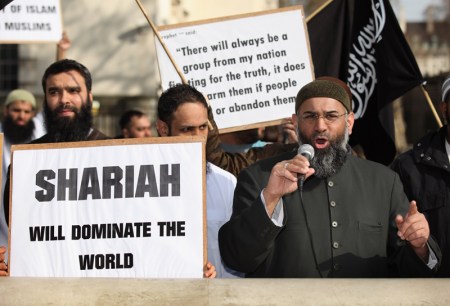
The most flamboyant radical preachers have all but disappeared. The most famous among them, Anjem Choudary, was recently sentenced to five years and six months in prison for his open support of the Islamic State, but hundreds of imams throughout the country continue similar work. No-go zones, forbidden to the “infidels”, continue to grow in big cities, and sharia courts continue to dispense a form of justice parallel to, but different from, the national one. Khuram Shazad Butt, one of the three London Bridge terrorists, could raise the Islamic State flag in front of cameras, be the main character of a documentary on jihad in Britain and still be considered “low priority” by the police. Salman Abedi, the Manchester killer, travelled to Libya and Syria for training before he decided to act; he could easily cross borders without being stopped.

The most famous of Britain’s radical Islamic preachers, Anjem Choudary (pictured holding the microphone), was recently sentenced to five years and six months in prison for his open support of the Islamic State, but hundreds of imams throughout the country continue similar work. (Photo by Oli Scarff/Getty Images)

Attempts to sound an alarm are rare, and quickly dismissed. Left-wing British politicians long ago chose to look the other way and indulge in complicity. Conservatives did not do much to help, either: after the uproar sparked by Enoch Powell’s “Rivers of Blood” speech in 1968, British conservatives avoided the subject and became almost as complacent as their political opponents. In 2002, while portraying Islamism as the “new Bolshevism”, Margaret Thatcher noted that “most Muslims deplore” terrorism. She described the “jihadist danger” without saying a single word on radical Muslims spreading Islamism in her own country.

In 2015, David Cameron said, “We need far more Muslim men and women at the head of British companies, more Muslim soldiers at the highest command posts, more Muslims in parliament, Muslims in a position of leadership and authority”. He did not mention those who were joining jihad in London even as he was speaking.

When he was at the head of Britain’s UKIP party, Nigel Farage said that there is a Muslim “fifth column” in the country. He was ferociously criticized for these words. Paul Weston, chairman of the GB Liberty party, was arrested by the police in 2014 for reading in public a text on Islam written by Winston Churchill. One wonders how Churchill would be regarded today.

Britain — in spite of the Brexit referendum and even though it is more undermined by Islamization than most other European countries — is fully imbued with a European, defeatist state of mind that corrodes its existence and is present throughout Europe.

At the end of World War II, Europe was exhausted and largely destroyed. The idea that prevailed among politicians was that it was necessary to make a clean sweep of the past. Nazism was described as the rotten fruit of nationalism and military power, and the only war that seemed to have to be waged was a war against war itself. Decolonization added the idea that the Europeans had oppressed other peoples and were guilty of crimes they now had to redeem. There was no mention of how, throughout history, recruits to Islam had colonized the great Christian Byzantine Empire, Greece, Sicily, Corsica, North Africa and the Middle East, most of the Balkans and eastern Europe, Hungary, northern Cyprus and Spain. Cultural relativism gained ground. The anti-Western revision of history gradually gained ground in media, culture, politics and education.

Immigrants from the Muslim world arrived in increasing numbers. They were not encouraged to integrate or respect the countries to which they came. In school, their children were told that European powers had misbehaved towards the Muslim world and that Muslim culture was at least as respectable as the Western one, maybe even more

Muslim districts emerged. Radical Islam spread. Whole neighborhoods came under the control of gangs and imams.

When violence erupted and riots took place, European politicians chose to placate them. European populations sometimes tried to resist, but they were constantly told that criticism of immigration and Islam is “racist”. They were intimidated, pushed to shut up.

What is happening now in the United Kingdom and elsewhere in Europe is merely a continuation.

European political leaders all know that radical Islam has swept throughout the continent, that hundreds of Muslim areas are under Islamic control, that thousands of potential jihadists are there, hidden among the immigrants and ready to murder, and that the police are overwhelmed.

They know that radical Islam has declared war on the Western world and that it is a real war. They see that they are prisoners of a situation they no longer control and that reversing the course of events would involve drastic actions they are not ready to take, such as closing thousands of mosques, taking back lost territories by force, arresting thousands of suspects, and deporting foreign jihadists.

They are aware that an apparently unstoppable replacement of population is underway in Europe and that there will be more attacks. They speak as if to limit the damage, not prevent it.

European populations also see what is happening. They watch as entire areas of European cities become foreign zones on European soil; they view the attacks, the wounded, the corpses. It seems as if they have simply lost the will to fight. They seem to have chosen preemptive surrender.

British political commentator Douglas Murray writes in his important new book, The Strange Death of Europe: “Europe is committing suicide. Or at least its leaders have decided to commit suicide”. He then wonders if the Europeans will agree to go along with what is happening. For the moment, it seems, the answer is yes.

Dr. Guy Millière, a professor at the University of Paris, is the author of 27 books on France and Europe.

Analysis: 2 US cases provide unique window into Iran’s global terror network

June 23, 2017

Analysis: 2 US cases provide unique window into Iran’s global terror network, Long War Journal, June 23, 2017

On June 8, the Department of Justice (DOJ) made an announcement that deserves more attention. Two alleged Hizballah operatives had been arrested inside the United States after carrying out various missions on behalf of the Iranian-sponsored terrorist organization. The plots took the men around the globe, from Thailand to Panama and even into the heart of New York City.

Both men are naturalized U.S. citizens. And they are both accused of performing surveillance on prospective targets for Hizballah’s highly secretive external operations wing, known as the Islamic Jihad Organization (IJO).
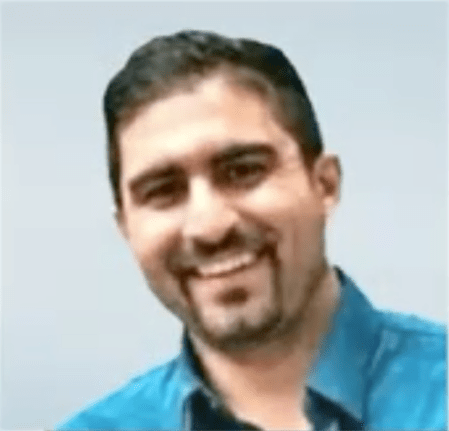
Ali Kourani, a 32-year-old who was living in the Bronx, New York (pictured on the right*), allegedly gathered “information regarding operations and security at airports in the U.S. and elsewhere,” while also “surveilling U.S. military and law enforcement facilities in Manhattan and Brooklyn.” Hizballah asked Kourani to identify “individuals affiliated with the Israeli Defense Force” inside the U.S. and locate “weapons suppliers in the U.S. who could provide firearms to support IJO operations” as well. Kourani allegedly conducted all of these missions on behalf of his IJO “handler,” who was safely ensconced back home in Lebanon.

Samer el Debek, a 37-year-old resident of Dearborn, Michigan, is charged with “casing security procedures at the Panama Canal and the Israeli Embassy” in Panama, identifying “areas of weakness and construction at the Panama Canal,” and determining for Hizballah “how close someone could get to a ship passing through the Canal.” His “IJO handlers” also “asked him for photographs of the U.S. Embassy” in Panama, as well as “details” concerning its “security procedures.” (El Debek told authorities he did not provide Hizballah with the information requested on the American embassy.)

The charges brought against Kourani and El Debek have not been proven in a court of law. They remain allegations that have yet to be weighed by the criminal justice system. Still, the legal filings in both cases provide a unique window into how the FBI and the U.S. government are tracking Hizballah’s international terror network, including inside America.

Hizballah’s Islamic Jihad Organization first gained infamy in the 1980s, when it orchestrated various attacks on Americans and Europeans in Lebanon and elsewhere. In some ways, the IJO could be credited with launching the modern jihadist war against the U.S., pioneering the use of near-simultaneous suicide bombings. Such tactics would later be adopted by Sunni jihadists, including al Qaeda, with devastating effects.

The IJO has avoided public scrutiny at times. The public’s attention has been mainly focused on the Islamic State of late. This is understandable as the so-called caliphate inspires, directs and guides terrorist operations around the globe.

But the U.S. government’s recent filings, including the sworn affidavits of two FBI agents responsible for tracking Hizballah, make it clear that the IJO continues to manage a sophisticated, clandestine web of operatives who are trained to carry out Iran’s bidding.

The IJO uses multiple aliases, including “External Security Organization” and “910.” The government describes it as a “component of Hizballah responsible for the planning and coordination of intelligence, counterintelligence, and terrorist activities on behalf of” the terror group “outside of Lebanon.” The IJO’s “operatives” are usually “assigned a Lebanon-based ‘handler,’ sometimes referred to as a mentor,” and this person is “responsible for providing taskings, debriefing operatives, and arranging training.”

The IJO often compartmentalizes its operations, conducting them “in stages” and “sending waves of one or more operatives with separate taskings such as surveillance, obtaining and storing necessary components and equipment, and attack execution.” Indeed, the government explains that the IJO’s handlers keep the procurement of ammonium nitrate-based products used for bomb-making separate from other terror-related tasks so as to avoid generating additional scrutiny.

Neither Kourani, nor El Debek is accused of conspiring to commit an imminent attack. But US officials think their work was part of longer-term planning.

“Pre-operational surveillance is one of the hallmarks of [Hizballah] in planning for future attacks,” Commissioner James P. O’Neill of the New York Police Department (NYPD) explained in a statement.

The surveillance performed in New York City was done “in support of anticipated IJO terrorist attacks,” according to the complaint against Kourani.

Reading through the extensive legal paperwork, totaling dozens of pages, one is left to wonder who else Hizballah may have stationed here inside the U.S. as part of its patient plotting.

The sections that follow below are based on the U.S. government’s complaints and affidavits. In many cases, these same filings say the details cited were originally provided, in whole or in part, by Kourani and El Debek themselves during interviews with the FBI.

Kourani allegedly admitted he was an IJO “sleeper” operative

Ali Kourani (also known as “Jacob Lewis” and “Daniel”) was born near Bint Jbeil, Lebanon in 1984 and relocated to the U.S. as a young man in 2003. He went on to receive “a Bachelor of Science in biomedical engineering in 2009” and a MBA in 2013.

Kourani sat for “multiple voluntary interviews” with the FBI in 2016 and 2017, and much of the evidence cited in the complaint against him is sourced to his own admissions during these sessions. At one point, he apparently said he hoped to exchange information for “financial support and immigration benefits for certain” relatives, but the FBI says it didn’t agree to this quid pro quo proposal.

Kourani allegedly compared his family to the “Bin Ladens of Lebanon,” describing one brother as the “face of Hizballah” in one area of Lebanon. He was first trained at a 45-day Hizballah “boot camp” in the year 2000. He was just 16 years old at the time, but claimed that his “family’s connections to a high-ranking Hizballah official named Haider Kourani” allowed him to attend the camp. Kourani was allegedly “taught to fire AK-47 assault rifles and rocket launchers, as well as basic military tactics.”

His “family’s home was destroyed by an Israeli bombing” during the 2006 Lebanon War. Approximately two years later, according to Kourani, he was “recruited by” Hizballah’s Sheikh Hussein Kourani to serve in the IJO.

Kourani described the IJO as being responsible for “black ops” carried out by Hizballah and “the Iranians.” Kourani also explained that the IJO is “operated” by Hizballah leader Hassan Nasrallah, who reports “directly to Ali Khamenei,” the Iranian Supreme Leader.

Kourani told the FBI that he was “recruited to join the IJO in light of his education and residence in the United States.” But there was another sinister motive for Hizballah’s interest in him. The IJO was developing a network of “sleepers” who “maintained ostensibly normal lies but could be activated and tasked with conducting IJO operations,” Kourani purportedly said.

Indeed, Kourani “identified himself” as one of these IJO “sleeper” operatives, “working undercover in the United States” and covertly “conducting IJO intelligence-gathering and surveillance missions” given to him by his handlers in Lebanon.

Kourani identified one IJO handler as “Fadi” (also known as “Hajj”) and explained the elaborate security protocols Hizballah took. In addition to be questioned about his own background, Kourani was trained on “conducting interrogations, resisting interrogations, and surveillance techniques.”

Fadi “typically wore a mask during their meetings,” explaining that the IJO’s “golden rule” is “the less you know the better it is.” Fadi “acted as” Kourani’s handler until about Sept. 2015, when Kourani claims he “was deactivated by the IJO.”

Fadi told Kourani to obtain a U.S. citizenship, a passport and related documents, thereby making it easier for him to travel around the world on behalf of Hizballah. The IJO’s man also instructed Kourani on how they could communicate securely, using code words and other basic tradecraft.

IJO surveillance in New York City, including at John F. Kennedy International Airport

The most striking allegations against Kourani involve his surveillance of potential targets in New York City on behalf of Hizballah.

Fadi “directed” Kourani to “surveil and collect information regarding military and intelligence targets in the New York City area,” the FBI found. Kourani then “conducted physical surveillance” on three locations in Manhattan and another in Brooklyn. The buildings he surveilled include: “a U.S. government facility, which includes FBI offices”; a “U.S. Army National Guard facility”; a “U.S. Secret Service facility”; and a “U.S. Army Armory facility.” Kourani transferred his video surveillance on “at least one” of these targets to “Fadi and other IJO personnel in Lebanon.”

According to the complaint, Fadi had Kourani surveil airports in the New York area. “In response,” Kourani “provided detailed information to Fadi regarding specific security protocols; baggage-screening and collection practices; and the locations of surveillance cameras, security personnel, law enforcement officers, and magnetometers at JFK and an international airport in another country.”

Fadi tasked Kourani with other missions as well. He told Kourani to “obtain surveillance equipment in the United States” – including “drones, night-vision goggles, and high-powered cameras” – “so that the underlying technology could be studied and replicated by the IJO.” He also had Kourani “cultivate contacts” who “could provide firearms for use in potential future IJO operations in the United States” (Fadi allegedly deemed these contacts unsuitable for arms purchases), while also collecting “intelligence regarding individuals…affiliated with the” Israeli Defense Forces.

El Debek’s alleged admissions during interviews with the FBI

As with Kourani, the FBI’s case against Samer el Debek is based in no small part on his interviews with the Bureau. El Debek was interviewed “in person a total of five times between” Sept. 8, 2016 and May 23, 2017, as well as “by phone on a number of occasions.” His testimony was supplemented with evidence culled from his social media, emails and travel documents.

According to the complaint in his case, El Debek allegedly admitted that: he was “first recruited by Hizballah in late 2007 or 2008” and eventually received a salary of $1,000 per month plus “medical expenses”; he “received military training from Hizballah in Lebanon,” including how to use assault rifles, a rocket-propelled grenade launcher, and other weapons; he “was trained on at least four occasions between 2009 and 2013 in surveillance and counter-surveillance techniques”; he “attended Hizballah religious training,” during which “a sheikh taught religious rules and topics including martyrdom ideology”; he was trained on the “handling of explosives and the creation of explosive devices,” including landmines, improvised explosive devices and how to remotely detonate such bombs; and he was “taught how specifically to target people and buildings.”

An FBI Special Agent Bomb Technician discussed the “bomb-making techniques” Hizballah imparted to El Debek and found that he “had a high degree of technical sophistication in this area.”

Indirect ties to Iran’s worldwide terror campaign in 2012

Several of the allegations against Kourani and El Debek connect them – albeit indirectly – to an IJO network responsible for orchestrating a wave of terrorist plots on behalf of the Iranian regime in 2012.

That year witnessed a “marked resurgence of Iran’s state sponsorship of terrorism, through its Islamic Revolutionary Guard Corps – Qods Force (IRGC-QF), its Ministry of Intelligence and Security (MOIS), and Tehran’s ally” Hizballah, the State Department said in its Country Reports on Terrorism 2012. Iran and Hizballah’s “terrorist activity…reached a tempo unseen since the 1990s, with attacks plotted in Southeast Asia, Europe, and Africa.”

Foggy Bottom went on to cite plots and attacks in Cyprus, Georgia, India, Kenya, and Thailand as evidence of Iran’s worldwide campaign of terror in 2012. [See FDD’s Long War Journal report, State Department highlights Iran’s ‘marked resurgence’ of state-sponsored terrorism.]

Some of these same plots – all carried out under the direction of Hizballah’s Islamic Jihad Organization (IJO) – are referenced in the complaints filed against Kourani and El Debek.

On July 18, 2012, Hizballah bombed a tour bus carrying Israelis at the Burgas Airport in Bulgaria. Five Israelis and one Bulgarian were killed. The Bulgarian government publicly fingered Hizballah as the culprit.

The FBI discussed the Burgas attack with El Debek, who explained that the bomber, Mohamad Husseini, “was connected to his family.” Husseini was the nephew of El Debek’s aunt. El Debek also “identified a photograph of Husseini,” explaining that “he knew of Husseini’s membership in Hizballah’s ‘External Security’ unit” – meaning the IJO, El Debek’s own parent organization.

The complaint does not cite any evidence directly tying El Debek to the Burgas bombing. But the FBI assessed that El Debek’s training would allow him to build an explosive device similar to the one that killed several Israelis.

The “techniques and methods in which Hizballah trained” El Debek to build an improvised explosive device “are substantially similar to those used to construct the IED used in the” Burgas bombing, FBI Special Agent Daniel M. Ganci wrote in an affidavit. Ganci relied on his conversations with another FBI bomb expert in formulating his assessment.

The complaints cite the IJO’s activities in Thailand, pointing to the Jan. 2012 arrest of Hussein Atris, who was detained as “he tried to board a flight at Bangkok airport.” Atris “subsequently led law enforcement personnel to a commercial building near Bangkok that housed a cache of nearly 10,000 pounds of urea-based fertilizer and 10 gallons of ammonium nitrate,” which “can be used to construct explosives.”

Atris wasn’t the only Iranian-sponsored operative in Thailand at the time. In Feb. 2012, two Iranian men were arrested by Thai police and a third by Malaysian authorities after the group “accidentally set off explosives that were allegedly intended to target Israeli diplomats,” according to the State Department. The explosives “were similar to bombs targeting Israeli diplomats in Georgia and India” during that same timeframe. Still other Iranian agents “successfully fled” Thailand. All of the operatives traveled “through Malaysia” to Bangkok.

In 2009, years before the high-profile arrests, El Debek himself traveled to Bangkok, apparently slipping in and out of Thailand unnoticed. According to the complaint, it was El Debek’s “first mission abroad” on behalf Hizballah. El Debek allegedly told the FBI that he was supposed “to clean up the explosive precursors” left behind at a house in Bangkok by other Hizballah members who were forced to flee “because they were under surveillance.”

Like his Hizballah compatriots who followed him, El Debek traveled through Malaysia en route to Thailand. While in Malaysia, “he met his IJO handler,” who “provided him with a cover story” to use in Bangkok.

El Debek was to hire a sex worker “to draw out any surveillance on the house.” El Debek told the FBI that he did as his handler instructed him, hiring a “female escort” to probe for any suspicious activity around the home. While El Debek watched, she entered the home without any problems. Now confident that authorities weren’t watching the home, El Debek later returned “and found approximately 50 boxes containing materials sealed in plastic.” He told the FBI that “the majority, if not all” of the boxes contained ammonium nitrate. He removed as many as he could in “his rented vehicle” and dumped the rest. Curiously, however, he was instructed a “day or two later” to “return the explosive precursors to the house and pay rent to the landlord.” He complied before returning to Lebanon via Malaysia.

The complaint does not explicitly connect the “explosive precursors” El Debek handled in 2009 to Hizballah’s plots three years later. But the charges, assuming they are true, confirm that the Iranian proxy was laying the groundwork for operations in Thailand years in advance.

In May 2009, Kourani made his own suspicious trip, which also may be tied to the events that unfolded in 2012. Kourani traveled to Guangzhou, China, where the manufacturer of “ammonium nitrate-based First Aid ice packs” was located. The FBI found that these same types of ice packs, from the same manufacturer, were “seized in connection with” the thwarted IJO plot in Thailand in 2012, as well as a separate foiled operation in Cyprus.

In 2014, the U.S. Treasury Department sanctioned a number of Hizballah “front companies” and “agents” used for procurement around the world. One of these, Stars International, Ltd., has a subsidiary in Guangzhou.

El Debek’s surveillance in Panama

Another one of El Debek’s alleged missions for Hizballah took him to Panama. He visited the tiny Central American nation twice, with his first trip coming in 2011. El Debek explained that “his operational taskings included learning to drive in Panama, determining the cost of opening a business, locating the U.S. and Israeli Embassies, and determining how to get to the Panama Canal.” He was “instructed to case and identify security procedures at the Canal and the Israeli Embassy,” but said “his purpose for locating the U.S. Embassy was simply to know its location.” According to the complaint, the IJO operative also “located hardware stores” and other places where “acetone and battery acid,” both “explosive precursors,” could be acquired.

El Debek’s second alleged mission to Panama came in 2012. This time it “was more focused on the Panama Canal,” he explained. Hizballah “asked him to identify areas of weakness and construction at the Canal, and provide information about Canal security and how close someone could get to a ship.” He “took a lot of photographs of the Canal, which he later provided to the IJO.”

His “IJO handlers” were keenly interested in the U.S. Embassy, including “details about its security procedures,” as well as “periods of heavy traffic into and out of the U.S. Embassy, and the locations of houses and apartments in close vicinity to” it. El Debek claimed he didn’t go into the embassy, nor did he take photographs of it, so he “did not have a significant understanding of” the Americans’ “security procedures.” He claimed that he merely informed his “IJO handlers” that “people waiting for a visa appointment entered the Embassy and then waited for their appointment inside.”

After returning from Panama to Lebanon, he “met with his IJO handler and the handler’s superior,” providing them “with maps, notes, pictures, and the camera he used in Panama.”

El Debek said that after performing these missions, however, Hizballah turned on him, accusing him of “spying for the United States.” He allegedly offered a “false confession after repeated interrogations,” telling Hizballah “that he worked for the FBI, CIA, and police.” He supposedly named his American handlers as “Jeff and Michael” (names he made up) and said he was “paid $500,000” for his services to the U.S. government.

It is not clear why Hizballah would think that El Debek had doubled-crossed them.

The cult of martyrdom has become a prominent feature of Sunni jihadism, but El Debek’s case includes important reminders that it is still a powerful concept within Iranian-sponsored Shiite jihadism as well. According to the complaint, he performed multiple searches on Facebook using terms such as “martyrs of the holy defense,” “martyrs of Islamic resistance,” “Hizballah martyrs,” and “martyrs of the Islamic resistance in Lebanon.”

Background on Hizballah’s Islamic Jihad Organization (IJO)

The world first heard of Hizballah’s “Islamic Jihad Organization” (IJO) in the early 1980s, when Iran’s terrorist proxy struck American and European targets in Lebanon. The IJO was poorly understood at the time. So when the group claimed responsibility for several operations, and threatened to execute more, there was confusion over which party was the real culprit. Some reporting still reflects the initial uncertainty to this day.

In reality, the IJO was one of Iran’s and Hizballah’s early fronts for waging jihad against the West. Western forces were deployed to Lebanon as peacekeepers in the wake of Israel’s invasion of southern Lebanon in 1982. The Iranian regime and its surrogates went to work. The CIA found that hundreds of members of Iran’s Islamic Revolutionary Guard Corps (IRGC) were deployed to Lebanon, where they built terror networks and began spreading Ayatollah Khomeini’s radical ideology. The IRGC was based in Baalbek and Iran coordinated the IRGC’s activities via its embassy in Damascus, often with the support of Assad regime. The IJO was a key part of these early Iranian plans.

The IJO claimed responsibility for the Apr. 18, 1983 US Embassy bombing in Beirut, killing 63 people, including 17 Americans. According to Langley, the bombing was the “deadliest attack in CIA history,” as some of the Americans killed were Agency personnel.

After the Embassy bombing, the CIA’s William F. Buckley volunteered to serve as Station Chief in Lebanon. In March 1984, the IJO kidnapped Buckley. He died in the terrorists’ custody in June 1985. The IJO claimed that it executed Buckley in Oct. 1985, months after US officials say he perished.
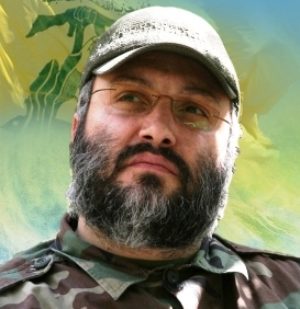
US officials also identified the IJO as the Iranian arm behind the Oct. 23, 1983 suicide bombs targeting peacekeepers in the Multinational Force in Lebanon (MNF). Twin vehicle-borne improvised explosive devices rocked the barracks for U.S. Marines and French peacekeepers, killing 241 Americans and 58 French service members. The fingerprints of Hizballah’s IJO and its terror master, Imad Mughniyah (pictured on the right), were all over the attacks.

A Sept. 27, 1984 analysis by the CIA’s Directorate of Intelligence found that the IJO “almost certainly carried out” the Apr. 1983 U.S. Embassy bombing, as well as the Oct. 1983 attacks on the Marines and French paratroopers. The CIA referred to “Islamic Jihad” (or the IJO) as Hizballah’s “terrorist component,” explaining that it operated with “Iranian assistance” and was “determined to drive the US and Israel out of Lebanon and to establish an Islamic state there.”

That same CIA analysis pointed to an “overwhelming body of circumstantial evidence” showing that Hizballah operated “with Iranian support under the cover name of Islamic Jihad.” Another now declassified CIA assessment concluded that the IJO was not “a distinct organization with identifiable leaders,” but instead “an umbrella name used by a number of Iranian-dominated Shia extremist groups” in Lebanon and elsewhere in the Middle East.

An observation in the CIA’s Sept. 1984 assessment proved to be a harbinger of things to come. “Radical leaders almost certainly viewed the withdrawal of the Marine contingent from Beirut last winter as proof of the effectiveness of terrorist tactics,” the Agency’s analysts wrote in reference to the aftermath of the IJO’s Oct. 1983 bombing.

Iranian-backed Shiite jihadists were not the only ones who held this view. At the time, a certain young extremist named Osama bin Laden was watching as events unfolded in Lebanon. Bin Laden believed that the American withdrawal signaled weakness. While stationed in Sudan in the early 1990s, bin Laden and al Qaeda even turned to Hizballah, Mughniyah and Iran for assistance in learning how to conduct simultaneous suicide attacks. “Bin Laden reportedly showed particular interest in learning how to use truck bombs such as the one that had killed 241 U.S. Marines in Lebanon in 1983,” the 9/11 Commission later found. Al Qaeda cadres were trained by Hizballah in Lebanon, as well as in Iran.

Hizballah’s terrorist innovation would become al Qaeda’s modus operandi. Bin Laden’s men directly modeled the 1998 U.S. Embassy bombings in Kenya and Tanzania after Hizballah’s 1983 attacks. As a U.S. court later found, Iran and Hizballah provided al Qaeda with the “technical expertise” necessary to carry out the 1998 Embassy bombings. Bin Laden believed he could drive the U.S. out of the Middle East if his men replicated Mughniyah’s early operations. However, the al Qaeda founder was proven wrong on that score.

Hizballah’s IJO was the spearhead for a series of other Iranian-backed, anti-Western operations in Lebanon and elsewhere. Bombings, kidnappings, assassinations – all were tied to the IJO in the 1980s. A car bombing outside of the U.S. Embassy in Kuwait in 1983 and the assassination of a Saudi government official in Spain were both claimed by the IJO, according to the CIA.
The 1985 hijacking of TWA Flight 847 was another instance of IJO-orchestrated terror.

Callers claiming to be affiliated with the group phoned in additional threats around the globe, promising more terror if all Western and Israeli forces didn’t evacuate Lebanon.

In 1987, on the fourth anniversary of the Marine barracks and French paratroopers bombings, a statement attributed to the IJO was sent to the press. “America failed to do anything. It just collected the limbs of its dead and fled from the Muslims’ fists in Lebanon,” the statement read, according to an account in UPI at the time. The group threatened more attacks against American interests. “And this, with God’s backing, will occur in other Muslim countries soon at the hands of the students of our blessed martyrs.” Photos of two men held hostage by the IJO — American journalist Terry Anderson and French journalist Jean-Paul Kauffman – were attached to the message, along with images the buildings bombed in Oct. 1983. Luckily, both Anderson and Kauffman were subsequently released.

This early campaign of Iranian terror has had lasting effects throughout the region. Some of its participants have continued to push the regime’s agenda decades after the fact.
One such figure is commonly known as Abu Mahdi Al-Muhandis (also identified as Jamal Jafaar Mohammed Ali Ebrahimi), the deputy commander of Iraq’s Popular Mobilization Forces (PMF), which is currently fighting the Islamic State inside Iraq. Muhandis, a close confidant of IRGC-Qods Force commander Qassem Soleimani, was designated by the U.S. government as a terrorist in 2009. The Treasury Department noted that he had “participated in the bombing of Western embassies in Kuwait and the attempted assassination of the Emir of Kuwait in the early 1980s.” Muhandis “was subsequently convicted in absentia by the Kuwaiti government for his role in the bombing and attempted assassination.”

Like so many plots during this timeframe, some sources identified Imad Mughniyah as the chief architect of the 1983 embassy bombings in Kuwait — the same attacks Muhandis was later convicted of participating in. One of Mughniyah’s family members, Mustafa Youssef Badreddin, was among the 17 people arrested in Kuwait and convicted of carrying out the attacks on the U.S. and French embassies, among other targets. In the years that followed, Iran’s terrorist proxies repeatedly demanded that members of this group (dubbed the “Dawa 17”) be released from custody in exchange for Western hostages.

Hizballah’s IJO wasn’t finished in the 1980s. And its operational reach extended into Central and South America. For instance, the IJO claimed responsibility for the Mar. 17, 1992 suicide truck bombing at the Israeli embassy in Buenos Aires, Argentina. A little over two years later, on July 18, 1994, another Hizballah suicide terrorist drove a bomb-laden vehicle into a Jewish community center (Asociación Mutual Israelita Argentina, or AMIA) in Buenos Aires. INTERPOL subsequently issued Red Notices for Mughiyah and several others for their role in the devastating explosions.

Hizballah’s IJO allegedly wanted revenge for the death of Mughniyah

In Feb. 2008, Mughniyah was assassinated in a highly professional operation in Damascus, Syria. The hit was likely carried out by the Israelis, possibly with the assistance of their American allies. The recently released court filings indicate that Hizballah has been seeking revenge, including inside the U.S., since then. Those same documents identify Mughniyah as the IJO’s “leader” until his death.

Fadi, the IJO handler, allegedly “directed” Ali Kourani “to identify and collect intelligence regarding individuals in the United States affiliated with the” Israeli Defense Forces (IDF). According to the complaint, Kourani “believed that the IJO gave this tasking to facilitate, among other things, assassinations of IDF personnel in retaliation for” Mughniyah’s death. Kourani “used a social media account to identify members or associates [of the IDF] in the New York City area, and he described his search methodology to Fadi.”

The cases against Kourani and El Debek suggest that the U.S. government will be forced to contend with Hizballah’s international network for the foreseeable future. Just this past week, in fact, the State Department amended its terrorist designation of Hizballah to include additional aliases for the group.

Hizballah’s IJO arguably began the current jihadists’ war against the West in the early 1980s. And it is still plotting more than three decades later.

*The photo of Ali Kourani was first used during a segment broadcast by NY1. A similar image was also used by NBC New York.
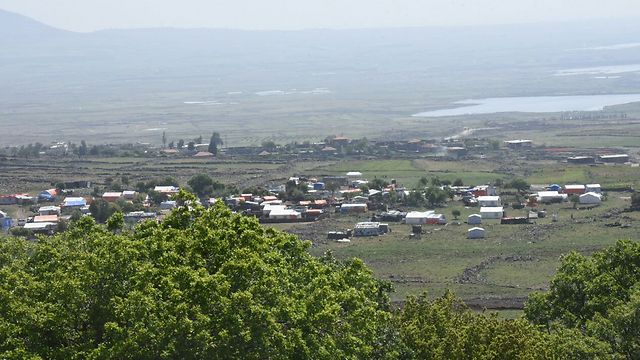
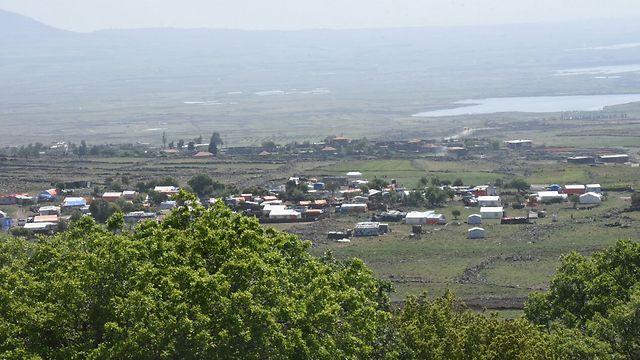
The Former Anchor Who Says Al-Jazeera Aids Terrorists

June 23, 2017

The Former Anchor Who Says Al-Jazeera Aids Terrorists, Bloomberg, Eli Lake, June 23, 2017

(Please see also Qatar’s neighbors issue steep list of demands to end crisis. — DM)

Mohamed Fahmy in the defendants’ cage during his trial in Egypt. Photographer: Khaled Desouki/AFP/Getty Images

“The more the network coordinates and takes directions from the government, the more it becomes a mouthpiece for Qatari intelligence,” he told me in an interview Thursday. “There are many channels who are biased, but this is past bias. Now al-Jazeera is a voice for terrorists.” 

Fahmy’s testimony is particularly important now. Al-Jazeera is at the center of a crisis ripping apart the Arab Gulf states. Earlier this month Saudi Arabia, the United Arab Emirates, Egypt and Bahrain imposed a political and diplomatic blockade on Qatar. As part of that blockade, al-Jazeera has been kicked out of those countries.

Fahmy’s case is one more piece of evidence that the al-Jazeera seen by English-speaking audiences is not the al-Jazeera seen throughout the Muslim world. It’s one more piece of evidence that Qatar’s foreign policy is a double game: It hosts a military base the U.S. uses to fight terror, while funding a media platform for extremists.

*****************************

Mohamed Fahmy is the last person one would expect to make the case against al-Jazeera.

In 2014, the former Cairo bureau chief for the Qatar-funded television network began a 438-day sentence in an Egyptian prison on terrorism charges and practicing unlicensed journalism. His incarceration made al-Jazeera a powerful symbol of resistance to Egypt’s military dictatorship.

Today Fahmy is preparing a lawsuit against his former employers. And while he is still highly critical of the regime that imprisoned him, he also says the Egyptian government is correct when it says al-Jazeera is really a propaganda channel for Islamists and an arm of Qatari foreign policy.

“The more the network coordinates and takes directions from the government, the more it becomes a mouthpiece for Qatari intelligence,” he told me in an interview Thursday. “There are many channels who are biased, but this is past bias. Now al-Jazeera is a voice for terrorists.”

Fahmy’s testimony is particularly important now. Al-Jazeera is at the center of a crisis ripping apart the Arab Gulf states. Earlier this month Saudi Arabia, the United Arab Emirates, Egypt and Bahrain imposed a political and diplomatic blockade on Qatar. As part of that blockade, al-Jazeera has been kicked out of those countries.

The treatment of al-Jazeera as an arm of the Qatari state as opposed to a news organization does not sit well with many in the West. This week a New York Times editorial accused Qatar’s foes of “muzzling” a news outlet “that could lead citizens to question their rulers” in the Arab world.

In some ways it’s understandable for English-speaking audiences to take this view. Al-Jazeera’s English-language broadcasts certainly veer politically to the left. At times the channel has sucked up to police states. The channel embarrassed itself with such fluff as a recent sycophantic feature on female traffic cops in North Korea. But al-Jazeera English has also broken some important stories. It worked with Human Rights Watch to uncover documents mapping out the links between Libyan intelligence under Muammar Qaddafi and the British and U.S. governments.

Al-Jazeera’s Arabic broadcasts however have not met these same standards in recent years. To start, the network still airs a weekly talk show from Muslim Brotherhood theologian Yusuf al-Qaradawi. He has used his platform to argue that Islamic law justifies terrorist attacks against Israelis and U.S. soldiers. U.S. military leaders, such as retired Lt. General Ricardo Sanchez, who commanded forces in the initial campaign to stabilize Iraq, have said publicly that al-Jazeera reporters appeared to have advance knowledge of terrorist attacks. Fahmy told me that in his research he has learned that instructions were given to journalists not to refer to al Qaeda’s affiliate in Syria, al-Nusra, as a terrorist organization.

He said Qatar’s neighbors were justified in banning al-Jazeera. “Al-Jazeera has breached the true meaning of press freedom that I advocate and respect by sponsoring these voices of terror like Yusuf al Qaradawi,” he said. “If al-Jazeera continues to do that, they are directly responsible for many of these lone wolves, many of these youth that are brain washed.”

Fahmy didn’t always have this opinion of his former employer. He began to change his views while serving time. It started in the “scorpion block” of Egypt’s notorious Tora prison. During his stay, he came to know some of Egypt’s most notorious Islamists.

“When I started meeting and interviewing members of the Muslim Brotherhood and their sympathizers, they specifically told me they had been filming protests and selling it to al-Jazeera and dealing fluidly with the network and production companies in Egypt associated with the network,” he said.

One example of al-Jazeera’s coordination with the Muslim Brotherhood revolves around Muslim Brotherhood sit-ins in the summer of 2013, following the military coup that unseated Mohammed Morsi, the Muslim Brotherhood-affiliated president. As part of Fahmy’s case against al-Jazeera, he took testimony from a former security guard for the network and the head of the board of trustees for Egyptian state television. Both testified that members of the Muslim Brotherhood seized the broadcast truck al-Jazeera used to air the sit-ins that summer. In other words, al-Jazeera allowed the Muslim Brotherhood to broadcast its own protests.

That incident happened in the weeks before Fahmy was hired to be the network’s Cairo bureau chief. He says he was unaware of these ties to the Muslim Brotherhood until he began doing his own research and reporting from an Egyptian prison.

When Fahmy learned of these arrangements, he became angry. It undermined his case before the Egyptian courts that he was unaffiliated with any political party or terrorist groups inside Egypt. “To me this is a big deal, this is not acceptable,” he said. “It put me in danger because it’s up to me to convince the judge that I was just doing journalism.”

Ultimately Fahmy was released from prison in 2015. But this was not because al-Jazeera’s lawyers made a good case for him. Rather it was the work of human rights lawyer Amal Clooney, who eventually got him safely out of the country to Canada.

Now Fahmy is turning his attention to al-Jazeera. He is pressing a court in British Columbia to hear his case in January against the network, from whom he is seeking $100 million in damages for breach of contract, misrepresentation and negligence.

Fahmy’s case is one more piece of evidence that the al-Jazeera seen by English-speaking audiences is not the al-Jazeera seen throughout the Muslim world. It’s one more piece of evidence that Qatar’s foreign policy is a double game: It hosts a military base the U.S. uses to fight terror, while funding a media platform for extremists.