Archive for January 4, 2017

John Kerry, Those “Illegal” Settlements, That “Two-State Solution” (Part II)

January 4, 2017

John Kerry, Those “Illegal” Settlements, That “Two-State Solution” (Part II), Jihad Watch

(Part I of the series is available here. — DM)

kerry-netanyahu

After the Six-Day War, while the Israelis waited for the Arabs to make that phone call about peace negotiations that never came, the Arabs had other ideas. First, they announced at a meeting in the Sudanese capital of the Arab League “the three No’s of Khartoum”: No peace with Israel, no recognition of Israel, and no negotiations with Israel. Who and what – before a single “settlement” was started — was then the “obstacle to peace”? Second, the Arabs and their willing collaborators began to speak about, and thus to reify, out of the local Arabs in Israel, Gaza, the West Bank, and in the refugee camps, a “Palestinian people.” This fiction, which Secretary Kerry uncritically accepts (to be fair, so do millions of others), was designed for propaganda purposes, and has proven to be a stunningly effective weapon against Israel. No Arab leaders or diplomats or intellectuals mentioned the “Palestinian people” until 1967, when the need for such became apparent. As Zuheir Mohsen, leader of the Palestinian Arab terror group As Saiqa, famously told a journalist in 1977:

The Palestinian people does not exist. The creation of a Palestinian state is only a means for continuing our struggle against the state of Israel for our Arab unity. In reality today there is no difference between Jordanians, Palestinians, Syrians and Lebanese. Only for political and tactical reasons do we speak today about the existence of a Palestinian people, since Arab national interests demand that we posit the existence of a distinct “Palestinian people” to oppose Zionism. Yes, the existence of a separate Palestinian identity exists only for tactical reasons, Jordan, which is a sovereign state with defined borders, cannot raise claims to Haifa and Jaffa, while as a Palestinian, I can undoubtedly demand Haifa, Jaffa, Beer-Sheva and Jerusalem. However, the moment we reclaim our right to all of Palestine, we will not wait even a minute to unite Palestine and Jordan.

Yet Kerry insists that U. N. Resolution 181 — the “Partition Plan” — was meant to “realize the national aspirations of both Jews and Palestinians.” In 1947, there were no “Palestinians” with “national aspirations.” The invading Arab states never mentioned these “Palestinians” and had no intention of giving up whatever territory they managed to win to a nonexistent “Palestinian” people. And in 1947, the “national aspirations” of the Jews were betrayed when they were left by the Partition Plan with only about half of what had been promised under the Palestine Mandate, or – if we include eastern Palestine — only 23% of the territory promised before eastern Palestine had been transformed into the Emirate of Transjordan. To the extent that the local Arabs had any “national aspirations,” they were to destroy the Jewish state. In any case, Resolution 181 became a dead letter when the Arabs unanimously rejected it and then invaded Israel. Kerry wants to resuscitate it.

Kerry then moves on to Resolution 242, and what he, and Resolution 2334, call “occupied Palestinian territory.” But the word “occupied” has both a colloquial and a legal meaning, and this confusion between the two meanings has been well exploited by the Arabs. Israel is an “occupier” in the colloquial sense: through force of arms, it has “occupied” certain territories. But Israel is not only a “military occupier” of the West Bank, in the way that it was an “occupier” of the Sinai. Israel’s legal (historic, moral) claim to the West Bank, under the Mandate for Palestine, remains.

The constant use of the phrase “occupied territory,” or still worse, “occupied Palestinian territory” by John Kerry and so many others suggests that Israel has no claim to the “West Bank” or Gaza other than the temporary one of being a military occupant. One thinks in this regard of such examples as “Occupied Berlin,” “Occupied Vienna,” “Occupied Paris,” “Occupied Japan.” In all of these examples, the word “occupied” signals that the territory in question is under the control of a victorious power or powers, that control having been won through military conquest, and the claim to that territory is understood to be only temporary, based solely on that military occupation. But Israel’s claim to the “West Bank” is not based on the fact of military occupation. Rather, the West Bank is properly thought of as an unallocated part of the Palestine Mandate, and the provisions of the League of Nations’ Mandate still apply. Had Israel managed to capture all of the West Bank in the 1948-49 war, it could have exercised its rights under the Mandate, and incorporated all of that territory into the Jewish state. The fact that the Jews did not end up in possession of Gaza and the “West Bank” at the close of hostilities in 1949 war did not change the legal status of those territories. Israel’s claim based on the Mandate itself was not extinguished. Of course, had the Arabs accepted the Partition Plan, as Israel had done, then Israel would have been obligated to stand by its own acceptance, but the Arab refusal to do so freed Israel from any such obligation. The Six-Day War allowed Israel, by coming into possession of the West Bank by force of arms, to finally exercise its right, based on the Mandate, to establish settlements in that territory.

The claim under the Mandate was reinforced, rather than weakened, by Resolution 242’s insistence that territorial adjustments be made to guarantee Israel’s security (“secure borders”). And when Israel voluntarily gave up the Sinai to Egypt, and later handed Gaza over to “Palestinian” Arab rule – for reasons of realpolitik– that had no bearing on Israel’s continued claim to the “West Bank.”

So what has John Kerry carefully not said in his ill-tempered attack on Israel that has apparently so heartened Hamas? He has failed to mention the most important foundational document for Israel, the Mandate for Palestine, which enshrines Israel’s legal, moral, and historic rights to establish Jewish settlements everywhere in Palestine, from the Jordan to the sea, including all of the West Bank. Not only are those settlements not illegal, but they were, and still are, to be “encouraged” under the express terms of the Mandate. He has failed to mention, too, that Israel gave up fully 95% of what it won in the Six-Day War, and failed to mention the endless Israeli efforts to engage the “Palestinians” in real peace talks, not Rose Garden photo ops; those Israeli efforts have always been rebuffed. When at Camp David in 2000 Ehud Barak made the astounding offer to Yassir Arafat of fully 95% of the West Bank, Arafat refused.

This puts quite a different spin on Israeli behavior from that which Kerry presents. For him, it is Israel that keeps trying to deny the “Palestinians” everything, whereas it is those same “Palestinians” under Abbas as under Arafat, who have turned down Israeli offers, and most important, continue to refuse even to recognize Israel as a Jewish state. The list of Arab refusals starts with the Partition Plan of 1947, then the refusal to make the armistice lines of 1949 into permanent borders as offered by Israel, then the further refusal, for 12 years after the Six-Day War, by all the Arab states to recognize, or to negotiate, or to make peace with Israel (the Three No’s of Khartoum) until Sadat made his separate peace.

And even Kerry’s whipping-boy, Prime Minister Netanyahu, whose government he describes as “the most right-wing” in Israel’s history, in November 2009 put in place a 10-month freeze on settlements, hoping thereby to get the Palestinians back to the negotiating table. It didn’t work. And Kerry, of course, doesn’t mention Netanyahu’s attempt. Far from clinging adamantly to territories it won, Israel has been remarkably generous in giving up territories. The minute Anwar Sadat decided he would break ranks with the other Arabs and negotiate for Egypt alone, he found the Israelis willing, in exchange for a peace treaty, to hand back the entire Sinai. How often, in human history, has a nation victorious in war handed back all the territory it won to an aggressor?

Israel went even further with its concessions in Gaza, removing all of the Jewish settlements, handing Gaza back to the local “Palestinians,” without receiving anything in return but rockets and bombs. Yet Secretary Kerry dares to present Israel as the obstacle to peace, with the “Palestinian” campaigns of terror, and celebrations of terrorists, mentioned only in passing, while the Israeli “settlements” – specifically authorized by the Mandate – are treated, at great length, as “illegal.” He finds the Israelis bizarre in their belief, one that they have come to most reluctantly, that IDF control of the West Bank is a better way to preserve peace than a peace treaty signed with the likes of Mahmoud Abbas. Kerry is outraged that Israelis dare to insist they have a legal right to establish such settlements in the West Bank. Don’t bring up the Palestine Mandate; he doesn’t want to hear about it. And he certainly doesn’t want people beginning to agree with Israelis that the Mandate remains relevant. He doesn’t care what the main author of Resolution 242, Lord Caradon, meant by the phrases “withdrawal from territories” and “secure and recognized borders.” Please don’t trouble Secretary Kerry, either, with the report prepared by the American Joint Chiefs of Staff for President Johnson, about the minimum territorial adjustments that in their view Israel would need for “secure and defensible borders.” For Kerry, it’s more than enough to keep repeating the phrases “two-state solution” and “just and lasting peace,” which for him clearly means almost complete withdrawal to the 1967 lines with “minor adjustments.” For Lord Caradon, however, the most important thing about Resolution 242 was that Israel not be compelled to return to the 1967 lines that invited Arab aggression, and the adjustments need not everywhere be categorized as “minor.” As he forcefully put it:

We could have said: well, you go back to the 1967 line. But I know the 1967 line, and it’s a rotten line. You couldn’t have a worse line for a permanent international boundary. It’s where the troops happened to be on a certain night in 1948. It’s got no relation to the needs of the situation.

Kerry doesn’t want to hear about “secure and defensible borders.” He wants the Israelis to “take risks for peace” (as if Israel was not already taking unbelievable risks for peace), to uproot settlements needed for Israel’s defense, and to put their trust in a peace treaty, while all the evidence suggests that the “Palestinians,” including nobody-here-but-us-accountants Mahmoud Abbas, have no intention of recognizing Israel as a Jewish state until Israel returns to the 1967 lines, including East Jerusalem, and likely not even then. As for the other Arabs, it’s true that right now a shared fear of Iran has made it possible for Egypt, Saudi Arabia, and Jordan to collaborate with Israel behind the scenes, but fear of Iran may not prove to be a unifying force forever. As for most Arabs and Muslims, the spectacle of a dimidiated Israel would not sate but whet jihadist appetites.

Among the many things John Kerry would prefer not to be reminded of is that in 1920, 77% of the formerly Ottoman territories that were originally intended to be included in the Palestine Mandate — that is, the land east of the Jordan — was closed to Jewish immigration. Eastern Palestine instead became, thanks to the British, the Arab Emirate of Transjordan. For Kerry, that’s not worth mentioning, but it was a huge event for the Zionists at the time. In fact, those Zionists who did not accept the loss of eastern Palestine continued to include it in their maximalist demands. Their leader, Ze’ev Jabotinsky, even wrote a celebrated poem: “Shtei Gadot L’Yarden – Zu Shelanu Zu Gam Ken” (“Two sides has the river Jordan/This side is ours, and that side too”) expressing the refusal to give up the claim to eastern Palestine. So Israel had by 1948 already been considerably reduced, the British having given away 77% of what had been intended for the Palestine Mandate. To remind people of this is not to endorse Jabotinsky’s demand, but at least to offer a historical perspective that might make some more understanding of Israel’s position.. Would it have been too much to expect John Kerry to mention how, and why, and on what land, the country of Jordan was created?

The Arabs, then, already had in 1948 a “Palestinian” state, consisting of all of eastern Palestine, the country we now call “Jordan,” where 80% of the population identifies itself as “Palestinian.” When the Arabs became convinced, after the Six-Day War, that they could not destroy Israel outright, they sought to undermine Israel in other ways – diplomatic isolation, boycotts, terror attacks – hoping to reduce its size through salami tactics, and to establish a second Arab state, this one in western Palestine, a state whose main purpose would be not to live in satisfied coexistence with Israel (‘two states, side-by-side” etc.) as Kerry naively foresees, but to serve, rather, as a springboard for yet another attempt at destroying, whether through the Fast Jihad of Hamas or the Slow Jihad of Fatah, the one Jewish state, whose mere existence, whatever its size, is such an affront to all Muslims and Arabs. John Kerry, innocent of Islam, gives no sign of realizing how deep is the Muslim Arab opposition to Israel.

So the Arabs refused this and the Arabs refused that. And the Israelis accepted this, and the Israelis gave back that. And the Mandate for Palestine says this, and U.N. Resolution 242 says that. It’s all so complicated and mind-numbing, no wonder John Kerry wants to hear only about a very few things. He blocks out the rest, and he reduces everything to the simple-minded phrases repeated endlessly: the “two-state solution,” the “just and lasting peace.” He doesn’t need to know what has actually happened between Arab and Jew in Palestine in the last 100 years, what principles were invoked or ignored, what rights created or destroyed, what promises kept or broken, what offers accepted or rejected. For Kerry, all he knows and all he needs to know is that the settlements are “illegal,” and positively noxious because they are what prevent that “two-state solution” that “everybody” knows can be arrived at just as soon as Israel stops building new settlements and dismantles all but a few of the old ones.

For the Palestinians, of course, as Kerry may not know, all the cities in Israel are “occupied” territory (“Occupied Haifa,” “Occupied Jaffa,” “Occupied Jerusalem”), and all the towns are “settlements” and all the settlements, of course, are on “Occupied Arab Land.” The Jews, as Infidels, have no rights on lands once possessed by Muslims. There is no historic connection of Jews to Jerusalem, which is also “occupied Palestinian territory.” And even if the Palestine Mandate existed, we are not required to pay any attention to it. Any history that is not on the side of the Muslims can safely be forgotten.

U.N. Resolution 2334 pretends to be about furthering “peace,” but its effect will be to embolden the “Palestinian” side, now less willing than ever to negotiate, since it believes it has now isolated Israel diplomatically. With little to lose, the Israeli government could take a different tack, a hypertrophied hasbara that would speak over the talking heads of the Security Council to a public that, especially in Europe, has been getting its own taste of Muslim convivencia and may, as a consequence, be more sympathetic to Israel’s plight than votes at the U.N. might suggest. Let Israel explain what the Palestine Mandate was intended to achieve, why the settlements are not “illegal,” what made the Partition Plan (Resolution 181) null and void, why those armistice lines were never made into permanent borders, how and why the “Palestinian people” were invented, and then, in terms anyone looking at a map can understand, what territory in the “West Bank” the tiny nation of Israel, as a military matter, must keep, as “settlements,” if it is to have those “secure and defensible borders” it both needs and deserves.

John Kerry assures us that he cares deeply about, even “loves,” the plucky little state of Israel that, he insists, stole his heart away decades ago. But he is convinced that Israel doesn’t understand its real situation, and its blinkered (“extreme right-wing”) leaders can’t seem to grasp that a “Palestinian” state living “side-by-side with a Jewish state” would only improve Israel’s well-being. Here is John Kerry, the American Secretary of State, fierce in Foggy Bottom, languid in Louisburg Square, who knows better than the Israelis what they need, and understands perfectly this most intractable of foreign policy problems. It’s an old and cruel idea: that Israel doesn’t understand its real interests, and must be saved in spite of itself. And John Forbes Kerry has arrived on the scene to help straighten out the little country he loves so much. All he asks of Israelis is that they come to their senses, and do what he, and Barack Obama, and the Security Council, demand.

Fortunately, for Israel, and for the Western world, too, the clock is running out on Obama and on Kerry. This means Israel still has a chance to decide for itself what it needs, at a minimum, in order to survive. Given the history of the Jews during the last 3000 years, that doesn’t seem like much to ask.
President Trump’s Immigration Challenge

January 4, 2017

President Trump’s Immigration Challenge, Front Page MagazineMichael Cutler, January 4, 2017

nj

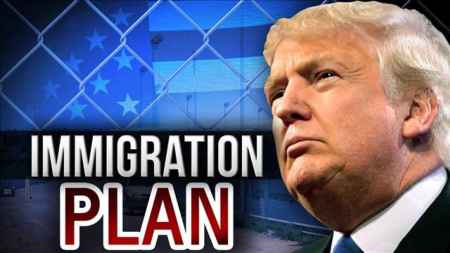
On January 20, 2017 President Trump can and likely will end all of Obama’s illegal immigration executive orders, but he needs to do more.

For decades the effective enforcement of our nation’s immigration laws was hobbled by lack of resources in general and a particularly devastating failure to enforce the immigration laws from within the interior of the United States.

For decades the Border Patrol was perceived as the primary enforcement arm of America’s immigration laws and for the Border Patrol this worked out fine.  They got the lion’s share of publicity and, far more importantly, the funding while INS special agents and the interior enforcement mission were all but ignored

When the DHS (Department of Homeland Security) was created in the wake of the terror attacks of 9/11, the former INS was dismantled and broken into several components of the DHS and mixed in with other agencies, principally the U.S. Customs Service.

Bad as it was for INS agents to operate in the shadow of the Border Patrol, the creation of the DHS was disastrous and caused many of the INS agents nostalgic for “the good old days.”

On May 5, 2005 the House Subcommittee on Immigration, Border Security and Claims conducted a hearing on the topic, “New ‘Dual Mission’ Of The Immigration Enforcement Agencies.”

I was one of four witnesses who testified at that hearing.  In point of fact, I testified at several hearings that sought to understand the challenges that the creation of the DHS created for the effective enforcement of our nation’s immigration laws.

In my testimony I clearly articulated my concerns about the myriad issues created when the DHS was established and the former INS was dismantled.

Consider this excerpt from the testimony of then-Subcommittee Chairman John Hostettler in which he articulated the importance of immigration law enforcement and that was, however, hobbled by the creation of the DHS:

The first two Subcommittee hearings of the year examined in detail how the immigration enforcement agencies have inadequate resources and too few personnel to carry out their mission. The witnesses mentioned the lack of uniforms, badges, detention space, and the inevitable low morale of frontline agents who are overwhelmed by the sheer volume of incoming illegal aliens. If this were not enough, these ”immigration enforcement” agencies also face internal confusion resulting from dual or multiple missions in which immigration has all too often taken a back seat. Sadly, contrary to Congress’ expectations, immigration enforcement has not been the primary focus of either of these agencies, and that is the subject of today’s hearing.

The Homeland Security Act, enacted in November 2002, split the former Immigration and Naturalization Service, or INS, into separate immigration service and enforcement agencies, both within the Department of Homeland Security. This split had been pursued by Chairman Sensenbrenner based on testimony and evidence that the dual missions of INS had resulted in poor performance.

There was a constant tug-of-war between providing good service to law-abiding aliens and enforcing the law against law-breakers. The plain language of the Homeland Security Act, Title D, creates a ”Bureau of Border Security,” and specifically transfers all immigration enforcement functions of INS into it. Yet when it came down to actually creating the two: new agencies, the Administration veered off course. Although the service functions of INS were transferred to USCIS, the enforcement side of INS was split in two, what is now Immigration and Customs Enforcement, or ICE, to handle interior enforcement, and Customs and Border Protection (CBP) to guard our borders.

ICE was given all Customs agents, investigators, intelligence and analysis-from the Treasury Department, as well as the Federal Protective Service to guard Federal buildings, and the Federal Air Marshals to protect our airplanes, and finally the INS investigators.

CBP was given all Treasury Customs inspectors at the ports-of-entry, Agriculture Inspector from the Department Of Agriculture, and INS inspectors.

At no time during the reorganization planning was it anticipated by the Committee that an immigration enforcement agency would share its role with other enforcement functions, such as enforcement of our customs laws. This simply results in the creation of dual or multiple missions that the act sought to avoid in the first place.

Failure to adhere to the statutory framework established by HSA has produced immigration enforcement incoherence that undermines the immigration enforcement mission central to DHS, and undermines the security of our Nation’s borders and citizens.

It is not certain on what basis it was determined that customs and agriculture enforcement should become part of the immigration enforcement agency, except to require Federal agents at the border to have more expertise and more functions.

It is also unknown on what basis the Federal Air Marshals should become part of this agency, especially since it has been revealed that the policy is not to apprehend out-of-immigration status aliens when discovered on flights. If the mission of the Department of Homeland Security is to protect the homeland, it cannot effect its mission by compromising or neglecting immigration enforcement for customs enforcement.

The 9/11 terrorists all came to the United States without weapons or contraband—Added customs enforcement would not have stopped 9/11 from happening. What might have foiled al Qaeda’s plan was additional immigration focus, vetting and enforcement. And so what is needed is recognition that, one, immigration is a very important national security issue that cannot take a back seat to customs or agriculture. Two, immigration is a very complex issue, and immigration enforcement agencies need experts in immigration enforcement. And three, the leadership of our immigration agencies should be shielded from political pressures to act in a way which could compromise the Nation’s security.

It was clear that the Bush administration was eager to de-emphasize immigration law enforcement.  What was not noted in the testimony is that most of the management at ICE came from Legacy Customs and not from Legacy INS.

Obama Administration Set for One Last Strike at Israel

January 4, 2017

Obama Administration Set for One Last Strike at Israel, Front Page MagazineP. David Hornik, January 4, 2016

kerryandobama

The Times of Israel cites an Israeli news broadcast saying Netanyahu believes the Middle East Quartet—which includes the U.S., UN, Russia, and the EU—“will coordinate positions at the Paris summit, and then return to the Security Council in the very last days of Obama’s presidency to cement these new parameters on Mideast peacemaking.”

*************************************

A week and a half ago President Obama gave the order for the U.S. to abstain on UN Security Council Resolution 2334, thereby—effectively—voting in favor and allowing the resolution to pass.

As I noted, the resolution goes beyond “moral equivalency” by obfuscating Palestinian terror and incitement while branding Jewish life beyond the 1949 Armistice Lines a “flagrant violation under international law” and a “major obstacle…to peace.”

But the administration wasn’t through with Israel. A few days later, with the Middle East aflame from Yemen to Iraq to Syria to Libya to Sudan and Iranian expansionism on the march, Secretary of State Kerry delivered a 75-minute harangue against what he called Israel’s “pernicious policy of settlement construction that is making peace impossible.”

Critics have noted that—in the real world—Israeli construction in settlements under the recent Netanyahu governments has been so modest that it has not affected the Israeli-Palestinian population balance in the West Bank; and that if any and all Israeli presence beyond the 1949 Armistice Lines is “illegal,” then the idea of a “peace process” to settle claims over disputed land appears to be invalidated, since Israel is then nothing but a rapacious thief and the Palestinians its victims seeking redress.

As international-law scholar Eugene Kontorovich notes in the Washington Post:

The…condemnation of any Jewish presence whatsoever in eastern Jerusalem and the West Bank is a unique rule invented for Israel. There has never been a prolonged belligerent occupation—from the U.S. occupation of West Berlin to Turkey’s ongoing occupation of Cyprus to Russia’s of Crimea—where the occupying power has blocked its citizens from living in the territory under its control. Moreover, neither the United Nations nor any other international body has ever suggested they must do so. What is being demanded of Israel in its historical homeland has never been demanded of any other state, and never will be. 

The Obama administration’s stepped-up diplomatic and verbal assault on Israel in the last weeks of its tenure has not gone unnoticed, sparking bitter criticism even from Democratic lawmakers and mainstream American Jewish organizations that are far from any right-wing agenda.

But the extent to which the administration listens to such protests, or can be budged from its wholesale endorsement of Palestinian claims regarding the West Bank and Jerusalem, can be gauged from the fact that the Obama-Kerry team has still more in store for Israel.

It’s set to take place in Paris on January 15, under the aegis of the Hollande government, and it’s expected that some 70 countries will be attending.

The ostensible subject: “Middle East peace.” The translation: more invalidation of any and all Israeli claims to land captured from Jordan (not the Palestinians) in a defensive war in 1967, and more support for what—under present circumstances—would almost certainly be a Palestinian terror state in that territory.

American Jewish leaders have demanded that France call off this “ill-conceived, poorly timed and damaging” event, also pointing to “the impending transition to a new US administration, just five days later.”

But according to The Times of Israel, that—the Obama administration’s exploitation of its last days in office to do more harm to Israel—is exactly what Prime Minister Netanyahu is concerned about.

The Times of Israel cites an Israeli news broadcast saying Netanyahu believes the Middle East Quartet—which includes the U.S., UN, Russia, and the EU—“will coordinate positions at the Paris summit, and then return to the Security Council in the very last days of Obama’s presidency to cement these new parameters on Mideast peacemaking.”

“Cement these new parameters” would, of course, mean another Security Council resolution that is ruinous to Israel’s stance in favor of a negotiated settlement, tars it as a rogue state and international outlaw, and gives another major boost to the ongoing international effort to delegitimize and ultimately dismantle the Jewish state.

The Obama administration that came into office calling for “daylight” between the U.S. and Israel and slamming “natural growth” in Israeli communities, will be leaving office having learned nothing about the real sources of Middle Eastern violence and instability, Palestinian intransigence and outright rejection of Israel in any contours, and Israel’s unique nature in its region as a stable, faithfully pro-U.S. democracy seeking a genuine peace that would not merely imperil it.

Instead the administration appears bent on compounding ignorance and incorrigibility by cementing a lasting legacy of shame.

Plagiarist Fareed Zakaria’s Love Letter to Barack Obama Cut Down to 90 Seconds

January 4, 2017

Plagiarist Fareed Zakaria’s Love Letter to Barack Obama Cut Down to 90 Seconds, Washington Free Beacon, , January 3, 2017

Fareed Zakaria is liberal, a plagiarist, and a journalist who proudly endorsed Barack Obama for president in 2008.

Naturally, CNN gave him two hours of primetime television last month to showcase his fawning documentary on the outgoing president called “The Legacy of Barack Obama.”

We condensed it down to 90 seconds to save you the two hours of propaganda.

Complete with interviews with no Republicans but plenty of former and current White House staffers–including Valerie Jarrett, Van Jones, Denis McDonough, Rahm Emanuel, and David Axelrod–Zakaria takes viewers on a sweeping and rosy tour of the Obama presidency.

Fond of a gambling analogy about Obama making big “bets,” Zakaria shockingly concluded that a man he nearly worked for four years ago was “largely scandal-free,” brought “elegance” and “intelligence” to the White House, was on the “right side of history,” and was “intensely charismatic.”

Zakaria gushed about the passing of Obamacare, while giving a total of five seconds to Obama’s “like your plan, keep your plan” lie that sent his approval ratings into a tailspin. In addition, the Iran nuclear deal got almost no in-depth discussion, with Zakaria focusing instead on how amazing it was that Obama opened up talks with the rogue country in the first place.

Throughout the documentary, Zakaria’s tone was reverent regarding Obama’s transformative powers. His tone (and the music) became grim when the subject of the “central crisis” of Republican opposition and the incoming Donald Trump administration came up.

Cartoons and Videos of the Day

January 4, 2017

Via Latma-TV


Via Latma-TV


H/t Freedom is Just Another Word

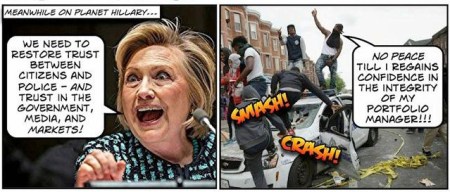
trumpbull


gross252b12b2


markets2b2


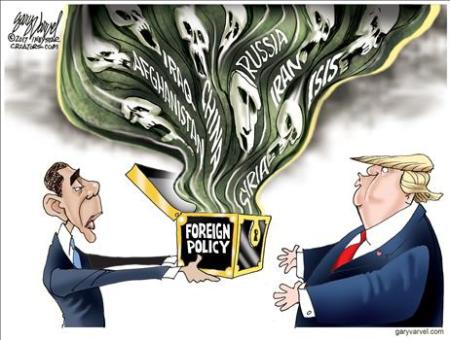
H/t Townhall cartoons

foreignpolicyhandover


It’s all on Azaria’s shoulders

January 4, 2017

It’s all on Azaria’s shoulders, Israel Hayom, Dror Eydar, January 4, 2017

(Please see also, The Azaria trial and the rift over orders to shoot. — DM)

In July 1988, a terrorist attacked Yossi Hadassi, a soldier who had enlisted just three months earlier. Hadassi grappled with the terrorist and managed to kill him. He was awarded a citation of merit from the commander of the Engineering Corps.

Then the media hunt began, backed by the self-righteous Left, which accused the soldier of murder. On May 30, 1989, Yossi Hadassi committed suicide.

That week, the poet Naomi Shemer published a message in Yedioth Ahronoth: “The soldier Yossi Hadassi killed his attacker, and a year later killed himself. It wasn’t only Yossi Hadassi who committed suicide; an entire nation is committing suicide. An entire country is defending itself as its investigators, police, and poets drive it mad and convince it that it is a predatory wolf, Goliath, a monster. The intifada is the prelude and the excuse for the destruction of Israel. We are all Yossi Hadassi.”

Hadassi’s fate touched me. Naomi Shemer’s courage touched me, too. She published her message after a decade in which her work had been viciously attacked because she was “right-wing.”

I was reminded of that piece when the Azaria affair broke. We’ve thrown all the problems in Israeli society, the disagreement rooted in debate between Left and Right and the 100-year-old conflict between us and our neighbors, on to the bowed back of the young soldier. The mechanism of national suicide camouflaged as morality, too.

No, I’m not arguing that Azaria acted rightly. I don’t know how I would have acted in his situation. But even if I don’t think he’s a hero, it’s clear that he’s no murderer, and that what I’ve written. He certainly should not have been put on trial; the matter should have ended with a disciplinary hearing in his unit. And he certainly should not have to carry the weight of Israel’s foreign relations and the IDF’s ethical code and the discussions that have used him as a beast of burden. Sgt. Elor Azaria killed a terrorist. The craziness around his case has to do with the accursed insanity and politicization of the public discourse.

Like Hadassi, Azaria comes from a humble family on which the uncompromising interest and self-righteousness of some of us came crashing down out of the clear blue sky and threatened to crush. No mercy was shown to Hadassi, may he rest in peace, or to Azaria, may he live a long life. But unlike the 1980s, this time there is social media, which was able to help and support him. That’s some comfort. Back then, I couldn’t help Yossi Hadassi, but today I can express my own opinion wholeheartedly: We are all Elor Azaria.

The Azaria trial and the rift over orders to shoot

January 4, 2017

The Azaria trial and the rift over orders to shoot, DEBKAfile, January 4, 2017

(What is the standard for Israeli military tribunals? Proof “beyond a reasonable doubt” or something less? — DM)

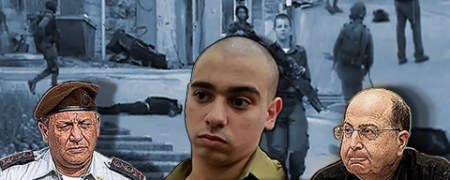
elorverdict480

DEBKAfile’s military analysts note that the controversy reflects long efforts to introduce politics – or a brand of political correctness – into IDF decision-making. Soldiers are under orders to shoot terrorists in the heat of an attack – that is not in question, but since the Azaria affair, the army under Gen. Eisenkott, is working on refinements, such as when it is permissible and when it is not.

*****************************

All three judges of an Israeli military court Wednesday, Jan. 4, unanimously found Sgt. Elor Azaria guilty of manslaughter for the fatal shooting of an injured terrorist in Hebron in March 2016, after an attack on soldiers. The conviction was announced after a three-hour reading of the verdict by the lead judge, Col. Maya Heller. The court threw out the entire case for the defense in favor of the testimony given by the commanders at the scene of the incident and the prosecution. The cause of the terrorist’s death was judged to be the bullet Sgt. Azaria fired to his head, although the court ruled that there was no danger of the terrorist continuing his attack. Nor was the suspicion of the accused that he concealed explosives confirmed after the fact.

According to the verdict, Azaria was motivated purely by revenge for the terrorist’s attempt to stab his friend. Col. Heller rejected arguments that the court was influenced by social, political or military controversy surrounding the case and stressed that it was guided solely by the facts of the case. The convicted soldier’s lawyer said he would appeal the verdict. Sentence is to be announced at a later date.

Outside the court, hundreds of protesters demonstrated against the Hebron soldier’s trial.

Seven months ago, Sgt. Elior Azaria was put on trial before a three-judge panel of the Jaffa Military Court. He was charged with manslaughter for shooting dead in March last year a Palestinian terrorist, who had attacked soldiers with a knife and was already shot and injured.

Release of the videotape which showed the terrorist lying prone on the ground but still alive when Azaria came on the scene went viral and made the case a cause célèbre.

The trial turned on the question of whether the terrorist was immobilized or still posed a threat. The popular controversy on this question led to Moshe Yaalon’s resignation as defense minister, after he argued that Azaria, then 19, was out of line and should stand trial for murder.

He was supported by the incumbent chief of staff, Lt. Gen. Gady Eisenkott.

Azaria’s family mounted a popular campaign to justify his actions, claiming that he acted in the conviction that he was saving lives. His conduct was backed by many uniformed men through the social media, and a number of former generals volunteered to testify in his defense.

DEBKAfile’s military analysts note that the controversy reflects long efforts to introduce politics – or a brand of political correctness – into IDF decision-making. Soldiers are under orders to shoot terrorists in the heat of an attack – that is not in question, but since the Azaria affair, the army under Gen. Eisenkott, is working on refinements, such as when it is permissible and when it is not.

Both Yaalon and Eisenkott went overboard in their attempt to improperly influence the course of the military trial sub judice by public statements disparaging the accused soldier.

Last week, in pursuance of this campaign, the former defense minister appeared before 1,000 18-year olds about to join the army for three years of compulsory service. First, he rehashed the events leading up to Azaria’s action and his own resignation.

On March 24, he said, two terrorists came up to the Gilbert checkpoint at Tel Romeida in Hebron and started stabbing a soldier and officer who were manning it. But then, Yaalon burst out:  “If we don’t preserve our human values, the IDF will be no better than Daesh!” the implication being that Azaria was no better than an Islamist State killer.

This was a move to prejudge the trial and sway the three military judges, just in case they were persuaded that Azaria was not trigger-happy but had shot the prone terrorist in the belief that as a soldier it was his duty to protect the immediate environment from further menace.

The chief of staff had his say on Tuesday, Jan. 3, the day before the court was to hand down its verdict. He declared that he had a duty to “preserve IDF values.”

Our military analysts have searched in vain the IDF military codebook for a definition of “IDF values” among the often contradictory orders of when to open fire. They wonder how a young conscript serving at a checkpoint -and knowing he is the target at any moment for a sudden knifing, shooting, bombing or vehicular attack – can be expected to decide on the spot which “military values” to apply.

In his basic training, he is taught that his duty as a soldier is to fight the enemy and protect civilians. Confusion at the vital moment of an attack could cost precious lives.

However, Yaalon and Eisenkott have made it crystal clear that, regardless of the verdict handed down by a court after a long trial and exhaustive questioning of a flock of witnesses – both for the defense and the prosecution – they are determined to perpetuate the divisive, politically-tainted controversy in the country and its armed forces.

This is the Face of Free Speech in Turkey

January 4, 2017

This is the Face of Free Speech in Turkey, Clarion Project, Meira Svirsky, January 4, 2016

barbaros-sansal-hpBarbaros Sansal after the attack (Photo: Video screenshot)

Renowned Turkish fashion designer Barbaros Sansal, beaten and bloody, is in Turkish custody after being deported from northern Cyprus.

Sansal, an outspoken critic of the ruling Islamist AK party, was forced out of the self-declared state of the Turkish Republic of Northern Cyprus after making a video on New Year’s Eve deemed to be insulting to Turkey.

In the video, which was uploaded before the jihadi attack on an Istanbul nightclub that killed 39 people, Sansal rails against the “scores of journalists in prison,” “corruption and bribes” and the increased Islamization of the country:

While scores of journalists are in prison, while children are sexually harassed, raped, while corruption and brides [sic?] are everywhere, radical Islamist are distributing shit to you in the streets. Are you still celebrating the New Year? I am not … You know what I will do? I will drink all the drinks in this room and bar. I will drink all of them! Will not leave you a single drop. I will take all my dollars to Switzerland. I will not leave a single penny [in Turkey]. OK? On the other hand, I am in Cyprus. The [North] Cyprus is now in the New Year, as they follow Turkey because of pressure. There is still an hour for the Cyprus Republic to enter the New Year. I will go there and I will celebrate there as well. I will drink there, too. I will drink everything. OK, baby? I am not even kissing you. You carry on with your celebration … in this disgrace, misery and dirt. Drown in your shit, Turkey!

On his Facebook page, Ari Murad, a Kurdish human rights activist and filmmaker, reported that “after the video went viral, Sansal was detained by Turkish Cypriot authorities and then extradited to Turkey. While Sansal was being ‘extradited’ to Turkey, Turkish state news agency AA informed readers of the flight airline and hour of departure.”

Other media picked up the gauntlet as well. A tweet by CNN Turk’s presenter Beste Uyanik said Sansal “must be cut down to size” and “taught his limits,” when he arrives in Turkey.

And so he was.

Waiting on the tarmac was a mob (ostensibly made up of Turkish baggage handlers). Brutal video footage of the attack was captured on a smartphone. Sansal can be seen walking down the stairs of the airplane before falling or being kicked or pushed down them, at which point the mob sets upon him until police decide to whisk his bloodied body away into a waiting car.

Commenting on the attack, the mayor of Ankara Melih Gokcek, tweeted, “Turkish Nation reacted against him while he was getting off the plane. Don’t irritate People Barbaros!” The mayor uploaded the video footage of the attack to his Twitter account as well.

Since the failed coup last summer, 41,000 Turkish citizens have been arrested for suspected links to Islamist cleric Fethulah Gulen, Turkish President Recep Erdogan’s rival and on whom he has blamed the uprising. Tens of thousands more have been relieved of their jobs – in academia, security forces, the judicial system and more.

Erdogan and his Islamist party have used the coup as a carte blanche to clamp down on everyone from secularists to human rights activists, Kurds and anyone else thought to be standing in the way of his perceived goal of re-instituting the glory of the Ottoman Empire.

Along the way, freedom of speech be damned.

As one twitter user Ankarali Jan said succinctly, “The treatment of Barbaros Şansal is intended as a warning to anyone in Turkey with a dissenting opinion, anyone who stands out from the herd.”

Another tweeted, “The treatment of Barbaros Sansal should be a wake-up call to all countries if Turkey requests someone’s extradition. They will not be safe.”

Sansal’s lawyer said his client was injured in his back, kidneys and crotch in the mob attack. He was taken directly to a police station where he was interrogated and formally arrested for “inciting hatred and animosity among the public” and for “insulting” the public, both crimes in Turkey since 2005.

The law has been used to prosecute those deemed to be insulting the president (even children as young as 12, 13 and 16 have faced prison time for this crime). One can be sure it will be used in full force against Sansal.

Israel erased in UN schools

January 4, 2017

Israel erased in UN schools

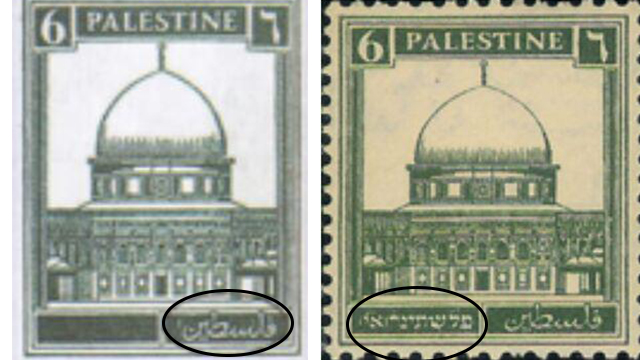
UN-run schools in the West Bank and Gaza use textbooks which negate the existence of Israel; teach Western Wall, Cave of the Patriarchs are exclusively Muslim holy sites which the Jews strive to occupy; stamps from the British Mandate period are doctored to remove the Hebrew.

Elior Levy, Eitan Goldstein

Published: 03.01.17 , 19:03

Source: Ynetnews News – Israel erased in UN schools

An Israeli investigation into school books used by United Nations-run schools in the West Bank were found to consistently delegitimize and demonize the State of Israel.

These textbooks—written by the Palestinian Ministry of Education—are used in schools run by the United Nations Relief and Works Agency (UNRWA) in both Gaza and the West Bank.

However, the most shocking discovery is that the UN schools don’t teach Palestinian children to recognize Israel as a country—not within the 1947 borders, nor any borders at all.

Picture of the countries of the Middle East in one of the textbooks. "Palestine" is superimposed on the whole of Israel

Picture of the countries of the Middle East in one of the textbooks. “Palestine” is superimposed on the whole of Israel

The research was presented by Dr. Arnon Gross who translated the books, and Dr. Ronni Shaked from the Harry Truman Research Institute at the Hebrew University in Jerusalem.

In one of the history books, Zionism is defines as a colonialist movement that was founded by European Jews in order to gather Jews from all over the world and to put them in Palestine along with in other neighboring Arab countries. The textbooks argue that the Zionists do this via methods such as immigration and forcing the Arab population off their land.

No mention is made of the religious or historical connection of Jews to the Land of Israel or to Jerusalem in these textbooks used by UNRWA. The schools also make no mention of Jewish holy sites anywhere in their materials—no Western Wall, no Cave of the Patriarchs, and no Rachel’s Tomb.

Instead, the textbooks teach that these are all Muslim holy sites which the Jews are trying illegitimately to take control of.

Also, children at UNRWA schools are taught that the Arab massacres of Jews in 1929 (specifically in Safed, Hebron, and Jerusalem) was called the “al Buraq revolt,” and was carried out to keep the Jews from conquering and occupying these holy cities.

Over 130 Jews were murdered by their Arab neighbors during these massacres.

British stamp from the Mandate Era. On the right, all three languages included on the original stamp. On the left, the doctored stamp used in Palestinian textbooks, completely erasing the Hebrew

British stamp from the Mandate Era. On the right, all three languages included on the original stamp. On the left, the doctored stamp used in Palestinian textbooks, completely erasing the Hebrew

The textbooks used by the UN to teach Palestinian children even negate the existence of Hebrew. One of the books has a picture of a stamp used during the British Mandate Period upon which is written Hebrew, English, and Arabic. However, the textbooks written by the Palestinians erase the Hebrew, leaving only the English and the Arabic.

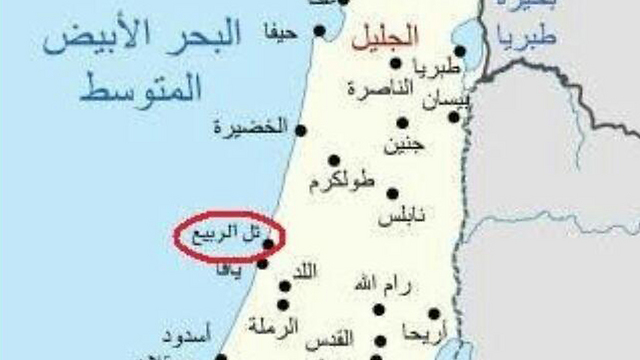
Additionally, there is no reference to the presence of Jews in Israel, with Jewish cities and towns established after 1948 erased from the maps given to Palestinian children. Tel Aviv, originally named after the Hebrew title of Theodor Herzl’s book Altneuland, is re-named “Tel al-Rabia.” The word al-rabia means the season of spring in Arabic.

Tel al-Rabia, circled, appears in place of Tel Aviv on a "Map of Palestine" used in UN schools. No Jewish towns built after 1948 are included

Tel al-Rabia, circled, appears in place of Tel Aviv on a “Map of Palestine” used in UN schools. No Jewish towns built after 1948 are included

Incitement in Palestinian textbooks is well known and documented. Palestinian President Mahmoud Abbas has spoken about the issue several times, and has agreed to be a part of a joint Israeli-US–Palestinian committee to design new textbooks. However, this committee has yet to meet.

The research was conducted by the Center for Near East Policy Research, and was published less than two weeks after the UN Security Council resolution declaring construction and settlements in the West Bank and eastern Jerusalem illegal.

UN schools were previously used as Hamas weapons storehouses during Operation Protective Edge.


The Significance, Ramifications, And Messages Of Hizbullah’s Show Of Military Force In Al-Qusayr, Syria

January 4, 2017

The Significance, Ramifications, And Messages Of Hizbullah’s Show Of Military Force In Al-Qusayr, Syria, MRMRI, Yael Yehoshua*, January 3, 2016

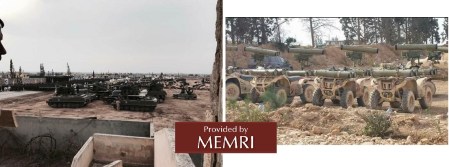
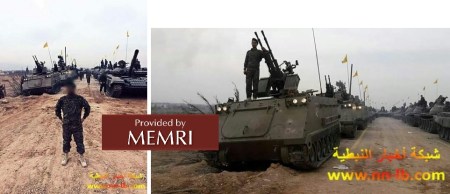
On November 13, 2016, Hizbullah marked its annual Martyr Day by holding its first military parade in a Syrian town, Al-Qusayr, which Hizbullah took over in 2013 following a long and bloody battle with rebel forces, and which has since become the main symbol of the organization’s involvement in the Syria war alongside the Assad regime. The parade featured hundreds of fighters in military uniforms, tanks, U.S.-made M113 armored personnel carriers, cannon, machine guns, and an armored regiment. Also marching was the Al-Radwan division, comprising some 10,000 fighters from Hizbullah’s “intervention forces” and “special forces” fighting in Syria, which constitute the spearhead of the organization in the country.[1]

By holding this parade at this time and at this location, Hizbullah was informing its rivals, locally and in the region – that is, political players in Lebanon, the Syrian rebels and their Arab supporters, and the West and Israel – that it is now a powerful cross-border military force that can control areas outside Lebanon’s borders. The parade did indeed cause a tremendous stir among Hizbullah supporters, as well as among the organization’s opponents.

This paper will review the significance and ramifications of the parade in Al-Qusayr and the messages that it sent.

1295aPhotos from the parade. Arabipress.org, November 13, 2016; Addiyar.com, November 14, 2016
1295bPhotos from the parade. Nn-lb.com, November 13, 2016

Hizbullah Underlines Its Presence On Syrian Soil

Hizbullah’s holding the parade on Syrian soil, particularly in Al-Qusayr, is a symbolic yet highly significant act showing the organization’s control of part of Syrian territory. Al-Qusayr is the jewel in the crown of Hizbullah’s  military involvement in Syria and is seared into the memories of the Syrian rebels as an arena in which they were defeated by Hizbullah in 2013 after a bitter battle that lasted weeks and involved many losses on both sides. Moreover, Al-Qusayr is also Hizbullah’s gateway into Syria. After capturing it from the rebels, Hizbullah emptied it of its residents and turned it into a center for its headquarters and into a staging area for its fighters arriving from Lebanon, from which they leave for other battle fronts in Syria.

Also, holding the parade on Syrian soil as opposed to Lebanese soil is a blatant attempt by Hizbullah to highlight its presence in Syria and signal that this presence has become a known, established and certain fact. It may also reflect Hizbullah’s view of Al-Qusayr and its surroundings as its own military territory, and not as Syrian territory – with no consideration whatsoever for Syria’s sovereignty or for Lebanon’s position on this. [2] Hizbullah deputy secretary general Na’im Qassem hinted at this when he said, several days after the parade: “We are in Syria, and we do not need to give any explanation or justification for this. We stand alongside the Syrian army and the Syrian state.”[3]

Qassem’s statements were backed up by statements by Lebanese Army Gen. (ret.) Amin Hatit, who is close to Hizbullah: “Hizbullah’s presence in Syria is something basic… As far as we are concerned, there is no difference between Al-Qusayr and South [Lebanon].”[4]

By holding it on its Martyr Day, Hizbullah also intended the parade to convey a message to the Shi’ite public in Lebanon, which supports Hizbullah and is the source of its political power and its fighters, that despite its losses Hizbullah has remained strong. For Lebanese Shi’ites, many of whom have been killed and wounded in the past four years of Hizbullah’s fighting in Syria, and particularly in the ongoing battle for Aleppo, the parade was meant to boost morale and signal that the losses had not been in vain but had only further strengthened the organization and made it possible for it to become a regional power.

Hizbullah’s Transition From A Resistance Force To A Quasi-Regular Army

Hizbullah’s demonstration of its military strength by parading hundreds of its soldiers with tanks, cannon, machine guns, and so on also reflected its wish to send the message that it was now a well-trained and well-armed force, with new units, resembling an experienced regular army, and was no longer a resistance militia waging guerilla warfare against Israel.

This upgrade of its military and deterrence capabilities is the result of its military experience in Syria fighting the anti-regime rebels. In this context, Lebanese daily newspapers quoted Na’im Qassem making statements about Hizbullah’s military capability. The Lebanese Al-Mudun daily quoted Qassem as saying: “Hizbullah has added expertise, fighting capability, and military capabilities. This force is becoming more powerful and more developed, into something greater than resistance and less than a regular army.”[5] The Al-Safir daily quoted him as saying: “Now we have a trained army and the resistance is no longer based on methods of guerilla warfare. We are better armed and better trained, and we have advanced professional knowledge.”[6] It should be noted that an official Hizbullah communique denied that Qassem had called Hizbullah an army.[7]

It appears that Hizbullah’s show of strength at this time was because of achievements in the field by both it and its camp, the resistance axis. These achievements included the strengthening of Hizbullah, the Syrian army, and the militias that have been operating alongside the Syrian army since the beginning of Russia’s military involvement in Syria over a year ago along with the upsurge in the political status of Syrian President Bashar Al-Assad in the Arab world and in the West, and the bolstering of Iran’s regional and international status because of its increased military presence in Iraq and Syria and in the wake of the nuclear agreement and the election of the Hizbullah ally Michel Aoun to the Lebanese presidency.


Hizbullah As A Cross-Border Regional Force

Alongside the messages it sent locally, the parade was aimed at letting the region know that Hizbullah is a cross-border military force that is not bound by any particular territory and does not recognize the Syria-Lebanon border, or other borders between Middle East states, set by the Sykes-Picot agreement.

Hizbullah and its sponsor, Iran, which itself is striving to spread its Islamic Revolution and “Rule of the Jurisprudent” doctrine, do not consider geographic borders to be significant, and are deepening their penetration of many countries in the region. This approach is expressed by the military involvement of Iran and its agents in Syria, Iraq, and Yemen, and by Hizbullah’s complete military control of part of Syrian soil, including the Al-Qusayr region.

The military parade sent a message not only to the rebels in Syria, but also to their sponsors in the Arab and Muslim world – Saudi Arabia, Qatar, and Turkey – underlining that the resistance axis in Syria has the upper hand, and that Hizbullah will not hesitate to show its power anywhere it needs to in order to subjugate its opponents. On this matter, Lebanese Army Gen. (ret.) Amin Hatit said: “Had Hizbullah wanted to send a message to Lebanon, it would have held the demonstration there, not in Syria, and what it did in Al-Qusayr is a message to the region.”[8]

In an interview with the Iranian website Tasnim, which is close to Iran’s Islamic Revolutionary Guard Corps (IRGC), Qassem said: “If we want to look [at this] realistically, we see that Hizbullah has become a regional power. The way in which Hizbullah is confronting both the Zionist enemy and the takfiriyyoun [i.e. the Salafi-jihadi organizations]… shows that the organization is a regional power, and the changes in the region are proof of that.”[9]

Also, Nasser Qandil, editor of the pro-Syria Lebanese daily Al-Bina and an Assad associate, wrote in a November 16, 2016 article titled “Hizbullah – The New Middle East Army” that the organization is a cross-border force and that the borders between countries mean nothing to it. He stated that Hizbullah has become the “Middle East Army” because of its military capabilities and because it is a military force that crosses borders, and that it has achieved this by virtue of the popular organizations in the region that assist it, which comprise approximately a million fighters spread across the Middle East. These forces share its wars and its positions, and see Hizbullah secretary-general Hassan Nasrallah as a leader “with special status and as a source of authority for the wars in the Middle East.” He added that in actuality Hizbullah “has torn up Sykes-Picot” by transforming the areas of Syria that border Lebanon’s east and northeast into a “direct and vital continuation of the resistance.”

In this context, Qandil added that as Israel’s military strength and Saudi Arabia’s economic and political strength were waning, and as Al-Qaeda was failing, and as the U.S. was more preoccupied with domestic affairs and Russia was concerned about neutralizing other regional forces such as Turkey, “Hizbullah and the network of its allies is developing, becoming like a soft-[power] state that lives in the bosom of several countries. [Hizbullah] is not a rival [to the states on whose soil it exists], but complements them, living and developing at their consent as a deterrent force and as added strategic value. Thus, this force is becoming the most important fact emerging with the beginning of the 21st century… and no force in existence can threaten the growth of this new army of the Middle East that is deployed from Lebanon to Afghanistan, and from Aleppo to Bab Al-Mandeb.”[10]


Hizbullah As An Independent Force Operating Outside Lebanese Laws And Institutions

The Al-Qusayr military parade has great significance also vis-à-vis Lebanon. Hizbullah’s control in the Al-Qusayr region erases the Lebanon-Syria border and creates a single large, contiguous swath of territory from Syria to the northern Beqa’a, one of its strongholds in Lebanon, without the Lebanese government’s agreement and under harsh criticism from various political elements in that country.[11]

By holding the parade, Hizbullah has again proven, to Lebanon and to the entire world, that it is not subject to Lebanon’s laws and institutions, but that it operates according to its own interests and the interests of Iran and the resistance axis. As far as it is concerned, its presence in Syria depends solely on it, not on any decision by the Lebanese state. On this, Qassem said: “We stand alongside the Syrian army and the Syrian state, and without our intervention in Syria, the terrorists would enter every place in Lebanon. The issue of our involvement in Syria is no longer under discussion by Lebanese circles.”[12]

This message was discordant to Hizbullah’s opponents within Lebanon, who expressed harsh criticism of the Al-Qusayr parade. Ashraf Rifi, justice minister in Lebanon’s interim government, a bitter enemy of Hizbullah, said that this parade sends a message threatening Lebanon’s sovereignty. He tweeted: “Hizbullah has blatantly shown its military strength in occupied Syria… What will ‘the strong president’ [Michel Aoun] say about the armed militia that has become an army that is participating in the occupation of Syria, and dividing and killing its people?” He added that “Lebanon is in danger” and called on all the forces opposing the Iranian sponsorship of Lebanon to act together “to save Lebanon that Hizbullah has exploited with shari’a backing and has turned into a platform in service of Iran’s plans.”[13]

Other criticism came from Ali Al-Husseini, in his column in the Lebanese daily Al-Mustaqbal, associated with the March 14 Forces: “It is odd that this parade was held at the same time as preparations were being carried out by the Lebanese army for [Lebanon’s November 22] Independence Day… The message to Lebanon is that Hizbullah is an independent force that is not subjugate to the laws of the Lebanese state and does not want [Lebanon] to be independent… Hizbullah has established itself as an occupier and has declared Al-Qusayr and other regions [in Syria] to be under its control and its aegis from now on, and declared that negotiation on them in the future will be only with [Hizbullah] and according to its conditions.”[14]


Hizbullah As A Deterrent Force In Lebanon’s Internal Politics

Hizbullah’s parade, which also came several weeks after its ally Michel Aoun was elected Lebanon’s president,[15] and at the height of consultations for the establishment of a new government headed by Sa’ad Al-Hariri, head of the Al-Mustaqbal stream, was also a way of flexing its muscles at various forces in Lebanon’s political arena, particularly at President Aoun and his party which are still considered Hizbullah allies. This show of strength was aimed at reiterating that the organization had military power and that it would not agree to any changes to the political balance of power that were not in its favor, and would also not allow its weapons to be touched.

While Aoun’s election was considered a victory for Hizbullah and for the March 8 Forces that it heads, there is, according to reports in the Lebanese media, great apprehension in Hizbullah and in the March 8 Forces that Aoun will end his sweeping support for the resistance, and will moderate his stance, compromise, and lean more towards the center than he has in the past, and will show neutrality towards both the March 14 Forces and the March 8 Forces.

The cooperation between Aoun (who represents the majority of Christians in the country after forming an alliance with the Christian Lebanese Forces party led by Samir Geagea) and Al-Hariri (who represents the majority of Sunnis) – cooperation which led to Aoun’s election and to the appointment of Al-Hariri to establish the next government – is also of concern to the Shi’ite Hizbullah. Its main fear stems from the possibility of shifts in the political power balance in the country, because Aoun’s alliance with Hizbullah foe Geagea has created a powerful, cohesive Christian group that has shared out the government portfolios among its members, at the expense of the other Christian parties who belong to the March 8 Forces – and Aoun is likely to prioritize this powerful Christian group over his alliance with Hizbullah and his support for the resistance.

These apprehensions also increased following visits by Saudi and Qatari emissaries to Aoun, following which the latter promised that Saudi Arabia will be the first stop on his visits to Arab countries, and in light of his statement, as part of his wish to establish Lebanon as an independent actor, that Lebanon under his leadership would “adopt an independent policy and will not be subjugated to anyone.”[16]


Hizbullah As An Anti-Israel Deterrent Force From Both Lebanese And Syrian Territory

Hizbullah also used the parade to convey a message about its position on a war against Israel. In light of its military involvement in Syria fighting the rebels alongside the Assad regime, Hizbullah was accused by elements in and out of Lebanon of abandoning the path of resistance against Israel, and of having become an accessory to the Iranian plan to eliminate the Sunni presence in Syria. In response, with the parade, Hizbullah sought to clarify that establishing its might in Syria was part of the plan of the resistance that serves its war against Israel and intensifies its anti-Israel deterrence. On this topic, Na’im Qassem said that upgrading Hizbullah’s capabilities and transforming it into a real military force “is sufficient to deter the Israeli enemy.”[17]

That the parade was an attempt by Hizbullah to demonstrate its strength to Israel was also expressed by the fact that the main element marching in it was from the Al Radwan division, revealed here for the first time. According to a Lebanese source,[18] this division was thought up by the late Hizbullah chief of staff ‘Imad Mughniyeh, who was assassinated in 2008, and comprises some 10,000 fighters trained at Hizbullah bases specifically built for this purpose in Al-Qusayr. The division was initially established to invade Israel’s Galilee during the next conflict there, but is right now fighting the rebels in Syria and gaining combat experience, and Hizbullah considers it its spearhead in Syria. Having fighters from this division marching in the parade is a message to Israel that the Al-Radwan division, which it considers a deterring force against Israel, is complete and ready for action against it at a moment’s notice.

‘Abdallah Kamah wrote on the Lebanese website Alhadathnews.net: “At a time when the warriors of the Al-Radwan [division] are fighting and gaining combat experience in Syria, they see the Galilee as their strategic goal. In order to achieve this goal, we must prepare for a war [with Israel], which ‘Imad Mughniyeh had said ‘would be different from those that came before it.’ This difference opens the door to adopt new [combat] methods, because this campaign will not be the same as in the past, when it was conducted according to a scenario where the enemy invades and the resistance ambushes and charges, or fires rockets from groves and using mobile, manually-operated, ground-based launchers. Moreover, the next war, as Hizbullah showed yesterday, will be more offensive than defensive, and will include armored vehicles entering the occupied Upper Galilee.”[19] It should be mentioned in this context that in a February 2011 speech marking the third anniversary of Mughniyeh’s assassination, Hizbullah Secretary-General Hassan Nasrallah threatened Israel, and warned that in the next conflict he would order his men to take over the Galilee.[20]

Moreover, by holding the parade on Syrian soil, Hizbullah challenged Israel’s opposition to the establishment of Hizbullah forces in Syria, specifically in the Golan Heights. Increasing its presence in the Syrian Golan is part of the organization’s plan to expand the arena of conflict with Israel from southern Lebanon to the Golan Heights, and transform them into a single front that transcends political borders. Back in January 2016, Nasrallah stated that Hizbullah will no longer recognize either the rules of combat with Israel or the separation between the South Lebanon and Golan Heights fronts.[21] In May 2016, Ibrahim Al-Amin, head of the board of directors of the Lebanese daily Al-Akhbar, which is close to Hizbullah, stated that the organization had established a resistance infrastructure in the Syrian Golan Heights with the help of local residents.[22]

In an article published a few days after the parade, the political editor of the Lebanese daily Al-Safir implied that that one of the reasons Hizbullah is establishing itself in Syria is to open an additional front against Israel in the Golan Heights: “The weapons displayed by Hizbullah [at the parade] are weapons that [regular] armies have, and this is a clear message to Israel that the arena for every future campaign will absolutely not be limited to certain Lebanese borders and to a local population that either does or does not support [the resistance], but will rather be an arena that is more energetic, deeper, and broader – strategically, geographically, and militarily.”[23]

*Yael Yehoshua is Vice President for Research and Director of MEMRI Israel


[1] For more on the military parade, see MEMRI Special Dispatch No. 6677, Special Dispatch No. 6677, Hizbullah Military Parade In Syrian Town Of Al-Qusayr: Tanks, Cannon, And Machine Guns, November 14, 2016. It should be noted that the Lebanese army denied claims that the M113 APCs and other military equipment in the parade belonged to it. Al-Nahar (Lebanon), November 15, 2016.

[2] Al-Mudun (Lebanon), November 16, 2016.

[3] Al-Safir (Lebanon), November 16, 2016.

[4] Al-Nahar (Lebanon), November 14, 2016.

[5] Al-Mudun (Lebanon), November 16, 2016.

[6] Al-Safir (Lebanon), November 16, 2016.

[7] Alahednews.com, November 16, 2016.

[8] Al-Nahar (Lebanon), November 14, 2016.

[9] Tasnim (Iran), November 22, 2016.

[10] Al-Bina (Lebanon), November 16, 2016.

[11] For more on Lebanese criticism of Hizbullah’s involvement in the fighting in Syria, see MEMRI Inquiry & Analysis No. 980, Lebanon Openly Enters Fighting In Syria, June 13, 2013; Special Dispatch No. 6383, Lebanese Writer: Hizbullah Is No Longer A Resistance Organization, But An Occupier And Target For Resistance, April 12, 2016; Inquiry & Analysis No. 1147, Lebanese Elements Furious Over Hizbullah’s Activity In Golan, Shebaa Farms, Critical Of Nasrallah’s Statements About Uniting Lebanese, Syrian Resistance Fronts, March 11, 2016.

[12] Al-Safir (Lebanon), November 16, 2016.

[13] Twitter.com/Ashraf_Rifi, November 14, 2016.

[14] Al-Mustaqbal (Lebanon), November 15, 2016.

[15] See MEMRI Inquiry & Analysis No. 1276, Al-Hariri’s Choice Of Hizbullah Ally Aoun For Lebanese Presidency Is Another March 14 Forces Concession To Pro-Iran Axis, October 28, 2016.

[16] Al-Safir (Lebanon), November 12, 2016; Al-Akhbar (Lebanon), November 26, 2016.

[17] Al-Mudun (Lebanon), November 16, 2016.

[18] For example, Alhadathnews.net, November 15, 2016.

[19] Alhadathnews.net, November 15, 2016.

[20] Al-Akhbar (Lebanon), February 17, 2011. See MEMRI Special Dispatch No. 6051, The Emergence Of ‘Galilee Force’ – Palestinian Forces Fighting Alongside Syrian Regime, May 20, 2015.

[21] For Lebanese criticism of Nasrallah’s statement, see MEMRI Special Dispatch No. 5994, Lebanese Elements Furious Over Hizbullah’s Activity In Golan, Shebaa Farms; Slam Nasrallah’s Statements About Uniting Lebanese, Syrian Resistance Fronts, March 10, 2015; For more on Hizbullah and Iranian IRGC activity in the Syrian Golan on the Israeli border, see MEMRI Inquiry & Analysis No. 1138, Following Killing Of Hizbullah Operative Jihad Mughniyah, New Information Comes To Light Regarding Hizbullah, Iranian Activity In Syrian Golan On Israeli Border, January 28, 2015; MEMRI Daily Brief No. 1146, From The Mediterranean to the Golan, Iran Builds Active Front And Direct Military Presence On Israel’s Border To Deter Israel And Further Ideology Of Eliminating The Zionist Regime, February 16, 2015.

[22] For more on Hizbullah’s activity in the Golan, see MEMRI Special Dispatch No. 6039, Board Chairman Of Pro-Hizbullah Lebanese Daily: Hizbullah Has Established Resistance Infrastructure In Syrian Golan In Cooperation With Locals, April 30, 2015.

[23] Al-Safir (Lebanon), November 16, 2016.