Archive for December 26, 2016

Obama insists Trump win no indicator Democrats’ vision for U.S. is ‘a fantasy’

December 26, 2016

Obama insists Trump win no indicator Democrats’ vision for U.S. is ‘a fantasy’, Washinton Times, Douglas Ernst, December 26, 2016

hopenchangePresident Barack Obama, joined by first lady Michelle Obama, speaks during an event to thank service members and their families at Marine Corps Base Hawaii, in Kaneohe Bay, Hawaii, Sunday, Dec. 25, 2016. (AP Photo/Carolyn Kaster)

President Obama is “confident” that he would have defeated Republican Donald Trump in a head-to-head match-up in the 2016 U.S. presidential election.

Mr. Obama recently joined his former chief strategist, David Axelrod, for a wide-ranging interview on CNN’s “The Axe Files.” The president talked about his childhood, Hillary Clinton’s doomed presidential campaign, and his plans for the future after leaving the White House.

“I am confident in this vision because I’m confident that if I had run again and articulated it, I think I could’ve mobilized a majority of the American people to rally behind it,” Mr. Obama said, CNN reported Monday. “I know that in conversations that I’ve had with people around the country, even some people who disagreed with me, they would say the vision, the direction that you point towards is the right one.”

The president then stressed that President-elect Trump’s ability to secure 306 Electoral College votes compared to Mrs. Clinton’s 232 is not an indicator that “hope and change” was a political illusion.

“In the wake of the election and Trump winning, a lot of people have suggested that somehow, it really was a fantasy,” the president said. “What I would argue is, is that the culture actually did shift, that the majority does buy into the notion of a one America that is tolerant and diverse and open and full of energy and dynamism.”

Mr. Obama said that although “it feels like the band is breaking up a little bit,” he would turn an objective eye on his performance once Mr. Trump becomes the 45th U.S. commander in chief.

“I have to be quiet for a while. And I don’t mean politically, I mean internally. I have to still myself,” Mr. Obama said, CNN reported. “You have to get back in tune with your center and process what’s happened before you make a bunch of good decisions.”

Bye Bye, Obama

December 26, 2016

Bye Bye, Obama, PJ Media, Michael Ledeen, December 25, 2016

(Please see also, Is real change coming to Iran? Get ready for March 15, 2017. — DM)

maddog

What would President Trump do if Khamenei passed from the scene, and millions of Iranians took to the streets again?  The president-elect has said he’s not a great enthusiast of regime change, but it’s hard to imagine he’d abandon the Iranians as Obama did seven years ago.  He ought to be thinking it through.

Yes, I know good news is hard to swallow, but we are living in a revolutionary moment, of which the Trump election is a dramatic symptom.  The crisis of the Islamic Republic would be a fitting end to the Obama era. He dreamt of a glorious strategic alliance with Iran, and a definitive lethal blow against Israel. How fitting with the Divine sense of humor to have the Palestinians and Iranians to wreck their own enterprises.

***********************

As I promised, as the days of Obama draw down, the jihadis are stepping up the terror tempo.  They know that there will be no reprisals from the Oahu links, and they fear Trump’s lineup of tough guys in the cabinet, so they’re in a hurry to kill infidels while the killing’s good. Therefore we, along with the other Western nations, are at maximum risk right now, until roundabouts January 20th.

And the killing’s plenty good, isn’t it?  Berlin,  Zurich, Ankara, Moscow, with a very nasty plot uncovered in Melbourne, and yet another involving terrorists in Detroit, Maryland, and Virginia.  Not to mention the ongoing slaughter in Syria, and, on Christmas day, Cameroon.

What does the “western world” do in response?  Declare the Western Wall “occupied territory.” This is no accident, since the jihadis believe that they have unleashed holy war against infidels.  That war will not end, in their view, until we infidels have been crushed and subjected to the will of a caliph.  They’ve got plenty of support from the Russians, without whom thousands of Iranians and Iranian proxies would have been killed in Syria and Iraq, and the Assad regime would have been destroyed.

That would have been a better world, but Obama did not want that world.  Nor did the feckless Europeans, who act as if profits on Iran trade compensate for the open subversion of public order.  Indeed, as Christmas arrived we were treated to the spectacle of the bishop of Rome—aka Pope Francis–blaming material misery for the jihadist assault on the West. Thus the first Jesuit pontiff surrenders the moral high ground to his mortal enemies.

Maybe Obama should convert and run for pope.

Paradoxically, the jihadis and their secular allies are launching their new assault just as they are suffering systematic setbacks on the battlefield, their own internal conflicts are intensifying, and there are signs of a religious and patriotic revival within the boundaries of their archenemy, the United States. Walter Russell Mead neatly catches the irony that, just as Obama handed the Palestinians a resounding political victory, a sober look at the situation suggests that the Palestinians have not been this weak, this divided, or this helpless in many decades.

In like manner, the Iranian regime, flush with its success in Aleppo, is increasingly riven.  Supreme Leader Ali Khamenei has had two medical events in the past 10 days, and the scrambling for the succession has resumed.  You may have noticed that General Qasem Soleimani has returned to the front pages, which invariably happens when the leader is ill; the Revolutionary Guards want him as the strongman of the next regime (he can’t be supreme leader for lack of theological standing, but he could still be a dominant figure). And it isn’t all peaches and cream for Soleimani, as recent demonstrations in Tehran against the rape of Aleppo make clear. Iranian apologists love to tell us that Persian nationalism  overwhelms internal tribal and sectarian divisions, but Iran has lost thousands in Syria, and the Persian nationalists don’t like their husbands and sons dying to save Bashar Assad.

What would President Trump do if Khamenei passed from the scene, and millions of Iranians took to the streets again?  The president-elect has said he’s not a great enthusiast of regime change, but it’s hard to imagine he’d abandon the Iranians as Obama did seven years ago.  He ought to be thinking it through.

Yes, I know good news is hard to swallow, but we are living in a revolutionary moment, of which the Trump election is a dramatic symptom.  The crisis of the Islamic Republic would be a fitting end to the Obama era. He dreamt of a glorious strategic alliance with Iran, and a definitive lethal blow against Israel. How fitting with the Divine sense of humor to have the Palestinians and Iranians to wreck their own enterprises.

You never know. Life is full of surprises.

At the AP, Opinion Masquerades as Reporting

December 26, 2016

At the AP, Opinion Masquerades as Reporting, Power LineJohn Hinderaker, December 26, 2016

Yesterday the Associated Press published an article by its Jerusalem bureau chief, Josef Federman, on Benjamin Netanyahu’s reaction to President Obama’s betrayal of Israel in the U.N. The article is an opinion piece–a virulent one, in fact. It is suitable for publication in, say, the New York Times, as an anti-Israel op-ed. The piece is headlined Israel: humbled Netanyahu places hopes in Trump. It begins:

The Israeli government’s furious reaction to the U.N. Security Council’s adoption of a resolution opposing Jewish settlements in occupied territory underscores its fundamental and bitter dispute with the international community about the future of the West Bank and east Jerusalem.

Prime Minister Benjamin Netanyahu insists that there is nothing wrong with his controversial policy of building Jewish towns in occupied areas that the Palestinians, with overwhelming world support, claim for their state. But Friday’s U.N. rebuke was a stark reminder that the rest of the world considers it a crime. The embattled leader is now placing his hopes in the incoming administration of Donald Trump, which is shaping up as the first major player to embrace Israel’s nationalist right and its West Bank settlements.

Those are perhaps defensible statements of opinion, although I would argue that they are mostly incorrect. The overall thrust of the opening paragraphs–that the entire world other than Netanyahu’s administration and “Israel’s nationalist right” considers it a “crime” for Jews to live in their Biblical home of Judea Samaria, and that Donald Trump is the first “major player” to disagree, is blatantly false.

There is much more, for example:

In a series of statements, Netanyahu has criticized the Obama Administration for letting Resolution 2334 pass Friday by abstaining, using unprecedented language that has turned a policy disagreement into a personal vendetta.

Netanyahu’s language was unprecedented? What, did he call Obama a “chickens*t”? And was not Obama’s betrayal, coordinated with the Arabs and timed to avoid accountability to Congress or the voters, the culmination of a vendetta that included interference in Israel’s election to try to defeat the Prime Minister? That wasn’t a vendetta because, I suppose, Federman welcomed it.

Federman has opinions about Trump, too:

The recent diplomatic defeat would be much more damaging if not for a potential remaining and rather major ace in Netanyahu’s hand: the incoming Trump Administration.

In a striking departure from past policy of incumbent [Ed.: sic] presidents waiting on the sidelines, Trump tried to scuttle the resolution and called for a U.S. veto. After the vote, Trump vowed that “things will be different after Jan. 20th.”

So it’s Netanyahu and Trump who have disrupted the natural order of things by smashing precedents. How about this, Mr. Federman: what’s the precedent for a lame-duck president executing a major change in American foreign policy, against the wishes of Congress and the American people, less than 30 days before leaving office, in the face of no crisis or emergency, or even a change in circumstances?

Critically, he has appointed an outspoken supporter and donor to the settlements, his longtime attorney David Friedman, as ambassador to Israel. And aides say Trump is serious about a promise to move the U.S. Embassy from Tel Aviv to Jerusalem, which even many Israelis fear could spark violence. The Palestinians claim east Jerusalem, home to sensitive religious sites, as the capital of the future state to which they aspire.

Sensitive religious sites like Temple Mount, the Mount of Olives and the Jewish Quarter of the Old City. Moving the U.S. embassy to Israel’s capital has been part of the Republican Party’s platform for a long time. The suggestion that having the U.S. embassy on Jerusalem, along with the Knesset, Israel’s Supreme Court and other organs of Israel’s government “could spark violence” is sheer editorializing.

Mr. Federman’s article is a typical expression of the international Left’s pro-Palestinian view of the situation in Judea and Samaria. It is, as I said, an op-ed that could easily appear in a liberal organ like the New York Times. But there is not a shred of news anywhere in it. It is merely a recitation of Federman’s opinions, with the opinions of Netanyahu, Trump and their allies erected as straw men to be struck down by others.

This conclusion was so obvious that I thought the AP must have designated the Federman article an opinion piece. But no: it went out on the wire as a straight news story. In fact, as I understand the AP’s position, it doesn’t publish opinion pieces. In fact, it cautions its reporters against expressing opinions at all:

EXPRESSIONS OF OPINION:

Anyone who works for the AP must be mindful that opinions they express may damage the AP’s reputation as an unbiased source of news. They must refrain from declaring their views on contentious public issues in any public forum, whether in Web logs, chat rooms, letters to the editor, petitions, bumper stickers or lapel buttons, and must not take part in demonstrations in support of causes or movements.

How about expressions of opinion in AP news stories? That, apparently, is fine, as long as the opinions are on the left.

Fatah: UN vote means Fatah will kill Israelis

December 26, 2016

Fatah: UN vote means Fatah will kill Israelis, Palestinian Media Watch, Itamar Marcus, December 25, 2016

Before the UN vote:

thanks-un

Three days ago Fatah’s official Facebook page posted a drawing of its map of “Palestine,” which includes all of Israel and painted like the Palestinian flag, being used to stab the word “settlement.” The text above the image: “#Palestine will defeat the settlement ” (Above)

After the UN vote:

thanks-un-blood

Yesterday in response to the UN Security Council resolution declaring Israeli settlements illegal, Fatah republished the identical image but added a pool of blood at the bottom, and the words “Thank You” above the image, and the names of the 14 countries that voted in favor of the UN resolution. (Above)

Is Fatah thanking the 14 countries for their UN vote because they interpret the UN as granting Fatah permission to kill Israelis? Or is Fatah thanking them because now that the UN declared settlements “illegal” it sees itself free to kill more Israelis?

Either way Fatah is saying more Israelis will pay with their lives as a result of the UN vote.

The 14 countries thanked by Fatah are:

Russia, Angola, Ukraine, Japan, Spain, Egypt, Malaysia, Venezuela, New Zealand, Senegal, Uruguay, France, China, and Britain.

The United States, whose abstention actually enabled the resolution to pass, is not mentioned.

Fearing UN vote on principles of Palestinian statehood, PM ‘reaching out to Trump’

December 26, 2016

Fearing UN vote on principles of Palestinian statehood, PM ‘reaching out to Trump’, Times of Israel, December 25, 2016

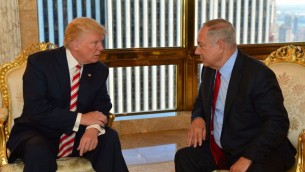
bibiandobamamouth(AFP/Pool/Atef Safadi)

TV reports: Netanyahu is wary that Kerry will set out parameters for permanent accord, then outgoing Obama administration will seek Security Council approval.

Amid escalating fallout from the UN Security Council vote Friday that condemned Israel’s settlement activities, a furious Prime Minister Benjamin Netanyahu was reported on Sunday night to be attempting to “recruit” the incoming Trump administration and the US Congress to block a feared bid by the outgoing Obama administration to have the Security Council approve principles for a Palestinian state.

“They are spitting at us,” Netanyahu has told colleagues behind closed doors, Channel 2 news reported. “We will respond forcefully.”

Netanyahu held a 40-minute meeting with US Ambassador Dan Shapiro on Sunday evening, having summoned the envoy to explain why the US abstained in the vote on Resolution 2334, enabling it to pass 14-0, rather than vetoing it. He had earlier summoned the envoys of the 12 nations with representatives in Israel that voted for the resolution for a dressing-down at the Foreign Ministry.

Underlining Israel’s determination to press ahead with building beyond the pre-1967 lines, the Jerusalem municipality will this week approve some new homes in Ramat Shlomo and Ramot, neighborhoods captured in 1967 and subsequently annexed by Israel as part of Jerusalem, Channel 2 news reported.

Netanyahu is now reaching out to the incoming Trump administration, which takes office on January 20, and to friends in Congress, in the hope of “deterring” what he sees as further potential Obama administration-led diplomatic action against Israel, the Channel 2 report said. His aim is for the Trump team to make plain that his administration will “economically hurt” those countries that voted against Israel in the UN and that do so in the future.

bibiandfriendSeptember 25, 2016. (Kobi Gideon/GPO)

Netanyahu’s fear is that Secretary of State John Kerry will set out principles or parameters for a Palestinian state in a speech that he has said he will deliver in the next few days on his Middle East vision. The prime minister fears that, in its final days, the Obama administration will seek to have a resolution enshrining those parameters adopted by the UN Security Council, the report said.

France is to hold a conference on the Israeli-Palestinian conflict on January 15, and Netanyahu expects that Kerry will attend, that the Middle East Quartet — the US, UN, Russia and EU — will coordinate their positions at that summit, and that they will then turn to the Security Council in the very last days of the Obama presidency, a Channel 10 report further suggested.

Such speculation was not confirmed by the Prime Minister’s Office, but Netanyahu has made public his outrage at the Obama administration several times since Resolution 2334 was passed, claiming that the president initiated and helped draft the resolution “behind Israel’s back.” He has variously called the resolution skewed, shameful and ridiculous — in part because it brands Jerusalem’s Old City, including the Temple Mount and Western Wall, “occupied Palestinian territory.”

Lighting festive Hanukkah candles at the Western Wall on Sunday night, Netanyahu stressed that Israel “cannot accept” the UN resolution, and asked: “How could they vote that [the Western Wall] is occupied territory? We were here much earlier.”

In an address on Saturday night, Netanyahu had likened President Barack Obama to the former president Jimmy Carter, who he said was “deeply hostile” to Israel. He described the vote in the Security Council as “the swan song of the old world that is anti-Israel.” Now, he said, “we are entering a new era. And as President-elect Trump said, it’s going to happen a lot faster than people think.” In this new era, it will be a lot more costly for those who seek to harm Israel, he warned.

The prime minister was also widely reported Sunday to have either canceled or opted not to schedule a meeting with Britain’s Prime Minister Theresa May at the World Economic Forum annual meeting in Davos next month; his spokesman said no such meeting had ever been arranged. He was also said to have chosen not to schedule a meeting with China’s President Xi Jinping. He has already recalled Israel’s ambassadors from Senegal and New Zealand, two of the four countries that co-sponsored the resolution. (Israel has no ties with the other two sponsors, Malaysia and Venezuela.)

Netanyahu also reportedly told his cabinet ministers at a meeting on Sunday morning to reduce to a minimum their engagement with all the countries that voted for the resolution and with which Israel has ties — China, Russia, France, the UK, Spain, Egypt, Angola, Ukraine, Uruguay, Japan, New Zealand and Senegal. They were told to minimize any visits to those countries, and that he would not receive visits from their foreign ministers.

On Saturday, Netanyahu canceled this week’s scheduled visit to Israel of Ukraine’s prime minister.

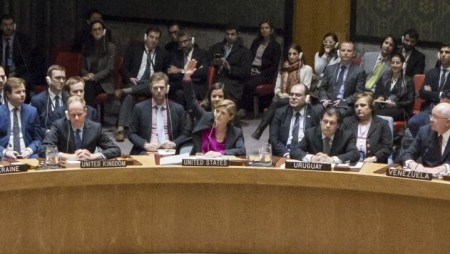
unseccounSamantha Power, center, the United States Ambassador to the United Nations, votes to abstain during a U.N. Security Council vote on condemning Israel’s settlements in the West Bank and east Jerusalem, Friday, Dec. 23, 2016 at United Nations Headquarters. (Manuel Elias/The United Nations via AP)

Addressing the weekly cabinet meeting in Jerusalem Sunday, Netanyahu reiterated his staunch opposition to Resolution 2334.

“We have no doubt that the Obama administration initiated it, stood behind it, coordinated its versions and insisted upon its passage,” he said.

Danish government pays welfare to Islamic State jihadis, expects them to return payments

December 26, 2016

Danish government pays welfare to Islamic State jihadis, expects them to return payments, Jihad Watch

The Danish government shouldn’t include these returned payments in its budget. In Islamic law, non-Muslims have the duty to provide for the upkeep of Muslims. British jihadist Anjem Choudary said in February 2013:

“We are on Jihad Seekers Allowance, We take the Jizya (protection money paid to Muslims by non-Muslims) which is ours anyway. The normal situation is to take money from the Kafir (non-Muslim), isn’t it? So this is normal situation. They give us the money. You work, give us the money. Allah Akbar, we take the money. Hopefully there is no one from the DSS (Department of Social Security) listening. Ah, but you see people will say you are not working. But the normal situation is for you to take money from the Kuffar (non-Muslim) So we take Jihad Seeker’s Allowance.”

This is, of course, based on the Qur’an: “Fight those who believe not in Allah nor the Last Day, nor hold that forbidden which hath been forbidden by Allah and His Messenger, nor acknowledge the religion of Truth, (even if they are) of the People of the Book, until they pay the Jizya with willing submission, and feel themselves subdued” (Qur’an 9:29).

islamic-state12

“Danish gov’t pays Daesh terrorists welfare assistance, report reveals,” Daily Sabah, December 25, 2016:

Denmark has been paying welfare assistance to dozens of citizens, who travelled to Syria to join Daesh terrorists, and expects them to return the payments, according to a report by the daily Ekstra Bladet.

Around 36 terrorists who officially left Denmark to fight with Daesh have received a total of 672,000 kroner ($94,515) from Danish welfare services, Ekstra Bladet reported based on information obtained from the Danish Employment Ministry.

34 of the terrorists reportedly received social benefits from municipal authorities, while two others received payments from heavily state-subsidized funds.

Seven of the terrorists have allegedly been killed while fighting with Daesh.

Welfare authorities are reportedly requesting 29 terrorists to return the improperly distributed welfare payments, but it is unclear how the procedure will work….

In 2014, 28 Daesh terrorists reportedly received welfare benefits from Denmark, reports said.Over 135 Danish citizens have joined Daesh terrorists according to estimates.

How Iran actually lost in Aleppo

December 26, 2016

How Iran actually lost in Aleppo, American ThinkerHeshmat Alavi, December 26, 2016

For 16 years America has failed to adopt a correct policy in the Middle East despite having huge opportunities to make significant changes. The 2003 war literally gift-wrapped Iraq to Iran, parallel to the highly flawed mentality of preferring Shiite fundamentalism to Sunni fundamentalism. This allowed Iran take full advantage of such failures and resulting voids.

Aleppo will be a short-lived success story for Iran. The tides are changing across the globe and Iran will no longer enjoy opportunities from West rapprochement. Understanding this very well, this is exactly why Tehran has resorted to such atrocities and sought to massacre all in Aleppo.

In contrast to how the U.S. handed Iraq in  a silver plate to Iran, Russia never entered the Syria mayhem to hand it over to Iran. The roots of Aleppo remain in the hearts of all Syrians. As world powers, especially the U.S. and Russia review their future objectives, Iran will be the first and ultimate party to suffer.

***********************************

Following a historic period of perseverance, Syrian rebels and their families were forced to evacuate eastern Aleppo after its liberation back in 2012. An unjust, intense war was launched upon Aleppo by Iran’s Revolutionary Guards (IRGC) and its proxy forces on the ground: Russia with its indiscriminate air strikes, and a lame-duck Syrian army of less than 20,000 deployable forces.

After more than 15 months continuous air raids and a long-lasting inhumane siege, Syrian rebels and civilians sealed an international agreement to depart Syria’s once economic and cultural hub.

In the past few weeks widespread bombing campaigns continued relentlessly on civilian areas. No Aleppo hospital was spared. The IRGC and its foot-soldiers, numbering at the tens of thousands, spearheaded the military of Syrian dictator Bashar Assad in horrific mass executions of innocent people. The United Nations reported 82 individuals, including women and children, were murdered on the spot in the streets and in their homes. God knows how many more incidents have gone unreported.

The amazing perseverance shown by Aleppo locals for years now in the face of atrocious airstrikes and artillery shelling is unprecedented to say the least. Amidst all this, the silence and inaction seen from the West, especially the United States, will remain forever a source of shame.

Conflict of Interests

In the pro-Assad camp there are three decision-makers. First Russia, second Iran, and third the Syrian regime. The role played by Assad and his military in such scenes is next to nothing.

The West and Turkey became frantic for a ceasefire in Aleppo in the early days of the war due to the negative public opinion resulting from shocking crimes. They sought to have the rebels and remaining civilians transferred to other Syrian opposition controlled areas.

On December 13th, Washington and Moscow reached what can be described a ceasefire agreement. Intense negotiations between Turkey and Russia were started afterwards, resulting in an agreement between the Syrian opposition with Russia and Turkey to evacuate Aleppo. Practically, the parties involved in the talks were Aleppo representatives and Russia, hosted by Turkey. All necessary preparations were made to begin evacuating the city from the morning of Wednesday, December 14th.

However, Iran disrupted this agreement and the IRGC hindered the evacuation process. It was crystal clear Russia and Iran were pursuing different objectives and sets of interests. Iran sought not to have Aleppo evacuated but to exterminate all Syrian rebels and civilians.

Twenty-four hours later, pressure from the international community forced the implementation of the Russia-Syrian rebel agreement on December 15th. On the morning of that day the first convoy carrying the wounded exited Aleppo, only to face roadblocks imposed by Iran-backed forces and the Assad military.

Iran raised certain conditions for the evacuation. Russia later threatened to airstrike any party hindering the evacuation, an obvious warning to Iran. Tehran was forced to wind back under Moscow pressure.

As a result, the last phase of this war and the method chosen to evacuate Aleppo was a defeat for Iran and a victory for the Syrian opposition. Especially since the conflict of interest between Iran/Assad and Russia became crystal clear. Politically speaking, Iran has become a secondary party in Syria.

“For Putin, a political settlement now makes sense. Staying involved in an ongoing insurgency does not. But for that, he needs the opposition — which is fractured — to accept a political outcome, and there is little prospect of that so long as Assad remains in power,” as explained by Dennis Ross, who served as the Director of Policy Planning in the State Department under President George H. W. Bush, the special Middle East coordinator under President Bill Clinton, and was a special adviser for the Persian Gulf and Southwest Asia (which includes Iran) to the former Secretary of State Hillary Clinton.

Is this the end?

The turn of events does not spell the end of the Syrian opposition. The opposition controls large swathes of Syria, with areas over ten times larger than Aleppo and millions of residents. Idlib Province has at a three million strong population; the western coast of the Euphrates in the Turkish border, recently liberated by the Free Syrian Army from Daesh (ISIS/ISIL); large portions of Deraa Province neighboring Jordan; a strategically important section in the north in Latakia Province on the Turkish border; large portions of areas in the Damascus vicinity and large portions in the Aleppo vicinity.

In contrast to Western mainstream media reporting, the Syrian opposition enjoys the capability to rise once again.

Despite all its differences, a comparison made to the Iran-Iraq War may help. In 1986, Iran made significant advances taking control over the Faw peninsula in southern Iraq. Western media and think-tanks all forecasted further advances by Iran and a defeat for Iraq. In 1988 Iran was forced into a U.N.-brokered ceasefire agreement.

Deep divisions between the Syrian nation and the Assad regime have reached the point of no return. Nearly 500,000 have been killed and more than half of the Syrian population displaced. The Syrian nation will never accept the continuation of this regime. Despite sporadic military advances, Assad has no place in Syria’s future.

Where Iran stands in Syria

Iran will not be the final victor in Syria.

First — For Iran, it is vital to maintain Assad in power. His fall will mark the end of Iran’s crusades in Syria. Even if the Syrian opposition becomes weaker, the overall crisis will continue while Assad remains in power. Assad is no longer acceptable in the international stage with an international consensus over his resort to war crimes and crimes against humanity.

Second — While Iran is financing and providing the ground forces, in this war, it no longer enjoys the first and final word. Russia calls the shots now with stark differences in interest, as seen in Aleppo.

Trump’s America

U.S. President Barack Obama’s weak foreign policy, especially the failed engagement with Iran, prolonged the Syrian crisis, allowed Tehran to take advantage, Russia to take the helm and America be sidelined.

Where will developments lead with Donald Trump in the White House? What will be the new U.S. foreign policy vis-à-vis Syria, Iran and the Middle East? How can we define Washington’s relationship with Moscow, and what practical measures will Trump take against Daesh (ISIS/ISIL)? Time will tell.

Good relations between the U.S. and Russia will at least not have a negative impact on the region, and this is good news for the Syrian opposition. Russia has weighable interests in Syria. However, what will Trump do with Iran? Considering Trump’s harsh tone on Iran to this day, far more positive outcomes can be forecasted for the Syrian opposition.

Second, Trump and secretary of state nominee Rex Tillerson have the potential of eventually convincing Russia to provide concessions. This is not in Iran’s interests, as Tehran remembers Russia ditching Libyan the dictator Muammar Qaddafi.

Lesson learned in Syria

For 16 years America has failed to adopt a correct policy in the Middle East despite having huge opportunities to make significant changes. The 2003 war literally gift-wrapped Iraq to Iran, parallel to the highly flawed mentality of preferring Shiite fundamentalism to Sunni fundamentalism. This allowed Iran take full advantage of such failures and resulting voids.

Aleppo will be a short-lived success story for Iran. The tides are changing across the globe and Iran will no longer enjoy opportunities from West rapprochement. Understanding this very well, this is exactly why Tehran has resorted to such atrocities and sought to massacre all in Aleppo.

In contrast to how the U.S. handed Iraq in a silver plate to Iran, Russia never entered the Syria mayhem to hand it over to Iran. The roots of Aleppo remain in the hearts of all Syrians. As world powers, especially the U.S. and Russia review their future objectives, Iran will be the first and ultimate party to suffer.


Is real change coming to Iran? Get ready for March 15, 2017

December 26, 2016

Is real change coming to Iran? Get ready for March 15, 2017, Israel National News, Dr. Mordechai Kedar, December 25, 2016

I do not recommend holding one’s breath in anticipation of the success of Iranian Zoroastrians, because it is not entirely clear that they are seriously planning action against the hated government – and even if they do go out to the streets, it is not at all sure they will succeed in getting the Ayatollahs to board those waiting planes out of the country. Success depends on a great many factors whose actions on that fateful day are hard to predict..

Still, taking into account the determination of the organizers, I have a reasonable basis for expecting them to carry out their plans in and around the middle of March. I send them my wishes for success from this podium. Israel will be only too pleased to return to the days of its good relations with Iran – the days before the Islamist revolution destroyed the Shah’s regime towards the end of 1978.

*********************************

The social makeup of Iran’s population is very complex, because there is actually no such thing as an Iranian people. There are, instead, Iranian citizens divided into many ethnic groups: Persians make up about 60% of the population, while the rest are Azars, Kurds, Blouchis, Arabs, Turkmen and tens of smaller ethnic groups.

The main religion in Iran is Shia Islam, adhered to by 90% of the country’s people, while Sunnis – mainly Kurds and Blouchis – make up about 10%. The country recognizes Judaism, Christianity and Zoroastrianism and reserves a parliamentary seat for each religion.

Zoroastrianism is based on the belief in two gods, a good one and an evil one.The world is the arena in which they battle one another. Daytime is when the good god wins and nighttime is the time the evil god has the upper hand. Good occurrences are arranged by the good god, bad ones are the fruit of the evil god’s labors.

Zoroastrianism was the official religion of the Sassanid Persian Empire, vanquished and destroyed in the 7th century Islamic-Arab conquest. The Arabs forced most of the Zoroastrian believers to accept Islam, and punished whoever stayed loyal to his original religion by death. Despite that persecution, or because of it, many of today’s Iranians are Zoroastrians who pretend to be Muslims. No one has any idea who is a secret Zoroastrian and who is an authentic Muslim, because everyone identifies himself as Muslim, knows how to pray and is familiar with the laws and customs of Islam.

During my academic career, I met many Iranian expatriates. Some of them told me that the number of people in Iran who are loyal to the Zoroastrian religion is in the millions and in fact numbers many millions, but that all of them succeed in passing as Muslims and even in having a significant presence in the Ayatollah regime. Many of them serve in the Iranian Army and in the Iranian Revolutionary Guards, a good number of them having reached the upper echelons of the Revolutionary Guards.

Every once in a while they burst out to demonstrate, the last time being in 2009 after the Iranian presidential elections were faked, allowing power to be snatched by Mahmoud Ahmadinejad. The country was filled with demonstrators, which could have ended with the Ayatollahs fleeing in planes that stood fueled, ready and waiting in the Tehran airport – had the protests continued. The brutal suppression of the demonstrations brought about their end – till next time.

President Obama did not support the protestors at that time, probably because of the empathy he had – and still has – for the Ayatollah regime, an empathy that brought him five years later to grant that dark regime the possibility of continuing its satanic plans to acquire nuclear power in another decade.

On Wednesday, March 15, 2017, the Zoroastrian holiday of Chahar Shanbeh Soori will occur.  Zoroastrians all over Iran are planning a “Freedom Holiday” for that date, intending to burst out into the streets in an attempt to overthrow the Ayatollah regime  If they are able to get rid of their Muslim rulers, they intend to bring the Shah’s son, at present in exile in Europe, back to Iran to assume the leadership of the country like his father, who was deposed at the end of 1978.

The Zoroastrians are using social media to organize the protests as well as passing information from one person to another among those whom they consider to be trustworthy. They estimate that there is enough time until mid-March to bring the message to the ears of every Zoroastrian in the country and to prepare them physically and psychologically for the “Freedom Holiday.”

Can this plan being an end to the Ayatollah regime? It most certainly can, if the Zoroastrians actually all go out to the streets and cause other “outsider” groups, who suffer economically and socially from the unbearable corruption that has taken over government officials, to join them.

If the many hidden Zoroastrians who serve in the armed forces turn their weapons on their Muslim colleagues, the army will be paralyzed, and so will the Revolutionary Guard, the Basij militia forces and the branches of Army Intelligence.  This will allow the Zoroastrians out in the street to take over the public sphere and force their own agenda upon it.

The Zoroastrians-in-exile, who encourage and advertise the “Freedom Holiday” are hopeful that this attempt will succeed, especially because the new US president Donald Trump is not exactly pro-Islam and certainly not in favor of the Ayatollahs ruling Iran. He, as opposed to Obama, might actually support the rebels and take concrete steps against the Iranian government if it comes down heavily against the protestors, as it did in 2009.

I do not recommend holding one’s breath in anticipation of the success of Iranian Zoroastrians, because it is not entirely clear that they are seriously planning action against the hated government – and even if they do go out to the streets, it is not at all sure they will succeed in getting the Ayatollahs to board those waiting planes out of the country. Success depends on a great many factors whose actions on that fateful day are hard to predict..

Still, taking into account the determination of the organizers, I have a reasonable basis for expecting them to carry out their plans in and around the middle of March. I send them my wishes for success from this podium. Israel will be only too pleased to return to the days of its good relations with Iran – the days before the Islamist revolution destroyed the Shah’s regime towards the end of 1978.

Plane crash ups Syria-tied Russian deaths to 310

December 26, 2016

Plane crash ups Syria-tied Russian deaths to 310, DEBKAfile, December 26, 2016

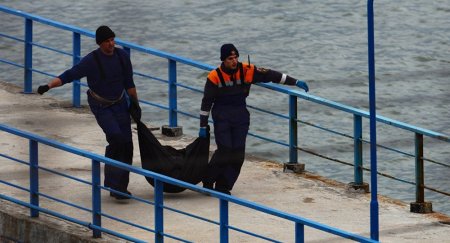
tu-154_crash_25-12-16

The Black Sea crash, if an act of terror is proven, will demonstrate that Russia has become a central target for Islamic terrorists, especially ISIS and Al Qaeda’s Syrian arm, the Nusra Front, and is paying a cruel price for its role in the Syrian conflict.

************************

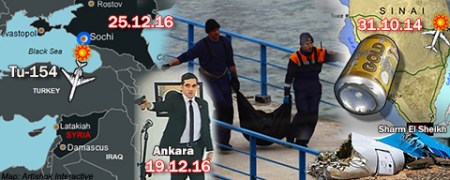
Notwithstanding the extraordinary circumstances surrounding the Russian Tu-154 air crash into the Black Sea minutes after its takeoff for Syria from Sochi early Sunday Dec. 25, the dread announcement that none of the 92 people aboard had survived was not accompanied by an official suggestion of terrorism.

That suggestion began rising to the surface later in the day. Transport Minister Maxim Sokolov reported the finding of 11 bodies in the sea, adding ominously that “fragments of other bodies were also found.” He added: “Of course the entire spectrum and almost any possible causes…are being probed, but it is premature now to speak about this as a terrorist act.”

Maj. Gen. Igor Konashenkov, a military spokesman put in that the pilot was “first-class,” and the 33-year-old Tupelov passenger jet had been serviced recently.

But by then, investigators must have had some idea of what caused the crash just two minutes after takeoff – too suddenly for the pilot to send a distress signal.

Did they find evidence of explosives planted on the plane or, possibly, a sabotaged fuel line or tank, or a passenger carrying a bomb or wearing a bomb vest? A possibly technical fault cannot be ruled out at this stage. However, the unusual Russian response to the disaster indicated that the Kremlin was in a hurry to find answers and that its emergency infrastructure was in high gear to cope with a massive terrorist attack. Deployed to the scene of the crash was an army of 3,000 rescue personnel, including 100 divers, who were rushed in from all parts of Russia, along with 32 ships and submarines and scores of helicopters and drones – all engaged in gathering every scrap of debris and human remains for a complete picture of the disaster.

While world attention remains focused on the wave of terror overtaking Europe, Islamist terrorists including ISIS, are clearly placing Russia firmly in their sights, especially since its intensified military intervention in Syria last September.

Still registered on the collective Russian consciousness is the tragic downing of the Metrojet Airbus on Oct. 31 2015 over Egyptian Sinai, after taking off from Sharm El-Sheikh, then a favorite Russian tourist resort. None of the 217 passengers and crew survived.

Still ringing in Russian ears is the voice of the Turkish assassin yelling: “Remember Syria! Remember Aleppo!” six days earlier, after he shot Andrew Karlov, 62, the Russian ambassador to Ankara. The video of the crime played out on TV screens across the world.

russainblackseaplane480

So far, President Vladimir Putin has managed to minimize the casualties of Russian military personnel involved in the Syrian war. But the number of fatalities building up from terrorism under the shadow of that war may have just jumped to an ominous level to 310 – not counting soldiers.

The Black Sea crash, if an act of terror is proven, will demonstrate that Russia has become a central target for Islamic terrorists, especially ISIS and Al Qaeda’s Syrian arm, the Nusra Front, and is paying a cruel price for its role in the Syrian conflict.

The doomed Tupolev was carrying more than one popular national symbol: 64 singers of the Red Army Choir, known as the Alexandrov Ensemble, a troupe of dancers, and Yelizaveta Glinka, known popularly as “Doctor Liza,” beloved leader of an organization for aiding victims in Russian combat zones. Nine reporters were also on the plane.  Putin declared Monday a day of national mourning.

They were all flying to the Russian Hmemim airbase in Latakia with a shipment of medicines. A concert for the troops was booked for the New Year.

Terrorists have for years had their eye on the celebrated Black Sea resort of Sochi, venue of international summits and favorite winter getaway location for Russian rulers, including Putin, who maintains a holiday residence there. An assault on Sochi is therefore a poke in the eye for the Russian president and the Russian military and security agencies battling terrorism.