via Washinton Examiner e-mail

H/t Power Line


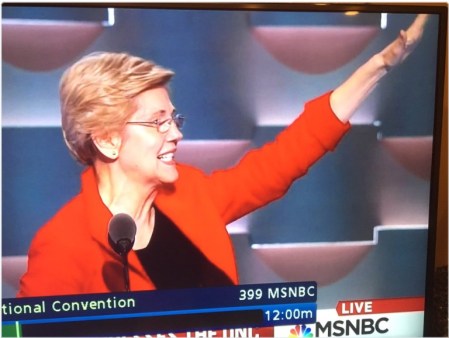 Look: Fauxchahontas plagiarizing Laura Ingraham.
Catalonia determined to press on with Spain independence bid with or without Madrid’s consent
Published time: 27 Jul, 2016 08:28

People hold Catalan separatist flags known as “Esteladas” during a gathering to mark the Calatalonia day “Diada” in central Barcelona. © Albert Gea / Reuters
Speaking exclusively to the Guardian, the president of Catalonia’s parliament, Carme Forcadell, and foreign affairs minister Raul Romeva said the stance taken by Madrid has left the region with no other choice.
“The [Spanish state] has left us feeling that we just don’t have an alternative,” Romeva told the Guardian. “We have always said that we would have preferred a Scottish-type scenario, where we could negotiate with the state and hold a coordinated and democratic referendum. We keep talking to Madrid, but all we get back from them is an echo.”
Catalonia has public opinion on its side, with a July 22 survey from the region’s official pollster showing that 47.7 percent of Catalans want independence. A total of 42.4 percent said they would prefer the region to remain part of Spain.
In December, the Spanish Constitutional Court blocked a resolution from Catalonia’s parliament calling for a secession process from Spain. However, Artur Mas – who at the time was Catalonia’s president – said the process had been annulled legally, but not politically.
“Legally, it is clear that the Catalan parliament’s resolution is now annulled,” Mas told Cadena Ser radio in December. “But politically, it is not, because the will of the parliament cannot be annulled and the will of the parliament reflects the will and the ideas of a significant part of the Catalonian population.”
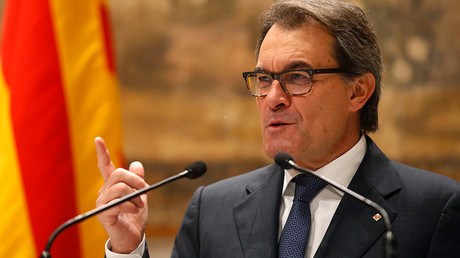
In June, Spain’s Constitutional Court recommended that Mas and two other officials face trial for overstepping their authority after they held a mock Catalan independence referendum in 2014, despite the court placing a ban on the vote taking place.
Romeva says that the Spanish government has two options at present. The first is to accept that Catalan independence is a distinct reality. The second is to simply carry on with what it has been doing – trying to use the courts and various legal processes to stop the movement.
Over 80 percent of those who voted in the mock referendum wanted Catalonia to gain independence from Spain.
“Every action they (Madrid) take serves only to rearm us and give us greater legitimacy for what we’re doing,” Romeva said.
Romeva also believes that Spain has a democratic responsibility to adhere to the will of the Catalan people. In April, acting Spanish Prime Minister Mariano Rajoy held talks with pro-separatist leaders in Catalonia, including new Catalan President Carles Puigdemont.
However, the two sides failed to find a consensus, with Rajoy saying “we will continue to defend Spanish unity.”
“The Spanish government uses the question of legality a lot,” Romeva said, speaking to the Guardian. “But legality is an instrument; it needs to adapt to reality and to democratic will, and not the other way round. People around the world need to understand that what we’re doing is fundamentally legitimate and is not illegal.”
Meanwhile, politicians from Catalonia have pointed to Madrid attempting to use underhanded tactics when dealing with the region. Forcadell, president of Catalonia’s parliament, mentioned that Spanish interior minister Jorge Fernandez Diaz and the head of Catalonia’s anti-fraud office, Daniel de Alfonso, were caught allegedly discussing what investigations could be opened against Catalan separatist politicians.
“How can they say that when the interior minister, who’s meant to defend the interests of all citizens, is caught conspiring to find evidence against citizens solely because they think differently? How can absolutely nothing come of that? We don’t understand it,” Forcadell told the Guardian.
A Career Sexual Predator Makes the Case for Hillary at the DNC, Front Page Magazine, Daniel Greenfield, July 27, 2016

“Hillary Clinton took me through Hell.”
Those were the words of a woman who was raped and beaten into a coma when she was twelve years old. Instead of helping that twelve year old girl, Hillary Clinton aided her rapist. She falsely accused the abused child who would never be able to have a family of her own after the assault of “a tendency to seek out older men”. Then Hillary Clinton was recorded on tape laughing at how her client had failed a lie detector test while relishing describing how she had gotten him off.
Tonight’s Democratic National Convention theme was “A Lifetime of Fighting for Children and Families”. But this was how Hillary Clinton’s “fight” for children and families really began. And Tuesday’s highlight was an address by a career sexual predator whom she covered up for and whose victims she smeared.
That sexual predator was her husband, Bill Clinton.
Bill Clinton put even more women through hell than Hillary did. And he isn’t done just yet. Amid the freakshow of the Carter mummy phoning in, the mothers of criminals, random mildly famous celebrities, the Sandernista walkout and Howard Dean doing the scream that ended his career one more time, the other Clinton took the stage.
In an evening featuring discussions about sex trafficking, the highlight was a sexual predator. In an evening that featured 9/11 victims, the highlight was the man who left America vulnerable to 9/11 and refused to take out Osama bin Laden.
And Bill being Bill, the lying didn’t take too long to get started.
Bill Clinton told the hooting and yapping DNC audience that Hillary Clinton wanted to help child abuse victims. But a child rape victim back home knows the truth and we know the truth. He got up on stage and lied again about the Children’s Health Insurance Program, one of those things which, like bringing peace to Northern Ireland and landing under fire in Bosnia, Hillary Clinton can’t stop lying about.
In Bill Clinton’s new version, Ted Kennedy and Orrin Hatch didn’t exist and Hillary Clinton got it all done.
But the Clintons always have a thousand new versions of every lie that they tell. And Bill’s entire speech was one big lie. The version of Hillary Clinton that he describes, an obsessive crusader for children who is also a devoted wife and mother has only one tiny problem with it. It’s an expert work of fiction.
The real Hillary Clinton hit up the Boys and Girls Club for $200K to speak for them. The real Hillary saw every non-profit organization working for education, children and any combination of the two as a piggy bank to loot for her greedy husband and herself. The real Hillary, the one revealed by the emails, is incapable of doing basic tasks and requires a horde of assistants to do anything for her.
The image of Hillary Clinton on her “hands and knees” putting liner paper in Chelsea’s dorm drawers is as real as Bill Clinton’s family values. The real Hillary Clinton requires people to pose before she steps into the picture so they don’t waste her time. The real Hillary Clinton laughed at the thought of a rapist beating a child into a coma and then getting off. The real Hillary Clinton has never met a charity she didn’t steal from. The real Hillary Clinton dislikes people and has her assistant elbow them out of the way.
Bill Clinton claimed that they never intended for Hillary to run for office in New York until New York Democrats “urged Hillary to run”. Then they offered to sell her the Brooklyn Bridge at a discount.
The Clintons didn’t move to New York for their health. They did it as part of a long term plan to get back into the White House. Tonight was a major step in the fulfillment of that plan.
Bill’s version of the Clintons, who moved to New York without ever giving thought to a political career plan, are as real as the “loving and caring” Hillary who just couldn’t stop trying to help children. When she wasn’t ripping off their charities or aiding their rapists.
It’s an insulting lie that treats the DNC audience like chumps. And it’s not the only one.
Bill claimed that Hillary “worked for farmers, for winemakers, for small businesses and manufacturers”. Hillary’s idea of a small business is a major bank or a multinational corporation. Hillary wouldn’t use a small business to clean between her toes. Not unless it could pony up a six figure check for her use.
He reeled off the usual lies about her foreign policy experience. The Iran sanctions. The worthless deal with Russia. And the even more worthless cease fire with Hamas in which the firing did not cease.
But we are told that she “put climate change at the center of our foreign policy”. That would explain why we’re losing the War on Terror.
The truth is that the Clintons are liars. That Hillary’s only qualifications for her current nomination are that she was Bill Clinton’s wife. And her only qualification to be his wife was her willingness to cover for his crimes.
Everything else is a lie.
Bill Clinton spoke one truth in his entire speech as he had Hillary suggest that “nobody would ever vote for me”. That much is true. Hillary Clinton doesn’t win votes. She wins rigged elections.
And that’s what this was.
Even in a night in which Chuck Schumer and Jimmy Carter did their best to put the DNC audience to sleep, they are still more charismatic and better speakers than Hillary Clinton.
The walkout during Hillary Clinton’s nomination left hundreds of empty seats aptly symbolizing her appeal. It doesn’t exist. It never did. America loves Hillary Clinton as much as Bill ever did.
Not even other Democrats like her.
Hillary Clinton has ruthlessly clawed her way to power. She has supporters, but no friends. After decades of victimizing women on behalf of a career sexual predator, she brought that predator up on stage to tell the world how much she loves families and children.
The best thing that can be said about the convention is that, like the rest of the Clinton campaign, it’s unremarkable. It’s bland and it’s boring. It’s full of the expected politicians and celebrities saying all the expected things about Hillary. But that’s what alibis look like. And that’s what this convention is. An alibi.
The Clintons are criminals who pretend to be activists. They’re greedy thieves who claim to want to make things better. They maintain a thin façade of normalcy as an alibi. It fooled some people a few decades ago. But it’s fooling fewer and fewer people. Even fewer and fewer Democrats.
Tonight was about making Democrats feel better about the unlikable candidate that they’re stuck with. And it didn’t work. No amount of lies about how much Hillary loves children and 9/11 victims will fix that. No amount of celebrities taking cheap shots at Trump will do it either.
Hillary barely eked out a win in a rigged election. Now she’s about to face a real one.
Pakistani ‘hate preacher’ who glorifies Islamic murder welcomed by Archbishop of Canterbury
ByPamela Geller on July 27, 2016
May o may, where are you now ?

The Islamization of Britain gallops forward. They banned me from the country for daring to oppose jihad terror and sharia, and it’s clear why: they’re embracing sharia provisions quickly and eagerly, and allowing jihad preachers to speak openly and without any hindrance. Sharia Britain will soon be a reality.

“Pakistani ‘hate preacher’ who glorifies Islamist murder welcomed by Archbishop of Canterbury,” by Tom Porter, International Business Times, July 21, 2016:
British authorities have been criticised for allowing two Pakistani clerics who led praise for an Islamist assassin to visit the UK on a seven-week preaching tour.
On Saturday (16 July), Muhammad Naqib ur Rehman and Hassan Haseeb ur Rehman arrived at London’s Heathrow Airport for a tour of mosques in cities including Birmingham, Leeds and Newcastle.
Archbishop of Canterbury Justin Welby welcomed Muhammad Naqib ur Rehman to Lambeth Palace on Monday to discuss subjects including countering “the narrative of extremism and terrorism” and interfaith relations.
The Muslim clerics have led a high-profile campaign in Pakistan in praise of assassin Mumtaz Qadri, who was executed in January after murdering liberal Pakistani politician Salmaan Taseer in 2011. The Punjab governor had criticised Pakistan’s strict anti-blasphemy laws, and Qadri claimed it was his religious duty to kill him….
The tour comes only months after cleric Muhammed Hanif Qureshi, who led calls for Taseer’s murder, was allowed into the UK to preach. A Facebook video shows the Rehmans preaching alongside Qureshi.
Michael Semple, an expert on Pakistan who served as deputy to the EU special representative to Afghanistan, told IBTimes UK those “preaching in favour of Mumtaz Qadri and lauding him and holding him up as a role model to be emulated by people in Pakistan or Afghanistan is something contrary to the public order and might well be illegal in Pakistan also”.
The home secretary has the authority to ban people from the country if their presence is not deemed “conducive to the public good”….
CNN Reveals The TRUE Victims Of ISIS Raid On French Church, Daily Caller, Rachel Stoltsoos, July 26, 2016
Muslims are the true target of the latest terror attack on a Catholic church in France, according to CNN.
In the name of the Islamic State, two Muslim men stormed a Catholic mass in Normandy Monday, took two parishioners and two nuns hostage, delivered a sermon in Arabic at the altar and then slit the throat of an elderly Catholic priest before police shot them dead. One of the hostages is in critical condition.
At least one Catholic person is dead, but according to CNN it’s Muslims in Europe who should be afraid.
Although France is a deeply secular country, CNN concludes the attack is especially provocative because Catholicism is “still deeply entwined in the national fabric.” By attacking churches, the logic goes, ISIS is hoping to fan the flames of a religious war that will ultimately result in persecution of Muslims, which in turn will drive them right into the arms of ISIS.
The tactic is working, according to CNN, which cites a 223 percent rise in the number of anti-Muslim threats and attacks last year reported by the French Human Rights Commission. The publication does go on to discuss at length the genocide ISIS is committing against Christians in its territory, but the clear implication is that Muslims, not Christians, are threatened in Europe.
“In urging attacks on churches, ISIS is trying to eliminate what it calls the ‘grey zone’ for Muslims in the West by provoking a far-right backlash,” reports CNN. “A drumbeat of attacks in France has led to a groundswell of anti-Muslim anger, which is being stoked and exploited by far-right politicians.”
Making a Killing: The 1.2 Billion Euros Arms Pipeline to Middle East
BIRN Belgrade, London, Sarajevo
Source: Making a Killing: The 1.2 Billion Euros Arms Pipeline to Middle East :: Balkan Insight
An unprecedented flow of weapons from Central and Eastern Europe is flooding the battlefields of the Middle East.
As Belgrade slept on the night of November 28, 2015, the giant turbofan engines of a Belarusian Ruby Star Ilyushin II-76 cargo plane roared into life, its hull laden with arms destined for faraway conflicts.
Rising from the tarmac of Nikola Tesla airport, the hulking aircraft pierced the Serbian mist to head towards Jeddah, Saudi Arabia.
It was one of at least 68 flights that in just 13 months transported weapons and ammunition to Middle Eastern states and Turkey which, in turn, funnelled arms into brutal civil wars in Syria and Yemen, the Balkan Investigative Reporting Network, BIRN, and the Organized Crime and Corruption Reporting Project, OCCRP, has found. The flights form just a small part of €1.2 billion in arms deals between the countries since 2012, when parts of the Arab Spring turned into an armed conflict.

Belgrade Airport | BIRN
Meanwhile, over the past two years, as thousands of tonnes of weapons fly south, hundreds of thousands of refugees have fled north from the conflicts that have killed more than 400,000 people. But while Balkan and European countries have shut down the refugee route, the billion-euro pipeline sending arms by plane and ship to the Middle East remains open – and very lucrative.
It is a trade that is almost certainly illegal, according to arms and human rights experts.
“The evidence points towards systematic diversion of weapons to armed groups accused of committing serious human rights violations. If this is the case, the transfers are illegal under the ATT (United Nations’ Arms Trade Treaty) and other international law and should cease immediately,” said Patrick Wilcken, an arms-control researcher at Amnesty International who reviewed the evidence collected by reporters.
But with hundreds of millions of euros at stake and weapons factories working overtime, countries have a strong incentive to let the business flourish. Arms export licences, which are supposed to guarantee the final destination of the goods, have been granted despite ample evidence that weapons are being diverted to Syrian and other armed groups accused of widespread human rights abuses and atrocities.
Robert Stephen Ford, US ambassador to Syria between 2011 and 2014, told BIRN and the OCCRP that the trade is coordinated by the US Central Intelligence Agency, CIA, Turkey and Gulf states through centres in Jordan and Turkey, although in practice weapon supplies often bypass this process.
BIRN and the OCCRP examined arms export data, UN reports, flight records, and weapons contracts during a year-long investigation that reveals how thousands of assault rifles, mortar shells, rocket launchers, anti-tank weapons, and heavy machine guns are pouring into the troubled region, originating from Bosnia and Herzegovina, Bulgaria, Croatia, the Czech Republic, Montenegro, Romania, Serbia and Slovakia.
Since the escalation of the Syrian conflict in 2012, these eight countries have approved the shipment of weapons and ammunition worth at least 1.2 billion euros to Saudi Arabia, Jordan, United Arab Emirates, and Turkey.

The figure is likely much higher. Data on arms export licences for four out of eight countries were not available for 2015 and seven out of eight countries for 2016. The four recipient countries are key arms suppliers to Syria and Yemen with little or no history of buying from Central and Eastern Europe prior to 2012. And the pace of the transfers is not slowing, with some of the biggest deals approved in 2015.
Eastern and Central European weapons and ammunition, identified in more than 50 videos and photos posted on social media, are now in use by Western-backed Free Syrian Army units, but also in the hands of fighters of Islamist groups such as Ansar al-Sham, Al Qaeda-affiliated Jabhat al-Nusra, the Islamic State of Iraq and the Levant, ISIS, in Syria, factions fighting for Syrian President Bashar-al Assad and Sunni forces in Yemen.
Markings on some of the weapons identifying the origin and date of production reveal significant quantities have come off production lines as recently as 2015.
Out of the 1.2 billion euros in weapons and ammunition approved for export, about 500 million euros have been delivered, according to UN trade information and national arms export reports.
The frequency and number of cargo flights – BIRN and the OCCRP identified at least 68 in just over one year – reveal a steady flow of weapons from Central and Eastern Europe airports to military bases in Middle East.
The most commonly used aircraft – the Ilyushin II-76 – can carry up to 50 tonnes of cargo or approximately 16,000 AK-47 Kalashnikov rifles or three million bullets. Others, including the Boeing 747, are capable of hauling at least twice that amount.
But arms and ammunitions are not only coming by air. Reporters also have identified at least three shipments made by the US military from Black Sea ports carrying an estimated 4,700 tonnes of weapons and ammunition to the Red Sea and Turkey since December 2015.
One Swedish member of the EU parliament calls the trade shameful.
“Maybe they –[Bulgaria, Slovakia and Croatia] – do not feel ashamed at all but I think they should,” said Bodil Valero, who also served as the rapporteur for the EU’s last arms report.“Countries selling arms to Saudi Arabia or the Middle East-North Africa region are not carrying out good risk assessments and, as a result, are in breach of EU and national law.”.
OCCRP and BIRN talked to government representatives in Croatia, Czech Republic, Montenegro, Serbia, and Slovakia who all responded similarly saying that they are meeting their international obligations. Some cited that Saudi Arabia is not on any international weapons black lists and other said their countries are not responsible if weapons have been diverted.
| A question of legality
The global arms trade is regulated by three layers of interconnected legislation — national, European Union, EU, and international – but there are no formal mechanisms to punish those who break the law. Beyond the blanket ban on exports to embargoed countries, each licence request is dealt with individually. In the case of Syria, there are currently no sanctions on supplying weapons to the opposition. As a result, the lawfulness of the export approval hinges on whether countries have carried out due diligence on a range of issues, including the likelihood of the arms being diverted and the impact the export will have on peace and stability. Bosnia and Herzegovina, Bulgaria, Croatia, the Czech Republic, Montenegro, Romania, Serbia and Slovakia are signatories of the UN’s Arms Trade Treaty, which entered into force in December 2014, and lists measures to prevent the illicit trade and diversion of arms. Member states of the EU are also governed by the legally-binding 2008 Common Position on arms exports, requiring each country to take into account eight criteria when accessing arms exports licence applications, including whether the country respects international human rights, the preservation of “regional peace, security and stability” and the risk of diversion. As part of their efforts to join the EU, Bosnia and Herzegovina and Montenegro have already accepted the measures and have amended their national law. Serbia is in the process of doing so. Weapons exports are initially assessed based on an end-user certificate, a key document issued by the government of the importing country which guarantees who will use the weapons and that the arms are not intended for re-export. Authorities in Central and Eastern Europe told BIRN and the OCCRP that they also inserted a clause which requires the buyer to seek approval if they later want to export the goods. Beyond these initial checks, countries are required to carry out a range of other risk assessments based on national and EU law and the ATT, although conversations with, and statements from, authorities revealed little evidence of that. OCCRP and BIRN talked to government representatives in Croatia, Czech Republic, Montenegro, Serbia, and Slovakia who all responded similarly saying that they are meeting their international obligations. Some cited that Saudi Arabia is not on any international weapons black lists and other said their countries are not responsible if weapons have been diverted. The three other countries did not respond to requests for comment. The Czech Foreign Ministry was the only public body to directly address concerns about human rights abuses and diversions, saying it took into account both when weighing up an export licence and had blocked transfers on that basis. How legal are these arms sales to the Middle East? Find out more here |
Saudi Arabia – The weapons king
The Central and Eastern European weapons supply line can be traced to the winter of 2012, when dozens of cargo planes, loaded with Saudi-purchased Yugoslav-era weapons and ammunition, began leaving Zagreb bound for Jordan. Soon after, the first footage of Croatian weapons in use emerged from the battleground of Syria.
According to a New York Times report from February 2013, a senior Croatian official offered the country’s stockpiles of old weapons for Syria during a visit to Washington in the summer of 2012. Zagreb was later put in touch with the Saudis, who bankrolled the purchases, while the CIA helped with logistics for an airlift that began late that year.
While Croatia’s government has consistently denied any role in shipping weapons to Syria, former US ambassador to Syria Ford confirmed to BIRN and the OCCRP the New York Times account from an anonymous source of how the deal was hatched. He said he was not at liberty to discuss it further.
This was just the beginning of an unprecedented flow of weapons from Central and Eastern Europe into the Middle East, as the pipeline expanded to include stocks from seven other countries. Local arms dealers sourced arms and ammunition from their home countries and brokered the sale of ammunition from Ukraine and Belarus, and even attempted to secure Soviet-made anti-tank systems bought from the UK, as a Europe-wide arms bazaar ensued.
Prior to the Arab Spring in 2011, the arms trade between Eastern Europe and Saudi Arabia, Jordan, the United Arab Emirates, UAE, and Turkey – four key supporters of Syria’s fractured opposition – was negligible to non-existent, according to analysis of export data.
But that changed in 2012. Between that year and 2016, eight Eastern European countries approved at least 806 million euros worth of weapons and ammunition exports to Saudi Arabia, according to national and EU arms export reports as well as government sources.
Jordan secured export licences worth 155 million euros starting in 2012, while the UAE netted 135 million euros and Turkey 87 million euros, bringing the total to 1.2 billion euros.
Qatar, another key supplier of equipment to the Syrian opposition, does not show up in export licences from Central and Eastern Europe.
Jeremy Binnie, Middle East arms expert for Jane’s Defence Weekly, a publication widely regarded as the most trusted source of defence and security information, said the bulk of the weapon exports from Eastern Europe would likely be destined for Syria and, to a lesser extent, Yemen and Libya.
“With a few exceptions, the militaries of Saudi Arabia, Jordan, the UAE and Turkey use Western infantry weapons and ammunition, rather than Soviet-designed counterparts,” said Binnie. “It consequently seems likely that large shipments of such materiel being acquired by – or sent to – those countries are destined for their allies in Syria, Yemen, and Libya.”
BIRN and the OCCRP obtained confidential documents from Serbia’s Ministry of Defence and minutes from a series of inter-ministerial meetings in 2013. The documents show the ministry raised concerns that deliveries to Saudi Arabia would be diverted to Syria, pointing out that the Saudis do not use Central and Eastern European stock and have a history of supplying the Syrian opposition. The Ministry turned down the Saudi request only to reverse course more than one year later and approve new arms shipments citing national interest. Saudi security forces, while mostly armed by Western producers, are known to use limited amounts of Central and Eastern European equipment. This includes Czech-produced military trucks and some Romanian-made assault rifles. But even arms exports destined for use by Saudi forces are proving controversial, given their involvement in the conflict in Yemen.
The Netherlands became the first EU country to halt arms exports to Saudi Arabia as a result of civilian deaths in Yemen’s civil war, and the European Parliament has called for an EU-wide arms embargo.
Supply Logistics: Cargo flights and airdrops
Weapons from Central and Eastern Europe are delivered to the Middle East by cargo flights and ships. By identifying the planes and ships delivering weapons, reporters were able to track the flow of arms in real time.
Detailed analysis of airport timetables, cargo carrier history, flight tracking data, and air traffic control sources helped pinpoint 68 flights that carried weapons to Middle Eastern conflicts in the past 13 months. Belgrade, Sofia and Bratislava emerged as the main hubs for the airlift.

Most frequent were flights operated from Belgrade, the capital of Serbia. The flights were either confirmed as carrying weapons, were headed to military bases in Saudi Arabia or the UAE or were carried out by regular arms shippers.
| The Middle East Airlift
At least 68 cargo flights from Serbia, Slovakia, Bulgaria and the Czech Republic have carried thousands of tons of munitions in the past 13 months to Saudi Arabia, the United Arab Emirates, and Jordan, three key suppliers of the Syrian rebels. These were identified through detailed analysis of airport timetables, cargo carrier history, flight tracking data, leaked arms contracts, end user certificates, and air traffic control sources. Cargo flights from Central and Eastern Europe to the Middle East, and particularly military bases, were extremely uncommon before late 2012, when the upsurge in weapons and ammunition purchases began, according to EU flight data and interviews with plane-spotters. The most commonly used aircraft – the Ilyushin II-76 – can carry up to 50 tonnes of cargo or approximately 16,000 AK-47 Kalashnikov rifles or three million bullets. Others, including the Boeing 747, are capable of hauling at least twice that amount. Of the 68 flights identified, 50 were officially confirmed to have carried arms and ammunition:
|
Many of these flights made an additional stop in Central and Eastern Europe – meaning they were likely picking up more weapons and ammunition – before flying to their final destination.
EU flight statistics provide further evidence of the scale of the operation. They reveal that planes flying from Bulgaria and Slovakia have delivered 2,268 tons of cargo – equal to 44 flights with the most commonly used aircraft – the Ilyushin II-76 – since the summer of 2014 to the same military bases in Saudi Arabia and UAE pinpointed by BIRN and OCCRP.
Distributing the weapons
Arms bought for Syria by the Saudis, Turks, Jordanians and the UAE are then routed through two secret command facilities – called Military Operation Centers (MOC) – in Jordan and Turkey, according to Ford, the former US ambassador to Syria.
These units – staffed by security and military officials from the Gulf, Turkey, Jordan and the US – coordinate the distribution of weapons to vetted Syrian opposition groups, according to information from the Atlanta-based Carter Center, a think tank that has a unit monitoring the conflict.
“Each of the countries involved in helping the armed opposition retained final decision-making authority about which groups in Syria received assistance,” Ford said.
A cache of leaked cargo carrier documents provides further clues to how the Saudi military supplies Syrian rebels.
According to the documents obtained by BIRN and the OCCRP, the Moldovan company AeroTransCargo made six flights in the summer of 2015 carrying at least 250 tonnes of ammunition between military bases in Saudi Arabia and Esenboga International Airport in Ankara, the capital of Turkey, reportedly an arrival point for weapons and ammunition for Syrian rebels.
Pieter Wezeman, of the Stockholm International Peace Research Institute, a leading organisation in tracking arms exports, said he suspects the flights are part of the logistical operation to supply ammunition to Syrian rebels.
From the MOCs, weapons are then transported by road to the Syrian border or airdropped by military planes.
A Free Syrian Army commander from Aleppo, who asked to remain anonymous to protect his safety, told BIRN and OCCRP that weapons from Central and Eastern Europe were distributed from centrally controlled headquarters in Syria. “We don’t care about the county of origin, we just know it is from Eastern Europe,” he said.
The Saudis and Turks also provided weapons directly to Islamist groups not supported by the US and who have sometimes ended up fighting MOC-backed factions, Ford added.
The Saudis are also known to have airdropped arms and equipment, including what appeared to be Serbian-made assault rifles to its allies in Yemen.
Ford said that while he was not personally involved in negotiations with Serbia, Bulgaria and Romania over the supply of weapons to Syria, he believes that the CIA is likely to have played a role.
“For operations of this type it would be difficult for me to imagine that there wasn’t some coordination between the intelligence services, but it may have been confined strictly to intelligence channels,” he said.
The US may not have just played a role in the logistics behind delivering Gulf-sponsored weapons from Eastern Europe to the Syrian rebels. Through its Department of Defense’s Special Operations Command (SOCOM), it has also bought and delivered vast quantities of military materiel from Eastern Europe for the Syrian opposition as part of a US$500 million train and equip programme.
Since December 2015, SOCOM has commissioned three cargo ships to transport 4,700 tons of arms and ammunition from ports of Constanta in Romania and Burgas in Bulgaria to the Middle East likely as part of the covert supply of weapons to Syria.
The shipments included heavy machine guns, rocket launchers and anti-tank weapons – as well as bullets, mortars, grenades, rockets and explosives, according to US procurement documents.
The origin of arms shipped by SOCOM is unknown and the material listed in transport documents is available from stockpiles across Central and Eastern Europe.
Not long after one of the deliveries, SOCOM supported Kurdish groups published an image on Twitter and Facebook showing a warehouse piled with US-brokered ammunition boxes in northern Syria SOCOM would not confirm or deny that the shipments were bound for Syria.
US procurement records also reveal that SOCOM secured from 2014 to 2016 at least 25 million euros (27 million dollars) worth of Bulgarian and 11 million euros (12 million dollars) in Serbian weapons and ammunition for covert operations and Syrian rebels..
A Booming Business
Arms control researcher Wilcken said Central and Eastern Europe had been well positioned to cash in on the huge surge in demand for weapons following the Arab Spring.
“Geographical proximity and lax export controls have put some Balkan states in pole position to profit from this trade, in some instances with covert US assistance,” he added. “Eastern Europe is rehabilitating Cold War arms industries which are expanding and becoming profitable again.”
Serbian Prime Minister Aleksandar Vucic boasted recently that his country could produce five times the amount of arms it currently makes and still not meet the demand.
“Unfortunately in some parts of the world they are at war more than ever and everything you produce, on any side of the world you can sell it,” he said.
Arms manufacturers from Bosnia and Herzegovina and Serbia are running at full capacity with some adding extra shifts and others not taking new orders.
Saudi Arabia’s top officials – more used to negotiating multi-billion-dollar fighter-jet deals with Western defence giants – have been forced to deal with a handful of small-time arms brokers operating in Eastern Europe who have access to weapons such as AK-47s and rocket launchers
Middlemen such as Serbia’s CPR Impex and Slovakia’s Eldon have played a critical role in supplying weapons and ammunition to the Middle East
The inventory of each delivery is usually unknown due to the secrecy surrounding arms deals but two end-user certificates and one export licence, obtained by BIRN and the OCCRP, reveal the extraordinary scope of the buy-up for Syrian beneficiaries.
For example, the Saudi Ministry of Defence expressed its interest in buying from Serbian arms dealer CPR Impex a number of weapons including hundreds of aging T-55 and T-72 tanks, millions of rounds of ammunition, multi-launch missile systems and rocket launchers. Weapons and ammunition listed were produced in the former Yugoslavia, Belarus, Ukraine, and the Czech Republic.
An export licence issued to a little-known Slovakian company called Eldon in January 2015 granted the firm the right to transport thousands of Eastern European rocket-propelled grenade launchers, heavy machine guns and almost a million bullets worth nearly 32 million euros to Saudi Arabia.
BIRN and OCCRP’s analysis of social media shows weapons that originated from the former states of Czechoslovakia and Yugoslavia, and Serbia, Croatia and Bulgaria are now present on the battlefields of Syria and Yemen.
While experts believe the countries continue to shirk their responsibility, the weapons pipeline adds more and more fuel to a white hot conflict that leads to more and more misery.
“Proliferation of arms to the region has caused untold human suffering; huge numbers of people have been displaced and parties to the conflict have committed serious human rights violations including abductions, executions, enforced disappearances, torture and rape,” said Amnesty’s Wilcken.
Additional reporting by Atanas Tchobanov, Dusica Tomovic, Jelena Cosic, Jelena Svircic, Lindita Cela, RISE Moldova and Pavla Holcova.
This investigation is produced by BIRN as a part of Paper Trail to Better Governance project.
The Associated Press Plays the Race Card, Power Line,
The Democrats’ campaign against Donald Trump consists mostly of branding him a bigot. Thus, they have sent out many emails like this one:

Stop bigotry! No details are necessary.
The Associated Press was once a straightforward, relatively nonpolitical news source, but those days are long gone. Now some of the most hard-core Democratic Party advocacy comes from the AP. Thus, it is no surprise that the AP is trying to advance the Democrats’ narrative that Trump is a bigot.
On July 22, the AP headlined: “Critics: Trump speech signals shift to coded race language.” This is an old trick–make a “news story” out of what critics say. The occasion was Trump’s convention acceptance speech. And, of course, talking about “coded” language allows reporters to impute to politicians things they never said, based on their enemies’ fantasies.
[S]ome observers say he’s turning to code words to gin up racial animosity and fear among America’s white voters.
Is that assertion true? The AP takes no responsibility, it is just what “some observers say.” Don’t hold your breath waiting for an article from the AP about the Democrats ginning up racial animosity and fear among African-Americans. That would actually make a good news story, but you won’t be seeing it any time soon.
Trump “didn’t get on stage and issue a bunch of racial epithets,” said Emory University political scientist Andra Gillespie, who watched his acceptance speech at the Republican National Convention. “We didn’t hear the N-word, and we didn’t hear other words that may offend many people. But just because he didn’t use racial slurs doesn’t mean he didn’t frame issues in a way that people in racial and ethnic groups find problematic.”
What does that mean? I have absolutely no idea. The AP didn’t inquire, and doesn’t tell us.
Ian Haney Lopez, author of “Dog Whistle Politics: How Coded Racial Appeals Have Reinvented Racism and Wrecked the Middle Class,” went further, saying Trump’s speech surpassed even the coded racial language of Richard Nixon in 1968.
“Coded racial language” is big on the left, but note that so far, the AP hasn’t quoted a single word that Donald Trump actually said. Not one. The AP goes on in the same vein, quoting Trump’s far-left critics, but never citing any of Trump’s own words. Except for a stray phrase or two, like this:
Some have pointed out that Trump’s slogan “America First” was also the slogan of the America First Committee, an isolationist, anti-Semitic group whose primary goal was to keep the United States from joining Britain in the fight against Nazi Germany. The group opposed the acceptance of shiploads of Jewish refugees fleeing Nazi persecution.
Flawed messaging on Trump’s part? Perhaps. But these days, anti-Semitism exists almost exclusively in the Democratic Party, not the Republican. And however the phrase may have been used 80 years ago, today “America first” is a perfectly straightforward way of expressing the proposition that America’s government should put the interests of its own citizens ahead of all others–a proposition with which the Democratic Party will not argue, but neither will it agree.
There is much more along the same lines; read it for yourself if you like. The next day, July 23, the AP came out with another anti-Trump racial smear: “Energized white supremacists cheer Trump convention message.” It is more of the same: Trump doesn’t actually say anything about race, but we liberals will tell you what he really means.
They don’t like to be called white supremacists.
The well-dressed men who gathered in Cleveland’s Ritz-Carlton bar after Donald Trump’s speech accepting the Republican nomination for president prefer the term “Europeanists,” “alt-right,” or even “white nationalists.” They are also die-hard Trump supporters.
Sure. And tomorrow, the AP will run a story on how Communists and Socialists are cheering for Hillary Clinton and Bernie Sanders. They won’t do that, of course, because fringe people are of interest only if they support Republicans. It’s just another day in the lives of liberal journalists who are devoted to advancing the interests of their party.
Leaked DNC email: Democrats delighted that news coverage exaggerated anti-Trump protest size, Sharyl Attkisson.com, July 26, 2016
Last May, when Donald Trump met with House Speaker Paul Ryan at Republican National Committee headquarters in Washington D.C., anti-Trump protesters “swarmed” the area.
Well, maybe not so much. It turns out news reports at the time seem to have exaggerated the truth.
That’s one thing we learned from newly-leaked Democratic National Committee (DNC) emails. Democrats had tried to organize a much larger turnout but failed. They were surprised and delighted by reporters’ mischaracterizations of the event.
“Tv coverage of protest great” declared DNC communications official T.J. Helmstetter in an email to DNC National Communications Director Luis Miranda on May 12, 2016.
“Shockingly good coverage despite abysmal turnout. CNN and MSNBC using prominently.”
Miranda responds: “Yes, but going forward, when our allies screw up and don’t deliver bodies in time, we either send all our interns out there or we stay away from it.. we don’t want to own a bad picture.”
“The Hill” published a story by a writer named Harper Neidig that made it sound like the area was crawling with Trump opponents and supporters. The story was accompanied by a photo showing four anti-Trump protesters holding signs.
“The Washington Post” published a story by a writer named Elise Tieback that also implied Trump’s presence had created unprecedented disruption, particularly by drawing a large group of protesters. She declared, “In each successive visit to the RNC, Trump is attracting bigger crowds, bigger protests, bigger media attention. Everyone crams into the small two-block area that surrounds the RNC building, many people just taking in the spectacle. Thursday’s meeting between Trump and Ryan (R-Wis.) was no exception.”
“Abysmal turnout” but “great” news coverage.
Below is a YouTube video that shows the size of the anti-Trump crowd compared to the collection of news media.
Analysis by debkafile’s intelligence and cyber defense sources has determined that the hacking and leak of 20,000 DNC emails was almost certainly not carried out by the GRU’s cyber warfare branch, but may well have been the work of party opponents of Hillary Clinton.
Source: The DNC emails were not hacked by Russian GRU

On July 25, as the Democratic Party’s convention got underway in Philadelphia, presidential candidate Hillary Clinton found herself struggling to unite the party behind her nomination as the party’s presidential nominee, after the shock release of 20,000 emails through WikiLeaks, which exposed top party officials as campaigning to discredit her rival Bernie Sanders.
This breach of objectivity in Clinton’s favor was supported by documents, statistical tables and videos attached to the emails hacked from the Democratic National Committee’s servers. To damp the crisis. party leaders, including Clinton, took two immediate steps that made the situation worse: They sacked the head of the Democratic National Committee (DNC), Debbie Wasserman Schultz, the day she was due to open the convention and, second, they called on the FBI to investigate the hacking and find who was responsible for the embarrassing leaks.
The culprit was quickly named as Russia’s military intelligence service, the GRU, by “experts close to the examination” – namely, the information security company CrowdStrike, which was hired by the DNC, and the FBI.
CrowdStrike said it had found two types of Advanced Persistent Threat (APT) malware inside the DNC’s servers that were intended to remain undetected for long periods of time, slowly spread inside the servers, and secretly send the data back to the culprits who planted the malware.
However, an analysis by debkafile‘s intelligence and cyber defense sources has determined that the hacking was almost certainly not carried out by the GRU’s cyber warfare branch, contrary to assertions by senior DNC officials who fix the blame on Russian intelligence.

Their assertions don’t hold water in the light of four facts:
1. Russia’s cyber warfare system is still mostly a “black hole” for the West. Although it is highly effective, very little is known about its methods of operation, organizational structures, scale of cooperation with counterparts in other countries, and the tools and resources at its disposal.
Had any branch of Russian intelligence been responsible for the hacking the Democratic party’s servers, no obvious signatures, such as the terms “Fancy Bear,” and “Cozy Bear” that were discovered, would have been left behind for investigators to find.
2. Intelligence organizations, including those of Russia, are usually fully focused on seeking security, strategic and economic data. It his hard to see Russian military intelligence, whose resources are stretched, expending time and manpower on digging out the DMC;s views of Bernie Sanders’ religiosity.
3. Then, too, CrowdStrike’s claim to have cracked the case in two hours is hardly credible. Getting to the bottom of an APT (Advanced Persistent Threat) calls for extra-powerful computers, working in conjunction with the internet service provider (ISP), and consuming weeks, if not months of analysis.
4. Attributing the hacking attack to the Russians provided US agencies with a convenient reminder that the most notorious leaker of classified US documents, Edward Snowden, still lives safe from prosecution in Russian exile, and that WikiLeaks founder Julian Assange, remains in asylum at the Ecuadorean embassy in Britain.
The true identity of the hacker that sent the cat among the Democratic party pigeons, at the most damaging moment for Hillary Clinton, remains the subject of conjecture for lack of firm proof. The leading suspects are may well be one or more of her party opponents.
But although the current crisis may be glossed over in the interim to allow the convention and nomination to take its course, the Clinton campaign up until November is more than likely to be bedeviled by fresh e-mails leaked via WikiLeaks or other means that are just as embarrassing.
‘I am prepared to take lives’: Dutch Imam sparks outrage by saying he is ready to kill and die for Islam Turkish Imam Halil Celik works at Mosque in Dieren, eastern Netherlands He told a journalist: ‘I am prepared to die for my religion and also take lives’ Journalist Mehmet Cerit said ‘it is a shocking and outrageous statement’ Selimiye Mosque says that the statement is ‘unworthy of an Imam’
By Charlie Moore For Mailonline
Source: Dutch Imam sparks outrage by saying he is ready to kill and die for Islam | Daily Mail Online
An Imam has caused uproar in the Netherlands after saying he was willing to die for his religion and to kill others.
Turkish Imam Halil Celik told a journalist on Twitter: ‘I am prepared to die for my religion, but also prepared to take away lives.’
The message was addressed to Mehmet Cerit, editor-in-chief of the weekly Dutch-Turkish dailies Zaman Vandaag and Zaman Hollanda.

Turkish Imam Halil Celik has caused uproar in the Netherlands after telling a journalist he was prepared to die for his religion and to kill others
The journalist then made the claim public saying: ‘It is a shocking and outrageous statement. This Imam gives a bad example and it is people like him who are responsible for radicalising youth.’
Celik works at the Selimiye Mosque in the eastern Dutch town of Dieren. The mosque’s board has distanced itself from the statement of its Imam.
It said: ‘We do not agree with the statement made, it is unworthy of an Imam. I am sure the Turkish community in Dieren will feel the same.’
Imam Celik will leave the Selimiye Mosque this week and go back to Turkey.
The mosque’s board say his departure has nothing to do with his recent comments but had been planned for a while.
The board added that their Imam’s comments had been taken out of context, saying it was part of a dialogue with an opponent.

Turkish Imam Halil Celik told a journalist on Twitter: ‘I am prepared to die for my religion, but also prepared to take away lives’. His posts are in grey
The threatening statement might be linked to the situation in Turkey, which has seen a coup and subsequent massive crackdown by the Erdogan government who blamed the Fethullah Gulen movement for orchestrating the attempted military takeover.
The Zaman newspapers, which originally supported Erdogan’s AKP party, have been accused by the Turkish government of being aligned with the Gulen movement.
The Selimiye Mosque is state-operated by Diyanet, the Turkish Ministry of Religious Affairs, which usually sends Imams abroad to Turkish mosques in foreign countries.
Under President Erdogan, it has taken an increasingly conservative line and clashed on occasions with other Turkish groups and minorities.

Celik works at the Selimiye Mosque in the eastern Dutch town of Dieren. The mosque’s board has distanced itself from the statement of its Imam




 anneinpt
 artaxes
 danmillerinpanama
 davidking1530
 Peter Hofman
 Joseph Wouk
 Peter
Peter Louisiana Steve
 WarSclerotic
Recent Comments