President Obama hits Donald Trump, Praises Hillary Clinton as “Steady” Fox News Alert via Youtube, July 8, 2016
(It’s a broad-reaching collection of Fox News programs dealing with Trump, Clinton and Obama. — DM)
President Obama hits Donald Trump, Praises Hillary Clinton as “Steady” Fox News Alert via Youtube, July 8, 2016
(It’s a broad-reaching collection of Fox News programs dealing with Trump, Clinton and Obama. — DM)
Trump gets it right on Saddam, CNN, Peter Bergen, July 7, 2016
Occasionally Donald Trump says something that is politically incorrect but which also happens to be true.
On Tuesday at a campaign rally in North Carolina, Trump defended the former Iraqi dictator Saddam Hussein’s record on terrorism, saying, “He was a bad guy — really bad guy. But you know what? He did well? He killed terrorists. He did that so well. They didn’t read them the rights. They didn’t talk. They were terrorists. Over. Today, Iraq is Harvard for terrorism.”
Defending the brutal Iraqi dictator who killed hundreds of thousands of his own people isn’t exactly fashionable. But if you consider the 13 years of war that have wracked the country — in which a quarter of a million have died — and add that Saddam brutally repressed all dissent, including groups such as al Qaeda, and also add to this that ISIS is itself a fruit of the Iraq War, it’s a far more defensible position.
Trump didn’t offer any evidence for his assertions about Saddam’s brutal repression of terrorist groups or of Saddam “killing terrorists,” but his observations about the dictator are an implicit critique of the George W. Bush administration’s erroneous claims before the Iraq War that Saddam was allied to al Qaeda. Those claims were an essential element of the case that the administration made to go to war, since Saddam’s supposed connections to al Qaeda were the only purported evidence that he might give his putative weapons of destruction to terrorists.
The centerpiece of the Bush administration’s case for going to war in Iraq was Secretary of State Colin Powell’s presentation to the U.N. Security Council on February 5, 2003, six weeks before the invasion. Powell’s presentation was a bravura performance that seemed to establish beyond a doubt that Saddam was actively concealing an ongoing weapons of mass destruction program and was in league with al-Qaeda.
At one point the secretary of state dramatically brandished a small vial of a white powder of supposed anthrax, saying “about this amount…shut down the U.S. Senate in the fall of 2001.” As Powell gave his speech, sitting directly behind him was CIA director George Tenet, giving a visual imprimatur to what Powell was saying.
One section of Powell’s UN speech tried to make the case for an emerging alliance between Saddam and al-Qaeda:
“Iraq today harbors a deadly terrorist network headed by Abu Musab al-Zarqawi, an associate and collaborator of Osama bin Laden and his al-Qaeda lieutenants…When our coalition ousted the Taliban, the Zarqawi network helped establish another poison and explosive training center camp, and this camp is located in northeastern Iraq… He traveled to Baghdad in May of 2002 for medical treatment, staying in the capital of Iraq for two months while he recuperated to fight another day.”
Five weeks before the invasion of Iraq, CIA director Tenet testified before the Senate Armed Services Committee that Iraq had “provided training in poisons and gases to two al-Qaeda associates,” a point that Powell had also made in his U.N. presentation.
What the American public did not know about Tenet’s and Powell’s crucial claim about Iraq training al-Qaeda associates on poison gases was that it didn’t show a nexus between bin Laden, Saddam and some of the world’s nastiest weapons. Instead, it was the tainted fruit of an “extraordinary rendition” in which militants were transported by American officials to countries that routinely used torture, where they would supposedly finally divulge whatever secrets they had been keeping from their American interrogators.
In December 2001 Ibn al Shaykh al Libi, a Libyan militant who had run an al-Qaeda-affiliated training camp, was captured in Pakistan. Libi told his FBI interrogators that there were no ties between Saddam and al-Qaeda. Several days into his interrogation the CIA then rendered Libi to Egypt, where jailors were known for subjecting their prisoners to beatings, electric shocks and sexual assaults.
To improve his chances of better treatment once in Egypt, Libi told his interrogators that bin Laden had sent two operatives to Iraq to learn about biological and chemical weapons.
Because Libi’s story encapsulated the key arguments for the Iraq war, his tale was picked up by President Bush in a keynote speech in Cincinnati on October 7, 2002 in which he laid out his rationale for the coming conflict with Iraq, saying, “We’ve learned that Iraq has trained al-Qaeda members in bomb-making and poisons and deadly gases.”
But once he was back in American custody, on February 14, 2004, Libi recanted what he had falsely told his Egyptian interrogators. Libi told his U.S. interrogators that he had “fabricated” his tale of the Saddam-al-Qaeda-poison connection to the Egyptians following “physical abuse and threats of torture.”
Since the fall of Baghdad no documents have been unearthed in Iraq proving the Saddam-al-Qaeda axis despite the fact that, like other totalitarian regimes, Saddam’s government kept meticulous records. The Defense Intelligence Agency had by 2006 translated 34 million pages of documents from Saddam’s Iraq and found there was nothing to substantiate a “partnership” between Saddam and al-Qaeda.
Two years later the Pentagon’s own internal think tank, the Institute for Defense Analyses (IDA), concluded after examining 600,000 Saddam-era documents and several thousand hours of his regime’s audio and video tapes that there was no “smoking gun (i.e. direct connection between Saddam’s Iraq and al-Qaeda.)”
Obama backtracks on Afghanistan withdrawal, cites ‘precarious’ security situation, Long War Journal, Bill Roggio, July 7, 2016
President Barack Obama called the security environment in Afghanistan “precarious” and said today he will keep more troops on the ground in Afghanistan than previously planned. Obama repeatedly promised to end the US mission in Afghanistan before the end of his administration in 2017, but a worsening security situation stemming from previous ill-timed reductions in force and a resilient Taliban proved that to be impossible.
“Instead of going down to 5,500 troops by the end of this year, the United States will maintain approximately 8,400 troops in Afghanistan into next year, through the end of my administration,” Obama said in a briefing at the White House.
Despite admitting the deteriorating conditions, Obama announced he will reduce the number of troops in the country by 1,400 by the end of 2016. Obama did not explain how withdrawing an additional 1,400 US forces this year will aid in the fight against the Taliban and its allies. The Taliban has regained ground in the strategic province of Helmand and other areas in spite of direct US military support to Afghan forces.
Obama admitted that the Taliban has continued to wage an effective insurgency and has taken control of territory.
“The Taliban remains a threat,” Obama said. “They’ve gained ground in some places.”
There are currently 9,800 troops in country conducting an “advise and assist” mission to Afghan forces as well as counterterrorism operations. Those two missions will not change, he stated.
The admission that security in Afghanistan is worsening is a dramatic shift by the Obama administration. Previously the administration maintained that Afghan forces were capable of sustaining combat operations with minimal or no US assistance.
However, this view flew in the face of the realities on the ground. The Taliban waited out the US “surge” that targeted their bastions in the south, and began attacking vulnerable Afghan forces when US troops began their withdrawal. By 2014, the Taliban gained control of a handful of far-flung districts while maintaining a guerrilla campaign throughout the country.
By the summer of 2015, the Afghan government admitted that four districts were under Taliban control. A study by The Long War Journal indicated that by the beginning of October 2015, the Taliban controlled 29 districts and contested another 36.
The Afghan government, which has notoriously underestimated the threat posed by the Taliban and areas under the jihadist group’s control, admitted in late June 2015 that nine district were now controlled by the Taliban and another 40 are heavily contested.The Long War Journal estimated that the Taliban controls 39 districts and contest another 43.
Perhaps the most worrisome indicator of deteriorating security in Afghanistan is the discovery of al Qaeda training camps in the country. Al Qaeda operated two large scale training camps, including a large facility, in the Shorabak district in Kandahar for more than a year before they were discovered by US forces. One of the camps occupied an area of 30 square miles and was well provisioned with weapons, ammunition, communications gear, and other equipment. In October 2015, a large US military strike force took four days to clear the two al Qaeda camps in Shorabak. More than 150 al Qaeda fighters are thought to have been killed during the operation.
The US military only discovered the location of the two camps in Shorabak after raiding another in Paktika province in July 2015. Abu Khalil al Sudani, one of al Qaeda’s most senior figures, is thought to have been killed during that raid. Al Qaeda obviously assessed the situation in Paktika as being safe enough to place one of their top leaders there.
The Shorabak raids shocked the US military and intelligence and forced them to revised its long-held estimate of 50 to 100 al Qaeda operatives in Afghanistan upwards to 300 in country. For more than six years, The Long War Journal has warned that official estimate of al Qaeda’s presence in Afghanistan is erroneous, and the jihadist group remains a significant threat to this day. [See LWJ report, US military admits al Qaeda is stronger in Afghanistan than previously estimated.]
Germany’s New “No Means No” Rape Law, Gatestone Institute, Soeren Kern, July 8, 2016
♦ The reforms are unlikely to end Germany’s migrant rape epidemic.
♦ When it comes to immigration, political correctness often overrides the rule of law in Germany, where many migrants who commit sexual crimes are never brought to justice, and those who do stand trial receive lenient sentences from sympathetic judges.
♦”Every police officer knows he has to meet a particular political expectation. It is better to keep quiet [about migrant crime] to avoid problems.” — Rainer Wendt, head of the German police union.
♦ “It is unacceptable that asylum seekers are trampling on our society at the same time that they are here seeking our protection.” — Prosecutor Bastian Blaut.
The German parliament has approved changes to the criminal code that expand the definition of rape and make it easier to deport migrants who commit sex crimes.
Under the bill, also known as the “No Means No” (“Nein heißt Nein”) law, any form of non-consensual sex will now be punishable as a crime. Previously, only cases in which victims could show that they physically resisted their attackers were punishable under German law.
The changes, which were prompted by the sex attacks in Cologne, where hundreds of women were assaulted by mobs of mostly Muslim migrants on New Year’s Eve, is being hailed as a “paradigm shift” in German jurisprudence.
But the reforms, which are designed to make it easier for victims of sexual assault to file criminal complaints, are unlikely to end Germany’s migrant rape epidemic. This is because Germany’s politically correct justice system is notoriously lenient when it comes to prosecuting, sentencing and deporting foreign offenders.

The bill was unanimously approved on July 7 by the Bundestag, the lower house of parliament. The measure must still be approved by the Bundesrat, the upper house, which will vote on the reforms after the summer recess.
According to the original law, as stipulated in Paragraph 177 of the Criminal Code, victims were required to prove that they had physically defended themselves for an act to constitute rape. Verbal communication — simply saying “No” — was insufficient to bring charges against an assailant. The original law was written that way to deter false accusations of rape and avoid frivolous lawsuits, according to German legal experts.
The reforms will allow prosecutors and courts to take into account physical, verbal and non-verbal signals from the victim when determining whether or not a rape occurred. Anyone convicted of sexual activity that goes against the “discernable will” (erkennbaren Willen) of the victim faces up to five years in prison. The law also broadens the definition of sexual assault to include groping, which is punishable by up to two years in prison.
Moreover, the new law introduces Paragraph 184j, which will make it crime just to be in a group that carries out sexual assaults. The measure is aimed to deter attacks such as those which occurred in Cologne, although some lawmakers say this provision is unconstitutional because a person could be convicted of a crime that he or she did not personally commit. Finally, the reforms make it easier to deport migrants who are convicted of sex crimes in Germany.
The German Minister for Women, Manuela Schwesig, hailed the measure as a milestone:
“In the past there were cases where women were raped but the perpetrators could not be punished. The change in the law will help increase the number of victims who choose to press charges, reduce the number of criminal prosecutions that are shelved and ensure sexual assaults are properly punished.”
According to Minister of Justice Heiko Maas, only one in 10 rapes in Germany is reported and just 8% of rape trials result in convictions.
Even if the new law results in an increase in the number of rape convictions, it is unlikely to be a meaningful deterrent for the migrants who are sexually assaulting German women and children.
When it comes to immigration, political correctness often overrides the rule of law in Germany, where many migrants who commit sexual crimes are never brought to justice, and those who do stand trial receive lenient sentences from sympathetic judges.
On June 30, for example, a court in the northern German town of Ahrensburg found a 17-year-old migrant from Eritrea guilty of attempting to rape an 18-year-old woman in the stairwell of a parking garage at the train station in Bad Oldesloe. The woman was seriously injured in the attack, in which the migrant tried to subdue her by repeatedly biting her in the face and neck. After police arrived, the migrant resisted arrest and head-butted a police officer, who was also sent to the hospital.
Despite finding the Eritrean guilty of sexually assaulting the woman and physically assaulting the police officer, the court gave him a seven-month suspended sentence and ordered him to do 30 hours of community service. He has been released from custody and will not be deported.
In addition to judicial leniency, migrant criminals have benefited from German authorities, who have repeatedly been accused of underreporting the true scale of the migrant crime problem in the country, apparently to avoid fueling anti-immigration sentiments.
In January, the newspaper Die Welt reported that the suppression of data about migrant criminality is a “Germany-wide phenomenon.” According to Rainer Wendt, the head of the German police union (Deutschen Polizeigewerkschaft, DPolG), “Every police officer knows he has to meet a particular political expectation. It is better to keep quiet [about migrant crime] to avoid problems.”
Also in January, a document leaked to the newspaper Bild revealed that politicians in the northern city of Kiel had ordered local police to overlook many of the crimes perpetrated by migrants. According to Bild, police in North Rhine-Westphalia and Lower Saxony have also been instructed to be lenient to criminal migrants.
In February, Die Welt reported that authorities in the German state of Hesse were suppressing information about migrant-related crimes, ostensibly due to a “lack of public interest.”
In May, a chief superintendent from the Cologne police department revealed that an official at the interior ministry in North-Rhine Westphalia ordered him to remove the term “rape” from an internal police report about the assaults in Cologne.
Police in Cologne now say they have received more than 1,000 complaints from women, including 454 reports of sexual assaults, related to New Year’s Eve. Police in Hamburg say they have received complaints from 351 women, including 218 reports of sexual assault that took place on the same evening.
On July 7, more than six months after the Cologne attacks (and the same day that the Bundestag approved the new “No Means No” rape law), a German court issued the first two convictions: The District Court of Cologne gave a 20-year-old Iraqi and a 26-year-old Algerian a one-year suspended sentence and then released the two men.
The court found the Iraqi, identified only as Hussain A., guilty of kissing one of the victims and licking her face. The Algerian, named as Hassan T., prevented the boyfriend of the other victim from intervening to stop the attack and offered him money to have sex with her: “Give the girls or you die,” he said. He was found guilty of being an accessory to sexual assault.
The Iraqi man, who was 20 at the time, was sentenced under juvenile law and was ordered to attend an integration course and do 80 hours of community service. The newspaper Bild published photographs of a jubilant Hassan T. smiling as he left the courtroom.
One observer said the light sentence was a mockery of justice and would serve as an invitation for criminal migrants to do as they please with German women.
Prosecutor Bastian Blaut said:
“It is unacceptable when basic values such as the equality of woman and man are violated. It is unacceptable that migrants are bargaining over women as in a bazaar. It is unacceptable that asylum seekers are trampling on our society at the same time that they are here seeking our protection.”
State Department Objects to Jewish Homes in Jerusalem, PJ Media, P. David Hornik, July 8, 2016

Israel has announced that it will be building 800 new housing units. Of these, 560 will be in Maale Adumim, a town of 40,000 located four miles east of Jerusalem, and 240 will be in three Jerusalem neighborhoods.
State Department spokesman John Kirby reacted with unusually strong language:
If it’s true, this … would be the latest step in what seems to be the systematic process of land seizures, settlement expansions, and legalization of outposts that is fundamentally undermining the prospects for a two-state solution. We oppose steps like these which we believe are counterproductive.
Kirby added that Washington was “deeply concerned”:
This action risks entrenching a one-state reality and raises serious questions about Israel’s intentions.
It should be added that Maale Adumim and the three “East Jerusalem” (actually eastern, northern, and southern Jerusalem) neighborhoods are located on land that was illegally occupied by Jordan from 1949 to 1967, and that Israel seized from Jordan in the 1967 Six Day War after Jordan attacked Israel.
It should not, though, have to be added.
The notion that Israel, by building homes in such places, jeopardizes chances of resolving the Palestinian issue is fundamentally flawed, and the State Department — if it were not wedded to that notion — would be able to find out why by doing a little fact-checking.
As Evelyn Gordon illuminates, since Benjamin Netanyahu was elected prime minister in 2009 (he has been reelected twice), Israel has not been engaging in a “systematic process of land seizures” or anything of the kind. Actually, construction in “settlements” — a term now used even for Jerusalem neighborhoods — has slowed to a crawl:
As data from Israel’s Central Bureau of Statistics unambiguously shows, since taking office … Netanyahu has built far fewer units in the settlements than any of his predecessors. True, he periodically announces grandiose building plans, as he did this week. But most are quietly frozen again immediately afterward; very few ever get built.
Gordon also reports on an investigation by Shaul Arieli — a leftist Israel who opposes Israeli construction in land previously occupied by Jordan — that finds:
In 2015, as in the preceding five years, almost 90 percent [of population increase in the “settlements” was] a result of natural population growth.
In other words — scandalous as some may find it — Israelis living in these communities have babies.
Arieli wrote further:
Last year, as in all the preceding 40 years, 75 percent of the population growth occurred in settlement blocs.
Gordon notes:
In short, almost all the increase, from both births and migration, is happening in a handful of settlements near the Green Line that every peace plan ever proposed has agreed will remain Israeli. Thus it hasn’t affected the prospects of a two-state solution at all.
Such “settlements” emphatically include, of course, Maale Adumim and the three Jerusalem neighborhoods in question.
So much for the facts. But beyond that level, Kirby’s castigation of Israel harbors “smelly little orthodoxies,” as George Orwell once called them, that are worth unpacking and exposing.
One of these is that the “two-state solution” is desirable.
In the imploding Middle East, amid severe violence and the disintegration of states like Syria, Iraq, Yemen, and Libya, would it be wise to create another Arab state? One rubbing up against Jerusalem and Tel Aviv and constricting Israel to a nine-mile width in its most populated region? Would it be in America’s interest?
That assumption is disputable, to say the least. It also implies that there is no other possible solution to the Palestinian issue, when in actuality other possible, eventual solutions are proposed and discussed all the time.
The solutions include, for instance, a one-state solution in which West Bank Palestinians would be offered full Israeli citizenship; or an arrangement with Jordan that would offer them full Jordanian citizenship.
Also implicit, even more problematically, in Kirby’s words is the notion that no further construction for Jews of any kind should occur in any of the land that Israel won in 1967.
If even construction in Maale Adumim and “East Jerusalem” neighborhoods “raises serious questions about Israel’s intentions” and warrants a sharp rebuke from Washington, then the inference is that the land is solely Palestinian. That Israel’s only role is to hold it, keeping Jews out of it, until the Palestinians deign to receive it and set up their state in it.
That notion is, of course, morally problematic on several grounds. It erases Jews’ profound historical and religious attachment to the land. It sentences existing Jewish communities in the proscribed places to slow strangulation. It permanently confines Israel to the tiny 1949-1967 domain that is too small for its rapidly growing population. And it ignores the fact that without at least parts of the West Bank, Israel is militarily indefensible.
Israel and the United States are allies. How long will the robotic State Department denunciations continue?
Comey’s Peculiar Explanations, Front Page Magazine, Joseph Klein, July 8, 2016
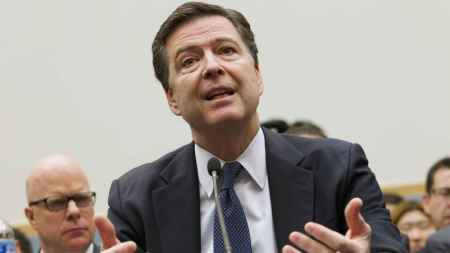
FBI Director James Comey testified Thursday before the House of Representatives Oversight and Government Reform Committee on the FBI’s probe of Hillary Clinton’s and her aides’ handling of e-mails containing classified information on her private e-mail system while she was Secretary of State. In more than four and a half hours of testimony, he sought to explain his recommendation, which he made public in his July 5th press statement, that there was not sufficient evidence for a reasonable prosecutor to bring a criminal case against Hillary Clinton. He said the FBI had not developed clear evidence that Clinton intentionally violated the law. Attorney General Loretta Lynch closed the case on July 6th based on the FBI’s recommendation.
When asked whether the FBI was looking into the Clinton Foundation, however, Director Comey notably declined to answer.
Director Comey admitted that he did not participate himself in the FBI’s interview of Hillary Clinton last Saturday, nor did he talk to all of the agents who were present at the interview. There evidently is no recording or full transcript of the interview, but there is an analysis which may or may not be provided to Congress. He also admitted that he did not compare Hillary’s FBI interview with her prior sworn testimony to Congress before he made his decision on what to recommend. Director Comey said a new referral from Congress for an investigation of possible perjury before Congress would be required. House Oversight and Government Reform Committee Chairman Jason Chaffetz (R-UT) responded that such a referral would be forthcoming shortly. The referral could include Clinton’s testimony that her attorneys had actually read the e-mails that they then deleted and that “There was nothing marked classified on my emails, either sent or received.”
In defending his recommendation not to prosecute Hillary Clinton or her aides regarding their handling of e-mails containing classified information on insecure e-mail facilities, the FBI director declared that there was not sufficient proof of willful intent, which he said is regularly imputed as a requirement to convict in all applicable criminal statutes. He said that proof of Hillary Clinton’s knowledge that what she did was unlawful would be required to justify a referral for criminal prosecution, which he claimed was lacking. In response to questions, the director tried to distinguish the Hillary Clinton case from the prosecution of General David Petraeus, which he claimed was based on evidence of Petraeus’s knowing and willful wrong-doing.
Although denying that he was effectively re-writing the language of any relevant statute to reach his conclusion, Director Comey asserted that it was appropriate to ignore the express “gross negligence” element in one such statute dealing with the gathering of defense-related information (18 U.S. Code §793(F)). He based his decision to ignore the “gross negligence” statutory element, despite his own statement that Hillary Clinton had been “extremely careless” in the “handling of very sensitive, highly classified information,” on his understanding of past precedent. He explained that federal prosecutors have brought only one case based on gross negligence in the last 99 years because, in part, of constitutional concerns with convictions in cases where there is no showing of criminal intent. He also concluded that it would be unfair to embark on what he called “celebrity hunting” by singling out Hillary Clinton for prosecution for “gross negligence” when only one such case has been brought in 99 years. Similarly, the director disputed that the requisite criminal intent was provable under a separate criminal statute involving the unauthorized removal and retention of classified documents or material in an unauthorized location (18 U.S. Code § 1924), even though that is precisely what Hillary Clinton did.
Director Comey walked a tightrope during the Congressional hearing. He tried to reconcile the findings he set forth in his July 5th press statement and his Congressional testimony, which were at significant variance with assertions Hillary Clinton has made publicly over the last year and in her Congressional testimony under oath. He failed to square the circle.
Even assuming that Director Comey was correctly applying what he described as a criminal intent standard, he failed to take into account the relevant circumstantial evidence of such intent.
Rep. Trey Gowdy (R-SC) had an exchange with Director Comey that set out the case for concluding that Hillary Clinton had criminal intent based on such circumstantial evidence. It is worth quoting from at length:
“GOWDY: …I’m going to ask you to put on your old hat. False exculpatory statements — they are used for what?
COMEY: Well, either for a substantive prosecution, or for evidence of intent in a criminal prosecution.
GOWDY: Exactly. Intent, and consciousness of guilt, right? Is that right?
COMEY: Right.
GOWDY: Consciousness of guilt, and intent. In your old job, you would prove intent, as you just referenced, by showing the jury evidence of a complex scheme that was designed for the very purpose of concealing the public record. And you would be arguing, in addition to concealment, the destruction that you and I just talked about, or certainly the failure to preserve. You would argue all of that under the heading of intent.
You would also be arguing the pervasiveness of the scheme: when it started, when it ended, and the number of e-mails, whether they were originally classified or up-classified. You would argue all of that under the heading of intent…
She affirmatively rejected efforts to give her a state.gov account, she kept these private e-mails for almost two years, and only turned them over to Congress because we found out she had a private e-mail account.
So you have a rogue e-mail system set up before she took the oath of office; thousands of what we now know to be classified e-mails, some of which were classified at the time; one of her more frequent e-mailed comrades was, in fact, hacked, and you don’t know whether or not she was; and this scheme took place over long period of time and resulted in the destruction of public records — and yet you say there is insufficient evidence of intent?
You say she was “extremely careless,” but not intentionally so. Now, you and I both know intent is really difficult to prove. Very rarely do defendants announce, “On this day, I intend to break this criminal code section. Just to put everyone on notice, I am going to break the law on this day.” It never happens that way. You have to do it with circumstantial evidence — or, if you’re Congress, and you realize how difficult it is to prove specific intent, you will formulate a statute that allows for “gross negligence.”
Congressman Gowdy asked Director Comey point-blank if Clinton’s testimony that she did not e-mail “any classified material to anyone on my e-mail” was true. Comey said it was not true. Was Clinton telling the truth when she said that she used only one device while Secretary of State? Comey said she used multiple devices. Did she return all work-related e-mails to the State Department as she had claimed? No was the reply. “We found work-related emails, thousands that were not returned,” Comey said.
Yet Director Comey skated by the voluminous amount of circumstantial evidence linking Hillary Clinton’s many lies demonstrating guilty knowledge to proof of her criminal intent. Contrary to common sense, Director Comey said he did not think that Clinton meant to erase any e-mails despite the volume of erased e-mails that were work-related and some of which contained information that was deemed classified at the time they were sent or received. He rationalized Clinton’s handling of classified information on her private unsecured server on the grounds that she appeared to be “unsophisticated” in such matters. He tried to explain away Clinton’s direction to have a classified marking removed from a document and sent to her unsecured system as a so-called “non-paper.”
In short, Director Comey did not budge from his recommendation, accepted by Attorney General Lynch, that there be no criminal prosecution of Hillary Clinton or her aides as a consequence of their handling of classified information in e-mails sent or received over insecure facilities. He insisted that the FBI investigation and his recommendation, to which he said there was no dissent within the FBI team that conducted the investigation, were honest, apolitical and even-handed. Whatever his reasons for reaching the legal conclusion that he did, Director Comey has at least provided enough factual findings for the court of public opinion to judge Hillary Clinton’s “extreme carelessness” and pattern of lies to cover up her wrong-doing.
The only real news to come out of the Congressional hearing was that there will be a new referral to the FBI to investigate Hillary Clinton for possible perjury and that she may not be out of the woods yet with regard to the Clinton Foundation.
Hillary Isn’t Out of the email Woods, Power Line,
The bottom line is that Hillary will remain under investigation at least until November, and the headlines and disclosures will continue. The fallout from her bizarre indifference to national security isn’t going away.
********************************
I am not as outraged as some over the FBI’s failure to recommend criminal prosecution of Hillary Clinton, in part because I am glad she is still the Democratic Party’s presidential nominee. While Hillary no doubt breathed a sigh of relief at not being indicted, her recklessness in handling national security information will continue to dog her. If you haven’t yet watched Rep. Trey Gowdy’s brief questioning of James Comey this morning, in which Comey repeatedly said that statements made by Hillary were not true, you should do so. This is great fodder for campaign ads.
But the trouble doesn’t stop there. Rep. Jason Chaffetz asked the FBI director whether Mrs. Clinton lied to Congress; Comey replied that the FBI has not investigated that question:
“I don’t think there’s been a referral from Congress.”
“Do you need a referral?” Mr. Chaffetz said, appearing incredulous.
“Sure do,” Mr. Comey said.
“You’ll have one,” Mr. Chaffetz promised.
So there is another investigation of slightly different questions that apparently will be launched promptly.
Now, the Associated Press reports that the State Department is reopening its investigation into mishandling of classified information by Mrs. Clinton and her staff:
The State Department is reopening an internal investigation of possible mishandling of classified information by Hillary Clinton and top aides, officials told The Associated Press on Thursday.
Although the former secretary of state’s closest confidants have left the agency, they could still face punishment. The most serious is the loss of security clearances, which could complicate her aides’ hopes of securing top positions on her national security team if she becomes president.
The State Department started its review in January after declaring 22 emails from Clinton’s private server to be “top secret.” It was suspended in April so as not to interfere with the FBI’s inquiry. State Department spokesman John Kirby said the probe is restarting after the Justice Department’s announcement Wednesday that it won’t bring any criminal charges. …
Clinton was secretary of state until early 2013. Most of her top advisers left shortly thereafter.
But Kirby said this week former officials can still face punishment. Options range from counseling and warnings to the revocation of an individual’s security clearance.
The bottom line is that Hillary will remain under investigation at least until November, and the headlines and disclosures will continue. The fallout from her bizarre indifference to national security isn’t going away.
Iranians & Walid suicide units on Golan border, DEBKAfile, July 8, 2016

A flurry of false Hizballah claims amid rising military tension this week was designed to cover up a direct Israeli hit of the Iranian Revolutionary Guards HQ in South Syria, DEBKAfile military and intelligence sources disclose.
Whereas Hizballah reported on July 5 that Israeli helicopters had attacked Syrian army positions near the Golan town of Quneitra, in fact, one of the two Israeli “Tamuz” IDF rockets fired on July 4, in response to stray cross-border Syrian army mortar shells, struck the Syrian Ministry of Finance building near Quneitra, which housed Iranian Guards and Hizballah regional headquarters. An unknown number of Iranian officers were killed as a result.
On July 6, Hizballah sources reported a high level of tension at its east Lebanese outposts in Hasbaya, al-Qarqoub and Mount Hermon, indicating possible preparations to retaliate for the Iranian casualties.
The mortar shells that occasionally stray into Israel are aimed by the Syrian forces in Quneitra at Syrian rebel engineering units, which are digging an anti-tank trench on the town’s southern edge to prevent Syrian tanks from mounting an all-out assault against them (See attached map).
These skirmishes are put in the shade by the dangerous gains by Islamist terrorists in southern Syria.
Both ISIS and al-Qaeda’s Nusra Front have overrun the entire Syrian strip bordering on Israel and Jordan – a distance of 106km from Daraa up to the Druze villages of Mount Hermon.
The Islamists have seized control of this strategic borderland by taking advantage of the fighting between Syrian army and Syrian rebel forces in southern Syria.
Israel and Jordan were also remiss. The IDF and the Jordanian Army were so busy trying to prevent the Syrian army, the Iranian Revolutionary Guards and Hizballah from encroaching on their northern defense lines in northern Jordan and the Golan that they failed to notice the Islamic terrorists creeping up on their borders.
The terrorist presence which Israel finds most alarming is that of the “Khaled Bin Al-Walid Army” – a militia linked to both ISIS and al-Qaeda, which now controls a 36km band bordering on central and southern Golan from south Quneitra to the Jordan-Israel-Syria tri-border area – opposite Hamat Gader and Shaar HaGolan (See map).
The Khaled Bin Al-Walid Army was spawned by a union between the Islamist Liwa Shouada Yarmouk and Mouthana Islamic Movement militias. Its commander is Abu Abdullah al-Madani, a Palestinian from Damascus, who is one of al-Qaeda’s veteran fighters. Close to Osama Bin-Laden, he fought with hhimagainst the Americans when they invaded Afghanistan 15 years ago. Ten years ago, he moved to Iraq, still fighting Americans, now alongside the al-Qaeda commander Abu Musab al-Zarqawi.
When al-Qaeda was defeated in Iraq, al-Madani moved to Syria.
DEBKAfile counter terror sources report that this veteran of Islamist terrorism, who is believed to be in touch wit Bin Laden’s successor Ayman al Zawahri, is active in three areas:
1. He is purchasing and stockpiling chemical weapons – a high priced commodity frequently traded among various Syrian rebel organizations.
2. Abu Abdullah al-Madani is recruiting from his militia suicide units for which he is personally training for operations inside Israel. DEBKAfile sources say that his plan is being taken very seriously by Israel security chiefs.
3. He is maintaining operational ties with Al Nusra commanders in the border region, possibly seeking access to the Israeli border through their turf for his chemical weapons and suicide units.
German intel report charges Iran seeking illegal nuke, missile tech, Fox News, Benjamin Weinthal, July 7, 2016
While the German intelligence report did not say what specifically Iran had obtained or attempted to obtain, the more recent report said dual use goods such as carbon fiber must be reported. Iran did not seek permission from the UN-affiliated panel for its proliferation attempts and purchases in Germany, officials said.
************************
With the ink barely dry on the deal between the U.S. and Iran to prevent the Islamic Republic from securing nuclear weapons, a new German intelligence document charges that Iran continues to flout the agreement.
Germany’s domestic intelligence agency said in its annual report that Iran has a “clandestine” effort to seek illicit nuclear technology and equipment from German companies “at what is, even by international standards, a quantitatively high level.” The findings by the Federal Office for the Protection of the Constitution, Germany’s equivalent of the FBI, were issued in a 317-page report last week.
German Chancellor Angela Merkel underscored the findings in a statement to parliament, saying Iran violated the United Nations Security Council’s anti-missile development regulations.
“Iran continued unabated to develop its rocket program in conflict with the relevant provisions of the UN Security Council,” Merkel told the Bundestag.
Merkel told lawmakers NATO’s anti-missile system, including a shield in Romania and a planned shield in Poland, were deployed in response to Iran’s rocket program and was “developed purely for defense” in a sign of how seriously the alliance takes Iran’s illegal ambitions.
One year ago, world powers led by the U.S. negotiated a nuclear deal designed to curb Iran’s drive to obtain an atomic weapon of mass destruction. The lifting of sanctions and the release of more than $100 billion of assets frozen since Iran’s 1979 revolution came in exchange for Iran’s pledge to forgo its nuclear weapons program and be transparent to international inspections.
The German report also stated “it is safe to expect that Iran will continue its intensive procurement activities in Germany using clandestine methods to achieve its objectives.”
According to an Institute for Science and International Security July 7 report by David Albright and Andrea Stricker, Iran is required to get permission from a UN Security Council panel for “purchases of nuclear direct-use goods.”
While the German intelligence report did not say what specifically Iran had obtained or attempted to obtain, the more recent report said dual use goods such as carbon fiber must be reported. Iran did not seek permission from the UN-affiliated panel for its proliferation attempts and purchases in Germany, officials said.
In addition, the report identified more than 1,000 associates of Iranian-backed terror groups living in Germany, including some 950 Hezbollah members and supporters, as well as 300 Hamas members. The report implied that some of these individuals could be inside Germany working on behalf of Iran and other terror-sponsoring states.
“The followers of Islamist-terrorist groups like Hamas and Hezbollah striving for the abolition of the Jewish State of Israel are focused on their regions of origin, which is where they commit most of their terrorist acts of violence,” the report said.




 anneinpt
 artaxes
 danmillerinpanama
 davidking1530
 Peter Hofman
 Joseph Wouk
 Peter
Peter Louisiana Steve


 WarSclerotic
Recent Comments