Archive for July 2, 2016

The FBI Interrogates Hillary Clinton at FBI Headquarters

July 2, 2016

The FBI Interrogates Hillary Clinton at FBI Headquarters, PJ MediaDebra Heine, July 2, 2016

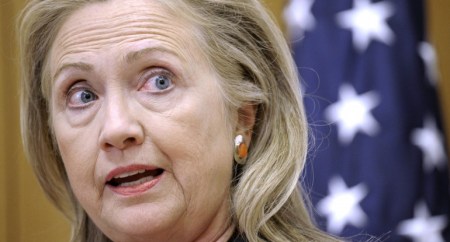
Hillary FBISecretary of State Hillary Clinton marks the State Department’s observance of the first International Day of the Girl Child, Wednesday, Oct. 10, 2012, at the State Department in Washington.(AP Photo/Cliff Owen)

The Clinton campaign has long characterized the FBI investigation as a “security review” or “security inquiry” in order to downplay the severity of the probe. In what PJ Media’s J. Christian Adams interpreted as a very bad sign, Attorney General Loretta Lynch recently used the same language, calling it a “security inquiry.” But FBI Director James Comey said he wasn’t familiar with such language, saying in May, “we’re conducting an investigation… That’s what we do.”

***********************

Presumptive Democratic nominee Hillary Clinton was questioned by the FBI for over three hours Saturday over her use of a private email server for official correspondence while secretary of state. The meeting — characterized as “voluntary” because there was no subpoena — lasted about three and a half hours according to reports, and was conducted at the FBI headquarters in Washington, D.C.

Via Fox News:

Clinton “is pleased to have had the opportunity to assist the Department of Justice in bringing this review to a conclusion” campaign spokesman Nick Merrill said in a statement. He also said Clinton, the presumptive Democratic presidential nominee, will not make further comment about the interview.Clinton’s use of the private server and email address — particularly whether the setup was used for classified information and how secure they were — has cast a shadow over her campaign from the start.

The FBI investigation is purportedly coming to a close, and the Clinton interview is considered among the final steps in the case.

The Clinton campaign has long characterized the FBI investigation as a “security review” or “security inquiry” in order to downplay the severity of the probe. In what PJ Media’s J. Christian Adams interpreted as a very bad sign, Attorney General Loretta Lynch recently used the same language, calling it a “security inquiry.” But FBI Director James Comey said he wasn’t familiar with such language, saying in May, “we’re conducting an investigation… That’s what we do.”

“She is the main subject — we believe with good reason — of a criminal investigation here,” said former FBI Assistant Director Steve Pomerantz on Fox News today. “And this interview — interrogation if you will — is the culmination of that lengthy investigation.”

Pomerantz said, “the agents who conducted this interview have prepared for weeks, if not months, and have a list of questions very long to ask her. It’s an adversarial process.” He continued, “these agents — if you’ll excuse the terminology — they want to sweat her. They want to get her under pressure, and they want to get answers to tough questions that they have.”

The former G-man added, “this is not a pleasant process for her.”

The ongoing email scandal blew up earlier this week when Bill Clinton initiated a meeting with Lynch on her airplane on an airport tarmac in Phoenix, prompting calls for Lynch to recuse herself. “There’s no good reason for her to have met with him. None. Zip,” said former U.S. Attorney Joseph DiGenova during an interview with The Daily Caller.

Security Cabinet Meets Sat. Night on Answers to Terror [video]

July 2, 2016

By: David Israel

Published: July 2nd, 2016

Source: The Jewish Press » » Security Cabinet Meets Sat. Night on Answers to Terror

IDF soldiers securing Route 60
Photo Credit: IDF

The security cabinet is meeting Saturday night following the two murderous attacks on Jewish civilians in Judea and Samaria last Thursday and Friday. Two ministers, Naftali Bennett (Habayit Hayehudi) and Gilad Erdan (Likud) have pointed a finger at one of the culprits in the wave of terror — Facebook, or, rather, the entire Internet and its social networks. Bennett plans to present a plan to take care of “viral terrorism,” including a demand to deny the use of Facebook and the Internet throughout the Hebron Mountain area, where so many terrorists have originated.

Appearing on Channel 2’s “Meet the Press,” Internal Security Minister Erdan attacked Facebook and its founder Mark Zuckerberg, saying, “Facebook is sabotaging police efforts to capture terrorists.” He even added that “the blood of the murdered is on Zuckerberg’s hands,” and called for a citizen’s rebellion against Facebook.

Bennett plans to demand at the cabinet meeting tonight the arrest of every Hamas activist in Judea and Samaria released in the Gilad Shalit deal who have since committed any violations. This has been done once before during the “Return, oh brothers” operation to locate the three Israeli boys kidnapped exactly two years ago, an act that preceded the 2014 Gaza War.

Bennett also insists on a full-scale military operation in areas A and B which are under PA control officially. He also demands blocking Arab traffic on Route 60, where the drive-by murder of Michael Mark was carried out Friday. “We can no longer continue with the old program,” he said, “we must switch the disc.”

The government meanwhile has ordered several steps in response to the attacks. Prime Minister Netanyahu and Defense Minister Liberman approved a bid for 42 new housing units in Kiryat Arba, the late Hallel Yaffa Ariel HY”D’s home town. The bid had been frozen 18 months ago and thawed on FRiday.

The IDF has imposed a complete closure on Hebron and neighboring villages, which includes roughly 700 thousand Arabs. In addition, the IDF has moved two paratrooper units and one infantry unit to the Hebron area.


28 Dead in Bangladesh as Jihadis Tortured, Killed Those Who Couldn’t Recite Quran

July 2, 2016

28 Dead in Bangladesh as Jihadis Tortured, Killed Those Who Couldn’t Recite Quran

by Breitbart News

2 Jul 2016

Source: 28 Dead in Bangladesh as Jihadis Tortured, Killed Those Who Couldn’t Recite Quran – Breitbart

The Associated Press

DHAKA, Bangladesh (AP) — The hostages were given a test: recite verses from the Quran, or be punished, according to a witness. Those who passed were allowed to eat. Those who failed were slain.

The dramatic, 10-hour hostage crisis that gripped the Bangladesh’s diplomatic zone ended Saturday morning with at least 28 dead, including six of the attackers, as commandos raided the popular restaurant where heavily armed attackers were holding dozens of foreigners and Bangladeshis prisoner while hurling bombs and engaging in a gunbattle with security forces.

The attack marks an escalation in militant violence that has hit the traditionally moderate Muslim-majority nation with increasing frequency in recent months, with the extremists demanding the secular government revert to Islamic rule. Most previous attacks have involved machete-wielding men singling out individual activists, foreigners and religious minorities.

But Friday night’s attack was different, more coordinated, with the attackers brandishing assault rifles as they shouted “Allahu Akbar” (God is Great) and stormed the Holey Artisan Bakery in Dhaka’s Gulshan area while dozens of foreigners and Bangladeshis were dining out during the Ramadan holy month.

The gunmen, initially firing blanks, ordered restaurant workers to switch off the lights, and they draped black cloths over closed-circuit cameras, according to a survivor, who spoke with local TV channel ATN News. He and others, including kitchen staff, managed to escape by running to the rooftop or out the back door.

But about 35 were trapped inside, their fate depending on whether they could prove themselves to be Muslims, according to the father of a Bangladeshi businessman who was rescued Saturday morning along with his family.

“The gunmen asked everyone inside to recite from the Quran,” the Islamic holy book, according to Rezaul Karim, describing what his son, Hasnat, had witnessed inside. “Those who recited were spared. The gunmen even gave them meals last night.”

The others, he said, “were tortured.”

Detectives were questioning his son and his family along with other survivors as part of the investigation on Saturday, as scattered details of the siege emerged. Authorities were also interrogating one of the attackers captured by commandos in dramatic morning rescue.

It was not immediately clear whether the attackers had a specific goal, and Bangladesh authorities would not say if they had made any demands.

The 20 hostages killed included nine Italians, seven Japanese, three Bangladeshis and one Indian, government sources said, as details of the bloodshed began trickling from other capitals worldwide.

“All the hostages were killed last night. The terrorists used sharp weapons to kill them brutally,” said Brig. Gen. Nayeem Ashfaq Chowdhury of the Army Headquarters in a news conference Saturday night.

Another two Bangladeshi police officers also died from injuries sustained while exchanging gunfire with the attackers Friday night.

In New Delhi, Foreign Minister Sushma Swaraj said she was “extremely pained to share that the terrorists have killed Tarushi, an Indian girl who was taken hostage in the terror attack in Dhaka.”

Eighteen-year-old Tarushi Jain had been on holiday from her studies at the University of California, Berkeley. She was in Dhaka visiting her father, who has run a garment business in the country for the past 15 or 20 years, according to Indian government sources, who were not authorized to speak with media and so requested anonymity.

But another Indian citizen, a doctor who spoke Bengali and could pass himself as a Bangladeshi, was released unharmed, a government source said.

A Bangladeshi woman Ishrat Akhond was also among the dead. She had been holding a dinner meeting with Italian businessmen when she was killed in the siege, according to three of her friends who did want to be named for fear of reprisal. One told the AP, “she was such a loving person, such a good friend.” Others posted photographs and messages of disbelief and condolences on her Facebook page.

Another victim, Abinta Kabir, had been a student at Emory University’s campus in Oxford, Georgia, and was visiting family and friends on a vacation, the university said in an email to employees.

Ten of 26 people who were wounded Friday night when the militants opened fire were in critical condition, and six were on life support, according to hospital staff. The injuries ranged from broken bones to gunshot wounds. Most of them were police officers, but one was a civilian. Hospital staff refused to provide any details of their condition on Saturday.

In the end, paramilitary troops managed to rescue 13 hostages, including one Argentine, two Sri Lankans and two Bangladeshis, according to Lt. Col. Tuhin Mohammad Masud, commander of the Rapid Action Battalion that conducted the rescue operations. Japan’s government said one Japanese hostage was also rescued with a gunshot wound.

The commandos launched the morning rescue operation after the attackers did not respond to calls for negotiation, Masud said. As the troops, wearing flak jackets and helmets and armed with automatic weapons, moved in on the restaurant at 7:40 a.m., local TV stations reported the sound of gunfire and explosions. At least seven armored vehicles and ambulances stood by.

The commandos killed six of the attackers and recovered explosive devices and sharp weapons from the scene, said Chowdhury of the Army Headquarters.

“Because of the effort of the joint force, the terrorists could not flee,” Prime Minister Sheikh Hasina said in a nationally televised speech, vowing to fight militant attacks in the country and urged people to come forward.

The audacious attack came during Ramadan, when devout Muslims fast during the day and eat after dark. Many left the city of more than 10 million people for a nine-day public holiday with families to celebrate Eid al Fitr festival with families.

“Anyone who believes in religion cannot do such an act,” Hasina said. “They do not have any religion, their only religion is terrorism.”

She announced two days of national mourning for the dead.

The Islamic State group claimed responsibility, saying it targeted the citizens of “Crusader countries” in the attack. The statement was circulated by IS supporters on the Telegram messaging service and resembled previous statements by IS. It was not immediately clear if its leadership in Syria and Iraq was involved in the planning the attack. The Amaq news agency, affiliated with IS, also posted photos purportedly showing hostages’ bodies, though the authenticity of the images could not be confirmed.

The government did not directly comment on the IS claim but has denied in the past that the extremist group has a presence in Bangladesh. Hasina’s government instead has accused her political enemies of orchestrating the violence in order to destabilize the nation – which the opposition denies.

The government has cracked down on domestic radical Islamists by making scores of arrests. It has blamed local terrorists and opposition political parties – especially the main opposition Bangladesh Nationalist Party and its Islamist ally Jamaat-e-Islami.

But the attacks have continued, with about two dozen atheist writers, publishers, members of religious minorities, social activists and foreign aid workers slain since 2013. Earlier on Friday, a Hindu temple worker was hacked to death by at least three assailants in southwest Bangladesh. IS and and al-Qaida affiliates have claimed responsibility for many of those attacks.

The escalating violence leading up to the unprecedented hostage crisis has raised fears that religious extremists are gaining a foothold in the country, despite its traditions of secularism and tolerance. That the attackers targeted a popular restaurant in the heart of the diplomatic quarter of Bangladesh’s capital signaled a change in tactics. The restaurant overlooking a lake serves Spanish food and is patronized by residents of Gulshan, an affluent neighborhood where most of the foreign embassies are located.

In Washington, a White House official said President Barack Obama was briefed on the attack by his chief counterterrorism adviser Lisa Monaco. The president asked to be kept informed as the situation develops, said the official, who was not authorized to speak publicly about the president’s meetings.

State Department spokesman John Kirby says the U.S. had offered its assistance to bring those responsible to justice.

Hillary Must Come Clean About Huma Abedin

July 2, 2016

Hillary Must Come Clean About Huma Abedin, Front Page MagazineJoseph Klein, July 1, 2016

(She won’t, but it won’t matter. As any fool knows, all allegations of wrong-doing are part of a “vast right wing conspiracy” and therefore not deserving of a substantive response.  — DM)

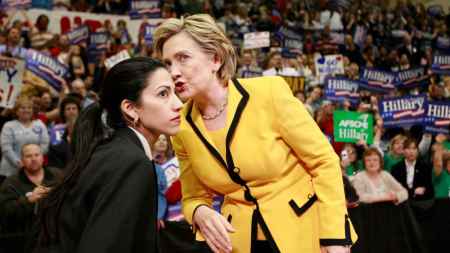
Hil And Abe

Into this morass steps Huma Abedin, the co-chair of Hillary Clinton’s presidential campaign and a person likely to have significant influence in a Hillary Clinton White House. Huma Abedin has had murky associations in the past with the Institute of Muslim Minority Affairs, which not only is a radical Islamist group in its own right but, as Breitbart has reported, was “located in the offices of Saudi Arabia’s Muslim World League.”

**********************

Saudi Arabia’s Islamic Affairs Department website contained a passage extolling jihad:  “The Muslims are required to raise the banner of Jihad in order to make the Word of Allah supreme in this world…” (As published by The Middle East Media Research Institute)  The Saudi government and some of its influential radical Islamic citizens and groups are pursuing the export of jihad in two ways. The first is through what has been referred to as “civilization jihad.” Saudi Arabia has spent billions of dollars in funding Sunni mosques, madrasas, and Sunni cultural centers all over the world, which spread the Saudis’ radical Islamic Wahhabi ideology. However, Saudi Arabia’s jihad also includes the support of terrorism.  A cable released by WikiLeaks under then Secretary of State Hillary Clinton’s name stated: “Donors in Saudi Arabia constitute the most significant source of funding to Sunni terrorist groups worldwide.”

The Muslim World League is an organization with ties to jihadist terrorist groups, including Hamas and al Qaeda.  The Muslim World League was founded by members of the Saudi government. Abdullah Omar Naseef exemplifies the connection between the Saudi government and this terrorist-supporting organization. He served as Secretary-General of the Muslim World League from 1983 to 1993. He also served as Vice-President of the Kingdom’s Shura Council. In addition, he founded the Institute of Muslim Minority Affairs, which, according to former Assistant United States Attorney Andrew McCarthy, seeks to “grow an unassimilated, aggressive population of Islamic supremacists who will gradually but dramatically alter the character of the West,” and to “infiltrate Sharia principles in our law, our institutions, and our public policy.”

The Muslim World League escaped being placed on the list of terror groups sanctioned by the United States shortly after the 9/11 attack, reportedly due to concern by President George W. Bush’s administration about embarrassing the Saudi government. Nearly thirteen years later, the Saudi government is still getting a free pass. The American people have still been denied access to the portion of the 9/11 Commission report relating to any Saudi Arabian government ties to the 9/11 hijackers.

Into this morass steps Huma Abedin, the co-chair of Hillary Clinton’s presidential campaign and a person likely to have significant influence in a Hillary Clinton White House. Huma Abedin has had murky associations in the past with the Institute of Muslim Minority Affairs, which not only is a radical Islamist group in its own right but, as Breitbart has reported, was “located in the offices of Saudi Arabia’s Muslim World League.”

Huma grew up in Saudi Arabia, where she was exposed to the Wahhabi ideology during her formative years. The Institute of Muslim Minority Affairs, founded by Abdullah Omar Naseef, has been an Abedin family affair. Huma herself served as the assistant editor of the institute’s journal for a dozen years until she joined Hillary’s State Department. Abdul lah Omar Naseef was on the board of advisers of the journal while Huma was its assistant editor.

Hillary Clinton owes the American people an explanation of the role that she would foresee for her close confidante, Huma Abedin, in a Hillary Clinton administration. And Huma Abedin owes the American people a full accounting of the associations which she and her family have had with any radical Saudi-backed Islamic groups, such as the Institute of Muslim Minority Affairs and its co-located Muslim World League, or radical Islamic Saudi individuals such as Abdullah Omar Naseef.

It’s not as if Hillary is unaware of Saudi Arabia’s connection to terrorism. As mentioned earlier, a cable sent under Hillary’s name while she was Secretary of State warned that Saudi Arabian donors “constitute the most significant source of funding to Sunni terrorist groups worldwide.” Following the Orlando shooting, the presumptive Democratic nominee for president said: “It is long past time for the Saudis, Qataris and Kuwaitis and others to stop their citizens from funding extremist organizations. And they should stop supporting radical schools and mosques around the world that have set too many young people on a path towards extremism.”

It’s also obvious that Saudi Arabia and ISIS share the same basic underlying Islamic supremacist and jihadist ideologies, despite the Saudi government’s protestations that it is committed to fight terrorism.

For example, ISIS beheads apostates. Saudi Arabia treats apostasy as a capital offense. They are both following literally the path of Prophet Muhammad’s sayings, collected in what is known as the Hadith: “Whoever changed his Islamic religion, then kill him.” (Bukhari 9.84.57)

ISIS kills and persecutes Christians. It destroys Christian holy sites. Saudi Arabia does not allow public worship of any religion other than Islam. It has even arrested Christians praying in a private home. Its religious leader, the Grand Mufti, has called for destruction of all Christian religious sites in the Arabian Peninsula. Smuggling Bibles into the country is a capital offense.  Persecution of Christians, Jews and other “non-believers” by ISIS and Saudi Arabia is also based on core Islamic teaching, rooted in the Koran itself. Infidels are regarded as Muslims’ “inveterate enemies.” (Sura 4:101) Muslims are directed to “seize them and put them to death wherever you find them, kill them wherever you find them, seek out the enemies of Islam relentlessly.” (Sura 4:90)

ISIS beheads suspected homosexuals or throws them off rooftops to die. The Saudi judiciary is calling for capital punishment against homosexuals who display their sexuality in public or on social media. Again, ISIS and Saudi Arabia are both following traditional Islamic teachings. Prophet Muhammad is quoted as saying, “Whoever is found conducting himself in the manner of the people of Lot, kill the doer and the receiver.” (Hadith: al-Tirmidhi, Sunan 1:152)

Finally, Saudi Arabia, like ISIS, believes in exporting its Islamic ideology as widely as possible. ISIS has declared its goal to expand until its flag “covers all eastern and western extents of the Earth, filling the world with the truth and justice of Islam.”  Saudi Arabia’s Islamic Affairs Department website contained a passage, quoted at the beginning of this article, which talks about raising “the banner of Jihad in order to make the Word of Allah supreme in this world…”

Huma Abedin was brought up in Saudi Arabia and was subject to the influence of the very kind of Saudi individuals and groups supporting terrorism that Hillary Clinton has warned about. If Hillary is as concerned as she says about Saudi-funded terrorism and its export of radical Islamist ideology, she must fully address the real concern of many Americans that she may bring an individual susceptible to such ideology into the inner circle of the White House.

If you had doubts about the islamisation of Europe

July 2, 2016

Islam, Islamism and Islamophobia in Europe

\http://www.assembly.coe.int/nw/xml/XRef/Xref-XML2HTML-en.asp?fileid=17880&lang=en

If you had doubts about the islamisation of Europe

Resolution 1743 (2010) Final version

Author(s): Parliamentary Assembly

Origin – Assembly debate on 23 June 2010 (23rd Sitting) (see Doc. 12266, report of the Committee on Culture, Science and Education, rapporteur: Mr Mogens Jensen; Doc. 12303, opinion of the Political Affairs Committee, rapporteur: Mr Hancock; Doc. 12305, opinion of the Committee on Legal Affairs and Human Rights, rapporteur: Mr Rafael Huseynov; and Doc. 12304, opinion of the Committee on Equal Opportunities for Women and Men, rapporteur: Mrs Memecan). Text adopted unanimously by the Assembly on 23 June 2010 (23rd Sitting). See also Recommendation 1927 (2010).

1. The Parliamentary Assembly notes that Islamic radicalism and manipulation of religious beliefs for political reasons oppose human rights and democratic values. At the same time, in many Council of Europe member states, Muslims feel socially excluded, stigmatised and discriminated against; they become victims of stereotypes, social marginalisation and political extremism. The Assembly is deeply concerned about Islamic extremism as well as about extremism against Muslim communities in Europe. Both phenomena reinforce each other.
2. The Assembly recalls that Islamism is the view that Islam is not only a religion but also a social, legal and political code of conduct. Islamism can be violent or mainstream and peaceful, but in both cases it does not accept the separation between religion and state, which is a fundamental principle of democratic and pluralistic societies. The Assembly also recalls that discrimination against Muslims is unacceptable and must be combated. A great majority of European Muslims share the principles at the basis of our societies and it is essential to fight against Islamophobia, which stems mainly from lack of awareness and from negative perceptions associating Islam with violence. Failing to address these issues, many European governments pave the way to the rise of extremism.
3. Muslims are at home in Europe where they have been present for many centuries, as the Assembly noted in its Recommendation 1162 (1991) on the contribution of the Islamic civilisation to European culture. Islam, Judaism and Christianity – the three monotheist religions – share the same historic and cultural roots and recognise the same fundamental values, in particular the paramount value of human life and dignity, the ability and freedom to express thoughts, the respect for others and their property, and the importance of social welfare. Those values have been reflected by European philosophies and have been included in the European Convention on Human Rights (“the Convention”; ETS No. 5).
4. Article 9 of the Convention guarantees freedom of thought, conscience and religion, including the right to manifest one’s religion or belief, either alone or in community with others, in public or in private, in worship, teaching, practice and observance. Article 10 of the Convention enshrines freedom of expression, including the right to express religious or philosophical views or oppose and criticise them. Both freedoms constitute the necessary requirements for a democratic society. However, they are not absolute and may be subject to limits imposed under strict control. Moreover, in accordance with Article 17 of the Convention, they must not be abused for the destruction or undue limitation of any of the rights and freedoms set forth in the Convention.
5. The Assembly has already stressed the importance of reconciling these two freedoms in its Resolution 1510 (2006) on freedom of expression and respect for religious beliefs, as well as its Recommendation 1805 (2007) on blasphemy, religious insults and hate speech against persons on grounds of their religion. The Assembly firmly condemns death decrees and threats against people who criticise Islam or political views linked to Islam. It regrets, however, the initiatives taken by a number of United Nations member states that have resulted in the Human Rights Council adopting resolutions on action against defamation of religions, and in particular Islam, as this strategy constitutes a threat to freedom of expression.
6. Recalling its Recommendation 1804 (2007) on state, religion, secularity and human rights, the Assembly emphasises that democratic standards require a separation of the state and its organs from religions and religious organisations. Governments, parliaments and public administrations that democratically reflect and serve their society as a whole must be neutral towards all religious, agnostic or atheist beliefs. Nevertheless, religion and democracy are not incompatible, in particular as religions may play a beneficial social role. Member states should therefore encourage religious organisations to support actively peace, tolerance, solidarity and intercultural dialogue.
7. The Assembly notes with concern, however, that some Islamic organisations active in member states have been initiated by governments abroad and receive financial support and political guidance from those governments. The objectives of such organisations are hence not religious. National political expansion into other states under the disguise of Islam should be brought to light. In keeping with Article 11 of the Convention, member states can limit the activities of such organisations on condition that such limitations satisfy the requirements set forth in paragraph 2 of Article 11. Therefore, member states should require transparency and accountability of Islamic as well as other religious associations, for instance by requiring transparency of their statutory objectives, leadership, membership and financial resources.
8. As the Assembly indicated in its Recommendation 1774 (2006) on the Turkish presence in Europe: migrant workers and new European citizens, member governments and parliaments as well as the Council of Europe must give priority to fostering the social inclusion of Muslims and other religious minorities. The many efforts undertaken by member states to better integrate migrants are to be commended, but this integration is often still far from reality, in particular with regard to Muslim migrants. Thus, the Assembly invites member states to be proactive in dealing with social, economic and political inequalities.
9. The Assembly calls on member states to effectively address the social and economic exclusion of Muslims and other minorities in Europe – including through the adoption, implementation and regular monitoring of comprehensive anti-discrimination legislation, policies and practices to protect them from the day-to-day discrimination they face and to ensure better access to legal remedies when their rights have been violated.
10. While organisational structures of Muslim communities in member states are desirable in order to facilitate contacts with governmental and administrative bodies, member governments and parliaments should also seek to establish direct political contacts with Muslims as equal citizens. Such direct contacts could be facilitated, for example, through public hearings at local and regional levels as well as through regional and national discussion platforms on the Internet. Referring to Recommendation 170 (2005) of the Congress of Local and Regional Authorities of the Council of Europe on intercultural and inter-faith dialogue: initiatives and responsibilities of local authorities, the Assembly calls on national parliaments to ensure that local authorities in their countries have the necessary legal, administrative and financial frameworks for local activities intended to foster social inclusion and intercultural dialogue.
11. It is necessary that persons belonging to a minority culture in their country do not isolate themselves and do not attempt to develop a parallel society. Thus the Assembly calls on the representatives of the Muslim communities to encourage intercultural dialogue and fight against divisions which would otherwise lead to societal frictions and conflicts. Recalling its Resolution 1605 (2008) and Recommendation 1831 (2008) on European Muslim communities confronted with extremism, the Assembly invites Muslims, their religious communities and their religious leaders to combat any form of extremism under the cover of Islam. Islam is a religion which upholds peace. Muslims should be the first to react with dismay and opposition when terrorists or political extremists use Islam for their own power struggle and thus disrespect the fundamental value of human life and other values enshrined in Islam.
12. The Assembly deplores that a growing number of political parties in Europe exploit and encourage fear of Islam and organise political campaigns which promote simplistic and negative stereotypes concerning Muslims in Europe and often equate Islam with extremism. It is inadmissible to incite intolerance and sometimes even hatred against Muslims. The Assembly calls on member states to pursue political action in accordance with General Policy Recommendation No. 5 (2000) of the European Commission against Racism and Intolerance (ECRI) on combating intolerance and discrimination against Muslims. It reiterates that it is for the member states to reject political statements that stir up fear and hatred of Muslims and Islam, while complying with the stipulations of the Convention, in particular Article 10.2.
13. The Assembly also remains concerned at policies and practices – by both national as well as regional and local authorities – that discriminate against Muslims and at the danger of the abuse of popular votes, initiatives and referenda to legitimise restrictions on the rights to freedom of religion and expression which are unacceptable under Articles 9 and 10 of the Convention. In this context, the Assembly is particularly concerned about the recent referendum in Switzerland and urges the Swiss authorities to enact a moratorium on and repeal as soon as possible, the general prohibition on the construction of minarets for mosques.
14. Recalling its Resolution 1464 (2005) on women and religion in Europe, the Assembly calls on all Muslim communities to abandon any traditional interpretations of Islam which deny gender equality and limit women’s rights, both within the family and in public life. This interpretation is not compatible with human dignity and democratic standards; women are equal to men in all respects and must be treated accordingly, with no exceptions. Discrimination against women, whether based on religious traditions or not, goes against Articles 8, 9 and 14 of the Convention, Article 5 of its Protocol No. 7 and its Protocol No. 12. No religious or cultural relativism may be invoked to justify violations of personal integrity. The Parliamentary Assembly therefore urges member states to take all necessary measures to stamp out radical Islamism and Islamophobia, of which women are the prime victims.
15. In this respect, the veiling of women, especially full veiling through the burqa or the niqab, is often perceived as a symbol of the subjugation of women to men, restricting the role of women within society, limiting their professional life and impeding their social and economic activities. Neither the full veiling of women, nor even the headscarf, are recognised by all Muslims as a religious obligation of Islam, but they are seen by many as a social and cultural tradition. The Assembly considers that this tradition could be a threat to women’s dignity and freedom. No woman should be compelled to wear religious apparel by her community or family. Any act of oppression, sequestration or violence constitutes a crime that must be punished by law. Women victims of these crimes, whatever their status, must be protected by member states and benefit from support and rehabilitation measures.
16. For this reason, the possibility of prohibiting the wearing of the burqa and the niqab is being considered by parliaments in several European countries. Article 9 of the Convention includes the right of individuals to choose freely to wear or not to wear religious clothing in private or in public. Legal restrictions to this freedom may be justified where necessary in a democratic society, in particular for security purposes or where public or professional functions of individuals require their religious neutrality or that their face can be seen. However, a general prohibition of wearing the burqa and the niqab would deny women who freely desire to do so their right to cover their face.
17. In addition, a general prohibition might have the adverse effect of generating family and community pressure on Muslim women to stay at home and confine themselves to contacts with other women. Muslim women could be further excluded if they were to leave educational institutions, stay away from public places and abandon work outside their communities, in order not to break with their family tradition. Therefore, the Assembly calls on member states to develop targeted policies intended to raise Muslim women’s awareness of their rights, help them to take part in public life and offer them equal opportunities to pursue a professional life and gain social and economic independence. In this respect, the education of young Muslim women as well as of their parents and families is crucial. It is especially necessary to remove all forms of discrimination against girls and to develop education on gender equality, without stereotypes and at all levels of the education system.
18. Female genital mutilation under the pretext of Islamic or other customs should be considered as a crime as it violates the right to physical and moral integrity of all individuals and especially of girls. Member states must do their utmost to put an end to this crime and provide practical help to children and their parents, including in particular through education. The Assembly recalls in this context its Resolution 1247 (2001) on female genital mutilation.
19. The Assembly accordingly urges member states to take every step to prevent and combat all forms of oppression or violence undergone by women and, in particular, as part of the negotiations for the future Council of Europe convention on preventing and combating violence against women and domestic violence, to support the provisions enabling women irrespective of their origin or status to have access to protection, prevention and rehabilitation facilities.
20. Stereotypes, misunderstandings and fears with regard to Islam are typical symptoms of a widespread lack of adequate knowledge among non-Muslims in Europe. Similarly, many Muslims in Europe lack adequate knowledge of Islam let alone other religions, which can make them vulnerable to “Islamism” as a religiously disguised form of political extremism. In this context, the Assembly recalls its Recommendation 1720 (2005) on education and religion and calls on member states to ensure that knowledge about Islam, Judaism and Christianity is taught at school and through lifelong education.
21. Teaching about religions should be supported by member states, to raise public awareness of the common origin and values of Judaism, Christianity and Islam and their impact on modern European humanism. Institutions of higher education and research in Europe should provide Islamic studies in order to educate religious scholars, teachers and leaders and distinguish Islam from Islamism. The Assembly is confident that most European Muslims accept a common approach reconciling Islam with democratic values, human rights and the rule of law; indeed, many have done so for a long time.
22. The Assembly also welcomes the White Paper on Intercultural Dialogue prepared by the Council of Europe during the European Year of Intercultural Dialogue in 2008 as well as other activities by the Committee of Ministers in this field. Member governments should use the White Paper in their related national action, including in schools and educational institutions.
23. It is important to create synergies with other international organisations in this respect. Therefore, the Assembly invites the United Nations Alliance of Civilizations to co-operate more closely with the Council of Europe, in particular by setting up joint programmes of action. In this context, the Assembly invites the Secretary General of the Council of Europe to seek additional funding for such activities through member states and facilitate reciprocal secondment of staff between the two organisations.
24. The Assembly invites the Islamic Educational, Scientific and Cultural Organization (ISESCO) and the Arab League Educational, Cultural and Scientific Organization (ALECSO) to work with the Council of Europe on combating Islamism and Islamophobia or other religious discrimination as well as on promoting the respect for universal human rights. ISESCO and ALESCO can be particularly important in ensuring that their members respect the International Covenant on Civil and Political Rights (ICCPR) and the International Covenant on Economic, Social and Cultural Rights (ICESCR) of the United Nations.
25. In this context, the Assembly regrets that some member governments of ISESCO and ALECSO have adopted national legislation based on an interpretation of Sharia law or have pursued national policies which are in conflict with the ICCPR and the ICESCR: imposing severe penalties or even the death penalty on persons wishing to adopt a religion other than Islam is incompatible with Article 18 (2) ICCPR; imposing severe sanctions on, or passing public death decrees against, persons who have criticised Islam is incompatible with Article 19 of the ICCPR; calling for a “holy war” or violence against other countries or their citizens and glorifying terrorists as “holy martyrs” is incompatible with Article 20 (2) of the ICCPR; educating children to hate or fight persons of faiths other than Islam is incompatible with Article 13 (1) of the ICESCR.
26. Contacts between Muslim and non-Muslim Europeans and Muslims in North Africa, the Middle East and Asia should be facilitated, in particular among young people, students and teachers. The Assembly invites, therefore, the European Youth Forum to expand its activities in this field. Co-operation between educational and cultural institutions as well as cities around the Mediterranean Basin should be supported, for instance in the framework of the Convention on the Recognition of Qualifications concerning Higher Education in the European Region (ETS No. 165) and the European Outline Convention on Transfrontier Co-operation between Territorial Communities or Authorities (CETS No. 106).
H/T  E.J.Bron


Cartoons of the Day

July 2, 2016

H/t Power Line

Obama-Hillary-copy


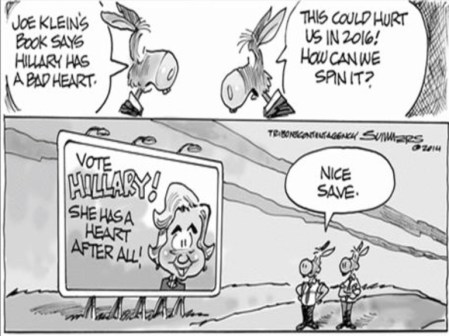
Hillary-Bad-Heart-copy


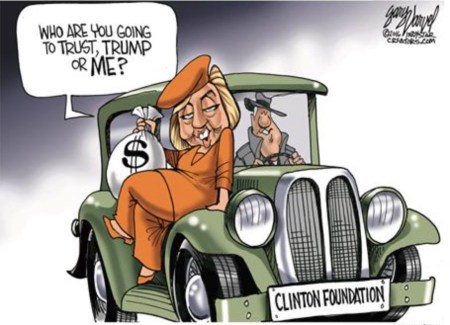
Hillary-Trust-copy


Dem-Parasites-copy


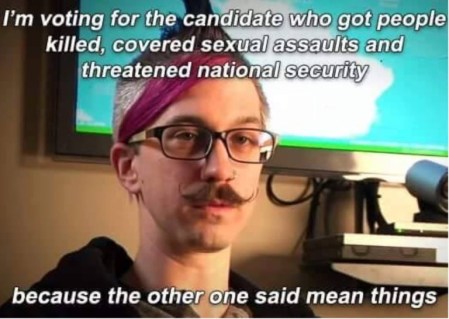
Trump-is-Mean-copy


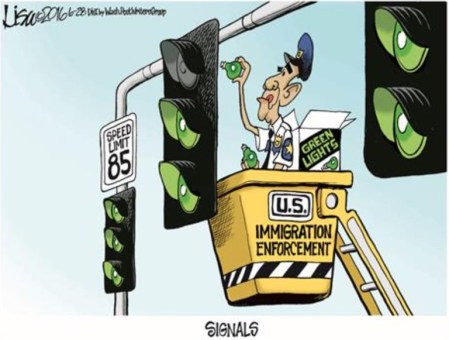
Obama-Signals-copy


To counter Muslim migrant sex assaults, Swedish cops giving girls “Do not molest me” bracelets

July 2, 2016

To counter Muslim migrant sex assaults, Swedish cops giving girls “Do not molest me” bracelets, Jihad Watch

This will work. Can’t you picture it? A Muslim migrant is about to attack an Infidel girl and make her a “captive of the right hand” (cf. Qur’an 4:3, 4:24, 23:1-6, 33:50, 70:30), but then he spies her “Do not molest me” bracelet, apologizes, and hurries away.

Is there no one left in Sweden, or Europe in general, who has any spine? Is every last Western leader determined to stand up to jihad terror and Islamic supremacism in the wimpiest possible manner?

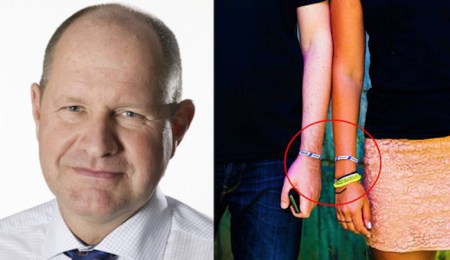
Dan-Eliasson-bracelets-do-not-molest-me

“‘Do not molest me’: Swedish police giving out bracelets to girls in the wake of immigrant attacks,” Fria Tider (Google Translate), June 30, 2016 (thanks to Maurice):

Domestic. In the aftermath of last year’s asylum-related sexual attacks at the “We Are Stockholm” youth festival, the Swedish police are now launching a new campaign. Officers will give out bracelets with the text “Do not molest me” to girls attending this year’s festival, of according to Dan Eliasson, head of the country’s national police force.

“The police are taking the reports of sexual molestation seriously, especially when it happens to young people,” Eliasson said in an official press release.

As a part of the new campaign, police officers equipped with bracelets with the text “Do not molest me” will be late to the Streets of Stockholm. The bracelets will be given out During The Summer Festival in the Swedish capital, and also in connection to other major events frequented by young people.

“This way, we can draw attention to the issue and urge Those Concerned to report,” Mr. Eliasson Continued.

Recently, the Swedish police published a report on sexual crimes in public swimming pools and other public places. : According to the report from May this year, the perpetrators are in most cases male asylum seekers from the Third World. One hypothesis put forward in the report Is that the asylum seekers are attacking Swedish girls as a “result of the Nordic alcohol culture, but overpriced Because of non-traditional gender roles” in the Scandinavian country.

Dr. Jasser joins Intelligence Report discussing the importance of identifying radical Islam

July 2, 2016

Dr. Jasser joins Intelligence Report discussing the importance of identifying radical Islam, AIFD and Fox News via YouTube, July 1, 2016

Boston police captain’s son indicted in ISIS-inspired plot

July 2, 2016

Boston police captain’s son indicted in ISIS-inspired plot

ByPamela Geller

on July 1, 2016

Source: Boston police captain’s son indicted in ISIS-inspired plot | Pamela Geller

The Muslim convert son of the Boston police chief is charged with plotting ISIS attacks:  “explosives filled with black powder, nails, ball bearings and glass, in places where large numbers of people congregate, like college cafeterias.”

Here is a Police Captain whose own son is ISIS. If he couldn’t see it in his own home, how can we expect him and his underlings to be effective against jihad in their cities?

 Boston is a hotbed of jihad terror-related activity. In each case the Muslim terrorists were tied to the notorious Islamic Society of Boston (ISB). What was Abu Al-Ameriki’s connection to ISB, and why hasn’t that mosque been shuttered? The Boston bombings and jihadists who plotted to behead policemen and me were tied to that mosque. What is being done about ISB?

How did this misunderstanding of Islam become so widespread? And why do so many converts understand it in exactly the same way? And while Muslims in the US condemn the Islamic State, where are they teaching against the ideology that gave rise to it?

Boston police captain’s son indicted in ISIS-inspired plot

By Associated Press, NY Post, July 1, 2016:
Modal Trigger Boston police captain’s son indicted in ISIS-inspired plot

BOSTON — A police captain’s son accused of plotting an attack on a college campus to support the Islamic State group was indicted Thursday on terrorism charges.

A federal grand jury indicted Alexander Ciccolo on one count each of attempting to provide material support to a foreign terrorist organization and attempting to use weapons of mass destruction. Those charges were added to a pending indictment charging Ciccolo with being a convicted person in possession of firearms and stabbing a nurse with a pen during a jail intake process.

Ciccolo was arrested last July in a plot to detonate homemade bombs similar to the pressure cooker bombs used in the deadly 2013 Boston Marathon attack. Twin bombs placed near the marathon finish line killed three people and injured more than 260 others.

Ciccolo’s lawyer, David Hoose, declined to comment on the new charges Thursday.

Boston police Capt. Robert Ciccolo alerted the FBI after his son, who’s 23, said he wanted to join the Islamic State group. Alexander Ciccolo was arrested after he received four guns he ordered from a person cooperating with authorities.

The indictment said that Ciccolo, who also used the name Ali Al Amriki, plotted to bomb an unidentified state university outside Massachusetts.

During a detention hearing after his arrest last year, prosecutors said he received four guns from a person cooperating with members of the Western Massachusetts Joint Terrorism Task Force.

Prosecutors say Ciccolo had spoken with the cooperating witness in recorded conversations about his plans to commit acts of terrorism inspired by the Islamic State, including setting off improvised pressure cookers filled with black powder, nails, ball bearings and glass in places where large crowds gather, such as college cafeterias. They also said Ciccolo was seen buying a pressure cooker similar to those used in the marathon bombings the day before his arrest.

Ciccolo has been held without bail since his arrest a year ago. He is scheduled to appear in US District Court in Springfield on July 7.

Two Glock pistols and two assault rifles purchased by Ciccolo