Michael Cutler Moment: Memorial Day and Celebrating the First Amendment, The Glazov Gang via YouTube, May 23, 2016
REPORT: Migrants Committing Disproportionately High Crime In Germany While Media And Govt Focus on ‘Far Right’ Thought Crimes, Breitbart, Raheem Kassam and Chris Tomlinson, May 23, 2016

A massive, migrant crime wave is surging across Germany according to figures buried in a new report released by the country’s Interior Ministry. The data reveals that without migrants considered, crime rates in Germany would have remained roughly static since 2014. But, in fact, the country recorded an extra 402,741 crimes committed by migrants.
While much of this criminality concerned illegal border crossings, German authorities instead talked up a “record surge” in crimes by “right wing radicals”.
Concerning statistics from the 135-page report reveal that 70 per cent of pickpocketing, one of the crime types on the rise, was committed by non-Germans. Of this figure, 34 per cent was committed by recent asylum seekers, with the rest committed by “non-Germans”.
Foreign nationals are thought to account for around 11 or 12 per cent of the total population of Germany, but were over-represented in every area of crime.
Illegal immigrants and asylum seekers account for around 2.5 per cent of Germany’s population, but were also massively overrepresented.
Amongst total offences, non-Germans accounted for 27.6 percent while illegal immigrants and asylum seekers accounted for 5.7 percent. Of homicides, the figures are 29.3%/8.2%, and of sexual assaults, the figures were 20.5%/4.8%.
In all of these cases as well as those indicated in the chart below, non-Germans and illegal migrants outstripped their proportions of crime to their representation in German society.
Non-Germans accounted for 38 per cent of all robberies, 38 per cent of thefts, and 43 per cent of thefts that involved a level of aggravation such as assault or force.
They accounted for 40.2 per cent of burglaries, 43.5 per cent of shoplifting, and a whopping 75.7 of pick pocketing or purse snatching.
In the chart below, non-Germans are in light red while asylum seekers and illegal migrants are in deep red.
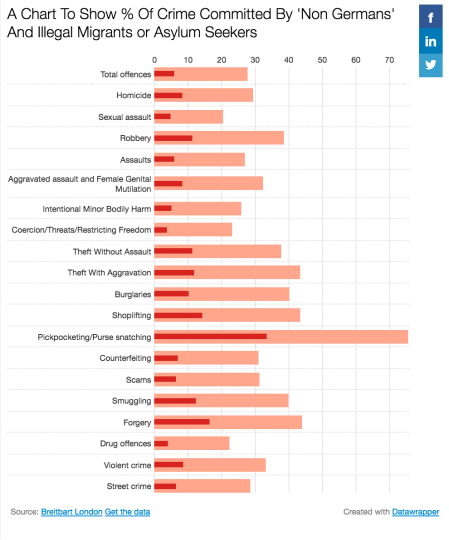
And of migrant crimes specifically, Syrians top the list of migrant crimes that are not related to border controls, with a total of 10,348 individual offences in 2015. They also led assault cases among migrants, with 3,186 offences in 2015.
Thefts were most committed by Albanians, with 6,689 offences and Algerians coming close with 5,611. Algerians almost tie with Serbians when it comes to fraud. Balkan nationals were accountable for 2,834 cases, barely above North Africans’ 2,774.
Algerians top the list for smuggling goods (2,449) and also top the list for drug selling offences (976).
Even when border control breaches are exempted from the data, the situation is still stark. Male crime is stagnant amongst Germans, but when migrants are added, male crime goes up 12 per cent, with female crime rising just 6 per cent. This reflects the fact that most migrants into Europe in 2015 were young men.
Crime rates amongst “non-Germans” outside the residence act are up 13 per cent, whereas crimes committed by Germans are down 5 per cent.
And the report shows that offences against the Residence Act, the Asylum Procedures Act, and the Freedom of Movement Act are up by 157.5 per cent, with shopliftings up by 7.1 per cent, pickpocketing up by 7.0 per cent, burglary up by 9.9 per cent, and drug offences up by 2.1 per cent.
Presenting the report to journalists however, Mr. de Maiziere insisted in focusing on “politically-motivated crimes by the far-right” which he said had risen 35 percent in 2015 to nearly 23,000.
“The sharp increase in politically motivated crime points to a dangerous development in society,” de Maiziere told reporters at a news conference. “We are witnessing a growing and increasingly pronounced readiness to use violence, both by right- and left-wing extremists.”
But while attacks on refugee centre rose to 1,031 compared to 199 in the prior year, most of the offences committed appear to be what could be called “thought crime”, or what police describe as “evidence that they aimed to eliminate certain constitutional principles”.
Of a total of 38,981 political crimes committed in 2015, some 29,681 (76.1 per cent) were classed under this category.
Of real incidents, 1,031 were attacks on asylum centres, but just 177 of these were thought to be “violent”, with most of the rest believed to be “propaganda” offences or vandalism.
And according to the statistics, identified left wingers have had more confrontations with police (3,507 incidents), according to the statistics, than right wingers have (1,203 incidents). Left-wing activists have confronted more right wingers (4,276 incidents) than vice versa (1,406 incidents). These incidents include public protests like those of the PEGIDA movement.
Nonetheless, the reporting from Western news agencies has focused on a “right wing” wave of violence.
Earlier this month, when Republican Party presumptive nominee Donald Trump alleged “[L]ook at Germany, it’s crime-riddled right now”, organisations like Politifact were quick to crow about how immigrants accounted for fewer crimes than native Germans.
But today’s statistics reveal that as a percentage of the population, non-Germans and illegal immigrants account for a massively disproportionate amount of crime in Germany.
Media’s New Muslim Heroine Really Likes Hitler, Front Page Magazine, Daniel Greenfield, May 23, 2016
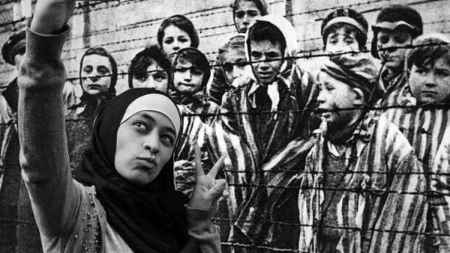
The media fell in love with Zakia Belkhiri, a Muslim settler in Belgium, took some mocking selfies at an anti-Islam rally. And the media quickly fell in love leading to viral gibberish propaganda headlines like this from all the usual sources.
Young Muslim woman trolls anti-Muslim demo with defiant selfies – Mashable
This young Muslim woman brilliantly countered an anti-Muslim protest – Vox
Muslim woman’s cheeky selfie with anti-Islam group goes viral – BBC News
Hijab-Clad Woman Brilliantly Shuts Down Anti-Muslim Protesters – Carbonated.tv
The media painted it as a defiance of bigotry, but Zakia was quite the bigot.
“Hitler didn’t kill all the Jews, he left some,” she wrote in a November 2012 tweet. “So we know why he was killing them.”
In a March 2014 Facebook post, Belkhiri used an expletive for Jews and then wrote: “I hate them so much.”
Well Hitler and anti-Semitism are very popular in the Muslim world. Muslims are not a minority. They’re a supremacist majority. So such behavior is only to be expected.
Turkey’s female journalists now risk parental rights for critical reporting, Al Monitor,
 The Turkish court has sentenced journalist Arzu Yildiz to prison and denied her “parental rights” over a story on MIT trucks and arms transfers to Syria, May 18, 2016. (photo by FACEBOOK/Save Kobane)
Turkish female journalist Arzu Yildiz was this week sentenced to 20 months in prison for her reporting on alleged Turkish arms shipments to Syria, a highly controversial issue that has riled Ankara and landed both journalists and judicial officials in jail. The court, however, did not stop there, and stripped Yildiz also of her parental rights. While the imprisonment of journalists may have become commonplace in Turkey, now ranking 151st on the World Press Freedom Index, the restriction of Yildiz’s parental rights marks a new milestone in the extent the pressure on journalists has reached, affecting even their familial ties and social standing.
Yildiz is an experienced journalist who, after working for various media outlets, was left jobless a couple of years ago. Together with other jobless colleagues, she co-founded the nonprofit Grihat news site, where her reporting on the trucks controversy led to her conviction.
The story in question was related to the interception of Syria-bound trucks in the southern provinces of Hatay and Adana in January 2014. Acting on tip-offs, prosecutors had issued search warrants for the trucks. But when stopped by police and gendarmerie officers, the men in the vehicles identified themselves as members of the National Intelligence Organization (MIT) and resisted the searches. President Recep Tayyip Erdogan claimed at the time the trucks carried humanitarian supplies, but few were convinced. All judicial officials and security forces involved in the attempted search are behind bars today. The Cumhuriyet daily’s Editor-in-Chief Can Dundar and Ankara representative Erdem Gul also found themselves behind bars for their reports on the story. Though they were released three months later, they received jail terms for revealing state secrets earlier this month. Another journalist who covered the issue, Fatih Yagmur, remains on trial.
Yildiz, for her part, faced several investigations for her coverage of the incident and ensuing developments. The report that earned her the 20-month sentence pertained to the testimonies of the prosecutors who were arrested for attempting the search. On top of the prison term, the court in the southern city of Tarsus banned Yildiz from using “certain rights.”
In an interview with Al-Monitor, her lawyer, Alp Deger Tanriverdi, explained what the ruling means. “Let me tell you the most significant part: The ruling strips Arzu Yildiz of her motherhood rights,” he said. “She can no longer register her kids to school, open bank accounts for them or do other similar things on their behalf. She can’t even go abroad with them.”
Asked about the grounds on which the court made the decision, the lawyer said, “The court was [actually] supposed to suspend the sentence because Yildiz had no other conviction before. That was her legal right. Yet the court arbitrarily went ahead on grounds she committed the crime willfully, which automatically brought the decision to strip her from her rights. The court could have withheld this decision as well. Such restrictions are based on the following logic: ‘You’ve committed a crime willfully, so you are guilty before society as well. Thus, you must not be allowed to have a [bad] influence on your children.’ Such is the intention of the clause, yet the court applied it to Yildiz — to humiliate her.”
In remarks to Al-Monitor, Yildiz also lamented the court had acted arbitrarily. “I have two kids — one 6½ years old, the other only four months. I think the court made this decision deliberately, knowing that I’m a mother of two — simply to hurt me more,” she said. “My kids are my whole world. What else do I have? The court now says I can’t claim any right on them, can’t register them to school and can’t travel abroad with them. What hurts even more is that a ban that the courts withhold [even] from child molesters and rapists is being imposed on a journalist.”
Yildiz believes the ruling essentially aims to denigrate and humiliate journalists before the public. Yet, she remains adamant on soldiering on. “I covered the MIT trucks investigation from beginning to end. In the meantime, I gave birth [to my second child] and left my baby home when she was only 20 days old to go watch the hearings in this case,” she said. “I did this without having any financial support. The story in question was published on Grihat, which we had launched without any financial considerations. With this ruling, the court is trying to prevent me from doing journalism but it won’t succeed.”
The restriction on Yildiz’s parental rights sparked indignation from civic society groups and social media users. The issue became a trending topic on Twitter, generating about 50,000 tweets. “Some court rulings are destroying the society’s trust in the judiciary,” the Turkish Journalists’ Trade Union (TGS) said, while Yildiz’s colleagues circulated pictures of her four-month-old daughter with the slogan “Baby Zehra is not alone.”
The onslaught on critical media in Turkey has proceeded through wide-ranging means, including dismissal, judicial probes and imprisonment. According to a recent report by Press for Freedom, an advocacy project carried out by the Ankara-based Journalists Association, 894 journalists lost their jobs in Turkey in the first four months of the year and 74 journalists faced some kind of judicial action. Thirty-six journalists remain behind bars, according to the TGS.
With the Yildiz case, the boundary of intimidation has moved even further, threatening the parental rights of journalists and undermining their standing in society and vis-a-vis the state.
Hillary and Bill Clinton’s Role in Vince Foster’s Death, Defending the USA via YouTube, May 24, 2016
On May 22, 2016, Palestinian Presidency Secretary-General Al-Tayeb ‘Abd Al-Rahim delivered a speech on behalf of Palestinian President Mahmoud ‘Abbas to a group of Palestinian National Security Forces. The speech was part of a ceremony celebrating their second-place win in the international 8th Annual Warrior Competition, which took place in Jordan on May 2-6, 2016.[1]
In his speech, ‘Abd Al-Rahim condemned attempts to intimidate the Palestinian people and divert it from its path, and called such attempts futile, as “our [Palestinian] people loves death more than life.” He added that the National Security Forces victory was a step on the way to establishing an independent Palestinian state, and rejected the notion of establishing a separate independent entity in Gaza, or a state with temporary borders in the West Bank alone.
The following are excerpts from the speech:
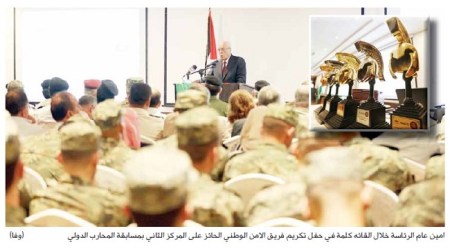 Abd Al-Rahim speaking at the ceremony (Al-Ayyam, PA, May 23, 2016)
“Today we celebrate the Palestinian man, who suffers a lack of means and opportunity, but has will power and is determined to keep the Palestinian flag flying so that it [the flag] remains in the hearts of peace-loving and liberty-loving peoples. We were very happy with this victory [in the Warrior Competition], and the honorable president and commander-in-chief, president Abu Mazen [Mahmoud ‘Abbas], has expressed his esteem for the brothers who won this award and his pride in their achievements. Many commanders in Arab military institutions have also expressed their pride in this new Palestinian man, who is always new and always renewing [himself].
“The occupation wagered that we would forget our cause and that, as the generations passed, we would dissolve into the societies around us… However, the occupation was the first to realize that each new generation was more determined and had a stronger desire to achieve the goals that the martyrs had died for in the distant and the near past and [are still dying for] in the present. Our blood is still being spilled at the roadblocks and the checkpoints by the gangs of settlers and the extremist soldiers of the occupation, some of whom have acknowledged that they do not act according to moral standards when facing our people and children…
“Occupiers are always destined to fail. This fact should be in our minds forever. We must always cling to hope. Our morale will not be influenced or shaken by anything. We will not grow soft or deviate towards personal interests for the sake of dubious goals such as establishing a state or an emirate in Gaza, or establishing a state with temporary borders in the West Bank. We must always tirelessly stick to our truth, and our faith in victory must never falter. It is the faith in our hearts that will lead us to our rights and to the realization of our righteous and legitimate goals…
“Every achievement is a step on the road to establishing an independent state and strengthens our belief that the future is ours, that tyrants will disappear, and that the aggressors will end up in the trash bin of history. Indeed, they are trying to intimidate us today with people who threatened to strike Gaza or the Aswan Dam [a reference to incoming Israeli defense minister Avigdor Liberman], but these threats are hollow as we are a people who loves death more than life when it fights for Palestine.”[2]
Endnotes:
[1] The Annual Warrior Competition is a combat-oriented competition held at the King Abdullah II Special Operations Training Center (KASOTC) in Amman (Warriorcompetition.com).
[2] Al-Hayat Al-Jadida (PA), May 23, 2016.
Austrian Freedom Party: Victory in Defeat, Gatestone Institute, Soeren Kern, May 24, 2016
♦ European political and media elites have been quick to hail the election of Van der Bellen, who campaigned on a pro-immigration, pro-EU platform. They seem to believe his razor-thin win validates their uninterrupted pursuit of European multiculturalism.
♦ Meanwhile, European elites have expressed relief at Norbert Hofer’s defeat. Their reactions would indicate that they unaware that they are largely responsible for the rise of anti-establishment parties in Austria and other parts of Europe.
♦ “Europe has been polarized for years by misguided policies pursued by the old major parties, not only in Germany but in many European countries. The fact is that it must be our task to preserve freedom, democracy and the rule of law across the continent. And the policy of open borders does exactly the opposite.” — Frauke Petry, Alternative for Germany party.
Norbert Hofer of the anti-immigration Austrian Freedom Party (FPÖ) has been narrowly defeated in his bid to become Austria’s next president.
Alexander Van der Bellen, former leader of Austrian Greens party, won 50.3% of the vote, compared to 49.7% for Hofer. The margin of victory was 31,026 out of nearly 4.5 million votes cast.
European political and media elites have been quick to hail the election of Van der Bellen, who campaigned on a pro-immigration, pro-EU platform. They seem to believe his razor-thin win validates their uninterrupted pursuit of European multiculturalism.
But Hofer can claim victory even in defeat. By winning half the ballots cast, Hofer has exposed Austria’s gaping political divide on immigration and relations with the European Union. Hofer’s rise, which has effectively upended Austria’s political system, has also inspired anti-establishment parties in other parts of Europe.
Hofer had been in the lead after polls closed on May 22, with 51.9% of the vote to Van der Bellen’s 48.1%. In the end, however, the race was decided by 700,000 mail-in votes, accounting for 14% of eligible voters. Van der Bellen won 2,254,484 votes to Hofer’s 2,223,458, according to the Interior Ministry.
 In this month’s Austrian presidential election, Alexander Van der Bellen (left), who campaigned on a pro-immigration, pro-EU platform, defeated Norbert Hofer (right) of the anti-immigration Austrian Freedom Party. (Image source: ORF TV video screenshot)
In what amounted to a political earthquake, Hofer won 36% of the vote in the first round of voting on April 24. Hofer — who campaigned on a platform calling for strict limits on immigration and tough rules for asylum seekers — defeated all of the other candidates, including those from the two governing parties, the Social Democrats and the Austrian People’s Party, which have dominated Austrian politics since the end of World War II.
Although the role of president in Austria has traditionally been largely ceremonial, Hofer had suggested that he would try to remove the current government led by newly appointed Chancellor Christian Kern and force new parliamentary elections. Opinion polls suggest that if parliamentary elections were held today, the Freedom Party would win. The next polls are scheduled for some time in 2018.
Van der Bellen, a 72-year-old economist, was gracious in victory, pledging to be “non-partisan president for all of those living in Austria.” He added: “All Austrians are equal. Austria consists of two halves. The one half is just as important as the other half.”
An analysis in the German newspaper Die Welt warned that Van der Bellen will not have it easy:
“It will be up to Van der Bellen to find the right tone and to show that he not only embodies the Austria of the city dwellers, but the whole country. He will have to bear in mind that according to the polls, 40% of those who voted for him did so only because they wanted to prevent a president from the Freedom Party.”
Conceding the election, Hofer wrote on Facebook: “Of course, it is a sad day. But please do not be discouraged. The effort in this election campaign is not wasted. It is an investment for the future.”
Hofer’s meteoric rise has focused the minds of the establishment parties. On April 27, just three days after Hofer’s initial electoral victory, the Austrian Parliament adopted what may be one of the toughest asylum laws in Europe.
Under the new law, Austria will declare a “state of emergency” on the migration crisis. This will allow Austrian authorities to assess asylum claims directly at the border. Only asylum seekers with immediate family members already in Austria, or those who can prove they are in danger in neighboring transit countries, will be allowed to enter the country. Other migrants will be turned away. The new law also limits any successful asylum claim to three years.
Austria received 90,000 asylum requests in 2015, the second-highest number in the European Union on a per capita basis, but this pales in comparison to what may lie ahead. In a radio interview on April 28, Interior Minister Wolfgang Sobotka warned that up to one million migrants are poised to cross the Mediterranean Sea from Libya to Europe.
Mass migration to Austria has been accompanied by a spike in migrant-related rapes, sexual assaults and other crimes across the country, and has contributed to the rise of the Freedom Party.
Reflecting on the outcome of the presidential election, Hofer’s campaign manager, Herbert Kickl, said: “This is a huge achievement. Hofer managed to convince half of the population in defiance of the system.”
In France, where polls show that the leader of the National Front, Marine Le Pen, is leading polls for presidential elections in 2017, party secretary general Nicolas Bay wrote on Twitter: “Despite the disappointment, a historic score for our ally from the Freedom Party. The future belongs to patriots!”
Meanwhile, European elites have expressed relief at Hofer’s defeat. Their reactions would indicate that they unaware that they are largely responsible for the rise of anti-establishment parties in Austria and other parts of Europe.
The president of the European Commission, Jean-Claude Juncker, said anti-EU parties should be completely shunned: “Neither a debate nor a dialogue is possible with right-wing populists.”
German Foreign Minister Frank-Walter Steinmeier said: “The election result removes a heavy burden for all of Europe.” Ralf Stegner, the deputy director of Germany’s Social Democrats (SPD)commented on Twitter: “This must serve as a warning that we can never again allow it [the rise of anti-establishment parties] go this far and that we have to combat this threat to our democracy with full force!”
But the leader of the Alternative for Germany party, Frauke Petry, said the vote was “an important day, not only for Austria, but for all of Europe.” She added:
“Europe has been polarized for years by misguided policies pursued by the old major parties, not only in Germany but in many European countries. The fact is that it must be our task to preserve freedom, democracy and the rule of law across the continent. And the policy of open borders does exactly the opposite.”
The outcome of the Austrian presidential election will not be official until June 1, the deadline for legal challenges to the vote count. Some Freedom Party members have expressed anger at the opaque manner in which mail-in ballots are counted.
Hardliner Elected as Head of Iran’s Top Clerical Body, Washington Free Beacon, Reuters, May 24, 2016
(Please see also, What is a ‘Reformist’ in the Context of Iranian Politics? — DM)

Ahmad Jannati speaks during Tehran’s Friday prayers October 15, 2010. REUTERS/Raheb Homavandi
DUBAI (Reuters) – A powerful anti-Western cleric was chosen on Tuesday as the head of Iran’s new Assembly of Experts, in a sign that hardliners are still in firm control of the body in charge of choosing the next supreme leader.
Ahmad Jannati, 90, is a an outspoken critic of President Hassan Rouhani and his attempts to end Iran’s global isolation by normalizing ties with the West.
The 88-member assembly, consisting mostly of elderly clerics, is expected to choose the successor to supreme leader Ayatollah Ali Khamenei, who is 77 and rumored to be in frail health.
The supreme leader has the final say on all state matters, including foreign policy. He is commander-in-chief of the armed forces and appoints the heads of the judiciary, state broadcasting and major economic conglomerates. By comparison, the president has little power.
In a letter to the new assembly, carried by state media, Khamenei asked the new members to “guard the Islamic and revolutionary identity” of Iran and pay attention to the “personal and political piety of the (next) supreme leader”.
The selection of Jannati, with 51 votes according to state media, as the new head is likely to surprise voters in the February election who managed to block many hardliners from keeping their seats in the assembly. Jannati had squeezed in as the last of 16 members elected in the capital Tehran.
Jannati is also the chairman of the Guardian Council, a hardline vetting body that disqualified the majority of prominent reformist and many moderate candidates from running in the February elections.
Even by the standards of Iran’s clerical establishment, Jannati stands out for his virulently anti-Western opinions, once accusing the West of having created al Qaeda and describing U.S. forces in Iraq as “bloodthirsty wolves”.
Rouhani and his key ally, former president Akbar Hashemi Rafsanjani, are also members of the assembly.
Pope Embraces Grand Sheikh of Al-Azhar, Front Page Magazine, Robert Spencer, May 24, 2016
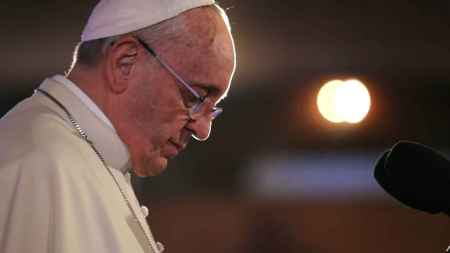
This Pope is a disgrace to the Church, to Judeo-Christian civilization, and to the free world.
******************************
AP reported breathlessly Monday that Pope Francis “embraced the grand imam of Al-Azhar, the prestigious Sunni Muslim center of learning, reopening an important channel for Catholic-Muslim dialogue after a five-year lull and at a time of increased Islamic extremist attacks on Christians.”
Why has there been this “five-year lull”? Because “the Cairo-based Al-Azhar froze talks with the Vatican to protest comments by then-Pope Benedict XVI.” What did Benedict say? Andrea Gagliarducci of the Catholic News Agency explains that after a jihad terrorist murdered 23 Christians in a church in Alexandria 2011, Benedict decried “terrorism” and the “strategy of violence” against Christians, and called for the Christians of the Middle East to be protected.
Al-Azhar’s Grand Imam, Ahmed al-Tayeb, whom Pope Francis welcomed to the Vatican on Monday, was furious. He railed at Benedict for his “interference” in Egypt’s affairs and warned of a “negative political reaction” to the Pope’s remarks. In a statement, Al-Azhar denounced the Pope’s “repeated negative references to Islam and his claims that Muslims persecute those living among them in the Middle East.”
Benedict stood his ground, and that was that. But in September 2013, al-Azhar announced that Pope Francis had sent a personal message to al-Tayeb. In it, according to al-Azhar, Francis declared his respect for Islam and his desire to achieve “mutual understanding between the world’s Christians and Muslims in order to build peace and justice.” At the same time, Al Tayyeb met with the Apostolic Nuncio to Egypt, Mgr. Jean-Paul Gobel, and told him in no uncertain terms that speaking about Islam in a negative manner was a “red line” that must not be crossed.
So Pope Benedict condemned a jihad attack, one that al-Azhar also condemned, and yet al-Azhar suspended dialogue because of the Pope’s condemnation. Then Pope Francis wrote to the Grand Imam of al-Azhar affirming his respect for Islam, and the Grand Imam warned him that criticizing Islam was a “red line” that he must not cross. That strongly suggests that the “dialogue” that Pope Francis has now reestablished will not be allowed to discuss the Muslim persecution of Christians that will escalate worldwide, especially since an incidence of that persecution led to the suspension of dialogue in the first place.
What’s more, his dialogue partner, al-Tayeb, has shown himself over the years to be anything but a preacher of peace, cooperation and mercy: he has justified anti-Semitism on Qur’anic grounds; and called for the Islamic State murderers of the Jordanian pilot to be crucified or have their hands and feet amputated on opposite sides (as per the penalty in Qur’an 5:33 for those who make war against Allah and his messenger or spread “mischief” in the land. Al-Azhar was also revealed to be offering free copies of a book that called for the slaughter of Christians and other Infidels.
Will the Pope during al-Tayeb’s visit to the Vatican again affirm his respect for Islam and contempt for Christianity? Will he convert to Islam before al-Tayeb, or just offer his submission and a jizya payment?
The Times of Israel opined that Monday’s Vatican meeting was a “sign of improved ties between Catholic Church and Muslim world.” Really? Where? Muslims have massacred, exiled, forcibly converted or subjugated hundreds of thousands of Christians in Iraq and Syria. Have these “improved ties” saved even one Christian from suffering at the hands of Muslims? No, they haven’t. All they do is make the “dialogue” participants feel good about themselves, while the Middle Eastern Christians continue to suffer. In fact, the “dialogue” has actually harmed Middle Eastern Christians, by inducing Western Christian leaders to enforce silence about the persecution, for fear of offending their so-easily-offended Muslim “dialogue” partners.
Has the Pope welcomed any of the persecuted Christians to the Vatican? Or is that honor reserved only for this man, who will allow for “dialogue” only when his Christian “dialogue” partners maintain a respectful silence about Muslim massacres of Christians?
This Pope is a disgrace to the Church, to Judeo-Christian civilization, and to the free world.
“Leave them; they are blind guides. And if a blind man leads a blind man, both will fall into a pit.” (Matthew 15:14)
Islamic apologists routinely claim that violent Qur’an verses have no validity beyond Muhammad’s time, but this story illustrates that this is not the mainstream view in Islam. The persecution of Mouhanad Khorchide also shows the uphill battle that genuine Muslim reformers face: branded as heretics and/or apostates, they’re often shunned (or worse) by the very community that needs their ideas the most.
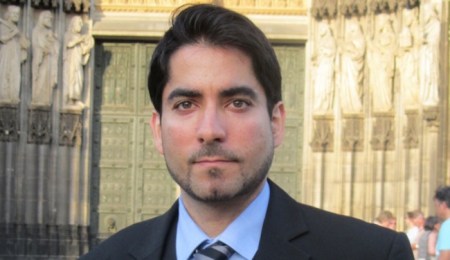
“Opinion: A German Islam must be liberal, self-critical,” by Susanne Schröter, DW, May 23, 2016:
When the theologian Mouhanad Khorchide, who teaches at the University of Münster, published “Islam Is Compassion” in 2012, he received a variety of diverse reactions. Many non-Muslims celebrated the work as the revelation of a humanistic Islam: an Islam that no one needs to fear. This feeling arose in part because the author created a picture of God that is not “interested in the labels of Muslim or Christian or Jewish, believer or nonbeliever.”
Korchide threw out the idea that Koran verses that appear violent or hostile toward women or non-Muslims may be valid for all eternity. He wanted them to be viewed as the words of a bygone era.
It seemed that the professor, with the swoop of his pen, managed to brush aside all those reservations that made people wonder whether Islam really “belonged to Germany,” as former President Christian Wulff said famously in a 2010. One might even have thought that Muslims would offer Khorchide a pat on the back.
On the website for DITIB, Germany’s Turkish Islamic union and the country’s largest Muslim organization, one can read that Khorchide’s statements were a “rejection of the teachings of classical Islam” and an “insult to Muslim identity.” For this reason, the professor was removed from his post at the university. As if that weren’t enough, the coordinating body of Germany’s Central Council of Muslims (ZMD), a cooperative made up of a number of large organizations, produced a nearly 100-page assessment document to discredit him further, but luckily was not able to get far with it….
“Jihad,” when used in the sense of a real war, is a term that is used in the Koran and in Islamic heritage. There are clerics who claim jihad is an appropriate instrument for avenging insults to the Prophet Muhammad – such as an act of revenge for a nation’s foreign policy. These clerics are even lent the pulpit at some mosques, though the official leaders of the houses of worship issue apologies to the community if religious youths clamor after extremists. But Salafism is a youth movement, and it draws in so many teenagers and young adults that the psychologist Ahmad Mansour speaks of a “Generation Allah.”
Mansour isn’t only referring to those youths who join radical groups and potentially fight in such places as Syria, but also those whose beliefs vacillate between extremism and orthodoxy. “Generation Allah” refers to youths who find meaning in life by subjecting themselves unquestioningly to God and his rules, who ask constantly what is halal (allowed) or haram (forbidden) because their perspective is that they can be winners in paradise. I have spoken to such young men. Living in contemporary German society is dangerous for these young men, full of sin, and as a result they reject any relationships with so-called unbelievers. They go beyond what is normally required of their faith.
Some Muslim organizations encourage such segregation. Nearly every mosque has soccer teams that play against other sides from other mosques. Islamic day care and cultural centers are being founded; Islamic NGOs are working with underprivilileged [sic] people and youth. Parallel structures are being developed that would allow Muslims to avoid contact with non-Muslims from the cradle to the grave….




 anneinpt
 artaxes
 danmillerinpanama
 davidking1530
 Peter Hofman
 Joseph Wouk
 Peter
Peter Louisiana Steve
 WarSclerotic
Recent Comments