Archive for May 26, 2016

First test for Lieberman from Iran and Hizballah

May 26, 2016

First test for Lieberman from Iran and Hizballah, DEBKAfile, May 26, 2016

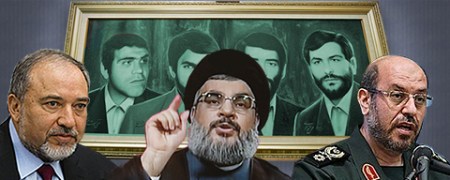
IranianDiplomats480_Koteret

The Middle East is full of surprises, but they are rarely disconnected from events. This applies to the speech made by Hizballah secretary Hassan Nasrallah on Wednesday May 25 which dredged up the past from 1992 in an allegation that the IDF while in Beirut, kidnapped four Iranian diplomats and is secretly holding them alive till this day in a jail in Israel.

He was not the first to resuscitate this old story. Monday May 23 the Iranian Defense Minister Brigadier General Hossein Dehqan brought it up, suddenly and surprisingly, in a special interview he gave to the Iranian news site Defa Press News.

General Dehqan said, “We claim on the basis of proofs that they are alive and in captivity by the Zionist regime.” He went on to say that, “the Israelis are responsible for the health of the Iranian diplomats.” He was referring to: charge d’affaires of the Iranian Embassy in Beirut Seyed Mohsen Mousavi, military attaché Ahmad Motevaselian, embassy technician Taghi Rastegar Moghadam, Islamic republic news agency Kazzem Akhavan.

Two days later, on Wednesday, while saying that ‘the resistance axis’ – meaning Iran-Syria-Hizballah – has not forgotten the Palestinian problem, Nasrallah said: “We have more land under Israeli occupation.”

Nasrallah had a long orderly list of ‘occupied places’: Shaaba Farms, The Kfar Shouba Hills, meaning Har Dov, and Ghajar village. “We also have”, Nasrallah continued, “captives and missing people whose families still wait for their return.”  And, “On the legal and ethical level, there is a Lebanese responsibility towards the four Iranian diplomats who were handed over to Israel.”

According to Nasrallah, just as the occupied lands must be returned, so must the Iranian diplomats be returned, first of all to Lebanon.

Nasrallah next turned to speak about the new Israeli Defense Minister calling him “crazy”.

Seven years ago, in 2009, German mediators were invited to broker a prisoner swap between Israel and Hizballah. They arranged for the bodies of the IDF soldiers: Ehud Goldwasser and Eldad Regev, whom Hizballah abducted and murdered in 2006, to be returned. The Germans established that the four Iranian diplomats had never been by held by Israel but were captured by Christian Phalangists and were apparently executed by them.

This finding was never accepted by the Iranian Foreign Ministry who insisted that their four diplomats were still in Israeli captivity.

The Iranian Defense Minister and the Hizballah leader have obviously coordinated the resuscitation of the diplomats’ fate and intended to use it as a tool to justify military or terrorist action against Israel.

DEBKAfile’s military and intelligence sources point to two reasons for the Iranian-Hizballah move:

  1. A first test for the new Israeli defense minister Avigdor Lieberman. They want to determine his responses to aggression and establish the measure of his control of Israeli military deployments on the Syrian and Lebanese borders. His predecessor, Moshe Yaalon, was conversant with every detail of those deployments.
  2. Tehran and Hizballah, have publically admitted that Israel had no hand in the assassination of the Hizballah military leader in Syria, Mustafa Badr Al Din, near Damascus on May 13. But as a morale booster for Shiite forces in Syria they may resort to a strike against Israel, Saudi Arabia or Jordan, whom they believe complicit in the killing.

They estimate that Israel, with its new defense minister, is the most vulnerable target.

Muslim reformers vs. Islamists

May 26, 2016

Muslim reformers vs. Islamists, Dan Miller’s Blog, May 26, 2016

(The views expressed in this article are mine and do not necessarily reflect those of Warsclerotic or its other editors. — DM)

Whether Islam will eventually be reformed is an open question. The topic is much discussed by Muslims, a few of whom favor reformation and more of whom oppose it. The issue is important for America, and indeed the free world in general. There is little that non-Muslims can do to assist a reformation beyond recognizing the substantial differences between moderate and radical (mainstream) Muslims, supporting the former and purging the latter. Please don’t conflate the cops with the killers.

Reformation of Islam

Here’s are comments by an American Muslim reformer, Dr. Zuhdi Jasser

In the following December 2015 video, the Fox News host misrepresented Donald Trump’s position as banning “all” Muslims, apparently permanently. Trump’s proposal was to ban Muslims until we can vet them adequately. Dr. Jasser agreed that Muslims advocating Islamist political ideology should be banned and that we should temporarily ban them all until we can distinguish moderate Muslims from “radical” Muslims. His suggestions for vetting Muslims included cessation of reliance on the Council on American – Islamic Relations (CAIR), et al, which are on the side of the Islamists.

An article by Raymond Ibrahim delves into Muslim perceptions of moderate vs. “radical” (i.e., mainstream) Islam and posts these views, as articulated by Dr. Ahmed Ibrahim Khadr, an Islamist. Dr. Khadr stated,

“Islamic researchers are agreed that what the West and its followers call ‘moderate Islam’ and ‘moderate Muslims’ is simply a slur against Islam and Muslims, a distortion of Islam, a rift among Muslims, a spark to ignite war among them. They also see that the division of Islam into ‘moderate Islam’ and ‘radical Islam’ has no basis in Islam — neither in its doctrines and rulings, nor in its understandings or reality. [Emphasis added.]

. . . .

Among the major distinctions (translated verbatim) made in Khadr’s article are:

  • Radicals want the caliphate to return; moderates reject the caliphate.
  • Radicals want to apply Sharia (Islamic law); moderates reject the application of Sharia.
  • Radicals reject the idea of renewal and reform, seeing it as a way to conform Islam to Western culture; moderates accept it.
  • Radicals accept the duty of waging jihad in the path of Allah; moderates reject it.
  • Radicals reject any criticism whatsoever of Islam; moderates welcome it on the basis of freedom of speech.
  • Radicals accept those laws that punish whoever insults or leaves the religion [apostates]; moderates recoil from these laws.
  • Radicals respond to any insult against Islam or the prophet Muhammad — peace and blessing upon him — with great violence and anger; moderates respond calmly and peacefully on the basis of freedom of expression.
  • Radicals respect and revere every deed and every word of the prophet — peace be upon him — in the hadith; moderates do not.
  • Radicals oppose democracy; moderates accept it.
  • Radicals see the people of the book [Jews and Christians] as dhimmis[barely tolerated subjects]; moderates oppose this [view].
  • Radicals reject the idea that non-Muslim minorities should have equality or authority over Muslims; moderates accept it.
  • Radicals reject the idea that men and women are equal; moderates accept it, according to Western views.
  • Radicals oppose the idea of religious freedom and apostasy from Islam; moderates agree to it.
  • Radicals desire to see Islam reign supreme; moderates oppose this.
  • Radicals place the Koran over the constitution; moderates reject this [assumption].
  • Radicals reject the idea of religious equality because Allah’s true religion is Islam; moderates accept it.
  • Radicals embrace the wearing of hijabs and niqabs; moderates reject it.
  • Radicals accept killing young girls who commit adultery or otherwise besmirch their family’s honor; moderates reject this [response].
  • Radicals reject the status of women today and think that the status of women today should be like the status of women in the time of the prophet; moderates oppose that women should be as in the time of the prophet.
  • Radicals vehemently reject that women should have the freedom to choose partners; moderates accept that she can choose a boyfriend without marriage.
  • Radicals agree to clitorectomies; moderates reject them.
  • Radicals reject the so-called war on terror and see it as a war on Islam; moderates accept it.
  • Radicals support jihadi groups; moderates reject them.
  • Radicals reject the terms “Islamic terrorism” or “Islamic fascism”; moderates accept them.
  • Radicals reject universal human rights, including the right to be homosexual; moderates accept them.
  • Radicals reject the idea of allying with the West; moderates support it.
  • Radicals oppose secularism; moderates support it. [Emphasis added.]

Dr. Jasser’s views on what American Islam should be are remarkably similar to the perceptions of moderate Islam set forth by Dr. Khadr, albeit with contempt as “a slur against Islam and Muslims, a distortion of Islam, a rift among Muslims, a spark to ignite war among them.” Mr. Ibrahim concludes his article by suggesting that “the West may need to rethink one of its main means of countering radical Islam: moderate Muslims and moderate Islam.” I agree. What is being done now is actually furthering “radical” Islam.

The former president of Egypt’s Al-Azhar University called, rather amorphously, for reform in the Islamic religious discourse.

https://www.youtube.com/watch?v=SIQnQjcdsWw

Here’s an address to the Canadian Parliament by a moderate Muslim journalist. Please watch the whole thing, because it sets forth quite well the differences between Islamists who want to overpower us and moderate Muslims who support freedom and want to eliminate Islamism.

https://www.youtube.com/watch?v=condC3PQfIg

https://www.youtube.com/watch?v=urCxNJpZoKM

Moderate Islam is not mainstream Islam

Germany’s largest Muslim organization recently had a moderate Muslim theologian fired from the University of Munster.

Islamic apologists routinely claim that violent Qur’an verses have no validity beyond Muhammad’s time, but this story illustrates that this is not the mainstream view in Islam. The persecution of Mouhanad Khorchide also shows the uphill battle that genuine Muslim reformers face: branded as heretics and/or apostates, they’re often shunned (or worse) by the very community that needs their ideas the most. [Emphasis added.]

The author, Robert Spencer, quotes a May 23rd article by Susanne Schröter in a German periodical:

When the theologian Mouhanad Khorchide, who teaches at the University of Münster, published “Islam Is Compassion” in 2012, he received a variety of diverse reactions. Many non-Muslims celebrated the work as the revelation of a humanistic Islam: an Islam that no one needs to fear. This feeling arose in part because the author created a picture of God that is not “interested in the labels of Muslim or Christian or Jewish, believer or nonbeliever.”

Korchide threw out the idea that Koran verses that appear violent or hostile toward women or non-Muslims may be valid for all eternity. He wanted them to be viewed as the words of a bygone era.

It seemed that the professor, with the swoop of his pen, managed to brush aside all those reservations that made people wonder whether Islam really “belonged to Germany,” as former President Christian Wulff said famously in a 2010. One might even have thought that Muslims would offer Khorchide a pat on the back.

On the website for DITIB, Germany’s Turkish Islamic union and the country’s largest Muslim organization, one can read that Khorchide’s statements were a “rejection of the teachings of classical Islam” and an “insult to Muslim identity.” For this reason, the professor was removed from his post at the university.

Canadian journalist Tarek Fatah, the moderate Muslim in a video provided above, wrote

In November 2014, while testifying before the Senate Committee on National Security and Defence, I raised the issue of Islamic clerics using mosque sermons to attack the foundational principles of Western civilization and liberal secular democracy.

The Senate Committee session referred to is the one presented in the video referenced above.

Liberal Senator Grant Mitchell was outraged by my testimony that at most Canadian mosques, the Friday congregation includes a ritual prayer asking, “Allah to give victory to Muslims over the ‘Kufaar’ (non-Muslims).” In a heated exchange with me, the senator suggested I wasn’t telling the truth, implying I was motivated by Islamophobia. Sadly, Sen. Mitchell is not alone in such views.

But neither is there any let-up in the attacks on Canadian values emanating from many mosque pulpits and Islamic conferences hosted by radical Islamist groups.

For example, in a sermon on Friday, May 6, delivered at a mosque in Edmonton, an imam invoked the memory of Prophet Muhammad to whip up hatred against Israel. He declared peace accords with Israel are “useless garbage” and vowed that Jerusalem will be conquered “through blood.”

In February, the same cleric predicted Islam would soon conquer Rome, “the heart of the Christian state.”

The Edmonton mosque diatribe was not isolated.

On May 13, just north of Toronto, an Islamic society hosted a celebration of Iranian mass murderer, Ayatollah Khomeini. The poster promoting the event described Khomeini as a, “Liberator and Reformer of the Masses.”

On Saturday, the Islamist group Hizb-ut-Tahrir, banned in some countries, hosted a conference to discuss the re-establishment of a global Islamic caliphate.

Here are excerpts from an article about the Hizb-ut-Tahrir meeting referenced by Mr. Fatah.

1616

The first speaker was Brother Mostafa, of Arabic roots. Mostafa started by calling nationalism and sectarian conflict the main reasons for division in the Ummah (Islamic nation). He reminded Muslims that they are obligated to implement Allah’s demands that fulfill the Islamic State. It is “not permissible for us to choose, ” he said. He cited the verse: [Emphasis added]

“It is not for a believing man or a believing woman, when Allah and His Messenger have decided a matter, that they should [thereafter] have any choice about their affair. And whoever disobeys Allah and His Messenger has certainly strayed into clear error.” — Surat-Al-Ahzab (33), verse 36. ]Emphasis added.]

. . . .

As the event started late, Naeema [a woman in the audience] began a conversation. We talked about our origins and how long we had been in Canada. She said she had been here 40 years, so I asked about the disconnect between enjoying 40 years of democracy, yet trying to end it. I mentioned a book published by Hizb-ut-Tahrir:

“Democracy is Infidelity: its use, application and promotion are prohibited.”

“الديمقراطية نظام كفر، يحرم أخذها أو تطبيقها أو الدعوة إليها”

Naeema said she was not qualified to debate the topic, but that democracy had done nothing good for people, so she and other believers would follow the rule of Allah. [Emphasis added]

The meeting participants are comparable to the Council on American Islamic Relations (CAIR), a Muslim Brotherhood – Hamas affiliated organization which, along with similar groups, provides Obama and His “fighting violent extremism” cohorts their marching orders on fighting, not Islamist jihad or Islamisation , but “Islamophobia.”

Conclusions

America would fare better in fighting “violent extremism” if the principal enemy were named: it is political Islam — Islamism. Presently, naming it is forbidden and those engaged in “fighting” it — supposedly on our behalf — are Islamists dedicated to the Islamisation of America.

Suppose that, instead of relying on CAIR, et al, as representative of “peaceful” Islam, our government rejected CAIR and its Islamist colleagues favored by Obama and instead supported and relied upon Dr. Jasser’s moderate group, American Islamic Forum for Democracy.

A devout Muslim, Dr. Jasser founded AIFD in the wake of the 9/11 attacks on the United States as an effort to provide an American Muslim voice advocating for the preservation of the founding principles of the United States Constitution, liberty and freedom, through the separation of mosque and state. Dr. Jasser is a first generation American Muslim whose parents fled the oppressive Baath regime of Syria in the mid-1960’s for American freedom. He is leading the fight to shake the hold that the Muslim Brotherhood and their network of American Islamist organizations and mosques seek to exert on organized Islam in America. [Emphasis added.]

Perhaps, if our next president is neither Hillary Clinton nor Bernie Sanders, we will do that. If we don’t, the Islamists will continue to win, the Islamisation of America will continue and American principles will go down the toilet. We cannot permit that to happen.

In an 1886 Fourth of July address to the citizens of the Dickinson Dakota Territory, Theodore Roosevelt said,

We only have the right to live on as free men, so long as we show ourselves worthy of the privileges we enjoy. We must remember that the republic can only be kept pure by the individual purity of its members, and that if it once becomes thoroughly corrupt it will surely cease to exist.

. . . .

All American citizens whether born here or elsewhere, whether of one creed or another, stand on the same footing; we welcome every honest immigrant, no matter from what country he comes, provided only that he leaves behind him his former nationality and remains neither Celt nor Saxon, neither Frenchman nor German, but becomes an American, desirous of fulfilling in good faith the duties of American citizenship. [Emphasis added]

When we thus rule ourselves we have the responsibilities of sovereigns not of subjects. We must never exercise our rights either wickedly or thoughtlessly; we can continue to preserve them in but one possible way – by making the proper use of them.

It has been my observation (and to a substantial extent that of the Canadian journalist and moderate Muslim in a video embedded above) that the principal loyalty of many Islamists is not geographical or to a state. Rather, it is to their version of Islam, be it Shiite, Sunni or some variation thereof. For example, Hezbollah members fight, not to help Lebanon or Syria, but to support the Iranian version of Shiite Islam — an apocalyptic vision in which the hidden iman will return and bring the world to an end. It is reasonable to assume that the principal loyalty of mainstream Muslims (Islamists) in America is, and will continue to be, to Islam, not to America.

American origins and views are very different and perhaps uniquely so.

https://www.youtube.com/watch?v=ArgMK2kAjzw

This land was made, not for Islamists but for immigrants who leave behind their former nationalities and remain “neither Celt nor Saxon, neither Frenchman nor German, but become an American, desirous of fulfilling in good faith the duties of American citizenship.” How many of America’s current crop of immigrants do that?

We have had little of this thus far. How much do we want? It’s pretty much up to us.

https://www.youtube.com/watch?v=DRlHcnHM6C4df

 New Report: 22 Israeli Academics in the Service of BDS

May 26, 2016

New Report: 22 Israeli Academics in the Service of BDS

By: JNi.Media

Published: May 26th, 2016

Source: The Jewish Press » » New Report: 22 Israeli Academics in the Service of BDS


In recent years, an increasing number of academics and student organizations throughout the world have been promoting the academic boycott of Israel. The goal of this boycott is to halt the cooperation between Israeli academics and academics abroad, an act that would cause significant harm to Israeli research as it heavily relies on international cooperation. This phenomenon could pose severe implications on the Israeli economy, and would significantly harm Israel’s standing in the world.

A new report from Im Tirtzu reveals the level of involvement of Israeli academics in the encouragement and promotion of the international effort to impose an academic boycott on Israel. The report focuses on the Israeli Anthropological Association as a case study that reflects the significant influence of Israeli academics in promoting the academic boycott on Israel. The report highlights how prominent Israeli professors, who receive salaries provided by the Israeli taxpayer, encourage, legitimize, and often promote boycott efforts, including boycotts that directly harm the institutions in which they work. It is important to note that a 2012 resolution passed by the Israeli Council for Higher Education explicitly rejects boycott efforts:

“The Council for Higher Education views the call for academic boycott on Israel by members of Israel’s institutions of higher education as an undermining action to the foundations of Israel’s higher education system” and thus “calls on institutions to consider the matter, and to formulate ways of dealing with it.”

As stated above, this report focuses on the Israeli Anthropological Association as a case study and examines its involvement with the advancement of the academic boycott on Israel, which began to intensify in 2013 after the American Anthropological Association (AAA) began to discuss the possibility of boycotting Israeli academia.

On May 31, 2016, the 10,000-member AAA will conclude its vote on a proposed resolution to boycott Israeli academic institutions, regardless of where the institution is located within Israel.

The Israeli Anthropological Association has sent a letter to the AAA in August 2014 advocating against this anti-Israel initiative and calling it an unprecedented and unjustified act of boycott against Israeli academia. But while the Israeli Anthropological Association was trying to block this attempt to harm the State of Israel, another group of 20 Israeli anthropologists, many of whom teach in publicly funded Israeli institutions, sent a petition to the AAA praising this effort and urging them to continue pressing for an academic boycott on Israel. These professors grant legitimacy to the academic boycott of Israel, and to the BDS movement against Israel as a whole.

In 2015, a task force sent by the AAA to “investigate” the situation in Israel produced a biased report filled with distortions and lies against Israel. The report repeatedly quoted anonymous Israeli academics as a means of attaining legitimacy to the baseless accusations raised in the report. These Israeli academics served as the “voice from within” who “verified” all of the anti-Israel charges in the report.

Several months prior to the publication of the report in July 2015, the Israeli Anthropological Association sent another letter in which they demonstrated a complete capitulation to the amounting boycott pressure. This letter condemned and severely criticized Israel for its prolonged “occupation,” urged Israel to rehabilitate Gaza, and called for a solution for the Palestinian refugees. At the end of the letter, however, they once again urged their colleagues at the AAA to refrain from academic boycott.

Like clockwork, this second letter by the Israeli Anthropological Association was also followed by another letter – this time from a group of 22 “anonymous” Israeli anthropologists – that contained an unequivocal call for academic boycott against Israel:

“We urge all members of the AAA to join in supporting the academic boycott resolution on the spring ballot.”

Im Tirtzu’s report emphasizes that all the Israeli signatories on the first petition sent to the AAA in attempt to foil the Israeli Anthropological Association’s effort to halt the boycott are activists in radical Left organizations, which are backed by copious amounts of foreign political funding and operate within Israel against the state and against the soldiers of the IDF.

In addition, the report notes that most of the Israeli signatories do not currently reside in Israel, and the vast majority of them are directly connected to other foreign agent organizations or to the international BDS movement. These facts substantiate the claim that Israeli organizations and individuals represent the head of the spear of the BDS phenomenon and often produce the initial efforts to boycott Israel.

Im Tirtzu CEO Matan Peleg stressed that the phenomenon in which a radical minority operates from within Israel in order to impose international pressure on Israel is not merely a display of ungratefulness, but an act of shamelessness. The challenge posed by the advancement of boycotts from within forces decision-makers to formulate a fitting response to this phenomenon: “Decision-makers and presidents of Israeli universities look to combat the international BDS movement, but completely ignore the boycott phenomenon from within Israel that is being led by Israeli academics. It is sad to see that those leading the boycott are cutting off the branch on which they are sitting and are working behind the scenes in order to mortally wound the future of Israeli academia.”

Peleg added that “The BDS movement is driven by blind hatred towards the State of Israel and is equipped with tremendous resources. Faced with the consistent attempt to harm the Israeli public, we as citizens need to mobilize against it. The State of Israel is the only democracy in the Middle East, and the only country in the region that preserves human and civil rights.”

Peleg stated that “The Im Tirtzu movement will continue to use all the tools at its disposal to fight against this theater of the absurd in which Israeli academics are playing the leading role.”

Associated Press: Donald Trump Clinches Nomination, Hits 1,238 Delegates

May 26, 2016

Associated Press: Donald Trump Clinches Nomination, Hits 1,238 Delegates

by Alex Swoyer

26 May 2016Washington, DC

Source: Associated Press: Donald Trump Clinches Nomination, Hits 1,238 Delegates – Breitbart

I will pop a bottle tonight !

Photo by Joe Raedle/Getty Images

Presumptive GOP nominee Donald Trump clinched the nomination reaching 1,238 delegates, according to the Associated Press delegate count released Thursday.

Trump sealed the deal by clinching unbound delegates that have disclosed to the Associated Press that they’ll support Trump at the Republican National Convention in July.

Pam Pollard, an Oklahoma GOP chairwoman, is one of the unbound delegates that spoke to the Associated Press.

“I think he has touched a part of our electorate that doesn’t like where our country is,” Pollard explained. “I have no problem supporting Mr. Trump.”

Trump needed 1,237 delegates to become the Republican nominee, but according to the Associated Press, he is at 1,238 delegates and still has 303 delegates up for grabs through the final state primaries on June 7.

“Minnesota Men” go to Trial (17)

May 26, 2016

“Minnesota Men” go to Trial (17), Power LineScott Johnson, May 26, 2016

Well, I went to the trial yesterday and a fight broke out. Waiting in the hallway to enter the courtroom at the appointed hour, The hallway was thick with those of us waiting to be admitted to the courtroom. I stood directly behind a young Somali lady wearing a hijab. As she started pushing and shoving, she repeatedly dropped the F-bomb at maximum volume within shouting distance of the jury. And here I thought I’d seen it all.

The fight, as it turns out, was between the mother of Abdirizak Warsame and her daughter, Warsame’s sister. As Warsame was about to resume testifying against the three defendants under a cooperation agreement with the prosecution, daughter took went after mother. The conflict represented their divided loyalties in the case. The Star Tribune’s Stephen Montemayor picks up on the trial’s undercard here. Warsame’s sister put up a better fight in the hall than Warsame did on the stand.

Warsame was the third and weakest of three key witnesses called by the government. He completed his testimony yesterday. The government seems to me to be ending its case on a low note. That’s generally not how you’re supposed to do it.

Without going into details, it seemed to me that defense counsel Bruce Nestor turned Warsame to use on behalf of his client, Abdirahman Daud. I may be missing something, but I’m not sure whether, on balance, Warsame was more helpful to the government or to the defense.

Warsame made me reflect on my understanding of the case against the “Minnesota men.” In a sense, they are products of the vacuous America of 2016. They have been Americanized in that sense. These young men had boundless opportunities of a conventional sort before them, yet they chose to squander them. They are talented and resourceful, yet they represent a great threat. They are seriously misguided young men. What happened?

Warsame is a graduate of the Tarek ibn Ziyad Academy in Inver Grove Heights. With a little help from the Minnesota chapter of the American Civil Liberties Union, the school has now been shuttered. I wore out a keyboard writing about the school before it closed. For years the school operated, illegally in my opinion, as a publicly funded Islamic charter school.

From TIZA Warsame proceeded to Heritage Academy, a mostly Somali high school in Minneapolis. This year the Minneapolis school district moved to retake control of Heritage from its board.

After high school Warsame attended a local community college and worked for several employers. Indeed, he worked for two on the tarmac at the Minneapolis-St. Paul International Airport while he was pursuing his interest in ISIS.

Islam filled the life of Warsame and his friends. It filled the vacuum now served up by American culture to immigrants. The “Minnesota men” could have succumbed to drugs or alcohol in a pattern that has devastated the lives of so many American families. In this case, however, they fell prey to Islam. It was Islam that intoxicated them.

Judge Davis himself took up this point with Warsame yesterday. “You understood that if you committed jihad you would die,” the judge said. “What attracted you to that?”

“The reward you would get and the fact that this life is temporary,” Warsame said. “If you were to go sacrifice yourself and go fight in jihad, the reward would be bigger. You’d save your family and save yourself.”

America, what you got for that?

WATCH: UK Joins Germany And France To Condemn Israel As World’s Only ‘Violator Of Health Rights’

May 26, 2016

WATCH: UK Joins Germany And France To Condemn Israel As World’s Only ‘Violator Of Health Rights’

by Simon Kent

26 May 2016

Source: WATCH: UK Joins Germany And France To Condemn Israel As World’s Only ‘Violator Of Health Rights’

JACK GUEZ/AFP/Getty

UN resolution has singled out Israel as the world’s only violator of “mental, physical and environmental health” and commissioned a delegation to report on “the health conditions in the occupied Palestinian territory” and in “the occupied Syrian Golan.”

The United Kingdom, France, and Germany were among 107 countries that voted for the proposal during this week’s gathering of the World Health Organization (WHO) in Geneva. Eight countries voted against the resolution and eight abstained, while 58 other countries taking part in the assembly were absent for the vote.

The entire European Union (EU) membership voted as a block to support the motion of condemnation against Israel. Watch video below of the UK casting its vote:

Only the United States, Canada, Australia, Paraguay, Guatemala, Micronesia and Papua New Guinea stood with Israel in opposing the motion that was co-sponsored by the Arab Group of States and the Palestinian delegation.

“The UN reached new heights of absurdity today,” said UN Watch executive director Hillel Neuer on Tuesday immediately after the vote.

He then slammed the global body for  “enacting a resolution which accuses Israel of violating the health rights of Syrians in the Golan, even as in reality Israeli hospitals continue their life-saving treatment for Syrians fleeing to the Golan from the Assad regime’s barbaric attacks.”

Mr Nieur added that the motion was more political and religious prosecution than considered policy. He said:

“Shame on Britain, France and Germany for encouraging this hijacking of the annual world health assembly, and diverting precious time, money, and resources from global health priorities, in order to wage a political prosecution of Israel, especially when, in reality, anyone who has ever walked into an Israeli hospital or clinic knows that they are providing world-class health care to thousands of Palestinian Arabs, as well as to Syrians fleeing Assad.

“At the same time UN Watch commends the principled stand taken by the U.S., Canada, Australia, Paraguay, Guatemala, Micronesia and Papua New Guinea in joining Israel to oppose perpetuating a politicized agenda item.”

The U.S. and Canada both took the floor to strongly object to the anti-Israel exercise, UN Watch reports.

The resolution calls for reports on a series of alleged Israeli violations, including on “the impact of prolonged occupation and human rights violations on mental, physical and environmental health” in “the occupied Palestinian territory.”

The text also adopted three reports mandated by last year’s Arab-sponsored resolution: a “field assessment” on “health conditions in the occupied Palestinian territory”, a similar report by the WHO director-general, and a related report by the WHO secretariat.

Earlier this month the UN cultural body UNESCO also singled out Israel for condemnation, criticizing it for recent actions on the Temple Mount in Jerusalem and declining to acknowledge Jewish ties to the site.

Has the Pope Abandoned Europe to Islam?

May 26, 2016

Has the Pope Abandoned Europe to Islam? Gatestone InstituteGiulio Meotti, May 26, 2016

♦ In 2006, Pope Benedict XVI said what no Pope had ever dared to say — that there is a link between violence and Islam. Ten years later, Pope Francis never calls those responsible for anti-Christian violence by name and never mentions the word “Islam.”

♦ Pope Francis does not even try to re-evangelize or reconquer Europe. He seems deeply to believe that the future of Christianity is in the Philippines, in Brazil and in Africa. Probably for the same reason, the Pope is spending less time and effort in denouncing the terrible fate of Christians in the Middle East.

♦ “Multiculturalism” in Europe is the mosque standing on the ruins of the church. It is not the synthesis requested by Pope Francis. It is the road to becoming extinct.

♦ Asking Europe to be “multicultural” while it experiences a dramatic de-Christianization is extremely risky. In Germany, a new report found that “Germany has become demographically a multi-religious country.” In the UK, a major inquiry recently declared that “Britain is no longer a Christian country.” In France, Islam is also overtaking Christianity as the dominant religion.

To scroll the list of Pope Francis’s apostolic trips — Brazil, South Korea, Albania, Turkey, Sri Lanka, Ecuador, Cuba, United States, Mexico, Kenya, Uganda, Philippines — one could say that Europe is not exactly at the top of his agenda.

The two previous pontiffs both fought for the cradle of Christendom. Pope John Paul II took on Communism by toppling the Berlin Wall and the Iron Curtain. Benedict XVI took on “the dictatorship of relativism” (the belief that truth is in the eye of the beholder) and bet everything on re-evangelizing the continent by traveling through it (he visited Spain three times) and in speeches such as the magnificent ones at Regensburg, where he spoke bluntly about the threat of Islam, and the German Bundestag, where he warned the gathered politicians against declining religiosity and “sacrificing their own ideals for the sake of power.”

Pope Francis, on the contrary, simply ignores Europe, as if he already considers it lost. This former Argentinian Cardinal, a representative of the “global South” Christianity, made spectacular trips to the migrants’ islands of Lampedusa (Italy) and Lesbos (Greece), but never to the heart of the old continent. Pope Francis has also made it difficult for Anglicans to enter into the Catholic Church, by downplaying the dialogue with them.

Most importantly, however, in his important May 6 speech for the Charlemagne Prize, the Pope, in front of European leaders, castigated Europe on migrants and asked its leaders to be more generous with them. He next introduced something revolutionary into the debate: “The identity of Europe is, and always has been, a multicultural identity,” he said. This idea is questionable.

Multiculturalism is a specific policy formulated in the 1970s. and it was absent from the political vocabulary of Schuman and Adenauer, two of Europe’s founding fathers. Now it has been invoked by the Pope, who spoke of the need for a new synthesis. What is this all about?

Today, Christianity appears marginal and irrelevant in Europe. The religion faces an Islamic demographic and ideological challenge, while the post-Auschwitz remnants of Jewish communities are fleeing from the new anti-Semitism. Under these conditions, a synthesis between the old continent and Islam would be a surrender of Europe’s claim to the future.

“Multiculturalism” is the mosque standing on the ruins of the church. It is not the synthesis requested by the Pope. It is the road to becoming extinct.

Asking Europe to be “multicultural” while it is experiencing a dramatic de-Christianization is also extremely risky. In Germany, a new report just found that “Germany has become demographically a multi-religious country.” In the UK, a major inquiry recently declared that “Britain is no longer a Christian country.” In France, Islam is also overtaking Christianity as the dominant religion. You find the same trend everywhere, from Protestant Scandinavia to Catholic Belgium. That is why Pope Benedict was convinced that Europe needed to “re-evangelized.” Pope Francis does not even try to re-evangelize or reconquer Europe. Instead, he seems deeply to believe that the future of Christianity is in the Philippines, Brazil and Africa.

Probably for the same reason, the Pope is spending less time denouncing the terrible fate of Christians in the Middle East. Sandro Magister, Italy’s most important Vatican observer, sheds light on the Pope’s silences:

“He remained silent on the hundreds of Nigerian schoolgirls abducted by Boko Haram. He remained silent on the young Sudanese mother Meriam, sentenced to death solely for being Christian and finally liberated by the intervention of others. He remains silent on the Pakistani mother Asia Bibi, who has been on death row for five years, because she too is an ‘infidel’, and [He] does not even reply to the two heartrending letters she has written to him this year, before and after the reconfirmation of the sentence.”

In 2006, Pope Benedict XVI, in his Regensburg lecture, said what no Pope had ever dared to say — that there is a link between violence and Islam. Ten years later, Pope Francis never calls those responsible for anti-Christian violence by name, and never mentions the word “Islam.” Pope Francis also recently recognized the “State of Palestine,” before it even exists — a symbolic and unprecedented first. The Pope also might abandon the Church’s long tradition of a “just war,” one regarded as morally or theologically justifiable. Pope Francis always speaks of the “Europe of peoples,” but never of the “Europe of Nations.” He advocates welcoming migrants and washes their feet, while he ignores that these uncontrolled demographic waves are transforming Europe, bit by bit, into an Islamic state.

1624In 2006, Pope Benedict XVI (left) said what no Pope had ever dared to say — that there is a link between violence and Islam. Ten years later, Pope Francis (right) never calls those responsible for anti-Christian violence by name and never mentions the word “Islam.” (Image source: Benedict: Flickr/Catholic Church of England | Francis: Wikimedia Commons/korea.net)

That is the meaning of Pope Francis’ trips to the islands of Lampedusa, Italy, and Lesbos, Greece — both symbols of a dramatic geographical and civilizational boundary. That is also the meaning of the Pope’s speech for the Charlemagne Prize.

Has the head of Christianity given up on Europe as a Christian place?

Greeks, Italians close off airspace to Libyans amid NATO operation rumors

May 26, 2016

Greeks, Italians close off airspace to Libyans amid NATO operation rumors

Published time: 26 May, 2016 11:27 Edited time: 26 May, 2016 13:02

Source: Greeks, Italians close off airspace to Libyans amid NATO operation rumors — RT News

© Wolfgang Rattay / Reuters

Greece has closed off its airspace for flight from Libya until September 8, local media reported. It comes amid rumors of a looming NATO operation in the country, which remains in turmoil since the alliance bombed it in 2011.

A notice to airmen (NOTAM) was issued by the Greek authorities on Wednesday, which bans Libyan flights from entering Flight Information Region Athens starting Thursday, the Greek media reported. Similar restrictions were reportedly imposed by Malta and Italy, although they will last till August.

An exception to the rule is made for military aircraft with special authorization, and emergency cases such as evacuations for medical reasons, according to the Kathimerini daily. The newspaper says the decision was made ahead of EU and NATO joint training in the Mediterranean. The Phoenix Express 2016 exercise is scheduled for the summer off the island of Crete.

The explanation, however, doesn’t convince some observers, who believe that the alliance is preparing a new full-fledged military intervention in Libya. The Greek communist party demanded that the government clearly state whether NATO is preparing such an operation and what would the country’s part in it would be.

Read more

© Stringer

The party “denounces any intervention in Libya and demands not to take part in the Euro Atlantic plans,” it said in a statement.

Earlier on Tuesday, NATO Secretary General Jens Stoltenberg said the alliance “stood ready” to act on a request of the country’s new reconciliation government. It was formed in a bid to bridge a gap between two rival governments, which had been ruling different parts of the disjointed country for months.

“I spoke recently with [Libyan] Prime Minister Sarraj on how NATO can assist and he will soon send a team of experts to NATO to identify how we can help the new Libyan Government of National Accord,” Stoltenberg said a joint press conference with the Italian Prime Minister Matteo Renzi.

NATO played a key role in 2011 by bombing Libyan government forces and helping armed groups oust and brutally kill strongman Muammar Gaddafi. The intervention, which was based on an overstretched interpretation of a UN mandate to form a no-fly zone in Libya, was hailed as a great success by the victors.

Since then Libya has de facto disintegrated into three historic parts and degraded into a state of constant armed struggle and poverty. It also became a major hub for asylum seekers, trying to reach Italy. Lately the Iraqi-Syrian terrorist group Islamic State (IS, formerly ISIS/ISIL) gained a foothold in eastern coastal part of Libya, slowly gaining control over what is left of the country’s oil exports.

US, British and French special forces are operating in Libya trying to undermine IS’ powerbase. In February, the US conducted a major bombing operation against a suspected IS training camp in Libya, killing dozens of militants.

Some members of the alliance, particularly Germany and France, are skeptical about escalating NATO’s or EU’s mission in Libya and the Mediterranean, a development favored by the US and Italy, according to Reuters. Berlin and Paris want a support role only for themselves, ruling out deployment of ground troops.

8 Iranian missile launches since nuke deal signed, expert tells US Congress

May 26, 2016

8 Iranian missile launches since nuke deal signed, expert tells US Congress Islamic Republic increases ballistic missile tests, strives to improve accuracy, despite American opposition

By Judah Ari Gross

May 26, 2016, 4:29 pm

Source: 8 Iranian missile launches since nuke deal signed, expert tells US Congress | The Times of Israel

But the US state department has more concerns about Liberman than Iranian rockets

An Iranian Shahab-3 missile launched during military exercises outside the city of Qom, Iran, in June 2011. (AP/ISNA/Ruhollah Vahdati)

In the 10 months since the Iran nuclear agreement was signed, the Islamic Republic has increased the frequency of its ballistic missile testing, according to researcher Michael Elleman, who testified before a US senatorial committee this week.

Iran is primarily focused on increasing the accuracy, not the range, of its missiles, Elleman said.

 Elleman, a senior fellow at the International Institute for Strategic Studies (IISS) think tank, was called to speak Tuesday before the US Senate Committee on Banking, Housing, and Urban Affairs, which is investigating the effects of the Joint Comprehensive Plan of Action (JCPOA), the official name for the Iran nuclear deal signed in July 2015.

Since then, Iran’s ballistic missile program has become a central issue in the debate surrounding the nuclear deal, with opponents of the agreement saying test launches violate the terms of the JCPOA, while proponents argue missile tests are “inconsistent” with United Nations resolutions but not necessarily illegal.

According to the UN decision, “Iran is called upon not to undertake any activity related to ballistic missiles designed to be capable of delivering nuclear weapons, including launches using such ballistic missile technology,” until October 2023.

As they’re only “called upon not to” test missiles, but not expressly forbidden from doing so, Iran has used that loophole to increase its testing with impunity.

“[The US has] engaged in a lot of hue and cry over Iran’s missile capabilities, but they should know that this ballyhoo does not have any influence and they cannot do a damn thing,” Iranian supreme leader Ali Khamenei said this week.

A Khalij Fars ballistic missile on a transporter during a military parade in Iran. (Iranian military/CC BY-SA 3.0/WikiMedia)

A Khalij Fars ballistic missile on a transporter during a military parade in Iran. (Iranian military/CC BY-SA 3.0/WikiMedia)

According to Elleman, in the almost year following the signing of the agreement and the removal of sanctions, Iran has performed at least eight missile tests — three in 2015 and five thus far in 2016.

In 2005, 2013 and 2014, however, when negotiations for the deal were in full swing, Iran did not perform a single test of a “nuclear-capable missile,” the IISS fellow testified.

After talks fell through in 2005 and before they resumed in 2013, the Islamic Republic “averaged roughly five test launches per year,” according to Elleman.

A missile launched from the Alborz mountains in Iran on March 9, 2016, reportedly inscribed in Hebrew, 'Israel must be wiped out.' (Fars News)

A missile launched from the Alborz mountains in Iran on March 9, 2016, reportedly inscribed in Hebrew, ‘Israel must be wiped out.’ (Fars News)

Though the increase from an average of five to eight missile tests a year seems dramatic — it’s a 60 percent increase, after all — Elleman offered perspective by comparing that to the US and Soviet missile testing programs during the Cold War, which averaged “about one test a week,” or nearly 10 times as many tests per year.

Tactically speaking, ballistic missiles have little value other than as a means of delivering a nuclear warhead, Elleman pointed out.

In May, an Iranian official claimed the country had tested a missile capable of reaching Israel, which had almost unheard-of accuracy for Iran.

“We test-fired a missile with a range of 2,000 kilometers and a margin of error of eight meters,” Brigadier General Ali Abdollahi was quoted as saying at a Tehran science conference.

However, this was swiftly denied by the Iranian defense minister on the same day.

“We’re still trying to get to the bottom of what exactly transpired,” White House spokesman Josh Earnest said at a press briefing.

“We are aware of Iranian claims of an additional ballistic missile launch. We’re also aware of statements from the defense minister indicating that such a launch did not take place,” he said.

Accuracy over range

Whether or not the test took place, the emphasis on the rocket’s margin of error points to a renewed focus on the accuracy of Iran’s existing arsenal of missiles, rather than on the development of farther-reaching projectiles.

“Iran seeks to improve the accuracy of its missiles, a priority that supersedes the need to develop longer-range missiles,” Elleman told the Senate committee on Tuesday. “Iran has repeated said that it does not need missiles with a range of greater than 2,000 kilometers, or 1,200 miles.”

At that range, Iran could easily reach any target within Israel, which is just under 1,000 miles away.

A military exhibition displays the Shahab-3 missile under a picture of the Iranian supreme leader Ayatollah Ali Khamenei, in Tehran, in 2008 (photo credit: AP/Hasan Sarbakhshian)

A military exhibition displays the Shahab-3 missile under a picture of the Iranian Supreme Leader Ayatollah Ali Khamenei, in Tehran, in 2008. (AP/Hasan Sarbakhshian)

At this point in time, however, Iran’s missile technology is far from accurate enough to reliably hit a predetermined target, and changing that will not be easy or quick, Elleman said.

“Substantial improvements in missile accuracy will take years, if not a decade, to materialize,” he said.

As with so many things, he most important aspects of a military attack are location, location, location. A missile — even a nuclear-tipped missile — landing in the Arava desert would have an incomparably lesser effect than a missile landing on, say, Dizengoff Center in Tel Aviv.

“Iran’s ballistic missiles have poor accuracy. The successful destruction of a single fixed military target, for example, would probably require Iran to use a significant percentage of its missile inventory,” Elleman told the Senate committee.

Illustrative photo of a Fateh-110 ballistic missile, taken at an Iranian armed forces parade in 2012. (military.ir/Wikimedia Commons)

Illustrative photo of a Fateh-110 ballistic missile, taken at an Iranian armed forces parade in 2012. (military.ir/Wikimedia Commons)

That inventory consists of over 300 missiles considered “nuclear-capable,” according to the international Missile Technology Control Regime monitoring association, which defines it as any missile capable of delivering a 1,100 pound (500 kg) warhead a distance of 186 miles (300 km), Elleman said.

Slow progress on ICBM technology

In terms of increasing the range of its ballistic missiles, the senior researcher said Iran has not made great strides in that effort.

“I have seen no evidence to suggest that Iran is actively developing an intermediate- or intercontinental-range ballistic missile (IRBM or ICBM, respectively),” Elleman said, but he added, “I cannot speak to a covert program.”

The most recent test that could be related to ICBMs appears to have been the launch of the Simorgh rocket, which is believed to have been conducted last month. US and Iranian officials have not publicly acknowledged the test, though Russian revealed that the launch popped up on one of their radar stations.

Iranians take photos of the Simorgh satellite rocket during celebrations to mark the 37th anniversary of the Islamic Revolution, in Teheran, February 11, 2016. (AFP/Atta Kenare)

Iranians take photos of the Simorgh satellite rocket during celebrations to mark the 37th anniversary of the Islamic Revolution, in Teheran, February 11, 2016. (AFP/Atta Kenare)

The Simorgh rocket is designed to launch satellites into space. However, Elleman told the Senate committee, “Without question, rockets designed to boost a satellite into orbit and long-range ballistic missiles employ many of the same technologies, key components, and operational features.”

But it’s not likely that the Simorgh itself would be used as a weapon because of the considerable effort that would be required to convert it into a reliable ICBM. Rather, the information gleaned from the space rocket would be applied to create a new type of missile, Elleman said.

“Iran’s ambitious space program provides engineers with critical experience developing powerful booster rockets and other skills that could be used in developing longer-range missiles, including ICBMs,” he said.

The production of those long-range missiles, which would be capable of striking the United States, is still years away, assuming Iran continues on its current course.

According to Admiral William Gortney of the North American Aerospace Defense Command, Iran is anticipated to have an operational intercontinental ballistic missile by the year 2020.

Michael Elleman, a senior fellow at the International Institute for Strategic Studies think-tank. (Screen capture: C-Span)

Michael Elleman, a senior fellow at the International Institute for Strategic Studies think tank. (Screen capture: C-Span)

Meanwhile, Elleman, who has interviewed Russian and Ukrainian scientists who worked in the Iranian missile program, estimated the Islamic Republic would not be able to produce an operational ICBM until “2022, at the earliest.”

In his testimony, the senior IISS researcher also discussed an interesting piece of modern history, namely that Israel is partially responsbile for the Iranian missile defense program, which was created before the 1979 revolution when the two countries were still allies.

“Ironically, the shah teamed with Israel to develop a short-range system after Washington denied his request for Lance missiles,” Elleman said.

“Known as Project Flower, Iran supplied the funds and Israel provided the technology. The monarchy also pursued nuclear technologies, suggesting an interest in a delivery system for nuclear weapons,” he said.
Lebanese ‘Al-Safir’ Daily Marks 16th Anniversary Of Israel’s Withdrawal From South Lebanon: Hizbullah Is Digging Tunnels On Israel Border

May 26, 2016

Lebanese ‘Al-Safir’ Daily Marks 16th Anniversary Of Israel’s Withdrawal From South Lebanon: Hizbullah Is Digging Tunnels On Israel Border, MEMRI, May 25, 2915

On May 25, 2016, the Lebanese daily Al-Safir, which is known for its support for Hizbullah, published a front- page article celebrating “Liberation Day,” i.e. the 16th anniversary of Israel’s withdrawal from South Lebanon. The article, which appears without a byline, analyzes the current situation of Hizbullah (which it calls “the resistance”) as well as its combative actions on the Syrian and Israeli fronts. It claims that this year’s Liberation Day celebrations are mixed with heartbreak for Hizbullah supporters, due to the large number of Hizbullah casualties in the Syria war. It adds that in its fight in Syria, Hizbullah currently faces the toughest challenge since its establishment, greater even than its conflict against Israel, because the price thus far paid by Hizbullah in this war – both in capabilities and casualties – is unprecedented, and no solution in Syria is on the horizon.

The article assesses that Hizbullah may expand its theater of operations even further in the future, in response to new challenges, and that this will turn it into a “regional power” that “formulates new equations in the region.”

Adding that alongside its fighting in Syria, Hizbullah is continuing its activity against Israel, the article also reports that resistance fighters work day and night along the Israeli border, “conducting observations, preparing, and digging tunnels that cause the settlers and enemy soldiers to lose sleep.” It also states that in fighting “tafkiri organizations,” Hizbullah has encountered an enemy that excavates tunnels, after becoming accustomed to being the only one digging them; in fact, it was Hizbullah that taught other resistance fighters, particularly Palestinians in the Gaza Strip, the tunnel doctrine.[1]

The following are excerpts from the article:[2]

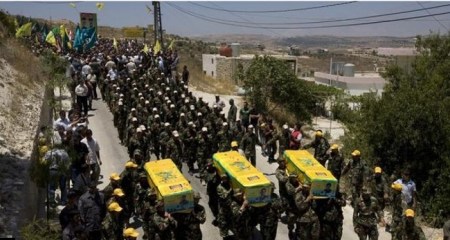
28169Funeral of Hizbullah fighters killed in Syria (image: Safa.ps)

“[Since its founding], the resistance [i.e. Hizbullah] never found itself deployed on several fronts and facing more than one challenge and more than one danger at once [as is happening today]. These four years since it became involved in the war in Syria represent the greatest trial it has [ever] faced… The movement has never paid in flesh, blood and abilities as it has paid [during the Syria war] and as it may continue to pay in the future, in the open confrontation with the takfiri [groups, i.e. the groups fighting against the Assad regime in Syria].[3] [So far] over 1,000 [fighters] have died and thousands have been wounded and disabled, and many others may meet [the same fate] in the ever-expanding confrontation that is becoming more difficult and more aggressive every day. This, especially since the horizon of a political solution seems to have been eliminated for the foreseeable future.

“Amid all this comes the 16th [anniversary] of the liberation [of South Lebanon], which underscores an element that Israel cannot ignore, namely the strengthening of the security and stability equation on both sides of the Palestine-Lebanon border. [This is] thanks to the deterrence system, or more accurately the balance of terror, which is an equation that has turned South Lebanon into the most secure region in the entire Middle East. Though we must not ignore other factors, no less important, [that contribute to this security], including [UN] Resolution 1701, UNIFIL and the Lebanese army.

“The celebrations of liberty are held amid heartbreak mixed with joy. Heartbreak [at the sight of] the processions of martyrs crossing the boundary south of the Litani every day [i.e. bodies of Hizbullah fighters killed in Syria being returned to Lebanon for burial], and joy [at the sight of] the processions [of people] rejoicing over [Hizbullah’s victory in some of] the local elections [that have been held in Lebanon in recent weeks]…

“The heartbreak over the martyrs is a necessary tax [that must be paid] in the struggle, [a struggle] which the Lebanese, of all sectors, regard as existential, even though they are divided on whether the preemptive war against the terrorists outside the borders of the homeland is justified. This heartbreak is present in every home in South [Lebanon]… When Hizbullah secretary-general Hassan Nasrallah speaks at Liberation Day ceremonies [today] in the town of Al-Nabi Shayth in the Bekaa [Valley], he will be speaking to a public that has contributed to the resistance [by supporting Hizbullah’s activity in Syria] just as residents of the South have contributed [in fighting against Israel], and perhaps even more, since [Bekaa Valley residents] face a danger today on their eastern border that is just as bad as the Israeli danger.

“It is right to say that the men of resistance on the eastern border complement the mission of the first men of resistance [who operate against Israel], who work day and night [along the border, from] the last border point in Al-Naquora to [the one in] Kfar Shouba, conducting observations, preparing, and digging tunnels that cause the settlers and enemy soldiers to lose sleep. [All this they do] without abandoning the [other] tasks of the resistance, which stands ready, openly and secretly, throughout Lebanon, and especially in the Southern Dahiya, in order to prevent any terrorist attack by the takfiris, in full coordination with the Lebanese army and Lebanon’s other security apparatuses. There might be further expansion of Hizbullah’s battle front, in accordance with future challenges, and this expansion turns this Lebanese group [Hizbullah], which was established 34 years ago in Sheikh ‘Abdallah’s base in Baalbek, into a regional force that formulates new equations in the region…

“In all of its rounds of fighting with the Israeli enemy, the resistance never faced what it has been facing for years in confronting the dark [elements] armed with the Prophet Muhammad’s Koran and Sunnah, who receive funding from tyrannical regimes and innumerable intelligence apparatuses, and are armed with military [equipment] that only armies possess.”

“The resistance also never experienced a four-year war in an area several times larger than Lebanon [itself]. It never experienced [war] against groups that imitate its methods and ways of warfare, but [who] instead of blowing themselves up against an Israeli convoy terrorize innocent people in the cities and villages, without batting an eyelash, as happened in the southern Dahiya or yesterday in Tartus and Jableh.

“The resistance never experienced war against groups fighting in caves and in the hills, mountains, wadis and even deserts, as happened at Tadmor and in the rural areas of Homs and Aleppo… Before [the war with Syria], the resistance did not storm cities and did not fight armies deep in the mountains.  Before this, no one lay in wait for it in tunnels like the ones that only it used to excavate, and [the doctrine of which] it spread to the rest of the men of the resistance, particularly to the Palestinians in the Gaza Strip.

“All these have been the unique characteristics of the resistance throughout the 16 years since May 25, 2000. All these [characteristics] and others will cause Hassan Nasrallah to declare that defending the achievement of liberation will end only with the defeat of the terrorists…”

Endnotes:

[1] Regarding the issue of the tunnels, it should be noted that Ibrahim Al-Amin, chairman of the board of the Lebanese dailyAl-Akhbar, wrote in a January 13, 2014 article that Hamas members fighting in Syria, in the Al-Quseir area and other regions, had dug tunnels there, similar to the ones excavated by Hamas in Gaza. He explained that Hizbullah had taught Hamas to dig these tunnels in the days when the two organizations were cooperating in smuggling arms into Gaza and preparing military plans against Israel.

[2] Al-Safir (Lebanon), May 25, 2016.

[3] Hizbullah, like the Syrian regime, does not draw a distinction between the rebels and the Salafi-jihadi groups.