Archive for May 4, 2016

How Trump Could Win

May 4, 2016

How Trump Could Win, Power LineSteven Hayward, May 4, 2016

First of all, kudos to Roger Simon of Pajamas Media, who said last summer that Trump would be the nominee and is in a strong position to win the general election. He takes a well-deserved victory lap today:

That seemed a bold prediction at the time — that the presidency, not just the Republican nomination, which he now has, was Trump’s to lose. But it really wasn’t so courageous. It was almost obvious, if you would let yourself look. And equally obviously, it still holds true. With all the sound and fury, nothing has changed.

Donald Trump did alter the nature of American politics, possibly forever, but at least for the foreseeable future, the moment he came down that Trump Tower escalator to announce his campaign. And he will, most likely, be the next president of the United States.

Hillary is out today with two new ads showing all of the Republicans who trashed Trump in the last few months. These ads might well reinforce the Never Trumpers among Republicans, but I can easily see them backfiring with independents and disaffected Democrats. It sends the message that Trump really is truly independent of the hated Republican establishment.

Notice, incidentally, that the exit polls yesterday showed Trump beating Hillary on the issue of who would be better able to handle the economy. If the economy is the leading issue in November (as it usually is), then this race is a lot closer than currently looks in the polls. And by the way, have you noticed that Trump consistently runs ahead of his polls? Just as there were “shy Tories” in Britain last year, I suspect there are a lot of shy Trump voters right now.

Finally, Howard Fineman at the Puffington Host lists “Seven Reasons Donald Trump Could Win.” It is a fairly obvious and unremarkable account, but at the very bottom there appears this:

Editor’s note: Donald Trump regularly incites political violence and is a serial liarrampant xenophoberacistmisogynist and birther who has repeatedly pledged to ban all Muslims — 1.6 billion members of an entire religion — from entering the U.S.

That’s objective, non-biased media for you! Expect a lot more of this right through election day. I suspect it will be worth at least a million votes for Trump.

The Mixed Legacy of Nuremberg

May 4, 2016

The Mixed Legacy of Nuremberg, Front Page Magazine, Alan M. Dershowitz, May 4, 2016

This year commemorates the 80th anniversary of the notorious Nuremberg Laws, the Nazi racist enactments that formed the legal basis for the Holocaust. Ironically, it also marks the 70thanniversary of the Nuremberg Trials, which provided the legal basis for prosecuting the Nazi war criminals who murdered millions of Jews and others following the enactment of the Nuremberg Laws.

1580

There is little dispute about the evil of the Nuremberg Laws. As Justice Robert H. Jackson, who was America’s chief prosecutor at the Nuremberg Trials, put it: “The most odious of all oppressions are those which mask as justice.”

There is some dispute, however, about the Nuremberg trials themselves. Did they represent objective justice or, as Hermann Göring characterized it, merely “victor’s justice?” Were the rules under which the Nazi leaders were tried and convicted ex post facto laws, enacted after the crimes were committed in an effort to secure legal justice for the most immoral of crimes? Did the prosecution and conviction of a relatively small number of Nazi leaders exculpate too many hands-on perpetrators? Do the principles that emerged from the Nuremberg Trials have continued relevance in today’s world?

Following the Holocaust, the world took a collective oath encapsulated in the powerful phrase “never again”, but following the Nuremberg Trials, mass murders, war crimes and even genocides have been permitted to occur again and again and again and again. Cambodia, Rwanda, Darfur, the former Yugoslavia and now Syria. Why has the promise of “never again” been so frequently been broken? Why have the Nuremberg principles not been effectively applied to prevent and punish these unspeakable crimes? Will the International Criminal Court, established in 2002, be capable of enforcing the Nuremberg principles and deterring future genocides by punishing past ones?

Whether the captured Nazi leaders — those who did not commit suicide or escape — should have been placed on trial, rather than summarily shot, was the subject of much controversy. Even before the end of the war, Secretary of the Treasury Henry Morgenthau had proposed that a list of major war criminals be drawn up, and as soon as they were captured and identified, they would be shot. President Roosevelt was initially sympathetic to such rough justice, but eventually both he and President Truman were persuaded by Secretary of War Henry Stimson that summary execution was inconsistent with the American commitment to due process and the rule of law.

It was decided, therefore, to convene an international tribunal to sit in judgment over the Nazi leaders. But this proposal was not without considerable difficulties. Justice must be seen to be done, but it must also be done in reality. A show trial, with predictable verdicts and sentences, would be little better than no trial at all. Indeed, Justice Jackson went so far as to suggest, early on, that it would be preferable to shoot Nazi criminals out of hand than to discredit our judicial process by conducting farcical trials.

The challenge of the Nuremberg tribunal, therefore, was to do real justice in the context of a trial by the victors against the vanquished — and specifically those leaders of the vanquished who had been instrumental in the most barbaric genocide and mass slaughter of civilians in history. Moreover, the blood of Hitler’s millions of victims was still fresh at the time of the trials. Indeed, the magnitude of Nazi crimes was being learned by many for the first time during the trial itself. Was a fair trial possible against this emotional backdrop?

Even putting aside the formidable jurisprudential hurdles — the retroactive nature of the newly announced laws and the jurisdictional problems posed by a multinational court — there was a fundamental question of justice posed. Contemporary commentators wondered whether judges appointed by the victorious governments — and politically accountable to those governments — could be expected to listen with an open mind to the prosecution evidence offered by the Allies and to the defense claims submitted on behalf of erstwhile enemies.

A review of the trial nearly 70 years after the fact leads to the conclusion that the judges did a commendable job of trying to be fair. They did, after all, acquit three of the twenty-two defendants, and they sentenced another seven to prison terms rather than hanging. But results, of course, are not the only or even the best criteria for evaluating the fairness of a trial. Furthermore, it is impossible to determine with hindsight whether the core leaders, such as Göring, von Ribbentrop and Rosenberg, ever had a chance, or whether the acquittals and lesser sentences for some of the others was a ploy to make it appear that proportional justice was being done.

In the end, it was the documentary evidence — the Germans’ own detailed record of their aggression and genocide — that provided the smoking guns. Document after document proved beyond any doubt that the Nazis had conducted two wars: One was their aggressive war against Europe (and eventually America) for military, political, geographic, and economic domination. The other was their genocidal war to destroy “inferior” races, primarily the Jews and Gypsies. Its war aim was eventually crushed by the combined might of the Americans and the Russians. Their genocidal aims came very close to succeeding. Nearly the entire Jewish and Gypsy populations within the control of the Third Reich were systematically murdered while the rest of the world — including those nations sitting in judgment — turned a blind eye.

The Nuremberg tribunal and those that followed it administered justice to a tiny fraction of those guilty of the worst barbarism ever inflicted on humankind. The vast majority of German killers were eventually “denazified” and allowed to live normal and often productive lives.

It is necessary to ask whether, on balance, the Nuremberg Trials did more good than harm. By convicting and executing a tiny number of the most flagrant criminals, the Nuremberg tribunal permitted the world to get on with business as usual. The German economy was quickly rebuilt, unification between East and West Germany became a reality, and anti-Semitism is once again rife through Europe.

Perhaps Henry Morgenthau was asking for too much when he demanded that Germany’s industry and military capacity be destroyed “forever,” and that Germany must be “reduced to a nation of farmers.” But perhaps the Nuremberg tribunal asked too little when it implicitly expiated those guilty of thousands of hands-on murders by focusing culpability on a small number of leaders who could never have carried out their wholesale slaughter without the enthusiastic assistance of an army — both military and civilian — of wholesale butchers.

The Nuremberg trial was an example of both “victor’s justice” and of the possible beginning of a “new legal order” of accountability. Trying the culprits was plainly preferable to simply killing them. But trying so few of them sent out a powerful message that the “new legal order” would be lenient with those who were “just following orders.”

The reality that, following Nuremberg, the world was to experience genocide again and again demonstrated that trials alone cannot put an end to human barbarity. But the fact that tribunals were established to judge at least some of these crimes against humanity also demonstrates a willingness to at least attempt to prevent and punish evil using the rule of law.

These and other issues have challenged and continue to challenge thinking. That is why a major conference of judges, academics, prosecutors, victims and government officials is convening today, May 4, 2016, at the Jagiellonian University in Krakow, Poland to consider the duel legacies of the Nuremberg Laws and the Nuremberg Trials. We plan to explore all sides of these enduring issues in a series of talks, panels and visual presentations. The goal of the conference is symbolized by Santayana’s famous dictum: “Those who fail to learn from history are doomed to repeat it.” The world cannot afford to repeat the tragedies of the Holocaust and so we must learn from the duel legacies of Nuremberg.

One of the most important lessons of history is that for genocide and other mass killings to be carried out requires the active participation of numerous individuals, from those who do the actual killing to those who incite, organize and provide the means. The Holocaust itself required hundreds of thousands of active co-conspirators and millions more of morally complicit people who remained silent while it was being carried out around them. Not only were most of these guilty participants immunized from prosecution, but many were rewarded with good jobs and other economic benefits. It should come as no surprise, therefore, that the Nuremberg trials did not effectively deter subsequent mass killings. Indeed, the use of civilians as weapons of war — victims of genocide, mass rapes and human shields — has continued, with only a few handfuls of leaders and perpetrators prosecuted and punished. The challenge of Nuremberg is to construct an effective, ongoing, legal regime that punishes not just the leaders, but each and every guilty participant in the most egregious of war crimes.

EU: Europeans Must Pay $280K For Each Muslim Migrant they Refuse

May 4, 2016

EU: Europeans Must Pay $280K For Each Muslim Migrant they Refuse, Front Page Magazine, Daniel Greenfield, May 4, 2016

2015-09-09_0134_2

Despite growing opposition, the EU is really doubling down on its aggressive push to distribute Muslim migrants across Europe. This is being described as “fair”, but that’s as fair as your neighbor setting his house on fire and then demanding that you either let him move in with you or he’ll set your house on fire.

Merkel decided to open the doors to any Muslim who wanted to come. Greece chose to pass them along without caring in the least what other countries would suffer. But other countries are supposed to be penalized for Merkel’s bleeding heart.

The European Commission made a proposal on Wednesday to automatically distribute asylum-seekers across the EU from member states overwhelmed by arrivals.

Depending on the number of asylum seekers in the European Union, each country would be assigned a “fair share”, based on the size of its population and economy. Should it face arrivals exceeding 1.5 times the fair share, automatic relocation would start to other EU states until it drops again.

There’s nothing fair about any of this. Nor is it much of a plan because the Muslim migrants have repeatedly said that they want to go to Germany or Sweden. And they want specific cities with large Muslim populations. Trying to send them to Poland won’t work for very long.

Countries could exempt themselves from relocation for one year at a time if they pay 250,000 euros per refugee they would otherwise need to take in to the country that accommodates the person.

The figure is meant to be “dissuasive” and is very high compared to 6,000 euros for every relocated person as offered by the European Commission last year under an emergency relocation plan that was due to cover 160,000 people.

That’s around $280K US. And rather few European countries can afford that. And since Muslim migrants keep coming, the question becomes moot anyway. As countries continue being overwhelmed, the figures will go on being recalculated.

While any reform would only apply mid- to longer-term, a calculation for Poland, the biggest eastern EU state, shows it would have to pay some 1.6 billion euros for fewer than 7,000 people it was assigned – but never took in – under the 160,000 plan.

Of course this isn’t going to shut down anything. It’s just meant to make Germans and some others feel better that other countries will do their “fair share”. It’s a political divide and conquer strategy.

Meanwhile smuggling migrants into Europe is a $7 billion business. And that’s not counting the payoffs that Turkey’s Islamist government will be getting.

Report: John Kasich to Suspend Presidential Campaign

May 4, 2016

Report: John Kasich to Suspend Presidential Campaign

by Breitbart News4 May 2016

Source: Report: John Kasich to Suspend Presidential Campaign – Breitbart

AP Photo/Hans Pennink

John Kasich will end his presidential campaign Wednesday evening, according to breaking news reports.

Speculation about the move began flying once the Ohio governor canceled a press conference in Virginia and announced a 5 PM event in his home state. Now, Politico writes that an inside campaign source confirms Kasich will drop out: “John Kasich is dropping his presidential bid, according to a senior campaign adviser, one day after Donald Trump became the presumptive nominee and Ted Cruz bowed out of the race.”

Kasich had long been mathematically eliminated from winning the presidential nomination on the first ballot of Cleveland’s Republican National Convention this coming July in Cleveland. Still, he campaigned onward — alongside Sen. Ted Cruz — in the hope of stopping frontrunner Donald Trump from reaching 1,237 pledged delegates and making his move at a contested convention.

Kasich and Cruz attempted a strategy of focusing their campaigns on states where they were most competitive on Trump; that alliance faced its first test in Indiana’s Republican primary Tuesday, where Kasich withdrew resources and allowed Cruz to attempt a one-on-one matchup. Trump won the state by 180,000 votes and is expected to sweep all of its 57 delegates. This prompted Cruz to announce the end of his presidential campaign.

After Cruz suspended his run, RNC Chairman Reince Priebus declared Trump the party’s “presumptive nominee.” Trump will now easily reach the 1,237 threshold to capture a majority of pledged delegates before the Cleveland convention.

*****

The Associated Press reports:

INDIANAPOLIS (AP) — Ohio Gov. John Kasich is leaving the Republican presidential contest, giving Donald Trump a clear path to his party’s nomination.

Kasich will announce the end of his underdog White House bid on Wednesday, according to three campaign officials who spoke on the condition of anonymity because they were not authorized to discuss the candidate’s plans. The decision comes a day after Trump’s only other rival, Ted Cruz, dropped out.

With no opponents left in the race, Trump becomes the Republican Party’s presumptive presidential nominee to take on the Democratic nominee in November – presumably Hillary Clinton.

Though armed with an extensive resume in politics, the second-term Ohio governor struggled to connect with Republican primary voters in a year dominated by anti-establishment frustration. Kasich was a more moderate candidate who embraced elements of President Barack Obama’s health care overhaul and called for an optimistic and proactive Republican agenda.

The Great Western Retreat

May 4, 2016

The Great Western Retreat, Gatestone InstituteGiulio Meotti, May 4, 2016

♦ Of all French soldiers currently engaged in military operations, half of them are deployed inside France. And half of those are assigned to protect 717 Jewish schools.

♦ This massive deployment of armed forces in our own cities is a departure from history. It is a moral disarmament, before a military one.

♦ Why does anyone choose to fight in a war? Civilized nations go to war so that members of today’s generation may sacrifice themselves to protect future generations. But if there are no future generations, there is no reason whatever for today’s young men to die in war. It is “demography, stupid.”

On March 11, 2004, 192 people were killed and 1,400 wounded in a series of terrorist attacks in Madrid. Three days later, Spain’s Socialist leader, José Luis Rodríguez Zapatero, was elected prime minister. Just 24 hours after being sworn in, Zapatero ordered Spanish troops to leave Iraq “as soon as possible.”

The directive was a monumental political victory for extremist Islam. Since then, Europe’s boots on the ground have not been dispatched outside Europe to fight jihadism; instead, they have been deployed inside the European countries to protect monuments and civilians.

Opération Sentinelle” is the first new large-scale military operation within France. The army is now protecting synagogues, art galleries, schools, newspapers, public offices and underground stations. Of all French soldiers currently engaged in military operations, half of them are deployed inside France. And half of those are assigned to protect 717 Jewish schools. Meanwhile, French paralysis before ISIS is immortalized by the image of police running away from the office of the satirical magazine Charlie Hebdo during the massacre there.

1578French soldiers guard a Jewish school in Strasbourg, February 2015. (Image source: Claude Truong-Ngoc/Wikimedia Commons)

You can find the same figure in Italy: 11,000 Italian soldiers are currently engaged in military operations and more than half of them are used in operation “Safe Streets,” which, as its name reveals, keeps Italy’s cities safe. Italy’s army is also busy providing aid to migrants crossing the Mediterranean.

In 2003, Italy was one of the very few countries, along with Spain and Britain, which stood with the United States in its noble war in Iraq — a war that was successful until the infamous US pull-out on December 18, 2011.

Today, Italy, like Spain, runs away from its responsibility in the war against the Islamic State. Italy’s Defense Minister Roberta Pinotti ruled out the idea of Italy taking part in action against ISIS, after EU defense ministers unanimously backed a French request for help.

Italy’s soldiers, stationed in front of my newspaper’s office in Rome, provide a semblance of security, but the fact that half of Italy’s soldiers are engaged in domestic security, and not in offensive military strikes, should give us pause. These numbers shed a light not only on Europe’s internal terror frontlines, from the French banlieues to “Londonistan.” These numbers also shed light on the great Western retreat.

US President Barack Obama has boasted that as part of his legacy, he has withdrawn American military forces from the Middle East. His shameful departure from Iraq has been the main reason that the Islamic State rose to power — and the reason Obama postponed a military withdrawal from Afghanistan. This US retreat can only be compared to the fall of Saigon, with the picture of a helicopter evacuating the U.S. embassy.

In Europe, armies are no longer even ready for war. The German army is now useless, and Germany spends only 1.2% of GDP on defense. The German army today has the lowest number of staff at any time in its history.

In 2012, Germany’s highest court, breaking a 67-year-old taboo against using the military within Germany’s borders, allowed the military to be deployed in domestic operations. The post-Hitler nation’s fear that the army could develop again into a state-within-a-state that might impede democracy has paralyzed Europe’s largest and wealthiest country. Last January, it was revealed that German air force reconnaissance jets cannot even fly at night.

Many European states slumber in the same condition as Belgium, with its failed security apparatus. A senior U.S. intelligence officer even recently likened the Belgian security forces to “children.” And Sweden’s commander-in-chief, Sverker Göranson, said his country could only fend off an invasion for a maximum of one week.

During the past ten years, the United Kingdom has also increasingly been seen by its allies — both in the US and in Europe — as a power in retreat, focusing only on its domestic agenda. The British have become increasingly insular – a littler England.

The UK’s armed forces have been downsized; the army alone is expected to shrink from 102,000 soldiers in 2010 to 82,000 by 2020 – its smallest size since the Napoleonic wars. The former head of the Royal Navy, Admiral Nigel Essenigh, has spoken of “uncomfortable similarities” between the UK’s defenses now and those in the early 1930s, during the rise of Nazi Germany.

In Canada, military bases are now being used to host migrants from Middle East. Justin Trudeau, the new Canadian prime minister, first halted military strikes against ISIS, then refused to join the coalition against it. Terrorism has apparently never been a priority for Trudeau — not like “gender equality,” global warming, euthanasia and injustices committed against Canada’s natives.

The bigger question is: Why does anyone choose to fight in a war? Civilized nations go to war so that members of today’s generation may sacrifice themselves to protect future generations. But if there are no future generations, there is no reason whatever for today’s young men to die in war. It is “demography, stupid.”

Spain‘s fertility has fallen the most — the lowest in Western Europe over twenty years and the most extreme demographic spiral observed anywhere. Similarly, fewer babies were born in Italy in 2015 than in any year since the state was founded 154 years ago. For the first time in three decades, Italy’s population shrank. Germany, likewise, is experiencing a demographic suicide.

This massive deployment of armed forces in our own cities is a departure from history. It is a moral disarmament, before a military one. It is Europe’s new Weimar moment, from the name of the first German Republic that was dramatically dismantled by the rise of Nazism. The Weimar Republic still represents a cultural muddle, a masterpiece of unarmed democracy devoted to a mutilated pacifism, a mixture of naïve cultural, political reformism and the first highly developed welfare state.

According to the historian Walter Laqueur, Weimar was the first case of the “life and death of a permissive society.” Will Europe’s new Weimar also be brought down, this time by Islamists?

Trump: Muslim Migration “Destroying Europe, I’m Not Gonna Let that Happen to the U.S.”

May 4, 2016

Trump: Muslim Migration “Destroying Europe, I’m Not Gonna Let that Happen to the U.S.” Billionaire refuses to walk back controversial policy

Paul Joseph Watson –

May 4, 2016

Source: Trump: Muslim Migration “Destroying Europe, I’m Not Gonna Let that Happen to the U.S.” » Alex Jones’ Infowars: There’s a war on for your mind!

Fresh off his massive victory in Indiana, presumptive Republican nominee Donald Trump told MSNBC’s Morning Joe earlier today that he would stick by his controversial policy on Muslim immigration because the migrant crisis is “destroying Europe”.

Trump’s proposal to place a temporary halt on Muslim immigration to the United States was perhaps his most incendiary of the campaign, but the New York billionaire shows no signs of walking it back.

Asked if he still believed “Muslims should be banned from entering the country until we can figure out what’s going on,” Trump said that he didn’t care if the policy hurt his chances in a general election.

“Look at what’s happening. It’s terrible what they have done to some of these countries of they are going to destroy — they are destroying Europe. I’m not going to let that happen to the United States,” said Trump, chiding Obama for refusing to even use the term “radical Islamic terrorism”.

Heralding the fact that “a civilian in the truest sense got the nomination of a major party,” Trump asserted he had been guided by “common sense” and that he would continue to follow that path.

We have to be careful. We’re allowing thousands of people to come into our country, thousands and thousands of people being placed all over the country that frankly nobody knows who they are. They don’t have documentation in many cases. In most cases. We don’t know what we’re doing. Let’s see what happens. This could be a very serious problem for the future,” added Trump.

Despite facing a substantial media backlash after he made the comments in December last year, polls taken immediately after the remarks showed that a majority of Americans supported a temporary ban on Muslim immigration.

At the time, the Obama White House said Trump’s stance on the issue disqualified him from becoming president, but after the attacks in Brussels and with the inevitability of more Islamist terror on the horizon, Trump’s position could end up being a rallying point rather than a hindrance in his bid to take the Oval Office.

#NeverTrump Holdouts: “A Trump Nomination is Not Inevitable”

May 4, 2016

NeverTrump Holdouts: ‘A Trump Nomination is Not Inevitable’

by Joel B. Pollak3

May 2016

Source: #NeverTrump Holdouts: “A Trump Nomination is Not Inevitable”

A group called Conservatives Against Trump, which is a core part of the “#NeverTrump” campaign, declared Tuesday night that it will continue to work against Donald Trump becoming the presidential nominee of the Republican Party in 2016.

“We believe a Trump nomination is not inevitable despite tonight’s result,” said spokesperson Deborah DeMoss Fonseca, in a statement, defying Trump’s sweep of Indiana delegates and the decision by Sen. Ted Cruz (R-TX) to withdraw from the race.

Fonseca called for Trump’s opponents to use the Republican National Convention to stage a final stand against him, whether he achieves the 1,237 delegates necessary for a majority on the first ballot or not.

Fonseca’s full statement is as follows:

Conservatives Against Trump are dismayed at tonight’s result, but not deterred. Polling continues to show that a huge swath of Republicans want a candidate other than Trump to run against Hillary Clinton in November — and this is to say nothing of the countless independents to which the party will need to appeal in order to prevail.

We believe a Trump nomination is not inevitable despite tonight’s result. We believe that an open and fair convention can produce a viable Republican candidate. As a coalition, we will continue to pursue this goal.

Trump has continued to show remarkable weakness for a “frontrunner” in key parts of the country, including the Mountain West and the Midwest — home to swing states like Colorado, Ohio, Missouri, Wisconsin, and Iowa. He has no apparent path to victory in Virginia. At this stage in the election cycle, the nominee should have already united the vast majority of Republicans.

Trump’s unfavorable ratings are sky-high, with only KKK leader David Duke faring worse in public opinion polling. Trump cannot self-finance; and if he is the GOP nominee, it will vastly raise the cost of the other state and local Republicans running.

Trump is a walking, talking, in-kind donation to Hillary Clinton and the Democratic Party. His nomination is one that Republican delegates and voters should not sign off on.

The GOP must not nominate a reckless political opportunist, who does not share our values or vision. Trump primarily seems to be pursuing the presidency as if it were some sort of new hobby designed to satisfy his great psychological need for attention and affection.

Other conservative holdouts staged protests on social media, burning their voter registration cards or declaring their intention to vote for Hillary Clinton in the general election, assuming she wins the nomination. (Clinton lost to Sen. Bernie Sanders (I-VT) in Indiana on Tuesday.)

But Liz Mair, who helped lead the #NeverTrump effort, along with GOP consultant Rick Wilson, with her Make America Awesome Super PAC, seemed resigned to the result: “In view of tonight’s events, it’s obviously significantly harder to see how Donald Trump does not become the GOP nominee,” she said in a statement.

Ohio Gov. John Kasich is the only Trump opponent remaining in the race, at least officially:

Islamist Extremism in France (Part II)

May 4, 2016

Islamist Extremism in France (Part II), Clarion Project, Leslie Shaw, May 4, 2016

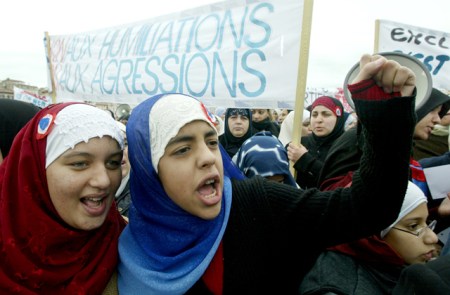
France-Muslims-Protest-Hijab-Ban-IP_0Muslims in France protest against a French law that forbids the wearing of religious symbols (including the hijab) in the primary and secondary schools. (Photo: © Reuters)

France has one of the largest Muslim communities in the West (estimated at 10% of the population), and French corporates have more experience than most in dealing with radical Islam.

City of Paris

In September 2012, in response to the encroachment of radical Islam, the mayor of Paris set up an Observatory on Secularism to ensure the principles of the 1905 separation of Church and State were being respected by the city’s 73,000 employees.

The observatory remained dormant but was reactivated in January 2015 after the Islamic terrorist attacks. Saïd Kouachi, one of the Charlie Hebdo killers, worked in the city sanitation department from 2007 to 2009. He was part of an employment program for young people from the ghettoes surrounding Paris.

A number of these youths were assigned to going door-to-door to inform householders on the benefits of domestic waste segregation. Many created problems for their supervisors due to their increasingly fundamentalist Islamic beliefs: refusing to shake hands with women, bringing prayer mats with them and taking time off to return to their workplaces to pray. Kouachi was moved from district to district as his supervisors, who described him as fundamentalist and unmanageable, became exasperated with his behavior. He was fired in July 2009.

A supervisor later revealed that city authorities had been notified about Kouachi’s radical behavior on several occasions, but that the subject was taboo. A “Charter on Secularism” was posted in the sanitation workshops and a one-day training program held for supervisors in 2013, but no action was taken to deal with the problem.

Since January 2015, the Observatory members meet regularly, have issued a 20-page rulebook to municipal employees and interviewed numerous city managers about the problems of radicalization. Departments most affected are sanitation, parks and gardens, public safety and security, and youth and sport. Common issues are praying in the workplace, refusal to shake hands with, look at or follow instructions from female supervisors, demands for work schedule accommodation on Fridays and during Ramadan, wearing of hijabs and other head-coverings.

RATP Paris Transit Authority

The RATP chapter of the CFDT union claims there is a groundswell of Islamist ideology within the company where Samy Amimour, one of the 2015 Paris suicide bombers, worked as a bus driver. In December 2015, a newspaper reported that several RATP employees were targeted by “Fiche S,” a law enforcement indicator that flags individuals linked to terrorism.

Religion-based workplace incidents are widespread. In 2013, RATP management issued a guidebook to supervisors listing typical infringements of secular principles and outlining rules to enforce. An RATP executive commented, “We pretend the problem has been solved, but the reality is that managers in contact with radicalized individuals in bus depots are left on their own to handle these kinds of things.”

ADP Paris Airports Authority

Following the November 2015 attacks in Paris, CDG Airport CEO Augustin de Romanet revealed that 70 airside security badges had been withdrawn from Muslim airport employees and 4,000 staff lockers raided by police as the employees were considered a security risk.

French Automobile Industry

The problems facing French public-sector companies have long been present in the automobile industry, where Muslims account for around 70 percent of the workforce. Militant Islam began to manifest itself in the 1980s, when it emerged that shop stewards frequently had links to the Muslim Brotherhood.

Employees began to shave their heads, grow beards and wear Islamic garb as the Salafist ideology gained ground in the suburbs where the auto plants are located. Automakers Renault and Peugeot integrated Muslim practices into their management model, setting up on-site prayer rooms and planning work schedules to fit in with prayer times and Ramadan.

Employee associations were established to cater to the needs of Muslim staff, organizing religious celebrations, pilgrimages to Mecca and arranging for the repatriation to North Africa of deceased workers. This policy of appeasement benefited the industry since it minimized religion-linked workplace conflict and litigation and fostered employee engagement.

Radical Islam and the Emergence of Jihadism

The first generation of Muslim immigrants who came to France in the 1950s kept their faith to themselves. The second generation was more militant and began making demands for accommodation of Islam. Opting for exclusion rather than integration into mainstream society, some turned to crime. Those caught and imprisoned often converted to radical Islam, spreading the ideology throughout the ghettoes upon release.

The third generation came of age with the nationwide 2005 riots, sparked by the electrocution of two juvenile delinquents who climbed over a fence into an electricity substation to escape from the police.

The same year, Abu Musab al-Suri published a 1,600-page Global Islamic Resistance Call urging the masterminds of jihad to exploit the presence of the huge disaffected Muslim populations in Europe by prompting them to set up terror cells targeting Western civilians. The strategy was rolled out on the internet and by Salafist imams operating in mosques financed by the Gulf states.

A growing number of Muslims in France and Europe converted to radical Islam resulting in the emergence of an informal jihadist army on the continent. In February 2016, the number of radical Islamists identified by French law enforcement was 11,700.

Suddenly Russia consents to consider Assad’s ouster

May 4, 2016

Suddenly Russia consents to consider Assad’s ouster, DEBKAfile, May 4, 2016

Washington and Moscow have made dramatic progress over the last few days in marathon telephone talks between Secretary of State John Kerry and Foreign Minister Sergei Lavrov on ending the war in Syria. Russia agreed for the first time to discuss the possibility that Syrian President Bashar Assad will step down, and the conditions under which such a process will take place, according to DEBKAfile’s intelligence sources.

The sources add that the Russians also agreed to begin to negotiate the future of senior Syrian military commanders who are carrying out the war against the rebels. The contacts that include the Saudis and the Jordanians have reached such an advanced stage that participants have started to prepare lists of Syrian commanders who will be removed or remain in their posts.

One of the clearest signs of the progress was the arrival of nearly all of the heads and commanders of the Syrian rebel organizations on Monday and Tuesday (May 2-3) for intensive talks at the US Central Command Forward-Jordan, a war room outside Amman staffed by officers from the US, Jordan, Saudi Arabia and the UAE. The gathering was arranged via a series of meetings held in Geneva over the last few days between the top diplomats of the US, Saudi Arabia and Jordan.

Our sources report that US officials and senior officers in charge of the Obama administration’s strategy for the war in Syria presented the rebel leaders and commanders with a series of agreements already reached by Washington and Moscow on ways of ending the war. The main part of the agreement focused on the resignation of Assad and the departure of him and his family from the country-the Syrian opposition’s key demand for continuing the talks.

The rebel leaders were asked by the US officials and officers, who were accompanied by Saudi and Jordanian officials, to help facilitate implementation of the agreed measures and not to try to interfere with them, or in other words, to stop the fighting.

According to the information from our sources, the discussions in Jordan are continuing.

Washington’s current goal is achieve a ceasefire in all of Syria that will prevent an imminent attack by Russian, Iranian, Syrian and Hizballah forces on Aleppo, the country’s second-largest city.

Our military sources report that on Monday and Tuesday, by order of President Vladimir Putin, the Russian air force suddenly halted its airstrikes in the Aleppo area.

Thus, the Iranian, Syrian and Hizballah armies are preparing to launch their assault without the air support needed to capture the city. Even though the Syrian air force can operate in an uninhibited manner in the Aleppo area, it is not up to a large-scale and decisive attack.

No specific information is forthcoming for the Russian U-turn on Assad ousters in mid offensive for the recovery of Aleppo.

However Putin is prone to sudden zigzag in policies.

The 5 Stages of Political Death by Donald Trump

May 4, 2016

The 5 Stages of Political Death by Donald Trump

by Matthew Palumbo3

May 2016

Source: The 5 Stages of Political Death by Donald Trump – Breitbart

Ricky Carioti/The Washington Post via Getty Images

The phenomenon that is Donald Trump and the Trump candidacy is historic. It has created an election and an atmosphere that we could go another century without seeing again.

Given that Donald Trump is the Haley’s Comet of American politics, no political science playbook or textbook or game plan exists on how to handle this phenomenon. From day 1, Donald Trump has baffled pundits, experts, strategists, analysts; and just about everyone else paying attention.

The efficacy of the Trump campaign to this point is attributable to Mr. Trump’s unpredictability and unconventionality. They call the study of politics and campaign management in academia “Political Science” for a reason. It doesn’t just exist to give future law students an easy major. Much like hard sciences, the political scientist likes to deal in theory or law with best practices, related to distinct causes and effects, tested over time in the laboratory.

But don’t expect to see any test tubes and microscopes. Politicos use public opinion, focus groups, conventional wisdom, and statistical analysis in their laboratory.

Donald Trump and his campaign has not only never entered the political laboratory — he’s burned it to the ground.

What is evident however is that a pattern has developed in the manner in which Donald Trump has dispatched his opponents — in the case of Jeb Bush, with nothing more than an adjective. One by one, his 16 opponents in the quest for the GOP nomination have vanished.

Each of these opponents was unique in their interactions with Trump over the course of the campaign. But in examining these interactions and how they have been portrayed in the media and evaluated by the court of public opinion, Trump’s opponents have met their demise to what I call: “ The 5 Stages of Political Death by Trump.”

Here are the stages:

Stage 1: Under Estimation

Hubris and ego are most prevalent in this stage as Trump’s opponents discount his business acumen and question his vast wealth and how he amassed it. Collectively they discount any chance he has for any type of success because he is after all a political novice and lacks the instincts needed to achieve. They ridicule his appearance, his hit TV show, and overall competence.

Stage 2: Placation

After they’ve gotten past Stage 1, the Trump opponent begins to realize that maybe Trump does have some appeal. During this stage advisers will tell the Trump opponent to “stay above the fray,” or “to keep doing your own thing,” or respond when asked about Trump with general platitudes like, I couldn’t care less about Trump.” Essentially you are just trying to stay out of his gaze, and thus stay out of his crosshairs. Your grandpa called it, “whistling past the graveyard” — at least mine did.

Stage 3: Manipulation

When their strategy in Stage 2 proves unsuccessful, Trump’s opponents attempt to manipulate him and diminish his rising poll numbers and momentum by impacting his campaign with external forces. Examples of this have been the eminent domain argument, the KKK attacks and focusing on his past donations to Democrats (though they never seem to mention that Hillary Clinton was once a Republican). Hyperbolic labeling is popular during this phase, as comparisons of Trump are made by his opponents to some of histories most divisive and infamous characters.

Stage 4: Frustration

After Trump utilizes his broad populist appeal to stave off the manipulative, coordinated attacks from Stage 3, good old fashioned frustration sets in. How could people be so dumb?and “Trump appeals to the low information voter” are typically the types of sound bites that you will hear during this stage — ironically, especially so from Democrats, claiming to represent the “common man.” During this phase you’ll also see Trump opponents make wholesale changes in their staff. Like the cherry blossoms in spring, denial is in full bloom during Stage 4.

Stage 5: Hate

Like a pot full of boiling water with the stove still on high, Trump’s opponents become enraged, unable to grasp how they could be losing to the incompetent novice whom they had foolishly under estimated in Stage 1. During this stage the Trump opponent begins to deviate from their disciplined style of campaigning and they begin to make rash, reckless decisions. Their hand has been forced by Trump, never a good situation for a candidate to be in. This stage signals that political death is near.

With the GOP nomination all but wrapped up for Donald Trump, and his delegate count surging toward 1237, many are now looking toward the general election and the match up with Hillary Clinton. For those of you scoring at home, Hillary and DNC Chair Debbie Wasserman Schultz are currently vacillating between Stages 1,2, and 3.