Archive for April 2016

Rutgers goes Sharia-Compliant,

April 28, 2016

Rutgers goes Sharia-Compliant, Front Page MagazineRobert Spencer, April 28, 2016

rutgers3

The April 5, 2016 issue of The Gleaner, the student paper of Rutgers University–Camden, published a cartoon of Muhammad, Buddha and Jesus in a bar. Its content, however, cannot be known at this point, because at the behest of Muslims on campus, and in a case fraught with implications for the health of the freedom of speech today, the entire issue has been deep-sixed.

Two weeks after the cartoon was published, the April 19 issue of The Gleaner contained a letter from the Muslim Brotherhood campus group, the Muslim Students Association, saying that it found the image offensive and asking The Gleaner to remove the image from the April 5 issue and circulate a new edition of that issue without it. The MSA letter claims that Christians and Jews on campus told MSA members that they, too, found the image offensive.

The MSA letter states: “Even though freedom of speech and press is emphasized and is something all of us value as proud Americans, the University prides itself on diversity of people of different faith and backgrounds so we feel that it is necessary to respect those faiths and backgrounds by honoring their beliefs.”

The April 19 Gleaner also contains a response to the MSA letter, written by Christopher Church, the Editor-in-Chief of The Gleaner. Church apologizes to the MSA and agrees to meet with it “so that we can rectify this issue and ensure that it doesn’t happen again.” He also agrees to remove any copies of the offending April 5 issue from the Gleaner boxes around campus and destroy them.

The Jihad Watch reader who alerted me to this sums up what is wrong here:

1. Freedom of speech is a Constitutional right. It is not negated by someone’s taking offense. This could have been and should have been a chance for Rutgers and The Gleaner to explain why the freedom of speech must be protected as our fundamental bulwark against tyranny, and why that means that we must all learn to put up with material that offends us.

2. Once a group’s feeling offended is taken as decisive, it may begin to take offense at other aspects of campus life it finds offensive. In the MSA’s case, it may begin getting offended at men and women sharing classrooms or coeds wearing tight jeans on campus.

3. In light of the violent attacks on those who have depicted Muhammad, The Gleaner by removing the image is bowing to the implicit threat of violence — which only in the long run encourages more violence. Rutgers’ Art Library recently featured an “artwork” depicting Jesus on a dartboard. It was ultimately removed, but not because it offended Christians. No one cares if Christians are offended: Rutgers officials know that offended Christians won’t murder them. Their solicitousness toward the MSA, by contrast, reveals that they know offended Muslims might very well kill them, and rather than stand up for the freedom of speech and against this kind of bullying, they signal their willingness to surrender and fall into line, accepting Sharia restrictions on speech.

Imagine how Rutgers would react if its Art Library had displayed, instead of this Jesus-on-a-dartboard “artwork,” a cartoon of Muhammad. The air would have been thick with cries of “Islamophobia.” Fragile Leftist students would be running for their safe spaces. The university would be instituting mandatory seminars designed to inculcate the proper “respect” that one must show for “The Other” so as to avoid charges of “racism” and “bigotry.”

The double standard is stark: Jesus crucified on a dartboard is art – and what’s more, it’s courageous. One Rutgers student chortled on Facebook that the dartboard “art” was “hilarious,” and crowed that “we don’t have to cater to the wills of the Church or any denomination of Christianity or religion.” Those who complained would be admonished: Don’t you respect the freedom of expression, you right-wing bigot?

A cartoon of Muhammad, on the other hand, even one as innocuous as the one in The Gleaner appears to have been — that’s an outrage. No one was crowing in that instance about not having to cater to the wills of the mosque. On the contrary, the message was clear: Don’t you respect Muslims as human beings, you right-wing bigot?

This is the kind of “respect” being irrationally violent will win you. Rutgers officials knew that Christians weren’t going to kill them, and that they could mock Christianity with impunity. They would only start blathering about “respect” when it comes to Islam. This respect won at the point of a sword does not bode well for the future of free expression in the West.

Turkey’s Fake War on Jihadis

April 28, 2016

Turkey’s Fake War on Jihadis, Gatestone InstituteBurak Bekdil, April 28, 2016

♦ Last year, a Turkish pollster found that one in every five Turks thought that the Charlie Hebdo attack in Paris was the natural response to men who insulted Prophet Mohammed.

♦ “Infidels who were enemies of Islam thought they buried Islam in the depths of history when they abolished the caliphate on March 3, 1924 … Some 92 years after … we are shouting out that we will re-establish the caliphate, here, right next to the parliament.” — Mahmut Kar, media bureau chief for Hizb ut-Tahrir Turkey.

♦ At a March meeting with top U.S. officials, King Abdullah of Jordan accused Turkey of exporting terrorists to Europe. He said: “The fact that terrorists are going to Europe is part of Turkish policy and Turkey keeps on getting a slap on the hand, but they are let off the hook.”

♦ And Turkey is the country its Western allies believe will help them fight jihadists? Lots of luck!

In theory, Turkey is part of the international coalition that fights the Islamic State (IS). Since it joined the fight last year, it has arrested scores of IS militants, made some efforts to seal its porous border with Syria and tagged IS as a terrorist organization. Turkish police have raided homes of suspected IS operatives. More recently, Turkey’s Interior Ministry updated its list of “wanted terrorists” to include 23 IS militants, and offered rewards of more than 42 million Turkish liras (more than $14 million) for any information leading to the suspects’ capture. But this is only part of the story.

On March 24, a Turkish court released seven members of IS, including the commander of the jihadists’ operations on Turkish soil. A total of 96 suspects are on trial, including the seven men who were detained but released. All are free now, although the indictment against them claims that they

“engaged in the activities of the terrorist organization called DAESH [Arabic acronym of IS]. The suspects had sent persons to the conflict zones; they applied pressure, force, violence and threats by using the name of the terrorist organization, and they had provided members and logistic support for the group.”

The release of terror suspects came in sharp contrast with another court decision that ruled for a trial, but while under detention, for four academics who had signed a petition calling for peace in Turkey’s Kurdish dispute. Unlike the IS militants, the academics remain behind bars.

The Turkish government, which controls the judiciary almost in its entirety, relies on Islamist grassroots supporters of various flavors — from Islamists and ‘lite jihadists’ to radicals.

Last year the Turkish pollster MetroPOLL found that one in every five Turks thought that theCharlie Hebdo attack in Paris was the natural response to people who insulted Prophet Mohammed [only 16.4% of Turks thought of the incident as an attack on freedom of expression]. Among the ruling Justice and Development Party’s (AKP) voters, the rate of approval of the attack was 26.4%; and only 6.2% viewed it as an attack on free speech. Only 17.8% of AKP voters thought the attack was the work of radical Islamists. Three-quarters of AKP voters thought Muslims were aggrieved by the attack; while as few as 15.4% thought the victims were the cartoonists who were murdered. Two-thirds of AKP voters thought attacks on Islam by Christian Crusaders were continuing.

The fact that key IS suspects are now free because the government may fear looking mean to its Islamist supporters only partly explains the appalling judicial rulings on jihadists and academics. “The suspects may be holding the Turkish government hostage … What if they threatened the authorities that they would reveal the government support for their organization in the past? You normally don’t walk free over such serious legal allegations,” observes one western diplomat in Ankara.

Russia has been claiming that Turkey keeps supporting the Islamic State through trading the jihadists’ oil, their main source of income. A new report claims that total supplies to terrorists in Syria last year was 2,500 tons of ammonium nitrate; 456 tons of potassium nitrate; 75 tons of aluminum powder; sodium nitrate; glycerine; and nitric acid. The report stated:

“In order to pass through the border controls unimpeded, effectively with the complicity of the Turkish authorities, products are processed for companies that are purportedly registered in Jordan and Iraq … Registration and processing of the cargo are organized at customs posts in the [Turkish] cities of Antalya, Gaziantep and Mersin. Once the necessary procedures have been carried out, the goods pass unhindered through the border crossings at Cilvegozu and Oncupinar.”

Turkey keeps playing a fake war on jihadist terrorists. At a March meeting with top U.S. officials, King Abdullah of Jordan accused Turkey of exporting terrorists to Europe. He said: “The fact that terrorists are going to Europe is part of Turkish policy and Turkey keeps on getting a slap on the hand, but they are let off the hook.”

In fact, the Turkish government’s secret love affair with various Islamist groups is not always so secret. In March, thousands of supporters of Hizb ut-Tahrir, a global Islamist group, gathered at a public sports hall in Ankara — courtesy of the Turkish government — to discuss the re-establishment of the Islamic caliphate. In his speech, Mahmut Kar, the media bureau chief of Hizb-ut Tahrir Turkey said:

“Infidels who were enemies of Islam thought they buried Islam in the depths of history when they abolished the caliphate on March 3, 1924 … We are hopeful, enthusiastic and happy. Some 92 years after … we are shouting out that we will re-establish the caliphate, here, right next to the parliament.”

(Hizb ut-Tahrir, viewed by Russia and Kazakhstan as a terrorist group, defines itself as a political organization aiming to “lead the ummah” to the re-establishment of the caliphate and rule with sharia law.)

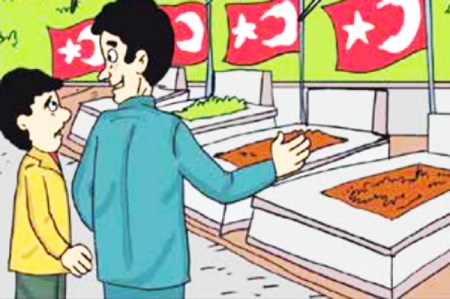
Guess what else Turkey is doing while pretending to be fighting jihadists? Apparently, President Recep Tayyip Erdogan’s declared political ambition to “raise devout generations” seems to have geared up. Turkey’s Religious Affairs General Directorate (Diyanet), the ultimate official religious authority in the country, recently issued comic books to the nation’s children telling them how marvelous it is to become an Islamic martyr.

1566Turkey’s Religious Affairs General Directorate (Diyanet), the ultimate official religious authority in the country, recently issued comic books to the nation’s children telling them how marvelous it is to become an Islamic martyr.

One comic strip is a dialogue between a father and his son. “How marvelous it is to become a martyr,” the father says. Unconvinced, the son asks: “Would anyone want to become a martyr?” And the father replies: “Yes, one would. Who doesn’t want to win heaven?”

And this is the country its Western allies believe will help them fight jihadists? Lots of luck!

Education Dept encourages Islam in classroom to stop bullying of Muslims

April 28, 2016

Education Dept encourages Islam in classroom to stop bullying of Muslims, Jihad Watch, Robert Spencer, April 27, 2016

(For some textbooks that might be appealing, please see also, I Love Islam. — DM)

Isn’t this unconstitutional? Wasn’t there a decades-long struggle to get Christianity out of public school classrooms? Now what had been accepted norms for the separation of religion from public school education are out the window. This initiative to introduce Islam into classroom teaching is based on spurious claims that Muslim students are bullied, when actual FBI statistics show that incidents against Jews are far more common.

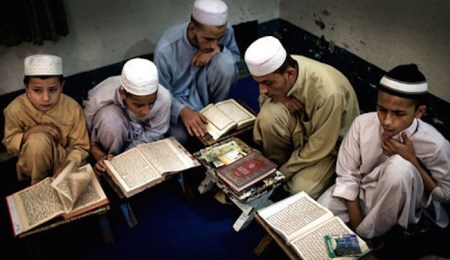
peshawar-madrassa-school-007

“Department Of Education Encourages Islam In Classrooms To Stop Muslim Bullying,” by Diane Palmer, Parent Herald, April 27, 2016 (thanks to The Religion of Peace):

The U.S. Department of Education calls educators to include Islam in the curriculum to address the bullying of Muslim students.

The Department of Education (DOE) in the U.S. encouraged educators to be more responsible in protecting Muslim students from bullying by teaching Islam in class. Many people rejected the demands of the DOE’s instructions by saying that it is inappropriate to bring up religion in class.

The DOE posted instructions on their website urging teachers to include Islam in classroom discussions. Educators are encouraged to incorporate experiences of Muslim people into the curriculum through current events, social studies and children’s literature.

The alleged bullying is said to be largely based on the lack of information about the religion and the tendency to associate Islam with terrorism. Although no firm statistics show how often Muslim students are bullied, activists claim that the numbers became higher after the attacks of 9/11, according to Huffington Post.

A 2010 survey of 57 Muslim teenagers aged 11 to 18 reported being called a name because of their faith. About 80 percent of the respondents also said they have been called a ‘terrorist’.

DOE cites an increase in incidents targeting the Muslim community due to the 10 incidents that happened nationwide, according to WND. Of the 10 events, two resulted in assaults, three reported the vandalism of mosques, five involved alleged threats and intimidation and only one involved a student inside school.

Parents were also called to educate their kids on how to prevent bullying. Parents were told to teach how to appreciate their peers and make friends across different cultures.

However, many groups rejected the claim of DOE by organizing a Change.org petition drive demanding the department to stop efforts to Islamize children in school. Nowhere in the blog does it talk about incorporating Christian or Judaism into classroom discussions despite far more actual violent attacks on Jews and Christians all over the world, according to Martin Mawyer, president and founder of Christian Action Network….

Report: Israel hunting chemical-armed ISIS terrorists in Golan

April 28, 2016

Report: Israel hunting chemical-armed ISIS terrorists in Golan, Israel National News, Ari Soffer, April 28, 2016

Isl St in SyriaISIS terrorist in Syria (file)Reuters

Israeli intelligence officials are concerned that an ISIS terrorist cell operating in the southern Golan Heights – along the border with Israel – has obtained chemical weapons.

According to a Channel 10 report, Israel is hunting the cell, located on the Syrian side of the border, amid fears the jihadists have imminent plans to use the chemical weapons in their possession.

The report added that the jihadists are not believed to be planning on using the chemical agents against Israel, but against their enemies inside Syria, of which there are no shortages. ISIS in Syria is currently fighting a multi-pronged war against the Assad regime, rival jihadists from Al Qaeda, other Syrian rebels, and, in northern Syria, against Kurdish forces.

Nevertheless, the prospect of an apocalyptic Islamist terrorist group possessing chemical weapons along Israel’s borders has naturally raised serious concerns in Jerusalem.

The Assad regime was supposed to destroy its massive chemical weapons arsenal under a Russian-brokered deal, but UN inspectors believe Damascus maintained reserves of nerve agents and other deadly chemical weapons. Fears have also been repeatedly raised of jihadists seizing chemical and even biological weapons depots from former regime positions.

Germany: “We Need an Islam Law”

April 28, 2016

Germany: “We Need an Islam Law” Gatestone InstituteSoeren Kern, April 28, 2016

♦ “All imams need to be trained in Germany and share our core values. … It cannot be that we are importing different, partly extreme values from other countries. German must be the language of the mosques. Enlightened Europe must cultivate its own Islam.” – Andreas Scheuer, the General Secretary of the Christian Social Union party (CSU).

♦ The Turkish government has sent 970 clerics — most of whom do not speak German — to lead 900 mosques in Germany that are controlled by a branch of the Turkish government’s Directorate for Religious Affairs. Turkish clerics in Germany are effectively Turkish civil servants who do the bidding of the Turkish government.

♦ Erdogan has repeatedly warned Turkish immigrants not to assimilate into German society. During a trip to Berlin in November 2011, Erdogan declared: “Assimilation is a violation of human rights.”

A senior German politician has called for an “Islam law” that would limit the influence of foreign imams and prohibit the foreign financing of mosques in Germany.

The proposal — modelled on the Islam Law promulgated in Austria in February 2015 — is aimed at staving off extremism and promoting Muslim integration by developing a moderate “European Islam.”

The move comes amid revelations that the Turkish government is paying the salaries of nearly 1,000 conservative imams in Germany who are leading mosques across the country. In addition, Saudi Arabia recently pledged to finance the construction of 200 mosques in Germany to serve migrants there.

In an interview with the newspaper Die Welt, Andreas Scheuer, the General Secretary of the Christian Social Union (CSU), the Bavarian sister party to German Chancellor Angela Merkel’s Christian Democrats (CDU), said that Berlin should restrict Turkish financing of mosques in Germany and begin training and certifying its own imams. Otherwise, he argued, Muslim integration will be difficult or impossible to achieve. He said:

“We need to become more critical in our dealings with political Islam, because it hinders Muslim integration in our country. We need an Islam Law. The financing of mosques or Islamic kindergartens from abroad, e.g. from Turkey or Saudi Arabia, should be banned. All imams need to be trained in Germany and share our core values.

“It cannot be that we are importing different, partly extreme values from other countries. German must be the language of the mosques. Enlightened Europe must cultivate its own Islam.

“We are still at the beginning of our efforts. We must start now. We cannot on the one hand enact an Integration Law and on the other side close our eyes to what is being preached in mosques and by whom.”

Scheuer’s comments come amid reports that the Turkish government has sent 970 clerics — most of whom do not speak German — to lead 900 mosques in Germany that are controlled by the Turkish-Islamic Union for Religious Affairs (DITIB), a branch of the Turkish government’s Directorate for Religious Affairs, known in Turkish as Diyanet.

Successive German governments are responsible for this state of affairs. An essay in Der Tagesspiegel states: “Over past decades, the federal government has welcomed the fact that the Turkish religious authority exercises a great influence on German mosques. Turkey was considered a secular state, and their influence was viewed as a shield against religious extremism.”

This was before Turkish President Recep Tayyip Erdogan embarked on a mission to turn the formerly secular nation an Islamic country.

According to Die Welt, Erdogan has increased the size, scope and power of the Diyanet, which now has a budget of 6.4 Turkish lira ($2.3 billion; €1.8 billion), which is more than the budgets of 12 Turkish government ministries, including the interior ministry and the foreign ministry. The Diyanet now has 120,000 employees, up from 72,000 in 2004.

The Turkish clerics in Germany are effectively Turkish civil servants who do the bidding of the Turkish government. Critics accuse Erdogan of using DITIB mosques to prevent Turkish migrants from integrating into German society.

German politician Cem Özdemir, co-chairman of the Green Party, said that DITIB is “nothing more than an extended arm of the Turkish state.” He added: “Rather than being a legitimate religious organization, the Turkish government has turned DITIB into a political front organization of Erdogan’s AKP party. Turkey must let go of the Muslims in Germany.”

Erdogan has repeatedly warned Turkish immigrants not to assimilate into German society.

1567 (1)The Cologne Central Mosque, run by DITIB, is used as a key base in Germany for Turkey’s intelligence agency, where they run a local “thug squad” to mete out “tough punishments” to Turkish dissidents in Germany. (Image source: © Raimond Spekking/CC BY-SA 4.0, via Wikimedia Commons)

During a trip to Berlin in November 2011, Erdogan declared: “Assimilation is a violation of human rights.” In February 2011, Erdogan told a crowd of more than 10,000 Turkish immigrants in Düsseldorf: “We are against assimilation. No one should be able to rip us away from our culture and civilization.” In February 2008, Erdogan told 16,000 Turkish immigrants in Cologne that “assimilation is a crime against humanity.”

For his part, Saudi Arabia’s King Salman recently announced a plan to finance the construction of 200 mosques in Germany to provide for the spiritual needs migrants and refugees who arrived there in 2015. The mosques would, presumably, adhere to Wahhabism, the official and dominant form of Sunni Islam in Saudi Arabia. Wahhabism is an austere form of Islam that insists on a literal interpretation of the Koran.

On April 11, Hans-Georg Maassen, the head of Germany’s domestic intelligence agency (BfV), expressed alarm at the growing number of radical Arab-language mosques in Germany. “Many mosques are dominated by fundamentalists and are being monitored because of their Salafist orientation,” Maassen said in an interview with Welt am Sonntag. He added that many of the mosques were being financed by donors in Saudi Arabia.

It remains uncertain, however, whether Merkel will back the “Islam Law,” which is certain to antagonize Erdogan, who effectively controls the floodgates of Muslim mass migration to Europe. If Merkel were openly to support a ban on foreign financing of mosques in Germany, Erdogan likely would threaten to pull out of the EU-Turkey deal on migrants, a deal Merkel desperately needs to stanch the flow of mass migration to Germany. It is yet another indication of the tremendous leverage Erdogan has gained over Merkel and German policymaking.

Germany’s coalition government has, however, reached a compromise deal on a new “Integration Law.”

On April 14, Merkel announced the broad outlines of the law, which will spell out the rights and responsibilities of migrants in Germany. Under the law, the text of which will be finalized by May 24, asylum seekers must attend German language classes and integration training or have their benefits cut.

The government pledged to make it easier for asylum seekers to gain access to the German labor market by promising to create 100,000 new “working opportunities.” The government will also suspend a law requiring employers to give preference to German or EU job applicants over asylum seekers.

In an effort to prevent the spread of migrant ghettoes in Germany, the new law, which is expected to enter into force this summer, will prohibit refugees from choosing where they live until they have secured asylum. Migrants who abandon state-assigned housing would face unspecified sanctions.

The new law also includes a counter-terrorism provision, which would allow German intelligence agencies to work more closely with their European, NATO and Israeli counterparts.

“We will have a German law on integration,” Merkel said. “This is the first time in post-war Germany that this has happened. It is an important, qualitative step.”

But critics say the proposed law does not go far enough because it does not threaten with deportation those migrants who refuse to integrate. In his interview with Die Welt, Scheuer insisted that Muslim immigrants must integrate or be deported:

“Anyone who fails to attend integration and language courses attests that they are not prepared to integrate and accept our values. Moreover, it is important that people who want to stay in Germany register with the Federal Employment Agency [Bundesagentur für Arbeit] and provide for their own livelihood. The message is clear: Those who are not integrated cannot stay here. We need to cease having romantic views of integration. Multiculturalism has failed. Those who are not integrated must count on deportation.”

Humor | Crisis at the Canadian Border

April 28, 2016

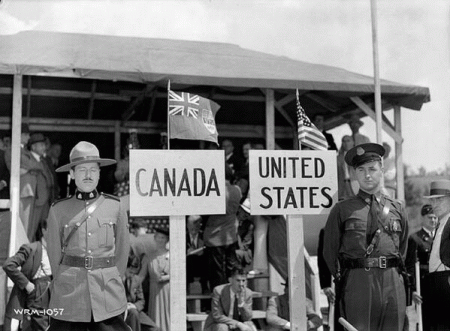
(But they don’t go. Via e-mail, author unknown. — DM)

H/t Socialism is not the answer

usa-vs-canadaImage via artfulpuck.wordpress.com

The flood of American liberals sneaking across the border into Canada has intensified in the past week, sparking calls for increased patrols to stop the illegal immigration. The Republican Presidential primary campaign is prompting an exodus among left leaning citizens who fear they’ll soon be required to hunt, pray, and live according to conservative ideas about the Constitution.

Canadian border farmers say it’s not uncommon to see dozens of sociology professors, global warming activists, and “green” energy proponents crossing their fields at night.

“I went out to milk the cows the other day, and there was a Hollywood producer huddled in the barn,” said Southern Manitoba farmer Red Greenfield, whose acreage borders North Dakota . “The producer was cold, exhausted and hungry. He asked me if I could spare a latte and some free-range chicken. When I said I didn’t have any, he left before I even got a chance to show him my screenplay, eh?”

In an effort to stop the illegal aliens, Greenfield erected higher fences, but the liberals scaled them. He then installed loudspeakers that blared Rush Limbaugh across the fields, but they just keep coming.

Officials are particularly concerned about smugglers who meet liberals near the Canadian border, pack them into electric cars and drive them across the border where they are simply left to fend for themselves after the battery dies.

“A lot of these people are not prepared for our rugged conditions,” an Ontario border patrolman said. “I found one carload without a single bottle of Perrier drinking water. They did have a nice little Napa Valley cabernet, though, and some kale chips.”

When liberals are caught, they’re sent back across the border, often wailing loudly that they fear retribution from conservatives. Rumors have been circulating about plans being made to build re-education camps where liberals will be forced to drink domestic beer and study the Constitution.

In recent days, liberals have turned to ingenious ways of crossing the border. Some have been disguised as senior citizens taking a bus trip to buy cheap Canadian prescription drugs. After catching a half- dozen young vegans in blue-hair wig disguises, Canadian immigration authorities began stopping buses and quizzing the supposed senior-citizens about Perry Como and Rosemary Clooney to prove that they were alive in the ’50s. “If they can’t identify the accordion player on The Lawrence Welk Show, we become very suspicious about their age,” an official said.

Canadian citizens have complained that the illegal immigrants are creating an organic-broccoli shortage, buying up all the Barbara Streisand c.d.’s, and renting all the Michael Moore movies. “I really feel sorry for American liberals, but the Canadian economy just can’t support them,” an Ottawa resident said. “How many art-history majors does one country need?”

A Quick Reaction to Trump’s Speech

April 28, 2016

A Quick Reaction to Trump’s Speech, Front Page MagazineDavid Horowitz, April 28, 2016

Trump foreign policy

If Mitt Romney had given the speech that Donald Trump did today, and if he had followed its strategy during the third presidential debate with Obama on foreign policy, he would have won the 2012 election. Trump’s themes were straightforward: Make America strong again, put America’s interests first. The Obama-Clinton-Kerry foreign policy has strengthened our enemies, disparaged our allies, and earned us global disrespect. It has led to disasters that include the rise of ISIS and the destabilization of the Middle East. The theme of the Obama-Clinton-Kerry years has been the weakening of America – point Trump with maximum bite: “If President Obama’s goal had been to weaken America, he could not have done a better job.” And of course the Jeremiah Wright-Billy-Ayers-radical-Barack Obama did set out deliberately to do just that.  Obama’s agenda is American weakness, which leads to losing. Trump’s agenda: we must start winning.

There were specifics. First a rejection of the neo-conservative dream of democratizing the world, and in its place old-fashioned conservatism: limited foreign policy goals and stability, as the framework of peace: “We are getting out of the nation-building business, and instead focusing on creating stability in the world.” And second, a rejection of liberal internationalism, and a defense of the nation state, in particular this nation state with its unique political culture: “Under a Trump Administration, no American citizen will ever again feel that their needs come second to the citizens of foreign countries. I will view the world through the clear lens of American interests. I will be America’s greatest defender and most loyal champion. We will not apologize for becoming successful again, but will instead embrace the unique heritage that makes us who we are.” And the (accurate) justification for this nationalism: The world is most peaceful, and most prosperous, when America is strongest.”

These were reassuring clarifications by Trump about his foreign policy views and should be a step towards satisfying his conservative critics although obviously a speech can also be only that – words to pacify critics. We’ll have to wait and see how he elaborates it further in response to specific event. But this was a very good beginning.

For me the most reassuring aspect of the speech was its political toughness, an indication of what is waiting for Hillary in November should Trump win the nomination:

“After Secretary Clinton’s failed intervention in Libya, Islamic terrorists in Benghazi took down our consulate and killed our ambassador and three brave Americans. Then, instead of taking charge that night, Hillary Clinton decided to go home and sleep! Incredible. Clinton blames it all on a video, an excuse that was a total lie…. And now ISIS is making millions of dollars a week selling Libyan oil.”

Can’t wait for those Trump-Hillary debates.

Gingrich – Trump is “One of the Most Amazing Experiences in Political History”

April 28, 2016

Gingrich – Trump is “One of the Most Amazing Experiences in Political History” via YouTube, April 27, 2016

(I am not aware of any discussion about it, but how about a Trump – Gingrich ticket? — DM)

Iranian Daily ‘Kayhan’: Iran Asked Russia To Intervene In Syria; Moscow Must Not Reach Any Agreement On Syria With Washington At Assad’s And Iran’s Expense; Tehran Is Providing Assad With Strategic Weapons

April 27, 2016

Iranian Daily ‘Kayhan’: Iran Asked Russia To Intervene In Syria; Moscow Must Not Reach Any Agreement On Syria With Washington At Assad’s And Iran’s Expense; Tehran Is Providing Assad With Strategic Weapons, MEMRI, April 27, 2016

In its April 11, 2016 editorial, the Iranian daily Kayhan, the mouthpiece of Iran’s ideological camp which is led by Iranian Supreme Leader Ali Khamenei, discussed Russia’s interests in Syria and the Middle East, and Iran-Russia relations. The editorial warned Moscow not to reach a secret agreement with Washington at the expense of Syrian President Bashar Al-Assad and Iran in exchange for Washington’s lifting its pressure on Russia over Ukraine and Crimea. It also underlined that such an agreement would in any case be doomed to failure, because it would not have Tehran’s knowledge or agreement, and stated that Tehran is opposed to Russia’s federal plan for Syria.

Noting that while it is important to Russia, Syria is not strategic to it as it is to Iran and Hizbullah. Russia’s might in the region stems solely from its protection of the Iran-Hizbullah-Syria resistance axis, it said, adding that if Moscow sells out Assad and Syria, it will become a minor player in the region, like France and the U.K.

The editorial revealed that the Russian military had entered Syria in October 2015 at Tehran’s request, and acknowledged that major parts of northern and southern Syria are directly controlled by Hizbullah and Iran. It added that Tehran has for some time been providing Assad with strategic weapons, and that Russia had withdrawn from Syria because its presence there was no longer needed.

The following are excerpts from the editorial:

“What Part Does Syria Play In Russian Foreign Policy?”

“…What part does Syria play in Russian foreign policy? Is it great or small? To what extent is Russia’s Syria policy based on cooperation with the West? Great or small? Is Russia’s security situation such that it would prefer to trade Syria for Ukraine – meaning that Russia will receive Ukraine and give Syria to the West? What weight does Russia have in Syria – meaning how much does Russia really influence the Syrian security issue? And on this matter, historically, in the past 50 years, was Syria, or was it not, part of the Eastern Bloc and [after the collapse of the Soviet Union] one of Russia’s satellite states?

“What is the extent of the military relations between Russia and Syria? How dependent is the Syrian army on Russian arms? What was Russia’s aim in becoming [physically] involved in Syria’s security situation this past October? What agreement was arrived at between the U.S. and Russia at the Geneva talks?

“Isn’t Russia’s becoming a main focal point at the Geneva talks, and isn’t its secret agreement with the U.S., aimed at weakening Iran’s role [in Syria] and placing the fate of Iran’s allies in the hands of Moscow-Washington agreements?

“According to this, and in light of the fact that it is clear what the outcome of the secret Kremlin-White House talks will be, what was the point of our five-year effort to protect the Syrian government, and our sacrifice of beloved martyrs? And, ultimately, in light of its past reputation, can Russia’s game be trusted?…”

“All Russia’s Might Lies In Its Preservation Of Iran, Hizbullah, And Syria; If It Does Not Do This, [Russia] Will Become A Minor Player, Like France And England”

“Syria plays a major part in Russia’s foreign policy… Syria and its Mediterranean coast is the only point in the Middle East and North Africa that has [physical] contact with the southern reaches of NATO territory. To some extent, these places are under Russian control, and any plan that impacts Russia’s ongoing presence in this sensitive region is certainly contrary to Russia’s interests and national security.”

“On the other hand, there is no way Russia can trust that any agreement with the West that rejects Assad will not also reject Russian influence. Therefore, we can say that in terms of geopolitics and strategic interests, there is no possibility that an agreement between Russia and the West about the current Syrian government would be achieved – unless the Russians make a mistake in the talks. But even if this happens, there is a possibility for rectification [of such a mistake by Russia], thanks to the good Iran-Russia relations. Additionally, in the past year or two, we have seen at least two such mistakes that were subsequently rectified.”

“Regarding Russian control over Eastern Ukraine and the Crimea, and Russian military control of the Black Sea: There is no reason for Russia to bring Syria in [to the equation] in order to obtain Ukraine. At this time, in the Ukrainian issue, the Westerners and the Western government in Kiev are apprehensive about Russia’s influence and about Russia’s military and security expansion in Eastern and Southern Ukraine. Therefore, the statement that is brought up in Iran – i.e. that Russia wants to trade Syria for Ukraine, is not compatible with reality.

“What weight does Russia carry in Syria? Undoubtedly, Russia is one of the countries that influence the Syrian issue. Russia’s military presence in the ports of Latakia and Tartus, as well as the Russia-Syria military agreements, give Russia prominent status. But in comparison with the status of Iran and Hizbullah, [Russia’s] status is not considered strategic.

“In principle, in some strategic matters, there are strategic points of contention between Russia and Syria – but there are no such disputes between Damascus and Tehran… Russia’s influence in Syria is not so great that [Russia] can make decisions on behalf of the Syrian government and its allies in the region… that is, Russia has no strategic relations either with the Syrian government or with the main rebels such as Jabhat Al-Nusra and ISIS, which would allow it to establish a particular situation in Syria. All Russia’s might lies in its preservation of Iran, Hizbullah, and Syria. If it does not do this, [Russia] will become a minor player, like France and England.”

“Major Parts Of The Line Of Defense And The Operations Of North And South Syria Are Now Directly In Hizbullah’s And Iran’s Hands”

“Over the past 50 years, Syria was never recognized as part of the Eastern Bloc, and never expressed solidarity with it, despite its good relations with the Soviet Union and Russia. Perhaps the main reason there was no such alliance is Russia’s active relations with the Zionist regime. In any event, Syria was not defined as part of Russia’s [interests], and has, since the beginning of the victory of [Iran’s Islamic] Revolution, been part of the resistance front and an ally of Iran – and now too it owes its existence to Iran’s special and influential aid.

“In contrast to Russia, that has nothing in Syria that belongs to it, major parts of the line of defense and the operations of north and south Syria are now directly in Hizbullah’s and Iran’s hands. If Russia reaches an agreement with a third country that is unacceptable to Iran, such an agreement will surely fail – because in the past 30 years, every decision made for the resistance states and movements in which Iran had no part failed.

“Syria has no absolute dependence on Russian arms, and Iran has been providing Syria with strategic weapons for a long time. Therefore, in the [second Lebanon] war, the Assad government gave its Russian weapons to Hizbullah in Lebanon, without fearing that this would violate either the military protocols [that were in place] with Russia or the Russians’ conditions. Russia also did not succeed in expressing serious opposition [to this move]. Therefore, if Moscow was Syria’s only source of weapons, Assad would not have been able to unilaterally violate the agreement.”

“On The First Of October 2015, Russia [Physically] Entered The Syrian Security Issue, After Iran Officially Asked It To Do So”

“On the first of October 2015, Russia [physically] entered the Syrian security issue, after Iran officially asked it to do so. Two days after a visit [to Moscow] by a high-ranking Iranian delegation, Moscow sent its air forces and missile defense systems into the war against terrorist elements in Syria, and five and a half months later, it withdrew part of its military forces from Syria. This was because the Islamic Revolutionary Guard Corps (IRGC)   agreement with Putin was in force for five months at most. After the end of the [Russia-Iran] agreement, Russia withdrew only some of its forces from Syria.

“[It was at] Iran’s invitation that Russia entered Syria, when such a [military intervention] was necessary and worthwhile, and [Russia] withdrew part of its forces when even withdrawing them all would not have harmed the [Assad] government and the Syrian security apparatuses one bit. In this case, Iran’s conclusion was that the Russian forces should return [to Russia].

“The truth is that last summer, because of the advance of the terror elements in Idlib, Shaykh Maskin, Sakhaneh, and Tadmor, terror elements were enthused, and Syria needed a psychological shock; additionally, prior to Russia’s entrance, the sensitive region of Zabadani was taken by Hizbullah.

“This shock [i.e. Russia’s entrance into Syria] was implemented in early October, and it gave the [Syrian] army, and the forces connected to it, their second wind, and they carried out the Nasser 2 operation in the western part of the city of Aleppo and also determined the fate of the war in Syria. Therefore, when the Russians withdrew their forces [from Syria], there was no longer any need for their presence. So it is not at all correct to say that Iran and Syria were surprised when this happened.

“For Syria, there is a need for diplomatic talks, and Iran always stresses [the need for] this alongside military operations. Iran has had a useful presence in most [of these talks] particularly in the two recent rounds of talks held in Munich and Geneva. Here, Russia’s role was two-pronged: First, in the developments in the [war] arena; in this matter [Russia] is fully coordinating with Iran. Second is Russia’s special plan, the main point of which is [Syria’s] federalization. Iran has neither rejected nor approved [this plan], but it recognizes it as premature, and as not serving the interests of the participants in the diplomatic talks in Geneva.”

Donald J. Trump Foreign Polity Speech

April 27, 2016

Donald J. Trump Foreign Polity Speech, DonaldTrump.com, April 27, 2016

Thank you for the opportunity to speak to you, and thank you to the Center for the National Interest for honoring me with this invitation.

I would like to talk today about how to develop a new foreign policy direction for our country – one that replaces randomness with purpose, ideology with strategy, and chaos with peace.

It is time to shake the rust off of America’s foreign policy. It’s time to invite new voices and new visions into the fold.

The direction I will outline today will also return us to a timeless principle. My foreign policy will always put the interests of the American people, and American security, above all else. That will be the foundation of every decision that I will make.

America First will be the major and overriding theme of my administration.

But to chart our path forward, we must first briefly look back.

We have a lot to be proud of. In the 1940s we saved the world. The Greatest Generation beat back the Nazis and the Japanese Imperialists.

Then we saved the world again, this time from totalitarian Communism. The Cold War lasted for decades, but we won.

Democrats and Republicans working together got Mr. Gorbachev to heed the words of President Reagan when he said: “tear down this wall.”

History will not forget what we did.

Unfortunately, after the Cold War, our foreign policy veered badly off course. We failed to develop a new vision for a new time. In fact, as time went on, our foreign policy began to make less and less sense.

Logic was replaced with foolishness and arrogance, and this led to one foreign policy disaster after another.

We went from mistakes in Iraq to Egypt to Libya, to President Obama’s line in the sand in Syria. Each of these actions have helped to throw the region into chaos, and gave ISIS the space it needs to grow and prosper.

It all began with the dangerous idea that we could make Western democracies out of countries that had no experience or interest in becoming a Western Democracy.

We tore up what institutions they had and then were surprised at what we unleashed. Civil war, religious fanaticism; thousands of American lives, and many trillions of dollars, were lost as a result. The vacuum was created that ISIS would fill. Iran, too, would rush in and fill the void, much to their unjust enrichment.

Our foreign policy is a complete and total disaster.

No vision, no purpose, no direction, no strategy.

Today, I want to identify five main weaknesses in our foreign policy.

First, Our Resources Are Overextended

President Obama has weakened our military by weakening our economy. He’s crippled us with wasteful spending, massive debt, low growth, a huge trade deficit and open borders.

Our manufacturing trade deficit with the world is now approaching $1 trillion a year. We’re rebuilding other countries while weakening our own.

Ending the theft of American jobs will give us the resources we need to rebuild our military and regain our financial independence and strength.

I am the only person running for the Presidency who understands this problem and knows how to fix it.

Secondly, our allies are not paying their fair share.

Our allies must contribute toward the financial, political and human costs of our tremendous security burden. But many of them are simply not doing so. They look at the United States as weak and forgiving and feel no obligation to honor their agreements with us.

In NATO, for instance, only 4 of 28 other member countries, besides America, are spending the minimum required 2% of GDP on defense.

We have spent trillions of dollars over time – on planes, missiles, ships, equipment – building up our military to provide a strong defense for Europe and Asia. The countries we are defending must pay for the cost of this defense – and, if not, the U.S. must be prepared to let these countries defend themselves.

The whole world will be safer if our allies do their part to support our common defense and security.

A Trump Administration will lead a free world that is properly armed and funded.

Thirdly, our friends are beginning to think they can’t depend on us.

We’ve had a president who dislikes our friends and bows to our enemies.

He negotiated a disastrous deal with Iran, and then we watched them ignore its terms, even before the ink was dry.

Iran cannot be allowed to have a nuclear weapon and, under a Trump Administration, will never be allowed to have a nuclear weapon.

All of this without even mentioning the humiliation of the United States with Iran’s treatment of our ten captured sailors.

In negotiation, you must be willing to walk. The Iran deal, like so many of our worst agreements, is the result of not being willing to leave the table. When the other side knows you’re not going to walk, it becomes absolutely impossible to win.

At the same time, your friends need to know that you will stick by the agreements that you have with them.

President Obama gutted our missile defense program, then abandoned our missile defense plans with Poland and the Czech Republic.

He supported the ouster of a friendly regime in Egypt that had a longstanding peace treaty with Israel – and then helped bring the Muslim Brotherhood to power in its place.

Israel, our great friend and the one true Democracy in the Middle East, has been snubbed and criticized by an Administration that lacks moral clarity. Just a few days ago, Vice President Biden again criticized Israel – a force for justice and peace – for acting as an impediment to peace in the region.

President Obama has not been a friend to Israel. He has treated Iran with tender love and care and made it a great power in the Middle East – all at the expense of Israel, our other allies in the region and, critically, the United States.

We’ve picked fights with our oldest friends, and now they’re starting to look elsewhere for help.

Fourth, our rivals no longer respect us.

In fact, they are just as confused as our allies, but an even bigger problem is that they don’t take us seriously any more.

When President Obama landed in Cuba on Air Force One, no leader was there to meet or greet him – perhaps an incident without precedent in the long and prestigious history of Air Force One.

Then, amazingly, the same thing happened in Saudi Arabia — it’s called no respect.

Do you remember when the President made a long and expensive trip to Copenhagen, Denmark to get the Olympics for our country, and, after this unprecedented effort, it was announced that the United States came in fourth place?

He should have known the result before making such an embarrassing commitment.

The list of humiliations goes on and on.

President Obama watches helplessly as North Korea increases its aggression and expands even further with its nuclear reach.

Our president has allowed China to continue its economic assault on American jobs and wealth, refusing to enforce trade rules – or apply the leverage on China necessary to rein in North Korea.

He has even allowed China to steal government secrets with cyber attacks and engage in industrial espionage against the United States and its companies.

We’ve let our rivals and challengers think they can get away with anything.

If President Obama’s goal had been to weaken America, he could not have done a better job.

Finally, America no longer has a clear understanding of our foreign policy goals.

Since the end of the Cold War and the break-up of the Soviet Union, we’ve lacked a coherent foreign policy.

One day we’re bombing Libya and getting rid of a dictator to foster democracy for civilians, the next day we are watching the same civilians suffer while that country falls apart.

We’re a humanitarian nation. But the legacy of the Obama-Clinton interventions will be weakness, confusion, and disarray.

We have made the Middle East more unstable and chaotic than ever before.

We left Christians subject to intense persecution and even genocide.

Our actions in Iraq, Libya and Syria have helped unleash ISIS.

And we’re in a war against radical Islam, but President Obama won’t even name the enemy!

Hillary Clinton also refuses to say the words “radical Islam,” even as she pushes for a massive increase in refugees.

After Secretary Clinton’s failed intervention in Libya, Islamic terrorists in Benghazi took down our consulate and killed our ambassador and three brave Americans. Then, instead of taking charge that night, Hillary Clinton decided to go home and sleep! Incredible.

Clinton blames it all on a video, an excuse that was a total lie. Our Ambassador was murdered and our Secretary of State misled the nation – and by the way, she was not awake to take that call at 3 o’clock in the morning.

And now ISIS is making millions of dollars a week selling Libyan oil.

This will change when I am president.

To all our friends and allies, I say America is going to be strong again. America is going to be a reliable friend and ally again.

We’re going to finally have a coherent foreign policy based upon American interests, and the shared interests of our allies.

We are getting out of the nation-building business, and instead focusing on creating stability in the world.

Our moments of greatest strength came when politics ended at the water’s edge.

We need a new, rational American foreign policy, informed by the best minds and supported by both parties, as well as by our close allies.

This is how we won the Cold War, and it’s how we will win our new and future struggles.

First, we need a long-term plan to halt the spread and reach of radical Islam.

Containing the spread of radical Islam must be a major foreign policy goal of the United States.

Events may require the use of military force. But it’s also a philosophical struggle, like our long struggle in the Cold War.

In this we’re going to be working very closely with our allies in the Muslim world, all of which are at risk from radical Islamic violence.

We should work together with any nation in the region that is threatened by the rise of radical Islam. But this has to be a two-way street – they must also be good to us and remember us and all we are doing for them.

The struggle against radical Islam also takes place in our homeland. There are scores of recent migrants inside our borders charged with terrorism. For every case known to the public, there are dozens more.

We must stop importing extremism through senseless immigration policies.

A pause for reassessment will help us to prevent the next San Bernardino or worse — all you have to do is look at the World Trade Center and September 11th.

And then there’s ISIS. I have a simple message for them. Their days are numbered. I won’t tell them where and I won’t tell them how. We must as, a nation, be more unpredictable. But they’re going to be gone. And soon.

Secondly, we have to rebuild our military and our economy.

The Russians and Chinese have rapidly expanded their military capability, but look what’s happened to us!

Our nuclear weapons arsenal – our ultimate deterrent – has been allowed to atrophy and is desperately in need of modernization and renewal.

Our active duty armed forces have shrunk from 2 million in 1991 to about 1.3 million today.

The Navy has shrunk from over 500 ships to 272 ships during that time.

The Air Force is about 1/3 smaller than 1991. Pilots are flying B-52s in combat missions today which are older than most people in this room.

And what are we doing about this? President Obama has proposed a 2017 defense budget that, in real dollars, cuts nearly 25% from what we were spending in 2011.

Our military is depleted, and we’re asking our generals and military leaders to worry about global warming.

We will spend what we need to rebuild our military. It is the cheapest investment we can make. We will develop, build and purchase the best equipment known to mankind. Our military dominance must be unquestioned.

But we will look for savings and spend our money wisely. In this time of mounting debt, not one dollar can be wasted.

We are also going to have to change our trade, immigration and economic policies to make our economy strong again – and to put Americans first again. This will ensure that our own workers, right here in America, get the jobs and higher pay that will grow our tax revenue and increase our economic might as a nation.

We need to think smarter about areas where our technological superiority gives us an edge. This includes 3-D printing, artificial intelligence and cyberwarfare.

A great country also takes care of its warriors. Our commitment to them is absolute. A Trump Administration will give our service men and women the best equipment and support in the world when they serve, and the best care in the world when they return as veterans to civilian life.

Finally, we must develop a foreign policy based on American interests.

Businesses do not succeed when they lose sight of their core interests and neither do countries.

Look at what happened in the 1990s. Our embassies in Kenya and Tanzania were attacked and seventeen brave sailors were killed on the USS Cole. And what did we do? It seemed we put more effort into adding China to the World Trade Organization – which has been a disaster for the United States – than into stopping Al Qaeda.

We even had an opportunity to take out Osama Bin Laden, and didn’t do it. And then, we got hit at the World Trade Center and the Pentagon, the worst attack on our country in its history.

Our foreign policy goals must be based on America’s core national security interests, and the following will be my priorities.

In the Middle East, our goals must be to defeat terrorists and promote regional stability, not radical change. We need to be clear-sighted about the groups that will never be anything other than enemies.

And we must only be generous to those that prove they are our friends.

We desire to live peacefully and in friendship with Russia and China. We have serious differences with these two nations, and must regard them with open eyes. But we are not bound to be adversaries. We should seek common ground based on shared interests. Russia, for instance, has also seen the horror of Islamic terrorism.

I believe an easing of tensions and improved relations with Russia – from a position of strength – is possible. Common sense says this cycle of hostility must end. Some say the Russians won’t be reasonable. I intend to find out. If we can’t make a good deal for America, then we will quickly walk from the table.

Fixing our relations with China is another important step towards a prosperous century. China respects strength, and by letting them take advantage of us economically, we have lost all of their respect. We have a massive trade deficit with China, a deficit we must find a way, quickly, to balance.

A strong and smart America is an America that will find a better friend in China. We can both benefit or we can both go our separate ways.

After I am elected President, I will also call for a summit with our NATO allies, and a separate summit with our Asian allies. In these summits, we will not only discuss a rebalancing of financial commitments, but take a fresh look at how we can adopt new strategies for tackling our common challenges.

For instance, we will discuss how we can upgrade NATO’s outdated mission and structure – grown out of the Cold War – to confront our shared challenges, including migration and Islamic terrorism.

I will not hesitate to deploy military force when there is no alternative. But if America fights, it must fight to win. I will never send our finest into battle unless necessary – and will only do so if we have a plan for victory.

Our goal is peace and prosperity, not war and destruction.

The best way to achieve those goals is through a disciplined, deliberate and consistent foreign policy.

With President Obama and Secretary Clinton we’ve had the exact opposite: a reckless, rudderless and aimless foreign policy – one that has blazed a path of destruction in its wake.

After losing thousands of lives and spending trillions of dollars, we are in far worse shape now in the Middle East than ever before.

I challenge anyone to explain the strategic foreign policy vision of Obama-Clinton – it has been a complete and total disaster.

I will also be prepared to deploy America’s economic resources. Financial leverage and sanctions can be very persuasive – but we need to use them selectively and with determination. Our power will be used if others do not play by the rules.

Our friends and enemies must know that if I draw a line in the sand, I will enforce it.

However, unlike other candidates for the presidency, war and aggression will not be my first instinct. You cannot have a foreign policy without diplomacy. A superpower understands that caution and restraint are signs of strength.

Although not in government service, I was totally against the War in Iraq, saying for many years that it would destabilize the Middle East. Sadly, I was correct, and the biggest beneficiary was Iran, who is systematically taking over Iraq and gaining access to their rich oil reserves – something it has wanted to do for decades. And now, to top it all off, we have ISIS.

My goal is to establish a foreign policy that will endure for several generations.

That is why I will also look for talented experts with new approaches, and practical ideas, rather than surrounding myself with those who have perfect resumes but very little to brag about except responsibility for a long history of failed policies and continued losses at war.

Finally, I will work with our allies to reinvigorate Western values and institutions. Instead of trying to spread “universal values” that not everyone shares, we should understand that strengthening and promoting Western civilization and its accomplishments will do more to inspire positive reforms around the world than military interventions.

These are my goals, as president.

I will seek a foreign policy that all Americans, whatever their party, can support, and which our friends and allies will respect and welcome.

The world must know that we do not go abroad in search of enemies, that we are always happy when old enemies become friends, and when old friends become allies.

To achieve these goals, Americans must have confidence in their country and its leadership again.

Many Americans must wonder why our politicians seem more interested in defending the borders of foreign countries than their own.

Americans must know that we are putting the American people first again. On trade, on immigration, on foreign policy – the jobs, incomes and security of the American worker will always be my first priority.

No country has ever prospered that failed to put its own interests first. Both our friends and enemies put their countries above ours and we, while being fair to them, must do the same.

We will no longer surrender this country, or its people, to the false song of globalism.

The nation-state remains the true foundation for happiness and harmony. I am skeptical of international unions that tie us up and bring America down, and will never enter America into any agreement that reduces our ability to control our own affairs.

NAFTA, as an example, has been a total disaster for the U.S. and has emptied our states of our manufacturing and our jobs. Never again. Only the reverse will happen. We will keep our jobs and bring in new ones. Their will be consequences for companies that leave the U.S. only to exploit it later.

Under a Trump Administration, no American citizen will ever again feel that their needs come second to the citizens of foreign countries.

I will view the world through the clear lens of American interests.

I will be America’s greatest defender and most loyal champion. We will not apologize for becoming successful again, but will instead embrace the unique heritage that makes us who we are.

The world is most peaceful, and most prosperous, when America is strongest.

America will continually play the role of peacemaker.

We will always help to save lives and, indeed, humanity itself. But to play that role, we must make America strong again.

We must make America respected again. And we must make America great again.

If we do that, perhaps this century can be the most peaceful and prosperous the world has ever known. Thank you.