Archive for April 27, 2016

Iranian Daily ‘Kayhan’: Iran Asked Russia To Intervene In Syria; Moscow Must Not Reach Any Agreement On Syria With Washington At Assad’s And Iran’s Expense; Tehran Is Providing Assad With Strategic Weapons

April 27, 2016

Iranian Daily ‘Kayhan’: Iran Asked Russia To Intervene In Syria; Moscow Must Not Reach Any Agreement On Syria With Washington At Assad’s And Iran’s Expense; Tehran Is Providing Assad With Strategic Weapons, MEMRI, April 27, 2016

In its April 11, 2016 editorial, the Iranian daily Kayhan, the mouthpiece of Iran’s ideological camp which is led by Iranian Supreme Leader Ali Khamenei, discussed Russia’s interests in Syria and the Middle East, and Iran-Russia relations. The editorial warned Moscow not to reach a secret agreement with Washington at the expense of Syrian President Bashar Al-Assad and Iran in exchange for Washington’s lifting its pressure on Russia over Ukraine and Crimea. It also underlined that such an agreement would in any case be doomed to failure, because it would not have Tehran’s knowledge or agreement, and stated that Tehran is opposed to Russia’s federal plan for Syria.

Noting that while it is important to Russia, Syria is not strategic to it as it is to Iran and Hizbullah. Russia’s might in the region stems solely from its protection of the Iran-Hizbullah-Syria resistance axis, it said, adding that if Moscow sells out Assad and Syria, it will become a minor player in the region, like France and the U.K.

The editorial revealed that the Russian military had entered Syria in October 2015 at Tehran’s request, and acknowledged that major parts of northern and southern Syria are directly controlled by Hizbullah and Iran. It added that Tehran has for some time been providing Assad with strategic weapons, and that Russia had withdrawn from Syria because its presence there was no longer needed.

The following are excerpts from the editorial:

“What Part Does Syria Play In Russian Foreign Policy?”

“…What part does Syria play in Russian foreign policy? Is it great or small? To what extent is Russia’s Syria policy based on cooperation with the West? Great or small? Is Russia’s security situation such that it would prefer to trade Syria for Ukraine – meaning that Russia will receive Ukraine and give Syria to the West? What weight does Russia have in Syria – meaning how much does Russia really influence the Syrian security issue? And on this matter, historically, in the past 50 years, was Syria, or was it not, part of the Eastern Bloc and [after the collapse of the Soviet Union] one of Russia’s satellite states?

“What is the extent of the military relations between Russia and Syria? How dependent is the Syrian army on Russian arms? What was Russia’s aim in becoming [physically] involved in Syria’s security situation this past October? What agreement was arrived at between the U.S. and Russia at the Geneva talks?

“Isn’t Russia’s becoming a main focal point at the Geneva talks, and isn’t its secret agreement with the U.S., aimed at weakening Iran’s role [in Syria] and placing the fate of Iran’s allies in the hands of Moscow-Washington agreements?

“According to this, and in light of the fact that it is clear what the outcome of the secret Kremlin-White House talks will be, what was the point of our five-year effort to protect the Syrian government, and our sacrifice of beloved martyrs? And, ultimately, in light of its past reputation, can Russia’s game be trusted?…”

“All Russia’s Might Lies In Its Preservation Of Iran, Hizbullah, And Syria; If It Does Not Do This, [Russia] Will Become A Minor Player, Like France And England”

“Syria plays a major part in Russia’s foreign policy… Syria and its Mediterranean coast is the only point in the Middle East and North Africa that has [physical] contact with the southern reaches of NATO territory. To some extent, these places are under Russian control, and any plan that impacts Russia’s ongoing presence in this sensitive region is certainly contrary to Russia’s interests and national security.”

“On the other hand, there is no way Russia can trust that any agreement with the West that rejects Assad will not also reject Russian influence. Therefore, we can say that in terms of geopolitics and strategic interests, there is no possibility that an agreement between Russia and the West about the current Syrian government would be achieved – unless the Russians make a mistake in the talks. But even if this happens, there is a possibility for rectification [of such a mistake by Russia], thanks to the good Iran-Russia relations. Additionally, in the past year or two, we have seen at least two such mistakes that were subsequently rectified.”

“Regarding Russian control over Eastern Ukraine and the Crimea, and Russian military control of the Black Sea: There is no reason for Russia to bring Syria in [to the equation] in order to obtain Ukraine. At this time, in the Ukrainian issue, the Westerners and the Western government in Kiev are apprehensive about Russia’s influence and about Russia’s military and security expansion in Eastern and Southern Ukraine. Therefore, the statement that is brought up in Iran – i.e. that Russia wants to trade Syria for Ukraine, is not compatible with reality.

“What weight does Russia carry in Syria? Undoubtedly, Russia is one of the countries that influence the Syrian issue. Russia’s military presence in the ports of Latakia and Tartus, as well as the Russia-Syria military agreements, give Russia prominent status. But in comparison with the status of Iran and Hizbullah, [Russia’s] status is not considered strategic.

“In principle, in some strategic matters, there are strategic points of contention between Russia and Syria – but there are no such disputes between Damascus and Tehran… Russia’s influence in Syria is not so great that [Russia] can make decisions on behalf of the Syrian government and its allies in the region… that is, Russia has no strategic relations either with the Syrian government or with the main rebels such as Jabhat Al-Nusra and ISIS, which would allow it to establish a particular situation in Syria. All Russia’s might lies in its preservation of Iran, Hizbullah, and Syria. If it does not do this, [Russia] will become a minor player, like France and England.”

“Major Parts Of The Line Of Defense And The Operations Of North And South Syria Are Now Directly In Hizbullah’s And Iran’s Hands”

“Over the past 50 years, Syria was never recognized as part of the Eastern Bloc, and never expressed solidarity with it, despite its good relations with the Soviet Union and Russia. Perhaps the main reason there was no such alliance is Russia’s active relations with the Zionist regime. In any event, Syria was not defined as part of Russia’s [interests], and has, since the beginning of the victory of [Iran’s Islamic] Revolution, been part of the resistance front and an ally of Iran – and now too it owes its existence to Iran’s special and influential aid.

“In contrast to Russia, that has nothing in Syria that belongs to it, major parts of the line of defense and the operations of north and south Syria are now directly in Hizbullah’s and Iran’s hands. If Russia reaches an agreement with a third country that is unacceptable to Iran, such an agreement will surely fail – because in the past 30 years, every decision made for the resistance states and movements in which Iran had no part failed.

“Syria has no absolute dependence on Russian arms, and Iran has been providing Syria with strategic weapons for a long time. Therefore, in the [second Lebanon] war, the Assad government gave its Russian weapons to Hizbullah in Lebanon, without fearing that this would violate either the military protocols [that were in place] with Russia or the Russians’ conditions. Russia also did not succeed in expressing serious opposition [to this move]. Therefore, if Moscow was Syria’s only source of weapons, Assad would not have been able to unilaterally violate the agreement.”

“On The First Of October 2015, Russia [Physically] Entered The Syrian Security Issue, After Iran Officially Asked It To Do So”

“On the first of October 2015, Russia [physically] entered the Syrian security issue, after Iran officially asked it to do so. Two days after a visit [to Moscow] by a high-ranking Iranian delegation, Moscow sent its air forces and missile defense systems into the war against terrorist elements in Syria, and five and a half months later, it withdrew part of its military forces from Syria. This was because the Islamic Revolutionary Guard Corps (IRGC)   agreement with Putin was in force for five months at most. After the end of the [Russia-Iran] agreement, Russia withdrew only some of its forces from Syria.

“[It was at] Iran’s invitation that Russia entered Syria, when such a [military intervention] was necessary and worthwhile, and [Russia] withdrew part of its forces when even withdrawing them all would not have harmed the [Assad] government and the Syrian security apparatuses one bit. In this case, Iran’s conclusion was that the Russian forces should return [to Russia].

“The truth is that last summer, because of the advance of the terror elements in Idlib, Shaykh Maskin, Sakhaneh, and Tadmor, terror elements were enthused, and Syria needed a psychological shock; additionally, prior to Russia’s entrance, the sensitive region of Zabadani was taken by Hizbullah.

“This shock [i.e. Russia’s entrance into Syria] was implemented in early October, and it gave the [Syrian] army, and the forces connected to it, their second wind, and they carried out the Nasser 2 operation in the western part of the city of Aleppo and also determined the fate of the war in Syria. Therefore, when the Russians withdrew their forces [from Syria], there was no longer any need for their presence. So it is not at all correct to say that Iran and Syria were surprised when this happened.

“For Syria, there is a need for diplomatic talks, and Iran always stresses [the need for] this alongside military operations. Iran has had a useful presence in most [of these talks] particularly in the two recent rounds of talks held in Munich and Geneva. Here, Russia’s role was two-pronged: First, in the developments in the [war] arena; in this matter [Russia] is fully coordinating with Iran. Second is Russia’s special plan, the main point of which is [Syria’s] federalization. Iran has neither rejected nor approved [this plan], but it recognizes it as premature, and as not serving the interests of the participants in the diplomatic talks in Geneva.”

Donald J. Trump Foreign Polity Speech

April 27, 2016

Donald J. Trump Foreign Polity Speech, DonaldTrump.com, April 27, 2016

Thank you for the opportunity to speak to you, and thank you to the Center for the National Interest for honoring me with this invitation.

I would like to talk today about how to develop a new foreign policy direction for our country – one that replaces randomness with purpose, ideology with strategy, and chaos with peace.

It is time to shake the rust off of America’s foreign policy. It’s time to invite new voices and new visions into the fold.

The direction I will outline today will also return us to a timeless principle. My foreign policy will always put the interests of the American people, and American security, above all else. That will be the foundation of every decision that I will make.

America First will be the major and overriding theme of my administration.

But to chart our path forward, we must first briefly look back.

We have a lot to be proud of. In the 1940s we saved the world. The Greatest Generation beat back the Nazis and the Japanese Imperialists.

Then we saved the world again, this time from totalitarian Communism. The Cold War lasted for decades, but we won.

Democrats and Republicans working together got Mr. Gorbachev to heed the words of President Reagan when he said: “tear down this wall.”

History will not forget what we did.

Unfortunately, after the Cold War, our foreign policy veered badly off course. We failed to develop a new vision for a new time. In fact, as time went on, our foreign policy began to make less and less sense.

Logic was replaced with foolishness and arrogance, and this led to one foreign policy disaster after another.

We went from mistakes in Iraq to Egypt to Libya, to President Obama’s line in the sand in Syria. Each of these actions have helped to throw the region into chaos, and gave ISIS the space it needs to grow and prosper.

It all began with the dangerous idea that we could make Western democracies out of countries that had no experience or interest in becoming a Western Democracy.

We tore up what institutions they had and then were surprised at what we unleashed. Civil war, religious fanaticism; thousands of American lives, and many trillions of dollars, were lost as a result. The vacuum was created that ISIS would fill. Iran, too, would rush in and fill the void, much to their unjust enrichment.

Our foreign policy is a complete and total disaster.

No vision, no purpose, no direction, no strategy.

Today, I want to identify five main weaknesses in our foreign policy.

First, Our Resources Are Overextended

President Obama has weakened our military by weakening our economy. He’s crippled us with wasteful spending, massive debt, low growth, a huge trade deficit and open borders.

Our manufacturing trade deficit with the world is now approaching $1 trillion a year. We’re rebuilding other countries while weakening our own.

Ending the theft of American jobs will give us the resources we need to rebuild our military and regain our financial independence and strength.

I am the only person running for the Presidency who understands this problem and knows how to fix it.

Secondly, our allies are not paying their fair share.

Our allies must contribute toward the financial, political and human costs of our tremendous security burden. But many of them are simply not doing so. They look at the United States as weak and forgiving and feel no obligation to honor their agreements with us.

In NATO, for instance, only 4 of 28 other member countries, besides America, are spending the minimum required 2% of GDP on defense.

We have spent trillions of dollars over time – on planes, missiles, ships, equipment – building up our military to provide a strong defense for Europe and Asia. The countries we are defending must pay for the cost of this defense – and, if not, the U.S. must be prepared to let these countries defend themselves.

The whole world will be safer if our allies do their part to support our common defense and security.

A Trump Administration will lead a free world that is properly armed and funded.

Thirdly, our friends are beginning to think they can’t depend on us.

We’ve had a president who dislikes our friends and bows to our enemies.

He negotiated a disastrous deal with Iran, and then we watched them ignore its terms, even before the ink was dry.

Iran cannot be allowed to have a nuclear weapon and, under a Trump Administration, will never be allowed to have a nuclear weapon.

All of this without even mentioning the humiliation of the United States with Iran’s treatment of our ten captured sailors.

In negotiation, you must be willing to walk. The Iran deal, like so many of our worst agreements, is the result of not being willing to leave the table. When the other side knows you’re not going to walk, it becomes absolutely impossible to win.

At the same time, your friends need to know that you will stick by the agreements that you have with them.

President Obama gutted our missile defense program, then abandoned our missile defense plans with Poland and the Czech Republic.

He supported the ouster of a friendly regime in Egypt that had a longstanding peace treaty with Israel – and then helped bring the Muslim Brotherhood to power in its place.

Israel, our great friend and the one true Democracy in the Middle East, has been snubbed and criticized by an Administration that lacks moral clarity. Just a few days ago, Vice President Biden again criticized Israel – a force for justice and peace – for acting as an impediment to peace in the region.

President Obama has not been a friend to Israel. He has treated Iran with tender love and care and made it a great power in the Middle East – all at the expense of Israel, our other allies in the region and, critically, the United States.

We’ve picked fights with our oldest friends, and now they’re starting to look elsewhere for help.

Fourth, our rivals no longer respect us.

In fact, they are just as confused as our allies, but an even bigger problem is that they don’t take us seriously any more.

When President Obama landed in Cuba on Air Force One, no leader was there to meet or greet him – perhaps an incident without precedent in the long and prestigious history of Air Force One.

Then, amazingly, the same thing happened in Saudi Arabia — it’s called no respect.

Do you remember when the President made a long and expensive trip to Copenhagen, Denmark to get the Olympics for our country, and, after this unprecedented effort, it was announced that the United States came in fourth place?

He should have known the result before making such an embarrassing commitment.

The list of humiliations goes on and on.

President Obama watches helplessly as North Korea increases its aggression and expands even further with its nuclear reach.

Our president has allowed China to continue its economic assault on American jobs and wealth, refusing to enforce trade rules – or apply the leverage on China necessary to rein in North Korea.

He has even allowed China to steal government secrets with cyber attacks and engage in industrial espionage against the United States and its companies.

We’ve let our rivals and challengers think they can get away with anything.

If President Obama’s goal had been to weaken America, he could not have done a better job.

Finally, America no longer has a clear understanding of our foreign policy goals.

Since the end of the Cold War and the break-up of the Soviet Union, we’ve lacked a coherent foreign policy.

One day we’re bombing Libya and getting rid of a dictator to foster democracy for civilians, the next day we are watching the same civilians suffer while that country falls apart.

We’re a humanitarian nation. But the legacy of the Obama-Clinton interventions will be weakness, confusion, and disarray.

We have made the Middle East more unstable and chaotic than ever before.

We left Christians subject to intense persecution and even genocide.

Our actions in Iraq, Libya and Syria have helped unleash ISIS.

And we’re in a war against radical Islam, but President Obama won’t even name the enemy!

Hillary Clinton also refuses to say the words “radical Islam,” even as she pushes for a massive increase in refugees.

After Secretary Clinton’s failed intervention in Libya, Islamic terrorists in Benghazi took down our consulate and killed our ambassador and three brave Americans. Then, instead of taking charge that night, Hillary Clinton decided to go home and sleep! Incredible.

Clinton blames it all on a video, an excuse that was a total lie. Our Ambassador was murdered and our Secretary of State misled the nation – and by the way, she was not awake to take that call at 3 o’clock in the morning.

And now ISIS is making millions of dollars a week selling Libyan oil.

This will change when I am president.

To all our friends and allies, I say America is going to be strong again. America is going to be a reliable friend and ally again.

We’re going to finally have a coherent foreign policy based upon American interests, and the shared interests of our allies.

We are getting out of the nation-building business, and instead focusing on creating stability in the world.

Our moments of greatest strength came when politics ended at the water’s edge.

We need a new, rational American foreign policy, informed by the best minds and supported by both parties, as well as by our close allies.

This is how we won the Cold War, and it’s how we will win our new and future struggles.

First, we need a long-term plan to halt the spread and reach of radical Islam.

Containing the spread of radical Islam must be a major foreign policy goal of the United States.

Events may require the use of military force. But it’s also a philosophical struggle, like our long struggle in the Cold War.

In this we’re going to be working very closely with our allies in the Muslim world, all of which are at risk from radical Islamic violence.

We should work together with any nation in the region that is threatened by the rise of radical Islam. But this has to be a two-way street – they must also be good to us and remember us and all we are doing for them.

The struggle against radical Islam also takes place in our homeland. There are scores of recent migrants inside our borders charged with terrorism. For every case known to the public, there are dozens more.

We must stop importing extremism through senseless immigration policies.

A pause for reassessment will help us to prevent the next San Bernardino or worse — all you have to do is look at the World Trade Center and September 11th.

And then there’s ISIS. I have a simple message for them. Their days are numbered. I won’t tell them where and I won’t tell them how. We must as, a nation, be more unpredictable. But they’re going to be gone. And soon.

Secondly, we have to rebuild our military and our economy.

The Russians and Chinese have rapidly expanded their military capability, but look what’s happened to us!

Our nuclear weapons arsenal – our ultimate deterrent – has been allowed to atrophy and is desperately in need of modernization and renewal.

Our active duty armed forces have shrunk from 2 million in 1991 to about 1.3 million today.

The Navy has shrunk from over 500 ships to 272 ships during that time.

The Air Force is about 1/3 smaller than 1991. Pilots are flying B-52s in combat missions today which are older than most people in this room.

And what are we doing about this? President Obama has proposed a 2017 defense budget that, in real dollars, cuts nearly 25% from what we were spending in 2011.

Our military is depleted, and we’re asking our generals and military leaders to worry about global warming.

We will spend what we need to rebuild our military. It is the cheapest investment we can make. We will develop, build and purchase the best equipment known to mankind. Our military dominance must be unquestioned.

But we will look for savings and spend our money wisely. In this time of mounting debt, not one dollar can be wasted.

We are also going to have to change our trade, immigration and economic policies to make our economy strong again – and to put Americans first again. This will ensure that our own workers, right here in America, get the jobs and higher pay that will grow our tax revenue and increase our economic might as a nation.

We need to think smarter about areas where our technological superiority gives us an edge. This includes 3-D printing, artificial intelligence and cyberwarfare.

A great country also takes care of its warriors. Our commitment to them is absolute. A Trump Administration will give our service men and women the best equipment and support in the world when they serve, and the best care in the world when they return as veterans to civilian life.

Finally, we must develop a foreign policy based on American interests.

Businesses do not succeed when they lose sight of their core interests and neither do countries.

Look at what happened in the 1990s. Our embassies in Kenya and Tanzania were attacked and seventeen brave sailors were killed on the USS Cole. And what did we do? It seemed we put more effort into adding China to the World Trade Organization – which has been a disaster for the United States – than into stopping Al Qaeda.

We even had an opportunity to take out Osama Bin Laden, and didn’t do it. And then, we got hit at the World Trade Center and the Pentagon, the worst attack on our country in its history.

Our foreign policy goals must be based on America’s core national security interests, and the following will be my priorities.

In the Middle East, our goals must be to defeat terrorists and promote regional stability, not radical change. We need to be clear-sighted about the groups that will never be anything other than enemies.

And we must only be generous to those that prove they are our friends.

We desire to live peacefully and in friendship with Russia and China. We have serious differences with these two nations, and must regard them with open eyes. But we are not bound to be adversaries. We should seek common ground based on shared interests. Russia, for instance, has also seen the horror of Islamic terrorism.

I believe an easing of tensions and improved relations with Russia – from a position of strength – is possible. Common sense says this cycle of hostility must end. Some say the Russians won’t be reasonable. I intend to find out. If we can’t make a good deal for America, then we will quickly walk from the table.

Fixing our relations with China is another important step towards a prosperous century. China respects strength, and by letting them take advantage of us economically, we have lost all of their respect. We have a massive trade deficit with China, a deficit we must find a way, quickly, to balance.

A strong and smart America is an America that will find a better friend in China. We can both benefit or we can both go our separate ways.

After I am elected President, I will also call for a summit with our NATO allies, and a separate summit with our Asian allies. In these summits, we will not only discuss a rebalancing of financial commitments, but take a fresh look at how we can adopt new strategies for tackling our common challenges.

For instance, we will discuss how we can upgrade NATO’s outdated mission and structure – grown out of the Cold War – to confront our shared challenges, including migration and Islamic terrorism.

I will not hesitate to deploy military force when there is no alternative. But if America fights, it must fight to win. I will never send our finest into battle unless necessary – and will only do so if we have a plan for victory.

Our goal is peace and prosperity, not war and destruction.

The best way to achieve those goals is through a disciplined, deliberate and consistent foreign policy.

With President Obama and Secretary Clinton we’ve had the exact opposite: a reckless, rudderless and aimless foreign policy – one that has blazed a path of destruction in its wake.

After losing thousands of lives and spending trillions of dollars, we are in far worse shape now in the Middle East than ever before.

I challenge anyone to explain the strategic foreign policy vision of Obama-Clinton – it has been a complete and total disaster.

I will also be prepared to deploy America’s economic resources. Financial leverage and sanctions can be very persuasive – but we need to use them selectively and with determination. Our power will be used if others do not play by the rules.

Our friends and enemies must know that if I draw a line in the sand, I will enforce it.

However, unlike other candidates for the presidency, war and aggression will not be my first instinct. You cannot have a foreign policy without diplomacy. A superpower understands that caution and restraint are signs of strength.

Although not in government service, I was totally against the War in Iraq, saying for many years that it would destabilize the Middle East. Sadly, I was correct, and the biggest beneficiary was Iran, who is systematically taking over Iraq and gaining access to their rich oil reserves – something it has wanted to do for decades. And now, to top it all off, we have ISIS.

My goal is to establish a foreign policy that will endure for several generations.

That is why I will also look for talented experts with new approaches, and practical ideas, rather than surrounding myself with those who have perfect resumes but very little to brag about except responsibility for a long history of failed policies and continued losses at war.

Finally, I will work with our allies to reinvigorate Western values and institutions. Instead of trying to spread “universal values” that not everyone shares, we should understand that strengthening and promoting Western civilization and its accomplishments will do more to inspire positive reforms around the world than military interventions.

These are my goals, as president.

I will seek a foreign policy that all Americans, whatever their party, can support, and which our friends and allies will respect and welcome.

The world must know that we do not go abroad in search of enemies, that we are always happy when old enemies become friends, and when old friends become allies.

To achieve these goals, Americans must have confidence in their country and its leadership again.

Many Americans must wonder why our politicians seem more interested in defending the borders of foreign countries than their own.

Americans must know that we are putting the American people first again. On trade, on immigration, on foreign policy – the jobs, incomes and security of the American worker will always be my first priority.

No country has ever prospered that failed to put its own interests first. Both our friends and enemies put their countries above ours and we, while being fair to them, must do the same.

We will no longer surrender this country, or its people, to the false song of globalism.

The nation-state remains the true foundation for happiness and harmony. I am skeptical of international unions that tie us up and bring America down, and will never enter America into any agreement that reduces our ability to control our own affairs.

NAFTA, as an example, has been a total disaster for the U.S. and has emptied our states of our manufacturing and our jobs. Never again. Only the reverse will happen. We will keep our jobs and bring in new ones. Their will be consequences for companies that leave the U.S. only to exploit it later.

Under a Trump Administration, no American citizen will ever again feel that their needs come second to the citizens of foreign countries.

I will view the world through the clear lens of American interests.

I will be America’s greatest defender and most loyal champion. We will not apologize for becoming successful again, but will instead embrace the unique heritage that makes us who we are.

The world is most peaceful, and most prosperous, when America is strongest.

America will continually play the role of peacemaker.

We will always help to save lives and, indeed, humanity itself. But to play that role, we must make America strong again.

We must make America respected again. And we must make America great again.

If we do that, perhaps this century can be the most peaceful and prosperous the world has ever known. Thank you.
Conspiracy Theorists Could Be Forgiven

April 27, 2016

Conspiracy Theorists Could Be Forgiven, Clarion Project, Leslie Shaw, April 27, 2016

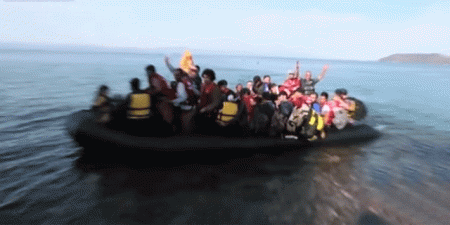
Migrant-Rubber-Boats-HP_1Migrants cross from Turkey to the Greek island of Lesbos (Photo: Video screenshot)

The Europeans are incapable of negotiating their way out of a paper bag.

In October 2015, they handed Turkey $3.4 billion to stop the flow of refugees into Greece. The flow continued. Six months later, in March 2016, Turkey was demanding another $3.4 billion plus visa-free travel to Europe for Turks and accelerated negotiations for membership of the European Union.

Rather than stopping the flow of migrants, the deal made it official. Europe agreed to accept one legal migrant for every illegal migrant sent back to Turkey.

With its radical Islamic government negotiating this deal, Turkey has demonstrated it is not part of the solution but part of the problem.

Now Libya wants to jump on the European gravy train.

On April 23, 2016, after a meeting in Rome with Italian Interior Minister Angelino Alfano, Libyan Vice President Ahmed Maiteeq stated that his country wants to negotiate a deal with Europe similar to that obtained by Turkey.

He is obviously surfing on the outpouring of humanitarian angst after 500 illegal migrants were drowned in the Mediterranean in a boat that people traffickers had sent from the Libyan port of Tobruk.

Maiteeq was originally elected as prime minister of Libya in 2014 under curious circumstances. On the first day of voting, gunmen opened fire in the parliament. The final vote was tainted with irregularities and on  June 9, 2014, the Supreme Court ruled his election was invalid.

Not someone you would want to negotiate a deal with.

On the European side, these deals are being negotiated by unelected officials with no electoral mandate. The people of Europe are thus being ignored. Conspiracy theorists could be forgiven for claiming this is part of a sinster master plan. In fact, they may be right.

On June 21, 2012, former European Commissioner Peter Sutherland said this in a speech to the British House of Lords :

“The United States, or Australia and New Zealand, are migrant societies, and therefore they accommodate more readily those from other backgrounds than we do ourselves, who still nurse a sense of our homogeneity and difference from others. And that’s precisely what the European Union, in my view, should be doing its best to undermine… Anybody who thinks that by erecting borders or fences in some way a particular state can be protected from alleged ‘floods’ of migrants is living in cloud cuckoo land.”

Sutherland is a former attorney-general of Ireland, former Chairman of BP, non-executive chairman of Goldman Sachs International, head of the UN Global Forum on Migration and Development and could be described as the ‘’godfather of globalization.’’

What has been happening to Europe over the past 15 months may well be nothing other than a deliberate strategy to undermine — that is, to destroy — the nation-states of Europe, from Greece to Ireland and from Spain to Finland.

In 1973, Sutherland was a candidate in the Irish general election in Dublin North West constituency, but only 1,968 people voted for him — 6.24% of the poll. This probably accounts for his hatred of democracy as well as his contempt for ordinary British citizens, whom he considers “racist and xenophobic.”

He has no political mandate but has been instrumental in shaping the economic and social future of Europe. An advocate of mass immigration, he believes the European Union should “begin weaving together the two sides of the Mediterranean.”

The results of this policy are literally blowing up in the faces of European citizens in the form of suicide vests and suitcase bombs.

Report: Child-Rape on the Rise Among Syrian Migrants in Greece, Europe

April 27, 2016

Report: Child-Rape on the Rise Among Syrian Migrants in Greece, Europe, Truth RevoltTiffany Gabbay, April 27, 2016

greece_refugees_0

Tell us again, Obama, about the new three-month vetting process.

Syrian migrants have been wreaking havoc in migrant camps and their surrounding neighborhoods all across the Eurozone. Reports of riots, looting, burning, assault and battery, molestation and worst of all child-rape, abound.

In fact, the latter scourge is reportedly on the rise in Greek migrant camps, according to Breitbart

Greek authorities are investigating after numerous reports of extreme violence and sex assault among the migrants living in the shanty town established among the abandoned former Athens International Airport. […]

The initial arrival of the young men means they have had time to establish themselves in the new camps. A report by The Times quotes an Afghan father of five who said of the new camps: “It’s like the Wild West there… I’m not going back. Neither are my children”.

Relocations started after a 17-year-old Afghan boy was stabbed to death in Athens, where both the victim and attacker were Ellinikon residents, but reports from the inside of the camp suggest a sinister web of child rape where fear rules. […]

In Greece, girls as young as five have been abused by Afghan males, while in countries like Austria, Germany, and Sweden, child rape in swimming pools has become a regular feature in national news.

One Afghan mother told the Times she sleep close to her children after witnessing child-rape at her Greek encampment.

“Weird things happen here after midnight,” she explained. “Many of the young men get drunk. They shout, fight and do ugly things. No one dares to confront them. We’ve seen young girls and boys raped in the bathrooms here.”

One of the primary issues is the types of people housed at the refugee camps — many of whom are able-bodied, Muslim men. Members of the Christian community — the one actually targeted for genocide —  aren’t found at the migrant camps for the very reasons stated above. Christians are targeted across the Middle East and know the refugee camps are as hostile a place for them as the country they’re fleeing.

Without proper vetting, as asylum applicants are processed across the West, the scourge of rape and mayhem will only spread outward. And, in case you missed it, the bill of goods Americans were sold on an 18-24 month vetting process for refugees was, predictably a lie.The actual vetting time has been reduced to three months, if that. What’s more, only a paltry 2.5 percent of our current Syrian refugee population are Christian.

Once again, Western leaders have utterly failed their own citizens, along with the very refugees they claim to be helping.

LIVE Stream: Donald Trump Speaks on Foreign Policy in Washington, DC (4-27-16)

April 27, 2016

LIVE Stream: Donald Trump Speaks on Foreign Policy in Washington, DC (4-27-16) via YouTube, April 27, 2016

Obama Admin Withholding Details of ‘Potentially Illegal’ Deal to Buy Iranian Nuke Materials

April 27, 2016

Obama Admin Withholding Details of ‘Potentially Illegal’ Deal to Buy Iranian Nuke Materials, Washington Free Beacon, April 27, 2016

"part
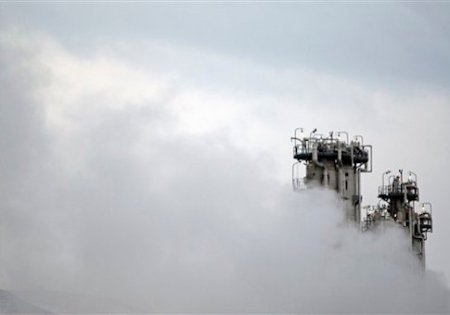
Part of Arak heavy water nuclear facilities is seen, near the central city of Arak, 150 miles southwest of the capital Tehran / AP

Officials from both the Treasury and Energy departments told the Free Beacon that details about the payment are being withheld until the purchase is complete. Iran is expected to deliver the heavy water to the United States in the “coming weeks,” officials confirmed.

**********************************

Obama administration officials are declining to provide specific details about an unprecedented upcoming purchase of Iranian nuclear materials, an $8.6 million exchange that is likely to be funded using American taxpayer dollars, according to conversations with multiple administration officials and sources in Congress.

The administration is preparing to purchase from Iran 32 tons of heavy water, a key nuclear material, in a bid to keep Iran in compliance with last summer’s comprehensive nuclear agreement.

But administration officials have declined to provide specific details to Congress and reporters about how exactly it will pay for the purchase, as well as other information, until the deal has been completed.

The effort to withhold key information about the purchase, which is likely to be paid in some form using U.S. taxpayer dollars, is causing frustration on Capitol Hill, according to multiple sources who disclosed to the Washington Free Beacon that the administration is rebuffing congressional attempts to discern further information about the deal.

Experts further disclosed to the Free Beacon that the exchange is likely to legitimize Iran’s research into plutonium, knowledge that would provide the Islamic Republic with a secondary pathway to a nuclear weapon capability.

Officials from both the Treasury and Energy departments told the Free Beacon that details about the payment are being withheld until the purchase is complete. Iran is expected to deliver the heavy water to the United States in the “coming weeks,” officials confirmed.

“We cannot discuss details of the payment until after the purchase is complete,” a Treasury Department official who was not authorized to speak on record told the Free Beacon. “The Department of Energy’s Isotope Program plans to pay Iran approximately $8.6 million dollars for 32 metric tons of heavy water.”

The administration will use an offshore third party to facilitate the transfer of cash to Iran, according to officials in both the Treasury and Energy departments.

“Regardless of whether or not this is in U.S. dollars, this licensed transaction is limited in scope. This routing through third-country financial institutions is similar to the mechanism that has been used for years to allow other authorized transactions—such as for exports of food and medicine—between the United States and Iran,” the treasury official said, referencing a loophole in U.S. sanctions that permits transactions of a humanitarian nature.

An Energy Department official confirmed that officials “cannot discuss details of the payment until after the purchase is complete.”

The exchange is being handled by the Energy Department’s Isotope Program, which routinely conducts transactions of this nature, according to the official.

“DOE’s Isotope Program produces and distributes a variety of isotopes that are in short supply for industrial and medical purposes,” an Energy Department official told the Free Beacon. “Transactions like this one are regular business for the program.”

Iran’s excess heavy water “will help to fulfill a substantial portion of U.S. domestic market demand this year,” according to the official, who said that “over the past few years, there have often been constrained supplies of heavy water.”

The administration further “expects to resell the purchased heavy water at commercially reasonable prices to domestic commercial and research buyers, including Oak Ridge National Laboratory’s Spallation Neutron Source, where it would be used to increase the efficiency of the facility,” the source said.

Congressional critics of the arrangement accuse the administration of using this sale as part of a larger plan to help Iran gain access to the American financial system and U.S. dollar.

“Subsidizing Iran’s production of heavy water is a dangerous move,” Sen. Tom Cotton (R., Ark.) told the Free Beacon. “It stimulates Iran’s nuclear industry, opens the door to the use of U.S. dollars to facilitate Iranian trade and illicit financing, and provides U.S. tax dollars to the world’s top state sponsor of terrorism.”

Energy Secretary Ernest Moniz “is aware of these dangers, which is why he stressed that this is a one-time purchase,” said Cotton, the author of a new amendment that would block the administration from engaging in similar purchases with Iran in the future. “I want to hold him and President Obama to that vow, particularly in light of the many promises broken and redlines erased by this administration in the course of negotiating the Iran deal.”

Rep. Mike Pompeo (R., Kan.), a member of the House intelligence committee, accused the administration of funding Iran’s nuclear pursuits in contradiction of last summer’s agreement aimed at winding down Tehran’s nuclear ambitions.

“The Obama administration’s deal with the Mullahs in Tehran to purchase heavy water demonstrates a disturbing, potentially illegal, willingness of the administration to subsidize Iran’s nuclear program,” Pompeo told the Free Beacon. “This purchase allows the Iranians to offload previously unsellable product and it destigmatizes the act of doing business in Iran.”

Pompeo said it is irresponsible to pursue this deal without first providing lawmakers detailed information about whether Iran will directly receive taxpayer dollars.

“This purchase is being made without explanation as to how Iran will receive these funds or what steps the administration is taking to prevent what will almost certainly be U.S. taxpayer dollars from possibly being used to support terrorist activities, Syrian dictator Bashar al-Assad, or Iran’s ballistic missile program,” Pompeo said. “Of course, the reality is that once that money is in the hands of the Ayatollah, there is no way to prevent the funds from being diverted toward any of those purposes—a fact that seems to concern no one at the White House.”

A larger debate has been taking place in Washington over Iranian and European demands that the United States grant Iran access to dollars, a move the administration has publicly opposed and promised Congress would not take place.

However, sources indicate that the heavy water exchange could be the first sign that the administration is caving on this promise.

 Mark Dubowitz, head of the Foundation for Defense of Democracy’s Center on Sanctions and Illicit Finance, told theFree Beacon that Iran is producing excess nuclear material in order to wring more cash from the nuclear deal.

“Iran has created a clever scheme—produce too much heavy water so as to break the nuclear agreement, then get the Obama administration and eventually U.S. companies to pay Tehran using the U.S. dollar to get rid of it,” Dubowitz explained. “These U.S. subsidies will help Tehran perfect its heavy water production skills so it will be fully prepared to develop its plutonium bomb-making capabilities when restrictions on the program sunset over the next 10-15 years.”

“This scheme also will open the door to further dollarized transactions as the administration green-lights the greenback for a regime with a decades-long rap sheet of financial crimes,” he added.

A senior congressional source familiar with the trade disclosed that administration officials are declining to disclose key details about the deal.

“The administration is being coy about how the financial mechanics of this deal will work,” the source told the Free Beacon. “But the bottom line is that U.S. taxpayer dollars will be used, and used for a purchase directly connected to Iran’s nuclear program. This is an attempt by the administration to slowly open a door that leads to the wide acceptance of Iran’s nuclear industry and to the use of U.S. dollars by Iran to conduct trade.”

“Many in Congress—on both the Republican and Democratic sides—won’t stand for that, and will move to shut that door tightly,” the source said.

Turkish Parliamentary Speaker Calls For Islamic State

April 27, 2016

Turkish Parliamentary Speaker Calls For Islamic State, Jonathan Turley’s Blog, Jonathan Turley, Apri 27, 2016

(What difference does it make now? — DM)

220px-recep_tayyip_erdogan (1)


ismail_kahraman_ankara_cropped

We have followed the rapid decline of civil liberties under the authoritarian rule of Recep Tayyip Erdoğan in the past few years as well as his empowering of Islamic parties in the once secular state. When Erdogan first ran, he assured Turks that he was committed to the secular traditions and constitution of the country. He then did precisely the opposite in power by chipping away at secular laws, introducing Islamic governing principles, and assuming authoritarian power. Now, Turkish Parliament Speaker Ismail Kahraman has finally taken Erdogan’s policies to their natural conclusion and called for the dismantling of secular government and the creation of an Islamic state.

The call confirms what was long obvious about Erdogan’s true intent to eradicate civil liberties and secular government — destroying the original model of the founder of modern Turkey, Mustafa Kemal Ataturk, after the collapse of the Islamic Ottoman Empire. Turkey was once the greatest hope among Muslim countries in maintaining a nation based of secular values. Then came Erdogan who sought to introduce Islamic law as well as authoritarian measures. This includes the arrest of Mehmet Emin Altunses, 16, who allegedly committed the crime of “insulting” Erdoğan. calling people who use birth control “traitors” and saying Muslims discovered America, you are not allowed to be disrespectful or insulting in discussing Erdoğan. Then there was the prosecution of model and former Miss Turkey Merve Buyuksarac, 26, for criticizing Erdogan for quoting a few lines from a poem called the “Master’s Poem” from weekly Turkish satirical magazine Uykusuz. Erdoğan’s totalitarian measures have earned him the nickname “Buyuk Usta” (the Big Master). Even a joking reference to Gollum and Erdoğan is enough to land you in jail today in Turkey.

Just as Erdogan has dropped any pretense of civil liberties, Kahraman wants to drop any pretense of secularism. He lamented that fact that the Constitution does not expressly name Allah and insisted that “[w]e are a Muslim country and so we should have a religious constitution.”

He added that “Secularism would not have a place in a new constitution.”

Kahraman is a member of the Justice and Development Party (AKP), which favors Islamic principles in government and is the largest political party in the country. His move reinforces the view by some that Islamic parties are naturally at odds with secular government and many civil liberties, particularly free speech and free exercise. His dubious legacy will be to add yet another Islamic state by destroying secular government in Turkey.

The Mr. Rogers Doctrine

April 27, 2016

The Mr. Rogers Doctrine, Israel Hayom, Clifford D. May, April 27, 2016

U.S. President Barack Obama last week visited Saudi Arabia, an unusual nation with which the United States has had a relationship that can be accurately characterized as both strategic and strange — and one that is now severely strained. To understand how we got to this juncture requires at least a smattering of modern history.

It’s polite to say that Ibn Saud, in the first third of the 20th century, united most of the tribes living on the Arabian Peninsula. It’s more accurate to say he defeated those tribes, conquering their lands, along with a source of enormous future wealth that lay under some of them.

Ibn Saud allied with the British against the Ottoman Empire whose sultan, based in Istanbul, also had been proclaimed caliph — ruler of all the world’s Muslims. That would have undercut the legitimacy of the House of Saud had a deal not been struck with the Wahhabis, until then a tiny, fundamentalist sect. The Wahhabis blessed the Saudis and granted them governing authority. In exchange, they would be well-funded and their reading of Islam would become the state religion.

In 1932, Ibn Saud gave his dominions a name: The Kingdom of Saudi Arabia. After World War II, a time when the sun was setting on the British Empire, the Saudis turned to the United States. The oil the Saudis had appropriated would now be extracted and sold to those in the West who had developed productive uses for it. In exchange, the United States would serve as Saudi Arabia’s defender and protector.

For a few decades, this arrangement worked reasonably well. Then, in 1979, two pivotal events occurred. The first was the overthrow of the Shah of Iran, an uprising that, under the leadership of the Ayatollah Ruhollah Khomeini, became an Islamic Revolution. That meant that the first modern state committed to waging global jihad was majority Shia and Persian — a shock and a humiliation to many in the Sunni and Arab worlds.

Then, in November of that year, around the same time as students loyal to the Aytollah were taking over the U.S. Embassy in Tehran, the Grand Mosque in Mecca was seized by what might be called ultra-Wahhabis. Putting down this rebellion was a bloody affair. But because of a Saudi information blockade, most of the world heard only vague and often incorrect details.

The full story would be told in 2007 by Yaroslav Trofimov in his indispensable book, “The Siege of Mecca.” In the aftermath of the 9/11/01 attacks, he recognized the episode as “the first large-scale operation by an international jihadi movement in modern times.”

In response to the 1979 upheavals, the Saudis might have been expected to oppose if not suppress fundamentalists eager to fight holy wars. Instead, they attempted to demonstrate their jihadi bona fides by installing Wahhabi clerics in mosques around the world, establishing madrasas that prepared young people to kill and die to defend and/or spread the “true” Islam, and funding mujahedeen in Afghanistan.

From these seeds would grow al-Qaida, and the fruits of al-Qaida — the Islamic State group among them. Such jihadis despise the Saudis and other Muslims who, they believe, are shirking their duty to smite infidels, apostates and heretics.

At least some Saudis were later to recognize their error. Trofimov quotes Prince Khaled al Faisal saying in 2004 that while those who seized the Grand Mosque were eliminated, “we have overlooked the ideology that was behind the crime. We’ve let it spread in the country, ignoring it as if it did not exist.” Nevertheless, Saudi-appointed clerics continue to this day to preach hate and incite violence.

As for Iran’s rulers, they have two large axes to grind with the Saudis. One traces back to the 7th century when a dispute arose within the newly created Muslim community over who was to succeed the Prophet Muhammad. Since then, the theological schism has only widened. The Shia mullahs of Iran believe no Sunnis should be custodians of the holy cities of Mecca and Medina — least of all the descendants of a warrior tribe who drink and gamble in Europe while insisting that royal blood flows through their veins.

A less ancient Iranian grievance: Most of Arabia’s oil lies in the Eastern Province where the majority of the population is Shia. These Arabians are hardly “Saudis,” having been conquered by them in 1913 and suffering discrimination and persecution at their hands ever since. In January, Nimr al-Nimr, a Shia cleric from the Eastern Province who had been critical of the Saudi government, was executed.

President Obama’s policy response to this complicated and fraught reality: He recently told a reporter that Saudis and Iranians need to “share the neighborhood.” It’s tempting to call that the “Mr. Rogers Doctrine” and imagine what was said about it within the palaces of Riyadh — and those of Tehran. Also worth pondering: the message that phrase sends to the neighborhood’s minorities — the Christians now under genocidal assault, the Kurds, the Druze and, of course, the Israelis.

The Saudis have never been America’s friends in the sense of having common values or mutual affection. But they have been America’s allies in the sense of having common enemies and some common — and vital — interests. Now the Saudis face what they see as an existential threat from Iranian theocrats who proudly proclaim their abhorrence of America.

Yet, the American president is enriching those Iranian theocrats, strengthening them and making concession after concession without demanding reciprocity. It’s reasonable to guess that the Saudis are feeling puzzled and perhaps betrayed. If so, they are not alone.

Understanding the Hijab

April 27, 2016

Understanding the Hijab, Front Page MagazineDr. Majid Rafizadeh, April 27, 2016

Hijab

I spent most of my life in the Islamic Republic of Iran and Syria until a few years ago. Now, living in the West, I am stunned with all misconceptions and misleading information about Islam. It seems to me that this stems from a large propaganda campaign coming from various platforms ranging from the dominant liberal media to Western Muslim scholars who have never lived in an Islamic country, but only read books published in the West. Liberals are brainwashed to view the West as the victimizers and the Muslims as the victims.

While covering all the misconceptions would require hundreds of books, I am going to only address the truth about the hijab in this article and the fallacies that are taught to ordinary people in the West about veiling, Muslim women, and the idea of victimhood.

(I have covered other truths and aspects of Islam in my memoir, Allah: A God Who Hates Women.)

Two of my own sisters have gone through the phases of wearing the hijab. I believe that the repression and domination of women in the Muslim world begins with the dress code — wearing a scarf, or hijab; wearing wide garments, chador; and hiding the body. In other words, the religion of Islam provides the language for men to dominate women by Sharia law, which takes possession of a women’s body from the moment a girl is born.

On the surface, a wide garment, scarf, or hijab looks like a piece of cloth. But, in fact, the dominating power of this piece of cloth is extraordinary. The idea is that once I can control your body, and once I can confine your body, I basically own you.

I believe and personally witnessed that wearing a scarf and wearing a wide garment, do not have anything to do with divine religious rules, as some ignorant imams or Muslims attempt to promote. Hijab is the first crucial step to possess a woman and make her follower of Islam.

I argue that the process of enforcing the hijab on women and making it feel natural to them is carried out through several institutional and psychological steps.

The First Phase: Indoctrination

The first phase is indoctrinating the idea of hiding one’s hair and body in the mind of a woman. The process of indoctrination begins from the moment a baby girl is born.

One concrete example is my sisters. They were forced to wear the hijab at the age of 8 in the schools of the Islamic Republic of Iran and Syria. So even before girls reach the age that they can make decisions, before they know right from wrong, they are indoctrinated to hide their body.  From age 3 or 4, they are repeatedly told about the “nice” things that will happen to them when they wear their hijab, and how they will be a good girl and be treated as a mature girl when they hide their body.

The Second Phase: The Superficial Pleasure

I call the second phase the superficial pleasure. In most cases, the first phase is followed with connecting fake pleasure with the action; in other words, this is the phase of connecting a bad or painful action with superficial pleasure and happiness.

For instances, there are ceremonies for the little girl when she wears the hijab. These ceremonies are performed at schools and often at houses as well. Psychologically speaking, the ceremony for the wearing of the hijab is skillfully, institutionally, and systematically orchestrated in schools to make the girls feel that these actions of hiding one’s body and listening to men elicit happiness.

Some Muslim women get stuck in these two phases for rest of their lives. For example, If you see some Muslim women in the West or East who wear the scarf and proudly argue and brag that they are wearing it happily and based on their own decision, they are actually unaware that they were subconsciously brainwashed from birth and that they are subconsciously confined in the aforementioned two phases. But since human beings normally are not cognizant of their subconscious thoughts that were formed while they were children, most of these women think that this is what they want.

More fundamentally, it is crucial to point out that there are also those Muslim women, particularly in the West, who get a different kind of superficial pleasure from wearing a scarf, wide garment, or hijab, even in the burning hot weather. These superficial pleasures are attention, materialistic gains, public sympathy, and a sense of victimhood.  They love the attention from the liberals primarily (whether from ordinary people, authorities or media), as well as the materialist gains that follows with that.

Many Western governmental and non-governmental institutions also prefer to hire a Muslim woman who wears a scarf over other women, or give a women wearing a hijab more bonuses because they fear being sued for discrimination.

The Third Phase: Terror

The third phase I identify as imposing terror. The moment the two phases of indoctrination and connecting superficial pleasure with the hijab and hiding the body are fulfilled, the next phase begins, which is the process of imposing terror and fear in the girl in order to fix and cement the action.

This applies to those Muslim women who wear the hijab, but don’t brag about wearing it; these women have gone through this third phase.

Suddenly, the ceremony shifts to the real depiction of Allah, Khoda (in Persian); the Muslim god created by Muslim men. Allah becomes a torturer, an oppressor and a dictator.

The society tells the girls, as they told my sisters, that if you take off your hijab, scarf, chador, etc., and if you show your hair to people, Allah or Khoda will hang you from you hair for billions of years. When you die from being hanged or when all your hair is pulled out from being hanged, Allah will make you alive again and hang you from your hair again and again. If you talk back to your husband, Allah will hang you from your tongue. Allah will repeatedly burn you if you show the shape of you body to anyone other than your husband. Allah will take everything from you in this life and afterlife. The threats go on and on. Fear of Allah’s punishment is taught to those little girls. (One of my sisters had nightmares for many years after they taught her these stories at school.)

The hijab was imposed from the beginning to show women that they are second-class citizens, that men control their bodies, that men can force them to wear whatever the men choose, that they have no freedom, that they are created by Allah only to please their men, that they can only take off their hijab in the bedroom, that they are only a sex object for their husband, that they are not allowed to communicate with other people, that they are restricted, that they are cut off from the rest of the world, etc., etc.. They become a slave of Allah and other men.

The Final Phase: Liberation, Enlightenment and Freedom.

Finally, some women pass phase three and go to the final phase by revolting. I call this phase liberation, enlightenment and freedom.

If the oppression and restrictive laws of Islam go too far, become ubiquitous and unbearable, resistance and enlightenment will occur in some women. (This scenario is more likely to happen for some women who live in a country where religion rules the state — a theocracy such as the Islamic Republic of Iran — and where the state imposes Sharia law. In secular countries, i.e. Western countries or those Muslim countries in which the government is mostly secular, Muslim women are more likely to become more “Islamic,” in fact. I discuss the reasons in my book.)

Those few women who rebel go against all the indoctrination imposed on them from the time of their birth, and sometimes they protest regardless of the repercussions.

This is the real truth behind covering the body and wearing the hijab, which liberals need to comprehend if they truly believe in values such as human rights, social justice, freedom and democracy.

US Sinai pullback payback for islands handover

April 27, 2016

US Sinai pullback payback for islands handover, DEBKAfile, April 27, 2016

RedSeaBab2

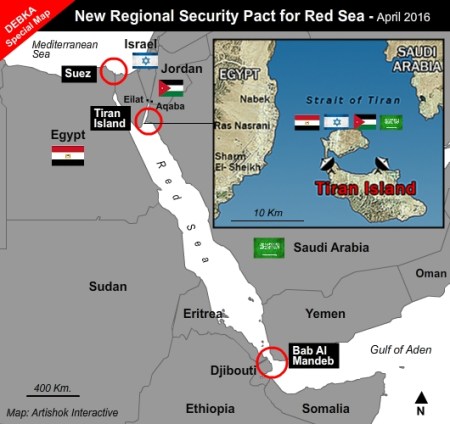
The US withdrew its forces from the Sinai Peninsula last weekend in retaliation for Egypt’s transfer of sovereignty over Tiran and Sanafir islands to Saudi Arabia, according to DEBKAfile’s military and intelligence sources. They also report that the move came after Washington protested to Egyptian President Abdel Fattah al-Sisi over its exclusion from the consultations and military coordination between Egypt, Saudi Arabia and Israel regarding the islands.

The US message was clear. Since Riyadh, Cairo and Jerusalem do not report their military steps in the Sinai Peninsula, the Gulf of Aqaba and the Red Sea to Washington, the US sees no need to inform them of its military steps in the Sinai.

That message was conveyed by the chairman of the US Joint Chiefs of Staff, Joseph F. Dunford, to the Egyptian president during their meeting on Saturday, April 23 in Cairo.

On Tuesday, DEBKAfile’s military sources reported that several days earlier the US military secretly withdrew about 100 of its officers and enlisted men from the multinational peacekeeping force in the northern part of the Sinai. As far as Riyadh, Cairo and Jerusalem are concerned, there is no doubt that it was a retaliatory measure.

US sources refused to specify the current location of the troops. The American force was withdrawn from El Gorah base, located next to the town of Sheikh Zuweid. Gen. Dunford told al-Sisi that the Obama administration is no longer willing to maintain forces in the northern Sinai following the recent shelling of the base by the ISIS affiliate in the restive area. The incident marked the terrorist organization’s first attack on US troops in the Sinai, but its second on an American force in the Middle East.

On March 19, ISIS shelled Fire Base Bell, a US marine base in Makhmur, northern Iraq, about 77 kilometers southeast of the terrorist organization’s de facto capital of Mosul. One marine was killed.

It was not by chance that shortly before he visited Cairo, Gen. Dunford made a visit lasting no more than 90 minutes to the US forward base to award purple hearts to four marines for their bravery during the ISIS shelling.

But while Washington is determined to maintain Fire Base Bell, where it has deployed HIMARS rocket launchers that can fire GPS-guided rockets known as GMLRS capable of reaching Mosul, and awards medals to soldiers serving at the base, it is not ready to treat its soldiers in the Sinai in the same manner because they have the status of multinational observers. Rather than giving out medals, it withdrew those soldiers immediately after the first ISIS attack.

At the same time, US sources launched an unprecedented personal attack on Egypt’s president over his decision to hand over the two islands to Riyadh. Articles attacking El-Sisi’s policy started to appear in the American media, with one saying “The decision to transfer the islands to Saudi Arabia may be the final nail in Sissi’s coffin.” It also described Egypt as being on the verge of a revolution against al-Sisi.

Two other Middle Eastern figures who were involved in Cairo’s decision regarding the islands were Saudi Deputy Crown Prince and Defense Minister Mohammad bin Salman and Israeli Defense Minister Moshe Ya’alon, who said recently that Cairo consulted Jerusalem regarding the transfer of the islands. However, his comment was not mentioned in US media reports, as if the development was not related to Saudi Arabia or Israel.

DEBKAfile’s military and intelligence sources report that one of the main reasons for Washington’s rage was the fact that Egypt, Saudi Arabia, Jordan and Israel decided to establish and coordinate by themselves a regional defense mechanism covering the Suez Canal, the gulfs of Suez and Aqaba, and the Red Sea.

The Obama administration prefers to ignore the fact that the US withdrawal of its naval and air forces from those areas over the last three years has enabled the Iranian fleet to start operating in those waters.