Archive for February 11, 2016

Our Good Islam/Bad Islam Strategy

February 11, 2016

Our Good Islam/Bad Islam Strategy, Front Page Magazine, Daniel Greenfield, February 11, 2016
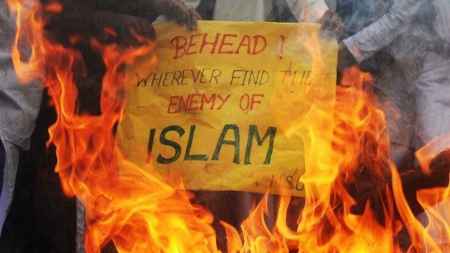
Behead them

There is no Good Islam. There is no Bad Islam. There is just Islam.

**********************

Our only hope of defeating Islamic terrorism is Islam. That’s our whole counterterrorism strategy.

But Islamic terrorism is not a separate component of Islam that can be cut off from it. Not only is it not un-Islamic, but it expresses Islamic religious imperatives. Muslim religious leaders have occasionally issued fatwas against terrorism, but terrorism for Muslim clerics, like sex for Bill Clinton, is a matter of definition. The tactics of terrorism, including suicide bombing and the murder of civilians, have been approved by fatwas from many of the same Islamic religious leaders that our establishment deems moderate. And the objective of terrorism, the subjugation of non-Muslims, has been the most fundamental Islamic imperative for the expansionistic religion since the days of Mohammed.

Our strategy, in Europe and America, under Bush and under Obama, has been to artificially subdivide a Good Islam from a Bad Islam and to declare that Bad Islam is not really Islam. Bad Islam, as Obama claims, “hijacked” a peaceful religion. Secretary of State Kerry calls Bad Islam’s followers, “apostates”. ISIS speaks for no religion. It has no religion. Which means the Islamic State must be a bunch of atheists.

Our diplomats and politicians don’t verbally acknowledge the existence of a Bad Islam. Even its name is one of those names that must not be named. There is only Good Islam. Bad Islam doesn’t even exist.

This isn’t just domestic spin, which it is, but it’s also an attempt at constructing an Islamic narrative. Our leaders don’t care what we think. They just want us to keep quiet and not offend Muslims. They do care a great deal about what Muslims think. And so, in their own clumsy way, they try to talk like Muslims.

They are attempting to participate in an Islamic debate without the requisite theological credentials. They want to tell Muslims that they should be Good Muslims not Bad Muslims, but they’re too afraid to use those words, so instead they substitute Good Muslims and Not Muslims. All Muslims are Good Muslims and Bad Muslims are Not Muslims is their Takfiri version of the No True Scotsman fallacy.

Our counterterrorism strategy has been constructed to convince Good Islam to have nothing to do with Bad Islam. And any of us who criticize Good Islam or argue that the artificial distinction between Good Islam and Bad Islam, between Saudi Arabia and ISIS, between Iran and Hezbollah, between Pakistan and the Taliban, is false are accused of provoking Good Islam to transform into Bad Islam.

Nothing so thoroughly proves that the difference between Bad Islam and Good Islam is a lie as the compulsive way that they warn that Good Muslims are capable of turning into Bad Muslims at any moment. Offend a Good Muslim, criticize his religion, fail to integrate him, accommodate his every whim and censor what he dislikes and he’ll join ISIS and then he’ll become a Bad Muslim.

After every terror attack, the media painstakingly constructs a narrative to determine why former moderates like Anwar Al-Awlaki, the Tsarnaevs or the San Bernardino killers turned bad without resorting to religious explanations. Their efforts at rationalization quickly become ridiculous; Nidal Hasan, the Fort Hood killer, contracted airborne PTSD, Anwar Al-Awlaki, the head of Al Qaeda in Yemen, became an “extremist” because he was afraid the FBI had found out about his prostitutes and the Times Square bomber turned into a terrorist because his “American Dream” was ruined.

Nobody, they conclude, becomes an Islamic terrorist because of Islam. Instead there are a thousand unrelated issues, having nothing to do with Islam, which creates the Muslim terrorist. Even the term “Radical Islamic Jihadist”, an absurd circumlocution (is there a moderate Islamic Jihadist), has become a badge of courage on one side and a dangerous, irresponsible term that provokes violence on the other.

But what is the distinction between Good Islam and Bad Islam? It isn’t fighting ISIS. Al Qaeda and the Taliban do that. It isn’t terrorism. Our Muslim allies, Saudi Arabia, Pakistan, Turkey and Qatar, are hip deep in the terror trade. It isn’t equality for non-Muslims. No Muslim country under Sharia law could have that. Equality for women? See above.

What are the metrics that distinguish Good Islam and Bad Islam? There aren’t any. We can’t discuss the existence of Bad Islam because it would reveal that Bad Islam and Good Islam are really the same thing.

Our Good Islam allies in Pakistan fight Bad Islam’s terror, when they aren’t hiding Osama bin Laden. Bad Islam in the Islamic State beheads people and takes slaves and Good Islam in Saudi Arabia does too. Qatar is our Good Islam ally helping us fight Bad Islam terrorists by arming and funding Good Islam terrorists who sometimes turn out to be Bad Islam terrorists so we can’t figure out if the Islamic terrorists the CIA is routing weapons to are Good Islam terrorists or Bad Islam terrorists.

The moderate Muslim Brotherhood wins democratic elections. The extremist Muslim Brotherhood then burns down churches. The moderate Palestinian Authority negotiates with Israel and then the extremist Palestinian Authority cheers the stabbing of a Jewish grandmother. The moderate Iranian government signs a nuclear deal and then the extremist Iranian government calls for “Death to America”.

Like the saintly Dr. Jekyll and the mean Mr. Hyde, Good Islam and Bad Islam are two halves of the same coin. When Dr. Jekyll wanted to act out his baser nature, he took a potion and turned into Mr. Hyde. But the nasty urges were always a part of him. When a moderate Muslim pulls a Keffiyah over his face and starts stabbing, bombing or beheading, he doesn’t become an extremist, he just expresses his dark side.

Good Islam borrowed all sorts of noble sentiments from Judaism and Christianity. But when non-Muslims didn’t accept Islam, then Mohammed stopped playing nice and preached murder. Bad Islam is not something ISIS invented on a website. It’s always been a part of Islam. We attempt to separate Good Islam and Bad Islam because we don’t like being beheaded. But Muslims don’t make that distinction.

Our counterterrorism strategy is based on empowering Good Islam, on building coalitions with Muslims to fight terrorism and enlisting their cooperation in the War on Terror. But we’re trying to convince Dr. Jekyll to help us fight Mr. Hyde. And Dr. Jekyll might even help us out, until he turns into Mr. Hyde.

Our moderate Afghan Muslim allies, when they’re aren’t raping young boys (one of their cultural peculiarities we are taught to ignore), sometimes unexpectedly open fire on our soldiers. The Muslim migrants who arrive here to “enrich” our societies sometimes start shooting and bombing. The head of Al Qaeda was hanging out near the West Point of Pakistan. The mastermind of 9/11 was saved by a member of the Qatari royal family. The call is coming from inside the house. Mr. Hyde is Dr. Jekyll.

When we “empower” and “build coalitions” with Good Islam, we’re also empowering and building coalitions with Bad Islam. Just ask all the Muslim terrorists running around with our weapons.

Our leaders want Good Islam to shield us from Bad Islam. If Good Islam is out front, then Muslims won’t see a clash of civilizations or a religious war, but a war between Good Islam and Bad Islam. But the Muslim understanding of Good Islam and Bad Islam is very different from our own.

Sunnis see their Jihadis as Good Islam and Shiites as Bad Islam. Shiites look at it the other way around. The Muslim Brotherhood, that our elites were so enamored with, saw secular governments as Bad Islam. To win them over, we helped them overthrow more secular governments because our leaders had adopted an understanding of Good Islam in which giving Christians civil rights was Bad Islam.

To win over Good Islam, we censor cartoons of Mohammed and criticism of the Koran, open our borders, Islamize our institutions and then wait to see if we’re on the good side of Good Islam. We adapt our societies and legal systems to Islamic norms and hope that it’s enough to let us join the Good Islam Coalition. If we go on at this rate, the experts will tell us that the only way to defeat Islamic terrorism is for us to become Muslims. Only then will we become members in good standing of Good Islam.

There is no Good Islam and no Bad Islam, as Muslim leaders occasionally trouble to tell us. The distinction that our leaders make between Good Islam and Bad Islam is not theological, but pragmatic. They dub whatever is shooting at us right now Bad Islam and assume that everything else must be Good Islam. That is the fallacy which they used to arrive at their Tiny Minority of Extremists formula.

There is no Tiny Minority of Extremists. Behind the various tiny minorities of extremists are countries and billionaires, global organizations and Islamic banks. Outsourcing our counterterrorism strategy to the countries and ideologies behind the terrorists we’re fighting isn’t a plan, it’s a death wish.

Islamic terrorism is just what we call Islam when it’s killing us.

The Jihad isn’t coming from some phantom website. It’s coming from our Muslim allies. It’s coming from Pakistan, Turkey, Qatar and Saudi Arabia. It’s coming from the Muslim Brotherhood and its front groups. It’s coming from the moderate Muslim leaders that our leaders pose with at anti-extremism conferences. And it’s coming from the mosques and homes of the Muslims living in America.

There is no Good Islam. There is no Bad Islam. There is just Islam.

Humor+ | Laugh. It’s the Best Medicine. Then get serious again.

February 11, 2016

Laugh. It’s the Best Medicine. Then get serious again. Dan Miller’s Blog, February 11, 2016

(The views expressed in this post are mine and do not necessarily reflect those of Warsclerotic or its other editors. — DM)

Obama and Hillary are evil and some Republican candidates are bad. Stay mad, but laugh occasionally because it’s refreshing. Then, let’s take America back.

Sometimes life is hard.

Yeah, but wouldn’t it be terrible if everything always happened just as we want it to?

This is pretty much how government really works. They just aren’t this good as telling us.

Jimmy Buffett manages to offend just about everyone while being funny as he does it. That’s good!

It’s about time for a drink.


OK, it’s time to get serious again.

Obama said, “You didn’t build that.” Yes we did; He didn’t, and He keeps trying to tear her down and to rebuild her in His own image.

Now she’s ours. We intend to keep her and to make her as productive, strong and hopeful as she once was. Xenophobic? Damn right.

We can take her back. Will we? You betcha!

‘IDF must be prepared for possible war with Hamas’

February 11, 2016

IDF must be prepared for possible war with Hamas’ Southern Command officers warn political echelon may ‘lose patience’ and demand immediate action against Hamas terror tunnels.

By Cynthia Blank

First Publish: 2/11/2016, 8:38 AM

Source: ‘IDF must be prepared for possible war with Hamas’ – Defense/Security – News – Arutz Sheva


Senior officers in the IDF’s Southern Command have begun to express concerns that the security situation along Israel’s border with Gaza is nearing the same levels of strain as during Operation Protective Edge.

However, according to one officer, unlike the 2014 campaign, there is now a possibility of the Israeli army taking offensive action against Hamas’ terrorist tunnels – from across the border.

“The various units should prepare for the possibility that the political echelon will lose patience or that the threat of tunnels in the Gaza Strip will not allow for restraint, and they will try to initiate treatment of the tunnels in Palestinian territory,” the officer told Walla! News. 

He added that all military units should maintain a high level of readiness for the possibility of deployment, and that exercises be conducted for entering Gaza, including the scenario of rockets being launched at IDF bases.

Indeed, members of Security Cabinet have already suggested that Israel initiate action against the Hamas tunnels leading into Israel.

According to a Channel 2 report on Monday, Education Minister Naftali Bennett (Jewish Home) recently made such a demand only to be rejected by Prime Minister Binyamin Netanyahu and Defense Minister Moshe Ya’alon.

The two later publicly said that “on this matter we must exercise judgment and responsibility” and equated such action to attacking Hezbollah missiles or Iran’s nuclear facilities.

The topic of Hamas’s terror tunnels has come back in the spotlight in recent weeks, after four tunnels collapsed in the last two weeks killing 11 Hamas terrorists.

According to some estimates Hamas has succeeded in again digging tunnels into Israeli sovereign territory, and Israeli officials have sought to play down fears from residents in southern Israel who say they have heard Hamas diggers underneath their homes.

The IDF however has not ruled out the possibility that Hamas tunnels may succeed in reaching Israeli territory; all forces on the ground are being trained on how to deal with such an infiltration.

Counter-terror expert warned US Senate: “13% of Syrian refugees support ISIS”

February 11, 2016

Counter-terror expert warned US Senate: “13% of Syrian refugees support ISIS” Counter-terror expert David Harris warned the US Senate about the dangers associated with Canada accepting so many Syrian refugees and the implications that it has for the United States.

Feb 11, 2016, 4:06PM

Rachel Avraham

Source: Counter-terror expert warned US Senate: “13% of Syrian refugees support ISIS” | JerusalemOnline.com

David Harris, a counter-terror expert who serves as the head of the international intelligence program INSIGNIS Strategic Research Inc., recently addressed the US Senate in order to discuss the dangers associated with the fact that the Canadian government has decided to fast-trek the arrival of 25,000 Syrian refugees into Canada and its implications for the United States: “Complications led the government to adjust intake goals to 10,000 before the end of 2015 and another 15,000 prior to 1 March, 2016. By last week, about 15,000 had entered Canada. Reports indicate that Canada might raise its target level and take in 50,000 Syrian refugees by the end of 2016. Given the threat picture in Syria and the scale of the intake, security considerations require thoughtful attention.”

According to Harris, FBI director James Corney highlighted screening difficulties if America would absorb 10,000 Syrians, warning that information gaps could lead to inadequate screening: “If the extensive US intelligence system would have trouble screening 10,000 Syrians in a year, how likely is it that Canada even with valuable US assistance could adequately screen two and a half times that number in four months?”

Harris emphasized that it is important to remember the risk associated with these refugees: “Apart from accounts of a suspected ISIS aim of penetrating international refugee streams, a Lebanese cabinet minister warned in September 2015 that at least two percent of the 1.1 million Syrians in Lebanon’s refugee camps were connected to ISIS extremism. Canada takes refugees from Lebanon’s UNHRC camps. More generally, Arab Center for Research and Policy Studies polls determined that 13% of Syrian refugees in Lebanon, Jordan and Turkey had positive views of ISIS. How many more might favor Al Qaeda, the Al Nusra Front, Hezbollah, Assad’s militias and other non-ISIS threats?”

He noted that it is critical to screen for these things when determining which Syrian refugees will be able to come to countries like Canada and the United States but he questioned how easily one can access the history of each Syrian refugee given that they come from a hostile and chaotic country: “We cannot reliably confer with the authorities of such jurisdictions, assuming that an authority exists about many prospective refugees.”

While Canada believes that the risk can be mitigated by barring single adult males, Harris warned that many people can lie about their age, adding that many children both male and female under the age of 18 are part of ISIS: “And what effect would an adult male embargo have on an adult-at-risk gay man and other males targeted by terrorists? Meanwhile, in favoring women with children and men with families, do we know who is actually married to whom and whose children are accompanying whom? Are some ISIS fighters families involved? Would they in turn sponsor relatives?”

Harris also is greatly concerned that there may be security risks for North America’s existing minority communities if there is a huge influx of Syrian refugees given the fact that in Syria, demonizing Jews is a national policy and threatening the lives of members of the LGBT community has reached a crisis point: “And what of importing the people from a region where anti-black racism is an especially serious matter?”

According to Harris, this situation in Canada can also adversely affect the US as Canadians require no visas to enter into the United States and terrorists have taken advantage of this in the past: “Failed milliunium bomber Ahmed Ressam and Ghazi Ibrahim Abu Mezar’s arrest in his Brooklyn bomb factory remind us of the cross border risks.” Harris noted that the Canadian government has assured that the process will be transparent and this should reassure the Canadian public as well as Canada’s allies but noted there is still a great risk involved in taking in so many Syrians: “There is little doubt that those in Canada tasked with the job of screening refugees are doing the best that they can given the constraints but the constraints are significant and we must be realistic about that fact.”

According to CBS News, Guidy Mamann, a Toronto immigration lawyer, also addressed the US Senate hearing and proclaimed: “There are people in our office waiting for years. Why is somebody being allowed to jump ahead of the line? This is not a rescue mission. This is a resettlement mission. The people we are helping have already 
escaped the conflict zone and have already reached safety in Jordan, Lebanon and Turkey. We are only relocating them and offering them permanent resettlement. We are making no attempt, whatsoever, to 
rescue people who are actually in Syria and who are in imminent danger. When compared to other large groups of refugees, one could easily argue that this group represents a relatively higher-risk demographic. Syria is widely considered to be a major hotbed of international terror. Large parts of Syria are controlled by ISIS which, sadly, enjoys some considerable local support. Virtually the entire country supports one of the three warring factions. All three groups have been associated with assorted atrocities and violations of human rights.” Given this, he argued that Canada should take more time to screen the Syrian refugees.

 Former PA Minster: We No Longer Abide by Oslo Accords

February 11, 2016

 Former PA Minster: We No Longer Abide by Oslo Accords

By: David Israel

Published: February 11th, 2016

Source: The Jewish Press » » Former PA Minster: We No Longer Abide by Oslo Accords

Dr.Mohammad Shtayyeh
Photo Credit: Wikipedia commons

Dr. Mohammad Shtayyeh, who served as the Palestinian Authority’s Minister of Public Works And Housing and Minister of the Palestinian Economic Council for Development announced on Thursday that the PA is going to inform Israel during Thursday’s security coordination meeting with Israeli officials that it no longer abides by its Oslo agreements with Israel as long as Israel is not keeping them, Israel Radio reported.

“Israel is not a partner — it’s an enemy state that occupies our land,” he said. He revealed that the current Palestinian leadership’s strategy is to internationalize the conflict through various means.

In a conference in Beirut, Lebanon, Shtayyeh said it’s the end of negotiations with Israel under an American monopoly. He supported the “Awakening,” as he called it, by Arab youth on the ground these days, and said that it is at the heart of the PLO’s strategy of its struggle.

Minister Zeev Elkin (Likud) said in response that the PA’s plan to inform Israel it no longer abides by the agreements between the two sides is yet another nail in the PA’s coffin. Elkin noted that the PA has been slowly vanishing from the map for all kinds of reasons. He emphasized that the PA’s existence completely depends on the Oslo Accords, and that security cooperation is a central part of those accords. Should it announce that it no longer keeps them, there will no longer be a basis for said existence and it would “evaporate,” as he put it.

In Elkin’s view, such a move would not cause Israel any damage in the world arena.

Cartoon of the Day

February 11, 2016

H/t Joop

Barbaric religion

Turkey’s Haunted Border with Syria

February 11, 2016

Turkey’s Haunted Border with Syria

by Burak Bekdil

February 11, 2016 at 4:00 am

Source: Turkey’s Haunted Border with Syria

  • Erdogan and his prime minister, Ahmet Davutoglu, are now paying the price for their miscalculated Islamist aspirations to install a Muslim Brotherhood type of Sunni regime in Syria in place of the non-Sunni Assad regime. Assad, with Russia’s help, has become somewhat untouchable, and has never been so safe and secure since the outbreak of the Syrian civil war in 2011. By contrast, the Turks now face a multitude of threats on both sides of an apocalyptic border.
  • “With the Middle East ravaged by religious radicalism and sectarianism, the European Union and the United States can’t afford the Turkish government’s brutal military efforts against the Kurds or its undemocratic war on academics and journalists. Only a secular, democratic Turkey that can provide a regional bulwark against radical groups will bring stability to both the Middle East and Europe. As Mr. Erdogan seeks to eliminate all opposition and create a single-party regime, the European Union and the United States must cease their policy of appeasement and ineffectual disapproval and frankly inform him that this is a dead end.” — Behlul Ozkan, assistant professor at Istanbul’s Marmara University, writing in the New York Times.

Six years ago, Turkey’s official narrative over its leaders’ Kodak-moment exchanges of pleasantries with Syrian President Bashar al-Assad’s regime in Damascus promised the creation of a Muslim bloc resembling the European Union. Border controls would disappear, trade would flourish, armies would carry out joint exercises, and Turks and Syrians on both sides of the border would live happily ever after. Instead, six years later, blood is flowing on both sides of the 900 kilometer border.

Inside Turkey, clashes between security forces and members of the youth wing of the outlawed Kurdistan Workers’ Party (PKK) have been taking place for weeks. Many towns and neighborhoods have turned into ghost-towns, as strict curfews are now in place. As a result, tens of thousands of Kurds have been forced to flee their homes, seeking refuge in safer parts of the country. While the Turkish army struggles to diffuse the latest Kurdish urban rebellion, hundreds of Kurdish militants and members of Turkey’s security forces have lost their lives.

Worse, the conflict has the potential to trigger further violence in Turkey’s non-eastern regions, where there is a vast Kurdish population spread across large cities.

Already in Istanbul, violence erupted on February 2, 2016, when unidentified gunmen opened fire on the campus of an Islamic association; they killed one man and wounded three others. In a second incident in a suburb of Istanbul, two people were killed and seven wounded after armed assailants fired on a tea-house.

Across the border in northern Syria, Turkey’s “Kurdish problem” is equally pressing. The PKK’s Syrian faction, the Democratic Union Party (PYD), has been successfully fighting on the front-lines alongside the Western alliance that is waging war on the Islamic State (IS), and making itself highly regarded by the alliance, thereby further angering Ankara.

Turkey, which views the PYD as a terrorist organization like the PKK, fears that the Syrian Kurds’ fight against IS could, in the near future, earn the PYD international legitimacy.

On February 1, Brett McGurk, the U.S. envoy to the coalition against IS, visited a part of Kurdish-controlled northern Syria. On his visit, McGurk posed in front of cameras with a PYD commander — all smiles — while receiving an honorary plaque. The ceremony lent further legitimacy to the PYD. McGurk’s actions greatly angered Turkish President Recep Tayyip Erdogan. In a statement directed towards Washington, Erdogan asked: “How will we trust [you]? Am I your partner or are the terrorists in Kobane [the Kurdish town in northern Syria]?”

Ironically, Syrian Kurds are not only backed by the U.S., but also by Russia, which became another Turkish nightmare. On November 24, 2015, two Turkish F-16 jets shot down a Russian Su-24 military jet flying along Turkey’s border with Syria. Turkey justified its actions against Russia, citing a violation of Turkish airspace. Russian President Vladimir Putin pledged to punish Turkey by means “other than” a slew of severe commercial sanctions.

Immediately after the November 24th incident, in a clear signal to Turkey, Moscow began to reinforce its military deployments in Syria and on the eastern Mediterranean. These included installations of S-400 anti-aircraft and anti-missile defense batteries, lying in wait for the first Turkish plane to fly over Syrian skies, in order to shoot it down in front of the cameras. Russia’s scare tactics worked. The Turks halted their airstrikes against IS strongholds in Syria.

On January 29, 2016, another Russian jet, this time a Su-34, violated Turkish airspace and was not shot down. The Turks, already uneasy over tensions with Russia, did not pull the trigger. Most observers agree that the second violation and Turkey’s failure to shoot, despite earlier pledges that “all foreign aircraft violating Turkish airspace would be shot down,” was a major humiliation on the part of Ankara.

Left: A Russian Su-24 bomber explodes as it is hit by a missile fired from a Turkish F-16 fighter, on Nov. 24, 2015. Right: A Russian Su-34 fighter jet. On Jan. 29, 2016, a Russian Su-34 violated Turkish airspace and was not shot down, despite earlier pledges that “all foreign aircraft violating Turkish airspace would be shot down.”



Much to Turkey’s discomfort, the Russians are playing a tough game in Syria. Most recently, the Russian military deployed at least four advanced Sukhoi Su-35S Flanker-E aircraft to Syria; the move — shortly after the January violation of Turkish airspace by the Su-34 — further augmented its air superiority and boldly challenging Ankara.

“Starting from last week, super-maneuverable Su-35S fighter jets started performing combat missions at Khmeimim airbase,” Russian Defense Ministry spokesman Maj. Gen. Igor Konashenkov told the TASS news agency on February 1. But a more humiliating move by Moscow was to come: Russian forces in Syria bombed “moderate” anti-Assad Islamist groups, as well as Turkmen (ethnic Turks) in northwestern Syria.

Russian airstrikes have reinforced Assad’s forces that now encircle Aleppo, a strategic city in the north. More than 70,000 Syrians, mostly Turkmen, fled from their villages to the Turkish border to seek refuge inside Turkey, and potentially add to the country’s refugee problem. Turkey is home to more than 2.5 million Syrians who have fled the civil war. It is estimated that at least one million more would flee to Turkey if Aleppo fell to Assad’s forces.

Erdogan and his prime minister, Ahmet Davutoglu, are now paying the price for their miscalculated Islamist aspirations to install a Muslim Brotherhood type of Sunni regime in Syria in place of the non-Sunni Assad regime. Assad, with Russia’s help, has become somewhat untouchable and has never been so safe and secure since the outbreak of the Syrian civil war in 2011. By contrast, the Turks now face a multitude of threats on both sides of an apocalyptic border.

As Behlul Ozkan, an assistant professor at Istanbul’s Marmara University, warned in a recent article in the New York Times:

“With the Middle East ravaged by religious radicalism and sectarianism, the European Union and the United States can’t afford the Turkish government’s brutal military efforts against the Kurds or its undemocratic war on academics and journalists. Only a secular, democratic Turkey that can provide a regional bulwark against radical groups will bring stability to both the Middle East and Europe. As Mr. Erdogan seeks to eliminate all opposition and create a single-party regime, the European Union and the United States must cease their policy of appeasement and ineffectual disapproval and frankly inform him that this is a dead end.”

Burak Bekdil, based in Ankara, is a Turkish columnist for the Hürriyet Daily and a Fellow at the Middle East Forum.