Archive for February 5, 2016

Hezbollah tries to shift attention to the West Bank

February 5, 2016

Hezbollah tries to shift attention to the West Bank, Long War Journal, February 5, 2016

Hezbolla Gaza

Israeli security forces announced last week their dismantling of a five-man terror cell from the West Bank city of Tulkarem, jihadists who were recruited by Hezbollah’s secretive Unit 133. The men were instructed to gather intelligence information on Israel Defense Forces (IDF) training facilities for attacks and prepare a bomb for use in a suicide operation against civilians. The foiled plot was Hezbollah’s latest attempt to stir up Israeli-Palestinian violence, exploiting the conflict to improve its tarnished image while bogging down Israeli forces in a battlefield far from its home base.

Hezbollah established Unit 133 in the early 2000s, to focus its operations on Israeli targets both domestically and across the Middle East and Europe. Unit 133 relies primarily on human intelligence activity, luring recruits with money. Due to the nature and purpose of the Unit’s activities, it does not exclusively draw on Shia Muslims for recruitment. Recruits are given broad security and military training, charged with recruiting new assets as well as intelligence collection, target acquisition, surveillance, reconnaissance, managing sources and establishing cover stories.

For its operations within Israel, the unit was tasked with recruiting intelligence assets and terror operatives from among Palestinians in the West Bank and Israel’s Arab citizens. To accomplish that, it turned to Lebanese drug dealers who work with Israeli-Arab smugglers.

Unit 133 has been linked to previous attempts, some unsuccessful, to carry out attacks within Israel. In April 2012, for example, it tried to smuggle 24 C-4 explosive devices, M-16 rifles and other weapons past Israel’s border with Lebanon through Israeli-Arab smugglers. The goal was to have one of the Unit’s cells within Israel use the materials to carry out a mass-casualty attack, but the attempt was foiled by Israel’s Shin Bet security services before they reached their intended recipients. Last summer, Israeli security forces arrested Hezbollah operative Hassan Khalil Hizrana dual Lebanese-Swedish citizen, at Ben-Gurion Airport. Hizran was to report on the airport’s security procedures, recruit Israeli Arabs with ties to Israeli civilians or military personnel, and gather intelligence on military targets.

This newest cell, taken down last week, was put together and funded by Hezbollah chief Hassan Nasrallah’s son, Jawad. He instructed the men to recruit more Palestinians and Israeli Arabs, providing them with $5,000 to acquire the necessary weapons and materials for the intended attacks.

Israeli security officials said the cell hoped to reignite the months-long wave of Palestinian violence that has waned in recent weeks. Hezbollah likely hoped the attacks would be the catalyst for turning the violence into a real Intifada, or uprising, on par with the bloody Al-Aqsa Intifada of the early 2000s. Beyond simply killing Israelis, Hezbollah has much to gain from such a heightened level of violence.

For one, full-blown violence would refocus the ire of Sunni Arabs (particularly the wealthy Gulf states) on what they insist is the “central cause” of the Arabs – Palestine – and away from Hezbollah and its Iranian masters. Sparking another Intifada would also improve Hezbollah’s image on the Arab street, allaying some of the anger directed at it over its involvement in the Syrian civil war. It would allow Hezbollah to portray itself as primarily fighting Israel, while – unlike during the 2006 war – keeping the fight away from Lebanese soil.

Finally, if Israel were once again plagued with frequent Palestinian suicide bombings and large-scale attacks as in the early 2000s,  the IDF would become bogged down again in counter-terror operations in the West Bank, severely reducing its ability to act against Hezbollah – either in Lebanon or Syria.

Atwan: ISIS Savagery – from Islamic History; West Likely to “Contain” ISIS Like It Contained Arafat

February 5, 2016

Atwan: ISIS Savagery – from Islamic History; West Likely to “Contain” ISIS Like It Contained Arafat, MEMRI-TV via You Tube, February 4, 2016


From the blurb beneath the video:

In a December 15 lecture about ISIS at the American University in Beirut, Abdel Bari Atwan, former editor-in-chief of “Al-Quds Al-Arabi” and the current editor-in-chief of “Al-Rai Al-Youm” rejected common claims that the savagery of ISIS is alien to Islam, presenting examples of similar conduct from Islamic history. Atwan said that the West faces two options: to contain ISIS or to destroy it. The former is more likely than the latter, he added. The West always starts by trying to destroy organizations that it considers to be terrorist and ends up negotiating with them, Atwan said, citing the Taliban, the PLO, and the IRA as prominent examples.

Turkey planning $5 billion for Gaza seaport

February 5, 2016

Turkey planning $5 billion for Gaza seaport, Israel National News, Ari Yashar, February 5, 2016

In the midst of ongoing normalization talks with Israel, Turkey is planning to invest $5 billion in reconstructing the Hamas stronghold of Gaza including a seaport – which Israel has fiercely opposed due to the blatant threat of weapons smuggling.

The Turkish Hurriyet Daily News on Friday reported that a team of the Union of Chambers and Commodity Exchanges of Turkey (TOBB) announced the expensive rebuilding plan, which is being prepared by the Center for Multilateral Trade Studies at the Economic Policy Research Foundation of Turkey (TEPAV).

The plans to reconstruct the Hamas-held region came after meetings with Palestinian Authority (PA) and Hamas officials, as well as Israeli officials.

“As the Turkish business world, we can fulfill this work,” said TOBB chairman Rifat Hisarciklioglu, who led the group. TEPAV claims that by 2020, Gaza will be “unlivable” with no drinking water left.

Indicating the subversive nature of the plan, TEPAV Executive Director Guven Sak said, “we made a strategic plan. A Gaza port will be one of the most important projects in this plan.”

Prime Minister Binyamin Netanyahu has rejected the idea of a port or lifting the maritime blockade on Gaza, which is meant to block the influx of weapons and which is fully legal according to international law, contrary to the claims of Israel’s opponents. Surprisingly, Agriculture Minister Uri Ariel (Jewish Home) in December called to build a seaport in Gaza.

The matter of the naval blockade has been a key sticking point in the reconciliation talks with Turkey, which continues to firmly support the Hamas terrorist organization. Turkey also continues to host Hamas terrorists, including those planning attacks in Israel.

With Israeli permission

Regarding the Turkish plan, TEPAV’s Sak said, “Turkish contractors will be an important part of this project,” while Hisarciklioglu said, “our contractors are materializing world-class works. They rank second in the world.”

The group met with Israeli officials unnamed in the report, and also met with Palestine Liberation Organization (PLO) Prime Minister Rami Hamdallah as well as several PA ministers and officials, in addition to Hamas officials and the Gaza Chamber of Commerce.

Israel gave the Turkish team permission to visit Gaza and plan the project according to the report, in an apparent sign of the growing rapprochement between the two states.

“It is not possible to go to Gaza without the permission of Israel,” said Hisarciklioglu. “But we did this. This is an indicator that the tensions between Turkey and Israel are easing.”

Israel’s normalization talks with Turkey have caused outrage in Egypt, where officials have urged Israel not to normalize ties.

Turkish defense sources revealed in December that Turkey is primarily interested in rapprochement so as to buy Israeli military hardware, with Ankara interested in buying more advanced Israeli drones as well as reconnaissance and surveillance systems for its fighter jets.

Turkish Prime Minister Ahmet Davutoglu in December also said that Turkey is only interested in the normalization talks so as to “benefit…Palestine and Gaza.”

Senior Israeli security sources for their part said they doubt Turkey is serious about rapprochement, noting on the crisis in ties with Russia – a key gas supplier for Turkey – that apparently prompted the desire for natural gas trade with Israel as Ankara hurts financially.

Bilateral ties disintegrated in the infamous 2010 Mavi Marmara flotilla incident, when IDF soldiers were forced to board the Turkish ship that had ignored repeated warnings to stop its attempt to breach the maritime blockade on Gaza.

The soldiers were brutally attacked by IHH Islamist extremists on board wielding knives and metal bars, and had no choice but to open fire, killing ten of the IHH members on board. After an investigation, Israeli authorities discovered the vessel to be carrying no humanitarian aid, despite the flotilla’s claims that it was on a “humanitarian” mission.

The End Of The Multiculturalist Consensus In Europe

February 5, 2016

The End Of The Multiculturalist Consensus In Europe, Daily Caller, Michel Gurfinkiel, February 3, 2016

(Please see also, Latest Poll: Merkel in Free Fall, Germans Sensible; 76% of AfD Supporters OK with Genuine Refugees.  — DM)

One wonders why America, a nation of immigrants, can be suddenly so receptive to Donald Trump’s anti-immigration rhetoric. The best answer, so far, is that immigration does not seem to work any more the way it did, at least for certain groups of immigrants.

A similar situation has arisen in Europe. In 2009, the American journalist Christopher Caldwell famously characterized the changes that a massive non-European, non-Judeo-Christian, immigration was forcing over Europe as a “revolution.” We may now be on the brink of a counter-revolution, and that can be as violent and far-reaching as revolution itself.

Last year’s massacres in Paris (the attacks on satirical cartoonists and a kosher supermarket’s customers in January 2015, then the November 13 killing spree) were a tipping point : the French – and by extension, most Europeans — realized that unchecked immigration could lead to civil war.

Then there was the Christmas crisis in Corsica, a French island in the Mediterranean. On December 24, a fire was activated at an immigrant-populated neighborhood in Ajaccio, the capital of Southern Corsica. As soon as the firemen arrived, they were attacked by local youths, Muslims of North African descent. Such ambushes have been part of French life for years. This time, however, the ethnic Corsicans retaliated; for four days, they rampaged through the Muslim neighborhoods, shouting Arabi Fora! (Get the Arabs out, in Corsican). One of Ajaccio’s five mosques was vandalized.

Then, there was the New Year’s crisis in Germany and other Northern European countries. On December 31, one to two thousand male Muslim immigrants and refugees swarmed the Banhofvorplatz in Cologne, a piazza located between the railway Central Station and the city’s iconic medieval cathedral. As it turned out during later in the evening and the night, they intended to “have fun”: to hunt, harass, or molest the “immodest” and presumably “easy” German women and girls who celebrated New Year’s Eve at the restaurants and bars nearby, or to steal their money. 766 complaints were lodged. Similar incidents took place in other German cities, like Hamburg, Frankfurt and Stuttgart, as well as in Stockholm and Kalmar in Sweden, and Helsinki in Finland.

Here again, the local population reacted forcefully. Support for asylum seekers from the Middle East plummeted – 37 percent of Germans said that their view of them has “worsened,” and 62 percent said that there are “too many of them.” The Far Right demonstrated against immigration in many cities, but liberal-minded citizens were no less categorical. Le Monde, the French liberal newspaper, on January 20 quoted Cologne victims as saying, “Since 1945, we Germans have been scared to be charged with racism. Well, the blackmail is over by now.”

Indeed, postwar Europe, and Germany in particular, had been built upon the rejection of Hitler’s mad regime and everything it stood for. Nationalism, militarism, authoritarianism, and racism were out. Multinationalism, pacifism, hyperdemocracy, and multiculturalism were in. This simple, almost Manichean, logic is collapsing now – under the pressure of hard facts. Or rather the Europeans now understand that it was flawed in many ways from the very beginning, especially when it came to multiculturalism, the alleged antidote to racism.

What Europeans had in mind when they rejected racism in 1945 was essentially antisemitism. Today, the “correct” antiracist attitude would be to welcome non-European immigrants en masse and to allow them to keep their culture and their way of life, even it that would contradict basic European values. Hence last summer’s “migrants frenzy,” when the EU leadership in Brussels and major EU countries, including Angela Merkel’s Germany, decided to take in several millions of Middle East refugees overnight.
European public opinion is now awaking to a very different view. And the political class realizes that it must adjust – or be swept away.

European public opinion is now awaking to a very different view. And the political class realizes that it must adjust – or be swept away.

The Schengen regime – which allows free travel from one country to the other in most of the EU area – is being quietly suspended; every government in Europe is bringing back borders controls. The French socialist president François Hollande is now intent to strip disloyal immigrants and dual citizens of their French citizenship (a move that precipitated the resignation, on January 27, of his super-left-wing justice minister, Christiane Taubira). He is also hiring new personnel for the police and the army and even considering raising a citizens’ militia. Merkel now says that immigrants or refugees who do not abide by the law will be deported. Even Sweden, currently ruled by one of Europe’s most left-wing cabinets, has been tightening its very liberal laws on immigration and asylum.

Most Europeans agree with such steps. And wait for even more drastic measures.


A (Much) Better Year

February 5, 2016

A (Much) Better Year, Front Page Magazine, Caroline Glick, February 5, 2016
ob

[A] of the Republicans candidates are significantly more supportive of Israel than the Democratic candidates. So it is simply an objective fact that Israel will be better off if a Republican is elected in November no matter who he is and no matter who the Democratic candidate is.

Part of the reason Obama is acting with such urgency and intensity is that he knows that regardless of who is elected to replace him, the next president will not be as viscerally hostile to Israel or as emotionally attached to Islam as he is.

**********************

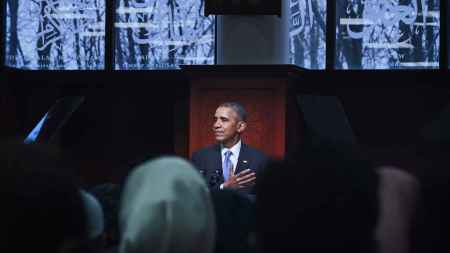
On Wednesday the U.S. media interrupted its saturation coverage of the presidential primaries to report on President Barack Obama’s visit to a mosque in Maryland. The visit was Obama’s first public one to a mosque in the US since entering the White House seven years ago. The mosque Obama chose to visit demonstrated once again that his views of radical Islam are deeply problematic.

Obama visited the Islamic Society of Baltimore, a mosque with longstanding ties to the Muslim Brotherhood and Hamas. During Operation Protective Edge, the leaders of the mosque accused Israel of genocide and demanded that the administration end US support for the Jewish state.

According to The Daily Caller, the mosque’s former imam Mohammad Adam el-Sheikh was active in the Islamic American Relief Agency, a charity deemed a terror group in 2004 after the US Treasury Department determined it had transferred funds to Osama bin Laden, Hamas, al-Qaida and other terrorist groups.

El-Sheikh left the Baltimore mosque to take over the Dar el-Hijra mosque in northern Virginia. He replaced Anwar al-Awlaki as imam after Awlaki moved to Yemen in 2003. In Yemen Awlaki rose to become a senior al-Qaida commander.

Awlaki radicalized many American jihadists both through direct contact and online. He radicalized US Army major Nidal Malik Hasan, and inspired him to carry out the 2009 massacre of 13 US soldiers and civilians at Fort Hood in Texas. Awlaki was killed by a US drone strike in 2011.

In 2010, a member of the Islamic Society of Baltimore was arrested for planning to attack an army recruiting office. According to the Mediaite news portal, the mosque reportedly refused to cooperate with the FBI in its investigation.

Obama’s visit to the radical mosque now is a clear signal of how he intends to spend his last year in office. It tells us that during this period, Obama will adopt ever more extreme positions regarding radical Islam.

Obama’s apologetics for radical Islamists is the flipside of his hostility for Israel. This too is escalating and will continue to rise through the end of his tenure in office.

The US Customs authority’s announcement last week that it will begin enforcing a 20-yearold decision to require goods imported from Judea and Samaria to be labeled “Made in the West Bank,” rather than “Made in Israel,” signals Obama’s intentions. So, too, it is abundantly clear that France’s plan to use the UN Security Council to dictate Israel’s borders was coordinated in advance with the Obama administration.

Part of the reason Obama is acting with such urgency and intensity is that he knows that regardless of who is elected to replace him, the next president will not be as viscerally hostile to Israel or as emotionally attached to Islam as he is.

On the Democratic side, neither candidate is a particularly energetic supporter of Israel or counter- jihad warrior. Former secretary of state Hillary Clinton’s recently released email discussions of Israel with her closest advisers indicate that all of Clinton’s closest counselors are hostile to Israel.

For his part, Vermont’s socialist Sen. Bernie Sanders harbors the far Left’s now standard anti-Israel attitudes. Not only did Sanders – like Clinton – support Obama’s nuclear deal with Iran. He boycotted Prime Minister Benjamin Netanyahu’s speech before the Joint Houses of Congress where Netanyahu laid out Israel’s reasons for opposing the deal. Sanders gave television interviews condemning Netanyahu for making the speech, accusing him of electioneering on the back of the US Congress. Sanders criticized Israel during Operation Protective Edge and supports decreasing US military aid to Israel.

For all their anti-Israel sensibilities, though, neither Clinton nor Sanders gives the impression that they are driven by them as Obama is.

Unlike Obama, neither appear to be animated by their hostility toward Israel. Neither seem to be passionate in their support for Muslim Brotherhood- affiliated groups or in their desire to realign the US away from Israel, from its traditional Arab allies and toward Iran. This lack of passion makes it safe to assume that if elected president, while they will adopt anti-Israel policies, they will not seek out ways to weaken Israel or strengthen its sworn enemies.

On the Republican side, the situation is entirely different. All of the Republican presidential candidates are pro-Israel. To be sure, some are more pro-Israel than others. Sen. Ted Cruz, for instance, is more supportive than his competitors. But all of the Republicans candidates are significantly more supportive of Israel than the Democratic candidates. So it is simply an objective fact that Israel will be better off if a Republican is elected in November no matter who he is and no matter who the Democratic candidate is.

It hasn’t always been this way. And it doesn’t have to remain this way.

Back in 1992 when Bill Clinton was running against George H.W. Bush, if Israel was your issue, you voted for Clinton because he was rightly viewed as more pro-Israel than Bush.

Twenty-four years ago, supporting Israel carried no cost for Clinton. According to Gallup, in 1992, 52 percent of Democrats were pro-Israel.

On the other hand, Bush was probably harmed somewhat for the widespread perception that he was anti-Israel. In 1992, 62% of Republicans were pro-Israel.

Over the past 15 years, the situation has altered considerably.

Today, Republicans are near unanimous in their support for Israel. According to a Gallup poll from February 2015, 83% of Republicans support Israel.

Only 48% of Democrats do. From 2014 to 2015, Democratic support for Israel plunged 10 points.

The cleavage on Israel is particularly acute among partisan elites.

Last summer, pollster Frank Luntz conducted a survey of US elite partisan opinion on Israel. His data were devastating. According to Luntz’s data, 76% of Democratic elite believe that Israel has too much influence over US foreign policy. Only 20% of Republicans do.

Nearly half (47%) of highly educated, wealthy and politically active Democrats think that Israel is a racist country. Thirteen percent of their Republican counterparts agree.

And whereas only 48% of Democrats believe that Israel wants peace, 88% of Republicans believe that Israel wants peace with its neighbors.

These trends affect voting habits. According to Luntz, while only 18% of Democrats say they would be more likely to vote for a politician who supports Israel, 31% said they are less likely to vote for a pro-Israel candidate. In contrast, 76% of Republicans say they want their representatives to support Israel.

Forty-five percent of Democrats said they would be more likely to vote for a politician who is critical of Israel and 75% of Republicans said they would be less likely to vote for an anti-Israel candidate.

These data tell us two important things. Today Democratic candidates will gain nothing and may lose significant support if they support Israel.

In contrast, a Republican who opposes Israel will have a hard time getting elected, much less winning a primary.

Partisan sensibilities aren’t the only reason that Israel is will be better off if a Republican wins in November. There is also the issue of policy continuity.

Even though neither Clinton nor Sanders share Obama’s anti-Israel passion, their default position will be to maintain his policies. Traditionally, when an outgoing president is replaced by a successor from his own party, many of his foreign policy advisers stay on to serve his successor.

Moreover, if American voters elect a Democrat to succeed Obama, their decision will rightly be viewed as a vote of confidence in his policies.

Obama has radicalized the Democratic Party in his seven years in office. When Obama was inaugurated, the Blue Dog caucus of conservative Democratic members of the House of Representatives had 54 members. Today only 14 remain.

Obama’s Democratic Party is not Bill Clinton’s party.

A party that isn’t forced to pay a price for its policies isn’t likely to change them. If the Democrats are not defeated in the run for the White House in November, their party will not reassess its shift to radicalism and reconsider its increasingly hostile stance on Israel.

That then brings us to the state of the presidential race following the Iowa caucuses and ahead of next Tuesday’s primary in New Hampshire. The Iowa caucuses showed a significant gap in enthusiasm among partisan voters. Participation rates in the Republican caucuses were unprecedented.

Cruz shattered the record for vote getting in the state that saw participation rates up 30% from 2012. On the Democratic side, participation rates were below the 2008 level.

On the Republican side, the three top candidates – Cruz, businessman Donald Trump and Sen. Marco Rubio – are all backed by committed, fervent supporters. On the Democratic side, Clinton’s supporters are reportedly diffident about her. And while Sanders enjoys enthusiastic support from voters under 45, he can’t seem to convince people who actually know what socialism is to support him.

If Sanders wins the Democratic nomination, on the face of it, it is difficult to see his path to victory in the general election. Whereas Obama was elected by hiding his radical positions, Sanders is running openly as a socialist and attacks Obama from the Left. Whether America is a center-right or center-left country, the undisputed truth is that it is a centrist country.

As for Clinton, the likelihood grows by the day that by the general election, her inability to inspire her base will be the least of her problems.

The FBI’s ongoing probe of her use of a private email server during her tenure as secretary of state is devastating her chances of getting elected.

The State Department’s revelation last week that 22 of Clinton’s emails were too classified to be released, even with parts blacked out, makes it impossible to dismiss the prospect that she will be indicted for serious felony offenses. Yet, as Jonah Goldberg argued Wednesday in National Review, with her narrow victory in Iowa, Clinton blocked the opening for a less damaged candidate – like Vice President Joe Biden or former New York mayor Michael Bloomberg – to step into the race.

In other words, the Republican nominee will have an energized base and will face either a legally challenged or openly socialist Democratic opponent.

According to terrorism expert Steven Emerson, before Obama visited the Islamic Society of Baltimore, he asked the FBI for its opinion of the mosque. FBI investigators informed Obama of the mosque’s ties to terrorism. They urged him not to confer it with the legitimacy that comes with a presidential visit.

Obama ignored the FBI’s advice.

The next 11 months will be miserable for Israel.

But we should take heart. By all accounts, next year will be better. And judging by the way the presidential race is shaping up, next year may be a much, much better year.

Facebook’s War on Freedom of Speech

February 5, 2016

Facebook’s War on Freedom of Speech, Gatestone InstituteDouglas Murray, February 5, 2016

♦ Facebook is now removing speech that presumably almost everybody might decide is racist — along with speech that only someone at Facebook decides is “racist.”

♦ The sinister reality of a society in which the expression of majority opinion is being turned into a crime has already been seen across Europe. Just last week came reports of Dutch citizens being visited by the police and warned about posting anti-mass-immigration sentiments on social media.

♦ In lieu of violence, speech is one of the best ways for people to vent their feelings and frustrations. Remove the right to speak about your frustrations and only violence is left.

♦ The lid is being put on the pressure cooker at precisely the moment that the heat is being turned up. A true “initiative for civil courage” would explain to both Merkel and Zuckerberg that their policy can have only one possible result.

It was only a few weeks ago that Facebook was forced to back down when caught permitting anti-Israel postings, but censoring equivalent anti-Palestinian postings.

Now one of the most sinister stories of the past year was hardly even reported. In September, German Chancellor Angela Merkel met Mark Zuckerberg of Facebook at a UN development summit in New York. As they sat down, Chancellor Merkel’s microphone, still on, recorded Merkel asking Zuckerberg what could be done to stop anti-immigration postings being written on Facebook. She asked if it was something he was working on, and he assured her it was.

At the time, perhaps the most revealing aspect of this exchange was that the German Chancellor — at the very moment that her country was going through one of the most significant events in its post-war history — should have been spending any time worrying about how to stop public dislike of her policies being vented on social media. But now it appears that the discussion yielded consequential results.

Last month, Facebook launched what it called an “Initiative for civil courage online,” the aim of which, it claims, is to remove “hate speech” from Facebook — specifically by removing comments that “promote xenophobia.” Facebook is working with a unit of the publisher Bertelsmann, which aims to identify and then erase “racist” posts from the site. The work is intended particularly to focus on Facebook users in Germany. At the launch of the new initiative, Facebook’s chief operating officer, Sheryl Sandberg, explained that, “Hate speech has no place in our society — not even on the internet.” She went to say that, “Facebook is not a place for the dissemination of hate speech or incitement to violence.” Of course, Facebook can do what it likes on its own website. What is troubling is what this organization of effort and muddled thinking reveals about what is going on in Europe.

1455

The mass movement of millions of people — from across Africa, the Middle East and further afield — into Europe has happened in record time and is a huge event in its history. As events in ParisCologne and Sweden have shown, it is also by no means a series of events only with positive connotations.

As well as being fearful of the security implications of allowing in millions of people whose identities, beliefs and intentions are unknown and — in such large numbers — unknowable, many Europeans are deeply concerned that this movement heralds an irreversible alteration in the fabric of their society. Many Europeans do not want to become a melting pot for the Middle East and Africa, but want to retain something of their own identities and traditions. Apparently, it is not just a minority who feel concern about this. Poll after poll shows a significant majority of the public in each and every European country opposed to immigration at anything like the current rate.

The sinister thing about what Facebook is doing is that it is now removing speech that presumably almost everybody might consider racist — along with speech that only someone at Facebook decides is “racist.”

And it just so happens to turn out that, lo and behold, this idea of “racist” speech appears to include anything critical of the EU’s current catastrophic immigration policy.

By deciding that “xenophobic” comment in reaction to the crisis is also “racist,” Facebook has made the view of the majority of the European people (who, it must be stressed, are opposed to Chancellor Merkel’s policies) into “racist” views, and so is condemning the majority of Europeans as “racist.” This is a policy that will do its part in pushing Europe into a disastrous future.

Because even if some of the speech Facebook is so scared of is in some way “xenophobic,” there are deep questions as to why such speech should be banned. In lieu of violence, speech is one of the best ways for people to vent their feelings and frustrations. Remove the right to speak about your frustrations, and only violence is left. Weimar Germany — to give just one example — was replete with hate-speech laws intended to limit speech the state did not like. These laws did nothing whatsoever to limit the rise of extremism; it only made martyrs out of those it pursued, and persuaded an even larger number of people that the time for talking was over.

The sinister reality of a society in which the expression of majority opinion is being turned into a crime has already been seen across Europe. Just last week, reports from the Netherlands told of Dutch citizens being visited by the police and warned about posting anti-mass-immigration sentiments on Twitter and other social media.

In this toxic mix, Facebook has now — knowingly or unknowingly — played its part. The lid is being put on the pressure cooker at precisely the moment that the heat is being turned up. A true “initiative for civil courage” would explain to both Merkel and Zuckerberg that their policy can have only one possible result.

Iran and Russia in first major falling-out over Syrian war and Assad

February 5, 2016

Iran and Russia in first major falling-out over Syrian war and Assad, DEBKAfile, February 5, 2016

P.V

While diplomats from 70 countries talked in London about how to raise $9 bn for projects to rehabilitate Syria’s refugees and rebuild their war-ravaged country, its future was further clouded this week by an argument that flared between the main arbiters, Russia and Iran.

Ali Akbar Velayati, Iranian supreme leader Ayatollah Ali Khamenei’s foreign affairs advisor, spent three days in Moscow Feb. 1-4 haranguing Russian leaders, including President Vladimir Putin, whom he saw twice, on the differences that had cropped up in their long political and military cooperation for propping up the Assad regime.

The Iranian official went home without resolving those differences, DEBKAfile’s sources report exclusively. Left pending were not just the next stage of the war but also the fate of President Bashar Assad.

Velayati told Iranian reporters on his plane: “We are against stopping the war,” and “The war must be continued until all (Syrian) terror cells are eradicated.”

He did not elaborate, but DEBKAfile’s Iranian and Moscow sources point out that he was underlining Tehran’s concerns about Moscow’s reported plans for the Assad regime, in which Iran is heavily invested, and the slowdown of Russia’s air campaign against every last rebel group.

Most of all, Iran’s leaders were troubled to find that Russia, by dint of its proactive military intervention, had maneuvered itself into position for calling the shots for Syria.

They are particularly distrustful, according to our sources, over Moscow’s complicated deals with Washington on the Syrian question and the dialogue Russia is holding with the Persian Gulf states, led by Saudi Arabia. The Iranians fear that Putin is calibrating his offensive against rebel groups according to the pace of these interchanges and may therefore scale back strikes on pro-American or “moderate” rebels, or even refrain from subduing them.

Tehran also looks askance at the improved relations Moscow is fostering with its rivals in the region, Riyadh and Abu Dhabi. Last week, Russian Foreign Minister Sergei Lavrov visited the two Arab capitals to allay their concerns for the Syrian rebel groups they support. He promised the Saudis not to harm them, so long as they did not get in the way of the joint Russian-Syrian steps in their country.

Given the Russian moves, the Syrian war looks increasingly to Tehran as unlikely to end in President Assad’s favor.

Lavrov seemed to confirm this Iranian concern on Feb. 2 when, during his visit to Oman he said, “Russian air strikes will not cease until we truly defeat the terrorist organizations ISIL and Jabhat al-Nusra, And I don’t see why these air strikes should stop.”

The Iranians immediately jumped on his omission of all other rebel groups but the two Islamists as the enemy, confirming their suspicions that Moscow was now acting in Syria on its own account. This was the cause of raised tempers in Velayati’s second meeting with the Russian president in Moscow.

The Iranian official demanded the expansion of Russian military operations to cover more inclusive rebel targets. Putin shot back that if Iran wants to ramp up war operations, it should send its own troops into the fray – and not just generals.

He touched on a sore point:  Iran’s Revolutionary Guards Corps don’t have troops available for fighting in Syria. And so, Velayati’s mission to Moscow ended on an acrimonious note.

Articles: The Unbalanced US Arab-Israeli Balancing Act

February 5, 2016

The Unbalanced US Arab-Israeli Balancing Act

By Dan Calic

February 5, 2016

Source: Articles: The Unbalanced US Arab-Israeli Balancing Act

The US and others, while suggesting they are strong supporters of Israel and its need for security, in reality are not promoting peace. Their policies are actually sustaining and rewarding terror.

Let me explain…

President Obama for example has repeatedly stated throughout his administration  America’s commitment to Israel’s security is unshakable. No doubt these are reassuring words to Israel and its friends around the world. However,  his actions contradict his words.

How so? It has been the policy of the US and others to condemn the “settlements” and the  “occupation” as the main obstacles to achieving peace with the Palestinians. For those who subscribe to said view, where were the occupation or settlements in 1948 or 1967? They did not exist.

However, in order to see the folly of blaming the lack of peace on these issues, we must look at what the statements imply.

  1. They suggest the US is attempting to be balanced. This is meant to appeal to the Arab world, which believes the US has been too supportive of Israel for many years.
  2. They allow the US to avoid tackling the real issues which are preventing peace.

Placing blame where it belongs

The  Palestinians flatly refuse to accept the right of Israel to exist. The charters of the PLO, Hamas, and Mahmoud Abbas’s own party Fatah, all require its destruction. Is the US devoting as much attention to combatting this as they are about condemning ‘settlements?’ Absolutely not.  Abbas has repeatedly said he will never recognize Israel as a Jewish state.  Israeli leadership has consistently committed to recognizing a ‘Palestinian’ state, yet is the US applying pressure on him to recognize Israel? Again, no.

Another issue is money.

The US and others believe if there is measurable improvement in the overall economic environment of the Palestinians it would reduce their “frustration,” which many believe motivates their terror against Israelis. In my view, there exists no moral equivalence between justice and terror.

Moreover, if the Palestinians wish to express frustration regarding their poor economic condition, Israel is not to blame.

The responsibility of the economic plight of the Palestinians belongs to their own leadership.

When Yasser Arafat formed the Palestinian Authority in 1994 he promised new hospitals, clinics, educational institutions and improvement to the general infrastructure. He also promised greater employment opportunities. However, instead of delivering on his promises he took complete control of all media, as well as the flow of money. None of the promised improvements took place. With virtually no independent oversight this became a recipe for corruption.

He and his cronies systematically stole huge sums of money, while the average ‘Arabstinian’ remained in abject poverty, which is still the case today under Mahmoud Abbas.

Such information rarely gets much attention, and certainly not in’ Arabstinian’ media, heaven forbid!

Tracking the money

Here are some rather incredible facts:

Since formation of the Palestinian Authority it has received over $31 billion in foreign aid. In 2014 alone they received well over $2 billion. Of that amount the US provides the most, by far- roughly $400 million, followed by the European Commission ($140 million), Saudi Arabia ($103 million) the UK ($95 million), etc. [see chart]  The Palestinians  have received more money than any other group of people in human history. In fact “if you take into account historic inflation, the PA has received 15 times more money than the US gave all of Europe under the Marshall Plan after WWll,” according to Calev Myers of the Jerusalem Institute of Justice who has studied this extensively.

With respect to Arafat, while the average ‘Arabstinian’ suffered, his wife Suha who lived in Paris received $200,000 per month from him. She also is alleged to have received numerous bulk payments, one of which was $11 million according to reports.  Where did this money come from? More important, what happened with the vast amount of international aid given to the PA?

When Arafat died in 2004 an investigation showed he had $1 billion stashed away in Swiss bank accounts. Plus, he supposedly was in control of up to $6 billion in assets.  His widow negotiated a rather tidy settlement before pointing investigators toward Arafat’s hidden assets. Rumor is she collected as much as $40 million.

Since then, the tradition of corruption has been well maintained by Arafat’s successor Mahmoud Abbas, whose personal wealth is said to be $1 billion. He is currently constructing a $13 million mansion for himself.

In reality the economic well-being of the Palestinians has long been in their own hands. However, their leadership has literally stolen it. Meanwhile, the world does nothing, and the money keeps lining the pockets of corrupt leaders.

As for the Arabstinian health care system, it remains so under developed many of them in desperation come to Israel for needed care. Indeed, in 2014 when tensions were extremely high due to the disappearance of three Jewish teens, who were later found murdered, Abbas’s wife was having surgery in an Israeli hospital. Plus, in the midst of the current spate of terror, which Abbas has fueled with hateful rhetoric, his brother-in-law had life-saving surgery in Israel. Israel even treated the granddaughter of Ismael Haniyeh, Hamas’s leader in the Gaza Strip.

International aid funding murderers

Aside from pilfering money meant to improve the lot of the average ‘Arabstinian,’ there is another disturbing aspect of how international aid is being used by the PA.

Approximately 16% of their total budget is designated to reward terrorists and their families. This is done under what is called The Law of the Prisoner.”
Here’s how it works:

If an ‘Arabstinian’ commits a crime against an Israeli and is imprisoned he becomes eligible to earn a large monthly income. It can be as much as $3,500, ($42,000 annually) which is five times greater than the average ‘Arabstinian’ earns. The more heinous the crime, the higher the stipend.

You’ve the old saying “crime doesn’t pay?” These terrorists are proof it does pay. US and European taxpayers are the ones who are “paying.”

Given the current state of affairs, what should the US do? While I don’t pretend to have all the answers   here are some suggestions:

  1. Stop blaming Israeli ‘settlements’ and ‘occupation’ for the lack of progress toward peace.
  2. Demand Abbas condemn terror against Israeli’s and take steps to eliminate it.
  3. Require mutual national recognition and hold him accountable if he refuses.
  4. Demand the PLO, Fatah and Hamas amend their charters which call for Israel’s destruction. (no legitimate peace partner is party to a charter calling for the others destruction)
  5. Insist the PA set up independent oversight and engage in complete financial transparency and accountability.
  6. Demand the Law of the Prisoner be scrapped. Inform the PA financial aid will be terminated if murderers continue to be financially rewarded.

At the end of the day the effort of the US to appear balanced by maintaining the status quo is not only failing to move the peace process forward, it is actually perpetuating an environment which will never produce peace.

What is needed is for world leaders, especially the US to stand up to the Arabs and stop trying to persuade Israel to further compromise its security by rewarding those who uncompromisingly seek its destruction with land and money.

Dan Calic is a writer, history student and speaker. See additional articles on his Facebook page.

Merkel’s coalition rival urges dismantling of anti-Russia sanctions after visiting Putin

February 5, 2016

Merkel’s coalition rival urges dismantling of anti-Russia sanctions after visiting Putin

Published time: 4 Feb, 2016 23:26

Source: Merkel’s coalition rival urges dismantling of anti-Russia sanctions after visiting Putin — RT News

Russian President Vladimir Putin, right, during his meeting with Minister-President of Bavaria Horst Seehofer at Novo-Ogaryovo, February 3, 2016. © Aleksey Nikolskyi
Horst Seehofer, the premier of the state of Bavaria, a nominal partner in Angela Merkel’s coalition, and a persistent thorn in her side, has called for a sea change in diplomatic dealings with Russia, following his trip to Moscow.

“Extending anti-Russia sanctions was a mistake,” said Seehofer, referring to the EU’s decision to prolong travel restrictions and economic embargoes against Russian individuals and companies over Ukraine late last year. “We need to consider the reality – they cannot be removed straight away. But we can deploy political means to repeal them… I think that they can be revoked in the foreseeable future.”

Journalists returned to the subject of sanctions repeatedly as Seehofer spent an hour answering questions at the final press conference, following the two-day visit during which he met Russian President Vladimir Putin, and signed bilateral trade deals on behalf of his home state.

Read more

© kremlin.ru

Seehofer tried to steer clear of incendiary soundbites that could annoy his partners in Berlin, insisting that he “wouldn’t remove sanctions this month,” and insisting any rapprochement was “conditional on Ukraine and Russia following the terms of the Minsk agreements.”

But for all his careful phrases, the trip, unapproved by Merkel, had already conjured up a storm in Germany, with its Russia policy chief Gernot Erler, accusing him of “breaking the EU consensus” and “letting himself be exploited for publicity.” Newspaper editorials accused him of “disloyalty” to Merkel, and “meddling” with his unsanctioned overtures.

Yet for Seehofer, whose CSU party is in theory merely the regional arm of the ruling Christian Democrats, stirring up confrontation and sticking to his guns are not a weakness, but a strategy. The maverick at the head of Germany’s second most-populous state, whose public persona has drawn comparisons with Donald Trump, has made his name opposing the policies of the federal government. He is the most senior politician to vocally oppose the “open-door” refugee policy Merkel adopted last year.

Relations with the Kremlin have been another fissure between Munich and Berlin, even before the latest trip. In his final conference, Seehofer insisted that Moscow has an “irreplaceable” role to play in mediating the Syrian conflict.

“When I met him, President Putin demonstrated deep knowledge of the Syrian issues. I don’t want to reveal details of our talks, but it became clear to me that no solution can be found without Russia,” said the 66-year-old politician.

German Chancellor Angela Merkel and Bavarian state premier and leader of the Christian Social Union (CSU) Horst Seehofer. © Peter Kneffel

The Russian President was equally complimentary in an earlier statement, noting a “special relationship” between Bavaria and Russia, and expressing gratitude to Seehofer for his diplomatic efforts.

Seehofer promised to persist with his maverick diplomacy, vowing to speak with Ukrainian President Petro Poroshenko and Russian Prime Minister Dmitry Medvedev during the Munich security conference later this month.

The Bavarian leader also promised to return to Russia in the latter part of 2016, as part of a more sizable state delegation.


