Archive for January 2016

ISIS Followers Plan to Take over Gaza Strip

January 13, 2016

ISIS Followers Plan to Take over Gaza Strip

by Khaled Abu Toameh

January 12, 2016 at 5:00 am

Source: ISIS Followers Plan to Take over Gaza Strip

  • In the video produced by the pro-ISIS Palestinian Islamic Army (PIA), Hamas leaders are denounced for aligning themselves with moderate Arab leaders in the Gulf, who are described as “criminals and enemies of Islam.”
  • Apparently, Hamas has been too kind to Christians living in the Gaza Strip. The narrator blasts Hamas leaders for offering greetings to Christians on their holidays.
  • It seems that there may be valid reasons for Egypt’s reluctance to reopen the Rafah border crossing with Gaza, as well as to Israel’s opposition to lifting the naval blockade on Gaza — initiated to prevent weapons from being imported to Hamas and other extremists in Gaza. The PIA video provides proof that the Gaza Strip has become a hub for jihadi groups posing a murderous threat not only to Israel and “the West,” but also to Muslims who are deemed by the terrorists as lacking in religious standards.

A new group calling itself the Palestinian Islamic Army (PIA) has popped up in the Gaza Strip, signaling incontrovertibly the growing influence of the Islamic State (ISIS) among Palestinians.

A thirty-minute video put out by the PIA shows its followers pledging allegiance to ISIS “Caliph” Abu Bakr Al-Baghdadi, and paints Hamas leaders as “apostates” and “infidels” for failing to implement Islamic sharia law in the Gaza Strip. The video constitutes proof positive that the ISIS ideology has infiltrated Gaza — a truth that Hamas has unsuccessfully been trying to conceal for the past year.

A frame from the recent video produced in Gaza by the Palestinian Islamic Army (PIA), in which the PIA followers pledge allegiance to ISIS “Caliph” Abu Bakr Al-Baghdadi.

In the video, Hamas leaders Ismail Haniyeh and Khaled Mashaal are denounced for aligning themselves with moderate Arab leaders in the Gulf, who are described as “criminals and enemies of Islam.” Apparently, Hamas has been too kind to Christians living in the Gaza Strip. The narrator blasts Hamas leaders for offering greetings to Christians on their holidays and condolences on the death of some of the community’s members. Hamas leaders are featured making visits to Christian “polytheists” in the Strip.

Yet Christians are not the only bedfellows prohibited to Hamas by the PIA. The video also damns Hamas leaders for their alliance with the Shiite Muslims of Iran and Lebanese Hezbollah. For the PIA, Hezbollah leader Hassan Nasrallah is a “Satan” waging war on Sunni Muslims. And this “Satan” is in good company: “The Hamas government in the Gaza Strip is a sect of apostasy and blasphemy,” the PIA video declares. Muslims are urged vigorously to distance themselves from the heretical Hamas.

The PIA holds Hamas responsible for the deaths of 11 of its members in the Gaza Strip. “The Hamas members executed them in front of their mothers, and left the wounded to die after preventing ambulances from reaching them,” the video charges. “One of those killed in this massacre was brother Saeb Abu Obaida, who was executed by Hamas in cold blood.” According to the video, Abu Obaida was the “emir” of the PIA in the Gaza Strip.

One of the leaders and founders of the ISIS-affiliated PIA, Mu’taz Daghmash (known by his nickname Abu Al-Majd), was killed in an Israeli airstrike two years ago — much to the satisfaction of Hamas. The video reveals that arch-terrorist Daghmash was involved in the 2006 abduction of Israeli soldier Gilad Shalit and the assassination of two Palestinian security commanders in the Gaza Strip — Musa Arafat and Jad Tayeh.

A second jihadi mentioned in the video, Sultan Al-Harbi, is described as a senior member of ISIS who received military training in Yemen, Sudan and Libya before returning to the Gaza Strip. He too was killed last year in an Israeli airstrike.

Nidal Al-Ashi (aka Abu Huraira) was another PIA member in good standing, before becoming the first Palestinian to be killed in Syria while fighting for ISIS. Al-Ashi participated in multiple rocket attacks on “the enemies of Allah, the Jews,” and attacks on churches and other Christian targets in Gaza, as well attacks as on Western journalists and diplomats.

Egyptian security officials have attested repeatedly that the Gaza Strip has become a major exporter of jihadis to Sinai. Events have proven those officials correct. It seems that there may be valid reasons for Egypt’s reluctance to reopen the Rafah border crossing with Gaza, as well as to Israel’s opposition to lifting the naval blockade on Gaza — initiated to prevent weapons from being imported to Hamas and other extremists in the Gaza Strip. The PIA video provides definitive proof that the Gaza Strip has become a hub for jihadi groups posing a murderous threat not only to Israel and “the West,” but also to Muslims who are deemed by the terrorists as lacking in religious standards.

Hamas has brought nothing but havoc to its people in the Gaza Strip. As for the Palestinian Authority and its leader, Mahmoud Abbas, all that is left for them is to be grateful for the presence of Israel in the West Bank. Without the Israeli military, Hamas and ISIS would eat Abbas and his Palestinian Authority for breakfast. One wonders: Is this the sort of state that Palestinians are seeking to establish?

Khaled Abu Toameh is an award-winning journalist based in Jerusalem.

Electronic Doomsday for the US?

January 13, 2016

Electronic Doomsday for the US? The Electromagnetic Pulse (EMP)

by Peter Huessy

January 13, 2016 at 4:45 am

Source: Electronic Doomsday for the US?


  • The recent North Korean nuclear and the Iranian ballistic missile tests are serious deadly threats to the United States. North Korea’s latest bomb test is being widely dismissed by “experts” because the apparent yield is around 10 kilotons or less – which just so happens to be exactly the right amount for an electromagnetic pulse (EMP) explosion.
  • An EMP attack on the U.S. would leave the country with no electricity, no communications, no transportation, no fuel, no food, and no running water.
  • “Our increasing dependence on advanced electronics systems results in the potential for an increased EMP vulnerability… and if unaddressed makes EMP employment by an adversary an attractive asymmetric option.” — EMP Commission
  • The recent military writings and exercises of potential adversaries would combine EMP with cyber-attacks, sabotage, and kinetic attacks against the national electric grid and other critical infrastructures.

Contrary to some “expert” analysis, both the recent North Korean nuclear and the Iranian ballistic missile tests are deadly serious threats to the United States.

The danger to the United States is particularly consequential due to the close military cooperation of North Korea and Iran. Their combined capabilities, as demonstrated recently, could very well signal a future nuclear attack of the electromagnetic pulse type, for which the U.S., at the moment, is totally unprepared.

The threat to the United States from an electromagnetic pulse (EMP) attack — the high-altitude detonation of a nuclear weapon over the United States — is so potentially catastrophic that both the 2004 and 2008 reports of the Congressional EMP Commission said so openly — probably in the hope that the public warning would spur the nation and the Department of Defense to action. [1]

Even an EMP attack from a single 10-kiloton nuclear weapon — of the type now in North Korea’s arsenal — could cause cascading failures which could black out the U.S. Eastern Grid for months or years, and devastate the civilian economy. An EMP, detonated at an altitude above 30-70 kilometers, could be delivered by a short-range missile fired off a freighter, hundreds of kilometers off U.S. shores.

The result would be no communications, no transportation, no fuel, no food, and no water for a decade or more. That would be true for at least the entire eastern half of the United States, where most of the population lives. National Geographic has described it as an “Electronic Armageddon.”

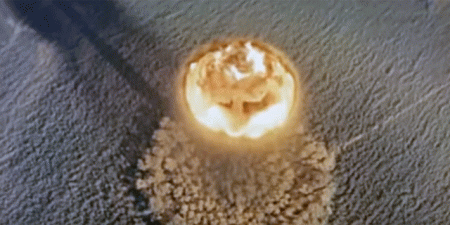
An illustrative rendering of an EMP attack on the United States. (Image source: Video screenshot from “33 Minutes”)

Despite these previous warnings and North Korea’s recent bomb test — its fourth known nuclear test since 2006 — “experts” are dismissing a nuclear threat from North Korea as of little concern because the apparent yield of the bomb was in the neighborhood of 10 kilotons or less.

Hydrogen Bombs, or thermonuclear weapons, which is what North Korea claimed to have detonated, produce yields higher than those.

In fact, however, these experts may be way off base. The yield of an EMP explosion is lower. The North Korean bomb capability that was tested may therefore well be that of a super-EMP.

Neutron bombs, or Enhanced Radiation Weapons such as Super-EMP weapons, are essentially very low yield H-Bombs. They typically have yields of 1-10 kilotons, exactly like North Korea’s device. Indeed, because of their very low yield, all four North Korean nuclear tests look like Super-EMP weapons.

A Super-EMP weapon is designed to produce special effects (gamma rays, in the case of Super-EMP). A Super-EMP warhead, while having a seemingly insignificant explosive yield, could be far more deadly and dangerous to the United States than the most powerful H-Bomb ever built.

Russia’s Tsar H-Bomb, (known as Tsar Bomba), the most powerful H-Bomb ever detonated, produced during its test in October 1961 a yield of 60 megatons. It would have been capable of flattening everything in the state of Rhode Island. [2]

A Super-EMP weapon, however, detonated 300 kilometers above the center of the U.S., could destroy the entire nation’s industrial and military capacity, and kill a large percentage of the American people, by taking down the U.S. electrical grid. Once destroyed, the grid’s elements would take decades to rebuild.[3]

Even if the U.S. were to protect its electrical infrastructure from such a threat — legislation to protect the grid is now in Congress, primarily thanks to Rep. Trent Franks (R-Arizona) — the parallel vulnerability of U.S. military forces to an EMP attack would be just as serious.

We know the Department of Defense has testified to Congress that 99% of the electricity for continental U.S. military bases comes from the civilian grid. Our military bases would thereby be without electrical power for decades as well. Unfortunately, the thousands of electrical transformers destroyed by an EMP attack were not primarily built in America. Even if they were, they require at least a five-year lead-time for production.

Overseas power-projection from U.S. military bases would be effectively impossible without an operational grid. Moreover, after such an EMP attack, the national focus would be on saving millions of Americans from mass starvation and preserving societal existence, not on going “over there” to fight a war or defend U.S. interests.

If the EMP attack were executed anonymously, say, by a missile launched off a freighter at sea close-in to the United States, we would probably not even know against whom to retaliate. Thus, classical deterrence would not work, further “inviting” such an attack.

In 1999, for example, at a high level meeting in Vienna of a Congressional delegation with senior members of the Russian government, Vladimir Lukin, the chairman of the Duma’s Foreign Affairs Committee, angry with American policy in the Balkans, issued the following threat: “If we really wanted to hurt you with no fear of retaliation, we would launch a Submarine-launched Ballistic Missile (SLBM), [and] we would detonate a nuclear weapon high above your country and shut down your power grid.”

Congressman Curt Weldon, (R-PA), the American delegation chair, who understood Russian, turned to his Maryland colleague, (Roscoe Bartlett, D-MD) and asked, “Roscoe, did you hear what he said?”

The chairman of the State Duma Geopolitics Commission, Alexander Shabanov, smiled and said, “And if that one doesn’t work, we have plenty of spares”.[4]

Thus a nuclear weapon designed specifically for EMP attack, what Russian experts call a “Super-EMP” warhead, would constitute a worst-case threat.

A single Super-EMP warhead, detonated in the sky 300 kilometers over the center of the U.S., would generate such a powerful EMP field over all 48 contiguous United States that, not only would a protracted nationwide blackout result, but even the best protected U.S. military forces and C3I on all military bases—if not sufficiently protected– could also be at risk.

The technology to protect the electrical grid is relatively straightforward and inexpensive. But only with action now could the grid be protected sufficiently to give the US industrial and economic capability a fighting chance to survive an “Electronic Armageddon”.

It is also possible to protect military assets through “hardening,” but doing so after production and the fielding of equipment is time-consuming and costly. The sooner the U.S. starts with hardening its equipment, sooner the job will get done. The U.S. is seriously behind schedule in what is required to protect it.

It is not as if the threat is “over the horizon.” Russia and China already have Super-EMP warheads. Moreover, according to the Congressional EMP Commission, the design of Super-EMP warheads is no secret: “Certain types of relatively low-yield nuclear weapons can be employed to generate potentially catastrophic EMP effects over wide geographic areas, and designs for variants of such weapons may have been illicitly trafficked for a quarter-century.”

The EMP Commission warned that non-state actors — terrorists — could also pose an EMP threat: “What is different now is that some potential sources of EMP threats are difficult to deter — they can be terrorist groups that have no state identity, have only one or a few weapons, and are motivated to attack the U.S. without regard for their own safety.”

The EMP Commission also warned that the Department of Defense has failed to maintain adequate EMP protection for U.S. military forces since the end of the Cold War:

“The end of the Cold War relaxed the discipline for achieving EMP survivability within the Department of Defense, and gave rise to the perception that an erosion of EMP survivability of military forces was an acceptable risk. EMP simulation and test facilities have been mothballed or dismantled, and research concerning EMP phenomena, hardening design, testing, and maintenance has been substantially decreased. However, the emerging threat environment, characterized by a wide spectrum of actors that include near-peers, established nuclear powers, rogue nations, sub-national groups, and terrorist organizations that either now have access to nuclear weapons and ballistic missiles or may have such access over the next 15 years have combined to place the risk of EMP attack and adverse consequences on the US to a level that is not acceptable.”

The EMP Commission further warned that even U.S. strategic forces and C3I may be at risk from an EMP attack:

“Current policy is to continue to provide EMP protection to strategic forces and their controls. The Department of Defense must continue to pursue the strategy for strategic systems to ensure that weapons delivery systems of the New Triad [land, sea and air] are EMP survivable, and that there is, at a minimum, a survivable ‘thin-line’ of command and control capability to detect threats and direct the delivery systems.”[5]

U.S. strategic forces today are also relatively more vulnerable than they were during the Cold War: they are far less numerous and located on fewer bases, so an adversary could more easily target peak EMP fields on each base. Compared to Cold War era systems, the more modern and sophisticated C3I systems for command and control of U.S. strategic forces could be vulnerable to EMP, unless they are hardened to withstand such electromagnetic pulse attacks. This is also true for the entire industrial infrastructure, the most critical of which is the electrical grid.

The EMP Commission also warned that as U.S. conventional forces become more dependent upon high-technology, they also become more vulnerable to EMP attack:

“The situation for general-purpose forces (GPF) is more complex. The success of these forces depends on the application of a superior force at times and places of our choosing. We accomplish this by using a relatively small force with enormous technological advantages due to superior information flow, advanced warfighting capabilities, and well-orchestrated joint combat operations. Our increasing dependence on advanced electronics systems results in the potential for an increased EMP vulnerability of our technologically advanced forces, and if unaddressed makes EMP employment by an adversary an attractive asymmetric option.”

The above alarming assessments about the vulnerability of U.S. military forces to EMP attack are what the EMP Commission decided must be stated publicly, in its unclassified Executive Summary. The EMP Commission submitted a separate, classified, report to the Department of Defense analyzing these and many other vulnerabilities in far greater detail.

What progress has the Department of Defense (DoD) made to protect itself and the nation from EMP attacks since the reports were completed?

When the EMP Commission terminated in 2008, it was on the understanding that DoD would move aggressively to protect U.S. military forces from EMP, and report biennially to Congress on progress being made implementing the EMP Commission recommendations. The only unclassified biennial report from DoD indicates that there were still serious deficiencies in protecting U.S. military forces from EMP in 2011.

On April 7, 2015, the North American Aerospace Defense Command (NORAD) chief, Admiral William Gortney, announced that NORAD was moving critical assets back into the nuclear bunker inside Cheyenne Mountain and spending $700 million to harden the mountain further against a potential nuclear EMP attack from North Korea. That the nation’s most critical C3I node is just now being adequately protected does not bode well for the preparedness of U.S. military forces as a whole for an EMP Doomsday scenario.[6]

Fortunately, Congress re-established the EMP Commission in the recently completed and passed Fiscal Year 2016 National Defense Authorization Act, to serve as a watchdog on U.S. preparedness and the fast-evolving EMP threat.

The recent military writings and exercises of potential adversaries, for example, combine EMP with cyber-attacks, sabotage, and kinetic attacks against the national electric grid and other critical infrastructures — a decisive new way of warfare described by Russian experts as a “Revolution in Military Affairs.”[7]

The U.S. response has recently gotten some important traction. The House, on November 16, 2015, unanimously passed the Critical Infrastructure Protection Act (CIPA — House of Representatives bill number HR 1073).

CIPA directs the Department of Homeland Security (DHS) to educate emergency planners and first responders at all levels of government about the EMP threat, and to prepare plans to protect and recover the electric grid and other critical infrastructures from an EMP attack and from natural EMP that can be generated by a rare solar super-storm. The House Energy and Commerce Committee also passed provisions to secure the electric grid from EMP, including by stockpiling spare parts and incorporating the SHIELD Act, which gives new authorities to the U.S. Federal Energy Regulatory Commission to protect the grid.

Protecting the national electric grid from EMP is necessary to preserve the existence of American civilization, to sustain U.S. military power-projection capabilities, and it would also mitigate worst-case threats from cyber warfare, sabotage, kinetic attacks, and even severe weather. CIPA and SHIELD are the crowning achievements of Rep. Trent Franks (R-AZ), who for years has been the conscience of the Congress, warning about the existential threat from EMP. [8]

While both bills now await action in the Senate, there is an increasing threat from Iran, which recently successfully tested two nuclear-capable missiles, and from a North Korean satellite, the KSM-3, which regularly orbits over North America at the optimum trajectory to evade U.S. national missile defenses. If the KSM-3 were to carry a nuclear weapon, it would project an EMP field over all of the 48 contiguous United States.

North Korea is Iran’s strategic partner, and there is a treaty between the two countries that obligates the sharing of scientific and military technology.

North Korea’s military recently carried out what some have described as an attempted test from a submerged barge, an indication that an earlier test failure has not derailed its underwater missile program, according to U.S. defense officials.

Add North Korea’s missile capability and a super EMP weapon to this potential, and the significance of the recent North Korean nuclear test comes into better focus. The possibility of a North Korean or Iranian EMP attack seems to be gathering strength.

We may have already seen what such an attack might look like. During the 2014 Gaza War, Hamas, the Syrian Electronic Army, and Iran attempted mass cyber-attacks, coordinated with massive missile strikes, on Israel’s electrical grid. Hamas launched over 5000 rockets and missiles against Israel. Prepared, Israel’s cyber defenses defeated the cyber-attacks, and the Iron Dome missile defense system shot down all the missiles aimed at the Israeli grid.[9]

There are important lessons here. Missile and cyber defenses work: they are critically important parts of any national security strategy.

Israel had also made a prior decision to harden its grid against threats by EMP attacks. The combined efforts of this crucial ally of ours gives us a roadmap to follow: robust missile defenses to defend the homeland from EMP-armed missiles; cyber defenses to protect critical assets and the infrastructure; and EMP defenses to protect national security and defense assets and the electrical grid from attack.

Both the 2004 and 2008, EMP Commission reports urged America’s leaders to protect against such threats as EMP. The House of Representatives has now passed the necessary legislation to protect the grid. The Senate has a champion — Senator Ron Johnson (R-WI), who has pledged to secure Senate passage.

But there are serious pressures working against its passage. Too many “experts” currently dismiss any such threat to the American homeland.

Just recently, for instance, a former intelligence specialist in the U.S. government, Paul Pilar, argued in The National Interest that Iranian ballistic missiles were “here to stay” and were simply elements of Iran’s defenses – and, despite repeated Iranian calls for “Death to America,” were no threat to the United States homeland or its overseas interests.[10]

Such conventional complacency, such as calling ISIS the jay-vee team, is not uncommon in Washington, D.C. The National Intelligence Estimate on Iran in 2007 argued that Iran had stopped all its nuclear weapons work in 2003[11]; the International Atomic Energy Administration has now determined that Iran’s nuclear work had continued to at least 2009.[12]

Unfortunately, there is real-world experience — in Israel — that such threats from missiles and cyber-attacks are constantly serious and looming: the entire job of an adversary is to look for weak spots to attack.

There always seem to be those who wish to downplay all threats and are reluctant even to invest in an “insurance premium.” The consequences of failing to protect America against such threats, however, will be far more serious than future embarrassment for some head-in-the-sand bureaucrats.

An EMP attack would shut down the country; lead to the loss of millions of lives, and set it back into effective defenselessness.

It is a threat as serious as any estimates of what a mushroom cloud at the height of the Cold War would have entailed. Instead, it kills by sending the country back to what former House Speaker Newt Gingrich has described as early 18th century America: people would not be able to function in even the simplest of ways. Buildings would be left standing but the ability to live in them would not. People would be unable to move about, eat, drink, shop or communicate.

It therefore requires full attention, in this era of increased cyber-sophistication, especially among enemies of the West, to see that an EMP attack is never “invited” to happen in the U.S.

Peter Huessy is President of GeoStrategic Analysis of Potomac, Maryland and Senior Defense Consultant to the Mitchell Institute of the Air Force Association and a guest lecture at the US Naval Academy on nuclear deterrent policy and the founder of the 36 year AFA-NDIA-ROA Congressional Breakfast Seminar Series on Nuclear Deterrence, Missile Defense, Arms Control, Proliferation and Defense Policy.


[1] Previous such threat analysis had been classified; the Report of the Commission to Assess the Threat to the United States from Electromagnetic Pulse (EMP) Attack, July 2004 and April 2008 was issued in both classified and unclassified versions; see also Henry F. Cooper and Peter Vincent Pry, “The Threat to Melt the Electric Grid,” Wall Street Journal, April 30, 2015; and Former Director of Central Intelligence, R. James Woolsey, testimony before the U.S. Congress, May 21, 2013.

[2] “Big Ivan”, The Tsar Bomba”, Viktor Adamsky and Yuri Smirnov, 1994, “Moscow’s Biggest Bomb”.

[3] EMP Commission, April 2008.

[4] Committee on Armed Services, House of Representatives, July 22, 2004, Hearing on the Report of the Commission to Assess the Threat to the US from Electromagnetic Pulse Attack.

[5] “Report of the Commission to Assess the Threat to the United States from Electromagnetic Pulse (EMP) Attack”, Volume I: Executive Report; hereinafter cited as EMP Commission Report 2004.

[6] EMP Commission Report 2004, p. 47.

[7] “Defense Science Board (DSB) Task Force on the Survivability of Systems and Assets to Electromagnetic Pulse (EMP) and other Nuclear Weapon Effects (NWE)”, Summary Report No. 1, Interim Report of the DSB Task Force, 2011. See also Dr. Peter Vincent Pry, Apocalypse Unknown: The Struggle to Protect America from an Electromagnetic Pulse Catastrophe, Task Force on National and Homeland Security, 2013, pp. 158-164.

[8] For a good history of these efforts, see Congressman Trent Franks, remarks at the AFA-NDIA-ROA Congressional Breakfast Seminar, December 17, 2015, transcript available from Peter Huessy at AFA (Phuessy@afa.org).

[9] Information from Uzi Rubin, President of Rubicon, to the authors.

[10] See an excellent rejoinder by Emily Landau and Shimon Stein, INSS, National Defense University, “Iran’s Ballistic Missiles Are Actually a Huge Problem“, January 5, 2016.

[11] Paul Pillar spoke approvingly of the 2007 NIE at “The Iran National Intelligence Estimate and Intelligence Assessment Capabilities”, December 20, 2007, the Brookings Institution.

[12] IAEA Board Report: Joint Comprehensive Plan of Action implementation and verification and monitoring in the Islamic Republic of Iran in light of United Nations Security Council Resolution 2231 (2015), Resolution adopted by the Board of Governors on 15 December 2015.

Egyptian Author Sayyid Al-Qemany: Al-Azhar Is a Terrorist Institution

January 13, 2016

Egyptian Author Sayyid Al-Qemany: Al-Azhar Is a Terrorist Institution, MEMRI-TV via You Tube, January 13, 2016


According to the blurb following the video,

In a January 2 interview on the Egyptian ON TV channel, author Sayyid Al-Qemany said that Al-Azhar should be placed on the list of terrorist organizations. “There are people working on this. They will file a suit in the international court, and I will provide them with documentation,” he said. ِFollowing the interview, it was reported in the press that Al-Azhar was planning to file a lawsuit against Al-Qemany for defamation of the institution.

When North Korea Tests a Nuke, Assume It’s Iran’s as Well

January 13, 2016

When North Korea Tests a Nuke, Assume It’s Iran’s as Well, Clarion ProjectRyan Mauro, January 13, 2016

North-Korean-Nuclear-Test-HPA previous nuclear Test made by North Korea (Photo: Video screenshot)

Given the spotty record of U.S. intelligence assessments (to say the least), the West must operate under the assumption that there isn’t an Iranian WMD problem and a North Korean WMD problem, but an Iranian-North Korean WMD problem.

********************************

North Korea briefly reclaimed the global press’ attention again by claiming to have tested a hydrogen bomb. While coverage focused on whether that was an exaggeration, the press missed a much more important question: Was this test only for Kim Jong-Un or was it also for the Iranian regime?

The North Korean and Iranian nuclear and ballistic missile programs should be seen as a single entity, as should be their shared cyber warfare programs. The advance of one is an advance of the other. Differences in their activity should be seen as a common-sense division of labor. Gordon Chang, a prominent expert on Asian affairs, has written about the likelihood that this is the case.

Last May, an Iranian opposition group that has accurately identified hidden nuclear sites in the past reported that it had specific intelligence about North Korean nuclear and missile experts secretly visiting Iran. Intelligence analyst Ilana Freedman said in January 2014 that her sources said a relocation of major parts of Iran’s nuclear program to North Korea began as early as December 2012.

For Iran, it is best to let the North Koreans put the finishing touches on the most provocative nuclear and missile work. Whereas the Iranian regime does suffer from sanctions and must always keep the 2009 Green Revolution in the back of its mind, North Korea thrives off isolation and international provocation.

North Korea has nothing to lose and can only gain by such an arrangement. Kim Jong-Un’s regime has already crossed the nuclear pariah threshold, so it might as well let its Iranian allies take the lucrative deal offered by the West. It has been content to spend $1.1-$3.2 billion each year on it. Plus, the deal puts Iran in a more advantageous position  and its economic improvements can help it invest more in North Korea’s activity.

The good news is that this latest test—North Korea’s fourth— does not appear to be more powerful than its last one, indicating no significant advance in technology. RAND Corporation analyst Bruce Bennett says North Korea is still working on the “basics” of a nuclear fission bomb.

It is hard for some to accept that an Islamist theocracy like that in Iran would work with a cultish communist dictatorship like North Korea, but there is nothing in either one’s ideology that would prevent such cooperation. In fact, North Korea’s success in building a nuclear arsenal actually encourages Iran to see nuclear weapons as a key lesson for the Islamic Revolution.

“The entire world may well consider North Korea a failed state, but from the view point of [Iran], North Korea is a success story and a role model: A state which remains true to its revolutionary beliefs and defies the Global Arrogance,” Ali Alfoneh, an expert on the Iranian regime, told the Washington Free Beacon.

Given the spotty record of U.S. intelligence assessments (to say the least), the West must operate under the assumption that there isn’t an Iranian WMD problem and a North Korean WMD problem, but an Iranian-North Korean WMD problem.

Will the Nonsense Ever End?

January 13, 2016

Will the Nonsense Ever End? Power LineSteven Hayward, January 12, 2017

(When will “radical” Islam be called “fundamentalist” Islam? Isn’t that what it is? — DM)

Is it required for political leaders (except Trump and Cruz) to deny the presence of Islamic radicalism in instances of obvious Islam-inspired terrorism, such as the shooting in Philadelphia the other day? Philadelphia’s major Jim Kenney went out of his way to declare “In no way, shape or form does anybody in this room believe that Islam or the teaching of Islam” had anything to do with the attack. Does the mayor think everyone is stupid? Just because most Philadelphia voters are?

Dorothy Rabinowitz nails it in her Wall Street Journal column today, “Denying the Obvious About Islamic Terrorism”:

The mayor’s comments, so bizarre in their determined denial of the deluge of facts delivered by top police officials standing next to him, were, nonetheless, familiar enough. Americans have learned to expect, after every Islamist terror attack, lectures instructing them that such assaults should in no way be connected to Islamic faith of any kind.

To hear the mayor of Philadelphia was to grasp, more clearly than ever, the fury that has led to Donald Trump’s success in attracting voters—the fury of citizens who know official lies when they hear them, whether about border security, immigration, or the ever-expanding requirements of multiculturalist dogma. . .

On no subject has there been more sermonizing than on Muslims and terrorism and on what the real Islam is and is not—no surprise in an administration which has from its outset tended to the apparent view that the American nation is essentially composed of yahoos whose barely controlled instincts to riot require regular monitoring and checks by their enlightened betters.

Yup. Can’t really say it any better than this.

UPDATE:

‘We Told You So,’ Eastern Europe Tells Germany

Leaders of Eastern European states opposed to Germany’s open-door refugee policy have been quick to tell Germany ‘we told you so’ after the Cologne sexual assaults.

Influential politicians across Eastern Europe have pointed to the Cologne attacks, in which men of Middle Eastern appearance allegedly sexually assaulted over a hundred women, as proof that Germany’s open-door refugee policy has been a mistake. . .

Hungarian Prime Minister Viktor Orban said in his weekly radio interview that it was proof of a crisis of liberalism that reporting of the sexual assaults in Cologne had been suppressed in Germany, adding that the press in Hungary is much freer than that in western Europe.

Orban added that Hungary is in the right on the refugee issue and that migration into Europe must be completely stopped.

Merkel must go.

Merkel-ruins-continent

Iran official denies report of nuclear reactor being sealed

January 12, 2016

Iran official denies report of nuclear reactor being sealed, Al Arabiya News, January 12, 2016

FILE -- In this Saturday, Jan. 15, 2011 file photo, a part of Arak heavy water nuclear facilities is seen, near the central city of Arak, 150 miles (250 kilometers) southwest of the capital Tehran, Iran. Iranian state television reported on Saturday, April, 19, 2014 that Vice President Ali Akbar Salehi has said a dispute between world powers and the country over its heavy water reactor at Arak has been “virtually resolved.” Iran and world powers are negotiating the terms of a permanent deal over its contested nuclear program. (AP Photo/Fars News Agency, Mehdi Marizad, File)

FILE — In this Saturday, Jan. 15, 2011 file photo, a part of Arak heavy water nuclear facilities is seen, near the central city of Arak, 150 miles (250 kilometers) southwest of the capital Tehran, Iran.  (AP Photo/Fars News Agency, Mehdi Marizad, File)

Iran’s deputy nuclear chief on Tuesday denied a report that the core of the country’s nearly finished heavy water reactor has been dismantled and filled it with concrete as part of Tehran’s obligations under the nuclear deal with the West.

Ali Asghar Zarean, in remarks to state TV said that Iran will first sign an agreement with China to modify the Arak reactor, a deal that is expected next week.

“Definitely, we will not apply any physical change in this field until a final agreement is finalized,” Zarean added, without specifically mentioning the Fars news agency report.

On Monday, Fars said that technicians had dismantled the core of the Arak reactor and filled it with concrete. The agency, which is close to Iranian hard-liners, cited unnamed sources for the report.

Under the landmark nuclear deal that commits Tehran to significant limits on its nuclear activities for over a decade in exchange for relief from crippling economic sanctions, Iran must redesign the Arak reactor so it can’t produce plutonium for nuclear weapons – though it will still produce small amounts of plutonium and heavy water.

Iran has insisted it needs the heavy water reactor for production of medical isotopes.

Hard-liners in Iran, who oppose Iranian President Hassan Rouhani and the nuclear deal with world powers, argue that the so-called “disabling” of Arak is a slap in the face of Iran and allegedly evidence of Rouhani having given too many concessions to the West in return to little.

It’s not clear what the modification process at Arak will involve, but officials in the past have said that some parts of the reactor need to be filled with cements because of safety concerns.

Zarean also said that once modifications are done and Arak goes online, Iran hopes to export excess heavy water produced there to the U.S. through a third country, for uses in research. He added that Savannah River National Laboratory near Jackson, South Carolina, has recently certified high purity of heavy water produced by Iran.

Iran is still expected to produce some 20 metric tons (22 tons) of heavy water at Arak a year. It has said it would domestically consume about 6 tons for medical isotopes and is looking to export the rest.

The Muslim Brotherhood is a Bigger Threat than ISIS.

January 12, 2016

Daniel Greenfield Moment: The Muslim Brotherhood is a Bigger Threat than ISIS, The Glazov Gang via You Tube, January 8, 2016


Our World: In Pakistan, they trust

January 12, 2016

Our World: In Pakistan, they trust, Jerusalem Post, Caroline Glick, January 11, 2016

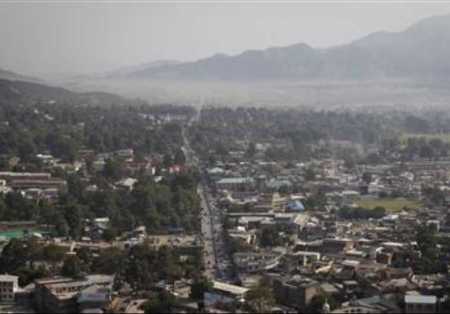
Pakistan viewA general view of houses from a hilltop in Abbottabad, Pakistan. (photo credit:REUTERS)

It is a testament to the precarious state of the world today that in a week that saw North Korea carry out a possible test of a hydrogen bomb, the most frightening statement uttered did not come from Pyongyang.

It came from Pakistan.

Speaking in the military garrison town of Rawalpindi, Pakistani Army chief Gen. Raheel Sharif said that any Iranian threat to Saudi Arabia’s territorial integrity will “wipe Iran off the map.”

Sharif made the statement following his meeting with Saudi Arabia’s defense minister and Deputy Crown Prince Mohammed bin Salman. According to media reports, Salman was the second senior Saudi official to visit Pakistan in the past week amid growing tensions between Iran and the kingdom.

Salman’s trip and Sharif’s nuclear threat make clear that following the US’s all-but-official abandonment of its role as protector of the world’s largest oil producer, the Saudis have cast their lots with nuclear-armed Pakistan.

When last October, the USS Harry Truman exited the Persian Gulf, the move marked the first time since 2007 that the US lacked an aircraft carrier in the region. Nine years ago, the US naval move was not viewed as a major statement of strategic withdrawal, given that back then the US had some one hundred thousand troops in Iraq.

While the USS Truman returned to the Gulf late last month, its return gave little solace to America’s frightened and spurned Arab allies. The Obama administration’s weak-kneed response to Iran’s live-fire exercises on December 26, during which an Iranian Revolutionary Guards vessel fired rockets a mere 1,370 meters from the aircraft carrier as it transited the Straits of Hormuz, signaled that the US is not even willing to make a show of force to deter Iranian aggression.

And so the Saudis have turned to Pakistan.

It would be foolish to view Sharif’s nuclear threat as mere bluster.

By every meaningful measure, Pakistan is little more than a failed state with nuclear weapons. Pakistan appears in every global index of failed or failing states.

To take just a few leading indicators, as spelled out by Basit Mahmood in a report last summer for The Political Domain, barely 1% of Pakistanis pay taxes of any kind. More than half the population lives in abject poverty. The government has no control over most Pakistani territory.

Between 2003 and 2015, more than 58,000 people were killed by terrorism countrywide.

Public health is a disaster. Polio, eradicated throughout much of the world, is now galloping through the country.

Last summer more than 1,300 people died in a heat wave in the supposedly advanced city of Karachi.

These data do not take into account the wholesale slaughter and persecution of minority groups – first and foremost Christians – and the systematic denial of basic human rights and widespread, violent persecution of women and girls.

As for its nuclear arsenal, a 2010 report by the Bulletin of Atomic Scientists estimated that Pakistan possesses between 70 and 90 nuclear warheads. Other credible reports estimate the size of the arsenal at 120.

Pakistan refuses to adopt a no-firststrike policy. In the US and worldwide, it is considered to be the greatest threat to global nuclear security.

Following a Pakistani jihadist assault on the Indian parliament in late 2001, India and Pakistan both deployed forces along their contested border. In the months that followed, due to Pakistani nuclear threats, the prospect of nuclear war was higher than it had ever been.

Cold War nuclear brinksmanship – which reached its high point during the 1962 Cuban missile crisis – paled in comparison.

In 2008, following the Pakistani jihadist assault on Mumbai, India threatened to retaliate against Pakistan.

India’s threats rose as evidence mounted that, as was the case in 2001, the jihadists were tied to Pakistan’s ISI spy service. Once again, rather than clean its own house, Pakistan responded by threatening to launch a nuclear attack against India.

And now, following the unraveling of US-strategic credibility, Pakistan’s aggressive nuclear umbrella is officially coming to the Persian Gulf.

Saudi Arabia’s decision to turn to Pakistan for protection indicates that the second wave of the destruction of the Arab state model is upon us. The notion of Arab states was invented nearly 100 years ago by the British and French at the tail end of World War I. The Sykes-Picot agreement, which partitioned the Arab world into states, rewarded national dominion to the most powerful tribal actors in the various land masses that became the states of the Arab world.

With the possible exception of Egypt, which predated Sykes-Picot, the Arab states formed at the end of World War I were not nation states. Their populations didn’t view themselves as distinct nations. Rather the populations of the Arab states were little more than a hodgepodge of tribes, clans and sectarian and ethnic groupings. In each case, the British and French made their determinations of leadership based on the relative power of the various groups. Those chosen to control these new states were viewed either as the strongest factions within the new borders or as the most loyal allies to the European powers.

The first wave of Arab state collapse began six years ago. It submerged the non-royal regimes, which fell one after the other, like houses of cards.

Syria, Libya, Iraq and Yemen ceased to exist.

Egypt, which in the space of two years experienced both an Islamist revolution and a military counter-revolution, still teeters on the brink of collapse.

Lebanon will likely break apart at the slightest provocation.

Today we are seeing the opening stages of the collapse of the Arab monarchies, and most importantly, of Saudi Arabia.

Most of the international attention to Saudi Arabia’s current threat environment has focused on Iran. The Iranian threat to the Saudis has grown in direct proportion to the Obama administration’s determination to realign the US away from its traditional Sunni allies and towards Iran. The conclusion of the US-led nuclear pact with Tehran has exacerbated Iran’s regional aggression as it no longer fears US retaliation for its threats to the Sunni monarchies.

But Iran is just the most visible of three existential threats now besetting the House of Saud.

The most profound threat to the world’s largest oil power is economic.

The drop in world oil prices has endangered the kingdom.

As David Goldman reported last week in the Asia Times, according to an International Monetary Fund analysis, the collapse in Saudi oil revenues “threatens to exhaust the kingdom’s $700 billion in financial reserves within five years.”

The house of Saud’s hold on power owes to its oil-subsidized economy. As Goldman noted, last month dwindling revenues forced the Saudis to cut subsidies for water, electricity and gasoline.

According to Goldman, Riyadh’s mass execution of 43 long-jailed prisoners at the start of the month was an attempt by the aging royal house to demonstrate its firm control of events. But the very fact the Saudi regime believed it was necessary to stage such a demonstration shows that it is in distress.

The third existential threat the regime now faces is Islamic State. Since 1979, the Saudis have sought to deflect domestic opposition by promoting Wahabist Islam at home and Wahabist jihad beyond its borders.

Now, with Islamic State in control over large swathes of neighboring Iraq, as well as Syria and Libya and threatening the Saudi-supported Sisi regime in Egypt, the Saudi royal family faces the rising threat of blowback. Some analysts argue that given the popular support for jihad in Saudi Arabia, were Islamic State to cross the Saudi border, its forces would be greeted with flowers, not bullets.

If the House of Saud falls, then the Gulf emirates will also be imperiled.

The Egyptian regime, which is bankrolled by the Saudis and its Gulf allies will also be endangered. The Hashemite monarchy in Jordan, which is protected by the US and by Israel, will face unprecedented threats.

The implications of expanding chaos – or worse – in Arabia are not limited to the Middle East. The global economy as well as the security of Europe and the US will be imperiled.

Obviously, the order of the day is for the US security guarantee to Saudi Arabia to be reinforced, mainly through straightforward US action against Iranian naval aggression and ballistic missile development.

Unfortunately, the Obama administration can be depended on to take just the opposite approach. And as a consequence, at least for the next year, the main thing propping up the Gulf monarchies, and with them, the global economy and what passes for global security, is a failed state with an itchy finger on the nuclear trigger.

ISIS Shifts to Libya

January 12, 2016

ISIS Shifts to Libya After Strikes in Syria Jihadists travel to Libya more easily than Syria, Iraq

BY:
January 12, 2016 5:00 am

Source: ISIS Shifts to Libya

ISIS Libya bomb

Officials survey the grounds of the the Moroccan Embassy in Libya after a bomb claimed by ISIS exploded / AP


The Islamic State terror group is making significant gains in Libya as hundreds of its members have been detected moving there from Syria and Iraq in recent weeks amid stepped up bombing and tighter border controls.

U.S. intelligence agencies have identified at least 500 ISIS fighters over the past two months moving into the war-torn North African state that became an al Qaeda safe haven following the ouster of Libyan dictator Muammar Gadhafi in 2011, according to American defense officials.

Since then, Libya has become a chaotic, largely ungoverned territory as large numbers of jihadists and militias operate in the country amid competing government factions.

Additionally, ISIS leaders have notified recruiters to urge foreign fighters wishing to join the group to consider traveling to Libya, as border controls in Turkey have tightened, making it more difficult to reach the group’s stronghold in Syria, said officials who spoke on condition of anonymity.

ISIS emerged in Libya in 2015, first in the eastern city of Darnah where it was ousted in July. Currently, its main stronghold is the costal city of Sirte, where its official radio, Al Bayan, began broadcasting in June.

The group also has claimed control of the costal town Bin Jawad, east of Sirte, and the group boasts of having strong presence in nearby Al Nawfaliyah, Al Sidra, and Ras Lanuf, key oil producing areas.

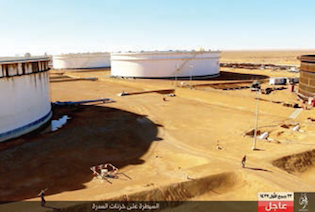
Sidra Oil Facility

Sidra Oil Facility

ISIS also has operatives in Benghazi and has set up cells in Tripoli.

The group has divided Libya into three sub regions it calls Barqah, the eastern coastal region also known as Cyrenaica; Tripoli, which refers to the former Italian colony formed from current region of northwestern Libya; and Fezzan, the name for southwestern region of Libya.

The United Nations estimated in a report in December that ISIS has between 2,000 and 3,000 fighters in Libya, with the most in Sirte, and has been recruiting fighters from sub-Saharan states.

A think tank, the Libyan Center for Terrorism Studies, however, estimated recently that the number of Islamic State fighters in Libya is increasing and provides a current estimate of some 10,000 fighters.

Most of the ISIS terrorists come from neighboring Tunisia, along with Mali, Sudan, and Egypt, the report says. The terrorist group also has clashed with other jihadist terror groups, including the al Qaeda-aligned Ansar al Sharia.

In recent weeks, at least two jihadist groups announced they are aligning with ISIS: The Ajdabiya Revolutionaries Shura Council, in Ajdabiya, and a second terror group in Misrata.

A U.S. intelligence official confirmed the group is expanding in Libya, but said it was not necessarily the result of the stepped up counterterrorism operations in Syria and Iraq.

“They first moved into Libya at the height of their so-called ‘caliphate,’” the official said. “ISIL operatives are in Libya because terrorists have access to ungoverned space, weapons, new potential revenue streams, and fighters willing to rally around the ISIL brand.” ISIL is an acronym used by the U.S. government for the Islamic State, which is also commonly referred to as ISIS or IS.

Losses by the group in Iraq and Syria don’t “reflect the group’s long-held and continuing expansionist agenda,” the official said.

The CIA has stepped up monitoring the flow of terrorists into Libya, according the Libyan news website Akhbar 24. The outlet reported Dec. 4, quoting Tunisian security sources, that the agency is working with Tunisian security to monitor ISIS activities in Libya, including the location of training camps and the influx of ISIS terrorists.

Sebastian Gorka, a counterterrorism expert, agreed that increased ISIS activity in Libya may not be directly linked to increased air strikes and tighter border controls in the Middle East.

“The truth is, IS has a clear strategy to expand its influence and control beyond Iraq and Syria,” said Gorka, the Horner chair of military theory at Marine Corps University.

“It already has official affiliates in Asia and even west Africa,” he added. “Now that the new caliphate approaches its second anniversary, it is essential for [ISIS leader] Abu Bakr al Baghdadi to demonstrate that his empire can expand into new territories.”

Gorka said current ISIS strongholds in Syria and Iraq are a “giant forward operating base” used for launching new attacks in other areas, in North Africa, the Middle East, Europe, or the United States.

American Enterprise Institute scholar Michael Rubin, a Middle East expert, said President Obama and Secretary of State John Kerry have focused their anti-ISIS strategy on Iraq and Syria.

“That’s like a chess player only focusing on what goes on in one or two squares rather than the whole board,” Rubin said. “The simple fact is that we need a strategy to counter the Islamic State not only in Iraq and Syria but also in Libya, the Sinai, Afghanistan, Nigeria, and an ever growing list of countries.”

Rubin said “ego and myopia” in the White House are to blame for the failure to counter ISIS. “Simply declaring the Islamic State is neither Islamic nor a state until we’re blue in the face is not a strategy,” he said.

Disclosure of increased ISIS inroads into Libya comes as airstrikes were reported Monday against ISIS targets in several Libya cities, including Benghazi, Ajdabiya, Bin Jawad, and Sirte.

The Libyan news outlet Al Wasat reported that unidentified aircraft bombed an ISIS convoy near Al Zahir, around 12 miles west of the main ISIS stronghold in Sirte. An ISIS-occupied military base in the region also was bombed in Monday’s airstrikes.

ISIS also sought to take over Libya’s Al Sidra oil fields and port near the city of Ras Lanuf on Jan. 4 in a surprise military offensive. The group has used black market sales of oil as a main source of revenue.

The attack began with a suicide car bomb at the entrance but was later repelled by guards and Libyan national military forces. ISIS fighters were able to set five oil tanks on fire at the facility.

European governments are said to be increasingly concerned about the group’s growth in Libya.

In Italy, the chairman of the Senate’s foreign affairs committee, Ferdinando Casini, called for military intervention to prevent ISIS from taking power in Tripoli.

A new UN-backed Libyan central government has been designated and its prime minister-designate, Fayez Sarraj, was the target of a suspected ISIS car bombing last week near the airport in Misrata. The blast killed 20 people and wounded more than 100.

Casini said the bombing attack against Sirraj and other new government leaders was aimed at preventing the new unity government from taking power.

“We are living close to a powder keg,” Casini told Italian newspaper La Nazione.

“The more the birth of a government is delayed, the more threats will multiply. Their number will be reduced only when the government takes office. From now until that point, we are in no man’s land. Nerves of steel are required.”

Germany’s military is considering a training mission for the Libyan army, according to the German newspaper Der Spiegel.

Up to 200 troops of the Bundeswehr, as the German military is called, could be sent to Tunisia within the next few months to train Libyan soldiers and counter the spread of ISIS fighters.

The German military is currently training Kurdish fighters in Northern Iraq and the Libyan mission would be similar.

Egypt also is concerned about new threats posed by the expansion of the Islamic State in Libya and warned recently that the danger is increasing, according to the Cairo newspaper Al Akhbar.

“ISIL is reinforcing its positions in Libya,” the newspaper stated in a Jan. 8 commentary. “Al Qaeda still has its factions there. The danger is growing for the countries of the region, and Europe will not tolerate this situation much longer because the danger is concentrated on the other side of the Mediterranean.”

“The situation is becoming more dangerous now,” the newspaper warned in a Jan. 8 commentary. “ISIL fighters have reinforced their presence in the port of Sirte, and they are now mounting a serious attack to control the so-called oil crescent, in the ports of Sidra and Ras Lanuf where most of Libya’s oil production is based.”

Libya’s Al Wasat newspaper reported Dec. 29 that IS terrorists have set up a training camp at a farm in Hirawa, east of Sirte, where around 150 children of mostly from Sudan and Nigeria are being trained in archery, shooting, suicide operations, and booby-traps.

IDF welcomes its fifth submarine

January 12, 2016

IDF welcomes its fifth submarine INS Rahav is ‘the most fearsome, advanced and expensive war machine in the IDF’s possession,’ says President.

By Gil Ronen First Publish: 1/12/2016, 4:28 PM

Source: IDF welcomes its fifth submarine – Defense/Security – News – Arutz Sheva

INS Rahav    IDF Spokesman

The Israel Navy’s fifth submarine, the INS Rahav, entered the Navy’s base on the shores of Haifa Tuesday and officially joined the Navy’s submarine fleet.

The previous submarine to join the Navy, the INS Tanin, was handed over to Israel in September of 2014. Vice Admiral Ram Rotberg said at the time that it “can dive deeper, go farther for a longer time and can operate at a level we have not seen until today.”

A sixth one is to be delivered by 2019, and Israel has even been reported to be interested in ordering three more. Rotberg said Tuesday that it will be named the INS Dakar, after the submarine by the same name that was lost in 1968, with all 69 crewmembers.

Prime Minister Binyamin Netanyahu said at the ceremony: “Our submarine fleet serves to deter enemies who seek to annihilate us. They will not achieve their aim. They need to know that Israel can strike with great force at whoever attempts to harm it.

“And the citizens of Israel need to know that Israel is a very strong country,” he added, “and that we are doing and will do everything to protect you, everywhere and in every theater. In the kinetic and cybernetic world, with the cyber array we are constructing. In the air and above the air, in space. On the ground and beneath the ground, facing the tunnel threat. At sea and underwater, with the submarine fleet.”

President Reuven Rivlin called the INS Rahav “68 meters and 2,100 tons of sophistication, power and innovation.” Without a doubt, he added, “the INS Rahav is the most fearsome, advanced and expensive war machine currently in the IDF’s possession.”

Defense Minister Moshe Ya’alon told the participants and guests at the ceremony that the INS Rahav, “and its sister, the INS Tanin, along with the three additional submarines, will enable the Navy to continue to operate in unison with the other units and arrays in the IDF, to stymie our enemies’ nefarious intentions to disrupt our lives.”

The submarines and the warriors operating them “will emerge from the depths silently, stealthily and creatively,” he added. “Sometimes they will even return to their bases without leaving a trace.”