Archive for October 23, 2015

Muslim “refugees” bring pregnant little girls as “child brides” to Europe

October 23, 2015

Muslim “refugees” bring pregnant little girls as “child brides” to Europe, Front Page Magazine, Daniel Greenfield, October 23, 2015

Child bride

This is what “European values” now look like. The millions of Muslim migrants invading Europe under the guise of refugees are making the abuse of children into the new normal. If you want to know where the Muslim sex grooming scandals of the UK in which thousands of young girls were raped come from, it’s down to religion and culture.

And this is what Europe is importing. via Religion of Peace.

Dutch asylum centres are reportedly housing 20 child brides aged between 13 and 15, while three a week on average are arriving to the country.

The brides were granted legal permission to join their older partners after the country recognised marriages involving young teenagers if they are officially registered in their home country.

Yes, you read that correctly. If this is true, then the Netherlands have apparently recognized child rape as a legal marriage if it’s legal under Muslim law.

Outraged Dutch Labour MP Attje Kuiken said: “A 12-year-old girl with a 40-year-old man – that is not a marriage, that is abuse. “We’re talking about really young children, girls 12, 13 years old. I want to protect these children.”

CHILD brides as young as 12 have been ordered to stay with the men they were forced to marry after European officials agreed to recognise the partnerships.

It comes amid fears of a paedophilia epidemic inside European refugee camps after a pregnant 14-year-old girl went missing from a Dutch centre.

Fatema Alkasem disappeared along with her 24-year-old husband in August and police are concerned the Syrian girl needs medical care.

This is not going over well among the native population.

More than 36,000 people entered the Netherlands this year. Former prisons, empty government offices and sports halls are being hastily modified to accommodate the surge in numbers. Earlier this month, Finance Minister Jeroen Dijsselbloem announced that the treasury’s original projection of $340 million to cover the cost of the new arrivals in 2015 was wildly understated.

They are now looking at a bill of approximately $1.13 billion.

The anti-immigration Freedom Party is enjoying its highest ever poll rating. The Freedom Party’s popularity is being partly attributed to Dutch concern about the continent’s inability to manage the flow of new arrivals.

I wonder why.

Crazy like a fox

October 23, 2015

Crazy like a fox, Front Page Magazine, Caroline Glick, October 23, 2015

benjamin-netanyahu


Due to his “gaffe,” every Western media outlet reported on Husseini’s actions. Some even mentioned that in his PhD dissertation, current Palestinian leader Mahmoud Abbas said the Holocaust was both a myth and a joint Zionist-Nazi project. For most Westerners, this is the first they’ve heard of the fact that the Palestinian’s George Washington was a Nazi war criminal.

************************

Prime Minister Binyamin Netanyahu is crazy like a fox.

Netanyahu’s assertion on Tuesday before the World Zionist Congress that the founder of the Palestinian people, Haj Amin al-Husseini, convinced Adolf Hitler to eradicate rather than expel the Jews of Europe was an overstatement of Husseini’s role.

No, the Holocaust was not Husseini’s idea.

But he was a partner in perpetrating and promoting it. He also made it inevitable.

As I detailed in my book The Israeli Solution: A One-State Plan for Peace in the Middle East, during the course of Husseini’s meeting with Hitler in Berlin in November 1941, Hitler told the Arab leader of his plan to eradicate European Jewry.

Husseini told Hitler that he would support the Nazis, and rally the Arab world to their side, if Hitler agreed to two conditions: that Hitler support his bid to rule over a postwar Arab state comprised of present-day Iraq, Syria, Jordan, Lebanon and Israel; and that Hitler support the genocide of Middle Eastern Jewry.

As both the official Nazi record and Husseini’s summary of the meeting in his diary report, Hitler accepted Husseini’s demands.

And it makes sense that he did.

Husseini proved his loyalty to the Nazis long before he arrived in Berlin. His romance with them began with Hitler’s election victory in 1933. From then on, Husseini’s followers in Mandatory Palestine greeted one another with the Nazi salute. Swastikas festooned their towns. The Nazis began directly funding Husseini’s terror war against the Jews of Israel and British Mandatory officials in 1937.

In 1937, the British forced Husseini to flee the country. In 1941, he organized and incited a pro-Nazi military coup in Iraq. The British were forced to invade Iraq in response to the coup.

Husseini then fled to Rome where he met with Mussolini and went on the Berlin, where he remained for the duration of the war.

As the grand mufti of Jerusalem, Husseini invented and shaped the Palestinian national ethos in a manner that aligned with his pathological hatred of the Jews. Rather than providing the Palestinian Arabs with a positive vision of a future state that would safeguard and cultivate them as a distinct Arab nation, he shaped Palestinian society as a wholly negative phenomenon. It was seeded in a hybrid hatred of Jews that fused Koranic hostility to Jews with racism-based annihilationist European anti-Semitism rooted in The Protocols of the Elders of Zion, which Husseini translated and published in Arabic.

The goal of Husseini’s nationalist drive was not to form a Palestinian Arab state, but to prevent the establishment of a Jewish state and to annihilate all aspects of the Jewish national liberation movement through a campaign a terror and political warfare.

Husseini’s goal of leading an Arab state that encompassed Iraq and the entire Levant shows that the founding father of the Palestinian national project did not view “Palestine” as a distinct territorial entity.

After Hitler agreed to both of Husseini’s conditions, Husseini began his active collaboration in the Nazi war effort. He participated in the Holocaust directly. In 1943, he formed the SS Handschar Division comprised of Bosnian Muslims. His troops exterminated 90 percent of Bosnia’s 14,000-member Jewish community.

Husseini used his position as well to scuttle British attempts to trade German prisoners of war for Jews. In one such documented episode, in 1943 Husseini appealed to SS commander Heinrich Himmler to cancel a deal to exchange 4,500 Jewish children and 500 Jewish adults from Hungary, Slovakia, Romania and Bulgaria to cancel the deal and send the Jews to Auschwitz.

Himmler bowed to his appeal. The Jews were sent to the gas chambers.

Husseini contributed to the Holocaust indirectly.

Beginning shortly after his meeting with Hitler and extending through the end of the war, Husseini broadcast regular programs to the Arab world on Nazi short wave radio in Arabic. In those broadcasts he engendered support for the Nazis and the extermination of world Jewry. Using the mix of Islamic Jew-hatred and European annihilationist anti-Semitism he had developed in Jerusalem, Husseini cultivated a culture of support for the annihilation of Jews and the destruction of the Jewish (then nascent) state in the Land of Israel. That culture, bred through those broadcasts heard regularly by millions throughout the entire Arab world, still holds today.

Husseini was indicted as a war criminal in Nuremberg. Rather than try him, the allies allowed him to flee to Egypt in 1946. There he was greeted as a war hero by King Farouk.

It is true that Hitler didn’t need Husseini to convince him to annihilate European Jewry. By the time Husseini arrived in Germany, the Nazis had already murdered a million Jews.

But Netanyahu’s claim that Husseini made it impossible for Hitler to suffice with expelling the Jews from Europe is true. The only place that wanted the Jews of Europe was the nascent Jewish state in the Land of Israel.

Through his terror war against the Jews and the British Mandatory authorities, and through his incitement of pro-Nazi sentiment in Egypt, Iraq and the Levant, Husseini convinced the British to betray their legal obligation to allow free Jewish immigration to the Land of Israel and so closed off the Jews’ last avenue of escape from Nazi-dominated Europe.

As Netanyahu said, Husseini is revered and glorified by the Palestinians. Yasser Arafat claimed that he was Husseini’s political heir and blood relative as a means of legitimizing his claim to leadership over the Palestinians.

Hamas as well has invoked Husseini as its ideological founding father.

History in hand, it is time to return to Netanyahu, and his overstatement of Husseini’s role in the Holocaust.

From the time of Husseini till today, propaganda and terror have been the Palestinians’ weapons of choice in their war against the Jews. Internally lies are spread of nonexistent Jewish plots and imaginary acts of aggression, to incite and solicit the murder of Jews. Propaganda and lies are then used to glorify the murderers as heroes and martyrs.

Externally, the Palestinians spread lies about Palestinian victimhood at the hands of bloodthirsty Jewish settlers and security forces who seek to drive the Arabs from their homes. By casting themselves as victims to the outside world, the Palestinians ensure that Israeli responses to their acts of aggression are perceived as acts of aggression, which they are fully justified in attempting to defy through murderous rampages against Jews.

The Palestinians recognize that for their terror to be acceptable to the West, they must portray themselves as guileless victims. Hence, they repeatedly insist the absurd claim that terrorists who deliberately kill Jews by running them over, are really merely victims involved in traffic accidents. The Palestinian teenage girl who this week sought to infiltrate the community of Yitzhar with a carving knife, suffers from “sleepwalking.”

These ridiculous lies are only credible in a world devoid of any historical knowledge of the Palestinians’ 95-year history of aggression against the Jews. And so the Palestinians have invented a false history of their war against Israel in which thousands of years of Jewish history is blotted out, and thousands of years of Palestinian history have been invented out of whole cloth.

In this revised version of events, Husseini has been erased from history. His role in the Holocaust has been deleted. The fact that the goal of the Palestinian national movement from its inception has been to annihilate the Jewish state and that the annihilation of Israel remains its goal still today has similarly been washed out of the history books and the news pages.

To maintain this fictional account of current and historical events, the Palestinians depend on the collaboration of the Western media.

And with each passing year, that collaboration has grown more open, expansive and shameless.

Western reporting on the events of the day now are almost entirely devoid of any relationship to reality.

Consider just a few recent examples. CNN’s report of the Palestinian arson assault on Joseph’s Tomb in Nablus on October 16 contained no mention of the fact that the fire at the holy Jewish site was set by Palestinians. In the same report, the network stated, “In the past month, eight Israelis died in 30 attacks involving knives and other weapons.”

As if fires set themselves and angry knives wander the streets.

MSNBC’s reporter Ayman Mohyeldin was caught lying two weeks ago as he claimed that the knife-wielding Palestinian terrorist in the Old City of Jerusalem who was lunging toward security personnel as they killed him, was an unarmed, innocent bystander. As Mohyeldin spewed his lies, the video of the assault that clearly showed the terrorist wielding a knife was being broadcast to his viewers.

That embarrassment didn’t stop MSNBC from maintaining the myth of Israeli aggression, however.

The next week, the network posted a graphic of British Mandatory Palestine from 1946 which it claimed was the State of Palestine in 1946. The graphic them purported to show how the Jews stole ever more Palestinian land in the years that followed. Although the network was forced to broadcast a retraction, the lie that Palestine once existed had already been told.

Then of course there was The New York Times with its stunning “background” piece purporting to provide its readers with historical context regarding the competing Israeli and Palestinian claims regarding the Temple Mount. The Times reported as fact the false claim that there is a debate among respected academics regarding whether the Jewish temples were actually located on the Temple Mount.

In other words, the Times unabashedly participated in the Palestinian project of rewriting history in a manner that erases Jewish history from the Jewish homeland.

Netanyahu recognizes that the media have sided with the Palestinians in their war to destroy Israel through a mix of terror and propaganda.

He knows that the only stories they will report on are stories with an anti-Israel angle. It is reasonable then to assume that he decided to use their embrace of every possible angle of attack as a means to get the truth out about the nature of the war.

By exaggerating Husseini’s importance in the Holocaust, Netanyahu gave the media a means of attacking him. But by doing so, he forced the Times to report on the Palestinians’ founding father’s role in destroying European Jewry and his desire to carry out the Final Solution in the Middle East. They would have ignored the issue if Netanyahu had not exaggerated his actual role.

Due to his “gaffe,” every Western media outlet reported on Husseini’s actions. Some even mentioned that in his PhD dissertation, current Palestinian leader Mahmoud Abbas said the Holocaust was both a myth and a joint Zionist-Nazi project. For most Westerners, this is the first they’ve heard of the fact that the Palestinian’s George Washington was a Nazi war criminal.

Like I said, crazy as a fox.

Top Iranian Commander Killed in Syria – Washington Free Beacon

October 23, 2015

Top Iranian Commander Killed in Syria Eight Iranian military leaders ‘martyred’ in clashes

BY:
October 23, 2015 12:52 pm

Source: Top Iranian Commander Killed in Syria – Washington Free Beacon

Iran confirmed on Friday that one of its generals was killed late Thursday during clashes in central Syria, bringing the total number of Iranian killed in action in the war-torn country this week to eight, according to state-controlled news reports.

Brigadier General Reza Khavari, a senior commander in Iran’s Revolutionary Guard Corps (IRGC), which is actively working to combat rebels seeking to depose President Bashar al-Assad, “was martyred in clashes” with opposition forces, some of which are being armed by the United States.

Khavari was “fulfilling his duty as a military advisor,” according to Iran’s state-controlled Fars News Agency.

At least seven other IRGC members part of the country’s Ansar Corps, which carries out clandestine activities outside the Islamic Republic’s borders, have also been killed in Syria in the past two days.

An IRGC official told Fars News on Friday that the “IRGC has boosted the number of its advisors in Syria in recent days following government troops’ striking victories in multiple fronts across the nation.”

Iran has publicly boosted its presence in the country since finalizing a nuclear accord with global powers earlier this year. Russia also has been actively running military operations in the country in the hope of bolstering Assad.

The IRGC confirmed a total of eight deaths this week.

“Asked why the IRGC casualties in Syria are mostly ranking officers, [the IRGC] said Iran does not have combat troops in Syria and has only sent advisors to help the Muslim nations, who provide counseling services and strategies to the Syrian army commanders in the battlefield and from a very close range to the forefront,” according to the report.

Another IRGC leader killed in Syria had served as a bodyguard for Mahmoud Ahmadinejad, the former president of the Islamic Republic. This official was “martyred while fulfilling his duty as a military advisor in Syria’s North province of Aleppo,” according to Fars.

Three other IRGC leaders killed this week were “veteran commanders,” according to the report.

Syrian Christian Church Elders Speak in Support of Russia’s Role

October 23, 2015

Syrian Christian Church Elders Speak in Support of Russia’s Role Syrian bishops and patriarchs have condemned western arming of Islamists radicals and reject western criticism of Russian intervention

Allen Baldanza

Source: Syrian Christian Church Elders Speak in Support of Russia’s Role

Syrian Christians, both Eastern Rite Catholics as well as Syriac Orthodox, have come out in support of Russia’s fight against terrorism in Syria.

Syria’s Christians, who consist of several denominations including Orthodox and Catholic, make up around 10% of Syria’s population. They have been singled out by ISIL terrorists for oppression and murder.  Since ISIL’s territorial expansion in Syria and Iraq in 2014, the terrorist group has given Christians few options: if they do not convert to Islam, or pay a special tax, they must leave or be killed.

So far, thousands of Christians have been killed, and hundreds of thousands more have been displaced by the fighting. The US-led coalition, meanwhile, has done little to stop ISIL forces.

According to Al Arabiya, the Melkite Greek Catholic archbishop of Aleppo, Jean-Clement Jeanbart, has said in an interview that Russia’s military involvement in the nation has been a source of hope for Christians in the country. Vladimir Putin “serves the Christians’ cause”, he stated

Prominent Syriac Catholic, the Archbishop of Hassakeh-Nisibi, Jacques Behnan Hindo, also came out in support of Russia:

“US Senator John McCain protested saying that the Russians are not bombing the positions of the Islamic State, but rather the anti-Assad rebels trained by the CIA. I find these words disturbing. They represent a blatant admission that behind the war against Assad there is also the CIA.” He continued, “Western propaganda keeps talking about moderate rebels, who do not exist.”

Не also said that

“Unfortunately, the United States, France – yes, France, and England do nothing except add poison to things.” Referring to western arming of the opposition, more than half of which come from outside Syria, he added, “The opposition does not want what is good for Syrians, but is rather massacring them.”

The Archbishop goes on to criticize US policy in the region. “And when I hear Kerry or Fabius, these people with their fake humanitarian sentiment, I ask myself `what are they doing?’… I do not want to see Fabius, Kerry, or the others. That’s why they are screwing around, excuse my expression.  They are screwing all Syrians.”

While not coming out in full support of Assad, he did state that Assad is certainly more preferable to the opposition, which includes Islamic State, saying that under Assad Christians can “now live much more quietly.”

The Archbishop of Hassekeh-Nibisi is not alone in these sentiments towards Western intervention. Syriac Orthodox Patriarch, Moran Mor Ignatius Aphrem II, called on the West to “stop arming and supporting terrorist groups that are destroying our countries and massacring our people.”

It remains clear that the intervention by Western nations has caused far more harm than good for Syria’s Christians. With that said, the intervention by Russia, in cooperation with the legitimate government of Syria, may very well save Syria’s Christians from further destruction, and help restore peace to the Syrian people.

Turkish PM claims Oslo documents leaked by Gülen movement

October 23, 2015

Turkish PM claims Oslo documents leaked by Gülen movement

Friday,October 23 2015,

Source: Turkish PM claims Oslo documents leaked by Gülen movement – POLITICS

I suppose Turkey is now asking for 5 other country,s to solve this ., like they do with Syria .

Perhaps  Syria, Iran and Russia . it is their likes to meddle with other country,s .

AA Photo

The Oslo documents, revealing negotiations between the Justice and Development Party (AKP) government and the outlawed Kurdistan Workers’ Party (PKK), were made public by sympathizers of U.S.-based Islamic scholar Fethullah Gülen, Prime Minister Ahmet Davutoğlu has claimed.

“I have said the peace process is local and national, because its actors are here. We realized that the parallel structure and foreign intelligence services revealed the Oslo talks,” Davutoğlu said late on Oct. 22 in a televised interview.

He said the “parallel structure,” referring the sympathizers of the Gülen movement within the state, were uncomfortable with the peace talks between the PKK and the National Intelligence Organization (MİT) back in 2011. After the publishing of details, talks were moved to within Turkey rather than Oslo or Brussels, Davutoğlu added.

The prime minister also said not all of the documents were accurate, and those that were published were revealed by people who “betrayed the state,” vowing not to leave the “fate of the state and the nation” in such traitors’ hands.

The debate has arisen once again after a leading figure from Turkey’s main opposition party displayed documents during a televised interview on Oct. 22 that he claimed to be identical to a protocol between the AKP and the PKK.

The documents, also made public by Doğan News Agency, state that the then-government promised to ease the release some alleged PKK members in addition to continuing talks and working on draft documents prepared by the jailed PKK leader, Abdullah Öcalan.

The introduction part of the document says the parties are determined to continue talks and take dialogue and negotiations as the core way to resolving the Kurdish issue within a spirit of democracy, human rights and justice.

Both parties promised to finalize efforts “within a constitutional and legal framework,” and they also pledged to comment on three documents submitted by Öcalan.

The parties vowed to work on the names to be included in commissions that were to be founded as per Öcalan’s drafts, namely the “Constitution Council,” the “Peace Council” and the “Truth and Justice Commission.”

The Turkish government, according to the document, promised to have two people representing the PKK meet with Öcalan right after the elections, apparently the general elections on June 12, 2011, and have some sub-commission members meet him after the foundation of the commissions mentioned above.

The document also noted that the release of people arrested on allegations of ties to the Kurdistan Communities Union (KCK), the PKK’s umbrella organization, would be an appropriate step to resolution. In this context, the Turkish side promises to release arrested Kurdish politicians after Nevruz as a first step.

Nevruz, or Newroz for Kurds, on March 21 marks the start of the spring in many countries.

In the document, the parties also promised each other to halt military operations mutually until June 15, 2011, while planning to meet once again in the second half of June 2011.

October/23/2015

Diplomacy: Looking for ways to douse the spark

October 23, 2015

Diplomacy: Looking for ways to douse the spark, Jerusalem PostHerb Keinon, October 23, 2015

(They “dance around in a ring and suppose, but the secret sits in the middle and knows,” with apologies to Robert Frost. — DM)

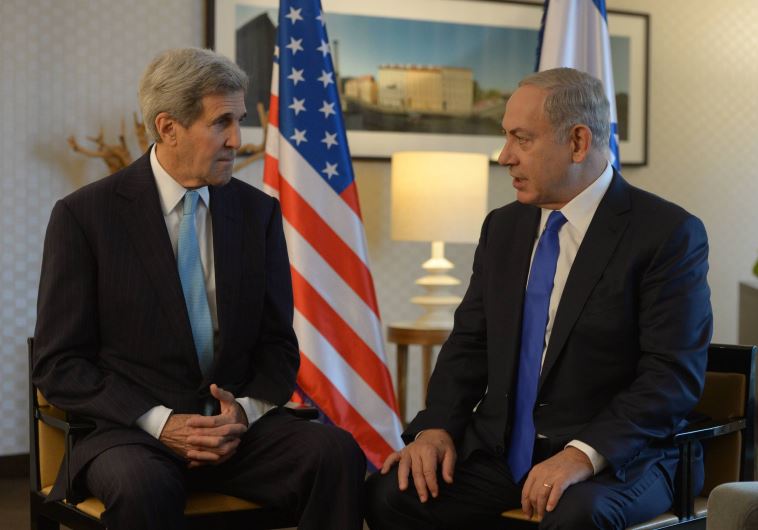
ShowImage (15)Netanyahu and Kerry meeting in Berlin. (photo credit:AMOS BEN-GERSHOM/GPO)

And now the diplomatic dance begins, again.

After three weeks of runaway terrorism on the streets, UN Secretary-General Ban Ki-moon arrived for a quick visit midweek; US Secretary of State John Kerry – after meeting with Prime Minister Benjamin Netanyahu on Thursday in Berlin – is expected to meet on Saturday with Palestinian Authority President Mahmoud Abbas in Amman, along with Jordan’s King Hussein; EU foreign policy chief Federica Mogherini is doing the same; and the French are floating various proposals to take to the UN Security Council.

All predictable, all the traditional steps taken in a time of Mideast crisis.

Ban did what Ban does in these situations – he comes, meets with both sides, issues platitudes about the need for both sides to show restraint, and declares how important it is to keep that light of hope burning.

The UN secretary-general dutifully fulfilled his role in the script. Netanyahu obliged by meeting politely with Ban, who then went on to meet politely with Abbas, to what appears to be absolutely no effect. It’s a dance whose steps – and way of ending – are known far in advance.

Jerusalem does not take Ban’s efforts overseriously, as the organization that he heads is seen as a big part of the problem rather than the solution.

Witness Wednesday’s one-sided resolution adopted by UNESCO, the UN’s cultural heritage agency, condemning “Israeli aggression” on the Temple Mount and declaring that the Jewish holy sites of Rachel’s Tomb and the Cave of the Patriarchs are an “integral part of Palestine.”

Similar disdain, to a certain extent, characterizes Israel’s view of the EU’s efforts. Netanyahu will listen to Mogherini, and lament both Abbas’s incitement and the EU’s acceptance of it, but will place little stock in the EU’s ability to play a constructive role in calming down the situation.

Brussels is not seen in Jerusalem as a particularly honest broker on all things Palestinian but, rather, as the institution that nurtures – perhaps more than any other – the hope among the Palestinians that if they press long enough and hard enough, the international community will deliver to them what they publicly say they want: a Palestinian state along the pre-1967 borders with east Jerusalem as its capital, and some kind of “fair and just” accommodation for the refugees.

The very skeptical Israeli view of the EU in any diplomatic process is reinforced by steps taken by France, which this week considered bringing a resolution to the UN Security Council to place international observers on the Temple Mount.

This idea, which Israel would never accept, and which even Jordan and the Palestinians have apparently rejected, is born of a burning French diplomatic desire to always do something, anything, in the Mideast – especially when there seems to be a stalemate or vacuum.

It is also the product of sour relations currently prevailing between Paris and Jerusalem, as well as a lingering French hope for the internationalization of Jerusalem – for the establishment of a corpus separatum in Jerusalem under a special international regime – which France hopes to be a part of.

So with the UN out, the EU out, and France out, that leaves the US.

But it is not as if Jerusalem is harboring any hopes that Kerry will be able to ride in and save the day.

From Jerusalem’s perspective the US track record in the region is not sterling, and though it appreciates Washington’s desire to help, there is little illusion that high-profile, high-level meetings will have any immediate effect on the ground.

And while Jerusalem is not waiting for Kerry with baited breath, it was clear from the beginning that he would get involved. An uptick in terrorism and violence leads to a well-worn pattern in Washington: condemnations of the terrorism, then statements that anger Israel about proportionality or settlements, followed by calls for restraint on both sides, and then meetings with the leaders.

But this current spurt of terrorism and violence is different from previous rounds, in that there is no identifiable organization – such as Hamas and Fatah’s Tanzim militia – to hold directly responsible for the bloodshed. This time it is more amorphous, individual terrorists incited by calls for Jewish blood on Facebook and from various leaders, going out to kill Jews.

The lack of a clear organizational structure behind the terrorism makes it more difficult for the security services to stop, because it is much more difficult to gather intelligence on an individual who grabs a knife and goes out to kill than on attacks directed by an organization.

Also, there is not one person seemingly in control who may be pressured to cease the violence.

It is not as if Kerry can talk to Abbas and convince him to issue a call to his people to “hold your horses,” and the horses will obediently be held. Abbas does not have anything near that type of control – many of the horses simply do not heed him.

This time around, thankfully, neither the State Department nor Kerry are inflating expectations; they are not talking about Kerry’s separate meeting with the leaders as a potential breakthrough for restarting the diplomatic talks and bringing a peace deal in a number of months.

Washington, it should be remembered, is still engaged in its own Mideast policy reassessment, a policy reassessment brought about after the breakdown of the Kerry-led peace talks in April 2014, and re-announced after Netanyahu’s preelection statement – which he later retracted – of less than full fealty to the notion of a two-state solution.

Rather, this time the bar has been set low, with the goals very limited.

State Department spokesman John Kirby said on Wednesday that the meetings would deal with “practical ways in which political breathing space can be had to help end the violence.”

No overreaching there, just looking for breathing space. The breathing space that Kirby mentioned but did not elaborate upon is likely to be an attempt – in discussions with Netanyahu, Abbas and especially Jordan’s King Abdullah – to come up with a clear set of procedures for governing the Temple Mount.

The Temple Mount has – like so many times over the last century – been the spark to violence against Jews. To douse the fire, there will be some need to deal with the spark, but this has to be done in a way where both Israel and the Palestinians can say that they have not given in.

In recent days Kerry has spoken about the need for clarity. Everyone talks about the status quo on the Temple Mount, but there is little understanding of what that entails.

“Israel understands the importance of the status quo and… our objective is to make sure that everyone understands what that means,” Kerry said at press conference on Monday in Madrid, adding that “we are not seeking a new change or outsiders to come in; I don’t think Israel or Jordan wants that, and we’re not proposing it. What we need is clarity.”

The new “clarity” is expected to involve enhanced coordination and cooperation with Jordan, possibly even more Jordanian representatives on the site, in such a way as to undercut the spurious charge that Israel is somehow threatening al-Aksa Mosque.

Former National Security Council head Yaakov Amidror said in an Israel Radio interview this week that he had little expectation regarding Kerry’s meeting with Netanyahu or Abbas, because the US has little impact on the Palestinians – which is true.

But the US does have leverage on Jordan, and this leverage may now be needed to get Abdullah to take a greater role in day-to- day administration and involvement at the site – if only as a way to suck the oxygen out of the lie propelling the current round of terrorism: that Israel is endangering al-Aksa.

US, Russia, Turkey, Saudi explore political solution on Syria

October 23, 2015

US, Russia, Turkey, Saudi explore political solution on Syria

VIENNA, A quartet of key actors in the Syria quagmire meet in Vienna to discuss the future of the country and President Bashar al-Assad

Friday,October 23 2015, Your time is 11:59:39

Source: US, Russia, Turkey, Saudi explore political solution on Syria – DIPLOMACY

hegelian dialectic

Ain’t it nice ? what have Turkey, USA and Saudi to do with regime change in Syria ?

Can you imagine if Russia , Swahili , Belgian, and iran wants and works on a regime change in the USA ?

From left, Turkey’s Minister of Foreign Affairs, Feridun Sinirlioğlu, U.S. Secretary of State John Kerry, Saudi Arabia’s Minister of Foreign Affairs Arabia Adel al-Jubeir and Russia’s Foreign Minister Sergey Lavrov pose for a photo, during a meeting in Vienna, Friday, Oct. 23, 2015. AP Photo


The United States, Russia, Turkey and Saudi Arabia met Oct. 23 to explore a political solution to the Syrian civil war despite basic disagreements over Syrian President Bashar al-Assad’s fate and disputes over the ongoing strikes in the war-ridden country.

The summit came just days after a surprise visit by al-Assad to Moscow, which hit the nerves of both the U.S. and Turkey.

There were no outward signs of progress toward ending the four-year conflict as U.S. Secretary of State John Kerry met Russian Foreign Minister Sergei Lavrov, after which they held four-way talks with Turkish Foreign Minister Feridun Sinirlioğlu and Saudi Foreign Minister Adel al-Jubeir.

Russia’s three-week-old campaign of air strikes against Islamist groups opposed to al-Assad has halted a summer offensive by rebels, including some backed by Washington and its allies, which had eroded al-Assad’s control in the heavily populated west of the country.

Russia has rejected Western calls for al-Assad to step down, saying Syria’s leadership can only be decided by the Syrian people via elections, and in the clearest sign of its backing, Russian President Vladimir hosted him in Moscow this week.

Speaking in Berlin on Oct. 22, Kerry said al-Assad himself was the central obstacle to resolving a conflict that has driven an estimated 4 million refugees into Turkey, Lebanon, Jordan and Iraq.

“One thing stands in the way of being able to rapidly move to implement that, and it’s a person called Assad – Bashar al-Assad,” Kerry told reporters before he held talks with German Foreign Minister Frank-Walter Steinmeier.

For his part, Steinmeier suggested the U.S. and Russia were still far apart. “We all know that ultimately the first steps into political solutions depend on whether Washington and Moscow find bridges towards each other,” he said.

Putin said his Syrian counterpart had told him he was ready to talk to armed opposition groups if they are genuinely committed to dialogue and to combating the Islamic State of Iraq and the Levant (ISIL).

“I will pull open the curtain a little on my talks with President al-Assad,” Putin said at a forum in the Russian resort of Sochi on Oct. 22.

“I asked him: ‘What view would you take if we found, now in Syria, an armed opposition which nonetheless was ready to oppose and really fight against terrorists, against Islamic State? What would be your view if we were to support their efforts in fighting Islamic State in the same way we are supporting the Syrian army,’” Putin said.

“He answered: ‘I would view that positively,’” Putin said of al-Assad.

The Russian president went on: “We are now thinking about this and are trying, if it works out, to reach these agreements.”

Putin also said that, at the root of the Syrian conflict was not just Islamist militancy but also internal tensions – a recognition that at least some of the people who rebelled against al-Assad’s rule had a legitimate grievance.

Several Russian lawmakers arrived in Syria on Oct. 23 for a meeting with al-Assad.

Local residents and refugees were ecstatic about Russia’s military help, chanting “Thank you!” to a bus carrying Moscow-based journalists.

The White House issued a scathing attack on Russia’s “red carpet” welcome for al-Assad, accusing Moscow of impeding progress towards a political transition by propping up the strongman.

White House Deputy Press Secretary Eric Schultz told journalists the U.S. viewed “the red carpet welcome for al-Assad, who has used chemical weapons against his own people, as at odds with the stated goal by the Russians for a political transition in Syria.” Moscow’s actions in the war-torn Middle-Eastern state were “counterproductive,” he added.

The U.S. blasted Russia’s military strikes in Syria on Oct. 22, saying they were strengthening ISIL militants, killing dozens of civilians, forcing tens of thousands more from their homes, and destroying schools and markets.

During a United Nations Security Council meeting on the Middle East, U.S. Ambassador to the U.N. Samantha Power referred to a Reuters analysis of Russian Defense Ministry data that found almost 80 percent of Russia’s declared targets in Syria had been in areas not held by ISIL.

“By attacking non-extremist groups Russia has boosted, perversely, the relative strength of [ISIL], which has taken advantage of this campaign by seizing new territory in rural Aleppo,” Power said.

Turkish Prime Minister Ahmet Davutoğlu said a peaceful transition could start in Syria if al-Assad “stayed in Moscow.”

“We need to work on formulae” for al-Assad’s exit, he said Oct. 21, adding he wished al-Assad “hadn’t returned.”

The Russian and Jordanian militaries, meanwhile, have agreed to coordinate actions on Syria via a special working mechanism in Amman, Lavrov was quoted as saying by Rossiya-24 TV channel out of Vienna.

Lavrov added that other countries may join this mechanism.

Russia’s top diplomat also said Moscow would back talks between al-Assad’s government and the “full spectrum” of the Syrian opposition.

“Our common position is that we need to boost efforts for the political process in the Syrian settlement,” Lavrov said. “This foresees the start of full-scale talks between representatives of the Syrian government and the full spectrum of the Syrian opposition, both domestic and external – with the support of outside players.”
Jordan is a member of a U.S.-led coalition that is targeting ISIL in neighboring Syria.

October/23/2015

GAZA University Dean of Quranic Studies tells students tha ALL Jews are fair game for killing, even the children

October 23, 2015

GAZA University Dean of Quranic Studies tells students tha ALL Jews are fair game for killing, even the children

Source: GAZA University Dean of Quranic Studies tells students tha ALL Jews are fair game for killing, even the children | BARE NAKED ISLAM

Dr. Subhi Al-Yaziji, Dean of Quranic Studies at the Islamic University of Gaza, recently said: “All Jews in (Muslim-occupied) ‘Palestine’ today are fair game – even the women.” “Every single Jew in Palestine is a combatant, even the children,” and says that terror attacks “should be carried out in the very heart of the enemy – in Haifa, Jaffa, Tel Aviv, and Hadera.”

Germany: Asylum Seekers Make Demands

October 23, 2015

Germany: Asylum Seekers Make Demands, Gatestone InstituteSoeren Kern, October 23, 2015

(How long can parasites survive when they demand more blood than their hosts can provide? —  DM)

  • “Human traffickers and the media in their home countries are making promises that do not correspond to reality.” — Hans-Joachim Ulrich, regional refugee coordinator.
  • The migrants said they were angry they were being asked to sleep in a huge warehouse rather than in private apartments. Hamburg officials say there are no more vacant apartments in the city. “The city lied to us. We were shocked when we arrived here,” said Syrian refugee Awad Arbaakeat.
  • “One of the men, who spoke broken German, said they [a family of asylum seekers from Syria] were not interested in viewing the property because I am a woman… I was taken aback. You want to help and then are sent away, unwanted in your own country.” — Aline Kern, real estate agent.
  • “A constitutional state cannot allow itself to be blackmailed.” — Marcel Huber, Bavarian politician.
  • “I man. You woman. I go first.” — Muslim male with a full shopping cart at the supermarket.
  • An asylum seeker from Somalia successfully sued the German Agency for Migration and Refugees for taking too long to process his application — 16 months. The agency said it currently has a backlog of 250,000 unprocessed applications.
  • Seventy percent of migrants from Afghanistan, Iraq and Syria who were offered apprenticeships fail to complete them. According to the director of the Munich Chamber of Trade, many young migrants believe apprenticeships are beneath them.

Asylum seekers are increasingly using tactics such as hunger strikes, lawsuits and threats of violence in efforts to force German authorities to comply with an ever-growing list of demands.

Many migrants, unhappy with living conditions in German refugee shelters, are demanding that they immediately be given their own homes or apartments. Others are angry that German bureaucrats are taking too long to process their asylum applications. Still others are upset over delays in obtaining social welfare payments.

Although most asylum seekers in Germany have a roof over their head, and receive three hot meals a day, as well as free clothing and healthcare, many are demanding: more money, more comfortable beds, more hot water, more ethnic food, more recreational facilities, more privacy — and, of course, their own homes.

Germany will receive as many as 1.5 million asylum seekers in 2015, including 920,000 in the last quarter of 2015 alone, according to government estimates. This figure is nearly double the previous estimate, from August, which was 800,000 for all of 2015. By comparison, Germany received 202,000 asylum seekers in all of 2014.

With refugee shelters across the country already filled to capacity, and more than 10,000 new migrants entering Germany every day, Germany is straining to care for all the newcomers, many of whom are proving to be ungrateful and impatient guests.

In Berlin, 20 asylum seekers sued the State Agency for Health and Social Welfare (Landesamt für Gesundheit und Soziales, Lageso) in an effort to force local authorities to speed up their welfare payments.

Berlin expects to receive 50,000 asylum seekers in 2015. German taxpayers will spend 600 million euros ($680 million) this year to pay for their upkeep.

Also in Berlin, more than 40 migrants, mostly from Pakistan, seized control over the observation deck of the city’s television tower and demanded stays of deportation, jobs, and exemptions from mandatory residence (Residenzpflicht), a legal requirement that asylum seekers reside within certain boundaries defined by local immigration authorities. More than 100 police were deployed to the tower to remove the protesters. After a brief questioning, they were set free. Police said no crime had been committed because the migrants had purchased tickets to the observation deck, some 200 meters (650 feet) above the Berlin.

In the Kreuzberg district of Berlin, more than 400 migrants, mostly from Africa, occupied an abandoned school because they no longer wanted to live in tents in a nearby square. When 900 police arrived to clear the building, some migrants poured gasoline inside the structure and threatened to set themselves on fire, while others threatened to jump off the roof of the building. “We are currently negotiating with local authorities about how to proceed,” a Sudanese migrant named Mohammed said. “We will not leave until our demands [amending German asylum laws so they can remain in the country] are met.”

In Dortmund, 125 migrants complained about the “catastrophic conditions” at the Brügmann sports facility, which now serves as a refugee shelter. The list of complaints included: bad food, uncomfortable beds and not enough showers.

Just hours after arriving in Fuldatal, 40 asylum seekers from Afghanistan, Pakistan and Syria complained about conditions at a refugee shelter there and demanded that they be given their own homes. The regional refugee coordinator, Hans-Joachim Ulrich, said that migrants are coming to Germany with unrealistic expectations. “Human traffickers and the media in their home countries are making promises that do not correspond with reality,” he said.

In Hamburg, more than 70 asylum seekers went on a hunger strike in an effort to pressure local authorities to provide them with better housing. “We are on a hunger strike,” said Syrian refugee Awad Arbaakeat. “The city lied to us. We were shocked when we arrived here.” The migrants said they were angry they were being asked to sleep in a huge warehouse rather than in private apartments. Hamburg officials say there are no more vacant apartments in the city, the second-largest in Germany.

Also in Hamburg, more than 100 migrants gathered in front of the city hall to protest the lack of heating in their tent shelters. City officials said they were caught off guard by the early frost and that all tents would have heating before the winter sets in. According to Hamburg Mayor Olaf Scholtz, some 3,600 migrants would be spending the coming winter in tents due to the lack of alternative housing in the city.

According to Hamburg officials, 35,021 migrants arrived in the city during the first nine months of 2015. During this same period, Hamburg police were dispatched to the city’s refugee shelters more than 1,000 times, including 81 times to break up mass brawls, 93 times to investigate physical and sexual assaults, and 28 times to prevent migrants from committing suicide.

Meanwhile, a confidential document that was leaked to the German newspaper Bild reveals that the Hamburg transit authority (Hamburger Verkehrsverbund, HVV) has ordered ticket inspectors to “look the other way” whenever they encounter migrants who are using public transportation without a ticket. The move ostensibly aims to protect the HVV against “bad press.”

According to the leaked document, ticket inspectors should be lenient with asylum seekers because many migrants are “the victims of professional counterfeit ticket scammers” and many others have “barely comprehensible knowledge” of the HVV’s tariff structure.

The CDU’s transportation expert, Dennis Thering, said the HVV’s policy cannot be left unchallenged. “This ‘look-the-other-way’ policy must be withdrawn. In Hamburg there is the opportunity to purchase discounted HVV tickets, explicitly also for persons who receive benefits under the Asylum Seekers Benefits Act.” Every newly arrived refugee receives 149 euros in pocket money every month. This includes 25.15 euros that have been earmarked for the purchase of transport tickets.

In Halle, four security guards were injured when they tried to stop a mob of asylum seekers from Africa and Syria from entering the city’s social welfare office before opening hours. The migrants, who were there to pick up their welfare payments, became angry when it appeared to them as though some migrants cut in front of the line. It later turned out that some migrants were there for other business, and thus were not required to stand in line.

In Munich, 30 migrants went on a hunger strike to protest shared accommodations in refugee shelters. Two of the men were rushed to the hospital after losing consciousness. “A constitutional state cannot allow itself to be blackmailed,” Bavarian politician Marcel Huber said. “We have zero tolerance for this action.”

In Nürnberg, six migrants from Afghanistan, Ethiopia and Iran went on a hunger strike to protest the rejection of their asylum applications. The men, who are living in a tent in downtown Nürnberg for several months, demanded to speak to local authorities. The asylum applications were rejected six years ago, but the men are still living in Germany.

In Osnabrück, an asylum seeker from Somalia successfully sued the German Agency for Migration and Refugees (Bundesamt für Migration und Flüchtlinge, BAMF) for taking too long to process his application. A judge ordered the BAMF to make a decision on his application within three months or provide him with financial compensation.

The man said he had been waiting for 16 months to get an answer from the BAMF. In its defense, the BAMF said it currently has a backlog of 250,000 unprocessed applications, and this number is expected to skyrocket as more asylum seekers arrive in Germany.

A spokesperson for the court said the ruling set a precedent, and that many more asylum seekers likely would file lawsuits against the BAMF in the near future.

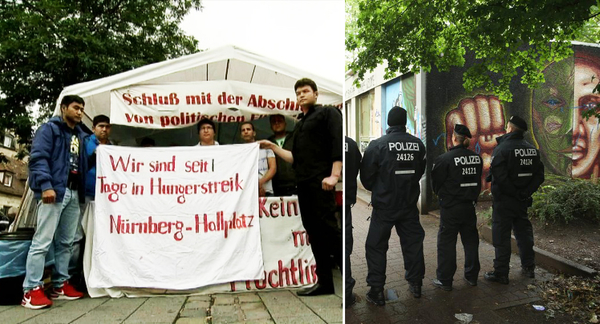
1312Groups of migrants across Germany have been launching hunger strikes, demanding more money, more comfortable beds, more hot water, more ethnic food, more recreational facilities, and their own homes. In Berlin (right), 900 police were needed to remove more than 400 migrants who had occupied an abandoned school.

In Walldorf, a town in the state of Baden-Württemberg, a group of migrants demanded that local authorities immediately provide them with private apartments because they were tired of living in a refugee shelter with 200 other asylum seekers. The leader of the group, a 46-year-old refugee from Syria, said he expected more from Germany. It was high time for Germans to begin to “treat us like human beings,” he said.

Following up on the complaints, state and local authorities inspected the shelter and found that conditions there were “absolutely acceptable,” with cubicles for privacy and plenty of food and clothing.

In Wetzlar, a city in the state of Hesse, migrants threatened to go on a hunger strike in an effort to force local authorities to move them into permanent housing. Local authorities said they delays were due to a quarantine after several migrants were found to be infected with Hepatitis A.

In Zweibrücken, 50 asylum seekers from Syria went on a hunger strike to protest the slow pace of the application approval process. “We can accept the living conditions in the refugee camp, but we need hope,” one of the men said. Local officials said the process has collapsed because of the large number of applicants.

Asylum seekers have also gone on hunger strikes in Birkenfeld, Böhlen, GelsenkirchenHannover, Walheim, and Wittenberg.

Meanwhile, teachers at Gemeinschaftsschule St. Jürgen, a grade school in the northern German city of Lübeck, ordered eighth graders to spend a morning at a local refugee shelter and “actively help” the migrants by making their beds, sorting their clothing and working in the kitchen.

Some parents complained that their children are also being asked to bring gifts and food for the migrants, who are already receiving handouts financed by German taxpayers. A woman wrote: “Sometimes I do not even know how I am going to put food on my own table.”

Another woman wrote: “This is going too far. Students are supposed to make beds and do cleaning work at a refugee shelter. My friend’s 14-year-old son is being asked to do this!!! I am not an agitator and I am tolerant, but this is going way too far. Is there now a new course in Lübeck schools called: Slavery???

The school’s principal, Stefan Pabst, said the negative reaction was a “catastrophe.” He said that having the children work in a refugee shelter was the best way for them to “understand social behavior.” The German newsmagazine, Stern, complained that the dissenting parents belonged to “right-wing circles” and are “spreading their stupid slogans.”

In Bad Kreuznach, a family of asylum seekers from Syria made an appointment to view a four-room rental property but refused to view the house because the real estate agent was female. According to real estate agent Aline Kern:

“One of the men, who spoke broken German, said they were not interested in viewing the property because I am a woman, I am blonde, and because I looked the men into their eyes. This was inappropriate. My company should send a man to show the property.

“I was taken aback, annoyed. One wants to help and then are sent away unwanted in your own country.”

In Idar-Oberstein, a town in the German state of Rhineland-Palatinate, an imam at a refugee shelter refused to shake the hand of Julia Klöckner, a visiting dignitary, because she is a woman. After Klöckner, the vice-chairwoman of the Christian Democratic Union (CDU), shared her experience with the German newsmagazine Focus, she received more than 800 emails from women across the country describing how they, too, have been mistreated by Muslim migrants.

One woman described how Muslim men repeatedly cut in front of her at the supermarket checkout line. “Twice while shopping at a German supermarket I was shown that I am a second-class citizen,” she wrote. In one instance, an adult Muslim male with a full shopping cart cut in front of her. In broken German, he said: “I man. You woman. I go first.” In another instance, a young Muslim male elbowed the woman while cutting in front of her. “When I said that I would let him go ahead of me if he asked me for permission, I was instructed by his sister that boys do not need to ask, they just demand.”

A teacher at a vocational school wrote: “The most problematic students are Muslim males, who do not acknowledge the authority of female teachers and who disrupt the classes.”

A mother reported that during a visit to her daughter’s school, she approached a fully-veiled female refugee and asked her if she could be of help to her. “A man with a fancy suit and a three-day beard, he seemed like out of a Hugo Boss fashion magazine, said: ‘My wife does not speak the language of the unclean.’ When I asked him who here was unclean, he said I was. I asked him what that means. He said it was nothing against me personally, because all German women are unclean, and that his wife should not speak the language of the unclean, so that she can remain clean.”

Klöckner is now calling for Germany to pass a new law that requires migrants and refugees to integrate into German society. She said: “We need an integration law. We are a liberal and free country. If we give up the foundations of our liberality, we will wake up in a different country.”

Klöckner insists that migrants must be informed about German “rules of the game” from the first day they arrive in the country. “The people who want to stay here must, from the first day, accept and learn that in this country religions coexist peacefully and that we cannot use force to resolve conflicts,” she said.

In Berlin, more than 150 migrant youths from North Africa and Eastern Europe are occupied as full-time purse-snatchers and pickpockets. Also known as the klau-kids (thief kids), they post their plunder (smart phones, laptops, designer sunglasses) on the Internet to taunt police. A 16-year-old known as Ismat O. has been detained more than 20 times on suspicion of theft, but each time he has been released, only to continue his trade. Walid K. has been arrested more than 10 times, and is also free.

According to the director of the police union in Berlin, Bodo Pfalzgraf, “it is incomprehensible that such serial offenders do not remain in pre-trial detention.” Police say the youths are released because German judges are not prepared to issue arrest warrants for so-called petty crimes such as purse-snatching. The youths can only be deported if they have been sentenced to at least three years in prison.

In Bavaria, the Munich Chamber of Trade (Handwerkskammer München und Oberbayern)reported that 70% of migrants from Afghanistan, Iraq and Syria who have been offered apprenticeships fail to complete them. The normal washout rate is 25%. According to the director of the chamber, Lothar Semper, many young migrants believe the apprenticeships are beneath them. “We have to make a tremendous effort to convince young people that they should even begin an apprenticeship,” he said. “Many have the expectation of quickly earning a lot of money in Germany.”

Germany to push for compulsory EU quotas to tackle refugee crisis

October 23, 2015

Germany to push for compulsory EU quotas to tackle refugee crisis Merkel is said to want hundreds of thousands of refugees brought directly from Middle East to control numbers and avoid perilous journeys

Source: Germany to push for compulsory EU quotas to tackle refugee crisis | World news | The Guardian

Germany is to push for more ambitious and extensive common European Union policies on the refugee crisis, according to policymakers in Berlin, with compulsory and permanent quotas for sharing the distribution of probably hundreds of thousands of people who will arrive directly from the Middle East.

Also on Berlin’s agenda are new European powers replacing some national authority over border control, and the possible raising of a special EU-wide levy to fund the policies.

The plans, being prepared in Berlin and Brussels, are certain to trigger bitter resistance and major clashes within the EU. Berlin backs European commission plans to make the proposed scheme “permanent and binding”. But up to 15 of 28 EU countries are opposed.

The plans will not apply to the UK as it is not part of the EU’s passport-free Schengen zone and has opted out of EU asylum policy, saying it will not take part in any proposed European refugee-sharing schemes.

Angela Merkel appears determined to prevail, as she grapples with a crisis that will likely define her political legacy. The German chancellor is said to be angry with the governments of eastern and central Europe which are strongly opposed to being forced to take in refugees. She is said to resent that these EU member states are pleading for “solidarity” against the threats posed by Russia and Vladimir Putin while they resist sharing the burdens posed by the refugee crisis.

EU government leaders agreed last month to share responsibility for 160,000 asylum seekers already in the EU, redistributing them from Greece and Italy over two years. But the decision had to be pushed to a majority vote, overruling the dissenters, mainly in eastern Europe, and with the Hungarian prime minister, Viktor Orban, accusing Merkel of “moral imperialism”.

It is highly unusual in the EU for sensitive issues with such deep national political impact to be settled by majority voting. But Berlin appears prepared to do this if no consensus can be reached.

The opponents of quotas insist last month’s decision was a one-off. But according to policymakers in Berlin, Merkel now wants to go further, shifting the emphasis of burden-sharing from redistribution of refugees inside the EU to those collecting en masse in other countries, notably Turkey, where more than 2 million Syrians are being hosted.

Under one proposal being circulated in Berlin, the EU would strike pacts with third countries, such as Turkey, agreeing to take large but unspecified numbers of refugees from them directly into Europe. In return, the third country would need to agree on a ceiling or a cap for the numbers it can send to Europe and commit to keeping all other migrants and refugees, and accommodate them humanely. This effectively means Europe would be financing large refugee camps in those third countries, which will also be obliged to take back any refugees who are not granted asylum in Europe.

Merkel returned from talks on the issue with the Turkish leadership on Sunday seemingly convinced that Ankara was the key to her winning some relief on the toxic immigration issue. She is being criticised for ignoring human rights problems in her dealings with Turkey’s authoritarian leader, President Recep Tayyip Erdoğan. But according to people familiar with her thinking, she has concluded that, in terms of Turkey, the main third country source of migrants heading for Europe, interests trump values.

Pinterest
We walk together: a Syrian family’s journey to the heart of Europe

The plans being developed in Berlin and Brussels also include moves to “Europeanise” control of the EU’s external borders. This would entail national governments surrendering some of their powers on those frontiers and granting at least some authority over refugee admissions, detentions and deportation to EU bodies such as Frontex, the fledgling borders agency.

Some senior diplomats and officials in Brussels say this is an intrusion into national sovereignty which will be difficult for some governments to accept. Policymakers in Berlin are aware of the sensitivities, but appear of a mind to proceed by stealth in small steps.

They take the view that the refugee crisis is by definition a Europe-wide emergency that can only be tackled by broader and concerted European policies. The new approaches being considered are also likely to prove expensive. In Bavaria, in southern Germany, for example, the influx of newcomers means the authorities are scrambling to create 3,000 extra school classes with all the attendant staffing and space problems.

Merkel is said to appreciate the sensitivity and the difficulty of the plans being drawn up and is likely to proceed cautiously in phases. She is understood to believe that the crisis will get worse and that the deterioration will bring her opponents round to the merits of her arguments.

Berlin expects at least 1 million refugees in Germany this year and Merkel is facing growing domestic criticism of her open-door policies.

The European commission is calling for a “permanent mechanism” for refugee sharing across Europe. Berlin appears to stand 100% behind the commission president, Jean-Claude Juncker, on this. But an EU summit last week avoided discussing the permanent scheme because it is too divisive and contentious.

Forced to bow to the sharing of 160,000 refugees last month, several EU leaders took the view that this was a limited and temporary move that would not be repeated. But for Berlin, it is but a beginning in the formulation of pan-European asylum and immigration policies.

On Wednesday Juncker called a Brussels summit for Sunday for some EU and Balkan leaders to tackle the crisis in Croatia, Slovenia, and Austria since Hungary closed its borders to those arriving in the EU from Turkey and Greece via the Balkans.

The German push for taking people directly from places such as Turkey has the merit of cutting out of many of the smuggling rackets prospering from the mass movements and reducing the numbers of those risking the hazardous journeys from the Middle East to the borders of Europe. But it is far from clear that the plan to persuade third-country governments to agree to enforce a ceiling on the numbers allowed to go to the EU can work.

According to the thinking in Berlin, if the new package of policies must involve a European solution rather than a mish-mash of national strategies, it will also have to be financed at the European level, possibly through a special levy, since the billions involved would blow a gaping hole in the existing EU budget and national governments would balk at footing the bills.