Archive for August 26, 2015

Taliban takes another district in southern Afghanistan

August 26, 2015

Taliban takes another district in southern Afghanistan, The Long War Journal, August 26, 2015

The Taliban now control most of northern Helmand province, and will likely push its offensive towards Lashkar Gah in central Helmand, as Afghan security forces are stretched thin with an ongoing Taliban offensive in the Afghan north. This spring and summer, the Taliban have taken control of at least four of the seven districts in Kunduz province and have also seized districts in Sar-i-Pul and Badakhshan provinces.

*****************

The Taliban overran the Musa Qala district center when Afghan forces fled after several days of fighting. The fall of Musa Qala puts the Taliban in effective control of northern Helmand, and will allow it to threaten the provincial capital of Lashkar Gah.

A member of the Helmand provincial council confirmed that the Taliban seized the district center this morning. “Three Afghan security members were killed and ten others including the district governor were wounded,”ATN News reported.

Afghan defense officials have boasted that more than 60 Taliban fighters were killed, most in Coalition airstrikes, during the peak of fighting which began three days ago. “Pakistani, Arab and Chechen Taliban insurgents” are present in Musa Qala, TOLO News reported.

Afghan forces took heavy casualties during the fighting. A member of the Helmand provincial council said that45 Afghan soldiers were killed and 20 more surrendered during an assault on an outpost on Aug. 23. At least nine policemen were killed in an attack on a police station on Aug. 13.

The Taliban confirmed its forces took control of Musa Qala. In a statement released on Voice of Jihad, the Taliban’s official website, the group said “Mujahideen of Islamic Emirate have managed to overrun Musa Kala district center, HQ building, Police HQ, PRT building and all surrounding check posts in an overnight assault.” According to the Taliban, “a sizable number of arms, ammunition, APCs, vehicles and other equipment has also been seized in the operation.”

Afghan forces are “currently retreating towards Gereshk” in the neighboring district of Nahri Sarraj district, the Taliban claimed. “Mujahideen are now pursuing the convoy.”

The Taliban now control most of northern Helmand province, and will likely push its offensive towards Lashkar Gah in central Helmand, as Afghan security forces are stretched thin with an ongoing Taliban offensive in the Afghan north. This spring and summer, the Taliban have taken control of at least four of the seven districts in Kunduz province and have also seized districts in Sar-i-Pul and Badakhshan provinces.

The northern-most district of Baghran was never liberated from the Taliban during the US ‘surge’ from 2009 to 2012. Sangin district is at best contested; after two months of fighting in Sangin in the summer 2014, local Afghan officials opened peace talks with the Taliban. Kajaki district is largely under Taliban control, Afghan officials have said. In July, the Taliban released a video showing its fighters parading in Kajaki. Now Zad district fell to the Taliban at the end of July.

This year Taliban has made a push on multiple fronts to regain territory it lost during the US surge. More than 30,000 US troops were deployed to Afghanistan, primarily in the south, to retake Taliban-held areas in Helmand and Kandahar during the surge. While the Taliban suffered heavy losses and lost control of key districts, the group was not defeated militarily or politically. The Taliban regrouped in Pakistan and other provinces in Afghanistan, and began attacking Afghan security forces as US forces began their withdrawal.

The Taliban has pressed its spring offensive, called “Azm,” despite controversy over the death of its founder and emir, Mullah Omar. Afghan and Taliban officials have said that Omar died in Pakistan in 2013. The Taliban’s leadership council hid his death from the rank and file and appointed Mullah Akhtar Mohammad Mansour, who is closely tied to al Qaeda, as the new emir. After Mansour was officially named the Taliban’s new emir, one of his first acts was to publicly accept al Qaeda’s oath of allegiance. The controversy over Omar’s death does not appear to have impacted the Taliban on the battlefield.

Iran Could Fund Own Nuclear Inspections

August 26, 2015

Iran Could Fund Own Nuclear Inspections, Washington Free Beacon, , August 26, 2015

International Atomic Energy Agency (IAEA) Director General Yukiya Amano arrives for a board of governors meeting at the IAEA headquarters in Vienna November 20, 2014. REUTERS/Heinz-Peter Bader International Atomic Energy Agency (IAEA) Director General Yukiya Amano arrives for a board of governors meeting at the IAEA headquarters in Vienna November 20, 2014. REUTERS/Heinz-Peter Bader

The Department of State on Tuesday left open the possibility that Iran could partially fund international inspections of its own contested nuclear sites, raising concerns that the Islamic Republic is being given too much control over the implementation of the recent deal reached with world powers.

John Kirby, a spokesman for the Department of State, declined to answer multiple questions about how international inspections of Iran’s nuclear sites would be paid for by the International Atomic Energy Agency (IAEA), which is requesting at least $10 million to carry out the work.

The United States will likely fund some portion of the cost, and Kirby left open the possibility that Iran could also foot some of the bill.

The matter has been the subject of much speculation in recent days after it came to light that Iran would be permitted to inspect its own nuclear sites, raising the possibility that Iran could continue to hide nuclear weapons work.

“I don’t have any specific funding contributions to speak to today in terms of amount,” Kirby told reporters. “We’re still working our way through that. I do want to add that we have every intention to continue to contribute to the IAEA for the purpose of this—doing this very important work of the verification of Iran’s nuclear-related commitments.”

“I won’t speak for Iran,” Kirby added. “I don’t know what, if any, commitments Iran has or will engender under this, but we’ve—as we noted in the statement, we’re committed to working with all the member states to ensure that the IAEA has the resources that it needs.”

When pressed to explain whether the United States would pay for Iran to inspect its own nuclear sites or press the Iranian government to foot the bill, Kirby demurred.

“Honestly don’t have a specific answer for you in that regard,” Kirby told reporters. “I mean, again, we’re going to contribute—continue to contribute to the IAEA and their funding needs specifically as it relates to this deal. And it’s not just us; we want other member states to do it as well.”

“I’ll let Iran speak for itself in terms of what, if any, contributions it plans to make,” he added. “But I don’t know that I would characterize the funding resources applied to IAEA and their need to do this work as sort of then paying for any efforts done by Iranian officials to meet compliance.”

Matthew Lee, a reporter for the Associated Press, continued to question Kirby on the issue.

“Well, I mean, someone’s got to pay for it,” Lee said. “They’re not going to work for free, whoever they are, whether they’re Iranians or they’re from Djibouti.”

“Well, I’m assuming many of them are government—work for the government of Iran,” Kirby responded.

Yukiya Amano, the IAEA’s director general, warned on Tuesday that the agency is in dire financial straits and will run out of money later this year.

“The Agency has immediate funding needs related to the continuing costs of implementing monitoring and verification under the existing Joint Plan of Action,” Amano was quoted as saying. “The extra-budgetary contributions which we have previously received for this purpose will be exhausted by the end of September.”

The State Department would not address a request for comment seeking further information about future funding for the IAEA, directing a reporter to call the IAEA directly.

One senior official with a pro-Israel organization criticized the administration for failing to take the funding issue into consideration before inking the deal.

“In the last few weeks we’ve learned that the Iranians will be inspecting themselves at some sites,” said the source, who is involved in the fight over the deal. “Now the administration has opened the door to the Iranians literally paying the salaries of the people who will be inspecting them at other sites.”

“That may or may not happen, but it’s revelatory that the White House cares so little about the nitty-gritty of the inspection regime that they didn’t even bother thinking through these questions,” the source said. “They just want this out of the way.”

The funding issue comes amid new revelations that Iran could be permitted to conduct its own inspections of the Parchin military complex, one of the country’s most disputed nuclear sites.

“Thanks to the Associated Press story, the public now knows that Iran, one of the worst nuclear proliferators in history, will be allowed to inspect itself at the Parchin military facility,” said a senior Republican congressional source. “While the Obama administration had initially refused to publicly confirm or deny Iran’s self-inspection at Parchin, now it’s doubling down and embracing this charade of nuclear verification, and holding open the possibility that the American taxpayer will help pay for the charade,” the source said.

Iran also has revealed in recent weeks that the United States is banned from knowing the details of its nuclear inspections agreement with the IAEA, a disclosure that prompted anger among many U.S. lawmakers.

Iran has gained additional leverage over the IAEA by refusing to sign a document known as the Additional Protocol, which is meant to force Iran to disclose certain details of its nuclear program to the IAEA in order to confirm that Tehran is not operating a clandestine weapons program.

Surviving the Obama Presidency and the Iranian Bomb

August 26, 2015

Surviving the Obama Presidency and the Iranian Bomb – Israel Today | Israel News.

Wednesday, August 26, 2015 |  Noah Beck

When, in 2012, I authored a cautionary tale about the dangers of a nuclear Iran, I never imagined a U.S. president who would, just a few years later, actively try to strengthen Iran’s geopolitical and financial position while providing international legitimacy to the Iranian nuclear program. But sometimes truth is scarier than fiction.

In my thriller, 35 Israeli submariners must decide what to do after Iran gets the Bomb. In an unexpected twist on fiction, a small group of undecided members of Congress may similarly have to determine the course of history. They represent the last chance for a democracy to reject the nuclear appeasement of the Ayatollahs. There are reportedly 26 Senate Democrats currently in favor of President Obama’s Iran deal, so eight more are needed to sustain Obama’s veto of a Congressional resolution disapproving of the Iran agreement.

But as ineptly negotiated as the Iran agreement is, defeating it would probably be worse, given the political realities. The best possible outcome, at this point, would be a Congressional resolution that rejects the Iran deal but then gets vetoed by Obama. Why? Because if Congress overrides Obama’s veto and defeats the deal, Iran will likely use that as an excuse to abandon whatever limited and temporary constraints it accepted under the agreement. Iran can then – at a time of its choosing – race towards nukes while Obama is still in office, secure in the knowledge that Obama wouldn’t dare to stop Iran militarily. If Obama cowered from enforcing his no-chemical-weapons “red line” against the far weaker Syrian regime in 2013, there is no chance that Obama would militarily confront Iran over its nuclear program (and he essentially admitted as much in an Israeli television interview). Lest anyone doubt Obama’s enforcement laxity, he has already accepted Iran’s brazen violations of existing sanctions.

Incidentally, Obama claimed that “diplomacy” could handle the Syrian chemical weapons threat more effectively than force could, but now ISIS is gassing the Kurds with impunity, which undermines any notion that diplomacy will prevent nuclear abuses. In the Middle East, strength is far more respected than diplomacy, and it’s clear that Obama projects weakness to foes and friends alike. Indeed, senior Iranian military leaders have openly laughed at the emptiness of Obama’s military threats.

Not only will Obama fail to take any military action against Iranian nukes, he will probably thwart any Israeli operations to that effect. The Obama administration reportedly floated the idea of attacking Israeli jets en route to destroy Iran’s nuclear program. Incredibly, Obama’s Iran deal arguably obligates the U.S. to help Iran protect its nuclear program from an Israeli attack.

The Islamic Republic couldn’t have a greater ally in the White House, and therefore would probably exploit a Congressional defeat of the Iran deal in order to race towards a nuclear weapon with impunity.

American Jews would also be harmed by the defeat of Obama’s Iran deal: Obama and his supporters would fuel anti-Semitism by alleging excessive Jewish power even more than they already have, and Jews and Israel would be blamed if Iran abandoned the agreement and dashed towards nukes – particularly if any military conflagration ensued.

As dangerous and risky as it is for Israel to undertake a unilateral military strike on Iran’s hardened and dispersed nuclear sites, such an operation is effectively impossible as long as Obama is in office. During Operation Protective Edge last summer, Obama reminded Israel that he could endanger the tiny state in the middle of war by refusing to resupply its military, and his FAA isolated Israel by imposing a ban on flights to Israel after just thirteen days of conflict (it took about three years of war in Syria for the FAA to take the same action there).

On the diplomatic front, Obama has already threatened to withhold diplomatic support for Israel at the UN on the Palestinian issue, so on the Iranian nuclear issue – his legacy foreign policy “achievement” – he would be far more dangerous to Israel at the UN.

The Obama administration has also leaked highly sensitive information to Israel’s detriment, from Israel’s attacks on Syrian weapons transfers to Hezbollah, to details about Israel’s nuclear program.

In addition to the already abundant evidence of Obama’s anti-Israel animus, Michael Oren, Israel’s former Ambassador to the U.S., detailed Obama’s hostility towards Israel in his recently published memoir, Ally.

Given the Obama administration’s willingness to harm Israel, the Jewish state simply cannot risk a major military operation as long as Obama is in office. Thus, the pro-Iranian nuclear deal is now, thanks to Obama, the only way to stop Iranian nukes until Obama leaves office.

56% of Americans think Congress should reject the deal with Iran, and 60% disapprove of Obama’s handling of the U.S. relationship with Iran, according to the latest CNN/ORC poll. Congressional rejection of the deal will officially reflect these sentiments and undermine the deal’s legitimacy (despite Obama’s subsequent veto) – particularly because Obama purposely rammed the accord through the U.N. Security Council in order to make it a fait accompli that deprives Congress of any meaningful constitutional role in the process.

But if Congress officially rejects Obama’s disastrous deal and it survives only by Obama’s veto, the next president can more legitimately rescind it and – with the help of traditional Mideast allies – stop Iranian nuclear ambitions and hegemony.

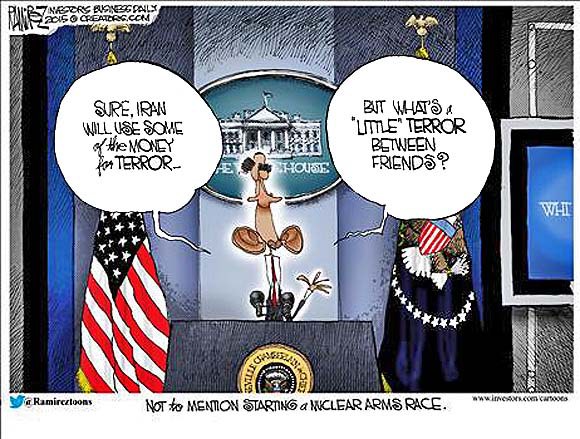
Unfortunately, Obama’s policies have made the job of his successor much harder. The next president will face a far stronger and less isolated Iran, economically empowered by a world rushing to do business with the Ayatollahs. Iran’s $150 billion post-sanctions windfall will increase Iranian financial support for terrorist groups (as Obama officials now concede) and boost Iran’s military capabilities (Russia just agreed to sell Iran its advanced, S-300 long-range, surface-to-air missile systems, complicating future missions to destroy Iranian nukes).

Until the 45th president assumes office on January 20, 2017, those concerned about Obama’s reckless and feckless foreign policy and his increasingly imperial presidency need to keep him on the defensive by focusing public attention on Obama administration controversies, many of which involve abuses of power that should interest the mainstream media. The busier Obama is defending his prior excesses, the less he can commit new ones during the rest of his tenure.

Noah Beck is the author of _The Last Israelis, an apocalyptic novel about Iranian nukes and other geopolitical issues in the Middle East._

PLO claims it can’t pay terror victims, spends $13 mil on palace

August 26, 2015

PLO claims it can’t pay terror victims, spends $13 mil on palace, Front Page Magazine, Daniel Greenfield, August 26, 2015

obamaarafat

Maybe once it’s done, there’ll be room there for an Obama sleepover.

*********************

The PLO’s Palestinian Authority is constantly experiencing an economic crisis. Maybe that’s because

1. Their imaginary country doesn’t actually produce anything and is funded by the UN, the EU and the US

2. They spend $144 million a year paying the salaries of convicted terrorists in prison and the families of suicide bombers

The PLO recently lost a major lawsuit against terror victims in the United States. The PLO claimed it couldn’t pay, even though it kept on paying terrorists. And Obama intervened to aid the terrorists.

A judge in New York on Monday ordered the Palestinian Authority (PA) and the Palestine Liberation Organization (PLO) to post $10 million in cash or bond while they appeal a jury’s finding that they supported terrorist attacks in Israel, Reuters reported.

At a court hearing in Manhattan, U.S. District Judge George Daniels said the defendants must also deposit $1 million each month pending the appeal of a February jury verdict worth $655 million in favor of 10 American families.

The order came a week after the Obama administration took the unusual step of urging Daniels to “carefully consider” the PA’s financial condition, saying too high a bond could compromise its ability to function.

Just think. The PLO might not be able to afford to pay terrorists… or build a palace for its terror boss.

Palestinian Authority (PA) chairman Mahmoud Abbas is building a $13 million palace for himself in Ramallah, the PA governmental seat in Samaria, as revealed in an official website recently.

The palace is to sprawl over 27,000 square meters of land, and is itself to be 4,700 square meters in size. Along with the palace, a “building for the Presidential Administration and Guards” is also to be built spanning 4,000 square meters.

Two helipads for helicopter transport are also to be built on the grounds of the palace, which according to architectural sketches on the site – that can be viewed here – is to be nothing short of royal in terms of its design and scale.

Pretty nice for a “concentration camp” where no one has any room to live. And it’s being paid for by American taxpayers. We’re funding another Saddam building himself palaces while American families are losing their homes.

Maybe once it’s done, there’ll be room there for an Obama sleepover.

Egypt and the Hamas “Cockroaches”

August 26, 2015

Egypt and the Hamas “Cockroaches,” The Gatestone InstituteKhaled Abu Toameh, August 26, 2015

  • “What were your four [Hamas] men doing in Sinai? Haven’t you denied in the past the presence of any Hamas men in Sinai? So where did these men pop up from?” — Dina Ramez, Egyptian journalist.
  • The incident also proves that Hamas does not hesitate to take advantage of Cairo’s humanitarian gestures to smuggle its men out of the Gaza Strip. Obviously, the four Hamas men were not on their way to receive medical treatment. That they are members of Hamas’s armed wing, Ezaddin al-Qassam, speaks for itself.
  • The Egyptians are particularly fed up with reports about Hamas’s increased involvement in their internal affairs and links to terror groups in Sinai.
  • This practice by Hamas is something that the Egyptian authorities have come to understand, which is why they are refusing to reopen the Rafah border crossing between Gaza and Egypt. The question now is whether the international community will understand Hamas’s true intentions and plans — namely to prepare for another war against Israel.

Egypt’s President Abdel Fatah Sisi has once again proven that he and his country will not tolerate any threats from Hamas or other Palestinians.

The crisis that erupted between Sisi’s regime and Hamas after the removal from power of Muslim Brotherhood President Mohamed Morsi two years ago, reached it peak in the past few days with the kidnapping of four Hamas operatives in Sinai.

The four men were snatched from a bus shortly after crossing from the Gaza Strip into Egyptian territory on August 19. Reports said that unidentified gunmen stopped the bus and kidnapped the four Hamas men, who are wanted by Egypt for their involvement in terrorism.

1222A bus carrying Palestinians drives through the Rafah crossing, from the Gaza Strip to Egyptian Sinai, on August 23, 2015. (Image source: Aqsatv video screenshot)

Although initial reports suggested that the kidnappers belonged to a salafi-jihadi group based in Sinai, some Hamas officials have accused Egyptian security forces of being behind the abduction. The Hamas officials even issued veiled threats against Sisi and the Egyptian authorities, and said that they held them fully responsible for the safety of the Hamas men.

A statement issued by Hamas warned the Egyptian authorities against harming the four men. “These men were the victims of deception and their only fault is that they are from the Gaza Strip,” the statement said. “This incident shows that the criminals are not afraid to target our people.”

Hamas leader Musa Abu Marzouk said that his movement holds the Egyptian authorities fully responsible for any harm caused to the abductees. He said that the kidnapping raises many questions and its circumstances remain unclear.

Hamas claims that salafi-jihadi groups in Sinai have informed its representatives that they did not kidnap the four men. According to Hamas officials, the abduction took place near the border with the Gaza Strip — an area where the Egyptian army maintains a large presence.

Sources in the Gaza Strip, however, have confirmed that the four men belong to Hamas’s armed wing, Ezaddin al-Qassam. The sources said that the men were apparently on their way to Iran for military training. The sources pointed out that the four had received permission from the Egyptian authorities to leave the Gaza Strip through the Rafah border crossing. The visas, however, are supposedly for civilians, not for Hamas operatives.

Hamas’s threats against Egypt have, meanwhile, enraged the Egyptian authorities as well as some top journalists in Cairo.

Egyptian authorities responded by refusing to give permission to Hamas leader Ismail Haniyeh and some leaders of his movement to travel to Qatar and Lebanon through the Rafah border crossing. The Hamas leaders were hoping to hold talks with some of their colleagues in those two countries about the possibility of reaching a long-term truce with Israel.

The Egyptians’ refusal to allow the Hamas leaders to leave the Gaza Strip has further strained relations between the two sides. Hamas representatives in the Gaza Strip were quoted as accusing the Egyptian authorities of “conspiring” against the movement and all Palestinians.

In Cairo, Egyptian security officials denied any link to the kidnapping of the four Hamas men. However, the denials have fallen on deaf ears and no one in Hamas seems to believe the Egyptian authorities. Even worse, Hamas representatives continued over the past few days to issue warnings and threats against Egypt.

As in the past, each time tensions rise between Hamas and Egypt, the Egyptians unleash some of their senior journalists against the Islamist movement. Since President Morsi’s removal from power, the Egyptians have displayed zero tolerance when it comes to Hamas. They are particularly fed up with reports about Hamas’s increased involvement in their internal affairs and links to terror groups in Sinai.

During the last war between Israel and Hamas, several Egyptian journalists and public figures openly expressed hope that the Israelis would destroy the movement for once and for all. Other journalists in Cairo, who are openly affiliated with the Sisi regime, have even urged their government to launch attacks against Hamas bases in the Gaza Strip.

This week, and in wake of the renewed tensions between Hamas and Egypt, Egyptian journalists resumed their rhetorical attacks against the movement. The question that most of these journalists asked was: What are Hamas members doing on Egyptian soil in the first place? The journalists accused Hamas of exploiting Egypt’s humanitarian gestures to smuggle its men out of the Gaza Strip.

One of these journalists, Dina Ramez, who is known as a staunch supporter of President Sisi, launched a scathing attack on Hamas, calling its members and leaders “cockroaches.”

Referring to the Hamas threats against Egypt, Ramez said: “Has anyone ever heard of cockroaches or ants that could threaten lions? These cockroaches belong to Hamas, which is threatening Egypt following the abduction of four of its men. I want to ask the Hamas cockroaches a simple question: What were your four men doing in Sinai? Haven’t you denied in the past the presence of any Hamas men in Sinai? So where did these men pop up from? I dare you to approach the border with Egypt. We have confidence in our army and our response will be painful. It will be a strong and deterring response against any cockroach that dares to come close to our border or threaten Egypt.”

Regardless of the identity of the kidnappers, the incident shows that Sisi and the Egyptian authorities continue to view Hamas as a threat to Egypt’s national security. The incident also proves that Hamas does not hesitate to take advantage of Cairo’s humanitarian gestures to smuggle its men out of the Gaza Strip. Obviously, the four Hamas men were not on their way to receive medical treatment or pursue their studies in Egypt or any other country.

That they are members of Ezaddin al-Qassam speaks for itself. Instead of dispatching its fighters to Iran and Turkey, Hamas should have allowed medical patients and university students to leave the Gaza Strip. But Hamas does not care about the well-being of the Palestinians in the Gaza Strip. Rather, it cares about sending its men to Iran and Turkey to receive military and security training.

This practice by Hamas is something that the Egyptian authorities have come to understand, which is why they are refusing to reopen the Rafah border crossing between Gaza and Egypt. The question now is whether the international community will understand Hamas’s true intentions and plans — namely to prepare for another war against Israel.

Iran: Nuclear Deal Will Enable Support for Terrorism

August 26, 2015

Iran: Nuclear Deal Will Enable Support for Terrorism, Washington Free Beacon, August 25, 2015

Iranian Foreign Minister Mohammad Javad Zarif speaks at the New York University (NYU) Center on International Cooperation in New York April 29, 2015. REUTERS/Lucas Jackson Iranian Foreign Minister Mohammad Javad Zarif speaks at the New York University (NYU) Center on International Cooperation in New York April 29, 2015. REUTERS/Lucas Jackson

Multiple senior officials in recent days have said that the Iranian nuclear deal will help the Islamic Republic fund its global terrorist operations, including the financial backing of Hamas and other regional groups, according to a briefing by an Israeli intelligence group.

Iranian officials, speaking at multiple forums in recent days, stressed that the nuclear deal will embolden Iran’s support for its “regional allies” and that weapons and military support would continue to be delivered on the “resistance front,” according to a recent brief by the Meir Amit Intelligence and Terrorism Information Center.

The officials outlined Iran’s plan to bolster its global terrorism operation and stated that the recent nuclear deal between Tehran and global powers will do nothing to deter Iran’s pursuit of regional dominance.

Ali-Akbar Velayati, Supreme Leader Ali Khamenei’s adviser for international affairs, stated at a recent conference in Tehran that support for the “resistance front” is a top foreign policy objective.

The nuclear agreement, Velayati said, “would make it possible to increase Iran’s support for its regional allies,” according to recent comments noted in the brief. The official went on to say that “the situation of the resistance front had improved.”

Other senior Iranian officials have echoed these remarks.

Foreign Minister Javad Zarif, who led nuclear negotiations with the United States, recently travelled to Syria and Lebanon to announce Iran’s renewed support for Hezbollah and the embattled regime of President Bashar al-Assad in Syria, according to the brief.

Iran will “continue providing weapons to support the Middle Eastern countries fighting terrorism,” Zarif is quoted as saying by Iran’s state-controlled press.

In light of the nuclear deal, Iran will “preserve its defensive capabilities and send weapons to its regional allies,” according to Zarif, who stressed that “without Iran and the weapons it provided to the countries fighting terrorism, the capital cities of the Middle East would have been occupied by” the Islamic State (IS, also known as ISIS or ISIL).

Iran also intends to boost its support for fighters in Yemen and Palestinian terrorist groups.

More than 70 members of the Iranian parliament, for instance, recently petitioned President Hassan Rouhani to increase “Iranian support for the regional resistance front after the nuclear agreement,” according to the report.

“They called on the president to use the ministries of defense and foreign affairs to send aid to the Palestinians in accordance with instructions from the Supreme Leader to arm the Palestinians in the West Bank,” the report notes.

Another senior Iranian national security official, Javad Karimi Qoddousi, demanded this month that “all the senior Iranian officials … support aid for the Palestinian people and the resistance front so that the nuclear agreement [is not] exploited to strengthen Israel’s security,” according to the brief.

These remarks have been accompanied by aggressive military moves by Iran, which has conducted multiple war drills in recent weeks and announced the upcoming launch of missiles, a move that could violate current United Nations Security Council resolutions barring such activity.

Iran appears to be attempting “to impress its allies with its commitment to continue supporting them even after the nuclear agreement with the West,” the Meir Amit center concluded in its brief. “The speeches of senior officials also reflected Iran’s approach to the rise and strengthening of ISIS and radical Sunni Islam.”

Iran also has committed itself to preventing the United States from gaining a foothold in the Middle East.

Iran will “not allow the United States to again extend its political influence in the region,” Velayati said in another recent interview. “Middle Eastern countries and people, led by Iran, had awakened and were standing firm” against America.

Senior Hamas officials have also disclosed in recent days that a delegation would soon be visiting Tehran.

Since the nuclear deal was secured, “relations between Hamas and Iran [have been] good,” according to these officials.

Cartoon of the day

August 26, 2015

H/t Vermont Loon Watch

choices

asdf