Archive for August 6, 2015

Column One: Obama’s enemies list

August 6, 2015

Column One: Obama’s enemies list, Jerusalem Post, Caroline Glick, August 6, 2015
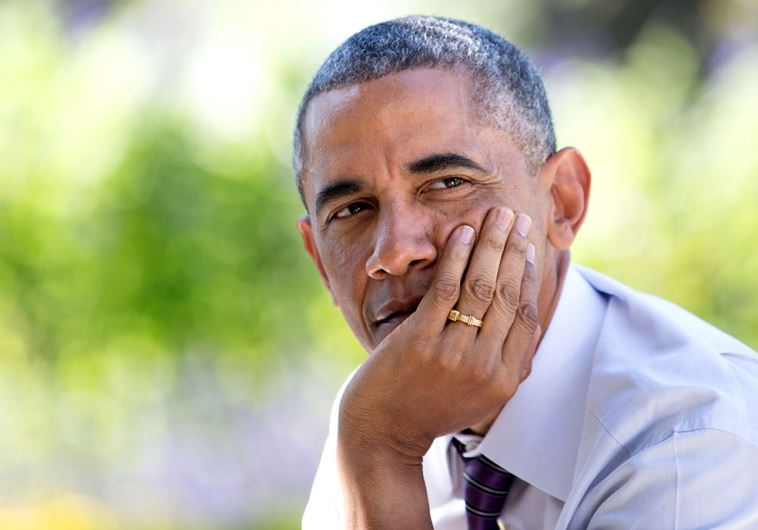
ShowImage (8)US President Barack Obama at the Rose Garden of the White House. (photo credit:OFFICIAL WHITE HOUSE PHOTO / PETE SOUZA)

[T]he real question lawmakers need to ask is whether the deal is good for America. Is Obama right or wrong that only partisan zealots and disloyal Zionists could oppose his great diplomatic achievement? To determine the answer to that question, you need to do is ask another one. Does his deal make America safer or less safe? The best way to answer that question is to consider all the ways Iran threatens America today, and ask whether the agreement has no impact on those threats, or whether it mitigates or aggravates them.

***********************

In President Barack Obama’s defense of his nuclear deal with Iran Wednesday, he said there are only two types of people who will oppose his deal – Republican partisans and Israel- firsters – that is, traitors.

At American University, Obama castigated Republican lawmakers as the moral equivalent of Iranian jihadists saying, “Those [Iranian] hard-liners chanting ‘Death to America’ who have been most opposed to the deal… are making common cause with the Republican Caucus.”

He then turned his attention to Israel.

Obama explained that whether or not you believe the deal endangers Israel boils down to whom you trust more – him or Prime Minister Benjamin Netanyahu. And, he explained, he can be trusted to protect Israel better than Netanyahu can because “[I] have been a stalwart friend of Israel throughout my career.”

The truth is that it shouldn’t much matter to US lawmakers whether Obama or Netanyahu has it right about Israel. Israel isn’t a party to the deal and isn’t bound by it. If Israel decides it needs to act on its own, it will.

The US, on the other side, will be bound by the deal if Congress fails to kill it next month.

So the real question lawmakers need to ask is whether the deal is good for America. Is Obama right or wrong that only partisan zealots and disloyal Zionists could oppose his great diplomatic achievement? To determine the answer to that question, you need to do is ask another one. Does his deal make America safer or less safe? The best way to answer that question is to consider all the ways Iran threatens America today, and ask whether the agreement has no impact on those threats, or whether it mitigates or aggravates them.

Today Iran is harming America directly in multiple ways.

The most graphic way Iran is harming America today is by holding four Americans hostage. Iran’s decision not to release them over the course of negotiations indicates that at a minimum, the deal hasn’t helped them.

It doesn’t take much consideration to recognize that the hostages in Iran are much worse off today than they were before Obama concluded the deal on July 14.

The US had much more leverage to force the Iranians to release the hostages before it signed the deal than it does now. Now, not only do the Iranians have no reason to release the hostages, they have every reason to take more hostages.

Then there is Iranian-sponsored terrorism against the US.

In 2011, the FBI foiled an Iranian plot to murder the Saudi ambassador in Washington and bomb the Saudi and Israeli embassies in the US capital.

One of the terrorists set to participate in the attack allegedly penetrated US territory through the Mexican border.

The terrorist threat to the US emanating from Iran’s terrorist infrastructure in Latin America will rise steeply as a consequence of the nuclear deal.

As The Wall Street Journal’s Mary Anastasia O’Grady wrote last month, the sanctions relief the deal provides to Iran will enable it to massively expand its already formidable operations in the US’s backyard. Over the past two decades, Iran and Hezbollah have built up major presences in Cuba, Venezuela, Nicaragua, Ecuador and Bolivia.

Iran’s presence in Latin America also constitutes a strategic threat to US national security. Today Iran can use its bases of operations in Latin America to launch an electromagnetic pulse attack on the US from a ballistic missile, a satellite or even a merchant ship.

The US military is taking active steps to survive such an attack, which would destroy the US’s power grid. Among other things, it is returning the North American Aerospace Defense Command (NORAD) to its former home in Cheyenne Mountain outside Colorado Springs.

But Obama has ignored the findings of the congressional EMP Commission and has failed to harden the US electronic grid to protect it from such attacks.

The economic and human devastation that would be caused by the destruction of the US electric grid is almost inconceivable. And now with the cash infusion that will come Iran’s way from Obama’s nuclear deal, it will be free to expand on its EMP capabilities in profound ways.

Through its naval aggression in the Strait of Hormuz Iran threatens the global economy. While the US was negotiating the nuclear deal with Iran, the Revolutionary Guards unlawfully interdicted – that is hijacked – the Marshall Islands-flagged Maersk Tigris and held its crew hostage for weeks.

Iran’s assault on the Tigris came just days after the US-flagged Maersk Kensington was surrounded and followed by Revolutionary Guards ships until it fled the strait.

A rational take-home message the Iranians can draw from the nuclear deal is that piracy pays.

Their naval aggression in the Strait of Hormuz was not met by American military force, but by American strategic collapse at Vienna.

This is doubly true when America’s listless response to Iran’s plan to use its Houthi proxy’s takeover of Yemen to control the Bab el-Mandab strait is taken into consideration. With the Bab el-Mandab, Iran will control all maritime traffic from the Persian Gulf and the Red Sea. Rather than confront this clear and present danger to the global economy, America abandoned all its redlines in the nuclear talks.

Then there is Iran’s partnership 20-year partnership with al-Qaida.

The 9/11 Commission found in its report that four of the 9/11 terrorists transited Iran before traveling to the US. As former Defense Intelligence Agency director Lt.-Gen. (ret.) Mike Flynn told Fox News in the spring, Iranian cooperation with al-Qaida remains deep and strategic.

When the US Navy SEALs killed Osama bin Laden in 2011, they seized hard drives containing more than a million documents related to al-Qaida operations. All but a few dozen remain classified.

According to Flynn and other US intelligence officials who spoke to The Weekly Standard, the documents expose Iran’s vast collaboration with al-Qaida.

The agreement Obama concluded with the mullahs gives a tailwind to Iran. Iran’s empowerment will undoubtedly be used to expand its use of al-Qaida terrorists as proxies in their joint war against the US.

Then there is Iran’s ballistic missile program.

The UN Security Council resolution passed two weeks ago cancels the UN-imposed embargoes on conventional arms and ballistic missile acquisitions by Iran. Since the nuclear deal facilities Iranian development of advanced nuclear technologies that will enable the mullahs to build nuclear weapons freely when the deal expires, the Security Council resolution means that by the time the deal expires, Iran will have the nuclear warheads and the intercontinental ballistic missiles required to carry out a nuclear attack on the US.

Obama said Wednesday that if Congress votes down his nuclear deal, “we will lose… America’s credibility as a leader of diplomacy. America’s credibility,” he explained, “is the anchor of the international system.”

Unfortunately, Obama got it backwards. It is the deal that destroys America’s credibility and so upends the international system which has rested on that credibility for the past 70 years.

The White House’s dangerous suppression of seized al-Qaida-Iran documents, like its listless response to Iran’s maritime aggression, its indifference to Iran’s massive presence in Latin America, its lackluster response to Iran’s terrorist activities in Latin America, and its belittlement of the importance of the regime’s stated goal to destroy America – not to mention its complete collapse on all its previous redlines over the course of the negotiations – are all signs of the disastrous toll the nuclear deal has already taken on America’s credibility, and indeed on US national security.

To defend a policy that empowers Iran, the administration has no choice but to serve as Iran’s agent. The deal destroys America’s credibility in fighting terrorism. By legitimizing and enriching the most prolific state sponsor of terrorism, the US has made a mockery of its claimed commitment to the fight.

The deal destroys the US’s credibility as an ally.

By serving as apologists for its worst enemy, the US has shown its allies that they cannot trust American security guarantees. How can Israel or Saudi Arabia trust America to defend them when it is endangering itself? The deal destroys 70 years of US nonproliferation efforts. By enabling Iran to become a nuclear power, the US has made a mockery of the very notion of nonproliferation and caused a nuclear arms race in the Middle East.

The damage caused by the deal is already being felt. For instance, Europe, Russia and China are already beating a path to the ayatollahs’ doorstep to sign commercial and military deals with the regime.

But if Congress defeats the deal, it can mitigate the damage. By killing the deal, Congress will demonstrate that the American people are not ready to go down in defeat. They can show that the US remains committed to its own defense and the rebuilding of its strategic credibility worldwide.

In his meeting with Jewish leaders Tuesday, Obama acknowledged that his claim – repeated yet again Wednesday – that the only alternative to the deal is war, is a lie.

Speaking to reporters after the meeting, Greg Rosenbaum, chairman of the National Democratic Jewish Council, which is allied with the White House, said that Obama rejected the notion that war will break out if Congress rejects the deal with veto-overriding majorities in both houses.

According to Rosenbaum, Obama claimed that if Congress rejects his nuclear deal, eventually the US will have to carry out air strikes against Iran’s nuclear facilities in order to prevent them from enriching uranium to weapons-grade levels.

“But,” he quoted Obama as saying, “the result of such a strike won’t be war with Iran.”

Rather, Obama said, Iran will respond to a US strike primarily by ratcheting up its terrorist attacks against Israel.

“I can assure,” Obama told the Jewish leaders, “that Israel will bear the brunt of the asymmetrical responses that Iran will have to a military strike on its nuclear facilities.”

What is notable here is that despite the fact that it will pay the heaviest price for a congressional defeat of the Iran deal, Israel is united in its opposition to the deal. This speaks volume about the gravity with which the Israeli public views the threats the agreement unleashed.

But again, Israel is not the only country that is imperiled by the nuclear deal. And Israelis are not the only ones who need to worry.

Obama wishes to convince the public that the deal’s opponents are either partisan extremists or traitors who care about Israel more than they care about America. But neither claim is true. The main reason Americans should oppose the deal is that it endangers America. And as a consequence, Americans who oppose the deal are neither partisans nor turncoats.

They are patriots.
Nuclearizing Iran, Sabotaging Arabs

August 6, 2015

Nuclearizing Iran, Sabotaging Arabs, The Gatestone InstituteBassam Tawil, August 6, 2015

(Please see also, Obama’s Strategy Of Equilibrium. — DM)

  • Obama’s solution? To let Iran have legitimate nuclear bombs in a few years, along with intercontinental ballistic missiles to deliver them to the U.S. — or perhaps from America’s soft underbelly, South America, where Iran has been acquiring uranium and establishing bases for years. Or perhaps launched from submarines off America’s coast, which would make the identity of the attacker unknowable and a response therefore impossible. Incredibly, America’s politicians do not even seem to seem to be concerned about that.
  • We have just sacrificed Sunni stability for American ideology: empty slogans fed to us by clueless, if well-meaning, American officials.
  • As we watched one stable Arab regime fall after another, we have allowed ourselves to be destroyed from within by these bungling diplomats — from America, Europe, China and Russia. Instead of keeping our eyes on the real threat, we exhausted ourselves in wasteful, unending battles against the Jews — meanwhile letting the Iranian menace slip out of sight.
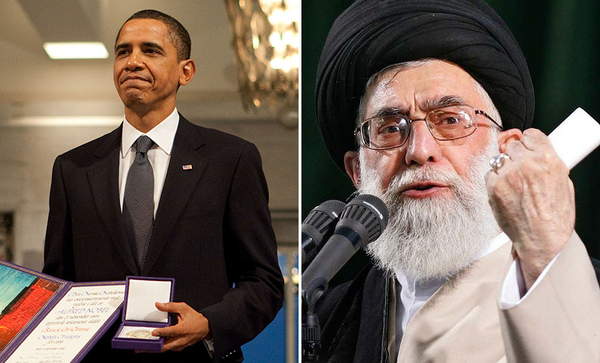
  • Obama really does deserve a Nobel Prize, but it should have been awarded by the Ayatollah Khamenei, the Supreme Leader of Iran, in gratitude for America’s surrender.

“Nation building” seems to have fallen into disrepute in the West, but it should not. It is vitally important — as the successes of Germany, Japan and South Korea attest.

Over the past few years, in our foolishness, we in the Middle East swallowed the deceptive bait of “democracy” dangled before us, even though we knew that it could not, in the misguided way it was presented, be implemented in the Middle East.

The idea was superb, but here in the Middle East, possibly in being impatient to “get credit” before the diplomats’ term of office were over, no one ever took the time to establish the institutions of democracy — equal justice under law, freedom of speech, property rights, the primacy of the individual rather than the collective, separation of religion and state — to show us in the Middle East how democracy actually operates, and to allow those institutions to take rootbefore ever holding an election.

So eager were Western leaders to take credit right away that they refused “let the rice bake.” Had the West introduced democratic elections to Japan and South Korea (where they eventually worked brilliantly) in the same way it muscled democracy into Iraq, it would never have taken root in those countries either. Had the Germans had been asked to vote right after World War II, they would most likely have reelected the Nazis — that was what they knew. It took seven years to re-educate the public to understand and accept a Konrad Adenauer.

What seems clear is that we have sacrificed Sunni stability for empty slogans — and for clueless, if well-meaning, American officials. As we watched one stable Arab regime fall after another, we allowed American ideology to destroy us from within. Instead of keeping our eyes on the real threat, we exhausted ourselves in wasteful, unending battles against the Jews — meanwhile letting the Iranian menace slip out of sight.

If we try to look at the positive side of the Iran nuclear agreement, it is just possible that Obama looked at the Sunni Arab states, fractured and at each other’s throats, and at the ruthless terrorist groups gaining ground in the expanding battle zones, and decided that we were too fractious for the U.S. to protect.

Sunni states such as Saudi Arabia, Qatar and Turkey have been worsening the situation in the Arab world by funding Sunni terrorist organizations, thereby putting it on a course of complete chaos. Despite Arab wealth and power, we have been dealing almost exclusively with the marginal issue of Palestine and the Jews, to excuse our inability to be effective in giving U.S. President Barack Obama what he really needs: regional stability.

Obama sees Iran and its terrorist organizations, which are all unified, organized and obedient, opposing the Sunni Arabs. Obama may be betting on Iran to bring order to the Middle East.

Imagine if we and our fundamentalist Sunni terrorist organizations had actually focused on stopping the Iranians in Syria, Iraq, Lebanon and Yemen. Imagine if we had abandoned, even momentarily, the dream of the Muslim Brotherhood (what the West calls “political Islam”) ruling the world. Imagine if we had stopped our stupid, useless acts of hatred, and could instead have focused on our common enemy, Iran. Our situation now would be immeasurably better. We would not be deviating from the teachings of Muhammad, because first we have to focus on the near enemy and then on the distant one. Iran is nearer and more dangerous than Europe and the United States, so Iran should have been — and still should be — the first Sunni target. We might have led Obama to adopt a different approach than allowing Iran to acquire a nuclear bomb in ten years or sooner — but we did not, because of our weakness and distraction with marginal “causes.” Thus Obama, from a desire to stabilize the Middle East, seems to be betting on the strong horse, Iran.

The truth, however, may be somewhat different. It is entirely possible that Obama, who won the Nobel Peace Prize, is employing a policy of “divide and conquer.” In the U.S., instead of trying to improve how children in the inner cities are being educated, he has been busy stoking racial and economic conflict. The Arabs are becoming increasingly suspicious that he is a historic “divide and conquer” manipulator. He may deliberately be creating fitna (civil strife) in the Arab world by whipping up conflict with Iran, so that America will one again look like the big power-broker — but at the expense of the Arabs.

We Arabs are expert conspiracy theorists, and interpret every political agenda as a hidden plot, but one only has to look at the Obama administration’s fawning support for the Muslim Brotherhood in Turkey and Egypt, and how America supported the fall of Mubarak, and it immediately becomes obvious that the U.S. is trying to manipulate the fate of the Arabs.

Anyone following America’s rejection of, and now only reluctant support for, the reformist regime of Egyptian President Abdel Fattah el-Sisi understands that the Americans prefer what they consider “backward Arabs”: those controlled by regressive Islam.

That is the reason we see Obama’s policies as backing both the Sunni Muslim Brotherhood and the theocrats in Iran. The ideologies of both the Muslim Brotherhood and Iran’s mullahs would lead to most dangerous and regressive fate of both Sunni and Shiite Muslims around the world, as well as Americans at home — and these are the Muslims most loved by the current American administration. Or maybe, as many of us say here on the street, Obama is just trying to “get even” with the West and bring it to its knees, for being white, “imperialist” and non-Muslim. Obama’s solution? To let Iran have legitimate nuclear bombs in a few years, with the intercontinental ballistic missiles to deliver them to the U.S. — or perhaps from America’s soft underbelly, South America, where Iran has been acquiring uranium and establishing bases for years. Or perhaps launched from submarines off America’s coast, which would make the identity of the attacker unknowable and a response therefore impossible. Incredibly, America’s politicians do not even seem to seem to be concerned about that.

Obama really does deserve a Nobel Prize, but it should have been awarded by the Ayatollah Khamenei, the Supreme Leader of Iran, in gratitude for America’s surrender.

1190Perhaps President Obama’s Nobel Prize should have been awarded by the Ayatollah Khamenei, the Supreme Leader of Iran, in gratitude for America’s surrender.

Speaking of the Iran deal (13)

August 6, 2015

Speaking of the Iran deal (13), Power LineScott Johnson, August 6, 2015

(Did anyone tell Obama about Iran’s sanitation efforts before his August 5th address on the Iran “deal?” The linked Bloomberg View article is available here at Warsclerotic. — DM)

The U.S. intelligence community has informed Congress of evidence that Iran was sanitizing its suspected nuclear military site at Parchin, in broad daylight, days after agreeing to a nuclear deal with world powers…

******************

Omri Ceren writes to comment on the Bloomberg View story reporting that President Obama’s friends in Iran are destroying evidence at the Parchin site in broad daylight. Omni comments by email:

The Obama administration has spent the last two years assuring lawmakers and reporters that any deal with Iran would have to include the Iranians allowing IAEA inspectors robust access to the Parchin military base. The Iranians used the facility to conduct hydrodynamic experiments relevant to the detonation of nuclear warheads, and the IAEA needs to resolve the nature of the work and figure out how far they got in order to set up a reliable verification regime.

The requirement was never, ever up for debate: Sherman in 2013: the JPOA requires Iran to “address past and present practices… including Parchin” [a]; Sherman in 2014: “as part of any comprehensive agreement… we expect, indeed, Parchin to be resolved” [b]; Harf in 2015: “we would find it… very difficult to imagine a JCPA that did not require such [inspector] access at Parchin” [c]; etc.

Then two weeks ago Sen. Risch revealed in an open Foreign Relations Committee hearing that U.S. negotiators had collapsed on the demand, and that the Iranians would be allowed to collect their own samples instead of the IAEA collecting the evidence. Sen. Menendez followed up with “chain of custody means nothing if at the very beginning what you’re given is chosen and derived by the perpetrator” [d]. Kerry responded by declaring that the information was classified, but the AP ran down and confirmed the story out of Vienna [e].

Now the punchline: Bloomberg View revealed this afternoon that the Iranians have spent the last few weeks busily trying to sanitize Parchin. So the administration blessed a deal in which they trusted the Iranians to provide evidence from Parchin, and the Iranians turned around and started destroying evidence at Parchin.

The U.S. intelligence community has informed Congress of evidence that Iran was sanitizing its suspected nuclear military site at Parchin, in broad daylight, days after agreeing to a nuclear deal with world powers… Intelligence officials and lawmakers who have seen the new evidence, which is still classified, told us that satellite imagery picked up by U.S. government assets in mid- and late July showed that Iran had moved bulldozers and other heavy machinery to the Parchin site and that the U.S. intelligence community concluded with high confidence that the Iranian government was working to clean up the site ahead of planned inspections by the IAEA…

Several senior lawmakers, including Democrats, are concerned that Iran will be able to collect its own soil samples at Parchin with only limited supervision, a practice several lawmakers have compared to giving suspected drug users the benefit of the doubt to submit specimens unsupervised. Iran’s sanitization of the site further complicates that verification.

A few hours after the Bloomberg View article The Institute for Science and International Security (ISIS) published one of its Imagery Briefs with photos showing the new destruction. ISIS assessed “the renewed activity occurring after the signing of the JCPOA raises obvious concerns that Iran is conducting further sanitization efforts to defeat IAEA verification… this renewed activity may be a last ditch effort to try to ensure that no incriminating evidence will be found” [f].

In the last few weeks, some skeptics of the deal have suggested that the JCPOA’s flaws are becoming borderline-comical (or at least they would be if the deal wasn’t such a catastrophe). Revelations like this are the reason why: the White House is telling Congress that Iran can be trusted to turn over evidence from Parchin while the intelligence community is telling Congress that Iran is destroying evidence at Parchin.

[a] http://www.gpo.gov/fdsys/pkg/CHRG-113shrg87828/html/CHRG-113shrg87828.htm
[b] http://www.shearman.com/~/media/Files/Services/Iran-Sanctions/US-Resources/Joint-Plan-of-Action/4-Feb-2014–Transcript-of-Senate-Foreign-Relations-Committee-Hearing-on-the-Iran-Nuclear-Negotiations-Panel-1.pdf
[c] http://www.state.gov/r/pa/prs/dpb/2015/04/240324.htm
[d] https://youtu.be/N4TK8hOLrNA?t=9m44s
[e] http://bigstory.ap.org/article/e1ccf648e18a4788ac94861a3bc1b966/officials-iran-may-take-own-samples-alleged-nuclear-site
[f] http://isis-online.org/uploads/isis-reports/documents/Renewed_Activity_at_Parchin_August_4_2015_FINAL.pdf

Obama Puts Fear Before Facts on Iran

August 6, 2015

Obama Puts Fear Before Facts on Iran, Bloomberg View, The Editors, August 5, 2015

(Please see also, Iran Already Sanitizing Nuclear Site, Intel Warns. — DM)

The pact is not a treaty: A future president and Congress might overturn it, arguing that it was sealed without proper consideration. And history often looks with disgust at causes built on fear, especially if they go awry. Obama wouldn’t want to face the kind of scorn he heaped on George W. Bush today.

***********************

President Barack Obama took to the airwaves today, aiming to sell Congress and the American people on the wisdom of his nuclear deal with Iran. He had a case to make but chose not to make it. He decided instead to cast legitimate criticism of his pact as ignorant warmongering. 

A few examples:

“We have achieved a detailed arrangement that permanently prohibits Iran from obtaining a nuclear weapon.” Actually, the deal’s restrictions end abruptly after 15 years, with some of the constraints on uranium enrichment fading away after just 10. Late in the speech, Obama made the case that much can change in a decade and that the West could be in a stronger position then to continue to block Iran’s nuclear desires. But the temporary nature of the deal remained disguised.

“Many of the same people who argued for the war in Iraq are now making the case against the Iran nuclear deal.” Certainly the Iraq war was sold on spurious grounds and had tragic results. Certainly Republicans and Democrats alike were far too credulous in accepting the Bush administration’s rationale. But these facts have absolutely nothing to do with this agreement.

“Before the ink was even dry on this deal, before Congress even read it, a majority of Republicans declared their virulent opposition.” That’s true, but ignores that opponents had plenty of time to study the draft agreement reached last spring. The real problem is that Congress still hasn’t read the entire accord, its side agreements and the inspections plan negotiated by the International Atomic Energy Agency. Even Secretary of State John Kerry says there are aspects of the deal he has never seen.

“If there is a reason for inspecting a suspicious undeclared site anywhere in Iran, inspectors will get that access even if Iran objects. This access can be with as little as 24 hours’ notice.” The key words here are “as little as.” Iran can draw that process out for as long as 24 days if it so chooses. Foreign Minister Javad Zarif says some military sites will remain off-limits to IAEA personnel.

“If, as has also been suggested, we tried to maintain unilateral sanctions, beefen them up … we’d have to cut off countries like China from the American financial system. And since they happen to be major purchasers of our debt, such actions could trigger severe disruptions in our own economy, and, by way, raise questions internationally about the dollar’s role as the world’s reserve currency.” Rejection by Congress could cause the sanctions regime to fray. Lawmakers should weigh this. The idea that it might cripple the U.S. economy is absurd.

“I’ve had to make a lot of tough calls as president, but whether or not this deal is good for American security is not one of those calls, it’s not even close.” Maybe this deal is the best chance to delay the mullahs’ race to the bomb and keep the Middle East out of a nuclear arms race. But the case is anything but open-and-shut. It’s hard to see what the president gains from denying this.

Well, perhaps one thing: Obama may hope that denigrating those who disagree with him will rally Democrats in Congress to support a veto of any measure of disapproval. Tactics aside, it would be far better to win this fight fairly. The pact is not a treaty: A future president and Congress might overturn it, arguing that it was sealed without proper consideration. And history often looks with disgust at causes built on fear, especially if they go awry. Obama wouldn’t want to face the kind of scorn he heaped on George W. Bush today.

Washington Institute: Send Israel Massive Ordnance Penetrators to Deter Iran

August 6, 2015

Washington Institute: Send Israel Massive Ordnance Penetrators to Deter Iran | Jewish & Israel News Algemeiner.com.

August 5, 2015 5:14 pm

A B-52 bomber releases a Massive Ordnance Penetrator, a 30,000-pound bunker buster bomb. Photo: Wikipedia

Nothing short of providing Israel with the Massive Ordnance Penetrator — the world’s most powerful “bunker buster” bomb — and the aircraft to deliver it will guarantee effective deterrence to keep Iran from skirting the nuclear deal to produce weapons of mass destruction, a group of influential Middle East security experts and former officials wrote in a review of the nuclear accords released on Tuesday.

It is important, on top of a credible U.S. military threat against Iran should the country try to maneuver its way to possession of nuclear weapons, that Israel maintain its own effective deterrence capacity, said the authors, which included longtime White House Middle East adviser, Dennis Ross, the director of Military and Security Studies at The Washington Institute, Michael Eisenstadt and former ambassador to Iraq and security adviser to president George W. Bush, James Jeffrey.

The MOP has long been seen as the military Plan B to dealing with Iran and its troubling nuclear program. It can penetrate fortified bunkers deep underground, burrowing up to 200 feet before unleashing 30,000 pounds of explosives deep inside its target. It carries the world’s largest nonnuclear payload.

Israel lacks both the MOPs and the bombers capable of delivering them; those capabilities belong squarely to the U.S.

The idea to arm Israel with the MOPs is not new. Last year, Lt. Gen. David Deptula and Michael Makovsky of the Jewish Institute for National Security Affairs (JINSA) made the recommendation in a Wall Street Journal article.

President Barack Obama spoke to an audience at American University on Wednesday saying he has been the best president for Israel’s security (no applause) and vowing to boost cooperation with Jerusalem over security and defense, particularly around destabilizing efforts in the region fueled by expansionist Iran. He also warned against another Middle East war, which to audience applause he explained were “anything but quick and simple.”

Israel has rejected all talks over a new military aid package until after Congress votes on the Iran deal.

Obama’s Strategy Of Equilibrium

August 6, 2015

Obama’s Strategy Of Equilibrium, Middle East Media Research Institute, Yigal Carmon and Alberto M. Fernandez, August 5, 2015

(The conflict between Shiite and Sunni factions has been going on since shortly after the death of Mohamed. Obama is not likely to bring reconciliation. — DM)

This article will analyze the strategy of creating an equilibrium between Sunnis and Shiites as a means to promote peace in the Middle East. It will examine the meaning of the strategy in political terms, how realistic it is, and what its future implications might be on the region and on the United States.

“It is worth noting that the first Islamic State created in the Middle East in the last 50 years was not the one created in the Sunni world in 2014 and headed by Abu Bakr al-Baghdadi.” Rather, it was the Islamic Republic of Iran created in 1979 by Ayatollah Ruhollah Khomeini and currently ruled by his successor, Supreme Leader Ali Khamenei, who maintains – even following the Iran deal – the mantra “Death to America,” continues to sponsor terrorism worldwide, and commits horrific human rights violations.

********************

Introduction

In an interview with Thomas Friedman of The New York Times (“Obama Makes His Case on Iran Nuclear Deal,” July 14, 2015), President Obama asked that the nuclear deal with Iran be judged only by how successfully it prevents Iran from attaining a nuclear bomb, not on “whether it is changing the regime inside of Iran” or “whether we are solving every problem that can be traced back to Iran.” However, in many interviews he has given over the last few years, he has revealed a strategy and a plan that far exceed the Iran deal: a strategy which aims to create an equilibrium between Sunnis and Shiites in the Muslim world.

President Obama believes that such an equilibrium will result in a more peaceful Middle East in which tensions between regional powers are reduced to mere competition. As he told David Remnick in an interview with The New Yorker, “…if we were able to get Iran to operate in a responsible fashion…you could see an equilibrium developing between Sunni, or predominantly Sunni, Gulf states and Iran in which there’s competition, perhaps suspicion, but not an active or proxy warfare” (“Going the Distance,” January 27, 2014).

In discussing the Iran deal, the President recalled President Nixon negotiating with China and President Reagan negotiating with the Soviet Union in order to explain the scope of his strategy for the Middle East and the Muslim world. President Obama seeks, as did Presidents Reagan and Nixon with China and the Soviet Union, to impact the region as a whole. The Iran deal, even if major, is just one of several vehicles that would help achieve this goal.

This article will analyze the strategy of creating an equilibrium between Sunnis and Shiites as a means to promote peace in the Middle East. It will examine the meaning of the strategy in political terms, how realistic it is, and what its future implications might be on the region and on the United States.

The Meaning Of The Equilibrium Strategy In Political Terms

Examining the strategy of equilibrium requires the recollection of some basic information. Within Islam’s approximately 1.6 billion believers, the absolute majority – about 90% – is Sunni, while Shiites constitute only about 10%.  Even in the Middle East, Sunnis are a large majority.

What does the word “equilibrium” mean in political terms? In view of the above stated data, the word “equilibrium” in actual political terms means empowering the minority and thereby weakening the majority in order to progress toward the stated goal. However, the overwhelming discrepancy in numbers makes it impossible to reach an equilibrium between the two camps. Therefore, it would be unrealistic to believe that the majority would accept a policy that empowers its adversary and weakens its own historically superior status.

Implications For The Region

Considering the above, the implications of the equilibrium strategy for the region might not be enhancing peace as the President well intends; rather, it might intensify strife and violence in the region. The empowered minority might be persuaded to increase its expansionist activity, as can be already seen: Iran has extended its influence from Lebanon to Yemen. Iranian analyst Mohammad Sadeq al-Hosseini stated in an interview on September 24, 2014, “We in the axis of resistance are the new sultans of the Mediterranean and the Gulf. We in Tehran, Damascus, [Hizbullah’s] southern suburb of Beirut, Baghdad, and Sanaa will shape the map of the region. We are the new sultans of the Red Sea as well” (MEMRITV Clip No. 4530). Similarly, in a statement dedicated to the historically indivisible connection between Iraq and Iran, advisor to President Rouhani Ali Younesi stressed that, “Since its inception, Iran has [always] had a global [dimension]; it was born an empire” (MEMRI Report No. 5991).

In view of this reality, this strategy might create, against the President’s expectations, more bitterness and willingness on the part of the majority to fight for their status. This has already been realized; for example, when Saudi Arabia intervened in Yemen after facing the Houthi/Shiite revolution, which it perceived as a grave danger to its survival, and created a fighting coalition within a month to counter it. Similarly, Saudi Arabia has previously demonstrated that it regards Bahrain as an area where any Iranian attempt to stir up unrest will be answered by Saudi military intervention. According to reports, Saudi Arabia has been supporting the Sunni population in Iraq, and in Lebanon, a standstill has resulted because Saudi Arabia has shown that it will not give up – even in a place where Iranian proxy Hizbollah is the main power. Hence, the strategy of equilibrium has a greater chance of resulting in the eruption of regional war than in promoting regional peace.

Implications For The United States

Moreover, this strategy might have adverse implications for the United States and its interests in the Sunni Muslim world: those countries that feel betrayed by the strategy might, as a result, take action against the United States – hopefully only politically (such as changing international alliances) or economically. These countries might be careful about their public pronouncements and might even voice rhetorical support to U.S. policy, as the GCC states did on August 3, but the resentment is there.

Realpolitik Versus Moral Considerations

The analysis presented here is based on principles of realpolitik: in politics, one does not align with the minority against the majority. However, sometimes other considerations take precedence. Morality is such an example: the Allies could not refrain from fighting Nazi Germany because it was a majority power – ultimately, they recognized the moral obligation to combat the Third Reich. However, with regard to the Middle East, the two adversaries are on equal standing: the Islamic Republic of Iran is no different than the Wahhabi Kingdom of Saudi Arabia. President Obama and Secretary Kerry would be wrong to think that Mohammad Javad Zarif, the sophisticated partygoer in New York City, represents the real Iran. Zarif, his negotiating team, and President Rouhani himself, all live under the shadow and at the mercy of the Supreme Leader, the ayatollahs, and the IRGC.

“It is worth noting that the first Islamic State created in the Middle East in the last 50 years was not the one created in the Sunni world in 2014 and headed by Abu Bakr al-Baghdadi.” Rather, it was the Islamic Republic of Iran created in 1979 by Ayatollah Ruhollah Khomeini and currently ruled by his successor, Supreme Leader Ali Khamenei, who maintains – even following the Iran deal – the mantra “Death to America,” continues to sponsor terrorism worldwide, and commits horrific human rights violations.

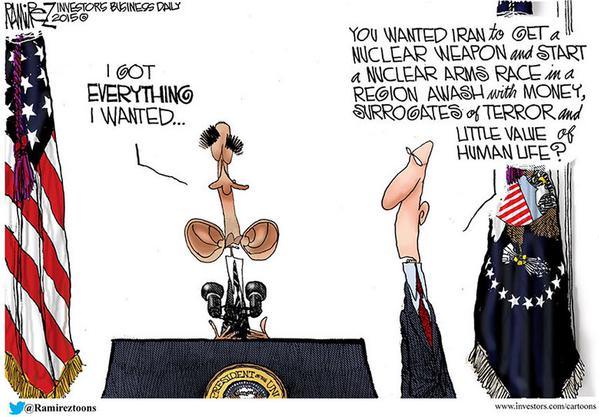
Cartoons of the day

August 6, 2015

H/t Freedom is just another word


wanted

deal

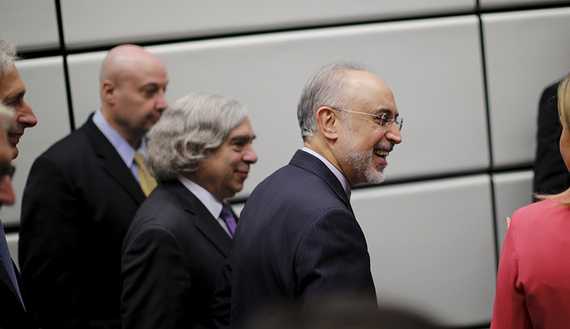
Iranian negotiator discusses talks with Moniz

August 6, 2015

Iranian negotiator discusses talks with Moniz, Al Monitor, Arash Karami, August 5, 2015

(A sweet deal between good friends. — DM)

REUTERS/Carlos Barria

Salehi said that he was asked to join the nuclear talks when the discussions on the Natanz enrichment facility reached a dead end. Salehi said he would only join the talks if Moniz, his American counterpart, did as well. According to Salehi, this was approved by Undersecretary Wendy Sherman and Deputy Foreign Minister Abbas Araghchi, which he described as “the communications link between America and Iran.”

*****************

One of the most popular American negotiators in Iranian social media was US Energy Secretary Ernest Moniz. The Massachusetts Institute of Technology (MIT) professor emeritus and former director of the MIT Laboratory for Energy and the Environment joined the nuclear talks between Iran and five permanent members of the UN Security Council plus Germany (P5+1) to discuss the technical aspects of the nuclear deal with the head of Iran’s Atomic Energy Organization, Ali Akbar Salehi.

In an interview with an Iranian newspaper, Salehi spoke about the negotiations and his relationship with Moniz. Just as Moniz was picked to lead the technical negotiations due to his nuclear expertise, Salehi, an MIT graduate, is one of the few individuals to have held important positions for three consecutive administrations — a sign that he has the trust of Supreme Leader Ayatollah Ali Khamenei.

Salehi first denied accusations that former hard-line nuclear negotiator Saeed Jalili was not a serious negotiator. Salehi was Iran’s foreign minister at the time and said that when he was at the meetings with the Supreme National Security Council, Jalili’s negotiating positions were in line with the country’s positions and that “he did not go rogue.”

According to Salehi, the reason for the deadlock during that time was the differences among the P5+1. Specifically, the EU3 (France, United Kingdom and Germany) saw their positions and interests separate from the E3 (US, Russia and China). He said that even when European Union Chief Catherine Ashton reached a point of agreement with Iran on one issue, one country would oppose it and throw everything off. This is why Iran agreed to bilateral talks with the United States in Oman.

Salehi said that he was asked to join the nuclear talks when the discussions on the Natanz enrichment facility reached a dead end. Salehi said he would only join the talks if Moniz, his American counterpart, did as well. According to Salehi, this was approved by Undersecretary Wendy Sherman and Deputy Foreign Minister Abbas Araghchi, which he described as “the communications link between America and Iran.”

Salehi said he and Moniz did not know each other well when they were at MIT, but when they first met during the talks, “there was a feeling that he has known me for years.” Salehi added, “A number of my classmates are now Mr. Moniz’s experts.”

According to Salehi, Moniz entering the talks was important because Salehi expressed that he had been sent with “full authority” to sign off on all technical issues in the nuclear negotiations and Moniz had told him that he had the same authority. He added, “If the negotiations did not take place with the Americans, the reality is that it would not have reached a conclusion. No [other] country was ready to sit with us and negotiate for 16 days with their foreign minister and all of its experts.”

Salehi said that one of the more difficult times negotiating with Moniz was after they reached an agreement on a particular issue. Moniz would take it to the other members of P5+1, who would then make their own requests.

It was also reported that Moniz had given Salehi a gift for the birth of his granddaughter — clothes and a toy embossed with MIT logos. Salehi said that he had also brought gifts for Moniz — Iranian honey and trail mix of Iranian nuts.


Analysis: Arabs see US-trained anti-Islamist force as only fit to ‘play paintball’

August 6, 2015

Analysis: Arabs see US-trained anti-Islamist force as only fit to ‘play paintball’, Jerusalem PostAriel Ben Solomon, August 6, 2015

ShowImage (7)AN ISIS member rides on a rocket launcher in Raqqa in Syria two months ago. (photo credit:REUTERS)

The deal with Iran and the cooperation with Iranian forces against Islamic State, include “Shi’ite militias that are no less criminal.”

*********************

The Arab world perceives the dramatic failure of the small US-trained Syrian rebel force as a further indication that it cannot be a reliable ally against the Iran led Shi’ite axis.

A US defense official, who spoke to Reuters on condition of anonymity, said on Tuesday that at least five Syrian rebels it has trained are believed to have been captured by the Nusra Front.

That followed an attack by the Nusra Front on Friday thought to have killed one member of the so-called “New Syrian Forces,” in what would be their first battlefield casualty.

The incidents underscore the extreme vulnerability of the New Syrian Forces, a still tiny group estimated to number less than 60, who only deployed to the battlefield in recent weeks.

The Pentagon is far behind on its goals to train around 5,000 fighters a year.

Kirk Sowell, principal of Uticensis Risk Services, a Middle East-focused political risk firm, who closely follows Arab media summed it up this way on Twitter: “Pentagon: Arab media are laughing at you.”

Sowell posted a broadcast by pro-opposition Orient News, which expressed astonishment as to why the US would send in a force of only 50 to 60 fighters to help destroy Islamic State.

Aymenn Jawad al-Tamimi, a fellow at the Middle East Forum who closely follows Islamist opposition groups in Syria and Iraq, told The Jerusalem Post that “for many Sunni Arabs and Syrian Sunni Arab rebels in particular, this train-and-equip program has had no credibility from the outset.”

This is because the notion of fighting Islamic State while ignoring regime forces does not make sense for them, said Tamimi.

“US policymakers’ sense of reality on the ground is seriously in question with the apparent failure to anticipate a clash with the Nusra Front, which has a notable presence in the Azaz district into which the force of 50-60 men was inserted,” he continued.

Since the US has targeted Nusra Front in air strikes it is not surprising that the group would view a US backed group as a threat, he said.

Middle East researcher Ali Bakir, who also writes for Arab publications, told the Post on Wednesday that “no one in the Arab world takes this program seriously; I mean you would need around 50 to 60 people to play paintball but definitely not to fight Islamic State.”

“There is a profound general perception in the Arab world that the Obama administration is no less responsible than Iran and Russia in the Syrian crisis,” he said.

The deal with Iran and the cooperation with Iranian forces against Islamic State, include “Shi’ite militias that are no less criminal.”

This situation is increasingly seen in the Arab world as siding with the Shi’ites at the expense of the vast majority of Muslims, he asserted.

The US administration is more concerned about not jeopardizing the Iran deal than helping the Syrian people, Bakir added.

A New Age of Theory

August 6, 2015

http://www.jewishmediaresources.com/1768/a-new-age-of-theoryAugust 7, 2015

The recently signed p5+1 nuclear deal with Iran is based on another beautiful theory: The nicer the United States is to the Iranian mullahs, the more she caves into their demands and acknowledges their valid reasons for hating America, the more they will seek to be like us and want to be good citizens of the world. President Obama has literally bet the fate of the world on that conjecture.

The theory that the Iranian theocracy will be transformed by kindness betrays another failure of progressive theorists from the French Revolution to the present: They view religion as “irrational,” and cannot fathom that anyone else takes its claims seriously. That Iran’s Islamic Revolution really seeks world conquest for Islam is too absurd to countenance as an explanation of regime behavior.

**********************

Alexis de Tocqueville’s explanation of the descent of the French Revolution into the Terror, in The Old Regime and the Revolution, emphasized the outsized role that men of letters played in French political discourse prior to the Revolution. These writers, as described by de Tocqueville, had a decided preference for “general and abstract theories of government” and a tendency “to trust in them blindly.” Since they dwelt at “an almost infinite distance from practice . . . no experience tempered the ardors of their natures; nothing warned them of the obstacles that existing facts might place before them.”

With the passage of time, “they . . . became much bolder in their innovations, fonder of general ideas and systems, more contemptuous of old wisdom, and still more confident of their individual reason. . . ,” writes de Tocqueville.

We live in another such age of theory, writes Alain Finkelkraut. Take for example the lunatic claim that Jews are committing genocide against the Palestinians. Under Israeli rule of the West Bank from 1967 to 1992, life expectancy leaped by 50% — from 48 to 72; infant mortality dropped by 75%; seven universities were built where none had existed, and Palestinian illiteracy was reduced to a fraction of that in neighboring Egypt and Syria; and the West Bank, as of 1992, had the fourth fastest growing economy in the world. If that be genocide, it was genocide of a decidedly peculiar sort.

But, explains Finkelkraut, Europeans have theory according to which Jews are uniquely capable of genocide today. And in an age of theory, a beautiful theory trumps a thousand unruly facts. What’s the theory? Because Jews were the victims of the Holocaust, not its perpetrators, they never learned of the danger of turning one’s fellow human beings into the dehumanized “Other.” From which it follows that Jews dehumanize Palestinians and are committing genocide against them. Never mind the facts.

The recently signed p5+1 nuclear deal with Iran is based on another beautiful theory: The nicer the United States is to the Iranian mullahs, the more she caves into their demands and acknowledges their valid reasons for hating America, the more they will seek to be like us and want to be good citizens of the world. President Obama has literally bet the fate of the world on that conjecture.

Neither tens of thousands chanting “Death to America” nor Supreme Leader Khameini’s insistence that Iran will continue to fight American arrogance even after the deal because hatred of America is the very raison d’etre of the regime register with supporters of the theory.

The theory that the Iranian theocracy will be transformed by kindness betrays another failure of progressive theorists from the French Revolution to the present: They view religion as “irrational,” and cannot fathom that anyone else takes its claims seriously. That Iran’s Islamic Revolution really seeks world conquest for Islam is too absurd to countenance as an explanation of regime behavior.

Another Obama theory holds that even rabid anti-Semites, like the Iranian mullahs, will not act upon their hatreds to the harm of their “rational” interests. But history proves the opposite: The Nazis diverted vital war material in an effort to wipe out Hungarian Jewry in Auschwitz.

The attachment to theory over empirical evidence is evidenced in the way that Left policy prescriptions remain constant despite their repeated failures. What Walter Russell Mead calls the Blue Model of governance – high taxes, high regulation, and generous public union pensions – is failing everywhere. From mid-size California cities to Detroit, Chicago, and most recently, Puerto Rico, it has led to literal bankruptcy.

A vicious cycle sets in of higher taxes to pay pensions based on fantastical assumptions followed by the flight of business and jobs to lower tax states followed by yet higher taxes on those remaining to compensate for the lost business and jobs. Eventually, Blue Model cities and states experience the highest income inequality, as the population divides between extremely high earners, on the one hand, and the menial workers who serve them and welfare recipients, on the other.

The Obama administration has now set out to increase Muslim immigration, despite Europe’s dystopian experience, which has left it poised to become an extension of the Maghreb by the end the century, with an increasingly radicalized and unassimilated Muslim population taking over.

The theories of the Left are unmoored from reality because they have less to do with seeking to make life better than with the emotional reaffirmation they offer their proponents. Every Democratic candidate, for instance, will call for universal pre-school education, despite 50 years of evidence that Head Start early intervention has no lasting impact.

Similarly, every Democratic candidate will advocate heavy government investment in abundant, renewable “green” energy – such as ethanol, the production of which actually creates more pollution than it saves – even though “green energy” consistently proves to be economically unviable and a drag on economic productivity in the form of higher energy costs. Billions of dollars of taxpayer money, however, will inevitably find their way into the pockets of “green energy” crony capitalists.

The attraction of “renewables” is primarily the feeling of moral virtue they confer on proponents. And the same is true of Head Start and calls for a $15/and hour minimum wage, which would only ensure that orders at McDonald’s will be taken by a machine and not by some striving high-school kid eager to earn money for college or a poor, single-mother with no marketable skills. Estimates of the American jobs likely lost if the minimum wage were to rise to $15/hour range from 3,000,000 to 6,000,000, most of them to low-wage earners. But how deliciously virtuous must legislators feel enacting minimum wage laws.

THOSE WHO PREFER THEORY over history and facts do not just produce bad policy: They are subject to a profoundly illiberal, even totalitarian, temptation. That was De Tocqueville’s subject. Their theory of government is that “smart” people – i.e., theoreticians like themselves — ought to run the show. A corollary is that all smart people will reach similar “rational” conclusions, and that those who don’t are either fools or evil. Not surprisingly, when human beings and reality fail to conform to their theories, they turn ornery. Think Pol Pot.

Hostility to free markets and a profound ambivalence towards representative democracy are part and parcel of the preference for abstractions. The former are too irrational and chaotic. Markets give equal value to the desires of the not-so-bright. Central planning, by contrast, is much more rational, or so it seems, until one considers its unbroken record of failure. Just think of resource rich Venezuela, where years of socialist rule have made both food and toilet paper scarce.

Similarly the flaw of representative democracy is that fools and geniuses alike have one vote. The preferred form of municipal government for early American Progressives was unelected city managers, above the fray of partisan politics. And those same early Progressives created the modern administrative state, whose rule-making by unelected bureaucratic “experts,” has become virtually indistinguishable from the law-making power conferred exclusively upon Congress by the Constitution.

Self-styled progressive Barack Obama is perfectly comfortable ruling by executive decree and through administrative agencies, like the Environmental Protection Agency, which seeks to impose by rule-making what could never pass in Congress.

Obama’s progressive ancestor, President Woodrow Wilson, famously declared the U.S. Constitution, with its federal system and checks and balances between the three branches, to be an outmoded document for the modern age, and called for a much more powerful unitary executive.

Progressive thinkers have little patience for the rules of procedure of representative democracy or its allocation of decision-making authority. Only results matter and that the smart people make the decisions – be they judges, agency bureaucrats, or the president himself. Neither Court President Aharon Barak in his heyday nor Justice Anthony Kennedy more recently showed the slightest concern over whom appointed them philosopher-king to determine the nature of human dignity.

The assumption that those who disagree are either stupid or evil undercuts the fundamental democratic value of tolerance. On issues like anthropogenic climate change, modern progressive are ever eager to declare the debate over, and even advocate criminal penalties for global warming deniers. (This at a time when many climate scientists are forecasting a mini-Ice Age based on lower solar activity.)

Anyone who follows nutrition and health reports knows how wildly fluctuating the best scientific advice is. How much more unlikely is the discussion to be over in the vastly more complex area of climate, involving up to twenty different scientific disciplines and in which controlled experiments are impossible.

Not by accident are the most progressive institutions in American society – the universities – those with the most restrictive speech codes designed to regulate various and sundry “micro-aggressions” in speech.

The Orwellian argument of the late Brandeis philosopher Herbert Marcuse that “new and rigid restrictions” on certain teachings that protect the oppressive status quo are required for true freedom of thought to flourish only represents the outer limit of where the preference for abstractions over human reality can lead.