Archive for July 2015

US, Turkey to create ISIS-free buffer zone in Syria

July 27, 2015

US, Turkey to create ISIS-free buffer zone in Syria

Kurds in Syria advance against Islamic State positions with help of US airstrikes; Turkey rides fine line, striking ISIS and Kurdish forces simultaneously.

News Agencies

Published: 07.27.15, 13:50 / Israel News

via US, Turkey to create ISIS-free buffer zone in Syria – Israel News, Ynetnews.

The United States and Turkey are finalizing plans for a military campaign to push the Islamic State out of a strip of land along the Turkey-Syria border, deepening efforts to halt the extremists’ advances.

A US official says the “Islamic State-free zone” aims to ensure greater security and stability along the border. However, the official says any joint military efforts with Turkey would not include the imposition of a no-fly zone.


Smoke rises from the Kurdish city of Kobani in Syria near the Turkish border. (Photo: Reuters)

Turkey has been pushing the US to set up a no-fly zone, though Washington has long denied those requests. Turkey did agree last week to let the US launch strikes against the Islamic State from one of its bases.

The official insisted on anonymity because they were not authorized to publicly discuss the talks with Turkey.

Meanwhile, the Kurdish YPG militia on Monday captured a town from Islamic State fighters in northern Syria after a month-long offensive against the ultra hard-line militants in the area to cut their supply lines, the Syrian Observatory for Human Rights said.

The Observatory said the town near the Euphrates River was a launch pad for Islamic State to wage raids on the Kurdish-held town of Kobani further north at the border with Turkey.

US-led air strikes assisted the Kurds in the assault, said Rami Abdulrahman, who runs the Observatory.

Conflicting Strategy

Turkish troops however, shelled positions held the Kurdish fighters who were battling the Islamic State group with the aid of the US, Syria’s main Kurdish militia and an activist group said Monday.

The Kurdish People’s Protection Units, or YPG, said the Sunday night shelling on the border village of Til Findire targeted one of their vehicles. It said Til Findire is east of the border town of Kobani, where the Kurds handed a major defeat to the Islamic State group earlier this year.


A Turkish airstrike against ISIS positions.

 In cross-border strikes since Friday, Turkey has targeted both Kurdish fighters as well as ISIS, stepping up its involvement in Syria’s increasingly complex civil war. The Syrian Kurds are among the most effective ground forces battling ISIS group, but Turkey fears they could revive an insurgency against Ankara in pursuit of an independent state.

A Turkish official said Turkish forces are only targeting Islamic State forces in Syria and the Kurdistan Workers’ Party, or PKK, in neighboring Iraq.

The official said the “ongoing military operation seeks to neutralize imminent threats to Turkey’s national security and continues to target ISIS in Syria and the PKK in Iraq.”

“The PYD, along with others, remains outside the scope of the current military effort,” the official said, referring to the political arm of the YPG.

The official added that authorities were “investigating claims that the Turkish military engaged positions held by forces other than ISIS.”

The official spoke on condition of anonymity because of rules that bar officials from speaking to journalists without authorization.

The YPG did not say in its Monday statement whether there were casualties in the shelling.


Hundreds of Thousands Called Up for IDF Drill

July 27, 2015

Hundreds of Thousands Called Up for IDF Surprise Drill

Exercise simulates an emergency callup of reservists, and will continue until Wednesday.

By Kobi Finkler

First Publish: 7/27/2015, 10:24 AM

via Hundreds of Thousands Called Up for IDF Drill – Defense/Security – News – Arutz Sheva.

Reservists (file)

Reservists (file) Flash 90

Hundreds of thousands of soldiers are being called up for service in a surprise emergency exercise that began Monday.

The reservists – from the air, land and sea branches of the IDF, as well as the Home Front Command – began receiving automated messages calling them up to service, starting at 8:00 AM.

Most of the soldiers were only required to acknowledge the call, but thousands will have to don their uniforms and show up at enlistment points, to rehearse emergency scenarios.

A senior officer said that the Air Force will be rehearsing for the neutralization of various attacks and that the Navy will train for protecting national infrastructures, among other things.

The officer added that this will be the first time in which the IDF rehearses cyber-defense on such a large scale.

Southern Command will practice several scenarios, including rocket fire from Gaza.

Northern Command will also rehearse a war scenario, in unspecified locations.

The exercise will continue until Wednesday, and an unusually high volume of security vehicle traffic will be noticeable on Israel’s roads.

Also on Monday, the Home Front Command will be holding rescue drills at sites simulating wartime destruction in Holon and Neurim.

Turkish journalist: “Turkey prefers ISIS to the Kurds”

July 27, 2015

Turkish journalist: “Turkey prefers ISIS to the Kurds”

In an exclusive interview with JerusalemOnline, Turkish journalist Uzay Bulut described how the Turkish state systematically persecutes the Kurds while at the same time assisting ISIS and other jihadist terror groups.

Jul 27, 2015, 02:03PM | Rachel Avraham

via Israel News – Turkish journalist: “Turkey prefers ISIS to the Kurds” – JerusalemOnline.

Photo Credit: Faridan Abbas

In an exclusive interview with JerusalemOnline, Turkish journalist Uzay Bulut, who writes for the Gatestone Institute, proclaimed that Turkey prefers the ISIS terror organization to the Kurds: “In a television interview on 28 December, 2012, Recep Tayyip Erdogan said that the government was in negotiations with Abdullah Ocalan, the jailed leader of the PKK, in order to resolve the Kurdish issue.  But at the same time, there are also several reports and witness accounts that Turkey has aided the rise of ISIS, enabling the flow of funds and fighters to support it.”

According to Bulut, the establishment of Turkey as a state was based upon the denial of the Kurds identity: “After the state was founded in 1923, the name of the Kurdish land, Kurdistan, the Kurdish language and everything else related to the Kurdish existence was denied. According to the founding ideology of the state, there were no Kurds or Kurdish language. So Kurdistan within Turkey’s borders became a sub-colony without even borders or a name. Kurds have been exposed to numerous massacres and extrajudicial murders for more than 90 years. As a result of these repressive and assimilationist policies, many Kurds have been assimilated into Turkishness but many others have resisted and still demand their national rights.”

Bulut noted that it has been more than 90 years since the establishment of the Turkish Republic but the Kurds within the country are still struggling for political recognition and the Turkish government wants to stop the spread of this desire for national rights at all costs. “The establishment of the Kurdistan Regional Government of Iraq was a huge step in the liberation of Kurdistan,” Bulut noted. “Now Syrian Kurdistan is on the rise; Kurdish male and female defenders there are struggling for their freedom. So Turkey wants to stop this new development. And ISIS is the name of their new plan that they apply to stop the liberation of Kurdistan and to exterminate the Kurds – as much as possible.”

In order to highlight this, Bulut stressed that on July 20th, there was a bomb attack in the Kurdish town of Suruc that killed 32 people during a meeting to discuss reconstruction efforts in Kobane and Turkish fighter jets recently bombed Qandil where the PKK was operating. She also noted that scores of Kurds have been arrested within Turkey this week: “These developments do not signal a positive change in Turkish state policy towards the Kurds.”

In an another instance, Kurds were persecuted by the Turkish state for taking a stand against ISIS: “Esra Yakar, a 5th-year Kurdish student at the Medical School of Dicle University in Diyarbakir, went to the Kurdish province of Kobani a few months ago as a volunteer doctor to help treat Kurds wounded in the fighting with ISIS terrorists. In December 2014, she suffered heavy wounds to her head and right eye during an attack by ISIS. Her referral to a hospital for advanced examination and treatment in Turkey was delayed. In the meantime, she lost her right eye. And while still under medical treatment, she was arrested and jailed in the Sincan prison in Ankara for being a terrorist.”

However, Bulut noted that ISIS terrorists face no such obstacles for receiving medical treatment in Turkey: “Emrah Cakan, a Turkish-born ISIS commander wounded in Syria, got medical treatment at the university hospital in Turkey’s Denizli province in March. As it is evident from this instance and many others, aiding ISIS terrorists while attacking or not helping Kurds has paved the way for the crimes committed by ISIS and other jihadist armies there.”

While the Kurds are being systematically oppressed within Turkey, Bulut noted that Turkey has not only economic relations with jihadist groups but also political relations with them as well: “For Islamic armies to advance and invade places today, they do need fighters as well as logistics and military support. People who believe in Islamic jihad become the fighters – or murderers and rapists – of ISIS and other Islamist armies. But the logistics and military support is mostly provided by the regional states – including Turkey.”

This support is used in order to oppress the Kurds: “ISIS mostly operates in all parts of Kurdistan, threatening the security of all Kurds in the region and even slaughtering or kidnapping and selling them as they did to the Yazidi Kurds in the Shengal region in August 2014. And this seems to be the only concrete outcome of the so-called resolution process in Turkey. No Kurdish rights have been recognized officially and Kurdish massacres are still happening.”

“Subjugating Kurds has been one of the primary policies of Turkey since 1920s,” Bulut emphasized. “A democratic state would choose to grant political and cultural rights to indigenous Kurds but Turkish supremacism, Kurdish-hatred and anti-Kurdish bigotry is so intense in Turkey that Turkey does not seem to aim to achieve real and sustainable peace with the Kurds. And because of that, the Turkish state seems to prefer even a genocidal group like ISIS to the Kurds.”


NATO Calls Emergency Meeting at Turkey’s Request Over ISIS, PKK

July 27, 2015

A full emergency meeting of NATO has been called for Tuesday in Brussels by Turkey over threats it faces from ISIS and the PKK.

By: Hana Levi Julian

Published: July 26th, 2015

via The Jewish Press » » NATO Calls Emergency Meeting at Turkey’s Request Over ISIS, PKK.

Ambassadors of all 28 member states of the North Atlantic Treaty Organization (NATO) have been called to an emergency meeting on Tuesday in Brussels at the request of Turkey.

The allies were summoned under Article 4 of NATO’s founding Washington Treaty, according to a statement released Sunday by NATO secretary-general Jens Stoltenberg.

The request came in the wake of last week’s attacks on two fronts, one by Da’esh (ISIS) and the other by the outlawed Kurdish separatist PKK terror organization, which has fought for autonomy since 1984.

“Turkey requested the meeting in view of the seriousness of the situation after the heinous terrorist attacks in recent days, and also to inform allies of the measures it is taking,” NATO said. “NATO allies follow developments very closely and stand in solidarity with Turkey.”

Under the treaty, Turkey has the right to request military assistance,, surveillance aircraft to monitor activity along the Syrian border, or even to call for establishment of a “safe zone” in northern Syria. The latter has been under discussion for several days.

Article 4 reads: “The parties will consult together whenever, in the opinion of any of them, the territorial integrity, political independence or security of any of the parties is threatened.”

Turkey has invoked Article 4 twice before, in 2003 and 2012.

A week ago Monday a Da’esh (ISIS) suicide bomber attacked a cultural center in the southeastern Turkish town of Suruc, killing 32 Kurdish youth activists who were engaged in sending aid across the border to the Syrian Kurdish city of Kobane, six miles away. Kurds blamed Turkey for not patrolling the porous 500-mile border with Syria.

And the outlawed Kurdish PKK separatist terror organization retaliated – not against Da’esh, but against Turkey — with a deadly car bombing. Two Turkish soldiers were killed in the predominantly Kurdish southeastern Turkish province of Diyarbakir on Saturday night. Four other soldiers were wounded in the attack. Turkey said PKK terrorists also attacked a police station in the province.

Late Sunday, Turkish F-16 fighter jets struck back, aiming at PKK terror targets in the northern Iraqi town of Hakurk, according to Turkish security sources.

Turkey’s military operations will continue as long as there is a threat, Prime Minister Ahmet Davutoglu told United Nations secretary-general Ban Ki-moon. The U.S. backed Ankara’s air strikes in Iraq, according to a report in the British newspaper The Telegraph.

Talks between the Kurdish terror group and Ankara that led to a cease-fire in 2013 have not resulted in a formal agreement. However, the pro-Kurdish Peoples’ Democratic Party (HDP) garnered 12 percent of the votes in this past parliamentary election, entering the governing body for the very first time.

To gratify Tehran and Moscow, new US-Turkish anti-ISIS war campaign in Syria skirts Assad’s forces

July 26, 2015

To gratify Tehran and Moscow, new US-Turkish anti-ISIS war campaign in Syria skirts Assad’s forces, DEBKAfile, July 25, 2015

Tanks_face_IS_at_Syria_25.7.15

Not exactly by chance, the security zone bisects Kurdish territory and holds back Kurdish forces in their assaults on ISIS.

DEBKAfile’s military sources report that a glance at the map betrays an all-out US-Turkish effort not put up backs in Tehran by interfering with Syrian, Hizballah and pro-Iranian militia operations in critical northern Syrian war zones such as Aleppo or give the Syrian rebels a helping hand in the Idlib province.

*********************

After the second successive night of Turkish cross-border bombing attacks on the Islamic State in northern Syria, Ankara and Washington agreed Saturday, July 25, to name the “security zone” covered by a “partial no fly zone” they had declared in northern Syria the “Islamic State free zone.” Click HERE for full-size map!

This name represents a significant US-Turkish concession to Iran of immunity for its allies, Syrian President Bashar Assad and Hizballah, in order to gain Tehran’s cooperation in the campaign Turkey launched against ISIS Friday. Integral to the deal is also a promise to abstain from using the campaign to grant anti-Assad rebel groups any advantages.

This immunity did not extend to the Kurdish Workers Movement (PKK), which were targeted in the course of Turkish air and ground action in and over the new “security zone.” Those warplanes also flew missions Friday night over the PKK bases and logistical facilities in the Qandil Mountains of northern Iraq. The PKK responded Saturday with an announcement that their armistice with Ankara was over. Turkey may consequently expect a recurrence of Kurdish terrorist violence in its cities,DEBKAfile notes.

High-placed sources in Ankara disclosed details of the US-Turkish deal with Iran. US warplanes will have the use of Turkish air bases, and not just the big Incirlik facility, for staging air strikes against ISIS, so long as Syrian targets are avoided. Washington agreed to Ankara using its air and ground operations against ISIS in Syria to drive into the new “security zone” and push toward the east to continue those attacks – eve if they run up against Kurdish forces which are also fighting ISIS.

The security zone’s area covered by a no-fly zone is 90 km wide and 40km deep, running between Mere, a small town 25  km north o Aleppo in the west, to the northwestern town of Jarabulus, which is situated on the west bank of the Euphrates.

Not exactly by chance, the security zone bisects Kurdish territory and holds back Kurdish forces in their assaults on ISIS.

DEBKAfile’s military sources report that a glance at the map betrays an all-out US-Turkish effort not put up backs in Tehran by interfering with Syrian, Hizballah and pro-Iranian militia operations in critical northern Syrian war zones such as Aleppo or give the Syrian rebels a helping hand in the Idlib province.

The combined US-Turkish action moreover greatly supports the Assad-Hizballah war against ISIS gains in Syria and enhances Iranian and Russian influence in Damascus.

US Secretary of Defense Ashton Carter, in Irbil Friday, July 24, assured leaders of the semiautonomous Kurdish Republic of Iraq. “We are trying to build a force through the territory of Iraq, and someday in Syria, that can do what the peshmerga have achieved.”

At the same time, in Syria, the Kurds and their national aspirations look like losing out dramatically in the fallout from the complex US-Turkish partnership for beating ISIS back.

Immoral to say Israel should stay out of Iran accord debate in US, minister says

July 26, 2015

Immoral to say Israel should stay out of Iran accord debate in US, minister says

via Immoral to say Israel should stay out of Iran accord debate in US, minister says – Middle East – Jerusalem Post.


Efforts to muzzle Israeli voices in the US debate over the Iran nuclear accord are unacceptable, illogical and even immoral, national Infrastructure, Energy and Water Minister Yuval Steinitz said on Sunday.

Steinitz, a close confidant of Prime Minister Benjamin Netanyahu, responded in an Israel Radio interview to comments US Secretary of State John Kerry made Friday that were interpreted by some as veiled threat to Israel to tamp down its criticism of the nuclear deal.

Kerry, speaking to the Council on Foreign Relations in New York, said that if Congress overturns the accord, “our friends in Israel could actually wind up being more isolated and more blamed, and we would lose Europe and China and Russia with respect to whatever military action we might have to take because we will have turned our backs on a very legitimate program that allows us to put their [Iran’s] program to the test over these next years.”

Steinitz completely rejected warnings that Israel should stay out of the debate. “To demand from a country which Iran threatens publicly to destroy, to wipe it off the map, that it not express its opinion on something so relevant for our national security, future and existence is an illogical and even immoral demand,” Steinitz said.

If there is harsh criticism inside the US – among the public, in Congress, in the media and among experts – then it is because the accord is “full of holes,” Steinitz added.

“This hint that if the agreement will be rejected by Congress, then Israel will turn into a scapegoat, is unacceptable to us,” he said.”Congress is sovereign to make any decision. If it rejects it, that means there is a big majority among the Republicans and also many Democrats who think the accord is not good and is full of holes, and needs to be rejected.”

Steinitz said that hanging the spectre of “isolation” over Israel’s head is not acceptable dialogue between friends.

It is, however, not the first time Kerry has warned Israel of isolation if it does not adopt policies he favors.

In a joint television interview in November 2013 with Israeli and Palestinian television networks, Kerry said. “I believe that if we do not resolve the issues between Palestinians and Israelis, if we do not find a way to find peace, there will be an increasing isolation of Israel, three will be an increasing campaign of the delegitimization of Israel that has been taking place on an international basis.”

During that same interview he asked, after saying that the potential of chaos was the alternative to getting back to negotiations. “Does Israel want a third intifada?” Two months later, at the Munich Security Conference, he said that the status quo between Israel and the Palestinians cannot be maintained.

“It is not sustainable. It is illusionary,” he said. “You see for Israel there is an increasing delegitimization campaign that has been building up. People are very sensitive to it, there is talk of boycott and other kinds of things. Are we all going to be better with all of that?”


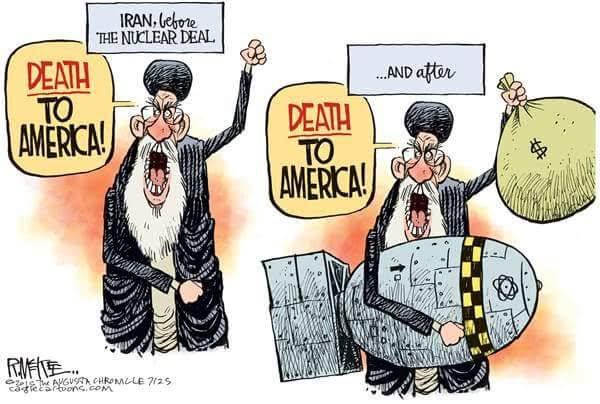
Cartoon of the day

July 26, 2015

H/t Freedom is just another word


death

U.S., Israel on collision course if Iran deal goes through

July 26, 2015

U.S., Israel on collision course if Iran deal goes through, Breitbart NewsJoel B. Pollak, July 26, 2015

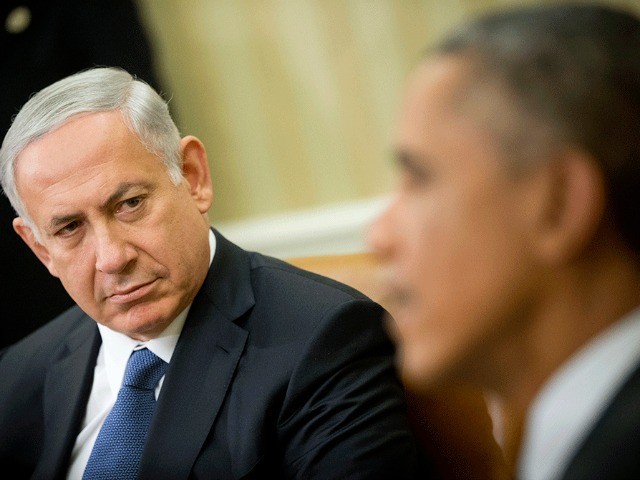
Netanyahu-stares-down-Obama-ap-640x480AP Photo/Pablo Martinez Monsivais

The Iran deal is President Obama’s most important “legacy” achievement. He sees it as the key to his vision of a “new equilibrium” in the region. In the past, he has “preempted” Israel’s preemptive capacity by leaking Israeli attack plans. He may do worse in future–unless Congress defeats the Iran deal and denies him that mandate.

**********************

On his visit to Israel in March 2013, President Barack Obama backed Israel’s right to use force to stop Iran from building a nuclear bomb.

At a joint news conference with Israeli Prime Minister Benjamin Netanyahu, Obama said: “…each country has to make its own decisions when it comes to the awesome decision to engage in any kind of military action, and Israel is differently situated than the United States. And I would not expect that the Prime Minister would make a decision about his country’s security and defer that to any other country…”.

Now, in the wake of the Iran deal, the Obama administration is sending dramatically different signals.On the Today show Friday, Secretary of State Kerry said of a pre-emptive Israeli strike on Iran: “That’d be an enormous mistake, a huge mistake with grave consequences for Israel and for the region, and I don’t think it’s necessary.”

Kerry later tried to deflect concerns that the Iran deal requires world powers to secure Iran’s nuclear facilities, downplaying the chance those clauses could be interpreted as requiring the U.S. to defend Iran against Israel.

Yet faced with a choice between defending Israel and defending the Iran deal, it is become clear that under some circumstances, the Obama administration would choose the latter. That is a radically different position from the one Obama took in public just a short time before formal negotiations began.

True, if Israel were to attack Iran preemptively, it would not be the first time it had done so without U.S. backing. President Ronald Reagan condemned Israel’s attack against Iraq in 1981; George W. Bush said “no” to Israel’s 2007 strike against Syria.

But Obama’s new stance suggests something stronger than mere disapproval.

The Iran deal is President Obama’s most important “legacy” achievement. He sees it as the key to his vision of a “new equilibrium” in the region. In the past, he has “preempted” Israel’s preemptive capacity by leaking Israeli attack plans. He may do worse in future–unless Congress defeats the Iran deal and denies him that mandate.

If the deal holds, Israel may soon face the impossible choice of whether to risk America’s new interests for the sake of its own survival.

Turkey Uses ISIS as Excuse to Attack Kurds

July 26, 2015

Turkey Uses ISIS as Excuse to Attack Kurds, Gatestone Institute, Uzay Bulut, July 26, 2015

(Please see also, Will Anyone Help the Kurds? — DM)

  • It appears as if the Turkish government is using ISIS as a pretext to attack the PKK (Kurdistan Workers’ Party).
  • Turkey just announced that its air base at Incirlik will soon be open to coalition forces, presumably to fight ISIS. But the moment Turkey started bombing, it targeted Kurdish positions in Iraq, in addition to targeting ISIS positions in Syria.
  • In Turkey, millions of indigenous Kurds are continually terrorized and murdered, but ISIS terrorists can freely travel and use official border crossings to go to Syria and return to Turkey; they are even treated at Turkish hospitals.
  • If this is how the states that rule over Kurds treat them, why is there even any question as to whether the Kurds should have their own self-government?

Turkey’s government seems to be waging a new war against the Kurds, now struggling to get an internationally recognized political status in Syrian Kurdistan.

On July 24, Turkish media sources reported that Turkish jet fighters bombed Kurdish PKK (Kurdistan Workers’ Party) bases in Qandil, in Iraqi Kurdistan, as well as the Islamic State (ISIS) in Syria.

Turkey is evidently unsettled by the rapprochement the PKK seems to be establishing with the U.S. and Europe. Possibly alarmed by the PKK’s victories against ISIS, as well as its strengthening international standing, Ankara, in addition to targeting ISIS positions in Syria, has been bombing the PKK positions in the Qandil mountains of Iraqi Kurdistan, where the PKK headquarters are located.

There is no ISIS in Qandil.

As expected, many Turkish media outlets were more enthusiastic about the Turkish air force’s bombing the Kurdish militia than about bombing ISIS. “The camps of the PKK,” they excitedly reported, “have been covered with fire.”

It appears as if Turkey’s ruling Justice and Development Party (AKP) is using ISIS as a pretext to attack the PKK. Ankara just announced that its air base at Incirlik will soon be open to coalition forces, presumably to fight ISIS, but the moment Turkey started bombing, it targeted Kurdish positions. Those attacks not only open a new era of death and destruction, but also bring an end to all possibilities of resolving Turkey’s Kurdish issue non-violently.

Prime Minister Ahmet Davutoglu announced that

“a second wave operation against Daesh [ISIS] in Syria was started. Just after that, a very comprehensive operation was carried out against the camps of the terrorist organization PKK in northern Iraq. I am glad that the targets were hit with great success. We have given instructions to start a third wave operation in Syria and a second wave operation in Iraq.”

The “great success” of the Turkish military has brought much damage and injury to even Kurdish civilians — including children. The Kurdish newspaper Rudaw reported that two Kurdish villagers in Duhok’s Berwari region were carried to hospital in the aftermath of a Turkish artillery bombardment in the Amediye region. One of the victims was 12 years old. The second victim lost a leg in an airstrike. Four members of the PKK were killed and several others were injured.

Shortly after military operations against the PKK started, access to the websites of pro-Kurdish newspapers and news agencies was denied “by decree of court.” These websites — including Fırat News Agency (ANF), Dicle News Agency (DIHA), Hawar News Agency (ANHA), Ozgur Gundem newspaper, Yuksekova News, Rudaw and BasNews — are still blocked in Turkey.

ISIS, meanwhile, has not so far made any statement regarding Turkey’s so-called bombings of ISIS in any of its media outlets.

Had Turkish military attacked the PKK alone, and not in addition to attacking ISIS, it would probably have received widespread international condemnation. So to add “legitimacy” to its attacks against the Kurdish PKK — whose affiliate Democratic Union Party (PYD) in Syria and its armed wing, the Kurdish People’s Defense Units (YPG) have been resisting ISIS and other Islamist terrorist groups since 2013 — Turkey declared that it will also attack ISIS. This would give it cover for its attacks against Kurdish fighters.

In 2014, Turkey’s President Recep Tayyip Erdogan described the plan he wanted to carry out in Syria and Iraq: “The problem in Syria should be taken into account. Iraq too should be considered similarly. Moreover, there needs to be a solution that will also deal with the Syrian wing [PYD] of the separatist terrorist organization [PKK].”

The AKP government, dissatisfied with the results of last month’s parliamentary elections, also seems to want to hold new elections, to push the mainly Kurdish HDP Party below the required 10% threshold, and thus force them out of parliament. Perhaps the government thinks that bombing the PKK will generate Turkish nationalist enthusiasm that will work in the AKP’s favor to help it regain a majority in early elections.

Apparently, Turkey does not need Kurdish deputies in its parliament. Apparently, the state prefers to slaughter or arrest the Kurds — as it has done for decades. Why hold talks and reach a democratic resolution when you have the power to murder people wholesale?[1]

Sadly, Turkey has preferred not to form a “Turkish-Kurdish alliance” to destroy ISIS. First, Turkey has opened its borders to ISIS, enabling the growth of the terrorist group. And now, at the first opportunity, it is bombing the Kurds again. According to this strategy, “peace” will be possible only when Kurds submit to Turkish supremacism and abandon their goal of being an equal nation.

In the meantime, Mevlut Cavusoglu, Turkish minister of foreign affairs, said that the Incirlik air base in Turkey has not yet been opened for use by the U.S. and other coalition forces, but that it will be opened in the upcoming period.

Kurdish forces, therefore, are the only forces that are truly resisting the Islamic State.

They have been repressed by Baghdad and murdered by Turkey and Iran.

If this is how the states that rule over Kurds treat them, why is there even any question as to whether the Kurds should have their own self-government?

As a result of the ISIS attacks in the region, the Kurdish PKK — as well as its Syrian Kurdish affiliate, Democratic Union Party (PYD) and its armed wing, Kurdish People’s Defense Units (YPG) — have emerged as the America’s most effective battlefield partners against ISIS. Ever since ISIS became a major force in Syria, the U.S. has apparently relied heavily on YPG to stop ISIS from advancing. According to Henri Barkey, a former State Department specialist on Turkey, “The U.S. has become the YPG’s air force and the YPG has become the U.S.’s ground force in Syria.”

* * *

Attacks on the Kurds were already under way last week. On July 20, a bomb attack in the Kurdish town of Suruc (Pirsus) in Turkey killed 32 people during a meeting of young humanitarian activists, who were discussing the reconstruction of the neighboring Kurdish town of Kobane.

1171The scene of the suicide bombing in Suruc, Turkey. An ISIS suicide bomber murdered 32 people and wounded more than 100 others in a July 20 attack on Kurdish humanitarian activists. (Image source: VOA video screenshot)

The blast took place while the activists were making a statement to the press in the garden of a cultural center. At least 100 others, mostly university students, were wounded. (Graphic video of the explosion)

The suicide bomber was identified through DNA testing, according to reports in the Turkish news media. Seyh Abdurrahman Alagoz was reportedly a 20-year-old Turkish university student, recently returned from Syria, and believed to have had ties to ISIS.

Alagoz targeted a meeting 300 secular activists, members of the Federation of Socialist Youth Associations (SGDF), who gathered at a cultural center in the province of Urfa, opposite the Kurdish town of Kobane in Syrian Kurdistan. As part of an effort to rebuild Kobane, they were preparing to provide aid, give toys to the children there and build a hospital, school, nursery, children’s park, library and a memorial forest for those who had lost their lives in Kobane.

“Work on the building of hospitals and schools needs to be done,” Oguz Yuzgec, the co-president of the federation, said before the explosion. “One of the things we will do is to build a children’s park in Kobane. We will name it after Emre Aslan, who died fighting in Kobane. We are collecting toys. We will participate in the construction of the nursery that the canton of Kobane is planning to build. We have the responsibility of helping the nursery function. We need everybody who knows how to draw and can teach children.”

Mazlum Demirtas, a survivor of the attack, said: “The main one responsible for this incident is the state of Turkey, the AKP fascism, the AKP dictatorship. … It attacked us with its gunmen and gangs. Since yesterday, parents have been collecting the dismembered body parts of their children. They are trying to identify the dismembered bodies. This is called fascism, inhumanity and barbarity.”

Pinar Gayip, another survivor of the attack, said in a telephone interview on the pro-government Haberturk TV that, “Instead of helping the wounded, the murderer-police of the murderer-AKP threw tear gas at the vehicles with which we carried the wounded.” She was taken off the air.

All across Turkish Kurdistan, there were protests condemning the massacre and the government’s alleged involvement in it. Police in Istanbul used plastic bullets and water cannonsagainst people who gathered to remember those murdered in Suruc.

The Turkish authorities briefly blocked access to Twitter last Wednesday to prevent the people from viewing photos of the bombing in Suruc. Officials admitted that Turkey had asked Twitter to remove 107 URLs (web addresses) with images related to the bombing; before the ban, Twitter had already removed 50.

Selahattin Demirtas, the co-chair of the pro-Kurdish Peoples’ Party (HDP), said that state surveillance activities were intensive in Suruc, and that the intelligence service was recording the identity of everyone traveling to and from Suruc.

As Demirtas’s own convoy had recently not been permitted to enter Suruc, he emphasized the extent of state surveillance in the town, and said that nobody could argue that someone could have managed to infiltrate the crowd and carry out the suicide attack without state support.

“Today, we have witnessed in Suruc yet again what an army of barbarity and rape, an army that has lost human dignity, can do,” Demirtas said. “Those who have been silent in the face of ISIS, who have not dared even raise their voice to it, as well as the officials in Ankara who threaten even the HDP every day but caress the head of ISIS, are the accomplices of this barbarity.”

In the meantime, Mehmet Gormez, the head of the Turkish Presidency of Religious Affairs (Diyanet), announced on its Twitter account that the perpetrators of the Suruc attack do not have religion.

However, three days before the massacre in Suruc, about 100 Islamists — alleged to be ISIS sympathizers — had performed mass Islamic Eid prayers in Istanbul. They demanded Islamic sharia law instead of democracy. ISIS sympathizers had performed the same Eid prayers at the same place the year before, as well.

Over the border in Syrian Kurdistan, shortly after the blast in Suruc, a suicide bomber detonated a car bomb at a checkpoint in Kobane. Two Kurdish fighters were killed in the explosion, according to Rami Abdel Rahman, director of the Syrian Observatory for Human Rights.

Last month, a deadly blast hit the Kurdish province of Diyarbakir in Turkey, during an election rally of the pro-Kurdish HDP that was attended by tens of thousands of people. Just before the HDP co-chair Selahattin Demirtas was going to speak, two bombs exploded at different places. Four people were killed, and more than 100 people are estimated to have been wounded. One of the wounded, Lisa Calan, 28, a Kurdish art director from Diyarbakir, lost both legs in the explosion.

As the wounded were being carried to hospitals, police used tear gas against people trying to run from the area in panic

The bomber was reported to be a member of ISIS.

* * *

In Turkey, millions of indigenous Kurds are continually terrorized and murdered, while ISIS terrorists can freely travel and use official border crossings to go to Syria and return to Turkey; they are even treated at Turkish hospitals. Emrah Cakan, for instance, a Turkish-born ISIS commander wounded in Syria, got medical treatment at the university hospital in Turkey’s Denizli province in March.

The Denizli governor’s office issued a written statement on 5 March:

“The treatment of Emrah C. at the Denizli hospital was started upon his own application. The procedural acts concerning his injury were conducted by our border city during his entry to our country and they still continue. And his treatment procedures continue as a part of his right to benefit from health services just like all our other citizens have.”

The “compassion” and hospitality that many Turkish institutions have for ISIS members is not even hidden. The silence of the West is mystifying and disappointing.

The U.S. government cooperates with oppressive regimes — including the terrorist regime of Iran, under which Kurds are forced to live — to the detriment of the Kurds, to the detriment other persecuted peoples, and to the detriment of the future of the West.

Many Middle Eastern regimes are ruled by Islamist, often genocidal governments — so there is not much to expect from them in terms of human rights and liberties.

The Kurds need real support, real arms and real recognition. Otherwise, there does not seem to be much difference between the dictatorial, genocidal Middle Eastern regimes and the West, which used to represent democracy and freedom.
_____________________________

[1] The so-called “peace process” was reportedly started in 2012 and through it, Kurds and the Turkish government were to resolve the Kurdish issue through negotiations.)

Op-Ed The consequences of a bad deal with Iran

July 26, 2015

Op-Ed The consequences of a bad deal with Iran, LA Times, John Bolton, July 26, 2015

American weakness has brought us to this difficult moment. While we obsessed about its economic discomfort, Iran wore its duress with pride. It was never an even match. We now have to rely on a tiny ally to do the job for us. But unless we are ready to accept a nuclear Iran (and, in relatively short order, several other nuclear Middle Eastern states), get ready. The easy ways out disappeared long ago.

***************************

President Obama has made an art form of attacking his opponents rather than substantively defending his own policies, most recently regarding the Vienna agreement on Iran’s nuclear program. Essentially, Obama argues that we must either accept his wretched deal or go to war to prevent Iran from acquiring nuclear weapons.

As is typical, Obama posits the wrong choice, apparently to distract from the unpleasant reality that the agreement won’t work. It will not prevent Iran from getting nuclear weapons. So the real choice we are faced with is dealing with the consequences of military action or the consequences of a nuclear Iran. Neither is palatable, but the latter is far worse. If the real objective is stopping Iran from getting nuclear weapons, preemptive military action is now inescapable.

This rock-and-hard-place outcome has long been foreseeable. Iran’s dogged determination to become a nuclear-weapons state was fiercer and stronger than the West’s frail response. Assuming Iran scrupulously complies with every provision agreed to in Vienna — an absurdly unlikely scenario given the ayatollahs’ objectives and history — its ambitions for nuclear weapons will simply have been delayed eight to 10 years.

In all likelihood, the ayatollahs are already at work violating the accords. After all, Iran has systematically breached its voluntarily-assumed obligations under the Nuclear Non-Proliferation Treaty for more than 30 years. Now the president’s deal will allow Iran to keep the fruits of its violations. Yes, the deal includes restrictions on uranium enrichment, but Tehran can retain its enrichment program, with guaranteed international assistance in improving it. These concessions are fatal mistakes.

Moreover, Iran’s ballistic missile efforts — its development of the means to deliver nuclear weapons all over the world — will barely be touched. Nor does the deal in any way address Iran’s clandestine weaponization efforts, which it has denied and hidden from the International Atomic Energy Agency with great skill.

Last week, the news that the administration has not even seen the texts of two agreements between the energy agency and Iran, both crucial to implementation of the Vienna accords, only raises further doubts. President Obama must provide the texts of these “side deals” to Congress before any serious consideration of the overall agreement is possible.

Some critics of Obama’s plan advocate scuttling the deal and increasing economic sanctions against Iran instead. They are dreaming. Iran and the United States’ negotiating partners have already signed the accords and are straining at their leashes to implement them. There will be no other “better deal.” Arguments about what Obama squandered or surrendered along the way are therefore fruitless. As for sanctions, they were already too weak to prevent Iran’s progress toward the bomb, and they will not be reset now. To paraphrase Bruce Springsteen, “These sanctions are going boys, and they ain’t coming back.”

Patrick Clawson, the director for research at the Washington Institute for Near East Policy, provided the most recent thumbs-down assessment of sanctions: “Iran has muddled through the shock of the sanctions imposed in 2012, and its structural [economic] problems are not particularly severe compared to those of other countries.” He estimates Iran’s nuclear and terrorism-support programs to cost only about $10 billion annually. No wonder administration officials have testified that sanctions (including those imposed piecemeal before 2012) did not slow Iran’s nuclear efforts.

Nor will the deal’s “snapback” mechanism (intended to coerce Iran back into compliance if it breaches its obligations) change that reality. Tehran’s belligerent response is expressly stated in the agreement’s text: “If sanctions are reinstated in whole or in part, Iran will treat that as grounds to cease performing its commitments … in whole or in part.” Tehran does risk losing some future economic benefits should sanctions snap back, but by then it will have already cashed in the assets the deal unfreezes and signed new lucrative trade and investment contracts.

Once those benefits begin flowing all around, the pressure on world governments will only increase to ignore Iranian violations, or to treat them as minor or inadvertent, certainly not warranting the reimposition of major sanctions. The ayatollahs have dusted off Lenin’s barb that “the capitalists will sell us the rope with which we will hang them,” and applied it to the age of nuclear proliferation.

If diplomacy and sanctions have failed to stop Iran, diplomacy alone will fail worse. Like it or not, we now face this unpleasant reality: Iran probably will violate the deal; it may not be detected doing so and if detected, it will not be deterred by “snapback” sanctions. So we return to the hard question: Are we prepared to do what will be necessary to stop Iran from getting nuclear weapons?

Obama most certainly is not, which means the spotlight today is on Israel.

If Israel strikes, there will be no general Middle East war, despite fears to the contrary. We know this because no general war broke out when Israel attacked Saddam Hussein’s Osirak reactor in 1981, or when it attacked the North Korean-built Syrian reactor in 2007. Neither Saudi Arabia nor other oil-producing monarchies wanted those regimes to have nuclear weapons, and they certainly do not want Iran to have them today.

However, Iran may well retaliate. At that point, Washington must be ready to immediately resupply Israel for losses incurred by its armed forces in the initial attack, so that Israel will still be able to effectively counter Tehran’s proxies, Hamas and Hezbollah, which will be its vehicles for retaliation. The United States must also provide muscular political support, explaining that Israel legitimately exercised its inherent right of self-defense. Whatever Obama’s view, public and congressional support for Israel will be overwhelming.

American weakness has brought us to this difficult moment. While we obsessed about its economic discomfort, Iran wore its duress with pride. It was never an even match. We now have to rely on a tiny ally to do the job for us. But unless we are ready to accept a nuclear Iran (and, in relatively short order, several other nuclear Middle Eastern states), get ready. The easy ways out disappeared long ago.