Archive for July 2015

There Is No Iran Deal: West, Iran Differ Sharply over Terms

July 20, 2015

There Is No Iran Deal: West, Iran Differ Sharply over Terms

by Joel B. Pollak

20 Jul 2015

via There Is No Iran Deal: West, Iran Differ Sharply over Terms – Breitbart.

The United Nations Security Council voted 15-0 on Monday to pass Resolution 2231, which endorses the Iran nuclear deal–“the Joint Comprehensive Plan of Action [JCPOA] signed in Vienna by the five permanent members of the Council, plus Germany, the European Union and Iran.” However, there are already sharp disagreements between Iran and the rest of the world as to what that deal actually means.

Iran’s Foreign Ministry claims, for example, that the deal does not actually cover its ballistic missile program, as advertised. Restrictions on ballistic missiles are to be ended after eight years, according to the JCPOA. However, Iran says, according to the Times of Israel, that the UN Security C0uncil resolution and the deal do not apply to its own missiles because they “have not been conceived to carry nuclear weapons.”

Similarly, there is confusion as to whether the deal prevents Iran from accelerating its nuclear program after the deal expires, or whether that is just an option. Such (voluntary) restrictions would have to be approved under the Additional Protocol to the Non-Proliferation Treaty, which the Iranian parliament is supposed to ratify, but there is no deadline for it to do so; it could wait until deal expires, in theory.

Alan Dershowitz, who has worked on UN resolutions on the Middle East, suggests there may not have been a “meeting of the minds” on the Iran deal at all: “Is it a postponement for an uncertain number of years — 8, 10, 13, 14, 15 — of Iran’s ability to develop a nuclear weapon? Or is it an assurance that ‘Iran will not be able to develop a nuclear weapon?’”

These differences go far beyond the usual disputes over the precise interpretations of terms in an agreement. There seems to be a wide gulf between Iran and the West about what, in fact, is covered by the agreement. Other areas of confusion in the deal include access for international inspectors to Iranian military sites, which the Iranian Revolutionary Guard Corps apparently is refusing to accept or allow.

It will be hard to enforce a deal that is not, in fact, an agreement.


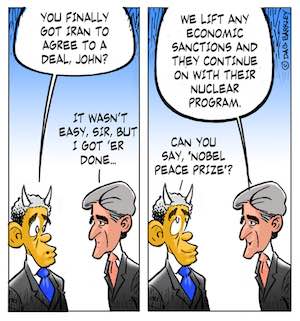
Cartoon of the day

July 20, 2015

H/t Joopklepzeiker

DAG071515

Islam, Imam Obama, Sir John of Kerry and a great deal for Iran | Part II

July 20, 2015

(The views expressed in this post are mine, and do not necessarily reflect those of Warsclerotic or its other editors. — DM)
Oh what a tangled web we weave, when first we practice to deceive.

Dealing from the Bottom

The current “deal” is based on a long-standing scam

Part I of this series, published on July 14, 2015, pointed out what should be a glaring consistency in the “Joint Comprehensive Plan of Action,” first made available on that date, and the November 24, 2013 Joint Plan of Actionneither provides for any “anytime -anywhere” inspections of Iran’s nuclear weaponization or missile sites. That consistency has been little remarked upon elsewhere.

Secretary Kerry now acknowledges that he never sought such inspections.

Leaving aside the twenty-four day lag between an IAEA request to inspect suspect facilities — which Kerry says is just fine — he claims that we now have a “unique ability” to get the U.N. Security Council to force inspections and reinstate sanctions. However, any effort to do so would almost certainly be vetoed by one or more Security Council members. The permanent members are China, France, Russia, the United Kingdom, and the United States — five of the members of P5+1 which approved the “deal.”

On July 16th, US Under Secretary of State Wendy Sherman said,

“I think this is one of those circumstances where we have all been rhetorical from time to time,” Sherman said in a conference call with Israeli diplomatic reporters. “That phrase, anytime, anywhere, is something that became popular rhetoric, but I think people understood that if the IAEA felt it had to have access, and had a justification for that access, that it would be guaranteed, and that is what happened.” [Emphasis added.]

Kerry also claimed that the massive financial boost for Iran resulting from the lifting of sanctions will not enhance Iran’s support for terrorism.

Speaking to the BBC after the nuclear agreement between Iran and six world powers was reached, Kerry said that the more than $100 billion that Iran is set to receive “is going to make all the difference in the world is just – it’s not true.”

Acknowledging Iran is an international player in wreaking terror across the globe, Kerry said, “What Iran has done for years with Hezbollah does not depend on money.” He similarly stated Iran’s support of the Houthi rebels against the government in Yemen has not “depended on money.” [Emphasis added.]

. . . .

In its most recent report, the State Department wrote, “Iran has provided hundreds of millions of dollars in support of Lebanese Hezbollah in Lebanon and has trained thousands of its fighters at camps in Iran.”

In 2010 alone, State reported “Iran provides roughly $100-$200 million per year in funding to support Hezbollah.”

Secretary Kerry is almost certainly wrong, on that as on other aspects of the “deal.”.

Here’s Megan Kelly’s wrap up.


Iran may reject the “deal.”

There are at least glimmers of hope that Iran may reject the “deal,” unanimously endorsed by the UN Security council today.

A UN Security Council resolution endorsing Iran’s nuclear deal that passed on Monday is unacceptable, the country’s Islamic Revolutionary Guards Corps commander Mohammed Ali Jafari was quoted as saying by the semi-official Tasnim News Agency.

“Some parts of the draft have clearly crossed the Islamic republic’s red lines, especially in Iran’s military capabilities. We will never accept it,” he was quoted as saying shortly before the resolution was passed in New York. [Emphasis added.]

The Iranian Parliament also has problems with the “deal.”

On Saturday, the Fars News Agency reported that the Majlis threatened to reject the agreement’s provision on ballistic missiles, which call for an international embargo on missile technology to be extended for eight years–a significant, last-minute concession by the U.S.

Iran wants unrestricted ballsitic missile development and access to conventional arms dealers abroad.

“The parliament will reject any limitations on the country’s access to conventional weapons, specially ballistic missiles,” said Tehran MP Seyed Mehdi Hashemi.

. . . .

In addition, the nuclear deal says that the Majlis will ratify the Additional Protocol (AP) to the Non-Proliferation Treaty–but it does not say when.

The AP is the key to long-term monitoring of Iranian nuclear research and development by the International Atomic Energy Agency (IAEA). Without approval of the AP, Iran may hide key information about its nuclear activity, and may accelerate advanced centrifuge research immediately when the nuclear deal expires, among other hazards. (Even then, its commitments under the AP will be somewhat voluntary.) [Emphasis added.]

. . . .

[W]hile the interim agreement of Nov. 2013 provided that Iran would ratify the AP within one year, there is no such deadline in the final Iran deal. The AP is merely to be applied “provisionally,” while the Majlis decides whether to accept it or not.

Meanwhile, if the Obama administration has its way, the U.S. Congress will have no opportunity to amend the deal–and will have to accept the lifting of international sanctions regardless of whether legislators accept or reject the agreement. [Emphasis added.]

Iranian leadership’s opposition to the “deal” appears to have come from Iran’s Supreme leader and the Iranian Parliament has the authority to reject the “deal.”

As expected, Ayatollah Ali Khamenei’s reaction to the nuclear deal was utterly different from that of President Hassan Rouhani. Right after the agreement was announced on July 14, Rouhani appeared on state television and praised the outcome. Yet when he and other officials visited Khamenei’s home a few hours later, the Supreme Leader did not say anything about the deal apart from a few lines thanking the negotiators. This reticence signaled to hardliners that they should increase their attacks on the agreement. [Emphasis added.]

America’s Supreme Leader, on the other hand, has been pushing vigorously to force the U.S. Congress to approve it, with no way to change it.


The “deal,” and Obama’s foreign policy in general, are rooted in His affinity for Islam

Obama may or may not be a Muslim. However, He thinks very highly of Islam and deems it the “religion of peace.” It would be ironic were Obama’s Iran “deal” to be rejected by Iran.

As observed in a Jerusalem Post article, with the thrust of which I agree, His affinity for Islam is at the root of His “deal.”

Obama is the first US president who genuinely conceives of Islam as not inherently opposed to American values or interests.

. . . .

It is through this Islamo-philic prism that the Obama administration’s attitude to, and execution of, its foreign policy must be evaluated – including its otherwise incomprehensible capitulation this week on Iran’s nuclear program. [Emphasis added.]

. . . .

The inspection mechanism provided for in the nascent deal make a mockery of Obama’s contention (July 14): “… this deal is not built on trust; it is built on verification,” and, “Because of this deal, inspectors will also be able to access any suspicious location… [They] will have access where necessary, when necessary.”

One can hardly imagine a more grossly misleading representation of the deal – so much so that it is difficult not to find it strongly reminiscent of the Muslim tactic of taqiya (the religiously sanctioned deception of non-Muslims). [Emphasis added.]

Indeed, immediately following the announcement of the agreement, Ben Rhodes, Obama’s deputy national security adviser, made a stunning admission to CNN’s Erin Burnett. Starkly contradicting the president’s contention of “access where necessary, when necessary,” Rhodes conceded, “We never sought in this negotiation the capacity for so-called anytime, anywhere,” which is diametrically opposed to the impression he conveyed in April this year when queried on this issue. [Emphasis added.]

In His capacity as America’s Imam in Chief, Obama has consistently claimed that the “religion of peace” has nothing to do with the Islamic State or with Islamic terrorism (of which he claims there is none) — such as the recent murder of four members of the U.S. Marines and one member of the U.S. Navy — committed in the name of Allah. The Daily Beast has posted some of the terrorist’s writings. They include these statements:

“I would imagine that any sane person would devote their time to mastering the information on the study guide and stay patient with their studies, only giving time for the other things around to keep themselves focused on passing the exam,” Abdulazeez wrote. “They would do this because they know and have been told that they will be rewarded with pleasures that they have never seen.”

This life is that test, he wrote, “designed to separate the inhabitants of Paradise from the inhabitants of Hellfire.”

. . . .

“We ask Allah to make us follow their path,” Abdulazeez wrote. “To give us a complete understanding of the message of Islam, and the strength the live by this knowledge, and to know what role we need to play to establish Islam in the world.” [Emphasis added.]

Obama apparently considers the Islamic Republic of Iran to be Islamic — and therefore peaceful — despite its widespread support for its terrorist proxies. That may explain the credence He gives to Supreme Leader Khamenei’s alleged fatwa preventing Iran from obtaining nukes. Obama and Khamenei have frequently referred to it in support of that proposition, although no text been produced. According to a Washington Post article dated November 27, 2013,

Oddly, the Iranian Web site does not provide the text of the original fatwa — and then mostly cites Western news reports as evidence that Khamenei has reiterated it on several occasions. The fatwa does not appear to be written, but in the Shiite tradition equal weight is given to oral and written opinions.

. . . .

Just about every Alfred Hitchcock thriller had what he called a “MacGuffin” — a plot device that gets the action going but is unimportant to the overall story. The Iranian fatwa thus appears to be a diplomatic MacGuffin — something that gives the Americans a reason to begin to trust the Iranians and the Iranians a reason to make a deal. No one knows how this story will end, but just as in the movies, the fatwa likely will not be critical to the outcome. [Emphasis added.]

Even if one believes the fatwa exists — and will not later be reversed — it clearly appears to have evolved over time. U.S. officials should be careful about saying the fatwa prohibits the development of nuclear weapons, as that is not especially clear anymore. The administration’s statements at this point do not quite rise to the level of  earning Pinocchios, but we will keep an eye on this issue. [Emphasis added.]

An April 6, 2015 article at the Middle East Media Research Institute provides additional information.

In March of this year Obama presented a Nowruz message to the people of Iran citing Khamenei’s alleged fatwa. Here’s a video from the White House.

Here are a few interesting excerpts:

“Our negotiations have made progress, but gaps remain,” he said. “And there are people, in both our countries and beyond, who oppose a diplomatic resolution. My message to you—the people of Iran—is that, together, we have to speak up for the future we seek. [Emphasis added.]

“As I have said many times before, I believe that our countries should be able to resolve this issue peacefully, with diplomacy,” Obama said. “Iran’s Supreme Leader Ayatollah Khamenei has issued a fatwa against the development of nuclear weapons, and President Rouhani has said that Iran would never develop a nuclear weapon. [Emphasis added.]

Isn’t that special! Why, in light of the alleged fatwa, does Iranian television broadcast simulations of nuclear attacks on Israel?

A short animated film being aired across Iran, shows the nuclear destruction of Israel and opens with the word ‘Holocaust’ appearing on the screen, underneath which a Star of David is shown, Israel’s Channel 2 reported on Tuesday.

Khamenei’s Death to America rants are considered an excellent reason to have a “deal.”

Similarly, the Reverend Jeremiah Wright was fond of saying “God Damn America.”

Obama apparently understood Khamenei’s words, but perhaps He didn’t understand Jeremiah’s words.


Conclusions

Elected on a platform of Hope and Change, Obama has brought us many changes; very few, if any, of those changes provide a basis for hope, at least until He has left office. Some will be difficult, if not impossible, even then to ameliorate. During His remaining time in office, He will continue to do His worst to eliminate any vestigial hope we may have. The “deal” with Iran is only one of the many changes for the worse that He has wrought.

Obama tells Congress to take note after UN okays Iran deal

July 20, 2015

Obama tells Congress to take note after UN okays Iran deal

President says pact proves diplomacy best option; Iranian envoy accuses Israel of fearing peace; Jerusalem ambassador says passage marks ‘sad day’

By Marissa Newman and AFP July 20, 2015, 7:27 pm

via Obama tells Congress to take note after UN okays Iran deal | The Times of Israel.

Iran's envoy to the UN Gholamali Khoshroo speaks during a Security Council meeting after a vote on the Iran resolution at UN headquarters in New York, July 20, 2015. (AFP/Jewel Samad)

Iran’s envoy to the UN Gholamali Khoshroo speaks during a Security Council meeting after a vote on the Iran resolution at UN headquarters in New York, July 20, 2015. (AFP/Jewel Samad)


S President Barack Obama on Monday hailed the passage of a UN Security Council resolution backing his nuclear deal with Iran, saying he expected a skeptical Congress to follow suit.

At the same time, Iran’s envoy to the United Nations derided Israel for spreading “Iranophobia,” and treating peace “as an existential threat.” And Jerusalem’s ambassador slammed the “tragedy” of the unanimous Security Council approval of the agreement, which paves the way to lifting long-standing sanctions on Iran.

Obama said he hoped the passage earlier Monday would “send a clear message that the overwhelming number of countries” recognize that diplomacy is “by far our strongest approach to ensuring that Iran does not get a nuclear weapon.

“There is broad international consensus around this issue,” Obama added. “My working assumption is that Congress will pay attention to that broad basic consensus.”

The UN Security Council earlier unanimously adopted a resolution endorsing the historic deal on Iran’s nuclear program and cleared a path to lift the sanctions crippling its economy.

The 15-0 approval of the deal clears a hurdle for the landmark pact, which will now go before the US Congress where it may face an uphill battle for confirmation.

Among those in the session were Iranian ambassador Gholamali Khoshroo, who condemned Israeli efforts to torpedo the deal.

The “Israeli regime, following its general policy to stoke tension in the region, has done whatever is in its power to sabotage and defeat any effort towards resolving the standoff over Iran’s nuclear energy program,” he said, according to a transcript by the Tasnim News Agency. “In so doing, it proves once more that it doesn’t see peace in our region in its interest and considers peace as an existential threat to itself.”

Jerusalem has tried to spread “Iranophobia” in both the Middle East and the world, “to serve this nefarious purpose,” the Iranian envoy continued.

“Thus, we alert our friends and neighbors not to fall into their trap,” he added.

While praising the deal, Khoshroo criticized the international sanctions on Iran which, he claimed, were “grounded on nothing but baseless and pure speculation and hearsay.” He said Iran will not quickly forget the world’s past relations with the Islamic Republic.

“In engaging with E3/EU+3, the Iranian people have had the foresight to move forward, without losing sight of the past,” he said, referring to the six world powers that negotiated the agreement.

“Therefore, while we hope that the Security Council will open a new chapter in its relations with Iran, we cannot accept or forget its previous treatment of Iran, starting from its inaction in the face of Saddam’s aggression and the use of chemical weapons to its more recent treatment of the Iranian peaceful nuclear program.”

Tehran “is resolute in fulfilling its obligations,” he stated, and “we expect that our counterparts remain also faithful to theirs.”

‘A very sad day’

Speaking in the UN — although not in the Security Council — Israeli envoy Ron Prosor lamented the international support for the Iran deal.

“Today’s a very sad day. Not only for Israel, but for the entire world, even if at this moment the international community refuses to see the tragedy,” he said. “It’s a sad day, because the international community is taking its first steps to lift sanctions on Iran without waiting to see if it complies with even one obligation.”

The UN just “awarded a great prize to the most dangerous country in the world,” Prosor said of the resolution.

Israeli envoy to the UN Ron Prosor addressing the UN Security Council, November 11, 2014. (Courtesy of the Israeli Mission to the UN)

“In future years, the consequences of this mistake will become clear to all. But for Israel, tomorrow is already too late,” Prosor continued.

The UN vote came shortly after the European Union approved the nuclear deal, okaying the pact between the five permanent members of the Security Council plus Germany and Iran, which lifts punishing economic sanctions on Tehran in exchange for temporary curbs on nuclear activity. Ambassadors from the so-called P5+1 touted the deal in a Security Council debate following the vote.

On condition that Iran respects the agreement to the letter, seven UN resolutions — passed since 2006 to sanction Iran — will be gradually terminated, according to the text of the deal, reached in Vienna last week.

McFarland on Kerry’s Iran Inspections Claim: ‘It’s A Lie’

July 20, 2015

McFarland on Kerry’s Iran Inspections Claim: ‘It’s A Lie’

BY:
July 20, 2015 10:20 am

via McFarland on Kerry’s Iran Inspections Claim: ‘It’s A Lie’ | Washington Free Beacon.

KT McFarland offered a blunt appraisal Monday of Secretary of State John Kerry’s claim that the U.S. had never sought “anytime, anywhere” inspections of Iran’s suspected nuclear sites.

“It’s a lie,” McFarland, a former State Department official for Ronald Reagan, said. “The reason anytime, anyplace inspections are crucial is because Iran in the past has cheated, so you really need ironclad inspections.”

“You think he was lying?” Fox News host Bill Hemmer asked.

“I think he wants this deal so badly he’s willing to stretch the truth around this,” McFarland responded.

Several of Kerry’s close confidants during the Iran negotiations, including Secretary of Energy Ernest Moniz and Deputy National Security Adviser Ben Rhodes, are on record earlier in the year assuring reporters that the U.S. would insist on “anytime, anywhere” inspections as part of any deal.

McFarland said the inspections process that the U.S. ultimately agreed to gives Iran the ability to stall inspectors for almost a month before they can visit a suspicious site.

“When the president said that we have 24-hour access to key nuclear installations, no you don’t—you have a 24-day period to request to look inside, and Iran has 24 days to say yes you can or no you can’t,” McFarland said.

Observers have expressed grave concern about the complicated bureaucratic mechanism that the U.S. will have to fight through at the U.N. to gain approval for an IAEA inspection.

By the time inspectors reach a suspected site, they may find only “elaborate cleanup efforts” like those that have been found at Iran’s Parchin military complex during past inspections.


Senior defense source: IDF preparing for possible covert Iranian nuclear production

July 20, 2015

Senior defense source: IDF preparing for possible covert Iranian nuclear production

via Senior defense source: IDF preparing for possible covert Iranian nuclear production – Arab-Israeli Conflict – Jerusalem Post.
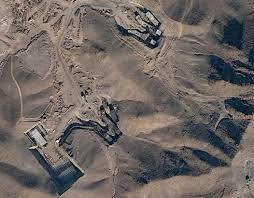
A SATELLITE view of the Fordow nuclear plant. The plant will not be shut down under the Vienna agreement, but no enrichment will be allowed there.

The IDF is seeking government commitment to a multi-year defense spending plan – a commitment that has been absent for the past several years – as it prepares to deal with the possibility of a covert Iranian attempt to break through to nuclear weapons production, a senior defense source said on Sunday.

The source said the IDF needs to assume that its most severe “reference scenarios” regarding Iran, Hezbollah, Hamas, and ISIS will come true, in order to correctly use the coming years to reshape the military, improve training, and make cost cutting reforms that include the shedding of 100,000 reservists and 5000 career soldiers.

The multi-year budget commitment from the government –  absent for the past several years – will be necessary to reshape the military and improve training to meet those challenges while at the same time, implementing cutting reforms that include the shedding of 100,000 reservists and 5000 career soldiers.

Other proposed changes include military restructuring to create specialized war fighting and border security divisions that do not overlap one another.

The source spoke ahead of the publication of the findings of the Locker Commission, due on Tuesday, on the defense budget. The commission is expected to call on the IDF to reduce itself in size by a third – a recommendation defense sources described as being completely out of tune with Israel’s security environment.

Decision-makers weighing the future defense budget will have to take stock of the current and future threats to Israel, the risk management system they wish to employ, and the national strategy to deal with threats. They will have to define “the results they want from the military,” the source said.

Looking at the latest threat assessments, the source said, “I’m not saying this is what will happen, but we are preparing for a scenario in which, Iran after the agreement, moves into covert nuclear production.”

He added that no one within the Israeli defense establishment thinks Iran has given up on its vision of reaching a nuclear capability in the future.

“The IDF’s role, and test, is based on capabilities. The working assumption is that they [the Iranians] will try in the near future…to go for a basic [nuclear] capability. The assumption is that there will be an Iranian pattern of action through the covert [nuclear] channel. I think it’s right to assume this severe assumption, in light of our familiarity with the Iranians,” the source stated.

In addition, “there’s no doubt that lifting the sanctions will enable Iran to activate its influence in the region in a discernible and significant manner, more so than today,” he said.

Iran is currently spending 4 – 5 billion dollars on its proxies and clients. “The restraint for Iranian activities on the other side of our borders comes from economic limitations. There’s no doubt that lifting the sanctions will lead to an increase in Iranian influence and terrorism,” the source said.

Despite international bans on Iranian arms trafficking, Tehran “does this all the time, and they will continue to do it in the future in Syria, Lebanon, and to other elements,” he added.

“Iran will be a central challenge for the IDF during this time. It will be a mission for Military Intelligence to [continue] monitoring, intelligence, and [provide] alerts. The intelligence will focus on Iranian [nuclear] efforts and [the regional] influence. Iran will continue to be the IDF’s first mission, as it has been defined since 2006,” he said.

This, alongside the collapse of the old order in the Middle East, the “galloping forward” of ISIS in Syria, Sinai, and Gaza, and traditional hybrid threats in the form of Hezbollah and Hamas, form the basis of the Gideon plan.

Military planners, led by IDF Chief of Staff Lt.-Gen. Gadi Eisenkot (who was deputy chief of staff in his previous role), have spent four years drawing up the Gideon plan.

It calls for significantly increasing the power of wartime multi-arena combat divisions, restructuring the army to create specialized brigades and battalions that focus exclusively on border security and leave the war fighting to the divisions, and improving weapons and and training.

“Hezbollah is the most significant enemy in our first circle,” the source said, using a term to refer to the countries that border Israel.

“Hezbollah has 100,000 rockets, although it is in the most difficult crisis point since its founding. It lost 1300 fighters in Syria, and sustained over 5000 injuries,” he said. The Shi’ite organization finds itself facing more than “two million Sunnis in Lebanon, due to the arrival of 1.6 million [Syrian] Sunnis.” ISIS has become Hezbollah’s “central enemy,” he added.

In both the West Bank and Gaza, Hamas is a central enemy of Israel, the source added. “We are trying to limit it in both arenas.” “Our required achievement is to be able to go war, while preventing any ground-based or aerial territorial achievements for our enemies, and minimizing the enemy’s achievement in the realm of projectile fire on Israel,” he said.

Israel’s ability to launch strikes on its enemies’ rocket and missile bases has grown “100 fold” in the past nine years, he added. Israel’s intelligence infiltration of Hezbollah is very high, according to the source. All of these capabilities “cost money,” he added.

“I don’t know any enemy that can stand up to our battalion or brigade battle group,” said the source.

“We demand [of ourselves] absolute land and naval superiority, and minimizing harm to Home Front Command as much as possible.” The IDF is working on addressing shortcomings, such as shortages in ammunition.

Turning to the Gideon plan, the source stated its goals as “magnifying deterrence in the region, being on high alert, and increasing the window of calm and normalcy around the state of Israel as much possible, to give the country time to flourish.”

A covert Israeli ‘war between wars’ against its enemies, which is ongoing, helps increase Israeli deterrence, limits armament efforts by foes, and sets up better conditions for a future conflict, he said.

The source stressed, however, that he sees “not only threats but also a big opportunity to adapt the IDF to future challenges. This is the basis of the Gideon multi-year program.”

The Gideon plan calls for significant cost cutting in the form of letting go of 100,000 reservists. “Those who are left will be better trained, equipped, and ready for war,” said the source. “The same is true of [reforms to] quality platforms in the air, sea, and on the ground.”

The plan calls for a new model for career soldiers, after shedding 5,000 of them. Under the new model, career soldiers like brigade and battalion commanders will be younger, and fewer.

According to the IDF’s calculations, it saves a billion shekels in salaries and pensions per 1000 career soldiers let go of service.

Cuts to reserve artillery support units and reserve battalions are also included in the plan.

” We want to set up school for command and control, and decrease officers. We have already cut four major-generals. For every 4 to 5 majors, there will be one lieutenant colonel,” said the source.

“We want to make cuts across all things not connected to combat: education, the IDF Rabbinate, Army Radio, the censorship division, the women adviser’s department, the reserves department,and the C4i Corps,” he said. “We’ll maintain aerial and intelligence superiority.” The result, he said, is a smaller military but one that is better prepared, equipped, and trained.

The source expressed doubts over the upcoming Locker Commission report on the defense budget, which calls for providing military pensions only to combat personnel from the level of battalion commander and upwards.

“To intercept an [Iranian arms smuggling ship like the] Klos C doesn’t take 20 personnel, it takes thousands of people working around the clock, including non combat personnel. To say that only battalion commanders or air force squadrons should receive pensions is a joke,” the source said.

According to the Gideon plan, one out of ten career soldiers will remain in the military long enough to get to pensions.

“There’s a reason the IDF has the most advanced capability in the world in underground warfare, protecting the population from missiles, cyber warfare, and satellites,” the source said, referring to defense spending.

The Gideon plan would be based on a multi-year spending commitment of between 61 to 64 billion shekels per year.
 

Footage: Terror attack in Turkey – JerusalemOnline

July 20, 2015

Footage: Terror attack in Turkey

At least 27 people were killed and more than 100 injured in an explosion that took place during a demonstration against the Turkish government’s policy concerning the Kurdish residents of the town of Kobani, which fell into the hands of the Islamic State. Turkish officials believe the IS is behind the terror attack.

Jul 20, 2015, 05:45PM | Tom Dolev

via Israel News – Footage: Terror attack in Turkey – JerusalemOnline.

Watch: The moment of the explosion during a demonstration in Turkey

http://www.jerusalemonline.com/news/world-news/around-the-globe/footage-terror-attack-in-turkey-14739

At least 27 people were killed and more than 100 others were injured in a terror attack that was committed today in the town of Suruc in Turkey near the border with Syria.

The terror attack took place during a demonstration that was held by political activists this afternoon in front of the cultural center in Suruc, in protest of the government ignoring members of the Kurdish community who reside in the nearby town of Kobani, which has been taken over by the Islamic State.

In footage documenting the terror attack taken by one of the activists at the demonstration, dozens of protesters are seen carrying huge signs and calling out against the government, when suddenly a forceful explosion occurs. Moments later, demonstrators can be seen running around frantically amongst the dead and injured.

Turkish officials are pointing the blame towards the Islamic State, but the deadly terror organization has yet to take responsibility for the terror attack.

Iranian Revolutionary Guards: UN resolution endorsing nuclear deal crosses Iran’s red lines

July 20, 2015

Iranian Revolutionary Guards: UN resolution endorsing nuclear deal crosses Iran’s red lines

via Iranian Revolutionary Guards: UN resolution endorsing nuclear deal crosses Iran’s red lines – Middle East – Jerusalem Post.


A UN Security Council resolution endorsing Iran’s nuclear deal that passed on Monday is unacceptable, the country’s Islamic Revolutionary Guards Corps commander Mohammed Ali Jafari was quoted as saying by the semi-official Tasnim News Agency.

“Some parts of the draft have clearly crossed the Islamic republic’s red lines, especially in Iran’s military capabilities. We will never accept it,” he was quoted as saying shortly before the resolution was passed in New York.

The United Nations Security Council on Monday endorsed the deal to curb Iran’s nuclear program in return for sanctions relief, but it will be able to re-impose UN penalties during the next decade if Tehran breaches the historic agreement.

The 15-member body unanimously adopted a resolution that was negotiated as part of the agreement reached in Vienna last week between Iran and the world’s major powers.

In return for lifting US, EU and UN sanctions, Iran will be subjected to long-term curbs on a nuclear program that the West suspected was aimed at creating an atomic bomb, but which Tehran says is peaceful.

Passage of the resolution triggers a complex set of coordinated steps agreed by Iran during nearly two years of talks with the United States, Russia, China, Britain, France, Germany and the European Union.

It says that no sanctions relief will be implemented until the International Atomic Energy Agency submits a report to the Security Council verifying that Iran has taken certain nuclear-related measures outlined in the agreement.

Under the deal, the major powers don’t need to take any further action for 90 days. Then they are required to begin preparations so they are able to lift sanctions as soon as the IAEA verification report is submitted.

The European Union approved the Iran nuclear deal with world powers on Monday. US President Barack Obama’s administration has sent the nuclear agreement to Congress, which has the next 60 days to review it.

Once sanctions relief can be implemented, seven previous UN resolutions will be terminated and the measures contained in the resolution adopted on Monday will come into effect.

The resolution allows for supply of ballistic missile technology and heavy weapons, such as tanks and attack helicopters, to Iran with Security Council approval, but the United States has pledged to veto any such requests.

The restrictions on ballistic missile technology are in place for eight years and on heavy weapons for five years. The resolution leaves in place an arms embargo on conventional weapons for five years.

The resolution places restrictions on the transfer to Iran of nuclear technology for peaceful purposes for a decade.

It allows all UN sanctions to be re-imposed if Iran breaches the deal in the next 10 years. If the Security Council receives a complaint of a breach it would then need to vote within 30 days on a resolution to extend sanctions relief.

If the council fails to vote on a resolution, the sanctions would be automatically re-imposed. This procedure prevents any of the veto powers who negotiated the accord, such as Russia and China, from blocking any snap-back of Iran sanctions.

All the provisions and measures of the UN resolution would terminate in a decade if the nuclear deal is adhered to.

However, the six world powers and the EU wrote to UN Secretary-General Ban Ki-moon last week to inform him that after 10 years they plan to seek a five-year extension of the mechanism allowing sanctions to be re-imposed.

UN Security Council unanimously approves Iran deal

July 20, 2015

UN Security Council unanimously approves Iran deal

EU foreign ministers okay pact ahead of United Nations vote; Netanyahu urges Congress to keep US sanctions in place

By Marissa Newman and AP July 20, 2015, 4:36 pm

via UN Security Council unanimously approves Iran deal | The Times of Israel.


The United Nations Security Council voting on the Iran nuclear deal (Screen capture: UN Webcast)

The United Nations Security Council voting on the Iran nuclear deal (Screen capture: UN Webcast)

The UN Security Council on Monday unanimously adopted a resolution endorsing the Iran nuclear deal and paving the way to lifting longstanding sanctions on the Islamic Republic.

The 15-0 approval of the Iran nuclear deal approves one of the largest hurdles for the landmark pact, which will now go before the US Congress where it may face an uphill battle for confirmation.

The UN vote came shortly after the European Union approved the nuclear deal in Brussels, okaying the pact between the five permanent members of the Security Council plus Germany and Iran that lifts punishing economic sanctions on Tehran in exchange for temporary curbs on nuclear activity.

Ambassadors from the so-called P5+1 touted the deal in a Security Council debate following the vote.

“It is a good deal, good for the United Kingdom, good for the United Nations, good for Iran,” UK ambassador Mark Lyall Grant said.

On condition that Iran respects the agreement to the letter, seven UN resolutions passed since 2006 to sanction Iran will be gradually terminated, according to the text of the deal, reached in Vienna last week.

Israel has opposed the terms of the deal.

Among those voting in favor at the Security Council was Jordan, a non-permanent member of the UN Security Council, putting a dent in Israel’s claim that all the Sunni Arab states in the region oppose the deal as vociferously as Jerusalem.

EU foreign ministers maintained that the deal as it stands is the best option available, according to Reuters.

“It is a balanced deal that means Iran won’t get an atomic bomb,” French Foreign Minister Laurent Fabius was quoted by Reuters as saying at the vote by EU foreign ministers. “It is a major political deal.”

Ahead of the vote, Prime Minister Benjamin Netanyahu urged Congress to keep US sanctions on Iran in place.

The UN Security Council vote is not “the end of the story,” Netanyahu said. “So long as US Congress sanctions are in place, and noting that the US economy is 40 times larger than Iran’s, Iran will need to make concessions.”

Netanyahu slammed the Security Council vote as “hypocrisy,” stressing that Tehran “systematically violates UN resolutions and calls for the destruction of Israel — a member of the UN.”

The prime minister said many countries in the Middle East see “eye-to-eye with Israel” on the nuclear deal. “History has proven that even when the world is united, it is not necessarily right,” he said.

“They say this agreement pushes war away but in fact it brings war closer. Firstly, because Iran will receive hundreds of billions of dollars and already now states openly that it will use this money to fund its terror proxies. Secondly, [the deal] will start a nuclear arms race in the Middle East,” Netanyahu said.

The EU said it will keep its embargo on supplying ballistic missile technology, as well as sanctions related to Iran’s human rights record, diplomats said.

High Representative of the Union for Foreign Affairs and Security Policy, Federica Mogherini speaks to journalists during a Foreign Affairs meeting at the European Union headquarters in Brussels on July 20, 2015. (AFP PHOTO/JOHN THYS)

High Representative of the Union for Foreign Affairs and Security Policy, Federica Mogherini speaks to journalists during a Foreign Affairs meeting at the European Union headquarters in Brussels on July 20, 2015. (AFP PHOTO/JOHN THYS)

Earlier Monday, Iran’s foreign minister criticized the United States and Israel for not taking the threat of military action against Tehran off the table following the landmark nuclear deal between Iran and world powers.

The official IRNA news agency quoted Iran’s top diplomat, Mohammad Javad Zarif, as saying the military option remains a very hazardous idea.

“Applying force … is not an option but an unwise and dangerous temptation,” he said. Yet, Zarif added, “there are people who talk about illegal and illegitimate application of force” for their own purposes.

Iranian Foreign Minister Mohammad Javad Zarif during a press conference, July 15, 2015.  (AFP/ATTA KENARE)

Iranian Foreign Minister Mohammad Javad Zarif during a press conference, July 15, 2015. (AFP/ATTA KENARE)


He called the nuclear deal reached last week a “victory of diplomacy over war and violence.”

Zarif did not single out any specific country but his remarks came a day after US Defense Secretary Ashton Carter said during a visit to Israel that the accord imposes no limits on what Washington can do to ensure the security of Israel and US Arab allies.

Carter also said the deal “does nothing to prevent … the US military option.”

Under the agreement, Iran’s nuclear program will be curbed for a decade in exchange for potentially hundreds of billions of dollars’ worth of relief from international sanctions.

Jonathan Beck contributed to this report.

UN Security Council unanimously confirms Iran deal

July 20, 2015

UN Security Council unanimously confirms Iran deal

Earlier, EU approves agreement; ‘It is a balanced deal that means Iran won’t get an atomic bomb,’ says French FM Fabius

July 20, 2015, 2:01 pm

via UN Security Council unanimously confirms Iran deal | The Times of Israel.

UN Security Council okays Iran deal 15-0

The UN Security Council votes 15-0 to approve the Iran nuclear deal.


