Archive for July 28, 2015

John Kerry’s ugly warning to Israel

July 28, 2015

John Kerry’s ugly warning to IsraelPaul Mirengoff, July 28, 2015

Issues of blame pale in comparison to issues of security — Israel’s, the wider Middle East’s, and ultimately our own. If Kerry had a strong case that his deal promotes security, he probably wouldn’t be resorting to thinly veiled threats against Israel.

*********************

Secretary of State John Kerry has warned that if Congress rejects the Obama administration’s nuclear deal with Iran, Israel will be blamed. “I fear that what could happen is if Congress were to overturn it, our friends Israel could actually wind up being more isolated and more blamed,” Kerry told the Council of Foreign Relations.

The question is: “more blamed” by whom?

The answer, I think, is “more blamed” by the Obama administration. As Jennifer Rubin says:

Kerry does not “fear” Israel would be blamed; he is threatening to blame Israel if U.S. lawmakers decide that the deal is not in the interests of the United States. Not only is he inciting anti-Israel fervor, but he also is repeating another canard, namely that Israel controls Congress.

In doing all this, the administration echoes ancient tropes against the Jews and not-so-ancient ones against an Israeli government that won’t meekly assent to its death.

Israel will indeed be blamed if Congress rejects the Iran deal. It will be blamed by the usual suspects, among whom the Obama administration features prominently, who blame Israel for a wide range of ills, including the rise of anti-Semitism in Europe and the break down of peace talks between Israel and Palestine.

As Michael Oren says, “the threat of the Secretary of State who, in the past, warned that Israel was in danger of becoming an apartheid state, cannot deter us from fulfilling our national duty to oppose this dangerous deal.” Nor should it deter Israel’s friends in Congress (and elsewhere).

The Obama administration is on its way out. The other “usual suspects” will continue to blame Israel for whatever, but their utterances have never counted for much.

Issues of blame pale in comparison to issues of security — Israel’s, the wider Middle East’s, and ultimately our own. If Kerry had a strong case that his deal promotes security, he probably wouldn’t be resorting to thinly veiled threats against Israel.

Op-Ed: Obama Knows Iran will Use its Nukes on Israel

July 28, 2015

Op-Ed: Obama Knows Iran will Use its Nukes on Israel, Israel National News, Mark Langfan, July 28, 2015

(The very notion that Iran wants to send the Jews of Israel to the ovens is ridiculous. Iran just wants to send the ovens to the Jews of Israel. Since they won’t even have to be transported and shoved in, why make a big deal of it? Hmmmm. — DM)

At first, Obama said we couldn’t talk about his Iranian Nuke Deal unless it was finalized.  Then, Obama said we couldn’t talk about his Iranian Nuke Deal unless we read it all – and simply didn’t disclose all of his side-deals.  Now, he says Mike Huckabee’s comparison of shipping the Jews of Israel to the new ovens of the Iranian Auschwitz-Nuke is “ridiculous.”

Perhaps Obama wants to wait until Iran nukes Israel for it to be politically correct to call Iran’s wiping Israel off the map a “Holocaust.”  But, make no mistake, Obama knows full well that Iran intends to wipe Israel off the map with its Obama-blessed Nukes.

Come on, does anyone (except the American left-wing cool-aid drinking Jews) really believe that Iran will abide by their “voluntary” protocols under the Vienna announcement?  Of course not!  Are Obama or any of the European Unionleaders so rank stupid and naïve that they think Iran won’t build a bomb just like North Korea?  Does anyone not know that one of Iran’s first targets will be to annihilate Israel?

Of course Obama knows Iran will seek to annihilate Israel, so that must be what Obama wants.

Obviously, Obama doesn’t care if he enables the murder of another 6 million Jews through a Palestinian State’s chemical Sarin-tipped Katyusha rockets, or an Iranian Nuke.  It’s simple: Obama wants Israel and its Jews offed.  What is so difficult to understand about that?  Every move Obama has made from the very first moment of his presidency has been to irreparably harm Israel and Saudi Arabia, and irrevocably empower Iran.  It doesn’t matter what Obama’s specific motivation is.  Obama may believe in Farrakhan’s and Rev. Wright’s virulent Chicago anti-Semitism; Obama may be merely steeped in anti-British anti-Colonialism; or both.  All that matters is Obama is acting in ways that will allow others to wipe Israel off the face of the earth. If Obama walks like a Jew-hater, arms Iran like a Jew-hater, and creates a PA “West Bank” State like a Jew-hater, he’s a Jew-hater.

But, now here come the American Leftist Jewish “Holocaust” speech-police like Debbie Wasserman-Schulz who say one isn’t allowed to invoke the “Holocaust” or “Auschwitz” into a political debate when it is Iran’s highest leaders who have repeatedly, openly, and notoriously injected into the political debate that they intend to wipe Israel off the map.  And, in plain sight, Obama is crowning Iran, the greatest openly Holocaust-threatening, terror-state in the world, the nuclear hegemon-state of the Middle East because Iran is “stable.” I guess Obama forgot he helped quash a popular uprising there  as his first foreign policy debacle.

And, let’s also not forget that Iran’s “stability” in Syria has murdered over 250,000 Syrian Sunnis. The Hiroshima “Little Boy” Uranium Gun-type Nuke killed about 150,000 Japanese, and the Nagasaki “Fat Man” Plutonium Implosion Nuke killed about 40,000 Japanese. So, Iran has already killed 2 Hiroshima’s worth of Syrian Sunnis or 6 Nagasaki’s worth of Syrian Sunnis.  So, the 150 Billion Dollars Obama is giving Iran is actually a weapon of mass destruction in itself.  All of the additional hundreds of thousands of dead Sunnis spilt by Iran’s malign use of the 150 Billion dollars is on the hands of Obama, Susan Rice, John Kerry and Samantha Power.

What Is so loathsome, is that every word, every sentence Obama says  is a lie tainted with a patina of truth, Take for example Obama’s statement that Iran had enough enriched Uranium for 10 nukes, but it will be cut down under the supposed deal.  When exactly did Iran enrich 10 nukes worth of Uranium?  Iran enriched the uranium solely in the last 6 years because the CIA’s published declassified number had virtually zero enriched Uranium when Obama became President.  And, Iran’s method to cut down its enrichment is a chemical process that can easily be reversed by a chemical process.

And you have to love Obama’s “If Iran’s ‘stable’ give them nukes” foreign policy.  Under Obama’s “Stability” theory, Obama would have also armed Hitler with an arsenal of nukes because Hitler’s Nazi Germany was very stable.

In short, Obama knows full well that Iran is building an Auschwitz-Nuke that it wants to use to annihilate Israel; and, Obama is doing everything he can to ensure that it can do so.

Don’t let Jew-haters like Obama and Wasserman-Schultz turn “Never again,” into “Too Late.

Netanyahu avoids committing to Locker Report recommendations

July 28, 2015

Netanyahu avoids committing to Locker Report recommendations

By Tom Dolev Jul 27, 2015 Via Jerusalem Online


Netanyahu will not commit to the Locker Report recommendations Photo Credit: Flash 90 / Channel 2 News

(While Netanyahu urges the US Congress to get tough on Iran to the point of military action, pressure is building back home to cut military spending. – LS)

For the first time since its publication, the Israeli Prime Minister addressed the controversy-sparking report that called for vast reforms in the IDF, claiming that he will study both the Locker Commission’s Report and the IDF’s report before making a decision.

Israeli Prime Minister Benjamin Netanyahu addressed the Locker Commission Report to examine Israel’s security budget for the first time today and did not commit to adopting the report recommendations. “Yohanan Locker did an excellent job, but the IDF also did an important job,” Netanyahu stated. “I will study both reports and will then reach a decision.”

“Yohanan Locker… worked for a year with excellent people in order to examine how best to deal with the IDF’s security problems from a budgetary standpoint and with regards to internal reforms,” Netanyahu stressed. “Meanwhile, the IDF under the Chief of General Staff and with the guidance of Israel’s Defense Minister did a very important job and prepared a plan of its own for a perennial outline.”

“The challenges in the region have changed,” Netanyahu added. “It is true that armies have disappeared and new armies have risen. That is why we must train them [soldiers] in force structure and development, in weaponry and fighting doctrine, in the IDF’s preparation for a new era when we know we have both budgetary needs and budgetary constraints.

Last week, Israeli Defense Minister Moshe (Bogie) Ya’alon attacked the Locker report conclusions. “The Locker Report is superficial, highly unbalanced and completely detached from the reality of the State of Israel,” he emphasized. “If the report’s conclusions are implemented, it would be gambling on the safety of the citizens of Israel. It will make it impossible for the IDF and the security system to deal with the threats facing the State of Israel and its citizens.”

Meanwhile, members of the Locker Commission came to the defense of their report and refuted the claims against it. “We have not come to butt heads with the IDF. We must address the report recommendations practically,” claimed commission member Esther Dominisini last week. “This report is a proper balance between the army’s needs, the market’s capabilities and the level of security the State of Israel will require.”

In the Locker Report, the commission recommended increasing the security budget to a record 59 billion shekels for each year in the next five years, lowering the retirement age from the IDF, converting early pensions to bonuses and shortening male soldiers’ obligatory service to two years.

In addition, the commission recommended making several financial reforms in the military that it claims would save the IDF some 10 billion shekels in the next five years. The committee also recommended reducing the number of reserve units, changing pension packages and hiring civilian companies for different projects in the IDF so that its soldiers can focus on essential issues.

Why Right-Wingers Are So Angry That Israel Hasn’t Bombed Iran Yet

July 28, 2015

Why Right-Wingers Are So Angry That Israel Hasn’t Bombed Iran Yet

By J.J. Goldberg June 12, 2015 Via Forward Dot Com


Image: Jerusalem Post

(Does the fault lie within? – LS)

Amid all the fuss over Treasury Secretary Jack Lew getting heckled at the Jerusalem Post Conference in New York on June 7, you might have missed the day’s biggest bombshell.

I refer to the nasty smackdown that morning between Post columnist Caroline Glick, the poison-pen darling of the pro-Israel far right, and two of the most storied figures in Israeli security, former Mossad director Meir Dagan and former military chief of staff Gabi Ashkenazi.

It happened during a panel discussion on the Iranian nuclear threat. Dagan, Ashkenazi and two other generals who shared the stage all argued that a negotiated agreement is preferable to military action. Then came Glick. Recalling her longtime advocacy of a military strike, she voiced “worry that some of the men on the panel with me have believed we could rely on America.” Then she tore into Dagan and Ashkenazi.

Her charge: The two had caused the current crisis in Israel’s international relations — and cleared Iran’s path to a bomb — by refusing an order in 2010 to prepare the military for an attack.

Glick’s twice-a-week column is one of the Post’s most popular features, beloved on the right for its vitriolic attacks on the likes of President Obama (“ Mainstreaming anti-Semitism ”) and Shimon Peres (“ narcissistic, sociopathic ”). She’s been sniping at Israel’s military leaders for several years, calling them Israel’s “ Achilles’ heel ” and tossing around words like “treason” because of their moderate views on Iran and the Palestinians.

This time, though, she went toe-to-toe with two of the best, and the contest turned out to be a bit lopsided.

Glick: “In 2010, according to a report that came out [in 2012] … we learned that two of the gentlemen on this panel with us were given an order to prepare the military for an imminent strike against Iran’s nuclear installations, and they refused —”

Dagan: “Because it was an illegal order.”

Glick: “What?”

Dagan: “It was an illegal order.”

Glick: “You were the director of Mossad. You were ordered by the Security Cabinet to prepare —”

Dagan: “You don’t know what happened there.”

Glick: “This is certainly a matter of interpretation.”

Dagan: “The prime minister, without the authority of the government —”

Glick: “Had you not brought in your expert legal opinion to determine whether or not the prime minister of Israel and the defense minister of Israel have a right to order Israel to take action in its national defense then we would not be where we are today,” with President Obama preparing to “conclude a nuclear agreement with Tehran that will enable them to acquire the bomb.”

The exchange quickly turned into a shouting match. Glick repeated her charge that the generals’ insubordination had spawned disaster. Dagan countered that Israel is governed by laws and “no one can ignore the legal system, even Netanyahu.” Glick, someone who claims to have learned the lessons of World War II, insisted soldiers aren’t entitled to decide if an order’s legal. As she railed, the audience applauded and cheered her on.

Their debate concerned a secret June 2010 meeting between a small group of security officials and several top government ministers, led by Prime Minister Netanyahu. According to a 2012 documentary that Glick cited as her source, Netanyahu ordered Ashkenazi to mobilize the reserves and put the military on high alert. Ashkenazi and Dagan reportedly told Netanyahu the order was illegal because mobilizing the reserves would set off a chain reaction leading to war, and only the eight-member Security Cabinet is authorized to initiate military action.

Netanyahu reportedly conceded and convened the Security Cabinet, which then asked Dagan, Ashkenazi and several others for their views on military action. The generals argued against it. The cabinet duly voted the action down, infuriating Netanyahu and then-defense minister Ehud Barak. Within a year Ashkenazi, Dagan and their ally, Shin Bet director Yuval Diskin, were all out of a job.

Glick, after citing the documentary and other coverage of the event, seemed flustered when Ashkenazi recalled that the cabinet actually rejected Netanyahu’s call-up order.

In any case, Ashkenazi said, his cadre of commanders “disappeared at the beginning of 2011. All of us. Then there were different people. And they didn’t act either. It’s an insult to say that we stopped the government from acting.”

Glick: “This is not how it played out in the media. And you didn’t deny it.”

Ashkenazi: “Are you saying that everything in the media is correct?”

Glick: “But you didn’t deny it.”

Ashkenazi: “It was speculation, so I didn’t say anything.”

Until now. That’s one of the extraordinary aspects of the June 7 exchange in New York. Many have discussed the 2010 confrontation between Netanyahu and the generals, but this appears to be the first time that Dagan and Ashkenazi have given their version.

Or part of it. As Dagan and Ashkenazi both noted, they didn’t just tell Netanyahu his order was illegal. They also gave him and the cabinet their analysis, as required by law, of how an attack could play out — and their reasons for opposing it. But they didn’t tell the New York audience what the reasons were.

I caught up with Dagan later and asked him about those reasons. He said he couldn’t repeat his confidential conversations with the prime minister. He did say, though, that among the “nonsense” stories circulating about the incident was that it all happened at that single meeting at Mossad headquarters in June 2010. “It was a series of conversations over months, beginning in 2009,” he said. That is, shortly after Netanyahu took office.

Some years back, Uzi Arad, who was Netanyahu’s national security adviser when the events occurred, told me the crux of the argument. Arad explained that a solo Israeli attack would set Iran’s nuclear project back for a while but then would spur the regime to rebuild with renewed urgency. And with greater international legitimacy, since it could now say it was attacked by a real nuclear power. The only way to prevent Iran rebuilding is an attack by an American-led coalition, which could then establish long-term, intrusive inspections.

Arad pointed to the 1981 Israeli attack on Iraq’s nuclear reactor. Often celebrated, it actually spurred Saddam Hussein to rebuild more urgently than ever, as the U.S.-led Gulf War coalition discovered on entering Iraq in 1991. The Israeli attack had backfired. Strict United Nations inspections prevented another Iraqi nuclear effort. That’s why no weapons of mass destruction were found after 2003.

And that suggests the other extraordinary aspect of the debate. Israel faces real threats. It’s blessed with the world’s best military and intelligence, which have managed to navigate the treacherous currents of the region for nearly 70 years. It’s useful for Israel’s friends to recognize that and try to understand the subtle complexities of her situation. It’s astounding that anyone claiming to represent Israel’s best interests would instead traffic in demagoguery and smearing the watchmen.

Netanyahu lost his Iran bet, but his next gamble may be disastrous

July 28, 2015

Netanyahu lost his Iran bet, but his next gamble may be disastrous

By Yossi Verter Jul. 15, 2015 Via Haaretz


Israeli Prime Minister Benjamin Netanyahu addresses a joint meeting of the United States Congress in the House chamber at the U.S. Capitol, March 3, 2015. Photo by AFP

(Israel deserves so much more that just rolling the dice and blaming Obama for the outcome. – LS)

After the deal was announced, the prime minister’s appearance was that of a desperate gambler who had lost everything. But now he wants to wreck what’s left of U.S.-Israel relations.

Prime Minister Benjamin Netanyahu looks defeated. He was ashen-faced on Tuesday next to the Dutch foreign minister at their joint press conference in Jerusalem; his appearance was that of a desperate gambler who had lost everything. The Iranian nuclear agreement, against which he had vigorously and repeatedly warned, had become a fait accompli. The deal over which he had declared political war on the president of the United States, while breaking all the rules of diplomatic relations between friendly countries, had become a reality, for better or worse.

Even before the details of the agreement were known, and without having any idea what was or wasn’t included, senior Likud officials were firing cannon shells through the electronic media. Talking points that had been sent to them in advance contained three main points: 1. The agreement is bad, terrible, and awful; 2. If not for Netanyahu, the situation would have been much worse, much earlier; 3. The opposition is to blame and ought to be ashamed for not being supportive enough/for being critical now/for not standing tensely quiet at the side of the prime minister, meaning the State of Israel.

Obviously. The opposition is to blame for the centrifuges spinning, the uranium being enriched, and the slaughter during the six consecutive years of Netanyahu’s rule.

Netanyahu deserves credit for stubbornly putting the nuclear issue on the global agenda, significantly contributing to the intensified sanctions on Iran. On the other hand, he lost his brakes when he did not hesitate to hook up with the Republican Party in its campaign against U.S. President Barack Obama. Sometimes it’s hard to know where Sheldon Adelson, the biggest Republican donor, ends and Netanyahu begins.

The prime minister himself hastened Tuesday to call on the opposition to “put petty politics aside and unite for the State of Israel’s national interests,” as if the Iranian nukes hadn’t served as an effective political weapon for him during every recent election campaign.

Netanyahu’s spokespeople said he plans to “kill himself” pursuing the last remaining option for scuttling the deal – preventing its ratification by the U.S. House of Representatives – by persuading Democratic congressmen to defect to the Republican camp and vote against their president. The destruction and devastation he avoided inflicting on the nuclear facilities scattered throughout Iran, he now wants to wreck on what’s left of U.S.-Israel relations. Here we again see his compulsive gambler syndrome: After losing his pants, he’s now putting his underwear on the roulette wheel in a move that experts on American politics say hasn’t much of a chance.

In this context, the call by Likud ministers for “internal cohesion that’s been lacking until now” sounds pathetic. Why exactly is Netanyahu demanding that Labor’s Isaac Herzog, Yesh Atid’s Yair Lapid, Meretz’s Zehava Galon and Yisrael Beiteinu’s Avigdor Lieberman join him? So they can share responsibility for the worsening of the fight between Israel and the leader of the free world?

Herzog and Lapid were competing with each other on Tuesdayto show whose patriotism was greater. Lapid drew first with an interview he gave to a foreign television network. But Herzog landed a crushing blow on him by tweeting that he had spoken with the prime minister and would soon be traveling to the United States “to advance a package of security measures to suit the new situation.”

Perhaps Herzog has been named defense minister and nobody told us. Perhaps something else is going on between him and Netanyahu, and under the pretext of the “new situation,” the chairman of Zionist Union plans to bring his party into Netanyahu’s government.

Obama’s Gamble with Iran’s Theocratic Regime

July 28, 2015

Obama’s Gamble with Iran’s Theocratic Regime, The Gatestone InstituteRobert D. Onley, July 28, 2015

[T]he gravest consequence of Obama’s Iran deal, and the most damning of its continued defense, is that the world bestowed ideological legitimacy on the Islamic Republic’s radical theocracy, and in so doing has consigned the people of Iran to near permanent rule under the iron fist of Twelver Shi’a Islamism.

************************

  • Obama’s Iran deal is a direct manifestation of the President’s fundamentally misguided worldview, one that wishes away danger and then believes in the wishes.
  • Even more concerning is that the Iran deal may directly conflict with U.S. obligations as a signatory of the Non-Proliferation Treaty. The Iran deal may be unconstitutional, violate international law and feature commitments that President Obama could not otherwise lawfully make. By seeking approval of the deal under the UN Security Council, Obama has bound the U.S. under international law without Senate consent.
  • The gravest consequence of Obama’s Iran deal is that the world bestowed ideological legitimacy on the Islamic Republic’s radical theocracy, and in so doing has consigned the people of Iran to near permanent rule under the iron fist of Shi’a Islamism.
  • A total reversal of the Iranian regime’s behavior should have been, and still can be, a precondition for the removal of any sanctions related to Iran’s nuclear program. An end to Iran’s financial and material support for terrorist forces such as Hezbollah and Hamas must be demanded, along with the return of the four American hostages Iran is holding.
  • There is still time for a better deal that can be had.

As President Obama and Secretary Kerry dominated the airwaves with rounds of media interviews to defend the Iran deal last week, German Vice Chancellor and Economic Minister Sigmar Gabriel flew straight to Tehran for the first of what are certain to be countless meetings by P5+1 leaders to capitalize on new business opportunities in Iran.

In Europe, it seems, there is no debate to be had over the Iran deal; rather, it is a fait accompli.

But in the United States, the domestic debate is heating up, fueled by a Presidential primary campaign and increasingly justified bipartisan anxiety over the bill.

Independent of these political realities, however, the immediacy and tenacity of the White House’s defense of the Iran deal (which now has its own @TheIranDeal Twitter account, no less), betrays an acute unspoken discomfort by many Democrats with the practical flaws and global security dangers that the deal presents.

Obama’s Iran deal is a direct manifestation of the President’s fundamentally misguided worldview, one that wishes away danger and then believes in the wishes.

Haunted by his electorally-motivated premature withdrawal from Iraq in 2011; his refusal in 2013 to confront Syria’s Bashar Assad when he used chemical weapons on his own people; his betrayal by Russia’s Vladimir Putin to whom he had offered a reset button, and his impotence in failing to respond to the aggressive expansionist moves of Russia, ISIS, Iran and China, the President and Democrat Party, in signing the Iran deal, seem to be trying to absolve the United States of its role at the forefront of the global fight against Islamic radicalism and other threats.

Citing the failed EU-led negotiations with Iran in 2005, which resulted in Iran’s massive expansion of centrifuge production, defenders of the deal, such as Fareed Zakaria, have painted a bleak and zero-sum counterfactual argument. It is claimed that the result of Congress’s opposition will be an international community that forges ahead on renewed trade relations with Iran, while leaving the United States outside the prevailing global reconciliation and supposed love-in with the Islamic Republic.

There are several serious problems with this defense, and similarly with the White House’s blitzkrieg public relations campaign to fend off detractors of the Iran deal, with Secretary of State John Kerry commanding the preemptive, and often totally inaccurate, strikes against Congress. In consideration of the colossal failure represented by the North Korea nuclear precedent, let us consider the issues unique to Iran.

Foremost, opponents of the Iran deal are not universally suggesting the Iran deal be killed outright or immediately resort to “war.” This is simply disingenuous. Instead, the opponents’ fundamental premise is that a better deal was left on the table, and thus remains available. The very fact that the Iranian regime was at the negotiating table was indeed a sign of Iran’s weakness; any timelines for the P5+1 to “close” the deal were artificial constraints that surely erased further achievable concessions.

Second, much ink has already been spilled about the technical weaknesses of the Iran deal. Namely: that Iran’s vast nuclear infrastructure remains in place; that the most important restrictions expire in 10 years (a mere blip for humanity); that Iran’s uncivilized domestic and regional behavior was a naughty unmentionable; and finally, that the deal undoubtedly initiated a regional nuclear arms race while supercharging the Iranian regime’s finances.

Third, the gravest consequence of Obama’s Iran deal, and the most damning of its continued defense, is that the world bestowed ideological legitimacy on the Islamic Republic’s radical theocracy, and in so doing has consigned the people of Iran to near permanent rule under the iron fist of Twelver Shi’a Islamism.

This capitulation occurred precisely at a time when the West and the broader Middle East are facing off against the Islamic State — a terrorist force which, when stripped of its social media allure, is ultimately a Sunni-branded spin-off of the extremist Shi’a Islamism that has ruled in Iran since 1979.

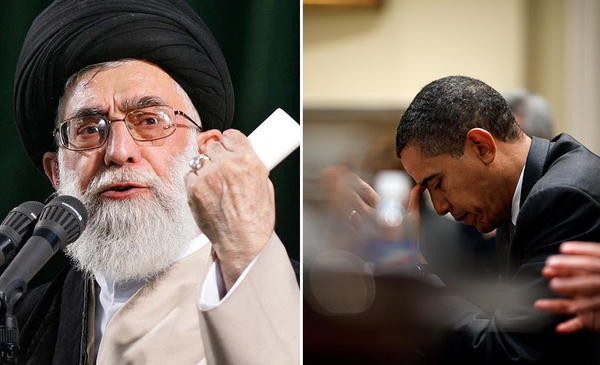
The Iranians may be convenient allies as enemies of our enemies today, but not for one second have Iran’s rulers suggested their ultimate intent is anything other than the all too familiar “Death to America” and “Death to Israel” propaganda seen for the past 36 years. In what is objectively and wholly a strange deadly obsession, the Supreme Leader of Iran, Ayatollah Khamenei, has been rousing crowds with calls for the destruction of two nation-states both during and after nuclear negotiations.

In spite of this public malice, defenders of the deal suggest that “the [Obama] administration is making a calculated bet that Iran will be constrained by international pressure.” Why exactly then is Khamenei making clear the opposite?

1173

President Obama’s willingness to concede Iran’s new-found normalized membership in the community of nations on the basis of this nuclear deal is an affront to the liberal, free, democratic principles that have stood against the forces of tyranny throughout American history.

It is also an affront the American political system and to the members of both parties who are now being cornered by the President into supporting, or not supporting, such an intrinsically dangerous and needlessly flawed bargain with an avowed enemy.

Even more concerning is that the Iran deal may directly conflict with U.S. obligations as a signatory of the Non-Proliferation Treaty (NPT). As a number of critics have pointed out, the Iran deal may be unconstitutional, violate international law and feature commitments that President Obama could not otherwise lawfully make.

By seeking approval of the deal under the UN Security Council, President Obama has bound the United States under international law without Senate consent.

If the United States is to remain the vanguard of human liberty, President Obama must distinguish between the vain pursuit of his legacy, and the civilized world’s deepest need at this consequential hour for the American President to defend comprehensively the fundamental principles that underpin the modern order. Unless his desired legacy is actually to destroy it.

As opponents of the Iran deal have noted, there is still time for a better deal that can be had.

To start, a total reversal of the Iranian regime’s behavior should have been, and still can be, a precondition for the removal of any sanctions related to Iran’s nuclear program. Congress can lobby for this change, and should maintain American sanctions and applicable provisions in the U.S. Treasury Department’s SWIFT terrorist tracking finance program.

Next, while Iran’s regional malignancy may run deep in the regime’s veins (through the many twisted arms of Tehran’s Islamic Revolutionary Guards Corps), an end to Iran’s financial and material support for terrorist forces such as Hezbollah and Hamas must be demanded, along with the return of the four American hostages Iran is holding.

Third, those who argue that Iran’s human rights record was not “on the table” in Geneva have needlessly abdicated the West’s moral and intellectual high ground to the forces of barbarism and hate that are now waging war across the region. Respect for international humanitarian norms should never be discarded in such negotiations.

At the end of the day, the deeper questions for Obama and the entire P5+1 are this: By whose standards were negotiations conducted? And whose worldview will rule the 21st century?

In defense of Obama’s approach, the deal’s supporters point out that the Iranians are a “proud, nationalistic people,” which is undoubtedly true, but irrelevant, just as it was for the leadership of Germany’s Third Reich.

The Iranian regime, by virtue of its radical religious nature, weak economy and political experiment with theocracy, should have borne the burden of coming to the negotiating table with the most to lose. Instead, President Obama, on behalf of the free world, is allowing this pariah state to guarantee its place among the nations, lavishly rewarded for having violated the Non-Proliferation Treaty, and in all its about-to-be-well-funded lethality.

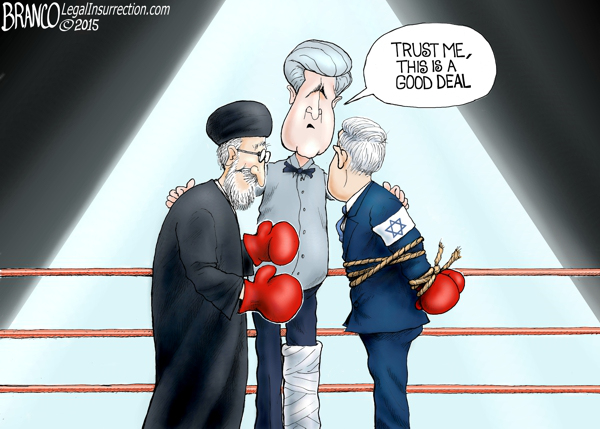
Cartoon of the day

July 28, 2015

H/t Kingjester’s Blog

israel-tied-600-li