Archive for July 6, 2015

When Palestinians Die in Jail

July 6, 2015

When Palestinians Die in Jail, The Gatestone InstituteKhaled Abu Toameh, July 6, 2015

  • Like the mainstream media in the West, the UN chooses to look the other way when Palestinians torture or kill fellow Palestinians.
  • The Palestinian Authority and Hamas claim that the three men committed suicide.
  • When three detainees die in less than a week, this should sound an alarm. But pro-Palestinian groups and human rights activists do not care about the human rights of Palestinians if Israel cannot be held responsible. Their obsession with Israel has made them blind to the plight of Palestinians living under the Palestinian Authority.

Three Palestinian men were found dead in their jail cells in the West Bank and Gaza Strip this past week.

But their stories did not attract the attention of the international media or human rights organizations in the U.S. and Europe. Nor was their case brought to the attention of the United Nations or the International Criminal Court (ICC).

By contrast, the case of 17-year-old Mohamed Kasba, who was shot dead north of Jerusalem by an Israeli army officer as he attacked the officer’s car with stones, received widespread coverage in the Western media.

The UN even rushed to condemn the killing of Kasba, and called for an “immediate end” to violence and for everyone to keep calm. “This reaffirms the need for a political process aiming to establish two states living beside each other safely and peacefully,” said UN Special Coordinator for the Middle East Peace Process, Nickolay Maldenov.

The UN official, needless to say, made no reference to the deaths that occurred in the Palestinian Authority (PA) and Hamas jails. He did not even see a need to express concern over the deaths or call for an investigation. Like the mainstream media in the West, the UN chooses to look the other way when Palestinians torture or kill fellow Palestinians.

The reason the case of the three detainees will not interest anyone in the international community is because the men did not die in an Israeli jail. Instead, the three men died while being held in Palestinian-controlled jails.

Had the three men died in Israeli detention, their names would have most likely appeared on the front pages of most leading Western newspapers. The families of the three men would have also been busy talking to Western journalists about Israeli “atrocities” and “human rights violations.”

But no respected Western journalist is going to visit any of the families of the three detainees: they did not die in an Israeli jail.

The same week that the three Palestinian men were found dead in jail, the UN Human Rights Council decided to adopt a resolution condemning Israel over the UN report into last year’s Operation Protective Edge in the Gaza Strip. Again, the UN Human Rights Council chose to ignore human rights violations by Hamas and the Palestinian Authority, who deny detainees basic rights and proper medical treatment.

Two of them died in PA security installations in Bethlehem, while the third was found dead in a Hamas-controlled jail in the Gaza Strip.

The two detainees who were found dead in their jail cells in Bethlehem are Shadi Mohamed Obeidallah and Hazem Yassin Udwan. The man who died in the Gaza Strip jail was identified as Khaled Hammad al-Balbisi.

The Palestinian Authority and Hamas claim that the three men committed suicide.

In the case of Obeidallah, the Palestinian Authority police said he hanged himself with a piece of cloth inside the jail restrooms. He was taken into custody on suspicion of committing a murder three years ago.

The second man, Udwan, died a few days later in another Bethlehem police facility. According to police officials, he too committed suicide.

The detainee in the Gaza Strip, al-Balbisi, was being held by Hamas authorities for allegedly assaulting his wife.

But al-Balbisi, 43, apparently did not commit suicide. He was very ill when he was arrested by the Hamas security forces, and did not receive proper medical care while in detention.

The Palestinian Center for Human Rights (PCHR), a Gaza-based non-profit group dedicated to protecting human rights, promoting the rule of law and upholding democratic principles in the Palestinian territories, called for an investigation into the circumstances surrounding the deaths of the detainees.

“PCHR stresses that the Palestinian Authority is responsible for the lives of prisoners and detainees under its control and is thus responsible for treating them with dignity, including offering them medical care,” the group said in a statement.
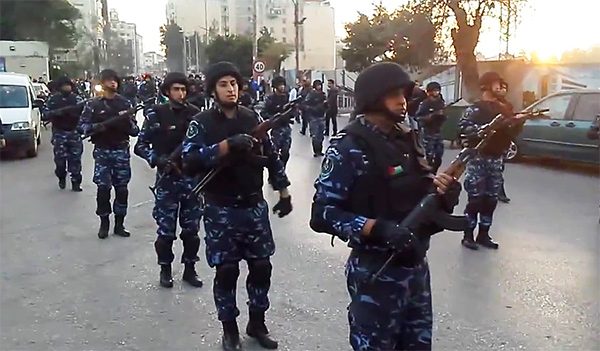
1143The Palestinian Authority police on parade, January 2015.

When three detainees die in less than a week in Palestinian detention, this should sound an alarm bell, especially among so-called pro-Palestinian groups and human rights activists in different parts of the world.

But these folks, like the UN and mainstream media, do not care about the human rights of the Palestinians if Israel cannot be held responsible. Their obsession with Israel has made them blind to the plight of Palestinians living under the Palestinian Authority and Hamas, as well as to the horrific crimes committed every day by Muslim terrorists in the Middle East and elsewhere.

The story of the three men who died in Palestinian jails is yet another example of the double standards that the international community and media employ when it comes to the Israeli-Palestinian conflict

How to insult a “progressive”

July 6, 2015

How to insult a “progressive,” Pat Condell via You Tube, July 6, 2015


Cartoon of the day

July 6, 2015

H/t The Jewish Press

Terms-of-Surrender

Contentions — Cementing the Bad Deal

July 6, 2015

Contentions — Cementing the Bad Deal, Commentary Magazine, July 6, 2015

The following is a dispatch from The Israel Project’s Omri Ceren regarding the state of nuclear negotiations with Iran:

Happy Monday from Vienna. The EU’s foreign affairs chief Federica Mogherini arrived yesterday and told reporters: “As you know I have decided to reconvene the ministers. They will be arriving tonight and tomorrow. It is the third time in exactly one week. That’s the end, the last part of this long marathon.” Secretary of State John Kerry and Iranian Foreign Minister Javad Zarif already held an impromptu meeting this morning. The overarching consensus – which is almost certainly correct – is that whatever gets announced will be announced no later than tomorrow afternoon. It might very well happen tonight.

As to what that announcement might be, there are a few options. In order of increasing probability:

0% chance: Kerry might make good on the comments that he made yesterday to reporters, and walks away from a bad deal.

Very low probability: the parties might come to a full-blown agreement ready to be implemented immediately. This scenario was never likely by June 30, and became functionally impossible after Supreme Leader Ayatollah Ali Khamenei set out a range of new red lines a few weeks ago. Also, the Iranians gave a background briefing earlier today in Vienna where they provided their interpretation of an emerging final deal. Among other things they have some interesting views on what military-related restrictions will be lifted, which are in tension with how the Americans have been describing the deal. Those differences will have to be overcome, and they won’t be in the next few days.

Low-probability: the gaps might still be too significant to even colorfully announce a deal, and the parties would extend the interim agreement all the way through the summer. The option would be more attractive to the Obama administration than taking another 2 or 3 weeks. If the administration sends Congress a deal after July 9 then the Corker clock – how long a deal sits in front of Congress – goes from 30 days to 60 days. But if they get all the way through the summer, it goes back down to 30 days. The administration has obvious reasons to prefer that.

Most likely: there will be a non-agreement agreement. The parties will announce they’ve resolved all outstanding issues but they still have to fill in some details. Then the P5+1 and Iran would move in parallel to implement various commitments, and the Iranians would in particular have to work with the IAEA on its unresolved concerns regarding Iran’s weapons program (PMDs). In the winter the IAEA would provide a face-saving way for the parties to declare Iran is cooperating – IAEA head Amano said earlier this week that the agency could wrap up by the end of the year if Iran cooperates – and then a deal would officially begin. The option is attractive to the administration because it puts off granting Iran all of its anticipated sanctions relief until the IAEA makes some noises about the Iranians cooperating. The alternative would be poison on the Hill. This way the administration can tell Congress that of course PMDs will be resolved before any sanctions relief is granted; and after Congress votes, if the Iranians jam up the IAEA but demand relief anyway, lawmakers will have no leverage to stop the administration from caving.

The focus will then shift to Congress, where the debate on approving or disapproving of the deal will take place over the next month. Some of the questions will get technical and tangled – the breakout time debate is going to be mind-numbing – but lawmakers will also use a very simple metric: Is the deal the same one the President promised he’d bring home twenty months ago? Back then the administration was very clear about what constituted a good deal and emphatic that U.S. negotiators had sufficient leverage to secure those terms. The U.S. subsequently collapsed on almost all of those conditions, and lawmakers will want to know how the deal can still count as a good one.

In line with those questions, here is a roundup from the Foreign Policy Initiative on where the administration started and how dramatically it has moved backwards. From the overview of the analysis:

Over the past three years, the Obama administration has delineated the criteria that any final nuclear agreement between the P5+1 and Iran must meet. In speeches, congressional testimony, press conferences, and media interviews, administration officials have also articulated their expectations from Tehran with repeated declarations: “No deal is better than a bad deal.” This FPI Analysis… compiles many of the administration’s own statements on nuclear negotiations with Iran over the past three years, and compares them with current U.S. positions. It also examines U.S. statements on a range of other issues related to U.S. policy toward Tehran, and assesses whether subsequent events have validated them.

The web version has embedded links for each of the statements, so if you need them just click through on the url at the top. You might just want to do that anyway, because the web version is more readable.

Israel Plotting to Occupy Nile to Euphrates with Support of ISIL: Iran’s DM

July 6, 2015

Israel Plotting to Occupy Nile to Euphrates with Support of ISIL: Iran’s DM, Tasnim News Agency (Iranian), July 6, 2015

(But, he inadvertently failed to mention, “we don’t want the bomb.” — DM)

139403121032243845415453

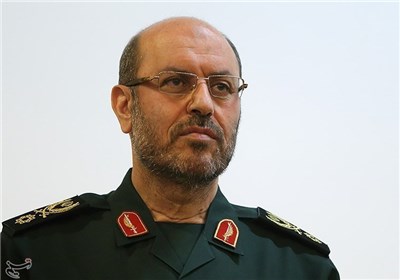
TEHRAN (Tasnim) – Iranian Defense Minister Brigadier General Hossein Dehqan warned against Israel’s plot to expand the occupied territories from “the Nile to the Euphrates” with the support of the Islamic State in Iraq and the Levant (ISIL) terrorist group.

“This year’s rallies to mark the International Quds Day due to be held this Friday are more important than the previous years’ because the Zionist regime (of Israel) with the full support of ISIL terrorists… is seeking to realize the occupation of (areas from) the Nile to the Euphrates,” General Dehqan said in a speech on Monday.

Undoubtedly, massive participation of people in the international event can thwart “the dangerous plot”, the minister stressed.

He further emphasized that the only way to liberate the holy Quds is unity and solidarity among Muslims.

Back in January, Supreme Leader of the Islamic Revolution Ayatollah Seyed Ali Khamenei underlined Iran’s determination to continue support for the Palestinian cause.

“The Islamic Republic of Iran will remain resolved (in its support) until the day that the cause of Palestine is materialized,” Ayatollah Khamenei said in a meeting with Head of Popular Front for the Liberation of Palestine–General Command (PFLP-GC) Ahmed Jibril in Tehran.

The Leader also noted that the issue of Palestine is among the top issues of the entire Muslim world.

Each year, the International Quds Day is celebrated on the last Friday of the holy Muslim month of Ramadan.

The event’s overarching theme is support for the Palestinians and fierce denunciation of Israel.

The day is also seen as the legacy of the late founder of the Islamic Republic of Iran, Imam Khomeini, who officially declared the last Friday of Ramadan as International Quds Day back in 1979.

4574 Years and Counting

July 6, 2015

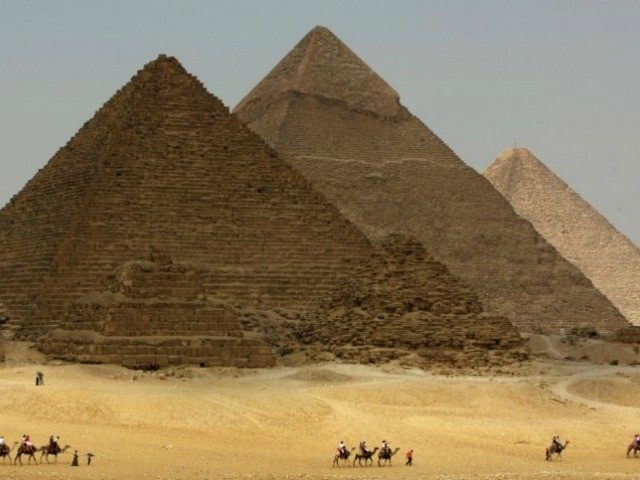
ISIS: Destroying Egypt’s Sphinx, Pyramids Is ‘Religious Duty’

by Jordan Schachtel3 Jul 2015 Via Breitbart


Will they stand the test of time? [Source: Reuters]

(Unthinkable. – LS)

ISIS “caliph” Abu Bakr al-Baghdadi told followers of his terror group that destroying Egypt’s national monuments, such as the pyramids and the sphinx, is a “religious duty” that must be carried out by those who worship Islam, as idolatry is strictly banned in the religion, according to reports.

UK radical Islamist Anjem Choudary echoed Baghdadi’s sentiments, telling The Telegraph: “When Egypt comes under the auspices of the Khalifa [Caliphate], there will be no more pyramids, no more Sphinx, no more idolatry,” saying that the ancient statues’s destruction “will be just.”

Another Islamist preacher, Ibrahim Al Kandari, agrees that the cultural monuments need to be destroyed to comply with the Shariah.

“The fact that early Muslims who were among prophet Mohammed’s followers did not destroy the pharaohs’ monuments upon entering Egypt does not mean that we shouldn’t do it now,” he told Al-Watan.

The jihadi terror threat to Egypt has steadily increased following the fall of its Muslim Brotherhood regime and the installation of President Abdel-Fattah el-Sisi, who has pledged to rid the country of its radical elements.

This week, Egyptian military personnel have faced an onslaught of terror attacks, particularly in the Sinai Peninsula, where a terror group loyal to ISIS remains the dominant jihadi outfit.

On Wednesday, the ISIS-affiliated Sinai Province (formerly known as Ansar Bayt Al Maqdis) claimed responsibility for a series of simultaneously attacks against Egyptian military checkpoints, killing, by some estimates, as many as 70 Egyptian soldiers.

Egyptian special forces struck back with several airstrikes against terror positions, including a raid at a Cairo apartment stocked with Muslim Brotherhood leaders.

Egyptian authorities claimed that the Muslim Brotherhood (and Palestinian terrorist group Hamas) helped to coordinate the Sinai attacks against military checkpoints.

The Brotherhood has responded by calling for an open “rebellion” against President el-Sisi and the Egyptian government.

Egyptian army backed by Apaches kills 63 Islamists in broad area between Sheikh Zuwaid and Rafah

July 6, 2015

Egyptian army backed by Apaches kills 63 Islamists in broad area between Sheikh Zuwaid and Rafah, DEBKAfile, July 6, 2015

(Please see also, The U.S. Must Help Egyptian President Sisi. — DM)

SinaiEgyptENG

An immense stretch of Sinai desert populated by half a million people is under siege, as the Egyptian army fights off a major offensive by the Islamic State’s Egyptian affiliate, the Sinai Province, against its positions in northern Sinai. The battle, which Monday, July 6, went into its sixth day, is being fought in an area bounded by the northern town of Sheikh Zuwaid, Rafah on the Gaza border, and up to Kerem Shalom and Nitzana on the Israeli border to the south. DEBKAfile’s military sources report a news blackout on the ongoing warfare except for Egyptian army handouts.

Egyptian security sources reported Monday that the latest round of helicopter strikes and ground operations had killed 63 Islamists in villages between Sheikh Zuwaid and Rafah, where four of their hideouts had been located. Our sources add that these air strikes are directed against civilian dwellings, especially in farming districts, where ISIS fighters are suspected of hiding out. No figures have been released by Cairo on civilian or Egyptian army casualties.

DEBKAfile describes the contest as an asymmetrical one between an army that depends heavily on aerial operations and ISIS terrorists, who have resorted mainly to guerilla warfare. By night, they flit swiftly on foot between the dunes to strike Egyptian army positions. By day, their foot soldiers trap Egyptian soldiers by setting up ambushes around those positions and on the roads of Sinai to keep Egyptian troops pinned down. Terrorist operations are a constant on their agenda.

The Egyptians respond with blanket air strikes which swoop on any moving object in the embattled area – whether by car or on foot

The hide-and-seek tactics employed by ISIS are sustainable in the long term, especially when the Islamists can rely on a constant influx of reinforcements, weapons and ordnance, the sources of which DEBKAfile disclosed in an exclusive report Sunday, July 5.

The Islamic State is rushing reinforcements to Egypt from Libya and Iraq for its battle with Egyptian forces in northern Sinai, which went into its fifth day Sunday, July 5, and other offensives, DEBKAfile’s intelligence and counter-terror sources report. After sustaining hundreds of casualties, both sides claim to have won the upper hand but the tenacious struggle is not over.

An Islamist manpower pool is provided by Egyptian extremists who crossed into Libya in the past and settled in bases around Benghazi.  Last week, ISIS summoned them to take up positions in Cairo and the Suez Canal and wait for orders to go into action. They crossed back with the help of smugglers. Those rings, dominated by the Muslim Brotherhood underground, with branches controlled by Hamas and Hizballah, bring illicit weapons and ammunition supplies to Sinai from Libya via Egypt.

President Abdel Fatteh El-Sisi is therefore obliged to earmark substantial military and intelligence resources for defending the Suez Canal and Cairo – more even than the Sinai front.

The other source of jihadi reinforcements is Iraq, They use another branch of the smuggling network which carries them through southern Jordan to the Gulf of Aqaba where they are picked up by smugglers’ boats and ferried across to the eastern coast of the Sinai Peninsula.

The IDF had more than one reason for its decision last Wednesday to close to traffic Rte 12, Israel’s main southern highway, which runs parallel to the Egyptian border up to Eilat: It was a necessary precaution lest ISIS turned its terrorists and guns against Israel from next-door northern Sinai. The other reason was to deter the Islamists coming from Iraq from trying to transit Israel and reach Sinai with the help of Bedouin smugglers operating on both sides of the Israeli-Egyptian border.

Our military sources estimate that some 1,000 jihadists are directly engaged in the North Sinai battle with the Egyptian army, but add that they could quickly recruit supplementary fighting manpower from Bedouin tribes near the warfront who already play ball with the terrorists.

Egyptian tacticians have strictly limited the army action on this front to air and helicopter strikes and local ground and armored forces. They are focusing on defending three Sinai enclaves, the northern district around Sheikh Zuweid, El Arish port and Rafah, and Sharm el-Sheikh in the south, to pin ISIS forces down in those places and prevent them from fanning out into areas controlled by the big Bedouin tribes.

When President El-Sisi visited the troops in northern Sinai Saturday, July 5, he disclosed that only one percent of the Egyptian army of 300,000 men was assigned to Sinai. He indicated that his army was perfectly capable of wiping out the Sinai terrorist threat in no time if all its might were to be thrown into the fray.

This strategy leaves ISIS with free rein in central Sinai. However, El-Sisis, like his predecessor Hosni Mubarak, is not prepared to go all out against ISIS in its “dens” any time in the near future, because he needs all his military resources and assets he can muster to defend the capital Cairo and the Suez Canal.
Neither the Islamic Army nor the Muslim Brotherhood or any other radical Islamists make any secrets of their next plans. ISIS has announced that it is setting its sights on Egypt’s pyramids, the Sphinx of Giza, and the country’s unique historic monuments in general, after its savage vandalism and looting of other precious world heritage sites.

In a new message released Friday, July 3, a number of radical Islamist leaders, including the ISIS “caliph” Abu Bakr al-Baghdadi, told their followers that the destruction of Egypt’s national monuments, such as the pyramids and the sphinx, was a “religious duty” that must be carried out by those who worship Islam, as “idolatry is strictly banned in the religion.”

This message has sharply ratcheted up the jihadist element of ISIS military confrontation with Egypt to a higher, more inflammatory level.

The U.S. Must Help Egyptian President Sisi

July 6, 2015

The U.S. Must Help Egyptian President Sisi, American ThinkerMichael Curtis, July 6, 2015

(Not much chance of that. General al-Sisi supported the large masses of Egyptians who wanted then President Morsi deposed. He was later elected President of Egypt. Morsi and his Muslim Brotherhood — which uses terrorism to gain and keep power — is an Obama favorite. Besides, al-Sisi’s efforts to reform Islam run counter to Obama’s delusion that Islam, as it is and has long been, is a wonderful religion of peace. — DM)

The silence was truly deafening. Not a sound from Archbishop Desmond Tutu or Alice Walker or the eager boycotters of Israel or the United Nations Human Rights Council about the brutal massacre of more than 70, perhaps 100, Egyptian soldiers and civilians by Islamist terrorists in the northern Sinai peninsula.

Since Israel, after the 1979 Egyptian-Israeli peace treaty, withdrew all its forces and all settlements — including Yamit — by 1982, the Sinai peninsula has been plagued by terrorist attacks, especially against tourists, by kidnappings, and by violence. After the 2011 Egyptian revolution and consequent uprisings, a major terrorist group emerged and became even more belligerent after the coup that deposed President Mohammed Morsi on July 3, 2013. This was Ansar Bayt al-Maqdis (ABM) that has claimed responsibility for numerous attacks against both Israeli interests and Egyptian personnel.

These assaults included an attack in July 2012 against a Sinai pipeline, a rocket strike in August 2012 on Eilat in south Israel, suicide bombings in el Tor in southern Sinai in May 2014, downing an Egyptian military helicopter in a missile attack, car bombings and hand grenades in Cairo, assassinations and attempted assassinations of Egyptian officials, beheading of four individuals in October 2014, an attack on a security checkpoint, and the June 29, 2015 murder in Cairo of Hisham Barakat, the Egyptian Prosecutor General, who in only two years in office had detained hundreds of members of the Muslim Brotherhood. He was the most senior Egyptian government official murdered.

In November 2014, ABM declared its allegiance to the Islamic State of Iraq and Syria (IS) and accepted the new self-appointed Caliph. It appears to have several hundred trained operatives and collaborators. There are different opinions about the actions of the Sinai Bedouin population, especially that of the largest of the 10 major tribes, the Tarabin tribe in northern Sinai, a tribe that is notorious for drug dealing, weapons smuggling, and human trafficking in prostitutes and African labor workers. Tarabin is said to have called for unification of all the tribes against the terrorists, but rumors of clashes appear to be untrue, and some even allege collaboration with the terrorists. What is true is that local Bedouin tribesmen, alleging discrimination by the state against them, have launched attacks against government forces in Sinai.

Over the last two years ABM, now regarding itself as a dedicated affiliate of IS, has tried to undermine the rule of Egyptian President Abdel Fattah al-Sisi. It has attacked Egyptian army posts, and security centers, and also the UN Multilateral Force in northern Sinai, that oversees the terms of the peace treaty between Egypt and Israel, and tried as well to infiltrate Israeli territory.

There had already been terrorist attacks on October 2014 and January 2015 when more than 30 were killed on each occasion in northeast Sinai. The most dramatic deed of ABM, which now seems to have changed its name to Province of Sinai, (POS) was the series of simultaneous coordinated attacks on July 1, 2015 on fifteen army centers of security forces and checkpoints in northern Sinai. The attacks, including three suicide bombers, killed at least 70 soldiers and civilians.

Evidently POS, imitating its mentor IS that has taken and now rules cities in Iraq and Syria, wanted to take over the city of Sheikh Zuweid, close to Israel, and cut off Rafah from al-Arish.

The danger to all of the democratic countries is immediate for a number of reasons. The first is that the success of the terrorists in their daring ambushes, control of the roads, taking police officers hostage, and planting mines in the streets, indicates not only their disciplined activity but also the influence of IS operatives directly and indirectly through training. IS in Iraq and Syria has operated in just this aggressive and disciplined fashion. All authorities responsible for security in the United States should be conscious of and take account of this highly organized success and of the threat of future similar attacks in the U.S. itself.

The second reason is that Hamas in Gaza is providing support to POS with weapons and logistical support, and even with Hamas terrorists taking part in operations. These have come from Hamas commanders in the Izz ad-Din al-Qassam Brigades that have been prominent for anti-Israeli attacks, including suicide bombings against civilians inside Israel. One particular active commander is Wael Faraj, who has smuggled wounded fighters from Sinai into Gaza.

A third problem is the obvious attempt to undermine and aim at the overthrow of President Sisi, a voice of sanity in the Muslim world. He has courageously criticized the extremists of his religion. In his remarkable speech at al-Azhar University in Cairo on January 22, 2015, he said that fellow Muslims needed to change the religious discourse and remove from it things that have led to violence and extremism. The Muslim religion, he said to imams, is in need of religious reform.

Since he assumed power on June 8, 2014, Sisi has attempted to stem the tide of terrorism by reinforcing the Sinai, restricting traffic, imposing curfews in the area, and demolishing homes of suspected terrorists in Rafah. He sought to create a buffer zone along the border with Gaza, and to destroy the tunnels built by Hamas. But clearly Sisi needs help to survive. It is imperative for the U.S. together with Israel to provide that help to the overwhelmed Egyptian army and intelligence services.

Israel is acutely aware of the danger. POS captured armored vehicles on July 1, 2015 that it can now use to penetrate the border fence between Sinai and Israel. That fence is unlikely to deter a trained terrorist group that now has combat experience. Israel responded by closing roads and two border crossings as a precautionary measure. But all the democratic countries, especially the United States, and also the United Nations because of its Multilateral Force, are now aware that the Islamist terror is at their doors as well as at the outskirts of Israel, and should act accordingly.


In Russia, Country Leaves You.

July 6, 2015

Jews Are Fleeing Russia Because Of Putin

By Roman Super and Claire Bigg July 03, 2015 Via Radio Free Europe


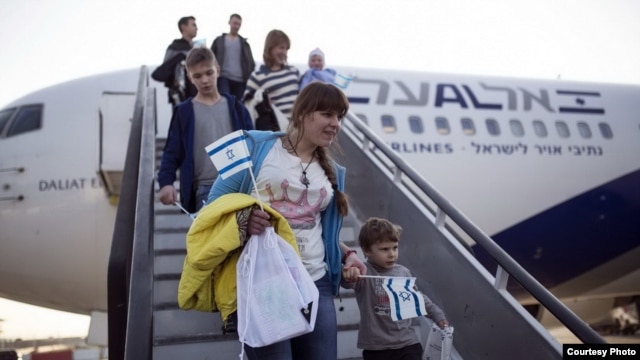
Nearly 5,000 Russians migrated to Israel in 2014 [Source: Courtesy Photo]

(Still, a lot of folks wonder why Israel builds all those settlements. – LS)

Just a year ago, Russian journalist Vladimir Yakovlev was one of Moscow’s most influential media figures.

Today, he lives a quiet life in Tel Aviv and has swapped his Russian passport for an Israeli one.

Yakovlev, the founder of the respected Kommersant publishing house and the Snob magazine, belongs to a new wave of disillusioned Russian Jews deserting their country for the relative stability of Israel.

“The big problem with Russia, and the main reason why I left, is the fact that our value system was destroyed,” he says. “Life in Russia has turned into Russian roulette. Every morning you turn the roulette wheel, you never know what is going to happen to you.”

Spooked by Russia’s actions in Ukraine and by the increasingly stringent punishments for anyone deemed critical of the Kremlin, Russians of Jewish descent have been fleeing in droves over the past 18 months.

Surge From Eastern Europe

According to Israeli authorities, as many as 4,685 Russian citizens relocated to Israel in 2014 — more than double than in any of the previous 16 years.

And the trend seems to be accelerating.

The nongovernmental Jewish Agency for Israel has released figures showing a 40-percent surge in immigration to the country between January and March of this year, compared to the same period in 2014.

The study suggests that while the majority of immigrants still come from Western Europe, Russians and Ukrainians are responsible for this increase. The number of Jews migrating from Western Europe has remained largely the same.

Yakovlev, however, doesn’t consider himself a simple immigrant. He is, in his own words, a refugee.

“People usually emigrate due to domestic circumstances,” he says. “People are now leaving because they are scared to stay where they would like to live. They are running from Russia.”

Zeyev Khanin, an official at Israel’s Immigrant Absorption Ministry, says the average Russian immigrant has changed dramatically since the last mass exodus of Jews from Russia ebbed in the late 1990s.

He says newcomers from Russia are significantly younger, more educated, and, as a rule, hail from Moscow or St. Petersburg.

“The average education level is on the rise and the number of people with degrees in humanities has increased massively,” he tells RFE/RL. “Today’s repatriates are mostly the creative intelligentsia.”

Mikhail Kaluzhsky was among the 4,685 Russians who moved to Israel last year.

A journalist and playwright from Moscow, he is typical of the new wave of Russian immigrants described by Khanin.

Kaluzhsky says his decision to leave Russia is “directly linked to politics.”

In January 2014, he traveled to Ukraine to witness the Maidan pro-democracy protests that toppled Russia-friendly President Viktor Yanukovych.

He says the unwavering determination of Maidan protesters left a deep impression on him, together with an uncomfortable realization that Russian antigovernment activists lag far behind their Ukrainian counterparts.

“I understood that our protests were worthless,” he says. “After the Bolotnaya protests [in Moscow in 2012] in our country, demonstrators went to the restaurant. Activists on Maidan did not go anywhere, they stayed until victory.”

Then, Kaluzhsky lost his job with the Sakharov human rights organization as a result of Russia’s new “foreign agent” law.

The controversial law, signed by Russian President Vladimir Putin in 2012, forces NGOs that receive foreign funding and are deemed to carry out political activities to register as “foreign agents.”

“The center’s financial situation deteriorated as soon as talk about foreign agents started in Russia,” says Kaluzhsky. “Western foundations said they could no longer fund initiatives that may be shut down tomorrow.”

In fall 2014, the Sakharov Center was forced to scrap its theater projects, to which Kaluzhsky had actively contributed.

Crimea Seizure

Russia’s annexation of Crimea from Ukraine was the last straw.

“After Crimea, our family decided to distance itself from all of this, most of all from the government,” he says.​

The Kaluzhskys now live in the outskirts of Tel Aviv. Their son attends a local Jewish pre-school and already speaks good Hebrew.

They have sold all their belonging in Russia and do not plan to return.

Vladimir Yakovlev, too, sees his future in Israel.

He and his wife have settled in downtown Tel Aviv, in a bright flat with a balcony full of flowers.

Most of their friends are other Russian intellectuals, and many of these friendships date back from their life in Moscow.

Yakovlev says Israel offers the best of both worlds — a sunny, friendly climate and the same circle of liberal, educated Muscovites that surrounded him in Russia.

“My group of friends here is almost the same as I had in Moscow,” he says. “We live in the same house as friends from Moscow, and I keep meeting people in the streets whom I regularly spent time with in Moscow.”

“No one,” he adds, “should be forced to spend their life dealing with this Russian nonsense.”

Israel gears up to battle Iran deal in Congress

July 6, 2015

Israel gears up to battle Iran deal in Congress | The Times of Israel.

Many in Jerusalem think efforts to block accord are a lost cause as world powers prepare to resume substantial economic dealings with Tehran

July 6, 2015, 3:57 am
Israeli Prime Minister Benjamin Netanyahu is greeted by members of congress prior to addressing a joint meeting of congress on Capitol Hill in Washington DC, March 03, 2015. (photo credit: Amos Ben Gershom/ GPO)

Israeli Prime Minister Benjamin Netanyahu is greeted by members of congress prior to addressing a joint meeting of congress on Capitol Hill in Washington DC, March 03, 2015. (photo credit: Amos Ben Gershom/ GPO)

Israel was preparing for the next phase of its fierce opposition to the Iran nuclear deal, by lobbying US Congressmen and women to block the emerging comprehensive agreement once it is finalized and goes to lawmakers for approval. But some in Jerusalem fear it is a lost cause given the belief that the potential economic benefits from resuming business with Iran could significantly outweigh political considerations.

The US-led P5+1 world powers and Tehran are currently in the midst of negotiations to hammer out a deal to curb Iran’s nuclear ambitions and remove crippling sanctions imposed on the Islamic Republic. On Saturday, the Associated Press reported that the powers and Iran had drawn up a draft document on the pace and timing of sanctions relief, advancing on one of the most contentious issues at their negotiations.

Israel reacted furiously to the development, with Prime Minister Benjamin Netanyahu warning on Sunday that the six world powers were dangerously caving to the Islamic Republic’s every demand.

“It seems that the nuclear talks in Iran have yielded a collapse, not a breakthrough,” Netanyahu said at the start of the weekly cabinet meeting. “The major powers’ concessions are growing.”

On Sunday, US Secretary of State John Kerry said that while “genuine progress” had been made and the sides “have never been closer, at this point, this negotiation could go either way. If the hard choices get made in the next couple of days, and made quickly, we could get an agreement this week.”

Speaking from talks in Vienna, Kerry added: “But if they are not made, we will not.”

Assuming the final accord is submitted to Congress by July 9, US lawmakers will have a 30-day review period for any agreement during which sanctions on Iran cannot be waived. Should the deal fail to pass, President Barack Obama will have the right to veto, a power he has vowed to use. To overcome the veto, the deal will need to be rejected in a second round of voting by two thirds of Congress and the Senate.

Israel, according to a report in Ynet, intends to use diplomatic pressure to have the deal quashed in the first round in Congress but is also gearing up to double down should that effort fail and Obama uses his presidential veto, to have the deal blocked in the next round.

Sources in Jerusalem assess that the deal will likely be approved in the initial stage, with Congress fearing that any delay could harm US industry, as the other world powers rush to resume business with Iran. Others believe not all is lost and the deal can be defeated, with the right diplomatic work on Israel’s part.

France, meanwhile, was gearing up for the resumption of its substantial economic dealings with Iran, under the assumption that a nuclear agreement with Tehran is likely in the near future.

Around 100 French companies are reportedly planning to participate in a delegation to Tehran in September to review business opportunities in the Islamic republic.

Other countries are likely to follow, assuming a deal is reached.

AFP contributed to this report.