Archive for June 2015

‘Iran Supporting More than 100 Shiite Terror Groups’

June 17, 2015

‘Iran Supporting More than 100 Shiite Terror Groups,’ The Clarion Project, June 17, 2015

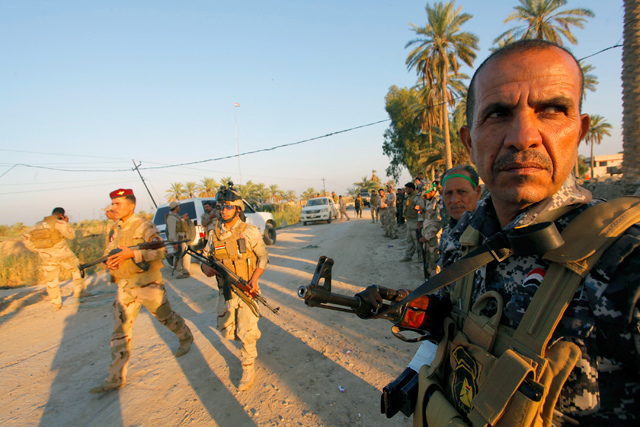
Iraq-Shiite-Militia-Iraqi-Army-IP_0A Shiite militia in Iraq (Photo: © Reuters)

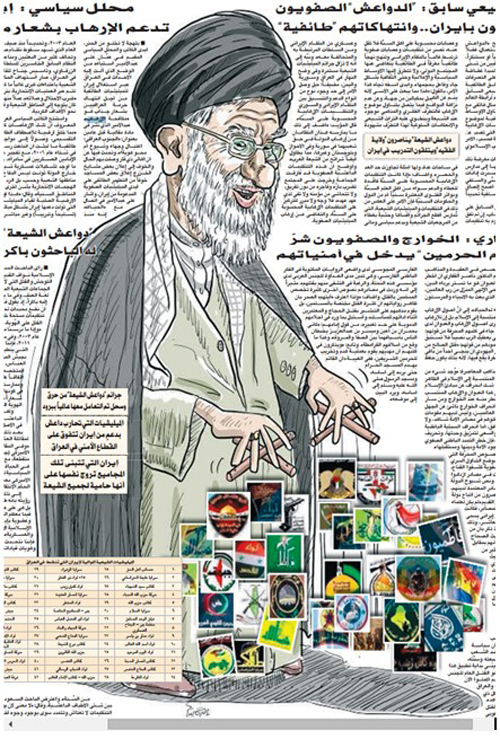
A recent report in Al Hayat, one of the largest and most-respected pan-Arab dailies, charges that Iran is supporting more than 100 Shiite extremist organizations and militias in Syria and Iraq.

The newspaper, which is published in London and funded by Saudi Arabia, says the crimes of these groups are no less horrific than those of the Islamic State.

In Iraq, the Iranian-funded armed militias comprised of Persians have capabilities far beyond those of the Iraqi security forces. The paper quotes academics who commented that the purpose of these militias is to target the Arabs in Iraq, both Sunni and Shiite.

In the Arab world, there is anger that the international media is ignoring the atrocities being committed by these militias. Hussein Al Muayid, an Iraqi religious scholar and advisor to the general secretary of the Muslim World League, pointedly questioned why the media as well as political figures focus only on the activities of the terror activities of Sunni organizations.

Muayid claims such selective reporting serves to makes an implicit statement that the Sunni world is responsible for all the terror in the world.

100-groups

In addition, while governments, experts and clerics issuing fatwasare refusing to give any aid to these Sunni terror organizations, Muayid says Shiite militias, which perpetrate the most horrific acts, enjoy the support of the Iranian ayatollahs, the highest religious authorities in Iran, and the financial and military support of the Islamic republic.

Western researchers and Arab analysts believe that Iran is supporting more than 50 militias in Iraq and another 50 in Syria whose atrocities are not less than those of the Islamic State.

The following is a list of most of the Shiite militias that are loyal to Iran and are active in Iraq:

1.       Gangs of the People of the Truth

2.       Companies of the Churasani Pioneer

3.       Battalions of the Lord of the Martyrs

4.       Noble Movement of Hezbollah

5.       Hezbollah Battalions

6.       Companies of Peace

7.       Corps of the Loyal Promise

8.       Bader Organization – Military Wing

9.       Brigade of Omar ibn Yasser

10.   Brigade of Assad Allah el Raleb

11.   Brigade of the Promised Day

12.   Battalions of the Supporters of Elhaja

13.   Battalions of the Sacred Defense

14.   Brigade of Elkariya

15.   Companies of Alzahra

16.   Brigade of Zu Elfakar

17.   Brigade of the Guarantors of Zainab

18.   Companies of the Supporters of the Belief

19.   Brigade  Al Muntazir

20.   Badar Special Groups

21.   Brigade of Abu Elfader Elabbas

22.   Movement of Al Jihad and al Bina

23.   Companies of the Public Defense

24.   Battalions of the Shiite Brigade

25.   Hezbollah the Rebels

26.   Battalions of the Anger

27.   Brigade of the Youths With Missions

28.   Hezbollah Battalions of the Missing Imam

29.   Battalions With the Direction of the Message

30.   Ashura Companies

31.   Battalions of Malek Elashtar

32.   Elabdar Movement

33.   Battalions of the Imam Ali

34.   Army of the Muktar

35.   Public Draft

36.   Elhamad Brigade

37.   Brigade of the Existing Imam

38.   Eladiat Brigade – Special Guard

39.   Movement of the Loyal Supporters of Allah

40.   Brigade of the 5th Special Guard

41.   Army of Elkarar

42.   Combat Division of Abba

Kerry’s refusal to be “fixated” on Iran’s former nuclear misdeeds fits the US pattern of indulging Tehran

June 17, 2015

Kerry’s refusal to be “fixated” on Iran’s former nuclear misdeeds fits the US pattern of indulging Tehran, DEBKAfile, June 17, 2015

(The Obama administration’s “fixation” is on getting any “deal” acceptable to Iran. Please see also, Kerry’s absolute idiocy. — DM)

Kerry_Massachusetts_General_Hospital_12.6.15John Kerry returns to the Iran nuclear table

US Secretary of State John Kerry remarked Wednesday that the “US and its negotiating partners are not fixated on the issue of so-called possible military dimensions [of the Iranian nuclear program] because they already have a complete picture of Iran’s past activities.”

This comment was a compendium of contradictions and untruths.

DEBKAfile lists five instances to demonstrate the US has been in the dark over Iranian nuclear activities – past and present:

1. Iran’s military complex at Parchin remains a closed book despite repeated international demands to check on the nuclear detonation tests reported to have been conducted there. The US and Israel are left with suspicions, no facts, although Kerry declared: “We know what they did.”

2. At the Fordo underground site, all that is known for sure is that the Iranians are enriching uranium with advanced centrifuges – which they admitted after they were found out. But nothing is known about activities in other parts of the subterranean facility.

3.  Iran is known to be operating secret sites. Once again, strong suspicions are not supported by solid evidence which remains out of reach.

4.  US intelligence has not gained a full picture of Iran’s nuclear collaboration with North Korea or their shared plans for the development of ballistic missiles. Every now and then, delegations of nuclear scientists pay reciprocal visits to each other’s facilities, but no one has got to the bottom of the secret transactions between them. The question is why does this collaboration continue if Iran is not developing a nuclear weapon? And how far as it got? There are no answers to either of these questions.

5. Neither the US nor the international inspectors have gained direct access to the Iranian scientists employed on military nuclear projects, aside from the information reaching the US and Israel from Iranian defectors. All applications to interview these scientists were either turned away or ignored by Tehran.

So when Kerry claims that the negotiators “already have a complete picture of Iran’s past activities,” he is in fact letting Iran off the hook for providing information or even opening up its suspect facilities to international monitors, least of all the “intrusive inspections” promised by President Barack Obama.

For the sacred goal of getting a final nuclear deal signed with Iran by the June 30 deadline, it is permissible to brush these embarrassing “details” under the carpet and ignore troubling questions.

On June 15, Republican Sen. Bob Corker, head of the Foreign Affairs Committee, sent a letter to President Obama saying: “It is breathtaking to see how far from your original goals and statements the P5+1 have come during negotiations with Iran.” He went on to say that negotiators “have moved” from trying to strike a 20-year agreement to a 10-year one and “seem ready to let Tehran continue to develop its ballistic missile effort and maintain research and development for advanced nuclear centrifuges.”

Senator Cork concludes: “The stakes here are incredibly high and the security implications of these negotiations are difficult to overstate.”

However, the Obama administration’s concessions to buy a deal do not stop there. They go still further. DEBKAfile’ sources reveal that Washington is preparing to give way on the snap inspections mandated by the Additional Protocol, and agree to limit inspections to facilities unilaterally designated “nuclear” by Tehran and only after two weeks’ notice.

But President Obama has made his most substantial concession yet, by accepting Tehran’s demand to divide the final accord into two parts. The first would be made public and the second, carrying the technical protocols, would be confidential. The senior US negotiator Undersecretary Wendy Sherman fought hard to have both parts of the accord released, explaining that the president could not otherwise get it through Congress. But she was overruled.

The US president has employed the same stratagem on the issue of sanctions. While declaring that they will not be lifted until Iran complies with its commitments, he has allowed American companies to enter into business negotiations with Iranian firms.

The 50 pages of the nuclear accord’s practical annexes embody the adage that the devil is in the detail. But president Obama has chosen to keep it secret from Congress, the American public and US allies, while Iran is given free rein to pursue its objectives.

The Rise of the Fourth Reich

June 17, 2015

REPORT: IRAN BEHIND HEZBOLLAH PLAN TO ATTACK JEWS, ISRAELIS IN EUROPE

By EDWIN MORA 16 Jun 2015 Via Breitbart


Heil Mullah! Heil Mullah! Heil Mullah! (photo credit: AP)

(Iran remains and will always be the snake in the woodpile, and yet after all these years, they still seem immune to retaliation. – LS)

Iran has been accused of providing support to an alleged Hezbollah operative in Cyprus who was planning to carry out a series of terrorist attacks against Israeli and Jewish sites in Europe, according to news reports.

Cypriot Foreign Minister Ioannis Kasoulides confirmed that authorities in his country likely foiled a plan involving a 26-year-old Lebanese-Canadian man who was planning to build bombs to target Israelis and Jews, reports Reuters.

The man was likely working for the Iran proxy Hezbollah, a terrorist group based in Lebanon, according to the foreign minister.

“Earlier this month, Israel said Cyprus had told it that the fertilizer was to be used for bombs by Hezbollah, a Lebanese militia hostile to Israel, and that Israelis or Jews on Cyprus may have been intended targets,” notes Reuters.

When Reuters asked him about the conversation between Cyprus and Israel, Kasoulides responded, “Your information you mentioned is correct.”

He added that it is likely that Hezbollah was behind the attack.

The Lebanese-Canadian man was arrested in late May after Cypriot police found nearly two tons of bomb-making materials in his basement, including ammonium nitrate, according to Haaretz.

Ammonium nitrate is a fertilizer commonly used by terrorists to make powerful explosives.

Cypriot authorities reportedly informed Israel that the man had been taken into custody and that he is believed to be an agent of Hezbollah.

“The 26-year-old man, Lebanese-born but with a Canadian passport, was detained by police in the EU [European Union] member state on May 27, after authorities discovered the hoard in the basement of a house,” reports Haaretz.

Authorities were reportedly “investigating any possible link” between the individual and Hezbollah, which considers Israel an enemy.

The individual has been linked to Hassan Nasrallah, Hezbollah’s chief, according to Haaretz.

Citing information provided to the Israel’s defense establishment, Haaretz reports that the Hezbollah operative was planning to use Cyprus as a “point of export” for a series of terrorist attacks targeting Jewish sites, including synagogues, in Europe.

Although Hezbollah is “the contractor behind the terrorist plan,” Iran is the entity who is providing “funding and training,” reportedly said an Israeli defense establishment source.

“This is a terror infrastructure ready to strike the moment it is given a chance… This is additional proof of Iran’s involvement in terror and the infrastructure of operatives, instructors and funders it provides,” added the source.

An unnamed senior Israeli official told Reuters “that the ammonium nitrate was apparently intended to make a large store of bombs that would be kept ‘on hand’ for future attacks.”

“It does not look like there was an immediate terrorist action planned in connection with this haul,” added the official.

Oren: Obama abandoned Israel

June 17, 2015

Oren: Obama abandoned Israel | The Times of Israel.

Former envoy to US and current Kulanu party MK faults president for breakdown in ties

June 16, 2015, 4:23 pm Barack Obama speaks to Benjamin Netanyahu outside the White House in 2011. (Pete Souza/White House)

Barack Obama speaks to Benjamin Netanyahu outside the White House in 2011. (Pete Souza/White House)

Knesset member and former ambassador to the US Michael Oren on Monday penned a scathing attack on US President Barack Obama’s policies toward Israel, claiming that while both he and Prime Minister Benjamin Netanyahu made mistakes, “only one leader made them deliberately.”

In an article in The Wall Street Journal headlined “How Obama Abandoned Israel,” Oren, who served as Israel’s ambassador in Washington during Obama’s first term in office, recounted various gaffes committed by the Israeli government. Currently a lawmaker with the Kulanu party, Oren cited the announcement of settlement expansion on the eve of visits by top US officials, the now infamous “lecture” Netanyahu gave Obama during a photo op in the Oval Office in 2011, and the prime minister’s speech to Congress earlier this year.

Oren absolved Netanyahu of some of the incidents, claiming that some missteps were taken by mid-level staffers without the prime minister’s knowledge (e.g., two instances where settlement expansion was announced just as Vice President Joe Biden was scheduled to arrive in Israel).

Netanyahu even apologized to Biden personally for the timing, Oren noted.

Obama, on the other hand, deliberately deviated from several long-held traditions in the US-Israel relationship, aired disagreements in the media, and pointedly skipped over Israel on his first Middle East tour after being elected, he said.

With these very public displays of dissatisfaction with Israel, Obama violated the “no sunlight,” as Oren referred to it, principle of not airing discord between the two governments.

Another principle Oren says Obama did not follow was one of “no surprises,” that is, refraining from public announcements of US expectations of Jerusalem until the issues had first been ironed out away from cameras and microphones.

According to Oren, Israeli leaders typically received advance copies of major American policy statements on the Middle East and could submit their comments.

But Obama delivered his Cairo speech 2009, with its unprecedented support for the Palestinians and its recognition of Iran’s right to nuclear energy, without consulting Israel.

Oren’s account included what he sees as the potentially most harmful consequence of the rift in US-Israeli relations – the negotiations conducted behind Israel’s back with its “deadliest enemy” – Iran.

He concluded by warning against further “erosion” of the “vital alliance” between the US and Israel.

Oren is the author of the forthcoming book “Ally: My Journey Across the American-Israeli Divide,” due to be published later this month.

Kerry’s absolute idiocy

June 17, 2015

Kerry’s absolute idiocy, Power LineScott Johnson, June 16, 2015

The administration told Congress to hold off pressuring Iran by declaring they were going to bring home a deal in which the Iranians capitulated on PMDs. They failed. Now they’re claiming it never mattered anyway.

********************

The Obama administration’s rush to sell us out to Iran presents a spectacle of deception, prevarication, and idiocy the likes of which we have never seen. It is as though Henry Wallace had been given the keys to the kingdom in 1945 instead of Harry Truman and made Alger Hiss Secretary of State instead of Dean Acheson.

Among the “parameters” of a final agreement set forth by the White House and supposedly agreed to by Iran is this one: “Iran will implement an agreed set of measures to address the IAEA’s concerns regarding the Possible Military Dimensions (PMD) of its program.” Sounds a little vague on a key measure that is necessary to provide a baseline against which future activities can be measured, but it was touted as a substantial requirement. In today’s news we have this development, summarized by Omri Ceren in an email this afternoon (including his footnotes):

Earlier today Secretary Kerry addressed the State Department press corps by teleconference. Here’s the quote, in response to a question from the NYT’s Michael Gordon on whether concerns over atomic work by Iran’s military would “need to be fully resolved before sanctions are eased or released or removed or suspended on Iran as part of that agreement.” The term of art for that work – which ranges from mines controlled by the IRGC to full-blown weaponization work – is “possible military dimensions” (PMDs):

Michael, the possible military dimensions, frankly, gets distorted a little bit in some of the discussion, in that we’re not fixated on Iran specifically accounting for what they did at one point in time or another. We know what they did. We have no doubt. We have absolute knowledge with respect to the certain military activities they were engaged in. What we’re concerned about is going forward. It’s critical to us to know that going forward, those activities have been stopped, and that we can account for that in a legitimate way. That clearly is one of the requirements in our judgment for what has to be achieved in order to have a legitimate agreement. And in order to have an agreement to trigger any kind of material significant sanctions relief, we would have to have those answers [1].

This is new. I don’t think the administration has ever tried to spin up reporters on the claim that the US “has absolute knowledge” of Iran’s military nuclear work. Certainly it’s never been a top message. But administration officials have no choice: the Associated Press confirmed last week that the P5+1 has collapsed on the demand that Iran come clean about its past atomic work, which would gut the verification regime that the White House has made the key criterion of any deal [2]. Without knowing what the Iranians did in the past there’s no way confirming they’ve stopped doing those things, which means there’s no way that Kerry’s other line about confirming that prohibited “activities have stopped” could ever be true. So the new argument is – as it sort of has to be – that Washington doesn’t need the Iranians to reveal anything because American officials already know everything.

Couple things to note about the claim:

(1) It’s false – Here is IAEA Director General Amano 3 months ago: “what we don’t know [is] whether they have undeclared activities or something else. We don’t know what they did in the past. So, we know a part of their activities, but we cannot tell we know all their activities. And that is why we cannot say that all the activities in Iran is in peaceful purposes” [3]. And here he is again a few weeks ago: “the Agency is not in a position to provide credible assurance about the absence of undeclared nuclear material and activities in Iran, and therefore to conclude that all nuclear material in Iran is in peaceful activities” [4].

And here is a partial list of things the West doesn’t know about Iran’s past atomic work (the first few are from current and former IAEA inspectors): how far Iran got on testing nuclear detonators [5], whether Iran maintains the infrastructure to do further tests and build on that work [6], whether Iran diverted nuclear material, including enriched material, for past or future clandestine purposes [7], what nuclear assets and knowledge Iran acquired from North Korea and is keeping on the shelf [8], same about nuclear assets and knowledge acquired from Russia [9], how Iran skirted inspectors in the past and whether they could repeat those tricks in the future [10], what the Iranians managed to destroy when it literally paved over the Parchin site where it did nuclear work [11].

(2) It’s a collapse the administration’s core promise to lawmakers on any deal – Every time the administration needed to defend negotiations they asked Congress and the public for breathing room by promising they’d force the Iranians to meet their PMD obligations. Lead negotiator Wendy Sherman sold the interim JPOA to Congress in December 2013 by telling Senate Banking that under the interim agreement Iran had agreed to “address past and present practices, which is the IAEA terminology for possible military dimensions” and that “we intend to support the IAEA in its efforts to deal with possible military dimensions” [12]. A few months later she told SFRC that “in the Joint Plan of Action we have required that Iran come clean” [13]. The same month she told AIPAC attendees to “create space” for talks because “the possible military dimensions of the Iranian nuclear program will have to be addressed” [14]. Kerry told PBS in April, in the immediate aftermath of Lausanne, that on PMDs the Iranians will “have to do it. It will be done” [15].

The administration told Congress to hold off pressuring Iran by declaring they were going to bring home a deal in which the Iranians capitulated on PMDs. They failed. Now they’re claiming it never mattered anyway.

[1] http://www.state.gov/secretary/remarks/2015/06/243892.htm
[2] http://hosted2.ap.org/APDEFAULT/89ae8247abe8493fae24405546e9a1aa/Article_2015-06-11-US–Iran-Nuclear%20Talks/id-bf93656644504b9386eb34a86065721d
[3] http://www.pbs.org/newshour/bb/iaea-monitoring-irans-nuclear-program/
[4] https://www.iaea.org/newscenter/statements/introductory-statement-board-governors-63
[5] http://www.isisnucleariran.org/assets/pdf/ISIS_Analysis_IAEA_Report_May_29_2015_Final.pdf
[6] http://isis-online.org/uploads/isis-reports/documents/PMD_Resolution_November_5_2014.pdf
[7] http://www.algemeiner.com/2014/10/21/iaea-chief-unsure-that-all-iranian-nuclear-material-is-peaceful/
[8] http://www.washingtonpost.com/opinions/what-else-is-iran-hiding/2015/03/29/0c231790-d4b9-11e4-8fce-3941fc548f1c_story.html
[9] http://www.timesonline.co.uk/tol/news/world/middle_east/article6860161.ece
[10] http://nationalinterest.org/feature/atomic-amnesia-the-forgotten-military-aspects-iran%E2%80%99s-nuclear-10585
[11] http://www.foxnews.com/world/2013/08/22/iran-may-have-covered-up-nuclear-site-with-asphalt-us-institute-says/
[12] http://www.nti.org/gsn/article/iran-iaea-discuss-atomic-probes-step-two/
[13] http://www.shearman.com/~/media/Files/Services/Iran-Sanctions/US-Resources/Joint-Plan-of-Action/4-Feb-2014–Transcript-of-Senate-Foreign-Relations-Committee-Hearing-on-the-Iran-Nuclear-Negotiations-Panel-1.pdf
[14] http://www.i24news.tv/en/news/international/middle-east/140222-sherman-aipac-should-give-iran-talks-a-chance
[15] http://www.pbs.org/newshour/bb/iran-must-disclose-past-nuclear-military-activities-final-deal-says-kerry/

Is there anything the Iranians could do that would upset President Obama?

June 16, 2015

Is there anything the Iranians could do that would upset President Obama? Jerusalem PostEric R. Mandel, June 16, 2015

(Not likely. — DM)

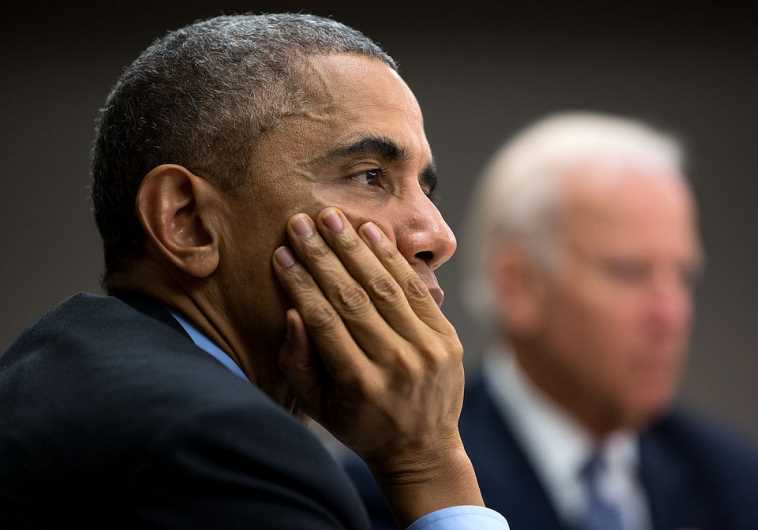
Biden and ObamaUS President Barack Obama (L) and Vice President Joe Biden. (photo credit:OFFICIAL WHITE HOUSE PHOTO BY PETE SOUZA)

The administration’s fear of provoking actions while the nuclear negotiations are ongoing is interpreted by Iran not as pragmatism, but as an invitation to cheat on any future deal.

This schizophrenic foreign policy is not fooling anyone. At best, it is naïve; at worst, it threatens longterm American national security and foreign interests, to say nothing of Israel’s existence.

*****************

It is probably time of us who have strenuously opposed acquiescing in Iran’s development of nuclear weapons to throw in the towel… Mr. Obama’s definition of a satisfactory outcome has evolved… from the complete abandonment… of the Iranian nuclear program to an honor-system reliance on the Iranians.” – Conrad Black, National Review.

What stands out in the following bullets?

• Iran is increasing its financial and military support for the genocidal Syrian ophthalmologist President Bashir Assad.

• The Iranian proxy Hezbollah is helping to prop up the Assad government with its armed forces in Syrian territory.

• US President Barack Obama has stopped supporting Hayya Bina, a “civil society program in Lebanon that seeks to develop alternative Shi’ite political voices to Hezbollah” (The Wall Street Journal).

Reminiscent of the president’s abandonment of the Iranian people during the 2009 Green Revolution, when he sided with the radical mullahs over Iranians seeking a democratic government, the US has decided to leave Lebanese Shi’ites with little choice but the repressive fundamentalist Hezbollah government.

But shouldn’t it be in America’s foreign policy interests to help Iranian and Lebanese Shi’ites break free from the repressive shackles of these anti-Western terrorists and help create the conditions for a peaceful and non-threatening Islam? Anyone paying attention to Iran’s behavior since the Revolution knows that the ayatollah does not reciprocate appeasement. You would have thought after six years of a failed Middle East policy that the president would have learned that unilateral concessions are pocketed, and only encourage more demands and intransigent behavior.

The administration’s fear of provoking actions while the nuclear negotiations are ongoing is interpreted by Iran not as pragmatism, but as an invitation to cheat on any future deal.

The Iranians have been testing the Obama administration with transgressions of the Joint Plan of Action, and their escalating support of the Yemini Houthis, Hezbollah, Hamas, Syria and the Iraqi Shi’ite government. Iran has learned that this American administration would rather bury its head in the sand than act upon almost any transgression.

Iran can be confident that the Obama administration will be the loudest public defender of the deal, knowing it is the president’s foreign policy legacy. Future transgressions will be swept under the table to avoid anything that might unsettle the Iranian regime. Just this week, Iran tested advanced satellite missile launchers, which could be used to deliver nuclear warheads.

Although they contradict current UN Security Council (UNSC) Resolutions, the Obama administration has remained silent, claiming the Iranians are complying with their commitments because the Joint Plan of Action does not address missile systems. The administration conveniently fails to acknowledge is that the JPA does not abrogate the UNSC sanctions.

The president’s outreach to the Iranian-backed Shi’ite Houthis in Yemin, while simultaneously defending the Iranian narrative that it does not support the Shi’ite fighters, fuels the fire that the White House will defend the Iranian narrative after the deal is concluded. Nothing must get in the way of threatening the “success” of the deal.

Even more egregious is the White House’s silence on the blatant violation of a UNSC blacklist. Qassem Suleimani, the head of Iran’s Revolutionary Guard’s elite Quds Force, is barred from traveling to UN member states like Lebanon, Iraq and Syria, yet he travels freely to these nations. For the past eight years, the American government has listed the Quds Force of the Iranian Revolutionary Guard Corps as a terrorist-supporting entity. The Quds Force reports directly to the supreme leader.

The history of the Quds Force’s terrorist activity is well known.

Ahmad Vahidi, who directed the Quds Force at the time, allegedly planned the infamous bombing of the Jewish Center in Buenos Aires in 1994. According to the Obama administration, in 2011 it attempted to assassinate the Saudi ambassador to the US in Washington. No wonder America’s Gulf allies are less than enthusiastic about the US cozying up to the mullahs.

Israel and the Sunni Arab world see the president’s desire to align with Iran as both incomprehensible and inevitable. With little chance of the Senate having the votes to override the president’s almost certain veto this summer, the president is a step closer to his grand plan, in place since his first day in office – to distance America from Israel and the Gulf States, and create a new relationship with the world’s capital for terrorism, Tehran.

The head of the Joint Chiefs of Staff, General Martin Dempsey, went to Israel last week and bluntly told the Israelis that the US expects sanctions relief to increase Iranian support of its proxies, including State Department-designated terrorists Hezbollah and Hamas. The Quds Force can expect a virtual windfall for its overseas terrorist activities. Iran is expected to receive at least $150 billion in sanctions relief, and Dempsey said it would not all be staying in Iran to help its people and economy. Is this administration acting as an indirect supporter of terrorist entities by facilitating their financing? You be the judge.

To deflect charges that the White House is in bed with the Iranians, the administration has allowed the Treasury Department to continue to place some sanctions on Hezbollah members. Like the blacklisting of Quds leader Qassem Suleimani, however, sanctions or blacklisting are one thing, enforcement is another.

This schizophrenic foreign policy is not fooling anyone. At best, it is naïve; at worst, it threatens longterm American national security and foreign interests, to say nothing of Israel’s existence.

Nuclear weapons in the hands of a terrorist state in a decade’s time. That’s a perplexing goal for the leader of the free world.
Cartoon of the day

June 16, 2015

H/t The Jewish Press

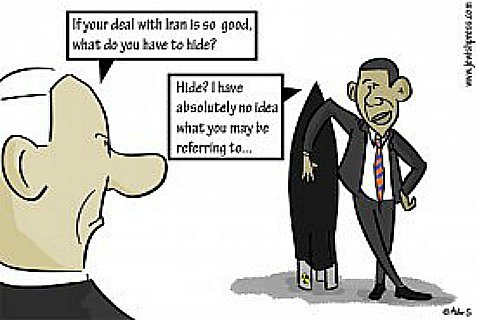
Obama nukes


Russian Bully Putin Threatens Europe

June 16, 2015

Russia warns of ‘new military confrontation’ in Europe

BY Holly Ellyat Via CNBC June 16, 2015


Russia prepares for a European road trip. (photo credit: Kirill Kudryavtsev | AFP | Getty Images)

(While the Russian economy continues to falter, Putin competes in the only way he’s capable…nuclear build up. I hope Europe is listening. The threat is real. Put a cap on the socialist spending and invest in a strong military now before it’s too late. – LS)

Relations between Russia and the West took another downturn this week when Russia warned that any stationing of military equipment along the border with eastern Europe could have “dangerous consequences.”

The warning came as Russian President Vladimir Putin announced on Tuesday that Russia would add more than 40 new intercontinental ballistic missiles to its nuclear arsenal this year, Reuters reported.

The Russian Foreign Ministry issued the warning on Monday after theNew York Times and other media organizations reported that the U.S. had offered to store military equipment for up to 5,000 troops – including battle tanks and heavy weapons — in allied eastern European countries.

“The emergence of such information confirms that the U.S., in cooperation with its allies, apparently has serious sights on ultimately undermining key provisions in the ‘NATO Russia Founding Act’ of 1997, in which the alliance pledged not to deploy substantial combat forces on the territory of the countries mentioned in the permanent basis,” the ministry said in a statement on its website.

“We hope, however, that reason will prevail and that the situation in Europe will be able to keep from sliding to a new military confrontation that could have dangerous consequences.”

The statement preceded a comments from Putin, who was attending a military and arms fair on Tuesday. Addressing the fair’s attendees, he announced the addition of the ballistic missiles which, he said, were able to “overcome even the most technically advanced anti-missile defence systems,” Reuters reported.

An U.S. Pentagon official told the NYT that no decision had yet been made and that the North Atlantic Treaty Organization (NATO), to which many European countries belong, would have to ratify such a move.

“The U.S. military continues to review the best location to store these materials in consultation with our allies,” said a Pentagon spokesman said, cited by the NYT. “At this time, we have made no decision about if or when to move to this equipment.”

Propaganda and Phobia

Eastern European and Baltic states sharing a border with Russia—which include Finland, Estonia, Latvia and Ukraine—have become increasingly nervous about recent, seemingly provocative military exercises by Russia. This follows Moscow’s annexation of Ukraine’s Crimea region last year, role in the pro-Russian uprising in Ukraine and subsequent sanctioning by the West.

Nonetheless, the Russian Foreign Ministry said the proposed move by the U.S. to station military equipment along the border was part of a propaganda plot to turn Europe against Moscow.

“Washington says the planned measures are needed to ‘increase the confidence’ of European allies in the face of the ‘Russian threat,'” the ministry said.

“In fact, capitals in both Washington and in Europe are aware that the ‘Russian threat’ is nothing more than a myth.”

The countries where military equipment could be stored include Bulgaria, Latvia, Lithuania, Poland, Romania, Estonia and possible Hungary. The plans could be decided upon when defence ministers from the 28 NATO member countries meet later in June.

A Russian defence official was also quoted on Monday as saying that any U.S. plan to station tanks and heavy weapons in NATO states on Russia’s border would be an “aggressive step,” news agency Interfax reported.

“If heavy U.S. military equipment, including tanks, artillery batteries and other equipment really does turn up in countries in eastern Europe and the Baltics, that will be the most aggressive step by the Pentagon and NATO since the Cold War,” Russian defence ministry official General Yuri Yakubov said.

He was also quoted as saying Moscow would retaliate by building up its own forces “on the Western strategic front.”

All about Ukraine

With the war of words between the U.S. and Russia threatening to descend into something nastier, Ian Bremmer, president of risk consultancy Eurasia Group, said the geo-political tension was very much focused on Ukraine.

“We have seen a ceasefire in Ukraine that has not held, we have seen an escalation in Russian war material in east Ukraine, we’ve seen casualties in the last few weeks and expanded Russian military exercises on the border as well as more Russian troops,” he told CNBC Europe’s “Squawk Box.”

“From the western perspective it does seem laughable that Russia would talks about the greatest escalation by the Americans potentially putting tanks in the Baltics, which still hasn’t been approved by NATO as a whole, when Russia is putting tanks in countries that don’t want those tanks there. This is very much about Ukraine.”

Moscow has also accused the U.S. of being responsible for the political uprising in Ukraine in 2014 that preceded the annexation of Crimea, in which the pro-Russian leader Viktor Yanukovych was ousted.

“It is convenient to use propaganda to cover up the responsibility of the U.S. for the anti-constitutional coup in Ukraine and in Kiev,” said the Russian Foreign Ministry in its statement.

“The U.S. has assiduously nurtured an anti-Russian among its European allies in order to take advantage of the current difficult moment for the further expansion of its military presence.”


The Postcolonial Rot Spreads Beyond Middle East Studies

June 15, 2015

The Postcolonial Rot Spreads Beyond Middle East Studies, Front Page Magazine, June 15, 2015

middle-east-scholarships

Middle East Studies programs, Kramer writes, “came under a take-no-prisoners assault, which rejected the idea of objective standards, disguised the vice of politicization as the virtue of commitment, and replaced proficiency with ideology.” The ideology, of course, comprised the old Marxist narrative of Western colonial and imperial crimes, a Third Worldism that idealizes the dark-skinned, innocent “other” victimized by Western depredations, and the juvenile romance of revolutionary violence.

*****************

In theory, Middle East Studies programs are a good idea. One of the biggest impediments to countering modern jihadism has been the lack of historical knowledge about the region and Islam. But even the attention and urgency that followed the terrorist attacks on 9/11 have not led to such knowledge. The result has been policies pursued both by Republicans and Democrats that are doomed to fail, as the current chaos in the region attests.

Rather than enlightening citizens and policy-makers, Middle Eastern Studies programs have darkened our understanding. As Martin Kramer documented in his important 2002 study Ivory Towers on Sand, most programs have become purveyors not of knowledge but of ideology. Under the influence of literary critic Edward Said’s historically challenged book Orientalism––“a work,” historian Robert Irwin has written, “of malignant charlatanry, in which it is hard to distinguish honest mistakes from willful misrepresentations”­­––Middle East Studies programs, Kramer writes, “came under a take-no-prisoners assault, which rejected the idea of objective standards, disguised the vice of politicization as the virtue of commitment, and replaced proficiency with ideology.” The ideology, of course, comprised the old Marxist narrative of Western colonial and imperial crimes, a Third Worldism that idealizes the dark-skinned, innocent “other” victimized by Western depredations, and the juvenile romance of revolutionary violence.

Yet Said’s baleful influence has not been limited to Middle East Studies programs, one of which has been created at my campus of the California State University, replete with the problems Kramer catalogues. It has insidiously corrupted much of the humanities and social sciences, operating under the innocuous rubric of “postcolonial” studies, which to the unwary suggests a historical rather than an ideological category. Through General Education courses that serve students across the university, and in departments like English that train primary and secondary school teachers, Saidian postcolonial ideology has been shaping the attitudes and presumed knowledge of Islam and the Middle East far beyond the reach of Middle East Studies programs.

Said’s dubious argument in Orientalism is that the work of Western scholars on the Middle East embodied “a Western style for dominating, restructuring, and having authority over the Orient,” thus creating the intellectual infrastructure for justifying colonialism and imperialism. As such, every European scholar perforce was “a racist, an imperialist, and totally ethnocentric.” For social science and humanities departments committed totally to the multiculturalist melodrama of white racism and oppression of the dark-skinned “other,” Said’s work seemingly provides scholarly bona fides to ideas that are in fact expressive of illiberal grievance politics.

English departments have been particularly vulnerable to Said’s work, for he overlaid his bad history with watered down Foucauldian ideas about the relationship of power to discourse. Thus English professors seduced by the poststructuralist theory ascendant in 1978 when Orientalism was published found in that book a seemingly sophisticated theoretical paradigm that shared both poststructuralism’s disdain for objectivity and truth, and its “hermeneutics of suspicion,” the notion that the apparent meaning of a discourse is a mask for the sinister machinations of power at the expense of the excluded “other.”

More important, postcolonialism is a politically activist theory, bound up as it is in the politics of the Middle East, especially the Arab-Israeli conflict. Now English professors could avoid the legitimate charge that poststructuralism, despite its patina of leftist ideology, was in fact an evasion of politics, a “symbolic politics,” as historian Russell Jacoby put it, “a replacement for, and a diversion from, the gritty politics of the community and the street.” On the contrary, the purveyors of postcolonialism were on the barricades, struggling to liberate Palestinians and other Muslims oppressed by a neo-imperialist America and its puppet Israel. Rather than pampered elitists guaranteed jobs for life, now the professors could fancy themselves freedom fighters and champions of the ex-colonial brown peoples still exploited and oppressed by the capitalist, racist West.

Finally, the dogma of multicultural “diversity” now firmly enshrined in American universities likewise has found Saidian postcolonialism a useful tool for interpreting and teaching literature, one that exposes the Western literary canon’s hidden racism and oppression. Moreover, in a university like Fresno State, half of whose students are minorities, a postcolonial perspective can establish a rapport with minority students who are encouraged to interpret their own experiences through the same lens of unjust exclusion and hurtful distortions of their culture and identity. At the same time white students are schooled in their privilege and guilt, minorities can be comforted by a narrative that privileges them as victims of historical oppression, one masked by the unearned prestige of the classics written by “dead white males.” Now minority students learn that Shakespeare’s Caliban is the true hero the Tempest with whom they should identify, the displaced victim of rapacious colonialists and slavers like Prospero who unjustly define the indigenous peoples as savages and cannibals in order to justify the brutal appropriation of their lands and labor.

Over the thirty years I have taught in the California State University, I have seen this transformation of the English department. Reading lists dominated by contemporary ethnic writers are increasingly displacing the classics of English literature, and even when traditional works are on the list, the books are often taught from the postcolonial perspective. New hires more and more comprise those Ph.D.’s whose specialties lie in ethnic or “world” literature, replacing the Shakespeare scholars and others trained to teach the traditional English and American literary canon. The traditional content of a liberal education––“the best which has been thought and said in the world,” as Matthew Arnold wrote––is disappearing, replaced by multicultural melodramas of Western crime and guilt.

More important for the culture at large, many of these students will go on to earn teaching credentials and staff public schools. They will carry the postcolonial ideology into their own classrooms, influencing yet another generation and reinforcing a received wisdom that will shape their students’ understanding of the important threats to our national security and interests emanating from the Middle East, especially jihadism. And it will encourage ordinary citizens to assent to the demonization of our most valuable regional ally, Israel, currently battling the Boycott, Divest, and Sanction movement that can more easily gain traction among those who from grade school to university have been exposed to the postcolonial ideology.

The damage done to our foreign policy by Middle East Studies is obvious. The influence of the godfather of such programs, Edward Said, on the social sciences and humanities departments like English is more insidious and subtle. But it is no less dangerous.

Cartoon of the day

June 15, 2015

H/t joopklepzeiker

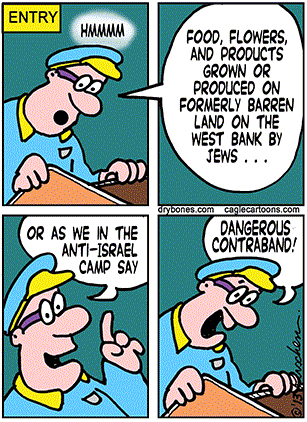
Contraband