Archive for May 31, 2015

Iraq Lost 2,300 Humvees in Mosul, Prime Minister Says

May 31, 2015

Iraq Lost 2,300 Humvees in Mosul, Prime Minister Says, Defense News, May 31, 2015

HumveesMembers of Iraqi security forces gather around a military vehicle on March 28 outside the western entrance of Tikrit during a military operation to retake the northern Iraqi city from Islamic State group jihadists. (Photo: Ahmad Al-Rubaye/AFP)

The militants gained ample arms, ammunition and other equipment when multiple Iraqi divisions fell apart in the country’s north, abandoning gear and shedding uniforms in their haste to flee.

IS has used captured Humvees, which were provided to Iraq by the United States, in subsequent fighting, rigging some with explosives for suicide bombings.

*********************

BAGHDAD — Iraqi security forces lost 2,300 Humvee armored vehicles when the Islamic State jihadist group overran the northern city of Mosul, Prime Minister Haider al-Abadi said on Sunday.

“In the collapse of Mosul, we lost a lot of weapons,” Abadi said in an interview with Iraqiya state TV. “We lost 2,300 Humvees in Mosul alone.”

While the exact price of the vehicles varies depending on how they are armored and equipped, it is clearly a hugely expensive loss that has boosted IS’ capabilities.

Last year, the State Department approved a possible sale to Iraq of 1,000 Humvees with increased armor, machine guns, grenade launchers, other gear and support that was estimated to cost $579 million.

Clashes began in Mosul, Iraq’s second city, late on June 9, 2014, and Iraqi forces lost it the following day to IS, which spearheaded an offensive that overran much of the country’s Sunni Arab heartland.

The militants gained ample arms, ammunition and other equipment when multiple Iraqi divisions fell apart in the country’s north, abandoning gear and shedding uniforms in their haste to flee.

IS has used captured Humvees, which were provided to Iraq by the United States, in subsequent fighting, rigging some with explosives for suicide bombings.

Iraqi security forces backed by Shiite militias have regained significant ground from IS in Diyala and Salaheddin provinces north of Baghdad.

But that momentum was slashed in mid-May when IS overran Ramadi, the capital of Anbar province, west of Baghdad, where Iraqi forces had held out against militants for more than a year.

Cartoon of the day

May 31, 2015

H/t Vermont Loon Watch

border1


European Welfare Systems Milked by Jihadis

May 31, 2015

European Welfare Systems Milked by Jihadis, The Clarion Project, Soeren Kern, May 31, 2015

Khalid-AbdurahmanIPKhalid Abdurahman (center)

The disclosures show that Islamists continue to exploit European social welfare systems to finance their activities both at home and abroad — costing European taxpayers potentially millions of euros each year.

Anjem Choudary, a British-born radical Islamic cleric who lives off the British welfare state, has repeatedly urged his followers to quit their jobs and claim unemployment benefits so they have more time to plot holy war against non-Muslims.

Choudary believes that Muslims are entitled to welfare payments because they are a form of jizya, a tax imposed on non-Muslims in countries run by Muslims, as a reminder that non-Muslims are permanently inferior and subservient to Muslims.

******************

More than 30 Danish jihadists have collected unemployment benefits totaling 379,000 Danish krone (€51,000; $55,000) while fighting with the Islamic State in Syria, according to leaked intelligence documents.

The fraud, which was reported by Television 2 Danmark on May 18, comes less than six months after the Danish newspaperBT revealed that Denmark had paid unemployment benefits to 28 other jihadists while they were waging war in Syria.

The disclosures show that Islamists continue to exploit European social welfare systems to finance their activities both at home and abroad — costing European taxpayers potentially millions of euros each year.

According to Television 2 Danmark, the welfare fraud was discovered after the Danish intelligence agency PET began sharing data about known Danish jihadists with the Ministry of Employment to determine if any of these individuals were receiving unemployment benefits.

As a percentage of the overall population, Denmark is the second-largest European source of foreign fighters in Syria after Belgium. At least 115 Danes have become foreign fighters in Syria and Iraq since Syria’s civil war broke out in March 2011, according to a recent report by the Center for Terrorism Analysis, an agency of PET. The report states:

“CTA assesses that approximately half of those who have gone abroad are now back in Denmark, while a quarter of them remain in the conflict zone. CTA assesses that two thirds of these individuals have been in the conflict zone for more than a year. The remaining travelers are located elsewhere abroad. CTA assesses that at least 19 travelers from Denmark have been killed in Syria and Iraq.”

The CTA admits that, “the number may be higher” than 115. The comment is a tacit recognition that it does not know exactly how many Danes have become jihadists abroad.

In April, it emerged that the parents of Omar Abdel Hamid El-Hussein — a Danish-Jordanian jihadist responsible for the terror attacks in Copenhagen in February 2015 in which two people died — have been welfare recipients in Denmark for more than 20 years. Omar’s parents received a total of 3.8 million krone between 1994 and 2014, amounting to roughly 500,000 euros or $560,000.

Social welfare fraud of the kind perpetrated in Denmark is being repeated throughout Europe.

In Austria, police arrested 13 jihadists in November 2014 who were allegedly collecting welfare payments to finance their trips to Syria. Among those detained was Mirsad Omerovic, 32, an extremist Islamic preacher who police say raised several hundred thousand euros for the war in Syria. A father of six who lives exclusively off the Austrian welfare state, Omerovic has benefited from additional payments for paternity leave (Väterkarenz).

Austrian police also arrested, in August 2014, nine other jihadists who were attempting to join the jihad in Syria. Their trip was being financed by Austrian taxpayers by way of social welfare payments.

In Belgium, 29 jihadists from the Flemish cities of Antwerp and Vilvoorde were prevented from receiving social welfare benefits from the state. The move came after an investigation found that the individuals had been accessing their Belgian bank accounts by withdrawing money from banks in Turkey, just across the Syrian border.

Per capita, Belgium is the largest European source of jihadist fighters going to the Middle East; up to 400 Belgians have become jihadists in Syria and Iraq.

In Britain, Terri Nicholson, an assistant commander at the Metropolitan Police’s counter-terrorism command unit, told the Telegraph newspaper in November 2014 that taxpayers’ money was being claimed fraudulently and used by jihadists in Iraq and Syria. “We are seeing a diverse fraud, including substantial fraud online, abuse of the benefits system, abuse of student loans, in order to fund terrorism,” she said.

Nicholson added that women were increasingly being used to smuggle welfare money out of Britain to fund terrorists abroad, because they supposedly arouse less suspicion.

In November 2014, for example, Amal El-Wahabi, a British mother of two, was jailed for 28 months for trying to arrange to smuggle €20,000 to her husband, a jihadist fighting in Syria. She persuaded her friend, Nawal Msaad, to carry the cash in her underwear in return for €1,000. Msaad was stopped at Heathrow Airport. The money she was carrying is thought to have come from social welfare payments.

Anjem Choudary, a British-born radical Islamic cleric who lives off the British welfare state, has repeatedly urged his followers to quit their jobs and claim unemployment benefits so they have more time to plot holy war against non-Muslims.

Choudary believes that Muslims are entitled to welfare payments because they are a form ofjizya, a tax imposed on non-Muslims in countries run by Muslims, as a reminder that non-Muslims are permanently inferior and subservient to Muslims.

In 2010, The Sun reported that Choudary takes home more than £25,000 ($39,000) a year in welfare benefits. Among other handouts, Choudary receives £15,600 a year in housing benefit to keep him in a £320,000 ($495,000) house in Leytonstone, East London. He also receives £1,820 council tax allowance, £5,200 income support and £3,120 child benefits. Because his welfare payments are not taxed, his income is equivalent to a £32,500 ($50,000) salary. By comparison, the average annual earnings of full-time workers in Britain was £26,936 ($41,000) in 2014.

Although analysts are divided over the question of how many followers Choudary actually has, no one disputes the fact that he is far from alone in exploiting the British welfare system.

British taxpayers have footed the bill for the Moroccan-born Najat Mostafa, the second wife of the Egyptian-born Islamic hate preacher Abu Hamza, who was extradited to the United States in October 2012. She has lived in a £1 million, five-bedroom house in one of London’s wealthiest neighborhoods for more than 15 years, and has raised the couple’s eight children there.

Abu Hamza and his family are believed to have cost British taxpayers more than £338,000 in benefits. He has also received £680,000 in legal assistance for his failed U.S. extradition battle. The cost of keeping him in a British prison since 2004 is estimated at £500,000.

Fellow extremist Islamic preacher Abu Qatada, a Palestinian, has cost British taxpayers an estimated £500,000. He has also won £390,000 in legal aid to avoid deportation to Jordan.

The Islamic preacher Omar Bakri Mohammed, a Syrian, obtained £300,000 benefits before being exiled to Lebanon. The money was provided to raise his six children, including Yasmin Fostok, a single mother who makes a living as a pole-dancer in London nightclubs.

More instances of British welfare abuse can be found here.

In France, the government in March 2015 cut welfare benefits for 290 persons identified as jihadists. French Interior Minister Bernard Cazeneuve downplayed the problem. “We shouldn’t make a controversy of this subject or allow people to think no action has been taken. We’re taking this seriously and will continue to do so,” he said.

In Germany, an analysis of the estimated 450 German jihadists fighting in Syria found that more than 20% of them were receiving welfare benefits from the German state. In addition, the 150 jihadists who have returned to Germany are eligible to begin receiving benefits again.

The Interior Minister of Bavaria, Joachim Herrmann, said:

“It should never come to this. German taxpayers’ money should never directly or indirectly finance Islamist terrorism. The benefits of such terrorist parasites should be eliminated immediately. Not working and spreading terror at the expense of the German state is not only extremely dangerous, it is also the worst provocation and disgrace!”

Separately, a study by the Cologne Institute for Economic Research found that Muslim immigrants were more likely to be unemployed and living off the social welfare state than any other immigrant group in Germany.

According to the study, 55% of the immigrants from Lebanon are unemployed, as are 46% from Iraq, 37.5% from Afghanistan, 37.1% from Iran, 27.1% from Morocco and 21.5% from Turkey. In real terms, immigrants from Turkey (140,000) constitute the largest number of unemployed. The report said the root cause for the high unemployment rates was the lack of educational attainment and job training qualifications.

In the Netherlands, a Dutch jihadist named Khalid Abdurahman appeared in a YouTube video with five severed heads. Originally from Iraq, Abdurahman was living on social welfare benefits in the Netherlands for more than a decade before he joined the Islamic State in Syria. Dutch social services declared him to be unfit for work and taxpayers paid for the medication to treat him for claustrophobia and schizophrenia.

Meanwhile, city councils across the Netherlands are attempting to help rather than to prosecute returning jihadists. In the city of Delft, for example, local politicians are using taxpayer money to “reintegrate” jihadists and to help them “rebuild their lives.” Dutch public television explained it this way: “The idea is that the local authorities do not want to alienate the returnees by means of a repressive approach which might lead to their further radicalization.”

Separately, several Dutch-Moroccan organizations sent a letter to the Labor Party (Partij van de Arbeid, PvdA) in which they threatened to urge Dutch-Moroccans to stop supporting the party if it agreed to a proposal by its Minister of Social Affairs, Lodewijk Asscher, to cut social welfare payments to Moroccans who do not live in the Netherlands. Asscher accused the organizations of using an “improper electoral threat.”

In Spain, police arrested five Muslims in the Basque Country who allegedly pocketed the social welfare payments of Redouan Bensbih, a Moroccan immigrant killed on the battlefield in Syria in March. Despite his no longer living in Spain, Bensbih continued receiving monthly payments of €836 euros ($920), which the suspects are accused of having wired to Morocco.

Meanwhile, a network of more than 250 butcher shops, grocery stores and telephone call centers was accused of financing the Islamic State and al-Qaeda. The network used the so-called hawala system — defined by Interpol as money transfer without money movement — where money is transferred through an informal and virtually untraceable system.

According to the El País newspaper, “the secret hawala network in Spain is comprised of about 300 hawaladars — the majority of them Pakistanis — who run clandestine offices in Barcelona, Tarragona, Lleida, Bilbao, Santander, Valencia, Madrid, Logroño, León, Jaén and Almería, and other cities with large Pakistani communities.” They manage the savings of over 150,000 Muslims, many of whom are believed to be receiving social welfare payments from the Spanish state, without any legal oversight.

The network allegedly paid the salaries of Spanish jihadists in Syria: They received about $800 if they were single and $1,200 if they were married.

In February 2015, a Pakistani couple residing in the Basque capital of Vitoria was accused of falsifying identity documents to fraudulently obtain social welfare payments for 10 fictitious individuals. The man was receiving six different welfare payments and his wife was receiving four. Each welfare payment was between €6,000 ($6,600) and €10,000 ($11,000) per month. Police say that over a period of three years, the couple defrauded the Basque government of more than €395,000 ($453,000).

The Basque Country is known for its liberal social welfare policies; all residents, including illegal immigrants, are eligible to receive welfare payments. In 2012, a massive wave of immigrants from Morocco and Algeria arrived in the Basque Country in order to — in the words of a local politician — “live off of welfare benefits without working.”

According to local observers, more than 65% of the immigrants from Morocco and Algeria are receiving benefits. Auditors found that in 2012 alone the Basque Country made €86 million ($95 million) in dubious welfare payments.

In Sweden, the state employment agency, Arbetsformedlingen, terminated a pilot program aimed at helping immigrants find jobs. Information had emerged that Muslim employees at the agency were helping jobseekers find jobs as jihadists for the Islamic State. Operatives from the Islamic State had also allegedly bribed — and in some cases issued death threats against — agency employees in efforts to recruit fighters from Sweden.

Also in Sweden, the government said it wanted to impose a special tax to finance a jobs program for returning jihadists. The project is based on a scheme in the Swedish city of Örebro, where the city is using taxpayer money to help returning jihadists find employment. Town councilor Rasmus Persson said:

“We have discussed how we should work for these guys who have come back, to ensure that they do not return to the battlefield. They should be helped to process the traumatic experiences they have been through.”

The project was challenged by a Swedish soldier deployed in Afghanistan, who said that he was likely to get less help when he came back to Sweden than returning jihadists were. Soldier Fredrik Brandberg wrote:

“It would be wonderful if I was met with a comparable program after my homecoming, after which I could feel safe in having a regular job, with monthly income and a social stable situation in the society where I wouldn’t need to wonder whether I’m wanted or not.”

A spokesperson for the Swedish Armed Forces said that what happens to soldiers upon their return from war was not an issue that fell under its mandate.

Russia said abandoning Assad as Syria regime collapses further

May 31, 2015

Russia said abandoning Assad as Syria regime collapses further, YNet News, Roi Kais, May 31, 2015

The report also quoted Syrian opposition sources as saying that Hezbollah and Iranian military experts have left Assad’s war room in Damascus, along with Russian experts.

*********************

Asharq Al-Awsat says Moscow has pulled military experts from Assad’s war room in Damascus, evacuated non-essential personnel and stopped declaring there is no alternative to Assad.

Russia is pulling away from its relationship with embattled Syrian President Bashar Assad and withdrawing key personnel from Damascus, the London-based Arabic newspaper Asharq Al-Awsat reported Sunday, citing senior Gulf and Western officials.

“The Kremlin has begun to turn away from the regime,” the newspaper said.

The report also quoted Syrian opposition sources as saying that Hezbollah and Iranian military experts have left Assad’s war room in Damascus, along with Russian experts.

There have been increasing signs in recent days that the Assad regime is disintegrating, four years into the civil war that has engulfed Syria. Last week, the Syrian president lost control of another province, which comes on the heels of previous reports that Islamic State already controls more than 50% of the country.

According to the same Gulf and Western sources, the change in the Russian position takes place against the backdrop of negotiations between the Gulf states and Moscow, a Russian response to economic sanctions imposed on it due to the war in Ukraine.

Syrian opposition sources told Asharq that Russia has evacuated 100 of its senior officials and their families from Syria via the airport in Latakia. They said that those leaving include experts who worked in the war room in Damascus, along with the Iranian experts and Hezbollah officials. According to the report, they have not been replaced.

Putin and AssadPutin and Assad. Allies no more. (Photos: EPA and AFP)

On Thursday, Russia confirmed that an Ilyushin II-76 aircraft took 66 Syrian nationals from Latakia to Moscow airport, as well as a number of citizens from other countries, and at the same time delivered humanitarian aid to the war-torn country. Russia has remained silent on removal of the military experts.

According to Asharq al-Awsat, Russia has in the last three months also cut down the number of employees at its embassy in Damascus, leaving only essential staff. Opposition forces have also claimed that Russia has not been abiding by the maintenance contracts with Syria for the Sukhoi aircraft, leading to a rare visit to Tehran last month by Syrian Defense Minister Fahd Jassem al-Freij, who was forced to ask Iran to intervene with Russia on this matter.

The newspaper, which is notably supportive of the Saudi regime, also quoted an apparently surprising response by the head of the Russian delegation at a meeting last month, when asked by the Western Europe security chiefs for Moscow’s perspective on Syria’s future.

“What matters to Russia is maintaining its strategic interests and ensuring the future of the minorities, the unity of Syria and the struggle against extremists,” the delegation chief said. Western diplomatic sources at the meeting said the unprecedented statement brings to an ends years of the Russian official line that there is no alternative to Assad.

602610501001095640360noThe rebels draw closer to Latakia (Photo: Reuters)

At the same time, there have been growing Arab media reports of a more serious dialogue than ever before between Russia and the United States on an agreement regarding the crisis in Syria. The Lebanese newspaper Al-Nahar quoted diplomatic sources in Geneva on Sunday as saying that the two sides are seeking an arrangement that will take into account the interests of regional and international parties, in particular Turkey, Iran and the Gulf states.

On Thursday, senior diplomatic sources told Al-Hayat that there has been a noticeable change in the Russian position toward Syria that Moscow is for the first time willing to discuss with the Americans the exact details of a transition period for the country, and even raise the names of individual military and political officials to oversee it.

Another sign of Assad’s difficulties comes from the Turkish news agency Anatolia, which cited opposition sources as saying that after four years of war, the regime controls less than 8% percent of the country’s oil and gas fields, while Islamic State controls more than 80% percent.


Western Officials Alarmed as Islamic State Expands Territory in Libya

May 31, 2015

Western Officials Alarmed as Islamic State Expands Territory in Libya, New York Times, 

The continued expansion inside Libya of the group, also known as ISIS or ISIL, has alarmed Western officials because of its proximity to Europe across the Mediterranean.

*********************

TRIPOLI, Libya — The branch of the Islamic State that controls the city of Surt has expanded its territory and pushed back the militia from the neighboring city of Misurata, militia leaders acknowledged Sunday.

In the group’s latest attack, a suicide bomber killed at least four fighters on Sunday at a checkpoint west of Misurata on the coastal road to Tripoli, according to local officials and Libyan news reports.

The continued expansion inside Libya of the group, also known asISIS or ISIL, has alarmed Western officials because of its proximity to Europe across the Mediterranean.

Four years after the removal of Col. Muammar el-Qaddafi, the near collapse of the Libyan government has left no central Libyan authority to check the group’s advance or even partner with Western military efforts against it. Two armed factions, each with its own paper government, are fighting for control, and each has focused more on internal quarrels than on defeating the Islamic State.

The group’s expanding turf in Libya also gives it an alternative base of operations even as it appears to be gaining ground — in Palmyra in Syria and in Ramadi in Iraq. The gains come despite an American-led bombing campaign aimed at rolling back the group’s original territory across the border between those countries.

Suliman Ali Mousa, an officer with the brigade from Misurata, confirmed in a telephone interview on Sunday that over the past two days its forces had retreated in the face of Islamic State advances to the east, south and west of Surt. Islamic State fighters have captured the Gardabya air base, about 20 kilometers south of Surt; it had been all but destroyed by NATO airstrikes during the 2011 campaign against Colonel Qaddafi, but Libyans describe it as a strategic foothold.

Toward the east, Mr. Mousa’s brigade retreated from its base in a water treatment facility, leaving the Islamic State in control as far as the town of Nofilya, another extremist stronghold. And toward the West the Misuratan forces had also pulled back about 20 kilometers toward their home city.

“We left our position and relocated,” Mr. Mousa said. “It was a necessary retreat. Our fighting position did not allow us to stay where we were.” He added that another group of Misurata fighters had abandoned a power station west of Surt and so his group had taken their place.

He said he was unsure why those fighters had pulled out, but “there was a lot of talk about money and unpaid salaries.”

Six powers agree on UN sanctions ‘snapback’ in push for Iran deal, sources say

May 31, 2015

Six powers agree on UN sanctions ‘snapback’ in push for Iran deal, sources say, Jerusalem Post, May 31, 2015

(Obviously, the tentative “deal” raises more questions than it answers, including its “non-binding” nature and whether Russia, China and even Iran would have vetoes.– DM)

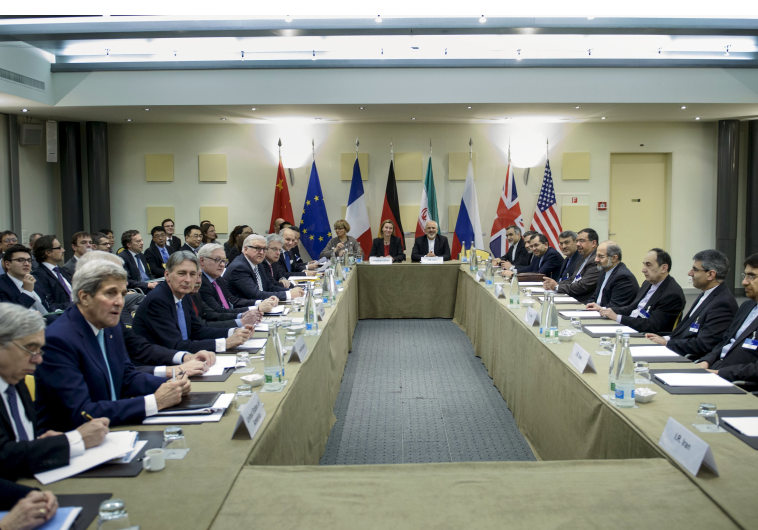
P5+1 meetingOfficials wait for a meeting with officials from P5+1, the European Union and Iran at the Beau Rivage Palace Hotel in Lausanne March 31, 2015.. (photo credit:REUTERS)

As part of the new agreement on sanctions snapback, suspected breaches by Iran would be taken up by a dispute-resolution panel, likely including the six powers and Iran, which would assess the allegations and come up with a non-binding opinion, the officials said.

As part of the new agreement on sanctions snapback, suspected breaches by Iran would be taken up by a dispute-resolution panel, likely including the six powers and Iran, which would assess the allegations and come up with a non-binding opinion, the officials said.

It was unclear exactly how the snapback mechanism would function, and the officials did not discuss the precise details. It was also unclear how the proposal would protect the United States and other permanent Council members from a possible Chinese or Russian veto on sanctions restoration.

**********************

New York, Paris, Ankara – Six world powers have agreed on a way to restore UN sanctions on Iran if the country breaks the terms of a future nuclear deal, clearing a major obstacle to an accord ahead of a June 30 deadline, Western officials told Reuters.

The new understanding on a UN sanctions “snapback” among the six powers – the United States, Britain, France, Germany, Russia and China – brings them closer to a possible deal with Iran, though other hurdles remain, including ensuring United Nations access to Iranian military sites.

The six powers and Iran struck an interim agreement on April 2 ahead of a possible final deal that would aim to block an Iranian path to a nuclear bomb in exchange for lifting sanctions. But the timing of sanctions relief, access and verification of compliance and a mechanism for restoring sanctions if Iran broke its commitments were among the most difficult topics left for further negotiations.

US and European negotiators want any easing of UN sanctions to be automatically reversible if Tehran violates a deal. Russia and China traditionally reject such automatic measures as undermining their veto power as permanent members of the UN Security Council.

As part of the new agreement on sanctions snapback, suspected breaches by Iran would be taken up by a dispute-resolution panel, likely including the six powers and Iran, which would assess the allegations and come up with a non-binding opinion, the officials said.

The International Atomic Energy Agency (IAEA) would also continue regularly reporting on Iran’s nuclear program, which would provide the six powers and the Security Council with information on Tehran’s activities to enable them to assess compliance.

If Iran was found to be in non-compliance with the terms of the deal, then UN sanctions would be restored.

The officials did not say precisely how sanctions would be restored but Western powers have been adamant that it should take place without a Security Council vote, based on provisions to be included in a new UN Security Council resolution to be adopted after a deal is struck.

“We pretty much have a solid agreement between the six on the snapback mechanism, Russians and Chinese included,” a Western official said. “But now the Iranians need to agree.”

Another senior Western official echoed his remarks, describing the agreement as “tentative” because it would depend on Iranian acceptance.

A senior Iranian diplomat said Iran was now reviewing several options for the possible “snapback” of Security Council sanctions against Tehran.

It was unclear exactly how the snapback mechanism would function, and the officials did not discuss the precise details. It was also unclear how the proposal would protect the United States and other permanent Council members from a possible Chinese or Russian veto on sanctions restoration.

US Ambassador to the United Nations Samantha Power has made it clear that Washington does not want Russia’s and China’s recent slew of vetoes on resolutions related to Syria to be repeated with an Iran nuclear agreement.

France’s Ambassador to the United States Gerard Araud said in Washington last week that, under a French idea, sanctions would be reinstated automatically in the event of non-compliance, avoiding the threat of a veto.

Under that idea, which Araud said had not to date been approved by the six powers, the onus would be on Russia or China to propose a Security Council vote not to re-impose sanctions.

Russian and Chinese officials did not respond immediately to requests for confirmation that they signed off on the snapback mechanism.

REVIEWING THE OPTIONS

US Secretary of State John Kerry met with Iranian Foreign Minister Mohammad Javad Zarif in Geneva on Saturday. They discussed progress and obstacles to an agreement in the Iran nuclear talks a month before the deadline for a deal aimed at reducing the risk of another war in the Middle East.

Restoring US and EU sanctions is less difficult than UN sanctions because there is no need for UN Security Council involvement.

For their part, Moscow, Beijing and Tehran have wanted assurances that Washington cannot unilaterally force a sanctions snapback – a risk they see rising if a Republican wins the US presidency in 2016.

A senior Iranian diplomat confirmed that discussions of specific snapback options were underway. He told Reuters Tehran was preparing its own “snapback” in the event the Western powers fail to live up to their commitments under the agreement.

“At least three or four different suggestions have been put on the table, which are being reviewed,” he said. “Iran also can immediately resume its activities if the other parties involved do not fulfill their obligations under the deal.”

He added that it was “a very sensitive issue.”

If Iran accepts the proposed snapback mechanism, there are other hurdles that must be overcome, including IAEA access to Iranian military sites and nuclear scientists and the pace of sanctions relief.

Iran says its nuclear program is entirely peaceful and rejects allegations from Western countries and their allies that it wants the capability to produce atomic weapons. It says all sanctions are illegal and works hard to circumvent them.